Front matter
Reading edition
The images may be viewed enlarged by clicking directly on the image. Aside from few typographical errors, no other corrections of grammar or place-names have been made in creating this etext from the printed book. (note of etext transcriber)
CATHEDRAL CITIES OF ITALY
UNIFORM WITH THIS VOLUME
CATHEDRAL CITIES OF ENGLAND. By George Gilbert. With 60 reproductions from water-colours by W. W. Collins, R.I. Demy 8vo, 16s. net.
CATHEDRAL CITIES OF FRANCE. By Herbert and Hester Marshall. With 60 reproductions from water-colours by Herbert Marshall, R.W.S. Demy 8vo, 16s. net. Also large paper edition £2 2s. net.
CATHEDRAL CITIES OF SPAIN. Written and illustrated with 60 reproductions from water-colours by W. W. Collins, R.I. Demy 8vo, 16s. net. Also large paper edition (limited) £2 2s. net.
BOOKS ILLUSTRATED BY JOSEPH PENNELL
ITALIAN HOURS. By Henry James. With 32 plates in colour and numerous illustrations in black-and-white by Joseph Pennell. Large crown 4to. Price 20s. net.
A LITTLE TOUR IN FRANCE. By Henry James. With 94 illustrations by Joseph Pennell. Pott 4to. Price 10s. net.
ENGLISH HOURS. By Henry James. With 94 illustrations by Joseph Pennell. Pott 4to. Price 10s. net.
ITALIAN JOURNEYS. By W. D. Howells. With 103 illustrations by Joseph Pennell. Pott 4to. Price 10s. net.
CASTILIAN DAYS. By the Hon. John Hay. With 111 illustrations by Joseph Pennell. Pott 4to. Price 10s. net.
London: William Heinemann 21 Bedford Street, W.C.
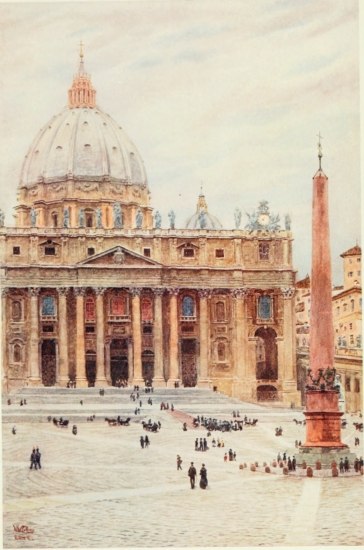
S. PETER'S, ROME
CATHEDRAL CITIES OF ITALY
WRITTEN AND ILLUSTRATED BY W. W. C O L L I N S, R. I.
LONDON: WILLIAM HEINEMANN NEW YORK: DODD, MEAD AND COMPANY 1911
All rights reserved Copyright, London, 1911, by William Heinemann and Washington, U.S.A., by Dodd, Mead & Co.
PREFACE
THE cathedral cities of Italy, the heir of all the ages in art, are as full of enchantment to the lover of architecture as to the poet, the painter, and the historian. Side by side with the great churches that give them their crowning splendour are the public buildings, universities, palaces, and fountains that tell the story of the glorious past, and form the best monument of their great creators. These architectural jewels are often set amidst scenes of great natural beauty, which relieve and enhance the perfection of their art. Every traveller in Italy will recall the emotion with which he first saw Rome rising from the green stretches of the Campagna, recognised the domes and campaniles of Florence, or lifted up his eyes to one of those towered "cities set upon an hill, which cannot be hid"—Siena, Perugia, or Orvieto. Among the many appeals which Italy makes to æsthetic appreciation is that of infinite variety. In no country are the different styles and periods so wonderfully exemplified. Here we may range from Rome and Verona, with their relics of the antique world—amphitheatres, temples, and thermæ—to the Byzantine glories of Ravenna and Venice, the Romanesque grandeur that finds typical expression in the cathedral of Pisa, and thence to the manifestations of that Gothic art which, though it was alien to the climate and character of Italy and so struck no deep roots into the soil, intervened between Romanesque architecture and that of the Renaissance as a brilliant episode, and finds stupendous expression in the thousand pinnacles of Milan.
It is with Christian Italy that we have to deal, the Italy of cathedrals, and it is at Ravenna and at Venice that we may trace the decline of Roman architectural methods and the gradual merging of these into Byzantine forms. Though the great Basilica Ursiana of the fourth century has disappeared, Ravenna has preserved many famous monuments of the fifth century: the votive church of Galla Placidia, sister of the Emperor Honorius, the Baptistery, the aulic church of the Gothic conqueror Theodoric, Sant' Apollinare Nuovo, and the churches of San Vitale and Sant' Apollinare in Classe. Venice, rising to power and splendour when Ravenna fell on evil days, secured the heritage of her glory, and carried on the Byzantine tradition in the cathedral of Torcello, the church of San Zaccaria, and above all in the incomparable San Marco. At Pisa the Romanesque evolution culminated in a unique group of buildings, famous throughout the world, while at Milan and in the surrounding district the local type of Romanesque became sufficiently individual to figure as an independent style under the title of Lombard architecture. Of this subdivision of Romanesque the prototype seems to have been the great church of Sant' Ambrogio at Milan, while San Michele at Pavia is another early and important example. Italy's essays in Gothic are scattered throughout the length and breadth of the peninsula, from Como to Naples. The Broletto at Como and the monastic buildings at Vercelli are said to have inaugurated them. Good examples are the cathedral at Como, the church of San Francesco at Assisi, the cathedral of Orvieto, San Petronio and San Francesco at Bologna, and San Lorenzo at Genoa.
But it is to the Renaissance architecture of Italy that many of us will turn as the most intimate expression of the Italian spirit, to the works of Brunellesco, Michelozzo, and Cronaca at Florence, of Palladio at Venice and Vicenza, of Bramante, and, above all, of Michelangelo at Rome, notably in his great life-work, the church of St. Peter. The exuberant later style that resulted from a too ardent application of the principles of Michelangelo and is known as Baroque, though generally reprobated at present, must not be too sweepingly condemned. It had an exponent of great talent in Bernini, and it will hardly be denied that it gave grandiose expression to the tendency of a splendour-loving age, and that Rome owes to its exponents much of the scenic effectiveness of her streets and the impressive magnificence of her interiors.
CONTENTS
PAGE
COMO1
MILAN7
PAVIA17
BERGAMO23
BRESCIA29
VERONA35
PADUA49
VENICE61
RIMINI91
FERRARA99
RAVENNA107
BOLOGNA123
PARMA137
GENOA145
PISA157
LUCCA169
FLORENCE179
PERUGIA199
ASSISI211
SIENA217
ORVIETO229
ROME239
NAPLES265
SALERNO279
PALERMO 285
INDEX: A, B, C, D, E, F, G, H, J, K, L, M, N, O, P, Q, R, S, T, U, V, W, Z
ILLUSTRATIONS
To face page
Como. The Brotello and Cathedral2
Milan. The Cathedral10
Pavia. The Cathedral18
Bergamo24
Brescia32
Verona. The Porch of the Cathedral38
Verona. Interior of S. Zeno42
Verona. The Market Place46
Padua. The Cathedral50
Padua. S. Antonio56
Venice. St. Mark's62
Venice. Interior, St. Mark's70
Venice. The Palazzi Foscari e Giustiniani80
Venice. The Lion of S. Mark's84
Torcello. Sta Fosca and Cathedral90
Rimini. Isotta's Tomb in the Cathedral96
Ferrara. The Cathedral102
Ravenna110
Ravenna. S. Apollinare Nuovo116
Bologna. Interior of S. Petronio130
Bologna. S. Domenico134
Parma. The Cathedral and Baptistery138
Genoa. An Old Street146
Genoa. Façade of the Cathedral152
Pisa. The Baptistery162
Pisa. The Campanile and Duomo164
Lucca. The Porch of the Cathedral170
Lucca. From the City Walls174
Lucca. S. Michele176
Florence. Or S. Michele and the Palazzo dell'Arte di Lana 180
Florence. The Campanile186
Florence. Ponte Vecchio190
Florence. The Duomo, from the Boboli Gardens198
Perugia. The Cathedral and Old Town200
Perugia. The Porta Susanna204
Perugia. The Piazza Garibaldi206
Assisi. The Cathedral214
Siena. The Cathedral218
Siena. Interior of Cathedral222
Siena. The Arco di S. Giuseppe226
Siena. Under the Walls228
Orvieto. La Porta Maggiore230
Orvieto. The Façade of the Cathedral232
Rome. On the Palatine240
Rome. S. Peter'sFrontispiece
Rome. The Arch of Titus250
Rome. S.S. Trinità de' Monti256
Rome. The Isle of S. Bartolomeo260
Naples. Interior of the Cathedral268
Naples. S. Domenico Maggiore272
Posillipo. The Bay of Naples from276
Salerno. A Pulpit in the Cathedral282
Palermo. The Cathedral286
Palermo. The Cloisters of S. Giovanni degli Eremiti296
Palermo. Mte Pelligrino298
Monreale. The Cloisters302
COMO
ON a flat piece of land at the southern extremity of Italy's most beautiful lake, the ancient Lacus Larius, stands a city whose history dates back to the days when a Grecian colony nestled at the foot of the mountains which lie east and west of the modern Como. Numerous relics of Roman days found at different times, testify to the truth of the younger Pliny's letters that the Comum Novum of Julius Cæsar was in a flourishing condition during the writer's life, and enjoyed all the privileges attached to a municipium.
At the present day Como is best known as a starting-point for tourists who board the steamers at the quay and leave their decks at one of the many delightful spots which fringe the shores of a lake whose attractions cannot be overwritten. The sun shines on an endless panorama which changes every minute as the steamer pants over the blue waters, breaking up and dispelling the reflections of verdure-clad slopes and stern crags which lie mirrored on the surface. Hamlets like Nesso cling to the rocks and bridge the orriao or torrent, as it enters the lake in a foaming cascade. Monster hotel settlements like Bellagio and Cadenabbia lie further up the water, opposite to Varenna with its golf course and English caravanserai. Little is left to remind one of those bloody sixteenth-century days when Il Medeghino from his stronghold of Musso ruled the lake, and with his fleet of seven big ships and countless smaller craft blockaded the City of Como, held for Charles V. by the Marquis of Pescara, and compelled the Spaniards to come to terms. Nothing more warlike nowadays ruffles the serenity of the waters than the evil-looking little dogana craft which flash their light along the shores, sweeping every tiny bay in search of contrabbandieri. Though much could be written about the internecine wars the mountains have seen, it is not with Gian Giacomo de' Medici this chapter is concerned, but with the city itself, which lies away out of sight of the great corsair's Castle of Musso.
THE BROTELLO AND CATHEDRAL, COMO
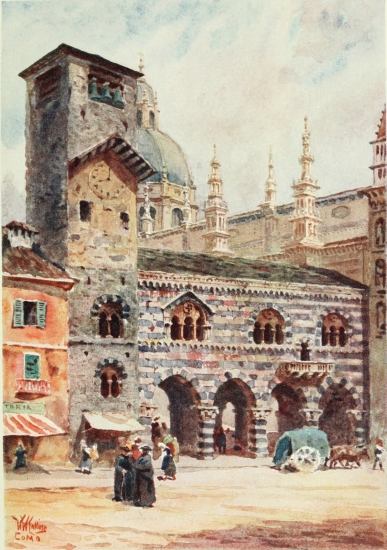
The Cathedral of Como, built entirely of marble, was commenced in 1396 from the plans of Lorenzi de' Spazi. The west façade, begun in 1460, was finished by Tomaso Rodario in the last few years of that century. It is Italian Gothic, with the exception of the three doorways, which are rich Lombard work; and, like all façades of the same style in Italy, has the appearance of simply facing or being stuck on to the building itself. Despite the adornment of statues and bas-reliefs, scrolls and arabesques, it has a very severe and flat look, which is unrelieved by the recesses containing busts of the two Plinys on either side of the central doorway, or the deep-set windows and canopied niches above. A fine wheel window occupies a position above the principal door and between these is a good Gothic screen with figures in five niches flanked by a couple of windows on either side.
The north side of the façade adjoins the Brotello, through the arches of which one reaches the north doorway. This is decidedly good. The porch is supported by elegant pillars and adorned by arabesques with birds, animals, and other figures. It was executed from designs by Rodario, and with the south portal possesses all the merit that good Renaissance work gives to both. The windows of the aisles are beautifully ornamented with decoration of the same character, and the slender pinnacles with their pierced galleries, albeit they remind one in their whiteness of the superior pieces of an ivory chess set, break the line of the roof in a most agreeable manner. The dome lacks proportion and is of the over-done style of French eighteenth-century work.
The interior of the cathedral is Gothic and Renaissance. The nave and aisles belong to the earlier date. The groining is good, but spoilt, as is generally found to be the case throughout Italy, by gilded and coloured bosses which mar the otherwise simple effect of the vaulting. The transepts and choir are Renaissance, and though the sympathies of the northman are more with the sterner style, it must be owned that in Como's cathedral the scheme of decoration found in these is more fitting and better of its sort than in the Gothic half of the building. At the west end of the nave stands the circular Baptistery attributed to Bramante, close by which are a lion and lioness, the former grasping a deer and the latter suckling her young. They support the two holy water basins. Among the pictures of interest which the cathedral contains is a good Bernardino Luini of the Virgin, and two glazed and framed frescoes of the Nativity and Adoration by the same hand.
The illustration shows the Brotello or old town hall, and the pinnacles and north walls of the Cathedral. The Brotello is faced with banded black and white marble, the common device for exterior walls in most Italian Gothic churches, and in this case justified by the beautiful colour it has taken on with age. The building stands mellowed by the hand of Time, a memorial of the days of the old Italian Republics; and its counterpart existed in every Lombard city. Above the arches, under which the good citizens were wont to discuss the affairs of their town while sauntering to and fro in the cool shade, is the great hall wherein the chief of the municipality assembled. From the window in the centre access was obtained to the bar, or ringhiéra outside, from which addresses were delivered to the crowd below, who in constitutional language formed the parliamento and from whom the powers of government emanated.
Two of the old city gateways still exist, the latter of which, the Porta del Torre, leading out on the high road to Milan is to-day but an empty five-storied shell. The old walls may be traced even now on the three sides of the city away from the water-front. But for these there is very little left to show the extent of a place which was once a serious rival to Milan. The staple industry is stone-working, for which the Comaschi have for centuries been widely known. In former times Como was justly celebrated for the products of its looms, excelling in number those at Lyons. Nowadays it exports the raw silk; the looms have sadly fallen off and diminished, and small industries have taken the place of those that brought considerable wealth to the pockets of its merchants.
MILAN
WHEN the great wave of conquest which swept mid-Europe in the fifth century broke against the walls of Châlons-sur-Marne and the westward march of Attila and his Huns was checked, the defeated hordes of the East followed their chief across the Alps and invaded the plain that stretches away now, just as it did in those far-off days, to the sunny seas that beat against the southern slopes of the Apennines. In the centre of this plain stood Mediolanum, a city ranking second only to Rome, and her greatest colony in the Peninsula. So rich and prosperous a place became of necessity the object of attack, and the hosts that looked to "the Scourge of God" as leader, swept into and through the fair city, sacking it completely. Rebuilt, but once again undergoing the same fate at the hands of Frederick I. in 1162, there remain but a colonnade of sixteen Corinthian columns near the Porta Ticinese, a few tablets and fragments let into the walls of other gateways, and some relics in the museum, to tell of the past glories of Rome's great colony.
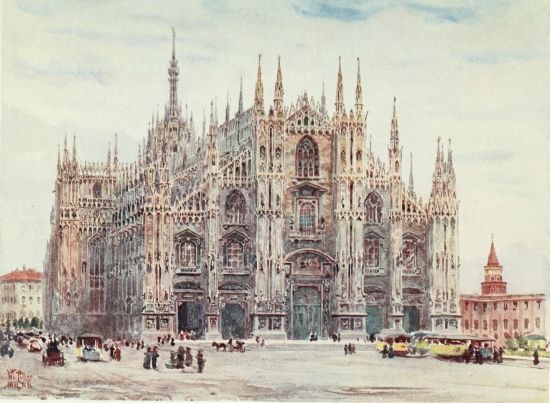
Milan, as we know it now, is the centre of commercial Italy. Intersected by an excellent system of tramways, with beautiful public gardens and magnificent buildings, it is up to date in every way and stands quite apart from all the other cities with which this book is concerned. The one thing that, perhaps, above all others places it in this position is, however, no product of this commercial age, but its world-famous work of art, the great cathedral, through the lofty aisles of which still reverberates the grand music of the Ambrosian Ritual. The exterior of this immense church, next in Italy to St. Peter's in size, is adorned by a forest of spires, pinnacles, turrets and lace-like tracery. In the midst of all this rises the central tower with its airy spire, from the base of which on a clear day the snow-clad peaks of the Alps may be seen stretching miles on miles away, and bounding the whole of the northern horizon by a lovely dreamland of colour.
Very few buildings compel one's admiration as this does, an admiration wrung in my case from a mind out of sympathy with everything that lacks the dignity of repose; but such is the effect obtained by hundreds of pinnacles and statues, by the turreted flying buttresses, by the filling of every available foot of space with ornament, that one cannot but appreciate the result of the skill and patience so truly Italian, which has carried out these infinite details and produced the great work that stands in the Piazza del Duomo. The present fabric, dedicated "Mariæ Nascenti," is the third cathedral built on the site: the first was destroyed by Attila in 452, and the second by Barbarossa in 1162. The foundation-stone was laid in 1387 by Gian' Galeazzo Visconti, who from a northern clime sought his architect, Heinrich Ahrler, of Gmünden. From that time down to the present day many have had a hand in its making, among them Bramante, Leonardo da Vinci, and Giulio Romano, and the wonder is that the great structure is not far more full of incongruities than it is. The whole exterior is built of white marble from the quarries of la Gandoglia on the Simplon Road, given by the founder for this purpose.
The façade rises with a course of open Gothic work to the gable above, and is divided into five sections which terminate in clusters of Gothic turrets surmounted by pinnacles and statues. The central doorway is surrounded by excellent Renaissance sculpture, the door itself being a magnificent piece of seventeenth-century bronze work. On each side are two more portals. The bases of the intervening buttresses contain splendid panels, and the Caryatides, which support the slender Gothic shafts right and left, by Rusca and Carabelli, are extremely good in pose and execution. The great façade designed by Pellegrini for S. Carlo Borromeo in 1560 was never carried out owing to the saint's death while Pellegrini was away in Spain working on the Escorial for Philip II. The east end is the oldest part of the building, and is almost entirely taken up by three grand Gothic windows. The east window, which is of most beautiful tracery, was executed from the designs of a Frenchman, Nicholas Bonaventure. Both the other windows are fine, but the upper portion or rose pattern, although in itself very delicate, appears "stuck in," and not part of the design; some of the glass in these is very rich in colour. The archivolts of the arches are filled with figures which follow the curve in a rather uncomfortable style, not only here but in every other window save the fine classical of the façade.
THE CATHEDRAL, MILAN
The interior is grand, and of immense height, albeit the vaulting with its admirably painted tracery is evidence of the great skill of the Italian at "faking." The mellow light from the amber coloured glass of the octagon and the twilight filtering through the gorgeous hues of the other windows is remarkably and impressively pleasing. The columns of the nave, in clusters of eight shafts, are eighty feet high, and carry narrow capitals of foliage which form the base to eight canopied niches occupied by figures of saints—a fine feature. The aisles are double, the outside being lower than that next the nave. The four columns at the crossing which support the octagon are of larger dimensions than those in the nave. Two semicircular pulpits covered with bas-reliefs of gilded bronze stand on either side of the steps leading into the choir, to the solemn darkness of which the shadows thrown from the sounding-boards above make pictorially a good foreground introduction. These pulpits are supported by caryatides representing the Evangelists and four doctors of the Church.
The choir was designed by Pellegrini, and contains a fine sixteenth-century tabernacle of gilded bronze. Beneath is the subterranean church, through which one enters the tiny chapel, under the central spire, wherein is deposited, in a magnificent silver shrine the gift of Philip IV. of Spain, the body of S. Carlo Borromeo dressed in full pontificals. Born in 1538 he was created cardinal by his uncle, Pius IV., in 1561. After the close of the Council of Trent he assisted other prelates to draw up the epitome of Catholic doctrine, the "Catechismus Tridentinus"; but it is more for his good works and great charity, especially during the plague of 1576, that he lives in the hearts of the Milanese.
In the north transept is a very good example of the metal work of the thirteenth century, in the shape of a fine bejewelled bronze candelabrum. It forms a tree and has many quaint figures in its intricate design. In a chapel in this aisle is the old wooden crucifix which S. Carlo carried when barefooted he tramped the streets during the plague, tending the sick. In the south transept close to the corner near the staircase leading on to the roof is a monument to Giacomo and Gabriele de' Medici, brothers of Pius IV., and a bronze statue of S. Bartolommeo which represents him flayed. The south sacristy door is a fine specimen of Gothic work. Unlike the exterior effect, nothing obtrudes inside this great cathedral. The eye on entering looks straight up to the east, conscious as it travels there, of great pillars rising into the gloom of the vault above, of fine glass and restful solemnity, in which even the chapels in the aisles are lost, to be discovered later on only when searched for.
Next to "Mariæ Nascenti," but taking precedence in archæological interest, is the church of S. Ambrogio, a basilica dedicated by the Saint when bishop of Milan in 387 to SS. Gervasius and Protasius. It was enlarged and rebuilt in 881 and restored by Ricchini in 1631, all the original features being faithfully preserved. A closed courtyard stands below the level of the piazza outside and forms the Atrium beyond which no catechumens were allowed to pass. The capitals of the columns here have the tendency of early Christian Art and adaptations of Runic and Byzantine carving. The church is Lombardo Romanesque. Beneath the gallery over the peristyle is the celebrated door, well guarded by an iron grille, some of the cypress-wood panels of which formed portions of the gate of the Basilica Portiana closed by S. Ambrose against the Emperor Theodosius after his cruel slaughter in Thessalonica. The nave is entered by two side doors and is composed of eight bays, the columns of which are slender in proportion for the deep shadows of the dark aisles. Pilasters run up to the low round vaulting, the large galleries over the aisles being divided by these. Up a few steps which cross the nave at the last bay, and behind a low marble balustrade, is the High Altar, enclosed by one of the finest extant relics of the goldsmith's art. This magnificent casing bears the name of its German maker, Wolvinius. Some of the panels, notably that of the Transfiguration, are very Greek in treatment. The back is almost of better workmanship than the front and is more interesting, as Wolvinius has here illustrated the principal events in the life of the founder. The enamelled borders of these silver-gilt panels are of exquisite design. One of the saint as a child asleep in his cradle with a swarm of bees hovering around, considered a presage of future eloquence, is very naïve. The baldachino above this altar is borne by four grand columns of black porphyry.
Up twelve steps are the choir and tribune, and at the end of these is the primitive throne of the Archbishop of Milan, known as the chair of S. Ambrose. The eighteen seats occupied by the suffragans of the province no longer exist, having been replaced in the sixteenth century by carved wooden stalls, and thus has perished a feature identical with the Cathedral at Torcello. The semi-domed roof of the Tribune is covered with a fine ninth-century mosaic which represents the seated figure of the Almighty, beneath whom are SS. Candida, Gervasius, Protasius, Marcellina and Satirus, and a representation of the cities of Milan and Tours—Tours because there, when S. Martin was undergoing martyrdom, the spirit of S. Ambrose went to give him strength. Beneath the choir is the crypt, and at its termination, exactly under the high altar in the church above, in a splendid casket of silver and crystal, repose the remains of three Saints, Ambrose, Gervasius and Protasius. There is a curious pulpit in the church of very early Lombard work, with an "Agape" or love feast carved upon its panels. Close by upon a granite pillar rests a bronze serpent, said to be the brazen serpent of the desert and presented to Archbishop Arnulphus by the Emperor of Constantinople. S. Ambrogio was the church in which the Lombard rulers were crowned with the Iron Crown that is the chief attraction in the neighbouring city of Monza.
So well known are the art treasures of Milan that it is hardly necessary to do more than allude to the many works of great interest in the Brera, formerly a Jesuit college, and in the celebrated Biblioteca Ambrosiana; or that greatest wonder of all which has drawn so many pilgrims to the Cenacolo, the refectory near the church of Santa Maria della Grazie—the much restored Last Supper by Leonardo da Vinci. The Castello of Milan was at one time the residence of the great Visconti family, and at the death of the last male representative passed by marriage into the hands of the first duke of the Sforza line. It was during their reign that Milan took the lead in the fashion of Europe (whence we have the word "milliner") and it was then that Leonardo wrought his masterpieces, including that great equestrian statue of Francesco Sforza which was the wonder of Milan, and of which posterity was so unhappily robbed by the French invasion.
PAVIA
FROM its position close to the confluence of the rivers Po and Ticino, Pavia, the "City of a hundred Towers," was for centuries a point of strategic importance. It is at present a great artillery station. Of its hundred towers that stood at intervals around the eleventh-century walls, hardly one remains, and the old fortifications which had been reconstructed at a later date, are rapidly being converted into a spacious and shady boulevard. The celebrated bridge is however still intact, despite many violent floods, a delight to the eye and a pleasant promenade on a hot day. This notable structure, which spans the Ticino, was built by one of the great Visconti family—Gian' Galeozzo—and is roofed in.
Pavia at one time was rich in noble churches. Many have been demolished, others have fallen into decay. The cathedral, dedicated to S. Stefano, stands on the site of one erected in the seventh century. The present edifice was designed by Bramante and constructed under the direction of one of his pupils, Cristoforo Rocci. In the original plan the nave, transepts, and choir were all of one size, but the nave is the only part in which the great architect's measurements were followed. The façade, approached by a good flight of steps, is unfinished. On the north, and adjoining a fine example of a late Romanesque gateway, stands the campanile.
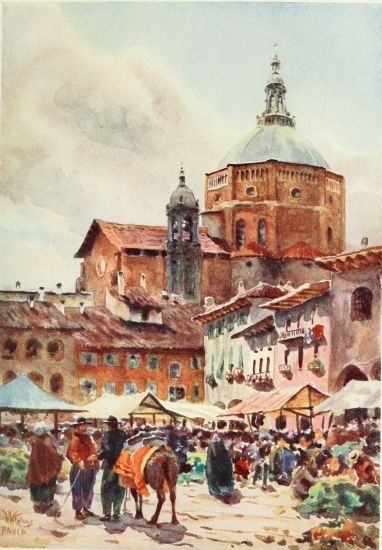
The interior of the main building is grey stone which has not been spoilt by the application of the whitewash brush. A fine pulpit, somewhat similar to those at Milan, stands out from one of the massive piers that support the octagon. It is of singularly large dimensions and is supported by well-carved wooden figures of the Fathers of the Church. The octagon, which carries a good dome and tower and is best seen from the market square, rises well above the roofs of the nave and choir. A gallery running round the entire cathedral forms a triforium, broken only by trasparente lights in the apse and side chapels of the choir. These windows accentuate the bad points of the barroque altars beneath. The clerestory lights are circular. If it were not for the magnificent tomb in which repose the remains of S. Augustine, the greatest of the Fathers of the Latin Church, the cathedral would be, notwithstanding the fame of its designer, the least interesting ecclesiastical building in Pavia.
THE CATHEDRAL, PAVIA
Experts disagree as to who was responsible for the fine monument which covers S. Augustine's remains. The body of the saint had been removed from Hippo, a suffragan see of Carthage, to Sardinia during the Arian persecutions. It rested there until Liutprand, the Lombard king, having purchased it, placed it in the church of S. Pietro in Cielo d'Oro; and when this church was destroyed it was conveyed to the cathedral. On certain festivals the silver casket, portions of which are the original, that contains the bones of the saint robed in full pontificals is removed from its usual position and hoisted up behind the tomb, so that the devout can mount a temporary wooden stair and look on all that is left of the great father.
A figure of the saint lies stretched on the sepulchral urn that usually holds the silver casket. This rests on the basement, or lowest, of the four tiers that compose the monument. Around it are figures of the lesser saints of his Order. Above are bas-reliefs of the chief events in his life and the miracles which after his death were performed in different places through his intercessions. The liberal arts, the cardinal virtues, and many symbols adorn the tomb, which is also decorated with statues of saints and angels, two hundred and ninety in all. They are extremely well executed and enhance the beauty of the design.
The church of S. Michele is a primitive structure and bears traces of being the precursor of all ecclesiastical edifices of the Lombard style of architecture. It was originally a basilica, but short transepts have been added and the roof, which is groined, is vaulted with stone. The oldest part of the church is the crypt, which is under the choir. This is probably the building, or part of it, in which Unulfus sought sanctuary in 661 when fleeing from King Grimoladus. Four compound piers in the nave are adorned with an extraordinary series of sphinxes, symbols, animals and other figures. The façade is decorated with reliefs in a richly coloured sandstone, and has a gabled gallery that is continued round the exterior as far as the apse.
The portals are covered with a profusion of very archaic imagery in which Pagan as well as Christian subjects form most of the decoration. Sculptured bands of sandstone are placed in courses along the whole front and medallions let into the walls. These are very massively built of stone, and though restoration is evident throughout the church it still bears the impress of great age.
Sta. Maria del Carmine is a fourteenth-century building of Gothic design, and is one of the very best examples of brickwork in all Italy. The beautiful rose window of the west front and the three pointed doors with their well-moulded terra-cotta ornament could hardly be finer. Seven elegant pinnacles stand on the rather heavy cornice, forming a good set off to the campanile, which, surmounted by a brick spire, is a landmark in the district. The brick piers of the interior are exceptionally good; four squares constitute the nave, the arches of each carry simple groining. Two small lancet-shaped arches, out of all proportion with the massive brick piers that support them, open into the aisles. They have double capitals, the upper being of stone, the lower of carved brick.
In the ruined church of S. Pietro in Cielo d'Oro stood the tomb of Boethius, who under Theodoric held high office in the state. Boethius was executed in Pavia after a long and rigorous confinement in the Casa Malsap ina, during which he wrote his incomparable "Consolations of Philosophy." This work was translated into many languages and was one of the most widely known treatises in the Middle Ages. Alfred the Great translated it into Saxon. Another connection with England exists through Archbishop Lanfranc who accompanied William the Conqueror across the sea and was made prelate of Canterbury. The district round Pavia is not healthy, a condition due probably to the intricate system of irrigation by which the pastures are kept green with a rank-growing grass. Between Pavia, Piacenza and Lodi—a triangle with the last-named at the northern point—lies the country which yields the best Parmesan cheese. The fields are of three kinds, those nearly always under water, those irrigated, and those used for rotation crops. The cattle that are utilised for cheese-making are mostly Swiss bred, and being valuable are well looked after. They are stalled at sundown in the buildings attached to the great farms, where farmhouse, cottages, barns and stables are all enclosed within a high wall. The little rectangular patches of meadow on which they feed are enclosed by rows of poplars or willows which make the landscape very monotonous. In winter a dense fog often shrouds the countryside and a deadly chill pervades the atmosphere, while the humidity of summer, when the sun draws the moisture from the soaking earth, is very enervating.
BERGAMO
WHEN October comes in its yearly round and the autumn afternoons close in, it is sometimes good to sit idly outside a caffè with the pernicious cigarette and ruminate on the glories of a past summer—better this than to hustle up the street a sight-seeing. A hot day was ending and the Bergamo of mediæval times towered above the haze of a sun-baked land and the smoke that curled upwards in thin wreaths from the city below. "La Città Alta" thus raised its head proudly against the copper-coloured sky, thrusting its bulwarks to the edge of one of the last spurs of the Alps that here creep down on to the plain. What a grand prospect from the shady boulevard on those ramparts which encircle the old fortress! The sun has not yet set; beneath lies the Borgo S. Leonardo, the lower city, a busy place with factory chimneys on its outskirts; beyond, a sea of verdure, cut by lines of tall poplars and here and there a slender campanile, stretches away over Lombardy until lost in the haze past the towers and domes of Monza, Cremona, and distant Milan.
There is something very fascinating in the quiet and exclusive old city. Its streets are steep and narrow, its houses seem to rake the sky, the rattle of wheels does not often disturb the aristocratic silence, a silence accentuated tenfold when one has left behind its busy plebeian partner on the plain below, and whisked upwards by the funicular, found oneself suddenly amidst high walls. Great spaces of faced stone are these walls, pierced by tiny windows, almost forbidding in their austerity; and though glimpses of foliage and flowering creepers break through, the pervading air is one of mystery and intrigue.
In the wars with Austria, Bergamo was a great rallying-point for patriots and a continual thorn in the side of that polyglot empire. The names of heroic Bergamasque who died for their country are inscribed on sundry tablets on the walls under the old Brotello. This interesting building stands at one end of the little Piazza Garibaldi, and is somewhat similar to the one which forms the illustration to Como, with the difference that here a fine open stairway leads up to the first floor. The great hall is now occupied as a library. In a corner at the head of the stairs rises a massive quadrangular belfry, one of the prominent features in the outline of "La Città Alta."
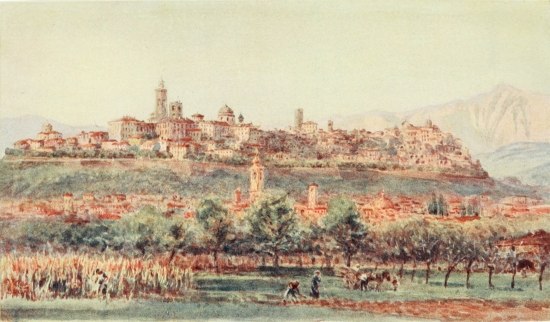
BERGAMO
Beyond the Brotello lies the Cathedral, a well-proportioned Renaissance building, which, by its juxtaposition to the much more ancient church of Sta Maria Maggiore, looks comparatively of recent date. It is constructed entirely of white marble and has a good dome. A Madonna by G. Bellini behind the high altar is its great treasure, and the only thing in it worthy of notice.
Sta Maria is an early Lombard pile of buildings, with a very lofty tower and an octagon over the crossing, which rises in four galleried storeys surmounted by a low spire. Good galleries extend round the exterior of the apse, and side chapels are thrust out at odd places with no particular plan. The east porch is by far the most interesting feature, and is an elaborate piece of work in breccia and white marble. The supporting pillars rest on the backs of two lions, the old ecclesiastical symbol of strength, the columns of the portal are beautifully sculptured, and one of them, encircled with admirable figures, is very fine. Above is a canopy under which, on his horse, sits King Lupus with two attendants, while beneath a second canopy on top are statuettes of the Virgin and Child, and the two Marys. The west porch is almost similar to this, but of not so intricate a design. It has also no canopies, but is surmounted by a turret niche, let into the wall of the main building, in which is the figure of the patroness. The doors of these two portals are of superbly grained rosewood. They open into the transepts, which are the finest portions of the interior, the carved choir stalls and screen by Stefano da Bergamo are considered the best in Italy.
Adjoining the east porch is the Capella Colleoni, the mausoleum of Bartolommeo Colleoni the celebrated condottiere of the fifteenth century, whose equestrian statue in front of the church of SS. Giovanni e Paolo in Venice is remarkable, not only as a work of art, but as exemplifying the power and rugged strength of a great man.
The façade is terribly ornate, with chequer work in white and black marble, red and yellow busts and medallions, twisted pillars and strange arabesques. The interior contains the tomb of Bartolommeo who sits astride his horse. It is rather too elaborate to be entirely pleasing. At the south end is one of the finest examples of intarsia, or inlaid wood-work, in Italy. The subjects of the three panels represent the entry into Jerusalem, and scenes from the stirring times in which the great condottiere played so prominent a part. The backgrounds are evidently of landscape in the neighbourhood. Not only is the spirit and execution of this fine work extremely good, but the colour surpasses anything of the sort I have seen. It is kept under lock and key, enclosed in three rosewood panels of well-selected grain. Not far from the chapel is the house in which Donizetti died. The Borgo S. Leonardo is of older date than "La Città Alta," although it is the more modern of the two. On the base of a damaged Corinthian column standing in the small piazza of Sta Maria d'Oleono is an old Latin inscription which tells that the column was erected where once stood a heathen temple, and that S. Alessandro, standard-bearer to the Theban Legion, overthrew the heathen pillar by a miracle, the column being erected by members of the municipality with the alms of the faithful. It is doubtful whether the Pergamus of ancient writers is the city on the hill or its sister on the plain; this relic rather points to the latter as the site. In the Borgo a fair, held for a month from the middle of August, and known as the Fiera di Sant' Alessandro, has taken place without intermission since the tenth century—surely a record; and there is no doubt that in the ancient Italian drama, harlequin, personifying the manners and jargon of the neighbouring Val Brembana, was a Bergamasque, and originated at this ancient festival.
BRESCIA
BRESCIA, like Bergamo, is situated on the fringe of the mountains and the plains, and like Bergamo played an important part in the wars against Austria. Its castello stands high above the rest of the city, but in the face of the power possessed of modern arms it would not be worth a garrison. So its ramparts and entrenchments have been wisely converted into a pleasant garden from which wide views of rolling country and level plain extend.
Many traces of the Roman colony of Brescia remain, but it was due to a small boy of the virile race that populate the city that the most interesting was unearthed. When a child, Girolamo Ioli was much exercised in mind about a Corinthian column that stuck out of the ground and around which he was wont to play. In maturer years the curiosity of youth was still the ruling passion, and he made it his business to agitate. Like many another agitator his demands were in time gratified, and excavations were commenced which resulted in the unearthing of a building erected by Vespasian it is supposed in the year 72—the supposition resting on fragmentary inscriptions. Palace of Justice or temple, this building is now the museum, and contains one of the finest bronzes Italy can boast of. Found in 1826, this beautiful winged figure of Victory, which is six feet high, still bears a trace of the silver fillet interwoven with a wreath of laurel-leaves that bound her hair. The last-century additions of a shield, which she was thought to have held, and a helmet under one of her feet, have been removed, and Victory stands in the state in which she was discovered. The head and limbs are finely modelled, and the arrangement of the drapery could not be excelled.
Down the wide street in front of the Museum a Corinthian column and heavy frieze, supported by massive brick pillars, have been excavated. Opposite these relics is the huge Martinengo Palace. In a line due south is the church of Sta Afra built on the site of a temple to Saturn. Most of the houses in the vicinity have Roman masonry in their basements and Roman inscriptions let into their walls. From this one gathers that ancient Brixia occupied this part of the later city. Write it down to the credit of Brescia that her citizens passed a law as early as 1480 that all antiquities found should be preserved and given up to the town.
There are two cathedrals in Brescia, La Rotunda and the Duomo Nuovo. The former is one of the most interesting ecclesiastical buildings in Italy. Constructed of stone, with a red brick dog-tooth cornice and twenty-four brick arches, supported by white marble pilasters forming an arcade into which the exterior is divided, a most pleasing effect is obtained. In the interior a circular colonnade, composed of eight extremely massive four-sided piers bearing round arches, supports the stone dome. It is supposed to be of seventh-century construction, and is evidently on the site of an earlier Roman building, as fragments of a mosaic floor exist beneath the present one. This, which is partly tesselated, is much below the level of the ground outside. Lower still, beneath the presbytery and choir, down twenty steps, is a very ancient crypt, in which forty marble columns support the round arches that carry the weight of the fabric above. None of these columns is more than five feet high. Half a dozen blocked up lights, with bases not more than three feet from the floor, are evidence that outside, the level of the ground was at one time far below where it is at present.
The Duomo Nuovo is a finely proportioned edifice and one of the best seventeenth-century churches in the country. The façade is immense and gains by its simplicity. The fine dome is said to be the third in size in Italy; and the lofty interior of white marble, unspoilt by any colour or decoration, gains in space from the fact that there is but one bay to the nave, producing the effect on the senses that one is everywhere standing under the spacious height of Brescia's greatest landmark. The houses of the piazza outside are chiefly occupied by metal-workers, and those who know the incessant din produced by the tapping of their hammers, will quite understand that it was impossible to make a sketch of these two churches as they stand together.
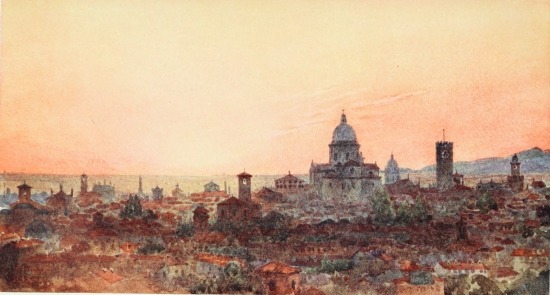
BRESCIA
Adjoining the Duomo Nuovo is the Brotello with its fine Torre del Popolo, an embattled tower. The inner courtyard is partly of red brick with a good corridor of the thirteenth century, formed of pointed and round arches and brick groining. Another fine tower stands in the Piazza Vecchia, the Torre del' Orologio. Its enormous dial marks the hours from I to XXIV, the course of the sun and moon, and has the signs of the Zodiac displayed on its face. Two figures that stand on top of the tower strike the hours in a similar way to those on the Clock Tower of Venice. At the west end of the piazza is La Loggia, the town hall, a good example of an early sixteenth-century building. It was commenced, to be accurate, by Tornasso Formentone in 1492 and continued from his designs as far as the first floor. Sansovino was responsible for the second, and Palladio completed what the other two had begun. The building, however, as a whole, is superb. Magnificent arches support the first floor, to which a grand open staircase leads. The medallions and figures which adorn the exterior are extremely good, and the frieze and cornice are equally so. The rich colour of the marble employed lends a beautiful tone to a beautiful building. Unfortunately the interior was burnt out in January 1575. The fire which consumed it is supposed to have originated at the instigation of those who wished to destroy certain ancient charters granting liberties to the inhabitants.
The Torre della Pallata is in a corner of the square—a good specimen of castellated architecture, which rises from a sloping base of immense stones and terminates with a projecting turret.
Brescia contains many fine palaces, and from the streets into which they open one often gets a glimpse, through the iron grille of their portals, of a charming arcaded court. The splash of a flower embowered fountain is music to ear and the cool shade under the arches a rest for eye.
VERONA
THOSE who enter the Brenner Pass, and with faces set towards Italy, leave Innsbruck behind, may have noticed how, after toilsome puffing and straining uphill, the train suddenly seems to draw breath and glide smoothly onwards with increased pace. At the side of the iron road a little thread of water dances merrily over a pebble bed in its haste to reach the sunny plains that lie to the south of the great mountain barrier. Further on the rail and its sparkling attendant part company to join later, when, from their slender origin, the waters have become a rushing river—the river Adige. The mountains are behind, to the north; the character of the landscape has changed, and within a horseshoe bend of the swift stream, well-nigh enclosed by it, lies Verona.
Verona "La Degna," Verona the Worthy, a city crammed with the history of past wars, a city of colour, in its bricks, in its stones, in its marble walls and fresco adorned palaces. Wherever one turns, be it the pale green of the river on which the wheels of those watermills, so like the Noah's Ark of childhood's days, for ever turn, or the brilliant and keen blue of the sky, there is always colour for the eye in Verona. Colour for the mind too lies concealed in its streets and buildings. Greek, Roman, Ostrogoth and Frank, Italians and Austrians, have all ruled here. Ruled and gone and left their trace on this beautiful city—the key to Alt' Italia—which Italy once more holds and guards with jealous eye. Long may she keep it.
Verona is connected with two great names in the history of Italian architecture, Frà Giaconda, the monk who in the early days of Renaissance was supreme in the north, and Sanmicheli. Many of the fine palaces the former designed bear evidence of his talent and justify the summons to Rome, where he went at an advanced age to superintend the building of St. Peter's. The latter, who evolved the triangular and pentangular bastion, is more widely known in the science of fortification than as a builder. Frà Giacondo's finest work in Verona is undoubtedly the Palazzo del Consiglio, the old town hall called "La Loggia," which stands on the north side of the Piazza dei Signori, one of the most architecturally beautiful squares in Italy. The Palazzo della Ragione, with a courtyard and grand open stairway of the fourteenth century, is on the south of the square next door to the Tribunale, and the Prefettura is opposite. The fine portal of the latter is one of Sanmicheli's works. These magnificent buildings, with the exception of the first-named, were all at one time or another palaces of the great family of Scaligeri or Della Scala, and in one of them Dante, whose statue is in the centre of the Piazza, found refuge when driven from Florence.
The family of Scaligeri, although settled in Verona as early as 1085, comes first before the historian at the death of the bloody tyrant Ezzelino in 1261. Verona, freed from his terrible rule, became at that date a free town, and Mastino della Scala accepted the office of Capitano del Popolo. Onwards for over a hundred years the Scaligeri governed Verona; and during the reign of the most famous of the race, Francesco, or "Can Grande," Great Dog, it became the gathering-place for men of note of all sorts, and his palace the home of the great poet. The family crest, a ladder, is to be seen all over the city, while the unique group of the Scala tombs is without a parallel.
This wonderful group stands outside the little church of Sta Maria Antica at the end of a passage leading out of the Piazza dei Signori.
Of these tombs, that of Mastino I. is a simple sarcophagus ornamented with nothing but a cross. It was at one time covered with a canopy, but the stones of this, being handy, were used for the restoration of Sta Maria Antica close by. The tomb of Can Grande forms the canopy over the portal of this church. Columns support its three storeys. Upon a sarcophagus lies an effigy of the Great Dog with his good sword at his side; above is his equestrian statue in full armour. Mastino II, who succeeded his uncle Can Grande, is likewise represented by a recumbent figure on the sarcophagus of his tomb, which is also crowned by an equestrian statue in armour. The visor of his helmet is drawn down, and thereby hangs the tale that Mastino was ashamed to show his face, even to his wife, after he had treacherously slain with his own sword his relative, Bishop Bartolommeo della Scala. Can Signorio's monument, though not the most elaborate, is decidedly the finest. At the four corners under beautiful pointed canopies, are the figures of Sigismundo, Alexius, St. George, and Signorio himself. A great deal of the bronze work and detail about this tomb is very good, and the equestrian figure on the top is excellent. There, gathered together, these warrior princes of the great family repose in their last long sleep. Those who deem the pen mightier than the sword, may care to reflect that a fame more universal and lasting than that of all the Delia Scalas has been attained by a French scholar of the sixteenth century who also bore the name of Scaliger. Yet even this prince of learning was prouder of his traditional descent from the noble Veronese house than of all his achievements in the world of letters.
THE PORCH OF THE CATHEDRAL, VERONA
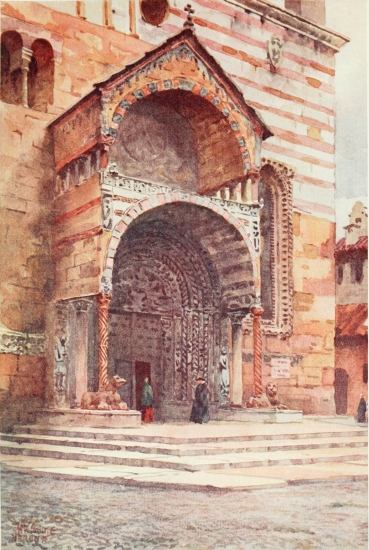
And Verona's churches? Tradition says that Charlemagne erected the first building on the site of the Cathedral. The present edifice, though almost entirely reconstructed in the fifteenth century, was commenced in the tenth. The most ancient part that remains, probably a portion of the first church, is the apse, which on its exterior bears traces of Roman influence. It is very simply built of a small cut grey freestone, faced with flat pilasters terminating in Roman capitals, above which is a frieze of floral pattern. In the remainder of the building Verona marble and the rich yellow stone of the district are used.
The double-arched west porch of the twelfth century is exceptionally good. Two colossal gryphons support elegant columns, and still command a certain amount of awe amongst the smaller children who play about the Piazza del Duomo. Both arches are round; the lower is supported by four columns, the upper by eight. Representations on the inner shafts of the lower arch of the two Paladins, Roland and Oliver, give a semblance to the tradition that Charlemagne had something to do with the first church erected here. Oliver holds his celebrated sword, on which is inscribed Du-rin-dar-da. Roland is cross-legged and bears his shield. They are both seen in the illustration. The colour of this porch and façade is very beautiful. Great blocks of red marble intermingle with yellow stone, white and pink marble courses continue the construction above, and arabesques of a weathered grey stone complete the harmony. The fine south portal is an earlier erection. Some ancient frescoes decorate the lunette, and monsters grin at one like a nightmare from above.
The interior is lofty and very striking. Tremendous columns support the low Gothic roof, the vaulting of which hardly exceeds the height of the arches between the nave and aisles. Many signs of "giving way" and cracks in the masonry have necessitated iron girders, which detract somewhat from a fine effect. The heavy capitals of the nave columns are rendered rather unsightly by three courses of floral design. The aisles are pointed, narrow, and very good. Encircling the high altar is a colonnade screen, which though beautiful in itself and designed by Sanmicheli, is sadly out of place. The fine bronze crucifix which surmounts it is by Gianbattista da Verona.
The cloisters lie on the north side of the Cathedral. About half a dozen feet below the level of the pavement, standing on its base, is a fine Corinthian column, with a Roman floor around. Between them and the early Lombard church of S. Giovanni in Fonte is a tortuous corridor lined with sepulchral slabs of many archbishops and bishops. This little dark church is formed of four small bays and was formerly the old baptistery. In the centre of the nave stands a huge octagonal font, with a smaller one inside, wherein stood the officiating priest. The figures in bas-relief on these two fonts, which by the way are cut from one solid block of marble, are well worth studying.
Another Gothic church is Sant' Anastasia, which was commenced by the Dominicans in the thirteenth century and is still incomplete. The nave is very fine and has the same low vaulting that is a feature in the Cathedral; its walls, too, are cracked and held together by iron girders. Close to the west door in the interior are two humpbacked figures which hold the Holy Water basins and are of some interest. One of them was executed by the father of Paolo Veronese and the other by Alessandro Rossi, who took his cripple son "Gobbino" for his model.
The most interesting ecclesiastical fabric in the city is, however, the church of San Zenone. It is unspoilt by anything flamboyant or gaudy, and is a fine example of Romanesque architecture—some consider it the finest in North Italy. A ninth-century building stood here before the present structure was begun in 1138. The west façade is marble, the apse and sides of alternating brick and marble courses. The great portal is a most elaborate example of early twelfth-century work, on which are rudely sculptured knights engaging in deadly combat, scriptural subjects and imitations of Roman bas-reliefs with Latin inscriptions. Theodoric on horseback, with feet in stirrups—a very early representation of such—and Roman dress, engages in the chase of the deer with the Devil. The attendant dogs are evil spirits furnished to the Emperor by the Arch-fiend. The ninth-century bronze doors are very remarkable and consist of forty-two square plates fixed on to pine-wood. The subjects of each panel, which are Biblical, are most interesting; some of the little figures wear the conical flat-brimmed hat that may still be seen on the heads of the shepherds in the more remote districts of Venetia. These doors boast no handles, but two huge grotesque heads do duty instead, and are the means of opening and closing them. Above the portal is a wheel-of-fortune window executed by Briolotus. At the top is the figure of a king, and at the bottom lies a prostrate man; between these two are many figures climbing up and falling down in their efforts to reach the best place. The façade terminates in a gable, with a lean-to on either side.
INTERIOR OF S. ZENO, VERONA
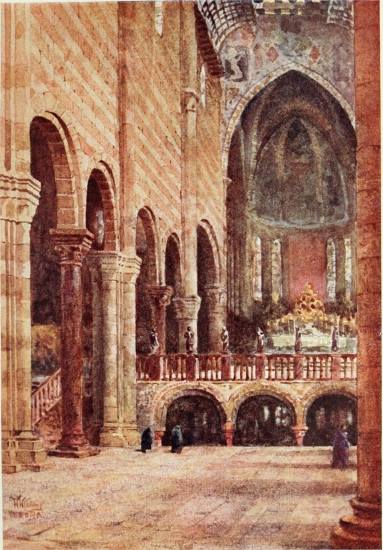
The interior is very striking, not only in its good proportions but in its simplicity, which no side-altars mar. As in the cathedral at Chester, one enters from the west down a flight of steps, held a moment in admiration by the solemn grandeur of this fine church. The beautiful larch roof soars away far above the mellowed floor, the warm colour of the walls and depth of shadow through the arches of the crypt below the choir, create a harmony of colour from our point of vantage not often met with in Italy's churches. The aisles are divided from the nave by alternate piers and red marble pillars, the former with ascending Doric pilasters, two of which, near the west end, support a flying arch beneath the roof and are evident traces of an early vaulting. At the end of the nave, and occupying its last three bays, is the raised choir reached by two flights of marble steps on either side of those leading down into the crypt. On the red marble balustrade of the choir are figures of Christ and the twelve apostles. In a niche on the south side is a forbidding looking figure of S. Zeno, the patron saint of the city, who, being an African, is represented with a black face. The apse at the east end was rebuilt in the fifteenth century and has Gothic windows.
The old Benedictine cloisters of the once attached monastery stand on the north, and contain amongst other tombs twenty-nine of the Della Scalas. The cloisters and tombs are admirably preserved. The former consists of brick arches, pointed on the east and west, and round on the north and south, supported by coupled columns of red marble. Of Verona's forty churches these three are the most typical and interesting, and San Zenone, with its great architectural simplicity and wonderful campanile, holds the palm.
It is a city of shapely bell-towers; every church has one. Some are high, others low and unpretending; some are flat topped, others embattled or crowned by the red brick spire which greets one further west in the lake country. But the most beautiful of all is that which stands at a corner of the Piazza dei Signori, adjoining the Palazzo della Ragione, and rears its head over two hundred and fifty feet from the pavement below. Like a queen, this graceful Campanile del Municipio stands, dominating her subjects the other towers, with all the tinkling bells they contain. Across the river from the vantage-ground of the terrace on the hill beneath the Castello S. Pietro, Verona lies mapped out. Her dull red and brown roofs remind one of the harmonious colours of a Bokharan rug. Immediately below, at the foot of the hill, are the ruins of the Roman theatre, and the green waters of the Adige, rushing under the arches of the old stone bridge close by. Straight as a line ran the Roman street to the Porta dei Borsari, erected under the Emperor Gallienus in 265, and out into the country beyond. Between this old gateway, which stands athwart the street almost blocking it, and the river, is mediæval Verona, intersected and crossed by hundreds of vicoli, or lanes, and full of subjects for a painter's brush in the cortili that fringe them. At the corner of the Vicola Pigna and the "Alley of the Jutting Stone," is a low marble column with a huge fir-cone on the top, a reminiscence of Roman days. Near at hand is the fine palace that Sanmicheli erected for the Miniscalchi family, and in a lane a few steps away, a crumbling remnant of another fine house with a beautiful portal and row of windows. These are but a few things in the secluded byways of old Verona, where one's feet continually led one on journeys of discovery. Many a silent and deserted courtyard I found, where the grass shyly thrust its head between the cobblestones, and where creepers came wantonly trailing down over old walls in a sweet endeavour to hide the decay of man's handiwork.
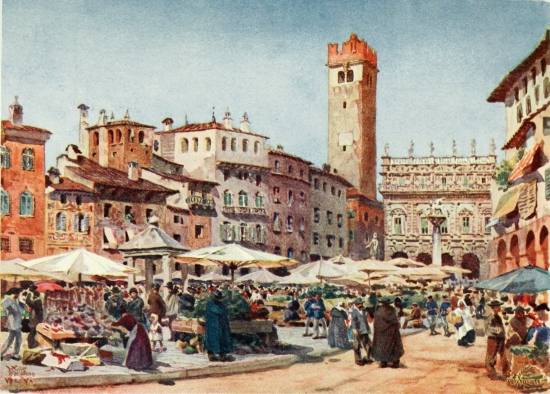
From all these it is but a step to the focus of the city's life, the Piazza delle Erbe, the forum of Roman rule, and the most picturesque market square in Italy. In the centre—and seen in the sketch—is the small open tribune which occupies the place of an old building where the newly elected Capitano del Popolo was invested with the insignia of his office. The fountain farther up the square was erected by Berengarius in 916, and supplied with fresh water by Can Signorio. The figure surmounting it gazes stonily every day over a sea of umbrellas which shelter the market folk below. Can Signorio beautified his native city, and erected the tower at the end of the piazza—a tower which can boast of the first public clock. The Lion of St. Mark stands on an isolated column, surrounded by vegetable and fruit stalls, in front of the Palazzo Tresa, a highly ornate specimen of the seventeenth century. Many of the old houses still bear traces of the frescoes which covered them, and which at one time must have made Verona's streets veritable galleries of decorative art. Others retain the marble balconies which formed so fascinating a feature of the city's architecture.
THE MARKET PLACE, VERONA
Of earlier days there still remains one of the grandest ruins in Italy—the celebrated Amphitheatre. It was the night of a hot day; a blood-red moon, mounting on her upward path in the copper-coloured sky, left a grim mass of deep shadow beneath. Bats were hawking in and out of the black shadow, as yet unrelieved by the electric lights, and the spacious piazza was nearly empty. An ominous feeling, intensified by the distant hum of the busier parts of the city, unsettled one's nerves. My thoughts travelled back to the time when, there behind that gloomy mass, slaves would be cleansing the arena after a scene of cruel sport, and the distant hum was nothing but the excited throngs discussing the brutal slaughter. Did the great poet in his twilight wanderings ever see such a moon and such a sky? It was certainly an evening that would have enticed him to shun the noisy company of his fellow men and saunter alone in the shadow of the great Amphitheatre. Perhaps his spirit was there now. Small wonder that in my dreams that night the howls of a cruel audience and the gentleness of the lonely poet were mixed up in inextricable confusion.
PADUA
The quaint old city of Padua lies on the beaten track to Venice. In its great Basilica repose the remains of St. Anthony. Giotto's frescoes in the Church of the Madonna are still a glory to behold, its university is one of the oldest in Europe, and the modern epicure can drink coffee of the very best at Pedrocchi's, an establishment as well known amongst Italians as the celebrated Florian's at Venice. The origin of Padua goes back to Antenor, whose tomb occupies a corner near the Ponte de Lorenzo close to the house at one time inhabited by Dante. A sarcophagus was discovered in 1274 during excavations for the building of a foundling hospital, and when opened, a skeleton of immense size, one hand still gripping a sword, was seen inside. Who could it be but Antenor? There was Virgil's authority for it that he had founded Padua—so Antenor it was who lay there in his stone coffin, and the good folk of Padua carried the sarcophagus and its contents to the church of S. Lorenzo amidst great excitement. The church has been demolished but the tomb was spared.
Padua's tortuous streets are lined with arcades, and although modern requirements have ordained that some should be altered and the houses pulled down, it still preserves an air of mediæval antiquity. Situated on the winding little river Bacchiglione and intersected by other small streams, it forms in the itinerary of the tourist a sort of prelude to Venice. Innumerable bridges span these waterways. Some of them are of Roman construction; and wherever one's footsteps lead one, be it along the riviere—the open streets that run by the side of the streams—or the narrow ways that may be likened to a rabbit warren, the great charm of bygone days lingers in them all, and still clings to its old walls and bridges.
The Cathedral, with an incomplete façade, was not finished till 1754. It is a vast, ugly structure of brick with a campanile and dome. The whitewashed interior possesses no redeeming feature; unless it be a rather pleasing course of grey marble that runs round on a level with the capitals of the grey columns. A bust of Petrarch, who was a canon here, and some beautiful twelfth-century MSS. with exquisite miniatures in the sacristy, are the most interesting things it contains. If there is but little in the Cathedral worthy of notice there is much in the other churches of Padua.
THE CATHEDRAL, PADUA
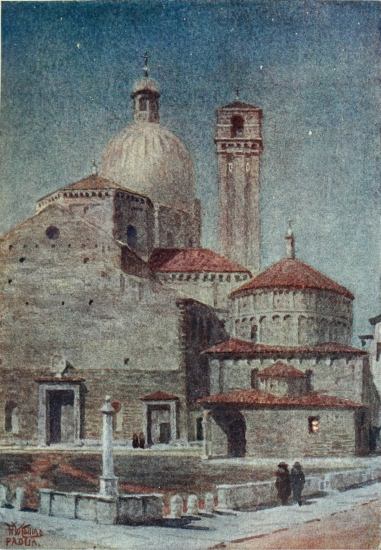
Sta Giustiana is a very fine building of the sixteenth century, commenced from designs by Padre Girolamo da Brescia and finished fifty years later by Andrea Morone. All its altars are decorated with scrolls and floral patterns, in the inlaid marble work for which Italy has been famous for many generations.
The church of S. Agostino degli Eremitani is a solemn building of a single nave three hundred feet in length, which was constructed at the latter end of the thirteenth century. Its sacristy is used by the students of the university as their chapel, and many memorials of the most famous among them cover its walls. The tombs the church contains are very interesting. One with a magnificent canopy is of the fifth Lord of Padua, Jacopo di Carrara, a friend of Petrarch's, while other members of this extinct family lie buried in the church. The Carraras were Lords of Padua for many generations; the last of the great race with his two sons held the city in 1405 against the Venetians, but famine so reduced the garrison that they surrendered themselves to the besiegers and were conveyed prisoners to Venice. The Council of Ten decreed that they should be strangled in their cells, and a member of the noble Venetian family of Priuli performed this disgraceful murder in the dungeons of the Doge's palace.
Sta Maria dell' Arena, or the church of the Madonna of the Arena, stands practically in what was the Roman Amphitheatre. About the year 1306, a certain Enrico Scrovengo, who was owner of the Arena and adjacent land, built within its precincts a chapel of the Annunciation, known as Sta Maria dell' Arena. Giotto was working in Padua at the time, and Enrico recognising his talent employed him to build and decorate the little chapel. It consists of a single nave with a Gothic apse, and tiny sacristy in which is a monument to the founder, whose tomb is behind the altar. It is not the province of this book to deal with the pictorial art of the country, but Giotto's frescoes which cover the walls of this little church stand far above all else—not excepting Fra Angelico's beautiful decorations in the monastic cells of S. Marco at Florence—in the deep piety and tender expression of intense religious feeling they portray.
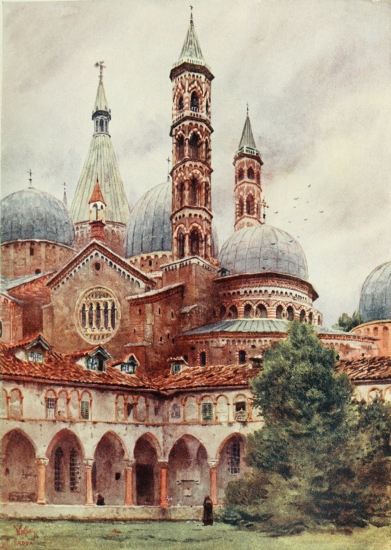
The greatest church that Padua possesses is the huge building dedicated to S. Antonio—"il Santo," as he is called by the Padovanese. This enormous fabric of marble and brick, stands facing a wide open piazza on two sides of which are low houses—houses of three storeys are very rare in the older parts of the city. Opposite the façade is Donatello's grand equestrian statue of Erasmo da Narni, or Gattamelata, bearing his name, "Opus Donatelli Flor." In the piazza is the Scuoio del Santo and the little church of San Giorgio, the sepulchral chapel of the Sograna family; close by which is the tomb of Rolando Piazzola with a fine Gothic canopy.
The seven domes of S. Antonio cluster round a heavy central spire, and two beautiful bell-towers rise elegantly to a height above; from wherever one sees the church, these domes and spires compose and "pile" well. Il Santo died in 1231, and Padua decided to erect a suitable building to hold his sacred remains. Niccolò Pisano was requisitioned for the task, but was not given a free hand. He was informed that he must follow the fashion of the day and produce a real Gothic edifice. His failure to carry out these instructions can be best seen in the façade, where the three portals are very poor; nevertheless, and despite his leanings towards other styles, he was able to introduce something of the Gothic in his bell-towers, in the open galleries round the exterior of the apse, and the arcading of the west front, with a mixed result that has produced a really stupendous church. The best decoration of the exterior is contained in the three west doors of bronze, which are exceedingly good.
The fine interior is most impressive, but what the result will be when the present scheme of decoration, already begun in the choir and apse, is carried out, it is difficult to say. The chapel of Il Santo is half way up the north aisle. Lights burn day and night before the altar, beneath which repose the saint's remains. Four fine columns support the somewhat heavy frieze of the great Renaissance screen by Sansovino, which separates it from the aisle. Two of these columns have a charming idea in their capitals, where little sea-horses take the place of the acanthus leaf. The screen is terminated by two very beautiful pilasters adorned with exquisite arabesques. The interior of this interesting chapel is lined with nine reliefs, one of which, by Sansovino, is rather curious and certainly very gruesome. The sculptor has represented a suicide with a gaping crowd of women surrounding him in his self-inflicted death agonies. Two enormous silver candlesticks, partly of Gothic and partly Renaissance design, stand at the foot of the steps of the altar, and bronze figures and silver angels are placed upon the balustrade. In the vestibule between this chapel and the next hang hundreds of votive offerings of all descriptions, forming a museum of the tangible homage paid to the saint by his devotees. The next chapel is the only part left of an ancient fabric which stood here long before the good Padovanese raised the present magnificent church as a memorial of their venerated saint.
In the south aisle, opposite to and corresponding with Il Santo's chapel, is one dedicated to S. Felix, which is fronted by a good screen decorated with an effective fish-scale pattern of Verona marble. It contains a good altar, placed high above a flight of steps, and some interesting fourteenth-century frescoes. A thick coating of paint quite spoils the well-carved Gothic stalls, and it is to be hoped that when the scheme of decoration reaches this chapel these fine stalls will be scraped and then left in their pristine state. In another chapel are the tombs of Gattamelata and his son; these and two monuments designed by Sanmicheli on two of the piers of the nave are the best in the church.
The presbytery is cut off from the nave by a low balustrade, in the centre of which, rising in a bold sweep, is a very fine bronze gate. The High Altar, impressively placed at the top of some steps, has eight splendid panels containing bas-reliefs by Donatello. The master was also responsible for the fine group of the Madonna and Saints, as well as the huge crucifix, which are placed above it. The magnificent bronze candelabrum, which stands to the left of the altar, is twelve feet high. Its maker, Andrea Riccio, spent ten years over the work before he considered it fit to leave his studio. The figures at the base are symbolical of Music, History, Destiny, and Astrology, forming with those above, a paschal candlestick that is one of the finest pieces of bronze work in any church in the country. The sanctuary beyond the apse was an addition of the year 1693, and occupies the most eastern dome seen in the illustration. Great gilded sliding doors hide a wonderful example of fifteenth-century goldsmith's work, a casket with Il Santo's tongue inside, and many other sacred relics, as well as Gattamelata's marshal's baton. The great doors are surrounded by work of the late seventeenth century, an example of the bad taste and very low ebb ecclesiastical art had sunk to at that period. Cherubs and nude female figures playing stringed instruments—angels apparently—circle round S. Antonio, who is borne aloft by other nudes. The extravagance of the whole thing is a jarring note amongst much that is extremely fine.
The monks of the brotherhood of S. Antonio still inhabit the conventual buildings attached to the church, and their dark-robed figures pass silently to and fro in the cloistered courts of the monastery. The walls of these three courts are lined with fine tombs and memorial slabs, and it was from one of these cloisters the illustration was taken. A great magnolia tree grows on the well-kept grass which covers the ground like green velvet. No sound from the outside world penetrated this sequestered nook. The only note to break the silence was the drowsy hum from a voice at prayer in one of the little green-shuttered rooms above, and the occasional twittering of a canary in its cage. One worked undisturbed at those domes and towers which compose so well and seem to reach up to the very heavens.
S. ANTONIO, PADUA
Padua's university was founded in 1221 by the Emperor Frederick II. on the site of the Inn of the Ox, and is still called il Bò. Its handsome courtyard, attributed to Palladio, is adorned with armorial bearings of distinguished alumni. At the head of the great staircase is a statue to Elena Piscopia, a poetess, musician, and fluent linguist; she received a doctor's degree and died a spinster in 1684. The anatomical theatre is the oldest in Europe. Among other famous men connected with il Bò the names of Baldus, who taught law, and Galileo, who expounded mathematics, must be mentioned.
Padua also possesses the oldest Botanical Gardens in Europe, which were instituted by the Venetian Senate in 1543. Many of the exotics which grow now all over Europe were first established here, brought from the East by Venetian traders, and the botanist can spend many interesting hours in this well cared for and shady retreat.
A vast building with a remarkable history occupies one whole side of the market square. A much-travelled architect and engineer, Fra Giovanni, visited Padua in the fourteenth century, bringing with him drawings of an Indian palace; these so pleased the Padovanese that he was asked to construct a roof to their great hall, the three divisions of which had been destroyed by fire. Fra Giovanni set to work, and his vaulted wooden ceiling, one of the largest in Europe, stands covering the principal chamber of the Palazzo della Ragione, though the roof above was renewed in 1857. The paintings on the walls of this magnificent room have by degrees replaced a series of frescoes by Giotto. They are mostly mystical and symbolical, the best among them being those representing Justice and Prudence. The wooden horse which stands in the hall is supposed to have been the model for Donatello's bronze horse on which Gattamelata is seated in the famous equestrian statue outside S. Antonio. The fine loggia on the ground floor of the palazzo is of later date than the original parts of the building, which were designed by Pietro Cozzo and constructed in the years 1172 to 1219. In a street not far off is another beautiful building, the early-Renaissance Loggia del Consiglio, with its fine stairway and open arcade. In front of this is an antique column with the Lion of S. Mark, the sign that the city at one time belonged to the Republic of Venice. Many other houses in this quaint old town are of great interest, and the windings of its streams as they meander past rose-covered walls and low roofs, with perhaps a tapering campanile or a dome towering above, afford a rare field for endeavours with the pencil and brush.
VENICE
VENICE, which has no counterpart in the world, is a city of all others in which one can linger on in a dream taking no count of time. The days run into weeks, these spread themselves into months, and it becomes more and more difficult to tear oneself away from the entrancing "Mistress of the Seas," from her Cathedral and all her other marvellous buildings; from her seductive gondolas and silent canals; from her picture galleries, and alas! from the fragrant coffee we sip idling away the time under the colonnade outside Florian's in the Piazza.
Well, the seductive cup is drained and while our cigarette is alight let us look round. Directly opposite to us, on the north side of this grand square, stretches the long colonnade of the Procuratie Vecchie, built early in the sixteenth century as a habitation for the procurators of S. Mark. It is one of the best examples of early Renaissance architecture in Italy; nobler, simpler than the Procuratie Nuove where we sit, which was built in the last quarter of the same century. An arcaded building in the classical style erected by Napoleon in 1810 connects the western extremities of the two Procuratie. It is a pity that this great Renaissance Piazza should be completed by an inferior bit of modern work instead of such a brilliant gem of the Renaissance style as Sansovino's Libreria Vecchia—at present invisible to us round the corner. To this building, which faces the Doge's Palace, no higher tribute could be given than to say that its perfection fairly distracts the admiration of the onlooker from the wonderful Gothic pile before it.
But all this is Hamlet without the Prince. It is time to leave the shadow of the arches, to step out into the open, and to surrender ourselves to the spell of the great church which draws one with an irresistible fascination from the first moment we set foot in the Piazza. S. Mark's rises bounding the vision at the eastern end of the great square with its gorgeous façade and cool grey domes. So rich is the colouring and so strange the outline that one wonders almost whether architecture has not passed here into the sister art of painting.
S. MARK'S, VENICE
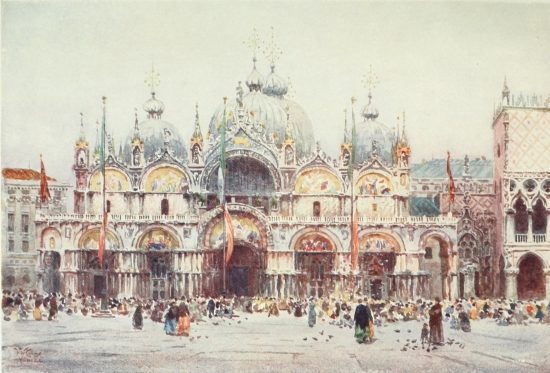
Yes, there stands a building surpassingly fascinating, unique and outside all comparison with any other church in the country. Planned as a Greek Cross, like S. Sophia at Constantinople, it is reminiscent of the East far more than any building in the peninsula, or even in Sicily where some with direct Arab influence still exist. The great traders of Venice who lavished their wealth on its decoration, and whose every homeward bound ship brought back from the Orient a choice column, a rare piece of marble, or some such thing as a contribution towards its making, helped to raise it bit by bit until the wonderful church grew to be what we find it to-day, the most seductive ecclesiastical fabric in Italy.
It was not until the year 1807 that S. Mark's became the Cathedral church of Venice. Before this date the Patriarchal seat was the church of S. Pietro di Castello, and S. Mark's simply the chapel attached to the Doge's Palace. In 828 the body of the Evangelist, stolen from Alexandria, was brought to Venice and S. Theodore the tutelary saint deposed to make way for a more important patron. S. Mark's remains were then placed in a church which was destroyed by fire in 976. The following year saw the first stone laid of a building which is perhaps the most interesting in Christendom; but it was not until eighty years had passed that the walls were finished, and seventy more gone by before it was consecrated. The interior sustaining walls are brick, and are lined with marble or covered with mosaics and decorated with every sort of inlay. The tout ensemble of this is an extraordinarily harmonious mixture of styles which compels unceasing admiration.
Standing at the west end of the Piazza one sees, almost stretching across the further side, a marvellous façade of deep shadowed arches; the tympanums seem to sparkle with jewels; the arches are supported by what appears to be a forest of columns, orderly in rank, receding into the shadow. Above, to give quality to this shade, is a flat surface that runs from end to end of the façade, broken by a central semicircular window, and crowned with Gothic turrets, crocketed finials and angels with wings outspread. Then, surmounting all are five wondrous domes, Oriental in themselves, so overpoweringly Oriental that the eye, unable at this distance to discriminate, telegraphs to the brain the magic words—"The East!" Spoils from the East, from Greece, from Syria, from Egypt; mosaics of the sixteenth and seventeenth centuries, bronze horses of Roman origin, Gothic saints under canopied turrets, flag poles with the crimson banner and golden Lion of S. Mark, all arranged without disorder, but all succumbing to the majesty of the marvellous domes. More Eastern than European is the Venetian's love of colour, and this is the note most deeply impressed on the mind with regard to S. Mark's—five grey domes, a foil to the brilliant mosaics and many-hued marble columns and walls below, but blending with them so subtly that the whole is one gorgeous chromatic scale.
The effect of the blazing sun pouring down on the façade at midday, casting deep shadows under the arches, is very fine. Again, in the evening when the domes are alight with the last rays of the dying orb and the great Piazza is in cool shade, the glories of the wonderful fabric assume a dramatic effect which becomes almost tragic as the light disappears and everything subsides into a monotone. Colour begets more subtlety in grey weather; every note that might jar on the eye is then diffused among the quieter tones around, and for this reason the pearly sky of a grey day was chosen to depict S. Mark's. The great campanile which fell to the ground on July 14, 1902, is now in course of re-erection. For some years past the necessary but hideous hoarding at its base has interfered with the beauty of the Piazza. The illustration does not show this but depicts the length of the façade, with the beautiful Porta della Carta and corner of the Doge's Palace beyond.
The lowest portion of the façade is formed as a vestibule with seven arches, the last one of which at each end is open through. All the columns and their capitals (spoils from the East) are of much older date than the building. Very few of these capitals fit the abacus on which they rest; most of them are exquisitely carved with foliage free from all imagery. The central arch is larger than the others. Under it is a grand door of forty-eight bronze panels inlaid with silver. The workmanship of the other doors which flank this is also very fine. The intricate Byzantine carving above these forms a scheme of decoration wherein figures, birds, beasts and arabesques run in a perfect riot of fanciful design. The vaulting of the vestibule is covered with mosaics of different periods. Those of the twelfth century are concerned with the Creation of the Firmament and the Creation of Life; the story of Adam and Eve continued on to the Deluge and Noah; the tragedy of Cain and Abel; Joseph's dream, Pharaoh and the story of Moses. The general scheme throughout is of white figures, mostly nude, on a green ground. Although not in any way comparable to the earlier mosaics at Ravenna, these are far better in style and true feeling for the enrichment of a flat surface than those of later date in the lunettes above the façade arches. Here the raison d'être of mosaic has been made subservient to an attempt to imitate the shades and gradations of an oil painting. The most important of these later mosaics is that which was executed from a design by Titian by the brothers Zuccati in the sixteenth century, wherein S. Mark appears in pontifical robes. It is above the centre door. On the pavement beneath is a red and white lozenge of marble marking the spot where Pope Alexander III. and Barbarossa were reconciled in July 1177, through the intervention of the Venetian Republic. Many inscribed slabs of marble bearing legends in Greek and Syriac, and Roman bas-reliefs, are let into the walls of the vestibule, evidence of offerings towards the building of the fabric. All the archivolts of the five large arches are decorated with symbolic carvings; the most interesting being that of the main entrance, where a charmingly quaint story illustrative of peasant life in the twelve months of the year tells in a realistic way the labours of those who till the soil. February with a little figure sitting at a fire warming his hands is particularly naïve.
On the south, S. Mark's joins the Doge's Palace by means of the Porta della Carta. At the base of a column which stands in an angle of the wall are four porphyry figures of knights in chain mail with arms round one another's necks. This group is supposed to have come from Acre. Detached from the main building, and not far from its south-west corner, are two short rectangular columns with Greek inscriptions. They were brought from the church of S. Saba at Ptolemais in 1256. Amongst other interesting spoils there is a slab let into the north wall on which Ceres, holding a torch in each hand, appears drawn in a chariot by two dragons. It seems to be a very early Persian work. But the best known, and certainly the finest gift the exterior of the building can boast, is that of the four bronze horses which stand over the principal entrance. Sent from Constantinople in 1204 by order of the Doge Dandolo as part of the spoils of victory when that city fell to the arms of the Venetians in the fourth Crusade, these horses at one time adorned the triumphal arch of Nero in Rome. Both Domitian and Trajan transferred them in turn to arches of their own; and Constantine conveyed them across the seas to his new capital in the East, where he also put them up over an arch. In 1797, when the Republic of Venice was no more, Napoleon took these already much-travelled horses from S. Mark's façade to Paris and placed them on the top of the Arc du Carrousel. After the peace in 1815 the Austrian Emperor, Francis I. caused them to be returned to their former position, and there they remain to-day.
Three doors open into the cathedral from the vestibule, and two on the north side. The interior strikes one at first as being very dark; but when the eye becomes accustomed to the half-light and is familiar with everything within, this wears off, and the senses are rather soothed than otherwise by the mystic gloom. Indeed, it is a great relief to find oneself inside out of the glare of the Piazza, and, seated in a corner perhaps, quietly contemplating the grand mosaics which cover the vaulting from end to end. It is quite impossible to describe these adequately in a short chapter which deals with other things as well, but noting them in guide-book fashion one observes that those in the aisles on either side of the main entrance depict the Acts and Miracles of the Apostles. On the vaulting of the dome which forms, so to speak, the foot of the Greek cross, is the Descent of the Holy Ghost. The great central dome is covered by twelfth-century mosaics of the Ascension, and the vault between this and the first dome with Christ's Passion and Resurrection. The vaulting of the two domes which compose the arms of the cross is decorated by work of later date; that on the north with the history of S. John, and that on the south with the saints. The chapel of S. John which is in the north transept was converted in the seventeenth century into one dedicated to the Miraculous Virgin of Constantinople. In the south transept also a rededication has taken place; the chapel of S. Leonard being turned into that of the Holy Sacrament.
Behind the gorgeous marble screen which divides the presbytery from the body of the church the high altar rises beneath a canopy of verde antico borne by four columns. Two of these columns are eleventh century and are elaborately carved in courses of innumerable figures. They came from Pola when Venice subdued Istria, and are much more interesting than the other two of a later date; the remains of S. Mark rest within this magnificent shrine. On the screen itself stand the Evangelist, the twelve Apostles, and Mary.
At the back of the high altar is the Pala d'Oro, the greatest treasure the cathedral possesses, and the most celebrated golden altarpiece in existence. The upper part came from Constantinople in 976, the lower about the middle of the fourteenth century. It is composed of eighty-three panels of Greek and Byzantine design filled with enamelled figures, studded with uncut gems and precious stones, and covered with Greek and Latin inscriptions. More gorgeous than that of S. Ambrogio in Milan, this magnificent piece of goldsmith's art glitters and sparkles in a wonderful manner when lit up by the candles used at high mass, and is without doubt the most splendid ecclesiastical treasure in Italy.
INTERIOR, S. MARK'S, VENICE
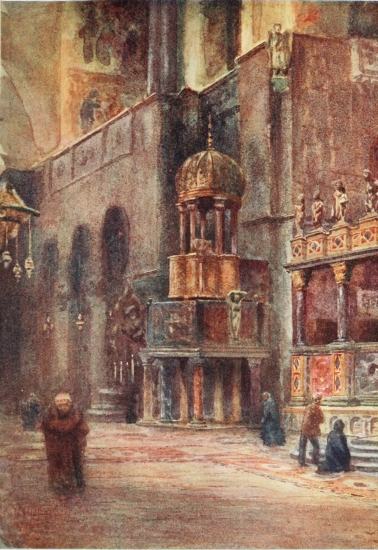
The fifth or eastern dome which is over the presbytery is covered with mosaics representing Christ and the Prophets, and one that is hardly visible of S. Mark is on the walls of the east end. The great figure of Christ faces the church and in its simplicity is very impressive.
The gallery, which is where the triforium would be in a Gothic building, runs round the whole cathedral and is pierced on its inner side only. The walls at the back and above are decorated with more mosaic work dealing with acts of martyrdom, and the Translation and Recovery of the Body of the Lord. When stray beams of sunlight find their way through the openings in the domes and pass along the gold background, lighting up in odd places small portions of these wonderful tesseræ pictures, the effect is very beautiful. All the angles of this mosaic work are rounded off and the travelling rays glinting first on one golden corner, then on another, are strangely attractive to eyes accustomed to the greater architectural severity of a northern clime. The well-chosen slabs that line the lower portions of the cathedral walls have taken to themselves a sombre, dusky hue, a pale velvety brown, but there can be no doubt that in their pristine state they realised in their splendour the Venetian's love of colour.
The strange pulpit, which with part of the rood screen seen in the illustration stands to the north of the steps leading into the presbytery, is arranged in a double tier, and is entered by a double winding stair from the vestibule of the Capella de S. Pietro. Its curious domed sounding-board is very reminiscent of the East. Mention has already been made of the chapels of the Miraculous Virgin and S. Leonard. That dedicated to S. Peter is behind this pulpit on the north side of the presbytery. It has a door leading out into the piazza. The corresponding chapel to the south is dedicated to S. Clement. At the end of the north transept is another to S. Isidore—a dark, solemn little place. The sacristy is beyond the chapel of S. Peter at the back of the presbytery. It is a fine apartment with mosaics from designs by Titian and his pupils, which may be studied as a good example of Renaissance decoration in tesseræ. Sansovino, who executed the beautiful door, is said to have had it in hand for twenty years.
The baptistery is entered from the south aisle, and with the adjoining Cappella Zeno is one of the most interesting parts of S. Mark's. In the former is the monument and sarcophagus of Doge Andrea Dandolo, who died in 1354. It is a grand specimen of the sculpture of the age. The recumbent figure of the Doge, who was the last to be buried in S. Mark's, is very serene in its realisation of the Last Sleep. All the mosaics the chamber contains were given and paid for by Andrea. Most of them naturally relate to the Holy Rite. The font is very ancient, and has a fine bronze cover designed by Sansovino and surmounted by a statuette of S. John the Baptist. A very beautiful low relief of four crossed swords which compose a cross, with birds beneath, is let into one of the walls. On the vaulted roof of the Cappella Zeno, the life of the Evangelist, whose body at first rested here, is well depicted in a series of mosaics. The centre of the chapel is occupied by the tomb of Cardinal Zeno, who left the bulk of his immense fortune to S. Mark's. The altar stands under a bronze canopy covering figures of Our Lady (who wears a gilded shoe), S. Peter, and S. John the Baptist. The legend runs that the Virgin gave her bronze shoe once to a poor votary and it was immediately turned into gold. From this incident the chapel, which became the Cardinal's Mausoleum, is also known as that of the Madonna della Scarpa.