Front matter (continued 4)
Reading edition
The six niches at the top of the clustered columns that support the cupola are filled with colossal metal figures. On bronze brackets, fixed to each pier of the choir, are thirteenth-century bronze figures of angels holding lamps. One admires the good taste that has always left these bronzes ungilded. The same praise may be accorded in the case of the grand bronze candlesticks on the high altar, and the magnificent tabernacle by Lorenzo di Pietro which rests on it. The only note which really jars is the crescent of hideous gilded cherubims that partially surround the east window. The choir stalls, which were exchanged for those in the convent of Mont' Oliveto Maggiore, nineteen miles out of Siena, have extremely good intarsia work of architectural and "still-life" panels.
INTERIOR OF SIENA CATHEDRAL
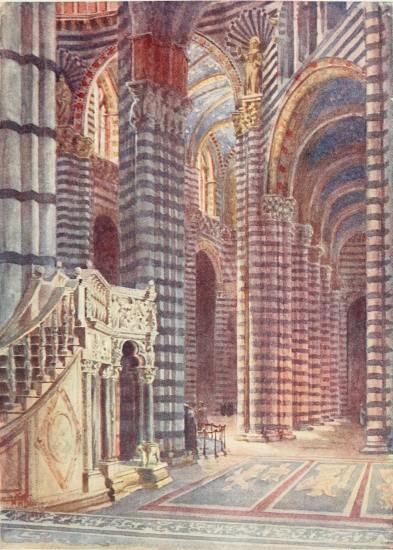
In the north aisle is the Piccolomini chapel, with a very fine Renaissance wall of carved arabesques. In niches stand statuettes, in the execution of which Michael Angelo had a hand. The celebrated Libreria Piccolomini adjoins this. Its walls are decorated with the frescoes of the life of Pius II., a scion of this noble House. In the centre of the library stands the beautiful group of the Three Graces, a Græco-Roman work which Raphael drew from and studied.
The baptistery, S. Giovanni Battista, is below the east end of the cathedral on a steep hill-side. Its exceptionally good Gothic front by Giacomo di Mino was never completed, and for this reason, as will be seen in the illustration, the roof of the cathedral has a barn-like termination at this end. The interior is a sort of transverse nave with two piers supporting a groined and vaulted roof. The frescoes of the apse, though much faded, still retain some of the rich colouring with which two Brescian painters decorated them. The font is a very beautiful example of Giacomo della Quercia's work, and is adorned with six bronze gilt panels, one of which is by Donatello. Small figures occupy the corners, and are by the same master-craftsman.
Among the many great names on Siena's roll of fame, the two saints Catherine and Bernardino are perhaps the best known. A little way beyond the margin of the first picture of this chapter, to the left, is the house where the former first saw light. The last of twenty-five children born to Giacomo Beninsca and his wife, her childhood was marked by an extraordinary ascetic devotion overwhelming all other feelings, so that at the age of sixteen she entered the Order of S. Dominic. The series of chapels which the Casa Beninsca is now turned into will be for some, from their sacred associations, the most interesting spots in all the city. The house has a charming loggia and cortile, but otherwise no architectural features worthy of note. On the hill above, and behind the spot from which the sketch was made, is the church of S. Domenico, in which S. Catherine worshipped; it is a huge building in the style of all Dominican churches, with a great nave, no aisles, a shallow choir and transepts. Her life was one replete with visions. In the chapel at the west end S. Catherine took the veil. Little could she have known at the time, that she was ordained some future day to be the prime factor in recalling Pope Gregory XI. from Avignon to Rome.
S. Bernardino was the son of the Governor of Massa Maritima, a Sienese town not far from the coast opposite the Isle of Elba. He joined the preaching Order of S. Francis at the age of twenty-two, and was one of those who always drew immense crowds to listen to his eloquent words. When in Florence he made a bonfire of evil books and vanities, thus forestalling one of Savonarola's great revolutionary acts. So great was his influence considered to be that, while in Perugia, the great bell was always tolled during his occupation of the pulpit. Care of the poor was one of his chief aims, and he established the "Monte di Pietà," for lending money on small pledges, to save those in want from the heavy hand of the usurer.
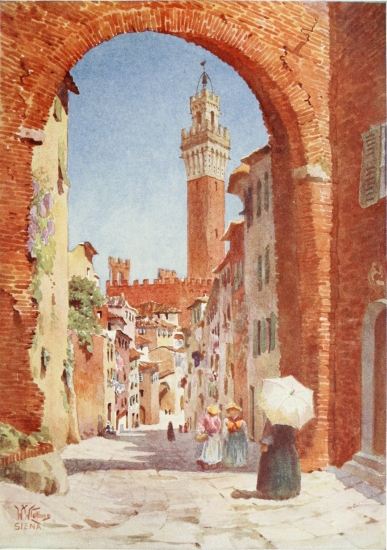
Of all the palaces in Siena that which stands on the south side of the Campo, the Palazzo Pubblico, is the most famous. Nearly every one who reads these lines must be familiar, through photographs or otherwise, with the magnificent campanile "del Mangia"—a title that originated with a figure, nicknamed the "Glutton," that at one time struck the hours on its bells. The illustration gives a view of the tower seen through the Arco di S. Guiseppe. It is three hundred and thirty-four feet high, and is built of brick with a machicolated stone cap and bell-turret above. At its base stands the Cappella della Piazza, a very beautiful open loggia, built to commemorate the city's deliverance from the great plague that was instrumental in causing the proposed enlargement of the cathedral to be given up. The Palazzo itself consists of a huge central square block with Sienese battlements—square with hatched mouldings. A couple of turrets rise in three storeys above the two side wings of the block. The lowest storey of the building is of stone, the others of that delightful red brick which charms the painter's eye, and is peculiar to Siena. All the windows of the palace are pointed, with a flat containing-member outside the three lights of each. Two good courtyards give entrance by stairways to the upper floors of the building, which is now used for judicial business. Almost opposite, across the Campo, is the Palazzo del Governo, formerly the palace of the great Piccolomini family. It contains the treasures of Siena, the state archives; and in front of it stands the Font Gaia.
In the Via del Capitano, leading into the Piazza del Duomo, is the Palazzo Squarcialupi. This thirteenth-century building was, in the old days, the official residence of the Judges of Appeal and the Captains of War. The Loggia dei Mercanti was built in the fifteenth century for the use of the City Fathers who assembled here in their business capacity of merchants to judge trade disputes. So widespread was the fame of this impartial tribunal that foreigners often brought their differences before it for adjustment. The palace is now known as the Casino dei Nobili. Many fine residences line the tortuous and shady thoroughfares, and others form parts of the different squares. Most of them have iron rings and brackets let into their walls similar to many of the Florentine palaces and those already mentioned in the chapter on Bologna.
THE ARCO DI S. GIUSEPPE, SIENA
It is not, however, so much in the individual buildings that the charm of Siena lies, nor in the long line of painters whose works are on the walls of the Spedale in the Piazza del Duomo, in the Accademia delle Belle Arti, and elsewhere. Rather is it in the personal and intimate note of the beautiful old city taken as a whole. For even the sojourn of a single week will captivate and make one feel as if he belonged to Siena, and Siena to him. It may be that the wheeled traffic, which can follow but two or three distinct lines through her streets, shuts off in silence large areas of the city, and that the visitor is left more to himself and his reveries than is the case in most Italian towns. Whatever it be, it is difficult to define, but the more one knows Siena the more whole-heartedly does one give oneself up to her charm.
Is there anything quite the same, quite so peaceful, and yet so full of history's wars, as the view from the pleasant gardens of La Lizza? Pass on to the walls of the Fortessa at the end of "the Lists," or old tilting-ground, and what a beautiful landscape unfolds itself! Undulating ground, covered with vines and orchards, carries us into a middle distance of cypress and pine-clad hills. These stretch away into an opalescent haze, out of which to the north and east rise the peaks of far-distant mountains. To the west but one great mass soars above the sea of golden mist—Mte. Amiata, always different yet always the same. A solitary mountain, once seen ever remembered; a mountain one can love. What a land of sunshine and pastoral beauty it is! Always at its best in springtime before the summer's sun has laid its grip on the red earth and scorched it sere, and when the showers of April freshen and draw from the warm soil that scent of Mother Earth, which nothing man has ever made can equal and which no money can buy.
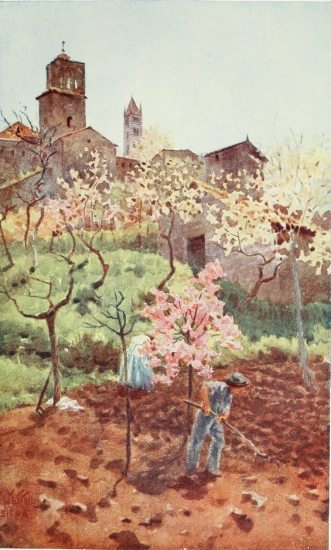
UNDER THE WALLS, SIENA
ORVIETO
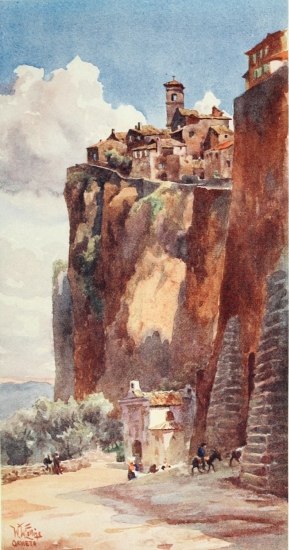
ORVIETO, yet another of the wonderful hill towns of Italy, is quite unlike any of those with which this book has hitherto dealt. It has an absolutely insular position, due to its situation on top of an isolated crag of dark volcanic rock which rises out of the wide valley of the river Paglia. The rock, which crowns the steep slopes of a hill, goes upwards a sheer precipice on three sides. On the fourth, the old road circles and winds in and out of olive groves and orchards, until, having climbed the ascent, it finally enters the city in a bold curve close to where the funicular rail from the station terminates. The principal entrance is the Porta Maggiore at the other end of the rock. It is a gateway hewn out of the solid tufa and built across a very narrow natural gorge. Two other gates pierce the walls. One, at the east end, is close to the old Fortessa—now converted into a charming garden. Like an old eagle that in his declining years cannot trust his wings for far flight, this grim old city, built of black lava, broods over the sweep of country below. Very few places in the country occupied so impregnable a position.
On the northern slopes of the hill there has been unearthed in a peasant's garden one of the most complete Etruscan necropoli in Italy. One tomb is left exactly as it was found, with the contents—vases, jars, utensils of bronze, &c.—in their original position.
LA PORTA MAGGIORE, ORVIETO
In the troublous times that so often overtook Papal Rome no fewer than thirty-two different Pontiffs found refuge in Orvieto from incipient revolutions. The impregnable situation of the city rendered it safe and immune from attack. Pope Clement VII., who fled here after the sack of Rome by the Emperor Charles V., caused the Pozzo di S. Patrizio to be made. This extremely cleverly constructed well is hewn out of the solid rock for a depth of one hundred-and-eighty feet, and has a double spiral staircase outside the water shaft. The Papal Court naturally followed the Pope, and Orvieto in the days which have gone must have worn a more human air than it does now. One can understand that then its dark, solemn streets resounded with a little gaiety, and its palaces had a greater show of life than they have at the present time. True, the owners now spend most of the year in Rome, and reside in their fortress homes for the summer months only. But even their advent does not, to the stranger, bring much more life into this solemn place. No other word describes the palaces of Orvieto better than the above. Nearly every one of these fortress palaces has a tower of defence, the walls of which are from eight to ten feet thick. Many of them are connected with one another by underground passages, and none have any windows at all accessible from the outside. The lower class of inhabitants are quiet and sad-looking. They appear even to this day to live under some heavy mental weight. Maybe generations of suppression and the dominance of an intriguing Court has had an influence that is inbred into the children born now. Then, too, it was so far down hill and up across the opposite slopes to the world beyond! So toilsome a climb to return home! You feel this to-day when you live in Orvieto—feel that this silent city is an island. Can you be surprised, when you think of these adverse influences, that the poorer Orvietans have not quite the gay and friendly air of the peasantry of the plains? But whatever the people may be, they live in a wonderful old city, and they live under the shadow of a grand Gothic cathedral.
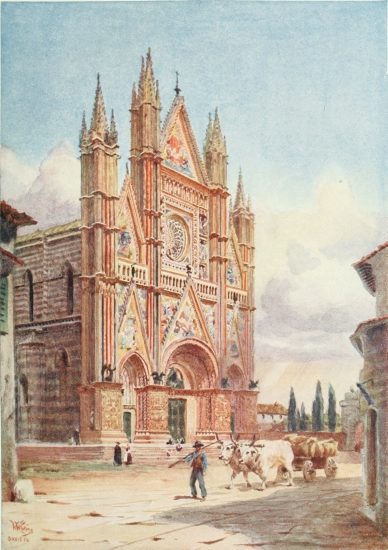
Standing in a fine open piazza with the Palazzo del Papa on one side, the Hospital on another, and the Bishop's palace on a third, this fine church occupies the vantage ground of Orvieto. In the Vatican, one of Raphael's well-known frescoes illustrates the miracle of Bolsena. It was to commemorate this that Pope Urban IV. founded the cathedral. The magnificent façade has three porches. The centre one has round arches, and the other two are pointed. Four flat panels are at the bases of the shafts that divide the façade. These shafts end in crocketed pinnacles surrounding the Gothic turrets, which soar upwards beyond the three gables at the top of the façade. The gables themselves rise above the roofs of the nave and aisles. The only fault one can find with this beautiful building, and it is one common to most Italian Gothic churches, is that the façade is "stuck on," and does not really form part of the architectural composition of the building. A glance at the illustration will explain what is meant.
The four panels are justly placed among the masterpieces of Italian sculpture of the thirteenth century. Vasari attributes the designs to Niccolò Pisano. This may be, but it is known that Giovanni Pisano and others were the artists who executed them. The first in order begins at the lowest left-hand corner of the north panel, and records the Creation of the World and all beasts and birds. Then follow the histories of Adam and Eve, Cain and Abel, Jubal—making bells, and Tubal-Cain measuring on a scroll with a compass.
THE FAÇADE OF THE CATHEDRAL, ORVIETO
This completes the first and best panel of the four. Each incident is enclosed by a very beautifully cut and intricate pattern of the vine. The second panel depicts scenes from the Old Testament; the third, the Tree of Jesse, the Nativity and Life of Christ, with classic foliage intervening. The fourth is very good and represents the Resurrection; here figures of a very Greek type rise from Greek sarcophagi. Saints, Virgins, and the Saviour in Glory surrounded by Apostles also find places on this panel. It finishes in the lowest right-hand corner with a most realistic scene in Hell. Raphael, it is said, came to Orvieto to study these wonderful works.
Immediately above and at the bases of the four shafts are the huge bronze symbols of the four Evangelists. They rest on the abaci of the pilasters which form a sort of drip-course right along the façade. Over the centre porch is a bronze tent, the curtains of which Angels draw aside revealing the Virgin and Child seated. The lights, forming the tympanums of the porches, are thin sheets of alabaster. The columns are spiral and twisted, octagonal and quadrangular. Each is set against a different coloured background of black lava, red, white, or grey marble; and each is covered with geometrical mosaic. The wheel window of the façade is beautified with exceptionally good tracing. It is framed by quatrefoils in panels, with the head of a saint in each. On two sides of these, in recessed rectangular niches, are statues of the Twelve Apostles.
At the top of the frame are canopied niches with a row of saints. The whole of this wonderful front is covered by modern mosaics which do not quite fit in with the severe lines of the architecture. Neither does the scheme of colour in which they are executed take its place with the warmth of the marble as well as it might.
The whole of the main building is constructed in bands of black lava and white marble. Semicircular chapels in the aisles break the monotony of the lower portion of the exterior; while the upper is rendered less severe by the pointed clerestory windows, a dripstone and string-course, and a good cornice.
The interior is one of the best in Italy. It was greatly improved when the colossal statues which stood at the bases of the piers were removed, and the side chapels cleared of their altars and rather meretricious adornments. The massive columns of the nave, eight of which are round, four clustered, and two engaged, have capitals that partake of a style far more classic than Gothic. Above the round arches they support runs a triforium gallery. This is open in the nave, and covered at the west end, where it follows the slope upwards of the gables of the aisles. At the east end it is carried over the window, being also covered in here. The windows of the aisles are all filled, or partly filled, with thin slabs of alabaster. The effect of light produced through this thick but comparatively translucent medium is extremely mellow and beautiful.
The short transepts are raised three steps above the nave, and the choir five. A fine red marble balustrade separates the latter from the rest of the church. The open stalls in the choir have some extremely good intarsia work. The wooden screen that shuts them off from the nave is a carved mass of most intricate geometrical design. Under the east window is the bishop's throne, backed and surrounded with more good intarsia, in which saints and sainted bishops with their symbols most effectively figure. The walls above and around are covered with fourteenth-century frescoes by Pietro di Puccio and Ugolino, both native artists. In their present faded state they harmonise beautifully with their surroundings, to which the colour of the well-worn red marble floor of the cathedral adds a pleasant note.
The work of Luca Signorelli can be better studied in the Cappella della Madonna di S. Brizio than anywhere else in Italy. This chapel practically forms the shallow south transept. In the magnificent frescoes which adorn its walls one can trace the possible influence of this great painter on the works of Michael Angelo. Two panels of the ceiling came from the brush of Fra Angelico. The north transept is almost entirely occupied by the Cappella del S.S. Corporale. The reliquary containing the "Corporal," or linen cloth of the Miracle of Bolsena, is kept over the altar. This reliquary is a fine piece of silver-gilt work, with two dozen beautiful panels of blue enamel. It was on to this linen cloth that the Blood dropped from the broken Host, and convinced the officiating priest of the Real Presence. Pope Urban IV. had it brought from Bolsena, and commenced to build this magnificent cathedral as a great shrine in which the sacred relic should rest for ever.
Behind the cathedral, that is to the east, Orvieto, not many years ago, was a ruined, broken-down mass of insanitary buildings. Gardens now take the place of what was a plague-spot, and the houses of the city as we find it now occupy barely one-half of the area contained within the walls. In this respect modern ideas have decidedly improved Orvieto. What is left of the old streets is well looked after from the sanitary point of view; and from the artistic, there are not many places in Italy where subjects are to be found in such plenty. The massive Torre del Moro is close to the Piazza del Popolo, where stands the ruined church of S. Domenico. This fine Romanesque structure is entered by a flight of steps at the west end; it is built over a massively constructed crypt, now used as a granary. The mighty arches of this crypt sustain part of the church, but it does not extend beneath the whole of the fabric. One of the numerous arched gateways which are to be found throughout the city intervenes between it and the little buttressed dwelling underneath the east end. From this rises the solid campanile. An arcade runs round the whole church. This good feature is composed of round arches, containing small round-headed lights. The outer member of each arch is finished by a broad, flat, square billet, the inner has a cable pattern. Above is a dripstone and string-course.
Saturday sees the piazza crowded with country folk, and it then presents a busy scene. All the rest of the week it is silent and deserted. I was there with my sketch-book one afternoon. A thunderstorm was rolling about in the hills. The air was charged with disturbing electricity. Swifts flew screaming round the ruined church. A kestrel up in the battered old tower cried to her young. The storm crept nearer. Grand cumuli clouds piled themselves higher and higher above the lightning-riven mass of rain-sodden blackness below. A beautiful swallow-tail butterfly, brilliant against the deep purple background, came gracefully sailing across the square into the sunshine. It hovered, now here, now there, like a spirit from another world seeking rest but finding none. Little puffs of wind stirred odd bits of straw and paper about the piazza. Dust began to eddy round and round. A drop of rain fell on to the open leaves of my sketch-book. It was the writing on the wall; so I closed the book and hurried home. For half an hour the heavens emptied themselves on Orvieto. To me a stage-play of some scene in her past was re-enacted in the sky; the passing storm seemed so appropriate to the rugged old city.
ROME
WITH pen in hand one approaches the subject of the Eternal City with great diffidence. The more one's acquaintance with her has ripened, the more does the attempt to write a chapter seem a hopeless task. There are so many Romes—Republican Rome, Imperial Rome, Rome of the Papal supremacy, Christian Rome, Pagan Rome; and then Modern Rome, with a municipality that is fast changing the face of everything. Catering for the tourist in these days of cheap transit does much to alter things. In the end it will defeat its own object, and history will be contained in libraries and museums only. Rome, like London, is fast becoming cosmopolitan. The perícolo giallo, or "yellow peril," as the motor post 'bus is facetiously called, rushes through streets where not so long ago solemn processions of the Mother Church wended their way. Building is going on at present with feverish haste. The "boom" of 1880, which ruined many of the wealthy families who speculated in it, does not seem to have acted as a deterrent to others. The great boulevard projected by the powers that be, slowly grows in length. Despite the outcry against such vandalism, an area that might disclose and yield up unknown archæological treasures if properly excavated is being levelled in the sacred names of sanitation and opportunism! The picturesque dwellings that lined the banks of Rome's famous river have disappeared, and the yellow waters of the historic Tiber rush along between massive walls of stone.
Is it possible amid all these rapid changes to realise what Rome has been and is still? No, not on any of her seven hills, not in her streets, nor on her river embankments, not even in her churches, can this now be done. No: to realise the power and majesty of Ancient Rome one must go out into the Campagna, that desolate plain in which she lies. There, where the stupendous ruins of her great aqueducts stretch away in utter loneliness to the distant hills; there, where once a prosperous people dwelt in plenty, and where the only living things likely to be seen now are a statuesque goatherd and his nibbling flock—there, one may gather an idea of the might of ancient Rome. By Hadrian's Wall, which cuts the Borderland of England, one may do the same; and there are none of her ruined outposts, east or west, where her majesty is not more apparent than in the Eternal City herself.
ON THE PALATINE, ROME
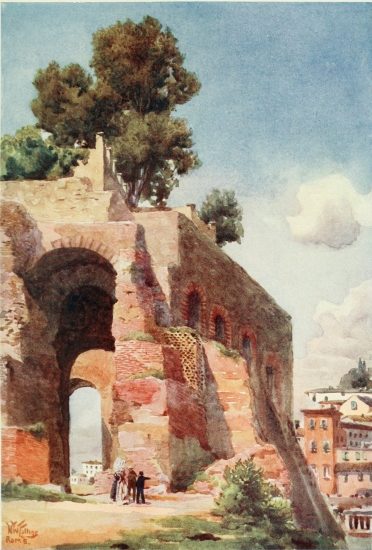
Up on the Palatine, close to the trees that are seen in the sketch of the Clovis Victoriæ, the Etruscan wall of the first Rome is now in course of excavation. Up there, too, are the remains of the first wall of the Roman city built by Servius Tullius. In the Via Merulana part of a great earthwork with a moat outside can still be seen. Long after Carthage had been practically obliterated by her rival, Rome had extended so far, and attacks from outside became of so great a danger to the inhabitants, that Aurelian found it necessary to build a line of defence which the present walls might be said to occupy. From that time onwards the city grew steadily to a magnificence and power which has never been equalled. She ruled the known world. But it was not until Constantine the Great transferred himself and the seat of empire to Byzantium that the turning-point in her fortunes was reached. Well has the great emperor earned that proud title! From Milan he issued the decree which gave to the much persecuted Christians equal rights with other religions; and even went further, embracing the faith he had befriended.
Many churches lay claim to be the oldest foundation in Rome. S. Pudenziana is said to be the church S. Paul founded in the house of his Senator friend Pudens. Recent excavations under S. Clemente have brought to light early-Christian masonry beneath the Republican and Imperial remains, over which the present edifice stands. S. Prisca is another ancient church; and tradition attributes S. Giovanni in Laterano, S. Pietro, S. Paolo, S. Lorenzo, S. Croce in Gerusalemene, S. Agnese, and SS. Pietro e Marcellino to Constantine's era. The first four of these, with S. Maria Maggiore, were afterwards known as the Patriarchal Churches over which the Pope presided. With S. Croce and S. Sebastiano, they became the seven churches of Rome. In them the Pontiff celebrated High Mass; and they were the principal churches which drew pilgrims from throughout Christendom. In these seven the high altar presents its back to the congregation, for His Holiness celebrates Mass with his face to the worshippers. The Papal supremacy really owed its foundation to Gregory the Great. But it was not until two hundred years after his decease, when on Christmas Day of the year 800, Charlemagne was crowned by Leo III., that the "Holy Roman Empire" became an accomplished fact. Unfortunately for Ancient Rome the Carlovingian period was one of demolition and plunder. Christian zeal cared nought for the beauty of pagan buildings, and many an one was pulled down and a church erected with the material. It was later on however, in the time of the Renaissance, that columns and marble of every sort were used for the adornment of the numerous sacred edifices which sprang up. What was not wanted in construction was ground down to make lime. Banding iron, clamps, bronzes, and every description of metal that was found were thrown into furnaces and melted down. Nothing that could be made use of for building material was spared. The Church could never forget the persecution she had undergone, nor the thousands of martyrs who had died for the Faith. Is it a matter for surprise then—a surprise one must add mingled with great regret—that the glorious buildings of ancient Rome have almost disappeared?
Whichever of all Rome's churches was founded first, there is no disputing the fact that the huge fabric which occupies one side of the Piazza di S. Pietro is the most famous Christian edifice in the world. Bernini's best work, the grand colonnades on two sides of the square lead up in splendid curves to the great façade of S. Peter's. But, so great is the size of the building, so far set back the dome, that it is impossible to realise the immensity of either from any point of view in the piazza. The first church was founded in the year 90 at the place where so many martyrs had suffered death during the time of the tyrant Nero. The Emperor Constantine commenced afterwards the erection of a basilica on this spot, the façade of which Raphael has handed down in his fresco of the Incendio del Borgo. When Julian della Rovere became Pope Julius II., he wantonly ordered the destruction of the church as it then stood. This was done to make way for a greater with which his own name would be for ever connected; and he employed Bramante to design the new cathedral. Hands once more were laid on the buildings of ancient Rome and the construction was begun from its ruins. Except for some of the columns, the whole of the marble work of S. Peter's was, up to the commencement of last century, abstracted from the same source. Bramante's designs were never carried out. The many alterations to which they were subjected after his death led to great dissatisfaction, and in the end Michael Angelo was consulted. All he could do was to reserve as much as possible of the great architect's ground plan, and this is, except for the lengthening of the nave and the addition of the façade, as the great cathedral stands to-day.
The immense travertine columns of the façade form part of a portico which is over two hundred feet in length. Above the columns runs an inscription recording that it was put up by the Borghese Pontiff, Paul V. A balustrade, broken by pedestals, surmounts the cymatium; on the pedestals are extra-colossal figures of the Saviour (in the centre) and the Twelve Apostles. At either end are groups of barroque angels surrounding a circle over which is the Papal Mitre. In one of these circles there is a timepiece. The ceiling of the portico is a fine example of stucco work.
There are five doors which open into the building. The central is of bronze and one of the few things spared by the destroyer Julius when he demolished the old basilica. The doors next to this are those by which one enters the church. In March 1910 the old and very unhygienic leather flaps were removed, and glazed swing-doors have taken their place. The Porta Santa, or door at the north end of the portico, is walled up. It was only opened for the purpose of celebrating a Jubilee, and has been closed since 1825.
Many and repeated visits are necessary to S. Peter's before the size of the vast interior can be in any way grasped. It is only when one is accustomed to the scale of the little human figures walking about and their insignificance in proportion to the whole, that the immense height of even the Corinthian pilasters of the piers becomes apparent. The roof is vaulted, coffered and gilded. It is supported by four piers on each side of the nave. The floor is of coloured marble, and has the measurements of the great churches of Christendom let in with brass at the spot where each would end if measured from the east. Just inside the central bronze door is a slab of porphyry upon which the emperors were crowned. At the base of each pier, as well as in other parts of the church, the colossal statues of the founders of different religious Orders find a place. The last pier on the right has a bronze figure of S. Peter seated, one foot of which is partially worn away by the lips of devotees.
The dome grows upwards from four massive buttresses. Niches above their bases contain figures of SS. Longinus, Andrew, Helena, and Veronica, who holds the napkin with the impress of the Saviour's Face. Under the dome is the Confessio of S. Peter, to reach which a double flight of steps leads down. Eighty-nine lamps for ever burn on the balustrade which encloses the well of the entrance; and doors of gilded bronze shut off the niche in which the sarcophagus of the Apostle rests. Soaring high up on four bronze columns ninety-four feet from the floor, the great baldacchino rises above all. But so immense is the space under the dome that one has no idea of the height it attains. It was designed by Bernini, and is made partly of the bronze which covered the roof of the Pantheon.
Nothing at all can be said in praise of Bernini's design. The high altar, at which only the Pope celebrates mass, is above the Confessio and directly under the cross which forms the apex of this somewhat unsightly mass of metal. The interior decoration of the dome is not in any way striking. Above the four statues of the already enumerated saints are the loggie, containing the sacred relics of the lance which pierced the crucified Saviour's side, the head of S. Andrew, a portion of the Cross, and the "Volto-Santo"—the napkin or handkerchief of S. Veronica, which wiped the Lord's brow on the way to Calvary. Four mosaics of the Evangelists are beneath the frieze which carries the drum of the dome; and a series of four each are between the sixteen gilded ribs of the vaulting. In the tribune at the east end of the cathedral is the ancient wooden episcopal chair of S. Peter.
Amongst other celebrated things which S. Peter's contains is the Pietà of Michael Angelo in the Capella della Pietà. The great sculptor has inscribed his name on the girdle of the Virgin—the only occasion on which he has done so. Opening out from this chapel is another, in which is a column, said to be that against which Christ leaned when preaching in the Temple at Jerusalem. Adjacent to this is the tomb of the great Countess Matilda by Bernini. The tombs and monuments of many Popes are to be found in other chapels, but none of them possess any real artistic merit. The best is that of Alessandro Farnese, Pope Paul III. It is by Guglielmo della Porta, and was one of the most expensive to erect. In the crypt, which is divided into two parts, the Grotte Vecchie, and the Grotto Nuovo, are the sarcophagi and fragments of sarcophagi of many other Popes, among them being that of Nicholas Breakspeare, the only Englishman who ever attained the dignity. The sarcophagus of S. Peter, already mentioned, is in the Confessio, or shrine of SS. Peter and Paul, which is richly ornamented with gold and studded with jewels.
In the Stanza Capitolare, which is part of the sacristy, are some remnants from the brush of Giotto that at one time adorned the walls of the old Confessio. The treasury contains a wonderful collection of jewelled crucifixes and candelabra. Among the latter is to be found the work of Cellini and Michael Angelo. The famous sacerdotal robe known as the Dalmatica di Papa San Leone, and said to be that used at the coronation of Charlemagne, is also kept here. Apart from its sacred interest, the great cathedral of S. Peter's cannot be said to raise any feelings other than wonderment at its size and admiration for its grand proportions. The exterior is disappointing, and many and many a visit must be paid to the interior before wonderment reaches admiration. Just as it is possible to gain the best impression of the power of ancient Rome outside Rome itself, so does one grasp the size of the mighty fabric only when some miles away in the country beyond the walls. Climb the lower slopes of the hills near Tivoli or Frascati, and what does one see? Apparently a level plain, out of which rises far away a marvellous dome. From Tivoli, especially, one sees nothing of the city on the Seven Hills. The line of fir-trees beyond Monte Mario is visible, and maybe, the afternoon sun shining on the distant Mediterranean. But save for the great dome there is nothing to indicate to the eye that the Eternal City lies well within the range of vision. Yet in Rome itself, though it is paradoxical to say so, the dome of S. Peter's in no way dominates anything, albeit that it rises above everything else. The enormous monument in course of erection on the Capitoline appears bigger. Each of the seven hills seems to be of greater altitude. But the former is not so large, and the latter do not reach the same height. Thus, the great church holds her own—but, physically as well as spiritually, one must go outside Rome to realise this.
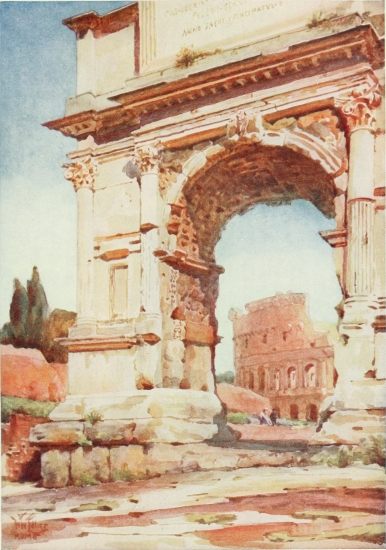
To return to ancient times, we find an absorbingly interesting link with pre-Christian days sculptured on one of the panels which decorate the interior of the Arch of Titus. The Via Sacra passed under this arch, which was erected to commemorate the taking of Jerusalem. The panel in question has figured on it in bas-relief a procession bearing the seven-branched candlestick and tabernacle which were spoils from the Jewish Temple. This is the only known material proof existing of the former object, and may therefore be justly said to be of surpassing ecclesiastical interest. Through the archway one sees the half-ruined walls of the Colosseum, the greatest amphitheatre in the world. This, too, is of intense religious interest. In the arena hundreds of Christian martyrs were torn to pieces by wild beasts, or butchered to fill the passing hours with amusement for the Roman populace. Pope Benedict XIV. consecrated the interior after erecting gates outside to preserve it from the demolition which up to his day had been going on for centuries. Small chapels were also formed amongst the lower structural arches, and services held where once the walls resounded to the shouts of bloodthirsty spectators. Close by the Colosseum is another fine archway, the Arch of Constantine. This likewise, has an interest apart from its design. It was put up when the great emperor declared himself in favour of the Christian faith. The devout may ponder over the fact that these two arches, so closely connected with Christianity, are still standing, while nearly every other has long since been razed to the ground.
THE ARCH OF TITUS, ROME
Away to the south-east of these three buildings the Mother Church of Rome is situated close to the city walls. Here, on rising ground, overlooking the vast Campagna, stands S. Giovanni in Laterano, "omnium urbis et orbis ecclesiarum mater et caput." Dedicated originally to Christ the Saviour, and afterwards in the sixth century to S. John, this fine basilica is of much greater, archæological interest than S. Peter's. The present building dates from the seventeenth century. All that remains of the once attached Benedictine monastery is to be found in the very beautiful cloisters, which are a transition between Romanesque and Gothic. The church itself has a fine eastern façade—it orientates to the west—of five arches with an intervening gallery. In the atrium is a statue of Constantine found in his Thermæ. The interior of the basilica is simple, with a very good opus Alexandrinum floor. The aisles are double, and are separated from the nave by eleven bays on each side. Colossal statues of Apostles and Prophets find places at the bases of the pillars. The transepts and tribune are raised above the body of the church. In the centre, the high altar is situated under an ornate Gothic canopy. This contains a tabernacle, erected partly at the expense of Charles V. of France, to receive the busts of SS. Peter and Paul which were found amidst the ruins of the older church. A few years ago the tribune was extended and beautifully inlaid with mosaic carrying out a design of the thirteenth century. Michael Angelo is said to have designed the flat ceiling of the nave, and there is a wooden figure of S. John by Donatello in the sacristy.
In the Piazza di S. Giovanni in Laterano stands a building that contains the Scala Santa, a flight of steps from Pilate's palace in Jerusalem, which Christ is said to have ascended. They are covered with wood, and may only be ascended on the knees. Light enters through barred windows, and partly illumines the solemn gloom of this deeply interesting place. At the top of the stairs is the Sancta Sanctorum, on the architrave above which is engraved in Latin: "There is not a place in the whole world more holy." This was the old chapel of the Popes and the only part of the Pontifical palace that the fire of 1308 did not consume. The present Palazzo del Laterano was built on part of the site of that which this fire destroyed. The old palace was the residence of the Popes from the time of Constantine until their migration to Avignon. The building that now enjoys the above title is a museum, wherein are many fine pieces of pagan sculpture as well as other interesting antiquities. The baptistery of the Lateran stands to the west of the basilica. The interior of this octagonal building is simple but not well lighted. Eight porphyry columns support an antique architrave; and eight smaller columns of marble rise from this and support the dome. The font is in the centre of the floor, which is lower than the pavement near the walls. It is of green basalt, and is supposed to be that in which the Anglo-Saxon king Caedwalla was baptised in the year 689. Rienzi bathed in it the night before he summoned the Pope and the Electors of Germany to appear before him for judgment.
Another and more magnificent basilica is that of S. Paolo fuori, which is situated two miles out of Rome on the Via Ostia. It is the grandest of the many basilicas Rome possesses. Constantine erected a tropæum, or sepulchral monument over the spot where Lucina buried the apostle's body; and in 386 the Consul Sallustrius by the Emperor's order began to build the church, which was known as the Basilica Ostiensis. The little town that arose around this sacred spot was on the banks of the Tiber, and from its position was subject to raids from the Saracens and other marauders who sailed up the stream. John VIII. in the ninth century enclosed the basilica and most of the surrounding buildings within a fortified wall. For fifteen hundred years this grand church has had as venerated a shrine as S. Peter's. The kings of England were its protectors until the Reformation severed their connection with the Roman creed; and sovereigns from all parts of Christendom came here to worship. On July 17, 1823, the pine roof caught fire and fell into the nave. The heat from the smouldering mass was so great that some of the columns split and the whole fabric was almost entirely destroyed. Pius IX. presided at a great function in 1854, when prelates from all over the world assisted at the consecration of the restored building. Eighty monoliths of Simplon granite, brought down Lake Maggiore to the river Po and then by sea up the Tiber, sustain the roof of the nave and aisles. A series of Papal portraits form a frieze above them. Magnificent columns of Egyptian alabaster presented by Mehemet Ali, Viceroy of Egypt, support the baldacchino over the high altar. The bases of these columns are malachite, and were given by the Czar Nicholas of Russia. Many other portions of this noble church were given by other princes. The dismay and regret at its destruction were universal. The body of S. Paul rests in the Confessio beneath the altar. The very beautiful cloisters of the old Benedictine monastery, now a barrack, vie with those at Monreale in Sicily, which are illustrated in another chapter. The noble atrium at the west end of the basilica is almost complete, and when it is finished and opened out to the river, S. Paolo fuori will once more take rank as one of the grandest ecclesiastical edifices in Italy. Among the other basilicas of Rome, S. Maria Maggiore, or the Basilica Liberiana, is the largest, and commands a fine position on the Esquiline. S. Sabina on the Aventine, that hill which is still almost entirely covered by gardens, is connected with the Dominican monastery that adjoins it. The church possesses a wonderfully carved wooden door and an orange tree in its court which grew from an orange pip that S. Dominic planted. S. Agnese fuori is close to one of the entrances to the numerous catacombs. Into this church every twenty-first day of January two lambs are brought to be blessed. After the ceremony is over they are presented to his holiness at the Vatican, and then sent to the convent of S. Cecilia-Trastevere. Here the good nuns weave their wool into palliums, which are subsequently worn by different metropolitans of the church.
The only Gothic church in Rome is that of S. Maria sopra Minerva. It contains the tomb-slab of Fra Angelico, whose face, rendered in marble, has a very sad and rather austere look. The interior of the church is marble, and it cannot be said that this polished shining surface is desirable for the lines of a Gothic building. Not far from S. Maria is the most perfect pagan edifice in all Rome—the Pantheon. Here again we have a heathen fabric that afterwards became a Christian church. Boniface IV. consecrated the temple, that Marcus Agrippa had built more than six hundred years previously, to S. Maria ad Martyres. Sixteen huge columns of oriental granite form the portico, and the ancient bronze doors still remain. The interior is a magnificent rotunda lighted by a circular aperture in the centre of the coffered dome. Against the walls, in recesses, rest the sarcophagi of Raphael and other painters. Here too, sleeping his last long sleep, lies King Victor Emmanuel II., to whom all Italians owe so much.
S.S. TRINITÀ DE' MONTI, ROME
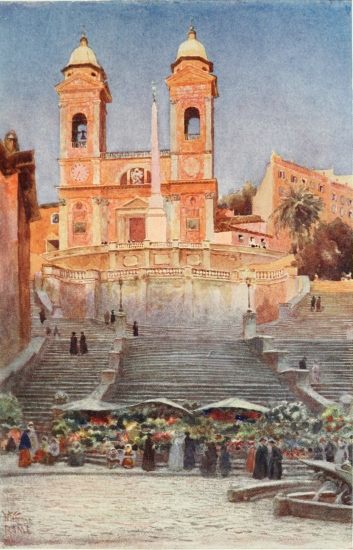
The church best known to foreigners is undoubtedly that which figures in the illustration, S. Trinità de' Monti. There is nothing about the church itself to call for comment; but its fine position, above the beautifully arranged steps, in the middle of what may be called the "foreign quarter," makes it worthy of note. Close by is the Villa Medici, the French Academy of Rome. At the base of the steps is the flower market. Until recently Italians had a great objection to cut flowers in their rooms—they were supposed to be unhealthy. Through foreign influence this is slowly giving way, and the market is as much patronised by the Romans as by the residents of other nationalities. Not many years ago the foot of these steps used to be thronged every morning by artists' models, who, in the picturesque garb of their native districts, sat here waiting for a day's hire. The few who still do this have moved off to the steps of the Greek church in the Via del Babuino, and the flavour of the Campagna and the mountains they gave to the Piazza di Spagna is now a thing of the past. Everything changes, everything passes away. The gaily coloured costumes of the ciociare, the peasants from the districts between Rome and Naples—so-called from the cioce or sandal they wear—is now never seen. The exaggerated dress of the flower sellers, who pester the foreigner to buy little faded nosegays, is simply worn for the purpose of extracting soldi and as a subterfuge for begging. Away up in the mountains beyond Tivoli are two villages, Saracenesco and Articoli. Though they are adjacent the dialect of the inhabitants is different. There is a deadly feud between them. They both provide the artist in Rome with models. Those who come from the last named pose for the figure, but those from Sarecenesco will only sit draped. They still provide the wet-nurses for Roman babies; for the physique of these Sabine villagers is very fine, as fine perhaps as in the days when the Sabine women were carried off by Roman youths.
Beyond the Villa Medici lie the beautiful gardens of the Pincio. From the terrace at the end, on the brow of the hill, one gets the famous view of Rome. The shady walks and well-kept drives of these noted gardens, and those of the adjoining Villa Borghese, are the favourite rendezvous in the evening for Roman society. We must leave this beautiful pleasaunce and dive down into the labyrinth of streets below. Nothing probably strikes one so much on a first visit to the Eternal City as the number of fountains and obelisks that are to be found in whichever direction a morning's walk takes one. Rome is the best supplied of any capital in the world with water, and though she has not the thirteen thousand odd fountains recorded by Cardinal Mai in the year 1540, those that remain still flow unceasingly. The Aqua Virgo brought into Rome by Agrippa to supply his thermæ at the back of the Pantheon rushes a never-failing supply into the huge Fontana di Trevi. One may sometimes see a Roman of the poorer class drinking furtively from the basin into which the water runs, drinking because he is leaving his native city and wishes to assure a safe return. The Fontana del Tritone is formed by dolphins, whose tails meet to support the coat-of-arms of the Barberini—the fine Palazzo Barberini is close by—and is surmounted by a Triton holding a conch shell to his mouth. In quite another district, down by the river hidden away amidst the narrow streets of the Ghetto, is the little Piazza Tartaruga. In the middle of this charming little square stands the Fontana delle Tartaruga. The design of this beautiful "Fountain of the Tortoises" has been attributed to Raphael. It is certainly worthy of his great name. The bronze figures of the four youths supporting the basin of the fountain are exceptionally good. With one hand each grasps the tail of a dolphin, the other is raised above their heads to assist the struggles of the little bronze tortoises that are endeavouring to crawl over the slippery wet lip of the bowl. The Fontana La Barcassia, in the Piazza di Spagna, a corner of which is seen in the sketch of S. Trinità de' Monti, is no doubt better known than the last named, but there is no public fountain in Rome that approaches in any way the artistic merit of "The Tortoises."
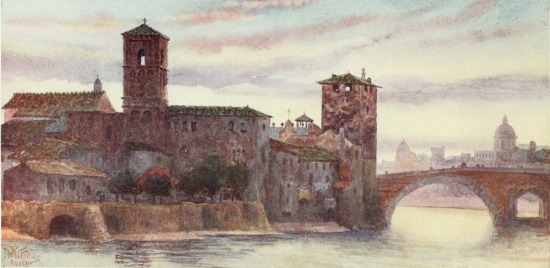
It is but a step from this to the gloomy looking Palazzo Cenci, which recalls the tragedy of Beatrice of that name. Another pace further on and we find ourselves in a recently cleared space with the new Jewish Synagogue standing close to the river Embankment. Here was situated the old Ghetto of Rome, a quarter which is being fast demolished. One certainly cannot regret the disappearance of some of the abominable slums that not so long ago stood where the housebreaker's pick and shovel have been at work. It was but a few yards from the synagogue that the sketch of the Isle of S. Bartholomew and the old Roman Pons Fabricius was made. S. Bartolommeo is the only island on the Tiber in its course through Rome; and the picturesque buildings of the old monastery are the only buildings left, which the yellow river washes, of all those that less than thirty years ago lined its banks. There is a different air about the Trastevere district across the water. It is another city altogether than the one left behind on the other bank. The foreigner is not so much in evidence, we are once again in Italy. Mount the steep ascent of the Janiculum, and from the wide space in front of the colossal equestrian statue of Garibaldi you will get a grand view of Rome, with the Campagna and Alban mountains beyond. From the top of the hill, as one turns northwards, we seem on a level with S. Peter's great dome. One is puzzled once again, when remembering how it really towers above all, to find that it is not of much significance in the view. Nothing of course is seen of the Vatican, which is situated on the other side of S. Peter's. In the illustration of the Cathedral, however, there is just visible the corner which adjoins it.
THE ISLE OF S. BARTOLOMEO, ROME
The Vatican is the largest Palace in the world and contains the vastest and most heterogeneous collection of all. It is quite impossible to enumerate a tenth of the treasures hidden behind its ochre-coloured walls. Neither can one enter here into any description of the Sistine chapel with Michael Angelo's masterpiece, or Raphael's magnificent frescoes in the Stanze and Loggie. We must pass over the famous picture gallery and the antiquities in the Museo Pio-Clementino and the Museo Chiaramonti, simply remarking that the Vatican Museums hold the finest collections in the world. There is one antique in the square outside which deserves a passing notice, and that is the great monolith of granite standing in the centre of the Piazza di S. Pietro. If Rome is a city of fountains, it is also a city of obelisks. This enormous block of stone was brought by Caligula from Heliopolis and placed in the circus of Nero, which occupied so much of the ground on which the great basilica was afterwards erected. Eight hundred men, besides many horses and over forty cranes, were requisitioned to elevate it in its present position. Turning away from the Vatican and diving into the squalid quarters of the Borgo, one comes on to the covered passage which John XXIII. commenced to build in order to afford a safe mode of retreat from the palace to the Castle of S. Angelo. The fortress of S. Angelo was erected by the Emperor Hadrian as his family tomb; and, as such, its exterior was perhaps decorated with statues. The Emperor died in his villa at Baiæ on the Bay of Naples, but his body was brought here, to be joined, as time went on, by the mortal remains of Marcus Aurelius, Caracalla, and others.
The history of the castle is the history of Rome in the Middle Ages. It has many times withstood a siege, and among other vicissitudes fell before the prowess of Totila and his Goths. The sarcophagus of its founder was used as the tomb for Innocent II., and its inverted lid now forms the font in the baptistery of S. Peter's. The streets in the neighbourhood of the castle have undergone an absolute change. Wide thoroughfares and huge blocks of flats cover the ground that a few years ago was a huge slum. The new Courts of Justice face the river, and the embankment in front is now a fine boulevard. We cross the water once more, by the Ponte Margherita, the bridge which is highest up the Tiber, and find ourselves in that fine square the Piazza del Popolo. Above the beautiful terraces that form the precipitous slope of the Pincio, the trees that adorn the gardens stand out against the blue of the sky. At the foot of the terraces is the church of S. Maria del Popolo, erected on the site of the Domitii tombs, the ghost-haunted burial place of the cruel Nero. Adjoining the church is a grand gateway, the Porta del Popolo. Under its arches on the straight road that runs north, the Via Flaminia, marched out of Rome all those legions that went forth to conquer and to extend the bounds of an Empire that has seen no rival.
NAPLES
THE old Greek colony of Parthenope was founded by settlers from Cumæ, and when the islanders of Pithecusæ (Ischia) built their adjoining town of Neapolis, it became known as Palæopolis. Its port was where the harbour of S. Lucia existed up to twenty years ago. Neapolis occupied that part of the present Naples which lies to the east of this. About 400 B.C. the Republic, formed by these two then united towns, allied itself with Rome; and during the height of the Empire's power, her rulers, statesmen, and poets built themselves residences on the shores of the beautiful bay. Augustus did much for Neapolis, and Tiberius sought refuge in that entrancing island, Capri, where to this day his infamies are a byword. Claudius, Nero, Titus, and Hadrian, whose palace can be seen under the waters of the blue Mediterranean near Pozzuoli, have all left traces of some sort or other in and about Naples. Lombards and Normans, Swabians and Spaniards were each in turn drawn hither, allured by the beauty of the situation. Colossal figures in marble of the most famous rulers of Naples occupy niches on the façade of the Royal Palace, and here Roger the Norman, Frederick II., the Swabian, who founded the university, Charles of Anjou, Alfonso of Arragon, Charles III., Joachim Murat, and Victor Emmanuel II. gaze stonily from their retreats at the noisy tram and rushing motor-car.
The Spanish Bourbons were the last to rule in Naples before Italy was united towards the close of the last century. They did much to improve the city but nothing to help its people. Twenty years ago there were still left members of the aristocracy who every year journeyed to Paris to pay their court to Francis II., the last of that race of kings whose reign had ended at the disastrous battle of Gaeta.
Naples, like Rome, changes every year. Modern improvements bring sanitation, but do away with all that is picturesque. All over the world hotels are becoming a great factor in the life of the folk who have spare cash, and Naples, with her splendid water supply and unrivalled position, is not behind in her eagerness to catch the foreigner's gold. Tourists by the thousand reach her by sea, and the enterprising agents who arrange the itinerary pop them into cabs, drive them through the streets, and deposit them at the far-famed Museum, where they are hustled from one gallery to another by the anything but intelligent guide. However, the Museum alone is worth a visit to Naples. The ashes from Mte Somma which smothered Pompeii, preserved for subsequent ages objects in bronze, in earthenware, and in glass, which lie in their cases—an open book of the domestic life of the Roman for every one to read. The great Farnese Hercules, brought by Caracalla from Athens to adorn his baths in Rome, is in one of the lower galleries. It is without exception the finest illustration of mighty strength in repose that exists. In the days when Glycon the Athenian evolved and produced this masterpiece, art was of more account in the lives of the people than it is now, and so much was his Hercules appreciated and admired that it was impressed on the money of Athens and the coins of Caracalla. Among the many small statuettes that the excavator's shovel has been the means of bringing to light is a very beautiful little winged figure of Victory. Nothing can exceed the grace of the composition and the floating-in-air quality this small treasure possesses. One of the best specimens of Greek bronze work is the so-called Narcissus. A row of bronze statues from the theatre at Pompeii place vividly before one the actors of the Greek stage, just as the armour and magnificent helmets of the gladiators bring the arena and its gory triumphs in front of one's eyes.
But, like the tourist, we must hurry on to the cathedral. The façade, approached by steps from the narrow street, is not in any way noticeable. The interior retains some of the original Gothic, but, owing to earthquakes, has been altered and restored, and now presents itself as a great incongruity to the eye. The illustration will make this apparent. Gothic arches form the bays of the nave. The aisles are also Gothic, and so is the arch over the tribune at the east end. Corinthian shafts and dark marble pilasters run up the square piers of the nave. At the base of the shafts, under classic canopies, are the busts of numerous archbishops, and between the piers are the confessionals. These latter give a rich note of brown, which, with the gilded candelabra on either side of the busts, finds an echo in the heavy and richly coloured ceiling. The vista of the north aisle is the best architectural feature in the building. The south aisle is marred by the obtruding classic columns of its side chapels. At the high altar, which the illustration shows, the blood of S. Januarius liquefies every year on the anniversary of the saint's martyrdom in September. The whole cathedral is then crowded, and the intense fervour and excitement of the immense congregation when the blood, in a phial held aloft by the officiating priest, begins to liquefy, is a sight that once seen can never be forgotten.
INTERIOR OF THE CATHEDRAL, NAPLES
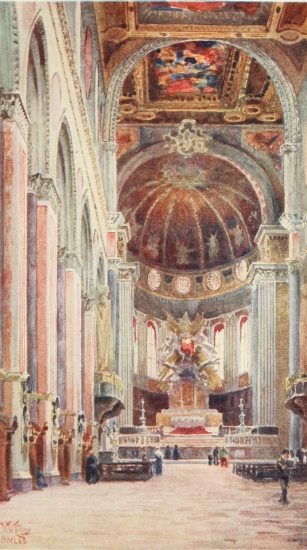
Immediately under the high altar in the crypt is the Confessio of S. Gennario. Its marble roof is supported by ten Ionic columns. The richly sculptured decoration of the chapel is very fine. The figure of Cardinal Caraffa, who built it, kneels beside the altar under which repose the saint's remains. One other thing of architectural note is the Archbishop's throne in the nave. This good specimen of Gothic work is upheld by most elaborately sculptured pillars, and arches with extremely beautiful tracery.
The most interesting part of Naples lies round the cathedral. Narrow streets, darkened by the clothes that hang from balcony and pole, form a maze which it is easy to wander into, but very difficult to escape from. Some of the finest of the old palaces stand in these dirty thoroughfares. One may pass them a dozen times and still be quite unaware of their existence. The moving crowd that throngs these narrow streets does not show any particular regard for the sightseer, and the careless Jehu who drives whither he will is absolutely unmindful of the pedestrian. So if you would explore old Naples you must look after yourself, and—as a caution too—look after your pockets. It is unwise to display a watch chain, or to carry anything that may be easily snatched from the hand. Remember you are in the midst of expert thieves and among the most heterogeneous race on the face of the globe, a race without the slightest idea of morals of any sort whatever. In the tortuous Via S. Biagio stands a thirteenth-century palace built by one of the Caraffa family, and since known as the Palazzo Santangelo. Some of the best objects in the Museum first found a home in this fine old house. Pope, Paul IV. and the great Neapolitan cardinal, Caraffa, were born in the Palazzo Caraffa in the same street. The central post-office is now housed in the Palazzo Gravina, built in the fifteenth century by one of the Orsini; and the great dwelling of the Monticelli is one of the best specimens of the domestic architecture of the same century.
Not far from the post-office is the church of S. Chiara. Despite the hideous scheme of decoration which has transformed an otherwise fine concert hall—for S. Chiara is more like one than a church—into a curiosity of bad taste, there is a great deal of interest within the fabric. Founded at the commencement of the fourteenth century by Robert the Wise, the church contains his monument and also others of the royal house of Anjou. The frescoes with which Giotto adorned the walls have long ago disappeared, and if it were not for the royal tombs S. Chiara would not be worth a visit. Behind the high altar, at the back of which stairs lead up to a platform enabling one to examine it, is the magnificent tomb of King Robert. The royal sarcophagus rests on Gothic pillars and is adorned by sculptures of the king and his children. His recumbent figure lies extended in the garb of a Franciscan, which Order he entered a few days before his death. Above this, under a canopy, is his figure seated on a throne and clad in royal robes. The beautiful Gothic canopy is supported by slender clustered columns, with five rows of saints in niches carried up to the base of the crocketed pinnacles that surround the canopy. Robert's son Charles, Duke of Calabria, and Mary of Valois, his second wife, lie in sarcophagi that are upheld by figures of angels. These two splendid tombs are to the south of the great king's. To the north are those of Mary, Empress of Constantinople, and of her third husband, Philip of Taranto. Two of her children, Agnese and Clementia, lie also near by; the former, who was married twice, espoused firstly one of the Scaligeri, or della Scala, of Verona. To the right of the high altar is a chapel adorned with fleur-de-lys, the burial place of the royal house of Bourbon. This little chapel and the tombs in it lose greatly in historical sentiment by their hideous and garish surroundings.
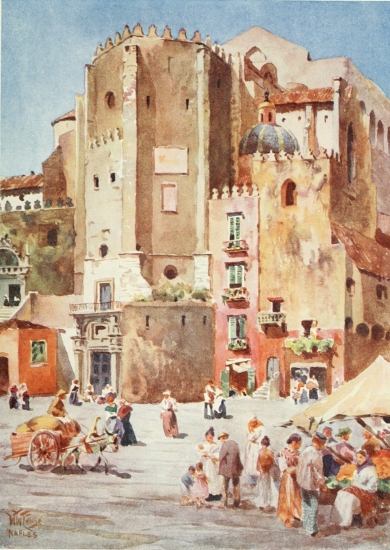
S. Domenico Maggiore, the curious exterior of which is illustrated, was originally a noble Gothic edifice. The restorer, unfortunately, has altered and added to this, and although the interior plan is much the same as when first erected, the terrible colours with which it is covered detract in no small measure from its very fine proportions. The sketch shows the exterior of the five-sided apse. The dull yellow tufa with which it is faced and the embattled cornice and buttresses give it a decidedly eastern appearance. S. Domenico may be entered by the door just visible on the left, to reach which one toils up a long flight of moss-grown steps. Push aside the heavy leather flap, and the noisy little piazza, with all Naples beyond, are immediately things of the remote past. You are in a beautiful little twelfth-century chapel. Its walls are lined with most interesting tomb slabs. Note the short figures on each. The Neapolitan is very low of stature, and these short figures, although the tombs are of the twelfth and two succeeding centuries, point to the surmise that the men of the south were never tall. From this chapel one enters the great church at the south transept. Immediately on our left is the sacristy. Here in the gallery which occupies one wall are forty-five burial chests, among which ten hold the remains of ten princes and princesses of the royal line of Aragon. Those which have been identified are Ferdinand I. and II., one of the Dukes of Montalto and his Duchess, and Cardinal Louis d'Aragona. Another contains the husband of the celebrated Vittoria Colonna, the Marquis of Pescara who defeated Francis I. at Pavia. There is something of interest to be found in every chapel in the church. In one of them is the crucifix which conversed with S. Thomas Aquinas while he was composing his Summa Theologiæ. The saint's cell may still be seen, and also the room in which he gave his addresses when lecturer in the university that was within the walls of the adjoining monastery. The high altar, raised well above the steps of the choir, is one of the most remarkable specimens of Florentine inlay in the country. It has the curious adjuncts of a recessed seat on either side, and two very fine marble candelabra.
S. DOMENICO MAGGIORE, NAPLES
These are but three of the three hundred churches Naples possesses. Climb the hill of the Mte Calvari crowned by the Castel Sant' Elmo and look out from the Belvedere in the suppressed Carthusian monastery of S. Martino. Try to count the towers, domes, and spires standing out from the carpet of roofs below. You will be fatigued before you have reached the second hundred. Perhaps the magnificent prospect over the blue bay, with Isola da Capri and the Punta Campanella in the distance, the Sorrentine peninsula and the wonderful shape of Vesuvius on the left, will distract your arithmetic. At any rate the counting of the churches is not worth the trouble when such a glorious view lies before one. Beyond the garden—the old monastic garden, how the monks must have revelled in it!—and beyond the roofs below, the Castel dell' Ovo juts out into the bay. To the left of it, shipping of all nationalities rides the water along the quays near the Arsenal and royal palace. The funnels of huge liners stand up amidst a forest of masts beyond the Immacolatella in a fine sweep to the Rione Margherita di Savoia. Coasting boats with sails like butterflies skim the water. Down in the harbour all is animation; but so far are we above it that not a sound breaks through the distant hum to enable us to distinguish any one particular note.
The cloisters of S. Martino are very beautiful. Sixteen white marble Doric columns form the arcade on each of the four sides. The cells of the departed monks are shut now and the holes through which their food was passed, bricked up. The walls are white; the classic well-head in the centre of the garden is white and so are its steps. The little burial ground in one corner of the court has a white marble balustrade on which are very realistic white marble skulls. Everything gleams white in this quiet court, and the deep blue of the southern sky intensifies it all. For a painter it is a rare study, but perhaps not so fine an one as I once saw years ago. It was in January, snow had fallen for two or three days—even Capri was covered—when with a friend I walked up to the Carthusian monastery of Camaldoli. We reached it just as the fall which had been going on all day ceased. A thick white carpet of fresh untrodden snow lay round us. The white monastery walls looked dull. We rang at the gate, a white garbed monk opened it. We were in a white courtyard surrounded by white walls, and a line of white monks moved slowly towards the chapel. Everything was white. But what a subtlety in the distinction of the colour! Only the sky was grey, and that such a beautiful pearly tone. I question if pigment even in a master's hand could have faithfully reproduced the scene.
Naples was very different in those days. S. Lucia existed then. Now the old harbour is filled up and modern hotels stand where frail wooden piers ran out into the water. From these spider-like structures oysters hung down in baskets fructifying in the outlet of the main sewer! S. Lucia was surpassingly picturesque and gay with the life of the lowest class, but—surpassingly odoriferous. Stalls lined the pavements. Fish of all sorts, cooling drinks, lemons, oranges, every description of fruit, were displayed in the shade of multi-coloured awnings. Lazzaroni lay stretched all day long on the sea wall, or slept on the foot-ways propped against the houses. Domestic toilettes performed out of doors in the street never excited remark. And the houses themselves, what a blaze of shifting colour when the wind stirred the sheets and clothing hung out to dry from a hundred balconies! All is changed. The sewage is carried out to sea right away at Cumæ. There are no more oysters at S. Lucia; there is no longer a S. Lucia, but with its disappearance Naples has lost its most unique attraction.
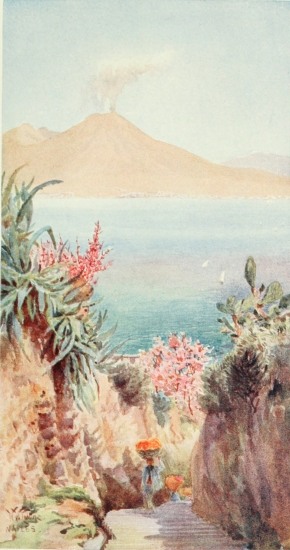
Away at the end of the Chiaia, past the celebrated Marine Aquarium, the hill of Posillipo rises above the little fishing harbour of Mergellina. A tram will carry you swiftly round the corner and along an uphill road from which you will obtain many delightful views. There is nothing on the Riviera to equal the position of some of the fine villas which line this road. Beautiful grounds run down to the sea. Exotic plants grow and flourish, sheltered from the bitter tramontana wind. Great pine trees rise solemnly above the tops of their Bay, such as is illustrated, lead one up the steep slopes. Wherever one wanders, it is always the blue sea that is below, and always the wonderful outline of the peninsula across the Bay in the distance or the graceful curves on the flanks of Mount Vesuvius, or, most beautiful of all, the lovely outline of the enchanting Isola da Capri.
THE BAY OF NAPLES FROM POSILLIPO
SALERNO
IN the Middle Ages the subject of this chapter was famous throughout Christendom for its school of medicine. S. Thomas Aquinas tells us that in the medical world Salerno ranked where Bologna did in law and Paris in science. Had its fame on this account not been so great, Robert, the son of William the Conqueror, would not have delayed his homeward journey, and stopped there to consult its medical men for a wound he had received in the Holy Land. In consequence of his absence from England, Henry stepped on to the throne which had meanwhile become vacant by the death of Rufus, and the rightful heir never reigned. Salerno was in many other ways connected with the powerful race of Northmen. Robert Guiscard received his mortal wound before the walls of the city as his troops swept over the ramparts at the first assault after an eight months' siege. Roger the Norman was here declared king of Naples and Sicily at a meeting of the barons in 1130, and for many years Salerno was the seat of the Norman government in South Italy. Like many another city which has in the past enjoyed a famous reputation and been of great importance, there is now practically nothing left to tell of its great days. On a crag at the end of the old city walls, some nine hundred feet above the sea, the ruins of the Northmen's stronghold, in the attack on which Robert Guiscard was wounded, still remain, buffeted by the storms that rush up the mountain slopes. The harbour which Manfred commenced to build, and which in old days held the Norman fleet, lies below the Marina, but it silted up many years ago, and is now almost useless for trade. The great days of Salerno have gone, just as the great days of her famous neighbour, Amalfi. The exigencies of modern trade routes and the facilities of the railway have robbed her of all the power and glory she once possessed.
There is, however, something left to remind one of her past wealth and power. Closely hemmed in by its surroundings, the cathedral is not by any means easy to find. Tortuous uphill streets lead to the piazza, where, on a steep incline, a fine double flight of steps with a marble balustrade give on to the spacious cloistered court or atrium beyond which it stands. Robert Guiscard dedicated his cathedral to S. Matteo, and, so that it should be worthy of the great race of de Hauteville, plundered the old Greek city of Pæstum for the building of it. Nearly every one of the pillars of these cloisters came from there. Most of them are so massive that the capitals of native workmanship, probably hewn while the plundering was going on, are too small. The arches above are stilted; they support a gallery whereon a row of statues of different archbishops appear in a now much delapidated condition. The same state of partial ruin greets the eye as one looks around. Fourteen ancient sarcophagi, nearly all of them Greek, stand in the cloisters of the court. They were used by the Normans for Christian burial, but, alas! are mutilated and chipped at the corners, and their fine bas-reliefs, one of a hunting scene, another with centaurs and nymphs on the panels, are almost completely ruined by the ill-treatment they have received. In the centre of the court is a fountain. Water still splashes in its Greek basin, but decay and neglect have robbed this otherwise beautiful atrium of most of its charm.
The cathedral adjoins the courtyard. The bronze doors of the central porch were at one time inlaid with silver. The precious metal has disappeared, but small figures of the Apostles and Christian symbols bear evidence that when these doors came fresh from Constantinople in the eleventh century they were of very fine craftsmanship. The interior of the great church is whitewashed. The floor slopes up towards the east end, and is a good example of a well arranged marble pattern. The most interesting things, if we except the tombs that are in the building, are the two ambones, or pulpits. That which appears in the illustration is a wonderful example of the work of John of Procida. The other, as well as the archbishop's throne, is by the same great designer. All three are masterpieces of the Græco-Byzantine style of inlaid tesseræ. In the illustration will be seen a fine Paschal candelabrum, with most intricate inlay, as fine in its way as that described in the next chapter. These pulpits are approached by steps from inside the choir. One is supported by four columns of rare porphyry and the other by twelve of granite from Pæstum. Age has toned the white marble panels to a light grey, which gives a wonderfully fine note to the white of the cathedral walls as one looks up the nave from the west end. The choir is encircled with a most beautiful inlaid marble screen, in decoration similar to the two pulpits. The floor is a grand example of opus Alexandrinum inlay, and is as good in this respect as the best in Italy.
A PULPIT IN THE CATHEDRAL, SALERNO
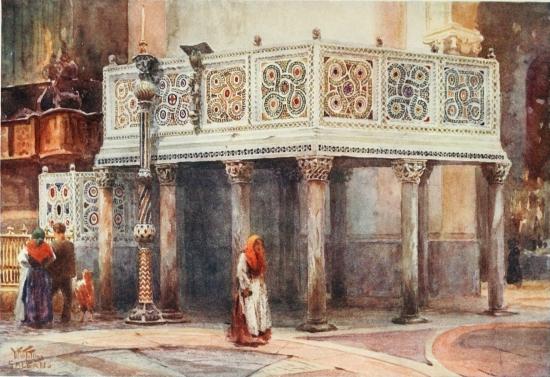
Under the high altar, in the crypt, is a monument to S. Matthew, with a seated bronze figure of the saint. Below this, in a casket, repose the remains of the Evangelist, which were brought here in the year 930. The crypt itself is not interesting. To find what is, we must return to the church above, where some of the tombs are well worthy of study. Pope Gregory VII., Hildebrand, who died in Salerno, lies in a sarcophagus in one of the side chapels. The remains of Margaret of Anjou, mother of King Ladislaus, rest under the canopy of a fine tomb, on which in relief the queen is depicted surrounded by her children and her maids of honour. Angels form the support to the canopy, which is decorated with gold fleur-de-lys on a blue ground. Archbishop Caraffa's remains are in a fine Greek sarcophagus with Medusa heads at its corners. On another is a fine bas-relief of the Triumph of Bacchus, and many more, like those in the cloisters, have been transferred from Pagan use to Christian. The chapel in which is Hildebrand's tomb belongs to the family of John of Precida, who decorated it himself.
In the sacristy is a very interesting Palla of ivory, the thirty panels of which represent scenes in the Old and New Testaments. This eleventh-century work is one of the few things which can with truth be said to be in excellent preservation. The cathedral, like its surroundings, is sadly in need of repair. Its fine campanile is buttressed up, or would long ago have toppled into the street below. The two lowest storeys of this grand tower are the original Norman work of Roger's day. At their angles are marble and granite columns, no doubt from Pæstum. The two upper storeys are not like the lower, built of stone, but have been constructed in a very beautifully coloured brick. They are pierced by Norman arches, above which is the belfry surmounted by a dome. Were it not for the few things we have noted, Salerno would not be worth a visit. But if only to see the magnificent pulpits and stand silently in the crypt by the remains of the Evangelist, the tourist in his hurry should never omit to spend at least a few hours in this once famous city.
PALERMO
PHŒNICIANS, Carthaginians, Greeks and Romans, Goths, Byzantines, Normans and Spaniards, have all ruled in Sicily; and those whose curiosity takes them to the museum of Palermo may there see many antiquities of great interest in the history of each period. The man who observes may also see much in her streets. There are distinct quarters in Palermo where the different races and their descendants have kept themselves to themselves from time immemorial. It takes no special knowledge of racial physiognomy to single out among other types the Berber or the Greek, as one saunters along watching the ever-changing crowd in the lively thoroughfares. The Norman occupation is recalled in the vivid decoration of the panels of the peasants' carts. On them one sees the gallant Norman slaying the truculent Infidel—slaying them by dozens! Quite archaic is the execution of these panels—the handiwork of a long line of painters, whose progenitors hundreds of years ago were painting the same scenes on the vehicles of their day. The colours are crude. Every inch of the car is painted. The spokes of the wheels are notched and carved. The body of the cart is firmly fixed, high above the axle bar, by well-arranged ironwork of floral design. There are no other carts in existence like them; and when the feathered plume of ultramarine and red which always adorns the donkey's headgear, and the tinselled harness worked with gold and silver thread, are new, not many chariots or state coaches make a braver show.
Palermo is divided into four quarters by the two streets that, running east and west, north and south, bisect one another at the circular space in the centre of the city called the Quattro Canti—the Four Corners. Standing in this busy spot and looking downhill northwards, the deep blue of the Mediterranean bounds the horizon. South the view is partially stopped by the great city gateway, the arch of the Porta Nuova which crosses the street by the Royal Palace nearly a mile away. East and west, high over the heads of the crowd and the congested traffic, grand mountains rise up with a puff of white cloud above their summits. In whichever direction one gazes the vista ends, far beyond the lines of tall houses, with the blue sea or the blue sky.
THE CATHEDRAL. PALERMO
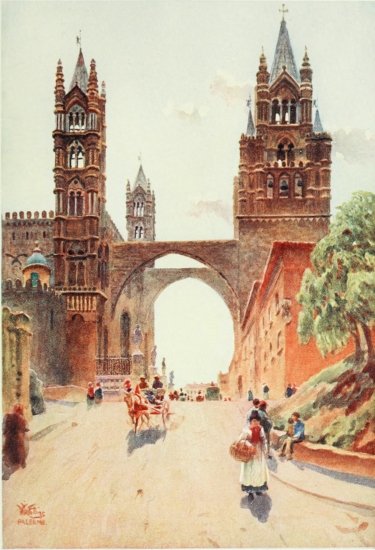
If one walks towards the Royal Palace up the hill, one passes through the fine Piazza del Duomo. It is a large square enclosed on three sides by a marble balustrade, on which stand, at intervals, colossal statues of bishops and saints. On the fourth side is the great cathedral. This fine specimen of pointed Sicilian work is dedicated to S. Maria Assunta, and was commenced in the twelfth century when Gualterio Offamilio, Walter of the Mill, was the English archbishop of Palermo. The curious architectural style of the building is due to the fact that it was designed by a Norman and carried out by Moorish workmen. The Moor found it impossible to leave out his native arcades and his battlements; and the diaper pattern on the west façade recalls in design the decoration of the east. The Saracenic capitals of the beautifully carved pillars of the three doors of this façade are exceptionally good. Norman zig-zag moulding embellishes the arches above. Niches filled with saints add to the harmonious incongruity so subtly arranged by infidel workmen. A noble tower at each corner rises in eight tiers, the three topmost being open. Throughout these towers small arches are supported by little marble columns with their corners rounded off in a bold way by ringed pillars. They terminate in little turrets and pinnacles, which have flames at their bases. To break all the flat surfaces of these, the Eastern mind was constrained to put some sort of decoration, thus carrying off the appearance of great weightiness; and so, square, billet, lozenge, and nail-head patterns have been most admirably introduced. The lower portion of the great tower across the street and opposite the façade, and which forms part of the archbishop's palace, is Saracenic, and was erected before the Northman's advent in Sicily. The upper stages are the belfry. Despite the spires which all these towers possess, there is something decidedly more Eastern than Northern in their appearance. The arches that cross the street—so bold a feature in the sketch—were put up in the twelfth century to sustain the palace and cathedral whenever earthquake shocks occurred.
The cathedral is entered by the south porch. This is flanked by twelfth-century towers, on the top of which are ugly white marble figures, executed at a bad period. Three stilted arches of Moorish design with cable mouldings, the central arch larger than the other two, support a rather low gable. The face of this gable is covered with a good scheme of decoration. The cornice is deeply cut with animals and foliage, a porcupine and a hare being among the former. Four grotesque Norman waterspouts break the string course between the cornice and a beautiful flat arcade under the arches, on which are half-length figures of saints and bishops. The wall beneath this and above the three arches of the porch was evidently at one time covered with Arab designs in black and red. Four grey marble pillars with their eastern capitals support the arches; they came from the mosque which stood on the spot where the cathedral was erected. The portal of the door itself is a real masterpiece of intricate Moorish carving. Here pomegranates and palm leaves occupy a prominent place. In the eighteenth century many alterations occurred, and this grand and, from an architectural point of view, deeply interesting church, was disfigured to a large extent. The porch has suffered almost as much as the interior of the building. But one tablet worth recording still exists in the former:
PRIM . SEDES . CORONA . REGIS . ET . REGNI . CAPUT
Thus runs the proud title of the city in the days when the kings of Sicily were crowned in Palermo's cathedral. A row of white marble figures stands on the exterior of the side chapels of the aisles. They are bad. Little domes with glazed tiles also remind one of a later period. These, with the big central dome over the crossing, were the work of Fuga, a Neapolitan architect. In the alterations he carried out, the battlements and the corbel tables under them were spared. The latter are a very curious study in the physiognomy of the different races known to the Normans when the cathedral was built. Executed by Arab workmen, whose faith forbade them to portray the handiwork of Allah, their accuracy is not unimpeachable. The east end is partly covered with flat arcading, most elaborately carved with Arabic design, and partly with a black and red pattern of the same character. The apse is not pierced by any lights.
The white-washed classic interior is a great disappointment after the rich brown and yellow stone of the exterior. But if, architecturally, it fails to interest, historically it is concerned with the most brilliant and prosperous period the city enjoyed. Turning to the left on entering the cathedral by the south porch are the two chapels wherein stand in solemn grandeur the mighty sarcophagi of the Norman and Swabian kings. The remains of Roger, the first Norman ruler of Sicily, rest in a porphyry sarcophagus supported by marble feet composed of four crouching Saracens. The fine canopy above is incrusted with mosaic. Its pillars are gilded and inlaid. The next tomb is that of Constantia, who was the last of the royal line of Normans. She was the wife of the Emperor Henry VI., and mother of Frederick II. By the side of this is the sarcophagus of Henry VI. Very elaborately adorned is that which contains the remains of Frederick II., and the body of Peter II. of Aragon. The lid of this is carved with medallions of Christ, and the Virgin and child. All that is left of Constance, wife of Frederick II., is in a Roman sarcophagus which is recessed in a wall of the chapel. It is beautifully decorated with a hunting scene in bas-relief. Standing against another wall is a mediæval tomb, with a cowled figure between two shields, on which are displayed the eagles of Aragon. It holds the ashes of William, Duke of Athens, who was a son of Frederick of Aragon. All these tombs are not only full of archæological interest in themselves, but when one reviews the origin and history of the Norman occupation of the island, the chapel in which they rest becomes one of the most historically absorbing spots in the world.
The Saracens were in possession of Sicily when Roger, the youngest of the twelve sons of Tancred de Hauteville, came over from Apulia, where his brothers, by force of arms, had established themselves as reigning Counts. Roger found all the civilisation, culture, and well-ordered bureaucracy of the Moor firmly established. And with this he was too wise to interfere. Changing nothing of the mode of life of those he conquered, but simply adding to it the strength of arm and vitality of a northern race, he became—and those who followed him were—by far the richest and most magnificent sovereigns of their time in all Europe.
The crypt is architecturally the most interesting part of the interior of the cathedral. It contains the tombs of twenty-four of Palermo's archbishops, including that of Walter of the Mill. Among the treasures in the sacristy is the cap of Constance of Aragon, which was found in her tomb, when, by order of Ferdinand I., the royal sarcophagi were opened. On one of the rough gems with which the cap is studded, is written in Arabic, "In Christ, God, I put my hope." Here, again, is evidence that the Moor and Christian lived amicably side by side. Theodoric in Ravenna, and the Norman in Palermo, brought peace to the land they conquered; and the greatest prosperity that both cities enjoyed was a consequence of their wisdom, and of their religious tolerance.
In the fine open square which one reaches at the end of the seemingly interminable Corso, a Roman house and other very interesting remains are now being unearthed. The Royal Palace occupies one side of the piazza, and, being the highest part of the city, is on the site of the old Roman palace. There is a magnificent view from the observatory situated on the roof of the building. It is, however, with the beautiful chapel built by Roger II. in the early part of the twelfth century that we are concerned. The Cappella Palatina is a perfect gem, and no one who has once visited it in the morning can ever forget the marvellous effect of dim light passing through its narrow windows, and illuminating its wonderful marble and mosaic walls. Three of the bays of the nave are formed by columns of Egyptian granite which alternate with three of fluted Greek marble. The composite capitals of the arches are Byzantine and Corinthian. These arches are stilted and covered in an extremely rich manner with gorgeous mosaic, and their soffits inlaid with tesseræ arranged in Moorish designs. The walls of the aisles are lined with the richest marble slabs, beneath which a beautiful dado of inlaid Eastern pattern runs round the chapel. The wooden roof of the nave is honeycombed, and like that of the Alhambra at Granada is arranged with splendidly coloured and gilded pendentives. Cufic inscriptions find a place amongst these hanging clusters. The ceilings of the aisles are coffered and sustain heavy gold bosses, which enrich the gorgeous effect of their strong colour.
The choir is raised five steps above the nave, from which it is shut off by a very beautiful marble screen. The stalls are carved perpendicular work. The fine wooden lectern of very late Gothic design has well-carved angels kneeling on the four supporting legs. Above these angels four kings stand around the centre column. On the book-rest repose the old black-letter parchment psalters. At the top of all, the Virgin and Child finish off this exceedingly well-designed and executed reading-desk. Beyond the choir the apse rises four steps. The risers of these steps and those of the choir are most beautifully inlaid. The colossal mosaic figure in the semi-dome of the apse is the only mosaic of a late date; and, aiming at the qualities of a painting, like those on the exterior of S. Mark's and the cathedral at Orvieto, somewhat mars the uniformity and simplicity of the tesseræ decoration of the chapel. The floor of the building is entirely opus Alexandrinum. At the west end, a raised dais for the exclusive use of royalty is railed off, and a portrait of the reigning sovereign let into the marble panels of the wall. By the pulpit stands a Byzantine candelabrum. Four lions rending their prey are at its base. Other animals and birds and figures of men, all fighting one another, encircle, in orderly confusion, the beautiful inlaid central column. Above them is a figure of the Almighty, serenely quiescent. Children, symbolical of innocence and freedom from sin, are carved round the bowl into which is stuck the huge Easter candle. It is very difficult to describe the effect of sudden calm that steals over one when, entering this dark church, with the glare of the sun and the noise of the streets outside, one is conscious of a very restful gloom, full of the richest colour, and a silence soothing to the senses. One somehow feels the gorgeousness of the east combined with the solemnity of a well-planned sacred interior, and this despite the sudden transition from light to darkness. There is no other building of like dimensions which grips one as does the wonderful Cappella Palatina of Palermo.
La Martorana, away down in the city, may have been as beautiful, but unfortunately in the year 1590 the nuns of the attached convent ordered most of the precious mosaics to be stripped from the walls, and a hideous choir added when these were demolished. Some few are left on the roof to tell us what a glorious thing this finely proportioned chapel must have been before religious zeal got the better of artistic taste. The central apse was likewise taken down a hundred years later, and with it more priceless mosaic destroyed. The inlaid marble on the walls was done away with in the eighteenth century. If anything better could have been found to take the place of the grand mosaics that covered the interior there might have been an excuse for these acts of vandalism but when one sees the hideous stucco and wretched mural paintings of bad design and colour, that have no religious fervour or tendency and nothing whatever to recommend them in any way, one stands aghast at the ignorance and stupidity which in the name of religious expediency destroyed such priceless treasures. Among the little that remains are two curious mosaics wherein King Roger is crowned by Christ, and the High Admiral, who founded the church, is dedicating it to the Virgin. The king is wearing the dalmatic. This he received, together with the mitre, from the Pope, who found it more diplomatic to confer ecclesiastical office upon the Norman king than to oppose him in useless wars.