Front matter (continued 5)
Reading edition
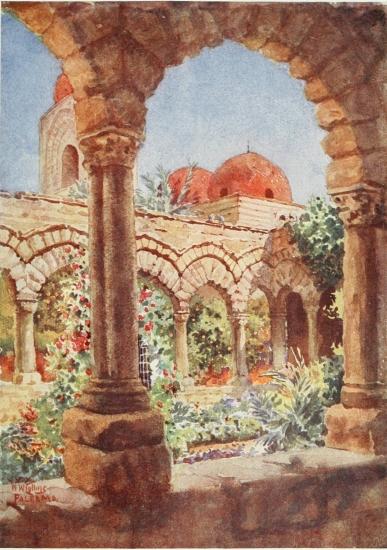
A little to the south of the Royal Palace, and almost abutting on the old walls of the city, is S. Giovanni degli Eremiti. The beautiful cloistered garden, which is adjacent, forms an illustration to this chapter. The little church is a very early specimen of Norman work on the plan of the letter T with three apses. On its south side is a tiny mosque, incorporated with the building and utilised in the old days as a chapel. The monastery, which existed here in the time of Gregory the Great, had fallen into disuse when the Normans came to Sicily, and King Roger restored the old buildings. The interior now is absolutely bare and the windows unglazed. The Moorish domes give the little church a very eastern appearance, to which the flat members of the rustic stones of the cloister arches in no small measure add. It is a peaceful spot where exotic plants flourish luxuriantly, and vie with all sorts of flowers in wanton growth.
THE CLOISTERS OF S. GIOVANNI DEGLI EREMITI, PALERMO
The traveller who has been in Spain will find in the old quarter of Palermo many palaces that will remind him of Seville, Salamanca, and other places in the Iberian peninsula. The tawny colour of the South predominates here, and the two or three courtyards possessed by many of these palaces will add to his reminiscences. This is not so strange as it may seem when one considers that from the year 1282, when Pedro of Aragon was crowned king, to 1713, when Victor Amadeus, Duke of Savoy, ascended the throne, Sicily was under the rule of the Spaniard. The great square block of yellow stone in the Piazza Marina, the Palazzo Chiaramonte, served as the palace of the Spanish Viceroys and headquarters of the Inquisition. Now known as the Palazzo de' Tribunali, it is used as the law courts. The ante-chamber of the court room has a magnificent wooden ceiling. Hunting about in the narrow streets in this quarter one chances on many a piece of architecture and decorative sculpture in the grandiose style of the great days of Spain. One or two good fountains and fine portals add much to the historical charm of a part of the city which is now occupied by humble folk. The church of S. Agostino, difficult to find in the slums, has a remarkable façade with a beautiful wheel window. Delicate white marble pillars radiate from the Paschal Lamb, which is the hub of the wheel, and three rows of tiny but beautifully-carved arches interlace and form the tracery of the window. The chevroned arches of the portal are decorated with acanthus leaves and arabesques. The capitals of the supporting columns are pomegranates, and a flat canopy with dripstone of acanthus leaves, beneath which are almost obliterated frescoes, completes one of the most fascinating relics of bygone days to be found anywhere in Palermo. It is in the old quarters, too, that the life of the cittadini is seen in its most picturesque garb. Fruit shops, full of golden oranges and pale lemons, prickly pears and great citrons, make gay patches of colour in the street vista. Glazed tiles, earthenware, and vividly coloured cotton goods displayed outside the shop fronts or hanging from the walls add to the variety of the scene. Cookshops, with pizzi and scaglozzi, and olive oil in the frying pan, excite the olfactory nerves in a pleasanter degree than those in which a particularly strong-flavoured cheese finds ready purchasers. Excellent wine may be drunk at a very small cost at the drinking bars, where a jet of clear water is for ever playing over the marble slabs of the cistern-like counter. Fowls scurry about in the midst of the throng, and hungry dogs scent a meal in the refuse heaps of the gutters. All is animation, and all has a touch of the South that is something more than Italian. It is almost worth while going to Palermo in order to perambulate her fascinating streets and observe the ever-changing crowd that peoples them.
MTE. PELLIGRINO, PALERMO
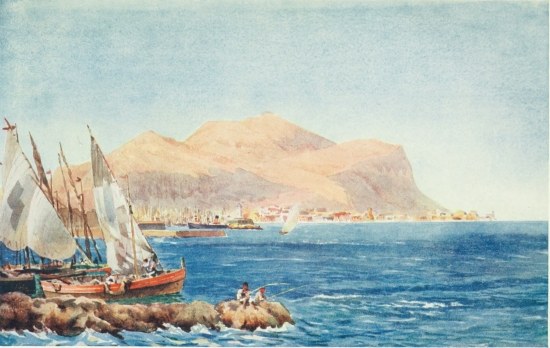
It is certainly worth the voyage to enter the harbour when the sun is well up and from the ship's deck watch the splendid panorama unfold itself as the vessel glides into port. At the foot of Mte Pelligrino, and where the famous valley of the Conca d'Oro, or Golden Shell, touches the blue waters of the Mediterranean, lies Palermo. Beyond, with an inclination upwards to the lower slopes of Mte Cuccio in the distance, stretches the triangular shaped valley, Mte Cuccio forming the apex of the triangle. Mountains hem the landscape in on two sides. The whole of the country between them and the sea is one vast grove of orange and lemon trees. On the edge of the receding wall of mountains to the right of the valley in the middle distance, a stately building stands above the brow of a steep hill. Round it cluster roofs and walls in irregular lines. This is Monreale. To Monreale we go to study the mosaics. For though its cathedral boasts of grand twelfth-century bronze doors, and a very fine portico, the magnificent mosaics that cover the walls of the interior are its pride and glory.
The decoration of this fine basilica may be described as a coherent mass of superb mosaics and well selected slabs of grey and white marble inlaid with panels of Moorish design. Here more than in any other church in the world has architecture been subordinated to a scheme of gorgeously coloured decoration. Its Mosaics are Greek in style, with Greek inscriptions. Moorish designs and arabesques also rival in colour the extraordinarily intricate gold pattern which sets off the beauty of the marble walls. On the semi-dome of the central apse is a very impressive colossal half-length mosaic of the Saviour holding an open book. Below, are figures of the archangels, Gabriel and Michael, and the twelve apostles. The vault of the south apse contains a gigantic figure of S. Peter, and in the corresponding one in the north apse, one of S. Paul. These two figures are robed in white, and light up the dark recesses of the deep-toned gold background of the apses in a remarkable manner. In the choir there is a mosaic over the royal throne very similar to that in La Martorana, wherein King Roger is being crowned. In this case Christ places the crown on the head of William the Good. Over the Archbishop's throne William is represented offering the church to the Virgin. Sicily was never a fief of the Popes, and these two mosaics no doubt express the idea that the sovereigns derived their authority from God alone.
Round the whole of the nave two sets or series of mosaics are arranged which, beginning at the Flood, illustrate different episodes in biblical history. Forty-two scenes are depicted in the nave and ten in each aisle which deal with our Lord's life as well as themes from the Old Testament. At the west end is a mosaic of S. Castrense, Monreale's tutelar saint, casting out a devil, and also walking on the sea.
Comparing these wonderful decorations with those at Ravenna and in S. Mark's, one may at first be more impressed with the apparent magnificence of the scheme which we find here. The cathedral is larger than any of Ravenna's churches, and has this advantage over S. Mark's, that one is better able here to grasp at once the whole idea of the colour scheme. In S. Mark's one sits and quietly discovers things at leisure. At Monreale one enters and is immediately overpowered by the magnificence of the dull gold tesseræ and the gorgeous arrangement of the sequence of figures which, like a flash, strike one at first sight. Ravenna can show us better schemes of colour, subtler and more refined. Ravenna gives us earlier work, and work more naïve, and is for this reason more attractive and interesting. But it must be admitted that in no other building of the kind is one impelled to stop suddenly and catch one's breath, as when first entering Monreale's great basilica.
Eight bays divide the nave from the aisles. Their stilted arches are supported by granite monoliths. The capitals of these are pure Corinthian, and Corinthian with cornucopiæ volutes and medallion heads. Above the abacus of each capital is the simple Norman bowl capital inlaid with rich mosaic. It is from these that the glorious colour-scheme springs—above and around, the eye finds nothing but mosaic. The lower portion of the walls of the aisles is composed of marble slabs separated from one another by inlay of Moorish design. In the north chancel aisle are the tombs of Roger, Duke of Apulia, and Henry, Prince of Capua, two sons of William the Bad. In the south chancel aisle are the tombs of William the Good and William II. Just as Palermo's cathedral is a fit resting-place for the remains of some of the Norman kings, so is this grand fabric for the bodies of those of the same royal line who here repose in peace.
THE CLOISTERS, MONREALE
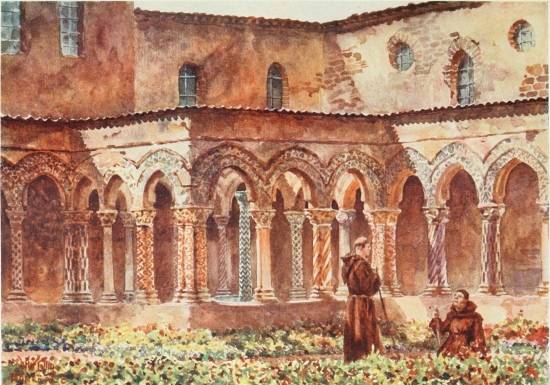
Adjoining the cathedral, on the south side, is all that is left of the original Benedictine monastery. The celebrated cloisters, of which we speak, are more Arab than Norman, and more infidel than Christian in their architecture. The two flat members of the Moorish arches are decorated with black tufa lozenges and spearheads. The coupled columns are nowhere approached in beauty and delicacy, save in S. Paolo fuori at Rome. Arabesques cover some of them; all were at one time richly inlaid with mosaic. Some are chevroned, others of lozenge pattern, or billeted, or twisted and spiral. Their capitals are one and all of extreme interest. One shows on its carved surface Norman knights in chain mail engaged in combat with Saracens; another, Roman gladiators slaying Christian victims. Birds, beasts, and subjects from the Old Testament, intricate foliage and vines add to a variety which is not to be found anywhere else in the cloistered courts of Italy. The illustration gives a corner of this beautiful spot where a fountain splashes and plays, adding to the delights of a well-kept garden and the sweet scent of flowers.
INDEX: A, B, C, D, E, F, G, H, J, K, L, M, N, O, P, Q, R, S, T, U, V, W, Z
Ahrler, Heinrich, 9 Alberti, Leo Battista, 93, 195 Alexander II, 170 Alexander III., 67 Alfred the Great, 21 Amalfi, 280 Ambrose, S., 13 Angelico, Fra, 197, 236, 255 Angelo, Michael, 136, 188, 191-3, 223, 236, 244, 247-8, 252 Antelami, Benedetto, 141 Antenor, 49 Anthony, S., 49 Ariosto, 101 Arnulphus, 15 Assisi, Church of S. Maria, 211-13; cathedral, 214; general description, 214-15 Attila, 7 Augustine, S., 18-19 Augustus, 107 Baldus, 57 Bank of Genoa, 148-9 Barbarossa, Frederick, 67 Bastianino, 103 Bellagio, 2 Bellini, 25 Benedict XI., 205 Benedict XIV., 250 Benenato, 164 Bergamo, cathedral, 24-26; other buildings, 23-24, 27 Bernardino, S., 202, 204, 224 Bernardone, Giovanni, 215 Bernini, 243, 246-7 Bisone, Bono da, 139 Boethius, 21 Bologna, Giovanni da, 126 Bologna, history, 123-5; cathedral, 130-1; other buildings, 125-9, 131-6; university, 133 Bonannus, 160, 164 Bonaventure, Nicholas, 10 Borromeo, S. Charles, 10-12 Borsi, Pier, 181 Bouillon, Godfrey de, 145 Bramante, 4, 9, 17, 126, 244 Breakspeare, Nicholas, 248 Brescia, Roman remains, 29-30; la Rotunda, 30-31; Duomo Nuovo, 31-32; other buildings, 32-33 Browning, Robert, 81 Brunelleschi, 186, 194, 196 Bruni, Leonardo, 193 Burlammachi, Francesco, 169 Busketus, 159 Byron, 109, 166 Cadenabbia, 2 Caedwalla, 253 Cæsar, Julius, 91, 170 Caligula, 261 Calvin, 101 Camaldoli, 275 Cambio, Arnolfo di, 183, 187, 189, 194, 222 Capri, 265, 277 Carabelli, 9 Caretti, Ilaria, 173 Carracci, 130-1 Carrara family, 51 Catherine, S., 224 Cellini, Benvenuto, 184, 248 Ceolfrid, 192 Charlemagne, 39, 115, 242 Charles V., 130, 230 Chiusi, 202 Cimabue, 196, 213 Clement VII., 230 Colleoni, 26 Columbus, 150 Como, history, 1-2; cathedral, 2-4; town hall, 4-5; industries, 5 Constantine the Great, 241, 243, 250, 253 Correggio, 137, 139, 140, 142 Dante, 37, 49, 109, 180, 185, 193 Diotisalvi, 162, 165 Dominic, S., 134-5 Donatello, 52, 55, 58, 77, 166, 181, 185, 194, 223, 252 Donizetti, 27 Doria, Filippo, 154 Ducci, Agostino, 203 Duccio da Siena, 196 Embrianco, Guglielmo, 145, 151 Enzio, 124, 127, 135 Este family, 99-101 Fabris, Emilie di, 187 Fanti, General, 200 Farnese family, 138 Felsina, 125 Ferrara, history, 99-100; cathedral, 101-4 Florence, general description, 179-82; Palazzo Vecchio, 182-4; Campanile, 186-7; cathedral, 187-9; Baptistery, 189-90; other buildings, 184-186, 190-8 Fiesole, Mino da, 206 Foix, Gaston de, 108 Francis of Assisi, S., 211-2, 215-6 Francis II., King of Naples, 266 Frederick II., Emperor, 57 Frediano, S., 170, 174 Fuga, 289 Gaddi, Agnolo, 194 Gaddi, Taddeo, 186 Galileo, 57, 164 Gambara, 140 Garibaldi, 156, 207 Genoa, history, 145; general description, 146-8; cathedral, 151-4; churches, 154-6; palaces, 148-51; rivalry with Pisa, 166 Ghiberti, 189 Giaconda, Fra, 36 Giotto, 49, 52, 58, 186, 194, 198, 213, 248 Giovanni, Fra, 58 Giudetto, 171, 176 Giugni, 175 Glycon, 267 Gozzoli, 165 Grail, Holy, 145 Gregory the Great, 283 Guiscard, Robert, 279-80 Hadrian, 262 Hauteville, Roger de, 291 Hecuba, Queen of Cyprus, 212 Januarius, S., 268-9 Julius II., 244-5 Julius III., 201 Ketterick, John, 194 Lanfranc, 21 Leo XIII., 205 Leopardi, Alessandro, 77 Lombardi, Martino, 77 Lombards, 126, 129, 136 Lucca, history, 169-70; cathedral, 170-3; other buildings, 173-8 Luini, Bernardino, 4 Lurago, Rocco, 150 Malatesta family, 93-98 Matthew, S., 282 Mazzuola, 140 Medici family, 12, 183, 190-3, 197-8 Mehemet Ali, 254 Michelozzo, 183 Milan, history, 7, 15; cathedral, 8-12; Church of S. Ambrose, 12-15 Mino, Giacomo di, 223 Misericordia, Compagnia della, 181-2 Monreale, 299-303 Montaldo, Leonardo, 155 Morone, Andrea, 51 Myrra, 154 Naples, history, 265-6; museum, 267; cathedral, 268-269; other buildings, 270-5; general description, 275-7 Nero, 263 Nesso, 1 Nicodemus, 173 Offamilio, Gualterio, 287 Orsini, Niccolo, 75 Orvieto, general description, 229-31, 236-8; cathedral, 231-6 Pacifico, Beato, 79 Padua, history, 49; cathedral, 50; university, 57; other buildings, 50-59 Palermo, general description, 285-8, 299; cathedral, 288-292; Cappella Palatina, 292-295; other buildings, 295-303 Palladio, 33, 82 Parma, history, 138; cathedral, 138-141; Baptistery, 141-2 Parmesan cheese, 22 Paul III., 200 Pavia, history, 17; cathedral, 17-19; other buildings, 20-21 Pellegrini, 10, 11 Pepo, 133 Perugia, general description, 199, 208-9; cathedral, 200-3; churches, 203-6; other buildings, 206-8 Perugino, 206-7 Petrarch, 50 Piacenza, Bartolino da, 142 Piacenza, Giovanni da, 143 Pietro, Lorenzo di, 222 Pisa, general description, 157; cathedral, 158-62; Baptistery, 162-4; other buildings, 164-7 Pisano, Andrea, 189 Pisano, Giovanni, 205, 219-20, 222, 232 Pisano, Niccolo, 53, 135-6; 163, 165-6, 177, 199, 221-2, 232 Piscopia, Elena, 57 Pius IV., 11 Polo, Marco, 146 Porta, Guglielmo della, 248 Procida, John of, 282 Puccio, Pietro di, 235 Quercia, Jacopo della, 129 Quercia, Giacomo della, 223 Raphael, 231, 256 Ravenna, history, 107-8; mosaics, 109-13, 115-7; cathedral, 113-5; other buildings, 118-21 Reggio, Niccolo da, 142 Reni, Guido, 135 Ricchini, 12 Riccio, Andrea, 55 Rienzi, 253 Rimini, history, 91-3; cathedral, 93-8 Robbia, Della, 174, 186, 188, 197 Rocci, Cristoforo, 17 Rodario, 2-3 Romana, Ezzelino da, 141 Romano, Giulio, 9 Rome, general description, 239-41; S. Peter's, 243-9; Colosseum, 250; S. John Lateran, 251-3; other buildings, 241-3, 253-63 Rossi, Alessandro, 41 Rusca, 9 Salerno, history, 279-80; cathedral, 280-4 San Marino, 98 Sanmicheli, 36, 40, 45, 55 Sansovino, 33, 54, 62 Savonarola, 182, 184, 197 Scaligeri, 37-9 Siena, general description, 217, 227-8; cathedral, 218-23; other buildings, 223-7 Signorelli, Luca, 235-6 Spazi, 2 Talenti, Francesco, 186 Tasso, 101, 145 Terribilia, 126 Theodoric, 108, 120 Thomas Aquinas, S., 273, 279 Tiberius, 179, 265 Titian, 66 Tivoli, 249 Torcello, 86-90 Tours, 14 Trent, Council of, 11 Tribolo, 128-9 Ugolino, 235 Varenna, 2 Vasari, 166, 188, 193 Venice, S. Mark's, 62-73; Church of SS. Giovanni and Paolo, 73-7; of the Frari, 77-9; Doge's palace, 82-5; other buildings, 61-2, 79-82, 85-6 Verona, history, 35-7; cathedral, 39-41; other buildings, 36-38, 41-7 Verrochio, Andrea, 77, 184 Vinci, L. da, 9, 77 Visconti, Gian Galeazzo, 9, 17 Wolvinius, 13 Zeno, S., 43 Zenobius, St., 188 Zuccaro, 188
PRINTED BY BALLANTYNE & COMPANY LTD TAVISTOCK STREET COVENT GARDEN LONDON