ILLUSTRATIONS
Reading edition
PAGE
Enrico Caruso, the master of natural singing vi
Caruso’s acceptance of the dedication to him of The Scientific Culture of the Voice” vii
The mechanism of voice production condensed in one illustration Facing page 1
Facsimile of Caruso’s letter dated July 22d, 1920 45
Facsimile of Caruso’s letter dated August 23d, 1920 47
Facsimile of Caruso’s endorsement of this work 48
The lungs (Figure 1) 61
The chest (Figure 2) 62
The larynx (Figure 3) 63
The vocal cords (Figure 4) 63
The epiglottis (Figure 5) 64
The pharynx (Figure 6) 65
The mouth (Figure 7) 65
Transverse section of the vocal apparatus (Figure 8) 67
The epiglottis erect (Figure 9) 81
The epiglottis turned down (Figure 10) 82
The tongue in complete relaxation (Figure 11) 113
The relation of the pitch of the sound with the pitch of the voice (Figure 12) 132
xviiiVoice range with and without breaks into registers (Figure 13) 148
Facsimile of Madame Galli-Curci’s endorsement of The Scientific Culture of the Voice” 168
Facsimile of Madame Calvé’s endorsement of The Scientific Culture of the Voice” 170
Facsimile of the original endorsement given by Signor Titta Ruffo to The Scientific Culture of the Voice” 172
A recent picture of Madame Galli-Curci 173
A recent picture of Madame Emma Calvé 175
A recent picture of Signor Titta Ruffo 177
Correct production of the vowel A (Figure 14) 235
Correct production of the vowel E (Figure 15) 235
Correct production of the vowel I (Figure 16) 235
Correct production of the vowel O (Figure 17) 235
Correct production of the vowel U (Figure 18) 236
Correct and incorrect production of the five vowels (Figure 19) 236
X-ray photograph of the vowel A correctly sung (Figure 20) 237
X-ray photograph of the vowel E correctly sung (Figure 21) 238
X-ray photograph of the vowel I correctly sung (Figure 22) 239
X-ray photograph of the vowel O correctly sung (Figure 23) 240
X-ray photograph of the vowel U correctly sung (Figure 24) 241
xixCaruso singing the vowel A (Figure 25) 243
Caruso singing the vowel E (Figure 26) 244
Caruso singing the vowel I (Figure 27) 245
Caruso singing the vowel O (Figure 28) 246
Caruso singing the vowel U (Figure 29) 247
Correct articulation of the consonants (Figure 30) 252
Incorrect articulation of the consonants (Figure 31) 253
Facsimile of manuscript copied by Caruso himself and containing his original method of teaching himself how to sing in English 282
CARUSO’S METHOD OF SINGING WAS NOT AN INDIVIDUAL SECRET WHICH HE ALONE POSSESSED, OR WHICH WITH HIM CEASED TO BE; IT WAS THE MOST GLORIOUS EXAMPLE OF NATURAL SINGING WHICH WILL REMAIN FIXED UNTIL NATURE EXISTS NO MORE.
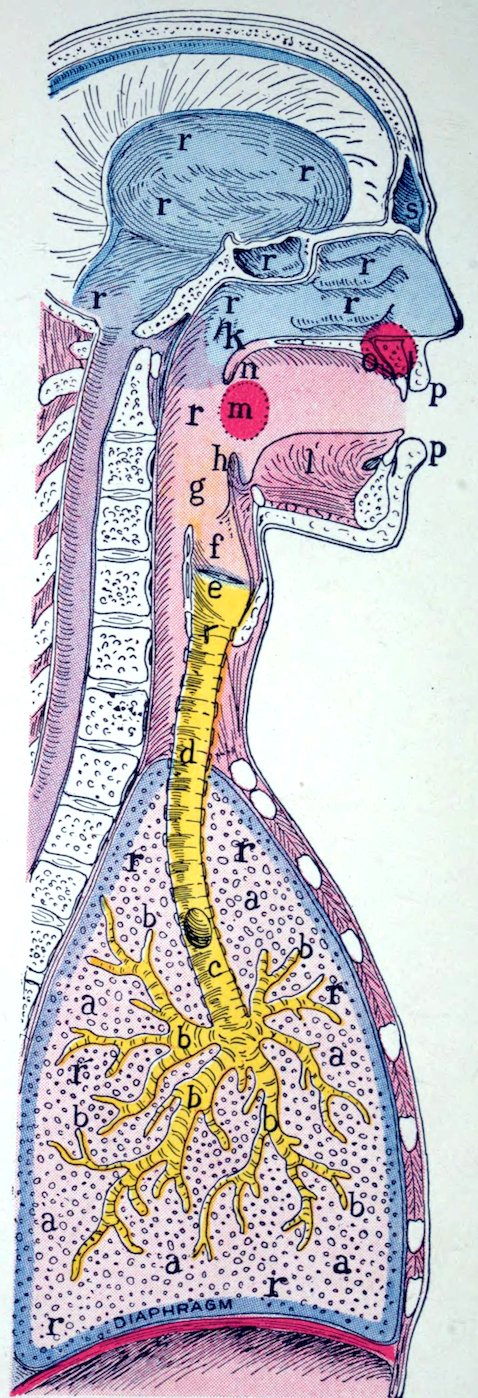
The Mechanism of Voice Production Condensed in One Illustration
a.
The Air in the Lungs which through the
b.
Small Bronchial Tubes and the
c.
Large Bronchial Tubes and the
d.
Trachea is propelled to the
e.
Larynx, putting the vocal cords in vibration and originating SOUND.
f.
The Laryngeal Sounds which going through the
g.
Pharynx behind the
h.
Epiglottis reach the
m.
Mouth and are transformed into VOICE.
o.
The Focus or Center of Resonance of the voice.
l.
The Tongue relaxed on the floor of the mouth.
n.
The Uvula.
k.
The opening of the Eustachian Tube.
pp.
The Lips, the megaphone of the voice.
rrr.
The head, chest and abdominal Resonating Cavities where the vocal vibrations get the resonance of the body.
s.
The Frontal Sinuses.
The Diaphragm is shown at the base of the lungs.
CARUSO’S METHOD OF
VOICE PRODUCTION
1