Chapter XXIV · VOCAL EXERCISES OF THE SCIENTIFIC CULTURE OF VOICE
Reading edition
The pupil, either standing in a natural pose, or seated comfortably, avoiding all muscular rigidity, must conduct himself as if carrying on a conversation.
In the case of professional singers who can hardly overcome the habitual pose of the stage, it is better to be seated, with head bowed slightly, concentrating their mental attitude on the idea of telling rather than singing their exercises to the teacher.
The first series of exercises are staccato in rhythm, and are made up of the five Italian vowels in combination with the consonants B and M in alternation with L, as in Ba, Be, Bi, Bo, Bu, and La, Le, Li, Lo, Lu (Italian pronunciation).
In cases where the pupil finds that another consonant is easier to articulate, he can use it for a preliminary length of time.
It is understood that these syllables must be pronounced very distinctly, observing strictly the phonetic rules of Italian vowels and consonants as given in Chapter XVIII, and special care must be taken to avoid the formation of double vowels.
279Pupils, after hearing the exercises on the piano, must first enunciate clearly the syllables to be sung, as nearly as possible on the pitch of the tones played; then, by using the same mechanism as in the speaking voice, that is, the same pronunciation and amount of breath, carry them into singing.
For practical convenience in practicing, we emphasize again, in a brief summary, what pupils must do in singing these exercises, according to this method, and what they must avoid:
1. They must act as real beginners, children, in fact, and they will learn much more quickly.
2. Give no emphasis to what they are singing, except in regard to its correct pronunciation.
3. Have the mental suggestion of being tired; it helps to relax.
4. Open the mouth wide by dropping, not forcing, the lower jaw in producing the first syllable, Ma, La, or Ba, etc. The larger the space of the A, the greater the resonance.
5. Sing with full voice, not falsetto. Often pupils who are self-conscious fail to give their full voices. This must be avoided, at any cost from the very beginning.
6. Practice before a mirror so as to be certain that the rules are observed. Do not depend on the ear for that; its control can be easily misleading.
7. Watch the tongue; that is of most vital importance. Keep it in soft contact with the lower lip; it helps its relaxation.
8. Sing the exercises in staccato rhythm for three or four months, or more, until the voice is placed 280and produced with the vocal organs in complete relaxation.
What pupils must avoid in singing:
1. To prepare themselves for singing.
2. To take a breath before starting, thus singing on the breath. The breath already existing into the lungs must be used first, then replaced by a new supply. This establishes a natural rhythm of breathing.
3. To attack the tone by a stroke (stroke of glottis). It must commence exactly as in talking.
4. To sing double vowels, like Ma-a, Me-e, Mi-i, Mo-o, Mu-u. In doing this the second vowel will always be dragged back into the throat by the tongue.
5. To accentuate the top notes, or the last of the exercises. This is done by most students. The tones must all be perfectly equal and colorless from the first to the last exercise.
Once pupils have acquired a certain freedom and dexterity in doing these exercises with the consonants B, M, L, they must practice all the other consonants of the alphabet. Thereafter start to use the syllables La, Le, Li, Lo, Lu, in alternation with the vowels alone, A—E—I—O—U in staccato form, until their experience in placing the voice is completely assured.
The above suggestions, besides being a valuable guide in placing the voice, can correct almost any defect in voice production, and establish the proper vocal mechanism for beginners.
In order to acquire the full command of a correct 281voice production, available for all styles of music, pupils must enter into the practice of sustained tones—the most difficult achievement in the art of good singing—only after a perfect control of the staccato tones has been attained, and in the beginning they must be attempted only in combination with staccato tones. This constitutes the second series of exercises.
The third series is made up of only sustained tones, which, when produced correctly, commences to take on all the musical characteristics of the singing voice: volume, color, expression, which gradually develop the pupils’ personal style of singing.
282 Audio content is not currently supported on your device. [MusicXML]
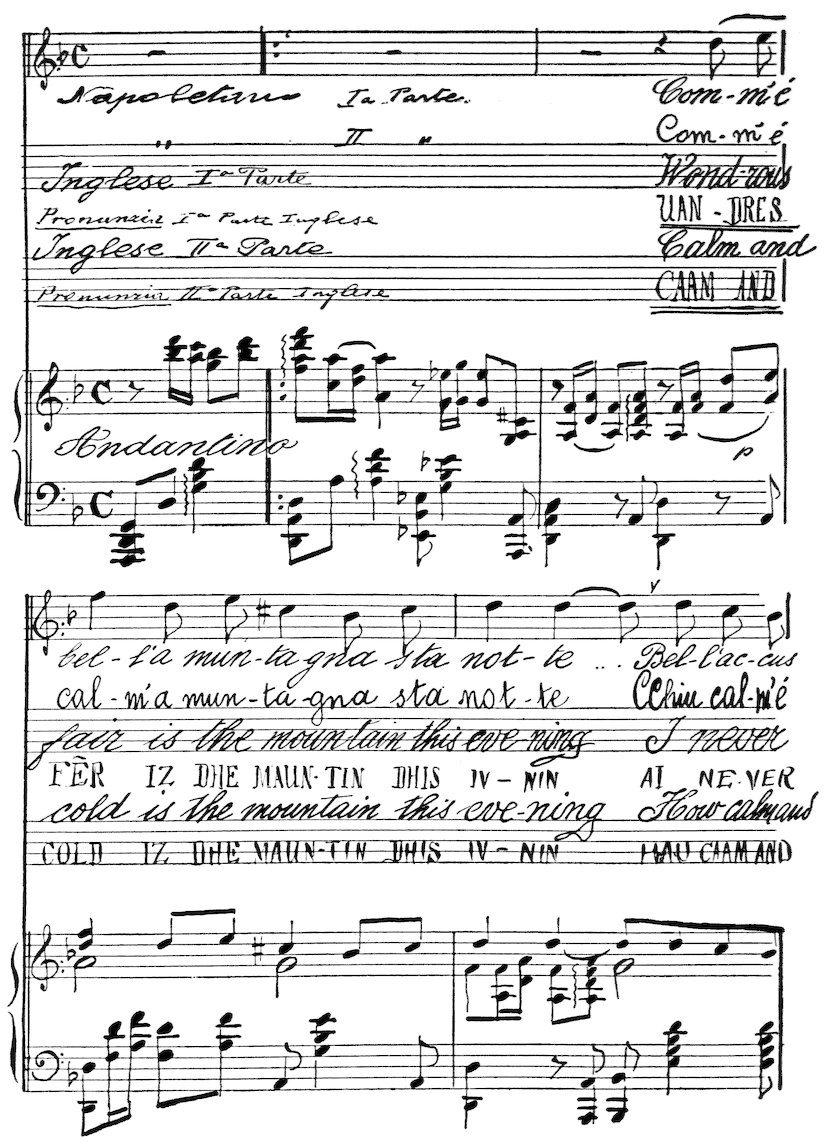
FACSIMILE OF MS. COPIED BY CARUSO HIMSELF AND CONTAINING HIS ORIGINAL METHOD OF TEACHING HIMSELF HOW TO SING IN ENGLISH
283
Before going into the vocal exercises of The Scientific Culture of Voice it may be of interest to study closely an original manuscript written by Caruso himself as an aid in studying.
The importance given by Caruso to his enunciation in singing is shown by the care with which he translated into English the front page of this Neapolitan song, spelling the English version according to the Italian rules.
The handwriting of both the music and the words is his own, and the underscored words represent the English pronunciation “Italianized.”
284This series of staccato exercises is suggested for the purpose of making students attain the correct enunciation of their words as the best means for placing the singing voice through the proper formation of the speaking voice.
When once the voice is placed, by the means of the consonants, these same exercises must be practiced again by using the vowels A, E, I, O, U alone, in staccato form.
The vowels are more difficult to place, therefore in singing them alone particular care must be taken to enunciate them as they are enunciated when connected with consonants as, for instance, la, le, li, lo, lu. It would be a good practice at the beginning to alternate, la, le, li, lo, lu with a, e, i, o, u.
285