Chapter XXI · THE ITALIAN VOWELS AND CONSONANTS AS FUNDAMENTAL PHONETIC ELEMENTS FOR VOICE CULTURE
Reading edition
Italian is perhaps the only existing language which has the phonetic property of pronouncing its vowels and consonants always in the same manner. To read Italian it is only necessary to know the enunciation of the twenty-four letters representing its alphabet, all of which take but a few minutes. This constitutes the essential advantage of the Italian language, especially for the student of singing, who, after acquiring a thorough knowledge of the correct pronunciation of the Italian alphabet, finds his voice already naturally placed in its physiological center, Italian being a naturally placed language.
All the phonetic sounds of the English language are included in the twenty-four letters of the Italian alphabet, except the combination of th which, however, is very similar to the Italian d, pronounced with the breath reinforced a little, while the tongue is held quite relaxed between the teeth.
The vowels, which are the fundamental elements in the formation of the voice, are simpler in the Italian language than in the English, from which they differ greatly, for they are composed of only 232five sounds, produced very smoothly in the front part of the mouth, while the phonetic organs are kept in relaxation. Therefore, it is of the utmost importance to learn their correct pronunciation, because most of the advantages of Italian, for singing, lie in their phonetic excellence and perfection.
The vowels are five in number, and are always uttered in the same manner, with no exceptions in any case whatsoever.[9] Each vowel has a characteristic shape, dependent upon the adjustments of the organs which take part in its formation.
The first vowel is A. It has the sound of A as in the English word father, emphasizing its pronunciation in a broad way. It is the largest vowel, and is open and round in shape.
It is most essential to learn the enunciation of this vowel as perfectly as possible, because it represents the first phonetic element from which the other vowels can easily be derived through a simple phonetic evolution.
For its correct production the mouth must be opened wide, though not by a forced movement; the throat, likewise, must be opened entirely. This act should be spontaneous and similar to the opening of the mouth in eating.
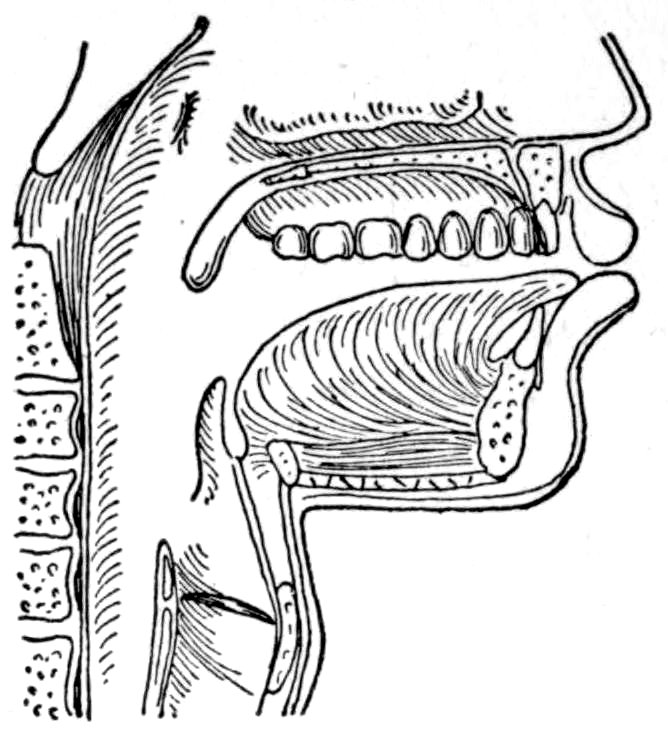
To be certain that this important movement is done correctly, two conditions are indispensable: The tongue must lie flat and completely relaxed on the floor of the mouth (see Fig. 19), its 233tip in contact with the lower teeth or lip. The relaxation must be almost passive, no sensation of any sort accompanying the act of pronunciation of this vowel. The palate must be in its normal position, relaxed, taking no part in this phonation.
As very few people pronounce by leaving the phonetic organs in complete relaxation, the author thinks it better for beginners to have these rules more than well emphasized, for they will be of the greatest benefit in singing. To those who have been accustomed for many years to one language, which has very different phonetic rules, it is of great help to exaggerate somewhat the rules of the new language.
It is necessary also to point out that pupils, from the very beginning of their study of this method, must leave aside entirely the English pronunciation in practicing the vowels and consonants, avoiding the confusion of the two languages.
By using only Italian, and always with the correct pronunciation of its phonetic elements, students will acquire the habit of their permanent and proper use.
The vowel E pronounced as in the English words late, fate, is but an evolution of the vowel A above-mentioned.
In this evolution, the mouth modifies its shape slightly, becoming smaller in size, almost half the size of A. This change is performed essentially outside the mouth, by the upper and lower jaws coming nearer, and making a narrower space in the cavity of the mouth (see Fig. 15).
234The organs of phonation—the tongue, palate, etc.—are left in almost the same position as the vowel A, taking very little part in the change, the tongue and palate alone being very slightly raised. The whole difference in the size of this vowel depends on the diminution of the oral cavity resulting from raising the lower jaw toward the upper one.
The vowel I is enunciated like the I in machine, and is formed by approaching the lower jaw to the upper one as closely as possible without, however, using any muscular tension. The size of this vowel is the smallest of all. The vocal organs inside the mouth are left in almost the same relaxation as in the preceding vowels, except for a little tension of the tongue and palate, which are raised upward, more than in the vowel E (see Fig. 16).
The focus of the vibrations of the voice in this as well as the other vowels must be centered precisely inside the base of the nose, where a certain vibratory sensation is created and can gradually be felt by the pupil in the form of a tickling sensation, becoming perceptible first in producing the vowel I.
The A, E and I (pronounced as in father, fate, sneeze) are, therefore, differentiated only by the size of the oral cavity, the A having the largest space, the E half the amount of space, and the I the smallest possible without contracting the phonetic organs. The following is an illustration of the comparative size of these vowels, the opening of the mouth to its full extent, without any exaggeration or effort for the A, constituting the starting point in the formation of all of them.
235
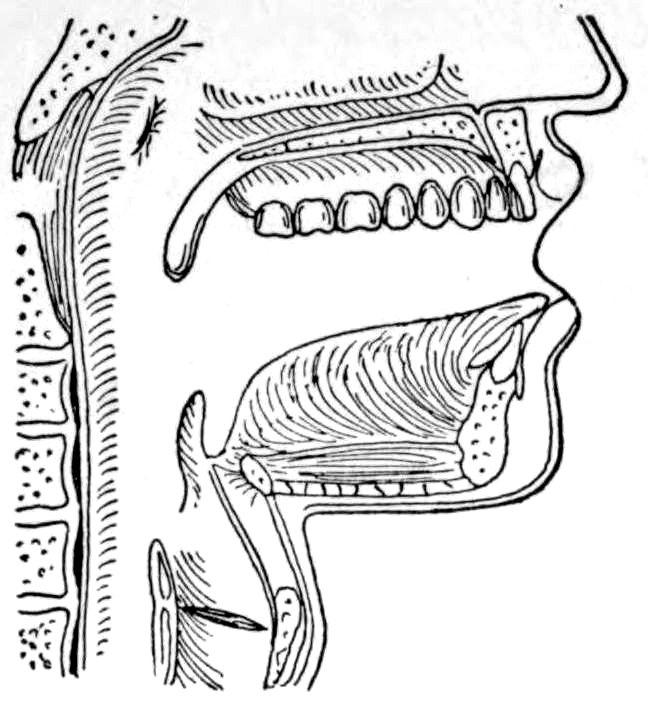
A Fig. 14.—The vowel a correctly produced
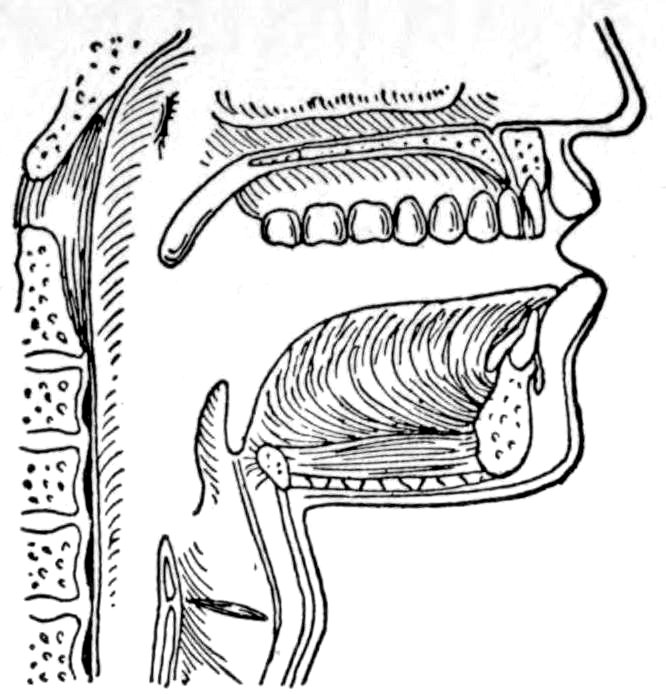
E Fig. 15.—The vowel e correctly produced
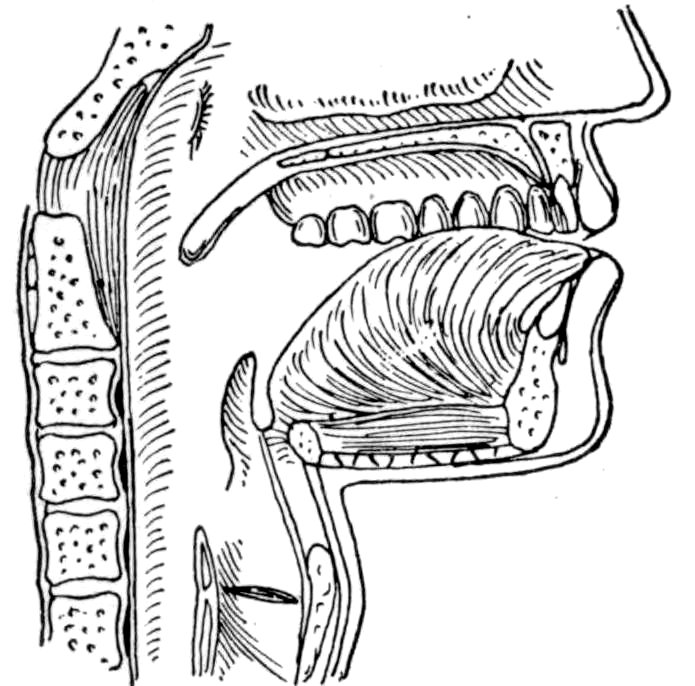
I Fig. 16.—The vowel i correctly produced
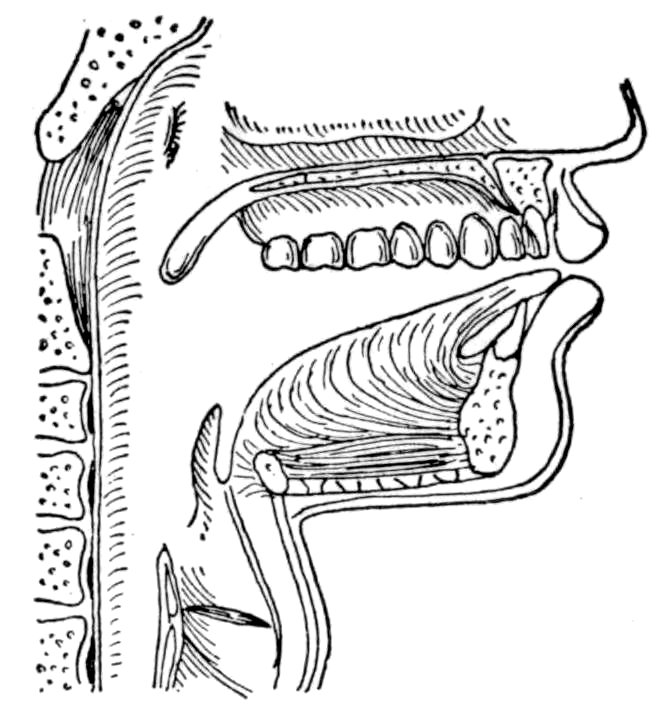
O Fig. 17.—The vowel o correctly produced
The vowel O, which has the sound of O as in bone, is also an evolution of A, in the formation of which the lips play the decisive part by converging into a rounded form, thus closing the mouth.
Inside the mouth the phonetic organs retain the same shape during this transition as for A, holding their same position. This gives O the same space as A in the mouth, and the approach of the lips forming a megaphone improves the color of its sound, 236which gets the characteristic darkness of the O, like a tone produced in a closed box.
U Fig. 18.—The vowel u correctly produced
The vowel U, pronounced like the U in prune, or like moon, is an evolution of the O, produced simply by protruding the lips forward, without squeezing them, as in the act of whistling or blowing.
The phonetic organs inside the mouth must be in complete relaxation in the same position as for A, and special care must be taken not to retract the tongue backward in prolonging the sound of the U.
It is of the utmost importance to emphasize time and again that all these sounds must be produced with the complete relaxation of the vocal organs, without any pressure on the part of the respiratory apparatus, with no interference of the laryngeal organs except for the necessary vibrations given to the sound by the vocal cords. In other words, the breath must be normal, the larynx almost passive, the phonetic organs in complete freedom, particularly the tongue. The full sound of the voice must be directed to the mouth, with a specific focus centered in the base of the nose where all vibrations must converge to get the proper resonance.
An X-ray illustration showing the vowels and the position of the tongue during their formation is given in Figures 20 to 24.
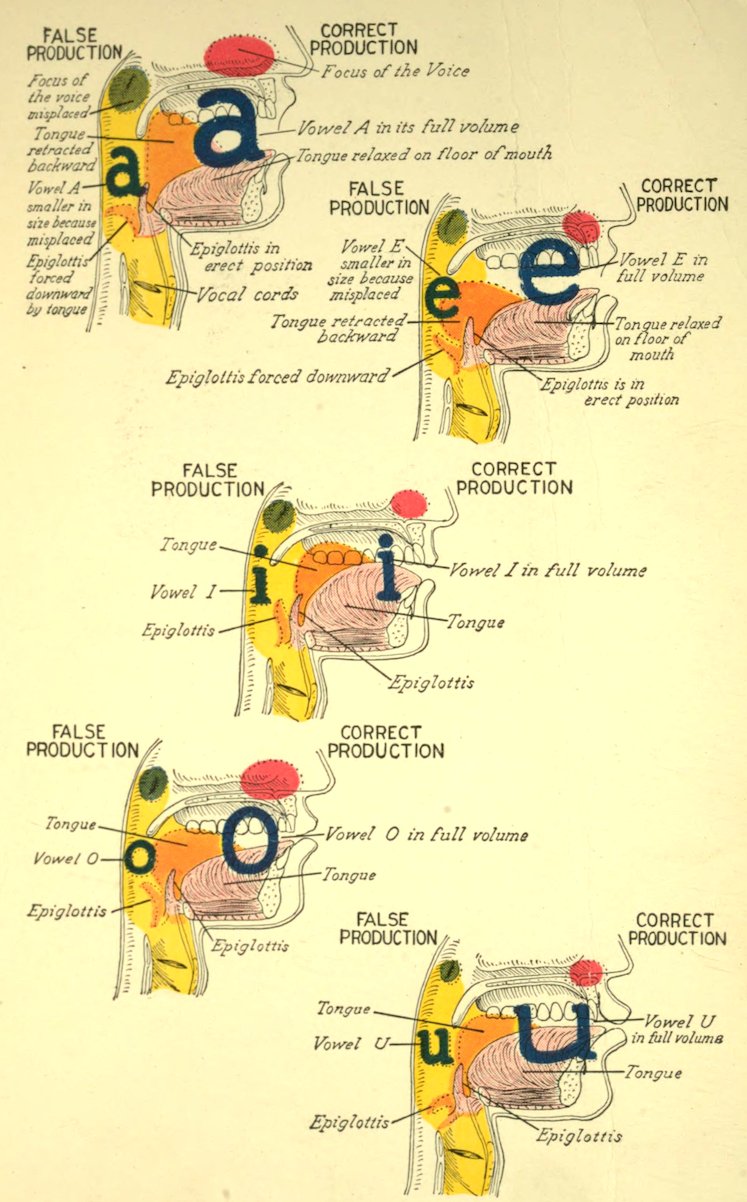
Fig. 19.—Correct and incorrect production of the five vowels
237The shape of the mouth and the position of the tongue in the formation of the vowels is shown by the following X-ray illustration taken while the vowels A E I O U were being sung by one who took particular care to produce his voice according to the rules of correct vocal mechanism.
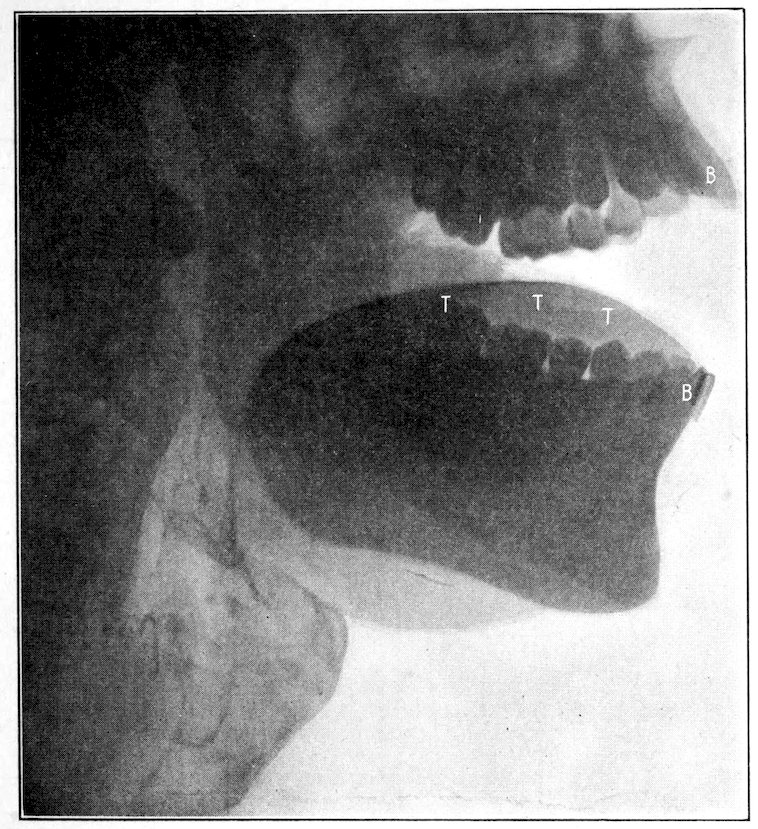
Fig. 20.—Vowel A bb. Upper and lower jaw at required distance for shaping a wide-open mouth. ttt. Tongue entirely relaxed on the floor of the mouth. The tip of the tongue extends far enough to cover the lower front teeth.
238
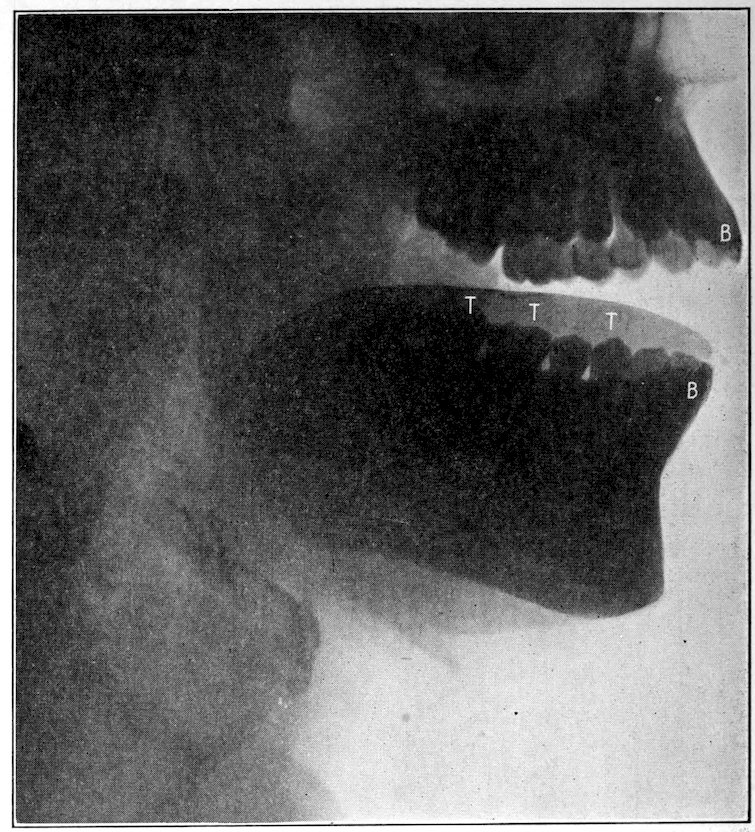
Fig. 21.—Vowel E bb. The distance between the upper and lower jaw is almost half compared to the opening for the vowel A. This constitutes the difference between these two vowels. ttt. The tongue is raised upward only very slightly, but in the same position and relaxation as for the vowel A.
239
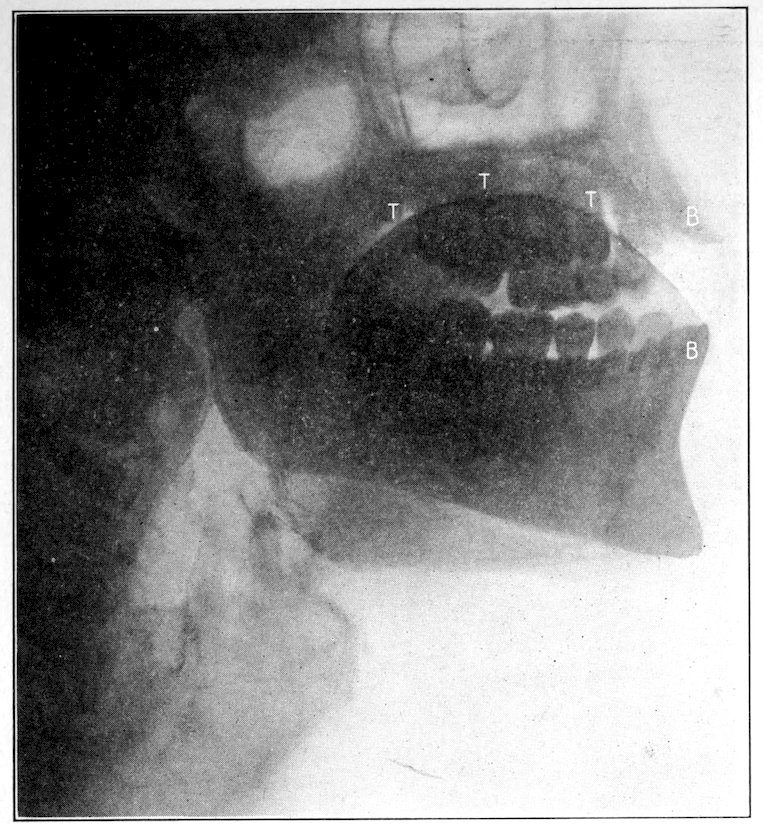
Fig. 22.—Vowel I bb. The opening of the mouth is smaller in size compared to the vowels A and E. ttt. The tongue is raised upward toward the palate, its tip likewise extending far enough to cover the lower front teeth.
240
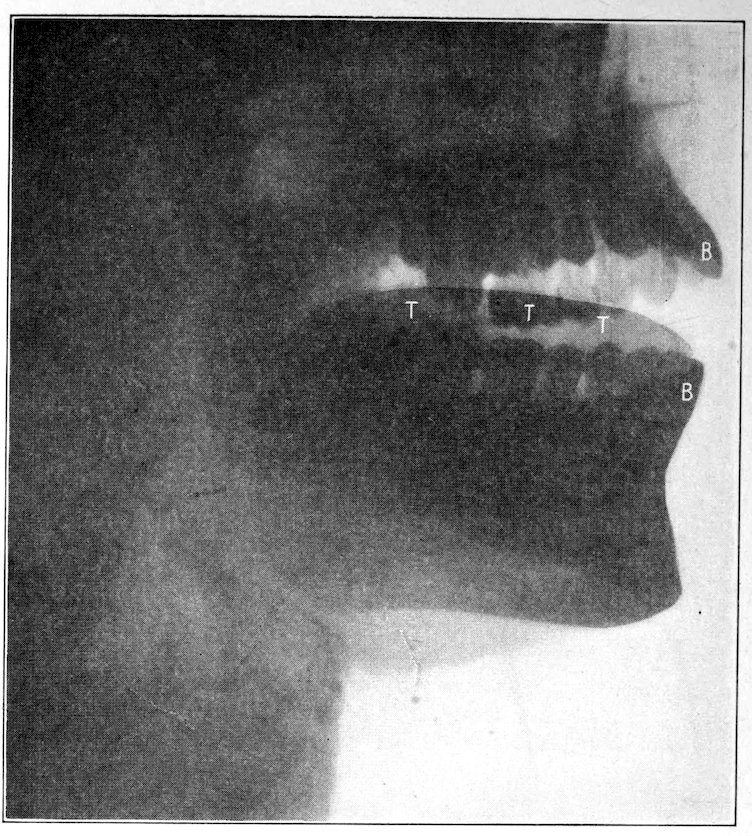
Fig. 23.—Vowel O bb. The relationship of the upper and lower jaw is very similar to the vowel A, though somewhat smaller in size. ttt. The tongue is in the same relaxation and position. The marked shape of this vowel, is established by the lips, which cannot be seen in the X-Ray.
241
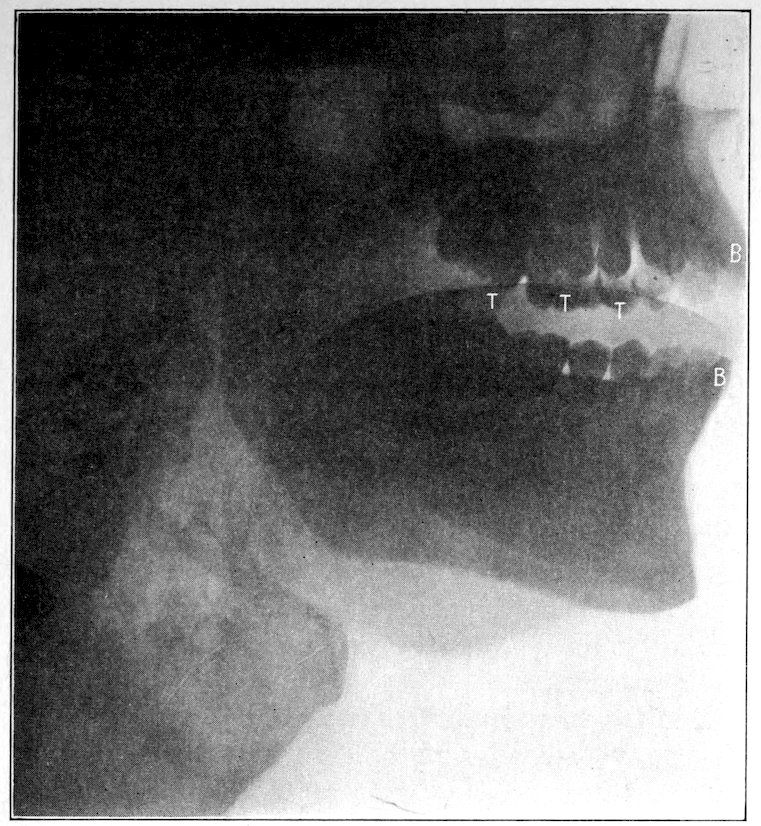
Fig. 24.—The vowel U bb. The relationship of the upper and lower jaw of this vowel is very similar to the vowel E. ttt. The tongue is likewise relaxed and extends over the lower front teeth. The marked difference in the shape of this vowel is established by the protrusion of the lips, which cannot be seen in the X-Ray. By comparing all the illustrations of the vowels already given in this book with those presented by the majority of books on voice, the readers can see the marked difference in the use of the phonetic organs (especially the tongue and lips) as suggested by this method of voice culture.
242Objection may be raised with regard to the accuracy of our suggestions about the pronunciation of the fundamental phonetic elements—the vowels. What entitles us, it may be said, to assert that the pronunciation of the Italian vowels, so different from the English, is the right one?
The answer is a very simple one. Physiologically, their formation corresponds to the fundamental principle of any function, namely, the minimum of energy for the maximum of efficiency. The mechanism of their production, which requires the complete relaxation of the vocal organs, entails no waste of energy. The X-ray illustrations already exhibited show also that phonetically, the Italian vowels are larger in shape, therefore more resonant, more melodious, softer and yet fuller in volume than those of any other modern language.
Hear the Italians talk, hear the street venders calling their wares, and you will realize the most obvious truth.
People who had the opportunity of hearing Caruso, whose voice nobody can deny was the most resonant and full, as well as the most melodious and beautiful, had practical evidence of this statement if only the formation of his vowels ever came to their attention.
The following photographs, taken while Caruso was singing the five vowels, show the different shape of his phonetic organs in the formation of each vowel. On close examination one can almost see the vocal vibrations, running freely all over the masque, and localize the focus of the voice.
243
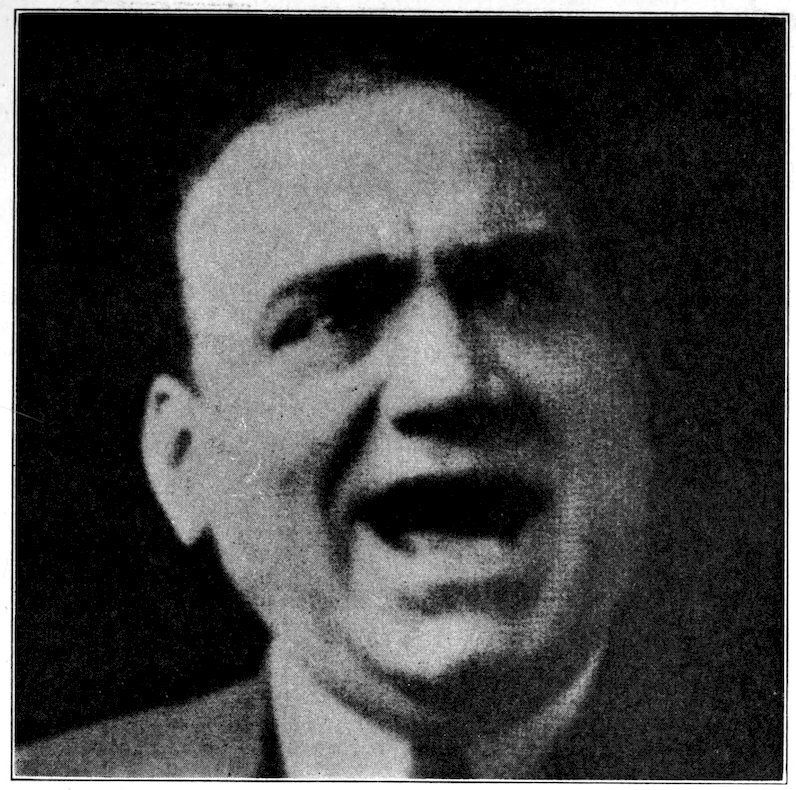
Photo by Bettini Syndicate, Inc. Fig. 25.—Vowel A In this illustration the great tenor is singing the vowel A, with very dramatic expression. Note how wide his mouth is open, while his lips are completely relaxed, and his tongue lies flat on the floor of the mouth, its tip in contact with the interior of the lower lip.
244
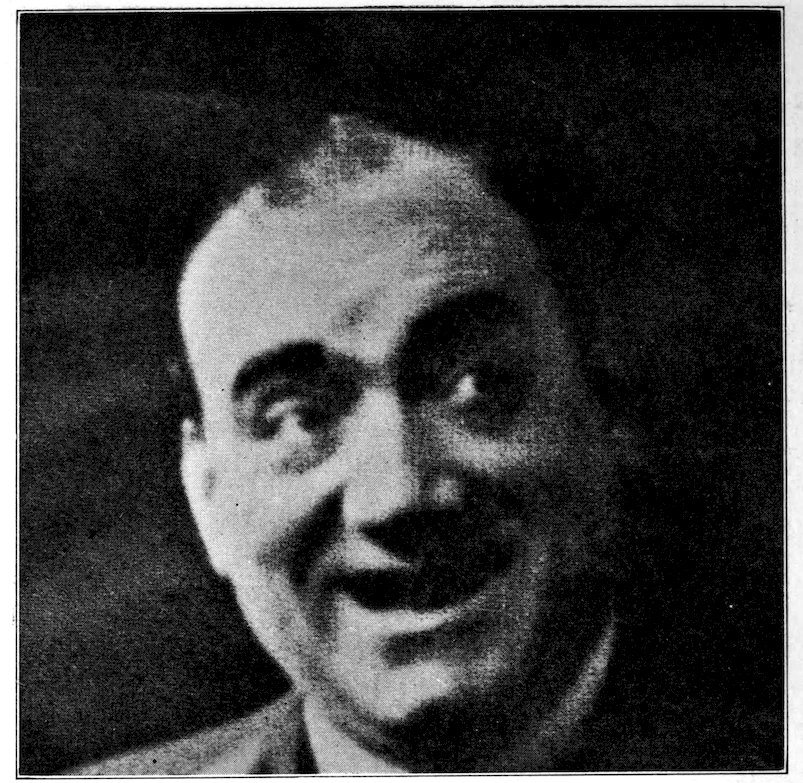
Photo by Bettini Syndicate, Inc. Fig. 26.—Vowel E This illustration shows Caruso singing the vowel E, with lyric expression. The mouth is half open when compared with the size of the vowel A. Note the marked relaxation of the masque and tongue which, as in A, is in contact with the interior of the lower lip.
245
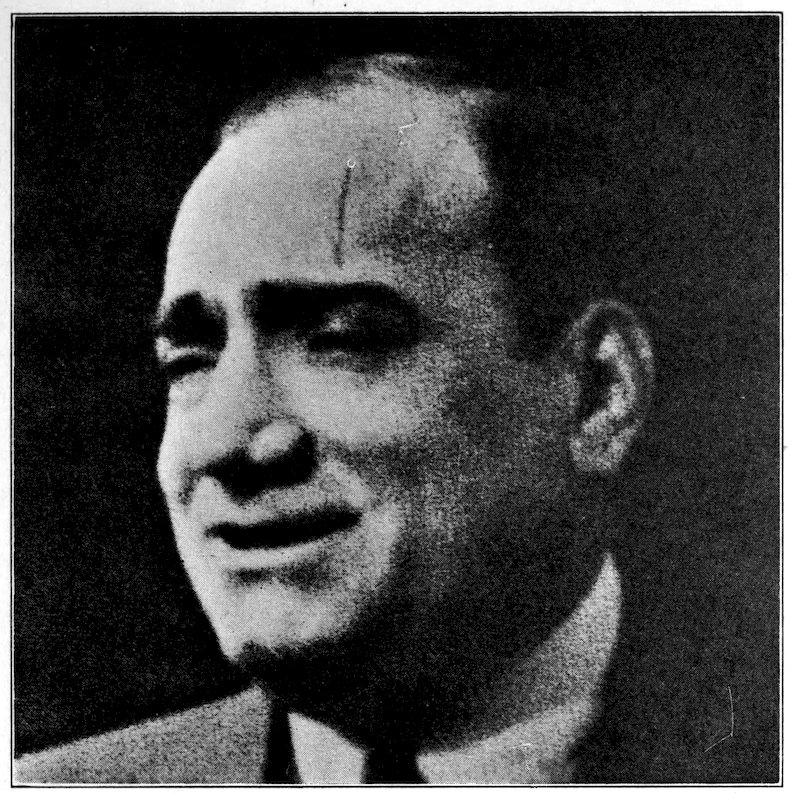
Photo by Bettini Syndicate, Inc. Fig. 27.—Vowel I In this illustration Caruso is seen singing the vowel I. Besides the relaxation of the masque, as in the vowels A and E, and its characteristic expression which makes it almost evident where the focus of the voice is centered, his lips approach without the slightest evidence of tension.
246
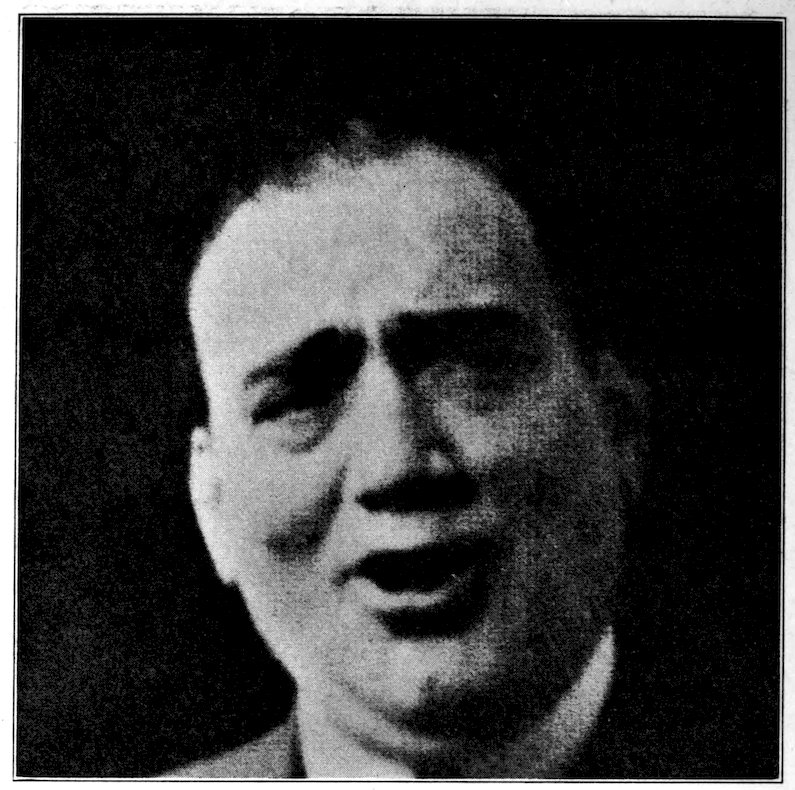
Photo by Bettini Syndicate, Inc. Fig. 28.—Vowel O This illustration shows Caruso singing the vowel O. The prominent feature lies in the shape of the lips, which are protruded, making a megaphone for the vowel. The lips, however, are in complete relaxation.
247
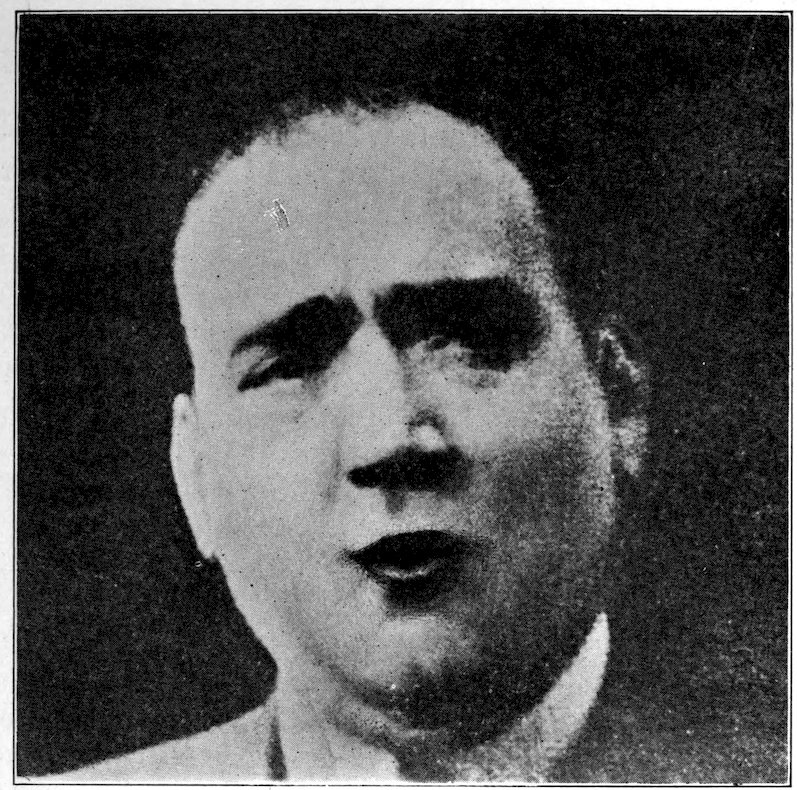
Photo by Bettini Syndicate, Inc. Fig. 29.—Vowel U This illustration shows Caruso singing the vowel U. In this vowel the prominent rôle is played by the lips, which by protruding markedly give the shape to the vowel U.
248It is otherwise known that Italian is the natural descendant of the classic languages—Latin and Greek—from which it has adopted its phonetic rules. These constitute a most valuable and precious inheritance, and are the best asset in building up its phonology.
All these illustrations reinforce the author’s assertion that the Italian language forms its vowels by a correct physiological and phonetic mechanism, and these practical examples given by Caruso justify the broad statement that Italian is the most adaptable and most suitable language for singing.
Although we have already given all the rules for the formation of the Italian vowels, we think that, in practicing, it is advisable for pupils to associate them with the Italian consonants, which, by their articulation, succeed better in placing the voice in its natural center for singing. As a matter of fact, it is true that the sound of the voice is given by the vowels,[10] but phonetically its placement is more distinctly directed by the consonants. Their denomination of Labials, Linguals, Palatins, etc., serves to indicate the place where they are to be articulated, and the organs which take part in their production. The consonants, therefore, are of great help in the correct pronunciation of the vowels, and a sure guide for the placement of the voice.
249