Chapter XV · SEVENTH PRINCIPLE
Reading edition
There are no registers in the singing voice, when it is correctly produced. According to natural laws the voice is made up of only one register, which constitutes its entire range.
According to almost general understanding the singing voice, at certain points of the natural range, breaks into series of tones and gives origin to the so-called registers of the voice.
Some writers contend that there are four or five registers; but the great majority of them claim only three, and this classification is universally adopted by singing teachers. A few authorities, however—among them Sir Morell Mackenzie, the well-known English laryngologist—admit two physical changes in voice production, while only a very small number of voice experts agree on the existence of but one register. It must be said that in none of these instances are these divisions founded upon a concrete or definite scientific truth.
The teachers who uphold the division of the voice in three registers call them the chest, the middle, and the head registers.
The author contends that no such division is suggested by nature, nor is it needed in voice culture. The breaks of the voice are the result of 137abrupt and artificial changes in the laryngeal adjustments when the vocal organs are adapting themselves to produce higher tones; the normal function of these organs is then disturbed and a defective vocal production is thus brought about. In fact not only is this classification not essential or necessary, but it places the mechanism of voice production at a certain disadvantage.
If we make an incidental analysis of it we are at first striken by the incongruous designation of the registers as chest, head, and middle. It is obvious that in speaking of the chest and head registers, reference is made to the resonance obtained by emphasizing the voice in the chest and head cavities. What about the middle register then? To what cavity does it allude?
The supposition that it would be a pharyngeal register would imply that the resonance is confined in the pharynx, which would give a throaty voice production, the most appalling defect in singing.
Another current misunderstanding exists in reference to the head register, which sometimes is confused with the so-called mezza voce. There is a substantial difference between them, which it is important to establish a priori, so that the criticism leveled at the head register may not be extended to the mezza voce.
When a singer is called upon to give his entire volume and intensity of voice in any part of its range for dramatic effect, he carries to the higher tones the same proportional volume and intensity of voice with the same quality, and this constitutes 138a dramatic style of singing in full voice; it can only be obtained by avoiding the break of the voice into registers.
But when the meaning of the words and the style of the music require lyric and delicate effects, only part of the voice—the mezza voce—is employed, being better adapted to express artistically and truthfully the meaning of words set to lyric music.
Caruso—a dramatic as well as a lyric tenor—in singing dramatic rôles used his full voice, in lyric parts the same voice but in lighter form, which in certain soft passages was very similar to a mezza voce. His correct mechanism of voice production made it possible for him to resort to the most perfect lyric style of singing without changing the intrinsic nature of his voice.
Singing in the mezza voce is then physiologically correct since it is performed without changing the mechanism of the full voice, with only this difference, that less intensity is used, while the volume and the quality of the voice remain the same.
There exists, then, a substantial difference between the head register and the mezza voce, which should be better understood.
The empiricism and the confusion that rule the singing field are put in relief by these commonplace and elementary errors; yet these are only a few of the many examples that go to explain the stagnant and chaotic condition of the art of singing as it is to-day.
Sir Morell Mackenzie, who wrote the most interesting book on the hygiene of the voice, admits, 139as previously stated, only two registers, and calls them the long or chest, and the short or head registers. This classification is by far more rational than all the others, and is based on the resonance of the chest for the long, and of the head for the short, register.
With all due respect to so great an authority, we venture to analyze this division as compared with the theory of no registers, except for the natural range; and we advance the following hypothesis:
Dr. Mackenzie defines the registers as a series of tones of like quality produced by a particular adjustment of the vocal cords.
According to this definition, the voice being divided into two registers, the chest register of a soprano singer, for instance would extend from low C to medium E, and would be represented by a series of tones of like quality produced by a particular adjustment of the vocal cords.
Following this there would be another series of tones produced by another adjustment of the vocal cords, with tones different in dimension than in the first series, and this would represent the head register.
Now, what can justify this change of the vocal cords to a second adjustment? Must it be attributed to a natural law dictating this alteration in the mechanism of voice production, or to an incorrect use of the vocal apparatus, particularly of the producing and moving power, which make this change in the mechanism of voice production unavoidable?
140No concrete reason has been given by Dr. Mackenzie for his classification. In fact further on he admits that, strictly speaking, there should be a different register for every note, which practically coincides with the theory generally accepted, that slight changes must take place in the vocal organs during their progressive adjustments for the ascending tones of the scale. But these gradual adjustments are not the same as contended by register advocates, according to whom the registers are originated by marked changes in the shape of the vocal organs in certain sections of the range where the voice breaks. There is no objection to having as many progressive registers as there are notes in the range, because practically it is tantamount to having one big register made up of as many small registers as there are notes in the compass of the voice, like one long chain formed by a great number of small links.
Therefore, Dr. Mackenzie’s classification, having no definite scientific basis, remains purely a personal view, which, however, stands out prominently among the many others as the most logical.
Dr. F. E. Miller, in his book The Voice, after illustrating the theory on registers, states that the breaks of the voice can be accounted for on scientific grounds:
Suppose [he says] there were a man able to produce the entire male vocal compass, from deepest bass to highest tenor. While for every note throughout the entire compass there would be subtle changes in the adjustment of the vocal tract the following also would be true: that beginning with the 141lowest note and throughout the first octave of his voice, the changes in the adjustments of the vocal tract would not alter the general character of the adjustment for that octave; that on entering the second octave, there would be a tendency toward change in the general adjustment of the vocal tract; while for the production of the remaining notes above, an almost startling change in the adjustment of the vocal tract would take place.
As much as we respect the opinion expressed in the above statement, we fail to perceive the scientific ground which justifies the necessity of the breaks of the voice into registers.
That slight changes of the vocal tract must occur in passing from one tone to the next, when the vocal organs undergo different adjustments for producing progressive pitches, has been demonstrated by scientific experiments and is admitted by all scientists. But that there is a tendency toward a change in the general adjustment of the vocal tract on entering the second octave, and that, for the production of the remaining notes above that, a startling change must take place in the adjustment of the vocal organs, has not thus far been reinforced by any scientific evidence.
And if it were true that the change in registers must occur at a certain particular altitude of the scale, it has not been demonstrated, up to this time, that this altitude is the correct place. There are singers, in fact, whose voices break in any difficult passage, and others—very few—whose voices never break through the entire range. We cannot think otherwise, then, that the division of the voice into 142registers, far from being a scientific axiom, is nothing else than an arbitrary and conventional hypothesis of voice experts, teachers and singers, who do not even agree among themselves as to where the breaks of the voice should occur.
Now and then [Dr. Miller adds] in a generation there may appear upon the scene a singer, usually a tenor, who for his high notes is not obliged to adopt the somewhat artificial adjustment required by the highest register, but can sing all his tones in the easier adjustments of the lowest or middle register. But he is a phenomenon, the exception that proves the rule....
This privilege which Dr. Miller claims for one singer in a generation is not so rare, we venture to say, and is far from being exceptional. As a matter of fact it is the rule with singers who produce their voice correctly, and furthermore, it should be the universal practice in voice training, as it is in absolute conformity with the normal physiological mechanism of the vocal organs.
Nature, as a rule, creates perfection through simplicity; the simpler the mechanism, the smoother and the more perfect its function; we can, therefore, hardly credit Nature with the complications that occur in the break of the voice into registers, and which we maintain are only the result of improper singing; neither can we think that Nature would bestow upon a few chosen singers physiological privileges which are denied to the generality. We are rather inclined to think that as in the case of blood circulation—the simplest and most 143wonderful function of the human system—the natural mechanism of voice production is one and the same for all of us.
Those singers whom Dr. Miller considers as “phenomena” are nothing more than good singers, conspicuous only through their scarcity and the deficiency of the others. Their great merit lies in the knowledge—whether conscious or unconscious—of how to make use of their vocal organs according to the laws of Nature.
Duprez, for instance [quotes Dr. Miller in his book] was a phenomenal tenor; he could sing the whole tenor range in the chest register. He could emit the ut de poitrine, which means that he could sing tenor high C in the chest register.
But there are others: Caruso could sing basso, baritone, dramatic and lyric tenor, without any breaks in his voice, and we believe he was not an exception in this. Of course, there was a slight change in Caruso’s voice when he used to sing as a lyric tenor, which affected only the dimensions of his voice, molded most essentially on the significance of the words and on the style of the music, which, being lyric, required a lighter form of voice than in the dramatic parts.
Lablache, the famous basso, used to sing tenor rôles as well as basso. Emma Calvé, a rare singer as well as exceptional artist, can sing as contralto and coloratura in one and the same voice. Galli-Curci uses only one register for the entire range of her voice, which covers almost three octaves, from G to F, and Titta Ruffo, the brilliant 144baritone, can invade very gallantly the domain of dramatic tenors with the same voice he uses for his entire range of baritone.
All this is not exceptional; when the vocal organs are properly adjusted for the different tones of the scale, every singer can acquire a voice production without breaks in the vocal range. In the case of many singers the changes of registers take place so frequently that they are condemned as “bad” singers even by people not well versed in the art of singing; the unevenness of their voices is caused by the continuous breaks at different points of the range, and the fact that the popular verdict is against them clearly shows that the public favors those who avoid breaks in their voices. This natural predilection of the uninformed listener is the best proof how essential is the homogeneity of the voice in quality and in volume.
To well-trained ears, the passing of the bow from one string of the violin to another produces somewhat of a peculiar and unpleasant effect which the good violinist tries to avoid, and strives to bring out all the tones alike in quality which procures a more uniform and artistic effect.
This dissonance, almost unavoidable in the violin, is only slight when compared with the disagreeable sensation produced by singers when passing from one register to another. The acoustic effects are obviously against the use of various registers in the human voice. To adapt the vocal organs to abrupt adjustments, which are only the result of artificial efforts to produce voices of different character in 145the same range, amounts to nothing less than the introduction of a faulty mechanism, which interferes with the natural production of the voice and destroys its beauty.
The singing of the greatest tenor in the annals of song—Caruso—gave the most striking evidence of the advantage of avoiding register breaks, and undoubtedly any singer who produces correctly the entire vocal range with a uniform quality throughout, and without any division into registers, is the nearest specimen to perfection in voice production.
The artificial division of the voice into registers, besides bringing about a complicated mechanism is also impractical and disadvantageous. If we produce, for instance, a tone of low pitch, belonging to the chest register, the resonance of which must be confined to the chest only, we eliminate the valuable support of the resonance of all the other cavities of the body and commit a grave error in voice production. No obstacles of any kind should check the sound waves in expanding from the larynx throughout the entire body, so as to get the benefit of the resonance of all its cavities; no reason, therefore, can justify a “chest” production or any other localization which would prevent the voice from getting its full resonance.
The scientific explanation of the disorder of the vocal organs, responsible for the breaking of the voice into registers, is that the adjustments of these organs for producing the tones are extremely exaggerated by two factors: the first is psychological, and is constituted by the spasmodic contraction 146of the larynx, usually at the mercy of psychological influences, as nervousness, fright, and other emotions, which, instead of a normal relaxation, instill into the muscles and cartilages an exaggerated tension; the second is physiological, and is represented by the increase of breath which singers feel they must force into their throats in order to counteract the tension of the vocal apparatus, and in the false belief that the harder they blow the more voice they produce.
From this fatal ignorance the notion of registers has originated probably. Singers, instinctively inclined to magnify their voices by giving more breath than necessary even in the lowest notes of their range, produce tones which are forced and also somewhat higher in pitch.
In progressing up the scale, by increasing the breath, the tones become more forced and sharp, and by persisting in this mechanism of forcing and growing sharper, they eventually reach a point when the normal resistance of the strained vocal organs refuses to lend its assistance any longer, so that the distressed singer is compelled to resort to artificial means in order to compensate for the lessened natural resources of the vocal organs. Then a sudden constriction of the larynx, pharynx, tongue, and soft palate combined reduce the vocal apparatus to a considerably smaller size and render it more apt to produce higher tones, which, however, have no longer the dimensions and the character of the previous ones, as we have demonstrated in a previous chapter.
147The result is evident: the more strained and contracted the vocal organs, the smaller the spaces of their cavities become, and consequently the volume of the voice produced is less; the greater the amount of breath employed under exaggerated pressure, the less exact is the resulting pitch of the voice and its original quality.
It is our firm conviction, however, that were the adjustments of the larynx but gradually employed with no constriction of the throat to interfere with the freedom of the tone and with the minimum amount of necessary breath employed, a mechanism would result which could regulate the entire range of the voice without requiring a break into different registers.
A rough illustration of what could be considered a perfect range, without division of registers, would be obtained by comparing the voice with a ladder; the wider part is at its base, and it diminishes in width proportionately as it nears the top. This gradual diminishing, however, does not affect its evenness. The identical evenness should remain in the gradual diminishing of the range of the voice, its lower tones, larger in volume, undergoing a gradual and slight decrease in ascending the scale, without this slight change, however, affecting the quality and evenness of the voice in any altitude of the range.
The illustrations in Figure 13 give material evidence of the breaks of the voice, according to the division of registers, with the last one showing the entire range without any breaks.
148The first illustration in the group of three represents the average compass of any high voice, that is, a dramatic tenor or a soprano, and shows where the usual breaks into registers occur. These breaks, however, are not the same and not equal in number for every voice. Some singers—the very bad ones—have breaks at almost every other note and sometimes, even in the same note, if long sustained, toward the end their voices slide into a kind of a squeezed sound, indefinite in pitch and disagreeable in effect. A certain great singer used to call these breaks the tails of the voice.
This traditional, time-worn divisions of the voice into three registers is explained as follows (referring to letters on the diagram):
a.
The chest register which gets its resonance from the chest. At the altitude of E or F the voice breaks and gives origin to the Middle Register.
b.
The first break of the voice.
c.
The Middle register which, according to some authors, gets its resonance from the pharynx. At the altitude of E it breaks and gives origin to the head register.
d.
The second break of the voice.
e.
The head register, which gets its resonance from the head.
The second illustration in Figure 13 shows the defects of the voice, resulting from its breaks into register, emphasized by colors, and referred to herewith by letters.
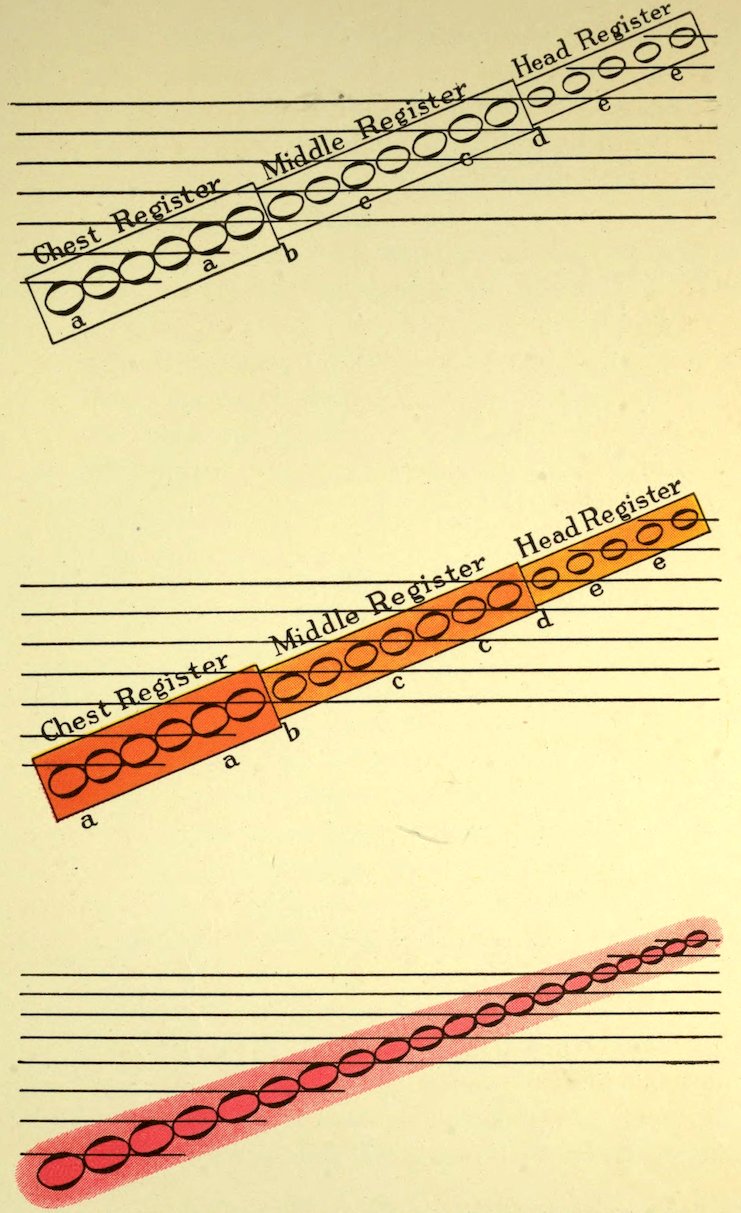
Fig. 13.—Voice range with and without breaks into registers
a.149
Chest register, produced by an exaggerated power and tension.
b.
Starting point of the first break. Change in the quality and volume of the voice.
c.
Middle register, the voice becomes gradually stiff, thin and sharp.
d.
Second break. Second change of the voice, its production becoming more difficult and forced.
e.
Head register. The voice becomes very sharp and decidedly changed in its characteristics—volume and quality. Its loses the character of human voice, and sounds like an instrument.
In a faulty voice mechanism, the lower tones being produced by an exaggerated effort for the purpose of getting more volume and resonance, the result is that the vocal apparatus, after a series of a few tones, cannot sustain the tension of its organs, and collapses. The voice breaks and gives origin to another series of tones molded on a new adjustment of the vocal organs, which suddenly reshape themselves into a smaller size, and produce smaller tones. Thus, from the chest register suddenly comes out the middle register, smaller in size (Fig. 13).
The middle register begins to show the deformities of the characteristics of the voice, which grow with the ascendency of its altitude. The volume begins to diminish, and the quality becomes stiff and sharp. From the collapse of the vocal organs 150at a certain point of the middle register, the head register takes origin.
In the head register the deformity of the voice is more appalling. It becomes empty and colorless with certain singers, or very sharp, though thinner in volume, and more like a sound than a human voice—a kind of a big, strong falsetto. In many instances singers cannot pronounce their words in this register, and therefore confine their efforts to singing tones only.
The third illustration in Figure 13 shows the full range of the voice as performed by a natural, correct mechanism. The lower tones, being produced by a normal amount of breath, can reach the lowest extension of the range, thus enabling the voice to run from E below the staff to high C. These low tones, however, are not strong, but rich, because the complete relaxation of the vocal organs allows their vibrations to expand and get the full resonance from all the body cavities. In singing, however, they are not used by tenors and sopranos.
By gradually ascending the scale there comes a point where the voice becomes naturally strong, without forcing its production, and this represents the natural, brilliant section of the compass, which characterizes the different voices—basso, baritone, tenor, soprano, etc.
The rest of the range of the voice follows the same mechanism, keeping its volume and quality almost entirely. The slight changes which may occur in its characteristics are related to the gradual, slight adjustments of the vocal organs for 151higher tones, but no breaks whatever into registers can take place.
The voice production with no registers, therefore, is able to render the entire range in the same form and quality, and relieves the vocal organs of any strain, giving also the possibility of training and developing a beautiful voice, with astonishing results.
Were a clear conception of the natural range of the voice to exist, nobody would bother about registers. Musical instruments have but one register, and require but one technique for playing at any altitude of their range. Why should it be essential for the human vocal apparatus—the most complete and perfect musical instrument—to undergo an elaborated process of breaks and sudden adjustments for producing the voice?
An original view, of a psychological nature, why we should supplant the theory of registers with one of psychological intonation of the voice, is suggested to the author by the fact that the speaking voice through the meaning of the words rules the singing voice and therefore must rule all its modulations in all the altitudes of its range.
The speaking voice has no registers; yet we talk in high and low pitch, and the modulation of our voice, in its different pitches, is dependent upon the psychological influence of the words.
We talk loudly, for instance, when we are excited, angry, etc.; softly and sweetly under the soothing influence of love, joy and tenderness; low 152on a solemn or sad occasion. All of these psychological phases influence and rule the pitch and color of our voice.
The changes in the character of the singing voice should be, by analogy, related rather to these emotional influences than to the physical mechanism of voice production, and thus render the entire range of the voice equal in form, provided a correct technique is used.
These psychological changes in the altitudes of the tones require no artificial adjustment of the vocal organs. In recitation, for instance, when the artist wishes to express an exquisite sentiment of happiness, tenderness, a dream or a vision, he raises his voice to a very high pitch (some do it very artistically) in order to produce a light and sweet intonation, and diminishing it at times to a mere shadow of a voice. Human psychology could not suggest any other inflection of voice than the high pitch for expressing such sentiments, as for the interpretation of dramatic feelings the medium and low tones are indicated; and the physiological mechanism of voice production fully obeys the psychological suggestion, without, though, changing the intrinsic characteristics of the voice, irrespective of how high or low the pitch may be.
The same must occur in singing; the changes of pitch, correctly produced, must not result in a change of register, but merely represent the psychological color given to the singing by the different sentiments to be expressed. In the unsurpassed love duet of Tristan and Isolde, for instance, it is 153the beautiful inspiration of the words more than technical execution of the notes that communicates its mellowness to the voices of the interpreters, and the voice production here is less the result of a skillful mechanical function than the corollary of the psychological influence of the words. The “head register” has nothing whatever to do with the light mezza voce which is required in this duet and is merely the attenuation of the voice under a psychological influence, just as would be the case if the same words were spoken.
The close relationship of the meaning of words with the altitude of the voice is shown by the fact that sometimes, in phrases of very dramatic portent, high pitches of voice are used, in full power and volume, neglecting entirely the change of the chest register into the more adaptable head register. In the finale of the third act of “Aïda,” for instance, the tenor holds the words, Sacerdote, io resto a te, in full voice, sustaining several high B’s, which, according to the division of registers, should be produced by the head register; but in so doing the quality of voice would not be suited to the meaning of the words, and would mar this powerful dramatic situation.
To sum up, there are no physiological needs for the break of the voice into registers; by leaving its intonation under psychological control we can attain any altitude in the vocal compass, without subjecting the vocal organs to artificial efforts in order to break the voice into unnecessary registers.
154Let psychology rule the voice within the bounds of one register for its entire range! If singers have drama, tragedy and poetry in their hearts, it will show in their singing, whether tragic, dramatic or lyric. The voice being the product of inspiration and natural resources will certainly be the truest and most beautiful expression of art when free from any artificial influence or deformity like the arbitrary break into registers.
155