Front matter (continued 6)
Reading edition
The agreement was kept two hours, after which the Blues took possession of the court-house; entered the door, and held the same, backed by armed men on foot and on horseback, terrorizing and keeping out most of the opposition voters. When the polls closed at 6:30 p.m., about one hundred and twenty-five electors had not cast their votes.[19] There had been plenty of intimidation and some personal violence, but no loss of life. The elements for riot and bloodshed, however, were all there, and it needed only a little brisk stirring to precipitate a general killing.
Meantime, news of the murder of Judge Welch, with a report of the general situation at Rio Grande City, and a request for Rangers, had traveled overland to Sam Fordyce and by telegraph to Austin, not arriving in time for action that day. Captain McDonald's territory included Starr County—his headquarters having been removed to Alice in 1903,[20] and on Wednesday morning of November 7th, 1906, he was called by telephone from the governor's office at Austin. Governor Lanham himself was at the Austin end and conveyed the news of the assassination, which McDonald had just learned from another source.
"How many men have you at Alice?" inquired the governor.
"Two, including myself. My sergeant, W.J. McCauley, is here. One of my men is on a scout below Corpus Christi, and the other (his force had by this time been reduced to three) is guarding two murderers at Edna."
"Captain," was the governor's next question, "would the fact that you have not been favorably disposed toward Judge Welch since the Brownsville affair make any difference in your undertaking this matter, now?"
"If you think so, Governor, you ought to get another Ranger Captain for this company; a Ranger that would let a thing like that make any difference in a case of this kind would be no good for any purpose that I know of."
"Well, then, Captain, take whatever force you have, and proceed as soon as possible to Rio Grande City, and I will send additional men there, as quickly as possible. I will wire the authorities that you are on the way with one Ranger and that more will follow at once."
"All right, Governor, I'll start first train, and do the best I can."
"And Captain" (The governor had suddenly remembered Brownsville).
"Yes, sir."
"Be conservative, Captain. Investigate, and try to quiet matters, but be conservative, quite conservative, Captain."
"Yes, sir, Governor, all right. I'll be conservative—as conservative as the circumstances will permit."
"Now, do that, Captain. Just quiet matters, and I'll send you reinforcements at once. Only be as conservative as possible till they come."
Captain Bill wasted no time in his preparation. The train would leave in half and hour, and he didn't stop to pack a dress suit. He notified McCauley, and gathered up a young fellow named Marsden, who had Ranger ambitions, and started with such clothes and guns as he had on.
It is a slow, roundabout way from Alice to Rio Grande City. You have to go from Alice over to Corpus Christi and there wait for a train that takes you down to Harlingen. Then at Harlingen you must wait for another train to take you to Sam Fordyce, and at Sam Fordyce you can hire a hack that will carry you to Rio Grande City, unless you are waylaid and murdered along that lonely road which follows the river and winds between a thick growth of cactus, mesquite and all the thorny rank vegetation of that sandy semi-tropical land. Starting from Alice in the forenoon, one with good luck may reach Rio Grande City by ten o'clock at night, though it will be safer to wait at Sam Fordyce until next morning. Those who travel from Sam Fordyce to Rio Grande City after nightfall, go armed, and need to.
Captain Bill had good luck on the way down. While waiting for the Harlingen train at Corpus Christi he fell in with Sam McKenzie, his ranger, who had been on a scout in that section, and at Harlingen he found Blaze Delling, who had resigned from Company B to become U.S. River Guard. He brought both men along, and with a force like that he felt able to cope with a mob of whatever size or nationality. Of course, nothing was known at Rio Grande City of the increase in the Ranger army. It had been given out there that Captain McDonald and one man had been ordered down, and that reinforcements would follow, accordingly as Governor Lanham had wired.
The day was well along when the little army finally reached Sam Fordyce and secured a conveyance for the final stage of their journey. An old frontiersman by the name of Inman, who owned a hack and pair of small mules, agreed to undertake the journey. It was late in the afternoon when they started.
Night fell, clear and starlight, but there was no moon, and the narrow winding southern road hedged thickly with mesquite and yucca and cactus growth was dark enough, except here and there where it opened to the river or to a hacienda (Mexican ranch), with its half dozen thatched huts, or hackles, surrounded by brush fences.
The Rangers drove along quietly, speaking in low voices when they spoke at all, peering into the darkness ahead, for they had no knowledge of what conditions were awaiting them, or what they were likely to meet along the way. Besides, it is the Ranger practice to go warily on dark nights and not traverse an unknown road with festivity and boisterous mirth.
It was about 8:30 o'clock and they had covered a little more than half the distance to Rio Grande City, when they heard the noise of approaching wheels and vaguely distinguished the outlines of some vehicle in the darkness ahead. They were at the time about opposite Casita Ranch—a poor place with the usual brush fences. Mr. Inman slackened down his mules and pulled the Ranger hack a little to one side of the road, supposing it to be only one of the traveling coaches that make daily trips between Rio Grande City and the railway terminus. But when the approaching vehicle was about thirty paces away, there was a sudden flash in the dark, a report, and a bullet went singing over the heads of the Rangers.
The Rangers were instantly in battle front, guns up and ready. They did not fire at once, however, for there might be some mistake.
"Hold up there!" called McDonald. "We are Texas Rangers! Stop that shooting!" and this admonition Private McKenzie quickly repeated in the Mexican tongue.
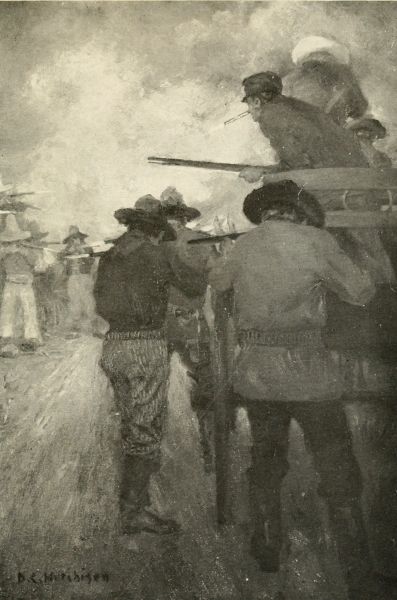
CAPTAIN BILL'S LAST BATTLE. "As pretty a fight as ever took place on the banks of the Rio Grande."
There was no chance for mistake, after that. The hacks had been moving right along and were now not more than twelve feet apart. Then the approaching hack stopped and three figures with guns were seen to leap to the ground. Captain Bill, who was standing up in the hack with his Winchester leveled on them, thought at first that they were getting out to surrender their arms, and three of his Rangers, McCauley, McKenzie and Delling quickly jumped down, facing them. But at that instant the epithets "Cavarones!" and "Gringoes!" came from the Mexicans, and then "Tetterly! Tetterly!" (Shoot! Shoot!) with which signal the Mexicans, both on the ground and in the hack, let go at the Rangers, point blank, while from behind the brush fence two guns in ambush opened an enfilading fire.
Then for the thirty seconds or so that it lasted, there was as pretty a fight as ever took place on the banks of the Rio Grande. With seven Mexican and five Ranger rapid-fire guns going—a round dozen in all—there was one continuous explosion, and an unceasing glare.
"From where I stood in the hack, I could see the whites of their eyes," Captain Bill said afterward, "and I felt as if I could pick the buttons off their coats. I let go as fast as I knew how, and at a different Mexican every time."
But though rapid, the Ranger fire was cool and accurate, while the Mexican marksmanship was inexcusably bad.
In less than half a minute it was all over. The seven Mexican guns were silenced, the Mexican force demolished. In the road, a man lay across his gun, dead. Two were limping and staggering away—one with a broken leg, the other to die; two more—the ambushers—were hiding in the weeds (where they were presently captured), while in the Mexican hack, which was now once more moving slowly along, was a freight of yet two more, both dead.
Sergeant McCauley, from his position on the ground, looked up to where Captain McDonald, still standing in the hack, was already reloading.
"Pretty little fight, Uncle Bill," he said, casual like.
"Yes," said Captain Bill, thoughtfully filling the magazine of his Winchester, "but do you reckon the governor will think we've been conservative enough?"
When the dead and wounded and prisoners were gathered and a general observation of the field was taken, it was found, from the empty shells, that each side had fired about an equal number of shots—some sixty, in all.
Marvelous as it may seem, not a Ranger was touched by any of the thirty or more shots fired at them, though Mr. Inman, the driver, got a pretty hot bullet through the very narrow space just under his arm a bullet that cut his undershirt and scorched his skin, and made him think for the moment that he was wounded. Old veteran that he was, he sat quietly holding his team—a silent observer of the spectacle—only regretting that, being unarmed, he could not have a more active part.
Captain Bill now took Delling and started for Rio Grande City, leaving the remainder of his force in charge of the dead, wounded and prisoners. They kept a sharp lookout for new attacking parties as they drove along, and discussed the recent battle in voices that were jubilant, but modulated.
"Of course, from the governor's telegram, they only expected to meet two men," Captain Bill reflected. "It must have been a sunrise when they suddenly found five guns going." And a little later, speaking out of what seemed a troubled conscience, "But I'm afraid the Governor won't think I was conservative."
Then presently they met two more vehicles coming, this time in a hurry. Ready for action, the Rangers waited until they were up close, then stopped them. They, also, had come to meet the Rangers, but this time with a note from the county judge, telling them to hurry, as the town was up in arms, and an outbreak was momentarily expected.
Captain McDonald sent one of the hacks after his men and their prisoners, with orders to get Mexicans from the Casita Ranch to watch the dead men until the inquest, next day. Then with the other hack he pushed on to Rio Grande City. From the tone of the judge's note he expected to find matters in a desperate condition. When he arrived, however, there seemed to be no special excitement. Everybody was armed and there were groups on the street, but there was little noise or open disturbance. The Ranger Captain looked up the judge and sheriff and made a report of his battle and its results, the news of which was soon both general and effective. When he went out among the crowds and told them to disarm—to go home and put their guns away and quit their foolishness—it was like the dismissal of a State encampment. By the time his men arrived everything was peaceable. It was too late that night to make a report to the governor, but Captain Bill summed up the situation in a telegram next morning. Governor Lanham had protested at the length and cost of a telegraphic report from Brownsville; this time there was no waste of words.
"Rio Grande City, Nov. 8, 1906. "Gov. S.W.T. Lanham, "Austin, Texas.
"We were ambushed; four Mexicans dead, one wounded, two captured; preparing to hold inquest. Everybody disarmed; everything quiet.
"W.J. McDonald, "Capt. Co. B, "Ranger Force."
That told the story, adequately, cheaply and modestly. The papers over the State made a good deal to-do over it, and reviewed Captain Bill's other exploits—real and imaginary—but to him it was only in the day's work, the work he had been carrying on for a long time, now, nearly a quarter of a century.[21]
The inquest was held that morning according to program, and the verdict justified the Rangers. After which, the four unlucky Ranger-hunters were buried in a lonely old graveyard near the place where they fell. The names of the four were, Farias, Osuna, Vincia and Perez—all known in Rio Grande City. Their comrade who was wounded, another Osuna, confirmed the Rangers' account of the battle. The original plan had been for all to lie in ambush behind the fence and fire on the Rangers deliberately, at close range. Losing patience, however, in an attempt to clamber over the thick barrier, all but two decided to remain in the hack.
The better element of Rio Grande City, though rejoicing over the results of the ambush, were naturally apprehensive as to what might happen next. Friends of the dead men were numerous, and it was believed that a bloody outbreak with reprisals would follow. Captain McDonald assured the citizens that he had no such fears, and the arrival of State troops and Ranger Company D, Captain Hughes, helped to restore confidence.
Captain Bill did not remain long in Rio Grande City. He was still engaged in solving the Conditt problem at Edna and could not undertake to unravel the mystery of Judge Welch's assassination. It remains unraveled to this day. Perhaps time will furnish a clue. Perhaps the secret lies buried in the old graveyard back of the Casita Ranch.
Nothing was ever done with the prisoners taken by the Rangers. That is, nothing was done with the two men caught in ambush. The wounded man was afterward made deputy sheriff, probably as a reward of merit for having engaged in a shooting match with the Rangers and escaped alive.
FOOTNOTES:
XLII
The End of Rangering and a New Appointment
STATE REVENUE AGENT OF TEXAS. THE "FULL RENDITION" BILL ENFORCED. A GREAT BATTLE AND A BLOODLESS TRIUMPH
The Rio Grande affair was Captain Bill's last Ranger service of dramatic importance. He was continuously busy during the two months that elapsed between that episode and his official retirement, but it was only in the usual line of duty, chasing murderers, putting down riot and disarming unruly men—the things he had done so often that to look back on his career now was to gaze down a kaleidoscopic vista of death and disorder—a whirling maze of bad men and guns.
It was in January, 1907, that he went to Bellville as a witness in a murder case, and it was while he was there, January 16th, that Governor T.M. Campbell, who had just succeeded Governor Lanham, appointed him State Revenue Agent of Texas. Captain Bill's first knowledge of the matter came to him through the morning paper at Bellville. When his duties were over there, he set out for Austin to inquire into it. He knew that a State Revenue Agent was appointed to keep a general supervision over the collection of the State revenues—taxes, license money and the like—but he had only a dim idea as to the specific duties of the office. He was by no means certain that he wanted to exchange the wide free life of Rangering, whatever might be its drawbacks, for the routine duties of an office in the Capitol, with a desk, a revolving chair and a stenographer, whatever might be the comforts and perquisites of these things. He was no longer a young man, and he had been shot through from different directions. Desperate wounds, long hard vigils, cold and exposure, had left him weather-beaten and with shoulders and chest no longer as full and erect as in the old days. Yet his eye was just as clear, his ear as alert and his nerve as steady as in the beginning, and if this appointment was merely a sinecure; a reward for deeds performed—a sort of official manifest that he was down and out—he would have none of it. He could wear out, and he might some day stop a conclusive bullet, but he declined to rust out.
Perhaps there was a pretty general belief in Texas that Captain McDonald's appointment was, in fact, a sinecure, but if so the idea was transient. Arriving at the State Capitol, he called on Governor Campbell, without delay.
"How about this appointment, Governor?" he said. "What kind of a job is it?"
"Well, it's a better job than you've got, Captain. The pay is better and it's safer, too. You're going to die, or be killed, someday, going about in all kinds of weather and getting shot at, from ambush. We can't afford to lose you, just yet."
"Thank you, Governor, I don't want to be lost, either," Captain Bill said in his gentle drawl, "but I don't know as I can fill the bill. What do I have to do as State Revenue Agent, anyway. No chance to handle a gun, is there? I can do that about as well as anything."
Governor Campbell laughed and handed Captain Bill a copy of the statutes.
"There's the law, on the subject," he said. "You'll find all the information you need, right there."
Captain Bill took the book and spent several days reading and re-reading whatever he could find bearing on the matter of tax-paying; also on the duties of tax-assessors and tax-gatherers in general, and on those of the State Revenue Agent in particular. He found that he knew a good deal on the subject, after all; not in technical detail, perhaps, but fundamentally and vitally. In his wide general knowledge of the conditions prevailing in every portion of the State he knew that the poorest counties—those least able to bear the burden—carried a disproportionate load of the State expenses. He had never given the matter much consideration before, taking it for granted that in a new county, and a poor county, taxes could not help being high. This was true, no doubt, but he saw clearly enough, now, that in such counties, taxes had been by far too high, all along, and that the "Full Rendition" law provided a remedy for just that thing. Captain Bill had but one idea about law, which was that it must be enforced. To enforce that law would be interesting, and righteous. He went back to Governor Campbell.
"Governor," he said, "I think this job will suit me pretty well, if I can run it my way."
"Well, Captain, that was what you were appointed for."
"Governor," Captain Bill proceeded, "there's some of our counties and people paying twice as much tax as they ought to, and some of them, the ones that ought to pay most, and the railroads and corporations, are not paying half enough."
Governor Campbell nodded.
"How would you rectify that, Captain?" he asked.
"Well, you see, the tax rate is the same for all counties, and the poor counties to provide for their own home expenses have to assess on a high valuation in order to make the amount big enough to go around, while the rich counties that are practically out of debt assess on a low valuation, sometimes not more than a fourth the value of the property. That might be all right if it was only the home levy that counted, but you see the State levy is assessed on the same valuation as the home levy, and the result is that a county that is in debt is paying State taxes on a valuation about twice or three times as big as those big rich counties that have had the most benefit from the State and are best able to pay for it. Why those old rich counties get an allowance of school money from the State that is actually more than all the taxes they turn in. Now the way to fix that is to make all the counties assess exactly alike—on full valuation—and get the State levy down where it belongs and the State expense fairly apportioned. The Full Rendition bill provides clearly for this case, and ought to be enforced."
Governor Campbell looked thoughtful. He foresaw the storm that a man with the convictions and determination of Bill McDonald could stir up in a State like Texas. Presently he said:
"Well, Captain, that was what the Full Rendition Bill was passed for, but it's been considered a dead letter, so far."
"It won't be a dead letter if I take the job, Governor. It will be the livest letter in the statute book, for a while."
Campbell smiled grimly. In imagination he already heard the howl that would go up, and the imprecations that would descend upon appointer as well as appointee. After all, perhaps a Ranger Captain in a job like that was not a perfect selection. Then presently he turned to Captain Bill.
"Well, Captain, you've got your appointment," he said.
The State Revenue Agent lost no time in beginning his work. Already many of the annual assessments for 1907 had been made, and if any re-assessments were to be taken there was no time to lose. In 1906 the assessed values of Texas properties had aggregated $1,210,000,000. State Agent McDonald resolved that they should properly be more than double this amount, and he undertook at once the first step in that direction. He did this knowing full well what would result. He knew that a man's purse is his tenderest point, and that to lay a finger on his taxes is to touch a spot already sore. He knew that what he was about to do meant to antagonize practically every corporation in the State, and every rich county as a whole. Also, perhaps, a majority of the press. Papers that had lauded him to the skies for his achievements would be first to belittle him, now, and to cry him down. What he was undertaking was distinctly a minority crusade; a struggle for the pioneer; a fight for the under dog.
Yet I think his chief consideration was the enforcement of the law. That would be likely to be so; the law's enforcement had been his habit so long. If the other things weighed at all, they probably only added zest to his resolve.
He began by issuing a general letter to assessors throughout the State. In part the letter ran:
"Dear Sir:
"As State Revenue Agent with well defined duties imposed upon me, I feel called upon to communicate with Tax Assessors relative to the rendition and assessment of real and personal property for Taxation....
"An inspection of the tax rolls of your county for 1906 and some years prior thereto, discloses the fact that real and personal property is assessed at only a certain percentage of its value instead of "at its value" as required by the Constitution and laws of the State. I will take occasion during the year to visit such counties as may be practicable and examine into the mode of rendition and assessment ... and I hope to have your assistance."
The letter then called attention to, and quoted from, the law, setting forth the duties which good officers and citizens would perform in full, and the penalties for being, and doing, otherwise. Near the end of this letter he said:
"This duty is imposed upon you by the law, and I suppose I am not presumptuous in asking you to follow it strictly so that there will be no embarrassment when I call for the purpose of making an investigation," etc., etc.
It was a careful dignified letter, entirely justified by the conditions. It is true the Revenue Agent did not fully explain in that last clause just what would be likely to cause the "embarrassment" when he appeared upon the scene "for the purpose of making an investigation," and the thoughtful assessor who had followed Bill McDonald's career and remembered some of his former investigations may have inferred that it would have something to do with guns.
Certainly that letter made those assessors mad. Also it made the people mad. And the newspapers. Even the people and newspapers of the counties that would benefit by the Full Rendition law—not quite understanding, at first—got mad as a preparation for further enlightenment. Never, since Joseph laid a twenty per cent. levy on the Egyptians, after first taking away all of their land, was there such a general madness over any tax order under the sun. In all the history of Texas there had been no such commotion—such a cyclone of indignation as that which had its storm center in the State Revenue Agent's office at Austin. Newspapers that only a week before had been praising Bill McDonald as the bravest man since Bowie and Travis—a fit successor to those heroes of the Alamo—now denounced him as a bloodthirsty desperado, who proposed to hold up the people of Texas as he had held up bad men—at the point of a six-shooter. They declared that his sole purpose was to fill the State Treasury to bursting with the people's money, so that it might be an easy prey for grafters, already lying in wait with schemes. Then they denounced Governor Campbell for appointing such a man, and prophesied his political ruin and general downfall. Some of them could not, and others would not, see that a full assessment for all was the only fair system, and that, if the values increased, the general rate of levy would lower accordingly. None so blind as those who will not see, and property owners, public and private, in counties where assessments had long been far too low to give them a fair share of the State's burdens, were naturally blinded by that self-interest which was stirred in with Adam's dust.
Indignation meetings prevailed. Assessors elected "by the people," told their constituents that they would "obey the will of the people," and tell any petty Revenue Agent that he could go to, with his bluff—that the "people" of Texas were bigger than any individual in it and knew what they wanted in the way of assessments, regardless of any fool laws to the contrary.
Perhaps the coolest man in the State sat in the State Revenue Agent's office at Austin, and smiled that bland winning smile of his as he greeted the reporters and declined to get mad or to recede from his position, merely referring them to the law as set down; dictating, between times, answers to excited assessors in which he assured them that his first letter was quite genuine and meant what it said, and that furthermore if they had—as some of them stated—already turned in their assessment rolls for 1907, they must go back and do it again, observing the law both in letter and spirit, in order to avoid, that little "embarrassment" when he should call somewhat later in the year. And this kicked up the dust worse than ever.
There was, however, a percentage of public sentiment in favor of the law and justice, regardless of personal interest. There were men in high places who stood boldly for the new order of assessment, and there were newspapers, even in the old rich counties that for a principle were willing to lose subscribers and pay the additional tax, besides. The names of those men and of those newspapers Texas should inscribe on a roll of honor in her State Capitol, for it was by such as those that some seventy years ago her independence was won.
Governor Campbell, assailed on every side, breasted the storm and stood firm. If his political structure must go down to ruin because of an effort to secure justice and the enforcement of the statutes as laid down, then perhaps the ruin would be better than the edifice. He discussed the matter thoughtfully and earnestly, here and there, when called upon, and was listened to with respect though with uncertain approval. Other officials throughout the State were inclined to be governed by the temper of their constituents. Yet there were notable exceptions. In February, 1907, at a convention of county judges, in Dallas, the statement was made that an attempt to carry out the instructions of the State Revenue Agent in the matter of the Full Rendition law would mean the political death of such county judges or commissioners as engaged in that effort. This statement, though wide, was not general. Among others to dissent was Judge Hill of Eastland County, who declared that if the people of Texas did not want a man in office who would carry out the law he, for one, would be glad to resign. That was a fine brave statement and had its effect. A resolution pledging the members of the association, individually and as a whole, to support and maintain the letter and spirit of the Full Rendition law, to the end that the taxes of the entire State might be equal and uniform, was unanimously adopted. The right word from the right source had been spoken. It began to be echoed in public places.
It was along in March, 1907, that the State Revenue Agent decided that he would not wait to call on the assessors during the year, but that he would gather them in Austin where he could talk to them, all together. A meeting of the State Association of Assessors, near the end of the month, was the result.
The assessors came together in many frames of mind, but mainly belligerent. Some of them had given it out to their constituents before they started that they were going down to tell that old Ranger that he might be able to round-up cattle-thieves and Mexicans, but that a bunch of county assessors would be a different matter. When these officials began to collect around the Capitol there was plenty of talk—not always complimentary. The State Revenue Agent loafed around among them. It was noticeable how the criticism subsided in the various groups as he sauntered in their direction. It was rumored that, though a civil officer, he still wore a "forty-five" in a holster and carried an "automatic" in his hip-pocket. When the members were finally assembled in general meeting, and "Captain Bill" rose to address them—they were quite still. He did not make a long speech, but it was to the point.
"We have been assessing in this go-as-you-please sort of a fashion a good while," he said, "and now we are going to do it the other way. We've been assessing by custom—now we're going to do it by law. The present tax rate is twenty cents on the hundred. We want to get it down to five cents on the hundred and adjust it so that every man will pay what he should—no more and no less. I don't want to pay out money any more than the next one, but I want to pay what is right, and I know you men want to do what is right, with your people, when you find out what the right thing is. This law is right, and just because we've been going according to an old unjust custom, is no reason now, why we shouldn't go according to an old and just law."
It was in this strain that he talked to them, using the friendly familiar vernacular which meant sincerity and a genuine interest in their welfare. They saw that he was in earnest, and he spoke to their better inclination. Also, he had the strong side of the argument. A paper commenting on the matter said:
"Thrice was the Captain armed, for the reason that he was in the right, and had the laws of the State to back him"—a statement true in the main, though it leaves the reader to guess in what third way the "Captain" was thought to be armed.
At all events, whatever rebellion may have existed must have been pretty well quieted by the next day, for the following resolution was unanimously adopted:
"Resolved, That we, the Assessors of the State of Texas, in convention assembled, will make what improvements we possibly can to increase the renditions of 1907, and promise to fully comply with the law, in the assessments of the future, and we hereby authorize the secretary of this convention to notify all assessors not present to co-operate with us in this matter."[22]
When that association disbanded, if there was any indignation and resentment existing for the State Revenue Agent it made no outward manifestation. One assessor said:
"As to what my duty was, I very well knew that before I went to Austin. But like most other assessors I followed a custom instead of the law. When a change was demanded I though it would cause a great deal of confusion among the people who had made an inventory of their property. I find it is not the case. I have very little trouble, and in my judgment I will get forty per cent. raise, for an average."
And another assessor, writing to the Fort Worth Record, said:
"Well, I am going to do my duty. I am swearing every man to the value of his property, as well as to the rendering of it, so when brother McDonald comes around, if he ever does, there will be no kick coming my way."
The result came when the inventories were all gathered and the items footed. Between the figures of 1906 and 1907 there was an actual difference of $414,137,246 in favor of the latter year. A part of this vast increase would come from the natural property growth of the State, but in the main it was due to the revised inventories and valuations. And this was a mere beginning, undertaken under disturbing and adverse conditions. The increase of 1908 over 1907 added another total of $561,297,248 to the property assessment values, aggregating an increase over the year 1906 of $975,434,494. Perhaps Texas will be a three billion dollar State yet, as has been prophesied, and the tax rate in the pioneer counties will be such as to encourage still further settlement and progress.
Not that the system is perfect yet. There are still assessors who shirk their duty, and hence counties who default in their burdens. No great reform can be immediately complete, but if State Revenue Agent McDonald survives long enough, this one will be so, in time, and already it stands as his greatest monument and victory.[23]
[Full rendition of property values for the purposes of taxation has always been the law in Texas. The Thirtieth Legislature provided for the reestablishment of an old and dishonored system. For a fuller understanding of the conditions before and after the enforcement of this and other laws the reader may refer to Governor Campbell's Message of Jan., 1909 (Appendix F), and an address by Hon. W.D. Williams (Appendix G), at the end of this volume.]
FOOTNOTES:
XLIII
In Conclusion
CAPTAIN BILL MC DONALD OF TEXAS—WHAT HE HAS BEEN AND WHAT HE IS TO-DAY
So now we have arrived at the end of our story—the story of "a man who does things"—who has been making history for twenty-five years, who is still making it, to-day. It is the story of a life so full of incident and episode that we have been able to give only a chapter here and there—to touch the high places as it were; for the tale entire would fill a library, and would involve the chronology of a State, which in that quarter of a century has increased its population nearly five times, its wealth in a like proportion, while its progress in education and morals has been incalculable. It is with the improvement last named that Bill McDonald, and the little army of State Rangers from which he had been selected as an example, have been chiefly concerned, though advancement in other directions has been collateral and dependent on moral growth. Order is not only the first law of Heaven, but of the frontier, and by the sturdy Frontier Battalion has the fight for order been made, and won. For in spite of plague-spots here and there (and in a State of so vast an area, and so recent and motley a settlement, it would be strange indeed if these did not exist), Texas is to-day a splendid empire of beautiful towns and cities—of fair and fruitful farms, and of handsome, hardy law-abiding men and women.
The Pan-handle has become a garden—not a Garden of Eden, exactly, but a garden of agriculture and home-culture—a larger garden than Eden, and happier and more profitable than Eden has ever been, since the fall.
And the best evidence of what the Ranger Force has done for Texas may be found in the steady reduction of its numbers. By the very nature of its achievements it has each year reduced the necessity of its existence. To-day it consists of four little companies, aggregating about thirty men, all told. They are brave, picked men—who face death daily and are not afraid. If from among these Bill McDonald has been marked for special distinction, it is not because he has been more willing to do and dare, or more resolute in its purpose of reform, but because he was at his birth marked by that special genius which, whatever his environment, would make episodic achievement and peculiar distinction his inevitable portion. Long before he became an officer he was a peace-maker. Wherever trouble occurred, McDonald had a genius for being there, separating and disarming the combatants, admonishing them in that convincing manner which few men ever resented. No one ever knew him to flinch at a time like that—perhaps no one ever dreamed that he would be likely to do so.
He was variously gifted. His perceptions were abnormally keen—his deductive conclusions often startling in their exactness. In his detective work, he was sometimes referred to as the Sherlock Holmes of Texas, though his processes would seem to have been more instinctive, and perhaps less intellectual, than those of Dr. Doyle's imaginary hero. For he had the eyes of a fox, the ears of a wolf and he could follow a scent like a hound.
"Cap, you have eyes in the back of your head and can smell a criminal in the dark," was once said to him, and perhaps this statement was not so wide of the mark.
His understanding of character—frontier character—was likewise a gift. Almost every man has a right side, and Bill McDonald always seemed to know how to reach that side. When no right side developed, he knew how to handle the wrong one. He seldom failed to win the confidence and the respect—even the friendship—of his prisoners. Such enemies as he has to-day are not among the men he caused to be punished, but among those who feared—and still fear—capture and punishment. There may be a good many such. Time and again his removal was not only requested, but demanded—sometimes by a whole community—a community which did not want the law's enforcement, and such a demand was likely to be accompanied by the threat of political revolt. But Texas, from the days of Sam Houston, has had good governors—governors to whom such a demand was in the nature of a compliment and the best reason for retaining the "offending" incumbent. Hence Bill McDonald not only remained in service, but was given an ever widening usefulness.
His "suddenness" and determination was a constant amazement to law-breakers. Once when he was in El Paso he received a telegram stating that some of his horses had been stolen from a ranch he then owned on the Oklahoma and Texas line. That ranch was nearly five hundred miles away as the crow flies, but Bill McDonald was on the train bound in that direction while the telegram was still damp. Arriving at his ranch, he struck the trail and set out alone to follow it, without rest, through Greer County, riding hot foot a distance of three hundred miles; overtaking the thieves at last somewhere beyond Norman, Oklahoma. Sid Woodring, a wary old outlaw, was in that gang, also his nephew, Frank Woodring, and a third member whose name is not recalled. It was a genuine surprise when Bill McDonald, whom they thought at the other end of Texas, charged in among them and had them disarmed almost before they realized what was going on. He marched them back to the jail at Norman; had them indicted in Greer County, where court was then in session; got them convicted for terms ranging from five to ten years, and returned with his recovered horses—completing, in the space of a few days, one of the neatest and most spectacular bits of official work on record.
The amount of his work was something enormous. In the two years ending August 31st, 1904, Ranger Company B, which he commanded, traveled 74,537 miles, made 205 scouts and 174 arrests. Thirty-one of the arrests were for murder, and nearly all for desperate crimes. When it is remembered that some of those scouts required days, and some of the arrests were hundreds of miles apart, and the result of long and arduous trailing and persistent detective work, the labor and the result can be better understood. Nor is this an unusual report. It has been selected at random and is by no means of the busiest period—the period of the early nineties—those riotous Pan-handle days.[24]
There was no show, no fuss and feathers about this work. Riot threatened or broke out here and there—the newspapers carried a line that Captain Bill was on the way to the scene. He arrived—often alone—disarmed a mob; made an arrest or two, perhaps; gave out a few quiet admonitions, and it was all over—next day to be forgotten. With many another man such cases would have meant resistance, bloodshed, troops, and the long animosities of years. That was his genius: to settle matters—to dispose of them—to get through and to be at other work without waste of time. Once when he was ordered to Galveston to prevent a prize-fight, he arrived at the hall where it was to take place, after the crowd had gathered. He did not bother to discuss matters with the managers or principals, but walked out on the stage and announced briefly to the audience that the fight would not take place, for the reason that it was against the law which he was there to enforce. That was a fair sample of his method—to know the law, and to enforce it, without a fire-works and without violence. No man has ever been his equal, perhaps, in that field.
It was true he was lucky, for bullets missed him, as a rule, and he steered clear of many dead-falls. Among the Mexicans, and bad men generally, there grew up a superstition that he was bullet-proof, and after the Rio Grande affair there would seem to be some reason for such a belief, for he stood up there in plain view, a tall and shining mark, blazing away, and no bullet touched him.
He has been always modest concerning his achievements, discussing them in the few words of an official report. When he has spoken at all it has been his habit to present the general result, rather than his part in it. It was this characteristic that made difficult the securing of material for these chapters. In preparing for the Rio Grande battle, for instance, I said to him:
"Of course you hit some of those Mexicans?"
"Well, you see, standing up as I was I had a good place to shoot from."
"Then you did hit some of them?"
"Well—of course, as I say, I had the best place to shoot from, and I felt as if I could pick the buttons off their coats."
"But, Captain, what I want to know is, if you think you really hit any of them."
"Oh, well, hell (very reluctantly), I don't guess I missed any of 'em!"
"Did you feel afraid?"
"No—I don't reckon I thought of that."
Yet every man is afraid of something. It was about the time of the conversation just noted (he was then visiting New York City), that he said anxiously to a companion who was steering him through the mess of traffic at one of the Twenty-third Street crossings:
"Look here, you'll get me killed, yet, in a place like this. I don't know the game."
The muzzle of a Colt 45, or of a Winchester, had no terrors for him, but a phalanx of automobiles and traction-cars, mingled with a medley of other vehicles, bearing down from four different directions—a perfect tangle of impending death—proved disturbing to one accustomed to simpler, even if more malignant, dangers.
With conditions of his own kind, however, he was at home, even in the metropolis. Visiting Coney Island one night he came upon two tough individuals, clutched in a fierce grip and trying to damage each other vitally. Texas was a long way off, but it did not matter. He took hold of those men saying:
"Look here, what are you men acting so sorry for? Stop this, now, and go home!"
They were the sort of men who would have resisted a policeman—who might have killed him. What they did now was to cease their warfare and stare in a dazed way at the tall lean figure, the unusual features and the large white hat of Captain Bill.
"You fellows go on home, now," he admonished, in his slow, homely way, and the two set out in different directions, without a word.
It was on his way back to Texas that he paid his promised visit to President Roosevelt. He was a bit nervous over the prospect, but found himself altogether at ease a moment after his arrival at the White House. For he was given the sort of hearty welcome that goes with the wider life he knew best, and was introduced without formality to men who were delighted to honor him for what he was, and had been. If Theodore Roosevelt had enjoyed his visit to the plains, so no less did Captain Bill McDonald find delight amid the halls and highways of legislation.
Captain Bill McDonald of Texas—the last of a vanishing race and a vanished day; of the race to which Crockett and Bowie and Travis and Fannin belonged; of a day when a hip and a holster were made one for the other—when to reach in that direction meant, for somebody, post-mortem and obsequies. State Revenue Agent of Texas—such to-day is his title—and the work he has undertaken in his new field goes bravely on. Texas still needs his honesty, his courage, and his determination. When those qualities direct the affairs of the body politic, the prosperity and predominance of that commonwealth are assured.
FOOTNOTES:
THE END
APPENDIX
APPENDIX A
EXTRACTS FROM REPORT OF ADJUTANT-GENERAL W.H. MABRY OF TEXAS; 1896. THE FITZSIMMONS-MAHER PRIZE FIGHT
Adjutant-General's Office, State of Texas. Austin, Feb. 27, 1896.
Lieutenant-Governor George T. Jester, Acting Governor:
Sir:—I herewith briefly submit a few facts connected with my presence at El Paso.
Much of the views sent over the wires were all colored in the interest of the managers of the prize fight. In fact, two reporters informed me that Stuart exercised a kind of censorship over all dispatches; that he demanded they be colored in his favor, with the threat that unless it was so worded they could not see the fight. The dispatches contained the denunciatory proceedings of a city council against the Governor's order in sending the rangers, and by my action there, in having close watch kept over all that was done so far as it pertained to the bringing off of the fight, but failed, with one exception, to contain the resolutions of the Ministers' Union, who represented a large class among the best citizens approving the Governor's action and upholding my methods. I talked with many of the best citizens, among whom were district officials, who stated they believed the fight would have been pulled off on some adjacent disputed territory about El Paso. Of course, Mr. Stuart assured me that he would not bring the fight off in Texas, but the Governor of Chihuahua also informed me that Mr. Stuart assured him that he would not pull off the fight in Old Mexico, and at the same time he had the dispatches to quote him as saying he would never violate the laws of Texas. If he does not do so every day in some of his gambling establishments, then common report has woefully misrepresented him.
I had a close and constant espionage placed, not only on the principals, but also on the passenger depot and the cars loaded with paraphernalia of the ring, with instructions to follow the latter to wherever hauled. Not only did I do this, up to the 14th, but kept it up to the 21st, notwithstanding Mr. Albers' outburst of virtuous (?) indignation, because I kept a surveillance over Maher when taken to Albers' room, over the latter's place of business, on the night of the 13th, the day before the fight was to occur. I did this on the night of the 20th, when Maher was domiciled in the same room. By the way, from the report of Captains Hughes and Brooks, I find it hard to reconcile Mr. Albers' high sounding document with his action in going on the bond of some bunco men whom Captain Hughes arrested for swindling and placed in jail. They were let out of jail, and Captains Hughes and Brooks investigated the facts, and found Mr. Albers and a man by the name of Burns, a keeper of a "red light" joint, were the bondsmen. Now, the surveillance over men who were advertised to commit a crime which was a felony in Texas, made these people very mad, and much was said about the liberty of the citizen, martial law, etc. The drippings from such sanctuaries should come very seldom, and then in very broken doses. I usurped no authority, nor interfered with local officers in any duty they saw fit to perform. I was ordered there to see that no such crime as was widely advertised to come off near El Paso should be perpetrated upon any isolated Texas soil, nor even on any so-called neutral strip between Texas and Mexico. The presence of the ranger force was evidently very much appreciated by a certain business element there, when these people called on me for protection and to leave a detachment in El Paso to protect the banks, while most of my force would be out of the city on the day of the fight. The city was full of desperate characters looking for spoils from whatever source.
From the utterance of Mr. Stuart, and most of his friends, as expressed in press dispatches, it would appear that the rangers and he were there for the same purpose—to prevent the fight in Texas. Nevertheless, Mr. Stuart's side kept up their misrepresentations until it became a foregone conclusion that no fight could occur on any disputed or neutral ground convenient to El Paso, notwithstanding the press dispatches reported him as having Mr. Bat Masterson and 100 men to protect his ring. I never heard of one cat squalling because another cat's tail got mashed. They began looking for another place, and Maher's eyes became very sore, and apparently remained in that condition until a secure place was found in Old Mexico, some 400 miles from El Paso. Then his eyes began to improve every day. Still, they may have been sore, but Dr. Yandell, who was reported in press dispatches as saying "Pete had acute ophthalmia," informed me that he never diagnosed his case, nor saw Maher at the time.
The prize fighters were merely dough in the hands of Mr. Stuart and the hundreds of others who were present for the money they hoped to win, and would have fought in the ring, wherever located, if unmolested by officers at that time. It is hard to believe that Mr. Stuart had so much respect for law he regarded as wrong, and which he believed was passed to affect his interests. To illustrate his great respect for laws generally, Mr. Brooks, manager of the Western Union Telegraph Company, came to me the night before the start was to be made for Langtry, and demanded protection. He stated that a representative of Mr. Stuart had come to him and informed him that unless his company paid $10,000 to Mr. Stuart, that he (Mr. B.) could not use his own office and his own wires to send off the report of the fight at Langtry. This same representative of Mr. Stuart's informed Mr. Brooks that said Mr. Stuart would place his (Mr. Stuart's) men in the office and keep him out by force. I readily granted him protection to do his legitimate business and had my rangers about the office, with the proper instructions, and no such high-handed measures were undertaken.
The statement wired, that I and the rangers crossed the river to see the fight, was palpably made to belittle the force. They knew it was false at the time.
I desire to express my approbation for the intelligent and efficient manner in which Captains Brooks, McDonald, Hughes, and Rogers executed every order and performed every duty. The rangers conducted themselves in such manner as to reflect additional credit upon the name of a ranger—always a synonym for courage and duty well performed. They were active in the execution of every order, quiet and orderly in manner, determined in mien, fearless and vigilant on duty; they thus naturally incur the displeasure of the law-breakers everywhere.
I have the honor to be your obedient servant,
W.H. Mabry, Adjutant-General.
Thanks are due Captains Orsay and Owen for the manner in which they have performed their respective duties.
I beg to here express my appreciation for the thoughtful and courteous consideration always accorded to me by Your Excellency, and my obligations for the cordial and able co-operation and advice which you have rendered to me in the administration of my department.
I have the honor to subscribe myself,
Very respectfully your obedient servant, W.H. Mabry, Adjutant-General.
STRENGTH AND OPERATIONS OF THE FRONTIER BATTALION
As now organized, the frontier force consists of four companies, commanded by Captains J.A. Brooks, W.J. McDonald, Jno. R. Hughes and J.H. Rogers.
Three are stationed along the Rio Grande and one (McDonald) in the Pan-handle, with headquarters at Alice, Cotulla, Ysleta and Amarillo. They scout over a large section of country, and detachments are sent to different sections where needed, if it is possible to send them. Demands for rangers have been greater than this department could furnish, because of the limited number of men in the service. But every effort has been made to cover as much territory as possible.
The report of operations for the two years show that they have traveled in scouting 173,381 miles; arrested 676 criminals; returned 2,856 head of stolen stock to their owners; have assisted the civil authorities 162 times, and guarded jails 13 times.
The duties of the ranger are arduous and often dangerous. The most desperate criminals would naturally seek that isolated section, and when on the trail of the bold desperadoes, often life is the forfeit in the encounter that may follow. Praise is due the commanding officers and their men for the prompt and fearless manner with which they perform their duties. While the pay is small, none but young men of character, standing, and good habits are enlisted, and they so conduct themselves as to reflect credit upon the State in the efficient service they render.
Because of the limited force, and the great demands made upon the service, there have been enlisted 82 special rangers, who serve without pay from the State. They are almost exclusively located in the frontier sections, and are paid principally by private interests, who claim they are compelled to stand the hardship of the extra burden, or tax it imposes, because, in conjunction with the regular force as a standing menace to criminals, they are thus enabled to enjoy some of the protection which a State really guarantees to them. These "specials" are always enlisted upon the recommendation of the sheriff and the district attorney, or the sheriff and some other officer of the county or district.
APPENDIX B
PART OF TWO YEARS' REPORT OF ADJUTANT-GENERAL THOS. SCURRY
December 1st, 1898—October 31st, 1900
THE RANGER SERVICE
The fact that the State has had for some years past a force always ready to suppress disorder, arrest criminals and aid the civil authorities in the protection of courts and jails, has been the cause of hundreds of criminals taking refuge in the border States, outside of the jurisdiction of Texas, and in Mexico, who would return to Texas to continue their depredations and murders were it not for the ranger force. Instances can be shown where the moral effect of having the rangers ready to co-operate with the civil authorities anywhere in the State has been a deterrent to the commission of lawless acts, and numerous instances can be shown where whole counties have been purged of their criminal element by the presence of the rangers, who alone were able to restore peace and good order in the community.
In reality, the so-called Frontier Battalion is but four small detachments. The reports received at this office indicate that these men, while fearless and prompt in the performance of their duty, have always acted with discretion and in the most orderly manner. Their well-known reputation for courage of itself has had a most salutary and good moral effect on the lawless element of the communities where they have been stationed.
Since January 1, 1899, the officers and men of the Frontier Battalion have been very actively engaged in running down the criminal element in the west, and in subduing lawlessness in other portions of the State. The rangers have only been used in other portions of the State when a direct request on your Excellency was made by the civil authorities of cities or counties needing them. That their work has been effective and to the satisfaction of those requesting their service, it is only necessary to refer to letters on file in this office in reference to their efficiency received from citizens and officials of the various cities and towns to which rangers have been ordered. It is probably appropriate to mention some prominent features of the work of the rangers during the past two years, outside of the duties usually performed by them in the way of scouting in the sparsely settled district of the west, and the work accomplished in recovering stolen cattle, arresting thieves, murderers, etc.
During the month of March, 1899, Captain McDonald, with two men, was ordered to Columbus, Colorado county, for the purpose of preventing trouble there between the Townsend and Reece factions. Captain McDonald went alone, his men not being able to reach him in time, and his courage and cool behavior prevented a conflict between the two factions. The district judge and district attorney both informed him that it was impossible to handle the situation, but he told them that he could make the effort, and he gave the members of each faction a limited time in which to get rid of their weapons, stating that he would put those in jail who refused to comply. His order had the desired effect.
Captain McDonald was ordered by your Excellency to Henderson county to work on the cases against the lynchers of the Humphreys. In reference to this affair, I take the liberty of quoting from a letter from Hon. N.B. Morris, ex-Assistant Attorney-General:
"You will remember that at the request of the sheriff, county attorney and other local authorities of that county, Captain McDonald and Private Old were sent there to assist them and myself in the investigation of that horrible murder which was then enshrouded in a mystery that it seemed almost impossible to uncover. Before the rangers reached us the people in the neighborhood of the murder seemed afraid to talk. They said they would be murdered, too, if they took any hand in working up the case. About the first thing that Captain McDonald did was to assure the people that he and his associates had come there to stay until every murderer was arrested and convicted, and that he would see that all those who assisted him would be protected. They believed him, and in consequence thereof they soon began to talk and feel that the law would be vindicated, and I am glad to say that it was. The work of the rangers in this one case is worth more to the State, in my opinion, than your department will cost during your administration. In fact, such service cannot be valued in dollars and cents....
"The rangers were at all times sober, orderly and quiet, and left that country on good terms with all factions. They paid no attention to the criticism of the mob sympathizers, but went straight along, did their duty and now have the confidence not only of the good citizens, but of the members of the mob and their friends."
Three of the lynchers turned State's evidence and eight of them were sentenced to the penitentiary for life.
In March, 1899, Company E, Captain J.H. Rogers commanding, was ordered to Laredo to assist the State health officer to enforce the quarantine laws, there being an epidemic of smallpox in that city. The Mexicans living there objected to being moved from their homes to the hospital, and the State health officer, considering it absolutely necessary for them to be moved in order to stop the spread of the disease, required force to accomplish his object. The Mexicans showed a disposition to riot on the 19th, collecting together in hundreds, some of them being armed. The city officials had a fight with them, several shots being fired, and on the 20th, Captain Rogers, followed by one ranger and a special ranger, went with the sheriff of the county to search for arms secreted in the house of an ex-policeman, it is supposed, for the purpose of making an assault upon the State health officer and his force if approached. These officers met resistance from the inmates of the house. A fight ensued in which Captain Rogers received a wound in the right arm, and one of the Mexicans was killed. The remaining detachment of Company E, having been advised of the fight, and having met Captain Rogers in a disabled condition, and presuming that the lives of the ranger and special ranger were in jeopardy, went to the scene of action without hesitation, and immediately upon reaching the street in which the Mexicans were assembled were fired upon by the latter. The six rangers proceeded up the street firing as they went, being under the impression that a man seen lying in the street, dead, was one of the rangers who accompanied Captain Rogers. Several disinterested citizens have said that these rangers showed remarkable pluck and daring in coming down the street, fighting several times their number without the slightest hesitation. Several Mexicans were wounded. After this the work of moving the smallpox patients to the hospital was an easy task.
In April, 1899, two rangers of this company were sent into Wharton County by request, and were successful in breaking up a gang of cattle thieves operating in that locality. Several were arrested, including the recognized leader.
In September, 1899, Captain Rogers and several of his men were ordered to Orange by request of the civil authorities, on account of an organized mob killing one negro and wounding another, and sending anonymous letters to others directing them to move out of the country. Several arrests were made. Captain Rogers was removed from Orange on account of his wound, and Captain McDonald and several of his men were ordered there to relieve him. Captain McDonald succeeded in arresting and having indicted four men for murder and a great number of men for conspiracy to murder in connection with the above mob. It is to be regretted that Ranger T.L. Fuller, while in the discharge of his duty at Orange, Texas, found it necessary to shoot and kill Oscar Poole in self-defense.
On the 15th day of October, 1900, while Captain W.J. McDonald, Lieutenant T.L. Fuller and Private A.L. Saxon, of Company B, were attending court at Orange, Texas, as witnesses, and Lieutenant Fuller to answer the charge of false imprisonment (for making an arrest while a private),[25] the latter was shot and killed by Tom Poole, a brother of Oscar Poole, while in a barber shop talking to one of the barbers. From the information received it is certain that Lieutenant Fuller did not know of the presence of Tom Poole when shot. While this ranger was enlisted on account of his previous good record as a deputy sheriff, he enlisted with the hope of saving sufficient money to finish his education in the University of Texas, having at that time just completed his freshman year. He was a young man of temperate habits, quiet in his manner and a fearless ranger.
RECOMMENDATION
I recommend that the law governing the ranger service be so amended "that the officers, non-commissioned officers and privates of the ranger force be clothed with the powers of peace officers to aid the civil authorities in the execution of the laws anywhere in the State; that they be given authority to make arrests, and in such cases to be governed by the laws regulating and defining the powers and the duties of sheriffs when in discharge of similar duties." That this force consist of not to exceed four companies of twenty men each. The commissioned officers to be four company commanders, each with the rank of captain, one quartermaster with the rank of captain, and four 1st sergeants. The pay of the officers and non-commissioned officers to be as heretofore prescribed, and the pay of privates to be $40.00 per month. By increasing the pay of the privates, the State will secure the service of a better class of men, who will remain in the service a longer time and do more efficient work.
In view of the fact that a number of criminal suits have been brought against privates in the ranger force for false imprisonment by reason of arrests made by them prior to the promulgation of the attorney-general's opinion advising that only the officers of the ranger force had authority to execute criminal process under the law (see General Orders No. 24, Exhibit P), I respectfully recommend that an act be passed by the Legislature legalizing the official acts of the rangers as peace officers prior to May 26, 1900.
Officers and privates have for twenty-four years been acting in good faith under the impression that all rangers had the authority of peace officers, and privates of the Frontier Battalion have, during that time, received orders from higher authority to exercise the power of peace officers.
FOOTNOTES:
APPENDIX C
REPORT OF CAPTAIN W.J. McDONALD, COMMANDING COMPANY B, RANGER FORCE
September 1st, 1902 to August 31st, 1904
The Adjutant-General, State of Texas:
Sir:—I have the honor to herewith inclose a report of the operations of Company B, Ranger Force, for the two years ending August 31, 1904:
September, 1902.—Captain McDonald, with Privates Blanton, Ryan and Taylor, scouted to Hutchinson County, from Amarillo. Private Taylor arrested James Newlin for assault to murder and turned him over to Sheriff Randal. Sergeant McCauley and Private Delling were ordered to Newlin county on a scout, and escorted a party of surveyors, who had been run out of pastures with Winchesters, and protected them from violence. Captain McDonald with Privates Blanton and Taylor went to Columbus to carry Gregorio Cortez to Karnes County district court. His life being threatened by a mob, it was necessary to secure two men from Company C and guard the jail in which he was placed. By order of the district judge we carried him back to Columbus and put him in jail there. Captain McDonald arrested S. Harvard for theft of a bale of cotton valued at $25.20 and put him in jail at Quanah.
October, 1902.—I went to Norman, O.T., to appear in cases against horse thieves previously caught by me, for theft of horses. Accompanied by Privates Taylor and Ryan, I went to Eagle Lake to investigate the attempted assassination of W.T. Eldridge and to protect Mr. Eldridge from further violence, and succeeded in finding out who did the shooting. Privates Blanton, Warrent and Ryan scouted Oldham, Moore, Hutchinson, Roberts, Hemphill, Wheeler, Gray and Carson counties during the month, locating cow thieves, reported to be in that section. Sergeant McCauley assisted Sheriff Johnson in carrying a crazy man to the asylum at Austin, Texas. During this month, 2,600 miles were scouted and traveled.
November, 1902.—Accompanied by Privates Ryan and Taylor, I attended district court at Richmond, where trouble was anticipated in connection with the attempt to assassinate Mr. Eldridge. I went to Texline and Clayton, N.M., to investigate cattle stealing.
December, 1902.—With Privates Blanton and Kenton I took Will Carr, who had turned State's evidence on the county clerk, cattle inspectors and others in Hutchinson County, to Lipscomb County to district court, where one of the cases had been transferred. By order of the Governor of the State, Company B was ordered to Fort Hancock, on the Rio Grande, which was made headquarters, instead of Amarillo.
January, 1903.—Private Smith scouted to Alpine, to Santiago and to Comstock. Arrested Joe Hammon for murder and delivered him to the sheriff at Alpine. Also arrested a man for theft.
February, 1903.—Privates Smith and Taylor arrested a man at Sanderson for burglarizing Lockhamden ranch. He recovered the stolen property and turned it over to the owner. He turned the burglar over to the sheriff of the county. Sergeant McCauley and Private Ryan arrested Joe Jones, wanted at Pecos for forgery, and turned him over to the sheriff of the county. The money in his possession was secured and turned over to the sheriff of the county, and the defendant sent to the penitentiary at once. Privates Bean and Blanton scouted to Shafter and guarded the money for the mines. I assisted the local officials of El Paso several times during the month, and went to Mangum, O.T., as witness, and to assist in the prosecution of Sid Woodring, Frank Woodring and others for stealing my horses. These men were followed by me from the line of Collingsworth County to Cleveland County, O.T., and caught with the horses. They were sent to the penitentiary for the theft.
March, 1903.—Sergeant McCauley and Privates Bean and Blanton scouted on two trips to Shafter and Marfa, and up the Rio Grande in search for the notorious Bill Taylor, the train robber and murderer, and who had broken jail on several occasions, but he escaped into Mexico. Privates Taylor and Smith scouted to Sanderson and assisted the constable in preventing trouble at a trial in court, where the defendant, a sheriff, had killed the justice of the peace. Private Taylor, at the request of the sheriff, went with him to El Paso to bring Geo. Maglovlin, who was charged with rape, to Alpine court. He also assisted in the arrest of a man for rape, one for horse theft, and one for murder, and put them in jail. Many scouts were made along the river in search of cow and horse thieves during the month.
April, 1903.—I assisted the officers and went with the sheriff of Pecos County to locate a man, but he escaped into Mexico. Sergeant McCauley and Private Bean arrested two men for theft of wood, and one for theft of a horse. Sergeant McCauley assisted the sheriff in arresting a man for threatening to take life. Privates Delling and Ryan scouted to Valentine and assisted in following horse thieves, but the thieves escaped into Mexico. They recovered one stolen horse and returned it to owner. Private Smith arrested a man for assault, and went to Sanderson to investigate the attempted burning of a hotel. He also went to Del Rio to look after several horse-stealing cases. Private Taylor went with Inspector Cook on a scout, looking for stolen cattle.
May, 1903.—I assisted in bringing to justice Gil Brice, a Mexican, charged with killing a lawyer named Tusselman several years ago, and who had escaped at Fort Hancock while shackled. Privates Ryan and Bean were sent to Sanderson to investigate the killing of a justice of peace and another man. Private Taylor arrested Thos. Chappis for attempt to murder, and succeeded in getting him in jail. Arrested R.C. McMahan for killing of Mr. Bob Smith, a justice of the peace, and Chas. Reed for lunacy.
June, 1903.—Private Ryan scouted down the river and to Sanderson. Sergeant McCauley scouted with and assisted river guards. Private Bean scouted from Sanderson in pursuit of a Mexican wanted in Tom Green County for attempt to rape. Scouted to Sanderson and arrested Tom Brown for killing Mr. Morris, the operator. Private Delling scouted to Ferlingin and investigated some cattle stealing.
July, 1903.—Privates Bean and Dunaway scouted four days down the river looking for stolen cattle. They arrested three Mexicans for shooting at Fort Hancock. Privates Delling and Ryan scouted to Sanderson to prevent trouble between factions, and to Fort Stockton to be present at the examining trial of McMahan, who was charged with murder, as trouble was expected. They also arrested a man charged with rape.
August, 1903.—Sergeant McCauley and Private Bean scouted in the northern part of El Paso County, looking after cattle and horse thieves. Private Dunaway arrested John McCain while he was in the act of robbing a T. & P. caboose. Private Taylor scouted during the month. Various other scouts were made during the month.
September, 1903.—By order of General Hulen, I took Private Dunaway and went to Marfa to investigate an attack made on L.N. Holbert, county attorney. Mr. Holbert had been taken from the hotel by a mob and seriously beaten. I found who the guilty parties were, and brought Mr. Holbert to go before the grand jury to prosecute them, but through fear he begged off from the district attorney and wanted the matter dropped. I made an investigation of some whitecappers, and furnished the grand jury with evidence of same. One man was indicted. By order of General Hulen, Sergeant McCauley and Private Dunaway went to Eagle Pass to assist in the quarantine regulations and guarded the river until the quarantine was raised. Accompanied by Sergeant McCauley, I went with Deputy Sheriff Kenton to capture a man, but failed to get him out of Mexico. Several scouts were made to Sanderson and Fort Stockton to assist the officers. Private Bean arrested two Mexicans for carrying pistols, and carried them to jail, by order of the justice of the peace. Privates Delling and Ryan arrested two Mexicans for disturbing the peace. Private Taylor went to Columbus as witness in the Cortez case. Privates Delling and Smith went with Sheriff Walton to assist him in his county for several days.
October, 1903.—Sergeant McCauley and Private Dunaway were still on quarantine service at Eagle Pass. Private Dunaway arrested a Mexican for running a night watchman from his duty, and put him in jail. Privates Ryan and Bean arrested a man for burglarizing Finley ranch; recovered the property stolen, and turned it over to its owner. The man was put in jail at El Paso. Private Smith assisted the sheriff and scouted with him over the county, and then went to Marfa and assisted the officers there. Sergeant McCauley and Private Dunaway returned from Eagle Pass, where they have been on duty for several months. Private Bean scouted after outlaws during the month. Private Ryan went to Fort Stockton to attend district court, and went to Sanderson to do some work for the sheriff in serving some papers. Privates Taylor, Smith and Delling carried prisoners from Fort Stockton to Marfa for safe keeping. Privates Smith, Taylor and Delling attended district court in Del Rio.
December, 1903.—By order of General Hulen, I went to Walker County to look after parties who waylaid and assassinated Bob James in Kittrell's "Cut-off" on December 4th. I arrived there on the 12th, and on the 13th and 14th arrested Buck Shaw, Henry Shaw, P. Clark and Jim Alston as being implicated in the murder, carried them to Huntsville, and had them put in the penitentiary for safe keeping. Held a court of inquiry before Judge Cox, a justice of the peace, every few days. On the 24th Buck Shaw, the leader of the gang, had an examining trial, and was held without bail. Chas. Rhoden was tried on the 29th and held without bail. The defendants then sued out writs of habeas corpus before District Judge Smithers. Alston was allowed bail in the sum of $1,500. Private Delling arrived in the "Cut-off" on the 16th and has been assisting me since in the cases. Private Delling assisted in arresting two men for theft of cattle. Private Bean killed a negro porter at El Paso for knocking him down with an iron poker, and was promptly acquitted in district court at El Paso in January. Sergeant McCauley went to Marfa to investigate some stealing there and then went to investigate the killing of William Johnson.
January, 1904.—I, together with Private Delling, went to Corrigan and Livingston to look after some witnesses. I went after a bad negro for Sheriff Brooks. The negro was armed with a shot-gun, and considerable shooting occurred. After the negro ran out he shot at me and I wounded him in the side. Went to Huntsville to attend habeas corpus trial of the murderers of Bob James, which resulted in holding Shaw, Rhoden and Clark without bail. Assisted Sheriff Brooks in arresting a bad negro, wanted for robbing. Scouted in Houston, Trinity and Walker counties during the month, continually. Private Delling went to Polk County and arrested four men for theft of hogs and put them in jail at Huntsville. Sergeant McCauley arrested C. Marsden for murder. Sergeant McCauley, Privates Ryan and Bean scouted to Love's ranch to stop an invasion of Mexicans who were coming over after parties charged with murder on this side.
February, 1904.—I went to Crockett after attached witness. Private Delling arrested a man in the "Cut-off" for theft of hogs. I was ordered to Groveton by Adjutant General Hulen for the purpose of investigating the murder of an old lady. Touchstone, who was murdered for her land and money and thrown out the door for the hogs to eat. After investigation, I found that her throat had been cut and that she had been killed outright. Assisted by Private Delling I arrested Ab Angle, who had run off, as principal, and five others as accomplices. These parties were indicted by the grand jury. I caught one of them over the line of Arkansas while running away and put him in the pen at Henderson. Private Delling arrested a man in the "Cut-off" for horse theft, and put him in jail at Groveton. Private Dunaway arrested a man for robbing a camp. Private Bean arrested five Mexicans for disturbing the peace, and one man for assault to murder. Privates Taylor and Smith attended district court at Marfa. Privates Smith and Dunaway were ordered to Groveton to assist me in holding down the toughs of east Texas. Private Ryan attended district court at Amarillo; attended district court at Huntsville; assisted the sheriff in handling prisoners. Private Delling arrested three men for shooting up the town. He also arrested one who was charged with adultery in the "Cut-off" and one for waylaying and shooting two men at Phelps with a shot-gun. Private Dunaway arrested a man for carrying a pistol at Groveton, and two men for conspiring to kill Abe Hyman, the only eyewitness to the murder of Dr. Gary, and another man at Groveton. One of the men had fixed a plan to make the other believe that Abe Hyman was going to do him some violence, and succeeded in getting him to get a shot-gun in order to kill Abe Hyman. Private Dunaway took the gun and landed both men in jail. The accused men admitted the whole truth. One of these men was made constable, deputy sheriff and jailer as soon as he was released from jail. The other was run off at once, but I have his sworn statements of the facts. Private Dunaway arrested a man for burglary and rape and put him in jail. Private Taylor arrested a man at Sanderson for stealing cattle. Private Taylor was ordered to report to me at Groveton. Private Dunaway arrested a man for carrying a pistol, put him in jail, but the sheriff released him soon after, pretending he was an assistant of his.
April, 1904.—I carried two of the accomplices in the Touchstone murder from Huntsville to Groveton. By order of the Adjutant General I went to Leon County to investigate the murder of Tummins, who was waylaid and killed. Two men were arrested at the house of the murderer and put under $5,000 bond, but the grand jury failed to find a bill against them. They then began shooting into houses and had the people considerably disturbed. With Private Delling, I arrested them and held them without bail at the examining trial and also in habeas corpus trial. I was ordered to San Jacinto County to investigate lawlessness there, especially wire cutting, but found some of the wire cutters on the grand jury, and it was the opinion of the district and county attorney that we could do no good under existing circumstances, and nothing was accomplished there. Private Dunaway arrested a man for assault to rape. Assisted by Privates Dunaway and Delling, I arrested four persons charged with murder. They had previously been arrested for being accomplices to the Touchstone murder. I arrested a man for theft of a horse. Sergeant McCauley scouted in different counties on the Rio Grande, and investigated the stealing of horses. I went to Waverly to investigate the poisoning of a well and cistern, but decided it was done by the parties themselves, in order to accuse others of it. I went to Palestine to assist the sheriff in hanging a negro charged with rape. Private Delling went to Leon County to investigate the murder of Bob Blackwell, and succeeded in securing the required evidence. He attended the examining trial of the two men charged with the murder, who were held without bail. Privates Smith and Dunaway arrested a man for attempting to murder A.A. Smith and put him in jail. They also arrested the same man for carrying a pistol. Private Ryan arrested two Mexicans for stealing sheep in El Paso County and another for stealing wood.
June, 1904.—Private Delling and myself scouted in Kittrell's "Cut-off," Houston and Trinity Counties. I went to Comstock; made a scout on Devil's River, to El Paso and to Fort Hancock. Sergeant McCauley arrested a man for embezzlement and started to jail with him at El Paso, but he escaped by jumping out of a window while the train was in motion. Sergeant McCauley and Private Ryan arrested two Mexicans for theft of horses and saddles, recovered the property and returned the same to its owners. Private Ryan attempted to arrest a man for theft of cattle, and had a running fight with and wounded him. He escaped across the river. Private Dunaway arrested a man and put him in jail for carrying a pistol. Privates Delling and Smith went to Centerville to court to prevent trouble between citizens there, when a malicious prosecution was filed against him. Private Delling arrested a man for carrying a pistol in the "Cut-off."
July, 1904.—Accompanied by Privates Delling and Wilcox, I went to Oakwood to investigate train robbing of the I. & G.N. We captured two of the men without a doubt. They were put in jail at Palestine and identified by the conductor as the two men that came into the sleeper, and the only two tracks that led up to where the express packages were torn open fitted theirs. They afterwards admitted them to be their tracks. While we made a strong case against them, the influence of the officers and others was too strong to find any bills. I would like to have space to add in this report the testimony taken at the examining trial.
August, 1904.—I went to Groveton to attend court, and carried Ab Angle before the grand jury, but he failed to testify, as he had been persuaded not to do so. I arrested a man for being implicated in train robbery, but he proved an alibi and was released. Private Delling went to Centerville to district court. Sergeant McCauley recovered six stolen horses and turned them over to the owners. He arrested four Mexicans for theft of cattle.
Very respectfully, W.J. McDonald, Commanding Company B, Ranger Force.
Table Showing Result of Operations of the Ranger Force from September 1, 1902, to August 31, 1904.
COMMANDERS OF COMPANIES. Captain J. A. Brooks Captain W. J. McDonald Captain J. H. Rogers Captain Jno. R. Hughes Totals
Letter of company. A B C D
Arrests Made.
Murder. 26 31 8 5 70
Assault to murder. 28 19 3 6 56
Aggravated assault. 5 4 4 3
Horse, cattle and other theft. 43 37 39 119
Swindling, embezzlement and forgery. 15 2 2 4 23
Robbery and burglary. 12 17 1 30
Mail and train robbery. 3 1 4
Perjury. 4 1 5
Rape and adultery. 6 1 7 4
Smuggling. 27 27
Carrying concealed weapons. 17 23 10 50
Seduction. 2 1 3
Escaped convicts (captured). 2 2
Rioting.
Minor offenses. 206 35 36 75 352
Total arrests. 344 172 86 166 768
Scouts. 140 205 81 204 630
Attempts at arrest.
District courts assisted. 19 25 16 16 76
Number days quarantine guard. 224 224
Jail guards. 15 13 28
Other assistance to to civil authority. 30 12 20 62
Engagements with criminals. 3 1 4
Persons killed in resisting arrest. 2 1 3
Wounded in resisting arrest.
Escorts. 3 5 8
Rangers killed in line of duty. 1 1
Rangers wounded in line of duty. 1 1
Horses and cattle recovered and returned to owners. 362 28 21 168 579
Miles traveled in discharge of duty. 47834 74,537 57,347 45,839 225,557
APPENDIX D
REPORT OF AN INVESTIGATION MADE BY HERBERT J. BROWN, EMPLOYED BY THE WAR DEPARTMENT IN CONJUNCTION WITH CAPTAIN W.G. BALDWIN, WITH A VIEW OF LEARNING WHAT HAPPENED AT BROWNSVILLE, TEX., ON THE 13TH AND 14TH OF AUGUST, 1906
Washington, D.C., December 5, 1908.
Sir: I have the honor to submit the following report relative to the investigation of the Brownsville raid:
Ex-Private Boyd Conyers, of Company B, Twenty-fifth Infantry, now at Monroe, Ga., told William Lawson, a detective in the employ of Captain William G. Baldwin, of Roanoke, Va., that he and three [or four] other men of the Twenty-fifth Infantry were the leaders in the Brownsville raid. This information was obtained at different dates during the month of June, 1908. (See Exhibit A.)
I submit the affidavit as presented. There are certain discrepancies of a minor character, due to the fact that Lawson is illiterate and had to depend on his memory for details. But it should be borne in mind that Lawson was unacquainted with the details of the Brownsville raid and was given information which could have come only from one familiar with the secret history of the affair. Lawson's first report included the names of Conyers, John Holloman, John Brown, and "another man." Subsequently he supplied the name of James Powell, but I think the original name given was that of Robert L. Collier, Company C, one of the relief guard. This information was corroborated in the presence of witnesses, but before Lawson could finish his work Conyers became suspicious and would give no further evidence incriminating himself. From then on he furnished to A.H. Baldwin, Captain W.G. Baldwin, and to myself information piecemeal and reluctantly. The name of Carolina de Saussure, his bunk mate, was the last one obtained.
Conyers tried to commit suicide after he found that he had made his statements to a detective, declaring that the other negroes would kill him when it got out. He finally wrote to Senator Foraker and received a reply, a copy of which is annexed. That reply he construed to mean that he should stick to his original story told before the Senate committee at all hazards, and there he stands. I have every reason to believe that his confession is genuine and gives for the first time the true secret history of the Brownsville raid.
The list of participants given in this report Conyers furnished me personally. I believe it is substantially correct, but with the influences shown to be backing Conyers to adhere to his false testimony given before the Senate committee still being exerted he cannot be relied on to support his own confession until it is thoroughly sustained from other sources.
Evidences of similar encouragement to stick to the lies told at Brownsville and before the Senate committee were found in many places, and subsequent to the date of the Foraker letter they became stronger and more obstructive than ever.
The investigation has been conducted with strict recognition of the advisability of preserving secrecy, and with discretion. No promises of immunity were made. The knowledge on the part of the ex-soldiers that the Government could not punish them after their separation from the service, coupled with the belief that by preserving silence they would aid in the passage of the relief legislation now pending in Congress, has added to the difficulty of securing information.
The issue has evidently become racial. The colored detectives would be confronted frequently in the smaller towns where these men are living with a demand from colored men for information as to their business.
We have located over 130 of these ex-soldiers, and have been in thirty States in quest of information. The appendices give statements as to the results obtained. They indicate a general knowledge on the part of the ex-soldiers that the raid came from inside the fort, and that the soldiers of Company B were the guilty parties.
We earnestly urge that we be permitted to continue the investigation. Several detectives are still in the field, and within the coming week a number of affidavits will be forthcoming.
With some repetition of matter appearing later in the report, Boyd Conyers's story is given here in narrative form:
REPORT OF T.B. SKIDMORE.
"The rumors of trouble over the assignment of colored troops to Brownsville were circulated before the troops left Fort Niobrara, and preparations were made among the men to 'get even with the crackers,' so the whites were called. Some cartridges were held out at range practice, but more en route to Brownsville. Pretense was made that they were given away at stations along the road. Some were, but a large number were secreted.
"At inspection in Brownsville, Lieutenant Lawrason, Company B, threatened punishment to the men who were short of ammunition, but nothing was done about it, and the deficiency was supplied.
"The friction with citizens of Brownsville began at once. In Boyd Conyers's language, 'Whisky made all the trouble. If we hadn't been drinking we wouldn't have had the nerve to shoot up the town.'
"It was agreed, at a gathering of a few men in the saloon of Allison, the colored ex-soldier, on the afternoon of August 13, 1906, that the raid should take place that night at 12 o'clock. It seems to have been delayed a few minutes to let Tamayo, the Mexican scavenger, get away from the B barracks.
"John Holloman, the money lender of Company B, was the chief conspirator and leader in the raid and custodian and distributor of the cartridges, but his plans could not have been carried out had not Sergeant George Jackson, of Company B, in charge of the keys of the gun racks in B barracks, and Sergeant Reid, in command of the guards, co-operated both before and after the raid.
"The four men who led the raid were John Holloman, John Brown, Boyd Conyers, and Carolina de Saussure, all of Company B (and probably R.L. Collier, of Company C). Holloman was in barracks, Brown in the bake shop, Conyers and De Saussure in the guardhouse. The two latter were in the same detail, and had been relieved at about 11 o'clock, de Saussure on the post at the guardhouse, and Conyers on No. 2, around the barracks and facing the town. Holloman got the party together. Conyers and De Saussure slept on the same bunk in the guardhouse, claiming that they wanted to get under the mosquito net, and they had the trick of taking their guns into the bunk instead of placing them in the open rack, on the excuse that they didn't rust so badly under cover, but really so the absence of the guns from the open guardhouse rack would not attract attention, and their own absence would be ascribed to a visit to the closet, which was back of the guardhouse. These two men slipped out the rear door of the guardhouse, passed through the sally port, and joined Holloman and Brown.
"The party crossed the wall of the fort down near the end of A barracks, went up the roadway to the entrance to the Cowen alley, where the signal shots were fired. These shots were immediately tallied onto by the alarm shots of Joseph B. Howard, guard on No. 2, and formed the series testified to by Mrs. Katie E. Leahy, of Brownsville. Her testimony is further borne out by the statement that not over thirty seconds elapsed before a number of men of Company B swarmed out on the upper gallery and opened a fusillade on the town.
"It is an absolute certainty that it would have been impossible for Sergeant Jackson to have opened the gun racks, for the men to have assembled, secured their guns, loaded them, gone out to the gallery, and started firing, all after the first shot was fired; all aroused, as they testified unanimously, from sound slumber, in less than two minutes, in the confusion of a dark barrack room. Beyond the possibility of a doubt, the racks had been opened and the inside conspirators were ready to pour out on the signal shots. The testimony is ample that there were scarcely twenty seconds between the last of the signal shots and the first general volley from B barracks.
"The number firing from the barracks is unknown, but perhaps 20 men were involved. A smaller number went to the ground and followed the leaders up the alley. It will be remembered that one of the witnesses testified to hearing some one of the group of soldiers exclaim, 'There they go!' Whereupon these men leaped over the wall and ran up the alley.