Front matter (continued 4)
Reading edition
At other points McDonald or his Rangers quieted the strikers and prevented trouble of various kinds. Usually Captain Bill went alone. It was his favorite way of handling mob disorders, as we have seen. It is told of him in Dallas how once he came to that city in response to a dispatch for a company of Rangers, this time to put down an impending prize-fight.
"Where are the others?" asked the disappointed Mayor, who met him at the depot.
"Hell! aint I enough?" was the response, "there's only one prize-fight!"
XXIX
The Buzzard's Water Hole Gang
THE MURDER SOCIETY OF SAN SABA AND WHAT HAPPENED TO IT AFTER THE RANGERS ARRIVED
But the San Saba affair was a different matter. It was in 1897 that certain citizens of San Saba County petitioned the Governor to send Rangers to investigate the numerous murders which had been committed in that locality—the number of assassinations then aggregating forty-three within a period of ten years.
In fact, San Saba and the country lying adjacent was absolutely controlled at that time by what was nothing less than a murder society. San Saba County, situated about the center of the State, lies on the border of the great south-west wilderness, and is crossed by no railroad. In an earlier day a sort of Vigilance Committee or mob had been organized to deal with lawless characters, but in the course of time the usual thing happened and the committee itself became the chief menace of the community. Whatever worthy members it had originally claimed, either dropped out or were "removed," and were replaced by men who had a private grudge against a neighbor; or desired his property; or were fond of murder on general principles. In time this deadly organization became not only a social but a political factor, and as such had gathered into its gruesome membership—active and honorary—county officials ranging from the deputy constabulary to occupants of the judicial bench. Indeed, it seemed that a majority of the citizens of San Saba were associated together for the purpose of getting rid—either by assassination or intimidation—of the worthier element of the community.
This society of death was well organized. It had an active membership of about three hundred, with obligations rigid and severe. Their meeting place was a small natural pool of water, almost surrounded by hills. It bore the curiously appropriate name of "Buzzard's Water Hole," and here the Worthy Order of Assassins assembled once a month, usually during full moon, to transact general business and to formulate plans for the removal of offending or superfluous friends. Sentinels were posted during such gatherings, and there were passwords and signs. These were forms preserved from the original organization; hardly necessary now it would seem, since the majority of the inhabitants were in sympathy with the mob, while those who were not could hardly have been dragged to that ghastly spot. They preserved other things—they kept up the semblance of being inspired by lofty motives, and they maintained the forms that go with religious undertakings; wherefore, being duly assembled to plot murder, they still opened their meetings with prayer!
After which, the real business came up for transaction. Members in good standing would make known their desires, setting forth reasons why citizens in various walks of life were better dead, and the cases were considered, and the decrees passed accordingly. Sometimes when a man's offense was only that he owned a piece of desirable real estate, a resolution was passed that a committee of fifty should wait on that citizen and give him from three to five days to emigrate, this to be supplemented by a second committee of one whose duty it would be to call next day and make the said undesirable citizen a modest, not to say decent, offer for his holdings. It was not in human nature to resist a temptation like that. The man would be likely to go. He would accept that offer, whatever it was, and he would get out of there before night. The organization acquired a good deal of choice property by this plan. When an election was coming on, the society decided who was to be chosen for office, and who for assassination, and committees were likewise appointed to see that all was duly performed. It was a remarkable society, when you come to think about it—a good deal like Tammany Hall, only more fatal.
To break up the Buzzard's Water Hole roost, and to discourage its practices in and around San Saba, was the job cut out for Bill McDonald and his Rangers during the summer and fall of 1897.
Captain McDonald began the work by sending over three of his men—John Sullivan, Dud Barker and Edgar Neil—to investigate. There was plenty of trail and the Rangers ran onto it everywhere. It wound in and out in a hundred directions, and gathered in a regular knot around the seat of justice. Perhaps there were town and county officials who were not in the toils of the deadly membership, but if so they were not discoverable. Sullivan promptly got into trouble with the sheriff by re-jailing a man whom he found outside, holding a reception with his friends, when the State had paid a reward for his capture. Sullivan and the sheriff both drew guns, but were kept apart, and the District Judge, who seemed to have been a sort of honorary "Buzzard," holding his office by virtue of society favor, undertook to get rid of Sullivan by sending him a long way off, after some witness supposed to be wanted; though why they should want any witness, in a court like that, would be hard to guess.
Captain Bill himself now came down to look over the field. He had his hands full from the start. When he arrived, Rangers Barker and Neil were patrolling the town with guns, while a number of citizens similarly armed were collected about the streets.
"Hello, Dud," he said, "are you-all going to war?"
"Looks like it, Cap," returned Barker.
Captain Bill looked over at the armed citizens, and raised his voice loud enough for them to hear.
"Well, Dud, if that's the best they can do," he said, "we can lick 'em, can't we?"
"Yes, sir, if you say so, Cap."
The armed citizens showed a reluctance in the matter of hostilities and began to edge away. McDonald now got his mail and reviewed the situation, for prior to his coming he had scarcely known what the trouble in San Saba was all about. By and by he went to his hotel. It was about ten o'clock and he was sitting out in front, when he saw flashes and heard shots across the public square. The mob was shooting up the town for his benefit. Captain Bill seized his gun and went up there. The main disturbance seemed to be in and about a saloon. The Ranger Captain pushed into the place alone, compelled every man of the assembly to put up his hands and allow himself to be disarmed. He then required them to appear for examination, next morning. They did appear, and were discharged, of course, but, nevertheless, it was evident that a man who would not be scared and who was not afraid to do things, was among them. Members of the society felt a chill of uneasiness. Worthy citizens, heretofore silent through fear of their lives and property, began to take heart.
McDonald now interviewed the sheriff and county officials in general and delivered his opinion of them, individually and collectively, concluding with the statement that he would bring Sullivan back as soon as a message and steam would get him. The sheriff replied that Sullivan and he could not stay in the same town.
"Then move," said Captain Bill. "The county will be rid of one damned rascal. It will be rid of more before I get through here."
Captain Bill went to Austin, himself, after Sullivan, so that there might be no mistake about his coming. He presented the case to Governor Culberson and got his sanction, then sent word to his men at San Saba to meet them, and he arrived with Sullivan, promptly on time. He had expected that there would be a demonstration by the sheriff and his friends, instead of which the streets of the little town were deserted. Perhaps the sheriff and his party had given out that war was imminent and this was the result.
It was clear now that to obtain evidence and convictions under such conditions as they prevailed in San Saba was going to be a long, slow job. With officials incriminated and good citizens intimidated; with witnesses ready to come forward and swear anything in defense of the murderers, knowing they would be upheld in their perjury, the securing of good testimony and subsequent justice would be difficult.
The Rangers went into camp in a picturesque spot on the banks of the San Saba River, a mile from town; pitched their tents under the shelter of some immense pecan trees; arranged their "chuck boards," staked their horses and made themselves generally comfortable. Then they posted sentinels (for a fusillade from the society was likely to come at any time), and settled down to business. Evidently they had come to stay. The society postponed its meetings.
Captain Bill now began doing quiet detective work, a labor for which he has a natural aptitude; anybody can see from the shape of his ears and nose, and from the ferret look of his eyes that this would be so. Good citizens took further courage and came to the camp with information. The Ranger Captain looked over the field and undertook a case particularly coldblooded and desperate.
A man named Brown, one of the society's early victims, had been hanged by that mob some ten or twelve years before, and his son Jim, though he had never attempted to avenge his father's death, had fallen under the ban. Jim Brown never even made any threats, but he must have been regarded as a menace, for one Sunday night while riding from church with his wife and her brother, he was shot dead from ambush; his wife, whose horse became frightened and ran within range, also receiving a painful wound.
Captain Bill secured information which convinced him that one Bill Ogle had been the chief instigator in this crime, and that the father and brother of Brown's wife were likewise members of the society and concerned in the plot. He learned, in fact, that the plan had been for Mrs. Brown's brother to ride with her, and for her father, Jeff McCarthy, to carry her baby by a different route to keep it out of danger. The brother, Jim McCarthy, was to stay close to his sister, to look after her horse and keep her out of harm's way while her husband was being murdered. It was due to the fact that Jim McCarthy did not perform his work well, that the sister was wounded. McDonald in due course uncovered the whole dastardly plot.
The murderers now realized that trouble was in store for them. Some of the men began quietly to leave the country. Others consulted together in secluded places and plotted to "kill Bill McDonald." Sympathizing citizens encouraged this movement, and anonymous warnings—always the first resort of frightened criminals—began to arrive in the Ranger camp. Captain Bill paid no attention to such communications; he was used to them. He went on gathering and solidifying his evidence, preparatory to the arrest of Ogle and such of his associates as the proofs would warrant. Ogle, the "tiger" of the society, as he was considered, McDonald had not yet seen, for the reason that the tiger did not live in the town, and for some cause had lately avoided those precincts. He arrived, however, in due season. Perhaps the brotherhood let him know that it was time he was taking a hand in the game.
Captain McDonald, one hot afternoon, was talking to an acquaintance on the streets of San Saba, when he noticed a stout surly-looking man, with the village constable, not far away. Now and then they looked and nodded in his direction and presently an uncomplimentary name drifted to his ear.
"Who is that fellow talking to that sorry constable?" he asked.
His companion lowered his voice to a discreet whisper.
"That is Bill Ogle," he said, "the worst man of the murder mob."
Captain Bill looked pleased.
"Good-by," he nodded, "I want to see Bill Ogle."
He stepped briskly in the direction of the two men who, seeing him approach, separated and loafed off in different directions. Captain Bill overhauled the constable.
"See here," he said composedly, "I heard you call me a name a while ago when you were talking to that murderer, Bill Ogle, who is going down the street yonder. Now, an officer that throws in with a murder mob, ain't worth what it would cost to try, and hang, and if I hear any more names out of you I'll save this country the expense of one rope, anyway."
The constable attempted to mutter some denial. Captain Bill left him abruptly with only a parting word of advice and set off down the street after Ogle. Ogle had crossed the street and passed through the court-house to a hardware store on the other side—where a number of his friends had collected.
"Don't go over there, Captain," cautioned his friend, "you'll be killed, sure."
"Well, I'll go over and see," Captain Bill replied quaintly, continuing straight toward the mob store.
As he entered there was a little stir, then silence. Evidently those present had not expected that he would walk straight among them. Here he was—they could kill him and put an end to all this trouble in short order. But somehow they didn't do it. There seemed no good moment to begin. Captain Bill walked over and faced Ogle.
"Come outside," he said quietly, "I want to talk to you."
Ogle hesitated.
"What do you want to say?" he asked sullenly.
Captain Bill laid his hand on Ogle's shoulder.
"I want to say some things that you might not want your friends to hear," he said—and a quaver in his voice then would have been death—"Come outside!"
He applied a firm pressure to Ogle's shoulder and steered him for the door. The others, as silent as death, made no move. They did not offer to interfere—they did not attempt to shoot. They simply looked on, wondering.
Outside, Captain Bill led Ogle to the middle of the street. It was blazing hot and the sand burned through his boots, but he could talk to Ogle out there and keep an eye on the others, too.
"Now, Bill Ogle," he said, in his deliberate calm way—"I know all about you. I know how you and your outfit murdered Jim Brown—just how you planned it, and how you did it. I've got all the proof and I'm going to hang you if there is any law in this country to hang a man for a foul murder like that. That's what I'm here for, and I am not afraid of you, nor of any of the men over there in that store that helped you do your killing. You are all a lot of cowardly murderers that only shoot defenseless men from ambush, and I'm going to stay here until I break up your gang if I have to put you every one on the gallows or behind the bars, and I'm going to begin with you."
As Captain Bill talked the sweat began to pour off of Ogle and his knees seemed to weaken. Presently they could no longer support his stout body and he sat heavily down in the hot sand, trying weakly to make some defense.
"Get up," said Captain Bill, "haven't you got your gun?"
"No, sir, Captain, I haven't."
"Well, you'd better get one if you're going to go hunting for me. And there's the men over there who helped you kill Jim Brown, and your Greaser-lookin' constable and your sorry sheriff. Get your whole crowd together, and get ready and then I'll gather in the whole bunch. Go on, now, and see what you can do."
"Yes, sir, Captain."
Ogle made several attempts to get on his feet, finally succeeded, and went back to his friends. Captain Bill immediately set about getting out a warrant for his arrest, but after some delay, found he could not get the papers until next morning. Ogle, meantime, had been to his friend, the District Judge, who now appeared before the Ranger Captain with the statement that Ogle, whom he believed to be a square man, had said he wanted to leave the country for fear McDonald would kill him; McDonald, he said, having the reputation of being a killer and a bad man generally.
"Yes, Judge," said Captain Bill, "that's the proper reputation to give me, so that some of your crowd of murderers can assassinate me and your court can deliver a verdict that I was a bad citizen and ought to have been killed sooner, the way you've done about all the rest of the forty-three that have been murdered and no one tried for it in this section. Now, I intend to see that he don't leave this country, unless he leaves it in shackles. He committed this murder, and I can prove it. I've got one of the members of the mob as a witness."
"You will stir up old trouble and get things in worse shape than ever," protested the judge.
"If I can't get things in better shape, I'll lay down my hand," said McDonald.
A little later, on the street, Captain Bill saw Ogle approaching. He was armed this time—with a big watermelon. He approached humbly.
"Captain," he said, "you've done me a great wrong, and I want you to accept this watermelon."
Captain Bill did not know whether to laugh or to swear. Presently he said:
"You scoundrel! I suppose that thing is poisoned. I believe I'll make you eat it, rind and all."
Ogle backed away with his melon and presently set out for home. Fearing now that he would escape before the warrant could be issued, Captain McDonald instructed Rangers McCauley, Barker, Neil and Bell, members of his camp, to keep watch, and if Ogle attempted to leave the county to hold him until he (McDonald) could arrive with the proper papers. These were obtained next morning, about ten o 'clock, and Captain Bill starting out with them, met his Rangers with Ogle, who had, in fact, attempted to escape. He was taken to jail and a strong guard was set.
Consternation now prevailed among the society and its friends; in the cowboy term they were "milling." Members of the mob were to turn State's evidence; one Josh McCormick, who had been made a member by compulsion—having run into one of their meetings—had been brought from an adjoining county and would testify; a grand jury composed of exemplary citizens had been secured.
And that was not all. Captain Bill one day went to the District Judge, ostensibly for advice.
"Judge," he said, "I want some legal information."
The judge was attentive, and took him to a quiet place.
"Now, Judge," said Captain Bill, "you know that the Buzzard Water Hole mob holds its meetings over there once a month, and the monthly meeting is about due. You know that they meet there to decide to kill somebody or to run him out of the country and take his property, and that they've already done such deviltry as that here for years."
The judge assented uneasily.
"Well, then," continued the Ranger Captain, "I want to know if it will be all right for me to charge in there on that meeting with my Rangers and kill any of them that might make any resistance, and round up the rest and drive them into town and put them in jail—just drive them afoot like a lot of cattle and let their horses be sent for, later; would that be all right, Judge?"
The District Judge was a good deal disturbed.
"No, Captain," he said, "I don't think you'd better undertake that, I should advise against such a move."
"Well, Judge," said Captain Bill, "that's exactly what I propose to do. I'll take chances on the results and I'll bring in the prettiest bunch of murderers you'll find anywhere. Good-day, Judge, and thank you for the advice."
However, this program was not carried out—not in full. There was no material with which to make it complete. Within a brief time from his talk with the District Judge, Captain Bill's purpose was known to every member of the mob. It was a time to take to tall timber and high trees. The society adjourned sine die.
The Rangers did, however, visit the Buzzard's Water Hole at the time when the mob meeting was due. Not a soul was to be found anywhere. Then knowing certain members of the gang, and having learned the society signals, Captain Bill and his men went riding over the country from house to house, halting outside to call "Hello!—--Hello! Hello!" which was a signal call between members of the society. In reply to each such call a door opened and a man came out quickly, only to find the Rangers, who inquired if he were going to attend the meeting at Buzzard's Water Hole; whereupon, as Captain Bill put it later, "they like to died," and vigorously pretended ignorance of the meaning of the "Hello" signal. Next morning the Rangers were back in San Saba, and when the news came in that they had been around calling on mob members there was not only anxiety, but mystery, for some of these members of the society lived a distance of twenty-five miles away. But a fifty or seventy-five mile ride in a night on an errand of that kind was merely a little diversion, to a Ranger.
The grand jury's work was difficult. It found indictments against many of the assassins, but the district judge made an effort to annul most of these actions on one ground and another, and to trump up charges against the Rangers. McDonald finally gave this official a lecture which he probably remembers yet, if he is alive. About the same time one of the gang leveled a Winchester at Ranger Barker, who with his revolver shot him five times before he could pull the trigger, and was promptly cleared—all of which had a wholesome effect on the community as a whole.
With the arrest of Ogle, the anonymous letters became very terrible indeed. Captain Bill had brought his wife to the San Saba camp for the winter, and one morning appeared before her with one of these letters in his hand.
"Well, I've got to leave San Saba," he said.
"Why," she asked. "Has the Governor ordered you away?"
"No, the Governor hasn't, but read this."
He handed her the letter which informed him that if he did not leave San Saba in two days he would be filled so full of lead that it would require a freight train to haul him to the graveyard. Rhoda McDonald read the communication through. Then she said:
"Bill Jess, if you leave here on account of a thing like that, I'll leave you."
"Well," said Captain Bill, sorrowfully, "I seem to be in a mighty bad fix. If I stay, I'll be filled with bullets, and if I go, I'll lose my wife. I s'pose I'll have to stay."
The examining trial of Bill Ogle was an event in San Saba. Josh McCormick was chief witness for the State, and was a badly scared man, in spite of the fact that the Rangers had taken him to their camp and guaranteed him protection from the members of the Buzzard's Water Hole crowd. Other witnesses on both sides were frightened enough, for nobody knew what might happen before this thing ended. It was the program of the mob forces, of which Ogle and his lawyers were the acting principals, to impeach the State's witnesses and thus break down their evidence before the court, as was their custom. Unfortunately for them they selected as one of their perjurers old Jeff McCarthy, father of Brown's wife, himself accessory to the crime for which Ogle was being tried. Captain Bill knew of McCarthy's relation to the affair, though the evidence had not been sufficient for his indictment. Furthermore, Captain Bill believed that the old man, like McCormick, whose uncle he was, had been forced into the band, and had acted under compulsion throughout.
McCormick was placed on the stand, and told what he knew about the society and its crimes in general, and about the killing of Jim Brown in particular. His absolute knowledge did not extend to the connection of the two McCarthy's with the killing, and they were not mentioned in his evidence. When he left the stand, a number of nervous witnesses were called by the other side to swear that they would not believe him on oath. Finally old Jeff McCarthy was reached. He was frightened and trembling and in a wretched state altogether. Captain Bill watched him closely while he was making his statement concerning the worthless character of his nephew, McCormick, and the old man shifted and twisted to evade those eyes that were piercing his very soul. Now and then the Ranger Captain leaned toward him and lifted his finger like the index of fate, prompting the District Attorney meantime as to what questions to put to the witness. The old man became more and more confused and miserable, and when at last he was excused he tottered from the stand. He lingered about the place, however, seemingly unable to leave, and by and by, when court adjourned for the day, McDonald found him just outside the door, with others of his kind.
"Jeff," Captain Bill said in his calm drawl, "you did not tell the truth on the stand; you know every word you said was a lie."
Old Jeff McCarthy gasped, tried to get his words, gasped again and failed.
"I don't blame you so much," Captain Bill went on, "for you were afraid this mob would kill you if you didn't testify according to orders—now, wasn't you?"
Again the wretched old man made an effort to reply, but he was past speech.
Captain Bill's finger was pinning him fast.
"They frightened you and made you join their gang, didn't they? And now you would like to get out, but you don't know how—ain't that so?"
The old man was on the verge of utter collapse. He backed off and slunk away. After that Old Jeff haunted the Ranger Camp and finally when he could stand it no longer made full confession to Captain Bill of his connection with the mob, revealing the mob's secrets, its signs and passwords, the names of its members and its gruesome oath.
"They will kill me," he said, "but I don't care. I'm happier now than I've been for years!"
"I don't reckon they'll try that," said Captain Bill. "That thing's about over, around here."
They formed a guard, and escorted the old man home, for he was full of fear.
When the court of examination adjourned, Ogle was held without bail. Through the efforts of District Attorney Lynden it was decided to transfer Ogle's case to Llano County for final trial, Lynden making his fight for this change on the grounds that no fair trial could be obtained in the San Saba court.
In Llano County, Ogle's case was fairly tried, and he received a life sentence. Two accessories to the killing of Brown, were arrested, but just then war was declared with Spain; the Rangers were hastily ordered off to protect the Rio Grande frontier, where a Mexican incursion was expected, and without Captain Bill to keep up the vigorous action, and a sharp oversight on the witness stand, convictions were not obtainable.
However, the San Saba campaign was a success. The society that murdered men for spite, or gain, or pastime, no longer existed. When the next election of county officials came around the old lot was wiped out clean, and men of character and probity came into power. The roads that led to the Bad Lands were kept dusty with the emigration of men who had formerly gathered at Buzzard's Water Hole, and in their stead came those who would give to San Saba nobler enterprise and worthier fame. Eight Rangers were among the new blood that came to rehabilitate San Saba County. That long winter of '97-98 had not been altogether spent in chasing criminals. These eight had found wives, or rumors of wives; in due time they were all married, and with eight established resident Rangers, how could any county help becoming as serene and safe as a Sunday-school? Ranger Edgar Neil was elected sheriff; Ollie Perry was chosen constable; Dud Barker, Ed. Donnelly, Forest Edwards and Bob McClure also settled in San Saba, and caused Company B to go recruiting for Rangers.
Bill Ogle is still in the Penitentiary at Huntsville, Texas. As late as May, 1908, he wrote to Captain McDonald as follows:
"Huntsville, Texas, 5/21/08. "Capt. W.J. McDonald, "Austin, Texas. "Dear Sir:
"It has come to my ears from some of my friends, who have recently visited Austin in my behalf, that you are bitterly opposed to my being released from the Penitentiary. I regret very much that you are taking this stand against me. My friends also told me that one of your reasons of being in opposition to my release was, that you had fears of your own life, should I be pardoned.
"Capt. McDonald, I want to assure you that I have no feeling of bitterness against you, and you may rest assured, that I would never harm you in the least or try to injure you in any way, should I regain my liberty. I feel that in doing what you did, you were doing your duty as an officer.
"My conduct in the Penitentiary ought to be a guarantee to you of my intention to lead a correct life, when I get out, and I feel, that if you will investigate my standing here, and find out what the officers here think about me, you will be convinced of this.
"I trust that you will reconsider this matter, and soften your heart in my case, and you may rest assured, that I will appreciate anything you will do for me as long as life shall last.
"I would be pleased to hear from you, and I hope that you will give me some little encouragement.
"Thanking you in advance for anything you may say or do for me, I am,
"Yours respectfully, "Will Ogle."
Captain McDonald's reply to Ogle's letter was, in part, as follows:
"Austin, Texas, June 4, 1908. "Mr. Bill Ogle, "Huntsville, Penitentiary. "Dear Sir:
"Your letter of the 21st inst. received, and contents duly and carefully noted.
"I note what you say in regard to what your friends say about my opposing your pardon, claiming that in case of your release I had fears of my own life. Now, Bill, ... my advice to you is to make a clear truthful statement, giving all the facts connected with numerous murders committed by this mob, and thereby secure your liberty.
"You know I'm not in the Ranger service now, and it makes no difference to me who is released, and I so notified the Board of Pardons.
"You say you have no feeling of bitterness against me, and that you would not attempt to harm me. You can rest assured that I have no fears in that line. I only did my duty as an officer, as you say I did, and I have no animosity against you; and would not have gone before the Board of Pardons, had I not been sent for.
"I understand your conduct has been all right while in jail, and in the Penitentiary, and I am sorry that your conduct wasn't better before you got into that mob, because you know that was an awful thing. Now, don't you?
"You asked me to consider this matter, and that you will appreciate it as long as life shall last. I certainly will not utter any protest, unless the Governor asks me what I know about it, and I'll then tell the truth about it.
"Very respectfully, W.J. McDonald."
What Captain Bill had said before the Board of Pardons was:
"I don't know the gentleman that is presenting this petition and making this talk to you, but I do know the names of a good many of those signers, and I know Bill Ogle is guilty of this murder, and I know that a good many of these other fellows ought to be where Bill is now."
XXX
Quieting a Texas Feud
THE REECE-TOWNSEND TROUBLE, AND HOW THE FACTIONS WERE ONCE DISMISSED BY CAPTAIN MCDONALD
As the old century drew near its end, a wave of disorder and crime that amounted to an inundation swept over the eastern and south-eastern portion of Texas. Murders, lynchings, mobs and rumors of mobs, were reported daily. The Pan-handle, even in its palmiest days, had been a Young Men's Christian Association as compared with the older, more thickly settled portions of the State. In the Pan-handle, crime was likely to be of a primitive, elemental kind-the sort of crime that flourished in the old, old days when the Patriarchs pastured their flocks on a hundred hills and protected them with a club.
In the long-settled districts to the eastward, crime had ripened, as it were, and manifested itself in more finished forms. Feuds had developed, and race prejudice. Communities had been established which found it necessary to hang their only respectable citizens in order to preserve peace. In other places old ladies, supposed to have a few hundred dollars, were murdered by relatives who could not wait for them to die. These are the things that come only with long settlement, and where certain human impulses have been carefully bred and nourished.
The Reece-Townsend feud in Colorado County gave the State no end of trouble. The Reece and Townsend families killed one another in the regulation way, when good opportunities offered. They had a fashion of gathering in the streets of Columbus, the county seat, for their demonstrations, and sometimes on a field-day like that they killed members of other families, by mistake. But errors of this sort were not allowed to interfere with the central idea of the feud; they apologized and went on killing one another, just the same.
It was when a boy who belonged to neither faction was shot and killed, at one of these reunions, that Captain Bill McDonald and his Rangers were ordered to Columbus to put down what seemed about to become a general war.
Captain Bill failed to receive the order in time to get his men the same day, but did not wait. He wired two to follow him on first train and set out for Columbus alone. Arriving on the streets of Columbus he saw detachments of armed men gathered here and there—the streets being otherwise deserted. He set out at once for the home of District Judge Kennon to whom he had been ordered to report. After the exchange of greetings, McDonald said:
"We haven't much time, Judge, from appearances. I saw a lot of armed men as I came along, and it looks like we're going to have war."
"You are right," Judge Kennon said, "we are expecting it any minute. Where are your men, and how many have you?"
"None, Judge. I came alone, but I expect two in the morning."
"In the morning! Why, man, by that time the fight will be over! And what can you do with two men here? Nothing less than twenty-five or thirty will help this case."
"Judge," said Captain Bill, in his deliberate way, "I believe I can stop this thing if you will come down to the court-house with me. Anyhow, it's my duty to try; and we'd better be getting over there, now, Judge, for this ain't going to wait long. If we can't stop it we can see a mighty good fight, anyhow."
They set out together. The court-house in Columbus stands in the middle of a big square, with a street on each of its four sides. On one corner of the square, was gathered the Reece faction, and near another corner the Townsend crowd had assembled. Both were fully armed. They were making no active demonstrations as yet, but were evidently organizing for business. It was a still, sunny summer day, and both crowds were in easy calling distance of the court-house.
"Now, Judge," said Captain Bill, when they had arrived at the court-house, "who is your sheriff, and where is he."
"His name is Burford, J.C. Burford, and he's over there with the Townsend crowd. He belongs to that faction."
Captain Bill stepped to the window and called in the strong official manner of a witness summons: "J.C. Burford," repeated three times.
There was a movement in the Townsend crowd and a man crossed over and ascended the court-house stair. McDonald introduced himself, as the sheriff entered, and added:
"Now, Mr. Burford, why don't you stop this row? Looks as if we're going to have a killing match here, right away."
"Captain, I can't. I'm powerless to do anything with these men. If I undertake to disarm them, it will start a fight that nobody can stop."
"Well, Burford, if you'll do as I tell you, I'll stop it in thirty minutes or I'll resign my job as Ranger."
"All right, Captain, I'll do whatever you say," assented Burford.
"Then call your crowd over here. I want to talk to them."
Sheriff Burford stepped to the window and signed to the Townsend faction. They trooped over and ascended the court-house stair, carrying their guns.
"Mr. Burford," said McDonald, "which are your regular deputies here?"
The sheriff indicated his three deputy officers. Captain Bill motioned them to stand apart from the others.
"Now, Sheriff," he said, "disarm the rest of these men."
The officer looked a little bewildered.
"I don't know about that," he began.
"Didn't you agree to do what I ordered?" Then, to Kennon—"Didn't he, Judge?"
The judge nodded. The sheriff still hesitated.
"Never mind," said McDonald, "I'll do it myself. Here, boys," he went on in his mild friendly drawl, "come in here and stack your guns in this wardrobe. It's a good safe place for them. They won't be likely to go off and hurt anybody, in there."
What was it about the manner of the man that made men obey? Those aroused, bloodthirsty Texans, full of an old deep hatred and the spirit of revenge, marched in and put away their guns at his direction, with scarcely a word of dissent.
"I don't blame you-all for having your guns until now," Captain Bill went on, as he locked the wardrobe and took the key. "But we want to stop this war if we can. It ain't good for the population. Now, I'll just go over and look after the other crowd."
He went out of the court-house, and crossed the street to where the Reece crowd was gathered. He carried his Winchester and the faction watched him curiously as he approached.
"I guess you boys are going to war, ain't you?" he said cheerfully as he came nearer.
Nobody replied, and Captain Bill came up close.
"Boys," he said, "your guns are all right, up till now, but the Governor has sent me down here to stop this trouble, and I want you-all to help me."
"How can we help you?" asked one of the Reece faction.
"Like them boys did over yonder, just now—by giving up your guns. Then by going quietly home."
There was a little murmur of dissent and one big husky fellow said:
"Well, you'll play hell getting my gun!"
In less than an instant, a Winchester was under his nose and Captain Bill was crisply saying:
"I will, hey? Well I'll just put you in jail, anyway, to show you how easy it is to do that."
The big fellow gave a great jump and nearly fell over with surprise and fright. His gun dropped as if it had been hot. The leader of the Reece faction spoke up quickly.
"Boys, he is right," he said. "The Governor sent him here, and he's obeying orders. He has no interest in one side or the other."
McDonald marched the Reeces over to a store, nearby, where they laid down their guns, and the clerk was ordered to take charge of them. The big man under arrest promised all manner of things if Captain Bill would let him go. He was set free, with a warning. Peace now seemed to be restored, and in the general gratitude of the community, refreshments and invitations were tendered to Captain Bill from both sides. He decided, however, to remain on duty during the rest of the day and night. His two men arrived next morning, but everything was still quiet, and there appeared no sign of a renewal of hostilities. The Reece-Townsend trouble, for the time, at least, was over.[10]
FOOTNOTES:
XXXI
The Trans-cedar Mystery
THE LYNCHING OF THE HUMPHREYS AND WHAT HAPPENED TO THE LYNCHERS
Captain McDonald was still at Columbus when he received a telegram ordering him to report at once to Assistant Attorney General Morris and the local officials at Athens, Henderson County, Texas, for the purpose of investigating the lynching of three respectable citizens—a father and two sons, named Humphrey—in a timbered tract between Trinity River and Cedar Creek, known as the Trans-cedar Bottoms.
Henderson County is in East Texas, and the Trans-cedar Bottoms constitute just the locality and neighborhood for a murder of the Humphrey kind. Shut-in, thickly timbered and lonely—it is a place for low morals to become lower with each generation—for scant intellect to become scantier—for darkened minds to become darker and more impervious to pity, indeed to any human impulse except crime.
The Humphreys had not fitted an environment like that. They were honest, sturdy men—fearless and open in their dealings. They were a menace to a gang who made moonshine whisky, stole whatever they could lay hands on and would swear a man's life away for a lean hog. It was necessary for the welfare of the neighborhood that the Humphreys be disposed of, and they were taken by a mob one night and hanged—three of them to one tree—they having been placed upon horses and the horses driven from under them. Then, when the ropes had proven too long, and the feet of the three Humphreys had touched the ground, the mob had bent back the legs of the victims at the knee and tied the feet upward to the hands, so that the Humphreys might swing clear.
Bill McDonald knew something of the Trans-cedar country, and the character of its settlement, for, as we have seen in a former chapter, he had passed his youth and his early manhood at Henderson and at Mineola, both within seventy-five miles of that very district. He set out alone by first train, and arriving at Athens, learned the details of the ghastly crime which already, through the telegraphed reports, had stirred the entire State. He learned that the lynching had taken place about twenty-five miles from Athens, near a little post-office named Aley, and he hurried to that place, without delay, taking with him one Guy Green, an Athens lawyer, familiar with the neighborhood. With Green, the Ranger went straight to the scene of the murder and made an examination of the tracks and various clues that remained. Two days had passed since the crime, and many of the signs had been obliterated. Still there were enough for a man with the faculties of Captain Bill. He identified no less than four trails—one, as he decided, made by five horses; another by three; a third by two, and a fourth the track of a single horse. The trails wound in and out, crossed and recrossed, and were evidently made with the idea of balking pursuit. Captain McDonald did not consider them especially difficult, and having satisfied himself that they could be followed, he went on to Aley, for it was near nightfall.
At Aley he joined Assistant Attorney General Ned Morris; District Attorney Jerry Crook; Tom Bell, sheriff of Bell County, and Ben. E. Cabell, sheriff of Dallas County, who had come over to aid the investigation. He was assured that the work was going to be hard—that the greater portion of the inhabitants were either in sympathy with the lynchers or were so much in terror of them that it would be almost impossible to get direct evidence. Captain Bill looked thoughtful as he listened.
"Well," he said, "I'm going to stay here till I get it, and I'm going after it just like I was going for a doctor. You can give it out that I mean business and that nobody need to be afraid to testify. I'll take care of them."
He discussed the case with the officials and learned that one Joe Wilkerson was suspected as having been connected with the murder—it being well-known that Wilkerson had pursued the Humphreys and bemeaned them; finally accusing them of stealing hogs, and swearing to some meat which the Humphreys had earned by digging wells. In the evidence it had developed that the Wilkerson hogs, though mortgaged by him, had in reality been sold, and that he had thus attempted to evade the consequences of this illegal act by saddling the Humphreys with a still heavier crime. The Humphreys had not been convicted, but Wilkerson had never ceased to vilify them. Later, one of the Humphrey boys, George, had been set upon by some of the Wilkerson crowd and in defending himself had killed, with a knife, one of his assailants. The courts—there were honest courts in Athens—had cleared him, but in the Trans-cedar tribunal he had been doomed. These facts constituted about all the foundation of known motive upon which McDonald would have to build his evidence. It was while he was discussing these things with the attorneys on the night of his arrival that a man rode up to the gate just outside and called his name. Captain Bill rose, but the others protested, declaring that it might be a plot to shoot him in the dark. However, he went, six-shooter in hand, and sticking it in the face of the caller, demanded his business. The man protested that he meant no harm, but had come from one Buck Holley, who lived two miles down the road and said he knew Captain McDonald and wanted to see him. The Ranger Captain reflected a minute.
"I don't know any Buck Holley," he said. "I knew a scoundrel by the name of Bill Holley some years ago up in the Pan-handle, and if that is who it is I don't want to see him. I judge you fellows have got a gang down the road there to shoot me from ambush. Who are you, anyway?"
The man said his name was Monasco; that he was staying at Holley's and that he had a brother named Bill Monasco, in Amarillo.
"I know Bill Monasco," McDonald said, "and he has a brother that was sent to the penitentiary. Is that you?"
The visitor acknowledged that he was the man—that he had been recently released.
"Well," said McDonald, "that's about the kind of a crowd that I would expect to find Bill Holley running with, and you can tell this Buck Holley, as you call him, that I suspect him of being connected with this mob, and that I used to make him stand hitched in the Pan-handle, and that I'm going to do the same here."
Monasco said "good-night," and Captain McDonald never saw him again. Somewhat later, when he met Bill Holley on the streets of Athens, he said:
"Look here, Bill, I'm afraid your partner, Monasco, didn't tell you the message I sent the night I came. I said I didn't know Buck Holley, but that I knew a sorry bulldozing scoundrel by the name of Bill Holley, and that I supposed he was down the road there to take a shot at me from ambush. You weren't in this lynching mob, I reckon, but they're your friends, and you'd help 'em if you could. Now, Bill, you've been courting a funeral a good while, and if you try any of your nonsense here, you'll win out."
He searched Holley for weapons and relieved him of a big pocket-knife, the bully protesting that he was no longer a bad man. Captain Bill learned, however, that he had recently whipped his wife, taken her clothes and driven her away from home, and later had attempted to kill her father for interfering in her behalf.
The Ranger Captain was out early the morning after his arrival in Aley, and on the trail. The tracks of the five horses were followed to the houses of Joe Wilkerson and his tenant, and to the homes of John and Arthur Greenhaw. In Wilkerson's lot the officers found part of a well-rope, the remainder of which had been cut away. It matched precisely with the rope used to hang the Humphreys—the freshly cut ends being the same on both. The Wilkersons and one of the Greenhaws were taken into custody forthwith, and other arrests followed, as the criminals were tracked home.
But it was hard to get evidence. A few who were anxious to testify, hesitated through fear. Others, subpœnaed and examined, were evidently in sympathy with the mob and withheld their knowledge accordingly. Captain Bill had been reinforced by Private Olds from Company C, and now began systematic investigation. He established his court of inquiry under a brush arbor—a framework of poles, with brush a-top to keep out the sun—and there for two months held high inquisition. It was a curious, exclusive court. The Ranger Captain gave it out that he would invite such attendance as he needed, and that mere spectators would kindly remain away. His wishes were heeded.
Little by little evidence collected. Men willing to testify gained confidence from Captain Bill's assurance of protection and told what they knew. Men unwilling to testify found themselves unable to hide their facts where they could not be reached by the keen persuasive probing of the man with those ferret eyes, that quiet voice and those alert extended ears. The testimony brought out the facts the Humphreys had known of an illicit still run by two men—one Polk Weeks and a man named Johns. Also that they had known of John Greenhaw stealing cattle and hogs, and that John Greenhaw had once drawn a gun on the elder Humphrey, who had taken it away from him, unloaded and returned it, instead of killing him with it and rendering the community a service. These things, added to the other provocations already named, had made the Humphreys sufficiently unpopular in a neighborhood like the Trans-cedar Bottoms to warrant their being hung to a limb, trussed up to swing clear of the ground.
In the course of time, practically every resident of that district had been before the brush-arbor court of inquiry, and if a shorthand report had been taken of that testimony it would have furnished material for many a character study and tale of fiction.
Guilty knowledge of the crime actually killed a man named Eli Sparks, whose conscience tortured him day and night to the point of giving testimony, yet whose fears upon the witness stand caused him to withhold the truth. He was a large red-faced man, evidently greatly excited when questioned, and concealing more than he told. Soon after his first examination he met Captain McDonald and offered to testify again, saying that he had been too frightened to tell the truth, the first time, but thought he could do better, now. The Ranger Captain scrutinized him keenly and made the prophecy that Eli Sparks would not live thirty days, unless he got rid of the load on his conscience. He died in just half that time; not, however, until he had fully confessed a complete knowledge of the details of preparation for the crime, and how once he had gone with the mob when they had intended hanging the Humphreys, but for some reason had postponed the event. The poor wretch did not go the second time, but his guilt nevertheless dragged him to the grave.
Another who came to the brush-arbor inquiry was a banker who testified that the Humphreys had received their just deserts for the reason that they were thieves and should have been hung long before.
"How did you come to escape, then?" asked McDonald. "I understand that you were once indicted for cattle-stealing yourself, and that you actually got the cattle. Is that so?"
Under severe pressure the witness admitted that there had been such a charge and that the cattle had by some means got into his possession. He got away at last and disappeared out of the case entirely, though he had been active up to that point.
The efforts of the men believed to be concerned as principals in the crime, to establish their innocence, were sometimes wary, sometimes crudely absurd, and always fruitless. The mesh of fact that was weaving and linking itself about them became daily more tightly woven, more impossible to tear away. Knowing themselves closely watched, they dared not attempt flight. To do so would be to confess guilt, and capture would be well-nigh certain. Like Ahab, having compassed the death of a neighbor, they "lay in sackcloth and went softly." Finally it came to pass that three of these "children of Belial" turned State's evidence—that is, they confessed fully, sacrificing their comrades, under the law, to save themselves. Eleven men, including these three, were brought to trial.
Yet, conviction was not easy, in spite of the direct character of the evidence. The accused men employed lawyers who were ready to balk at no methods that would save their clients, and there were plenty of witnesses willing to testify as instructed. Efforts were also made to influence and coerce the State's witnesses, and McDonald found it necessary to threaten certain counsel for the defense with subornation proceedings, before he could get the way clear for action. Even then it was thought advisable to transfer the cases to Palestine, in the adjoining county, for trial—sentiment in the neighborhood of Athens being regarded as too favorable to the accused. In the final trial John and Arthur Greenhaw and Polk Weeks, who were not only murderers, but cowardly traitors, were given their freedom in exchange for their evidence that sent their eight associates to the Penitentiary for life.
Polk Weeks, in giving his evidence, appeared much disturbed, but confessed how he had climbed the tree and tied the ropes, and tied them too long, making it necessary for the legs of the Humphreys to be bent upwards, to clear the ground. John Greenhaw corroborated this, but grinned as he told it, remembering how amusing it had been. He did not live to enjoy his freedom, for he was shot soon after his discharge by a son of one of the murdered Humphreys—young Willie Humphrey, who was never punished for that righteous act.[11]
FOOTNOTES:
XXXII
Other Mobs and Riots
RANGERS AT ORANGE AND AT PORT ARTHUR. FIVE AGAINST FOUR HUNDRED
A riot at Orange, Texas, followed the Trans-cedar episode. Orange is a lumber town on the Sabine River in the extreme south-east portion of Texas, and many negroes are employed in the sawmills. A white mob composed of the tougher element in and about the city had organized, with the purpose of driving the negroes away. The negroes received anonymous warnings, and as they did not go immediately, were assaulted. Some twenty or more of the mob, one dark night, surrounded a house where a number of the colored men were assembled and opened fire, killing one man and wounding several others. Ranger Captain Rogers of Company E, with his men, was ordered to Orange, but soon after his arrival, while making an arrest among desperate characters, was disabled through injury to an old wound. Captain McDonald then came down from Athens with Rangers Fuller, Jones, Old, McCauley, Saxon and Bell. They lost no time in taking a firm grip on the situation and landed twenty-one of the offenders in jail, with evidence sufficient to convict. But it was a hard profitless work. Whatever the citizens might want, Orange officially did not care for law and order. A gang controlled the law of the community, and the order took care of itself. Private Fuller found it necessary to kill one man who interfered with an arrest and attempted to use a knife. Later, Fuller was summoned to Orange, ostensibly to answer to the charge of illegal arrest, but in reality for purposes of revenge. Captain McDonald protested to the Governor that it was simply an excuse to get Fuller over there to kill him.
It turned out accordingly: Fuller was washing his face in a barber shop when the dead man's brother slipped up behind and shot him through the head with a Winchester, killing him instantly. The assassin was made chief deputy sheriff, as a reward, and in due time was himself killed by the city marshal, who, in turn, was killed by the dead man's family; which process of extermination has probably continued to this day, and perhaps Orange has improved accordingly. There was room for improvement. The cases against the twenty-one men arrested by Captain Bill and his Rangers were all dismissed, as soon as the Rangers got out of town.[13]
Port Arthur, also on the Sabine River, below Orange, is a city of oil refineries, and is a port of entry, as its name implies, its outlet being through Sabine Pass. In March, 1902, trouble broke out there between the longshoremen and the operators of the refineries. As a result the longshoremen struck, and when the operators introduced Mexican laborers, the strikers, numbering about four hundred, drove them away and issued a manifesto, declaring that no more Mexicans need apply.
It was at this stage of the proceedings that Captain Bill was ordered by Adjutant-General Scurry to take several men and be on hand when the next Mexicans arrived. He took four—Privates Grude Brittain, Jim Keeton, John Blanton and Blaze Delling—picked men—and arrived on the ground a day in advance of the next hundred Mexicans, then on the way.
The Rangers proceeded immediately to the refineries, which are located several miles from the city, and saw nothing of the longshoremen that day. It was likely they would be on hand next morning when the Mexicans would arrive. Threats had been made that these Mexicans would not be allowed to leave the train for the refineries, and that if any such attempt was made, blood would flow.
When the train pulled in next morning Captain Bill and his men were on hand, fully expecting trouble. Everything was quiet, and the Mexicans were marched by the "Rangers to the refineries and went immediately to work. Then, there still being no sign of interference, Captain Bill said:
"Well, boys, let's go down in town now and see what's become of the mob."
The mob was not hard to find. It had assembled on the street and was a good deal excited. Men were talking, and gesticulating, and denouncing, in words noisy and violent. As Captain Bill and his men drew up, a voice loud enough for them to hear said:
"There are them damned Rangers, now."
The little company of five continued to advance until within easy talking distance; then McDonald said:
"What are you men doing here, gathered in a crowd this way, on the street?"
A longshoreman asked:
"Are you the Rangers?"
"That's what we are," said Captain Bill.
"Come down to protect the Mexicans, I guess."
"That's what the Adjutant-General sent us for," returned Captain Bill pleasantly.
"Well, we're not going to let them work."
"They're already working," smiled Captain Bill.
"How many men did you bring with you?" asked the leader of the rioters.
"Enough to whip this crowd, if a fight is what you're looking for," Captain Bill answered—still pleasant.
"Where are they?"
"Here," said Captain Bill, indicating his brigade of four—five with himself.
"Hell!" said the leader of the longshoremen, "there are four hundred of us."
"Well, that makes it just about even," drawled Captain Bill, more pleasant than ever, "if you think you want to fight, get at it!"
The leader of the strikers looked at the little army thoughtfully. Then he turned to the others.
"Boys," he said, "I think these Rangers are all right. Let's all have a drink!"
The Rangers politely declined this invitation, but continued on friendly terms with the strikers. There was no further trouble, and a few days later Captain McDonald and one of his men left Port Arthur. The remainder of his force stayed a few weeks longer, but the war was over.
FOOTNOTES:
XXXIII
Other Work in East Texas
DISTRICTS WHICH EVEN A RANGER FINDS HOPELESS. THE TOUCHSTONE MURDER. THE CONFESSION OF AB ANGLE
It was only a short distance—as distances go in Texas (only a hundred miles or so, in a southeasterly direction)—from the Trans-cedar country, made celebrated by the Humphrey lynching, to certain sections of Walker, Houston, Madison and Trinity counties, where similar social conditions have developed.
In Kittrell's Cut-off, for instance, and around Groveton, there has developed a special talent for assassination. Men walking along the road in daylight are sometimes shot from behind. When it is nightfall the assassin may lie in wait by the roadside. If he gets the wrong man by mistake, it is no difference—it keeps him in practice. Sometimes the victim is called to his door at night and shot down from the dark. These are a few of the methods for removing individuals not favorably regarded by the active set, and many other forms of murder are adopted or invented for particular cases. Even Captain Bill McDonald found these districts hopeless as fields for reform, he said.
"If a whole community has no use for law and order it's not worth while to try to enforce such things. You've got to stand over a place like that with a gun to make it behave, and when you catch a man, no matter what the evidence is against him, they'll turn him loose. In Groveton, for instance, when I was there they had only two law-respecting officers—the district clerk and the county attorney, and the county attorney they killed. Good citizens were so completely in the minority that they were helpless. Kittrell's Cut-off was probably one of the most lawless places you could find anywhere, though it was named after a judge. It's a strip cut off of Houston and Trinity counties and added to Walker, and its name is the only thing about it that ever had anything to do with the law. Many murders have been committed there and no one ever convicted for them, so far as I know."
Captain Bill was ordered to investigate a Kittrell's Cut-off murder during December, 1903. A man had been assassinated from ambush, in the fashion of that section, and such attempts as had been made by the local authorities to uncover the murderers had been without result. But such murders had become so common there that the few respectable citizens of the locality had decided to appeal to Governor Lanham for aid, and their plea asked especially for Captain McDonald.
McDonald went down; looked over the ground and sent for one of his men, Blaze Delling, to assist in handling the situation—the community being simply infested with men of low, desperate natures. Already the Ranger Captain had taken up the trail and had arrested three men, and these were brought for trial.
What was the use? Before the final trial, the three principal witnesses suddenly sickened and died; the District Attorney found himself without a case; the prisoners were discharged.
It was about this time that County Attorney H.L. Robb (himself a victim later), asked that Captain McDonald be sent to Groveton in Trinity County to unravel the mystery surrounding the murder of an old lady, committed about a year before. Captain Bill went reluctantly, for he was tired of that section and cared not much for a "cold" trail at best.
On arrival at Groveton, he learned the facts so far as known. A feeble old lady named Touchstone, living alone, had been murdered for a stocking full of money supposed to be hidden somewhere on the premises. She had only a life interest in the money, anyway, but the heirs to her trifling hoard of probably not more than a few hundred dollars, had been impatient and had frequently demanded their shares. They were a devilish brood, but the old lady did not seem to fear them and carried a stout stick for defense. She had been found murdered, one afternoon, her throat cut, and her body left lying in the dooryard, where it had been mangled by hogs. Naturally the relatives were suspected, but thus far no evidence had been found against them.
There was evidence enough, however, for a man who had eyes trained to follow clues and to distinguish signs. In a comparatively brief time, Captain McDonald felt warranted in causing the arrest of one Ab Angle, and several others. Angle had married a granddaughter of the murdered woman and all were relatives. In the course of time, Angle's heart failed him and he confessed the crime in full. In his sworn statement, he said:
"We all talked the matter over about going and robbing Mary Jane (Mrs. Touchstone) and Hill Hutto said: 'Let's have an understanding.' George Angle, Wash and Joe Tullis, Hill Hutto and Mrs. Tullis and myself (all relatives) were to meet over at Mary Jane's to see where she kept the money, and to get it. That was our intention—to get the money on Saturday night. Hill Hutto was to be there when we got there. It was just dark when we got started, and we went through the fields in an easterly direction, in a trail through the woods.
"The understanding was that Joe Tullis and I were to do the watching, and Joe was on one end of the gallery and I was on the other end—he being told to watch the east end of the road, and I to watch the west end. Hill Hutto was to be there, talking to Mary Jane, while George Angle and Mrs. Tullis were to go in at the front, and Wash was to go in at the back of the house. She (Mrs. Touchstone) had some meal spread out on the floor to dry. She was sitting down—I do not know on what—talking to Hill.
"Mrs. Tullis said, 'Mary Jane, we have come to see whether you have that money yet, or not.' Mary Jane started to get up, but Hill Hutto, George Angle, Wash Tullis and Mrs. Tullis grabbed her and carried her out on the gallery and told me and Joe to watch the road, good, and we told her (Mrs. Tullis) we would, as far as we could see. She (Mrs. Touchstone) started to holler, but Wash put a handkerchief over her mouth. He had a white handkerchief in his right coat-pocket...."
The confession then relates how they put out the fire (fearing its light) by throwing a bucket of water on it and how they jerked off a bonnet which the old lady had on. It proceeds:
"They (her precious relatives) carried her to the edge of the gallery and asked her to say where the money was, and she said she did not have any, and they pushed her off, and as they pushed her off, Hill Hutto struck her with a stick."
It was at this point probably that they cut their victim's throat—a detail which Angle's confession does not mention—through delicacy, perhaps. He says:
"They went out and examined her, going through her clothes carefully, in search for her possessions. Hill Hutto, Wash Tullis, George Angle and Mrs. Tullis did the examining, and they got one-half and one-quarter of a dollar. George Angle and Wash Tullis spent the money. Hill Hutto, Wash Tullis, George Angle and Mrs. Tullis looked over the house and went through the trunks and the bed. If they got any money, I do not know of it. They came out of the house and looked under the house to see if they could find any dirt dug up, or any fresh signs, but they could not find any, and we went out at the west end of the gallery, and climbed over the fence and took the trail through the fields and Hill went the back way...."
Many half-burnt matches were found under the house by Rangers McDonald and Delling to confirm this statement. The confession proceeds:
"The stick and the bucket were thrown out near where she was. The stick was her walking-stick and the bucket the one Wash put the fire out with. Hill threw the stick out, and Wash threw out the bucket. Hill said he would leave the bucket out there and the people would think she just went out to slop the hogs and fell out. It was understood that night by all six of us that Wash and George would come back and get the hogs in there, and that they would dig a hole on the left of the gate as you go in."
He details how Wash Tullis and George Angle changed their shirts before breakfast—for the removal of ghastly evidence, of course-and how after breakfast they changed their trousers. He relates how the hogs were to be "tolled into the yard," and adds:
"The understanding was that we were to find her by the buzzards, but Jim Ray found her before the time."
Now, it would be natural to suppose that a confession like that would hang the confessor and his confederates as high as Haman. It did nothing of the sort. Angle's relatives prevailed upon him to retract his confession, and under the law, as administered in that district, they were all discharged except Angle himself who was sentenced for three years for having committed perjury by swearing to a confession which he subsequently declared a lie!
It is hardly to be wondered at that men like Bill McDonald should lose interest in a neighborhood where conditions like these exist. What use is it to track and bring home criminals only to see them go free, perhaps vowing vengeance against their captors. A detective was assassinated in Groveton, and Ranger Dunaway, on invitation of Attorney Robb, went over to look into the matter. On their way to the court-house both Robb and Dunaway were fired upon from the window of a law office. Dunaway was severely wounded, and Robb, fatally injured, lived but a short time.
It would be monotonous to detail the instances of crime and of the captures made in the neighborhood of Groveton, Madisonville and neighboring communities; to record the careful and brave work of Captain McDonald and his Rangers which led only to failure in the end, through the lack of public and official co-operation. When the men who administer the law, and a controlling number of the citizens, do not want justice, then perhaps it is just as well that law abiding citizens should move away and let the rest murder one another to their hearts' content.
A father and son waylaid and killed an old man named Tummins in Madison County, and were arrested single-handed by Captain Bill. The two were discharged on the plea of self defense.
A young man by the name of Hunter Gibbs was entrapped and assassinated near Madisonville, and his murderers were traced home and arrested by McDonald and his Rangers. They were eventually discharged.
A man named Wright Terry (this was in Groveton) after killing an officer and a doctor and nearly killing a drummer, was brought to book by Captain Bill, and might have gone free like the others if he hadn't good-naturedly agreed to plead guilty and take a life sentence rather than discommode his friends. But enough, let us turn to pleasanter things.[14]
FOOTNOTES:
XXXIV
A Wolf-hunt with the President
CAPTAIN BILL SEES THE PRESIDENT THROUGH TEXAS AND ACCOMPANIES HIM ON THE "BEST TIME OF HIS LIFE." QUANAH PARKER TELLS STORIES TO THE HUNTERS
It was early in April, 1905, that Governor Lanham summoned Captain McDonald and informed him that a wolf-hunt had been arranged for President Roosevelt, by these two big ranchmen, Tom Waggoner and Burke Burnett, somewhere in their pastures up in Comanche County, Oklahoma, and that he, McDonald, was to accompany the President as a special body-guard, particularly through the State of Texas.
Captain Bill looked unhappy.
"Governor," he said, "you know I'm a hell-roarin' democrat, and don't care much for republican presidents in general and this one in particular. I'd rather you picked another man for the job."
"All the same, Captain, we've picked you, and you'll have to serve," said Lanham.
Captain Bill saluted.
"Just as you say, Governor," he said, "only if I'd done the picking I'd picked a man that wanted the job. There's enough of 'em."
Captain Bill proceeded to Fort Worth to join the President's party. Col. Cecil Lyon introduced the Ranger Captain to President Roosevelt, and Burke Burnett, also present, said:
"Now, Captain, you've got a very precious charge—the President of the United States. He's in your hands, don't let anything happen; don't let anybody assassinate him."
Captain Bill smiled, in his quaint fashion.
"Burke," he said, pleasantly, "if anybody gets killed on this trip I'll be the man charged with it, and the President of the United States won't be the victim, either."
Without delay the President and party took the Fort Worth and Denver train toward the Pan-handle. Once inside, out of the throng and under way President Roosevelt with his accustomed good-nature and friendly fellowship promptly struck up a conversation with his Master of Affairs.
"Look here," he said, "you were introduced to me as Captain McDonald: you're not Captain Bill McDonald of the Rangers, are you?"
Captain Bill nodded.
"That's my name, Mr. President," he said, "I've been captain of a company of Rangers for a long time."
"Is it possible? Well, I've heard a good deal about you."
Theodore Roosevelt has been accused of a good many things, but no one ever accused him of not being able to make friends, or to keep them.
Captain Bill smiled, as who wouldn't.
"Why, Mr. President," he said, "I didn't think you'd ever heard about the Rangers."
The President's teeth shone in an expansive appreciation.
"Yes, indeed I have, and I've heard all about you. I remember very well when you captured Kid Lewis and his partner, Crawford, up here at Wichita Falls, and kept the crowd from lynching them as long as you stayed there."
After that, conversation was easy, and Captain Bill's opinion of his distinguished guest improved steadily. They discussed hunting, marksmanship, the Rough Riders, the capture of bad men and all the subjects of the strenuous life of the frontier.
With the President had come a body-guard of four secret-service men, whose chief duty at this time was to protect him from the crowds who pressed upon him here and there when the train halted and he went out, as he did when there was time, to greet the people and perhaps make a brief address. Captain Bill noticed that the secret-service men did not seem quite equal to these occasions. Perhaps they were not accustomed to handling the range-bred enthusiasm of that elemental region. When the presidential party pulled into Wichita Falls the platform was thronged. The crowds made a rush as the train came to a standstill—trying to climb over one another, it would seem—to get near the President. The secret-service men were helpless—they pushed and protested, but accomplished little. Captain Bill stepped out on the platform. Hardly a man in that crowd but recognized that lean weather-beaten face, and that white hat. A good many remembered that picture from a night and a morning nine years before when, at their jail, a lone Ranger Captain had risen up in wrath and ruled the mob. Some there remembered Bill McDonald a good deal longer than that—for twenty years or more, when he had found that place a lawless settlement on an untamed frontier and brought order out of human chaos and put a governor on the wheels of law. When he spoke, now, they listened.
"Get out of the way, boys! Stay down there, you fellows; don't crowd up here!" he said, and a sudden impulse of order was the result.
Now and then he added a word of caution, but it was hardly needed. Captain Bill knew his crowd, and the crowd knew Captain Bill. The President observed and marveled. At Vernon there was another crowd—rollicking and noisy—and again the Ranger Captain held the disorder in hand. When the train started once more President Roosevelt said to his body-guard of four:
"Boys, you ought to take a few pointers from Captain McDonald in handling a crowd," and the "Boys" agreed to do it, knowing all the time, as everybody there knew, that it would need Captain Bill's twenty years' special acquaintance with that crowd to achieve his results.
At Vernon they took a train for Frederick—a little station in Comanche County, from which place they would ride a distance of twenty-five miles to the camping place, located on a creek called the Deep Red. At Frederick the President relieved his special guard of four, and sent them back to Fort Worth to wait his return.
It was on April 8th that they arrived at Frederick where a good share of the hunting party, and an enthusiastic crowd had gathered to welcome them. The hunting party set out immediately for the camp, arriving about nightfall.
Whoever chose the camping place made a good selection. The Deep Red—a branch of Red River—is a fine running stream, with plenty of timber and good grass. From all about the howling of their game—the small gray wolves, or coyotes, which infest that country. The surroundings were ideal.
There were about fifteen in the hunting party, which included their hosts, Tom Waggoner and Burke Burnett; also young Tom Burnett, who was in charge of the horses—himself a daring horseman—Lieut.-General S.M.B. Young (known to the Indians as "War Bonnet"); Lieutenant Fortescue (formerly of the Rough Riders); Dr. Alexander Lambert of New York; Col. Cecil Lyon of Texas; Sloan Simpson, Postmaster of Dallas; John R. Abernethy of Tesca, Oklahoma (later, by the President's appointment, United States Marshal); certain ranchmen and cowboys—by no means forgetting Chief Quanah Parker, of whom we have heard before in these chapters, now specially invited by the President's request. Chief Quanah was then about sixty—tall, straight as an arrow and a fine rider.
It was a pretty extensive camp, altogether. There were a hundred horses and a "chuck" wagon—a regular "cow outfit";—a buggy for Burke Burnett and General Young; two hacks, one of which belonged to Chief Quanah, and other vehicles. Then there was a pack of forty greyhounds, some stag-hounds, and about a half-dozen long-eared deer or fox-hounds, for special work.
The excitement and joy of the tents and blazing campfires, and the howling of the wolves, made everybody eager for morning and an early start. So when supper was over and the guard set for the night, the Great National Hunter and his friends and protectors lay down to rest, the campfires still throwing a wide circle of light, on the fading edges of which the coyotes gathered and looking up howled their anguish to the stars.
It was a little more than daylight, next morning, a bright cool morning, when the hunting party was up and away. The hunters were mounted, all except General Young and Burke Burnett, who were in the habit of following the chase in their buggy. The dogs to be used for the morning run mingled with the riders, the others being confined in the chuck wagon in a large cage, to be kept fresh, and used in the afternoon, when the first detachment should be run down. At the head of the party rode Tom Burnett and "Bony" Moore and behind these came President Roosevelt of the United States, and Captain Bill McDonald of Texas.
It was no trouble to find a wolf in that locality. One was soon started up and the hounds were away, with the party of horsemen and Burke Burnett's buggy following pell-mell in a general helter-skelter, for which the President set the pace. As the Ranger Captain saw the Chief Executive of the nation go careering over ditches and washouts and through prairie-dog cities, his admiration grew literally by leaps and bounds. He wished, however, he hadn't promised to bring the President home intact. Bill McDonald was considered something of a rider, himself, but he was not entirely happy in this Tam O'Shanter performance. Still he stayed in the game.
"It looked mighty scary to me," he said afterward, "but I wouldn't quit. The others followed, but some of them would go slower."
It was great excitement, great sport and great fun—a wild race across the prairie—a final bringing of the wolf to bay with the "worry" and "death" by the dogs, and general rejoicing by all.
But when the next wolf—or it may have been the third one—was cornered there was a genuine exhibition. It was not killed by the dogs, it was taken alive, by one man. John Abernethy was that man, and he took that wolf with his hands. This was the manner of it. Whenever the dogs ran upon the wolf, the wolf would turn and snap savagely, and if those teeth of his happened to touch any part of the dog they left their mark, and sometimes that part of the dog remained with the wolf. This made the dogs careful—and shy.
But Abernethy was not careful—at least he was not shy. He ran up close to that cornered wolf and fell upon him, and when the wolf snapped at him, just as he had snapped at those dogs, Abernethy by a quick movement of his hand caught the wolf by the lower jaw and held him fast, and in such a way, that jerk and writhe and twist as he might he could not get free. Then Abernethy, who was about thirty years old and a muscular man, quick of movement and fearless, holding fast to the wolf's jaw, carried that wolf to his horse, mounted and rode away, still carrying his captive, alive.
Well, of course, President Roosevelt admired that beyond any feature of the expedition. He had Abernethy do it again and again, and Abernethy never made a failure. Sometimes he tied the wolf's jaws together with a handkerchief; just held him and tied him in a deft workman-like way and made off with him hanging on his saddle. It looked easy enough, to see Abernethy seize the wolf, and presently a young fellow in the group of hunters decided that it was easy. But when he tried it, he only got a knife-like slit across his hand and abandoned the contract. Then the President wanted to try it, himself, as of course he would, but there are some things which even a President cannot be permitted to attempt.
However, he was not to be kept altogether out of danger, and in the characteristic incident which follows, those who will, may, perhaps, find some allegorical significance.
As the party rode along—this was during a quiet recess between wolves—they came upon a big rattlesnake, about five feet long, and thicker than a man's wrist, coiled up, on a prairie-dog hill. When the President saw it, he got down from his horse and taking his quirt (a small rawhide riding whip about two feet long) he went up to the big rattler and struck him. The snake was coiled, and sprang, but Roosevelt stepped aside and quickly struck him again and again, then stamped his head into the earth. There were plenty of rattlesnakes around there, for the country was one great prairie-dog colony, and when they came upon another, the President, like Abernethy, repeated his special performance. The others did not like it—it looked too risky—and that night when the President was not in the vicinity, Cecil Lyon and Captain McDonald quietly removed the quirt which had been left hanging on the Presidential saddle, and said nothing of the matter at all. But the President was a good deal disturbed when he wanted to use the quirt next day, and wondered and grumbled about it, until finally Captain Bill confessed the fact and reasons of its disappearance.
"We were afraid you'd get snake-bit, Mr. President," he said, "and we're having too much fun to have it stopped by an accident like that."
Theodore Roosevelt saw the joke and laughed. Then he led them away on a race that if not as dangerous as coquetting with rattlesnakes was at least more boisterously exciting.
They got four or five wolves that first day and the next, most of them also taken alive by Abernethy, and these they carried to camp and lariated out. It was a good start for a menagerie, and they added to it daily.
It was on the second day that Chief Quanah's family arrived—his favorite wife, Too-nicey, and the two others whose names are not remembered, but may have been Some-nicey and Quite-nice-enough, together with a small boy and a papoose; and these in their hack followed the hunt with the others. It was a genuine jubilee when a coyote was started up and was followed by that boisterous company; the buggy of "War Bonnet," and Burnett hitting only the high places; Too-nicey and her matrimonial alliance bouncing along in the hack, with the dog-wagon, wildly excited—a regular canine explosion—bringing up the rear. Then, what excitement when the wolf was finally run down and killed or captured; what rejoicing by everybody—including Too-nicey, Quite-nicey, and Pretty-nicey, or whatever their names might be.
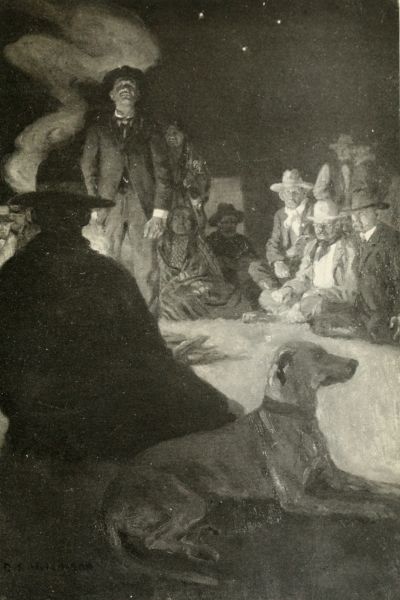
IN CAMP WITH THEODORE ROOSEVELT. "They gathered about the big fire, cowboy fashion."
But now it developed that the three Nicey's could serve a good purpose on a hunt like that as well as for mere decoration. They had eyes—marvelous eyes—that could see a wolf far across the prairie when the eyes of white men could not distinguish even a sign. There was no need of a glass when the wives of Quanah sat in their hack and scanned the horizon. Certainly that was an unusual hunting party, and very likely a unique experience, for all concerned.
But perhaps the best part of the hunting was the evening, after all. Then it was that they gathered about the big fire, cowboy fashion, with Chief Quanah Parker in their midst, talking to them—repeating the traditions of his father and his tribe—the tale of his mother's capture, the story of his own life and battles—his views and his religion of later years.
In a former chapter we have told of the massacre of Fort Parker and the capture of the little girl, Cynthia Ann Parker, who was adopted by the tribe, married a chief, and in time became Chief Quanah's mother. Gathered about the campfire on Deep Red Creek, in a wide circle of loneliness, with "Tom" Burnett, who understands the Indian language "better than the Indians themselves," acting as interpreter and the President of the United States listening, the son of that little captured girl told that story, now, and he supplemented it with the story of his father—a sequel that will not be out of place here.
The tribe had loved the little captive white girl, the story runs, and the little girl had learned to love her captors. She had learned their speech and forgot her own; then, by and by when she was no longer a little girl, a great chief named Nacona had wooed her and made her his wife. Nacona was a mighty warrior and made frequent raids on the white settlements and carried off much property—cattle and horses.
But finally his last raid came. Captain Sul. Ross (later Governor Ross), stationed at Fort Griffin with a troop of Rangers—sixty trained Indian fighters—was watching for an opportunity to fall upon Nacona, unawares. The opportunity came when Nacona, with his braves and many of their squaws and children, were camped one day at the mouth of Talking John Creek in Hardeman County. There was good hunting on Talking John Creek, and Nacona and his braves, fresh from a raid on the white settlements below, had stopped there for a few days to rest and recuperate before taking up the final homeward march. They felt secure and had no thought that Rangers were anywhere in the vicinity.
Then suddenly there was a clatter of horses' feet, a crack of carbines, and Captain Ross with his sixty fighting devils were upon them. There was no time for preparation. Most of the Indians fled wildly, leaving their squaws and their captured plunder. Nacona's wife, who had been the little captured Parker girl, was in the camp with him; also their two children, Quanah, and his little sister, Prairie Flower.
With the first charge of the Rangers, Nacona seized his rifle, leaped upon his horse and rushed after his braves, in the hope of gathering them for battle. That his wife and children would not be harmed by the white men he knew. He knew also, that the case was desperate, and he realized this more fully when he found that his braves were hopelessly scattered, and in full flight.
Nacona prepared to meet his death. The mounted Rangers were already close upon him and he would die like the great chief that he was. Beneath a large mesquite tree he dismounted and seating himself began chanting the death song. Captain Ross and a detachment of Rangers rode up. Nacona still chanted on. Then suddenly it may have occurred to him that they meant to take him alive. They would imprison him, perhaps hang him. He would die fighting.
Rousing as from a dream, he ceased his chant and throwing his rifle to his shoulder, fired. The bullet missed, but it brought a quick answering shot from a Ranger at Captain Ross's side, and the chief dropped forward, his face in the grass.
So died Nacona, bravely, as a chief should die, and was buried where he fell. In time his grave became a landmark. And Nacona's wife, who had been Cynthia Ann Parker—no longer of the white race, but an Indian in language and habits and affiliations—was brought by her new captors, once more to dwell among her own kind, bringing with her the boy Quanah, and his little sister, Prairie Flower. The mother was never satisfied with civilization and always longed to return to the tribe. Little Prairie Flower—homesick and delicate—pined away and soon followed Nacona to the Spirit Land. The boy Quanah was sent back to his father's people, for he was a chief in his own right. In time he became a great leader of the Comanche Tribe, and, unlike his father, a friend of his mother's race. He surrounded himself with the comforts and many of the luxuries of white men; his home to-day is truly a white man's home, with handsome furnishings, a piano and pictures; his voice has been heard in the white man's councils, and a white man's city was named in his honor. But the language of white men he has never learned.[15]
Altogether that wolf hunt was a great success. Seventeen wolves completed the result of the five days of hunting, most of them taken alive and lariated out around the camp—a lively and musical collection that delighted all parties concerned, except possibly the wolves themselves. As for President Roosevelt he enjoyed this vigorous isolated vacation continuously. But it was not easy to preserve the isolation of that camp. Every day visitors came riding or driving across the country, from somewhere, to seek an audience with the nation's Chief Executive. There were men who wanted office for themselves; men who wanted office for other people; men who wanted every sort of Presidential assistance under the sun; men who came merely out of curiosity and for the purpose of relating how they had visited "Teddy" in his hunting camp and taken a hand in the sport. A guard of soldiers from Fort Sill was supposed to picket the reservation, but would-be visitors eluded the men and somehow got through the lines. They did not get past Captain Bill, who met them and serenely but surely turned them back. If they had business, Washington was the place to transact it, he said. The President was here only for pleasure. Some went willingly enough—others protested, but all went. The President's days in the field, and those rare evenings about the campfire were not to be marred by business or any mere social diversions.
And when it was all over Theodore Roosevelt, in his enthusiasm pronounced it all "Bully!" and repeated it, and said he had never had a better time in his life, which was probably a correct statement.
And when they all rode back to Frederick he led the way again, and they set out with a whoop and a run and yell, regular cowboy style, and as they came into town where there was a great crowd waiting, the people went fairly wild, as of course they would. Then the President had to talk to the crowd again—he had said a few words on his arrival—and tell them what a good time he had had, and what a great country this was in general, and that part in particular, and how much he thanked them for letting him come there, and how he was going on to Colorado for a bear hunt, but how he never expected to have any better time than he had had right there in Comanche, on the Deep Red wolf-hunt with Tom Waggoner and Burke Burnett, and Bill McDonald and John Abernethy, and Quanah Parker and Too-nicey, Some-nicey and Plenty-nice-enough—
No, he didn't say all that either, but he said the right thing for the occasion, just as he always does, and especially on an occasion like that, where he is happy and full of life and the wild freedom of the open. And every man within sound of his voice was his friend forever, from that moment, regardless of his politics, and no man of all there, was a warmer admirer and friend than Captain Bill McDonald of Texas, who was a "hell-roaring" democrat and hadn't wanted to go.
He did not accompany the President to Colorado, though the arrangement would have just suited both sides. But after all, he was a Ranger, and there was other kind of game—game on which it is always open season—waiting to be brought home. He accompanied the President's party a distance on their journey; then he said: