Front matter (continued 3)
Reading edition
The man who had just moved in had stampeded for his own safety and started a general alarm, which did not subside even when the cowboys themselves came in and testified to the truth. The panic spread throughout that section of the country and other reports of Indian outbreaks were circulated, becoming magnified until it was believed that the Indians had broken out, and were making a general raid on the Pan-handle. The inhabitants of one town, south of Amarillo, threw up breastworks, got behind them, and put out pickets in preparation for the arrival of the Indians. Every man seen loping across the prairie was reported as an Indian; and all this happened as late as 1891, when there had been no Indian outbreaks for years, and when there was scarcely a possibility of anything of the sort. It was a big joke, of course, afterward, but it seemed no joke at the time, and it was Bill McDonald's initiation as Captain of Company B.
XIX
A Bit of Farming and Politics
CAPTAIN BILL AND HIS GOATS. THE "CAR-SHED" CONVENTION
There were to be plenty of real alarms soon enough, with plenty of desperately hard work. Before taking up this part of the story, however, it may not be out of place to dwell briefly on certain other labors and interests incident to this period in Captain McDonald's career.
The ranch on Wanderer's Creek, conducted for the most part by his plucky wife, remained one of his possessions and in time became not unprofitable. McDonald was one of the first to break land in that section and when he put in a sowing of wheat it was thought that he had gone daft. But the following year when the plowed land turned off a crop of from twenty to thirty bushels to the acre, those who had been first to scoff were likewise the earliest to imitate.
Captain Bill now became chief promoter in a plan for the irrigation of this fruitful soil—the water to be obtained by damming Wanderer's Creek. Several years later, two men of influence and substance, Cecil Lyon and Joseph Rice, gave able support to this project with the result that thousands of acres of grazing land became fertile farms—the cowman's domain passing into the hands of tillers of the soil. The town of Quanah reflected the steady agricultural increase, and what had been an antelope range when McDonald and his wife first drove their herds to that region, became a bustling city—in due time law-abiding—with a population steadily increasing to this day.
The mention of the McDonald herds opens a way here for recording an incident connected with the stocking of the Wanderer's Creek range. McDonald and his wife had decided that they would raise goats as a sort of by-product and began business in this line by introducing a flock of considerable size. However, it was a mistake. The goats were a great nuisance. They would be feeding quietly on the range, when suddenly, without warning, they would be seized with an impulse for violent exercise, and would break away and go racing over the prairie for seven or eight miles, to the brakes of the Pease River, where it was very mountainous and hilly—altogether in accord with a goat's idea of landscape. All the horses on the range were in danger of being run to death chasing goats, getting them together and bringing them back to the range. Finally it got to be a regular occupation, when there was nothing else to do, to head for the Pease River and chase goats. One of the men came in one morning when Captain Bill happened to be at home, and asked:
"Well, Cap, what shall I do to-day?"
"Oh, I don't know. Go chase goats, I reckon."
"All right; but if you want me to do that, you'll have to get you some goats. I rode all my horses down a couple o' days ago, hunting for them in the brakes, and there ain't a goat to be found within forty miles.
"D——n the goats," said Captain Bill, "I don't care much for goats, anyhow."
There had been about two hundred of them, and for several years afterward, hunters from other States in these wilds used to bring down "mountain sheep" and "antelope," which bore strong resemblance to the flocks which had once been Captain Bill's.
It was not long after McDonald's appointment as Ranger Captain that the State political campaign came on. He had never lost his interest in politics since the first awakening in the old Mineola days, when he and Jim Hogg had been ranged against each other, ready to shed blood for their candidates. Now, Hogg was governor and a candidate for reëlection, with Bill McDonald ready to show what he could do in the way of gratitude for favors past and present. The convention for the nomination of the State officials was to be held at Houston, and there was a good deal of excitement, as the opposition was likely to be strong, with nominations closely contested. McDonald resolved to be on hand and ready for any condition or emergency. Arriving in Houston he learned upon investigation that the supporters of Hogg's opponent, George Clark of Waco, had laid a plan to pack the convention with Clark's friends; to occupy it so fully in fact, that it would be impossible for the regular delegates to get seats. This would make it necessary for them to meet elsewhere, and would cause them to be regarded as bolters from the regular convention. Upon satisfying himself that this was to be the program, Captain McDonald promptly went to his old friend and other leaders, and proposed to take charge of matters. As Captain of the Rangers, he was under the Governor's orders, and with Hogg's sanction he could use his own methods for preserving the peace and for the prevention of scrambling and riot.
The convention was to be held in the "car-shed," a very large building, which had been seated for the purpose. It had a wide entrance to admit cars, and it could easily have been filled and crowded by a mob. Captain Bill's plan was to put a good capable fence across this wide opening, leaving a narrow passageway for a gate, which would be completely guarded. No one unable to show credentials as a delegate would be permitted to enter until the delegates were in and seated.
Governor Hogg approved of the idea and issued an order accordingly. There was no delay in carrying it out. Captain Bill got some men together, worked all night, and by sunrise the wide gateway of the car-shed had been narrowed down to the little wicket-gate of official admission. It was a complete surprise to the opposition. The gang that had arranged to rush and pack the convention, regarded the barrier and the men delegated to defend it, with amazement and profanity. They began with epithets, and these they followed with more tangible missiles, such as umbrellas, old shoes, and handbags. In another part of the State they might have attempted the use of more effective ammunition. As it was, they were obliged to confine themselves to protests more spectacular than effectual. The regular delegates filed in and were seated. Then the crowds were permitted to enter in the usual way, whereupon another convention was immediately organized in the same hall, with another chairman on the same platform, and for a time two conventions were running side by side.
Captain McDonald was finally called to the platform to preserve order. There was a lively scene. The Ranger was kept busy keeping the two factions separate, taking away their knives, a few pistols, canes, umbrellas and such other weapons and missiles as they attempted to bring into action. The final result was that both Clark and Hogg were nominated, at the same time, in the same convention, and by the same political party, though the Clark followers were styled "Anti-Democrats" and bolters.
Hogg was re-elected in due time, by a good majority. The episode passed into history as the "Car-shed" Convention.
XX
Taming the Pan-handle
THE DIFFERENCE BETWEEN COWBOYS AND "BAD MEN." HOW CAPTAIN BILL MADE COW-STEALING UNPOPULAR
The Texas Pan-handle is that portion of the State which lies directly south of what was No-man's Land, extending from parallels 100 to 103, east and west. Its shape suggests its name, and its name suggests limitless areas of waving grass; vast roving herds; cowboys and ponies—both of the unbridled variety; bad men whose chief business was to start graveyards, and the glad primeval lawlessness that prevails when worlds are new.
Not so many years ago the Pan-handle was distinctly a world apart, and a new one. With No-man's Land on the north, Indian Territory on the east and New Mexico on the west, civilization could come only from the south, and it did not come very fast. Indeed there was still plenty of territory to the southward to be subdued—two or three tiers of counties in fact—before the Pan-handle would be reached. So, it was a place apart—an isolated fertile land, justifying the assertion of a tramp that he had lost a hundred thousand dollars there in one year by not having cattle to eat up the grass.
The cattle came in due time, fighting back the Apache and the Comanche, protected by Rangers from Ft. Griffin, accompanied by stockmen of every nation, cowboys of every grade and criminals of every breed. That was a wild epoch—chaotic and picturesque—a time of individual administration and untempered justice.
It was also a time of mighty domain. Ranches there were as big as some kingdoms. One, the X.I.T., covered a good portion of the northern part of the Pan-handle. Another, the Matador, spread itself into five counties. When settlement became thicker—when there were ranch-houses not more than twenty-five to thirty miles apart—official allotment of the lands was made. Then there was a grand gobble. The big stockmen fenced everything with little regard for boundaries and less for the law.
With such examples as these in high places, it is not strange that a general indifference for legal rights and possessions prevailed. Next to cattle raising, cattle-stealing was the chief industry. The cowboy proper was not concerned in such work. He was likely to be a clean-handed, straightforward, even if reckless, individual, honest according to his lights. True, loyalty to his employer might render him a trifle indifferent as to brands and marks when strays mixed with the herd, but it was the employer and not the cowboy who profited by such laxity. The cowboy was a retainer who would fight for his ranch, would die for it when circumstances seemed to require such a sacrifice, and the increase of the ranch herd by any means short of actual raid and theft was a custom which bore no relation to disrepute. But individually the cowboy was likely to be the soul of honor and good-nature, troublesome only on holidays when he was moved to ride into the nearest settlement, drink up all the whisky he could buy, and then, with six-shooter drawn, go careering up and down the streets, shooting in random directions, explaining meantime with noisy and repetitious adjectives, that he was a bad man—a very bad man from very far up the Creek.
On such inspired occasions he would sometimes exclaim:
"Hide out little ones! Dad's come home drunk!" after which he would let go a round of ammunition and the inhabitants of that neighborhood, regardless of size, would proceed to hide out, as admonished. Sometimes a whole group of cowboys would engage in this pastime, whereupon the rest of the town disappeared and sat in cellars or flattened themselves under beds until the cyclone passed by.
It was in such manner that the cowboy found relaxations and social joy. He was not a bad man, in spite of his declaration. He was not really hunting for trouble and would be the last to kill, without offense.[7]
The truly bad man was of entirely different make-up. Always posing, and sometimes accepted, as a man of valor, he was in nearly every case merely a boaster and a coward. He would kill when he got the drop on his man, and he built his reputation upon such murders. He passed as a cowboy, when he was merely a cow-thief; as a hero, when he was only an assassin. Driven into a corner he would fight, but his favorite method was to slay from ambush. It was seldom that his reckless disregard for human life included his own.
The Pan-handle was full of bad men in the early nineties. Most of them had graduated from other schools of crime and found here a last resort. Some of them—a good many of them—had obtained official positions and were outlaws and deputies by turns, or worked conjunctively as both. As a rule they were in one way and another associated with a gang.
Local authorities, even when conscientious, were poorly equipped to cope with such an element, and it was for Company B, Ranger Force, consisting of eight men with quarters at Amarillo, Captain W.J. McDonald commanding, to police this vast wilderness, and to capture and convert, or otherwise tame, its undesirable citizens.
Some of them would not wait to be captured; some, of course, could not be tamed alive. Others, and these were not a few, would be able to wield official influence through which they would escape conviction, regardless of the evidence.
Soon after McDonald's appointment he was notified of a marauding band that across in Hutchinson County were committing the usual crimes. They had burned the hay belonging to a ranchman on Turkey Creek—several hundred tons in quantity—they had cut his wire fences; they had killed cows for their calves, butchered beef cattle, cut out brands—in a word they had conducted the business of cattle-stealing and general depredation on a large scale.
Taking a portion of his force, Captain McDonald went over to investigate. There seemed to be a good deal of mystery concerning the identity of the offenders; but a mystery of that sort does not stand a very good chance when it is operated upon by a man with eyes like those of Captain Bill and with a nose and pair of ears of his peculiar pattern. In a short time he had identified one member of the band in a young man prominently connected in that section. This young fellow—a dupe, no doubt, of professional cow-thieves, whose glittering reputation as bad men had dazzled him—was the son of an able and reputable lawyer, a member of the State legislature. The son, supposed to be a cowboy, had become in reality an outlaw.
Captain McDonald took him in charge one day, questioned him and secured sufficient evidence to file a complaint. The prisoner was turned over to the sheriff of Hutchinson County, and Captain Bill pursued his investigation. He located a bunch of stolen calves, herded in the brakes of the Canadian River, guarded by another member of the gang. He brought a man who had lost a number of milk cows and calves to identify the calves; no very difficult matter, for the man declared that he knew them as well as he knew his own children. The cows had been killed for their calves—and the latter had been "hobbled and necked." After locating the calves, Captain McDonald investigated the canyons and after several days found the cows that had been shot and killed. One after another the missing bunches of cattle were located, and the members of the band were brought in, and lodged in jail. The case against them was clear. They were found with the stolen property; some of them did not even attempt to make denial. Their examining trial was held at Plemons, the county seat of Hutchinson County, and the settlers gathered from far and near for the event. The trial was held in a big barn of a court house, and the prisoners were bound over to the district court. The Rangers were preparing to take them to Pan-handle City, where there were safer and more commodious quarters, when the sheriff—who had already distinguished himself by setting free the prominent young outlaw first captured—appeared and demanded the prisoners, on the ground that being sheriff of that county, they could not be removed without his consent. The Ranger Captain promptly informed him that, sheriff or no sheriff, he had shown his disqualifications for office, and that these prisoners would be taken to more secure quarters than he seemed willing to provide. The officer departed, and presently mustered a crowd, armed with Winchesters. Then he appeared once more before Captain Bill, produced the law which under proper conditions might have supported him in his demand, and again declared that he would have those prisoners, or that there would be bloodshed and several Ranger funerals. Captain Bill promptly called his men together.
"We are not going to stand any foolishness," he said. "If an attempt is made to take these prisoners, cut down on any one who takes a hand in it. Come, let's move on now, and get these men in jail."
The crowd that had gathered expected battle, then and there, but nothing of the kind took place. The sheriff's armed bluff had been called. Later, he obtained a writ of habeas corpus, but it was not effective for the reason that the men had been committed under bond. At all events it was not effective so long as McDonald and his Rangers were in charge of the jail.
It was now evident that conviction of these offenders was not to be expected in that county. Most of them had official influence of one kind or another. In fact, there appeared to be nobody except those whose property had suffered who seemed concerned in bringing these bandits to justice.
With such overwhelming evidence McDonald was determined, if possible, to secure their punishment. He kept them in jail several months and eventually was instrumental in getting their cases distributed and sent to other counties for trial. Even so, they managed to evade the law. Through influence of one kind or another, and the coöperation of officials—former associates, perhaps, in the business of crime—their cases were one by one dismissed.
In spite of this miscarriage of justice, the general effect of McDonald's vigorous prosecution was wholesome. The members of that band either left for the far isolations, or decided to reform. The case is given, one of many such, as an example of what the honest official had to contend with in the early Pan-handle days. Sometimes, indeed, justice was even more openly and briskly side-tracked. Once, when Captain Bill had caught a notorious cattle-thief, red-handed; brought him to trial and secured his conviction by jury; the judge, instead of passing sentence, took the law wholly into his own hands, and administered it in a manner rather startling for its unexpectedness and originality. He delivered an elaborate oration, which no one in the court room comprehended in any large degree—himself included, perhaps—and then read a lengthy decision concerning captures made upon the high seas; closing with his own decision to the effect that the clause covered this particular case as perfectly as if it had been made for it, and that the entire proceedings were irregular, irrelevant, without warrant and without effect; concluding his amazing declaration with the statement that the prisoner was discharged.
Cases like these would have discouraged and disgruntled a man of less resolution and character than Bill McDonald. To him such things meant only renewed determination. Strong in the knowledge that unless he happened to be killed he would eventually make criminals scarce, and corrupt or weak-kneed officials unpopular in that section, he gave neither rest nor respite to those who broke the law in the field, or to those who warped and disfigured it in the courts. Individually and in groups he brought the bad men in and filled the jails with them, and the box-cars, and when neither was handy he lariated them out, set a guard, and rode off after more. When he failed to convict in one court he tried another, and when he found an honest official he kept him busy. In a recent letter written by Col. W.B. Camp of San Antonio, to Edward M. House, one of the best known citizens of Texas, the writer says:
"When he (Captain McDonald) was captain of the Rangers in Texas, and doing his most effective work, I was District Attorney of the Thirty-fifth Judicial District, in the Pan-handle, and I learned to love, respect and admire this fearless officer, who always placed duty before his own life. In those days on the frontier of Texas, it was almost worth a man's life to uphold the majesty of the law, and the five years of such experience I had in doing so teaches me the value of such men as Captain Bill McDonald. History should hand down his name for the coming generations by the side of the heroes of the Alamo and San Jacinto."[8]
FOOTNOTES:
XXI
The Battle with Matthews
WHAT HAPPENED TO A MAN WHO HAD DECIDED TO KILL BILL MCDONALD
It was strange, indeed, that McDonald did not "happen to get killed" in those busy days of the early nineties. One of the favorite vows of tough "pan-handlers" was to shoot Bill McDonald on sight. But the reader will remember that there was a suddenness and vigor about Bill McDonald's manner and method that was very bad for a vow like that when the moment for its execution arrived. Still, there were those who tried to make good, and one of these, duly assisted, came near being successful. He would have succeeded, no doubt, if he had had time.
This man's name was John Pierce Matthews, which became simply John Pierce after its owner had got the drop on a steamboat captain one day in Louisiana and shot him dead. He took the new name with him to the Pan-handle, where in due time he got the drop on another man, somewhere up in the northern tier of counties, with the same result. This was a good while before he came down to Childress County and got to be sheriff, but there were those who had not forgotten, and among them was Captain Bill McDonald, then stopping at Wichita Falls. Matthews, or Pierce, as he was called, frequently came down to the Falls for a spree, and on one such visit made application to join a secret society. McDonald was a prominent member of that society and Matthews did not get in. This stirred the animosity of Matthews, and he began to clean his six-shooter daily and to practise sudden and accurate firing, which he knew would be necessary in case of a show-down.
By and by there was a sheriff's convention at Houston, and on a boat excursion between Houston and Galveston, Matthews spoke disrespectfully to Governor Hogg, who was on board. McDonald, who was also present, promptly called Matthews to account, and a general settlement might have been reached then and there had well-meaning, but misguided friends of both parties not interfered, and spoiled a very pretty sheriff's-picnic newspaper story. As it was, Matthews kept on oiling his pistol and practising, meantime enlisting the sympathy of friends, to whom he confided that some day when he had a little leisure he was going to look up Bill McDonald and kill him, suggesting that they be present and take a hand; they being of the sort naturally interested in such an enterprise.
Matthews also had another enemy, one Joe Beckham, sheriff of Motley County, an officer of his own kind, who presently got as short as possible in his accounts, absconded, and set out for Indian Territory. Matthew had no right to go outside of his own county after a fugitive, and no business in this matter, any way, as he wanted Beckham only for a misdemeanor, whereas he was charged in his own county with felony. But Matthews had an itch for Beckham on his own account, so he picked up another enemy of Beckham, named Cook, a citizen of Motley with an ambition for Beckham's office, and the two came with peaceful attitude and fair words to Quanah where Captain Bill was then stopping, requesting the loan of a Ranger to go over into the Territory after the defaulting officer. McDonald refused, but said he would send a man as far as the Territory line—Ranger authority not extending beyond that border. He did send one Ranger McClure, who being strongly persuaded, overstepped, at the same instant, his authority and the State line; captured Beckham, whom he lost through a writ of habeas corpus; fell into a plot devised by Matthews and Cook to get rid of him, and was finally brought back to Quanah by Captain Bill, who drove a hundred miles on a bad night to get him out of the mess; after which McClure was a wiser and better Ranger.
Beckham, meanwhile, had fallen a victim to remorse, or more likely had been promised immunity, and now hurried over to Quanah and gave himself up again to Ranger McClure, Captain Bill being absent from Quanah at the time. Beckham asked to be taken to Matador, county seat of Motley, for trial, and begged McClure to see him through Childress, where he expected to be killed by Matthews and Cook.
McClure assured Beckham that he would see him safely to Matador, and they set out by rail for Childress, at which point they would take a team for the Motley county seat.
Matthews was on hand at Childress. He demanded Beckham of McClure, who refused to deliver his prisoner. Matthews then started to organize a posse to take Beckham. Word of this came to McClure who promptly gave his prisoner a revolver and told him to help defend himself. Matthews and his crowd now tried to enlist the co-operation of Sheriff Cunningham of Abilene who, as soon as he understood the situation, resigned from the Matthews force and offered to assist the McClure contingent. McClure thanked him, but said he guessed he'd go along to Matador, now, with his prisoner, as the team was waiting. Captain Bill was in Matador when Ranger and prisoner arrived, and Beckham was jailed without further difficulty. Cook got appointed sheriff, by the Commissioners' Court, but the District Judge refused to accept him and selected a man named Moses for the job, whereupon Cook refused to resign and Captain Bill was sent over to turn him out, which he did with promptness and vigor. On his way back to Quanah, waiting for a train in Childress, Matthews appeared and demanded that McDonald dismiss Ranger McClure on general charges connected with the Beckham episode. McDonald mildly but firmly refused and spoke his mind pretty freely on the subject. All of which added fuel to the old resentment which Matthews nursed and nourished in his bosom for Captain Bill.
If Matthews wanted to commit suicide he began preparing for it, now, in the right way. He gave it out openly that he was going to wander over to Quanah some day and kill Bill McDonald, just as a matter of pastime, and he sent word to the same effect by any of Captain Bill's friends that he found going that way. Perhaps he thought these messages of impending death would unnerve the Ranger Captain and interfere with his sleep. That was bad judgment. Bill McDonald needed only the anticipation of a little pistol practice like that to make him sleep like an angel child.
"I didn't talk as loud as he did—nor as much," Captain Bill said afterward. "I reckon he thought I was afraid of him."
Matthews had really cut the work out for himself, however, and had enlisted help for the occasion. He was satisfied with his target practice and the condition of his fire-arms, and he had taken to wearing a plug of tobacco or a Bible or something solid like that in the coat-pocket just over his heart, about where one of Bill McDonald's bullets would be apt to strike, provided the Ranger happened to get a bead on him, though he had planned against that, too.
It was in December, 1895, at last that Matthews and his pals came down to Quanah for the declared purpose of killing a Ranger Captain. It was a cold, dreary day and they visited one saloon after another, getting a supply of courage for the job and explaining what they were going to do. Then they took to following McDonald, always in a group, evidently waiting the proper opportunity, confident enough that McDonald would not take the offensive. Finally, however, they pressed him so close that he suddenly turned and told them to quit following him or trouble would ensue. Perhaps it did not seem a good place to do the job—there being no sort of protection; perhaps there was something disquieting in the manner of Captain Bill's warning. They dropped away, for the time, and McDonald gave the matter no further thought. Men threatening to kill him was an item on every day's program.
It was nearly dusk of that bleak day, and McDonald was in the railway station, sending an official telegram to his men at Amarillo, when an old man named Crutcher, whom McDonald knew, came in with the word that Matthews wanted to see him and fix up matters without any more trouble.
Captain Bill regarded Crutcher keenly; evidently he was sincere enough.
"John says he wants to see you and fix up everything right," repeated the old man persuasively.
Captain Bill finished writing his telegram and sent it. Then turning to Old Man Crutcher he said in his slow mild way:
"Well, that all sounds mighty good to me. I never want any trouble that I can help. Come on, let's go find him."
They left the depot on the side toward the town, and as they did so they saw the sheriff of Hardeman County, whose name was Dick Coffer, with Matthews and two of the latter's friends, coming to meet them. Sheriff Coffer was a step ahead of Matthews when they started across the street. Old Man Crutcher in a friendly way put his arm through McDonald's as they advanced. When they were but four or five feet between the groups, all stopped and there was a little silence.
Then McDonald said:
"Well?"
And Matthews answered, keeping Coffer just a trifle in advance:
"Well, what is it, Bill?"
Captain Bill began quietly.
"I understand," he said, "that you have been saying some pretty hard things about me, and that you-all are going to wipe up the earth with me. Is that so?"
Matthews edged a trifle nearer to Coffer.
"No," he said, "I didn't say that, but by God I'll tell you what I did say," at the same moment pointing his left index finger in McDonald's face, while his right hand slipped in the direction of his hip pocket.
Captain Bill saw the movement and his own hand dropped into his side overcoat pocket where in winter he carried a part of his armament. Matthews' practice in drawing, for some reason failed to benefit him. His gun seemed to hang a little in the scabbard. A second later he had jerked it free and stepping behind Coffer fired at Captain Bill over the sheriff's right shoulder. But the slight hitch spoiled his aim, perhaps, for the bullet missed, passing through McDonald's overcoat collar, though the range was so short that the powder burned his face.
The game could now be considered open. Captain Bill with a quick movement that was between a skip and a step, got around Coffer and let go two shots in quick succession, at Matthews. But the latter's breast-piece was a success. Both of McDonald's bullets struck within the space of a fifty-cent piece, just above Matthews' heart, penetrated a thick plug of Star Navy, found a heavy note-book behind it and stopped.
With a thought process which may be regarded as cool for such a moment, Captain Bill realized that for some reason he could not kill Matthews by shooting him on that side, and shifted his aim. Matthews, meantime, had again dodged behind Coffer, who now dropped flat to the ground, where it was quieter. Captain Bill was bending forward at the time, trying to get a shot around Coffer, and as the latter dropped, Matthews fired, the bullet striking McDonald in the left shoulder, ranging down through his lung to the small of his back, traveling two-thirds the length of his body for lodgment.
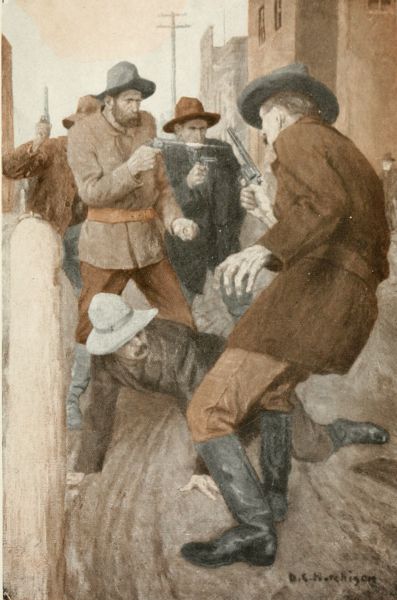
THE BATTLE WITH MATTHEWS AT QUANAH. "He started to cock his gun, when he received another ball in his right shoulder."
The Ranger was knocked backward, but did not fall. Matthews quickly fired again, but McDonald was near enough now to knock the gun aside with his own, and the ball passed through his hat-brim. Aiming at Matthews' other shoulder, McDonald let go his third shot and Matthews fell.
Meantime the two deputy assassins had opened fire, and one of them had sent two bullets through McDonald's left arm. To these he gave no attention until Matthews dropped. Wheeling now he started to cock his gun, when he received another ball, this time in his right shoulder, along which it traveled to his neck, thence around the wind-pipe to the left side. His fingers were paralyzed by this wound and he made an effort to cock his gun with his teeth; but there was no further need, for with the collapse of Matthews his co-murderers fled wildly to cover, behind the depot, nearly upsetting a box-car in their hurry, as a spectator remarked.
Captain Bill walked a few steps to the side-walk. There was a post there, and holding to this he eased himself to a sitting position. A man ran up to him.
"Cap, how about it?"
"Well, I think I'm a dead rabbit."
They gathered him up and took him to a drug-store, and they took Matthews to a drug-store across the street. By and by they carried Captain Bill home and a doctor came to hunt for the bullets.
"Don't fool around with that one in my neck, Doc," Captain Bill said. "Go after the one in the small of my back, and let out the blood. There's a bucket of it sloshin' around in there."
The doctor obeyed orders. It was proper to gratify a dying man.
"Now, Doc," the Ranger Captain said when the operation was over, and the surplus cargo had been removed, "now, I'll get well," and Rhoda McDonald, his nervy wife, who had arrived on the scene, echoed this belief.
"If Bill Jess says he'll get well, he'll do it!" she declared.
But this was a minority opinion, and that night when it was rumored that Captain Bill would not pull through, there were threats that in case he didn't, the two men who had trained with Matthews would be strung up without further notice. Some word of this was brought to Captain Bill, perhaps as a message of comfort.
"Don't you do it, boys," he said. "I'm going to get well, and even if I don't, I want the law to take its course. I'm opposed to lynching."
Matthews died in a few days. He was removed to Childress and died there. Before his death he sent word to McDonald.
"You acted the man all through," was his message. "I'm only sorry that I can't see you and apologize."
"Tell him that I'm doing all right," was the answer returned, "and that I hope he'll get well."
The mending of Captain Bill was a slow process. For about two months he was laid up, and then with his wife he sojourned for a time at a sanitarium. After that, he was up once more, pale and stooped but ready and eager for action. In time he was apparently as fit as ever; though, in truth, the physical repairing was never quite complete.
XXII
What Happened to Beckham
AN OUTLAW RAID AND A RANGER BATTLE. JOE BECKHAM ENDS HIS CAREER
Meantime the cause of the final and fatal difference between Matthews and McDonald—Joe Beckham, former sheriff of Motley—was out on bond, disporting himself in picturesque fashion. He got a change of venue, and when his case came up in Baylor County, Cook—his old rival and now his successor, by election—started over to testify; whereupon Beckham met the train and promptly shot Cook dead as he struck the platform. Beckham then mounted a fast horse and cantered away into the Territory, where he joined in organizing a new gang made up of old offenders, with a view to doing a wholesale general business in crime. In this gang were Red Buck, and Hill Loftus, both justly celebrated; also Kid Lewis—later hung. They established headquarters in a neighborhood thought to be comparatively safe, since Bill McDonald's work had been confined to Texas, and opened business with every prospect of reaping the natural reward of perseverance and industry.
They began by making a general raid on what is now Electra, Texas, where they cleaned out some stores and knocked a storekeeper on the head; after which, they looted a country store and post office, kept by one Al Bailey, then rode away in the direction of their Territory headquarters.
Company B, Ranger Service, was promptly notified, and Captain McDonald, not yet able to undertake a hard chase, sent his nephew McCauley with Jack Harwell and two other Rangers to join the sheriff of Wilbarger County at Electra, in the pursuit. The Rangers quickly struck the trail and had followed forty miles toward the Territory at a hard gait when they spied a dug-out, not far ahead. At the same moment they met an ostensible cowboy—a "line-rider," he said, on his rounds. The dug-out, he told them, was his, and that they would find something to eat there.
The party hurried on in the hope of food and warmth, for with the coming of evening it had grown very cold, and snow was beginning to fall. They were a little surprised to see a light in the dug-out, but pushed on toward it, when suddenly a volley of shots rang out from that cover, and three horses dropped dead. Not one of the riders was injured, and they promptly returned the fire. Then followed a regular exchange of shots which kept up to some extent all that bitter cold, snowy night. When morning came, only McCauley and Harwell of the Ranger Force remained in action, the others having been driven by the cold and storm to find shelter.
The dug-out was silent enough, now, but McCauley and Harwell, nearly dead from exposure, were in no condition to charge it, alone. They were without horses, and set out for Waggoner's ranch twenty-five miles away, afoot. Red River lay between, and when they arrived there the prospect of wading that icy current was miserable enough. Nevertheless, they did it, arriving at Waggoner's ranch, frostbitten and almost dead of hunger. The others had reached there several hours earlier.
When all were in condition again, they returned to investigate the dug-out. The place was deserted. Red Buck (wounded, as they learned later) with Hill Loftus, had been able to get away; also, Kid Lewis, for whom a telephone pole was already waiting at Wichita Falls.
Joe Beckham lay stretched upon the floor, dead.
XXIII
A Medal for Speed
CAPTAIN BILL OUTRUNS A CRIMINAL AND WINS A GOLD MEDAL
We are not through with the Pan-handle, but we will relate here an incident which belongs outside of that district, though within the period. It seemed always a part of Bill Jess McDonald's peculiar fortunes that wherever he went he found work suited to his hand.
He had been in Fort Worth on official business, in this instance, and boarded the north-bound train just as it was pulling out of the station. As he did so, he noticed two disreputable-looking characters crowding against a well-dressed old gentleman, and an instant later heard the latter exclaim, "I have been robbed!" At the same moment the two toughs started to leap from the car-steps.
Captain Bill's presence of mind responded promptly. His six-shooter was out with small delay, and seizing one of the men, he called to the other to halt. The man detained made an attempt to strike his captor, who promptly "bent" his gun over his head—mildly at first, then with force, bringing the offender to his knees. The Ranger Captain now pulled the bell-cord; brought the train to a standstill; turned his prisoner over to a policeman who had appeared on the scene, and set out in pursuit of the other thief, who by this time had obtained a healthy start.
Captain Bill is built like a greyhound, with long hind legs, and a prow designed for splitting the wind. The thief was active, and making good time, but he was no match for a Ranger of that architecture. The distance between them closed up rapidly, and after a race of over a mile the fugitive, having reached what was known as "Niggertown," dived into one of the houses, causing a regular stampede among the inhabitants. Men, women, and a rabble of little pickaninnies fell out in every direction. Captain Bill, now close behind, added to the excitement as he plunged in, only to find the room vacant. A quilt, however, hung across a second doorway, and stepping over to it, his six-shooter ready for emergency, he drew the hanging quickly aside. As he did so, he was confronted by a man standing on a chair, holding in his hand a bottle filled with some transparent liquid, which he was in the act of throwing. The crack of McDonald's revolver was followed by such a sudden collapse of the would-be vitriol-thrower, that the Ranger Captain thought he had wounded him seriously, though his intention had been merely to disable the arm in action. Investigation showed, however, that the thief was only frightened; that the ball had grazed his arm, also his ear, cutting a hole through the rim of his hat.
Securing the vitriol as evidence, Captain Bill marched his man back to where he had left thief Number One, only to find that the inexperienced policeman had allowed him to escape. He did not trust him with his second capture, but personally saw him safely locked up, and then set out for home by the next train.
Not long after, a package arrived one day in Amarillo, and upon being opened, it was found to contain a handsome gold medal, contributed by a prominent jeweler and others of Fort Worth.
This decoration was engraved with Captain McDonald's name and official title; and an accompanying letter stated that it was awarded as a token of appreciation of his efforts in bringing criminals to justice, and as a premium for his superior swiftness of foot on a mile and a quarter track.
XXIV
Captain Bill in Mexico
MEXICAN THIEVES TRY TO HOLD UP CAPTAIN BILL AND GET A SURPRISE. MEXICAN POLICE MAKE THE SAME ATTEMPT WITH THE SAME RESULT. PRESIDENT DIAZ TRIES TO ENLIST HIM
The First National Bank of Quanah failed in 1893, and one of the head officials, wanted for embezzlement and forgery, made his escape to Mexico, where he was arrested. Governor Hogg immediately made requisition for him, and Captain McDonald was detailed to bring him back across the line. Accompanied by one of the bank directors, McDonald set out for Mexico, only to find that his man had been set free, and was then making his way to remoter hiding. It was no difficult matter, however, to trace him, and the Ranger Captain presently overhauled him and put him in jail, there to await certain red-tape formalities incident to the deliberate Mexican official methods.
Having a good deal of time on his hands, Captain Bill spent it in sight-seeing. It was interesting enough, but he could not understand why he used up so many handkerchiefs. They seemed to disappear from his pockets in some magic way, and no matter how many he set out with, he presently found his supply entirely exhausted. He realized at last that this curious condition was not due altogether to accident, nor to carelessness on his own part. Laying in a fresh stock of handkerchiefs, he strolled warily along, seemingly unconscious of those who loitered near him, apparently absorbed in sight-seeing. Presently, from the corner of his eye, he noticed a Mexican passing near him make a quick movement with his hand, and caught a glimpse of white passing from his pocket to that of the Mexican. His sudden grab so startled this industrious person that he did not even attempt flight. Captain Bill thereupon promptly recovered his handkerchief, which he found had been lifted with a slender wire hook; an effective implement in busy and skilful hands. Without any further preliminaries, he set out for the jail with his prisoner, but meeting an American acquaintance to whom he explained the situation, he was advised to proceed no further with the case.
"If you take him there, they will lock you up with him," he said.
"Well, I guess they won't," said McDonald.
"They certainly will," insisted his friend. "The law here is to confine the witness with the prisoner, and there is no telling when you'll get out."
Captain Bill reconsidered, whirled his prisoner around, gave him an impetuous kick or two, and some advice, which perhaps reached his comprehension, though in an unknown tongue.
The man fled; it is not known whether he took the advice or not.
Captain Bill's adventures in Mexico were not over. A few nights later he visited a large casino where gambling was conducted openly, and mildly diverted himself by taking a hand at bucking the national game, monte. He played in luck, and the stakes became high. His winnings grew to a considerable sum, and there were greedy eyes in the group who watched his play. When he left the place, at last, and descended the stairway, he noticed that two men seemed to be following him. As he reached the dim hallway below, he stopped; they stopped also.
Captain Bill was pleased. This was a game he preferred even to monte, he had played it so much oftener. He stepped out into the middle of the street, where he would have a clear field of observation, and set out leisurely, as if he had not noticed anything wrong. The men following gained upon him, one dropping a little in the rear, the other working his way to the front. As they reached a dark locality, the man in front began to drop back a little, evidently getting ready to close in, while the one behind stepped up a little more lively, until he was about on a line with Captain Bill, who now noticed him throw back his serape as if to free his arm for action. No longer in doubt as to what they meant to do, the Captain brought out his "forty-five" with a swing that landed the barrel of it with full force on the head of the man in front. Wheeling, he covered the other, who, seeing his companion drop with a thud, promptly fled, the Ranger Captain close behind. They raced down the dim street, and the Mexican, trying to keep his eye on his pursuer and turn a corner at the same time, ran into a stone wall and nearly knocked his head off.
Captain Bill was satisfied with the game as it stood, and set out for his hotel. He was not to arrive there, however, without further complications. The commotion of the foot-race had aroused a squad of police-a poor lot, in greasy white uniforms—and these bore down upon him now with a good deal of excited talk and gesticulation, none of which he understood. Apparently they thought he was a bloodthirsty person, who was in the habit of knocking men over the head with his gun and chasing others into stone walls, for amusement. He explained in the best Texan he could muster that the men had been trying to rob him, but it was no use. They insisted by signs that he must come with them. When he shook his head in refusal, they began reaching for their long revolvers, which they wore in clumsy holsters.
Captain Bill knew this game, also. He had played it in No-man's Land, in the Cherokee Strip, and he was still playing it in the Pan-handle. It was his favorite and daily occupation. Before their guns were half way to any effective position, he had them covered, and in tones that are universally understood, even when they convey words of strange meaning, he warned them to desist.
Men are in the habit of obeying Bill McDonald under such conditions. The Mexican police obeyed him, and when he indicated that they were to march in front of him, they did so in a formation at once orderly and well-maintained. He directed them toward the Hotel Guadaola, where he was stopping. Arriving there, he explained to the guard, who understood English, what had happened, and instructed him to convey the information to the police, with his thanks for their courteous and prompt attention, and a request that they should meet him at the office of President Diaz at ten o 'clock the following morning. The guard undertook to do this, and the police went away, dazed and muttering.
They were on hand next morning at the President's office when Captain Bill arrived. During his sojourn in the city, McDonald had come in contact a number of times with President Diaz, and a pleasant friendship had sprung up between them. Diaz, who has an excellent knowledge of English, heard the Captain's explanation now with a good deal of amusement, and after dismissing his policemen with some paternal advice, he presented Captain Bill with a pass which gave him the freedom of any portion of the city at any hour and under all circumstances.
The friendship between Diaz and Captain Bill ripened into something like intimacy now, and a few days later, the Mexican President, in discussing the nation's troubles with Guatemala, invited the Ranger Captain's opinion of the situation, and of the force in the field.
"Well, Mr. President," said Captain Bill, "I don't think much of your Mexican soldiers, but I could take a squad of Texas Rangers and go down to Guatemala and clean up that outfit down there, capture their finances and bring their Government to terms in twenty-four hours."
The Mexican President's eyes showed his approval of this scheme.
"I think a good deal of your Texan rurales," he said, "but they have killed a lot of our people, too."
Captain Bill nodded.
"Only the kind that needed killing," he said.
"Very likely," assented Diaz; then added, a moment later,
"Captain, I propose that you enlist with us for the purpose you mentioned just now, and bring over five hundred of your Texas cowboys to assist in the undertaking."
Diaz waxed enthusiastic over this idea, and Captain Bill was not unwilling to enter into the scheme. The matter went so far as to get into the newspapers, but at that point it came to a sudden end. Governor Hogg and Adjutant-General W.S. Mabry—a fine soldier, who later died in the Cuban war—did not propose to have their Ranger Captain go off on any such filibustering expeditions, and promptly nipped the whole matter in the bud.
Captain Bill stayed for a considerable time in the Mexican capital, for his companion, the bank official, fell very ill, and the Captain turned nurse to pull him through. He very soon became a well-known figure in the city, being often pointed out as the man who had taken a squad of police in charge; who was going to bring his Rangers down to whip the Guatemalans, and whose skill with the six-shooter was nothing short of miraculous. This last belief was in some manner sustained one day when he visited a shooting gallery in company with an American dentist, who had taken pleasure in showing him the sights of the quaint old town.
"Captain, suppose you shoot at those targets as rapidly as you can, and see how many you'll miss," he said, when they were inside.
Without hesitation, McDonald drew his revolver and opened a perfect fusillade, hitting a target at each shot. Two Mexicans who were practising in the gallery made a wild break for the open air and safety. Soldiers and police came running in excitement and confusion to discover the cause. It was all over by this time, and the officers, seeing only Captain Bill and the dentist, stood gaping, waiting an explanation.
"It is nothing," said the dentist, in Spanish; "my friend the Captain was only practising a little to keep his hand in."
XXV
A New Style in the Pan-handle
CHARLES A. CULBERSON PAYS A TRIBUTE TO RANGER MARKSMANSHIP. CAPTAIN BILL IN A "PLUG" HAT
It was during the Pan-handle period that Charles A. Culberson—son of the Dave Culberson who nearly thirty years before had cleared the boy, Bill Jess McDonald, from a charge of treason—was Attorney-General for the State of Texas. Captain Bill was at Quanah, one day, when he received notice from Culberson that the latter was anxious to locate the 100th meridian, preliminary to beginning a suit against the United States to test the claim made by Texas for Greer County—now a portion of Oklahoma. The Attorney General invited Captain Bill to accompany him as guide and body guard, knowing him to be familiar with the district and capable of taking care of such an expedition.
They left the railroad at Vernon, Wilbarger County, proceeded in a buck-board to Doan's Store on the Red River, and crossed over into Greer County. It was a pleasant drive across the prairies, and Captain Bill who felt in good practice beguiled the time by bringing down prairie dogs, running rabbits, sailing hawks and the like, using his six-shooter with one hand and his Winchester with the other, riding along as they were, without stopping. To Culberson, this performance was amazing enough.
"Captain," he said, "that beats anything I ever saw. Why, I believe you could throw a nickle up in the air and hit it before it touched the ground."
McDonald smiled in his quiet way.
"Do you think so?" he said. "Well, I reckon I might, but I wouldn't want to waste a nickel that way."
Captain Bill then gave a few exhibitions of what he really could do in the way of shooting, and Culberson declared without hesitation that there was not such another marksman in the State of Texas. The Attorney General was enjoying himself immensely.
They camped that night, and next morning were continuing their journey toward Mangum, the county seat of Greer, when they began to meet men and women on horseback, evidently getting out of that section of the country without much waste of time. Captain Bill inquired the reason of this exodus and was told that a cowboy had killed an Indian over on the North Fork of the Red, and that the Indians were getting on their war-paint, preparatory to making a raid—Comanches and Kiowas.
"General," said Captain Bill, "I'll have to look into this thing. You can go on to Mangum with the team and I'll get me a horse and go over and take a hand in the trouble."
"Not at all," said Culberson, "you've undertaken to see me through this trip and I'm not going to let you desert now, Indians or no Indians."
"But I've got to, General. This is a pleasure trip, and that's business. Them devils are goin' to start something over there and it's my duty as Ranger to investigate it."
Culberson laughed.
"Now, Captain," he said, "you know very well that all you want is to get over there where there's a chance to give a shooting exhibition. You've got tired of hawks and prairie dogs and want to try your hand on Indians."
A new arrival just then furnished the information that the offending cowboy had been jailed at Mangum, and that the Indians were likely to storm the jail. This settled the matter, for Ranger duty and inclination now lay in the same direction. McDonald and Culberson drove as rapidly as possible toward Mangum, then about fifty miles away, changing horses once on the hard journey. The town was well-nigh deserted, as nearly everyone who could get a gun had gone to the scene of the killing. Captain Bill therefore established himself as guard of the jail where the cowboy was confined, and waited results. Nothing of consequence happened. The country quieted down, Culberson and Captain Bill presently returned to Quanah.
But a few days later when the Attorney General had arrived in Austin, Captain Bill received a package by express, prepaid. On opening it he was stupefied to find that it contained a "plug" hat of very fine quality. It was the first silk hat in the Pan-handle, where the soft wide-rimmed cowboy Stetson predominated, and it took more courage to wear it than to face an assault with intent to kill.
But Captain Bill was game. He was a "brother-in-law to the church" as he said—his wife being a member—and the following Sunday he put on the silk hat and accompanied her to meeting.
Their seat was up near the front, only a step from the pulpit—a good thing for the minister, otherwise nobody would have looked in his direction. As it was, all eyes were aimed toward Captain Bill and his hat. The congregation had seen him come in with it in his hand, and they could still observe the wonder, for it would not do to put so fine a piece of property on the floor, while to set it toppling on his lap would be to court disaster. It seemed necessary therefore to hold it in his hand, raised a little, and at a distance from his body, in order that by no chance movement the marvelous gloss of it should be marred. The people of Quanah who attended church that day were glad to be there. They are still glad. They do not remember the sermon they heard, but they do remember that hat. Even the minister wandered from his text in his contemplation of that splendid exhibition. Those of Quanah who remained away from service on that memorable Sunday have never entirely recovered from their regret. For it was their only opportunity ever to see Captain Bill in a plug hat. When services were over, the congregation crowded about for a nearer view. Cowboys stood up on the backs of the pews to look over the shoulders of those in front of them. Homesick women who remembered such things back east, shed tears. Many wanted to touch the precious thing—to stroke its silken surface, and among these were little children who insisted on rubbing the fur the wrong way.
Captain Bill got out at last and headed for home. Once there, the gift of the Attorney General was reverently damned and laid away. Somewhere in a secret stronghold, deep buried from mortal eye, it exists to this hour.
XXVI
Preventing a Prize-fight
THE FITZSIMMONS MAHER FIGHT THAT DIDN'T COME OFF AT EL PASO, AND WHY. CAPTAIN BILL "TAKES UP" FOR A CHINAMAN
Culberson became Governor in the course of time, and remembering Captain Bill's peculiar talents was wont to rely upon him for special work in any portion of the State where nerve, determination and prompt, accurate marksmanship were likely to be of value.
During February, 1896, a national sporting event—a ring contest between Bob Fitzsimmons and Pete Maher—was advertised to take place at El Paso, a busy city dropped down on the extreme western point of the Texas desert, on the banks of the Rio Grande. Governor Culberson, speaking for himself as well as for the better class of citizens in his State, announced that so long as he was in office, Texas would not go on record as a prize-fighting commonwealth, and that the fight would not take place. Thereupon there came a crisis. Certain interested citizens of El Paso had made up a purse of ten thousand dollars to bring this event to the "Paris of Texas" and these and their friends were filled with indignation. Dan Stuart, prominent in Texas sporting matters and promoter of this particular event, issued a proclamation which bore not only the announcement that the fight would take place as advertised, but a picture of Dan himself. Also, it was declared that there was no law in Texas which would prevent prize-fighting, and the preparations for this particular event continued; whereupon Governor Culberson promptly called a special session of the legislature to pass a law which would be effective, and Adjutant-General Mabry ordered the State Ranger Service to assemble at El Paso to see that this law was enforced—it having been widely reported that Bat Masterson with a hundred fighting men would be present to see that the fight came off. Then, when it was rumored that the contest would take place in either Old or New Mexico—the boundaries of both being near El Paso—President Cleveland ordered the United States Marshal of New Mexico to proceed to the vicinity of El Paso and guard the isolated districts of that territory, while the Governor of Chihuahua took measures to discourage the enterprise in that State.
Things began to look pretty squally for the sporting fraternity, both in El Paso and at large, and they were mad clear through. The city council assembled and passed a denunciatory measure, condemning the Governor for asking for Rangers; the Adjutant-General for sending them, and the Rangers for being present.
It was no use. The Rangers went quietly about the streets, paying no attention to unfriendly looks and open threats as they passed along. Efforts were made by the principals and their friends to elude the Rangers, but with no other result than that a Ranger was appointed as a special body-guard to each of the pugilists, while a third, Captain McDonald, became the temporary associate of Dan Stuart. They had nothing particular to do—these Rangers—except to be companionable, and pleasant, and to stay with their men. Wherever Stuart and Maher and Fitzsimmons went their official attendants went with them, and even if not always welcome they were entertained with sufficient courtesy, for the person of a Ranger is sacred—besides, he is reputed to be quick and fatal.
Such sport became monotonous. The pugilists and their friends gave up the El Paso idea, and, still accompanied by the Rangers, took the train for Langtry, a point where the Southern Pacific Railway touches the Rio Grande. The State of Coahuila lay across the river, and Langtry itself was at that period the proper gateway to a pugilists' paradise, its law being administered by one Roy Bean, justice of the peace and saloon-keeper, whose sign read:
MIXED DRINKS LAW WEST OF THE PECOS.
It is said that Bean's drinks were about on a par with his law, and that the latter was administered with a gun. He tried court cases, granted divorces, and handed down decisions without the trammel of a jury or other assistance. Once when a citizen killed a Chinaman in his place, Bean consulted the statutes, and finding nothing in reference to the murder of a Chinaman in his saloon, discharged the prisoner as having committed no offense. At another time, when a man walking across a high bridge over the Pecos had fallen and broken his neck, and the matter was brought before Bean, the dispenser of "Law West of the Pecos," discovered that the pockets of the unfortunate contained a six-shooter and forty-one dollars in money; whereupon he fined the dead man twenty-five dollars and costs for carrying a concealed weapon, and appropriated the forty-one dollars and the six-shooter, in settlement. A whole chapter could be written about Bean and his official service, but this is not the place for it. It is the place, however, for another incident concerning a Chinaman—a case in which, though tried west of the Pecos, the Chinaman's rights were sustained.
The train bound for Langtry with the pugilistic party and Rangers aboard stopped at Sanderson, a small wayside station in the desert, for lunch. Everybody was hungry and hurried over to a Chinese restaurant for something to eat, and the Chinese waiters scurried about to serve them. They were doing their best, but it was not easy to satisfy everybody at once. Next to Captain McDonald sat Bat Masterson. Bat has since given up all his reckless ways and become a good citizen, but at that time he was training with the unreformed and not feeling very well, anyhow. It seemed to Bat that a Chinese waiter was not getting around as promptly with food as he might and he set in to admonish him. The Chinaman replied to the effect that he was doing his best, whereat Masterson decided to correct him with a table-castor. Captain Bill had been sitting quietly, saying nothing; but as Masterson raised the castor the Ranger Captain clutched his arm.
"Don't you hit that man!" he said.
Masterson wheeled.
"Maybe you'd like to take it up!"
Captain Bill regarded him steadily for an instant.
"I done took it up!" was his quiet answer.
The castor was put down. Masterson reflected silently while he waited for his food. Perhaps that was the beginning of his reform.
Arriving at Langtry, Stuart, Fitzsimmons and Maher were escorted to the Rio Grande, where, with all their fraternity, they crossed over to Mexican soil and the fight was pulled off in good order. It was a good fight, as fights go, and Fitzsimmons won with a knock-out landed on Maher's jaw; but it did not take place on Texas soil.[9]
FOOTNOTES:
XXVII
The Wichita Falls Bank Robbery and Murder
KID LEWIS AND HIS GANG TAKE ADVANTAGE OF THE ABSENCE OF THE RANGERS. HE MAKES A BAD CALCULATION AND COMES TO GRIEF
The absence of Captain Bill and his Rangers from the Pan-handle, was construed by Kid Lewis as an invitation to rob a bank. He selected the City National of Wichita Falls for his purpose and with a partner named Crawford rode up to that institution one day about noon, and entering, demanded the bank funds. Cashier Frank Dorsey failing to comply with that demand, was shot dead; H.H. Langford, bookkeeper, was wounded, and the Vice-President of the bank escaped by having in his left breast-pocket a small case of surgical instruments. This deflected the ball which otherwise would have entered his heart.
The robbers then secured whatever money was in sight—about six hundred dollars in gold and silver—ran out the back door, mounted their waiting horses and galloped away. The citizens were by this time alarmed and a number set out in pursuit, full speed. There was a running fight, during which Lewis' horse was shot, but an instant later he was clear of it, and leaping behind Crawford the two went plunging away double until they met an old man driving into town with a single horse. This they appropriated forthwith, leaving their pursuers a good way behind. Still further on, they crossed Holiday Creek and came to a field where a man was plowing. They now abandoned their blown horses and at the point of a gun took his heavy Clydesdale team and once more dashed away, making for the Wichita River. Their pursuers gained on the clumsy animals and fired several more shots at the fugitives, then decided to return and organize a posse, which they raised in short order. This posse followed the track of Lewis and Crawford beyond the Wichita River, to a place where the robbers had taken to the thick brush overgrowing the river bottom. Here the trail was lost.
Captain McDonald, returning from the Fitzsimmons-Maher contest, via Fort Worth, had got as far as Bellvue in the adjoining county when he was met by a telegram, containing the news of what had happened that morning at Wichita Falls. He immediately wired the authorities at the Falls to have horses in readiness for himself and men.
The Rangers reached the city about two in the afternoon and mounting the horses, already waiting, dashed away in the direction the robbers had taken. With him, Captain Bill had Rangers McCauley, Harwell, Sullivan, Queen, and McClure—the tried, picked men whom Lewis and Crawford had been most anxious to avoid. The horses were picked, too, for speed and endurance and went at a wild headlong gait—almost too headlong for safety. A small creek that had become a bed of mud lay across the road and Captain Bill's horse, stumbling on the brink, sent him head first into the soft mixture, which literally daubed him from head to foot before he could get on his feet. His men thought for a moment that he was killed, but he rose spluttering and swearing, wholly unhurt, though fearfully disfigured, and with no time to remove his disguise. Instantly mounting, he galloped on, a sight to behold, the others respectfully restraining any tendency to mirth.
Presently they met the local posse coming back. The posse had given up the chase, but was able to furnish information. Captain Bill and his Rangers learned where the robbers had disappeared, and pressed on in that direction, the posse following.
It was now getting toward evening and would soon be dusk. It was desirable to make an end of matters by daylight, if possible, and the Rangers wasted no time. They picked their way rapidly into the thick undergrowth of the bottoms, and suddenly in a bend of the river discovered the Clydesdale horses tied close to the bank. Their riders were believed to be close by, and the Rangers expected to be fired upon at any moment. Without waiting for any such reception they charged in the direction of the horses, with no other result than that Ranger Sullivan broke a stirrup, fell, and with a fractured rib, retired from action.
Lewis and Crawford had abandoned the horses, and their trail led down the river bank. The Rangers also left their horses at this point, for it was hard going. McDonald now took Queen and Harwell, one on either side of him, their guns in readiness while he gave his attention to the trail. The light was getting very dim where they were, but Captain Bill is a natural trailer and followed the tracks without difficulty. Here and there they found stray articles which the men had dropped in their flight. Finally the tracks led to the river where it was evident the bandits had crossed.
It was February and the water was very cold. Captain Bill had not yet recovered from the terrible bullet wounds received in the fight with Matthews, two months before, and was bent and debilitated, but he did not falter. With Queen and Harwell he plunged in and waded the icy water, chin deep, to the other side. Twice more the trail led to the river and crossed, and twice more McDonald and his men waded that bitter current, holding their fire-arms above their heads, their bodies literally numb with cold. It was a severe experience, but as Captain Bill said afterwards, it removed a good deal of his mud.
McDonald now made up his mind that the robbers would be likely to cross a road that had been cut through the bottoms, and head toward the Territory, which they were evidently trying to reach, believing the Rangers would not follow them across the line. He called to one of his men—Ranger McClure, who appeared just then, a little distance away—to get all the force he could and guard that road, while he, McDonald, with Queen and Harwell, would continue to beat the brush and search carefully through the bottoms. At that moment Lewis and Crawford were near enough to hear this order, and the realization that it was Bill McDonald and his Rangers who were on the trail gave them a sudden and more severe chill than the icy water they had waded.
They had been heading for the Territory, as McDonald suspected, but decided to change their course toward a creek that ran parallel with the river. On their way to it they were obliged to cross an open field, and though by this time it was night—between nine and ten o'clock—a full moon had risen and they were discovered by the men guarding the road, and fired upon. They returned the fire as they ran, but no damage was done on either side. Meantime, McDonald and his two companions, nearly perishing with wet and cold, having come upon a house in their search, had stopped to try for a cup of hot coffee. At the sound of the shots they rushed out. A horse was hitched at the door and Captain Bill leaped into the saddle and hurried in the direction of the alarm. As he approached, he saw in the moonlight a crowd—the local posse—gathered on the little hill overlooking the wheatfield where the robbers had crossed. The Ranger Captain fully expected to find the captured or dead bandits in that crowd, and called out as he came up:
"Boys, where are they? Where are the robbers?"
They pointed in the direction of some brush about a quarter of a mile away.
"They went into that creek bottom, over yonder."
"Well, then, what in the devil are you all doing up here?"
Somebody answered:
"You must think we're dam' fools to go in there after those fellows. Of course we didn't go in there, and don't intend to."
"Well," said Captain Bill, "I'm going, and if any of you fellows want to go, come ahead, but I don't want any man that don't go willingly."
Ranger McCauley had ridden up.
"You can't get away from me, Uncle Bill," he said.
The two loped off in the direction of the thicket, but presently found their way barred by a wire fence. Leaving their horses they made a circuit around the enclosure and soon struck what seemed to be a road, leading into the bottom. Hurrying along they came upon Ranger McClure, who had been in charge of the posse when the shooting had occurred, and had set out alone to locate the robbers.
"Hello, Bob, where are they?" asked Captain Bill, as he and McCauley came up.
"Right over there, Cap. They ran in the brush, over by yonder big tree."
"Well, boys, we've got to get them. We'll charge in there."
They pushed rapidly into the bushes without further parley—McDonald heading for the tree, McCauley and McClure spreading out to the right.
Captain Bill made straight for the big tree pointed out by McClure, his gun ready for quick service. It was a still, moonlit place, but brushy and full of shadows, and not easy going. The crack of Winchesters might be expected at any moment.
Suddenly the Captain found himself confronted by a creek, and looking across saw two men with guns, squatting in the weeds. They appeared to be on the point of raising their guns to fire, but with McDonald's appearance and his sharp command, "Hold up there!" made from behind his own leveled Winchester, they were unable to complete the action. Their guns dropped into their laps—they seemed stupefied.
"Throw up your hands!" was the next order.
The hands went up.
"Get up from there!"
One of the men found his voice.
"We can't, Captain, our guns are lying across our laps, cocked. They'll go off if we get up."
"Get up or I'll turn you over!"
They rose hastily, their guns sliding to the ground.
"Back off there, now, and face the other way."
They obeyed like soldiers on drill.
Captain Bill stepped into the creek, about three feet deep, and waded across. He noticed a bag, doubtless containing the stolen money, and observed that the robbers had laid their cartridges out on a log for convenient use. At that moment McCauley and McClure came hurrying up, apparently ready to shoot.
"Hold up boys! It's all right," said McDonald, "I've got 'em!"
McCauley and McClure waded across and assisted in searching the prisoners. A purse of gold was found in one of the men's pockets; the sack on the ground contained silver.
"Now, let's get out of this," said McDonald, "and get where it's warm."
"You're not going to make us wade that cold creek, are you" said Lewis, shivering.
"Look here," said Captain Bill. "If you don't get across there and pretty quick, too, I'll duck you, head first. You've made me wade water up to my neck, all the afternoon."
They all crossed, then—the fifth time in the cold water that day for McDonald—and made their way to where he and McCauley had left their horses. Here they got a rope and bound the prisoners, their arms behind them. Captain Bill then called to the posse, still waiting in the road a quarter of a mile away listening for the sound of the shots that would probably bring down Rangers.
"Come on, boys," he yelled, "we've got em!"
So they came "lickety brindle," but presently stopped.
"Captain, are you sure you got 'em!"
"Yes, I've got 'em, and got 'em tied. Come on—there's no danger, now!"
The crowd tore through the brush to get over there, and some of them began abusing the captured men, declaring they had murdered the best man in Wichita Falls, and furnishing a graphic outline of what would happen to them, in consequence. What they said was all true enough, maybe, but the saying of it seemed in rather poor taste to Captain Bill.
"Look here," he said, "these men are my prisoners, now; you let them alone."
He marched Lewis and Crawford over to Mart Boger's ranch, where all got some hot coffee and something to eat. Boger also supplied a wagon in which to haul the prisoners.
It was McDonald's first intention to take the men to Henrietta, for safe keeping, but against his judgment he was persuaded to take them to Wichita Falls. He gave orders, however, that none of the crowd should leave, as he did not wish the news of the capture to travel ahead of them—realizing that a mob of citizens would be likely to gather.
On the way to the Falls the Rangers fell into conversation with Lewis; and McCauley and Harwell discussed with him the fight that he and Hill Loftus and the others had made, that night in the dug-out when Joe Beckham had been killed. Lewis explained how he and Red Buck and Loftus had managed to slip away without being seen. Then McDonald said:
"Boys, how was it you didn't shoot me a while ago, when you saw me coming through the bushes? You-all had your guns cocked and ready—and you knew you'd be hung, anyway, if you got caught. You saw me first—why didn't you shoot?"
"Cap," said Lewis, "we thought you were out of the country and wouldn't get back before we could get to the Territory. When we heard you giving orders and knew who it was, we lost our nerve, and when we saw you, we somehow got paralyzed."
When the procession had arrived within a mile or two of the Falls, Captain McDonald, realizing that some one had doubtless slipped away and carried the news, sent one of his men to have the jail door open in order that there might be no delay in entering. His suspicion was correct, for the news had traveled, and though it was then about two o 'clock in the morning, several hundred men were congregated about the jail when the Rangers with their prisoners arrived. Captain Bill rode ahead and opened the way with his gun.
"Give room, here, men!" he commanded, and the way opened.
Lewis and Crawford were marched into the jail—Rangers McCauley and Queen being left to guard the door. The prisoners were taken to cells, carefully searched, and locked in. Captain McDonald then descended to disperse the crowd, which had grown noisy and ugly in its demands for the prisoners, and was apparently making ready to attack the jail. Captain Bill addressed this assembly.
"Boys," he said, "I reckon you-all are my friends, and if you are, you'll go home now and go to bed. My Rangers and I captured these men and they are our prisoners. We've got them locked up, and they'll have a fair trial. You men didn't capture them, and you have nothing to do with them. They're unarmed now, and can't defend themselves, but if you make an attack on this jail I'll give the prisoners their guns, and we'll lick this crowd. I command you to disperse immediately. If you don't, we'll begin business right now."
The mob dispersed. Some of the leaders wanted to call Captain Bill away to discuss matters, but he would have none of it, and cleared the grounds. Then in spite of his wet, cold, weary condition, and the terrible wounds received less than three months before, he stayed with his men, on guard, till morning. Then a message was brought to him that Hill Loftus had been concerned in the robbery and that he was hiding in a dug-out near town.
Knowing that Loftus and Lewis trained together, Captain McDonald did not discredit this report, or suspect that it was part of a ruse to get him away from the jail. He ordered a horse from the stable at once and made ready to start.
"Aren't you going to take your men with you?" asked the men who had brought the word.
"No," said Captain Bill. "I want them to stay here."
"But Loftus is a bad man, and will have the advantage of you, being in the dug-out."
"That's all right—I can take care of him; but I do want somebody to come and show me the place."
A man volunteered to do this, and rode with Captain Bill to a dug-out some distance away, in the edge of the town. The place was empty, but another man appeared just then who claimed to have seen Loftus leave, a little while before, taking a northerly direction.
Still unsuspecting, Captain Bill set out at full speed, but after riding three miles and seeing no sign of Loftus, or his trail, he rode back to Wichita Falls. At the edge of the town he was met by his nephew, Henry McCauley, with the news that everybody who could get a gun had marched on the jail, and that no doubt Lewis and Crawford were already hung.
Captain Bill did not wait for another word. A mob of several hundred men had gathered about the jail, wild with excitement, determined to have Lewis and Crawford and to lynch them, forthwith. Suddenly this multitude saw Captain Bill bearing down on them—his Winchester in position for business and fury in his eye.
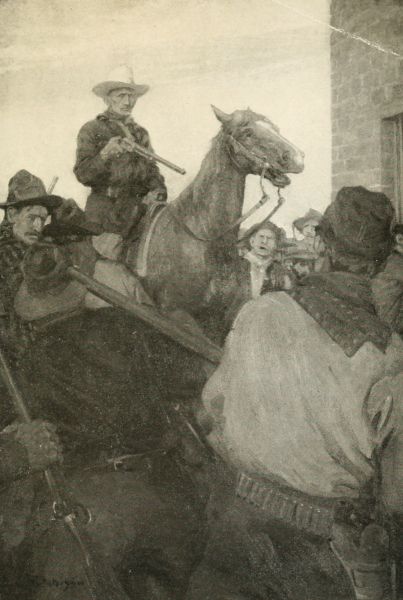
QUELLING A LYNCHING MOB AT WICHITA FALLS. "Boys, have you still got the prisoners?"
"Boys," he called to his Rangers, as he dashed up, "have you still got the prisoners?"
"Yes," they called back, "they're still in the jail!"
Captain Bill wheeled on the mob.
"Now!" he shouted, "damn your sorry souls! march out of here and get away from this jail, every one of you, or I'll fill this yard with dead men!"
He had his Winchester leveled as he spoke and those who considered themselves in range made a wild, hasty effort to get into some safer locality. Captain Bill swung the point of his gun a little so it covered a good many in its orbit, and nobody knew when it might go off. They knew if it did go off it would hit whatever spot he selected, and nobody wanted to own that spot. The crowd moved—some of it hurried a good deal—and Captain Bill helped things along with language. He escorted the mob well into town.
The Ranger Captain now prepared to move the prisoners to Fort Worth, but was notified by the District Judge that this could not be done—that any attempt to do so would result in general trouble with the citizens of Wichita Falls. McDonald protested that the citizens had already shown that they were unable to take care of the prisoners in a legal way. The judge said:
"I will appoint twenty-five men to guard the jail."
"You mean you will appoint twenty-five men to keep me from taking Lewis and Crawford away," McDonald said:
"No, only to help you guard them."
"But if you have a guard of twenty-five men you don't need the Rangers."
The judge argued for the moral support of the Rangers. McDonald informed him that it was impossible for his force to remain in Wichita Falls, guarding prisoners; that other work was waiting for them; that there was already a requisition for them at Quanah; that furthermore they had been away from their headquarters for two weeks, besides being wet and cold and worn out from exposure and want of sleep.
"Let the others go, Captain, and you stay," urged the judge.
"Judge," said Captain Bill, "you know I'm all shot up, and it's the first time I've rode any, and what with yesterday, and last night, and to-day I'm about used up, and likely to be sick. Now, if you can take care of those prisoners with your guard, all right. If you think you can't, I'll take 'em to Fort Worth, where they'll be safe. But I'm going to get out of here to-night, unless you get an order from Governor Culberson for me to stay. It ain't far to the telegraph office, only about thirty steps—you can go and wire him, if you want to. If he says for me to stay, I will, of course. But otherwise I'm going. I've done my whole duty, now. When I get prisoners in jail, and guarded, my duty ends. Your guard of twenty-five men with your local officers can hold that jail if they want to. I could hold it alone."
No order came to the Rangers from Governor Culberson, and they left that afternoon, when the local guard had been duly installed. That night the mob once more marched on the jail, and in spite of the armed guard and the sheriff, deputies and constables, Lewis and Crawford were taken from their cells and hung to telephones poles, close to the bank where they had committed their crime.
Citizens of Wichita Falls complained to Governor Culberson that Captain McDonald and his Rangers had gone away, leaving the prisoners to the mercy of the mob. Culberson wired to McDonald, and receiving the facts in reply, commended him throughout.
A reward of two thousand dollars for the capture of Lewis and Crawford was paid by the two banks of Wichita Falls. The local posse divided it into thirty-two equal parts, in which they generously permitted the Rangers to share.
XXVIII
Captain Bill as a Peace-maker
HE ATTENDS CERTAIN STRIKES AND RIOTS ALONE WITH SATISFACTORY RESULTS. GOES TO THURBER AND DISPERSES A MOB
During the years that ended the old century and began the new—from about 1896 to 1902, or later—there occurred in Texas a series of strike and mob disorders of various kinds. To quiet troubles of this sort is the special province of the Ranger Service, and as the Pan-handle became more tractable—more range-broken, as one may say—Captain Bill McDonald and his little force were summoned to points far and near to put down disturbance and to check agitation.
It was not long after the bank murder at Wichita Falls, and the capture of Lewis and Crawford, that Captain McDonald was summoned there again, this time to investigate a strike on the Fort Worth and Denver Railroad. Things were in bad shape at the Falls. Trains were not allowed to run, engines were not permitted to move. Riot and bloodshed were imminent.
Captain Bill did not think it necessary to take his men. He went up to Wichita Falls alone, and learning where the main body of the strikers were assembled, went over there. They had gathered in a hall, and were holding a secret meeting when he arrived. The Captain knocked on the door. A doorkeeper came, but refused admission.
"I am Captain McDonald, of the Rangers," said McDonald quietly, "and I'm here to talk to you men and see what the trouble is. You're all here? now, and I think I'll talk to you together."
The doorkeeper went away and reported, and presently returned.
"Where are your Rangers?" he asked.
"I didn't bring any. I don't need any. I'm a pretty good single-handed talker, myself."
There was another consultation inside, and the door opened. Captain Bill went in with a friendly greeting for everybody, given in his genial natural way. Then he got up where he could see his audience.
"Boys," he said, in his slow, friendly way, "I understand you-all are acting mighty sorry over here, interfering with business and making out like you're going to tear up things generally. Now, you know me, and you know that I don't want anything that ain't right, and if a man behaves himself I'll try to get him what's right, if I can. I suppose you think you have a grievance and perhaps you have, but you'll never get it settled this way, and it's my business, as you-all know, not to have this sort of work going on. You have a perfect right to quit work, but you haven't any right to keep other men from working, or to injure people's business or to break up property. Nothing good can come out of such doings. I didn't bring any of my men along, because I didn't believe I'd need 'em, and I don't think so now, but of course if this thing goes on, I'll have to bring 'em, and then it will be too late to talk all friendly here together as we're talking now.
"I'm well acquainted with President Good of this road, and I know you can't get anything this way; and if you take my advice you'll go back to work: and tell him your troubles afterward. Now, boys, that's all I've got to say, and I reckon if you listen to it you'll come out a good deal better than if you listen to one or two men that for some reason of their own are trying to stir up a lot of trouble, and will be in jail before night, as like as not."
Captain Bill went down on the street and the crowd soon followed. A good many came to him and expressed willingness to go to work. Here and there he talked to a little group in his friendly, earnest way. The strike at Wichita Falls was over.
From Wichita Falls McDonald went over to Fort Worth, where there was similar trouble, but learned that a more serious situation existed at the Thurber coal-mines, in Erath County. The miners were of many nationalities—ignorant and brutish—and they were swayed by anarchical leaders. The Ranger Captain was urged to take his men to Thurber, but decided to go alone.
Arriving at Thurber, he hunted up the mine officials, for consultation. Colonel Hunter, President of the mines, looked at Captain Bill—bent over from his wounds and battered up from illness and exposure—and shook his head.
"You should have brought your men," he said. "You can't do anything with a gang like ours, alone."
"Well, Colonel, I'm using my men in other places. I'll look around a little and do what I can, anyway."
Loitering about the town, he discovered that a number of kegs of beer were going out to a high hill, beyond the outskirts—headquarters of the striking miners. He learned that there was to be a sort of mass meeting there that night, when the leaders and chief agitators would be on hand. He decided to be present.
It was well after dark when he set out, and a good crowd had assembled when he reached the place. It was out on a mountain where the timber had been cut off, about half a mile from Thurber, and there was no light except from a misty moon. At one place there was a big log, used by the speakers to stand on, and about this the crowd and the beer-kegs were gathered. Captain Bill, unnoticed, blended with the outer edges.
It was near eleven o'clock, and a speaker had come to the conclusion that the crowd was in the proper condition to take some good radical advice—which might be followed by prompt action—so he proceeded to give it. He told them how they had been mistreated and what they should do. They were to begin by blowing up the mines and the superintendent's office, and he told them which mine to blow up first. Then he told them what they were to do to "Old Hunter," and it was clear from the faces and the muttering of the listeners that they were ready to do these things.
Captain Bill worked his way through the crowd until he was close to the speaker's log. When the agitator reached what seemed a good stopping place, the Ranger Captain suddenly stepped up beside him. The speaker stopped dead still, in his surprise. It was Captain Bill's turn.
"Men," he said, "this rascal that has been talking to you is an enemy to you and to the country. He's trying to get you to commit murder, and to get you sent to the penitentiary, or hung. You can quit work, but you can't kill people and destroy property, not in this State. These walking delegates and leaders that are telling you to do these things are just a sorry lot of damned scoundrels, and I'm going to put them where they belong, and where they're trying to get you. I'm Captain of Company B, Ranger Service, and I'm here alone, but I'll have my men here, if I need them, and I'll hang just such fellows as this man—"
Captain Bill turned to indicate his selected victim, but he was no longer there. He had melted into the crowd, and was seen no more. A man from the assembly came up and urged the Ranger Captain to desist—warning him that there were desperate men there, and that he would be killed.
"Don't mind me," Captain Bill proceeded, "that's been tried on me more than once without much success. You see I'm here yet—spared, I reckon, to give you some good advice. Now, you men had better take it and give up these meetings, and if you've got to jump onto anybody, jump onto the fellows that's trying to get you into trouble. Good-night!"
Captain Bill walked back to Thurber and next morning a messenger came to his room to tell him that there was a big crowd outside, hunting for him. He rose and dressed, and taking his Winchester went out to see what was going on. When he appeared he was waited on by some miners who wanted him to talk a little more to the men. He was told that a number of them had decided to go to work and wanted to know what kind of protection they would have. Captain Bill assured them of protection and fair treatment. Then he asked where their leaders had gone—the men who had been urging them to do murder. But they could not tell. Those ill-advisers had vanished over night. Within a brief time the men were nearly all back at work, doing better than ever before.