Front matter (continued 2)
Reading edition
The men protested that they were good citizens, and that if he would let them off they would undertake missionary work in the cause of law and order. He let them go, then, and handed back their unloaded arms, promising them another fate, if he ever caught them in mischief. He watched them disappear behind the first rise; then, whipping up, he made the best time he could for Turkey Track Ranch, where he rested a day, delivered the borrowed buck-board, taking his prisoner next morning to jail.
XI
Redeeming No-man's Land
BILL MCDONALD AND LON BURSON GATHER IN THE BAD MEN. "NO MAN IN THE WRONG CAN STAND UP AGAINST A FELLOW THAT'S IN THE RIGHT AND KEEPS ON A-COMIN'"
It was natural that other work in No-man's Land should follow this first experiment. It having been demonstrated that Bill McDonald could go into that infested place and not only come out alive, but bring back his man, other and more extensive contracts were laid out for him. There were several bad gangs there to be broken up before legitimate settlers could live there, and it was decided that McDonald was the man for the job.
McDonald on his part was ready for the undertaking, it being of a sort which he found always most congenial. Deciding that it was a good thing to have a reliable partner in the handling of a gang, he selected for his associate another deputy marshal—one Lon Burson of Henrietta—a quiet athletic fellow with plenty of grit and endurance.
"I could always rely upon Lon," McDonald said, in speaking of that period, long after; "I believed I knew just what he would do, every time, and he never failed me." It may be added that Burson on his part had complete faith in McDonald, and that their ideas of conducting a campaign were in exact accord.
They began on what was thought to be one of the worst gangs, a band of nine who had established on Beaver Creek a general headquarters from which they conducted a miscellaneous business in crime—stealing cattle and horses, robbing trains and shooting down bank officials when occasion offered, frequently crossing over into adjoining States for that purpose.
McDonald had laid out the plan of attack, which was to arrive on the scene at his favorite early hour—daybreak—and then to do no parleying or long distance firing, but to charge at once and storm the works. His theory was—and is to-day—that the criminal cannot stand up against the man who is not afraid of him and does not hesitate.
"If you wilt or falter he will kill you," he has often said, "but if you go straight at him and never give him time to get to cover, or to think, he will weaken ninety-nine times in a hundred. No man in the wrong can stand up against a fellow that's in the right and keeps on a-comin'. I made up my mind to that long ago, and I've never made a mistake yet."
Here in homely vernacular is expressed a mighty truth. Crime is always coward and cannot stand against the conviction of right. Error cannot survive in the face of truth that does not falter and "keeps on a-comin'."
McDonald and Burson proceeded in the saddle to Higgins, in Lipscomb County—a station on the Santa Fe Bail road, and their last base of supplies. Here they chartered a big three-seated hack in which to bring back their prisoners, should their raid prove successful. They put their own horses to this vehicle, loaded their saddles in behind and continued their journey.
It was toward evening when they arrived in the neighborhood of the outlaw den and camped in a secluded place, to wait for morning. The house stood in the edge of the prairie, near Beaver Creek and was easy of access. It was made of logs and seemed to be a deserted ranch place, probably built by some adventurous person who had long since departed for a locality where there was more law, even if less grass.
One of the band—an early riser—had just gone out to round up the horses when the two deputies, mounted, made their approach, next morning. He discovered them when they were about four hundred yards away and made for the house, McDonald and Burson following at full speed. The outlaw was a little in advance, and his eight companions were out in front with their Winchesters when the officers bore down on them.
"Go round the house, Lon, and come in from behind. I'll 'tend to them on this side," said McDonald as they dashed up.
This maneuver was immediately put into action and in less than a minute later the deputies were on the spot, their game between them. In another instant both deputies had slid from their horses and were in the midst of the confused, half awake outlaws.
"Drop them guns! Drop 'em, and put up your hands!" commanded McDonald—his own gun and Burson's leveled.
There was not even an attempt at resistance. The bandits were simply dazed, overwhelmed by the suddenness and vigor of the onslaught. Heretofore, attacks—always made by a posse—had begun with scouting and skirmish and ended with a running fight, usually at long range. The plan of two mere deputies coming straight upon them and demanding sudden and complete surrender was wholly new. As before remarked, there was something about it terribly convincing—almost supernatural.
McDonald kept the men covered, now, while Burson secured their weapons. Then, hand-cuffed and shackled, they were marched to the big hack, crowded into it and driven fifty miles to Higgins; thence by rail to the United States Commissioner at Wichita Falls.
McDonald, as usual, was sociable enough with his prisoners, once secure, and delivered to them his customary homily, as they drove along.
"I just want to show you fellows, up here, how easy it is to take you," he said affably. "You-all have got the notion that you can run this country your own way, and that there ain't any officers that can come up here and make you behave. Now, you-all are mightily mistaken. I'm going to put every one of you fellows in jail and a lot more like you. You know well enough it ain't right to act like you-all have been doing—driving off other men's cattle and robbing trains and shooting men that you had the drop on. You might know you'd get into trouble. The United States has made laws against such business as that, and them laws cover this country the same as anywhere else and every one of your kind up in here is going to find it out."
The gang was landed safely in Wichita Falls. Some of them were eventually convicted; the rest either became better citizens or sought quieter territory for their industries. The cleaning up of No-man's Land had begun.
The work of active reform was not allowed to languish. News of the first successful raid traveled quickly, and State Senator Temple Houston—son of Governor Sam Houston—notified McDonald that the Sheriff of Hansford County was in need of assistance to cope with a bad gang which had a rendezvous just across the border from Hansford, in No-man's Land. These bandits had been carrying on the usual business of horse and cattle stealing, and general highway robbery. Unlike some of the officials, the sheriff of Hansford, though not noted for reckless bravery, was in no way in league with the thieves and desired only their extermination. His jurisdiction, however, extended no farther than the Texas line, and thus far no State or federal officer had rendered any assistance. As a result, the band, becoming very bold, had pitched their camp just over the line, and had defied arrest, declaring they would shoot the first man that stepped across.
When Bill McDonald got the word from Senator Houston, he immediately sent over for Lon Burson and then proceeded to Canadian, Hemhill County, where Houston lived. Here they learned more fully what work was cut out for them, and presently continued their journey over into Hansford, where, from the sheriff, they secured the names of the offenders, as far as possible, and a partial list of their misdeeds. Complaints were now filed against six men, the usual commodious hack was secured; also, a light buggy for possible side excursions, and McDonald and Burson, accompanied by the sheriff as a guide, drove through the gray of early morning, to the line which divided Hansford County from No-man's Land.
Arriving at the border, the sheriff pointed out where the robber den—a log building—was located, not more than eight hundred yards beyond. Then he said he would wait there until they got back.
"Come right along with us," said McDonald, "we need you to identify the men."
But the officer said. "No," that the men knew him, and it might alarm them if they saw him coming. Besides, he had no authority over there.
"Never mind that," urged McDonald, "I'll risk the consequences, and I'll make you one of a deputy's posse, which fixes your authority all right."
But the sheriff still said "No," that he didn't care for any more authority than he had—that anything new in that line might make him proud. He said he thought he would enjoy sitting there in the hack where he would have a good view of what happened to them when they tackled that outfit.
McDonald and Burson, therefore, set out in the light buggy, driving leisurely across the intervening space. Arriving near the log-house, they discovered that five men were up, and sitting sleepily on the ground in front of their cabin, their Winchesters leaning against the wall behind them. Evidently they did not look for any attack, and even when they saw the approaching buggy, their wits were not sufficiently collected to suspect that these might be officers; nor could they realize that any two men in a buggy would drive over to attempt their capture. In another instant they were covered.
"Get up from there and throw up your hands!" was the word of greeting they received. "And don't try to touch them guns. The first man that tries it I'll kill him."
The five men rose—it was polite to do so—also, they refrained from offering any discourtesy in the matter of the guns. McDonald now called the roll of the names he wanted, and curious as it may seem, each man answered to his name. One man of the six wanted, being missing, the officers proceeded to hand-cuff and shackle the five captured men, and marched them back to the hack, where the sheriff of Hansford was waiting.
Of course the sheriff didn't believe it was true. He had had such dreams before and thought he would wake up, presently, at home, in bed. When he convinced himself at last that he was not asleep, he offered to aid in the search for the sixth man. He was well acquainted with the Territory trails, and McDonald decided to send Burson to Hansford with the hack-load and to proceed with the buggy and the sheriff after Number Six of the gang who, it appeared, had a place of his own some twenty miles away.
Number Six was out looking after his cattle—about thirty in number—the result of industry—when McDonald and the sheriff of Hansford arrived, and not expecting official guests, was unprepared. He had, in fact, "no more gun than a rabbit," as Deputy Bill said afterward, and his capture was child's play. That night the gang complete set out for Wichita Falls, to be tried later in the United States Court at Dallas.
Raids followed each other rapidly. One gang of cattle thieves after another was gathered in, and took up the march for Dallas and trial. Outlawing in No-man's Land became an unpopular occupation. Men of more legitimate enterprise began to wonder if the time was not coming, by and by, when they could do business on or within the borders of that territory without the protection of a company of soldiers. The fame of Bill McDonald was on every man's tongue, and those who had not seen him, especially the outlaws still at large, usually conceived him to be a very terrible person: large, bushy, heavy of voice and fierce of mien. Yet he was just the opposite of all these things. He was slender, quiet, blue-eyed, and gentle of voice—only, he had that gift of command—that look, and that manner of speech with law-breakers which they did not disobey. The time came presently in No-man's Land when his name alone and a rumor that he was coming was sufficient to cause a gang to contemplate emigration. Perhaps they believed he bore a charmed life, and it was useless to resist him. If so, they were hardly to be blamed for such a conviction.
XII
Some of the Difficulties of Reform
"FRONTIER" LAW AND PRACTICE. CAUGHT IN A NORTHER IN NO-MAN'S LAND
It is neither necessary nor possible to give a full history of all the raids that during the brief period of little more than a year broke up organized lawlessness in that stray corner of the nation and redeemed an abandoned land. The general plan was the same in all. The early morning hour; the hack and the Winchester; the surprise attack, and the pleasant drive home with the guests duly hand-cuffed and shackled; these were features common to each episode. Though conducted against desperate men, it was a bloodless warfare. Nobody was killed—scarcely a gun was fired. Bill McDonald's career was not to be always like that. There was to be shooting enough and blood-letting too, but the No-man's Land campaign was peculiar in the absence of these customary attributes of border warfare.
Yet there are one or two aspects of the happenings of that period which may not be overlooked here. As before suggested, the administrators of the law were not always to be relied upon. Some of them were actually in league with the law-breakers; others were honest enough, but afraid of them. But there was still another sort, who being both honest and courageous lacked information. Sometimes this resulted in curious complications which were annoying and discouraging to an officer. Often, the results were rather humorous in their nature. The following is an illustration of frontier jurisprudence.
McDonald had heard of a cow thief in No-man's Land who was working on his own hook—a sporadic case, as one might say—and went over to arrest him. He descended upon him in an unexpected moment, and though the outlaw strenuously protested that it being Sunday the law of arrest did not hold good, Deputy Bill conveyed him across the border and down into Roberts County where the cattle had been stolen and where there was a justice of the peace—it being hardly worth while to take a single prisoner to Wichita Falls. McDonald's idea was that the justice would have authority to bind his prisoner over until such time as the grand jury of that district should meet and indict him in regular form.
Now, Roberts County was a wild desolate place in those days. There was no town anywhere about, and few people. There had been no previous call for administration of the law of any sort, and up to that time no case had come before this justice of the peace. On the arrival of McDonald with his prisoner, his honor convened court with a sort of a helpless look. His office was merely a title, so far as he was concerned, and the wide realm of the law was to him an unexplored country. He had a copy of the "Revised Statutes," however, which he now took down and examined, perhaps for the first time. With McDonald's help he found the section which related to cattle stealing, and the penalty. Regular procedure, with indictments and trial by jury were as nothing to him. He only knew that he had been elected to his office, and that his duty was to administer the law as laid down. He read the law as pointed out, and assumed a judicial severity.
"You own up that you stole them cattle?" he said to the prisoner.
The prisoner nodded.
"Then as justice of the peace of this county I hereby send you to the penitentiary for ten years."
McDonald gasped.
"Judge," he said, "I don't believe that's quite regular."
"Why; ain't that the law?"
"Well, yes, but you see he's entitled to trial, an' mebbe it would be just as well to bind him over under a good heavy bond, and if he can't raise it send him to jail over in Canadian until the grand jury meets. Of course I only mention that as being the usual way of doing things."
The justice looked a little disappointed.
"Why, yes, of course, if you want it that way," he said, "but the man's guilty and I thought you'd like to put the thing through as quick and easy as possible, and save expense. Oh, well, any way to suit you. I'll make his bond heavy enough, anyway." He paused to think, perhaps trying to imagine a sum large enough for a man who had plead guilty to the heinous crime of cattle stealing. "I'll put him under a heavy bond—a good heavy bond—I'll make it three hundred dollars!"
It will be seen that an official who was given to inspirations such as these could become a trial, even with the best intentions in the world; and there were others who added arrogance to their ignorance, and connivance at crime. Nor were the raids into No-man's Land altogether pleasure excursions even though Deputies Bill McDonald and Lon Burson, with their headlong tactics and general disregard of death, had things pretty much their own way when it came to the final show-down. There were long wearying journeys in a trailless land and long night vigils when bone and muscle and nerve were racked and the whole body cried out for sleep. The onset might be swift and reckless, once begun, but the preparation for that moment was cautious and slow and often beset with difficulties. The few dwellers in No-man's Land really desirous of getting rid of the outlaws, were afraid to reveal their anxiety, to give anything resembling information, or even to offer shelter to the officers. They knew that to manifest any interest on the side of law and order would incur the enmity of the gangs and bring down reprisal swift and bloody. McDonald and Burson realized this, and, however severe the conditions of weather and weariness, faced them, rather than impose any risk upon men whose only offense was to dwell among very bad neighbors.
At one time the deputies were after a gang of five men, wanted for murder and theft, and were driving from Higgins into No-man's Land, with hack and team, their saddles loaded in behind, as usual. It was late in the year, now, and suddenly in the swift Texas fashion a norther came down, with piercing wind and fine driving snow. If the reader has never seen a Texas norther, or a Dakota blizzard, he will hardly understand their predicament. The wind leaps up in a wild gale almost in an instant; the air from being balmy takes on a sudden bitterness that wrings the body and numbs the heart and pinches the very soul. Then the snow comes, fine and blinding—sharp and hard as glass. No living being was ever created that could survive long in the face of a storm like that. Cattle know when a norther is coming and find shelter in canyons, or gather into thick bunches in the open, their heads to the center. Birds speed away to the south, ahead of it, or find shelter in hollows and crannies until the demon has passed by. A storm like that always means death. The Texas norther and the Dakota blizzard have strewn the prairies with bones.
McDonald and Burson in the face of such a tempest tried to press on, hoping to find a shelter of some sort—anything that would break the terrible wind. But everywhere was only the wide prairie, level as the sea and lost now in the swirling drift. Night was coming on rapidly, and unless a place for camp was found soon, their case would be hopeless, indeed. It seemed to them that they had drifted for hours, battling against the norther—though it probably was less than one hour—when they came upon some stacks of prairie hay, which indicated the habitation of men. Without seeking further, they made for the shelter of the stacks, burrowed themselves and their horses into them, allowing the latter to feed liberally from the hay. There they remained all night and until the afternoon of the next day, the men without food. The storm abated then, and the officers undiscouraged, pressed on, reaching the outlaw camp late in the afternoon, instead of at their favorite morning hour.
The surprise was quite as complete, however, for the last thing that those bandits expected was that two officers should suddenly appear out of that white devastation to take them to jail. They were too much astonished to attempt resistance and were on their way to Wichita Falls that night, following the road which earlier in the year so many of their kind had taken.
Indeed it was this capture at the end of 1888 that marked about the close of the heaviest work in that particular section. The year's crusade had demonstrated that No-man's Land was not big enough to hold a band of cow thieves and two deputies like Bill McDonald and Lon Burson at the same time. It was no encouragement to a band of hard-working outlaws, just as they had got their plant established and things well under way to be suddenly pounced down upon and put out of business by two men who had no regard for the customary rules of fighting, but just rushed right in with a lot of impertinent orders and an assortment of hand-cuffs and always had a big hack ready to start at a moment's notice for Wichita Falls.
"What is the use?" one of the freebooters is said to have complained, "A fellow no more than gets started when these dam' fools come in and upset everything."
What was the use? Such of the No-man's Land fraternity as still remained unhung and out of jail set out for other fields of labor. Some of them located in the more barren districts of New Mexico and Arizona. Some of them settled in the further places of what was then known as the Cherokee Strip, where they joined with congenial spirits in that territory, and pretending to be engaged in agriculture—for they were in a more settled country—Indian country—continued their old business at the new stand. These we shall meet again presently, for if they had said good-by to Bill McDonald, he had not said good-by to them. It would require new tactics to deal with the new conditions—to identify the outlaw in the pretended agriculturist, and to get evidence for his conviction. It would require the development of another talent in Bill McDonald's make-up, and that talent was ready for cultivation, as we shall see.
XIII
Captain Bill as a Tree-man
THE LOST DROVE OF LAZARUS. A PILGRIM ON A "PAINT HOSS". A NEW WAY OF GETTING INFORMATION IN THE "STRIP"
Meanwhile, the ranch on Wanderer's Creek had suffered. Compelled to be absent most of the time, McDonald was unable to give his herd personal protection, and now and again bunches of his cattle were driven off by outlaws from across the border. His brave wife, facing the problem of the wilderness with only a few hired helpers, did her best, but was not always able to prevent these raids. The thieves would seem to have taken especial delight in watching for the times when Deputy Bill was absent and then descending on his herds, mainly for the booty, no doubt, but also by way of retaliation. It was a dangerous thing for them to do, and though they were certain to pay for it in the end; the double temptation of profit and revenge was not to be resisted.
But while the ranch did not prosper, its owner was in no immediate danger of bankruptcy. With his success in breaking up the gangs in Hardeman and adjoining counties, and in No-man's Land, McDonald's fame had grown amazingly. As a thief-taker he was regarded as a past-master. That an outlaw could neither intimidate nor elude him, and that when he was feeling well he could whip any number of them single-handed, before breakfast, was the current belief. The Cattle-men's Association—a combination of law abiding ranchmen, one of the strongest organizations ever known—invited his special attention to their herds and contributed a monthly acknowledgement of one hundred and fifty dollars, which with his numerous fees made his income an ample one—often as large as five hundred dollars a month—sometimes double this amount.
Among the members of the association was Sam Lazarus, who was with Bull Turner when he was shot by the Brookens, and who came into town on the whiffletrees, undamaged, but a good deal shaken up as to nerves. Soon after McDonald's arrangement with the cattlemen, Lazarus was sending a herd of perhaps a thousand head into Kansas, driving them across the Territory. Pat Wolforth, whose name may also be recalled in connection with the Brookens, was in charge of this herd, and when just beyond the Territory line, in a very lonely district, met with misfortune. One evening near nightfall the cattle suddenly became frightened, doubtless through some device of the outlaws, and Wolforth and his men found it impossible to control them. A general stampede followed and Lazarus's cattle were scattered over the prairies and through the fastnesses of the Strip—a prey to the spoilers lying in wait on every hand. It was a heavy disaster and there seemed little hope of much in the way of recovery. The spring round-up might gather in a few stragglers, but for the most part the herds of Lazarus were believed to be beyond all hope of restoration.
Bill McDonald took no such view of the situation. With Pat Wolforth he immediately visited the scene of the stampede, and began looking for cattle with the "Diamond-tail" brand, such being the symbol of the Lazarus herd. It was a ticklish undertaking. Some of the cattle had been butchered, and these of course were lost. Others had been absorbed by the herds of men who though not regularly engaged in cow stealing were in nowise particular as to whose cows they got and welcomed anything that browsed unguarded on the range. Still others had been collected in "pockets"—small gullies or canyons—where they were retired from general circulation, guarded, as a rule, by one or two ostensible cowboys.
McDonald began by prevailing upon the honest ranchmen in that section to join at once in a general round-up by which means a great number of cattle could be collected and distributed to their rightful owners. The result was fairly satisfactory and a good many of Lazarus's cattle were recovered, though not always without disputes and a display of fire-arms, especially where the brands had been grown over by the long winter-coat of hair. Such cases were settled first and tried afterward. In other words, McDonald and Wolforth possessed themselves of the cattle and then at their leisure "picked the brand," which is the range idiom for picking the hair from around the brand with a pocket-knife, so the brand may be seen. If the brand proved to be other than that of the Lazarus herd, the cattle were turned over to their true owners. When the round-up was over the cow-hunters took up the search in other directions.
It mattered little to McDonald and Wolforth where they found the Diamond-tail brand—they took the cattle, peaceably if possible, forcibly if necessary. They conducted the campaign with an enthusiasm and vigor which did not invite argument. Large herds they searched without ceremony and if any cattle of their brand were found, they were "cut out" with few formalities and with scant courtesy. When they came upon bunches of the Diamond-tail brand in secluded places, they did not pause to present any credentials except their Winchesters which they carried always ready for instant action, and set out at once with the cattle; also, sometimes, with the astonished cowboys as well. It was a sudden and energetic procedure and resulted in the recovery of the greater number of the lost drove of Lazarus.
It resulted further in a definite plan by Bill McDonald for the discouragement of cattle stealing in the Territory, and for the capture of the most actively engaged in that industry. As set down in a foregoing chapter, the outlaws in the Cherokee Strip were not likely to be congregated in a single rendezvous, as had been the case in No-man's Land, but were scattered as individual squatters through neighborhoods more or less friendly to their business, or at least not bold enough openly to oppose it. Indeed, the back country was very sparsely settled, and the Indians and half-breed whites and negroes were not especially interested in law and order, even where they were not directly concerned in opposing these things. Along the rivers—the Cimmaron, the Canadian, the Washita and the North Fork of the Red River, the country was rugged, and the hiding places for plunder were good. The prairies were nice and level with fine land and plentiful grass. White men had no legal right of residence there, except where they were intermarried with the Indians, and those who acquired citizenship in this manner were not likely to be any more desirable than those others whose occupation was itself an infringement on the law.
"Did they raise anything there, Bill?" McDonald was asked in discussing the conditions, long afterward.
"Just raised hell!" the old Ranger answered drily.
Nearly all, however, made a pretense of agricultural employments; for after all, the country, unlike No-man's Land, was really under a regular form of government; legitimate settlement was considerable, and there was a semblance, at least, of law and order. Also, there were towns of considerable size, and railroads—the latter affording liberal returns now and then when some train was waited upon in a lonely place and the express messengers, mail agents and passengers were invited at the point of six-shooters to contribute to a highway development fund. The writer of these chapters was himself a resident of Kansas during this earlier period, and he recalls now what an uninteresting month it was when an M.K. & T. or Santa Fe or Rock Island train did not come up out of the Territory with passengers telegraphing home for money and the express and mail cars full of bullet holes.
Bill McDonald decided to break up this sort of thing, and set about it in a way suggested by his own peculiar genius. It was necessary first to identify the men who were really concerned in these various employments, for in a country where all were "settlers," even if unofficial ones, it was not worth while working at hap-hazard and bothering men whose only offense might be that of squatting. Investigation must be conducted openly and yet in a way to avoid suspicion. His gentle manner and seemingly inoffensive personality suited him for just such an undertaking, and he prepared and "made up" carefully for the part.
Returning to Quanah and Wanderer's Creek, he bought a "paint horse" (a spotted pony); an old tenderfoot saddle, such as a plainsman would never use, and a book with pretty pictures of fruit in it—a regular nurseryman's plate-book—the kind of a book fruit-tree salesmen always carry. Then dressed as unlike an officer, or a cow-man, or a Texan as possible, with these properties he set out—to all appearances a genial, garrulous, easy-going tree-man, inviting orders and confidences—willing to sit around all day and whittle and swap knives and yarns, and to express any kind of interest or sympathy necessary to encourage a man to tell his business ventures and those of his neighbors.
It was a pleasant excursion, enough. No fruit-tree man had been through that section before—none ever had dared, or perhaps thought it worth while, to go. McDonald's excursion proved that profit awaited the seller of trees who should first make that wilderness his territory. He had expected not much in the way of sales, for he did not imagine that men engaged in driving off and slaughtering other men's cattle, and in waylaying trains and robbing banks would have any special taste for horticulture. This was an error of judgment. Most of these bad men had been fairly good boys at home at some time in the past, and the sight of those luminous plates presenting fruit of extravagant size and coloring, made their mouths fairly water at the thought of its cultivation by the doorway of their own dug-outs or sod houses or log cabins. They turned the pages lovingly, and lingered over the wonderful plums and pears and peaches, and as they turned they talked and somehow almost without realizing it they told a great many things about themselves and neighbors which no well-trained and properly constructed outlaw should tell, even to a sympathetic and simple-hearted fruit-tree man who wrote down the orders and listened and chuckled at some of the yarns, while he encouraged further confidences.
He would drift around presently to his customer's former place of residence, and to the reason for his leaving. It was easy enough for an alert tree-man to detect a lack of complete frankness in the replies, especially if the reason had "something about a cow or horse" in it, that being the usual first admission that the isolation of the Strip had been found congenial for other reasons than those connected with its soil and climate. The tree-man did not hesitate to give a generous return for any such confidences, inventing on the spot some of his own for the purpose. The number and character of crimes he confessed to having been accused of in the States would be worth recording in this history if they could be remembered now. But, alas, like other gay bubbles, they were blown only to charm for the moment, and once vanished cannot be recalled. The tree-man would then fall to abusing laws in general and the men who enforced them, and end by declaring that he was mightily in love with that particular section and would stay where there was little or no chance of meeting any of those obnoxious officials, if the boys would consider him one of them and all stand together in time of trouble. Talk like this would open the door for anything. The rest of the interview was likely to run something as follows:
Picture: Two men seated on a log, or down on the grass cowboy style, in front of a dug-out; one the slim, mild-looking tree-man; the other a burly person, very dirty, hairy and unkempt, bent over a large book of gay pictures which the tree-man leans forward to explain. Nearby, two horses are grazing, the "paint-hoss" with the old tenderfoot saddle and saddle-bags; the other a very good looking animal, often saddled and bridled for prompt use.
"By gum," nods the big burly individual, staring at a picture of such peaches as grow only in paradise, "eating peaches like them would be like holdin' up the Santa Fe express."
"That's what," assents the salesman gayly, "regular picnic all the time. I s'pose you fellers in here have money to throw at the birds after that kind of a job."
"Well, not so much after all. Too many have to have a piece out of it. Everybody wants to help. It has to be a pretty big basket of money to cut in two more'n twice and leave enough to pay."
The salesman shows a sympathetic interest.
"Of course," he agrees, "it's too bad to spoil a good bunch of money by making little piles of it. I guess you have to have a good many though for a job like that."
"No, two can do it, an' there ain't no need of more'n three. One to take care of the engineer, another to pull down on the passengers and the other man to go through 'em. It's plum easy. They give up like sinners at a camp-meetin', and the messengers and mail fellers come down pretty easy, too. If they don't we put a few shots through their cars and that fetches 'em."
"But you had to kill the messenger in that Rock Island job, last fall."
"Well, I wasn't in that mess—that was another outfit. Them boys are huntin' trouble and 'll find it some day, good an' plenty. When I put a job through, the' ain't nobody going to get killed unless they commit reg'lar suicide. You ought to come down here an' go in with me. You've got a persuadin' way about you that would make a man give up anything he had and thank you for takin' it. It 'ud pay yeh better, I reckon, than ridin' a paint-hoss over the country, peddlin' trees. That reminds me—you c'n give me six o' them peaches, an' a few o' them pears an' plums an' a couple o' cherry-trees and some grape-vines—the big yaller ones—Niagaries, I think you said they was."
And this was the drift of more than one conversation between the Cherokee agriculturists and the genial tree-man who certainly did have a "persuadin' way" in making a man give up anything he had, in the way of information. No one could dream that this inoffensive mild-eyed pilgrim on a paint-hoss could ever make trouble in that wilderness of lawless living and of desperate men.
So for several weeks the tree-man on his paint-horse with his old tenderfoot saddle and his picture-book loitered up through the Strip and on over into the Territory, on the surface taking orders for spring delivery, and beneath it all locating the different communities of offenders; the individuals of the same; stolen cattle and horses, and securing data of particular crimes. He ended his canvass at Guthrie, a busy frontier point on the Santa Fe, with twenty-five hundred dollars worth of orders for trees—trees which might be bearing to this day if the spring deliveries had been made as planned.
XIV
The Day for "Deliveries"
THE TREE-MAN TURNS OFFICER AND SINGLE-HANDED WIPES OUT A BAD GANG
But McDonald was ready now for deliveries of a different sort—deliveries of the purchasers themselves, into the hands of the law. As a preliminary step he swore out warrants for eight men—the chief operators in a very bad community located along a small creek between Guthrie and Kingfisher—about fifteen miles west of the latter. He then went with his warrants to a deputy marshal at Guthrie and invited his co-operation in making the arrests. The Guthrie deputy looked at him with curiosity, wondering perhaps if this circuit-riding Texas person was in his right mind. Clearly the fame of Bill McDonald had not yet penetrated into darkest Oklahoma. Then, when he had looked over Bill Jess's credentials, and perhaps felt his pulse, he said:
"If you can get a company of soldiers to go along I might undertake that job with you. You don't know that Sand Creek crowd—I do. No two men nor ten men could go up against that outfit and get back alive. Bring a company of regulars over here, if you want to undertake that campaign."
McDonald argued, and related what he had done in No-man's Land, but to no purpose. A sudden charge might work, over there, the deputy said, where the gangs were bunched, and were surprised before they were awake enough to fight. But it was different over here. The bad men were scattered a mile or so apart and while you might get the drop on one, there 'd be a lot more left to get the drop on you, and you'd be full of lead before sunrise. No-siree, nothing less than soldiers, and plenty of them, would do that job.
McDonald went about the town trying to enlist volunteers. He realized that a scattered gang would require time to corral, and that its members would be likely to be awake and busy, before he got them all in. He did not want a company of soldiers, for such a force would scare the gang and accomplish nothing; but he did want a few quick fearless men for this work. Finally he wired U.S. Marshal Walker at Topeka, Kansas, to come on first train. Walker came, and McDonald explained the situation.
"I've got these men located, and warrants for their arrest," he said, "and now I can't get your deputies or anybody else to give me a hand on the job. It ain't just the sort of a thing I want to do alone, for we ought to get to several of these men's houses simultaneous like, an' I thought you might be able to persuade these boys to come along."
"Certainly," said Walker, "that's all right—they don't know who you are. I'm satisfied from what U.S. Marshal Knight, of Dallas, has written me that you know what you want to do, and how to go at it. I'll get the men together and explain the situation."
They collected about a dozen deputies and posse-men, and Walker explained as agreed. It was no use. The men declared that no small force could go into the Sand Creek neighborhood and come out alive, and nothing short of a squad of trained soldiers would be of any use. McDonald looked them over scornfully. Then he turned to Walker.
"If I had as sorry a lot of men as that," he said, "I'd discharge them on the spot. I'll go out there alone, if I can get a man with nerve enough to drive a hack, and I'll bring back a load of criminals, too."
This was regarded as a bluff. Walker returned to Topeka, and Bill McDonald's fruit-tree expedition began to look like a failure. McDonald, however, was not the sort of a person to whom the words "bluff" and "failure" were likely to apply. He discovered a man presently who agreed to drive a hack, provided he would be asked to do no fighting, and would be allowed to remain out of range.
"If you ever get 'em to the hack and tied, I'll haul 'em," he said, but it was clear that he expected to haul home a dead deputy marshal, instead.
They set out long before daybreak, next morning, with a big three-seater—McDonald with an extra horse—and drove to the home of what was considered the most desperate of the Sand Creek gang—a very hard looking customer who lived with his wife in a dug-out in a small clearing. When they had arrived within about two hundred yards of the place, the driver declared that he was satisfied with his position and did not think it necessary by the terms of his contract to go any closer. It was full early, barely daybreak, and everything was very still. McDonald lost no time, therefore, for a whinny of the horses might rouse the occupants of the dug-out, and with his Winchester cocked stepped across the little clearing and without ceremony pushed open the door. As he did so a woman stepped directly in front of him, calling out a warning to some one behind her. In the dimness of the place McDonald saw a man on a bed in the corner reaching for a gun which lay on the mattress near him. It was no time for manners. With a quick sweep of his gun the officer pushed the woman aside and covered the man on the bed, before he could bring his weapon to bear.
"Drop it," he said. "Drop it or you're a dead man!"
There was no mistaking the sincerity of that order. The mild fruit-tree peddler, was merged completely into the resolute officer with eyes of steel and a crisp voice that uttered words of unmistakable meaning. The gun fell upon the bed. McDonald stepped forward and slipping hand-cuffs on his prisoner, ordered him to start for the hack and to make no suspicious movements. Arriving at the awaiting vehicle he invited him to step in and be shackled.
"First delivery," he said to the astonished driver. "We'll go on now and make the rest."
The next hut was perhaps a mile further along, and the sun was getting up when they arrived. As they approached, they saw the occupant standing in the doorway. He saw them about the same time, and suspected trouble. His horse was hitched to a mesquite tree, and making for it he mounted and fled. McDonald was mounted also and gave chase. The race continued for perhaps half a mile when the officer realized that his man had the better horse and would presently get into the brakes and escape. He dismounted quickly, therefore, and taking careful aim began to shoot at the ground near the flying horse in such a manner that the bullet striking the earth would go singing by, very close to the ears of the fugitive. He had long since discovered that a bullet singing in that way, close to a man's ears has an impressive and convincing sound. A man hearing a bullet sing by like that would be willing to bet any reasonable sum that the next one would hit him, especially when the command, "Halt! or I'll get you, next time," came with it. With the second shot the disturbed rider brought his horse up suddenly, dismounted and made motions of surrender. McDonald signaled him to approach, still keeping him covered. He came up in good order, and was marched toward the hack, the driver of which headed in that direction, now that the danger was over.
It was thought that the sound of the shooting might have aroused the neighborhood by this time, and the thief-hunters worked more cautiously. There was no need, however. Gun-fire was of too frequent occurrence to create alarm in that locality, and the sense of immunity from the law had become too chronic to be lightly disturbed. The desperadoes had been left unmolested so long that they had become established in their security and careless of intrusion. Two men were at breakfast at the next place, and deputy Bill's Winchester covered them before they fairly realized that they had a morning visitor. These two were hand-cuffed together and marched to the hack. The driver by this time had picked up a good deal of courage and remained only a few yards behind. As for the outlaws, they were inclined to be sociable, and with the true Western American spirit discerned a certain humor in the situation.
"Hello, Jim, you been buying fruit trees too?" was the greeting of one of the men already loaded as the hand-cuffed pair came in. "What did you get, peaches or pears?"
"You go to hell, will you? You'll get a tree with a rope on it before you get out of this mess."
"That's all right—you must have bought sour grapes, I reckon, the way you talk."
"No, his got frost-bit. They'll be all right in the spring. My apples got a little case of dry-rot, too. I wonder how Buck Dillon 'll like them blue plums o' his'n."
McDonald, always good-natured with his prisoners, joined in the bantering.
"I'm delivering," he said, "I brought in a nice pair, this time," as he loaded his double capture into the hack. Truly no situation can entirely destroy the breezy Western point of view.
The next house lay across quite a stretch of prairie and the hack and its contents were discovered before the approach was near enough for effective action. McDonald on horseback immediately charged, but the outlaw suspected the nature of his visitor and mounting his horse raced away, emptying his six-shooter at his pursuer. Riding, and shooting backward disturbed his aim and his bullets flew wild. McDonald also began shooting, to bring him to a halt, not to kill. As the outlaw uncased his Winchester, however, the officer decided that it was time to bring matters to a focus. Dropping to the ground he knelt and set some bullets singing close to the ear of the fugitive. At first this only had the effect of making him sink his spurs into the pony, but at the third crack of the gun and just as Deputy Bill was taking careful aim for a shot that would be likely to save the cost of prosecution the rider dropped his gun back into the scabbard, and leaped to the ground.
"Well, you've got me," he called as he came up.
"Hello, Joe, what you been buyin'? Prickly pears I reckon," was the greeting from the hack as he came nearer—the latter half of the remark due to a trickle of blood on the man's ear where the last bullet had sung its warning song a trifle too close.
"Must a struck a stone and glanced a little," commented Bill Jess as he looked at it. "I aim to make 'em miss just about three inches. They sing nicer when they don't really hit. That either glanced off of a stone or else it's mighty sorry shooting. Dad-slap it, that sorter makes me ashamed of myself. Oh, well, get in an' make yourself comfortable. I want to get along."
The boy who had been "born with a gun in his hand" as we say, and could pick cherries with a rifle was humiliated by anything that resembled bad marksmanship. Still, it was good enough under the circumstances, and was justified by the result.
That was a busy day. His favorite hour for working (daybreak) was over, now, but matters were going too well to knock off on that account. There were at least three more of this gang, and he would get as many as he could.
He got them all in fact, and one extra—a bad man who happened to be visiting his brother at a bad time. The houses being a good way apart, and the work being done rapidly and with such system and neatness, the alarm had no time to spread. Deputy Bill knew the exact location of each house and of course used more caution in making the approaches as the day advanced. He stalked his game like the true hunter that he was, creeping up unnoticed until he had it covered, keeping the hack well out of view, though by this time the driver had lost all concern, except that of eagerness to see the fun, and was disappointed as were the captured fruit-tree buyers when kept out of view.
The hack went into Kingfisher next morning with every seat full and the driver sitting on the knees of two prisoners. The Sand Creek gang—one of the toughest gangs in the Territory—in the space of a single day and by a single man had been retired from active business.
From Kingfisher, their captor wired U.S. Marshal Walker at Topeka that he had his men and would proceed with them to Wichita, Kansas, as soon as he had rested a little. Within a few days the men were being distributed to the various points where they were wanted for an assortment of crimes. When McDonald and his driver returned to Guthrie, the men he had invited to assist had a downcast look. They had heard the news of the Sand Creek gang. They had heard also from Mr. Walker. Their excuses were many and various, and to a man they offered to join the next expedition.
"No," said Bill Jess, drily, "you fellows are a little too slow. My deliveries in this section are all made."
XV
Cleaning up the Strip
DEPUTY BILL GETS "STOOD OFF," BUT MAKES GOOD. BILL COOK AND "SKEETER." "A HELL OF A COURT TO PLEAD GUILTY IN"
The Cherokee Strip campaign was not allowed to languish. An outlaw community about twenty-five miles north of Kingfisher, and seven miles west of Hennessey, on Turkey Creek, was raided next. In the course of his tree selling, McDonald had fallen in with a man who was peddling stolen beef. He had learned that this man was operating for the Turkey Creek gang, and that the beef he was selling was really the property of the Cherokee Strip Livestock Association, which, it may be mentioned, at that time had a lease on the Cherokee grazing lands for which they paid an annual rental of one hundred thousand dollars.
McDonald now went over to Kingfisher and established headquarters; took the beef peddler to Wichita, Kansas, put him in jail, and got on friendly terms with him. Then he gave his prisoner some good fatherly advice about bad company and the usual rewards of becoming the tool of lawless men. The result was a general confession and turning of State's evidence. The peddler of beef lodged information as to the identity of his employers; the exact nature of their business; the hiding place of their stolen cattle, and the locality of a deep water-hole where they had sunk the hides in order to get rid of the brands and ear-marks. McDonald returned to Kingfisher, next morning, swore out warrants for the men named, and with a deputy marshal, who declared himself willing to go, set out for Turkey Creek. They went in a hack as usual and arrived before daylight at the house of one Charlie Tex, where they thought it likely they might find most of the men wanted. When they entered, however, they found only a man in bed, who declared he had just arrived in that country; that there was nobody at home, and that he knew nothing of the owner's whereabouts. They took him along, however, and proceeded to another house not far away, but found it also empty. The officers now concluded that the men had in some manner got wind of their coming and were hiding in the bottoms. They followed a way down the creek, breaking through to the prairie again, not far from the Tex house. As they did so they noticed the man with them apparently trying to signal in that direction. Then they became aware that several men with Winchesters were walking leisurely along the top of the grassy hill, either unaware of the presence of the officers, or indifferent to it.
McDonald and his associate, satisfied that these were the men wanted, set out up the hill, briskly. Their companion discouraged this movement, insisting that they would all certainly be killed if they molested that crowd. They continued to advance, however, and presently the men with the Winchesters, without appearing to have noticed the deputies, dropped leisurely back behind the hill-top. McDonald now started running, straight up the hill, while his brother deputy set out in a sort of diagonal flank movement around it. In a moment or two he had apparently reached a place where he could see the retreating men, for he called out:
"Hey, Mack, they're right over the hill. They'll get you sure."
McDonald was too interested to stop, now. He raced to the top of the rise, his gun presented, ready for shooting, expecting to see the flash of guns as he broke the sky-line. Instead, he saw the men running for Tex's dug-out, and noticed that still another fellow was already there, pacing about, like a picket, with a gun.
McDonald did not take time to guess at their plans, but kept straight after them, supposing his companion-in-law was following. The men did not pause when they reached the house, but made for a half-built log stable, which formed a sort of pen, and leaping into it put their guns through the spaces between the logs and yelled at McDonald to stop, swearing they would kill him if he came any further.
A brave man is not necessarily a rash man, and to establish bravery it is not necessary to throw oneself in front of a moving train or to charge alone a half-finished log stable full of outlaws who poke their Winchesters through the cracks at you and call you names. McDonald discovered now that his partner was not with him, or anywhere in the neighborhood, and he concluded to stop and negotiate. One might get an outlaw or two through the cracks, but on the whole it didn't seem the part of wisdom to play the game in that way.
He checked his speed when he was about sixty yards from the fort, though he continued to advance in a leisurely walk, talking persuasively meantime.
"Now you fellers better have some sense," he said. "You're going up against the United States law, and even if you killed me it wouldn't make any difference. I've got a posse coming that would be right down on you anyhow. Besides you'd have the United States army after you, and they'd take you and hang you for murder. I only want two out of your bunch anyway, this time; that's all I got warrants for, and maybe none of you are the right ones. You'd better come out and let me look you over."
The men swore they would do nothing of the sort, and if he came a step further they would kill him.
McDonald slackened his pace a bit—some nervous man's gun might go off by accident. He could talk very well from where he was.
"Oh, pshaw!" he said. "You fellers wouldn't kill a kitten. Six of you men behind breastworks to get away from one. Come out where I can look at you. What kind of men are you, anyway?"
"Where's your partner?" called the outlaws.
"You see him, way up yonder, don't you?" Bill Jess said quaintly—"on that hill. I haven't got a rope on him; I couldn't bring him along unless he'd come. You-all are actin' mighty sorry the way you're doin'. Come out of there now, and quit this foolishness."
The outlaws repeated their refusal and their warning that if he came another step they would shoot him dead. McDonald took out his watch.
"Well, boys," he said, "if you want to make a fight you might as well get at it. It's time for my men to be here. Your partner I got yesterday said you'd likely try to start something, so I come fixed for such fellows as you. Come, let's see what you can do."
McDonald waved his hand as if signaling to his companion half a mile in the rear and made a start toward the log fort. Before he had taken two steps, out of it piled the six outlaws and broke "lickety brindle" for the creek bottom, like a bunch of frightened steers. McDonald ran after them and saw them leap on their horses that they had tethered in the bushes and go tearing down the creek, without stopping to look behind. Evidently they did not doubt for a moment that the deputy had a posse, waiting nearby, for they would not be likely to believe that he had dared to face them alone unless assistance was close at hand. Deputy Bill, on his part was not sorry to see them go, for they had him at a serious disadvantage, and his only backing had weakened.
His companion was at the hack when he returned. The one man they had taken in charge had disappeared. Bill Jess made a few choice remarks and they set out for Kingfisher by way of Hennessey.
The following night as McDonald came out of a drug-store in Kingfisher, several shots were fired at him from the darkness. He pulled his six-shooter immediately and emptied it at the flash of the guns, running toward them as he did so. He heard retreating footsteps, but did not follow, as he discovered that he had left his cartridge belt in the hotel.
He was satisfied that the attack had been made by some of the Turkey Creek gang of the day before, trying to get rid of him, and resolved to delay no further in putting them out of business. He enlisted a man whom he knew, one Charley Meyers, and two other young men anxious for adventure, and next morning struck the trail which led, as they expected, in the direction of Turkey Creek. They followed it rapidly and toward evening came upon their game. There was no parleying this time. McDonald headed his force and they charged with a rush. Three of the men threw down their arms and surrendered—the others fired some scattering shots as they ran, and they must have kept on running, for they troubled that country no more. The Turkey and Sand Creek gangs no longer existed.[2]
It was while McDonald was at Kingfisher that he came in contact with Bill Cook and one "Skeeter," both of whom were later to become notorious in matters connected with the looting of banks and trains. The deputy was making some purchases in a store one evening when Cook attempted to ride his horse in the front door. McDonald grabbed the animal's bridle and set him back on his haunches, and before Cook could draw his gun—had him covered and under arrest. Immediately Cook's "side-partner," Skeeter, came up swearing vengeance, and was also suddenly disarmed and landed in jail. The incident closed there, but a sort of sequel was to come along a good many years later, as we shall see presently.
Meanwhile the work of "delivery" by the erstwhile tree-man was not delayed. Following the backward track he gathered up one undesirable citizen after another, until by the end of the season he had established official relations with no less than fifty of his former customers, and the rest had concluded not to wait. The story of the work of that year alone would fill a volume if fully told, but the telling is not necessary. Having planned a campaign along special lines it is only needful to give one or two examples of Bill McDonald's work to see what the rest would be in that particular field. Each field of labor was different and called for different treatment—requiring as much genius to conceive the method as bravery and presence of mind to carry it out. We have now seen what he accomplished in reclaiming a land so lost that it was called No-man's Land, and in cleaning up a strip of country infested by desperadoes supposed to be invincible. We have seen that he could do these things with thoroughness and despatch and with little bloodshed. The old manner of going in with a big posse and engaging in a general fight in which men were killed on both sides and nothing of value accomplished he had rendered obsolete. Men politically and personally opposed to Bill McDonald have referred to him in print and in spoken word as bloodthirsty, and a desperado. Certainly the reader who has followed these chapters thus far will find it hard to agree with such opinions. That he was fearless almost to the point of rashness we may believe, but that he ever wantonly shed blood, or, with all his opportunities, deliberately took human life will be harder to demonstrate.
"I never was a killer," he said once. "Some fellows seem to want to kill, every chance they get, and in a business like mine there's plenty of chances. But I never did want to kill a man, and I never did it when there was any other way to take care of his case."
It may not be out of place here to refer to the method of disarming men which McDonald used. The author has been asked how this sudden and efficient action was performed. His reply is that it is just about as hard to explain as those sleight-of-hand tricks which depend on deftness and exactness of motion—the result of a natural ability combined with long practice. Bill McDonald was born "as quick as a cat," and disarming became his special sleight-of-hand trick. He could locate a man's weapon and could daze and disarm him with a sudden movement that even he himself could not convey in words, and it was this performance that saved the lives of many men, good and bad, and often-times his own.
It was some six years after the Kingfisher incident that McDonald was to renew relations with the "Cook-Skeeter" outfit. He had become Ranger Captain meantime and was engaged in some work in North Texas when he heard of a suspicious gang, heavily armed, camped in a vacant house in the neighborhood of Bellvue, in Clay County. Unable to go himself, he sent his sergeant, J.L. Sullivan, his nephew, W.J. McCauley and another ranger named Bob McClure, to investigate. Before the Rangers reached the house a picket discovered them and set out to give warning to his associates. The Rangers overtook and captured him, but by this time they had been discovered by the occupants of the shanty who began firing through the cracks in the walls.
The Rangers promptly returned the fire and charged, shooting as they came on. The fire became very hot, but McCauley, who had many of the characteristics of his "Uncle Bill," kicked in the door, though the bullets were coming through it from the other side. The outlaws now took refuge in the loft and began shooting down through the floor, the Rangers shooting straight up from below. The Rangers would seem to have had the best luck in this blind warfare for one of the men above was wounded; another had his gun shot from his hand, and a third had his hat shot through. One of them came to the opening, presently, and offered his six-shooter as a sign of surrender. Four were captured, including the aforenamed "Skeeter," but Bill Cook, though a member of the gang, was absent at the time, and escaped. The captured men were taken to Wichita Falls and one of them, a young fellow named Turner, turned State's evidence, through McDonald's persuasive probing, and detailed their plan for robbing the Fort Worth and Denver, next day, giving a list of their crimes. Skeeter and the others were taken to the United States courts at Fort Smith for trial, and pleaded guilty. Skeeter was given thirty years and upon hearing the verdict made his now famous remark:
"Well, this is a hell of a court for a man to plead guilty in."
FOOTNOTES:
XVI
Texas Ranger Service and its Origin
THE MASSACRE OF FORT PARKER. CYNTHIA ANN PARKER'S CAPTURE. RANGERS, AND WHAT THEY ARE FOR. THEIR CHARACTERISTICS AND THEIR REQUIREMENTS
The early history of Texas was written in blood and fire. Her counties preserve the names of her martyrs. Parker, Coleman, Crockett, Fannin, Travis, Bowie and a hundred others have the map for their monument; their names are given daily utterance by those for whom their deeds have little meaning.
In the beginning, after the Indian tribes—friendly at first—became hostile, the warfare was almost solely with the savages. For a full half century every settler who built his campfire on the frontier did so at the risk of his property and his scalp. Those who established homes and settlements must have been a daring race indeed, for raids upon horses and herds were always imminent and massacres were as regular as the seasons.
We have already mentioned in these chapters the name of Chief Quanah Parker (still living) for whom the town of Quanah, Texas, was named. Quanah Parker's mother was Cynthia Ann Parker, a little white girl captured by the Tehaucano Indians, during a raid on what was known as the Austin Colony, in 1836. A brief story of that raid will serve as an example of a thousand others of a similar sort. The Austin Colony settled in what is now Grimes County,[3] and consisted of something more than a score of persons, including women and children. The Indians who dwelt in the neighborhood seemed friendly enough until a small party of unknown settlers came along and attempted to steal their horses. Immediate trouble was the result and the loss of Tehaucano friendship for the entire settlement. When the reader considers what follows, I believe I shall be forgiven for hoping that those newcomers who stirred up the first trouble received the sort of a reward which only an Indian would know how to confer.
As the Austin Colony consisted chiefly of the Parker family, a rude fortification which they erected was called Fort Parker, a name that to-day still suggests something of shuddering horror to those who have heard its history.
It was a fair May morning when that history was made. The early risers noticed that a body of restless Indians had collected within about four hundred yards of the fort. A white flag was hoisted by the savages to signify their peaceable intentions, and a warrior approached as if for conference. Benjamin Parker, commander of the fort, went out to meet him. He came back presently with the word that he believed the Indians intended to fight. He returned, however, to the hostile camp, where he was at once set upon and literally chopped to pieces by the savages, who then with wild yells and bloodcurdling war-whoops charged on the fort. Some of the inmates had already left the stockade. Others were trying to escape. John Parker and wife and a Mrs. Kellogg were overtaken a mile away. Parker was killed and scalped, his wife was speared and Mrs. Kellogg was made captive. Other members of the colony were butchered right and left, and mutilated in the barbarous fashion which seems to give an Indian joy. Silas Parker was brutally killed and his two children, one of whom was the little girl, Cynthia Ann, were carried away. A Mrs. Plummer—daughter of Rev. James W. Parker—attempted to escape, carrying her little son in her arms. A huge painted savage, begrimed with dust and blood overtook her, felled her with a hoe, and seizing her by the hair dragged her, still clinging to her child, back amid the butchery and torture of her friends. She and the others who were living were beaten with clubs and lashed with rawhide thongs. That night such of the captives as remained alive, and these included three children, were flung face down in the dust, their hands bound behind their backs while the Indians, waving bloody scalps and shrieking, danced about them and beat them with their bows until the prisoners were strangling with their own blood. Later, they took the infant child of Mrs. Plummer and slowly choked it before her eyes. When it was not quite dead they flung it again and again into the air and let it fall on the stones and earth. Then they tied a rope around its neck and threw its naked body into the hedges of prickly pear, from which they would jerk it fiercely with demoniacal yells. Finally they fastened the rope attached to its neck to the pommel of a saddle and rode round and round in a circle until the body of the child was literally in shreds. The poor fragments were then thrown into the mother's lap. For some reason, the little girl, Cynthia Ann Parker, received better treatment, and lived. She grew up an Indian, forgot her own race and tongue, married a chief and became the mother of another chief, Quanah, surnamed Parker, to-day a friend of the white race.
It was the massacre of Fort Parker and events of a similar nature that resulted in the organization of the Texas Rangers. The Rangers were at first a semi-official body, locally enlisted and commanded, with regulations and duties not very clearly defined. Their purpose, however, was not in doubt. It was to defend life and property, and their chief qualifications were to be able to ride and shoot and stand up against the warfare of bloodthirsty savages.
"Exterminate the Indians" became a watchword in those days, and the warfare that ensued and continued for forty years, can be compared with nothing in history unless it be with the fierce feuds of the ancient Scottish clans.
Early in 1836 Texas fought for and gained her independence, the only State in the Union to achieve such a triumph. On the following year the Texas congress recognized the Ranger movement and authorized several persons to raise Ranger companies to scour the country and annihilate marauding bands. Indians and low class Mexicans ("greasers") often consorted, and the work, desperate and bloody, continued along the ever widening and westering frontier up to within a period easily remembered to-day by men not beyond middle age. Many names of those early Rangers have been preserved in Texas annals and in local song and traditions, and it would take many volumes to recount their deeds. Jack Hays, James and Resin Bowie, "Big-foot" Wallace, Kit Ackland, Tom Green "Mustang" Grey, of whom the song says:
"At the age of sixteen He joined that jolly band And marched from San Antonio Out to the Rio Grand,"——
these and a hundred others are names that thrilled the Texan of that elder day and they are still repeated and linked with tales of wild warfare and endurance that are hardly surpassed in the world's history of battle. A.J. Sowell, himself a Ranger in the early seventies, when Indian outbreaks were still frequent and disastrous, speaking of the Ranger equipment says:
"We had to furnish our own horses, clothing and six-shooters. The State furnished us carbines, cartridges, provisions, etc., and we got fifty dollars a month."[4]
It will be seen from the foregoing how different the Ranger service and regulations were from those of either the federal or state troops. Unlike the army they wore no uniform, and they provided, for the most part, their own equipment. They differed from State and county officials in that they were confined to no county or portion of the State, but could "range" wherever their service was needed and with little or no direction from headquarters until their mission was accomplished. It will be clearly seen that men constituting such a band must be not only brave, and quick and accurate with fire-arms, but must be men of good character and high, firm principle as well. It is the moral qualification more than any other that has given the Ranger organization its efficiency and power. A force, however small, composed of men who can shoot straight and are brave, and who believe in the right, is well-nigh invincible. The Rangers, originally organized for a great and sacred purpose, the defense of homes, went forth like knights inspired by lofty motives and high resolves, and during whatever change that has come in the aspect of their duties the tradition of honor seems to have been preserved. Indeed they have been from the beginning not unlike the knights of old who rode forth without fear and without reproach to destroy evil and to redress wrong.
Speaking further of Ranger equipment Sowell says:
"In the first place he wants a good horse; strong saddle, double-girted; a good carbine (this was before the day of Winchesters); pistol and plenty of ammunition. He generally wears rough clothing, either of buckskin or strong durable cloth and a broad-brimmed hat of the Mexican style; thick over-shirt, top boots[5] and spurs, and a jacket or short coat so that he can use himself with ease in the saddle."
And the author adds:
"A genuine Texas Ranger will endure cold, hunger and fatigue, almost without a murmur, and will stand by a friend and comrade in the hour of danger and divide anything he has got from a blanket to his last crumb of tobacco."
So much for the Ranger and his origin. As the years went by and the Indian was conquered or driven away, the Ranger's work changed, but his personality remained the same. The Ranger of seventy years ago is the Ranger of to-day—only, his duties have altered. Long before the conquest of the savages a new element of disorder had entered the field. The desperado who had stirred up the first Indian troubles had survived and increased, to plunder his own race. The new and sparsely settled land invited every element of lawlessness and every refugee of crime. Local authorities would not or could not contend with them. It was for the Rangers, now much reduced in numbers, to solve the problem of destroying the disturber in their midst as they had driven the savage enemy from their frontiers. They were made peace officers, and became a mounted constabulary, their duties being to quell disorders, to prevent crime and to bring criminals to justice. It was new work—less romantic than the wild Indian warfare of the frontier; work full of new dangers and what was still worse it was work which instead of inviting the encouragement and enthusiasm of a community, was of a sort to incur its displeasure, for the desperadoes of a neighborhood were either the heroes or the terrors of it, and in either case to molest them was likely to prove unpopular. So it was, during this new order of things, that the Ranger service had to contend not only with the offenders but sometimes with the very people whom they were hoping to protect. This made the work hard and discouraging, as work always is hard and discouraging when it is done amid enemies who wear the guise of friends. How well they have succeeded is told in the official reports. W.H. Mabry, Adjutant General of Texas in 1896, says in his report for that year, referring to the Rangers:
"This branch of the service has been very active and has done incalculable good in policing the sparsely settled sections of the State where the local officers, from the very nature of the conditions, could not afford adequate protection. Including the meanderings of the Rio Grande we have about 3,000 miles of frontier line. Part of this borders on a foreign country, with different customs, law and language. Only a river fordable at most any point intervenes. But for the Ranger force, specially equipped for continued rapid movements, this border line would be the rendezvous for criminals of nearly every description and class."
General Mabry then sets down the fact that the Ranger service has increased the State revenues by something like four hundred thousand dollars for the year through the protection of leased frontier State lands which otherwise could not be inhabited and would yield no return in either rental or taxes.
In concluding he adds: "It is true that the frontier force does not and could not cover all this territory, but the fact that they exist and are scouting over every foot they can travel prevents organized bands from being established along this border line.... They are circumscribed by no county limits; can easily and rapidly move from one section to another and criminals do not care to invite their pursuit. Specially equipped for continued rapid motion, they take up the trail and follow it with a persistency of the sleuth hound, until the criminal is either run out of the country, captured or killed.
"In every train robbery which has occurred in Texas, the robbers have been either captured or killed, whenever it was possible to carry the Rangers to the scene, so they could take the trail. The broad expanse of sparsely settled territory in this State would offer easy opportunity for such crimes, if it were not for the protection given by our mobile and active Ranger force."
FOOTNOTES:
XVII
"Captain of Company B, Ranger Force"
CAPTURE OF DAN AND BOB CAMPBELL. RECOMMENDATIONS FOR A RANGER CAPTAIN. GOVERNOR "JIM" HOGG APPOINTS HIS OLD FRIEND ON THE STRENGTH OF THEM
It will be seen from the foregoing, and from the chapters already published of these memoirs, that a man like Bill McDonald would be well qualified for Ranger service. Already he had been appointed a special Ranger in Company B., commanded by Captain S.A. McMurray, but his duties as U.S. Deputy Marshal, in No-man's Land and in the Cherokee Strip, had been his chief work. Nevertheless, he had, on occasion, engaged in bandit-hunting in his own State, during this period, either alone or in company with other officials, usually with good results. An instance of this kind was the capture of Dan and Bob Campbell which occurred about the time of his concluding the Cherokee Strip campaign.
With his wife, McDonald was on the way from Quanah to Fort Worth, when, at a switch now known as Iowa Park, they met a special, standing on a sidetrack, waiting for them to pass. It was the sort of train that is made up for an urgent purpose, consisting only of an engine and a single car, and McDonald recognized upon it the sheriff of Wichita Falls, also the marshal and others of a posse, evidently out for action. Upon inquiry, he learned that the Campbell boys, two well-known desperadoes of that time, were believed to be somewhere in the neighborhood, preparing to waylay a train. A good reward had been offered for the Campbells and the sheriff and his men were considerably moved. McDonald asked if they would like his assistance, and being assured that they would, sent word back to his wife by the conductor of the down train that he was going to catch some bad men, and boarding the special already impatient to start, took the back track toward Burke, a small station where the outlaws had been seen. When they reached there, it was McDonald's wish to procure horses and begin the search at that point, but the sheriff and his posse thought better to proceed to Harrold, some twenty miles further along, in which direction it was supposed the bandits had traveled.
Leaving word at Burke that they were to be notified in case of any fresh discoveries, the officers again boarded the special, and upon arriving at Harrold found a telegram that the outlaws had been seen entering a thicket not far from Burke. Horses, and a freight car in which to load them, were immediately secured, and the train was backed to Burke. Here the officials separated, the sheriff directing McDonald and the guide who had located the burglars, with a man selected from the posse, to go in one direction, while the sheriff with the remainder of the posse, took another course; the general plan being to round in on the thicket where the outlaws were supposed to be concealed. Arriving near the place, Deputy McDonald and the two men with him discovered two horses hitched in the brush—undoubtedly the mounts of the two Campbells. It was certain now that the quarry was near by, and the three men waited a little for the sheriff and his party to come up. It became evident, however, that their tactics were of a different sort. The posse was scattering out as if they were deer-hunting, taking stands at various distant and semi-distant points, evidently expecting McDonald and his companions to go in and start up the game. McDonald noticed now that his guide was not armed, and was therefore of no further service. Turning to his other companion, he said:
"I don't like this kind of performance. I'm in favor of charging straight in on them."
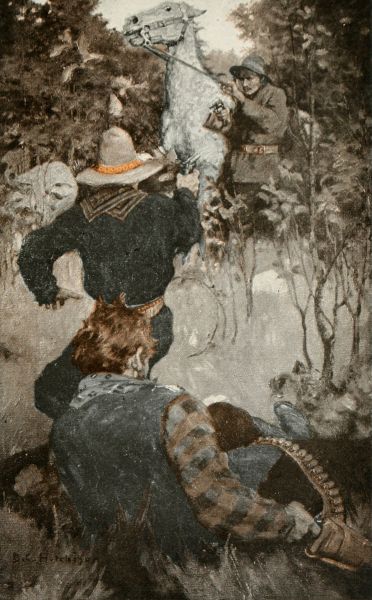
Illustration: THE CAPTURE OF DAN AND BOB CAMPBELL. "He charged straight into the thicket, and suddenly found himself almost on top of them."
His companion seemed to agree to this plan, and without further word Deputy Bill put spurs to his horse, charged straight into the thicket, and suddenly found himself almost on top of Dan and Bob Campbell. Without a breath of hesitation, he leaped to the ground, leveled at the former, who was already in the act of shooting, and commanded him to drop his gun. The order was obeyed; but Bob Campbell, who would seem to have been asleep, reached for his six-shooter, and though commanded not to touch it upon penalty of death, paid small attention to that order. He did not attempt to fire the weapon, but lay there on the ground with it raised, defying his would-be captor with language that was both violent and uncomplimentary. McDonald now suddenly realized that he was alone; that his companion had failed to join in the charge. Bob Campbell realized this too, and became momentarily more defiant. Then, all at once, help arrived. A dentist who had joined the sheriff's posse, had observed Deputy McDonald's single-handed charge, and now came bravely to his assistance. The Campbells both surrendered, then, for the posse was not far behind. They were taken to Wichita Falls, where the sheriff promptly claimed credit for the capture—also, the reward. Later, the Campbells broke jail, but were eventually recaptured, and served a long sentence.
Events of this sort kept Bill McDonald's name fresh in the Texas mind, and made him seem peculiarly eligible for regular service. The resignation of Captain S.A. McMurray, who had long and bravely commanded Company B became his opportunity, and he hurried to Austin to try for that command.
His old friend, James Hogg, was now governor of the State. Since the settlement of their differences so long before, there had been no discord of any kind, and each had admired the other's career, proud to remember the friendship. Arriving at the capital, McDonald was shown into the governor's room. Greeting him, he said:
"Well, I hardly know what to call you, since you got to be governor. I don't know whether to call you 'Jim' or 'Mister.' I'll have to call you 'Governor,' I guess, as I want to get a place."
They shook hands cordially. Governor Hogg said:
"What is it, Bill? What can I do for you?"
"Why," said McDonald, "I came down to get to be Ranger Captain—to take McMurray's place in Company B."
Hogg looked at him reprovingly.
"Why didn't you let me know sooner?" he said. "There are two other applications for the place; both from good men, with long petitions and fine endorsements."
The applicant for position forgot his old friend's title.
"Why, Jim," he said, "I never thought of it until a day or two ago. I didn't have time to get endorsements, but I can get 'em, if you want them. I have been working mostly in No-man's Land and the Territory lately, but have done work in Texas too, and I can get about any kind of endorsement you want."
Hogg laughed. He had a robust sense of humor.
"By gatlins!" he said, using his favorite expression. "That's all right, Bill, you have already got the best endorsement I ever saw."
McDonald looked puzzled.
"I don't understand," he said, "I didn't know anybody knew I wanted a place."
"All the same, you have got the endorsements," insisted Hogg.
He turned to his desk, and got out a bundle of letters.
"Look over these," he said. "You probably know some of the writers."
McDonald took the letters, and read them one after another. They were from well-known criminals, their lawyers, their friends and their associates. They had been received by Hogg while he was attorney-general, and each was a protest and a complaint against McDonald, declaring him to be a ruthless and tyrannical official, whose chief recreation was hounding good citizens for the sake of revenge or glory, enforcing laws that were not on the statute books, adding that it was not unusual for him to put the said citizen in jail, or in box-cars, declaring further that he sometimes hitched them to posts with chains, and that he was a menace to legitimate settlement and society in general.
McDonald looked over some of these documents, and grinned.
"That's so, Jim," he said, "I do put 'em in box-cars when there ain't a jail; the way I used to do back in Mineola—you recollect, when the jail was full—and I lariat 'em out with a chain and a post when there ain't a box-car handy; but I don't reckon they're innocent."
Hogg nodded.
"By gatlins! Those endorsements are good enough for me," he said. "They carry the flavor of conviction, I appoint you Ranger Captain on the strength of them."
McDonald returned to Quanah with his appointment as captain of "Company B, Frontier Battalion." The headquarters of the company were then at Amarillo, in the southern part of Potter County, near the Randall County line. This was almost the exact center of the Pan-handle, and in a locality sparsely settled, untamed, and lawless.
Since the early days of "Ranging" there had been not much change in Ranger regulations and equipment. The character of the work, however, had changed and the force had been reduced in numbers. Company B now consisted of only eight members all told. These were supposed to range over all that vast section known as the Pan-handle, and were subject to orders that might take them to any other portion of the State where their assistance was needed. The Rangers were peace-officers, their duty being to assist the local officers, rather than to take the initiative and predominate.[6] In the Pan-handle, however, and in many other portions of the State, the Rangers were obliged to lead, for the reason that the local officers were either incapable, indifferent, or incriminated, as we have already seen.
The Ranger camp at Amarillo—besides the eight men mentioned—consisted of tents, furnished by the State, a wagon and mule team, a hack, and two pack-mules. Each Ranger furnished his own horse and arms; the State paid for food and ammunition, also for transportation when necessary. In Company B were enrolled Sergeants J.M. Brittain and W.J. Sullivan; Privates John and Tom Platt, Jim Green, John Bracken and John Bishop; also somewhat later, W.J. McCauley—McDonald's nephew—a daring youth—then about eighteen years old, but a natural plainsman, dashing and fearless; an ideal Ranger.
Expeditions were always made with horses. When the distance was far, the horses and pack-mules were shipped to the nearest railway-point, sometimes by special train; an engine and car being secured for such excursions. This train would stop at any point required; the horses and pack-mules were jumped from the door of the car to the ground—sometimes a distance of several feet—and when the point of attack was close by, this wild little army would sweep across the prairie or through the bushes; the pack-mules, loaded with cooking utensils and tinware, often clattering ahead—riderless, but seeming to know by instinct where to go—braying, with tail in air, constituting an advance guard of reform. It would seem that such a charge might have given the alarm and frightened every outlaw within a radius of several miles; but as a matter of fact, these charges were generally planned and undertaken with great secrecy, and the sudden clamor of such an approach was likely to create an amazement which did not subside to the point of action before the time for escape had slipped by. Speaking of it afterwards, Captain McDonald said:
"That infernal racket seemed to jar the nerve of a criminal, for I never knew a pack-mule charge where the men we wanted seemed to have either spunk enough to put up a good fight or sense enough to get away."
FOOTNOTES:
XVIII
An Exciting Indian Campaign
FIRST SERVICE AS RANGER CAPTAIN. BIGGEST INDIAN SCARE ON RECORD
It was in January, 1891, that Bill McDonald received his appointment as Ranger Captain, and his first official service was not long delayed. He arrived at Amarillo about midnight, and was received with congratulations, for the news had traveled ahead of him. He was tired, however, and the hour was late, so he presently slipped away to bed. He had hardly fallen asleep when he was rudely awakened and handed a telegram which stated that the Indians had made a raid across the border, and were killing and robbing in Hall County, near Salisbury.
Captain McDonald read the telegram and laughed. There had been no Indian troubles in Texas for a number of years. White renegades there were in plenty, but Indian outbreaks had long since ceased.
"I guess the boys are trying to have some fun with me on my first night," he said, and turned in once more to sleep. But a few minutes later another telegram came; and another; this time from the superintendent of the railroad company—a Mr. Good, whom McDonald knew as a man not given to practical joking.
The Ranger Captain dressed himself, hurried over to the telegraph office and got the operator there to talk over the wire to the operator where the scare had originated. He learned that it seemed to be genuine, and that everybody was leaving the neighborhood. The operator at Salisbury ended his information with "Good-by, I'm going now myself."
Captain Bill still could not believe it a genuine Indian incursion. Hall County was in the second tier from the Territory line, and the Indians would have had to cross Childress County to get to it. He did not believe that they would undertake to do this, or that they could have accomplished it without previous alarms. Still, it was his duty to investigate. He got a special train; loaded in men, horses and pack-mules, and set out on a hunt for Indians. It was about a hundred miles to Salisbury, and they reached there early in the day. Not a soul was in sight anywhere. The inhabitants were hidden, some in dug-outs, some in haystacks, some in the tall grass. Here and there, as the train pulled in, McDonald saw a head stick out from a sod house far out on the prairie, then suddenly disappear, like a prairie-dog dropping into his hole. He set out to interview some of these wary settlers, and learned that the Indian alarm had been given by a man—a new settler just arrived in the country—who had ridden his horse to death and lost one of his children—having left him far behind somewhere—in his wild eagerness to escape the savages who, he declared, were burning and scalping not far away. Captain Bill found this man, and after a little talk with him was convinced that what he had seen was nothing more nor less than some cowboys on a round-up, disporting themselves around their campfire at night, as cowboys will—dancing and capering in the mad manner of young plainsmen whose ideas of amusement are elemental, and whose opportunities for social diversions are few. The man and the neighborhood, however, remained unconvinced, so it was decided to visit the scene of the disturbance.
Horses, men and pack-mules unloaded themselves from the freight car, and went racing over the prairie; the pack-mules, as usual, plunging and braying with tail in air, their tinware clattering in a manner calculated to put a whole tribe of Indians into a panic and send them capering across the eastern horizon into their own domain. But there were no Indians. It was as Captain Bill had thought; a gang of cowboys, the evening before, had rounded up some cattle; killed a beef; carried it to their camp near by, where they had built a great fire and roasted it, doing a wild war-dance of celebration, and shooting off their six-shooters in their prodigal expression of joy. Viewed from a little distance, through a sort of mirage condition which had exaggerated the whole effect, the scene to the newcomers was a horrifying picture of savages about a burning home, with the inhabitants fleeing for their lives.