CANOEING IN KANUCKIA.
Reading edition
I. GETTING UNDER WAY.
ALL night the Statesman, the Editor, the Artist and the Scribbler had been rumbling northward in a sleeping car, and as day dawned the steady and quickened clank of wheels told that they were on a down grade toward the Lake, and nearing the point where vacation was really to begin. They had turned into their respective berths somewhere south of Albany; they awoke and looked down from a precipitous hillside into the clear Lake. Presently the train slowed and in another minute they were questioning the station-master about their canoes, which had preceded them as freight some days before.
"No, can't wait till after breakfast. Must see them now."
So the station-master rather reluctantly unlocked his freight room and there in a row side by side lay the "Red Lakers" and the "Chrysalids," for all the world like two pairs of twins tucked in a big bed together. For the station-master—bless him!—had thoughtfully spread a tarpaulin over them so that only their darling noses were in sight.
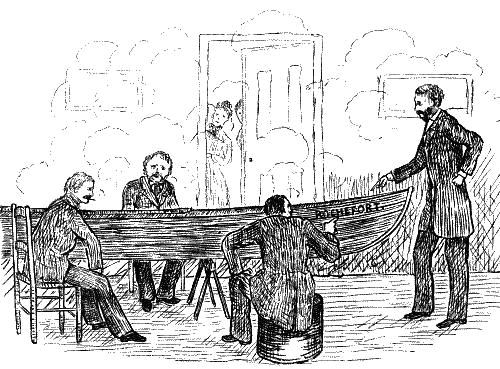
Mlle. Rochefort at home.
It should here be explained that the terms "Red Lake" and "Chrysalid" designate certain models of canoes, the first being named for the locality where the canoes are built, while the appropriateness of the second must be evident from the accompanying sketch.
Let the Expeditionis Personæ now be introduced.
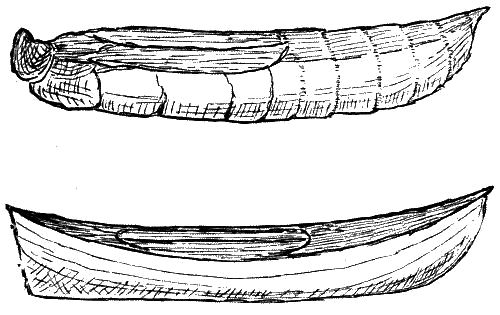
Chrysalis and Chrysalid.
Behold the Becky Sharp (flagship) and the Cherub, commanded respectively by the Editor and the Scribbler, and constituting the "First Division." Behold also the "Rochefort" and the "Arethusela" [1] forming the Second Division, and commanded by the Statesman and the Artist.
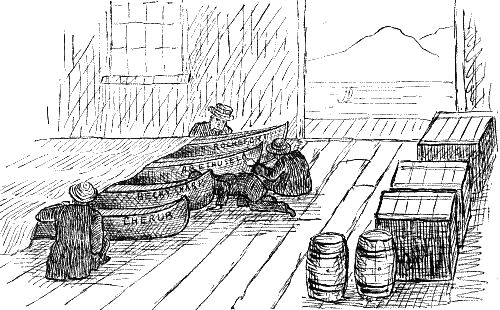
The Twins.
Over the meeting between each man and his canoe a veil is delicately drawn. Even the station-master considerately stepped out upon the platform during the few moments when each metaphorically made his canoe put out its tongue and answer questions as to its moral and physical well-being. The interview was satisfactory to all save the Statesman, who detected several minute scratches on the deck of the Rochefort and declared that palpable demoralization had resulted from her enforced association with Red Lakers.
The Artist having volunteered to stay by the boats while his companions breakfasted at the neighboring tavern, was straightway beset by a number of wayfarers who demanded full accounts of the canoes and of canoeing in general. The Artist had been in the lecture field, and as the spirit was strong upon him, he gave the assembled multitude (about a dozen in all) a comprehensive account of the art. No reporter was present, but his remarks are believed to have been about as follows:
"In the civilized acceptation of the term, gentlemen," (here the six small boys who composed a fraction of the audience punched one another in the ribs,) "modern canoeing dates back only a few years,—some fifteen in England and half as many in America. Its acknowledged progenitor is Mr. John Macgregor, an English barrister to whom was vouchsafed the brilliant idea of crossing the canoe of the North American Indian with the Esquimaux Kayak, for purposes of civilized recreation, the product being a hybrid known as the Rob Roy model. (Here the speaker seized the station-master's chalk and drew rapidly upon the wall in illustration of his meaning.) Although the canoe exists among all savage nations, it reached its greatest perfection for inland and coast wise navigation among the North American Indians. The 'birch,' as it is familiarly called, is so nearly perfect for use on forest streams that the Hudson's Bay Company, after various experiments with wood and iron, settled down, years ago, to its almost exclusive use for their vast transportation service extending throughout the British American Possessions. The Kayak, built as it is of a light frame with skin stretched over it, has less weight and more strength than the birch, and as it is all covered over excepting a man-hole amidships, it is evidently the more seaworthy of the two. It has, however, no carrying capacity to speak of, beyond its crew of one."
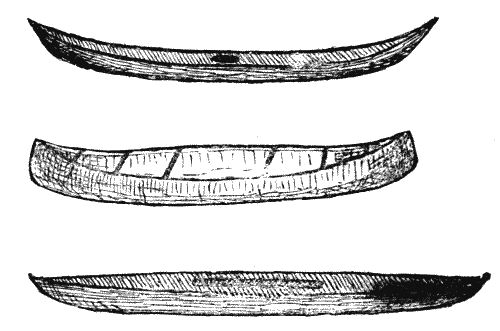
Kayak—Birch—Rob-Roy.
"A different craft from either of these is required for the use of the civilized voyager. He wants a boat which will not, like the birch, leak if it happens to touch bottom. He wants one which will retain its buoyancy even when full of water; which at a pinch he can carry alone across a portage; which is roomy enough to sleep in, large enough to carry stores and equipments for a reasonable number of days, staunch and seaworthy in any weather when it is pleasant to be on the water, and readily obedient to his hand under sail or paddle.
"No doubt Mr. Macgregor drew his first inspiration from the two barbarian models referred to. He designed a boat known as the 'Rob-Roy,' which was easy to paddle, which could be slept in, and in which he made many long cruises. It was, however, decidedly faulty in many particulars, being wet and uncomfortable in a sea-way, owing to its lack of 'sheer;' it was also of small sailing capacity. In smooth water, the 'Rob-Roy' has its advantages, but for general purposes the 'Nautilus' model is decidedly its superior. This was designed by Mr. Baden Powell, another Englishman, who improved on Mr. Macgregor's model by giving his boat greater 'bearings,' that is, a broader and flatter bottom, that of the original Rob Roy being nearly semi-circular, and by raising her lines at stem and stern so that it was nearly impossible to drive her nose under in a sea-way. This made her very difficult to manage under paddle with the wind abeam, so in subsequent plans the sheer was considerably reduced, and the change proved to be a decided improvement.
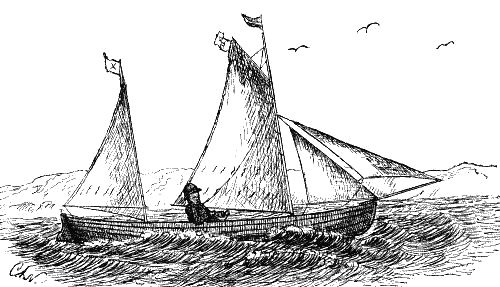
Under Full Sail—Chrysalid.
"The 'Chrysalids' (here the speaker indicated the Arethusela and the Rochefort) are variations of the Nautilus type. You perceive at a glance their great superiority in every particular over the 'Red Laker' (pointing to the Cherub and the Becky Sharp) which lie beside them, and which are merely elaborate copies of the Indian birch made of wood and rigged for cruising. I will draw for you a Chrysalid under sail." (The Artist turned again to his extemporized black-board and with a few rapid strokes produced the sketch on page 28).
Meanwhile the local population had dropped in one by one, until he had a respectable audience, and the Scribbler, who had finished his breakfast and drawn near, began to consider the expediency of taking up a collection.
"You see how ship-shape she is in all respects, (applause, the Artist bowing,) I will now, in order that my fellow voyagers may not accuse me of partiality, show you also a Red Laker under sail." Again the station-master's chalk was in requisition, and presently a sketch something like this adorned the wall. As the Artist was proceeding, a youth near the door, who, the Artist vows, had been bribed by the Scribbler, checked him with, "I say, mister, that there Red Laker makes the best looking picter of the two, don't it?"
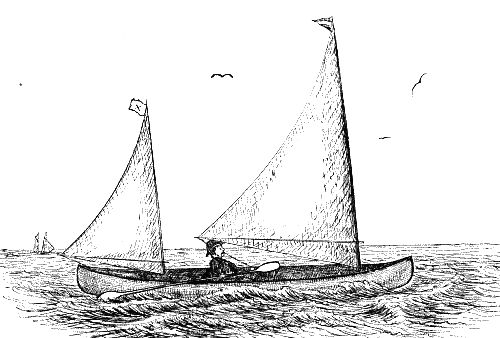
Close Hauled Red Laker.
The Artist had not compared his illustrations, and on glancing at them, was obliged to explain that certain peculiarities of outline assuredly did give a false impression in this instance:—"However," he went on easily, resuming the imperturbable manner which had become habitual with him in the desk, "as I was about to say, having thus become Anglicized, it was merely a question of time how soon the modern and improved canoe should be re-naturalized in America. It was introduced in 1872 by Mr. W. L. Alden, founder and senior member of the New York Canoe Club, an association to which the boats before you belong, and which now has a fleet of about thirty canoes, and a somewhat larger number of active and honorary members."
The Artist ceased and the Scribbler led off in a round of applause, which was however, but feebly seconded.
Breakfast over, the quartette donned their blue flannels and sauntered down to the shore, followed by a curious throng of the inhabitants. (N. B. The throng of inhabitants is seen at the right.)
The Lake, which at an early hour had been placid as a anglican sermon, was, by the time the fleet was ready to start, breaking furiously against the wharf before a northerly breeze and the mariners were glad to launch and stow their canoes under the lee of the railway bridge, and the critical supervision of the local small-boy.
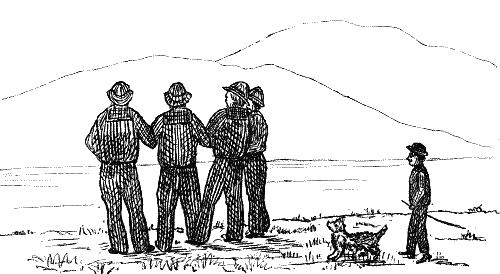
The Quartette.
For six months the four comrades had made preparations for the cruise, but the knowledge which worketh experience worked also calamity, for the stores which were unloaded from steamboats and express cars on the shore of the lake, would have justified each captain of a canoe in chartering a steamer of moderate dimensions as a tender. As such a course would have tended to the destruction of the picturesqueness of the squadron under sail, it was given up without a murmur, so the quartette, each man for himself, proceeded to the exasperating duty of deciding what he best could spare and return. The Statesman decided against carrying a tent, a tin pail, a couple of hundred weight of canned goods, a life-preserver, a Bible and a looking-glass which he had brought with him, but retained a double-barrelled gun, a twenty-pound bag of duck-shot and a volume of Tupper's "Proverbial Philosophy."
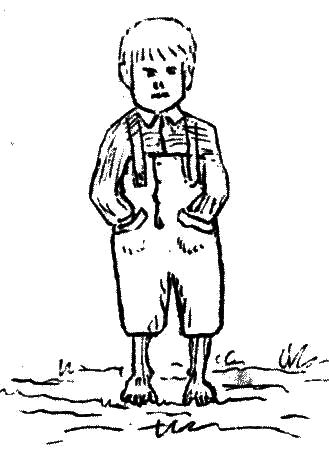
The Local Small Boy.
"If your boat springs a leak, no earthly power can save her, with such a cargo," said the Editor.
"I'll keep the shot where I can drop it overboard in such case," briskly replied the Statesman.
"What good will that do?" asked the Editor, "if the Tupper remains on board?"
"The Tupper will make a capital anchor, though," suggested the Artist, as he reluctantly laid upon a heap, to be returned, a field easel, a camp-stool, a medicine-chest, a set of Shakespeare in three volumes, and a demijohn, the latter, by some deplorable oversight, having arrived empty. The Scribbler carefully inspected two bulky portmanteaus, extracted therefrom a single change of underclothing, a box of cigars, a tooth-brush and a comb, and returned the bags with their contents. The Editor concluded that perhaps he might be safe in Acadia without the copy of Webster's Dictionary which he had brought thus far in several thicknesses of rubber cloth, and a mental survey of the proposed route convinced him that he might dispense with his faithful scissors and paste-pot, inasmuch as no newspaper was published on either the Lake or the River, but he stowed in his boat a gold headed-cane and a horse-pistol, explaining, as he did so,
"These are the interviewer's only faithful friends."
The individual property thus rejected, with the superfluous stores which had been purchased en bloc by the quartette, threatened for a little while to cause a "corner" in freight cars, but a threat to charter several steamers which were idle upon the Lake brought the railway agent to his senses, and gave his Company an excuse to put upon Wall Street a story of sudden increase of gross earnings. The rejected cargoes were stowed, and then the Editor, calling his companions apart from the immense crowd of gazers and listeners, said,
"Gentlemen, by virtue of long experience as a fighting editor, I hereby assume command of this expedition, and propose to be obeyed and respected accordingly. I detail the Statesman as Vice-commodore, commanding the Second Division."
"Vice," murmured the Artist, "what an ideal title for a Statesman!"
The Commodore continued, "The Artist I appoint Purser—"
"What delicious sarcasm!" interrupted the newly appointed Vice; "the idea of an Artist taking care of money! Judas and his bag are nowhere."
"And the Scribbler," resumed the Commodore, "will be Cook, a position to which his experience in concocting literary hash most richly entitles him. During the cruise all family, baptismal and social names will be dropped, and the members of the expedition will be known only by their nautical titles. Is every one ready to embark?"
"Ready!" replied the Vice, the Purser and the Cook in chorus; the paddles were seized, and the Commodore was giving the command "Shove off!" when the Vice exclaimed,
"Gracious! how could I have forgotten it?" Then he ran to the pile of rejected material and rescued an immense brown paper parcel containing something which seemed to be instinct with every angle and line known to the student of conic sections. Hurriedly stowing it away in his forward compartment, he shoved his boat from the beach.
"What is it?" shouted the fleet.
"It was a present to me from a constituent," roared he, at the top of his lungs, the wind whisking away his words. "That's what it is."
This was accepted as a diplomatic and statesmanlike way of saying "None of your business," so the rest held their peace, and gave themselves to the serious work of making headway against the sea.
'Tis ever thus! Never have any of the Four started on a cruise without having at the very beginning to tax their as yet unaccustomed muscles by paddling straight in the teeth of an adverse gale. Of course the canoes are at their heaviest and must be expected to leak more or less after a fortnight's baking in a box-car. So when all are ready the command paddles round through the draw, points toward a headland three miles off dead to windward, and doggedly settles down to its work. It takes nearly two hours to cover the distance, and the Chrysalids have had to bail at frequent intervals under the protecting care of Red Lakers. The headland is reached at last, however, and then comes the bath for which all have been longing. If any future explorer finds an unaccountable deposit of cinders and scoriæ off that point he may ascribe them, if he likes, to prehistoric volcanic convulsions, but the four voyagers know better.
It was now noon, and a substantial luncheon was followed by a long siesta under the cedars, while lungs accustomed to inhale the de-oxidized atmosphere of the city filled themselves with the first draughts of ozone from the great paradise of spruce which stretches almost unbroken from the Canada line to the Arctic circle. Grand mountain forms rose against the sky, the city was far away; they were free!
The sun lacked but three hours of setting, when the squadron shook off the delicious languor that succeeded its unwonted exertions, bailed out the Chrysalids, now thoroughly soaked, and in a condition which their owners were pleased to consider "tight," wiped up with a sponge the few drops that had penetrated the seams of the Red Lakers, and paddled merrily away toward an island blue in the afternoon haze, on which it had been determined to camp over Sunday. The lake was by this time ashamed of the boisterous welcome it had given to the fleet, and was undergoing a burnishing process preparatory to serving as a mirror for the sunset. By dusk camp was made in a lean-to left by some considerate predecessors. The canoes were anchored in the lee of a shingly point, excepting the Rochefort, which her commander carefully, and for some inscrutable parliamentary reason, anchored to windward, and by nine o'clock all, with one exception, were rolled in their blankets, and sound asleep.
II. COOKS AND COFFEE POTS AND SEAMANSHIP.
AS is the case in all well regulated families, the Cook was the first person to greet the morning of the second day. He not only did so, but he greeted it in its extreme infancy, an instant after his own watch, had it been a repeater, would have struck midnight, and from this moment onward he manifested the liveliest interest in the growth of the new day. His impatience could scarcely be attributable to a desire to see the sun rise, for at home the Cook habitually rose at dawn, and had already an unequalled collection of sunrises in his mental portfolio. In truth, the Cook was very cold. He had smiled pityingly as he saw his companions retire each under a pair of woolen blankets, while he himself stretched freely upon his rubber sheet, with no covering whatever. Woolen blankets in July, when at midday the thermometer stood at ninety degrees in the shade!—the Cook perspired anew at the thought, and chuckled over the superior good luck which had led him to forget his blankets when he left New York, thereby materially reducing the bulk of his equipment. Woolen blankets might be necessary to the city existence of the Statesman, the Editor and the Artist, for each of the gentlemen represented professions which are notoriously cold-blooded, but as for the Scribbler—well, all scribblers come early in life to regard blankets as rarely attainable luxuries, and to depend for warmth upon their own inner man.
But on this particular occasion the inner man of the Cook failed to respond to the demand made upon it. The Cook would have encouraged the inner man had he known where the expeditionary brandy was kept, but no racking of memory elicited the information desired. He scraped carefully among the ashes of his evening fire, hoping that some coals might have remained alive to kindle a new one, but the fire had been of wood too small to leave coals, and the Cook's matches were wet. He might have had dry matches, brandy—yes, and a share in the blankets themselves, all in an instant, had he but awakened either of his brother officers. But the Cook's pride exceeded in greatness even his discomfort, so he sought consolation in his own reflections, as men are always possessed to do at just such times, when their reflections are in the most shocking condition imaginable. The Cook paced the sand, hugged himself, and tried to believe that there had been no such day as yesterday, and that he had never left a blanket in New York. Then he tried to draw his rubber blanket noiselessly from the tent, to throw over his shoulders, but one side of the Purser rested upon its extreme edge, and the Purser was of the conventional English ponderosity. Then the Cook tried to revive his spirits with a song, sung softly between his teeth, but these last named gateways of sound were trembling so that the song itself became sadly demoralized. The Cook had once written a convincing essay on "The Power of the Imagination, as Exemplified by Physical Facts," and recalling this, he soliloquized "Physician, heal thyself!" Honestly he endeavored to obey the injunction, by imagining himself burrowing in a whole bale of Mackinaw blankets, as he had once done in the far west when smitten by an ague, but the warmth was as imperceptible in the former case as in the latter.
The night wore on, to the extent of two or three thousand hours, and reduced the chilling Cook at last to a single desire:—he wished that before he froze to death he might have a thermometer, a pencil and paper, and record for the benefit of coming canoeists this terrible temperature—if, indeed, the thermometer could indicate it before the mercury itself would freeze.
Then came that mysterious hour of the night in which night, itself still regnant, trembles at the prospect of its own dissolution. It was the hour in which sick men who are foredoomed to die generally accept the inevitable: it was also the hour in which the Commodore, in his home capacity of Editor, always left the office of the "Daily Tocsin," and walked home with a sedative cigar for company. The force of habit being strong in the Commodore, he rustled uneasily under his blankets, and finally emerged from the tent, filling a pipe as he came.
"Just the man!" exclaimed the Cook. "I want to smoke, but I hadn't the heart to awake any one to beg a dry match."
Both pipes lighted, the Cook remarked,
"D-d-don't you think it would be more cheerful to smoke by a f-f-fire?"
And the Commodore, with a very perceptible flavor of irony in his tones, replied,
"I d-d-don't know but I d-d-do."
Five minutes sufficed in which to make a roaring fire: then the Cook scraped up a ridge of sand a few feet from the blaze, allowed it to heat, stretched himself against it and was asleep in an instant. An experienced seaman, however, when in a position of grave responsibility, never allows himself entire freedom from care. Hence in the present instance the sailor-like instincts acquired by the Commodore during long years of sedentary life, caused him some anxiety as he once more lay down in the tent. The wind had freshened from the southward, and he deemed it his duty to arouse the Vice whose canoe, as has been stated, was anchored off a lee shore while the rest were securely sheltered behind a point. The reply elicited by his appeal was somnolent rather than respectful, and the Commodore resolving upon disciplinary measures in the morning, once more arose and sought the beach. Professional instinct had not been at fault. There was the Rochefort full of water, rolling heavily in the trough of the sea, and banging her cedar broadside against the stony shore. With that devotion to the service characteristic of the true sailor, the commanding officer laid aside at once his trousers and the dignity of his station, and rescued, at the risk of wetting his remaining garment, the vessel which the inexperience of a subordinate had imperiled. In this connection it may be well to remark that a stone which weighs twelve pounds out of the water weighs only about seven beneath its surface. Ignorance of this simple mechanical principle led a well-meaning and occasionally meritorious officer into the error of using such a stone for an anchor.
Still the Cook slept when the Commodore returned from his labor of love, and crept shiveringly into his blankets.
The hours passed, the sun arose and beat upon the Cook's face, and still he slept. By the time the occupants of the tent awoke the sun had performed his toilet so thoroughly that not a dewdrop remained visible. But still the Cook slept, and when the Vice saw him he took in the situation at a glance, and remarked:
"Methinks I remember a cruise in which the Alderman was temporarily without blankets."
The Vice performed his ablutions, shaved himself, eyed the fire, walked impatiently around the Cook, and finally exclaimed:
"Boys, I'm starving, but it's too bad to rouse that tired wretch. I'll take his place this morning. He does well enough as a cook, but he has some silly notions that I'd like to reason him out of. He always cooks with hot coals; now I propose to show him that a bright blaze is just as useful, and far sooner made ready. Besides I am the proud owner of a utensil which is destined to revolutionize the art of coffee-making." The others were fain to acquiesce in this arrangement, but the Purser, with characteristic prudence, put some water to boil in the regular way. The Statesman meanwhile burrowed among his stores and shortly appeared bearing the brown paper parcel which had excited curiosity at the beginning of the voyage. Tearing off the paper he exhibited a structure of the general appearance depicted.
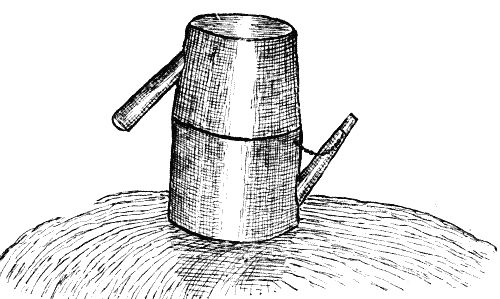
The Vice's Coffee Pot before.
"Here," said he, rapidly resolving it into its component parts, "is the receptacle for the coffee. And you fill this part—no, this one—with water. Then you put it on the fire. As soon as it boils you turn it bottom up. Let's see—no, it was bottom up before; you turn it right side up and there you are. Coffee strained, not boiled." This last with a contemptuous glance at the sleeping cook.
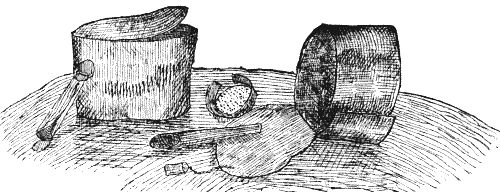
The Vice's Coffee Pot after.
The Vice piled wood upon the fire, and while it blazed up fiercely he hastily filled the wonderful coffee-pot half full of water, and set it in the midst of the flames. Five minutes later the Cook awoke from a dream of hearing a tin peddler's wagon upset on a stone pavement. Rubbing his eyes he beheld the Vice, with a long hooked stick, rescuing various pieces of tin from the fire, and dropping them upon a boulder near by.[2] The flame had resolved the wonderful coffee-pot into its dozen or more original fragments, and as the Vice made a final dive for the spoutless, handleless, topless vessel, the Cook drawled:
"Some people cook over coals, and some prefer a blaze."
"Why," spluttered the Vice, as he blew upon a burned finger, "the Alderman always made coffee over a blaze."
"Then he did it in a coffee-pot with a bail which hooked on, instead of being fastened by solder. And besides he suspended it over the fire after this fashion."
The Vice walked away to his boat in disgust, while the rest seated themselves about the unprofessional breakfast which had been made ready. Presently he sauntered boldly among them with what he was pleased to term a coffee-cup in hand, looking rather red in the face, but sturdily demanding his breakfast.
"Some of that potted salmon, Purser. Pass us the bread, Commodore. I say, Cook, isn't that coffee ready yet? Commodore, this thing won't work. If fellows are going to shirk their share of the drudgery, the service will go to the dogs. What I want is my coffee, and I want it NOW, do you hear, Cook?"
But the Cook was magnanimous, for he had a coffee-pot of his own, and though the Vice contended that the coffee made therein had not the aroma peculiar to that made in the one which he had loved, and lost, he revealed the hollowness of his plea, (or his stomach) by drinking twice as much as any one else did.
The Flag officer deemed the moment a fitting one to administer, firmly but kindly, a merited rebuke to the subordinate whose heedlessness had on the preceding night imperilled the safety of a valuable vessel. On being asked if he had anything to say in his own defence, the disgraced officer replied with unblushing effrontery that he was warm and comfortable when the Commodore waked him; he was sleepy, and he knew the Commodore would get up and do what had to be done anyhow, and he didn't want to get up in the cold and—
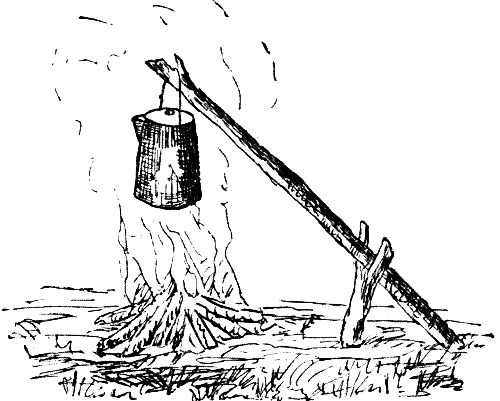
A Sporhungan.
Here the Commodore broke in with an authoritative "Silence, Sir," but as the rest of the fleet went off in convulsions of irreverent laughter, he thought it best to let the matter drop.
Saturday is a good day to begin a canoe-cruise. The unwonted exercise induces weariness which the first night in camp does not wholly remove, so that a day of rest and a second night of more refreshing sleep, are usually acceptable to all. Opposite is what the voyagers looked at from their camp, throughout that peaceful Sunday.
At this camp too, the regular details were permanently and formally arranged. The Scribbler having confirmed the Commodore's judgment, and evinced a decided genius for cookery, consented to serve permanently as chef, the rest taking turns on successive days as foragers, woodcutters, and dish-washers.
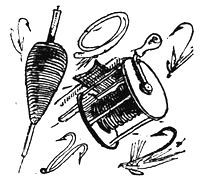
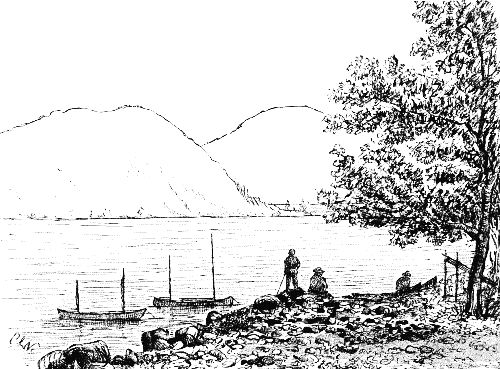
The Sanctuary.
III. THE COOK STUDIES NAVIGATION.
AS the squadron turned out and took its matutinal swim, soon after sunrise, the lake was dimpled by a favorable breeze, and after breakfast orders were issued to make sail.
"I've got to make a spar first, Commodore," exclaimed the Cook, "my main boom is gone, or hasn't come, I don't know which."
"Find another at once," said the commanding officer, and the Cook seized the hatchet, and started into the timber, returning presently with an elm pole weighing twenty pounds, nearly half the weight of his boat, his original boom having been a piece of bamboo weighing a scant half-pound. By dint of hard work with hatchet and knife, he worked this log into a makeshift for a boom.
"I wonder," remarked the Cook, as he dropped his knife for a moment, and caressed the blistered palms of his hands, "why all you fellows insist on having decks. I don't wonder that you two Chrysalids," referring to the Vice and the Purser, whose boats were of that famous model, "I don't wonder that you two Chrysalids do it, for the builder of your boats stupidly decked them before you bought them, but the Commodore, who, like me, was sensible enough to buy a Red Lake boat, wasn't satisfied to leave it free and open as he found it, but has gone and stretched rubber-cloth over it fore and aft. It's as bad as sailing in a coffin, to sail in any of them."
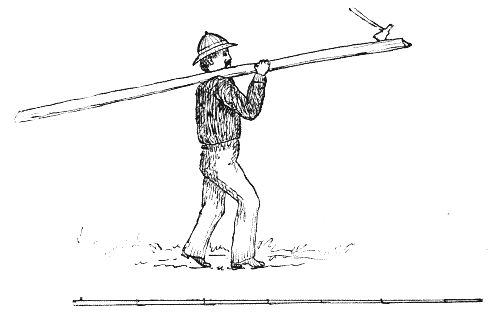
The Cook selects a Boom. (Below is the one that was lost.)
"I'd as lieve sail in a coffin as in a bath-tub," replied the Vice, who, having commanded a blockade-runner during the late unpleasantness, had a natural fondness for tight decks and plenty of them.
"A well-covered bath-tub," remarked the Commodore, "is fully as seaworthy as a mahogany-topped coffin, and far less suggestive of canoeing on the Styx. But for a cover of some sort, I confess an affection. It keeps things dry; if a man capsizes—"
"A canoeist has no business to capsize," interrupted the Cook, who had learned canoeing on a Western river, and in a "dug out," which could only be turned over by the united efforts of at least two men, "and a canoeist has no right to have 'things' lying so loosely as to drop out."
At length the squadron set sail. The wind had freshened, and the white caps were as numerous and agitated as in a large female seminary during a night alarm of fire. The Commodore, the Vice and the Purser were all experienced sailors, so they shortened sail, but the Cook, having never handled a boat under sail before, possessed his soul of the nautical bliss that comes of ignorance. Shorten sail? He would show those fellows what a fearless sailor and a good boat could do, when the wind was disposed to aid them. The Cook experimented nervously for a few moments to learn where the sail should really be to catch the most wind, but when he learned he made full use of his knowledge, and his boat, the Cherub, seemed literally to fly. It passed the Becky Sharp, (the flagship) so rapidly that the Cook had not time to study the Commodore's face long enough to know how that official liked it; it passed the Rochefort, causing the Vice to scowl as if the unoffending Cherub were a member of the party which the whilom statesman hated; it threw for an instant the shadow of its great white mainsail on the Arethusela, darkening the blonde complexion and golden locks of the Artist-Purser.
Then the Cook began to enjoy his boat and himself. A pistol which he had in his pocket to be ready for a shot at some passing water-bird, chafed him somewhat, and he laid it in the bottom of the boat, where it would be equally handy and less troublesome. He had heard that a canoeist should always be barefooted, so he kicked off his shoes. He pitied his comrades who sat upon the hard bottoms of their boats as they sailed, while he sat upon the many folds of a large tent. All the inner lines of his beautiful canoe were before his eye, instead of being hidden by decks, as those of his companions were—if, indeed, there were any beautiful lines any where about their boats.
The Cook was happy; he fastened the sheet of his mainsail to a cleat, softly whistling, as he did so, "A Life on the Ocean Wave," neither thinking nor caring that the ocean was really several hundred miles away. He was astonished and delighted that sailing was so easy an art to acquire, but pshaw—sailors, like poets, are born, not made. Had not one of his ancestors sailed with Drake when that hero interfered with the sailing directions that had been delivered to the Spanish Armada? What might he not have achieved himself, had cruel fate not ordained that ink should be his only fluid element? Just here the Cherub made such astonishing speed that the Cook determined roughly to "time" his boat, so he estimated a mile of distance by the trees upon the shore, opened his watch and laid it in the bottom of the boat, before his eyes.
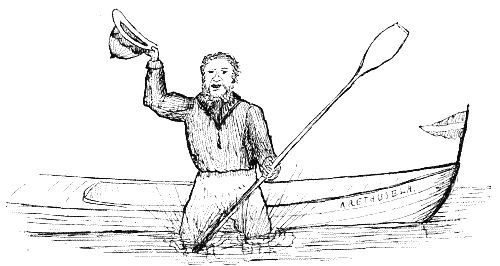
But Solomon said that pride must have a fall, and when there is any unpleasant saying of Scripture to be fulfilled, a conceited canoeist is as good as any one else that can be selected for the purpose. The squadron was approaching a point beyond which its course would be changed. The Commodore shouted "Ready about!" and the Cook's self-confidence disappeared as rapidly as if it had been the conscience of a congressman after an interview with a "subsidy" lobbyist. "Jibe!" shouted the Commodore. The Cook, almost in despair, looked astern, to see what the others did. He saw their masts straighten, their sails flap irresolutely for a moment, and then fill on the opposite side. How was it done? Accident came to the Cook's rescue: a wretched steersman at best, he had almost forgotten his helm as he looked astern, and an unintentional turn of the wrist of his steering hand turned the boat's head from the wind. Around came the new boom; the Cook had never before seen a boom come around on his own boat, and he had no idea of how close the same would come to the plane occupied by his own head. But the time occupied by an industrious boom in jibing is not sufficient for prolonged meditation, and while the Cook was wondering what to do, the boom attended faithfully to its own business. The elasticity of a green elm log is an unknown quantity; the Cook's dome of thought was equally inelastic, so the Cook soon heard a heavy thud, as when one throws a mighty stone at a well-laden chestnut tree. Then the Cook heard a splash, and he was not allowed to remain in doubt as to the object which caused it. All the terrible stories he had heard about men who had been carried down by the sails and rigging of capsizing boats came hurrying into his mind, and he swam so vigorously to escape a similar fate, that his boat had time to turn leisurely over and adjust itself to its new condition before he dared to pause in his mad career. (See Frontispiece.)
Then the Cook swam to his boat, and resting an elbow upon her keel, gazed pensively around him. Something that seemed to be a peculiarly-shaped dark fish, a little way below the surface in front of him, proved to be the slowly sinking form of one of his shoes, going to join its mate. A black bundle, consisting of most of the Cook's personal effects wrapped in a rubber-blanket, was rescued by the Commodore just as it seemed discouraged by the difficulty it experienced in floating. The Cook's hat, one of the paddles, a covered tin pail containing butter, a worthless bit or two of board, and sundry other articles of little value, were picked up by other members of the expedition, but the indisposition of watches, pistols, and even wet tents to wander aimlessly about on the bosom of a lake is known to all students of comparative specific gravities. The Cook groped for the painter of his own boat; his other hand he rested upon the stern of the flagship, and thus the demoralized couple reached the shore. The remainder of the squadron had already disembarked, and the Purser made haste to extend the hospitalities of a private flask, but he robbed the draught of its flavor by asking, as he passed it,
"Shall I explain to you why canoes are usually decked?"
And the Cook was so absorbed in contemplation of his bare feet, that he did not even look up. At length he inquired as to the depth of the lake; the Vice obligingly paddled to the scene of the disaster, took soundings, and reported fifty feet. To go through fifty feet of water to cover two feet not over dry was not to be thought of, but what hope was there of replacing lost shoes in a wilderness—even when Acadia was reached, the natives probably made and wore only wooden sabots.
The overturned boat was righted, and the Cook emptied his portmonnaie and laid his money on a sheltered rock to dry, while he should change his clothing and restore his boat. Then the Commodore, consulting a chart, discovered that there was a village only ten miles distant on the border of the lake, and it was large enough to justify a hope of shoes: the squadron should put in there. The delighted Cook proposed an immediate start, particularly as a force of small boys was approaching. The village was reached, the Cook found a pair of shoes, but on attempting to pay for them he remembered having left his money on a stone to dry. And that stone was ten miles away, it could only be reached by paddling against a head wind, and when last seen the ground containing the stone was occupied in force by boys! The Cook, as he walked back to his boat, was in a savage frame of mind, and wanted to hurt somebody or something, but no one would laugh at him, or offer sympathy. Suddenly his eye fell upon the extempore boom; a moment later and that faithful spar which had done only its honest duty, sank deeply in the lake. The Cook's credit was good, however, and he succeeded in borrowing from the Statesman enough money to pay for the shoes and a blanket, and buy a bamboo fishing-pole from a casual youth who angled on the adjacent wharf. This was speedily converted into a boom of proper size and weight.
"The rest of us may as well go booming, too," remarked the Commodore, who had been strongly stimulated by the exhibition of spirit in which the Cook had indulged. By this time there had gathered about the squadron quite a crowd. It was, however, a crowd of great conservatism; each man seemed to have in his pocket a valuable something, which required the unremitting contact of his hands, as well as something in his mouth which would escape were he to part his lips. Occasionally, however, one would release a hand long enough to test the weight of the Vice's canoe, which was the only one that had been drawn entirely out of the water, and as each of the sixty odd men present did this at least once, gravely uttering, as he did so, the monosyllable "Gosh!" the Vice was extremely delighted. The expletive recalled the days of his innocent youth.
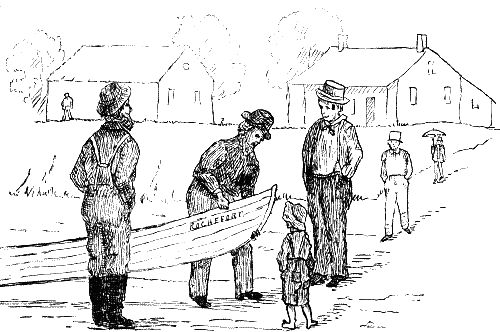
Gosh.
"It is plain to see," said he, "that living right on the edge of monarchical institutions as they do, these poor fellows have never before seen a boat of any lightness and grace."
"Don't forget, please," remarked the Cook, "that my canoe, which is lighter and faster than yours, was made in Canada."
Having repaired damages, the squadron proceeded, paddling side by side along the shore in search of favorable camping ground.
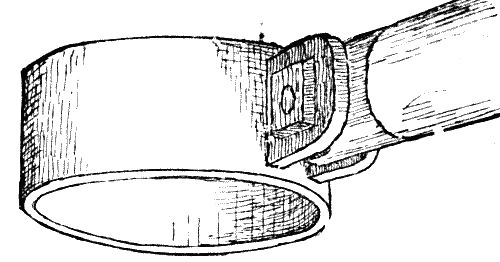
The Vice's Boom Toggle.
"How does the Alderman toggle his boom, Vice?" asked the Purser, who during the day had his own private troubles with that important spar, and was beginning to have some misgivings as to rig.
"Same as I do mine, with a brass collar for the mast, and a screw and bolt arrangement to make the boom fast. See?" And the Vice exhibited his boom where it was attached to the mast.
"That's just like mine," said the Purser, "and I don't altogether like it. I believe simple jaws and lashing, such as you see on any sail-boat, are more convenient."
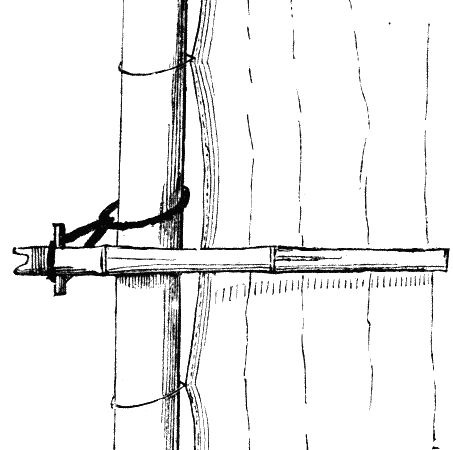
The Commodore's Sprit.
"No true canoeist will sacrifice style, merely for convenience," replied the Vice sententiously. "Now, there is more style about a Chrysalid than about a Red Laker, and that more than compensates for their inferior speed, and carrying capacity, and so on. Every man should have his boom rigged in the most complicated manner. Now look at the Cook, and the Commodore. See their booms, (The Commodore accommodatingly held up the foot of his mast for inspection,) or sprits rather. They are not properly booms. Now, that rubber band passed through a ring, and over a cross-head or a notch on the end of the sprit, undoubtedly keeps a light sail flatter than any other contrivance I know of, but there's nothing ship-shape about it. 'Twouldn't be allowed for a moment in the navy. You want something that it takes some skill to manage."
"Thanks," said the Purser, "I see the thing in its true light now," and he went to work when camp was reached and fitted jaws to his boom, and even threatened to adopt the leg-of-mutton sprit-sail before he went cruising again.
"I don't see," commented the Cook, "why the india-rubber arrangement should not be adapted to a boom as well as a sprit. It only requires a little ingenuity, and would keep the sail quite as flat as does your present rig."
Rounding a promontory the fleet sighted a wooded island three-quarters of a mile from shore, and as such an island is for several reasons preferable to the main land for camping, they made for it at once and found it all that their fancy had painted. The fleet with one exception was hauled upon the beach, but the Vice, anxious to retrieve his reputation for seamanship, made fast the painter of the Rochefort to a stone which he could hardly lift and hove her short under the lee of the point. The flag-officer silently noticed these preparations, but said nothing, resolved not to interfere again between the Rochefort and her commander.
Here again it was found that former generations of campers-out had sojourned, leaving their lean-to, scientifically constructed of poles and bark, standing for the accommodation of posterity. As the sun sank black bass began to break the glassy surface of the lake in search of their evening meal.
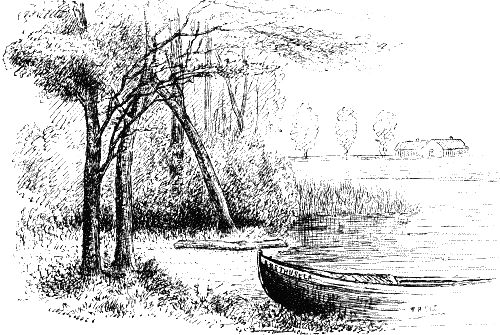
Island Camp.
"Would that the Alderman were here," remarked the Vice, as he watched the circles widen on the water, and heard the inspiriting splash as the fish flashed up in the sun's rays, "he would catch us a string of bass and show the cook how to fry them, in less than half an hour."
But the Commodore had been putting his rod together, and having in the course of the day killed a large bull-frog, he now lashed a portion of its hind leg to a hook with fine thread and quietly launching the flagship, stood up in her amidships and made a cast as far out toward the feeding ground as possible. A vigorous pull rewarded his effort and almost as soon as the Alderman could have done it he had two thumping bass and a good sized chub, or dace, which the Purser and Vice cleaned and the Cook fried to a turn for supper.
"The Alderman would not have stood up in his boat to catch these fish," said the Vice with a crisp "second cut from the tail" on his plate, "that kind of thing isn't regular."
"No; it would be decidedly irregular in some boats," remarked the Cook.
"I'll bet you cigars for the crowd—my choice ones, that I've preserved carefully in my water-tight,—that I can throw a line from a Chrysalid."
"Done."
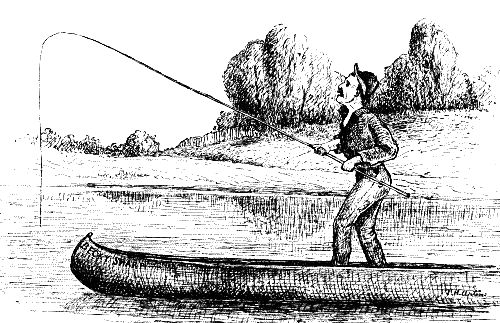
A Vigorous Pull.
The Arethusela had nothing aboard, so the Vice borrowed her and the Commodore's rod, and pushed out a few yards from the beach. Then rising gingerly to his feet he made one or two gentle casts with great circumspection and was about to claim his wager, but thinking to perfect his claim, made a third cast, which was a thought too vigorous. (Result shown on page 65.)
The flag ship was still afloat, and the Commodore being anxious about his rod, sprang aboard and pushed off to the rescue, but the Vice sternly waved him back.
"You may take your rod, if you like," said he, "though I could manage that too well enough, but I'll show you another point of superiority in a Chrysalid."
The Commodore took the rod and backed off to a respectful distance. The Arethusela had righted herself instantly after discharging her occupant, and floated full of water, but still buoyant from the air in her large water-tight compartments. The Vice picked up his paddle, and put it aboard and then swam to the stern, which he grasped with both hands, and managed by a sudden and judicious effort to mount.
Then, hitching carefully along, leap-frog fashion, he was soon seated amidships, bailing the water out with his hat, the canoe still floating with considerable buoyancy.
"That is well done," was the general verdict. "A Chrysalid's water-tights are more efficient than those of a Red Laker provided she has any to bless herself withal."
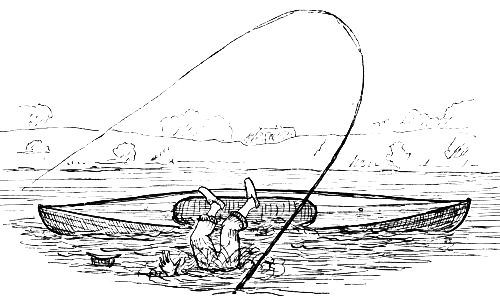
A little too Vigorous.
"I want to take a bath," said the Commodore, "before turning in, and as a long enough time has now passed since supper to reasonably warrant exemption from congestion, I think I will test my water-tights if the Vice will permit me so to denominate the bags which serve in that capacity on board the flag ship. At any rate, I will prove to you that I can climb aboard a Red Laker without upsetting. I take precautions, you see, against wetting my toggery."
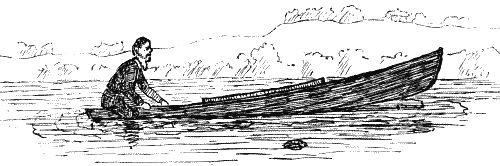
Aquatic Leap-frog.
So saying the Commodore stripped, embarked, and when in deep water jumped overboard, climbing on board just as the Vice had done, and with about the same ease. Then he sat on the gunwale and upset his boat, filling her with water. She floated, but by no means so buoyantly as had the Arethusela, and the task of climbing on board was somewhat more critical as the power of flotation was so much less. However, the water being perfectly smooth, it was accomplished, and it is probable that the Commodore could have bailed her out without going ashore, if he had given time enough to the operation, and darkness had not come on. As it was, he prudently and laboriously paddled the water-logged flag ship ashore, where all hands performed their evening toilettes, and sat down around the camp fire to enjoy cigars, which the Vice had promptly handed over to the Cook, remarking that he did so under protest and stipulating that no precedent should thereby be established: "For," said he, "I laid a wager that I could throw a line while standing in the boat, and no fair-minded man can say I didn't do it."
With the moan of a rising gale in their ears, the members of the expedition soon dropped off to sleep.
IV. THE WRECK OF THE ROCHEFORT.
AT dawn the Purser arose and woke the camp with the blood-curdling cry, "The Rochefort is gone!" The rest, as soon as they could rub their eyes open, scanned the lake to leeward, but no trace of the missing canoe could be seen. The sky was grey with low driving clouds and the lake repeated the sombre hue, save when it broke into white before the southerly gale.
With ill concealed reluctance the Commodore offered to lend his darling Becky to the bereaved Statesman, who protested that the loss of an election was as nothing in comparison with his present affliction. It must be admitted, too, that his remarks as to going in a Red Laker to the rescue of a Chrysalid, were not altogether gracious. However, the Purser volunteered to go with him in search of the runaway, each man following one side of the lake which was here only about two miles wide. Under the shortest possible sail, then, they set out, each standing across the wind at first, so as to close in with the shore and then follow it down with the wind astern. They went merrily off riding the white caps like ducks, and turning to follow the dark wooded shores to the North.
Presently the Purser was observed to broach to, and after a short time he went ashore, unshipped his mast and proceeded under paddle. It subsequently transpired that the sea wrenched off one of the "gudgeons" which held the rudder, and he was thereupon disabled for sailing purposes. The wind, however, was dead astern, and he progressed almost as easily and as fast as if he had not lost his helm.
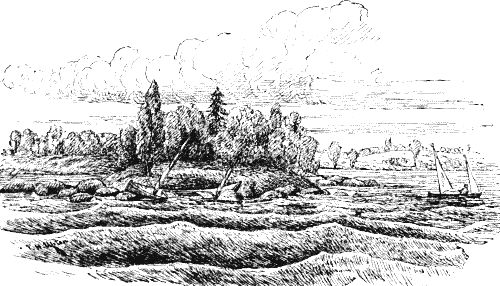
"His Ship she was a-wrack."
Meanwhile the Vice proceeded, anxiously scanning the coast, and at length had the pleasure of discovering the runaway some three miles down the lake, full of water, and with the sea, in dear old Robinson Crusoe's immortal words, "making a clean breach over her." That she was not stove into match-wood speaks well for her builder's workmanship. She had carried her anchor with her all the way, having been hove so short that she gradually worked off the steep beach as the wind and sea rose, and had not even cable enough out to anchor her off the lee shore on which she finally brought up.
As the Vice approached her, the buoyant Red-Laker rising cork-like with him on the white capped waves, he could not but be struck by the ship-shape appearance of the wreck. As has been intimated, the Vice is distinguished for elaboration of equipment, and he had anchored his canoe the night before with her sails beautifully furled, and every strand of her multitudinous running rigging exactly in position. Now she looked for all the world like a miniature frigate cast away on a rocky coast, and the solitary spectator half expected to discover a crew of pigmies clinging to her hatch-combings, as he drew near.
The first thing to be done however, was to signal the Purser, who was coasting the opposite shore. To beach his borrowed boat with such a sea running, and where there was not any beach but boulders, was a problem which might easily have floored the greatest statesman, but the Commodore is glad to certify, that the task was accomplished with due regard for the welfare of the flagship, and this while the Vice's own beloved Rochefort was perhaps banging herself to pieces on the boulders.
By dint of firing his revolver and waving his dandy, unshipped for the purpose, he succeeded in attracting the Purser's attention, and saw him change his course. This done, he waded to the stranded Rochefort, expecting to find her hopelessly broken amidships, but on getting her off the rocks, she floated as well as ever, showing that her compartments were still uninjured; so, anchoring her in waist-deep water, with her head to the sea, the Vice proceeded to bail.
Why this amber hue of the water? Alas, the Vice carried the coffee of the fleet and it was not in a water-tight box. Why this slight saccharine quality? Alas again, the Vice carried the expeditionary sugar. The coffee did not prove a total loss. Persistent boiling extracted from it a passable beverage, which served until a market town was reached, but the sugar was past redemption.
By the time the Purser had reached the scene of disaster the wreck was pumped dry, and careful inspection showed that she was wholly uninjured save as regards a few bruises. So the Vice unshipped her masts, and rightly judging that the Becky Sharp would be the easiest to tow, made fast her painter, and started on the long paddle against the wind back to camp.
To the rest of the fleet this escapade argued poor seamanship on the part of the Vice, but to him it only proved the moral obliquity of his boat. In order to shield his own reputation, he ruthlessly alleged against her the most abominable nautical crimes, and would never trust her alone thereafter, unless she was tied to a large tree or a huge boulder.
The Purser, meanwhile, noting the shoreward trend of the waves, instituted a successful search for his lost rudder, which he found ashore in a quiet cove. On returning to camp, he and the Vice admitted that there are certain advantages connected with a steering oar, which do not belong to a rudder, and each resolved thereafter to carry a suitable row-lock, so as not to be entirely disabled for sailing in case of accidents. Nevertheless, while a rudder holds, it is certainly more convenient than a paddle to steer with, but at the same time it necessitates an awkward amount of stern-post, which renders the boat hard to turn, and has usually to be shipped and unshipped in changing from sail to paddle. For this reason the Vice is accustomed to remark, that it is always well to have another fellow at hand in a Red-Laker to render aid in emergencies. Of course it was necessary to dry the Rochefort before proceeding, and it was afternoon before the Purser had repaired his steering gear, and everything was in readiness. There is always enough to do however, so all hands busied themselves in sundry tinkerings until after dinner, when, as the sky had cleared and the wind had somewhat moderated, the order was given to make sail, and the pretty island was speedily left behind, the fleet skimming along the wooded shore like a flock of white sea gulls.
Now whatever advantages a Chrysalid may possess over and above a Red-Laker, she is nowhere in point of speed on a free wind. Consequently the first division invariably ran away from the second, and was obliged every little while to lie by and wait for it to come up. After his first experience in jibing, the Cook had been content for awhile to trust to a spruce breeze, and indeed there had been since his overturn no favoring wind until now. He soon acquired commendable skill in laying a straight course. He no longer zig-zagged over the lake as at first. Evidently, however, something weighed upon his mind, for as with his companion boat he entered a bay to wait for the second division:
"Commodore," said he.
"Well?"
"I say, what is tacking anyhow?"
"Why it's working to windward."
"Yes, I know, but how do you do it?"
"O, I see. You don't understand the theory of sailing a boat. Well, I must own you're a plucky one. And you've done mighty well too."
Then the Commodore made his companion lie to, while the flagship worked past him to windward by short tacks. The Cook with his usual aptitude soon caught the idea and satisfactorily put it in practice. Then, as the breeze was moderate, there followed lessons in "jibing" and "wearing," with explanations of the circumstances under which each was necessary.
By the time the second division rounded the point, the Cook's spirits had risen, and he began once more to prate of his piratical ancestry who knew no home but the ocean.
"What were you two benighted Red Lakers doing in the bay this side of Black Point?" asked the Vice as the party sat by the fire that evening.
"Merely a little discussion as to merits of rig, and the best way of handling a boat, with practical illustrations," said the Cook, who clung frantically to the remnant of his reputation for seamanship, and trusted to the Commodore's magnanimity not to expose him.
"O, that was it, eh? And what conclusions did you reach with your Red Lake monstrosities?"
"We had plenty of time to reach any conclusions, and have them illustrated and published, and sell a dozen editions before you came along," retorted the Cook.
"We were trying experiments," said the Commodore adroitly, "in going about, and we concluded that the best way was to come up into the wind as sharp as you like, hauling in a little on the dandy sheet to help, and then as soon as the mainsail shivers, give her one or two strokes with the paddle, let go your dandy sheet, hold your boom over till the mainsail fills, and her head falls off, shift your paddle to the lee side and there you are."
"Yes," said the Vice, who is a devoted adherent of a "sliding gunter" rig with full boom and gaff, standing lug, dandy, jib and flying jib, as distinguished from the two leg-of-mutton sails carried by the Red Lakers. "Yes, there you are indeed with your steering paddle and other unseamanlike contrivances. Now let me show you how a Chrysalid goes about. We will suppose this log to be the canoe."
"Parallel exact, so far," broke in the Cook, "Go ahead." Taking no notice of the interruption the Vice proceeded, seating himself astride the log.
"We will suppose the canoe to be under full sail on the port tack, with everything drawing. Order is given 'ready about,' crew spring to stations. Helmsman gives her a good full, passes port tiller-rope over his shoulder, takes it in his teeth and has his paddle handy. Let go flying jib halyards, and in with your down haul. Let go main sheet, and if you get a chance, haul in a little on the dandy. Round with your helm. When the mainsail begins to shiver, top your boom or lift it clear while she swings. If she don't come round, help her with your paddle. Let go dandy sheet if you hauled in on it. Let go topping lift, slack away weather jib sheet as soon as she is pointed on starboard tack. Bowse in flying jib halyards, letting mainsail take care of itself, make all fast, haul in main sheet, and there you are all ship-shape."
"And hull down astern of the Red Lakers," added the Commodore.
During this explanation the Vice had, after his own enthusiastic fashion, gone through all the motions, as he described them, and when he appealed to his auditors to know if it was not a far more artistic performance than that which the Commodore described, no one had a word to say.
"Just tell us, Vice," said the Cook, "how many ropes have you to attend to?"
"O there are only a few," responded the Vice, curiously enough not seeing the trap into which he was falling, "There are the dandy halyards, sheet and brail, that's three, main halyards—peak and throat—sheet, brail, and topmast halyards, that's seven, jib halyards, down haul, outhaul and sheets, that's twelve. Flying jib ditto ditto, that's seventeen. Tiller ropes and painter, that's all, total twenty. Oh, yes, and there's the signal halyards, that's twenty-two, or twenty-three if you have a pair on your topmast."
"He does get ahead of us, that's a fact, Commodore," drawled the Cook. "Now I can only make out two halyards, two sheets and a painter, five in all, unless I count my fish-line, and he has twenty-three. I give it up."
"Yes," said the Vice musingly, "when you are in a Chrysalid canoe, properly rigged, you have a sense of completeness, not to be attained elsewhere." Then suddenly changing the subject:
"I thought," said he, as he helped himself to an eighth slice of toast, "that I was lucky when the Cook kindly volunteered to carry my tent as a seat, and thus relieve my boat from a certain amount of weight, but now I am wondering under what cover this expedition will sleep tonight." It so happened that the expedition had not yet felt the loss of their tent, having at the different camps chanced upon lean-tos and other adequate substitutes.
"When you lack information on any matter connected with canoeing," said the Cook, "come to me." The Cook emptied his third cup (pint) of coffee, unrolled a pack in his boat, and displayed a piece of stout sheeting, five yards long and two and three-quarter yards wide, with four rope loops at each end for tent pins, and a row of button-holes, a foot apart, along each edge. He also displayed two triangular pieces of the same material, at the bases of each of which were three loops for pins, and along the other two sides a row of buttons.
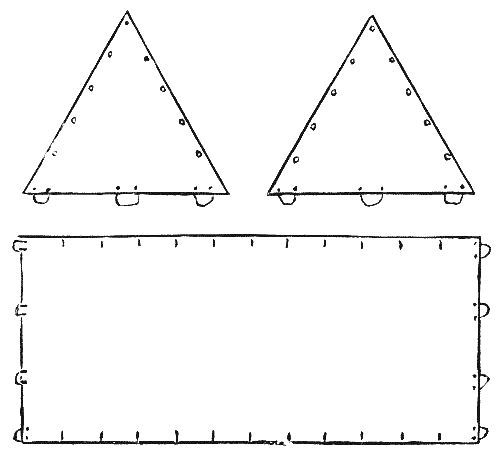
The Cook's Tent.
"Button these together properly," said he, "set the whole affair up on poles, and cross pole, or across a rope strung tightly between two trees, and you have a larger and better ventilated tent than the one I left in the lake; it won't weigh half as much, either. Except in very cold weather or driving rain, the end pieces will not be necessary. Indeed, it can be set over a canoe, so as to cover all the open portion of the boat."
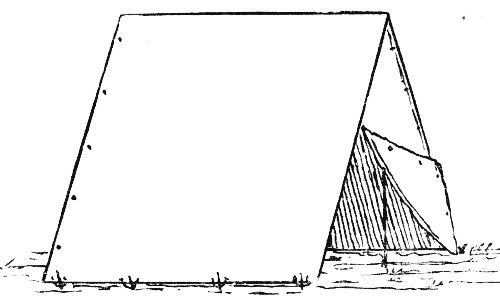
The Cook's Tent.
The whole supper table gazed admiringly, until the Commodore asked,
"Why have the holes, instead of the buttons, on the main piece?"
"So that you may affix the ends either from the inside or outside. The latter is the easier way, but occasionally the wind blowing from the front, will come in very freely between the fastenings outside, so that the canoeist who drops asleep with a head full of pleasant dreams, will awake with a head full of neuralgia."
"And if it rains, what is to prevent this tent from leaking like a sieve, and distributing shower baths impartially among the clean and the unclean?"
"Two things—a steep pitch or a neat coat of oil," said the Cook.
"The water-proof of the pudding is in the eating," remarked the Commodore, who had begun to yawn. "Set the tent at once."
The tent was set on a line between two trees, the front remaining open, and half an hour later there lay within it four men who were beginning fully to realize how delicious weariness may become, when it is earned by the body instead of the brain. With sand for mattresses, and a rubber blanket each for sheets, they slept more soundly than they had ever done at home upon springs and between linen. The only visitations they experienced were heavenly ones. Venus glided past the open front, but saw no one there over whom her fastidious gaze cared to linger. Saturn peeped suspiciously in, but passed on contentedly, assured that in the presence of such sound sleepers his rings were as safe as if they were Indian Rings at Washington. Mars glared in with his great red face, but the quartette had been all day on the water, under an unfamiliar sun, so there were four fiery faces to Mars' one, and the blazing old fellow went off in a huff and got behind a little cloud to hide his mortification.
V. SUNSHINE AND SHADOW.
IF the reader has watched with any interest, the development of what may perhaps without offence be termed canoebial character, he must have been pained to observe that however fair minded the average canoeist maybe in other respects, neither his judgment nor his statements can be trusted where his own boat is concerned. Of this fact each member of the expedition became convinced in the course of the first day out, and the authors deem it their duty to warn the public against indiscriminate belief in the virtues ascribed to different canoes by their respective owners.[3] The Statesman, who has associated to some extent with sporting men, says, that he has observed a like trait in owners of horses, dogs and yachts, and all know that every mother discovers in her own children beauties and virtues which no other living being is able to perceive. Why then, should a trait which is beautiful in one case be scoffed at in another? The authors hold that a sublime faith in one's own canoe, is one of the noblest sentiments that can animate the human breast.
Morning opened with the usual brisk breeze ruffling the lake from the south, and the fleet made all preparations to continue the voyage under sail. Hardly, however, were they clear of the land when the wind fell suddenly, and in a wonderfully short space of time the lake was like a mill pond. An occasional puff of wind however, justified keeping sails set, and so alternating from paddle to canvas, a broad expanse was passed, and the "narrows" neared where mountains seemed trying to shoulder one another into the lake, and where, as if they had fallen off in the scuffle, several rocky, wood-crowned islands floated double as it were, on the glassy water. By the time the shadow of the woods was reached, all hands were glad to stop until the declining sun should make motion a little more endurable, so a cool and shady nook was selected where several hours were spent in meditative contemplation of as lovely a panorama as ever rested the eyes of leisurely voyagers.
This laisser aller fashion of cruising is the only really enjoyable plan. Your restless spirits will push on and make their twenty-five miles a day, rain or shine, but your philosopher is content it may be with five or six, and recks not if he be obliged to cut his journey short at its latter end. So the hours drifted slowly by until the mountains threw their shadows across the lake, and a gentle breeze once more invited action.
It took only an hour or two to run out from the shadow of the mountain range, and see stretching out toward the north the low lying hills which characterize the broad St. Lawrence Valley, for thitherward tend in the Canadas all waters that run down hill. The lake, too, spread out again, its edges bordered by extensive shallows whereon grew tall graceful bulrushes, each of which rose six or eight feet or more above the water, tapering beautifully and smoothly from near an inch in diameter at the base, to a needle-like point at the top. Sometimes when the wind was fresh, the cruisers would run in among them. There was something peculiarly fascinating in thus flying through vast green stretches of rustling, bending reeds. The breeze was almost wholly checked near the water, but the peaks of the sails caught it above the supple rushes, and the canoes went whistling through them, their sharp bows dividing the green stems as they flew along, and a broad swath bowing under the booms as they swung out to leeward.
Now and then a startled marsh hen, or wild fowl of some sort, would rise almost from under the gunwales and go scuttling off, frightened half to death at the unwonted invasion of her retreat. The solitude was perfect.
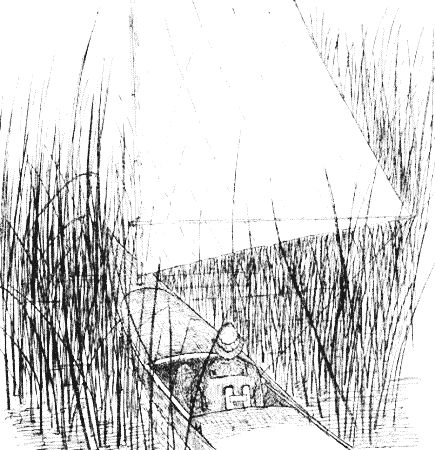
"Green grow the Rushes, oh!"
The canoeists could see nothing of one another when separated by a few yards. Any one might have upset and been left far behind, before the rest could have discovered his loss, and then the chance of ever finding him would have been as one to a hundred. However the water was only two or three feet deep, so that there was no actual danger. Along such tracts as this the fleet coasted this afternoon, and there was no apparent prospect of getting beyond, or through the reeds to find a camp. The lake was wide, and it was not expedient to cross it so near nightfall, and with a threatening sky. So sails were prudently furled and the four cruisers paddled along hoping to find, somewhere, an opening through which the land could be reached. The sky grew dark. Rain began to plash around, and suddenly night shut down, with a cold driving mist and not a glimmer of light to show the bearings, save an occasional momentary gleam from one of the little light-houses away off toward the north. The fleet had drawn out into the lake in order to get a better sight at the coast line, and here it rode with the heaving water all around, and no means of steering to a place of safety. The Vice had taken the bearings with his compass, but now as fast as a lantern was lighted to steer by, the wind blew it out, so there was nothing for it but keep together, and steer by the sea. After a somewhat anxious time, with startling suddenness, a long dark wall seemed to rise through the rain and drive straight forward over the lake. "Hold all" was the word for a moment, but there was no roar of surf, only a whistling murmur as of a million wings. Then the dark wall opened and the reeds were recognized as old friends. The course in which the fleet was heading, had been entirely problematical, for the wind was very gusty and variable, but it was certain that among the countless slender stems was safety from the fiercest gale that ever blew. Pushing inward for a hundred yards or so, the boats were moored side by side, to sheaves of reeds, and their occupants proceeded to make themselves as comfortable as was possible under the circumstances, feeling, as the Cook remarked, better able than ever before to appreciate the early experiences of Moses.
Now, if ever, was the time to try the Purser's "Rob Roy cuisine." He had imported it at great outlay of treasure from England and had repeatedly explained its beauties, but having received it just on the eve of departure from New York, he had never practically tested its virtues, and the professional prejudices of the Cook were so obstinately in favor of a wood fire, that he could never be persuaded to use a substitute. This "cuisine" is a canoeing device invented by Mr. Macgregor, the father of modern canoeing. In external appearance it is a circular box of plated copper. The main part of the box is used as a stew-pan, the top as a frying-pan. Moreover it contains, compactly fitted, an alcohol blast-lamp, and a multitude of little cooking contrivances which are admirable under circumstances like those in which the command was now placed. The Purser knew by heart the theoretical rules for managing the cuisine, but as has been stated, had never put them in practice.
By the light of the little lanterns, he now took out the compact apparatus, opened it, filled the lamp, placed the standard on his forward deck, struck a match and applied it to the aperture. An innocent, bluish flame appeared, flickered for a moment, gathered strength, burst into a roar, shot upward three feet, shook itself, and prepared seemingly to consume the entire fleet. The Purser shrank backward as far as the narrow limits of his Chrysalid would allow, and glared helplessly at the vicious little engine, while he made abortive efforts to reduce it to decorum. The rest shipped their cables and hauled off, leaving him to his fate.
"Kick it overboard."
"Put your hat on it."
"Blow it out."
"Douse that glim," were some of the directions shouted, as muskrats skurried away into the darkness, and an owl and one or two bats swooped within the circle of light to see what was up. But the Purser remembered the bill he had paid, and resolved to risk his life rather than lose his "cuisine."
As the roaring continued without abatement and with no disastrous results, it presently occurred to the Cook that here was a splendid heat going to waste. In a trice he had the coffee pot in position, and in a marvelously short time more each man had a cup of hot coffee and a rude sandwich, cut hap-hazard from a half soaked loaf. The Rob Roy cuisine was unanimously voted a success, where for any reason an ordinary fire cannot be lighted.
It is not pretended that a remarkably comfortable night followed this episode, but it was much better than driving aimlessly before the wind on the lake, and most of the party managed to get some sleep under their rubber blankets. At any rate the expedition was safe, and its members could listen without concern to the gale that roared a few feet over their heads, but touched them not.
VI. MY NATIVE LAND, FAREWELL.
Morning dawned on a somewhat forlorn set of castaways. Every man was more or less damp, not to say wet, and the Vice with his bedraggled mutton-chop whiskers presented a peculiarly lugubrious appearance as he exasperated the Americans of the party by singing in the pitch of an Irish "keen" the old Southern air "Maryland, My Maryland."
The day promised to be a fair one, and by sunrise land had been reached, a fire built, dry clothes extracted from bags and water-tight compartments, and amiability once more asserted its mild and benignant sway over the depressed spirits of the command. This was the last day on the lake, although its lower end was on a small scale what the geographers might almost term a lacustrine river. It was broad, that is, and at times nearly currentless. The nominal division between lake and river, however, was marked by a railway bridge and here it was understood the fleet must stop for official recognition by her majesty's representative before crossing the Dominion line. The town lay low along the lake shore, and under the shelter of a wooden breakwater the fleet successfully effected a landing. The Commodore, after a few moments spent in making himself look as respectable as possible, set off on his official visit to the British Consulate. As he departed, the Vice asked if the needed stores were not to be purchased at this point, and before the expedition entered alien if not hostile waters.
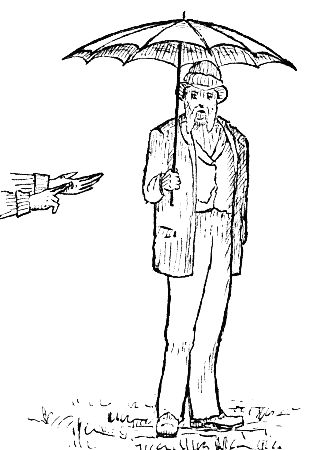
"But the Consul's brow was sad."
"Of course not," said the Cook. "You can buy better things for half the money in Canada."
"Under a monarchical government," added the Purser.
"That is undoubtedly the best plan," said the Commodore.
"Now look here. I'm a citizen of the United States," began the Vice, but, the Purser, the Cook and the Commodore fled in as many different directions and left him gesticulating solus upon the lonely shore.
Presently the Commodore returned, followed shortly by the British Consul, who wished to assure himself that the squadron was not the advance guard of a Fenian expedition. The Vice begged the right to receive him officially in the Commodore's stead, and this favor being granted, the Consul was treated to half an hour of impassioned eloquence upon the rights of man.
Meanwhile the breeze freshened and inflated itself to the size of a gale. Sloops and sail boats began to huddle together behind the little breakwater. The custom-house officer kindly offered to find a trusty guard for the canoes while their officers should go ashore, but the suggestion was declined with thanks. The Purser longed to be on British soil once more, the Vice was impatient to pat his own love of country on the back, by observing how much more miserably England's subjects exist than do those of his own happy land, the Commodore saw a fort in the distance, which he and the Cook, having once been soldiers, were impatient to inspect, and the Cook pined for Canada, because he understood that the expeditionary butter pail might there be more cheaply refilled. Then the humane custom-house officer appealed to their sense of personal safety, to their regard for the friends and creditors who might miss them if they were drowned, as they surely would be if they ventured out in such a storm. But the eye of Britannia was gazing upon the expedition from under the pith helmet of the Consul, so the Commodore roared,
"Prepare to pass bridge! Strike standing rigging! Club and private signals fore and aft!"
"One minute, Commodore," shouted the Vice, who was dancing frantically about his boat, "where shall I display the flag of Our Country?" And the Vice reverently drew a small American flag from his bosom.
"Display it in your pocket," replied the Commodore, rudely. "Forward!"
The Vice glared angrily, and got as far with a reply as to shout, "The Alderman always—" when the sight of the Cherub, the Arethusela and the Becky Sharp, dancing vivaciously on the big waves as their respective commanders plied their paddles rapidly, each with the intention of being the first to pass between the piles of the bridge and cross the Dominion line, caused the Vice to become inspired with the strongest sentiment acquired in the practice of statesmanship, namely, that nothing is so disastrous as to be left behind. The wind being directly abaft, there could be no possible doubt as to the fate of any commander or boat that might be dashed against the piles, particularly if he first got into the trough of the sea, and was cast up broadside. Each man braced himself, leaning warily forward, each paddle performed wondrous and unexpected gyrations in air, and the colors vanished and darted up again like guidons in a cavalry fight. The commodorial helmet was blown off at this juncture, and in recovering it the flag ship had fallen some distance to the rear. Noting this with some disgust, the Commodore successfully executed a tactical movement which redounded greatly to his own glory. He shouted,
"On, first division, deploy column. Squadron into line; Guide Right, March! (when manœuvering the squadron, the Commodore was everlastingly bothered by unbidden reminiscences of army tactics, which led him to enunciate orders applicable to the handling of a battalion instead of a fleet).
The effect of this command was to subject the squadron to the moral influence of discipline; it was also to arrest for an instant the progress of the three boats which had distanced the Commodore's, for it was the flagship itself that was at the right, and upon this the squadron was to align itself. The principal effect was to give the wily Commodore the advantage of a boat's length. The Vice comprehended the trick only when it was too late, and the gnashing of his teeth could be distinctly heard above the whistling of the gale. But if distanced by trickery, he at least could console himself with patriotism, which is the last refuge of a Statesman.[4] Wildly he snatched the flag of his country from his pocket; proudly he waved it aloft as the nose of his canoe shot safely between the piles. Gloriously the holy rag fluttered in the air for an instant; then it wrapped a fold about a huge oak splinter of one of the under-timbers of the bridge, which nearly dislocated the Vice's shoulder in passing. Then it concluded to remain where it was, and there it flutters to this day, to show to timorous mariners where the gallant Vice passed the bridge. As for the Vice himself, he dropped, his paddle as he emerged, several lengths behind every body else, into the comparatively still water behind the bridge; then he rubbed his agonized shoulder, and remarked,
"Patriotism always did play the devil with Statesmen."
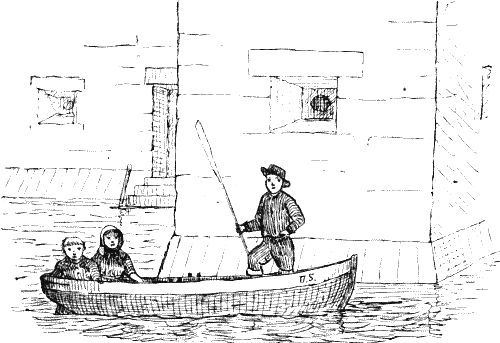
The United States Garrison.
The squadron now drifted under the granite walls of a United States fort, which commanded the approaches from Her Majesty's dominions. It bore the marks of neglect usually seen in an unoccupied and unfinished fort, but as the canoes drew near, signs of life manifested themselves about the sally-port, and in less time than it takes to write it the entire garrison had embarked and was advancing to reconnoitre the approaching fleet. A parley ensued to the mutual edification of both parties, and then the race for the Dominion line was resumed and easily won by the Purser, who paddled into water so shoal that the mud was visible just below the surface. He turned his boat on her centre as rapidly as a man could do with a canoe of the Chrysalid pattern; then he arose and exclaimed, as the Vice and the Cook drew up,
The Purser on British Soil.
"Gentlemen, this is the first time in eight years that I've stood upon British soil. 'God save the Queen!' say I, and three cheers"—
"You're not on British soil," interrupted the Vice; "you're on British water." But the Purser, unmindful of the interruption, had got as far as "hip, hip!"—when the motion of raising his hat destroyed his equilibrium, and a second later he was more than knee deep in a hummock of greyish-blue mud.
"Now you're on British soil," continued the Vice; "how do you like it as far as you've got?"
But the unchanged ecstasy of the Purser's patriotic face banished from the hearts of his companions any memories of '76 and 1812 that might have been hiding there, and the three cheers were heartily given with a supplementary "tiger," which was fully as noisy as if it had been one of the tigers native to the royal lady's own Indian Empire.
The Purser extracted himself with some difficulty from his native clay, and all paddled to a shelving beach for the noontide rest, the Cook and the Commodore striking up "God save the Queen," out of compliment to the Purser. The others joined in and the notes of the noble old anthem rang far across the water until it was noticed that the Vice was patriotically roaring the words:
"My Country 'tis of thee Sweet land of libertee,"
instead of the original. The other two Americans, although they were old United States soldiers, could not brook this gratuitous affront to their English companion, so they vigorously attacked the Vice with their paddles and spattered him till he was fain to cry "quarter." Then the bows grated on the sand, and springing lightly ashore, the Vice mounted a boulder and delivered himself as follows, while the rest, dumb with amazement, sat in their boats to listen and applaud:
[5]"Far be it from me fellow-citiz—mariners, to disturb the harmony of this joyful occasion. We are gathered tonight almost upon the very spot where Chartreaux and Champlain and Vanjohn and Rouget Noir fit the Injuns and made them knuckle to the Jesuit Fathers, with none to molest nor make them afraid. Here subsequently Lord Howe and Commodore Vanderbilt marched their squadrons and manœuvered their battalions, and spliced the main brace, and shivered their timbers according to the dictates of their own consciences. Did any of them ever go back on their environment? No; contrariwise they harmonized, and shall we their successors fail to do likewise? Never, gentlemen, never. It has been hurled in our faces by the honorable gentleman from England, that the great republic is rotten with corruption—that our highest officers are not above peculation. Let me ask that honorable gentleman and his allies (here the Statesman indicated the Commodore and the Cook,) if any president of the United States ever stole corn meal and had his disgraceful act perpetuated in his country's literature? I pause for a reply. None? Then none has ever done such a deed. And yet, gentlemen, it is recorded of one of the most exemplary of English monarchs that he not only stole the then current equivalent of corn meal, but caused it to be used on the royal table. I invite you to join me in singing a song to the glory of Old England—one, two, three; sing!
(Air Auld Lang Syne.) When good King Arthur ruled this land, He was a goodly king. He stole three pecks of barley meal, To make a bag-pudding. A bag-pudding the Queen did make, And stuffed it well with plums, And in it put great lumps of fat, As big as my two thumbs. The King and Queen did eat thereof, And noblemen beside, And what they could not eat that night, The Queen next morning fried. (Great applause.)
"Can anything more clearly indicate a low moral sentiment than the existence, and acknowledged popularity of this song? Fellow citizens (carried away by the tide of eloquence the Statesman forgot to say shipmates) and you, sir, whose alien friendship I am proud to own, although the unfortunate accident of a foreign birth (for which I cannot blame you,) opens a chasm between us—fellow citizens, I have done. My native land is behind me. I now appeal for protection to the Queen of England, and for the time being repudiate the American Eagle—though with all his faults I love him still."
Amid thunders of applause the Vice jumped down and inquired why luncheon was not ready.
After an hour's rest and refreshment in a sheltered nook, the squadron proceeded on its way under paddle, the wind having died out, making for a heavily wooded island visible several miles distant, on which it was surmised there would be good camping ground. Islands indeed proved to be the most satisfactory camping places that were found during the expedition, and were invariably selected when practicable.
The squadron paddled socially along, side by side, until the Cook stopped his stroke and fell behind. As he seemed to be engaged in making some not very satisfactory arrangement of his luggage, the Commodore ranged alongside and asked what was the matter.
"I can't fix my seat so as to be comfortable."
"Thought so."
"How do you fix yours?"
"Why this way," and the Commodore, vacated his seat, turning round and sitting on his forward thwart, so as to afford an unobstructed view. The two other canoes had now drawn near.
"Look at that," said the Vice. "He can stand up and turn round without upsetting in that old tub of his."
"So can I," said the Cook, suiting the action to the word.
"So cannot we," said the Purser, and the Vice. "But what are you looking at?"
It is a characteristic of Chrysalid canoeists that they never notice anything outside of their own boats until they bring up all standing, as it were, against it. Hence the Commodore's seat was a novelty to them, and they gazed upon it with mute admiration.
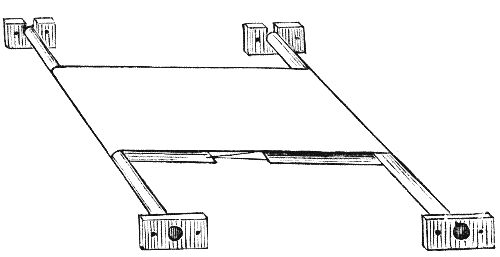
A Canoe Seat.
The blocks in which the cross-pieces rest, are screwed to the inside of the canoe. The cross-pieces are ash sticks about an inch in diameter. They are fourteen inches apart. Over and around them is passed a piece of fourteen inch canvas, with grommets for lacing on the under side. The seat should have a slight slope aft and should be so placed that a back-board will rest conveniently against the after thwart or bulkhead. If the cross-pieces spring too much, two bits of wood cut to fit between them on either side of the canvas will make the whole structure very firm and elastic. A simpler arrangement is a movable thwart made of half-inch pine, with cross-pieces tongued and grooved across the ends to prevent splitting. If made eighteen inches wide, such a thwart may be used for a lee-board, as the canoeist should sit on or near the bottom of his craft when under canvas.
"There are some advantages about Red Lake canoes," said the Vice.
"Very plebeian though," said the Cook, satirically; "their principal mission is to go cruising with Chrysalids in the capacity of tenders."
"Yes," said the Vice, "I admit their carrying capacity."
"And their superior speed," said the Cook.
"And their great stability," added the Commodore. So with cheerful chaff the fleet went on its way, and in a couple of hours was making camp on a pretty island, evidently a resort for picnickers and which was playfully called "Murderer's Isle," from an unpleasant episode of early days.
The Commodore, having noted an abundance of drift lying about, detailed himself to procure fire-wood, and stretched at full length upon the dry sand, leisurely tossed fragments of wood toward the spot where the Cook was engaged in the soothing attempt to light a fire with damp paper and wet matches, and the Purser was scraping, within the water's edge, a hole to be used after supper as a dish-pan, when the expedition suddenly obtained its first foreign view of the picturesque. From the shore of the main land there crept out something which at first bore itself somewhat as indicated on the next page.
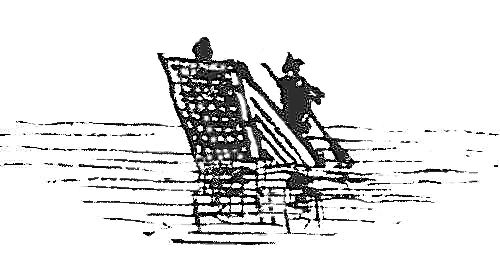
The Picturesque afar.
It finally resolved itself into a strange craft which seemed to be a generous pig-trough remodelled by one with yearnings after the art of the undertaker. Standing, yet bent nearly double, in the stern was a slight, short old man, clothed in raiment utterly unlike anything which any member of the expedition had ever seen at home. The old man paddled his boat at a surprising rate of speed directly toward the camp of the expedition, and as he did so the gazers gradually lost their enjoyment of the picturesque in the realization of a dread duty about to devolve upon them for the first time during the cruise. The old man being a Canadian, it naturally resulted that he must be a Frenchman, and incapable of English. Who was to converse with him? The Cook, who had picked up some French among the Louisiana creoles, but had not for ten years heard or spoken a word of the beautiful language, modestly retired behind the Commodore's broad shoulders. The silence began to be terrible, but it was bliss compared with the sensation with which the group shuddered when the strange craft slid noiselessly and darkly up the beach, and her crew partially undoubled himself and remarked,
"Wahu ei hoo mi eh ha ma?"
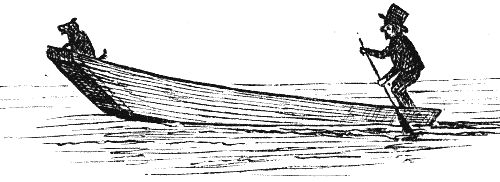
The Picturesque anear.
Three mariners involuntarily dropped back a pace or two; the fourth (the Cook) felt secure in his inconspicuousness until he discovered that he had been dropped to the ground by the Commodore's backward movement, and that the Commodore was nervelessly sitting upon him. At length the Vice, whose admiration for the French Commune had caused him to immure himself many a night with some ex-Communists who had escaped to America, asked in faltering tones,
"Q'est-ce-que vous voulez?"
"That's it," gasped the Cook, as he endeavored to reanimate the Commodore's spinal cord with the sharp end of a quill toothpick, "make the ancient mariner explain himself."
But the Ancient Mariner only shook his head with a vague look, and said,
"O hyu wuh oo mi en?"
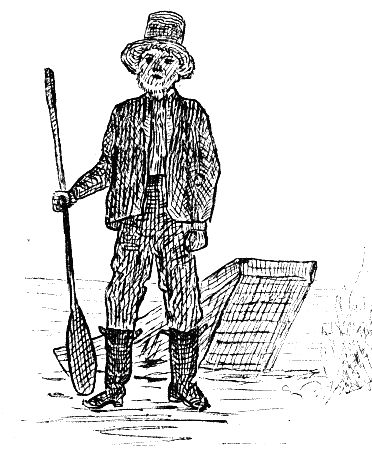
Wahu ei hoo mi eh ha ma?
Then the Commodore, who had lived a year in Paris, and was familiar with the polite phrases there in vogue, said,
"Voulez-vous pourboire?"
The old man shook his head, scrutinized the party closely, read the names of the boats, and exclaimed,
"Haw hihi."
Then the Purser, who before he left Oxford had made a French translation of the "Antigone" of Sophocles, which competent judges pronounced superior to that of Voltaire, stepped a pace to the front to hide his blanched countenance, and said,
"Nous ne comprenons pas."
And the old man replied,
"Haw hihi, hahu?"
By this time the Cook, who had extricated himself from beneath the ruins of the Commodore, was discreetly and rapidly seeking the leafy coverts of the forest, but the Vice detected him and dragged him back. The Cook put on an air of bravery and exclaimed,
"It's no use, boys; I'm convinced that he's a Basque, who has strayed up into France, and somehow got over here. I speak half a dozen languages, but there are no affinities between the Basque and any other known dialect. It will be just as well to talk English to him as anything else, so here goes. Say, old friend, we don't know what you're driving at, but"—here a happy thought struck the Cook, "say it over again." And while the Cook listened attentively, the old man repeated his first inquiry,
"Wahu ei hoo mi eh ha ma?"
"Certainly!" exclaimed the Cook briskly, "how much do you ask for them?"
"Hihi heh," replied the old man with great animation.
"It's a bargain," said the Cook; "Purser, please give the ancient mariner half a dollar?" And then the Cook, with the air of a man who comprehended the wisdom of the ages, explained to his astonished auditors. "Gentlemen, our visitor is not a Frenchman at all; he is an Irishman whose palate has departed, and he wants to know if we will buy two pike and a bass—'hoo mi eh ha ma,'—you know." The old man in the meantime hurried to his boat, paddled off to a crate anchored on the edge of the channel, and returned with a string of fish in the full vigor of life.
The three linguists sat deliberately down upon the sand, and their lips remained closed until coaxed from their obduracy by the mingled odors of coffee, fried fish, buttered toast and canned peaches. The Vice was heard to mutter, "French I can talk and most patois I can understand, but Basque complicated with loss of palate throws me." Presently however he began to exhibit symptoms of his accustomed loquacity.
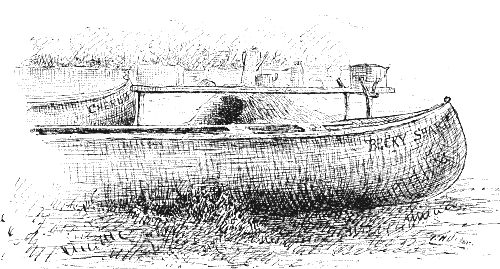
Supper Table.
It so happened that the supper table was sustained by resting against the cut-water of the Cherub, and it gradually dawned upon the Vice that there was something peculiar about her construction, something, that is, different from the construction of a Chrysalid which is built in the orthodox style, known as lap-streak or clinker, the planks being of quarter-inch white cedar, and the timbers of well seasoned oak. Said he, addressing the owners of the Red Lakers:
"Why don't the joints between your planking show?"
"Because the boats are not built in that way," said the Cook.
"But that's no way to build a boat; the seams can't be made tight unless the planks over-lap. Look at the Rochefort."
"Very true," said the Commodore, "but our boats don't seem to leak so very much more than yours do, for all that."
"How are they built any how?" and the Purser and the Vice simultaneously arose and examined the Red Lakers by moonlight and firelight.
Mention has already been made of the characteristic indifference of Chrysalid owners to all canoes which are not Chrysalids until some chance occurrence forces them to make examination.
In this respect they strikingly resemble certain ecclesiastical sects, which rest serenely ignorant of other denominations, until they stumble upon information inadvertently, which startles into respectful investigation.
"Why they are perfectly smooth inside and out,"—"no timbers at all,"—"what lots of rivets," were some of the remarks.
"Certainly, haven't we told you so a dozen times," said the Cook, "and you never looked at them before."
"How do you suppose they are made?" asked the Vice.
"I am informed," replied the Commodore, "that thin strips of white cedar are steamed and bent transversely over an exact model or "last" of the intended canoe. The edges are straight so that they fit closely against one another. When all these are in place, a longitudinal outside sheathing of cedar or other wood, butternut in the case of our boats, is copper-fastened to the inner lining, the nails being driven through both thicknesses at short intervals, and clinched on the inside. The ribs and sheathing as used by the builder are each a quarter-inch thick, so that the total thickness is half an inch. The canoe is perfectly free from ribs inside, and from the raised edges outside, and cannot leak while she remains sound. Her strength is necessarily immense from the way in which she is put together."
"I think," added the Cook, "that we get a good deal of speed out of this model from the absence of the over-laps which are unavoidable in clinker built boats. These necessarily hold the water to an extent which must be appreciable in so light a craft. Moreover, the fore and aft curve of the bottom line rids them of a deal of what builders call 'skin-friction.' Recent experiments indicate that a shape like the bowl of a spoon offers the least resistance in passing over the surface of water."