CANOEING IN KANUCKIA. (continued 2)
Reading edition
"Your boats approximate to the spoon shape, that's a fact," said the Purser.
"Look at those rivets," remarked the Vice, "they make her look as though she were freckled."
"Granted," was the Cook's answer, "but are not freckles beautiful when they indicate a sound constitution?"
"The rib-and-batten, and the paper boats are quite as smooth outside," the Commodore admitted, "but, they all have internal projections which are sometimes inconvenient, as for instance when you wish to sleep on board, or when you are trying to sponge out sand and so forth."
The Purser and the Vice closed the dispute by proving that their lap-streak cedar boats when empty were somewhat lighter than the others, and the Commodore and Cook were fain to be content with asserting that if lightness were the only object, Red-Lakers could be built lighter than Chrysalids by using thinner stuff.
VII. GARRISON LIFE.
THE Vice and the Purser, having boats of the Chrysalid model, were so long in stowing their cargoes that the Commodore and the Cook started in advance of the remainder of the squadron and made a brisk run to a British fort, the outline of whose parapet was discernible to a military eye, on an island some miles distant. When built during the last war, this work was far beyond the range of Yankee guns, but now the two forts might exchange cards with some chance of doing execution, albeit they are out of sight of one another.
Doubting what reception they might meet at the hands of a British garrison, the voyagers resolved themselves into two divisions, one of which approached the water-gate, while the other ran behind a stockade which flanked the work. No sentries being visible upon the parapet, the two officers disembarked and having learned in former days never incautiously to approach an earthwork, they advanced up the glacis and along the counterscarp with due circumspection. Suddenly the Cook paused, seized his companion's arm; struck a dramatic attitude and exclaimed,
"Behold the garrison!"
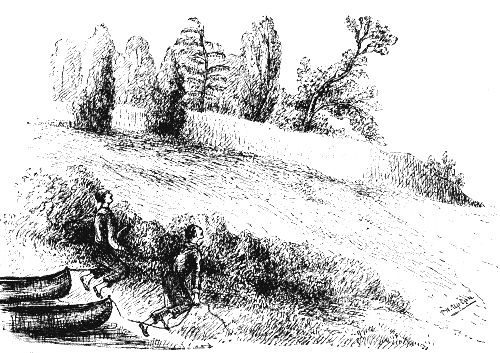
An Unknown Fortress.
The couple, who had walked as they conversed, had reached one of the bastions, and as the Cook spoke, the two men beheld, between the gabion-lined walls of an embrasure, three children with uncovered heads and saucer-like eyes.
"'Grim-visaged war hath smoothed his wrinkled front,'" said the Cook.
"'And thus be it ever,'" quoted the Commodore.
By this time the Purser and the Vice had made the island, and joined the first arrivals, who carefully and with professional pride inspected the outward defences of the fort, using technical military terms with a fluency which humbled their civilian companions into comparative silence. At length the Vice, noticing the rotting stockade, the weedy ditch, and other signs of inattention, ventured to let the eagle scream a note or two.
"Just like everything else, that is subject to the decaying influence of monarchical institutions," said he. "How quickly a handful of our brave fellows would take possession of it!"
"Perhaps," admitted the Commodore, "but I'd prefer to risk my chances from the inside."
The Purser immediately patted the Commodore on the back, while the Vice opened his eyes and demanded an explanation.
"Some forts," remarked the Commodore, "are like singed cats; they fight better than they look. This fort is in better condition now, than half the forts were that have become historic."
"But in case of sudden war," said the Vice, "there's nothing at hand to repair a broken-down fort with, is there?"
"Yes; living men; they make and unmake forts," said the Commodore brusquely.
"It's the same way with conventions and caucuses," remarked the Vice, regaining his self-respect as he imagined himself once more the Commodore's equal.
"You've been a soldier," said the Purser to the Cook, "and I am longing to see once more the uniform of my native country. Tell me how to gain admission to the fort."
The Cook replied,
"Go around to the sally port, which you will be sure to find opening away from the neighboring republic, and fire your pistol. The guard will hurry out and make you its prisoner; then the Commodore and I will come around and intercede for you, on the ground of your ignorance."
The Purser looked disdainful; "And think you," said he, "that Britain's laws are so fitful as to waver under the persuasions of a brace of Yankees?"
"When Yankees can't persuade Britishers," remarked the Vice, "they usually proceed to"—
"Pack a High Court of Arbitration," interrupted the Purser.
The quartette straggled through the tall weeds, which prevented farther chaff, and reached the sally port. The heavy gates hung aloft, their duty being discharged by deputy in the shape of long rails resting edgewise in two posts, and with "No Admittance" painted upon a board. The garrison, moving on interior lines, gradually massed itself behind the board, its forefingers taking wary positions within its respective mouths. Behind, and in the centre of the terreplain, towered an enormous haystack. "Behold," said the Purser, "the ingenuity with which the garrison has placed the haystack just where riflemen can take shelter behind it, and command the entrance to the fort, picking off infatuated Yankees who venture upon the drawbridge."
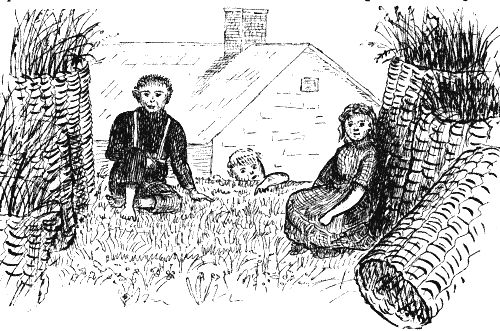
The British Garrison.
"True," retorted the Cook, "the idea is not unlike that of General Jackson, who used cotton-bales at New Orleans, but I believe it was not Yankees, who were picked off." The contrast between the ideal and the real was so absorbing, as the four stood at the bridge-head, that some time elapsed before they realized that clouds had gathered heavily, and begun to drop their contents.
"My main hatch is open!" shrieked the Vice, as he hurried off to his canoe.
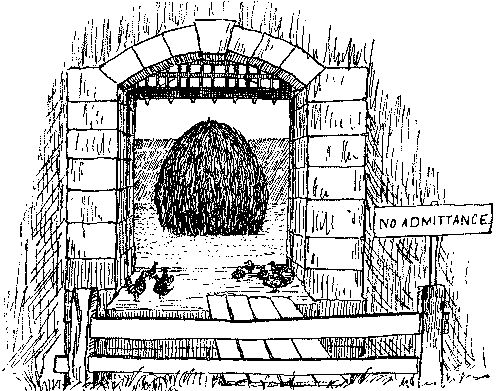
The Sally Port.
"My tobacco—and it's a rare Brazilian article—is lying in the bottom of my boat!" shouted the Cook, as he followed the Vice.
"The Vice and the Cook will tow up the other boats," ordered the Commodore, "while the Purser and I construct temporary shelter."
Several hundred yards from the fort was a group of trees and a board pile, and to this the commanding officer and the Purser hastened. The trees seemed to have been a favorite resort of cattle, and the contents of the board pile were rotten, but it was not a time to be particular, so a beam was stretched between the limbs of two trees, and boards slanted against it to shed the rain. Fortunately a platform of boards happened to be just where the extempore shed would cover it. When the Vice and the Cook returned, the latter considerately bringing dinner material with him, it was discovered to be noon-day, so the party did justice to bread and butter, cold tongue, and a can of apricots. Suddenly the Vice remarked,
"I suppose these boards beneath our feet are the floor of some late military structure. I can't help noticing how perfectly they are combined for drainage, sagging, as they do, at the centre."
The Commodore had not before noticed the peculiarity alluded to, but now his mathematical eye saw that the depression in the boards was lower than the surface of the surrounding ground. Extracting a trolling line from the Vice's pocket, he lowered a sinker cautiously in a crack between two boards, unrolled considerable line, withdrew it, and remarked,
"I have the pleasure of informing the squadron that during military occupation of the fort, the inmates of the hospital, the ruins of which we behold in front of us, had an abundant supply of cool water from a very deep well, which well is at the present moment directly under us, while the boards which cover it are slowly breaking."
Every one sprang to his feet. While at his home occupation of statesmanship, the Vice never beheld disaster impending over his own party without speedily traversing the whole distance between his own party and the opposition, so on this particular occasion, his instincts impelled him to dash through rain, mud, and thistles toward the ruins of the hospital, whose wall offered the most distinct shelter within view. The Vice wore a helmet, his long whiskers fluttered behind him on the breeze, his shoulders and body were covered by a black rubber blanket, his trowsers were rolled high above his stockingless calves, and he wore a huge pair of carpet slippers, which were nearly as wide as they were long. His figure and attitudes, as he ran, were so full of suggestion that the artist preserved them in a series of sketches, severally entitled.
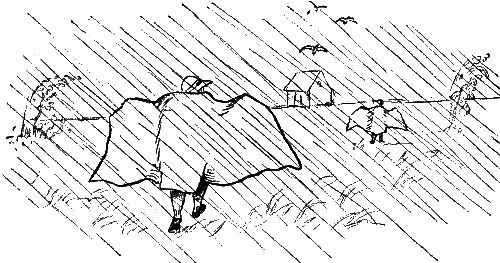
The Vampire Bat.
"The Flight of Cain."
"Scotch Laird enjoying His Favorite Weather."
"Study of the Bottom of a Bear's Foot."
"Rip Van Winkle chased by Dogs."
"Mephistophiles Triumphant."
"Election Returns from a Rural District."
"The great Vampire Bat."
The absence of the Vice left his late companions in possession of additional elbow room, but on a rainy day there are blessings more to be desired than elbow room. Among these is a pipe of tobacco, and four walls between which to smoke it. The Cook's precious Brazilian tobacco was wet, the Commodore and the Purser had left their pouches in their boats, but each man had a pipe in his pocket, and it was known that the Vice had in his possession a bag of delicious weed. So dispatches were sent him during a slight lull in the storm, and the Commodore and Purser made a reconnoissance in the direction of the fort. The garrison being invisible, the storming party dashed over the bridge and beneath the temporary portcullis, putting to flight a large body of chickens who were carelessly resting upon their arms in the guard-room. These alarmed the commander of the fort, who at once emerged from headquarters, with an axe upon his shoulder, and himself in dishabille.
The Commodore saluted the commandant, and asked, with due formality, the courtesy of shelter for himself and companions, and for permission to walk about the fort when the rain should cease.
"Is it wantin' to be out av the wet ye are?" asked the commandant; "come straight into the kitchen an dhry yerselves."
"There are two more of us, yet to come," explained the Commodore.
"Ah, niver ye fear," quoth the old man; "isn't the kitchen in the casemate that held the biggest gun, in the good ould times, an' hasn't a whole company av the Rifles been in there to wanst many's the time."
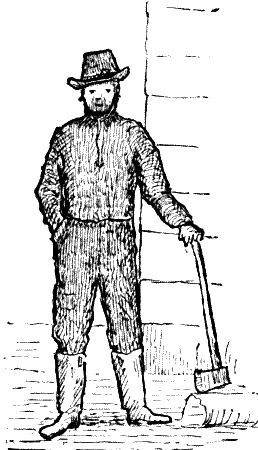
The Commandant.
The casemate proved of generous size, as was also the cooking-stove that stood in the midst of it. The commandant's wife and children made haste to place chairs, while one child was detailed to bring in the Vice and the Cook at the double-quick. Soon the quartette sat about the refilled stove, and though the month was July, no one thought to push back his chair. Gradually there stole over the party that delicious drowsiness which is peculiar to a man who has been acting as clothes-horse to a wet suit—a drowsiness
"That resembles slumber only As the mist resembles rain"—
a drowsiness which demands not sleep, but smoke. In short, each member of the expedition was dying for a pipe, but he would have prolonged his sensation of dissolution to its logical end rather than have got out of his chair on the one hand, or, on the other, have ventured to smoke in an apartment which was apparently the host's parlor as well as his kitchen. But the Vice, the Statesman, the moulder of men, came at the critical instant to the rescue of his companions and to that of
"A nearer one Still, and a dearer one"—
himself.
"You must find it quite lonesome here at times," he remarked to the commandant of the fort.
"Thrue for yez, an' I do," responded her Majesty's representative.
"Still," continued the Vice, "I suppose you can once in a while take some comfort out of a drop and a smoke?"
The commandant of the fort winked profoundly. The Vice passed his half pint flask stealthily to the custodian of Britain's honor, and the old man, first prudently sending his wife out of the casemate for something, drained the flask with the greatest courtesy and enthusiasm. Then the Vice remarked,
"I suppose you get very good smoking tobacco in Canada, as there is no duty on it, but permit me to leave you a fine pouch of it, as a slight remembrance of your courtesy to us."
The commandant accepted the token of esteem, and smiled his thanks from every line of his wrinkled visage. Then he opened the pouch, and advanced his ancient nose, first cautiously, then critically, and finally with a sniff of decided approbation.
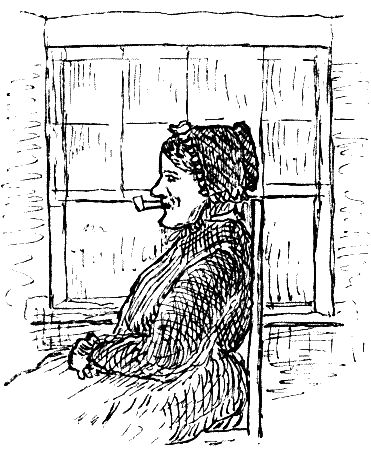
The Commandant's Lady.
"Try it at once," said the Vice, with ill-dissembled eagerness. "Don't hesitate on our account—we are old smokers."
The commandant acted at once upon the suggestion, first courteously passing the bag to his guests. Within three minutes these traditional enemies were smoking the pipe of peace together, nor was lovely woman missing from the circle, for the commandant's lady filled and lit, not exactly a yard, but a "lady-finger" of clay herself, and puffed thereat with great satisfaction.
The rain ended, the party went out to look at the fort, and discovered that what from the outside had appeared a mere earthwork was really a very carefully built fort, with stone quarters, galleries, casemates and revetments, and easy of defence to a mere handful of men.
Just as the party was bidding adieu to their kind entertainers, there occurred an accident which displayed to an unexpected degree the esprit de corps of the expedition. The commandant had offered the Commodore some milk for the expedition, if some one would wait an hour for it—the cows were quite a way off, he said. To wait inside a grim fort while the sun shone brightly outside, and four canoes needing inspection on account of damages by rain, was a duty to chill the ardent soul. Just then, however, when the Commodore was wondering if he could safely forget his own morning detail of himself as fleet milkman, and assign this duty to some one else, the commandant's older daughter, heretofore invisible, and of about eighteen or twenty summers, appeared from an adjoining room.
"I'll stay, Commodore," shouted three manly voices in unison. The Commodore was so affected by this devotion to the interests of the fleet that he felt shamed into a determination to remain true to his self-appointed duty, but when he beheld the Purser's pleading eyes, more eloquent than any words could be, human sympathy overcame soulless discipline in the Commodore's rugged breast, and the brotherhood of man asserted itself.
The wind and the shower died together, and as each captain of a vessel had some special reason to wish himself farther on his journey, it was agreed that the squadron should proceed under paddles, and camp for the night at a point which the Vice knew all about, having camped there during a previous cruise with the Alderman. This plan was accepted with expressions of the liveliest satisfaction.
As the Purser rejoined the command with his milk pail, the three Americans were seriously conversing about garrison life, as it exists in the British service.
"I have often read," the Vice was saying, "of the exalted social tone which pervades the British army, and I confess that I am glad to have been admitted even for so short a time into society so select."
"I have always understood," said the Commodore, "that the commandant of an English military post is sure to be a gentleman of high social position at home."
The Cook remarked that "it was pleasant to have the notions of the simple and unaffected manners of the English aristocracy, as derived from contemporaneous literature, so pleasantly confirmed by an actual experience."
"But you know that there isn't any—" put in the Purser.
The Cook went on serenely with his remarks, in the same vein and was so ably seconded by his fellow citizens, that the Purser finally embarked and paddled away, stopping a few yards from shore to shout defiantly back,
"It was all Gladstone's doings, you know. But for him there would have been a regular garrison there, and may be you wouldn't have been so cordially received."
To be out of doors and at liberty for ten days is, to men without physical vices, wonderfully exhilarating, and enforced confinement by a few hours of rain only intensifies physical spirit and alertness. Every nerve and muscle seems to demand something to do, a mountain to climb, an untamed horse to ride, a locomotive to drive, a regiment to lead into a battle, or—as was the case with the Vice on this particular afternoon—a good, close, vicious political canvass to dash into. To gratify and utilize this sensation, there is no sport superior or equal to that of paddling a canoe. Rowing may lessen the physical disquiet, but while the canoeist sits upright in his boat, voluntarily working only with his arms, and learning of unsupposed physical availability and grace with every motion, the oarsman sways to and fro like the deserted half of a melancholy hinge, which wavers helplessly about in air, always longing for something to attach itself to, but never finding it. Besides, the paddler faces his water and his goal, instead of fixing his eyes unceasingly upon the fleeting past. The oarsman's duties are confined to steady pulling, while with every stroke of his paddle, the canoeist pulls and pushes also, discharging these duties with alternate arms as he works upon the opposite sides of his boat. The exercise is not passive, like that which one takes on horseback, nor does it partake of that mental strain which a man experiences when he takes the helm of his own yacht. It is superior, by far, in physical benefit, to that most exhilarating experience that comes of driving a canoe under full sail and before a brisk breeze. And if, after an hour's work at the beginning of a cruise, the canoeist finds himself the owner of two handfuls of blisters which nobody cares to borrow, he finds himself at its end in possession of a fund of strength, spirits, and clearness of head and heart that are far too precious to lend, although they may have been bought very cheaply.
The paddles used by the modern canoeist are like that represented on the cover of this book. They are very light, being made usually of spruce, an inch and a half in diameter at the largest part of the shaft. For a wide canoe a nine foot paddle is desirable, but for narrower craft one seven and a half feet or even seven feet long is sufficient. A common ferule joint in the middle facilitates close packing. Two joints dividing the paddle in three parts, do not work well in practice. Rubber rings, or the two halves of a three inch rubber ball cut to slip over the shafts prevent the water from dripping inboard.
The squadron had sailed thus far without beholding any of the picturesque which is peculiarly French, but now it hoped that at landing, the essence of Acadia would be visible. It seemed for a few moments as if this hope was about to be realized, for as the boats approached their prospective landing, two quaintly dressed boys stood observantly and quietly upon the bank, instead of dancing and hooting like savages, or casting stones and objurgations at the squadron, as almost any brace of boys in the United States would have done under similar circumstances.
"Note the respectful ways engendered by monarchical institutions," observed the Commodore.
"Rather the absence of the spirit which the heavy hand of despotism has crushed out," replied the Vice.
As the boats were beached, the boys timidly approached them. The Vice, forgetting his first encounter of the picturesque, accosted them in French, and was somewhat confused by their replies until he learned that the youths were of English parentage, and that they lisped.
The boys were soon reinforced by their father, a tall, modest, but self-reliant looking man, who eyed the camping preparations of the party with an interest which was greater than curiosity, and which was explained afterward by the discovery that he had been of the Argonauts of '49.
The Vice, in his capacity of Statesman, knew the honest farmer as a type, only as the principal element of mass-meetings which he sometimes addressed; the Commodore, when in his editorial chair, knew him principally as a subscriber to be secured; the Cook, when playing scribbler, found the farmer-type useful to contrast with other types, and the Purser, when in his studio, knew him only as an occasional adjunct to a pastoral composition.
But after the self-contained, hard-working, rather lonely and diffident farmer had lounged about the camp for a couple of hours that evening, the party learned, as the city-bred man needs sorely to learn about many another farmer, that the old man could see something in a sunset besides tints reducible into pigments, more in a book than its writer's art, that he knew more of the essentials of politics than the editor and statesman combined, and stranger still, that he cared neither to edit a newspaper nor to run for office.
After a good supper and a cheerful pipe or two, the Commodore, who had been extremely quiet for a few moments, announced that he considered it the proper thing for canoeists to sleep in their boats instead of tents.
"Then," said the Commodore, "if the river rises suddenly, you will be in your boat, instead of having it drift away from you."
"And if you turn over in bed, in such case," remarked the Vice, "you'll never know what drowned you."
The Commodore did not reply, for the real object of suggestion was to emphasize one point of superiority of the Red Lake model, after which his own boat and the Cook's were built, over the Chrysalid model affected by the other two mariners. But the Commodore's will was law, and that night the four men slept each in his own canoe, a rubber blanket thrown across a line extending from mast to mast affording protection from dew and possible rain.
VIII. THE BEGINNING OF ACADIA.
ON the morning of this day, two canoeists arose from their nautical couches with that satisfied air which betokens a night of peaceful rest, but the Vice and the Purser arose only after many a premonitory groan, and even then they strongly resembled a couple of rough logs from which a single slab had been sawn, so flattened was one side of each. The Commodore eyed them with manifest satisfaction, called the attention of each of them to the appearance of the other, and exclaimed,
"Observe the effect of sleeping in a canoe with ribs and a bottom board! I was curious to see how the experiment would result."
"I wish, then," grunted the Vice, as by vicious pinches he sought to restore animation in his flattened side, "I wish—ow—that your devotion to science had prompted you to try the experiment upon yourself, and borrowed my canoe to do it in."
"Thanks, thanks," rejoined the Commodore, briskly, "but I had an experiment of the same sort to try in my own boat, which has a smooth concave bottom. I beg you will observe how my outlines preserve their habitual shapeliness."
The flat-sided sufferers retired for a bath, and speedily forgot their sorrows. If the morning bath in a city bath-tub is a washer-away of fragments of slumber, and a merry awakener, how much more delightful is the same exercise in an ever-replenishing body of water half a mile wide and hundreds of miles long, enclosed only by blue sky, green trees and brown earth, with no close dining-room and conventional breakfast to be descended to, no morning paper to be read, no vile horse-car to go to business on, nor any hard pavement to tramp over, and no brother man to find fault with, except in that cheerful banter which always comes back to bless the giver. Thus thought the Cook as he stood waist deep in the clear water, and thus he might have continued to think for a long time had his foot not impinged upon the riparian rights of an honest mussel with slightly parted shells.
The Commodore had already been out for provisions, and returned rejoicing.
"Another proof of the superiority of monarchical institutions," said he. "Instead of the prices we have been accustomed to heretofore, I pay twelve cents a-piece for chickens, ten cents per pound for butter, and three cents per dozen for eggs."
"And you are pleased to regard this cheapness as a virtue?" asked the Vice. "Is no one but the buyer to be considered?" How do you suppose people live who sell the products of their industry at such starvation figures? But monarchists and imperialists have but a single idea—to crush the poor."
The Commodore shrunk an inch or two in length and breadth, but soon recovered himself, donned a vicious smile, and announced with assumed cheerfulness that the time had come to "sling the healthy," whereby monarchists, imperialists and republicans would suffer alike.
"What's that?" asked the Cook.
The Commodore grinned sardonically. "He wants to know what, slinging the healthy, is," said he. "Well, he'll know before dinner. It means paddling—paddling in earnest, young man—paddling a ten or fifteen mile stretch, instead of a leisurely half mile."
There seemed no alternative, for the river was as smooth as glass. The sun noted the mirror-like surface of the water, and his natural vanity caused him to rub up his face until its brightness could not be increased. Just by way of refreshing the pleasurable sensation of beholding his face in the water, he dropped his gaze quite frequently upon the blue-shirted backs of the canoeists, until each man imagined that he must have caught some sparks from the camp-fire. Then it seemed as if there must be rain falling from the cloudless sky, for the Cook felt water-drops coursing steadily down his back. The Purser was sure his boat must be leaking, for water was gradually soaking the small canvas cushion on which he sat in the bottom of his canoe. The Vice's slippers grew clammily moist, and the Commodore's eyes filled with water which was not an accumulation of remorseful tears. But no man would debase himself so far as to be the first to cry for mercy.
But the Vice, the Statesman, was true to his profession. To have suggested a rest would have been merely a straight-forward act which even an idiot might have performed. The Vice preferred to gain his point by an exercise of intellect. Half a mile down the stream was a small pier; to this the Vice called the panting Commodore's attention, and exclaimed,
"That, by gosh,[6] is the identical dock where the Alderman and I went swimming. I assume that all such important precedents are to be respectfully observed?"
"They are," said the Commodore, almost fainting with the ecstasy of the transition from despair to hope.
Within ten minutes the boats were beached, and four perspiring canoeists, after an interval of rest, made haste to disrobe and take headers from the pier into the refreshing water.
From this pier the Commodore called the attention of his companions to a glittering spire which shot heavenward a mile down the river, and exclaimed,
"There begins Acadia. Every spire we see hereafter will be of that precise pattern—they are as unchanging as the beautiful faith which our sister Church of Rome maintains."
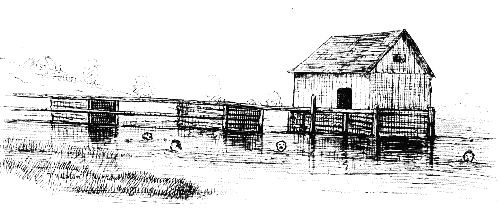
The Dock.
"Have we a Ritualist among us?" whispered the Vice to the Cook, with a face full of horror.
"Ye—es," replied the Cook, reluctantly, "but don't think too hardly of the poor fellow. Editors must have some sort of religious belief, you know—they're human, like the rest of us—and how can they reconcile their practice to any thing but a religion of mere forms? What would religion be, if it did not provide for every man's own peculiar infirmities?"
The Vice eyed the Commodore with abating horror, nevertheless he began to talk Baptist doctrine to him. He even, to arouse his faculties to the utmost, strode up and down the shore warbling to himself (so the Purser declared) something like this:
"Baptist, Baptist is my style, Baptist born was I. I've been baptized in the Baptist way And Baptist will I die."
But the Commodore was obdurate, and intimated that the Vice's experience in upsetting from a canoe had something to do with his denominational preference; things had to go according to law in newspaper offices, he said; the newspaper was the highest embodiment of human intellect, and so he reasoned, analogically, that men had no higher model to which to conform religion. The Vice sighed and determined to convert the Commodore—at a more convenient season.
The calm and heat continued, and no one was rude enough to make suggestions to the Commodore about starting. Indeed, the Purser remembered that he had brought a hammock, which until now he had forgotten. It was one of the most remarkable hammocks in the world—woven of silk by an Italian sailor—wouldn't the Commodore just try it? The Commodore accepted the proffer in gracious spirit; then the Cook remembered that the Commodore had never tried the wonderful, the priceless Brazilian tobacco, and there could be no fitter place than a hammock in which to sample it. The general result was that the Commodore occupied the hammock until the Cook announced dinner, and even then he arose with noticeable reluctance.
After dinner the breeze sprang up again, and as it wafted clouds of dust into the eyes, faces and hair of the expedition, as well as upon their garments, still damp with honest sweat, every one hailed with joy the order to sail. Besides, the dinner had been a mere lunch, and as the largest town on the river was but a few miles distant, the Cook suggested that an excellent dinner might be procured there at a quaint little French inn which he had visited in other days. This suggestion led to a lively race, which as usual in such cases was won by the Cook.[7] Whether beating or beaten, however, the pleasure of spreading all sails and making the best possible time in a good wind, was more than sufficient reward for all the effort put forth. With a boat fourteen feet long, and weighing, all rigging, spars, personal property, stores, etc., included, a scant hundred and fifty pounds, yet carrying fifty square feet of canvas, the canoeist has to exert to the uttermost his clearness of vision, nicety of touch (at the helm) weather wisdom, and balancing ability. He is himself his own ballast and the principal portion of the cargo. The shifting of five pounds of weight would compel a capsize, and the slightest flaw, carelessly caught, would even more certainly induce the same undesirable result. To keep all dead weight as far as possible below the water line, the navigator sits in the bottom of his boat, his back resting against a small board which, in turn, bears upon the after thwart or bulkhead. In one hand he holds the sheet of his mainsail; if he steers with a rudder, he holds one tiller rope in the same hand, and the other in the remaining digits. If he steers with a paddle, which is for several reasons the preferable mode, he holds the paddle with the hand unoccupied by the sheet; there is thus a steady strain upon both arms, and this strain is also a perfect brace. Some canoeists work the tiller with the feet, and this when properly carried out is a very convenient mode, but not every one who has tried it succeeds in making it work. The time which intervenes between the coming of a flaw and the full fruition of a capsize, is usually about three seconds, but one of these suffices for prevention, if the sailor promptly lets go his sheet or allows his boat's head to go into the wind. In practice, however, a flaw seldom strikes a close-hauled sail; the pilot's ear detects it coming several seconds before it strikes, and so, before it appears, the mainsail is as innocent of the possibility of abetting disaster as if it were the proprietor of a gambling saloon, who had been forewarned by some sympathetic police captain of an impending raid, or a skilful insurance president who knows that the state inspector is coming. How the canoeist's ear detects the coming flaw is the mystery and despair of the novice, though several hours of practice make this wisdom seem an acquisition some centuries old. When the "green" canoeist experiences a flaw, he generally seeks safety by letting go his sheet and at the same time steering "into the wind". Safety is at once assured, but when the boat again takes the "course," the other boats, if sailed by experts, are already too far away to be available if one wishes to borrow an æsthetic idea or a pipe of tobacco. The experienced sailor lets his sheet go sufficiently, but he knows to a breath when the flaw is sufficiently spent to allow him to "haul close" again, and he holds his course to a point all the while, saving some wind by throwing his weight well to windward. If he has a satisfactory family, but lacks as much life insurance as he desires, he will prefer to try a good wind over water not more than five feet deep, (and such water is a hundred times as plentiful as deeper water) but the chance of capsizing a sober canoeist of a week's practice is less than that of falling dead in the street at home; it is as easy to avoid as if it were the risk of stepping over a precipice in full view, for in the former case the catastrophe is as easily foreseen as in the latter. And while the boat is flying (literally, for her bottom barely touches the water, and she can sail at a respectable speed over tide-mud barely glazed with water,) its occupant has every pleasure experienced by the owner of a twenty-thousand dollar yacht. He has the same glorious wind whistling in his ears, the same sharp remonstrance of the waters divided by the bow, the same murmurs of recognition and complaint by the same waters as they reunite under the stern-post, the same sense of triumph over one element, of compulsion of another, which if it had its own way would be only a fitful ally, the same glorious abandon of health and spirits revelling in pure air and in endeavor unconstrained by age, sex, or previous conditions of social or business servitude. And when the sail is over, or the season itself is ended, the delightful memories of the cruise are not, as in the case of the yachtsman, palled by recollections of the frightful expense of the crew, or the extortionate charges of ship-builders for repairs. And while the yachtsman lays up his boat for the winter, and bemoans the wasting interest upon her cost, and the various charges for dockage, keeping, etc., the canoeist quietly puts his boat upon his back, or, at worst a cart, carries it to his house, and puts her down in the cellar or up in the garret (after an unsuccessful attempt to have her wintered on top of the piano in the parlor) in either of which places he may visit her as frequently as he pleases, in any weather, and refresh any memories that may seem laggard when recalled.
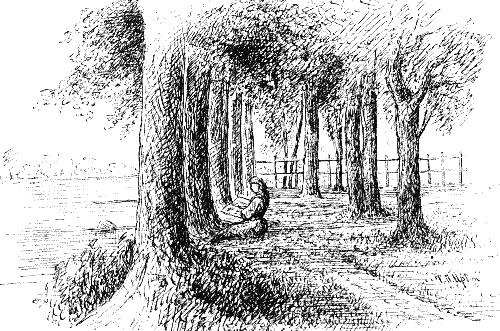
Under the Elms.
The party went into camp in the shade of some grand old elms which stood in front of what had once been her Majesty's barracks. During the political changes which had turned the British spear into the Canadian pruning-hook, the barracks had been diverted from their original purpose into homes for the friendless poor; the shore of the river in front of them was, therefore, full of the discarded crockery and broken bottles peculiar to a certain phase of poverty, and as the Vice and the Purser stepped barefooted into the water to carry their boats ashore, the soles of their feet testified to the truth of the scriptural saying "The poor ye have with you always."[8]
As the expedition landed, weary, foot sore, hungry, unshaven, and covered with the dust of their last camp, the sight of a busy town, full of brisk well-to-do people, caused them to experience to the uttermost the sensations peculiar to the vagabond and the pariah. A marvelously good dinner at a marvelously low price comforted the material part of their inner man, but their mental parts remained ill at ease. So uncomfortable were they that the party took pattern after the vulgar who wish to appear as gentlemen—they purchased and smoked the best cigars in the town. Returned to their camp, the spectacle of a number of well-dressed, sprightly children playing under the trees reminded them strongly of home, where changes of clothing were more numerous than on board canoes, and where whatever bath tub may be available, is not paved with scrap tin and broken glass and crockery.
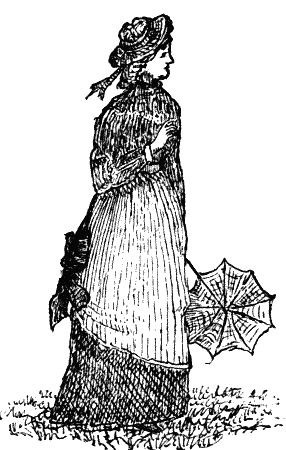
The Enchantress.
Suddenly an unexpected, an unhoped for influence appeared upon the scene. A young lady, who apparently had a nephew or niece among the children, strolled toward the water's edge a little way from the boats, and amused herself with the gambols of a huge water-dog. The parlor critic would scarcely have called her beautiful—probably at the Court of Jove there were goddesses more beautiful than Juno, nevertheless Juno ruled men as no rival beauty did. The lady with the dog noticed no member of the expedition, but it was impossible for the mariners to be as unconcerned in return, for maidens who are embodiments of health, strength, grace and modesty are not seen often enough even where maidens most do congregate. The Commodore sat down and leaned against a tree to hide the dusty back of his shirt; the Purser made haste to don a blue jacket which he had fortunately brought with him; the Vice, who, apparently with malice aforethought, had shaved himself, sat in his canoe, adjusted his statesmanlike glasses, and took full satisfaction out of the ennobling spectacle, while the Cook, with characteristic modesty, crept within the tent, where he might behold and yet remain invisible. When the lady departed, as unfortunately she did, the quartette debated whether she went on wings, or floated off on one of the clouds that were hovering about, or was wafted away by the fortunate breezes which could express their admiration without being suspected of forwardness or flattery, or, whether she was suddenly translated to a better world, as the Vice enthusiastically declared was no more than her desert. And yet, the material optics of every member of that expedition knew that the lady walked away upon her own feet, as any ordinary mortal would have done, for each of them had gazed industriously after her as long as her form was visible. The difference of opinion led to no dispute, however, for the manners of the expedition had noticeably improved within an hour, and though no canoeist had modified his apparel in any way, each man had something in his face which made him more presentable.
Meanwhile the little clouds which had been previously acting, each for itself, gathered in convention, resolved that in union there was strength, and then proceeded to business. The merry children, with juvenile trust in nature, suspected nothing until they felt it, and then protests were of no avail. But the Commodore took charge of the entire party, and massed it within the expedition's tent, where the children had a glorious time while the navigators strolled about outside and made-believe enjoy the heaven-sent shower-bath. Then the shower departed and so did the children, the shades of night were drawn, and behind these the expedition hid itself while it changed its soaked clothing. Then it lit its evening candle and prepared for bed, the Vice and the Purser insisting that the evening couches should be within the tent instead of the boats. While in the preliminary stages of a discussion, however, a vivacious small dog announced the approach of visitors, and then ushered to the front of the tent a gentleman, a lady and a small hand-wagon. The couple proved to be the parents of one of the children who had been sheltered by the tent during the afternoon, and they had called to express their thanks, some of which were from the tongue and heart, while others were from the hand-wagon, and consisted of bottles of excellent ale, a huge loaf of cake, some dainty preserves, etc. The gentleman proved to be an ex-officer of a famous Canadian regiment, so the Commodore and the Cook talked military affairs with him; he knew all about Dominion politics, so he and the Vice found a point of contact; he was also of English birth, and when the Purser learned this, he monopolized him, and the couple talked church and agriculture, Gladstone and Melton-Mowbray pork pies, while the lady exhibited a degree of tact and vivacity which prevented the other gentlemen from remembering that the place was not a parlor, and that they themselves were not within their respective funereal dress suits. Then several citizens with aquatic tastes dropped in, one by one, and offered various generous hospitalities, and the result of it all was that the expedition thought no more of its shabbiness than if this condition had suddenly gone out of existence.
It was not until an unprecedentedly late hour that the last visitor departed, and the members of the squadron retired with a faint notion that rain was again beginning to patter upon the leaves overhead.
IX. AREAS OF RAIN.
SLEEP was sedulously courted this morning by the entire squadron, for not only did the late hours and social dissipations of the preceding night have a soporific effect, but a steady rain had set in during the small hours, and not even the Cook felt any disposition to arise and shine. The tent was rather close quarters for four, so the Commodore had slept in his canoe, and for him rising meant stepping out of a dry nest into a steady down-pour. After a while, however, voices began to issue from the tent and a desire for breakfast soon asserted itself. As the camp was in the outskirts of a town, no wood was to be had save through purchase, so the Rob-Roy cuisine was resorted to with eminent success, and a wandering small boy who spoke nothing but Kanuck of the most rudimentary description, was persuaded to fill an order from the maternal larder.
Breakfast was at last finished, and numerous pipes were smoked to kill time until the rain should cease, but still it poured down with such steady persistency, that it had its effect even upon the buoyant spirits of the quartette. The sole objects of interest which presented themselves were boats laden with hay which drove past the tent-door down the river before the wind. These the Commodore sketched with the adjoining result, and then relapsing into a state of demoralization was maliciously portrayed by the artist on page 147. At length the showers became intermittent, and the two division commanders sallied forth in different directions to collate information regarding the rapids.
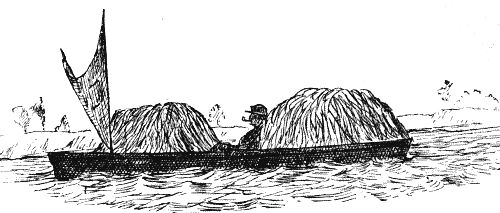
Aristocratic.
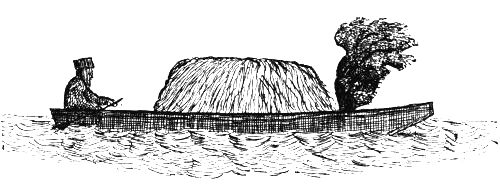
Plebeian.
"One charm of the character of your true rural," remarked the Commodore, on their return to compare notes, "is that he is unconventional. When you have learned the opinions of one, upon matters about him, you are not justified in accepting them as those of the community at large."
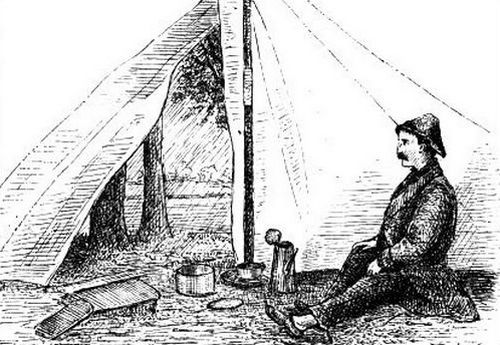
The Commodore Weather Bound.
"Very true," said the Vice. "I have spent two hours in interviewing the honest villagers near the waterside, to ascertain if the rapids, which begin a short half mile below, are passable, and from no two of them did I get the same reply. One said yes, another said no, a third looked doubtful, a fourth encouraging, number five was dumb, and from a dozen or two others I obtained enough of shrugs, gestures, and facial contortions to supply the clown of a pantomime. So little recks your true rural of what doesn't particularly concern him that one fellow, who works in a flour-mill, informed me that there were no rapids whatever, any where in the river."
"Proof positive that he doesn't pay taxes upon property," said the Commodore. "The tax-collector is the grand educator upon local geography: hence, the most intelligent nations of Europe are those which are taxed heaviest."
"The Turks, for instance," suggested the Vice. "I accept your theory, however, for the sake of offering it back to you as proof positive that we Americans are the most intelligent people on the face of the globe."
"The exact bearings of taxation upon the passability of rapids," said the Commodore, "may be clear to a statesman's mind, but the editorial brain fails to record any impression regarding it. The question is, are we to run the rapids or pass around them by canal? I propose first to listen to the counsels of my captains, and then to act according to my own. Officers will speak in reverse order of rank. Cook?"
"Run the rapids by all means," promptly replied the Cook, who had no nautical reputation to lose, but might gain an immense amount without exceeding the demand.
"Purser?" said the Commodore.
The custodian of the fleet's treasure tossed his auburn locks gaily behind his ears, and replied,
"As well ask the bird if it would soar heavenward, the imprisoned soul if it would yearn for light, the poet if he would seek his ideal!"
"Or a duck could he swim," put in the Vice.
"Do you mean that you prefer to run the rapids?" asked the Commodore.
"Certainly," replied the Purser.
"Say so, then," said the Commodore, with editorial sternness, "Vice?"
"The one delight of a canoe cruise," said the Vice, "is to run rapids. I don't know of another joy that compares with it, unless it be that of a Presidential campaign full of personalities."
"I decide in favor of the canal," said the Commodore. "My duty to society demands it. Moreover, I encountered this morning a large number of natives, all of whom without a single exception assured me that the rapids could not be run. Running unknown rapids is attended by considerable danger, and while the loss of a Statesman, an Artist or a Scribbler might be a blessing to suffering humanity, an Editor cannot be spared. Editors are born, not made, and are consequently very rare."
"Which fact, like that of the crocodile destroying its young," remarked the Vice, "is a proof of the merciful interposition of Providence to save the human race from what might otherwise be a terrible scourge."
As the natives had missed neither spoons, poultry nor any other easily secreted property during the night, they viewed the departing fleet with kindly eyes, and pressed sundry favors upon it. The expedition attempted to advance in column under sail, but it speedily became involved in difficulties with sundry saw-logs and slightly submerged ropes, until all available seamanship was called into exercise to avoid humiliating disaster. When the entrance to the canal was reached, the navigators discovered that the water was spanned, at short intervals, by bridges not only so low as to compel the striking of masts, but also to necessitate the striking of signal staffs fore and aft, and the temporary assumption, by the various commanders, of a physical attitude most truly devout. As the fourth bridge was approached by the expedition, it was also reached by an industrious shower, and no one made haste to pass from under the cover afforded by the structure.
"Think of the poor sailors on the broad ocean, with no bridge to shelter them," remarked the Cook, as he improved the opportunity to light a peaceful pipe. Just then a small stream of water, in search of its final level, meandered between two planks of the bridge, and trickled into the Cook's pipe, producing a sizzle which seemed to greatly titillate the nerves of those who were not smoking. Then another stream struck the helmet of the Vice and broke into what would have been a graceful cascade had not its perfect curve been broken by the official nose. The Purser bowed his head to avoid showing unseemly merriment at the expense of his superior officer, when another stream, heavily charged with the soil which wagons had deposited upon the bridge, insinuated itself between his shirt and his skin. Then began a magnificent but ineffectual struggle of mind against matter. Given, a bridge the planks of which were not more than ten inches wide, and several men whose shoulders exceeded in width any two of the planks, and whose depth of chest, with its environment, also exceeded the distance between any two cracks, and the reader will perceive, more freely than by any logical form of demonstration, the utter futility of free will in a contest against destiny. The best that man can do in such an unequal conflict is to prepare himself as well as possible for the blow, and this the Commodore did by throwing a rubber poncho (a square sheet with a hole in the middle) over his head, the ends dropping outside the gunwales of the boat, and shedding the water into the canal. The wooden decks of the Chrysalids kept water from dripping into the boats except amidships, the oilcloth decking of the flagship served a similar purpose, but the inside of the Cherub was soon deplorable in the extreme.
In time the sun banished the shower, and under its beams the canoeists brightened sufficiently to drop into song, beating time with their paddles. As they approached one bridge, and recurred to the reflection that civilization has its penalties as well as its pleasures, the keeper of the bridge good-naturedly opened it.
"By Jove!" exclaimed the Commodore, "no one but a Frenchman would have been civil enough to do that. Let's sing the 'Marseillaise' for him, and remind him of his far distant home. Now!
'Allons, enfants de la patrie. Le jour de gloire est arrivè.'"
The song was given with spirit, and with that confidence of accent which song somehow inspires. The squadron, in perfect line, and keeping a rhythmic stroke as of one man, reached the bridge just as they struck the refrain,—
"Aux armes, citoyens! Formez vos battalions! Marchez, marchez, qu'un sang impur, Abreuve nos sillons."
The bridge-keeper raised himself from the leaning position which he had at first assumed, his eye brightened, a flush of red showed under the dark brown of his cheek.
"That's a magnificent song," he shouted in French. "What do you call it?"
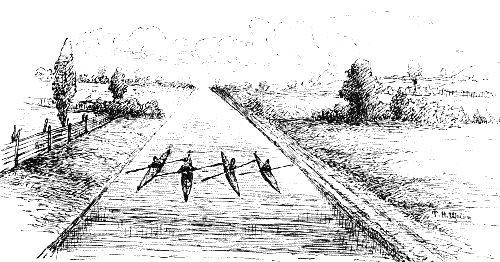
Aux Armes Citoyennes.
Four paddles stopped abruptly in mid-air, four men stared blankly at each other, then the Commodore sank back into his cockpit as nerveless as Salvini in the finale of "La Morte Civile." In a moment he recovered himself enough to gasp,
"True enough; the ancestors of these French Canadians came over a century before Rouget de Lisle was born!"
"What?" exclaimed the Vice, hastily backing out of line and turning his boat, "and that poor fellow knows nothing of the glory of his race, of the rights of man, and things? I'll go back and enlighten him."
"Let him alone," said the Purser. "He knows enough to be polite and sympathetic—to volunteer extra labor that others may be saved annoyance, so he knows more of the rights of man than you can teach him."
The Vice meekly drew back into line, merely asking if it was not nearly dinner-time. As one bank of the canal was heavily covered with weeds, and the other was being frequently traversed by tow-horses, the noon-day meal was taken in the boats, the four being temporarily lashed together that the various viands might be passed back and forth without danger of being dropped overboard. The leisure consequent upon dining enabled the squadron to observe critically the crews of the various barges that passed, and to learn that although the spirit of trade has not altered the French canal-boatmen of Canada from their national model, the environment of circumstance has made the rider of the canal-horse like unto his brother navigators of all climes. The remarks which these gentlemen volunteered as they passed the squadron were all couched in the French tongue, but the accent was that of the Erie canal, the Delaware and Hudson, and all other watery highways upon which the motive power is equine or mulish.
These canalers indeed, as was quickly evident, were of cosmopolitan or at least of republican habit, for so personal did their remarks become that some means of retaliation or self-defence was manifestly necessary. Dignified silence is all very well, but your modern canaler does not appreciate it in the traditional fashion, and when a quiet professional gentleman is invited to "come out of that and have a head put on him" by a burly ruffian, it is apparent that the policy of silence is not always that of wisdom. Under these circumstances it occurred to the Vice, who had been a "Son of Malta," that portions of the extinct ritual might be made available. The Cook was accordingly instructed to hang the expeditionary frying-pan over his forward-thwart and provide himself with a short baton, wherewith to beat it after the manner of a Chinese gong. The next "Bargees" that we encountered opened the usual conversation, inquiring where we were from, and where bound, all which questions were answered with due civility. Then the chaff element cropped out.
"Say, Boss, whar did you get that hat?" The remark was addressed to the Commodore who headed the line. In a resonant voice that officer repeated: "He asks where did I get my hat."
Then the Vice, "He asks where did he get his hat?"
Then the Purser, "He asks where did he get his hat?"
Then the Cook, "He asks where did he get his hat?" and then lifting his bâton he proclaimed in a stentorian voice RECORDED! and mightily smote the frying-pan till it rung again. The invariable sequence of this was a momentary pause, during which the squadron usually passed out of ear-shot. Sometimes however, the canalers attempted a continuation of the attack, as for instance:
"Now then," (but really this part of the sentence can only be represented by blanks) "Come out o' that, and I'll learn yer."
Commodore. "He calls us scions of a noble race."
Vice. "He calls us scions of a noble race."
Purser. "He calls us scions of a noble race."
Cook. "He calls us scions of a noble race. Recorded! Whang!!"
"The recorded answer turneth away chaff," said the Vice somewhat irreverently after the success of the experiment was established, and so it was, for the profane resources of the most fluent mule-driver failed him in the presence of the frying-pan.
Soon after dinner the squadron approached a lock, and the Commodore went ashore to exhibit the passes of his command. As the collective measurement of the boats did not reach ten tons, the four had been included in a single pass, the cost of which was twenty cents, and this sufficed for the dozen locks which were to be passed before the smooth water of the river could again be reached. It was probably a realization of the small amount of money which their labor represented which made the various lock-keepers so solemn of mien as they labored over their gates to let the Liliputian squadron through. The walls of each lock were substantially built of huge blocks of grey stone, and as the water subsided rapidly the Artist imagined himself being let down into a dark dungeon. He hastily drew his portfolio from a locker, and proceeded to sketch a study for a "Prisoner of Chillon," hugging the shady side of the lock as he did so. The sketch proceeded to his satisfaction, and then some loose earth behind the stones ejected through a crack some of its superfluous moisture in a parabolic curve over the Artist's shoulder, and upon the sketch, putting in some half tints which gave the picture an air of extreme realism and antiquity.
Reaching at length a long stretch of canal upon which no boats were visible, the squadron disembarked and washed its respective faces with soap, an operation rendered necessary by the drippings it had encountered under the bridge, and during the various showers. An hour later, the face of the Vice looked as if it had been liberally but carelessly patched with court-plaster. Fragments of skin fluttered aimlessly from his cheeks and brow, while his Roman nose was as picturesque as the brown shoulders of a tramp who had lately begged a very ragged white shirt. The Vice became conscious that he was attracting attention, and a pocket-mirror, furtively consulted, revealed to him the cause. He passed his mirror to the others, and the merriment of the party came to a sudden stop, for every one else was displaying symptoms of impending trouble of the same sort. Not one of them had experienced an hour of sunshine a day for months; their faces had been burning steadily for days, and the alkali of the soap had destroyed the last bond between the burned cuticle and that beneath. The Purser suggested that cold cream, being peculiarly a French production, could doubtless be found in the next village, but the Vice said him nay.
"Frenchmen who don't know the Marseillaise when they hear it," said he, "can't be expected to know anything about the appliances of modern civilization."
The morning's rain, the late start and sundry delays had hindered the fleet more than it realized, and the sun was setting before the canal was half-way passed. It became necessary therefore to camp on the canal bank, but this was no great hardship, as a smooth strip of green sward opportunely presented itself on the side away from the tow-path, as shown at the left of this sketch. A moral title is appended to this illustration because the Vice went off by himself after supplies and came back thoroughly sobered, as he intimated, by the sublime immensity of the canal, which, he said, stretched away before him like the narrow path which he remembered as depicted in the "Pilgrim's Progress" of his boyhood.
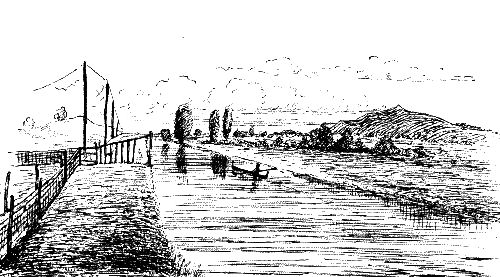
Alone with his Conscience.
Indeed there was a pastoral beauty about this canal which one is not apt to associate with artificial waterways. It was but a few miles in length and skirted a lovely valley, rich in historic association and beautifully diversified by wood and meadow, hill and stream. Beyond the lowlands, as shown in the sketch, rose a commanding and somewhat isolated mountain range which caught the last rays of the setting sun, and welcomed him again in the morning in such charming fashion that it was simple luxury to exist within the range of its influence. Since crossing the line, too, minor incidents of daily recurrence recalled the fact that this valley was first penetrated by emissaries of "Mother Church." On every side the little tin covered spires, one just like the other, arose, and at sunrise and sunset, the matin and vesper bells sent their notes far and near, reminding all within range that the priest was at the altar holding aloft the sacred emblems and repeating the angelus. The members of the expedition were all Protestants by birth and association, but there was not one of them who had not a tender spot in his heart when the bells rang out and he knew that hundreds of fellow beings, far and near, paused a moment at their tasks to repeat the prayer that the church had taught them to say. These little churches, of which this may serve as a type, form a charming feature of the Acadian land. You may walk into any of them at any hour, and some are very quaint, and in a strange fashion touching, in their interior design and adornment. It seemed as though the prayers of generations of simple minded folk were imprisoned there, willing and ever anxious to get up to heaven, if that were possible, and yet hampered somehow so that they did not make it out. Often as one or another of the quartette strolled into a village church and sat down in the suggestive silence, a man or woman would come in and kneeling repeat a prayer. To say that the act is mechanical and heartless is not to the purpose. It may be both mechanical and heartless, but it is not meaningless, and through it and other like observances, the church retains a tolerably strong hold upon a very considerable fraction of Christendom. Would that the home-feeling could be as successfully cultivated by some of our Protestant sects as it seems to be by the church of Rome. Perhaps however the home feeling as it there exists is incompatible with advanced thought, and the liquefaction of gases, and Boston Monday Lectures.
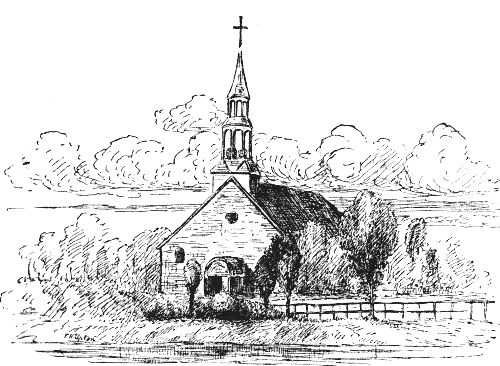
The Typical Church.
So at least the Vice was remarking when he suddenly became aware that a canal-propeller was coming down his recent straight and narrow path, towing behind her an endless chain of lumber barges. Anxiety for the boats banished every other sentiment. The Red Lakers were confidently trusted to take care of themselves by their commanders, but Chrysalids must be carefully tended and held off shore, lest the swell should dash them against the stone facing of the embankment. Considering what the Rochefort had been through on her various lee shores, this solicitude seemed rather superfluous. Furthermore, no perceptible swell was caused by the passage of the tow, and the only notable result was that the Purser, in his anxiety to hold the Arethusela off shore with a boat-hook, lost his balance and took a ducking, much to the amusement of spectators on the canal boats.
An exquisite moonlit night was this on the canal. The tent stood white against the grassy bank, the canal glittered, from far away could be heard the hoarse roar of rapids, and farther still the blue mountain range rose flat against the sky as if it had no irregularities save those which marked its outline. Only one anxiety marred the serenity of the fleet.
Ever since "the Enchantress" arose upon its horizon, one member of the command who shall be nameless, had not been quite in his right mind. While passing along the canal, he had evinced a preference for such airs as "Annie Laurie" and "The Girl I left behind Me," while the "Mulligan Guards" and the Marseillaise failed to stir his soul as was their wont. This evening he passed walking up and down the canal bank in the moonlight, apart from the rest, and he was even suspected of declaiming poetry sotto-voce. There the squadron left him when it turned in.
After a long interval of quiet, no one knows what the hour was, the sleepers were softly awakened by the enthusiast, who by the straggling moonbeams was seen with a finger on his lips as an injunction of silence, while with the other hand he pointed toward the remains of the camp-fire in front of the tent. Each man arose noiselessly; one softly cocked his revolver, another grasped a boat hook, while a third clutched two empty beer-bottles, stole out of the tent, and peered warily about, in the shadows of the trees. Each man saw that the boats were safe, and as all cargoes had been removed to the tent before nightfall, the nature of the danger which impended could not be imagined by any one. The demented man threw several twigs upon the smouldering embers, thus making a bright light; then he squatted near the fire, motioned to the others to take similar attitudes, and spoke thus to his mystified auditors:
"Gentlemen, for years I have endeavored to formulate a definition of the phrase 'pretty girl;' not to give a mere literal description, but one which should be artistic as well as truthful, and have the virtue, peculiar to all true art, of suggesting more than it says. At last I have fully succeeded; or, rather, a glorious inspiration has enlightened me. Before disclosing this marvel of truth and poetry, I beg you to give me your own definitions of the same precious phrase—they will be useful by way of contrast."
"I can better tell you what a pretty girl is not," answered one of the party promptly. "She is not an imbecile who rouses people at dead of night for the idiotic purpose of revising standard lexicography."
"Nor is she," quoth another, who, being a very light sleeper, sprang to his feet, in a violent fit of trembling, on being aroused, "nor is she a being who will in cold blood frighten an honest fellow almost to death."
"Nor a person whose literary musings disturb the slumber of any one, unless, haply, he be editor of a paper containing a poet's column," said the third.
"Listen, then," replied the lunatic, his look of scorn giving place to a lambent light from within, which irradiated his pale features. "A pretty girl is a person from whose glass you are willing to drink, after she is done with it."
For several moments there was dead silence, then somebody asked in the iciest of tones,
"And you aroused us only for the purpose of imparting this."
"I did."
"Have I offered you a single affront since the cruise began?" asked another. "I certainly have tried hard to do my duty, and have never discriminated knowingly against any one."
"You are guiltless," was the reply.
"I suppose I am the guilty one," groaned the third. "I gave him a cigar to-day which was not what it should have been. But how out of all proportion to the offence is the punishment!"
The object of these denunciations, remaining unchanged of mien, began again to pace the bank beneath the moonbeams, while his companions returned to their blankets and failed miserably to devise any vengeance commensurate with his shameful act.
At length the wisest of the trio, raising himself on his elbow, exclaimed "I have it—make him marry one."
X. ACADIA.
AT length the voyagers seemed really in Acadia. A large village at the lower end of the canal exhibited in charming profusion the red-tiled roofs, white stuccoed cottages, and verandahs peculiar to French village architecture; all signs over the shop-doors were in French, and nearly all of them indicated that spirituous liquors were sold there; the native stare was of short duration and respectful, instead of long drawn and insolent, as it would have been at any canal terminus in the United States, and the village dogs did not respond to whistles delivered in the American manner. A single new house with Mansard roof had intruded itself in the village, but the Cook promptly suggested that it must belong to some fugitive American statesman, so it could not be considered as part of the village proper.
At this suggestion the Vice became pensive and was presently discovered questioning a resident as to the personal appearance of certain American sojourners. His curiosity was pardonable as he had been conspicuous in breaking up a famous metropolitan Ring, and knew personally some of its fugitive fragments.
No factory reared its horrid front aloft, so the village maidens were meek-eyed and healthy, and the young men did not congregate at street corners with hands in pockets. Two or three score of men stood upon the walls of the final lock, to look at the boats, but they displayed none of the officious curiosity which any able-bodied American citizen would have considered necessary under like circumstances. To the Commodore, the Purser and the Cook the change from the restless activity with which they were familiar was inexpressibly delightful, but the Vice regarded everything with cold suspicion.
"The natural result of monarchical rule," was his incessant comment upon whatever he saw. "There is waterpower enough going to waste," said he, pointing to the rapids, "for a manufacturing city such as the world has never seen. Capital would be attracted, labor would follow, facilities for navigation would increase, farmers would have a home market for their produce, real estate would increase in value, and local politics would become a science. But see it as it is! Why, I doubt if it has a board of aldermen, or even a mayor!"
"Then it is Acadia indeed," murmured the Purser, raising his head from a sketch he had hastily made of a sweet-faced girl who was gazing wonderingly yet modestly from a window.
The Water Front.
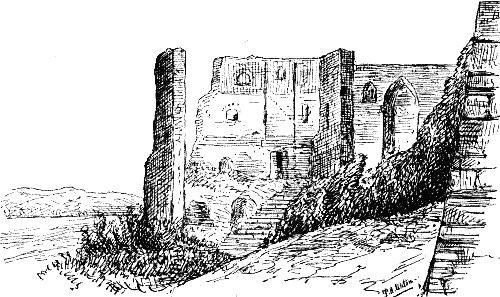
From the river below the lock the expedition saw the foot of the rapids, and near them a ruined fort. A double invitation to view the picturesque was not to be declined, so every one paddled up as far as the rapids would allow. The fort bore date of 1711, and tradition said that it had been constructed for defence against the Indians, in the days when Canada was still New France, from which it was safe to infer that the North American savage was not in the habit of rounding rapids by canal when he disported himself in his light canoe. The work had been stripped to its bare walls, not by relic-hunters but by searchers after seasoned fuel, and its water-wall had fallen in, but enough remained to show the plan of the work. The Commodore and the Purser broiled in the sun at the gateless sally-port and endeavored to reconstruct the work in the interest of romance. They filled it with picturesque men-at-arms, gallant officers, and venerable priests, and took care not to omit the occasional Indian maiden, while the Vice calculated the cost of transforming the work into a distillery, and the Cook, who had climbed to a sealed loophole overhead in search of reflections which did not appear, gently led the thoughts of the romancers back to the real by an occasional shower of partly pulverized mortar.
It presently occurred to him, however, that the stock of bread was running low, only one loaf being left from the supply laid in beyond the line. He accordingly made a requisition on the Purser for the necessary funds and paddled off to the village. In a few moments he was seen returning, partly concealed behind something which he had placed on the forward deck. As the bow touched the sand the mysterious object was seen to be merely a loaf of bread beside which, for the sake of contrast, the Cook had laid the remaining loaf of the United States pattern.
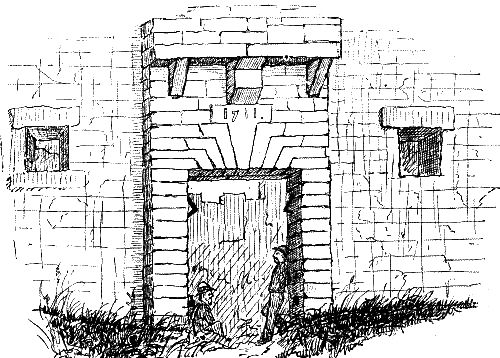
No Ruins in America (Ruskin).
The Vice regarded the two with a puzzled air. "Why," he asked, "should forty millions of people living in a free republic, be content with loaves of such diminutive size when the subjects of a despotic monarchy are provided with bread on a scale so truly magnificent?"
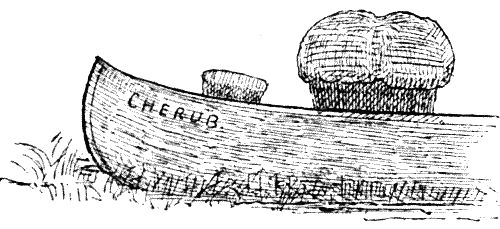
Two Loaves—a Contrast.
"The loaves are to one another in an inverse proportion to the population which they represent," said the Cook.
In quality and price, this loaf compares favorably with that of the American baker, but in size and shape it is unlike anything that elsewhere exists under the same name. Its shape is that of a cloven mountain, and its size—well, if such loaves were used in Judea eighteen hundred years ago, the miracle of the feeding of the five thousand would not seem so very wonderful after all. A single loaf materially increased the draft of the Cook's boat, and had he bought four, as he had expected to do, it would have been necessary to have chartered a store-ship.
As the party sat in the shadow of one of the water bastions and viewed the rapids in their changing forms but changeless beauty, the Vice fell into gloomy reverie.
"It's always so," said he. "We've paddled through a straight cut canal for ten miles, been drenched with water and wind, jeered by mule-drivers, and in French, too,—loosened the skin from our faces, caused heaven only knows how much inward profanity among lock-keepers, lost a whole day and ten miles of scenery, and all because we were afraid to run the rapids, which would have brought us here in an hour. It's the same way in politics; caution means labor and trouble, but if you dash ahead in spite of every thing and every body, you're sure to come out all right. The Alderman always said—"
"It isn't too late yet," interrupted the Commodore. "I am so desirous of seeing some one run those rapids that I will be one of any two to carry your boat as far up the stream as you like, if you will run down in her."
"Agreed!" shouted the Vice, "but—" here he prudently admitted to himself the defects of the model of his boat, "I wonder if the Cook wouldn't rather do it in the Cherub—you will find it far the easier to carry."
"Certainly," replied the Cook; "besides, she is far safer, faster and more manageable than your craft. She has no keel to catch upon a rock and tip one over, and her peculiar construction makes it impossible to start a leak, no matter how hard you may strike a stone with her."
The Cherub was promptly unloaded and carried up the stream half a mile, when the Cook seeing an almost unbroken line of rocks crossing the river, stopped her bearers. He then divested himself of all clothing except such as is technically denominated "gents underwear." The boat was placed in the water, heading up stream, and the Cook embarked, bracing his back against the amidship thwart, and his knees against the sides. The painter was thrown in, and he started to paddle out into the stream, but the current was in the habit of working its own sweet will upon floating bodies, and it promptly signified as much to the Cook by whirling him around so rapidly that the force of rotary motion almost deprived him of his scalp and whiskers—his helmet he had thoughtfully left ashore. Then the boat danced merrily along, saluting each inviting rock with a long soft caress, yet obeying the paddle with an alacrity of which no Chrysalid canoe could ever be capable. The time occupied by the trip seemed so great to the Cook, that a thousand years added or subtracted would have had no perceptible influence upon the total; according to the Commodore's pulse, however, (all watches having stopped) rather less than four minutes had elapsed since the start when the Cook paddled the Cherub up to the smooth beach below the rapid, and found that she had not shipped a drop of water, nor started, in striking the rocks, anything more important than varnish.
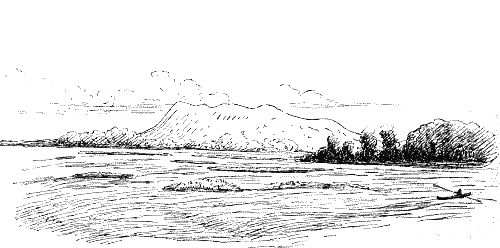
Down the Rapids.
The four sat for a while longer under the shadow of the main gateway, and then proceeded on their way in order to reach a camping ground not in the immediate vicinity of any village.
Upon the broad basin into which the river spread below the fort, the sun shone with a fierceness which set at naught the vulgar theory that solar heat decreases as one goes northward. The voyagers decided, without a dissenting voice, that the isothermal line which reached this portion of Canada was that of the Desert of Sahara, and the Vice, whose scientific ideas were rather vague, suggested that it had probably passed through several blast-furnaces and a ratification meeting on its way north. A gentle breeze finally came to the relief of the party, and at the same time there came certain of the natives to inquire about the speed, etc., of the boats, and as the river at this point was very wide, and the canoeists were not averse to displaying their seamanship, the boats were soon doing the picturesque to the delight of all beholders. Suddenly, however, the breeze took offence at something and vanished, leaving the boats a mile or two from shore. Paddles were manfully plied, the nearest shade upon the banks being several miles away. As no one but a denizen of the abode of the finally impenitent could realize what the heat of that afternoon actually was, it is extremely unlikely that the tale will ever be told, but the Purser solemnly declares unto this day that the sleeve of his blue flannel shirt was scorched by the sun.
The fresh meat purchased at the end of the canal having succumbed to the heat, the expedition went out in a body, on making camp, in search of animal food. The nearest house seemed miles away, so the Vice took to his favorite pastime of trolling for pickerel, the Purser went into the forest with the Vice's gun, and the Commodore and the Cook started, with boat-hooks, to secure bullfrogs for a fricassee. The Vice caught nothing, as men universally do when they troll, the Purser got nothing but a bruised shoulder, while the Commodore and the Cook, having failed to secure so much as a single batrachian, lost what little character they had for perseverance under difficulties, and swore roundly that the French inhabitants had hunted the frogs till they were too shy to be successfully harpooned. The voyagers fell back upon their canned provisions, made a tolerably satisfactory supper and straightway engaged in a discussion on the kinds of wood available in that most important branch of industry, the construction of canoes, and their accessories.
American white-cedar, they concluded, is undoubtedly the best of all woods for building light boats. It is now exported for this purpose to all parts of the world where artistic boat-building is practiced. Its structure is such that a blow or scrape, such as boats are likely to receive, merely indents without splintering or splitting. It is moreover very light. It has no special beauty of grain but takes varnish well and has an agreeable color, which improves with age.
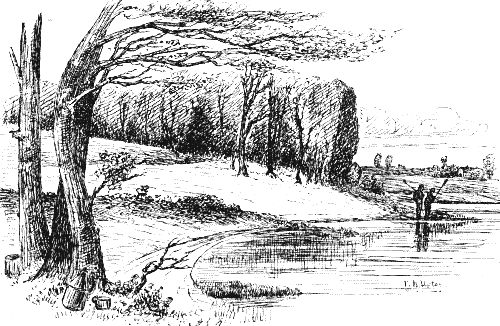
A Quiet Cove.
Oak is handsomer in appearance, but is too heavy and splinters badly at the edges when exposed to wear and tear. It is usually the best available wood for keels and timbers.
Spanish cedar splits too easily to be used for planking, but makes a handsome deck, and is strong enough when properly supported by carlines.
Butternut is a little heavier than cedar, but is somewhat harder and tougher, and is far more beautiful in color and grain. In point of texture and toughness there is small choice between the two. If one is willing to paddle a pound or two of additional weight for the sake of appearances, let him choose butternut. If not, white cedar is best. Clear butternut can be had in longer and wider strips than cedar.
For stem and stern posts hackmatack is given the preference, by nearly all builders. For the timbers, carlines, and interior braces of all sorts, tough, nonsplitable woods are used, different builders having different favorites.
The masts technically denominated the "main" and "dandy," may be of white-ash, spruce or pine—the last being lightest and weakest. They should be carried up without any taper, a short distance above the deck—say three feet for the main and two for the dandy. This is not very essential, it merely makes them bend more symmetrically under sail pressure. Ash is heavier than spruce, but more slender and graceful spars may be made from it, owing to its greater strength. The Commodore having tried both, rather prefers ash. Some members of the New York Club have used bamboo for masts with satisfactory results; for its weight it is certainly the strongest of spars, and in appearance it is all that can be desired, except that it does not taper quite enough at the top to suit a fastidious eye. This objection might be overcome by using a topmast of pine or spruce.
It is almost always convenient to have the masts of a canoe jointed, so that they can be readily stowed below decks. The simplest and cheapest way is to place the mast so that it shall be an inch and a quarter or less at the joint, that being the largest regular size of fishing-rod ferrules. Such joints have been fully tested and are strong enough. The device known as the "sliding gunter" is a brass fitting which holds the main topmast and slides up and down the mainmast, operated by a halyard. It works very well when in perfect order, but is apt to give trouble when the parts get wet. Moreover it necessitates a clumsily large lower-mast, since this part must be deeply grooved to receive the topmast-halyard over which the "gunter" slides. The Vice who has tried the sliding gunter rig has decided to adopt a simple nine-foot mast with a mainsail like that shown in the illustration on page 107, and a ferrule joint. The sail runs up and down on rings as do those of the Red Lakers, and having throat and peak halyards attached to the gaff, the peak can be dropped or raised without lowering the sail. This has the effect of reefing and shaking out without the bother of tying the reef-points shown in the sketch referred to, on the lower part of the mainsail.
The Red Lakers, by the way, are reefed by means of a small brass S. hook carried at the peak of each sail. The sail is lowered away and this hook passed through any one of the rings on which it runs. When hoisted again the sail is of course correspondingly reduced in area.
It was ten o'clock before the squadron had settled all this and was content to turn in.
XI. SEVERAL OTHER DAYS.
THE disgust of the voyagers on the next morning, when they found themselves reduced to breakfasting on bread and coffee, was provocative of vigorous paddling, and a large town was soon reached. The voyagers passed en route a small Indian camp, in which were exhibited some of the positive results of civilized environment, for one of the men had a beard, and the only visible squaw wore an apron with pockets. As the town was one at which the expedition expected many letters, there was a movement in force upon the post-office, which consisted of two cigar boxes upon the table of a sitting-room; one of these contained letters received, and the other mail matter to be transmitted; one contained, after the expedition had received its letters, a single postal card, and the other, when the voyagers deposited their home and business correspondence, was so full that the pleasant lady in charge was visibly affected by the sudden increase of business. There were several streets of very old and very quaint cottages, and a church, externally a duplicate of every other church on the river, and containing an odd yet touching assortment of votive offerings. Among these was a huge model of a full-rigged ship; this swung aloft from the centre of the ceiling, and doubtless kept nervous worshippers from the pews directly beneath it. The value of such an object of contemplation must be inestimable for the adolescent portion of the congregation, that is if the Acadian fancy is as much given over to dreams of piratical adventure on the high seas, as is that of American youth.
Three women were upon their knees in the church; two were utterly oblivious to the entrance of the outlandish foreign quartette, but the third kept alive the faith of man in womanish curiosity, for she stared at the party as long as it was visible. The four sailors walked around the side aisles past the "Stations of the Cross," more, it must be admitted, from longings artistic rather than devout, and were about to leave the church, when two bright looking youths of seventeen or eighteen entered the organ loft, and sang several hymns, accompanying themselves with the organ which was presumably blown by a third. The Vice interviewed them and asked what portion of the service they had been conducting, and learned that they had been singing merely for amusement. Fancy two healthy young Americans going into church during business hours, and singing hymns for purposes of personal diversion! Their associates would promptly cut their acquaintance, their employers would discharge them for laziness, and their parents, if truly affectionate, would hasten to call a physician skilled in treating the victims of mental aberration. The quartette concluded that their fond imaginings regarding the uses of aerial ships had been at fault. Maritime adventure can have no place in the Acadian mind.
A careful survey of the picturesque little hamlet showed that it was infested, though not infected, by a railroad; from this the whole village shrunk away, so that a modern "Railway Hotel," which stood near the station, stood alone, in unrelieved ugliness. The Vice, with his prejudice against every thing foreign, insisted upon the expedition dining at this hotel, because it reminded him of home, and within half an hour he endured the worst meal that had ever been set before him. The Cook, who had been detailed to watch the boats while his associates dined, sank into a peaceful slumber in the Cherub, and became an object of interest to several natives and many hundreds of flies. The former, though somewhat curious, were too polite to arouse the sleeping watchman, but the latter being evidently summer visitors from the States, had neither conscience nor modesty, so the slumberer awoke and devoted some moments to drowsy sympathy for the defunct Pharaoh and his people who suffered under the seventh plague. Then he paced the river-bank, looking about for the picturesque, and was rewarded by a glimpse of the old, old story, which went down the river road between a bashful young man and a comely maiden.
Near this point the river contained several beautiful islands, and to one of these the squadron made its way after dinner. The distance was small—a mere matter of five miles—but the fact that it had to be traversed by paddle and under a blazing sun, caused the trip to seem fully long enough for an afternoon voyage. A delightful camping ground was finally reached, however; a narrow grassy plateau spreading itself under a belt of thick trees, with lovely outlooks up and down the river. It was the Commodore's tour of duty for forage, and after a lesson in Canadian French from the Vice, who had it at second hand from the Alderman, he paddled over to the mainland. The substance of his instructions was that milk instead of being "lait" was "lât," sounding the final "T," also that the final "S" was in most cases sounded. He tried the nearest house.
"Bon jour, Madame. Avez vous du lât, à vendre?" Glances exchanged among the members of the household with frequent repetitions of the word "lât."
"Comment, M'sieu?"
The Commodore repeated the sentence. Same effect.
"Ne comprens pas."
Another trial with some changes of structure and pronunciation.
"M'sieu, we no speak Anglais."
The Commodore went his way to the next house, half a mile distant, and protected by a black dog of great apparent enterprise. Interview substantially duplicated.
At the third house the discovery was made that the Alderman's information as to the pronunciation of "lait" was erroneous.
Pronouncing the word in usual manner he was readily understood, but there was no milk to be had. So he paddled over to the island again and approached the somewhat "swell" mansion of the proprietor, which had been shunned in the first instance because the occupants of such mansions not infrequently scorn the advances of canoeists in the direction of supplies. Ascending a footpath from the landing, the Commodore found himself before a square brick house standing in the midst of forest trees, many being superb specimens of spruce and balsam, which sent their perfect spires of green sixty or seventy feet upward. The underbrush had been cleared away, so that a somewhat broken lawn spread from the house to the edge of the bluff, and through the tree-trunks there opened an expanse of rich meadow-land dotted with cottages crossed by lines of dark coniferous woods, and backed by the blue Belœil range. Lost in the contemplation of the delicious landscape, the Commodore was for a time merged in the love of nature, but a rude interruption was in store for him. No sign of human life had been visible when he turned his back upon the house and became absorbed in the contemplation of the beautiful, but a sudden bark rang upon the air and was instantly taken up, as it seemed from all parts of the island. The case of James Fitzjames and the ambuscaded Highlanders flashed through his mind as a parallel one:
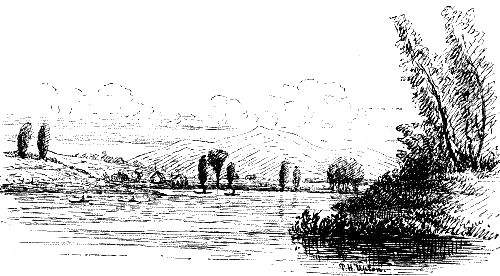
A Charming Landscape.
"Instant through copse and heath arose Bonnets and spears and bended bows."
He turned from the scene which the Artist has depicted and beheld what is shown on the following page. The apparent relative dimensions of himself and the dogs are faithfully preserved.
On they came, but by this time the Commodorial soul had returned from its æsthetic wanderings. If there is one thing of which he is less afraid than another, it is dogs. Consequently when the leader, a shaggy brute of great external ferocity, reached him, he remarked in a low tone of voice, "One moment, old chap. You are making a great mistake. It is all right. I am going to the house for milk." "Major," for that turned out to be his name, accepted the explanation with perfect courtesy, told his followers that it wasn't the fellow he thought, and would they hush their noise, and so all fared along together with occasional growls from still suspicious members of the cortége, and turned the corner of the house, where were seen two seemly maidens of the peasant class, sitting on a verandah with their needle-work.
"Bon jour, Mesdemoiselles," said the Commodore, raising his helmet. "Nous sommes campé la-bas, et nous avons besoin de lait, de pain et de beurre." The last few words had a reassuring Olendorfesque sound, which, as it were, set the speaker on his pins.
The girls looked at one another doubtfully, "Il parle Allemand, n'est ce pas, Louise?" said one.
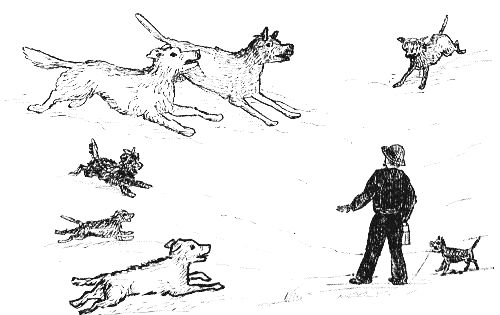
A Shock to the Commodore's Nerves.
"Mais non," said the other, "Je crois que c'est l'Anglais."
The Commodore seated himself on the steps and buried his head in his hands. One of the dogs whined and poked a cold, sympathetic nose against his cheek. It presently occurred to him that the silence, which was becoming embarrassing, was in danger of being broken by the irrepressible laughter of the young women, who continued their work with mischievous glances at their discomfited visitor. The Commodore is a bashful man, and it has always seemed to him that the laughter of girls is particularly and peculiarly derisive. However, by dint of frequent repetitions of "pain" "beurre" and "lait," he at length succeeded in making himself understood.
The two girls bestirred themselves to procure the desired articles, which by the way proved to be of excellent quality and of absurdly low price. Meanwhile the dogs had become so friendly as to be troublesome, and the two biggest were actually fighting for the privilege of receiving personal attention.
On hearing of this experience, the Purser, who is very fond of dogs, was anxious to be detailed for milk at once, and the Vice, who is,
"Steel amid the din of arms And wax amid the fair,"
longed to air his French in connection with the girls, whom the Commodore represented as possessed of rare charms and engaging manners. It was evident that there would be no trouble about the milk detail at this camp. Indeed a rivalry sprang up between the Purser and the Vice which was only kept within bounds by the necessity of a co-partnership, one being as hopelessly embarrassed in canine society as was the other in that of young women. It followed as a natural result that they invariably went for milk in company and were a long time in getting it. The Vice's French was cultivated to a degree which left him without a rival in the fleet, while the two always came back to camp with a retinue of dogs which nearly drove the Cook crazy by investigating the expeditionary stores.
On the grassy plateau before mentioned, the four graceful boats lay side by side, and in them as the fire burned low, the four voyagers composed themselves to rest, and the Cook and Purser were lulled to slumber by the tones of the Vice who pointed out the constellations, and discoursed learnedly of the precession of the equinoxes. The Commodore, who chanced to be somewhat wakeful, feigned an interest in astronomy, which he had never before displayed, and evinced such an appetite for sidereal nomenclature that he presently had the Vice out of bed, so to speak, and shiveringly endeavoring to discover certain hypothetical stars whose locality the Commodore carefully described, but which could not be seen from the recumbent position occupied by his companion. Having for a sufficient space indulged in this justifiable revenge for certain insubordinate acts on the part of the Vice, the Commodore suddenly became sleepy, and left the astronomer to discover the ruse at his leisure.
The next day was Sunday and sunny, and a canvass of commanders showed that the squadron was Sabbatarian to a degree which would almost satisfy a Pharisee. This feeling was so strong in the Vice, whose day it was to be scullion, that he volunteered to leave until Monday all dishes needing washing, but the Purser, who succeeded him with the dish-cloth, declined to exact any such extreme test of the Vice's fidelity to the fourth commandment. A suggestion, by the Cook, that the officers should attend divine service in a body, was voted down, on the ground, that the nearest church, whose spire was plainly visible down the river, was distant more than a Sabbath day journey. (N. B. There was no wind, and to paddle back from church would be to paddle against the current.) But the Cook was determined to go to church. He shaved himself, sponged his uniform into some semblance of neatness, oiled his shoes until they lost some of their rusty look, emptied the baggy breast-pockets of his shirt, unloaded his boat, and sponged out the inside. Then he washed and smoothed a white handkerchief, the latter operation being performed by folding the kerchief, "four double," placing it between two folds of a sail, and sitting determinedly upon it for the space of half an hour. Then the Cook carefully disposed the handkerchief in his pocket, so that some inches of white corner should show against the dark blue of his shirt; he bade his slothful companions a reproachful farewell, shoved his boat from shore, and started for the sanctuary. The distance was at least five miles, the sun very hot, and the hour uncertain, but regarding the latter the Cook had some experience in guessing time rudely by the apparent altitude of the sun, so he paddled briskly along, and though he perspired freely, the fact led him to compare himself, with considerable satisfaction, with the early American settlers who endured so much discomfort rather than remain away from church. That he had no prayer-book, and was rather unfamiliar with the Mass except as a verbal accompaniment to some of his favorite music, did not distress him greatly, for in truth he was not as intent upon worship as he might have been. He had gone to church in French-American settlements in other days, and had seen how the worshippers cast off the dingy garments of the farm and shop, and appeared in bright and costly raiment, so the Cook was now going to church principally in search of the picturesque. At the end of half an hour's paddling he saw that opposite the church he was aiming for there was another, which had been hitherto hidden by the foliage upon a small island. The sacred edifices, with their dependent villages, seemed to be of equal size, and the Cook was distraught with uncertainty as to which to visit. Then along the road of one bank he saw many vehicles passing at the trot and full of people. Couldn't be?—yes, it was true—that the service at one church was over. The Cook hastily took a racing stroke, and made for the other church, which was still a mile away, but suddenly a procession of carriages appeared from that direction. The Cook dubiously paused in mid-stream, endeavored to estimate the two lines of vehicles to ascertain which was most promising; then he ran his boat ashore and scrambled up the bank. A bramble claimed his handkerchief, but he did not pause to contest the claim; he dashed across the dusty road, seated himself on the top-rail of a fence, and rigidly inspected the occupants of the vehicles until of vehicles there were no more. Then with a sigh he descended from his perch and started to paddle back, against the current, to his camp and the hungry men for whom he had to prepare dinner. Even his small measure of Sabbatarian virtue had its reward, however, for just then there came along a tug towing a barge load of lumber; under its shady side the Cook found a convenient place to tie his own boat, while from the cabin-window of the barge, the Captain's black-eyed, black-haired wife, leaned and, taking the Cook for an innocent scull-racer from Montreal, warned him impressively against "the cheats, the hogs of Yankees," who would make his life miserable if he went on to the States.