CANOEING IN KANUCKIA. (continued 3)
Reading edition
On reaching camp the Cook found the Commodore and the Vice engaged in varnishing their somewhat tarnished boats, one using brown shellac, and the other, coach varnish of the costliest description.
"Shellac," the Commodore was saying, "is certainly inferior to your varnish in beauty of finish, but it dries in fifteen minutes, and stands water, for all that I can see, quite as well."
The Vice admitted disappointment in that the varnish which he had been at such pains to procure, turned a bluish-white color, when exposed to wet, recovering its lustre, however, on drying. This was certainly an objectionable feature, and marred the complexion of the Rochefort in a way that was highly exasperating to her owner, especially when his companions jeered him on the number of coats with which he had covered his boat.
"Look at my varnish," said the Cook finally after the others had somewhat exhausted the topic. "It is not shellac, neither is it coach varnish, yet the Cherub is arrayed in a coat which retains its lustre better than either of yours."
"What is it?"
"Even 'Pellucidite.' I know not the process whereby the lac is dissolved, which forms its basis, but it stands water better than any other that I know of, and is no more expensive than the ordinary kinds."
In fact after duly weighing the matter, the cruisers concluded that Pellucidite is the best varnish known to them for general use on canoes. It appears to be less affected by constant exposure than any other that they have tried.
"Varnishing," said the Vice, as he lay in the shade and contemplated the Rochefort glittering in the sun, "is perhaps the most ennobling way for a canoeist to spend his time after he has received his boat from the builder. Every coat you put on adds so much to her beauty. I believe I've gone over my boat in parts thirteen times."
"That's one thing that I don't like about a Chrysalid," said the Commodore. "Half your original outlay goes for fittings which it is much better fun to make yourself, and you have no recourse but to varnish and re-varnish. Now you get a Red Laker clear fore and aft—excepting two and a half feet of decking, at bow and stern, and you go to work and contrive and experiment in a manner highly stimulating to a properly organized mind, until you get her decked or covered over with a removable covering of wood or water-proof cloth, and rigged to suit you. I admit, though, that some people would rather pay more money and have less tinkering to do. Nevertheless I hold that tinkering is essentially a higher order of intellectual employment than is mere varnishing, admirable as that may be when used in moderation."
"There is enough to do in all conscience," replied the Vice, "about a Chrysalid. Look at my hatches. They consumed an enormous amount of brain force in the preparation."
As has been already stated, the Chrysalid boats have rather more than four feet of bow and stern devoted to water-tight compartments, which of course occupy a great deal of space, but are extremely useful in case of accident. These spaces the Vice had made available for light articles, such as extra clothing, etc., by cutting hatchways in his deck, and fastening them down by means of thumbscrews, the seams being rendered water-tight by strips of india rubber used as packing. Red Lakers, on the contrary, have all the room they want, but their water-tight compartments, if they have any, are only large enough for the purpose of flotation. Their owners therefore are fain to be content with water-proof bags or sheets for the protection of their haberdashery.
The charms of the natural scenery about the island finally lured the Vice away from the annotations which he was preparing for a new edition of "Jefferson's Manual," and he went with the Cook to explore a beautiful creek which emptied opposite the camp. Its charms were many, and its ways as devious as those of a woman about whom romancers write, so the couple followed it as a matter of course, until the declining sun warned them to return to their camp, but as they turned their boats' heads homeward they paddled only with leisurely strokes, so loth were they to leave the beautiful alternations of sunny hillside and shady grove, solitary giants of trees, and thickets full of birds, mats of lily pads, and bars covered with just water enough to enhance the brilliancy of their shining sands. The Cook heaved a deep sigh, and said,
"What a pity that this fair spot is where it is, among a set of peasants who are blind to its true value."
"Indeed it is," said the Vice. "There never was a finer bit of ground for a beer garden, and such a place would call for a brewery; this, in turn, would bring out an opposition establishment, and malt and hops would look up, while coopers would find steady employment."
"Mercy!" murmured the Cook imploringly, "mercy!"
"Or," continued the Vice, "it would make a beautiful park; not large to be sure, but there is enough forestland to clear, and enough bare land to plant with forest trees, to occupy a great many voters along about election time. Then the grades are such that the roads could be constructed only by an immense amount of work, and as there's no stone near by, the contract for road-filling would amount to a handsome thing. Properly managed, such a park would hold a party together for twenty years, unless some set of old fogies happened to impose a landscape gardener and architect upon the commissioners."
The Cook made haste to quit the creek and return to camp, and that same evening he experienced a severe bilious attack. As the Purser was already ill from a surfeit of rice and maple syrup at dinner, and the Vice was rapidly succumbing to the same viands, the Commodore charged himself with preparing a supper which should have for its principal feature an entirely new dish—to wit, fried frogs' legs. He had devised a beautiful method of taking the musical batrachians. He baited a very fine fish-hook with a bit of red flannel and affixed it to an eighty-foot trout-line. Then joining a fourteen foot rod he walked along the shady shore, and cast his line. Should the fisher for trout sneer at such outlandish fishing, and pot-fishing at that, he should know that to catch a bull-frog with hook and line requires a better eye and more skillful hand than are sufficient to successful trout-fishing. The frog never "rises" to the bait; the latter must be let gently down before his eyes and nose, and then, as he leisurely opens his jaws, be dropped into his mouth. The slightest breath of wind, or tremor of arm, causes the bait to graze the cheek of the game, and then an angry foot is lifted to brush it away, and a goggle eye rolls back reproachfully at the disturber. When the bait is taken, the frog seems to realize but slowly that anything unusual has occurred, and the sportsman is likely to accuse him of lacking the proper spirit of a game fish (or beast, or bird, whichever he may please to call it), but when the truth dawns upon the frog's mind he gives a leap, to view which would drive a kangaroo into mortification and suicide, and then goes for deep water with an alacrity which causes the reel to buzz merrily. Having tested the length of the line, however, his method changes to that of a goat, and he pulls stubbornly in a single direction while the sportsman reels him in. The Commodore illustrated this operation but once however, for after landing his first frog he was unable to find another to try his wiles upon. A few moments before, the creatures sat numerously along the water's edge, blankly blinking, and as reserved and unsympathetic as a body of officeholders at a civil service reform meeting; the spectacle of the suspension of one of their own number, however, was one which they were quick to see and take warning by.
Later in the evening the quartette received a call from a fine looking old farmer and his wife, both arriving in one of those peculiarly rotten old skiffs which, when one sees them in use, seem strong arguments in favor of a special Providence interposing to protect human life. The lady was curious to see the culinary outfit of the party, while her husband led conversation slowly but surely toward the subject of the late war in the States. When he learned that some of the party had seen military service, he manifested great satisfaction, and told of his own experiences, which the military and political exigencies of France had caused to be of varied but stirring nature. The Vice listened with a sympathy born of his recollections of the blockade-running service, but when he learned that the old fellow, when a soldier, had once fraternized with the revolutionists and fought beside them behind a barricade, he shouted, "Liberté, Egalité, Fraternité," and tumultously embraced the grizzly old warrior in true French fashion.
The next morning found the expedition still in camp upon the island, and not caring to depart. Scenery so diversified it had not been the fortune of any of the party to have seen elsewhere. Every hour of the day revealed some new beauty, and every change of light discovered new charms in those which had been seen before. The Cook, who had become so enamored of the view that he occasionally forgot his official duties, arose at dawn one morning to enjoy the scene by sunrise. The air was chilly, so he kindled his fire and soon had a fine bed of coals behind which he stretched himself, with his face to the east. The dawn had doffed its bluish-grey night-robe and was putting on a morning-dress of soft pink, but doing it as leisurely as if this were not an age of action, and as if time were not money. Then its complexion slowly but steadily brightened under the influence of atmosphere unpolluted by factory chimney, and undisturbed by rumbling omnibus or rattling milk-wagon. It glanced kindly down into the farmer's barnyard, and received murmuring acknowledgments from the cattle and fowls; it peered between the young trees on the steep bank of the opposite shore, and each of them seemed to stand a little straighter than before, while each leaf gazed down into the watery mirror beneath and made its most elaborate toilet. The river saw it coming, and, ashamed of its own leaden complexion, hastened to throw over its face a misty veil which should prevent too close a gaze until the river's only valet should arise from his couch behind the dawn, and brighten the heavy countenance. The birds greeted cheerily the acquaintance who came every day, and whose only fault was that it never remained long enough; the tiny blossoms beneath the trees began to peer forth at it; a million daisies turned their yellow eyes toward it, and with each new attention bestowed it blushed more and more. It sent the politest of zephyrs to beg the river to remove its veil; it lavished its own charms upon the river until the stream seemed to have emerged suddenly from the fountain of youth; the most subtle and delicious perfumes diffused themselves every where, and the Cook breathed them in with a feeling that he was absorbing Nature's own sweet self. Then there floated through the air an odor more pronounced and less fragrant, and the Cook discovered that a large fold of one of his baggy trouser legs had succumbed to the attentions of the neighboring fire, and disappeared like the baseless fabric of a vision and left but a rag behind. Just then the Purser, who at home was a philosopher as well as an artist, emerged yawning from his couch and proceeded to the river and his ablutions.
"Purser," said the Cook; "you believe in the conservation of force; tell me now, I pray you, in what potent form the lost fabric of my trouser leg will reappear?"
"In a tailor's bill," replied the Purser, and the Cook, a wiser and a sadder man, sauntered off to fill the expeditionary coffee-pot.
"The squadron," remarked the Commodore, as he drained his second pint of coffee and laid aside his emptied plate, "will now prepare itself for the reception of a plain but startling statement. I call upon you all to bear witness that I did not in the least discourage the little ebullition on the part of the Cook which led him to run the rapids at the fort through the humiliating device of getting his boat carried up stream, so that he could float down. I wish now to inform the fleet that real rapids are before us. (Sensation, the squadron well knowing that naught in the nature of rapids intervened between them and the St. Lawrence.) You all know, by report at least, that the river a few miles below is crossed by a railway bridge. This railway traverses a rough section of country and shortly touches the head-waters of a wild river where they break from one of the largest of our mountain lakes. Over this road I have secured transportation for the fleet, and in two days at the latest I hope that the "Becky Sharp" will show the expedition the way down the "Horse Race" at Lake End. The stream to which I refer falls into a navigable river which in its turn joins the St. Lawrence within easy reach of transportation to New York. I have prudently kept this contemplated change of plan to myself until I could be reasonably assured of its feasibility. The letters received at the fort gave me the desired information, and I now submit my proposition to the fleet."
"We don't want to reach any where," said the Purser. "Wherever we are is paradise."
"No, we don't want to reach any where," said the Vice. "We must in some way distinguish ourselves from the tramps to whom we outwardly bear so faithful a resemblance. I'm in no hurry; my canvass for the fall elections don't begin for a month. Besides, on expeditions like this I believe, with the Alderman—"
"Wherever we are may be paradise," remarked the Cook, "but I never heard of manna being found except in the wilderness, and in my official capacity I would state that the manna of this expedition is reduced to one pair of frogs'-legs, and that these, having been gathered on the Sabbath, are, in short, spoiled."
Immediately every man began to stow his boat, and in a short time the expedition was paddling over the line of the Cook's Sabbath-day journey. At the first village touched by the squadron the Purser, who went ashore for stores, discovered that in spite of the distance from great centres of thought, the rights of woman had gained full recognition. The store was managed by a woman, who left a loom to wait upon the customer, while her husband smoked calmly in his chair and exhibited no sign of disapproval.
Nor were there lacking sufficient indications of the universal brotherhood of man. The village was as destitute of shade-trees as if it had been for years under the charge of a New Jersey road-board, and all forest trees had been as carefully removed from the broad expanse of farming land as if they had been noxious weeds. A stone pier which extended a little way into the river had cracked and settled as thoroughly as it could have done under the fostering care of a dock commission, and some people living in a house close to a large stagnant pool bewailed, as a direct visitation of Providence, the serious illness of a member of their family.
At this point the expedition admitted the advisability of obtaining from mid-stream all water for drinking and culinary purposes. They saw numerous small floats, extending fifty or more feet into the river, and at the end of each of these, (the day being Monday) bent a woman over a washtub, while at the landward end of the float a fire of driftwood burned under a kettle, and sturdy daughters of the family were engaged in tending the fire, wringing the clothes and hanging them on the bushes to dry. The beautiful simplicity of all these arrangements so impressed the Vice, that no sooner had the expedition camped on a verdant point than he remarked that he did not see why men should not wash as well as women, and extracting some articles of apparel from their hiding place, he shortly presented the appearance depicted on the following page, and now and then expressed his surprise that the fleet was not as much interested in watching his proceedings as it had been in those of the Canadian blanchisseuses along the water side.
It had needed but the stimulus of action to make the squadron forget its lotus-life at the island where it seemed always afternoon, and around the evening fire a healthful reaction set in favor of rapids and the contemplated change of programme.
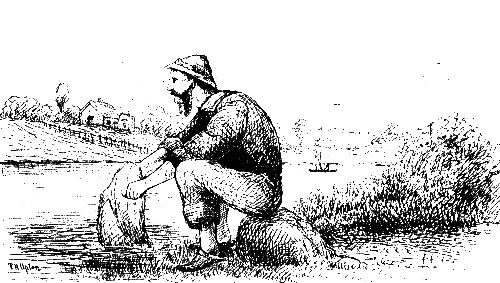
"Use Laundry Soap and be Happy."
XII. A CHANGE OF SCENE.
AFTER breakfast the Commodore announced that as nearly as he could estimate the town of St. Ursus was only about one hour's run from the camp, and that thence the squadron was to be shipped across country, to Lake End, a freight train being due about the middle of the morning, and a passenger train following shortly after noon. With light hearts the squadron paddled down a lovely stretch of river, past one or two "swell" houses at which the Vice looked askance, as the probable abodes of an "effete aristocracy." Two ladies, however, were encountered out rowing in a boat, and as they gave pleasant greeting to the Vice who happened to pass nearest them, his opinions underwent a marked change, and he expressed himself as not averse to associating with peeresses in their own right, as he declared these undoubtedly were.
In due time the bridge was reached; the little station at one end thereof was enlivened for a time by the presence of four canoes and their owners, the station-master showed a Montreal paper only a few hours old, the freight train thundered up and away bearing the most important part of the command, and after two or three hours of dining and loafing about, the four inferior beings followed in a passenger car. Thence an hour later they emerged and stood upon the platform at Lake End, gazing southward through a rugged mountain gateway which closed in steeply on the dark blue waters.
It was but a few minutes work to secure the services of a wagoner, who, for fifty cents, transported the four canoes one by one to the water's edge and deposited them ready for launching. By mid-afternoon the Purser and Cook had bought a few necessary supplies and the Commodore and Vice had reconnoitered the dam and scanned the rapids below, down which it was intended to run before sunset.
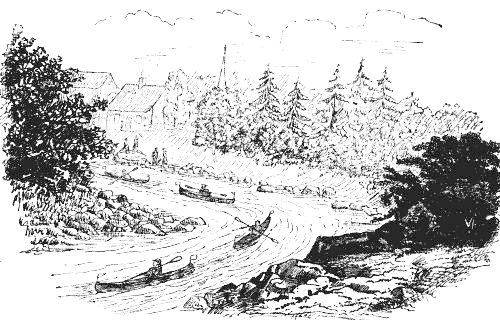
In the Second Rapids.
Very quickly the news spread through the little town that four Yankees were going down the Race, and by the time all was ready for passing the boats over a practicable part of the dam, the whole population, male and female, including summer boarders in the bewildering toilettes of the period, were ranged along the banks, with the exception of those who came to lend a hand, and a squad headed by the local hotel-keeper, who strove to dissuade the party from what he represented as a rash venture. The hotel-keeper in fact was very kind, offering to provide good rooms over night and send the boats round the Race in a wagon in the morning. But the white water was all the while roaring its invitation and drowning his arguments, and though a witness was finally brought who, having only one leg, declared that he had "run" the rapids, and that the squadron couldn't do it, the temptation was too strong to be resisted, so one after another, with safe intervals between, the cruisers paddled out into the flashing water, and then for a few minutes, with every sense on the alert, every nerve strained, no one had an eye for anything save sunken rocks, treacherous swirls of the current, and the hundred indications which to the canoeist indicate the deepest water and the safest channel. It seemed only a few seconds, but the better part of a mile had been passed when the four waited for one another in the first reach of quiet water that afforded us a resting place. Each had grazed a few rocks in the first rapid, but all had passed triumphantly and without visible mishap beyond the ken of the hotel keeper, and the villagers, and were content. Half the Race, however, was yet to be run, and there was barely enough of daylight left for the undertaking.
"The stream runs fast, The rapids are near, and the daylight past,"
sang the Purser as he paddled the Arethusela out into the stream to show the channel, the flagship following, the Cherub next, and the Rochefort bringing up the rear—an order of sequence that was presently effectually reversed. Just below the head of the next rapid the Arethusela hung upon a rock, and in an instant her commander was overboard and struggling in a fierce waist-deep current to keep his footing, and retain a hold upon his boat. To add to his discomfiture his paddle had come apart and half of it was floating merrily down the stream. As the Commodore swept past, the discomfited Purser called on him to save it; and two or three strokes brought him nearly within reach, but at the same time deflected him from the only path of safety. The next minute he, too, was in the water, which, before testing, he supposed to be knee-deep, but which proved to be nearer neck-deep, while the fugitive paddle, with a playful flourish of its blade, dived under a log, disappeared for a moment from view, and then danced cheerfully down the swift waters beyond. At this crisis the Cherub and Rochefort appeared, and flashed past as, half swimming, half wading, the two strove to reach a secure footing.
They shouted derisive inquiries for orders to the Commodore, and presently disappeared around the bend below.
Speaking unofficially and strictly in a private capacity, the Commodore admits that he had all he could do to avoid grievous wreck on the logs beneath which his companion's elusive paddle had vanished. Wading and swimming were alike irreconcilable with the conditions, for the bed of the river was full of boulders over which the water boiled without breaking. He tried the plan of holding on to his boat and floating; but after being dragged and bumped for a few yards over the stones, he gave that up and resigned himself to careful wading until he reached the shallows, where he at length succeeded in re-embarking—no easy task, by the way, in swift water—and soon joined the Cherub and Rochefort.
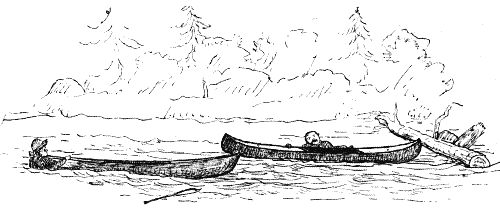
Down the Race.
A camping spot was selected on a bank of sawdust near which was a mighty pile of dry mill waste, and the three proceeded to light a fire and make a somewhat needful change of clothing, before getting supper and turning in for the night. After a long time the Arethusela came in sight, her crew laboriously working a half-paddle—though why a spare one stowed below decks was not used was never found out—and examining the shores and channel for the lost property. This was happily discovered close to camp, and presently a "lean-to," was covered with the soaked tent, which made a reasonably comfortable shelter.
Sawdust is not so bad to sleep on when you have a boat or a rubber-blanket under you, but it retains moisture badly, and is seldom dry more than an inch below the surface. Moreover, the dry part catches fire and burns in an exceedingly persistent and stealthy manner, tunneling unsuspected in all directions and making itself very disagreeable. The members of the expedition, however, knew its nature and provided against its vagaries by wetting thoroughly in the vicinity of the fire, where the Cook speedily had coffee and a tempting pan of scrambled eggs ready for the evening meal.
The voyagers went to sleep this night with unwonted noises in their ears, namely the close-at-hand roar of rapids rising and falling as the mysterious and imperceptible changes of the evening air bore it, now heavily, now faintly, through the thick forest of spruce. It was a wilder region than that through which they had been passing on the lake and its outlet, and the woods gave out sounds at night which often aroused one and another with the pleasing and yet uncomfortable thought of bears and lynxes in his half awakened brain.
XIII. SWIFT WATER.
HERE, at the foot of "Rapid No. 2," the authors would say a word for the benefit of the inexperienced. They are asked by cautious readers if this kind of play is not dangerous. Certainly, just as coasting, and travelling by rail, and crossing Broadway, and playing base and foot-ball, are dangerous. In short, just exactly as life itself is dangerous. They would not advise any but bold swimmers to undertake the amusement; but where proper survey is taken to avoid possible falls, a wetting is the worst that can ordinarily happen. During the entire trip no mishaps occurred save those which came in as part of the fun, and although the voyagers were wet and dry half a dozen times a day, not one caught the slightest cold, or suffered any ill effects from exposure. Hardly any woman, and not by any means all men, can be expected to appreciate the fun of these duckings and other uncertainties of canoe cruising. It may as well be admitted, however, that no out-of-door recreation that is worthy the name, is wholly without risk. The steadiest horses sometimes take fright and run away. Without its rivalries and possible perils to heart and hand, croquet itself would be but an insipid pastime. All excitement presupposes risk of some kind, but it refreshes body and brain alike when taken in reasonable doses and in a fashion that does not infringe on the rights of others. Since the Saturday afternoons of their boyhood the authors have experienced nothing so delightful as those long days on lake and river.
To certain members of the fleet the awakening in the chilly morning air, with fog rising from the water and drifting through the slender spires of balsam and spruce, was the reverse of inspiriting, and the uncertainty as to the course of the river below did not tend to create an irresistible eagerness for farther rapids and farther wettings. The sun however, soon drove away the mist, dried the heavy dew from boats and equipments, and gradually, as the river dimpled in the sunlight and rushed brimming past in a swift deep current, it resumed its attractiveness and, as soon as clothing was dry enough to put on, every man was eager to begin the day's adventures, and get it comfortably wet again.
Single file should be the order of procedure in a rapid river where there is any question as to the width of unobstructed channel. On sighting a rapid whose foot cannot be clearly seen from its head, some one should reconnoitre, and after noting the bearings of the current, should lead the way, the rest of the fleet following at safe intervals and taking prompt warning from his example in case he comes to grief. As a general rule the water is deepest near the concave shore. The reason is obvious. Each general shore-line of a crooked stream is a series of points and bays modified by a hundred varying conditions. Every point tends to deflect the current toward the opposite shore, and where the strongest current is, there is ordinarily the deepest water. Where the stream breaks into rapids the same rule holds good, but is liable to endless modifications from boulders and rocks of all shapes and sizes. Nevertheless it may be assumed that it has been trying for untold ages to shape its channel according to nature's rule, and it will be found in most cases to have attained a reasonable success. At the head of a rapid the white broken water is almost invariably V shaped, the apex pointing down stream. Between the arms of the V the water is comparatively smooth, and dark. Along the arms and below the apex is white water, thrown up more or less into waves. It is generally the safest course, barring casual rocks which may put in an appearance anywhere, to head directly for the apex of the V, keeping in unbroken water as long as possible. Then trust to luck and a quick eye and hand to avoid the rocks which come too near the surface. Nothing but experience can teach one to recognize these, and even recognition does not always imply the ability to avoid disaster.
If a keel-boat hangs resolutely on an obstacle, there is nothing for its occupant to do but to jump overboard, and the quicker the better, if he wishes to keep his stores dry. In many cases such a boat may swing free or be lifted clear by a powerful thrust of the paddle. The canoeist's instinct is all that he has to tell him whether to jump or thrust. With a keelless canoe the case is different as it is comparatively rare that such an one will hang persistently to an obstacle. It is often best however, to take to the water in order to save the canoe from hard knocks and scrapes. In view of this necessity for jumping overboard, some protection is necessary for the feet, and there is nothing so good as the common canvas bathing-shoes with thick soles of hemp or jute. An old pair of slippers is, however, far better than nothing.
Upon the whole, the best policy is to sit as usual amidships and give to rocks the widest berth possible. There is a pernicious doctrine in some quarters, derived it must be confessed from English canoeists, that in running rapids it is well to sit astride the canoe near the stern, and lift her clear if she strikes by simply standing up on the bottom of the stream, if it can be reached with the feet. The Purser tried this once, purely out of patriotism, but did not make a very good demonstration of its advantages, for he upset as soon as he ran out of shoal water, or rather he took a ducking in order to save his stores which would inevitably have been wet had he tried for an instant longer to maintain his precarious seat. The rivers of Europe may admit of this very unpicturesque mode of running a rapid, but those of America do not take to it kindly.
The keels of the Chrysalids, are a decided disadvantage in this phase of canoeing. They give the canoe additional draught, and hang with provoking tenacity upon any rock or other obstacle which they encounter. The Red-Lakers on the contrary slide with an inch or more to spare over an obstacle which would bring a Chrysalid to instant grief. They turn far more easily, and hence can much more readily be made by a quick swerve to one side or the other, to avoid a threatened danger. The blindest worshipper of the Chrysalid model can claim nothing for a keel in swift water, save that it receives the hard knocks which would otherwise have scarified the more fragile bottom planks. This argument in their favor is not good for much, as the keel cannot protect more than two or three inches on each side, unless the obstacle happens to be broad and flat. Under these conditions, it was to be expected that the Rochefort would select with excellent judgment a place whereon to demonstrate the advantages of her keel. It may have been at the foot of Rapid No. 9, at any rate it was at the head of a comparatively quiet reach of water where three of the fleet had drawn out of the current with a view to luncheon. The Vice was the last to arrive, and was sweeping boldly down where the current was swift and deep, having passed the white water, when suddenly he was observed to bring up all standing, his boat swinging round instantly across the current, having fixed a malicious grip upon a hidden rock, over which the water boiled, but did not break. The Vice was unceremoniously plumped out on the down-stream side into water that was neck deep and running like a mill-race, but as he wore a life-belt he feels justified in maintaining that he did not go entirely under. He succeeded in getting a hold upon the rock by the aid of his boat hook, and seated himself thereon, holding his boat by the painter as she floated, full of water and only sustained by her air-tight compartments, a yard or two below him. The picture that he presented at this moment was comical in the extreme, and he was heartlessly kept sitting there,—he could not very well get off alone with his boat to manage,—while the Commodore made a sketch. The regular artist was too much concerned at his friend's critical situation to pay any attention to the calls made upon him for a careful study. The current was so swift and deep that efforts to reach the Vice by swimming were unsuccessful, so it became necessary to wade out a few rods below him and catch his boat, when he let her float down. He easily swam ashore when relieved of this charge, and once more the Rochefort had to be emptied of everything, and all lay by for two or three hours, while her owner and his belongings were spread out on the rocks to dry, he discoursing, the while, until all fell asleep, of the innate viciousness of a boat which could thus deliberately bring her commander to confusion and shame.
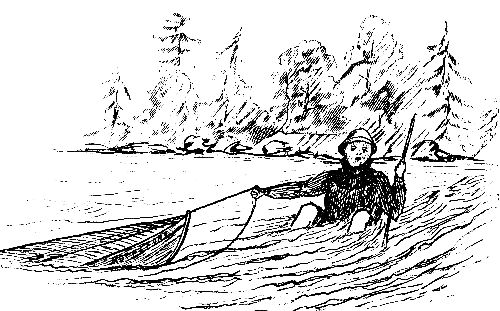
The Vice sits for his Portrait.
It was in "Number 12" that all came nearest to utter discomfiture, that is to actual overturns, and consequent wettings of things not intended to be wet. Never had the Vice, whose turn it was to survey the route, seen a more innocent-looking rapid. It swept down in a slight curve, dancing in the sun and seemingly offering a clear channel. It was the flagship's turn to bring up the rear, and in watching the descent of the others the Commodore perceived that at a certain point each crew of one became as it were demoralized, and struggled mightily with the current until each turned at a right angle and went on its way into the pool below. The reason was not apparent until he reached the same point, when he suddenly became aware that the stream was bearing him with great velocity directly upon a huge rock. To go to starboard was certain wreck. The only safety lay in turning sharply to port, as his predecessors had done. To all appearance this was utterly impossible, and, while straining every nerve to make good his escape, the flag-officer fully expected to be rolled over into twelve feet of water in the most undignified manner, and in full view of the fleet. Just at the last moment, when an overturn seemed inevitable, an unexpected set-back from the rock caught the canoe and whirled her instantly over a delightful little dip, hardly high enough to be termed a fall, into the deep water below, where the rest of the fleet lay enjoying the perplexity and relief through which each in his turn had passed. It is quite impossible under such circumstances to shout advice, for the roar of the water completely overpowers the voice. What would have happened if any or all had struck the rock? Why, each and all would have been spilled comfortably into deep water, to be sure, whence it would have been easy to swim ashore and put things to rights.
After a day of exciting work of this kind it was not unpleasant in the afternoon to paddle out upon the smooth waters of a little lake in the midst of the forest. Along its gentle swelling shores were scattered farm houses, beyond which the rough clearings crept up the hillsides. Two or three huge water-oaks bent over the shore in a shady cove, and here the squadron took shelter until the sun's rays should be less vertical. Presently from a neighboring farm house there came down to the water's edge a damsel who proceeded artlessly to rivet upon herself the attention of the fleet by lighting a fire under a boiler, and doing up the family washing at the lake-side. The artist filled a page or two of his sketchbook with studies from the life, but refuses for some reason to furnish them for publication. She was near enough, however, to afford a fine opportunity, as the Artist said, to study the peculiar French type of form and feature, as modified by several generations of life in a foreign climate.
Presently the Commodore, under pretence of inquiring after eggs and milk, approached la blanchisseuse. The Cook lounged respectfully behind his commanding officer, while the latter addressed the woman in alleged French to receive only a dismal shake of the head in reply. He repeated his question, changing the phraseology, but with a different result, while the Cook, to relieve the Commodore's evident embarrassment, softly whistled the Thuringian "Volks-lied." A pleased glance from the woman elicited a word or two from the Cook; after a short but spirited conversation in which the Commodore took no part, the Cook informed his companion that the desired supplies could be had at the house, and the two men departed.
"Confound this French lingo!" exclaimed the Commodore, "there are as many dialects in this region as there are towns, and I don't easily pick them up; how do you manage to do it?"
"My dear fellow," said the Cook impressively, "there is one rule to be unvaryingly observed in conversing with these people: never speak French to a woman who understands only the German language."
The Commodore dropped the milk-pail—fortunately it was empty—and endeavored to swear the Cook to secrecy, with what success this narrative doth show. But he derived some consolation from frequent allusions to the Purser's professional studies of the "French type of form and feature, as modified by a change of abode."
When the sun was low enough to cast the shadow of the hills upon the lake, the fleet started and made its way toward a distant point which, it was surmised, was not far from the outlet and would afford good camping ground for the night. A more delightful three mile paddle can hardly be imagined. The peculiarly sacred stillness of a forestland at sunset was over all the scene; a silence that seemed absolute, and was yet vocal with noises that did not break the spell. The plash of leaping fish, the far off scream of an eagle, the occasional laughter of a loon, the measured dip of paddles, none of these were discordant with nature, and even the human tones that now and then floated from the distant houses were so faint as to be inoffensive. The voyagers hardly exchanged a word as side by side they slid through the reflected hues of sunset, watching in silence the mighty mountain that rose in dark purple against the west, and gathered around its summit a night-cap of cloud that changed from red to grey just as the point was reached and the tent pitched beneath a huge gnarled pine, that towered above its fellows, and offered, as the Vice suggested, an admirable mark for any nocturnal thunderstorm that might be wandering in this direction. Only one thing aroused any apprehensions as to the comfort of this camp, and that was the ceaseless roar (the word is used advisedly in preference to "hum") of insects. They proved innocuous, however, and sleep soon came down upon the tired canoeists.
XIV. MORE RAPIDS.
CONTRARY to custom the camp had been pitched where the morning sun would strike in upon it. This is undesirable unless an early start is the order of the day, for breakfast in the level rays of a summer sun is not so comfortable as in the shade of a natural screen. At a tolerably seasonable hour, therefore, the squadron paddled around the point and across the reach which still separated them by two miles or so from the outlet. For variety the wind was dead ahead, but the distance was soon passed and the flash of rapids at the very lip of the lake announced that the stream maintained the character which it had displayed in the earlier portion of its career. In a moment the four pretty canoes were in line at ample distance apart and were dancing down the swift current into a dark sweep of spruce-covered banks, with four as light hearted vagabonds on board as ever left care behind them.
In retrospect it is hardly possible to recall any part of this romantic river where a halt was not a luxury merely because of the picturesque surroundings. Seldom could the eye reach more than half a mile up or down stream, for the precipitous or forest-covered banks were continually pushing out on the one side and receding on the other, while between them the river curved and wound in a perpetual succession of rapids, pools, and quiet stretches. The current even in its most quiet moods was singularly swift and powerful, bearing the fleet onward with hardly an effort, at the rate of six or seven miles an hour. When clearings occurred they were on the points, as is always the case in thinly settled countries. Naturally such points are formed in the re-entrant angle of the stream, and become places of deposit for drift and alluvium in flood time. The opposite bank is usually bold and with soil enough in most cases to sustain only the wild forest growth. The quiet reaches, however, are frequently broken where the river forces its way through narrow passages, or over rocky ledges. There are no dangerous falls until within a mile of the mouth, and there is only one dam between the lake and the falls. This dam the voyagers reached a few hours after leaving the lake; hours full of the pleasant, healthful excitement of rapids and wild shifting scenery.
Striking the back-water of the mill-pond a mile above the dam, the fleet paddled down and soon came in sight of the logs and crib-work which indicate the presence of a saw-mill.
Drawing up alongside the boom, all hands walked across the dam and considered the chances of running the race-way. Noon had passed however, and while the question was still unsettled, children came down from the mill-settlement with fresh raspberries, and butter made in the French style, without salt, and thus reminded of luncheon, it was decided, in view of an approaching thunder shower, to adjourn to the shelter of the mill. Here an incident occurred which proved as it had never been proved before the admirable discipline maintained in the personnel of the command.
In the early days of the cruise it became painfully evident to the real canoeists who were connected with the expedition, that in one particular at least an unseemly tendency toward effeminate luxury was developing itself. The Vice and the Purser, on the first day out, produced with an air of insufferable superiority, china plates, and bowls which they were pleased to denominate coffee cups. The relative size of these as compared with the legitimate tin-cups used by the Commodore and the Cook is herewith shown. Of course the flag-officer at once detected the ruse, and foiled the conspirators by issuing at the first camp, Special Order No. 1 to this effect:
The coffee ration will always be measured in the Cook's cup, that being the standard pint recognized at these headquarters.
By order of the Commodore.
Possible infringement on the rights of individuals having thus been provided against, it was only necessary to counteract so far as possible the demoralizing effect of the daily sight of china upon the morale of the expedition. This end was diligently sought by the commanding officer by every means in his power, but to no purpose. He personally supervised the daily measuring of coffee with the Cook's cup, but by some means the china bowls were always filled, and their owners never failed to remark upon the superior excellence of coffee taken from such receptacles over that imbibed from barbaric tin. It was evident that sooner or later a resort must be had to arbitrary measures, but no fitting opportunity presented itself until the squadron took refuge in the mill as narrated above.
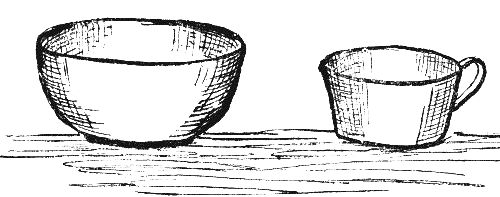
Comparative Coffee Cups.
The thunder storm proved to be of extraordinary violence, throwing down trees, overturning buildings and playing the mischief generally.
Midway of the meal the wind so increased as to drive the rain in upon the festive board. The Commodore saw that the time had come for action, and acted with the promptitude which should always characterize an able commander. "Prepare for a change of base," he shouted above the roar of rain and wind. "Purser, coffee-pot and sugar; Vice, devilled turkey and salt; Cook, bread and butter." Each man seized the articles indicated and fled to a place of shelter. With a gleam of triumph in his eye the Commodore collected the remaining dishes, and taking his life in his hand, for the good of the service, sprang upon a pile of logs that was awaiting the saw, and attempted to cross it at a run. At the third step a log tilted. The Commodore went down, while the spasmodic upward motion of the arms, under such circumstances, sent the dishes aloft. They speedily came down, but it was in pieces that did the Cook's heart good to see. The Commodore, it is true, might have broken his leg, but he did not, and while he somewhat ruefully rubbed his starboard shin, he watched with scarce concealed satisfaction the gathering of the fragments. Not a bowl or a plate remained. The morale of the expedition was saved!
After the storm passed, it became necessary to circumvent or run the dam. It was a logging dam, some eighteen feet in perpendicular height, and offered extraordinary inducements for running, but with a little too much risk, so the boats were laboriously passed one by one over the wing of the dam, and found themselves at the head of a superb rapid which swept beneath and around a rocky cape, and quickly carried the fleet beyond the ken of the little forest settlement lying around the mill.
If possible the scenery below the mill was more picturesque than any previously seen. At one point the woods were on fire, and for a few hundred yards the smoke was so thick that progress had to be made with extreme caution, as the current was swift and the channel full of rocks. At another the stream wound slowly between wood-crowned cliffs, whose geological nature severely taxed the scientific attainments of the expedition, and tempted a long sojourn, while the Artist vainly essayed a realistic sketch of the strangely convoluted strata, which made the face of the cliff so wonderfully expressive of the elemental strife and torture that must have shaped it in some by-gone age. So with alternating reaches of swift and still water, the lovely stream coursed downward, bearing the fleet only too rapidly toward its junction with the larger river. One more night was passed among the spruces of its rugged shores, and shortly after the next morning's start it became evident that the forest stream was preparing to fulfill its destiny in driving the saws of a great mill. Houses straggled along the bank, and presently the fleet was feeling its way among logs and booms to a landing place. A few hours sufficed to procure transportation around the beautiful falls, and by sundown the squadron was making camp as usual on the banks of a broad placid river, which to all appearances was the same which it left a few days before. Here was Acadia again, and something of a mental effort was necessary to realize that it was another Acadia from that wherein the first æon of the cruise had passed. The vesper bell sounded as before, the lumber laden barges drifted as lazily as ever, and the villages named after unheard of saints dotted the banks in close succession, and the roar of rapids was no longer to be heard.
XV. THE BEGINNING OF THE END.
IT had been something of a relief to stow masts and sails compactly away for a few days, and now again it was an agreeable change to be once more under canvas and see the slender masts bend and spring before the breeze.
In the course of a day's sail the river narrowed perceptibly, as rivers are wont to do as they near their outlets, and the various members of the expedition, having noted the fact, proceeded, each in his own way, to discover the cause thereof. A melancholy howl (learned from Garibaldians in Italy) by the Vice, who was always in the rear, was rightly construed by the occupants of the Red Lakers (in the advance) as a sign that the Vice wanted to light his pipe, so the Cook, who by virtue of his official position was custodian of the expeditionary matches, lay to until the Vice came alongside.
"The river," remarked the Vice, between puffs, "is narrowing—every mile. Suppose it—should keep on—doing it for—fifty miles more; it—would close entirely before—it reached the—ow!—(here the flame of the match reached the Vice's fingers)—reached St.—the devil, oh!" for the Vice had dropped the still blazing fragment upon his bare foot.
"No such saint in any calendar but that of politics," said the Cook reprovingly.
"The St. Lawrence, I meant, of course," said the Vice: "the devil isn't recognized by any party at all."
"I suppose not," answered the Cook, who had dropped into a dreamy reverie. "The true workers in this world are never recognized by those who are most entirely dependent upon them."
"You're begging the question," exclaimed the Vice, examining his scorched instep. "An apology in the shape of your flask of olive oil will be satisfactory. How do you explain the river's shrinking, any how?"
"Why, it's growing deeper, and as there's only a given amount of water, it can't occupy more space in one direction without narrowing in another. It's a precedent you might safely follow in politics."
The Vice reflected for a moment; then a sweet smile irradiated his features, his left eye closed, his right forefinger was slowly laid athwart his nose, and he replied,
"I knew that long ago, my boy; it's the mainstay of the business—the system, I mean. Let the party broaden, and 'Othello's occupation's gone.'"
But the Cook, having relieved his mind of chaff which nevertheless carried (unknown to him) a grain of wheat, determined to inflict upon some one else the questioning to which he had been subjected, so he speedily overhauled the other Chrysalid containing the Purser, and demanded the reason of the river's narrowing. The Purser abruptly ceased patching a sonnet which he had scribbled upon the blade of a spare paddle, and answered,
"The water-drops, so long united, have a premonition of the doom of separation soon to befall them, and they cling more closely to each other, for a last fond interchange of sentiment."
"Water is not compressible by its own volition," promptly replied the Cook, who loved cyclopedias, and never knew sentiment when he encountered it. But the Purser, who hated questions so intensely that, had he lived in the time of that vigorous old interrogation point yclept Socrates, would have tramped a thousand miles for hemlock rather than have left the sage unpoisoned, ran ashore to avenge himself upon the Commodore, who had beached his boat to await the coming up of his lagging fleet. To the commanding officer the Purser put the disturbing question as to the cause of the narrowing of the river, and with the following result:
"Rivers shrink toward their natural channel for the same reason that capitalists take to government bonds—because their banks are slippery, and suffer by the many rushes upon them."
The villages grew nearer together as rapidly as the shores did, and ahead and aloft there were always in sight several church spires of the unvarying pattern peculiar to churches along the river. Every spire was metal-covered and bright, the latter perhaps because there were no opposition houses of worship to cause that dismalness of aspect affected by all churches in neighborhoods where religion tends more to squabbling than to sanctity. At short intervals appeared the residences of the priests, each indicated by a tall cross at the gateway. The Commodore, with his peculiar regard for the church so near a sister to his own, signified a half-intention to go ashore to confession, but on being reminded that but a week remained for the cruise, and that no such short time would suffice an editor in which to unburden his soul of its manifold sins and transgressions, he forbore to make others suffer for his own faults. It was noticed thereafter, however, that he doffed his helmet respectfully whenever he sailed past a church, and that when his own day for foraging came, he preferred always to purchase milk from a priest's housekeeper.
About this time the Purser began to drop behind in a manner inexplicable even by the known slowness of his boat; even the slow-sailing Vice distanced him, so the Cook, not without a special appreciation of the Purser's tobacco, went ashore to wait for his comrade to come up. The bank of the river was high, and the Cook, who had been hugging the shore for shade, had made company for himself by roaring sundry staves, supposing that no one but his comrades were within listening distance. Great was his surprise, therefore, when on clambering up the bank he beheld a closely built village in front of him. Had the locality been any but Acadia, even the river banks could not have hidden the town, but here the dwellings are as modest of mien as the natives. Few boast of a second story, nor is the floor of the first very much raised above the level of the ground. In exterior dimensions, most of the houses reminded the Cook of his chicken-house at home, or of those suburban villas which cluster so thickly upon the hills adjoining Central Park. But with size the last-named parallel ceased, for the exteriors were painted, the floors, seen through the open doors and windows, were clean, and no pig disported himself about the door-step. Children clustered about them as thickly as they always do about very small houses, but the matrons lacked that fagged, heaven-hungry mien peculiar to their sisters in climes where the Scripture is fulfilled by the greatest being the servant of all—all of her own servants. Here one might speak of love in a cottage and not be laughed out of society—hopeless, indeed, would be his fate were he to desire any other sort of asylum for his affections.
The Cook longed for social intercourse in this real Acadia, but he doubted the ability of his French to see him through; fortunately he espied a shop, and therein he purchased sundry sticks of candy; with one of these gravitating between his fingers and lips, he strolled about, and within five minutes he had enchained in sweet bonds several lapsful of dark-eyed children whose pure intuitions taught them that in the great human search for sweetness and light it was never well to decline a proffered half of the desirable whole.
When the Purser drew near, it was with a sketchbook loaded with drawings of odd boats which had been passed at their moorings; and the names of these, with those of their owners, which were painted in antique letters astern, would have been of inestimable value to any writer of a French romance. And he brought something dearer yet to the eyes and heart of the Cook, and yet not wholly unpicturesque, it being a pair of cockerels, handsomely spangled, which he had purchased of a thrifty dame with whom he had exchanged some courteous words as he lounged past her riparian laundry in his boat. The Cook hastily took to his boat, distanced the Commodore and Vice, and an hour later announced broiled chickens for dinner, the gridiron having been a few feet of stout wire, which after use could be crumpled together into a thin handful of old iron, yet extended, at need, to a two-chicken capacity.
After the expedition had dined, each member discovered, upon arising, that the human side is not destitute of muscles, and that a steady strain of half a day at rudder and paddle, can search these out in a manner as uncomfortable as it is thorough. The Purser, who usually made himself conspicuous, when ashore, by a broad red woolen sash, apparently a muffler such as small boys wear upon their necks in winter, was by far the most agile of the party, and his companions, as they rubbed away the stitches in their sides, inwardly vowed that the picturesque was not always ridiculously useless, particularly when assumed on proper occasions, instead of being treated as of constant utility.
As the wind was gaining in industry, the Commodore permitted an overlong delay, to be improved physically, and while this was being enjoyed there hove in view a craft peculiar to French-American waters, but which would not be tolerated anywhere else. It was an immense barge, considerably more awkward than a canal boat, and moved by two great square sails, each with a mast to itself. The breeze which bellied the canvas of this monster would have driven a canoe along at the rate of twelve miles an hour, but the barge proceeded so leisurely that a maiden sauntering along the road on the bank chatted with the pilot for a mile or two without quickening her pace. Having both his vessel and his sweetheart upon his mind, it is not strange that the pilot did not perceive the four foreign craft beached a-starboard; the maiden, however, with a woman's eye for color, caught sight of the club signal which the Cook always flew at his masthead, instead of upon the mainpeak, with which it would have been furled when sail was taken in. Her figure, which had afforded so gracious a relief against the blue sky behind her, disappeared with the unscientific effect of seeming to leave a cloud behind, and as the unintentional listeners devoutly thanked heaven for such knowledge of the French tongue as had enabled them to overhear the artless affectionate dialogue which had been going on, they saw, gazing at the pilot, how dark the Acadian complexion can be when displayed in the face of a lover newly made lonesome. Gladly would the swain himself have retired from sight, but the helm of his boat was obedient only under greatest effort, so he strained sullenly at the tiller, a figure at first amusing but soon pathetic. The sentiment which keeps the world from growing old was not a stranger to the canoeists, so the Purser murmured a bit from Jasmin and caught a hint which for years he had tried to take from Jules Breton; the Cook wished there might be a joint of chicken left to offer the poor fellow; the Commodore hailed him heartily, and offered to carry him out a taste of brandy in token of a professional and sentimental sympathy, and the Vice sent him a good cigar; and it came to pass that five minutes later the ere-while lovelorn helmsman was trolling a song of war and slaughter as merrily as if love and Evangeline had never existed.
"Ah," sighed the Commodore, "the days are gone when rum and true religion were the principal supports of fallen humanity. Smoke seems to answer that fellow's purpose as well as religion."
"If my memory serves me rightly," said the Vice, as if in profound reflection, "a great deal of the religion I have heard preached, was well informed with a something from which smoke is a natural deduction."
"That," said the Purser, "is because in the universal fitness of things a man recalls most readily that which he most urgently needs. No one can wonder that a politician—"
"Language unparliamentary," interrupted the Vice, with a wry face.
"A statesman, then," resumed the Purser, "should recall most vividly the only element by which he can effectually be purified."
"Sulphur is not to be used under the rays of the sun," interposed the Commodore; "let's take to a more cooling element."
A few moments were devoted to extra-careful stowing, for there was a likelihood that terra firma would again be reached only on the shores of the great St. Lawrence. The Vice, with the statesmanlike instinct of saving himself by assisting his companions heavenward, endeavored by fair means and foul to persuade the others to accommodate his gun, shot-bag and the volume of Tupper, but regarding the latter his failure was complete. At length he slyly tossed it into the branches of an umbrageous ash, a picturesque old landmark of centuries. But the Commodore saw him, and went handsomely to the rescue of the old tree by knocking the book out with a boat-hook.
"There are trees enough being destroyed daily by coon-hunters, road-boards, and other villains," said he, "and I won't stand quietly by and see so splendid a specimen crushed beneath so relentless a weight."
"But somebody may find the book," pleaded the Vice, who was already afloat.
"Thank heaven, the natives can't read English," replied the Commodore, "so they won't be injured."
"But I supposed I might find it there when I came this way on next summer's cruise," said the Vice.
"So you will," said the Commodore; "neither wind nor wave can move any thing so heavy: when that book changes its base, there'll be nothing left to cruise with, and nobody left to cruise."
The Commodore, for reasons which he would not explain, had ordered that the St. Lawrence should be reached that day, even though there was not a breath of wind, and the whole trip had to be made under paddle, and the Cook knew full well that when a Commodore (or anyone else) issues an order that sounds well and prints nicely, its success or failure depends largely upon the digestion of those who are expected to execute it. So the Cook prepared a meal as digestible as it was bountiful, and within an hour the expedition had consumed enough of omelettes, stewed potato, rice croquettes, cream-toast and coffee to have terrified their respective wives into applying for divorces on the ground of inordinate appetite.[9] It is barely possible that the meal was prolonged with the hope that a breeze might spring up in the meantime, and do away with the necessity not only of paddling, but of taking down and stowing away all standing rigging, which in still water is likely to unfavorably affect the time of the boat. But no breeze came, not even in reply to some vigorous whistling on the part of the Commodore. So the expedition took to its several paddles, and got into mid-stream to get all possible assistance from the current, and then, just where the river was widest, and the squadron furthest from shore, a brisk breeze came down as unexpectedly as if it were a savings bank, and each man had to paddle ashore again to re-step his masts so that he could set his sail. Then the squadron ran rapidly down the river, wondering only if such a breeze on so small a water could work a man up to so keen an ecstacy, how they would be able to contain themselves when cruising upon the almost shoreless St. Lawrence.
As usual,[10] the Cook, in the Cherub, soon took the lead, and rapidly increased the distance between himself and his companions. There was nothing to fear, for the Vice, who had previously been through the river with the Alderman, had assured the party that there was not another rapid between it and the St. Lawrence. And even if there should be one which the Vice had forgotten, the Cook would be glad of the geographical ignorance which would enable him to shoot it without the attendance of three other boats, with their advisory counsels. So he hauled his mainsail close and flew along through the water, his steering-paddle keeping upon his wrist a strain more delicious than man ever felt at the larger end of a trout-rod. He shouted, he whistled, and finally, there being no critic within hearing distance, he sang. And as his rather uncertain voice rose and fell, the wind seemed to supply a deep bass, a foundation into which his wavering notes fitted perfectly. He fervently thanked the wind, and the tall trees through which it roared, for their sympathetic effort; he redoubled his own vocal exertions, and the wind and trees, apparently touched by his appreciation, seemed to assist more heartily than before. Suddenly the Cook noticed that the east bank, from which direction the wind came, was without trees at that point, and while he dropped into silence to wonder how the sound could be created where the means were lacking, the bass turned gradually to sub-bass. Suddenly he saw an irregularly intermitting spout of water near the middle of the river, then he noticed a troubled wrinkle across the river's entire front. He hastily let his boat come up into the wind and run into what seemed a cove on the east bank, and as she ran ashore there arose a loud shout of applause from a dozen men congregated there.
"No one ever came so near before," said one, in French.
"Saved by a minute!" ejaculated another.
"Could he have meditated suicide?" murmured a third. "No; he looks not like one who has been disappointed in love."
The Cook courteously but firmly demanded an explanation, and one of the bystanders, a venerable man in the dusty coat of a miller, led him to a slight elevation to obtain it. Then the Cook saw that a natural and abrupt fall of about fifteen feet extended entirely across the river! In an instant he vowed a handsome subscription to the campaign fund of whatever candidate might run against the Vice in the autumn campaign.
The other boats approached in the order of their rapidity, the Chrysalids coming last, and the Vice's admission that his boat, with its keel, could never have escaped had it been in the Cherub's dangerous proximity to the falls, so reacted upon the Cook's temper that he alienated a portion of the intended subscription to the opposition campaign fund, and expended it upon a dinner for four, for which he gave the proprietress of an adjoining hotel—"Le Hotel de la Ville"—carte blanche. And the landlady did her best. For an hour she and several assistants hung over two stoves, while other assistants scoured the neighborhood for delicacies. The dinner was appetizing, as was all whereof the squadron partook in Acadia after they had learned to avoid the railroad hotels. Finally after all else was disposed of, an immense dish of raspberries was placed upon the table, and beside it a small bowl full of what seemed to be buttermilk.
"There!" exclaimed the Vice, eying the bowl with manifest disgust, "that's an illustration of the effect of monarchical institutions upon physical habits. The dinner has been perfect, thus far, but now, just when the climax should be attained, they offer us buttermilk!"
"Perhaps it's cream," suggested the Commodore.
"Cream?" said the Vice scornfully. "Oh no. I know cream. Cream is a thin blue fluid. This is not like it in the least."
Here the Vice scooped a teaspoonful of the pasty fluid, and brought it gently towards his fastidious nose. Suddenly he tasted it, straightened rigidly, and exclaimed,
"Judas Iscariot! It is cream!"
The Vice said no more until he had sampled the bowl to the extent of a saucerful. Then he raised his face and displayed unwonted lines of thoughtfulness and conviction, as he exclaimed,
"Gentlemen, if an English cow gave that cream, I have no hesitation in saying that our independence wasn't worth fighting for!"
"Huzza!" shouted the Commodore and the Purser, as they fell into each other's embrace and wept conservative tears upon each other's blue shirt-collars, while the sternly patriotic Cook pushed the seductive bowl afar and whistled the "Star-Spangled Banner," as a counter-irritant. But when he asked for his bill, and found that it was but thirty-five cents for each individual, he retired to the hotel parlor where there was an asthmatic cottage-organ and penitently played "Rule, Britannia," keeping, however, a cautious foot upon the soft pedal lest his temporary lapse from national love should be discovered.
On returning to the boats it was discovered that the small boy who had been engaged as watchman had accumulated half a hundred deputies. As none of these expected any money, the fickle Vice fluctuated back to his first love among the nations, and was rebuked by the Commodore for judging all things by a financial standard.
The breeze had apparently been to dinner too, for it was amazingly reinvigorated and marked about forty flaws to the hour. An order to carry only "dandy" sails was protested against by the entire command, and the Commodore, hoping that the coffin trade was not depressed in the shipping port at the river's mouth, reluctantly gave way to the wishes of his subordinates. The result was that extraordinary time was made, and twenty-five miles were passed almost before the voyagers realized that the afternoon was waning.
As they approached the close of their voyage, the considerable town where their voyage was to end, it occurred to the squadron that its personal and individual appearance was the reverse of prepossessing. A halt was accordingly made, and for an hour assiduous attention was paid to baths, soap, shaving utensils, and the carefully preserved remnants of what had once been laundried articles of wear. The one pocket mirror had long since disappeared, so that certain delicate operations of the toilette were performed with some uncertainty. The Commodore had reached the final touches, and was tenderly arranging the thin locks which still cluster about his posterior cranial processes. To this task he devoted for a time all the powers of his gigantic intellect, but in the absence of the accustomed mirror, the result was unsatisfactory. Dropping his hand at last, the Commodore sighed, and looked around for assistance. The Vice, resplendent in a white shirt and neck-tie, was unoccupied. To him the Commodore, tendering the fragmentary comb:
"I say, Vice, part my hair, will you, please."
The Vice marveled, but mechanically took the comb, while the Commodorial dome was bowed conveniently before him. Long he paused, so long that the Commodore, losing patience, called out, "Why don't you go ahead?"
"My dear boy," said the Vice, "So I would, but there's nothing in the world to part."
The venerable mariner slowly straightened himself, looked blankly for a moment into the face of his lieutenant, and passed his hand reflectively over the smooth top of his head.
"I beg your pardon, boys," he said at last. "I had forgotten. This cruise has made me so much younger that I thought I wasn't bald yet. It's high time for me to be back at the office—'There'll be no parting there.'"
Of the remainder of the run, some five or six miles, no member of the squadron is mentally fitted to give a correct account. Every one wanted to be first in port, and the Vice, in anticipation of being the fortunate man, had secretly extemporized a new star spangled banner to carry at the peak of his mainsail. But both Red Lakers shot ahead of the Chrysalids, and the Vice at last ignominiously took in his national ensign because it wasted a certain amount of wind.[11] Finding there was but one boat against him, the Cook assumed that he had himself already won the race, so he began to compose a sarcastic address to be delivered to his associates as one by one they rejoined him at whatever landing-place he might select. While he composed he heard a whiz, he saw a shadow, and the wind died (apparently) so suddenly that he barely had time to adjust the trim of his boat to avoid capsizing. Looking about him he saw the great sails of the flagship passing him to windward, and he heard the voice of the Commodore, in tones which no combination of type can express, shouting,
"Come to the best hotel and see me when you get in!"
So the Cook looked about for some excuse to make for what would be his probable tardiness, and he soon found it. As he flew past a large assemblage of rafts, he found their occupants, all Canadians, in an extreme fever of curiosity to know how the boats were steered; the wind being from their own bank, they could not see the steering-oar on the opposite side. They also looked upon the Red Lake boats, built in their own country, as utter strangers, which fact enabled the Cook to moralize, by comparison, upon the ignorance of people about their own neighbors, and upon the peculiar fancies which in such cases are made to do duty as facts. The Cook explained to the full extent of his knowledge and his French, and then, sighting the Chrysalids within a mile he sheared away, and within five minutes a swell from a steamer sent a wave of St. Lawrence water under his bows, and he saw the "Great Lone River of the North," from the midst of as entangling an alliance of steamers, barges, tugs, schooners, ferry-boats, yachts, fishing boats and pirogues as any canoe was ever imperilled of, while the Commodore lay under the lee of a decayed pier, and placidly smoked at his subordinate's confusion.
The St. Lawrence was hailed with delight by the tardy Chrysalids when they reached it, and then the party strolled to the post office, debating whether to run up to Montreal, which course the wind favored, or down to Quebec, with the current and an occasional tide to help. All admitted that the cruise had but fairly begun; placid lakes and beautiful rivers were all very well, but,
"Give to them the roaring seas And the white waves heaving high,"
or as much thereof as was within the bestowal of a river many miles across. Just then they reached the post-office, their change of course deprived them of mail matter for several days. How it came about, nobody knew; but within an hour the Commodore, his boat stowed for return as freight, was on a train for New York, and his comrades were mourning that they could not accompany him. That evening all the canoes were stowed, and placed on board a south-bound canal-boat, while the Vice, the Purser and the Cook sat in Christian garb upon the deck of the Montreal steamer, smoked cigars instead of pipes, and discussed dados, symphony concerts, the woman question, the railroad riots, and the impending finance muddle as conventionally as if they had never lived out of doors.
A few days later they met at a canoe club dinner in New York, but neither claw-hammer coat nor white tie could smother the fire within them as they discussed the merits of their respective boats.
"The Chrysalids don't ziz-zag when they're paddled, as the keelless Red Lakers do," observed the Vice.
"Nor do they keep within hailing distance in a breeze in which even a dead log would run and be joyful," retorted the Commodore.
"They need no lee-board to keep them from drifting down the wind," said the Purser.
"Nor more than three men to land them on a shore upon which a gentle tug at the painter will beach a Red Laker," said the Cook.
"Give me a boat," said the Vice, "which steers in the ordinary ship-shape manner."
"I," remarked the Commodore, "prefer one whose Commander don't have to analyze a whole rope yard before he can get her into sailing condition."
"The idea of oilcloth decks for any sort of a craft!" exclaimed the Purser.
"Or of decks that make you imagine it's resurrection morn, and you're crossing the Styx in your own coffin," said the Cook.
"Order, gentlemen," shouted the ruler of the feast; "if you've any personal difficulties to settle, please retire to the ante-room, and cease disturbing the club."
"Ze ante-room," remarked the caterer, "is full of ze Alderman an' ze Judge, who fight about ze merits of ze Rob Roy boats an' ze paper canoe."
"Then I will settle the question myself," said the President, taking from his pocket a copper cent of the fathers. "Heads signifies the superiority of the Chrysalids, tails of the Red Lakers."
The coin spun in the air, and the quartette sprang to its collective feet. It came down exactly edgewise into a bit of Fromage de Brie, and so remained.
APPENDIX.
IN the preceding pages the authors have introduced in a desultory way some hints which it is hoped may prove of practical use to inexperienced or possibly to experienced canoeists. There are some questions however which are asked by every one who contemplates engaging in this delightful recreation, and to a few of these questions answers are now volunteered.
I. Where can I get a canoe?
The best answer is a list of builders. James Everson, Williamsburgh, N. Y., W. Jarvis, Ithaca, N. Y., and George Roahr, Harlem, N. Y., build excellent boats after the Nautilus model and its modifications. These all build on the well known lap-streak or clinker plan, using cedar planks and oak timbers. Mr. J. H. Rushton of Canton, N. Y., builds after the Nautilus and Rob Roy models, also after a model of his own. He has a peculiar method of construction, which makes his work very strong and serviceable. Walters & Sons, of Troy, N. Y., build paper boats after the Nautilus and Rob Roy models, D. Herald, of Rice Lake, Ontario, Canada, builds canoes on a model of his own approximating to the best type of Indian "birch." His method of building is described on page 106. The model is admirable for speed, sea-worthiness and safety. At Ottawa, Canada, is a builder named English whose boats are well spoken of but the authors are not personally acquainted with them. J. F. West, of East Orange, N. J., builds light and serviceable boats of ash strips covered with painted canvas. He does not build for sale, but will furnish information for those who wish to build for themselves.
II. How much does a canoe cost?
Seven dollars a foot is not an unfair rule whereby to estimate the cost of a lap-streak, Nautilus model, including spars and rudder. Some builders charge more, others less than this. The Canadian canoes are cheapest of all, but to the first cost must be added the tariff duty for importation into the United States (about thirty per cent ad valorem). Herald's highest priced canoe, seventeen feet long, was at latest advices forty-five dollars. This size is built under his patent and copper fastened throughout. Built in the rib-batten style, the price is ten dollars less and canoes of smaller sizes of both kinds still less. The Nautilus models are largely decked over fore and aft without extra cost, and are provided with ample water-tight compartments which are invaluable in case of accident and may be fitted with hatches which render them available for stowage. The other models whose first cost is less, are not provided with these conveniences except by special arrangement, involving of course additional expense. A canoe may be purchased and fully rigged for less than a hundred dollars if her purchaser is gifted with mechanical ingenuity. Or if money is no object, the cost may be run up to almost any figure. The ordinary price of a double-bladed paddle is in the United States five dollars. All the builders make them. A specialist is Henry Mitchell, of Bergen, New Jersey.
III. Miscellaneous.
For sails use the best unbleached heavy twilled cotton sheeting, double width. Cut so that the selvedge will form the leach of the sail. Hem half an inch wide, stitched on both edges. Strong laid cotton cord about an eighth of an inch in diameter should be sewed along the luff of the sail, and is by no means undesirable along the other edges, loops for making fast being provided whenever needed. All these cotton articles should be well soaked before being made up to prevent unequal shrinkage. The plates entitled "Under full sail," and "Close hauled" give a sufficiently accurate idea of the size and shape of sails. The "Chrysalid," as drawn, is supposed to be fourteen feet long, and the "Red Laker" seventeen feet. From this the size of the sails can be easily ascertained. The flying jib shown in one of the cuts is of no practical use, and no one is advised to rig one.
Laid or braided cotton cord of one-eighth-inch or a little more in diameter is best for running rigging. For painter use braided sash cord, or best Manilla hemp.
Probably the best varnish for canoes, spars, paddles, etc., is "Pellucidite" Nos. 1 and 2, made by Seely and Stevens, of No. 32 Burling Slip, New York. The same house has "paste filling" which should be applied before the varnish. The best brown shellac is very good and possesses the inestimable virtue of drying in ten minutes. It may be applied over the paste filling above mentioned. All varnishes are better and clearer for being laid on and suffered to dry in the sun.
All metal work about a canoe should be brass or copper. If it is nickel-plated, so much the better.
Decks or coverings of some sort are essential. These may be fixed as in the Nautilus model, or movable, which is better for obvious reasons. Canvas, rubber, or glazed cloth serve very well. A simple and inexpensive device is to sew small rings in the edges and hook them over small round-headed brass screws set along the gunwale. Let the screws be either on top of the gunwale or under it. If set along the outer edge they are sure to be knocked off. The authors, after a trial of flexible covers, have decided in favor of wooden decks, fastened along the gunwale with simple keys, staples, or buttons. If cloth is used ridge-poles are necessary to make a watershed. Wooden decks should be cambered or arched for the same reason. The open central space should have a flexible cover available in rain.
Some of the open canoes have thwarts which are curved downward. This makes them uncomfortable to sleep in, and the builder should be directed to curve them upward. They can be easily changed if desired.
The masts should be stepped in fixed copper tubes, because these relieve the canoeist from the often difficult task of feeling about blindly for the lower step in the bottom of the boat, and because an accidental starting of the mast may lift it clear of the step, in which case, lacking the tube, it will inevitably split the deck. Suitable tapered tubes known as hose-pipes are kept in stock by dealers in copper tubing. The taper is an advantage as the mast cannot well be stuck fast therein. Cost only a few cents.
Bags of cork-shavings, air-pillows, tin cans, or other like devices may serve open canoes instead of the water-tight compartments of Nautili.
Melted candle grease rubbed into a crack will make it temporarily water tight. White lead is more permanent, and gutta-percha softened in warm water and pressed in is highly recommended. This last is not vouched for personally.
Fine copper wire is very useful about a canoe for lashings, etc.:
Very light and easily working mast-rings may be made by stringing wooden or glass beads on stout copper wire, which is then bent to the desired size. Solid rings without beads (or "pearls" in strictly nautical phrase) are apt sometimes to hang on the mast. The beads serve as little wheels in running the sail up and down.
The "latteen" rig is very pretty, but very dangerous. It is not recommended. The "standing lug" which is, in effect the latteen with nearly all the dangerous part cut off, works very well.
A lee-board may be used to advantage in working to windward. It should be hung over the lee-side a little forward of amidships. The simplest way of making it fast is to pass a line through holes in its upper edge so that turns can be taken over the cleats used for sheets. The strain of a lee-board is quite heavy and all its connections must be made strong. It has of course to be shifted from side to side as often as the canoe goes about.
In paddling some sort of a cushion or elastic seat is necessary. Abrasions and possibly more serious difficulties will follow a disregard of this advice.
Do not undertake to be a canoeist unless you can swim easily and well, and do not attempt to sail until you are well accustomed to your boat under paddle.
To render cloth of any kind water-proof the following recipe may be found useful:
Into a bucket of soft water put half a pound of sugar of lead and half a pound of powdered alum: stir at intervals during a day or two until a clear, saturated solution is formed. Pour off into another vessel, soak the cloth therein for twenty-four hours and then hang it to dry in the shade without wringing. By this process an insoluble salt is deposited on the cloth fibres and the fabric will shed water like a duck's back. Woolens such as good Scotch tweed, retain their water-proof qualities indefinitely, cottons not so long.
A glue which is practically water-proof may be made by boiling isinglass (Russian is best) in skimmed milk. The proper proportion is about two ounces to a pint. Common glue treated in like manner is rendered a good deal more capable of resisting moisture than when made with water in the usual way.
THE END.