Chapter XLIV
Reading edition
PEACE.
THE WAR GOVERNORS—CIVILIAN PATRIOTS—THE SUDDEN FALL OF THE CONFEDERACY—CAPTURE OF MR. DAVIS—CHARACTER OF THE INSURRECTION—MAGNANIMITY OF THE VICTORS—THE ASSASSINATION CONSPIRACY—LINCOLN'S SECOND INAUGURAL ADDRESS—LINCOLN IN RICHMOND—THE GRAND REVIEW—THE HOME-COMING—LESSONS OF THE WAR.
No account of the war, however brief, can properly be closed without some mention of the forces other than military that contributed to its success. The assistance and influence of the "war governors," as they were called—including John A. Andrew of Massachusetts, William A. Buckingham of Connecticut, Edwin D. Morgan of New York, William Dennison of Ohio, and Oliver P. Morton of Indiana—was vital to the cause, and was acknowledged as generously as it was given. There was also a class of citizens who, by reason of age or other disability, did not go to the front, and would not have been permitted to, but found a way to assist the Government perhaps even more efficiently. They were thoughtful and scholarly men, who brought out and placed at the service of their country every lesson that could be drawn from history; practical and experienced men, whose hard sense and knowledge of affairs made them natural leaders in the councils of the people; men of fervid eloquence, whose arguments and appeals aroused all there was of latent patriotism in their younger and hardier countrymen, and contributed wonderfully to the rapidity with which quotas were filled and regiments forwarded to the seat of war. There were great numbers of devoted women, who performed uncomplainingly the hardest hospital service, and managed great fairs and relief societies with an enthusiasm that never wearied. And there were the Sanitary and Christian Commissions, whose agents went everywhere between the dépôt in the rear and the skirmish-line in front, carrying not only whatever was needed to alleviate the sufferings of the sick and wounded, but also many things to beguile the tedious hours in camp and diminish the serious evil of homesickness.
It was a common remark, at the time, that the Confederacy crumbled more suddenly in 1865 than it had risen in 1861. It seemed like an empty shell, which, when fairly broken through, had no more stability, and instantly fell to ruins. It was fortunate that when the end came Lee's army was the first to surrender, since all the other commanders felt justified in following his example. To some on the Confederate side, especially in Virginia, the surrender was a surprise, and came like a personal and irreparable grief. But people in other parts of the South, especially those who had seen Sherman's legions marching by their doors, knew that the end was coming. Longstreet had pronounced the cause lost by Lee's want of generalship at Gettysburg; Ewell had said there was no use in fighting longer when Grant had swung his army across the James; Johnston and his lieutenants declared it wrong to keep up the hopeless struggle after the capital had been abandoned and the Army of Northern Virginia had laid down its weapons, and so expressed themselves to Mr. Davis when he stopped to confer with them, in North Carolina, on his flight southward. He said their fortunes might still be retrieved, and independence established, if those who were absent from the armies without leave would but return to their places. He probably understood the situation as well as General Johnston did, and may have spoken not so much from judgment as from a consciousness of greater responsibility, a feeling that as he was the first citizen of the Confederacy he was the last that had any right to despair of it.
Nevertheless, he continued his flight through the Carolinas into Georgia; his cabinet officers, most of whom had set out with him from Richmond, leaving him one after another. When he had arrived at Irwinsville, Ga., accompanied by his family and Postmaster-General Reagan, their little encampment in the woods was surprised, on the morning of May 11th, by two detachments of Wilson's cavalry, and they were all taken prisoners. In the gray of the morning the two detachments, approaching from different sides, fired into each other before they discovered that they were friends, and two soldiers were killed and several wounded. Mr. Davis was taken to Savannah, and thence to Fort Monroe, where he was a prisoner for two years, after which he was released on bail—his bondsmen being Cornelius Vanderbilt, Horace Greeley, and Gerrit Smith, a life-long abolitionist. He was never tried.
The secession movement had been proved to be a rebellion and nothing else—although the mightiest of all rebellions. It never rose to the character of a revolution; for it never had possession of the capital or the public archives, never stopped the wheels of the Government for a single day, was suppressed in the end, and attained none of its objects. But although it was clearly a rebellion, and although its armed struggle had been maintained after all prospect of success had disappeared, such was the magnanimity of the National Government and the Northern people that its leaders escaped the usual fate of rebels. Except by temporary political disabilities, not one of them was punished—neither Mr. Davis nor Mr. Stephens, nor any member of the Confederate cabinet or congress; neither Lee nor Johnston, nor any of their lieutenants, not even Beauregard who advocated the black flag, nor Forrest who massacred his prisoners at Fort Pillow. Most of the officers of high rank in the Confederate army were graduates of the Military Academy at West Point, and had used their military education in an attempt to destroy the very government that gave it to them, and to which they had solemnly sworn allegiance. Some of them, notably General Lee, had rushed into the rebel service without waiting for the United States War Department to accept their resignations. But all such ugly facts were suppressed or forgotten, in the extreme anxiety of the victors lest they should not be sufficiently magnanimous toward the vanquished. There was but a single act of capital punishment. The keeper of the Andersonville stockade was tried, convicted, and executed for cruelty to prisoners. His more guilty superior, General Winder, died two months before the surrender. Two months after that event, the secessionist that had sought the privilege of firing the first gun at the flag of his country, committed suicide rather than live under its protection. The popular cry that soon arose was, "Universal amnesty and universal suffrage!"
No such exhibition of mercy has been seen before or since. Four years previous to this war, there was a rebellion against the authority of the British Government; six years after it, there was one against the French Government; and in both instances the conquered insurgents were punished with the utmost severity. In our own country there had been several minor insurrections preceding the great one. In such of these as were aimed against the institution of slavery—Vesey's, Turner's, and Brown's—the offenders suffered the extreme penalty of the law; in the others—Fries's, Shays's, Dorr's, and the whiskey war—they were punished very lightly or not at all.
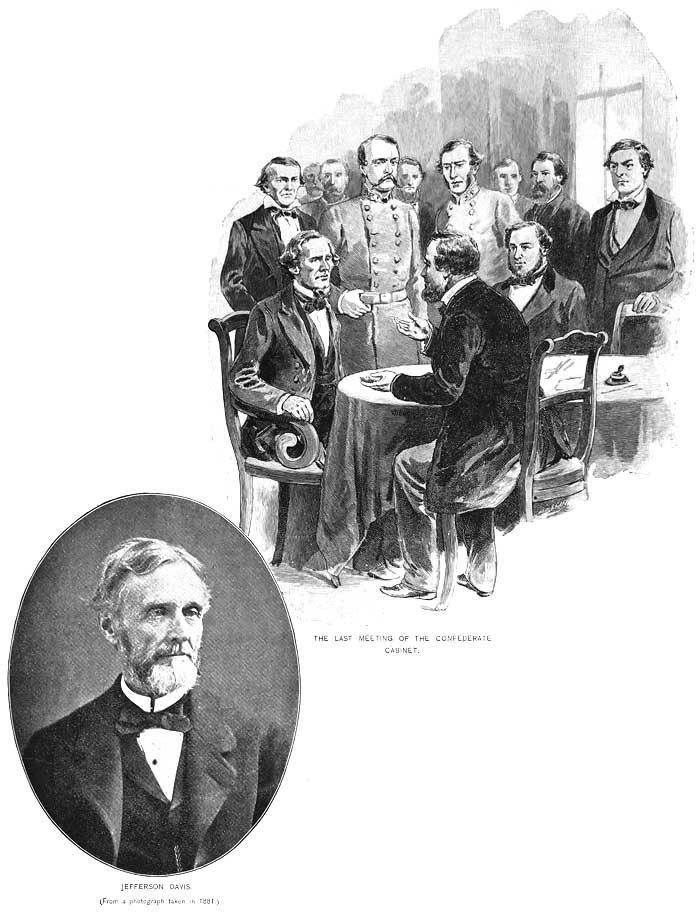
The general feeling in the country was of relief that the war was ended—hardly less at the South than at the North. After the surrender of the various armies, the soldiers so recently in arms against each other behaved more like brothers than like enemies. The Confederates were fed liberally from the abundant supplies of the National commissariat, and many of them were furnished with transportation to their homes in distant States. Some of them had been absent from their families during the whole war.
If the people of the North had any disposition to be boisterous over the final victory, it was completely quelled by the shadow of a great sorrow that suddenly fell upon them. A conspiracy had been in progress for a long time among a few half-crazy secessionists in and about the capital. It culminated on the night of Good Friday, April 14, 1865. One of the conspirators forced his way into Secretary Seward's house and attacked the Secretary with a knife, but did not succeed in killing him. Mr. Seward had been thrown from a carriage a few days before, and was lying in bed with his jaws encased in a metallic frame-work, which probably saved his life. The chief conspirator, an obscure actor, made his way into the box at Ford's Theatre where the President and his wife were sitting, witnessing the comedy of "Our American Cousin," shot Mr. Lincoln in the back of the head, jumped from the box to the stage with a flourish of bravado shouting "Sic semper tyrannis!" and escaped behind the scenes and out at the stage door. The dying President was carried to a house across the street, where he expired the next morning. As the principal Confederate army had already surrendered, it was impossible for any one to suppose that the killing of the President could affect the result of the war. Furthermore, Mr. Lincoln had long been in the habit of going to the War Department in the evening, and returning to the White House, unattended, late at night; so that an assassin who merely wished to put him out of the way had abundant opportunities for doing so, with good chances of escaping and concealing his own identity. It was therefore perfectly obvious that the murderer's principal motive was the same as that of the youth who set fire to the temple of Diana at Ephesus. And the newspapers did their utmost to give him the notoriety that he craved, displaying his name in large type at the head of their columns, and repeating about him every anecdote that could be recalled or manufactured. The consequence was that sixteen years later the country was disgraced by another Presidential assassination, mainly from the same motive; and, as the journalists repeated their folly on that occasion, we shall perhaps have still another by and by.
Mr. Lincoln had grown steadily in the affections and admiration of the people. His state papers were the most remarkable in American annals; his firmness where firmness was required, and kindheartedness where kindness was practicable, were almost unfailing; and as the successive events of the war called forth his powers, it was seen that he had unlimited shrewdness and tact, statesmanship of the broadest kind, and that honesty of purpose which is the highest wisdom. Moreover, his lack of all vindictive feeling toward the insurgents, and his steady endeavor to make the restored Union a genuine republic of equal rights, gave tone to the feelings of the whole nation, and at the last won many admirers among his foes in arms. In his second inaugural address, a month before his death, he seemed to speak with that insight and calm judgment which we only look for in the studious historian in aftertimes. "Neither party expected for the war the magnitude or the duration which it has already attained. Neither anticipated that the cause of the conflict might cease with, or even before, the conflict itself should cease. Each looked for an easier triumph and a result less fundamental and astounding. Both read the same Bible, and pray to the same God, and each invokes his aid against the other. It may seem strange that any men should dare to ask a just God's assistance in wringing their bread from the sweat of other men's faces. But let us judge not, that we be not judged. The prayer of both could not be answered; that of neither has been answered fully. If we shall suppose that American slavery is one of those offences which, in the providence of God, must needs come, but which, having continued through his appointed time, he now wills to remove, and that he gives to both North and South this terrible war as the woe due to those by whom the offence came, shall we discern therein any departure from those divine attributes which the believers in a loving God always ascribe to him? Fondly do we hope, fervently do we pray, that this mighty scourge of war may speedily pass away. Yet if God wills that it continue until all the wealth piled by the bondman's two hundred and fifty years of unrequited toil shall be sunk, and until every drop of blood drawn with the lash shall be paid by another drawn with the sword, as was said three thousand years ago, so still it must be said, 'The judgments of the Lord are true and righteous altogether.' With malice toward none, with charity for all, with firmness in the right as God gives us to see the right, let us strive to finish the work we are in, to bind up the nation's wounds, to care for him who shall have borne the battle, and for his widow and his orphan, to do all which may achieve and cherish a just and a lasting peace among ourselves and with all nations."
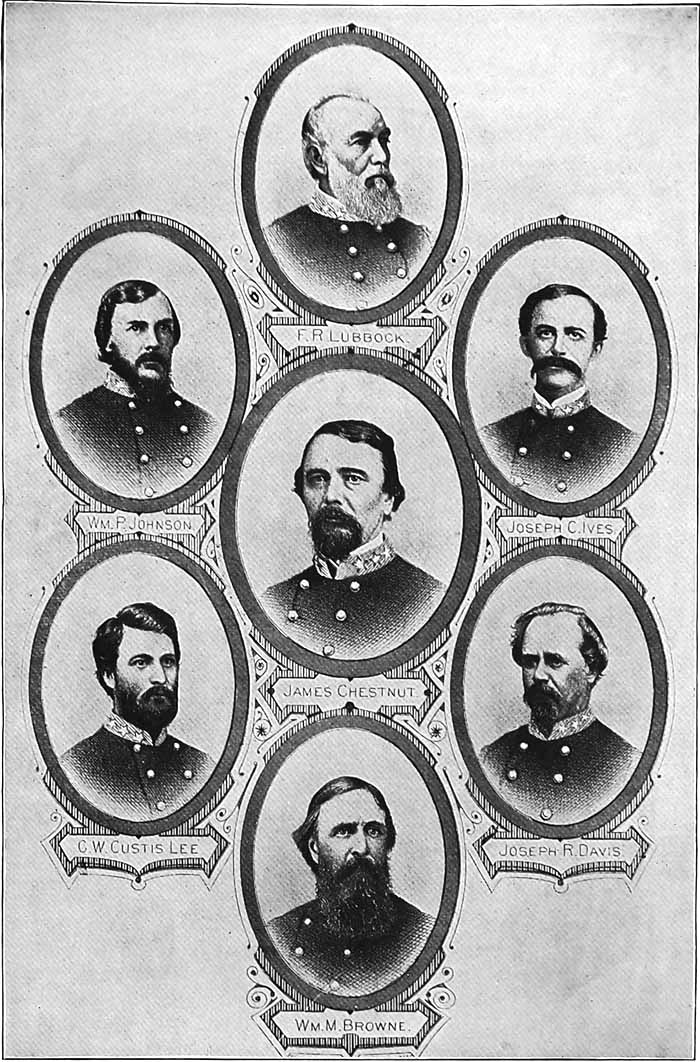
JEFFERSON DAVIS'S BODYGUARD.
A day or two after the evacuation of Richmond, Mr. Lincoln walked through its smoking and disordered streets, where the negroes crowded about him and called down all sorts of uncouth but sincere blessings on his head. He had lived to enter the enemy's capital, lived to see the authority of the United States restored over the whole country, and then was snatched away, when the people were as much as ever in need of his genius for the solution of new problems that suddenly confronted them.
The funeral train retraced the same route over which Mr. Lincoln had gone to Washington from his home in Springfield, Ill., four years before; and to the sorrowful crowds that were gathered at every station, and even along the track in the country, it seemed as if the light of the nation had gone out forever.
The armies returning from the field were brought to Washington for a grand review before being mustered out of service. The city was decorated with flags, mottoes, and floral designs, and the streets were thronged with people, many of whom carried wreaths and bouquets. The Army of the Potomac was reviewed on May 23d, and Sherman's army on the 24th, the troops marching in close column around the Capitol and down Pennsylvania Avenue to the music of their bands. As they passed the grand stand at the White House, where President Johnson and his cabinet reviewed them, the officers saluted with their swords, and commanders of divisions dismounted and went upon the stand.
The armies were quickly disbanded, and each regiment, on its arrival home, was given a public reception and a fitting welcome. The men were well dressed and well fed, but their bronzed faces and their tattered and smoky battle-flags told where they had been. It was computed that the loss of life in the Confederate service was about equal to that in the National. Their losses in battle, as they were generally on the defensive, were smaller, but their means of caring for the wounded were inferior. Thus it cost us nearly six hundred thousand lives and more than six thousand million dollars to destroy the doctrine of State sovereignty, abolish the system of slavery, and begin the career of the United States as a nation.
The home-coming at the North was almost as sorrowful as at the South, because of those that came not. In all the festivities and rejoicings there was hardly a participator whose joy was not saddened by missing some well-known face and form now numbered with the silent three hundred thousand. Grant was there, the commander that had never taken a step backward; and Farragut was there, the sailor without an equal; and the unfailing Sherman, and the patient Thomas, and the intrepid Hancock, and the fiery Sheridan, and the brilliant Custer, and many of lesser rank, who in a smaller theatre of conflict would have won a larger fame. But where was young Ellsworth?—shot dead as soon as he crossed the Potomac. And Winthrop—killed in the first battle, with his best books unwritten. And Lyon—fallen at the head of his little army in Missouri, the first summer of the war. And Baker—sacrificed at Ball's Bluff. And Kearny at Chantilly, and Reno at South Mountain, and Mansfield at Antietam, and Reynolds at Gettysburg, and Wadsworth in the Wilderness, and Sedgwick at Spottsylvania, and McPherson before Atlanta, and Craven in his monitor at the bottom of the sea, and thousands of others, the best and bravest—all gone—all, like Latour, the immortal captain, dead on the field of honor, but none the less dead and a loss to their mourning country. The hackneyed allegory of Curtius had been given a startling illustration and a new significance. The South, too, had lost heavily of her foremost citizens in the great struggle—Bee and Bartow, at Bull Run; Albert Sidney Johnston, leading a desperate charge at Shiloh; Zollicoffer, soldier and journalist, at Mill Spring; Stonewall Jackson, Lee's right arm, at Chancellorsville; Polk, priest and warrior, at Lost Mountain; Armistead, wavering between two allegiances and fighting alternately for each, and Barksdale and Garnett—all at Gettysburg; Hill, at Petersburg; and the dashing Stuart, and Daniel, and Perrin, and Dearing, and Doles, and numberless others. The sudden hush and sense of awe that impresses a child when he steps upon a single grave, may well overcome the strongest man when he looks upon the face of his country scarred with battlefields like these, and considers what blood of manhood was rudely wasted there. And the slain were mostly young, unmarried men, whose native virtues fill no living veins, and will not shine again on any field.
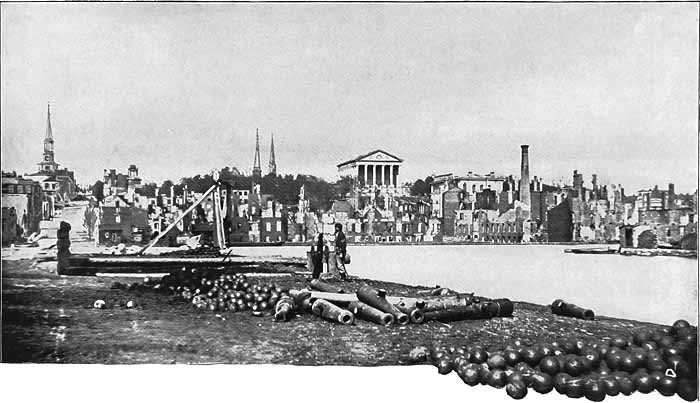
RICHMOND AFTER THE EVACUATION—SHOWING THE EFFECT OF THE FIRE. (From a War Department photograph.)
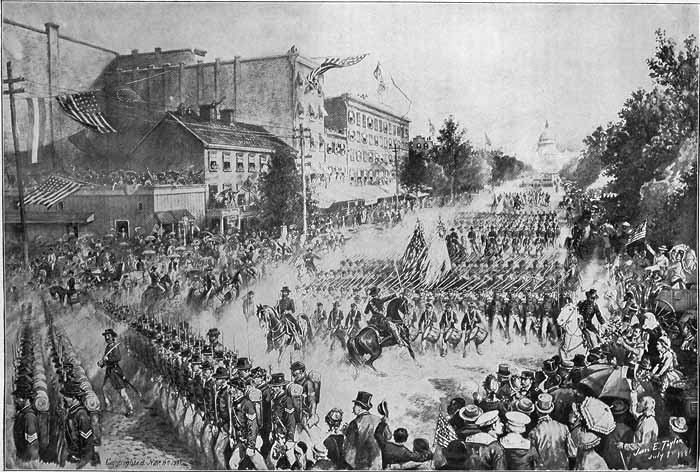
GRAND REVIEW OF THE ARMY, WASHINGTON, MAY 23-24, 1865.
It is poor business measuring the mouldered ramparts and counting the silent guns, marking the deserted battlefields and decorating the grassy graves, unless we can learn from it all some nobler lesson than to destroy. Men write of this, as of other wars, as if the only thing necessary to be impressed upon the rising generation were the virtue of physical courage and contempt of death. It seems to me that is the last thing that we need to teach; for since the days of John Smith in Virginia and the men of the Mayflower in Massachusetts, no generation of Americans has shown any lack of it. From Louisburg to Petersburg—a hundred and twenty years, the full span of four generations—they have stood to their guns and been shot down in greater comparative numbers than any other race on earth. In the war of secession there was not a State, not a county, probably not a town, between the great lakes and the gulf, that was not represented on fields where all that men could do with powder and steel was done, and valor was exhibited at its highest pitch. It was a common saying in the Army of the Potomac that courage was the cheapest thing there; and it might have been said of all the other armies as well. There is not the slightest necessity for lauding American bravery or impressing it upon American youth. But there is the gravest necessity for teaching them respect for law, and reverence for human life, and regard for the rights of their fellow-men, and all that is significant in the history of our country—lest their feet run to evil and they make haste to shed innocent blood. I would be glad to convince my compatriots that it is not enough to think they are right, but they are bound to know they are right, before they rush into any experiments that are to cost the lives of men and the tears of orphans, in their own land or in any other. I would warn them to beware of provincial conceit. I would have them comprehend that one may fight bravely, and still be a perjured felon; that one may die humbly, and still be a patriot whom his country cannot afford to lose; that as might does not make right, so neither do rags and bare feet necessarily argue a noble cause. I would teach them that it is criminal either to hide the truth or to refuse assent to that which they see must follow logically from ascertained truth. I would show them that a political lie is as despicable as a personal lie, whether uttered in an editorial, or a platform, or a President's message, or a colored cartoon, or a disingenuous ballot; and that political chicanery, when long persisted in, is liable to settle its shameful account in a stoppage of civilization and a spilling of life. These are simple lessons, yet they are not taught in a day, and some whom we call educated go through life without mastering them at all.
It may be useful to learn from one war how to conduct another; but it is infinitely better to learn how to avert another. I am doubly anxious to impress this consideration upon my readers, because history seems to show us that armed conflicts have a tendency to come in pairs, with an interval of a few years, and because I think I see, in certain circumstances now existing within our beloved Republic, the elements of a second civil war. No American citizen should lightly repeat that the result is worth all it cost, unless he has considered how heavy was the cost, and is doing his utmost to perpetuate the result. To strive to forget the great war, for the sake of sentimental politics, is to cast away our dearest experience and invite, in some troubled future, the destruction we so hardly escaped in the past. There can be remembrance without animosity, but there cannot be oblivion without peril.
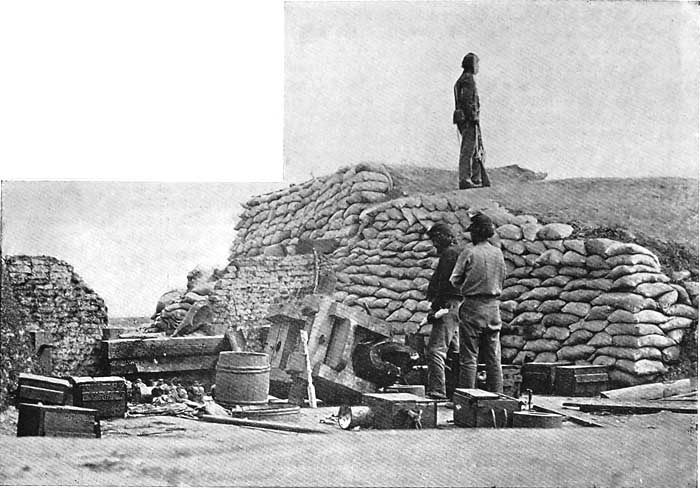
AN EXPLODED GUN IN THE DEFENCE OF RICHMOND.
THE FIRST UNITED STATES FLAG RAISED IN RICHMOND AFTER THE WAR.
BY MRS. LASALLE CORBELL PICKETT, Wife of Major-General George E. Pickett, C. S. A.
The first knell of the evacuation of Richmond sounded on Sunday morning while we were on our knees in St. Paul's Church, invoking God's protecting care for our absent loved ones, and blessings on our cause.
The intense excitement, the tolling of the bells, the hasty parting, the knowledge that all communication would be cut off between us and our loved ones, and the dread, undefined fear in our helplessness and desertion, make a nightmare memory.
General Ewell had orders for the destruction of the public buildings, which orders our Secretary of War, Gen. J. C. Breckenridge, strove earnestly but without avail to have countermanded. The order, alas! was obeyed beyond "the letter of the law."
The terrible conflagration was kindled by the Confederate authorities, who applied the torch to the Shockoe warehouse, it, too, being classed among the public buildings because of the tobacco belonging to France and England stored in it. A fresh breeze was blowing from the south; the fire swept on in its haste and fury over a great area in an almost incredibly short time, and by noon the flames had transformed into a desert waste all the city bounded by Seventh and Fifteenth Streets, and Main Street and the river. One thousand houses were destroyed. The streets were filled with furniture and every description of wares, dashed down to be trampled in the mud or buried where they lay.
At night a saturnalia began. About dark, the Government commissary began the destruction of its stores. Soldiers and citizens gathered in front, catching the liquor in basins and pitchers; some with their hats and some with their boots. It took but a short time for this to make a manifestation as dread as the flames. The crowd became a howling mob, so frenzied that the officers of the law had to flee for their lives, reviving memories of 1781, when the British under Arnold rode down Richmond Hill, and, invading the city, broke open the stores and emptied the provisions and liquors into the gutters, making even the uninitiated cows and hogs drunk for days.
All through the night, crowds of men, women, and children traversed the streets, loading themselves with supplies and plunder. At midnight, soldiers drunk with vile liquor, followed by a reckless crowd as drunk as themselves, dashed in the plate-glass windows of the stores, and made a wreck of everything.
About nine o'clock on Monday morning, terrific shell explosions, rapid and continuous, added to the terror of the scene, and gave the impression that the city was being shelled by the retreating Confederate army from the south side. But the explosions were soon found to proceed from the Government arsenal and laboratory, then in flames. Later in the morning, a merciful Providence caused a lull in the breeze. The terrific explosion of the laboratory and of the arsenal caused every window in our home to break. The old plate-glass mirrors, built in the walls, were cracked and shattered.
Fort Darling was blown up, and later on the rams. It was eight o'clock when the Federal troops entered the city. It required the greatest effort to tame down the riotous, crazed mob, and induce them to take part in the struggle to save their own. The firemen, afraid of the soldiers who had obeyed the orders to light the torch, would not listen to any appeals or entreaties, and so the flames were under full headway, fanned by a southern breeze, when the Union soldiers came to the rescue.
The flouring mills caught fire from the tobacco houses, communicating it to Cary and Main Streets. Every bank was destroyed. The War Department was a mass of ruins; the Enquirer and Dispatch offices were in ashes; and the county court-house, the American Hotel, and most of the finest stores of the city were ruined.
Libby Prison and the Presbyterian church escaped. Such a reign of terror and pillage, fire and flame, fear and despair! The yelling and howling and swearing and weeping and wailing beggar description. Families houseless and homeless under the open sky!
I shall never forget General Weitzel's command, composed exclusively of colored troops, as I saw them through the dense black columns of smoke. General Weitzel had for some time been stationed on the north side of the James River, but a few miles from Richmond, and he had only to march in and take possession. He despatched Major A. H. Stevens of the Fourth Massachusetts cavalry, and Major E. E. Graves of his staff, with about a hundred mounted men, to reconnoitre the roads and works leading to Richmond. They had gone but a little distance into the Confederate lines, when they saw a shabby, old-fashioned carriage, drawn by a pair of lean, lank horses, the occupants waving a white flag. They met this flag-of-truce party at the line of fortifications, just beyond the junction of the Osborne turnpike and New Market road. The carriage contained the mayor of Richmond—Colonel Mayo—Judge Meredith of the Supreme Court, and Judge Lyons. The fourth worthy I cannot recall. Judge Lyons, our former minister to England, and one of the representative men of Virginia, made the introductions in his own characteristic way, and then Colonel Mayo, who was in command of the flag-of-truce party, handed to Major Stevens a small slip of wall paper, on which was written the following: "It is proper to formally surrender to the Federal authorities the city of Richmond, hitherto capital of the Confederate States of America, and the defences protecting it up to this time." That was all. The document was approved of, and Major Stevens most courteously accepted the terms for his commanding general, to whom it was at once transmitted, and moved his column upon the evacuated city, taking possession and saving it from ashes.
His first order was to sound the alarm bells and to take command at once of the fire department, which consisted of fourteen substitute men, those who were exempt from service because of disease, two steam fire engines, four worthless hand engines, and a large amount of hose, destroyed by the retreating half-crazed Confederates. His next order was to raise the stars and stripes over the Capitol. Quick as thought, two soldiers, one from Company E and one from Company H of the Fourth Massachusetts cavalry, crept to the summit and planted the flag of the nation. Two bright, tasteful guidons were hoisted by the halyards in place of the red cross. The living colors of the Union were greeted, while our "Warriors' banner took its flight to meet the warrior's soul."
That flag, whose design has been accredited alike to both George Washington and John Adams, was raised over Virginia by Massachusetts, in place of the one whose kinship and likeness had not, even after renewed effort, been entirely destroyed. For by the adoption of the stars and bars (three horizontal bars of equal width—the middle one white, the others red—with a blue union of nine stars in a circle) by the Confederate Congress in March, 1861, the Confederate flag was made so akin and so similar to that of the nation, as to cause confusion; so in 1863 the stars and bars was supplanted by a flag with a white field, having the battle flag (a red field charged with a blue saltier, on which were thirteen stars) for a union. This, having been mistaken for a flag of truce, was altered by covering the outer half of the field beyond the union with a vertical red bar. This was the last flag of the Confederacy.
Richmond will testify that the soldiers of Massachusetts were worthy of the honor of raising the first United States flag over her Capitol—the Capitol of the Confederacy—and also to the unvarying courtesy of Major Stevens, and the fidelity with which he kept his trust.
HUMOROUS INCIDENTS OF THE WAR.
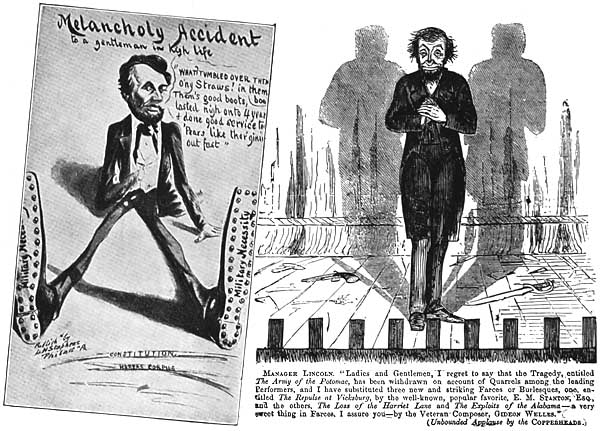
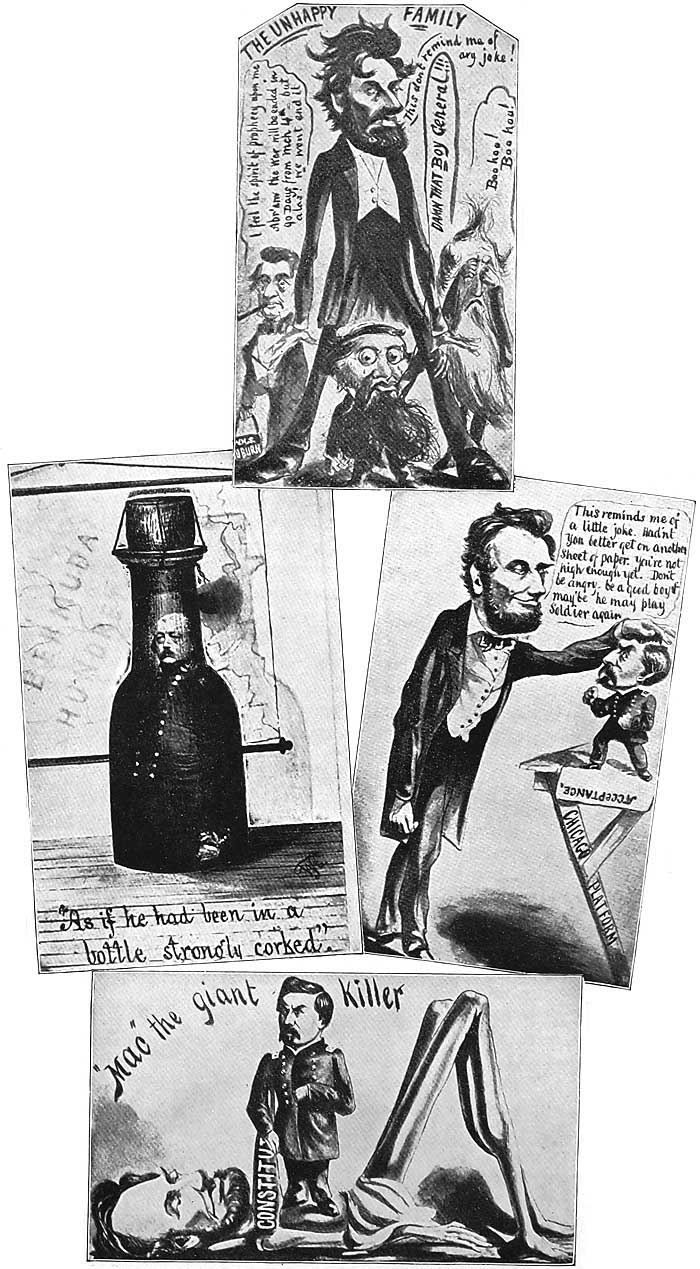
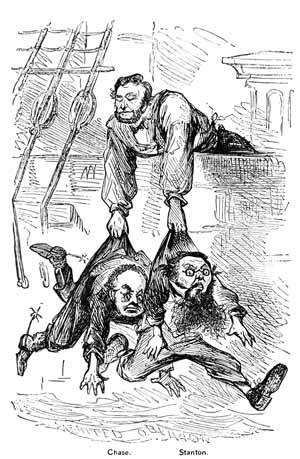
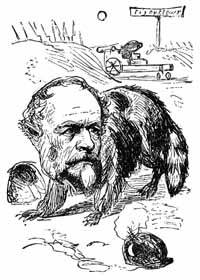
The illustrations of this chapter are exact reproductions of cartoons published during the war in various newspapers and periodicals.
FUN FROM ENLISTMENT TO HONORABLE DISCHARGE—RECRUITS' EXCUSES—BULL RUN PLEASANTRIES—GREENHORNS IN CAMP—FUN WITH THE AWKWARD SQUAD—OFFICERS LEARNING THEIR BUSINESS—SENTRIES AND SHOULDER STRAPS—STORIES OF GRANT, LINCOLN, BUTLER, SHERMAN, ETC.—DUTCH, IRISH, AND DARKY COMEDY—EXPEDIENTS OF THE HOMESICK—ARMY CHAPLAINS—HOSPITAL HUMOR—GRANT'S "PIE ORDER"—"THROUGH VIRGINIA"—YANKEE GOOD NATURE AND PLUCK A BETTER STIMULANT THAN WHISKEY.
he hardships of campaigning, the sufferings of the hospital, the horrors of actual combat—none of these sufficed to keep down the irrepressible spirit of fun in the American soldier. From the day of his enlistment to the day of his discharge he did not cease to look upon the funny side of every situation, and the veterans of to-day talk more about the humor of the war than of privations and pitched battles. Wits in and out of the army said and did clever things, some of which have passed into the proverbs and idioms of the American people; and more than one distinguished "American humorist" laid the foundation of his reputation in connection with the war.
Humorous situations began at the very recruiting office, or the citizens' meeting which stimulated recruiting, and continued to the end of the service. It was at one of the meetings held in a New England village that the wife of a spirited citizen, whose patriotism consisted in brave words, said to him: "I thought you said you were going to enlist to-night." Well, he had thought better of it. "Take off those breeches, then, and give them to me, and I will go myself." There was not much prospect of "peace" for him in a life at home after that; so he went to the front. Countless excuses were offered by candidates for the draft in the hope of proving themselves physically disqualified for service. The man who had one leg too short was let off; but the man behind him, who pleaded that he had "both legs too short," failed to prove a double incapacity, and he wore the blue, and that creditably.
Officers who tarried too long in Washington on their way to the front were not seldom rendered uncomfortable by the remarks made to them or in their hearing. One who was eager for news from the first battle of Bull Run bought an "extra" of a newsboy who was calling, "All about the battle!" Glancing over it, he shouted after the boy: "Here! I don't see any battle in this paper." "Don't you?" said the boy. "Well, you won't see any battle if you loaf around this hotel all the time." It was of the battle of Bull Run that a wit said, it was so popular it had to be repeated the very next year, to satisfy the public demand for it. And one of the participants in this first experience of the new army said: "At Bull Run we were told that the eyes of Washington were upon us; when we knew very well that what we were most anxious about was to get our eyes on Washington." It was said of the soldiers on both sides in that battle, that their guns trembled in their hands, so that if the enemy was dodging he was almost certain to be hit, and that the conclusion arrived at by the rearward experiments of both armies was that a soldier may retreat successfully from almost any position if only he starts in time. Thus the pleasantry of the day turned to account the "baptism of fire" of some of the bravest troops that ever wore blue or gray.
Once in camp, the school-boy spirit revelled in larks of every description. A few weeks of experience developed military manners and prepared the recruit to enjoy the greenness of the newer comers. On drill, a new recruit was sure to get his toes exactly where a "vet" wanted to drop the butt of his musket as he ordered arms, and if there was a mud-puddle within a yard of him he was sure to "dress" into it. The new men were sent to the officers' quarters on the most absurd errands, usually in quest of some luxury which, fresh from the comforts of home, they still regarded as a necessity. The drilling of the awkward squad was a never-ending source of amusement; for some men are constitutionally incapable of moving in a machine-like harmony with others, and these were continually out of place. One of them was a loose-jointed fellow from, say, Nantucket, who was so thorough a patriot that he was always longing for home, and he met every hardship and discouragement with a sigh and the wish that he was back in Nantucket. He was exceedingly awkward at drill. He seemed to make every movement on the "bias." One day, in responding to a command, he figured it out so badly as to find himself all alone, several yards away from the rest of the squad. All at sea, he said: "Captain, where ought I to be now?" The captain, thoroughly out of patience, shouted back: "Why, back in Nantucket, gol darn you!" There was the Irishman who said he had spent two years in the cavalry learning to turn his toes in, and two years in the infantry learning to turn his toes out. "Divil take such a sarvice," said he; "there's no plazing the blackguards, anyhow."
The drill jokes were not all on the men. The officers, who at the beginning were nonmilitary citizens like their soldiers, had their business to learn. Indeed, it was not an easy matter at first to preserve thorough discipline, because of the frequent equality, in military knowledge, between the officers and the men. It was said that the American soldier was perfectly willing to endure hardships, to fight, and if necessary to die, for his country; but the hardest thing for him to submit to was to be bossed around by his superior officer, who might, like enough, be his next-door neighbor at home. One captain, who had abandoned railroading for the war, in his excitement over the necessity of halting his men suddenly, true to his former calling, shouted out, "Down brakes!" And another, who had forgotten the command for breaking ranks, dismissed his company with the order, "Adjourn for rations!" It was a Georgian commandant of a Home Guard who, while showing his men off before a visiting officer, invented his own tactics on the basis of "common sense." His first order after falling in was, "In two ranks, git!" It was not long before he had his men pretty well mixed up; but, equal to the occasion, he shouted, "Disentangle to the front, march!" which was as effective as anything in "Hardee's Tactics." Drill sergeants were often peremptory fellows, and they sometimes called on their men to perform difficult feats. One under-sized sergeant had much trouble with an Irish recruit, whose enormous height had given him the habit of looking down, and he could not keep his chin up to the military angle. Finally the sergeant reached up to the Irishman's chin (for which he had to stand on tip-toe) and poked it up, saying, "That's the place for it; now don't let us see your head down again."—"Am I always to be like this, sergeant?" asked the recruit. "Yes, sir."—"Then I'll say good by to yez, sergeant, for I'll niver see yez again." It was a very fresh recruit who was found on his sentry post sitting down and cleaning his gun, which he had taken entirely to pieces. The officer who discovered him rebuked him sternly and asked, "Are you the sentinel here?"—"Well, I'm a sort of a sentinel."—"Well, I'm a sort of officer of the day."—"All right," said the undismayed recruit, "just hold on till I get my gun together, and I'll give you a sort of a salute."
The military rule that a sentry must challenge everybody, and not pass unchallenged even those whom he knew to be all right, was often as slow in taking possession of the officers' minds as those of the least experienced of the men. A full-uniformed lieutenant, much disgusted at the "Who goes there?" of one of his own company on guard, expressed his sentiments by indignantly exclaiming, "Ass!" To which the sentry promptly responded, "Advance, Ass, and give the countersign!" Not infrequently general officers and high dignitaries had experiences with the guards of their own camps. It is said that every great general in history has been halted by a guard, the approach of a well-known superior officer giving the sentry an opportunity of showing off his discipline. General McClellan was not only halted on a certain occasion, but forced to dismount and call up the officer of the guard before a sentry would let him pass. General Sherman, who used to see for himself what was going on among his men, under the incognito afforded by a rather unmilitary dress, once interfered with a teamster who was pounding a mule, and told him who he was. "Oh, that's played out!" said the mule driver; "every man that comes along here with an old brown coat and a stove-pipe hat claims to be General Sherman." This suggests the story of a mule driver in the army who was swearing at and kicking a span of balky mules, when the general, who was annoyed at his profanity, ordered him to stop. "Who are you?" said the mule driver. "I'm the commander of the brigade," said the general. "I'm the commander of these mules, and I'll do as I please, or resign, and you can take my place!" The general passed on. Even the President of the United States had his encounter with a guard, and was for a short time kept waiting outside General Grant's tent under the order, suggested by his somewhat clerical appearance, "No sanitary folks allowed inside!"
Lincoln always made friends among the soldiers. On one occasion he came on some men hewing logs for a hospital, and remarking, with a reminiscence of his rail-splitting days, that he "used to be pretty good on the chop," made the chips fly for a while like a veteran lumberman. The President's half-pathetic saying, that he had "no influence with this administration," has passed into history; but less familiar is his remark, when some one applied to him for a pass to go into Richmond, and he said, "I don't know about that; I have given passes to about two hundred and fifty thousand men to go there during the last two years, and not one of them has got there yet."
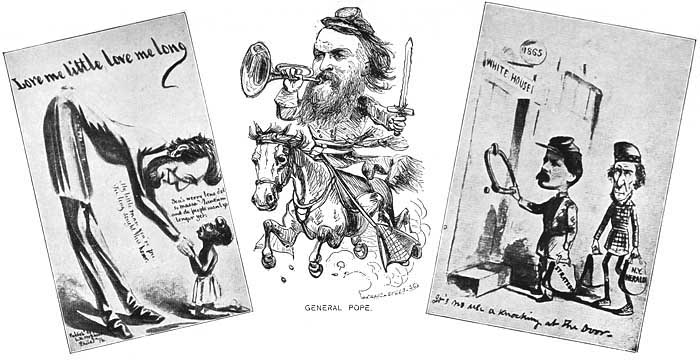
Ben Butler was credited with a lawyer-like disinclination to be cross-questioned when he gave orders. Word was brought to him that his favorite horse, "Almond-eye," had fallen into a ravine and been killed, and he called an orderly and told him to go to the ravine and skin the horse. "What, is Almond-eye dead?" asked the man. "Never you mind whether he is or not," said the general, "you obey orders." The man came back in about two hours and reported that he had finished. "Has it taken you all this time to skin a horse?" asked Butler. "Oh, no; it took me half an hour to catch him," was the reply. "You don't mean to say you killed him?" shouted the irate general. "My orders were to skin him," said the soldier, "and I obeyed them without asking any questions."
Officers and men alike showed much wit in their way of dealing with impossible or unwelcome orders. A lieutenant protested against an order to take a squad of men across a swamp where he knew the depth was enough to drown every man of them. He was sternly rebuked by his superior, who ordered him peremptorily to make the crossing, telling him that his requisition would be honored for whatever he might require for the purpose. So he made a requisition for "twenty men eighteen feet long to cross a swamp fifteen feet deep."
We will give another of the many similar stories. After a long march a captain ordered, as a sanitary precaution, that the men should change their under-shirts. The orderly sergeant suggested that half of the men had only one shirt each. The captain hesitated a moment and then said: "Military orders must be obeyed. Let the men, then, change with each other."
Orders against unauthorized foraging were very strict. A youthful soldier was stopped on his way into camp with a fine goose slung over his shoulder, and he was required to account for it. "Well," said he, "I was coming through the village whistling 'Yankee Doodle,' and this confounded rebel of a goose came out and hissed me; so I shot it."
"Where did you get that turkey?" said the colonel of the —— Texas regiment to one of his amiable recruits that came into camp with a fine bird.
"Stole it," was the laconic reply.
"Ah!" said the colonel, triumphantly, to a bystander, "you see my boys may steal, but they won't lie."
During a battle the interest in the work was so intense as to leave small room for fear, either of the enemy or of superior officers. An Irish private was ordered to take up the colors when the color-bearer was shot down. "By the holy St. Patrick, colonel," said he, "there's so much good shooting here, I haven't a minute's time to waste fooling with that thing."
The desire to get home for a few days developed much ingenuity among the enlisted men. "What do you want, Pat?" asked General Rosecrans, as he rode along the line, inquiring into the wants of his men. "A furlough!" said Pat. "How long has your sister been dead?" asked a sympathetic comrade of a soldier who had obtained a leave on account of the family trouble. "About ten years," was the cool reply. General Thomas asked a man who applied for leave to go and see his wife how long it was since he had seen her. "Over three months," was the answer. "Three months!" exclaimed the general; "why, I haven't seen my wife for three years!" "That may be," said the soldier, "but you see, general, me and my wife ain't o' that sort."
The "intelligent contraband," the irrepressible darky, is one of the few types of mankind that furnish as much fun in real life as on the stage. He was a source of constant amusement in the army. A colored refugee from the Confederate lines brought word, as the only news worth mentioning (referring to himself), that "a man in Culpeper lost a mighty valuable nigger this mornin'." The driver of a commissary wagon exemplified the general non-combativeness of his race, when, in describing his emotions during an attack on the train, he said he felt "like every hair of his head was a bugle, an' dey was all a-playin' 'Home, Sweet Home.'" An officer tried to induce his servant, who was a refugee, to enlist, saying he must trust the Lord to keep him safe. "Well," he said, "I did trust de Lord when I was tryin' to get into de Union lines, but I dun dare resk Him again!"
The army chaplain now and then ran against the rough soldier wit. One of them, who took a practical view of his responsibility for the souls of his regiment, welcomed some recruits with the suggestion that, having joined the army of their country, they should now also join the army of the Lord. "What bounty does He give?" was the irreverent rejoinder. Even in hospital the disposition to look on the humorous side of life—or of death—never forsook men. One who had lost three fingers held up the maimed member and sorrowfully regretted that he "never could hold a full hand again." A pale-faced sufferer in a hospital near a large city was asked by a visiting lady if she could not do something for him. No. Could she not bathe his head? "You may if you want to very much," he replied; "but if you do, you will be the fourteenth lady that has bathed my head this morning." It was an Irish surgeon who remarked that "the man who has lost his finger makes more noise about it than the man who has lost his head." A nurse was shocked one morning to find two attendants noisily hammering and sawing at one end of a ward where a very sick man was lying. In reply to her questions, they said they were making a coffin. "Who for?" "Him"—pointing to the sick man. "Is he going to die?" she asked, much distressed. "The doctor says he is, an' I guess he knows what he give him!" It was a Confederate guerilla who comforted himself, while lying on his hospital cot, with the reflection, "I reckon I killed as many of them as they did of me."
A soldier was wounded by a shell at Fort Wagner. He was going to the rear. "Wounded by a shell?" some one asked. "Yes," he coolly answered. "I was right under the durned thing when the bottom dropped out."
The occurrences in the enemy's country, and stories that originated there, furnished no small portion of the humor that was current during the war. "Where does this road lead to?" asked the lieutenant in command of a reconnoitering party. "It leads to h——!" was the surly reply of the unregenerate rebel thus interrogated. "Well, by the appearance of the inhabitants of this country, I should judge that I'm most there," was the retort. An old man in Georgia was called upon to declare which side he took, and, uncertain as to the identity of his captors, he said: "I ain't took no side; but both sides hev took me!" It must have been his wife who said: "I ain't neither Secesh nor Union—jest Baptist."
The devotion of Southern women to the Confederacy has often been remarked. One of the minor officers of the army, who marched with Sherman to the sea, and who states that he tramped, all told, at least two thousand miles during the war through the South, says that he saw many Southern men who were loyal to the Union, and who regretted the secession of their respective States, but he saw only one Southern woman whom he even suspected to be Union in sentiment. He saw this woman during a foraging expedition in connection with the march to the sea. He had charge of a squad of thirteen men who had marched through the woods some distance away from the army. As they rounded a sharp curve in the road, they suddenly came upon a house almost covered with foliage. In front of the house, and only a few yards from the men, was a woman picking up chips. Her back was toward the soldiers, and she had not noticed their approach. The commanding officer motioned to his men to stop, and, tip-toeing up to the side of the woman, he put his arm around her waist and kissed her. Stepping back a pace or two, he waited for the bitter denunciation and abuse that he was sure would come. The woman, however, straightened herself up, looked at the officer for a moment, and then said slowly: "You'll find me right here every morning a-picking up chips." The officer said he strongly suspected that she was disloyal to the South.
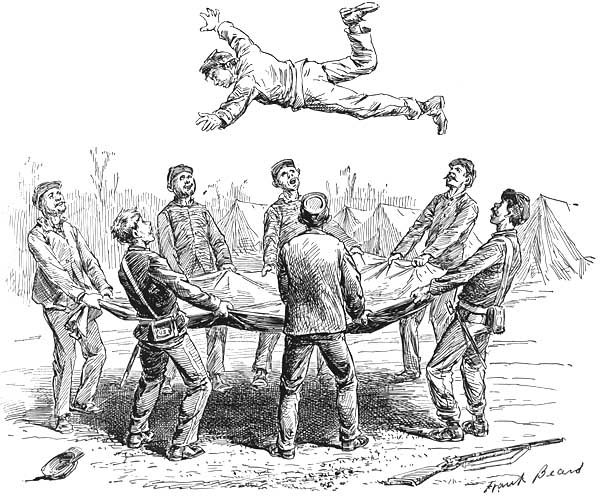
FUN IN CAMP.
A military peculiarity of General Bragg's was touched on in the remark that, when he died and approached the gate of heaven and was invited in, the first thing he'd do would be to "fall back." Gen. W. T. Sherman never seemed to suit the Confederates, no matter what he did. One of the prisoners who fell into the hands of his army gave the following graphic expression of the Southern idea of the general: "Sherman gits on a hill, flops his wings and crows; then he yells out: 'Attention, creation! by kingdoms, right wheel, march!' And then we git!" It was a solitary relic left behind after one of Sherman's advances, that, communing with himself, said: "Well, I'm badly whipped and somewhat demoralized, but no man can say I am scattered."
Among the humorous miscellanies of the war, General Grant's "pie order" must have an immortal place. It was during Grant's early campaign in Eastern Missouri that a lieutenant in command of the advance guard inspired the mistress of a wayside house with exceptional alacrity in supplying the wants of himself and men by announcing himself to be Brigadier-General Grant. Later in the day the general himself came to the same house and was turned away with the information that General Grant and staff had been there that morning and eaten everything in the house but one pumpkin pie. Giving her half a dollar, he told her to keep that pie till he sent for it. That evening the army went into camp some miles beyond this place, and at the dress parade that was ordered, the following special order was published:
"HEADQUARTERS, ARMY IN THE FIELD.
"SPECIAL ORDERS, NO. —.
"Lieutenant Wickfield, of the —th Indiana Cavalry, having on this day eaten everything in Mrs. Selvidge's house, at the crossing of the Ironton and Pocahontas and Black River and Cape Girardeau roads, except one pumpkin pie, Lieutenant Wickfield is hereby ordered to return with an escort of one hundred cavalry and eat that pie also.
"U. S. GRANT, "Brigadier-General Commanding."
Virginia mud and Virginia swamps were celebrated by the invention of the response to the question, "Did you go through Virginia?" "Yes—in a number of places;" and the exclamation of the trooper who was fording a stream flanked by miles of swamp on either side: "Blowed if I don't think we have struck this stream lengthwise."
It is impossible here to attempt more than a suggestion of the combination of good nature and pluck that, all through the dreadful days of the war, rendered hardships endurable, lent courage to the faint-hearted, and cheered the low-spirited. "The humor of the war" was no mere ebullition of school-boy fun; it was as potent a factor in accomplishing the results of the war as powder and shot—a stimulant that carried men over hard places better than whiskey.
WAR HUMOR IN THE SOUTH.
THE BADINAGE OF THE ARMY—NO RESPECTER OF PERSONS—"PICKIN' A CHUNE" FROM A BASS DRUM—SWEARING THAT WAS "PLUM NIGH LIKE PREACHIN'"—WHAT IS A "BEE-LINE"?—FUN AMONG THE NEGROES—STONEWALL JACKSON'S BODY-SERVANT—WOMEN IN SEWING SOCIETIES AND AT THE BEDSIDES OF THE WOUNDED.
outhern soldiers, like their Northern opponents, soon found that humor was a safety valve—a diversion from the graver thoughts that, in their lonely hours, lingered around the wife, mother, and children in the distant home. Withal, it was a spontaneous good humor, such as Washington Irving calls the "oil and wine of a merry meeting," where the companionship was contagious and the jokes small, but the jollity was abundant. It might not have been as polished as that of Uncle Toby or Corporal Trim, nor as philosophical as Dickens makes the observations of the elder Mr. Weller and his son "Sam," but it exemplified human nature in the rough, and overflowed harmlessly.
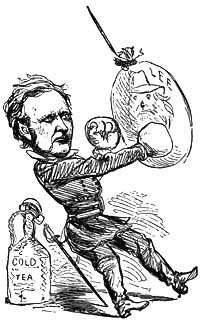
GENERAL HOOKER.
Those who have had occasion to make the comparison have, without doubt, observed salient points of difference between the styles of badinage prevalent in the Northern and Southern armies. Your Southerner was no respecter of persons. He seized on any feature of an individuality that presented a ludicrous side. If a stranger was unusually long or short, or lean or fat, he was sure to be a target for ridicule.
Passing through Frederick in the first Maryland campaign (1862), a good-natured-looking citizen, who evidently had not been able to tie his shoestrings for a number of years, stood on his doorstep watching us as we passed. "Hi, there! Hog-killing time, boys," suddenly astonished his ears, and was the signal for an instant fire of playful chaff. "Aint he swelled powerful?" "Must have swallowed a bass drum." "I say, stranger, buttermilk or corn-fed?" "Does it hurt much?" "What hurt?" ventured the fat man, quizzically. "Why, totin' them rations around with yer all day." In a minute or two the old gentleman, very red in the face, carried his abdominal rotundity into the house, but quickly reappeared with a demijohn in each hand. "Here, boys!" he exclaimed, "wash your mouths out with some of this applejack, and have a bit of mercy on a fat man." It is needless to say that the boys promptly cheered their vote of thanks.
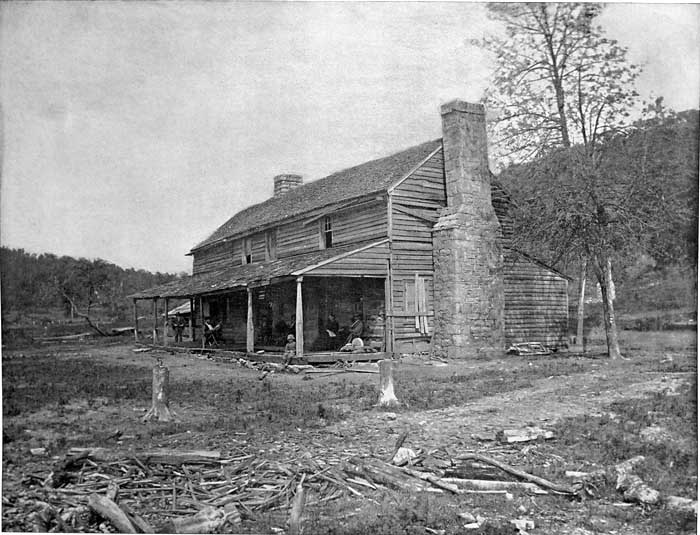
THE OLD JOHN ROSS HOUSE, NEAR RINGGOLD, GA.—MISSIONARY RIDGE ON THE RIGHT. (From a Government photograph.)
The colonel of a South Carolina regiment, having returned from his furlough with a pair of high top boots—boots were then worth seven or eight hundred dollars—had the temerity to run the gauntlet of a neighboring brigade, and heard comments like these: "I say, mister, better git out'r them smokestacks; know you're in thar 'cause we kin see yer head stickin' out." "Boys, the kern'l 's gone into winter quarters." "What mout be the price o' them nail kags?" etc. An officer wearing noticeably bushy whiskers was unfeelingly invited to "come out from behind that bunch of har! 'Taint no use t' say yer aint in thar, 'cause yer ears is workin' monstrous powerful." It was rarely safe, under these circumstances, to answer with either wit or abuse.
Our soldiers had little respect for what were known as "bombproofs"—the fellows who had easy positions in the rear. On one occasion a smartly dressed young officer belonging to this kindred cantered up to a depot where a regiment of men were awaiting transfer. As soon as they saw him they began whooping: "Oh, my! aint he pooty!" "Say, mister, whar'd ye git that biled shut?" "Does yer grease that har with ham fat, or how?" And so they plied the poor fellow with all manner of questions concerning his age, occupation, religious and political convictions, that were calculated to make a man feel uncomfortable. One feather, however, broke the camel's back. A long, cadaverous specimen of humanity, who had evidently been making a comical survey of the victim—his handsome uniform, and well-polished boots—taking a step or two forward as if to show his intense interest, solemnly drawled out: "Was yer ra-a-ly born so, or did they put yer together by corntract? Strikes me yer must have got yere in a drove or ben picked afore you was ripe." Then somebody suggested that "sich a nice-lookin' rooster ought to git down and scratch for a wurrum"; and amid the laughter that followed, he was glad to put spurs to his horse and gallop out of hearing.
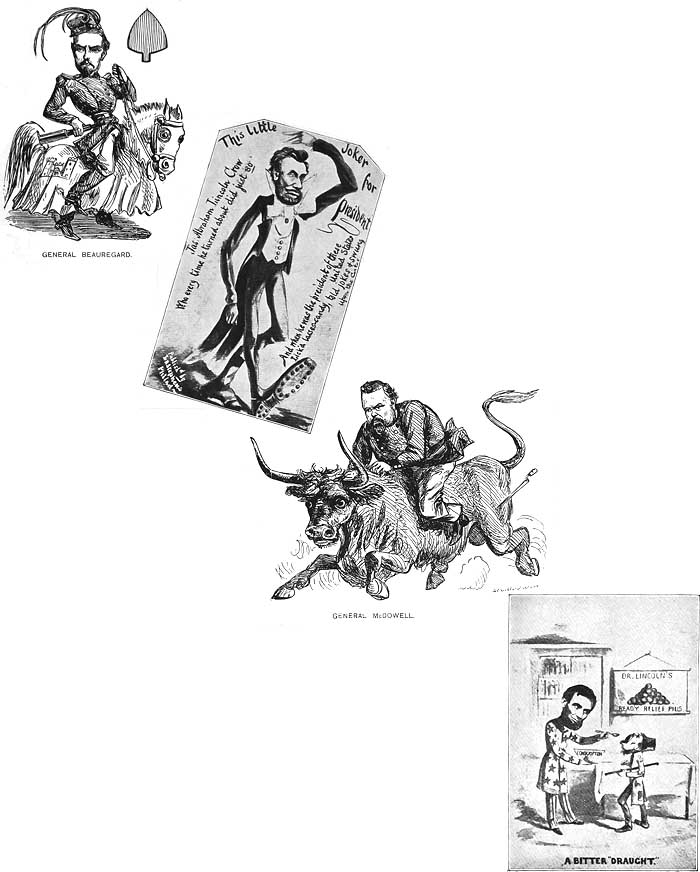
Cavalrymen were called by the infantry "buttermilk rangers," and the musicians came in for more than their share of good-natured chaff. Rather than be tormented, the latter would sometimes leave the line of march and go through the fields, thus avoiding the frequent invitation to "give us a toot on yer old funnel," or "brace up with yer blow-pipe." One day a bass drummer, plodding along, was attracted by a pitiful voice coming from a group of men resting by the roadside: "Mister, oh, mister, please come yere?" Turning in the direction, he found it proceeded from a woe-begone-looking Mississippian, whose sickly appearance was well calculated to arouse the sympathy of a tender-hearted musician. "Well, what can I do for you?" said the man with the drum. "Oh, a heap, a heap. I've got a powerful misery, and I thought as how you mout set down yere and pick a chune for a sick man on that ar thing you tote around on your stomach." Shouts of laughter told him that he was "sold," and he never heard the last of the applications for the soothing tones of "that ar thing."
This drollery of expression cropped out even amid the turmoil and excitement of the battlefield. The story is told of a young fellow who was under fire at Manassas for the first time, one of those hundreds of thousands on both sides behind whose inexperience was too much pride of character to permit them to show the white feather, and whose fear of the contempt of their comrades, as well as of the disgrace at home, made them good fighters. He had become pretty well warmed up and was doing excellent service when suddenly he caught sight of a rabbit loping across the field between the lines. Dropping his gun, as he was about to shoot, he looked dolefully at the little animal for an instant and then yelled with honest pathos: "Go it, cotton tail, go it. I'm ez skeered ez you be, an' ef I hadn't a reputation to lose I'd run too."
At the battle of Kinston, N. C., Gen. N. E. Evans, of South Carolina, familiarly known in the old army as "Shanks," posted a body of raw militia at the crossing of a creek, but they were met by a severe fire and forced to give way. In the disorder that followed, the general caught one of the fugitives and with a number of emphatic adjectives demanded: "What are you running away for, you blank, blank coward? You ought to be ashamed of yourself." "I ain't runnin' away, gineral, I'm jes' skeered. Why, them fellers over thar are shootin' bullets at us big as watermillions, boo-hoo-hoo! One on 'em went right peerst my head—right peerst—an' I want ter go home."
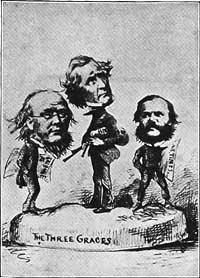
TRIBUNE—HERALD—TIMES.
"Well, why didn't you shoot back, sir? You are crying like a baby."
"I know it, gineral, I know it, boo-hoo! and I wish I was a baby, and a gal baby too, and then I wouldn't have ben cornscripted."
This reminds us of another North Carolina story. During the Rebellion the staff of General Wise was riding through a rather forlorn part of that State, and a young Virginian of the staff concluded to have a little fun at the expense of a long-legged specimen of the genus homo who wore a very shabby gray uniform and bestrode a worm fence at the roadside. Reining in his horse, he accosted him with "How are you, North Carolina?"
"How are you, Virginia?" was the ready response.
The staff officer continued: "The blockade on turpentine makes you rather hard up, don't it? No sale for tar now?"
"Well—yes—" was the slow response. "We sell all our tar to Jeff Davis now."
"The thunder you do! What on earth does the President want of your tar?"
North Carolina answered, "He puts it on the heels of Virginians to make them stick on the battlefield."
The staff rode on.
Speaking of General Evans, an incident is recalled concerning his brother-in-law, Gen. Mart Gary, who succeeded Wade Hampton in the command of the Hampton Legion. Gary employed many phrases, especially in battle, that are not often heard in polite society. His old body-servant, commenting on this habit, gave the following description of the manner in which his master stormed and swore at some disobedience of orders during one of the fights.
"I golly, massa, but de way de ole man moub about dat day was 'scrutiatin'. He went dis away an' he went dat away wabin his sword like a scythe blade. He went yere and he went dar; but to hear de ole man open battery on de hard wuds in de langidge and jes' frow um aroun'—frow um aroun' loose—I declar, boss, it were plum nigh like preachin'."
LINCOLN SIGNING THE EMANCIPATION PROCLAMATION. (From a Southern war etching.)
At first, the necessity for discipline was not recognized by the raw Southern volunteers, and instances of the verdancy which prevailed were common. When a picket guard at Harper's Ferry, where our first troops assembled, was being detailed for duty, one of the men stoutly protested against any such arrangement, because, as he remarked, "What's the use of gwine out thar t' keep ev'rybody off? We've all kim here t' hev a fight with the Yankees, and ef yer keep fellers out thar t' skeer 'em off, how in thunder are we gwine to hev a scrimmage?"
An officer, while inspecting the sentinel lines one day, asked a picket what he would do if he saw a body of men coming. "Halt 'em, and demand the countersign, sir!" "But suppose they wouldn't halt?" "Then I'd shoot." "Suppose they didn't stop then, what would you do?" "I reckon I'd form a line, sir." "A line? What kind of a line?" "A bee-line straight for camp, and run like thunder!"
A young lieutenant, fresh from a country drill ground and sadly ignorant of the tactics of Hardee or Scott, didn't know exactly what to do when the commanding officer ordered him one morning to "mount guard." He marched off with his squad of men, however, and about an hour afterwards was found sitting under a tree and talking to some one in the branches. "Well, lieutenant, have you mounted guard?" "Oh, yes, sir," was the cool reply; "got 'lev'n up this tree and t'others 'r' over yander roost'n' in another."
UNIVERSAL ADVICE TO ABRAHAM: "DROP 'EM!"
The Southern negroes also furnished abundant humor of their peculiar kind. During the occupation of Yorktown, Va., a shell entering camp made a muddle of a lot of pots and kettles. Mingo, the cook, at once started off for a safe place in the rear. On the way he was met by one of his brother servants, who inquired: "Wot's de matter, Mingo? Whar's yo' gwine wid such a hurrification?"
"'Ain't gwine nowhar p't'c'lar; jis' gittin' outen de way dem waggin hubs dey's t'rowin' at us."
"Eh, eh, Mingo, I 'spects dat's a sign you's a wicked nigger, for ef yo' was a good Chrishun yo' nebber be skeer by dem shell. Ef yo' listen to de Good Book, yo' find dat Massa up yander am pintin' eb'ry one ob em, an' know 'zactly whar to drap um!"
"Da' mebbe so, mebbe so; but yo' can't fool dis chile. Hear me, Jupiter. Dar's too much powder in dem t'ings for the good Lor' to meddle wid 'em, and dis chile ain't gwine ter bu'n hisself, needer. And dar's dem Minnie bullets, too. When dey come flyin' troo de air singin' de chune, whar is yer, whar is yer? I ain't gwine for to stop and say whar I is fur de bessest cotton patch in the lan'. I'se a twenty-two-hundred-dollar nigger, Jupiter, an' I'se gwine t' tek keer ob what b'long t' massa."
It is said that the body-servant of Stonewall Jackson always knew when he was about to engage in a battle. Some one asked him how he came to be so much in the confidence of his master. "Lor', sir," was the reply, "de gin'rul nebber tell me nuffin'. De way I know is dis: massa say he prayer twice a day—mornin' an' night; but w'en he git up two or t'ree time in de night to pray, den I begin to pack de haversack de fus' t'ing, ca'se I know dere'll be de ole boy to pay right away."
GENERAL JOHNSTON.
In the early part of the war there was much equality between the officers and privates. Many of the latter were socially and intellectually superior to the former. In the course of an altercation one day, a subordinate made an irritating remark, when his captain exclaimed: "If you repeat that, I'll lay down my rank and fight you." "Lay down your rank!" was the indignant response. "That won't make you a gentleman. A coward ought to fight with straps on his shoulders, but it takes a gentleman to fight for eleven dollars a month!"
The women of the South furnished what may be called the nerve-force of the war. From the very beginning they made it disgraceful for any man of fighting age to stay at home without sufficient cause. Their earliest associations were soldiers' sewing societies. Yet not all of the ladies were at first adepts in fashioning men's attire, and sometimes comical results followed. Stockings failed to match, and buttons would be sewed on the wrong side of a man's shirt or breeches. In one instance a friend of the writer turned over to the matron president of her society in Charleston a pair of trousers with one leg. "Why, what in the world did you make that thing for?" was asked by the old lady. "Oh—er—er, why, that's for a one-legged soldier, of course," gasped the young patriot in her confusion. "That's all right, Miss Georgia; very thoughtful, very thoughtful. But," looking at them quizzically through her spectacles, "Miss Georgia, you've got 'em buttoned up behind."
After the battle of Leesburg, Va., a group of ladies visited the wounded, and seeing one of the latter prone upon his stomach, the sympathetic question was asked, as would be quite natural: "Where are you hurt?" The man, an Irishman, pretended not to hear, and replied: "Purthy well, I thank ye, mum." "But where were you wounded?" again fired away one of the ladies. "Faith, it's nothing at all, at all, that I want, leddies. I think I'll be on me way to Richmond in about tin days," again answered Pat, with a peculiarly distressed look, as if he wished to avoid further conversation on a delicate subject.
Thinking that he was deaf, an old lady, who had remained in the background, now put her mouth down to his ear and shouted: "We—want—to—know—where—you—are—hurt—where—you—are—wounded— so—we—can—do—something—for—you!"
Pat, evidently finding that if the bombardment continued much longer he would have to strike his flag, concluded to do so at once, and with a face as rosy as a boiled lobster and a humorous twinkle in his eye replied: "Sure, leddies, it's not deaf that I am; but since ye're determined to know where I've been hurted, it's—it's where I can't sit down to take my males. The rascally bullet entered the behind o' me coat!"
Sudden locomotion followed, and the story circulated among the fair sex like quicksilver on a plate of glass; but while Paddy had plenty of sympathy, the pestered him with no more questions of "Where are you hurt?"
HENRY W. B. HOWARD.
INDIVIDUAL HEROISM AND THRILLING INCIDENTS.
KINDNESS TO FEDERAL PRISONERS BY MEMBERS OF THE FIFTY-FOURTH VIRGINIA REGIMENT—AN ORATION ON PATRIOTISM—THE LAST WORDS OF AN HEROIC SOLDIER—HE DIES FOR US—MATCHING GALLANT AND CHIVALROUS DEEDS OF PREVIOUS WARS—AN INCIDENT OF GETTYSBURG—HOW GENERAL JOHN B. GORDON GAVE AID AND COMFORT TO HIS ENEMY, GENERAL BARLOW—WOMEN WHO DARED AND SUFFERED FOR THE FLAG—MRS. BROMWELL, A BRAVE COLOR-BEARER IN TIME OF DANGER—A MODERN ANDRÉ—THE SULTANA DISASTER—THE HERO OF BURNSIDE'S MINE.
AN ORATION ON PATRIOTISM.
I have listened to the best speakers our country has possessed in the thirty years which have elapsed since the war, but not one of them has made the impression on my mind which a few words, falling from the lips of a private soldier, did away back in 1862.
It was the night of the 30th of August, 1862, and I, with others, was lying in the Van Pelt farmhouse, on the field of the Second Bull Run. The time of night I do not know. I had been semi-unconscious from the joint effect of chloroform and amputations. The room in the old farmhouse in which I lay was crowded with desperately wounded men, or boys, for some of us were not nineteen years of age—one hundred and seventy odd men in and around the house. With returned consciousness, sometime in the night, I became aware of voices near me.
I turned my head as I lay on the floor, and next beyond me I saw the dim light of a kerosene lamp on the floor. I soon made out that some one was kneeling by a wounded man and examining his wounds. I heard the injunction given, "Tell me honestly, doctor, what my chance is." He had been shot in the abdomen, and all too soon came the verdict, "My poor fellow you will not see another sunrise." I heard his teeth grate as he struggled to control himself, and then he spoke: "Doctor, will you do me a favor?"—"Certainly," was the response; "what is it?"—"Make a memorandum of my wife's address and write her a line telling her how and when and where I die." Out came the surgeon's pencil and memorandum book, and made note of the name and address. I did not remember them the next day, or since. I only recall it was some town in Michigan.
WE DRANK FROM THE SAME CANTEEN.
It appeared that the dying soldier was a man of some property, and in the clearest manner he stated his advice to his wife as to the best way to handle it. All this was noted down, and then he paused; and the surgeon, anxious, it is to be presumed, to get along to others who so sorely needed his aid, said, "Is that all, my friend?"—"No," he replied falteringly; "that is not all. I have two little boys. Oh, my God!" Just this one outburst from an agonized heart, and then, mastering his emotion, he drew himself hastily up, resting on his elbows, and said: "Tell my wife, doctor, that with my dying breath I charge her to so rear our boys that if, when they shall have come to years of manhood, their country shall need their services, even unto death, they will give them as fully as, I trust under God, their father gives his life this night." That was all. He sank back, exhausted, and the surgeon passed along. In the gray of the morning, when I roused enough to be aware of what was transpiring around me, I glanced toward him. A cloth was over his face, and soon his silent form was carried out. I repeat, I have heard the best speakers of my time, but after all these years I still pronounce the dying utterances of that unknown soldier as the grandest oration on patriotism I have ever listened to.
HE DIED FOR US.
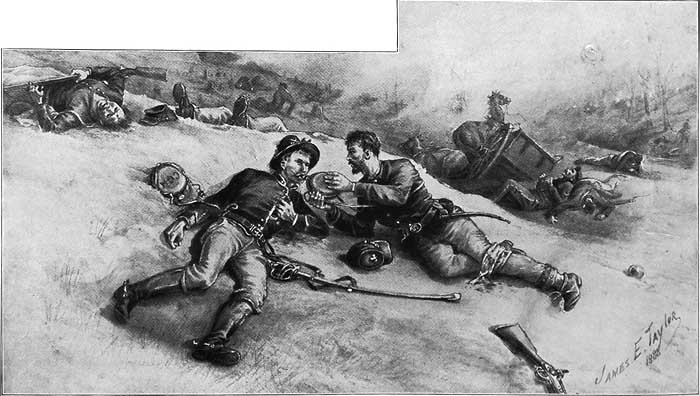
As I stir the memories of those days, there comes to mind one experience which, even after the lapse of all these years, stirs me deeply. For over three hundred years English history has been enriched by the recital of the chivalrous act of Sir Philip Sidney, who, stricken with a mortal wound at Zutphen, and being offered a drink of water, took the cup, but, when about to raise it to his lips, saw the eyes of a wounded private soldier fixed longingly thereon. With all the grace and courtliness which had at any time characterized him when treading the salon of Queen Elizabeth, the gallant knight handed him the refreshing draught, saying, "Friend, thy necessities are greater than mine, drink." The private drank, and the knight died.
I have a pride in the belief that in our four years of bloody strife we matched the most gallant, chivalrous deeds that previous history has recorded. It was my good fortune to meet and participate in the beneficence of a lineal descendant, in spirit, if not in blood, of Sir Philip Sidney, albeit he was garbed in the uniform of a private soldier of the Union army. Some of us who were lying there in the Van Pelt farmhouse, after the battle of the Second Bull Run, and who had suffered amputations, were carried out of the house and placed in a little tent in the yard. There were six of us in the tent, and we six had had seven legs amputated. Our condition was horrible in the extreme. Several of us were as innocent of clothing as the hour we were born. Between our mangled bodies and the rough surface of the board floor there was a thin rubber blanket. To cover our nakedness, another blanket. I was favored above the others in that I had a short piece of board set up slanting for a pillow. Between us and the fierce heat of that Virginia sun there was but the poor protection of the thin tent-cloth. There were plenty of flies to pester us and irritate our wounds. Our bodies became afflicted with loathsome sores, and, horror indescribable! maggots found lodging in wounds and sores, and we were helpless. Cremation made converts in those hours.
A very few attendants had been detailed to stay behind with us when it was apparent we must fall into the enemy's hands, but they were entirely inadequate in point of numbers to minister to our wants. Heat and fever superinduced an awful thirst, and our moans were for water, water, and very often there was none to give us water.
We lay there one day when there was none to answer our cry; but outside of our tent the ground was strewn with wounded men, one among whom was Christ-like in his humanitarianism. Sorely wounded in his left side, torn by a piece of a shell, he could not rise and go and get us drink, but it always seemed to us that, like his prototype of more than three centuries ago, he said in the depths of his great heart, "Their necessities are greater than mine," for he could crawl and we could not. Some little distance across the grass he saw where some apples had fallen down from the branches overhead. Every motion must have been agony to him, yet he deliberately clutched at the grass, dragged himself along until he was in reach of the apples, some of which he put in the pockets of his army blouse, and then turning, and keeping his bleeding side uppermost, he dragged himself back to our tent and handed out the apples.
As I lay nearest, I took them from him one by one and passed them along till we each had one, and I had just set my teeth in the last one he handed in, and it tasted as delicious as nectar, when, hearing an agonizing moan at my right, I turned my head on my board pillow, and saw our unknown benefactor, his hands clutched, his eyes fixed in the glare of death; a tremor shook his figure, and the eternal peace of death was his.
This was all we ever knew of him. His name and condition in life were a sealed book to us. I saw that he was unkempt of hair, unshaven of beard; his clothes were soiled with dirt and stained with blood—not at all such a figure as you would welcome in your parlor or at your dinner table; but this I thought as I gazed at the humble tenement of clay from which the great soul had fled, that in that last act of his he had exhibited so much of the purely Christ-like attribute in the effort to reach out and help poor suffering humanity, that in the last day when we shall be judged for what we have been and not for what we may have pretended to have been, I had rather take that man's chance at the judgment bar of God than that of many a gentleman in my circle of acquaintance of much greater pretensions.
AN INCIDENT OF GETTYSBURG.1
1 The account here given of this interesting incident is taken from an article by Capt. T. J. Mackey, of the Confederate army, recently published in McClure's Magazine.
Though never a war was fought with more earnestness than our own late war between the North and the South, never a war was marked by more deeds of noble kindness between the men, officers and privates, of the contending sides. Serving at the front during the entire war as a captain of engineers of the Confederate army, many such deeds came under my own personal attention, and many have been related to me by eye-witnesses. Here is one especially worthy of record:
The advance of the Confederate line of battle commenced early on the morning of July 1, 1863, at Gettysburg. The infantry division commanded by Major-Gen. John B. Gordon, of Georgia, was among the first to attack. Its objective point was the left of the Second Corps of the Union army. The daring commander of that corps occupied a position so far advanced beyond the main line of the Federal army, that, while it invited attack, it placed him beyond the reach of ready support when the crisis of battle came to him in the rush of charging lines more extended than his own. The Confederate advance was steady, and it was bravely met by the Union troops, who for the first time found themselves engaged in battle on the soil of the North, which until then had been virgin to the war. It was "a far cry" from Richmond to Gettysburg, yet Lee was in their front, and they seemed resolved to welcome their Southern visitors "with bloody hands to hospitable graves." But the Federal flanks rested in air, and, being turned, the line was badly broken, and, despite a bravely resolute defence against the well-ordered attack of the Confederate veterans, was forced to fall back.
CONFEDERATE INTRENCHMENTS ON THE BATTLEFIELD OF NEW HOPE CHURCH, GA. (From a War Department photograph.)
Gordon's division was in motion at a double quick, to seize and hold the vantage ground in his front from which the opposing line had retreated, when he saw directly in his path the apparently dead body of a Union officer. He checked his horse, and then observed, from the motion of the eyes and lips, that the officer was still living. He at once dismounted, and, seeing that the head of his wounded foeman was lying in a depression in the ground, placed under it a near-by knapsack. While raising him at the shoulders for that purpose, he saw that the blood was trickling from a bullet-hole in the back, and then knew that the officer had been shot through the breast. He then gave him a drink from a flask of brandy and water, and, as the man revived, said, while bending over him, "I am very sorry to see you in this condition. I am General Gordon. Please tell me who you are. I wish to aid you all I can."
The answer came in feeble tones: "Thank you, general. I am Brigadier-General Barlow, of New York. You can do nothing for me; I am dying." Then, after a pause, he said, "Yes, you can. My wife is at the headquarters of General Meade. If you survive the battle, please let her know that I died doing my duty."
General Gordon replied: "Your message, if I live, shall surely be given to your wife. Can I do nothing more for you?"
After a brief pause, General Barlow responded: "May God bless you! Only one thing more. Feel in the breast pocket of my coat—the left breast—and take out a packet of letters."
As General Gordon unbuttoned the blood-soaked coat, and took out the packet, the seemingly dying soldier said: "Now please take out one, and read it to me. They are from my wife. I wish that her words shall be the last I hear in this world."
Resting on one knee at his side, General Gordon, in clear tones, but with tearful eyes, read the letter. It was the missive of a noble woman to her worthy husband, whom she knew to be in daily peril of his life, and with pious fervor breathed a prayer for his safety, and commended him to the care of the God of battles. As the reading of the letter ended, General Barlow said: "Thank you. Now please tear them all up. I would not have them read by others."
General Gordon tore them into fragments and scattered them on the field "shot-sown and bladed thick with steel." Then, pressing General Barlow's hand, General Gordon bade him good-by, and, mounting his horse, quickly joined his command.
He hastily penned a note on the pommel of his saddle, giving General Barlow's message to his wife, but stated that he was still living, though seriously wounded, and informing her where he lay. Addressing the note to "Mrs. General Barlow, at General Meade's headquarters," he handed it to one of his staff, and told him to place a white handkerchief upon his sword, and ride in a gallop toward the enemy's line, and deliver the note to Mrs. Barlow. The officer promptly obeyed the order. He was not fired upon, and, on being met by a Union officer who advanced to learn his business, he presented the note, which was received and read, with the assurance that it should be delivered instantly.
Let us turn from Gettysburg to the capital, Washington, where, eleven years later, General Gordon held with honor, as now, a seat as senator of the United States, and was present at a dinner party given by Orlando B. Potter, a representative in Congress from the State of New York.
Upon Mr. Potter's introducing to him a gentleman with the title of General Barlow, General Gordon remarked: "Are you a relative of the General Barlow, a gallant soldier, who was killed at Gettysburg?"
The answer was: "I am the General Barlow who was killed at Gettysburg, and you are the General Gordon who succored me!" The meeting was worthy of two such brave men—every inch American soldiers.
I should add, that, on receiving her husband's note, which had been speedily delivered, Mrs. Barlow hastened to the field, though not without danger to her person, for the battle was still in progress. She soon found her husband, and had him borne to where he could receive surgical attendance.
Through her devoted ministrations he was enabled to resume his command of the "Excelsior Brigade," and add to the splendid reputation which it had achieved under General Sickles, its first commander.
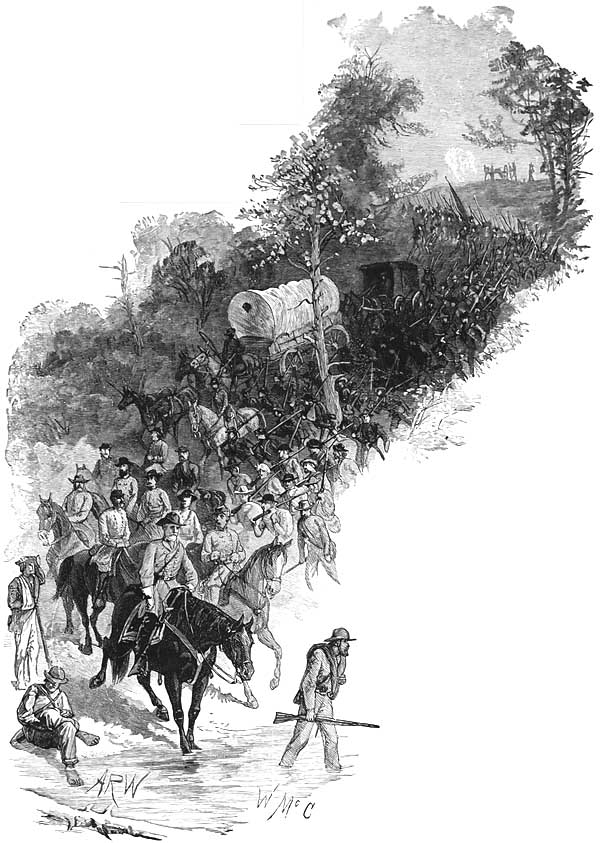
RETREAT OF LEE'S ARMY AFTER GETTYSBURG.
AN INTERESTING INCIDENT.
It was a curious fact during the war, that, however savage and hostile the armies and the troops might be in action, there was a certain friendly relation subsisting between individuals on the opposing sides, and even between special commands. The semi-intercourse between the picket lines is a familiar story; it was based principally on an agreement that the popping over of an occasional poor devil who happened to be exposed was not compensated for by any material military gain, so the pickets were generally suffered to perform their lonesome vigil without being shot like squirrels. But there was also a touch of the common humanity in this intercourse, which went beyond mere military conventions. A pleasant episode of warfare in Tennessee marked the kindly relation that sometimes was established between regiments. The Third Ohio Regiment were among the prisoners after a certain engagement, and when they entered a Tennessee town, on their way to the prisons in Richmond, they were visited, through curiosity, by a number of the Fifty-fourth Virginia, who wanted to see how the Yankees liked it to be hungry and tired and hopeless. The melancholy picture that met their gaze was enough to touch their hearts, and it did so. They ran back to their camp, and soon returned reinforced by others of their regiment, all bringing coffee (and kettles to boil it in), corn-bread, and bacon; and with these refreshments, which were all they had themselves, they regaled the hungry prisoners, mingling with them and doing all they could to relieve their distress, and the next morning the prisoners departed on their weary way, deeply grateful for the kindness of their enemies, and vowing never to forget it. It was not long before the opportunity came to them to show that they remembered it. In due time they were exchanged, and, returning to service, they found themselves encamped near Kelly's Ferry, on the Tennessee River. When Missionary Ridge was stormed, a lot of prisoners were taken from the Confederates, and among the number was the Fifty-fourth Virginia, and they were marched nine miles to Kelly's Ferry. It happened that at the landing there were some of the Third Ohio, and they asked what regiment this was. The answer, "The Fifty-fourth Virginia," had a most surprising effect on them. They left the spot on the run, and rushing up to their camp they shouted out to the boys, "The Fifty-fourth Virginia is at the ferry!" If they had announced the appearance of a hostile army in force, they could not have started up a greater or a quicker activity in the camp. The men ran about like mad, loaded themselves up with every eatable thing they could lay their hands on—coffee, bacon, sugar, beef, preserved fruits, everything—and started with a yell for the ferry, where they surrounded and hugged the Virginians like so many reunited college-mates, and spread before them the biggest feast they had seen since the Old Dominion seceded from the Union.
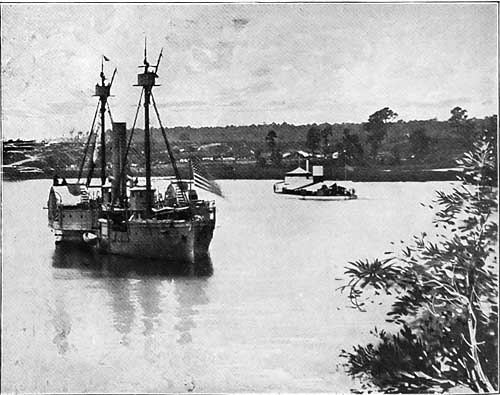
JAMES RIVER, BELOW DUTCH GAP.
THE "SULTANA" DISASTER.
The Mississippi steamer Sultana called at Vicksburg, April 25, 1865, on her journey from New Orleans to St. Louis, receiving on board nineteen hundred and sixty-four Union prisoners from Columbia, Salisbury, Andersonville, and elsewhere, who had been exchanged in regular manner, or set free through the surrender or flight of their jailers.
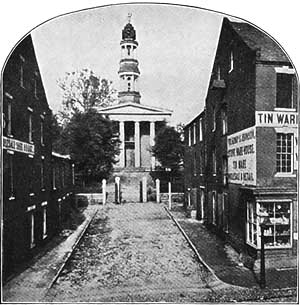
COURT HOUSE, PETERSBURG, VA.
Being anxious to proceed North, the poor fellows gave little heed to the fact that the Sultana was already carrying a heavy load of passengers and freight, and that workmen were busy repairing her boilers as she lay at the wharf. So great was the swarm that when they came to lie down for sleep every foot of available space on all the decks, and even the tops of the cabins and the wheel-house, was occupied by a soldier wrapped in his blanket, and making light of his uncomfortable berth in anticipation of a speedy arrival home.
From Vicksburg the Sultana steamed to Memphis, and there took on coal, leaving the wharf at one A.M. on the 27th. The next news of her received at that port came from the lips of survivors snatched from the rushing current of the river. When about eight miles above Memphis, one of her boilers had blown up, with frightful effect. To add to the horror, the woodwork around the engines had been set on fire by the accident, and the steamer burned to the water's edge, compelling all who had been spared by the explosion to leap overboard for safety.
The force of the explosion hurled hundreds of the sleeping soldiers into the air, killing many, mangling others; while others again, terribly scalded, fell into the water and were swallowed up by the resistless tide, never again to rise. The few survivors who had escaped all these perils finally reached the Arkansas shore, which, owing to the unusual high waters, was a long distance from the channel.
Among the soldiers on board were thirty commissioned officers, of whom only three were rescued. The dead at the scene of the accident numbered fifteen hundred, nearly all of them soldiers belonging to Western States. The heaviest loss in any one regiment fell to the One Hundred and Fifteenth Ohio, which numbered eighty-three victims on the list. The One Hundred and Second Ohio counted seventy, and the Ninth Indiana cavalry was represented by seventy-eight.
A catastrophe of similar character, not quite so appalling in results, had occurred on the Atlantic coast only three weeks previous. The steamer General Lyon, from Wilmington, bound for Fortress Monroe, burned to the water's edge off Cape Hatteras, on the night of March 31st. Out of five hundred on board, over four hundred of them soldiers, only twenty escaped. Among the lost were eleven officers and one hundred and ninety-five men belonging to the Fifty-sixth Illinois, with nearly two hundred released Union prisoners.
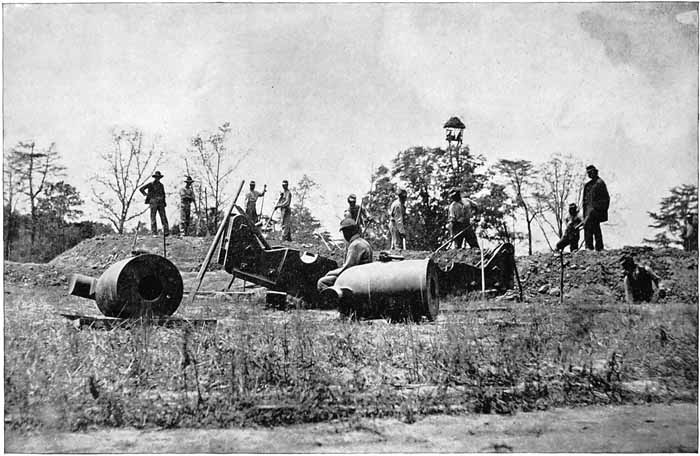
"CROW'S NEST," AN ARMY OBSERVATORY, NEAR PETERSBURG. (From a War Department photograph.)
THE HERO OF BURNSIDE'S MINE.
In the ranks of the Forty-eighth Pennsylvania, the regiment which placed the powder magazine of Burnside's mine, at Petersburg, underneath the doomed Confederate fort, was a sergeant known as Harry Reese.
He had been the first to propose the mine seriously. Permission to construct it having been granted at headquarters, he, with a score of his fellows, all experienced coal miners, set to work with their ordinary camp tools, and, under cover of night, in one month excavated, concealed from the enemy's eyes, eighteen thousand cubic feet of earth, creating a tunnel nearly six hundred feet long. On two occasions Reese, by personal effort, saved the enterprise from failure; once when the shaft opened into a bed of quicksand, and again when the army engineers through faulty measurements located the powder-chamber outside the limits of the fort to be destroyed, instead of directly under it.
Finally came the hour for the explosion. The troops stood ready to charge into the breach, and the long fuse was ignited by Reese, who, with a group of his mining companions, stayed at the mouth of the shaft, awaiting the result. Generals and aids anxiously studied their watch-dials, that would show the flight of moments beyond the appointed time. Grant telegraphed from army headquarters over his special field-wire: "Is there any difficulty in exploding the mine?" and again: "The commanding general directs, if your mine has failed, that your troops assault at once."
The mine had failed. Daylight was spreading over the trenches, and the enemy were alert even to the point of expecting an assault.
Reese drew his soldier's clasp dirk, and, turning to a comrade, said: "I am going into the mine. If it don't blow up, give me time to reach the splice in the fuse, and then come to me with fresh fuse and twine." He creeps into the shaft with resolute caution, following up the tell-tale streak of black ashes, which shows that the fuse has surely burned its way toward the powder-cells in the chamber beyond. It may reach there any second, and then! At last, just ahead of him, the brave miner sees a stretch of fuse outwardly uncharred. A fine thread of flame may be eating through its core, nevertheless, one spark of which is enough to set the terrible train ablaze. Reese knows this, for a man accustomed to handling powder cannot for an instant lose consciousness of its quick and awful violence when the connecting flash is struck. He knows his peril, yet presses on, and with his blade severs the fuse beyond the charred streak. Danger for that moment is over.
The delay had been caused by a splice wound so tightly that the fire could not eat through freely. He made a new short fuse, relit the flashing string, and escaped to the mouth of the tunnel, just as the magazine chambers exploded, spreading a mass of ruins where the armament of Lee had stood grim and threatening in the morning light but a moment before.
The fort thus destroyed was occupied by Capt. R. G. Pegram's Virginia battery, and the trenches—which means the system of walled ditches, bomb proofs, and other shelter for troops on both sides of the battery—by the Eighteenth and Seventy-second South Carolina infantry. These men, numbering several hundred, lay sound asleep, all except the sentinels. The battery and the sections of work adjoining were hoisted into the air, and two hundred and eighty-eight officers and soldiers were buried in the débris, while their comrades who escaped injury fled in confusion, leaving a defenceless gap in the line twenty or thirty rods wide, into which Burnside's corps charged without a moment's hesitation.
The Union advance was promptly met by a sharp fire from the Confederate reserves, and the fight which ensued in the breach is known as the battle of the Crater.
THE ARKANSAS BOY SPY.
When the Confederate army abandoned Little Rock in 1863, one of its military operators, David O. Dodd, stayed back and lived some time in the Union lines. He was a lad of seventeen. Shortly after the town was Unionized he left there, ostensibly to go to Mississippi, but returned in a few days and lingered about in his old haunts. A second time he passed out of the picket lines, unrestrained until he reached the outposts, where the guards, searching him, discovered some curious pencil marks in a memorandum book carried openly in his pocket.
He was arrested, and at headquarters the marks were shown to be telegraphic dots and dashes that gave a full description of the Union fortifications and the distribution of forces about the city. His act was that of a spy, and his life was the forfeit. Having admitted that he had accomplices, he was offered pardon if he would betray them. A last appeal was made at the scaffold by his friends and relatives, but he firmly put the temptation aside and signalled the executioner to do his duty. Then the drop fell, carrying him and his secret to another world. My informant, who witnessed the hanging, declared that the lad met his doom with the coolness of a stoic, while the spectators, chiefly soldiers, wept like children.
WOMEN WHO DARED AND SUFFERED FOR THE FLAG.