Chapter XLIV · (continued 2)
Reading edition
War calls women to weep, not to take up the sword in battle, yet to such lengths does their devotion run that the place of danger finds them on hand unasked. On the Union side in the civil war military heroines came from every class and from every stage of civilization. Of those who put on uniforms the record is hard to trace, but their dead and mangled forms on countless battlefields proved that the American amazon was no myth. Not to speak of these, there were women who openly faced all the terrors and hardships of war. Michigan seems to have eclipsed the record in this class of heroines.
When the Second Michigan volunteers started for the seat of war in 1861, Annie Etheridge, a young woman just out of her teens, volunteered as daughter of the regiment. Her dress was a riding habit, and she wore a military cap as a badge of her calling. A pair of pistols rested in her holsters for use in emergencies. Annie served four years, part of the time with the Fifth Michigan, and always in the Army of the Potomac. Her service was the relief of wounded on the field, which means under fire. General Kearny presented her with the "Kearny badge" for her devotion to his wounded at Fair Oaks. Once while bandaging a wound for a New York boy a Confederate shell killed him under her hands.
Though not called on to fight, Annie had spirit enough to make a battle hero. At Chancellorsville she went to the outposts with the skirmishers, and was ordered back to the lines. The enemy was already shooting at the pickets. On the way back she passed a line of low trenches where the Union soldiers lay concealed, and spurning the thought that the affair must end in a retreat, she turned her face to the front and called out to the men, "Boys, do your duty and whip those fellows!" A hearty cheer was the response, and "those fellows" poured a volley into the hidden trenches. Annie was hit in the hand, her skirt was riddled, and her horse wounded. At Spottsylvania she turned a party of retreating soldiers back to their place in the ranks by offering to lead them into battle. No one but a miscreant could spurn that call.
The other Michigan heroines were Bridget Divers, of the First cavalry, an unknown in the Eighth and in the Twenty-fifth regiments who passed as Frank Martin, and Miss Seelye who served in the Second as Frank Thompson. "Thompson" and "Martin" wore men's disguise. Bridget Divers was the wife of a soldier, and performed deeds of daring in bringing wounded from the field, under fire.
Two Pennsylvania regiments carried women into battle in men's disguise—Charles D. Fuller, of the Forty-sixth, and Sergt. Frank Mayne, of the One Hundred and Twenty-sixth. "Mayne" was killed. The Fifth Rhode Island Regiment produced a heroine in Mrs. Kady Brownell, wife of a sergeant. She is credited with having been a skilful shooter with a rifle and also a brave color-bearer in time of danger. The wives of officers were accorded great freedom of action at the front, and many a gallant and noble deed was called forth by devotion to husband first and incidentally to the cause. Madame Turchin, wife of the Illinois general, went into battle and rescued wounded men, besides cheering and inspiring the soldiers of the general's command. Gen. Francis C. Barlow, of New York, was accompanied by his wife, who attended the wounded on the field. This devoted woman served at the front until 1864, and died of fever contracted in the hospitals at Petersburg.
A MODERN ANDRÉ.
Lieut. S. B. Davis, of the Confederate service, probably came the nearest of any officer on either side to playing the rôle of the André of the Rebellion. He did not, it is true, lose his life in an attempt to negotiate for the surrender of an enemy's fortress, as did the noted British spy; but he was sentenced to be hanged for complicity, under disguise, in negotiations between citizens of the United States and Confederate officials in Richmond and in Canada for the delivery of the States of Ohio, Illinois, and Indiana, and certain military positions on the lakes, into the power of organized and armed emissaries of the South, led by Confederate officers.
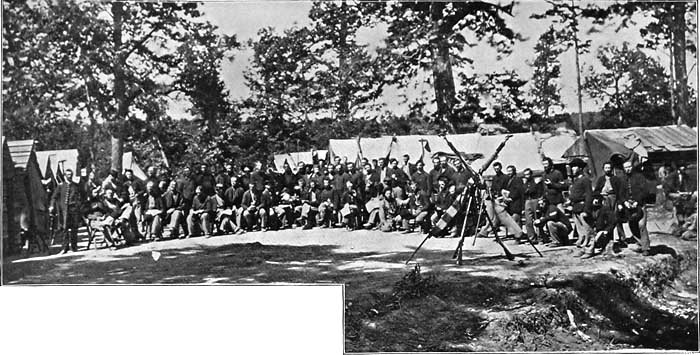
A COMPANY OF SHERMAN'S VETERANS.
Lieutenant Davis was but twenty-four, a native of Delaware, a State that did not secede, and entered into the part he played on his own motion; that is, he volunteered to act as a messenger between Richmond and Canada. He was provided with a British passport under an assumed name, had his hair dyed, and put on citizen's dress. The regular route of communication between Richmond and Canada was by steamer, viâ Bermuda; but for some reason never yet explained Davis went from Richmond to Baltimore, and from there to Columbus, O., where he certainly communicated with people of suspicious character at the time.
From Columbus he went to Detroit, and from there to Windsor, Canada, where he met the notorious Jacob Thompson and other Confederate emissaries.
There were many points about the young man to give him peculiar fitness for his work; there was also a fatally weak spot in his harness. He was well bred and of prepossessing appearance. A native of Delaware, he could mingle with Northern people without arousing suspicion. He was a distant relative of Jefferson Davis, and had the respect and confidence of the Confederate chieftains. Too young to have attained prominence before the war, and never having served in the regular army, his personality was not likely to be known on the Union side of the lines. But he had served a long time on the staff of General Winder, commander at Andersonville prison, where many Union soldiers had seen him often.
Fortune favored him in his daring enterprise until his arrival, on what proved to be his final trip southward from Canada, at Newark, O. He was travelling in the passenger cars of the Baltimore and Ohio railroad; had passed safely through Columbus and other public centres most dangerous to him.
At Newark two Union soldiers entered the car where the disguised Confederate sat. They had been in Andersonville prison, and after eying their fellow passenger for a time one ex-prisoner whispered in his comrade's ear, "There is Lieutenant Davis, of Andersonville!"
Both arose, and, approaching Davis, one called out bluntly to the stranger, "Aren't you Lieutenant Davis?"
"No, sir; my name is Stewart," was the prompt reply.
"Yes, you are Lieutenant Davis, and you had charge of the prison when I was in Andersonville," persisted the soldier. A crowd of passengers quickly surrounded the parties, and seeing that his stubborn cross-questioners would not be convinced, the Confederate yielded, and said:
"Well, boys, you've got me. I am Lieutenant Davis."
The provost marshal of Newark was summoned, and the prisoner was speedily hurried to the common jail. A search of his person failed to disclose any secret papers, and he was left in the main room with a number of ordinary county criminals. Soon after the military had left the place the stranger was seen to remove from inside his coat-lining a number of despatches and drawings upon white silk, and to burn them in the fire which was blazing in an open stove. The link that would have removed all doubt as to his purposes and condemned him to the gallows was thus hopelessly destroyed; but a court martial held that his presence in the Union lines in disguise constituted the offence for which the penalty is death. When the evidence was all in and the case clear against him, the prisoner rose, facing the officers and witnesses, every one wearing the colors of his mortal enemies, and some of them scarred with the conflicts in which he and his own had been pitted against them. There was no reason to expect mercy, and he did not ask it.
After stating his case briefly, he looked over his accusers and judges, and said: "I do not fear to die. I am young and would like to live, but I deem him unworthy who should ask pity of his foemen. Some of you have wounds and scars; I can show them, too. You are serving your country as best you may; I have done the same. I can look to God with a clear conscience; and whenever the chief magistrate of this nation shall say, 'Go,' whether upon the scaffold or by the bullets of your soldiery, I will show you how to die."
The sentence was that he be confined in the military prison at Johnson Island, in Lake Erie, until the 17th of February, 1865, then "to be hung by the neck until he is dead."
During the night of the 16th of February, when all preparations had been made, and Davis had, as he believed, beheld the last sunset on earth, a reprieve came from President Lincoln. He was placed in a dungeon at Fort Warren, Boston Harbor, and before the reprieve ended the war closed. Then the authorities permitted him to go free. To the end he kept the secret of his mission to Ohio.
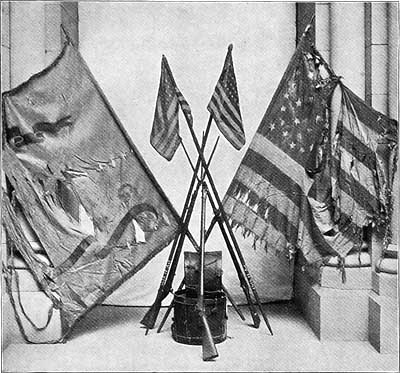
THE BATTLE FLAGS AND MARKERS OF THE FOURTEENTH REGIMENT NEW YORK ARTILLERY.
ENGAGEMENTS IN WHICH THE REGIMENT, WITH THESE FLAGS, TOOK PART.
WILDERNESS, VA., May 5-7, 1864.
SPOTTSYLVANIA C. H., May 10-19, 1864.
NORTH ANNA RIVER, VA., May 23-26, 1864.
TOCOPOTOMY CREEK, VA., May 30, 1864.
BETHESDA CHURCH, VA., May 31, 1864.
SHADY GROVE ROAD, VA., June 2, 1864.
COLD HARBOR, VA., June 3-12, 1864.
PETERSBURG FRONT, VA., June 16-18, 1864.
SIEGE OF PETERSBURG, FIRST, June 19 to August 19, 1864.
CRATER, VA., July 30, 1864.
BLIELL'S STATION, VA., August 19, 1864.
WELDON RAILROAD, VA., August 21, 1864.
PEEBLES FARM, VA., September 29, 1864.
POPLAR SPRINGS CHURCH, VA., September 30, 1864.
SIEGE OF PETERSBURG, SECOND, November 29, 1864 to April 3, 1865.
FORT HASKELL, VA., March 25, 1865.
FORT STEADMAN, VA., March 25, 1865.
CAPTURE OF PETERSBURG, VA., April 3, 1865.
APPOMATTOX, VA., April 9, 1865, Surrender of Lee and his Army of Northern Virginia.
REMINISCENCES OF THE BATTLE OF BULL RUN.
BY GENERAL JOHN T. MORGAN, C. S. A.
The battle of Bull Run—the first battle of Manassas—was a great and decided victory for the Confederate army, and aroused the pride and enthusiasm of the Southern people as no other event ever did. Yet there is a painful recollection in every mind that it was the first act in an awful drama, the first great field upon which the hosts of the North and the South measured arms and opened the series of great tragedies of the civil war, in which millions of men perished.
If that had been the last battle of the war instead of the first, and if it had been accepted as the final arbitrament of the questions that could not have been settled otherwise, I would still recall its incidents with pride, but also with sadness. But the glory of it would have scarcely compensated for its sacrifices.
I doubt if any humane person can recall without pain even the most gratifying victories of a great war in which he was a participant. The excessive toil and anxiety are only made tolerable, and the suffering and waste of human life can only be endured, for the sake of our interest in the cause that demands such victims for the altar of sacrifice.
Yet war, like other intense passions, often becomes a consuming desire, as the hope of victory verges upon the recklessness of despair. My earlier impressions of civil war may be illustrated by a few personal incidents connected with the first battle of Manassas.
With the exception of a few "regulars" in either army, every experience of actual warfare was then entirely new to the soldiery, and not a man in any position failed to seriously question his heart as to its fortitude in the approaching crisis of battle. None, perhaps, were about to march upon that great and open field who did not overdraw the pictures of danger and distress that he would be called to meet. It was a relief from this excessive tension that enabled men of highly nervous condition to quiet their emotions and to engage in battle like trained veterans, when its realities were found to be less harrowing than they expected.
It is probable that no two armies of trained soldiers ever confronted each other with a less daunted spirit than the hundred thousand proud men who, in almost full view of the extended lines of each army, marched steadily into action across the open fields about Manassas. For many miles the view was uninterrupted.
The approaches of the martial hosts, in line after line of supporting columns, under the fire of artillery that covered the field with the bluish haze of battle, were marked with an air of firm defiance, which spoke of the cause at stake, and of a contest for principles which, as they were felt to be involved, commanded the devotion of each army. It was not a flag or a government for which either army was fighting, but a dispute about rights under the Constitution of a common country. War under such circumstances is always desperate, and too often becomes ferocious. When men make war as political or religious partisans, they often forget the honorable zeal of the true soldier and lend themselves as the instruments of vengeance. We had not then reached that stage of hostility. On this field there met in battle many thousands of the best and most enlightened men of a great nation, all Americans, and all inspired with the love of a common country, and many in the opposing ranks were of the same families. They were gallant and chivalric men, and their fierce onsets left the field thickly strewn with dead and wounded. Almost every man who fell had some personal history in which whole communities felt a proud and grateful interest. The survivors in such armies could not be cruel.
As the incidents of the battle were narrated in the camps of the victors, and by parties returning from the pursuit of McDowell's shattered forces, it was clearly manifested that it was political antagonism and not sectional animosity that had brought on the war.
When the death or capture of some leading Federal officer was announced, respectful silence was observed and personal sympathy was manifested with sincerity; but, when the capture of a leading politician or of a member of Congress was announced, the wildest rejoicing was heard in the crowds of delighted listeners.
That was a grand field of battle, and it was occupied by armies that were all the more eager for war because they did not then realize its terrible significance.
Few strategic surprises were possible on such a field, and none were attempted. An approaching column could be seen, as it was headed toward a point of attack, when it was miles away; and the clouds of dust, rolling up in vast volume, indicated its strength. Then, suddenly, arose the opposing cloud, and presently both were illumined with flashes of artillery, and roared with the spiteful din of musketry, in their quickened dash, and were clamorous with hoarse cheers from thousands of sturdy men. A few crashing volleys; the swaying back and forth of the lines, as repeated charges were met and repulsed—and the field was won and lost by some impulse, in which all seemed to share at the same moment, that was as much a mystery to the victors as it was to the vanquished. It was what is called "a square stand-up fight" in an open field, without military defences; and the result was a notable victory of the soldiers engaged, not a victory won by superior strategy or gallant leadership. The battle ended late in the afternoon, and by nightfall, the successful army was in bivouac, while the beaten army was in flight for Washington, unpursued. The rain began to fall in floods as the night came on, adding to the misery of the wounded of both armies, who were treated with every possible kindness. To a novice in warfare, the battlefield was a fearful scene, as the bright morning of the next day dawned upon it, with the dead scattered over it, lying beside dead horses, broken artillery, muskets, wagons, and shattered trees. It was the silent reproach of havoc and death upon the fierce injustice of a resort to war as the arbiter of differences of opinion as to civil government, which had been exaggerated to such awful conclusions, and could not, after all, be in any wise settled by such means. Peace and wiser judgment finally came out of the thousand succeeding conflicts, but were not created by them. They were only made possible by the failure of war to convince anybody of errors.
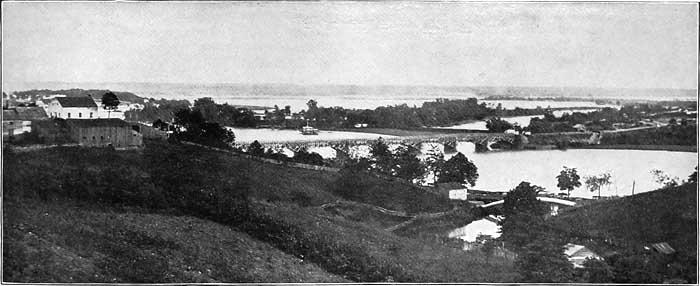
AQUEDUCT BRIDGE, POTOMAC RIVER.
Taking a half-dozen cavalry and a brother officer along, we moved, at daylight, under orders given to me to follow and reconnoitre the army that had moved off in column at the close of the battle, but was supposed to have camped not far away. We soon found that nothing remained of that army but the evidences of panic which had overtaken almost every command. The wounded had, in some cases, been left to their own resources, and, at bridges that were broken, there were piled in wild confusion, dead men and horses, guns and caissons, wagons and sutlers' goods, tents, muskets, drums, ambulances, spring wagons, and the lighter vehicles that had brought the picnic parties from Congress to witness the consummation of their "policy." It was to them a sudden and frightful adjournment, sine die.
As we rode over the field, gray-haired fathers and mothers from the nearer homes in Virginia were already there looking for their dead or wounded sons. All was silent save the moanings of the sufferers, and the subdued chirrup of little wrens as they sought for their mates. The birds seemed as sad as the venerable seekers for their loved ones. The dead seemed to preserve their personal characteristics, and the tense strain of the conflict was settled upon their features. In most cases, death on the battlefield is instantaneous and painless, and the latest thoughts seem to linger on the faces of the dead.
As we rode along the farm lanes where the rail fences had been torn away as they were crossed and recrossed by charging columns, we found, not widely separated, the victims of the bayonet. Several had fallen in this close combat.
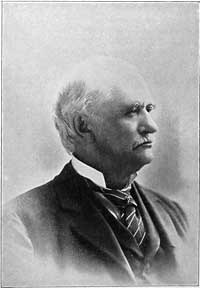
BRIGADIER-GENERAL JOHN T. MORGAN, C. S. A.
One of them was a very handsome man, clean-shaven, and dressed in a neat uniform as a private in the Federal army. He was about thirty years old. On his shirt bosom there was a single spot of blood. He sat almost erect, his back propped in a corner of the fence, with his blue eyes wide open, and his mouth was firmly closed, and his gun and hat near by him. His form and face were majestic, and his pallid brow, with the hair gracefully swept back, was a splendid picture of the serenity of death, almost as expressive as life, and the most earnest plea for peace that I had ever contemplated.
On the opposite side of the lane was a Confederate soldier—an Irishman—whom a ball had killed. Evidently he had received a mortal wound, and had sat down to die in an angle of the fence, and rested on a small log he found there. He was also leaning against the fence, which held him up in a position that seemed very life-like. His hat was on his head and sheltered his face which was slightly bowed to the front. In his mouth he held his pipe, with a very short stem, in a way that was quite natural and suggestive of his race. His wound was in the thigh, and while he was bleeding to death, he had doubtless sought comfort in his pipe.
A beautiful photograph was in the side pocket of the Federal soldier, near the fatal blood-spot on his shirt bosom. We thought we could readily trace his dying thoughts to that dear friend. We left him with his friend's picture where we found it, to find, in another spot, a mile distant, a living proof that it is love and not hatred that survives death, and commands the heart's last tribute of devotion.
The body of an oak tree that was heavily clad in foliage had been cut through with cannon shot until the top had fallen over and formed a thick mass of branches and leaves on the ground. There was a copse of undergrowth near by, into which we saw a man dart like an arrow as we rode up. From the tree-top came low moanings, as from one who feared discovery, and yet could not stifle his voice when spasms of pain returned upon him. It proved to be a field officer of a New Jersey or Delaware regiment, whose thigh had been crushed by a cannon shot in the battle.
His servant had laid him in the tree-top, with leaves and a horse blanket for a bed, and was guarding him. When the servant saw us halt, he came out timorously from his hiding, and was weeping and pleading for the life of his master. I said to him, "What do you take us for?"—"But be you not rebels?" he said. I answered, "We are called rebels, and yet your kindred."—"Be you Christian men?" I said that was our faith. "And you will be merciful to the major?" I replied, "I am a major, and have no ill-will toward majors, even if they are enemies." The major, hearing our conversation, invited us to dismount and come to him. We went to his hiding-place, and found him pale with loss of blood, and in great anguish.
Seeing that we were Confederate officers, he said, "I wish to give you my parole."—"We need none from you," I replied; "our friendship has been broken, and renewed very suddenly by your wounds, it seems, and you are our guest."—"Are you Virginians?"—"No, we are Alabamians, and this is our home, as it is yours, for we are all Americans."—"A home I have invaded," he said, "and I don't know why. I wish this war had never occurred; but I longed for it, in my thoughtless anger, and here I must meet death."
He said, "I am a lawyer."—"So are we," I replied. "I am a Mason."—"So are we," I replied. "Thank God," he exclaimed, "I may yet see my wife before I die. She came to Washington with me, and I parted with her at Longbridge, three days ago, as we crossed the Potomac."
I assured him that I would inform his wife of his condition, through the first flag of truce that went over the lines, and that she should have safe-conduct to join him. Taking our hands, he prayed God to bless us; and turning to his servant, whose astonishment was now greater than his fear, he said, "Sam, get me the bread and the canteen, and give me some whiskey. Maybe if I eat and take a stimulant, I may live to see her." It was a hard, rough crust of corn-bread, which he munched with energy, and the canteen contained a few spoonfuls of common whiskey, a part of which he drank. I said, "This business is urgent, and we will gallop to your lines with your message."—"Yes," he said, "a race for a life, that has but one hope, that I may see her—my wife—before I die." We soon met a surgeon at a field hospital—a few blankets on which wounded soldiers were stretched—and he went at once to the sufferer in the tree-top. The message was despatched, and the loving wife came to find that, after one last kiss from his conscious lips, she was a widow indeed.
The glory of our victory was saddened to my heart by the reflection that the blood that enriched the fields was American, and was poured out from hearts that were alike and equally patriotic. Yet the sacrifice was voluntary, and may have been needed to demonstrate again the devotion of the American people to what they believe to be their duty in the defence of their liberties as they understand them, and in the enforcement of our laws as they are written.
This grand result, which seems to be perfectly assured, and this demonstration of American manhood is worth all that it has cost.
The battle of Bull Run was the last political battle of the civil war. It set Congress to passing vain resolutions to stop the war, and to reconcile the people and the States. After that awful event, war for the sake of war, and not for peace or justice, swept over the land and raged with unheard-of fury, until the sheer power of numbers prevailed, and peace came from exhaustion, but not from a broken spirit.
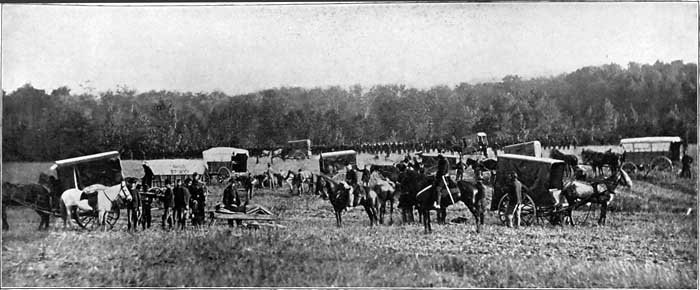
PICKING UP THE WOUNDED, FIFTY-SEVENTH NEW YORK AMBULANCE CORPS.
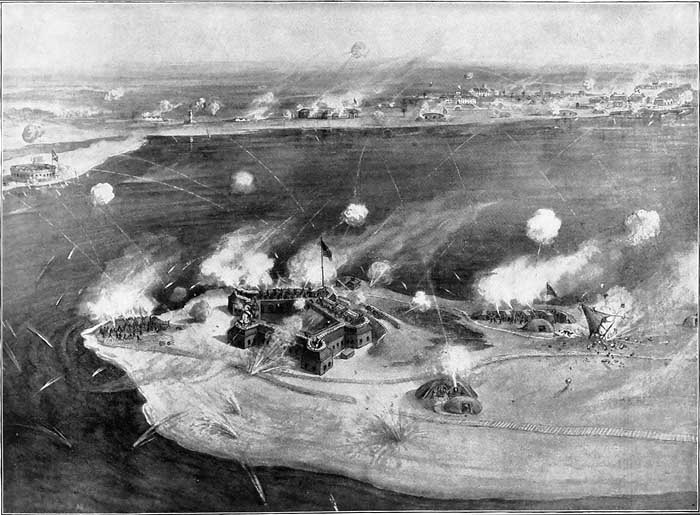
BOMBARDMENT OF THE CONFEDERATE LINES BY FORT PICKENS, SANTA ROSA ISLAND, PENSACOLA BAY.
THE MEASURE OF VALOR.
So far as valor is to be measured by dangers voluntarily encountered and losses sustained, the American citizen may justly compare with pride the incidents and statistics of the great civil war with those of any modern conflict in Europe. In our chapter on Gettysburg the close resemblance between that battle and Waterloo—in the numbers engaged on each side and the losses—has been pointed out. When comparison is made of the losses of regiments and other organizations, in particular engagements, the larger figures are with the Americans. The charge of the British Light Brigade, at Balaklava, in 1854, has been celebrated in verse by Tennyson and other poets, and is alluded to over and over again as if it were the most gallant achievement in modern warfare. Every time that some old soldier chooses to say he is one of the survivors of that charge, the newspapers talk about him as a wonder, report his words and publish his portrait. Yet that exploit sinks into insignificance when compared with the charge of the First Minnesota Regiment at Gettysburg. The order for the charge at Balaklava was a blunder, blunderingly obeyed; it accomplished nothing, and the total loss to the Light Brigade was thirty-seven per cent. At Gettysburg, on the second day, General Hancock observed a gap in the National line, and saw that Wilcox's Confederate Brigade was pushing forward with the evident intention of passing through it. He looked about for troops to close the gap, and saw nothing within immediate reach but the First Minnesota, though others could be brought up if a little time could be gained. Riding up to Colonel Colville, he said: "Do you see those colors?" pointing at the Confederate flag. "Take them!" Instantly the regiment dashed forward and charged the brigade; there was a short, fierce fight, and the regiment lost eighty-two per cent. of its numbers in killed and wounded, but the onset of the enemy was stayed, the desired time was gained, and even the colors were captured and brought off. In the Franco-German war of 1870 the heaviest loss sustained by any German regiment in a single battle was a fraction more than forty-nine per cent. In the National service during the civil war there were sixty-four regiments that sustained a loss of over fifty per cent. in some single action, and in the Confederate service there were fifty-three, making a hundred and seventeen American regiments that, in this respect, surpassed the German regiment of highest record.
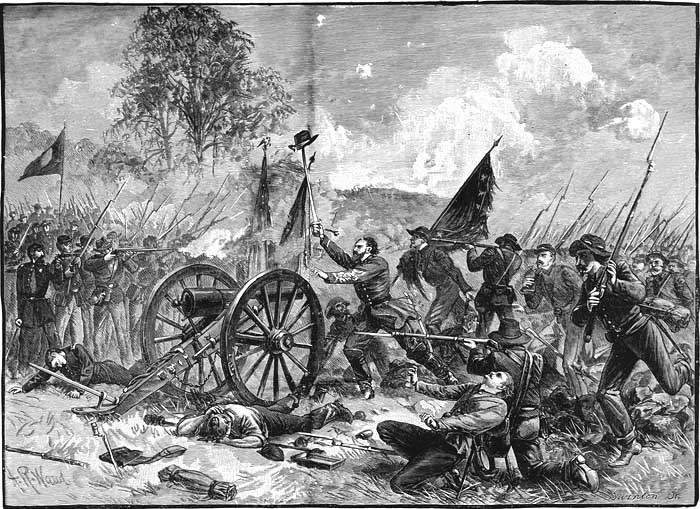
PICKETT'S CHARGE AT GETTYSBURG.
There were thirteen battles in which one side or the other (in most instances each) lost more than 10,000 men, taking no account of the great capitulations like Fort Donelson and Vicksburg. And in the least of these nearly 1,900 men were shot dead on the field. The greatest losses on both sides were sustained at Gettysburg. Next in order (aggregating the losses on both sides1) come Spottsylvania, 36,800; the Wilderness, 35,300; Chickamauga, 34,600; and Chancellorsville, 30,000. But each of these battles occupied more than one day. The bloodiest single day was September 17, 1862, at the Antietam, where the National army lost 2,108 men killed and 9,549 wounded, with about 800 missing. The Confederate loss cannot be stated with exactness. General Lee's report gives only consolidated figures for the whole campaign, including Harper's Ferry and South Mountain, as well as the main battle; and these figures fall short by a thousand (for killed and wounded alone) of those given by his division commanders, who also report more than 2,000 missing. On the other hand, McClellan says that "about 2,700 of the enemy's dead were counted and buried upon the battlefield of Antietam," while "a portion of their dead had been previously buried by the enemy." Averaging these discrepant figures, and bearing in mind that there were no intrenchments at the Antietam, we may fairly put down the losses as equal on the two sides, which would give a total, on that field in one day, of 4,200 killed and 19,000 wounded. The number of prisoners was not large.
1 As there are discrepancies in all the counts, only the round numbers are given here.
The heaviest actual loss that fell upon any one regiment in the National service in a single engagement was that sustained by the First Maine heavy artillery (acting as infantry) in the assault on the defences of Petersburg, June 18, 1864, when 210 of its men were killed or mortally wounded, the whole number of casualties being 632 out of about 900 men. This regiment was also the one that suffered most in aggregate losses in battle during the war, its killed and wounded amounting to 1,283. Over nineteen per cent. were killed. Another famous fighting regiment was the Fifth New Hampshire infantry, which had 295 men killed or mortally wounded in battle, the greatest loss, 69, occurring at Cold Harbor, June 1, 1864. Its first colonel, Edward E. Cross, was killed while leading it in the thickest of the second day's fight at Gettysburg. Another was the One Hundred and Forty-first Pennsylvania, which lost three-quarters of its men at Gettysburg, and at Chancellorsville lost 235 out of 419. At the second Bull Run (called also Manassas), the One Hundred and First New York lost 124 out of 168; the Nineteenth Indiana lost 259 out of 423; the Fifth New York lost 297 out of 490; the Second Wisconsin lost 298 out of 511; and the First Michigan lost 178 out of 320. At Antietam the Twelfth Massachusetts lost 224 out of 334. It had lost heavily also at Manassas, where Col. Fletcher Webster (only son of Daniel Webster) was killed at its head. It lost, altogether, 18 officers in action. Another famous Massachusetts regiment was the Fifteenth, which at Gettysburg lost 148 men out of 239, and at the Antietam, 318 out of 606, and, out of a total enrolment of 1,701, lost during the war in killed and wounded 879. Another Massachusetts regiment distinguished by hard fighting was the Twentieth, which General Humphreys compliments as "one of the very best in the service." Its greatest loss, in killed (48), was at Fredericksburg, where it was in the brigade that crossed the river in boats, to clear the rifle-pits of the sharp-shooters that were making it impossible to lay the pontoon bridges. This regiment had the task of clearing the streets of the town, and as it swept through them it was fired upon from windows and house-tops. The other regiments that participated in this exploit were the Seventh Michigan, the Nineteenth Massachusetts, and the Eighty-ninth New York. Some nameless poet has made it the subject of one of the most striking bits of verse produced during the war:
They leaped in the rocking shallops, Ten offered, where one could go, And the breeze was alive with laughter, Till the boatmen began to row. In silence how dread and solemn! With courage how grand and true! Steadily, steadily onward The line of the shallops drew. 'Twixt death in the air above them, And death in the waves below, Through ball and grape and shrapnel They moved, my God, how slow! And many a brave, stout fellow, Who sprang in the boats with mirth, Ere they made that fatal crossing Was a load of lifeless earth. And many a brave, stout fellow, Whose limbs with strength were rife, Was torn and crushed and shattered— A helpless wreck for life.
The Twentieth lost 44 men killed at Gettysburg, 38 at Ball's Bluff, 36 in the Wilderness, 20 at Spottsylvania, and 20 at the Antietam. During its whole service it had 17 officers killed, including a colonel, a lieutenant-colonel, two majors, an adjutant, and a surgeon. The story that Dr. Holmes tells in "My Hunt after the Captain" relates his adventures in the track of this regiment just after the battle of the Antietam.
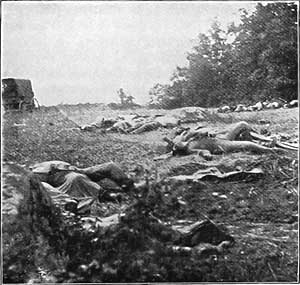
AFTER THE FIRST DAY'S BATTLE AT GETTYSBURG.
Among the Vermont regiments, the one that suffered most in a single action was the Eighth, which at Cedar Creek lost sixty-eight per cent. of its numbers engaged. The First Heavy Artillery from that State, acting most of the time as infantry, with a total enrolment of 2,280, lost in killed and wounded 583. The Second Infantry, with a total enrolment of 1,811, lost 887. Its heaviest loss was at the Wilderness, where, out of 700 engaged, 348 (about half) were disabled, including the colonel and lieutenant-colonel killed. And a week later, at Spottsylvania, nearly half of the remainder (123) were killed or wounded. The Fourth Infantry, at the Wilderness, went into the fight with fewer than 600 men, and lost 268, including seven officers killed and ten wounded. In the fight at Savage Station, the Fifth Vermont walked over a regiment that had thrown itself on the ground and refused to advance any farther, pressed close to the enemy, and was taken by a flank fire of artillery that struck down 44 out of the 59 men in one company. Yet the regiment held its ground, faced about, and silenced the battery. It lost 188 men out of 428.
In the second and third years of the war, several regiments of heavy artillery were raised. It was said that they were intended only to garrison the forts, and there was a popular belief that their purpose was to get into the service a large number of men who were not quite willing to subject themselves to the greater risks incurred by infantry of the line. But after a short period of service as heavy artillery, most of them were armed with rifles and sent to the front as infantry, and many of them ranked among the best fighting regiments, and sustained notable losses. The First Maine and First Vermont have been mentioned already. The Second Connecticut heavy artillery, the first time it went into action, stormed the intrenchments at Cold Harbor with the bayonet, and lost 325 men out of 1,400, including the colonel. At the Opequan it lost 138, including the major and five line officers; and at Cedar Creek, 190. The Seventh, Eighth, Ninth, and Fourteenth New York heavy artillery regiments all distinguished themselves similarly. The Seventh, during one hundred days' service in the field as infantry (Grant's overland campaign), lost 1,254 men, only a few of whom were captured. The Eighth lost 207 killed or mortally wounded, at Cold Harbor alone, with more than 200 others wounded. Among the killed were eight officers, including Col. Peter A. Porter (grandson of Col. Peter B. Porter, of the war of 1812), who fell in advance of his men. Its total loss in the war was 1,010 out of an enrolment of 2,575. The Ninth had 64 men killed at Cedar Creek, 51 at the Monocacy, 43 at Cold Harbor, and 22 at the Opequan. Its total loss in killed and wounded was 824 in an enrolment of 3,227. This regiment was commanded, a part of the time, by Col. William H. Seward, Jr. The Fourteenth had 57 men killed in the assault on Petersburg, 43 at Cold Harbor, 30 in the trenches before Petersburg, 26 at Fort Stedman, 22 at the mine explosion, and 16 at Spottsylvania. It led the assault after the mine explosion, and planted its colors on the captured works. Its total loss in killed and wounded was 861, in an enrolment of 2,506. In comparing these with other regiments, it must be remembered that their terms of service were generally shorter, because they were enlisted late in the war. The Fourteenth, for instance, was organized in January, 1864, which gave it but fifteen months of service, and it spent its first three months in the forts of New York harbor; so that its actual experience in the field covered somewhat less than a year. In that time one-third of all the men enrolled in it were disabled; and if it had served through the war at this rate, nothing would have been left of it. This explanation applies equally to several other regiments.
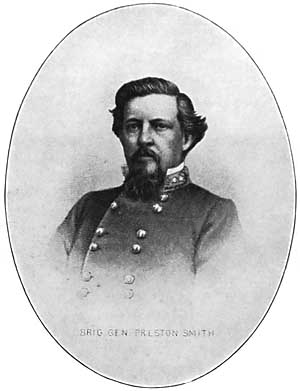
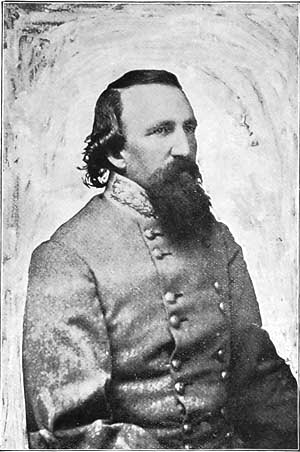
BRIGADIER-GENERAL PRESTON SMITH, C. S. A. Killed at Chickamauga. MAJOR-GENERAL JAMES B. GORDON, C. S. A. Killed at Yellow Tavern, Va.
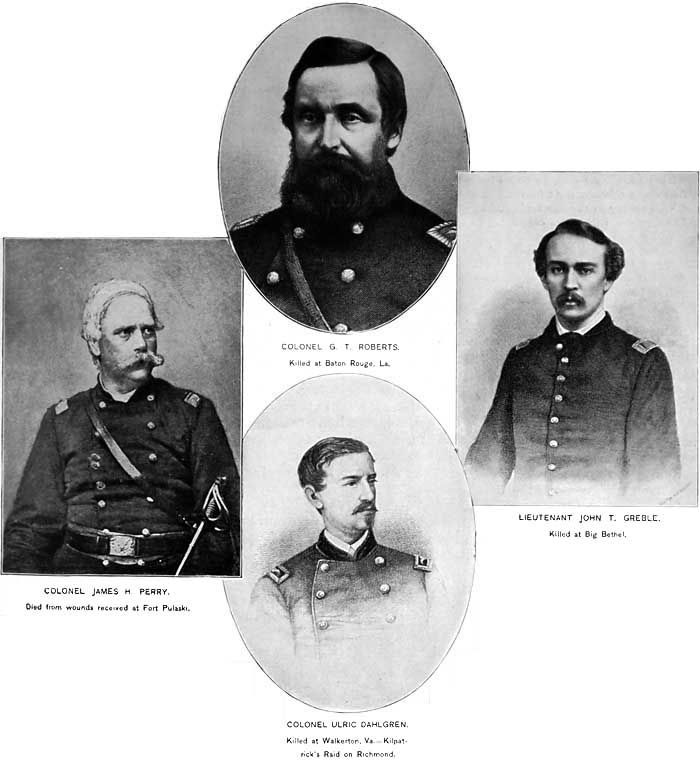
The State of New York furnished one-sixth of all the men called for by the National Government. Of Fox's "Three Hundred Fighting Regiments" (those that had more than 130 men killed during the war), New York has 59—nine more than its proportion. The Fifth Infantry, known as Duryea's Zouaves, met with its heaviest loss, 297 out of 490, at Manassas, and lost 162 at Gaines's Mill. This regiment was commanded at one time by Gouverneur K. Warren, afterward famous as a corps commander, and General Sykes pronounced it the best volunteer regiment that he had ever seen. The Fortieth had 238 men killed in battle, and lost in all 1,217. Its heaviest losses were in the Seven Days' battles, 100; Fredericksburg, 123; Gettysburg, 150; and the Wilderness, 213. The Forty-second lost 718 out of 1,210 enrolled, its heaviest loss, 181, being at the Antietam. The Forty-third lost 138 at Salem Church, and 198 in the Wilderness, its colonel, lieutenant-colonel, and major all being killed there. The Forty-fourth, originally called "Ellsworth Avengers," was composed of picked men from every county in the State. It lost over 700 out of 1,585 enrolled. At Manassas, out of 148 men in action, it lost 71. It was a part of the force that seized Little Round Top at Gettysburg. The Forty-eighth was raised and commanded by a Methodist minister, James H. Perry, D.D., who had been educated at West Point. He died in the service in 1862. The regiment participated in the assault on Fort Wagner, and lost there 242 men. At Olustee it lost 244. Its total loss was 859 out of an enrolment of 2,173. The Forty-ninth had two colonels a lieutenant-colonel, and a major killed in action. The Fifty-first New York and Fifty-first Pennsylvania carried the stone bridge at the Antietam, the New York regiment losing 87 men, and the Pennsylvanians 120. The Fifty-second New York lost 122 men at Fair Oaks, 121 in the siege of Petersburg, and 86 at Spottsylvania. It was a German regiment, and two Prussian officers on leave of absence fought with it as line officers at Spottsylvania and were killed in the terrible struggle at the bloody angle. The Fifty-ninth went into the battle of the Antietam with 321 men, fought around the Dunker Church, and lost 224, killed or wounded, including nine officers killed. The Sixty-first lost 110 killed or wounded at Fair Oaks, out of 432; 106 in the siege of Petersburg, and 79 at Glendale. Francis C. Barlow and Nelson A. Miles were two of its four successive colonels. One company was composed entirely of students from Madison University. The Sixty-third, an Irish regiment, lost 173 men at Fair Oaks, 98 at Gettysburg, and 59 at Spottsylvania. The Sixty-ninth, another Irish regiment, lost more men killed and wounded than any other from New York. At the Antietam, where it contended at Bloody Lane, eight color-bearers were shot. The Seventieth lost 666 men in a total enrolment of 1,462. Its heaviest loss, 330, was at Williamsburg. Daniel E. Sickles was its first colonel. The Seventy-sixth lost 234 men out of 375 in thirty minutes at Gettysburg. In the Wilderness it lost 282. The Seventy-ninth was largely composed of Scotchmen. It lost 198 men at Bull Run, where Colonel Cameron (brother of the Secretary of War) fell at its head. At Chantilly six color-bearers were shot down, when General Stevens (who had been formerly its colonel) seized the flag and led the regiment to victory, but was shot dead. The Eighty-first lost 215 men at Cold Harbor, about half the number engaged. The Eighty-second, at the Antietam, lost 128 men out of 339, and at Gettysburg 192 out of 305, including its colonel. The Eighty-third lost 114 men at the Antietam, 125 at Fredericksburg, 115 in the Wilderness, and 128 at Spottsylvania. The Eighty-fourth, a Brooklyn zouave regiment, lost 142 men at Bull Run, 120 at Manassas, and 217 at Gettysburg, where, with the Ninety-fifth, it captured a Mississippi brigade. The Eighty-sixth lost 96 men at Po River, and over 200 in the Wilderness campaign. The Eighty-eighth, an Irish regiment, lost 102 men at the Antietam, and 127 at Fredericksburg. The Ninety-third lost 260 men in the Wilderness, out of 433. The Ninety-seventh at Gettysburg lost 99 men, and captured the colors and 382 men of a North Carolina regiment. The One Hundredth lost 176 men at Fair Oaks, 175 at Fort Wagner, and 259 at Drewry's Bluff. The One Hundred and Ninth lost 140 men at Spottsylvania, and 127 in the assault on Petersburg. Benjamin F. Tracy, Secretary of the Navy in President Harrison's cabinet, was its first colonel. The One Hundred and Eleventh lost 249 men at Gettysburg, out of 390, and again at the Wilderness it lost more than half of the number engaged. The One Hundred and Twelfth lost 180 men at Cold Harbor, including its colonel killed, and it lost another colonel in the assault on Fort Fisher. The One Hundred and Twentieth, at Gettysburg, lost 203 men, including seventeen officers killed or wounded. The One Hundred and Twenty-first, at Salem Church, lost 276 out of 453, and at Spottsylvania it lost 155. On both occasions it was led by Emory Upton, afterward general. Its total of killed and wounded in the war was 839, out of an enrolment of 1,426. The One Hundred and Twenty-fourth lost at Chancellorsville 204 out of 550, and at Gettysburg 90 out of 290. The One Hundred and Twenty-sixth lost at Gettysburg 231 men, including the colonel, who was killed, and another colonel was killed before Petersburg. The One Hundred and Thirty-seventh lost 137 at Gettysburg, where it formed a part of the brigade that held Culp's Hill. At Wauhatchie it lost 90, and in the Battle above the Clouds 38 more. The One Hundred and Fortieth lost 133 men at Gettysburg, where it formed part of the force that occupied Little Round Top at the critical moment, and helped to drag up Hazlett's battery. Its colonel was killed in this struggle. In the Wilderness it lost 255, and at Spottsylvania another colonel and the major were killed. The One Hundred and Forty-seventh was in the brigade that opened the battle of Gettysburg, and there lost 301 out of 380 men. The One Hundred and Forty-ninth was one of the regiments that saw service both at the East and the West. It lost 186 men at Chancellorsville, and at Lookout Mountain lost 74 and captured five flags. In the Atlanta campaign it lost 136 out of 380 men. The One Hundred and Sixty-fourth, an Irish regiment, participated in the assault at Cold Harbor and carried the works in its front, but at the cost of 157 men, including the colonel and six other officers killed. The One Hundred and Seventieth, another Irish regiment, lost 99 men at the North Anna and 136 in the early assaults on Petersburg. Its total of killed and wounded during the war was 481 out of 1,002 enrolled.
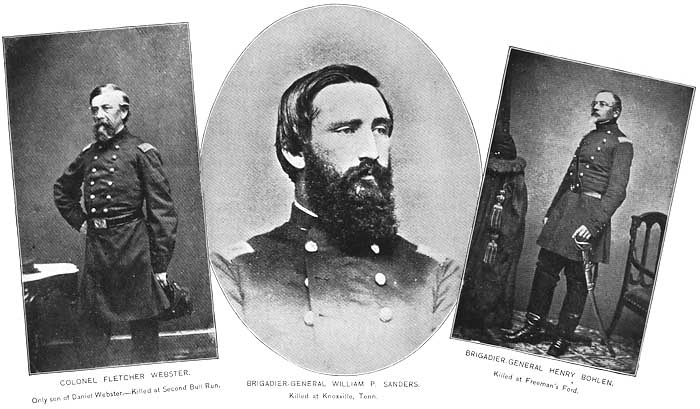
Thus runs the record to the end. These regiments are not exceptional so far as the State or the section is concerned. Quite as vivid a picture of the perils and the heroism of that great struggle could have been presented with statistics concerning the troops of any other States. Looking over all the records, one discovers no difference in the endurance or fighting qualities of the men from different States. For instance, the Eighth New Jersey lost, at Chancellorsville, 125 men out of 268; and in the same battle the Twelfth New Jersey lost 178; while at Gettysburg less than half of the regiment made a charge on a barn filled with sharp-shooters, and captured 99 men. The Fifteenth New Jersey had 116 men killed, out of 444, at Spottsylvania. The Eleventh Pennsylvania, at Fredericksburg, lost 211 killed or wounded out of 394, and in its whole term of service it had 681 men disabled in an enrolment of 1,179; and the Twenty-eighth lost 266 men at the Antietam. The Forty-ninth Pennsylvania had 736 men disabled, in an enrolment of 1,313, its heaviest loss being at Spottsylvania, where it participated in the charge at the bloody angle and lost 260 men, including its colonel and lieutenant-colonel killed. The Seventy-second lost 237 at the Antietam, and 191 at Gettysburg, where it was in that part of the line aimed at by Pickett's charge. The Eighty-third Pennsylvania suffered heavier losses in action than any other regiment, save one, in the National service. At Gaines's Mill it lost 196, at Malvern Hill 166, at Manassas 97, and at Spottsylvania 164. At Gettysburg it formed part of the force that seized Little Round Top. Its total losses were 971 in an enrolment of 1,808. The Ninety-third, like a regiment previously mentioned, was raised and commanded by a Methodist minister. It rendered specially gallant service at Fair Oaks, the Wilderness, and Spottsylvania. The One Hundred and Nineteenth made a gallant charge at Rappahannock Station, capturing guns, flags, and many prisoners, and losing 43 men. It fought at the bloody angle of Spottsylvania, and there and in the Wilderness lost 231 out of 400, including two regimental commanders killed. The One Hundred and Fortieth was in the wheat-field at Gettysburg, and there lost 241 men out of 589. Its total killed and wounded numbered 732 in an enrolment of 1,132.
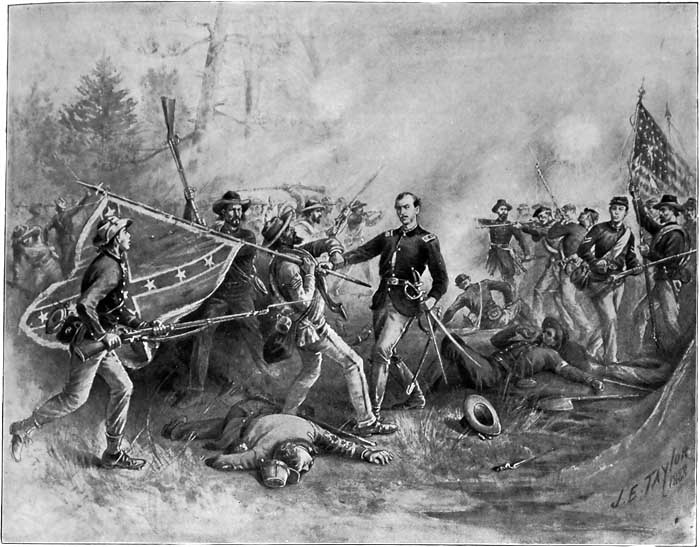
CAPTAIN W. N. GREENE, OF THE ONE HUNDRED AND SECOND NEW YORK REGIMENT, Capturing the Battle Flag of the Twelfth Georgia Regiment at Chancellorsville.
Delaware, a slave State, contributed its quota to the armies that fought for the Union. At the Antietam its First Regiment lost 230 men out of 650. At Gettysburg it was among the troops that met Pickett's charge.
Maryland, another slave State, contributed many good troops to the Union cause. Its Sixth Regiment lost 174 men at Winchester, and 170 in the Wilderness.
The Seventh West Virginia lost 522 men killed or wounded, in an enrolment of 1,008.
The Seventh Ohio lost, at Cedar Mountain, 182 out of 307 men. At Ringgold all its officers except one were either killed or wounded. At Chickamauga the Fourteenth lost 245 men out of 449. At Jonesboro it carried the works in front of it by a brilliant charge, but at heavy loss. The Twenty-third, at South Mountain and Antietam, lost 199 men. Two of its four successive colonels were William S. Rosecrans and Rutherford B. Hayes.
It was not in the famous battles alone that heavy regimental losses were sustained. At Honey Hill, an action seldom mentioned, the Twenty-fifth Ohio had 35 men killed, with the usual proportion of wounded; and at Pickett's Mills, hardly recorded in any history, the Eighty-ninth Illinois lost 154.
The Fifth Kentucky, at Stone River, lost 125 out of 320 men, and at Chickamauga 125. It was commanded by Lovell H. Rousseau, an eminent soldier. Its total loss was 581, in an enrolment of 1,020. The Fifteenth, at Perryville, lost 196 men, including all its field officers killed. Its "boy colonel," James B. Forman, was killed at Stone River. Its total killed and wounded numbered 516, in an enrolment of 952.
The Fourteenth Indiana lost 181 men at the Antietam, out of 320. At Gettysburg it formed part of the brigade that annihilated the Louisiana Tigers. The Nineteenth suffered, during its whole term of service, a loss of 712 killed and wounded, in an enrolment of 1,246. The Twenty-seventh lost 616 from an enrolment of 1,101.
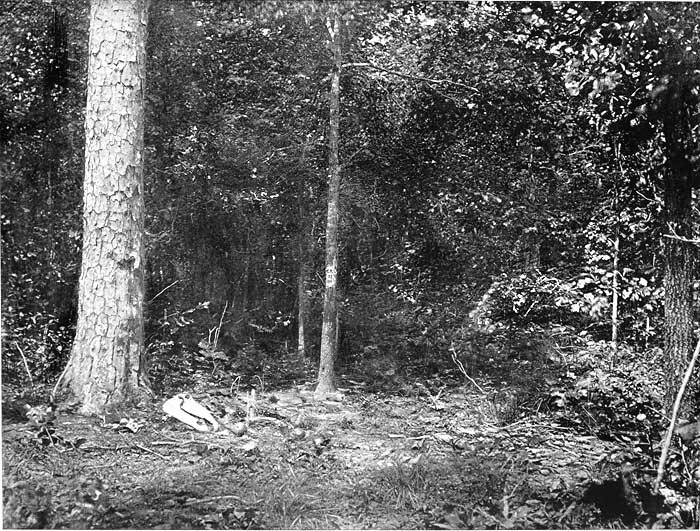
SCENE OF MAJOR-GENERAL JAMES B. McPHERSON'S DEATH, ATLANTA, GA., JULY 22, 1864. (From a War Department photograph.)
The Eleventh Illinois lost, at Fort Donelson, 339 men out of 500. It was commanded by W. H. L. Wallace, who was afterward a brigadier-general and fell at Shiloh. The Twenty-first lost 303 men at Stone River, and 238 at Chickamauga. Its first colonel was Ulysses S. Grant. The Thirty-first lost 176 at Fort Donelson. Its first colonel was John A. Logan. The Thirty-sixth lost 212 at Stone River. The Fortieth lost 216 at Shiloh, and gained special credit for keeping its place in the line after its ammunition was exhausted. The Fifty-fifth lost 275 at Shiloh out of 512. The Ninety-third lost 162 at Champion Hill, and 89, including its colonel, at Mission Ridge.
The First Michigan lost, at Manassas, 178 out of 240 men, including the colonel and fifteen other officers. The Fourth lost 164 at Malvern Hill, including its colonel. At Gettysburg it was in the wheat-field, and lost 165 men. Here a Confederate officer seized the regimental colors and was shot by the colonel, who the next moment was bayoneted by a Confederate soldier, who in his turn was instantly killed by the major. This regiment had three colonels killed in action. The Twenty-fourth, at Gettysburg, lost 363 men, including the colonel and twenty-one other officers, out of 496.
The Second Wisconsin lost 112 men at the first Bull Run and 298 at the second, including its colonel killed; and the Seventh had a total loss in killed and wounded of 1,016 from an enrolment of 1,630; and the Twenty-sixth lost 503 from an enrolment of 1,089.
The Fifth Iowa lost 217 men at Iuka, and the Seventh, at Belmont, lost 227 out of 410. At Pea Ridge the Ninth lost 218 out of 560. In the assault on Vicksburg the Twenty-second lost 164, and was the only regiment that gained and held any portion of the works. Of a squad of twenty-one men that leaped inside and waged a hand-to-hand fight, nineteen were killed.
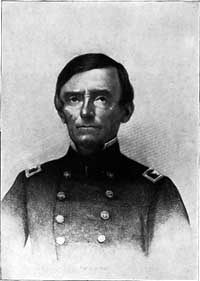
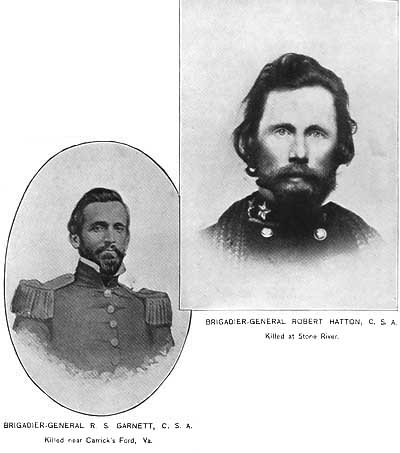
BRIGADIER-GENERAL J. W. SILL. Killed at Stone River. COLONEL JOHN W. LOWE. Killed at Carnifex Ferry.
The Eleventh Missouri had a total loss of 495 from an enrolment of 945. Its heaviest loss was in the assault on Vicksburg, 92. Joseph A. Mower, afterward eminent as a general, was at one time its colonel. The Twelfth Missouri lost 108 in the assault on Vicksburg, and the Fifteenth lost 100 at Chickamauga. General Osterhaus was the first colonel of the Twelfth.
The First Kansas lost 106 men killed and wounded at Wilson's Creek.
The losses in the cavalry were not so striking as those of the infantry, because they were seldom so heavy in any one engagement. But the cavalry were engaged oftener, sometimes in a constant running fight, and the average aggregate of casualties was about the same as in other arms of the service.
In the artillery there were occasionally heavy losses when the enemy charged upon a battery and the gunners stood by their pieces. At Iuka, Sands's Ohio battery had 105 men, including drivers. It was doing very effective service when two Texas regiments charged it, and 51 of its men were killed or wounded. It was captured and recaptured. Seeley's battery at Chancellorsville lost 45 men, and at Gettysburg 25. Campbell's lost 40 at the Antietam, and Cushing's 38 at Gettysburg. The Fifth Maine battery lost 28 at Chancellorsville, 28 at Cedar Creek, and 23 at Gettysburg.
The colored regiments, which were not taken into the service till the third year of the war, suffered quite as heavily as the white ones. They lost over 2,700 men killed in battle (not including the mortality among their white officers), and, with the usual proportion of wounded, this would make their total of casualties at least 12,000.
The regimental losses in the Confederate army were at least equal to those in the National, and were probably greater, for the reason that for them "there was no discharge in that war." Every organization in the National service was enlisted on a distinct contract to serve for a definite term—three months, nine months, two years, or three years—and when the term expired, the men were sent home and mustered out. But when a man was once mustered into the Confederate army, he was there till the end of the war, unless he deserted or was disabled. But no records are available from which complete statistics can be compiled. And in May, 1863, General Lee issued an order forbidding commanders to include in their reports of casualties in battle any wounds except such as disabled the men for further service, and also forbidding them to mention the number of men engaged in an action. This makes any mathematical comparison with the casualties in the National armies impossible; and without information as to the number engaged, the percentage of loss, which is the true test, cannot be computed. Still, there were a considerable number of regiments the statistics of which were recorded and have been preserved. The heaviest loss known in any Confederate regiment was that of the Twenty-sixth North Carolina, at Gettysburg. It went into the fight with somewhat more than 800 men, and lost 588 killed or wounded, besides 120 missing. One company went into the first day's battle with three officers and 84 men, and all but one man were either killed or wounded. Another North Carolina regiment, the Eleventh, went in on the first day with three officers and 38 men, and two of the officers and 34 men were killed or wounded. At Fair Oaks, the Sixth Alabama lost 373 out of 632, and the Fourth North Carolina, 369 out of 687. At Gaines's Mill the First South Carolina lost 319 out of 537; and at Stone River the Eighth Tennessee lost 306 out of 444. The heaviest percentage of loss, so far as known, was that of the First Texas, at the Antietam, 82 per cent. In that same battle the Sixteenth Mississippi lost 63 per cent.; the Twenty-seventh North Carolina, 61 per cent.; the Eighteenth and Tenth Georgia, each 57 per cent.; the Seventeenth Virginia, 56 per cent.; the Fourth Texas, 53 per cent.; the Seventh South Carolina, 52 per cent.; the Thirty-second Virginia, 45 per cent.; and the Eighteenth Mississippi, 45 per cent. Some of the losses at Chickamauga were equally appalling. The Tenth Tennessee lost 68 per cent.; the Fifth Georgia, 61 per cent.; the Second and Fifteenth Tennessee, 60 per cent.; the Sixteenth Alabama and the Sixth and Ninth Tennessee, each 58 per cent.; the Eighteenth Alabama, 56 per cent.; the Twenty-second Alabama, 55 per cent.; the Twenty-third Tennessee, 54 per cent.; the Twenty-ninth Mississippi and the Fifty-eighth Alabama, each 52 per cent.; the Thirty-seventh Georgia and the Sixty-third Tennessee, each 50 per cent.; the Forty-first Alabama, 49 per cent.; the Twentieth and Thirty-second Tennessee, each 48 per cent.; and the First Arkansas, 45 per cent. And these losses include very few prisoners. At Gettysburg, besides the regiments already mentioned, the heaviest losers among the Confederates were: the Second North Carolina, 64 per cent.; the Ninth Georgia, 55 per cent.; the Fifteenth Georgia, 51 per cent.; and the First Maryland, 48 per cent. At Shiloh the Sixth Mississippi lost 70 per cent. At Manassas the Twenty-first Georgia lost 76 per cent.; the Seventeenth South Carolina, 67 per cent.; the Twenty-third South Carolina, 66 per cent.; the Twelfth South Carolina and the Fourth Virginia, each 54 per cent.; and the Seventeenth Georgia, 50 per cent. At Stone River the Eighth Tennessee lost 68 per cent.; the Twelfth Tennessee, 56 per cent., and the Eighth Mississippi, 47 per cent. At Mechanicsville the Forty-fourth Georgia lost 65 per cent. At Malvern Hill the Third Alabama lost 56 per cent.; the Forty-fourth Georgia, 46 per cent.; and the Twenty-sixth Alabama, 40 per cent.
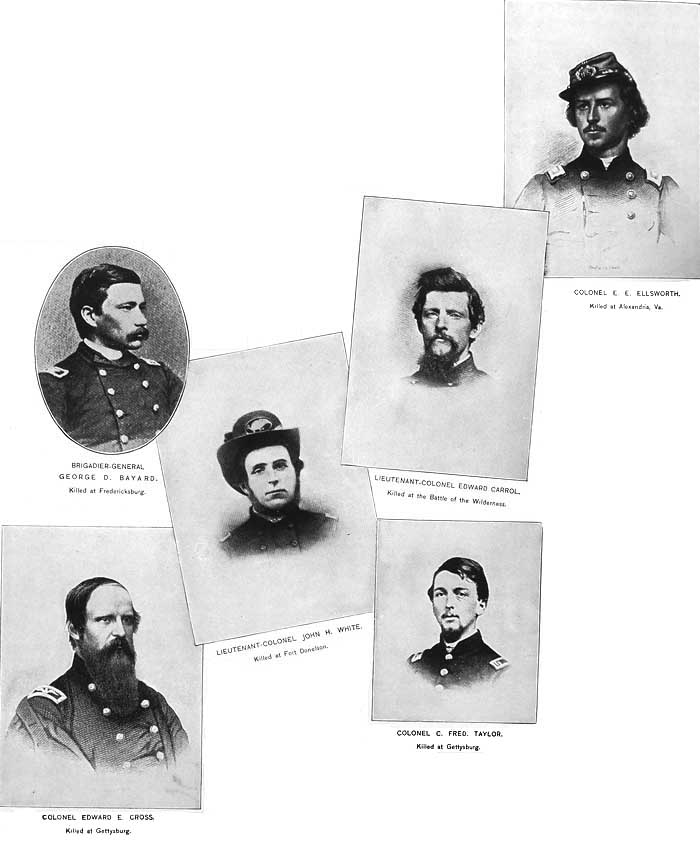
Some writers have asserted that the Confederate troops were better led than the National, and that this is proved by the greater loss of commanding officers. But the statistics do not bear out any such assertion. On each side one army commander was killed—Gen. J. B. McPherson and Gen. Albert Sidney Johnston. On each side three corps commanders were killed—National, Generals Mansfield, Reynolds, and Sedgwick; Confederate, Jackson, Polk, and A. P. Hill. On the National side fourteen division commanders were killed, and on the Confederate, seven. In comparing losses of brigade commanders, it should be explained, that in the Confederate service, as soon as a man was put in command of a brigade he was made a brigadier-general, but the National government was more chary of rank, and often left a colonel for a long time at the head of a brigade. Counting such colonels who actually fell at the head of their brigades as brigadiers, we find that eighty-five brigade-commanders were killed on the National side, and seventy-three on the Confederate.
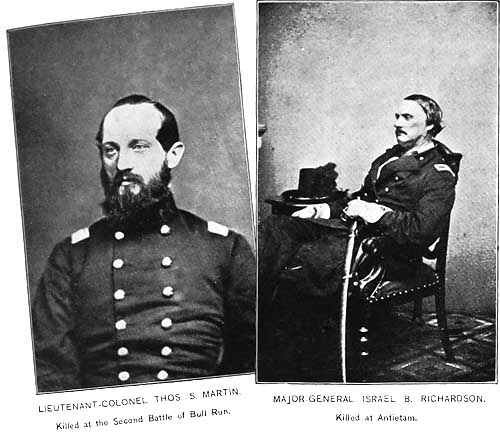
On any other subject, the figures that crowd this chapter would be "dry statistics," but when we remember that every unit here presented represents a man killed or seriously injured, a citizen lost to the Republic—and not only that, but its loss of the sons that should have been born to these slaughtered men—every paragraph acquires a deep, though mournful interest. We may well be proud of American valor, but we should also feel humiliated by the supreme folly of civil war.
NOTE.—For the statistics of this chapter, we are largely indebted to Col. William F. Fox's admirable compilation of "Regimental Losses in the American Civil War" (Albany, 1893).
LAST DAYS OF THE CONFEDERACY.1
BY GEN. JOHN B. GORDON. C. S. A.
1 This article was dictated by Gen. John B. Gordon to the late Henry W. Grady, and prepared by him for publication. It appeared originally in the Philadelphia Times. It is reprinted here by permission, after revision and correction by General Gordon.
I will give you from my personal knowledge the history of the struggles that preceded the surrender of General Lee's army, the causes that induced that surrender—as I had them from General Lee—the detailed account of the last assault ever made upon the Federal lines in pursuance of an offensive purpose, and a description of the last scenes of the bloody and terrible civil war. This history has never been published before. No official reports, I believe, were ever made upon the Confederate side; for after the battle of Hare's Hill, as the attack upon Fort Steadman was called, there was not an hour's rest until the surrender. From the 25th of March, 1865, until the 9th day of April, my men did not take their boots off, the roar of cannon and the rattle of musketry was scarcely stilled an instant, and the fighting and marching was continuous. Hence no report of these operations was ever made.
You will remember the situation of affairs in Virginia about the first of March, 1865. The Valley campaign of the previous summer, which was inaugurated for the purpose of effecting a diversion and breaking the tightening lines about Richmond and Petersburg, and from which so much had been expected, had ended in disaster. Grant had massed an enormous army in front of Petersburg and Richmond, and fresh troops were hurrying to his aid. Our army covered a line of over twenty miles, and was in great distress. The men were literally starving. We were not able to issue even half rations. One-sixth of a pound of beef a day, I remember, was at one time the ration of a portion of the army, and the men could not always get even that. I saw men often on their hands and knees, with little sticks, digging the grains of corn from out of the tracks of horses, and washing it and cooking it. The brave fellows were so depleted by the time Grant broke our lines, that the slightest wound often killed them. A scratch on the hand would result in gangrene and prove fatal. The doctors took me to the hospitals and showed me men with a joint on their fingers shot off, and their arms gangrened up to the elbows. "The men are starved," they said, "and we can do little for them."
A TERRIBLE SITUATION.
The sights that I saw as I walked among these poor, emaciated, hungry men, dying of starved and poisoned systems, were simply horrible. Our horses were in no better condition; many of them were hardly able to do service at all. General Lee had gone in person into Petersburg and Richmond, and begged the citizens to divide what little they had with his wretched men. The heroic people did all that they could. Our sole line of supplies was the railroad running into North Carolina and penetrating into "Egypt," as we called Southwest Georgia, which was then the provision ground for our armies. Such was the situation. My corps (Stonewall Jackson's old corps), after severe and heroic work in the Valley campaign, had been ordered back to Petersburg and placed upon the right wing of the army. I had general instructions to protect the flank of the army, prevent General Grant from turning it, and, above all, to protect the slender line of road from which solely we received our scanty supplies. We were almost continually engaged in fighting, making feints, and protecting our skirmish lines, which the enemy were feeling and pressing continually. Before daylight on the morning of the 2d of March, 1865, General Lee sent for me. I mounted my horse at once and rode to the general's headquarters. I reached the house in which he was staying at about four o'clock in the morning. As I entered the room to which I had been directed, I found General Lee alone. I shall never forget the scene. The general was standing at the fireplace, his head on his arm, leaning on the mantelpiece—the first time I ever saw him looking so thoroughly dejected. A dim lamp was burning on a small centre-table. On the table was a mass of official reports. General Lee remained motionless for a moment after I opened the door. He then looked up, greeted me with his usual courtesy, motioned me to the little table, and, drawing up a chair, sat down. I sat opposite him. "I have sent for you, General Gordon," he said, "to make known to you the condition of our affairs and to confer with you as to what we had best do." The night was fearfully cold. The fire and lamp both burned low as General Lee went on to give me the details of the situation. "I have here," he said, "reports sent in from my officers to-night. I find, upon careful examination, that I have under my command, of all arms, hardly forty-five thousand men. These men are starving. They are already so weakened as to be hardly efficient. Many of them have become desperate, reckless, and disorderly as they have never been before. It is difficult to control men who are suffering for food. They are breaking open mills, barns, and stores in search of food. Almost crazed from hunger, they are deserting from some commands in large numbers and going home. My horses are in equally bad condition. The supply of horses in the country is exhausted. It has come to be where it is just as bad for me to have a horse killed as a man. I cannot remount a cavalryman whose horse dies. General Grant can mount ten thousand men in ten days, and move around your flank. If he were to send me word to-morrow that I might move out unmolested, I have not enough horses to move my artillery. He is not likely to send this message, however; and yet," smiling, "he sent me word yesterday that he knew what I had for breakfast every morning. I sent him word that I did not think this could be so, for if he did know he would surely send me something better. But, now, let us look at the figures. I have, as I have shown you, not quite 45,000 men. My men are starved, exhausted, sick. His are in the best condition possible. But beyond this there is Hancock, at Winchester, with a force of probably not less than 18,000 men. To oppose this force I have not a solitary vidette. Sheridan, with his terrible cavalry, has marched almost unmolested and unopposed along the James, cutting the railroads and canal. Thomas is approaching from Knoxville with a force I estimate at 30,000, and to oppose him I have a few brigades of badly disciplined cavalry, amounting to probably 3,000 in all. General Sherman is in North Carolina, and, with Schofield's forces, will have 65,000 men. As to what I have to oppose this force, I submit the following telegram from General Johnston. The telegram reads: 'General Beauregard telegraphed you a few days ago that, with Governor Vance's Home Guards, we could carry 20,000 men into battle. I find, upon close inspection, that we cannot muster over 13,000 men.'" (This, General Gordon said, was, as nearly as he could recollect, General Johnston's telegram.) "So there is the situation. I have here, say, 40,000 men able for duty, though none of my poor fellows are in good condition. They are opposed directly by an army of 160,000 strong and confident men, and converging on my little force four separate armies, numbering, in the aggregate, 130,000 more men. This force, added to General Grant's, makes over a quarter million. To prevent these from uniting for my destruction there are hardly 60,000 men available. My men are growing weaker day by day. Their sufferings are terrible and exhausting. My horses are broken down and impotent. I am apprehensive that General Grant may press around my flank and cut our sole remaining line of supplies. Now, general," he said, looking me straight in the face, "what is to be done?" With this he laid his paper down and leaned back in his chair.
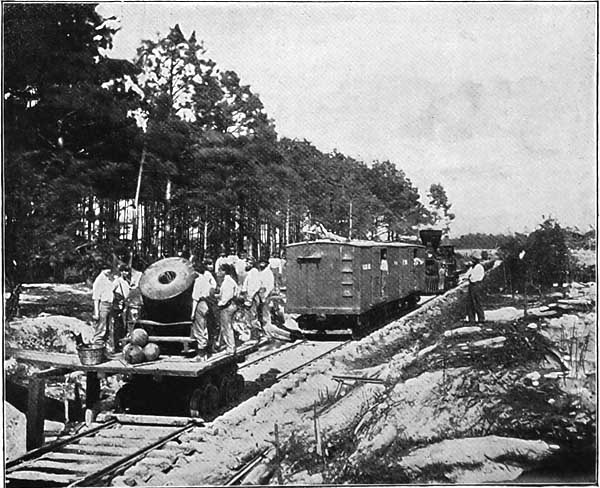
A MORTAR MOUNTED ON A FLAT CAR, UNITED STATES MILITARY RAILROAD.
WHAT IS TO BE DONE?
I replied: "Since you have done me the honor to ask my opinion, I will give it. The situation as you portray it is infinitely worse than I had dreamed it was. I cannot doubt that your information is correct. I am confident of the opinion, therefore, that one of two things should be done, and at once. We must either treat with the United States Government for the best terms possible, or we should concentrate all our strength at one point of Grant's line—selecting some point on the right bank of the Appomattox—assault him, break through his lines, destroy his pontoons, and then turn full upon the flank of his left wing, sweep down it and destroy it if possible, and then join General Johnston in North Carolina by forced marches, and, combining our army with his, fall upon Sherman."
"And what then?"
"If we beat him or succeed in making a considerable battle, then treat at once for terms. I am forced to the conclusion, from what you say, sir, that we have no time for delay."
"So that is your opinion, is it?" he asked, in a tone that sent the blood to my face. I ought to have remembered that it was a way that General Lee had of testing the sincerity of a man's opinion by appearing to discredit it.
"It is, sir," I replied; "but I should not have ventured it, had it not been asked; and since you seem to differ from the opinion I hold, may I ask you what your opinion is?"
At once his manner changed, and, leaning forward, he said, blandly: "I entirely agree with you, general."
"Does President Davis and the Congress know these facts? Have you expressed an opinion as to the propriety of making terms, to President Davis or the Congress?"
General Lee replied to this question: "General Gordon, I am a soldier. It is my duty to obey orders."
"Yes," I replied; "but if you read the papers, General Lee, you can't shut your eyes to the fact that the hopes of the Southern people are centred in and on your army, and if we wait until we are beaten and scattered into the mountains before we make an effort at terms, the people will not be satisfied. Besides, we will simply invite the enemy to hunt us down all over the country, devastating it wherever they go."
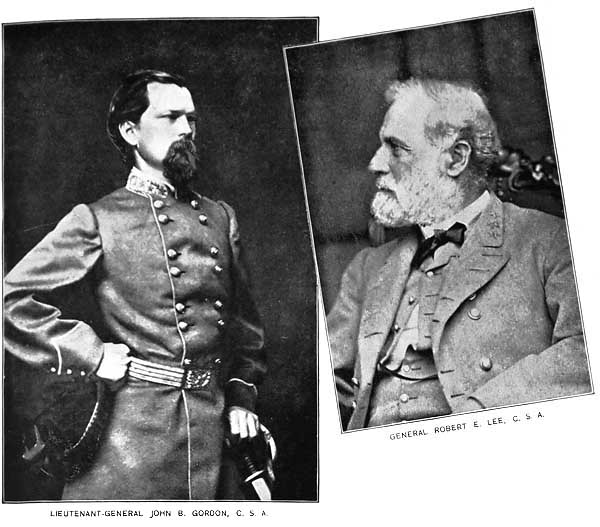
General Lee said nothing to this for some time, but paced the floor in silence, while I sat gloomily enough, as you may know, at the fearful prospect. He had, doubtless, thought of all I said long before he sent for me. I don't wish you to understand that I am vain enough to believe for a moment that anything I said induced him to go to Richmond the next day. As I said before, he had probably decided on his course before he sent for me, and only feigned a difference of opinion or hesitation in order to see with what pertinacity I held my own. He did go to Richmond, and on his return sent for me again, and in reply to my question as to what had occurred, he said:
"Sir, it is enough to turn a man's hair gray to spend one day in that Congress. The members are patriotic and earnest, but they will neither take the responsibility of acting nor will they clothe me with authority to act. As for Mr. Davis, he is unwilling to do anything short of independence, and feels that it is useless to try to treat on that basis. Indeed, he says that, having failed in one overture of peace at Hampton Roads, he is not disposed to try another."
"Then," said I, "there is nothing left for us but to fight, and the sooner we fight the better, for every day weakens us and strengthens our opponents."
It was these two conferences that led to the desperate and almost hopeless attack I made upon the 25th of March on Grant's lines at Fort Steadman and Hare's Hill, in front of Petersburg. My corps was, as I tell you, at that time on the extreme right of General Lee's army, stretching from Hatcher's Run, southward along the Boydton plank road. He proposed to transfer my corps to lines in and around Petersburg, and have me familiarize myself with the strong and weak points, if there were any weak ones, on Grant's line near the bank of the Appomattox River. He ordered my command into Petersburg to replace the troops which were there. I spent a week examining Grant's lines, learning from deserters and men captured the names of the Federal officers and their commands in the front. At last I selected a point which I was sure I could carry by a night assault. I so reported to General Lee. It was in the last degree a desperate undertaking, as you will presently see; but it was the best that could be suggested—better than to stand still. Almost hopeless as it was, it was less so than the certain and rapid disintegration, through starvation and disease and desertion, of the last army we could ever organize. The point on my line from which I decided to make the assault was Colquitt's salient, which had been built by Governor Colquitt and his men and held by them, when, to protect themselves, they had to move under covered ways and sleep burrowed in the ground like Georgia gophers. I selected this point because the main lines here were closest together, being not more than two hundred yards apart, I should say, while the picket lines were so close that the Confederate, and the Federals could easily converse. By a sort of general consent the firing between the pickets nearly ceased during the day, so that I could stand upon my breastworks and examine General Grant's. It is necessary that you should know precisely the situation of the lines and forts, as I can illustrate by a rough diagram:
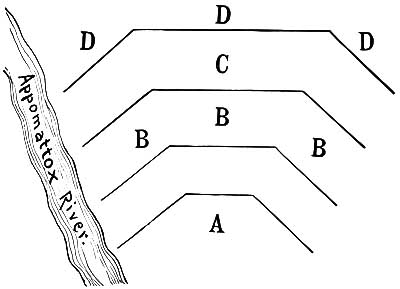
A, Colquitt's salient. B, the main line of Federal intrenchment, with Fort Steadman in the centre and two other forts flanking it. C, line of Federal reserves to support Fort Steadman and the troops in the main trenches. D, second line of Federal forts, so arranged as to command Fort Steadman and the main line of intrenchments, should these be broken.
A STRONG POSITION.
You can see at a glance how desperately strong was even this, the weakest point on Grant's line. It was close to Colquitt's salient where the fearful mine was sprung called the Crater. The whole intervening ground between Fort Steadman and Colquitt's salient, over which I had to make the assault, was raked not only by a front fire, but by flank fires from both directions from the forts and trenches of the main line, B. An attack, therefore, by daylight would have been simply to have the men butchered, without any possibility of success, so that nothing but a night attack was to be thought of. Between the main line of trenches and forts and the rear line of forts, D, was a heavy line of Federal reserves, C, and the rear forts were placed with such consummate engineering skill as to command any point on that portion of Grant's line which might be captured. It was, therefore, necessary to capture or break through the reserves and take the rear line of forts as well as the front. This rear line of forts was so protected by abatis in front that the whole of General Lee's army could not have stormed them by a front attack, and the only possibility of securing them was to capture them from the rear, where there was an opening. This could only be done by stratagem, if it could be done at all.
I finally submitted a plan of battle to General Lee, which he approved and ordered executed. It was briefly this: To take Fort Steadman by direct assault at night, then send a separate body of men to each of the rear forts, who, claiming to be Federals, might pass through the Federal reserves and take possession of the rear line of forts as if ordered to do so by the Federal commander; next, then to press with my whole force to the rear of Grant's main line and force him out of the trenches, destroy his pontoons, cut his telegraph wires, and press down his flank. Of course, it was a most desperate and almost hopeless undertaking, and could be justified only by our desperate and hopeless condition if we remained idle. We both recognized it as the forlornest of forlorn hopes. Let me particularize a little more. The obstructions in front of my own lines had to be removed, and removed silently, so as not to attract the attention of the Federal pickets. Grant's obstructions had to be removed from the front of Fort Steadman. These obstructions were of sharpened rails, elevated to about breast high, the other end buried deeply in the ground, the rails resting on a horizontal pole and wrapped with telegraph wire. They could not be mounted or pushed aside, but had to be cut away with axes. This had to be done immediately in front of the guns of Fort Steadman. These guns were at night doubly charged with canister, as I learned from Federal prisoners. The rush across the intervening space between the lines had to be made so silently and swiftly as to take the fort before the gunners could fire. The reserves had to be beaten or passed and the rear line of forts taken before daylight. All this had to be accomplished before my main forces could be moved across and placed in position to move on Grant's flank, or rather left wing.
THE PLAN OF ATTACK.
My preparations were these: I called on my division commanders for a detail of the bravest men in their commands. To rush over the Federal pickets and into the fort and seize the Federal guns, I selected a body of only one hundred men, with empty rifles and fixed bayonets. To precede these, to clear an opening to the fort, I selected fifty of the most stalwart and brave men I could find, and armed them with axes to cut clown the obstructions in front of the fort. They were ordered to remove my own abatis, rush upon the Federal obstructions, and cut away a brigade front. The one hundred with empty rifles and fixed bayonets were to follow immediately, and this one hundred and fifty men were not to falter or fire, but to go into Fort Steadman, if they had to do it in the face of the fire from all the forts. Immediately after these axemen and the one hundred had cleared the way and gained the fort, three other squads of one hundred each were to rush across, pass through Fort Steadman, and go pell-mell to the rear, and right through the Federal reserves, crying as they went: "The rebels have carried our lines in front, captured Fort Steadman, and we are ordered by General McLaughlin, Federal commander of Fort Steadman, to go back to the rear forts and hold them against the rebels." I instructed each commander of these last squads as to what particular fort he was to enter; and a guide, who had been raised on the ground, was placed with each of these three squads, or companies, who was to conduct them through the reserves and to the rear of the forts. If they were halted by the Federal reserves, each commander was instructed to pass himself off as one of the Federal officers whose names I had learned. I remember that I named one commander of one of the companies Lieutenant-Colonel Pendergrast, of a Pennsylvania regiment—I think that was the name and regiment of one of the Federal officers in my front. As soon as Fort Steadman should be taken, and these three bodies of one hundred men each had succeeded in entering the rear forts, the main force of infantry and cavalry were to cross over. The cavalry was to gallop to the rear, capture the fugitives, destroy the pontoons, cut down the telegraph wires, and give me constant information, while the infantry was to move rapidly down Grant's lines, attacking and breaking his division in detail, as they moved out of his trenches. Such, I say, was the plan of this most desperate and last aggressive assault ever made by the Confederate army.
General Lee had sent me, in addition to my own corps, a portion of Longstreet's corps (Pickett's division) and a portion of A. P. Hill's and a body of cavalry. During the whole night of the 24th of March I was on horseback, making preparations and disposing of troops. About four o'clock in the morning I called close around me the fifty axemen and four companies, one hundred each, of the brave men who were selected to do this hazardous work. I spoke to them of the character of the undertaking, and of the last hope of the cause, which was about to be confided to them. Around the shoulders of each man was bound a white strip of muslin, which Mrs. Gordon, who sat in a room not far distant listening for the signal gun, had prepared, as a means of recognition of each other. The hour had come, and when everything was ready I stood on the breastworks of Colquitt's salient and ordered two men to my side, with rifles, who were to fire the signal for attack. The noise of moving our own obstructions was going on and attracted the notice of a Federal picket. In the black darkness his voice rang out:
"Hullo there, Johnny Reb! what are you making all that fuss about over there?"
The men were just leaning forward for the start. This sudden call disconcerted me somewhat; but the rifleman on my right came to my assistance by calling out in a cheerful voice:
"Oh! never mind us, Yank; lie down and go to sleep. We are just gathering a little corn; you know rations are mighty short over here."
There was a patch of corn between our lines, some of it still hanging on the stalks. After a few moments there came back the kindly reply of the Yankee picket, which quite reassured me. He said:
"All right, Johnny; go ahead and get your corn. I won't shoot at you."
As I gave the command to forward, the man on my right seemed to have some compunctions of conscience for having stilled the suspicions of the Yankee picket who had answered him so kindly, and who the next moment might be surprised and killed. So he called out to him:
"Look out for yourself now, Yank; we're going to shell the woods."
This exhibition of chivalry and of kindly feelings on both sides, and at such a moment, touched me almost as deeply as any minor incident of the war. I quickly ordered the two men to "Fire."
Bang! Bang! The two shots broke the stillness, and "Forward!" I commanded. The chosen hundred sprang forward, eagerly following the axemen, and for the last time the stars and bars were carried to aggressive assault.
FORT STEADMAN TAKEN.
In a moment the axemen were upon the abatis of the enemy and hewing it down. I shall never know how they whisked this line of wire-fastened obstructions out of the way. The one hundred overpowered the pickets, sent them to the rear, rushed through the gap made by the axemen up the slope of Fort Steadman, and it was ours without the firing of a single gun, and with the loss of but one man. He was killed with a bayonet. The three companies who were to attempt to pass the reserves and go into the rear forts followed and passed on through Fort Steadman. Then came the other troops pouring into the fort. We captured, I think, nine pieces of artillery, eleven mortars, and about six hundred or seven hundred prisoners, among whom was General McLaughlin, who was commanding on that portion of the Federal line. Many were taken in their beds. The prisoners were all sent across to our lines, and other troops of my command were brought to the fort. I now anxiously awaited to learn the fate of the three hundred who had been sent in companies of one hundred each to attempt the capture of the three rear forts. Soon a messenger reached me from two officers commanding two of these chosen bodies, who informed me that they had succeeded in passing right through the line of Federal reserves by representing themselves as Federals, and had certainly gone far enough to the rear for the forts, but that their guides had abandoned them or been lost, and that they did not know in what direction to move. It was afterward discovered, when daylight came, that these men had gone further out than the forts, and could have easily entered and captured them if the guides had not been lost, or had done their duty. Of course, after dawn they were nearly all captured, being entirely behind the Federal reserves.
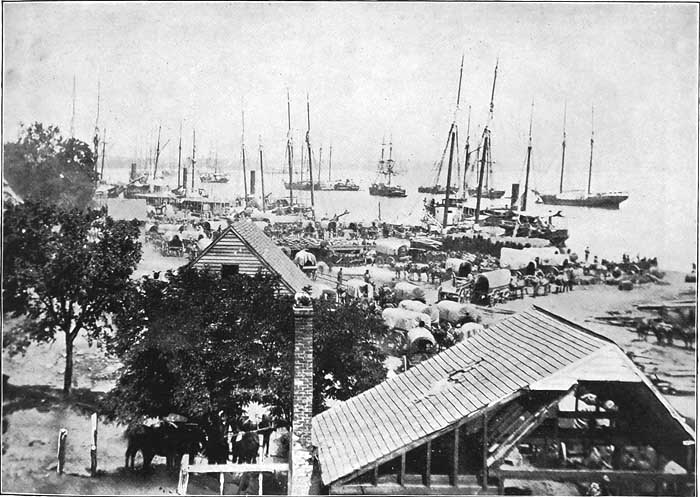
CITY POINT, VIRGINIA. (From a war-time photograph.)
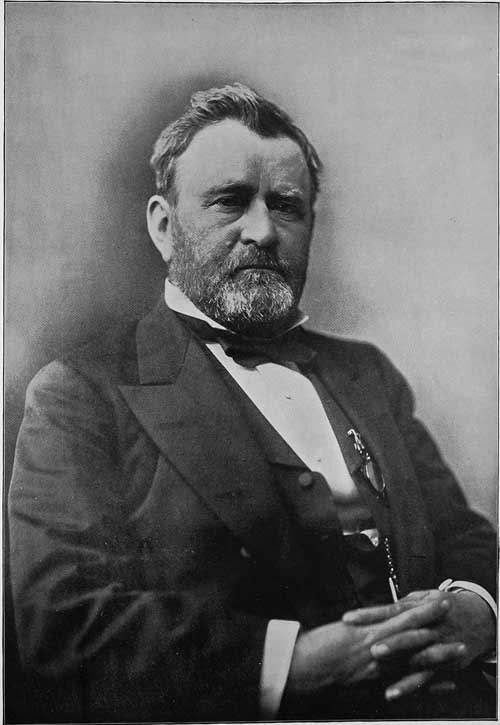
GENERAL ULYSSES S. GRANT.
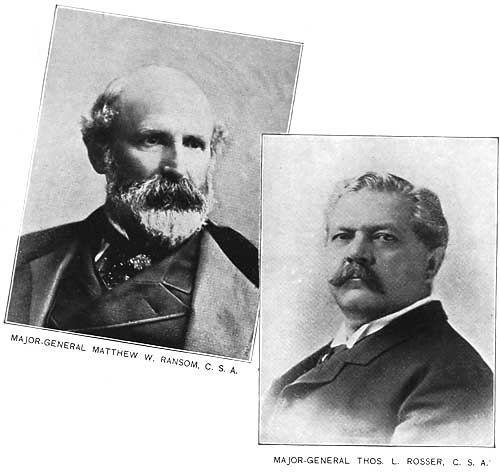
FAILURE OF THE ATTACK.
In the mean time, the few Federal soldiers who had escaped from the fort and intrenchments we had captured had spread the alarm and aroused the Federal army. The hills in the rear of Grant's lines were soon black with troops. By the time it was fairly daybreak the two forts on the main line flanking Fort Steadman, the three forts in the rear, and the reserves, all opened fire upon my forces. We held Fort Steadman, and the Federal intrenchments to the river, or nearly so. But the guides had been lost, and as a consequence the rear forts had not been captured. Failing to secure these forts, the cavalry could not pass, the pontoons could not be destroyed, and the telegraph wires were not cut. In addition to these mishaps, the trains had been delayed, and Pickett's division and other troops sent me by General Lee had not arrived. The success had been brilliant so far as it had gone, and had been achieved without loss of any consequence to our army; but it had failed in the essentials to a complete success or to a great victory. Every hour was bringing heavy reinforcements to the Federals and rendering my position less and less tenable. After a brief correspondence with General Lee, it was decided to withdraw. My loss, whatever it was, occurred in withdrawing under concentrated fire from forts and infantry. The fighting over the picket lines and main lines from this time to the surrender was too incessant to give me an opportunity to ascertain my loss. It was considerable; and although I had inflicted a heavy loss upon the enemy, I felt, as my troops reëntered Colquitt's salient, that the last hazard had been thrown, and that we had lost.
I will give you here the last note I ever received from General Lee, and one of the last he ever wrote in his official capacity. It is as follows:
4.30 P.M., HEADQUARTERS, March 24, 1865.
GENERAL: I have received yours of 2.30 P.M., and telegraphed for Pickett's division, but I do not think it will reach here in time; still we will try. If you need more troops, one or both of Heth's brigades can be called to Colquitt's salient, and Wilcox's to the Baxter road. Dispose of the troops as needed. I pray that a merciful God may grant us success, and deliver us from our enemies.
Very truly, R. E. LEE, General.
GEN. J. B. GORDON.
P. S.—The cavalry is ordered to report to you at Halifax Road and Norfolk Railroad (iron bridge) at three
A.M.
to-morrow. W. F. Lee to be in vicinity of Monk's Corner at six
A.M.
R. E. L.
THE DEATH STRUGGLE.
I had very little talk with General Lee after our withdrawal. I recognized that the end was approaching, and of course he did. It will be seen from his semi-official note, quoted above, that he became very much interested in the success of our movement. While he had known as well as I that it was a desperate and forlorn hope, still we had hoped that we might cut through and make a glorious dash down the right and seek Johnston in North Carolina. The result of the audacious attempt that had been made upon his line, and its complete success up to the time that it was ruined by a mischance, was to awaken General Grant's forces into more aggressive measures. A sort of respite was had, for a day, after the night attack on Fort Steadman, and then the death-struggle began. Grant hurried his masses upon our starved and broken-down veterans. His main attack was made upon our left, A. P. Hill's corps. Grant's object was to turn our flanks, and get between us and North Carolina. The fighting was fearful and continuous. It was a miracle that we held our lines for a single day. With barely six thousand men I was holding six miles of line. I had just one thousand men to the mile, or about one to every two yards. Hill and Longstreet were in not much better trim, and some part of this thin line was being forced continually. The main fight was on my line and Hill's, as General Longstreet was nearer Richmond. Heavy masses of troops were hurled upon our line, and we would have to rally our forces at a certain point to meet the attack. By the time we would repel it, we would find another point attacked, and would hurry to defend that. Of course, withdrawing men from one part of the line would leave it exposed, and the enemy would rush in. Then we would have to drive them out and reëstablish our line. Thus the battle raged day after day. Our line would bend and twist, and swell and break, and close again, only to be battered against once more. Our people performed prodigies of valor. How they endured through those terrible, hopeless, bloody days, I do not know. They fought desperately and heroically, although they were so weakened through hunger and work that they could scarcely stand upon their feet and totter from one point of assault to another. But they never complained. They fought sternly, grimly, as men who had made up their minds to die. And we held our lines. Somehow or other—God only knows how—we managed day by day to wrest from the Federals the most of our lines. Then the men, dropping in the trenches, would eat their scanty rations, try to forget their hunger, and snatch an hour or two of sleep.
THE EVACUATION OF PETERSBURG.
Our picket lines were attacked somewhere every night. This thing went on till the morning of the 2d of April. Early that day it became evident that the supreme moment had come. The enemy attacked in unusually heavy force, and along the line of mine and Hill's corps. It became absolutely necessary to concentrate a few men at points along my line, in order to make a determined resistance. This left great gaps in my line of breastworks, unprotected by anything save a vidette or two. Of course, the Federals broke through these undefended passes, and established themselves in my breastworks. At length, having repulsed the forces attacking the points I defended, I began reëstablishing my line. My men fought with a valor and a desperate courage that has been rarely equalled, in my opinion, in military annals. We recaptured position after position, and by four o'clock in the afternoon I had reëstablished my whole line except at one point. This was very strongly defended, but I prepared to assault it. I notified General Lee of my purpose and of the situation, when he sent me a message, telling me that Hill's lines had been broken, and that General Hill himself had been killed. He ordered, therefore, that I should make no further fight, but prepare for the evacuation which he had determined to make that night. That night we left Petersburg. Hill's corps, terribly shattered and without its commander, crossed the river first, and I followed, having orders from General Lee to cover the retreat. We spent the night in marching, and early the next morning the enemy rushed upon us. We had to turn and beat them back. Then began the most heroic and desperate struggle ever sustained by troops—a worn and exhausted force of hardly four thousand men, with a vast and victorious army, fresh and strong, pressing upon our heels! We turned upon every hilltop to meet them, and give our wagon-trains and artillery time to get ahead. Instantly they would strike us, we invariably repulsed them. They never broke through my dauntless heroes; but after we had fought for an hour or two, we would find huge masses of men pressing down our flanks, and to keep from being surrounded I would have to withdraw my men. We always retreated in good order, though always under fire. As we retreated we would wheel and fire, or repel a rush, and then stagger on to the next hill-top, or vantage ground, where a new fight would be made. And so on through the entire day. At night my men had no rest. We marched through the night in order to get a little respite from fighting. All night long I would see my poor fellows hobbling along, prying wagons or artillery out of the mud, and supplementing the work of our broken-down horses. At dawn, though, they would be in line ready for battle, and they would fight with the steadiness and valor of the Old Guard.
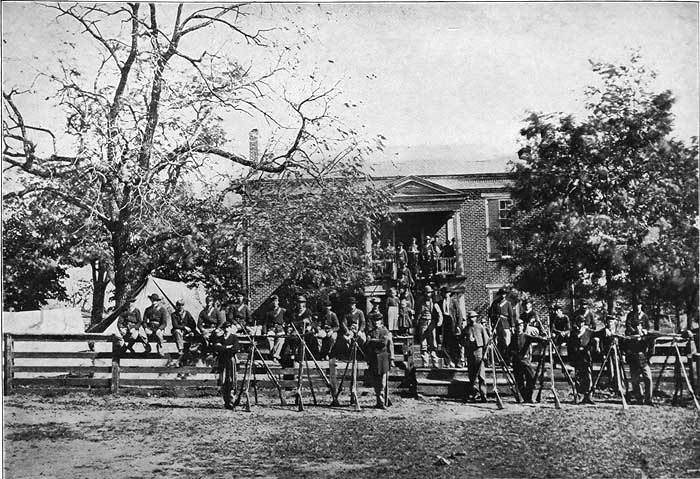
APPOMATTOX COURT-HOUSE. (From a War Department photograph.)
THE LAST COUNCIL OF WAR.
This lasted until the night of the 7th of April. The retreat of Lee's army was lit up with the fire and flash of battle, in which my brave men moved about like demigods for five days and nights. Then we were sent to the front for a rest, and Longstreet was ordered to cover the retreating army. On the evening of the 8th, when I had reached the front, my scout George brought me two men in Confederate uniform, who, he said, he believed to be the enemy, as he had seen them counting our men as they filed past. I had the men brought to my campfire, and examined them. They made a most plausible defence, but George was positive they were spies, and I ordered them searched. He failed to find anything, when I ordered him to examine their boots. In the bottom of one of the boots I found an order from General Grant to General Ord, telling him to move by forced marches toward Lynchburg and cut off General Lee's retreat. The men then confessed that they were spies, and belonged to General Sheridan. They stated that they knew that the penalty of their course was death, but asked that I should not kill them, as the war could only last a few days longer, anyhow. I kept them prisoners, and turned them over to General Sheridan after the surrender. I at once sent the information to General Lee, and a short time afterward received orders to go to his headquarters. That night was held Lee's last council of war. There were present General Lee, General Fitzhugh Lee, as head of the cavalry, and Pendleton, as chief of artillery, and myself. General Longstreet was, I think, too busily engaged to attend. General Lee then exhibited to us the correspondence he had had with General Grant that day, and asked our opinion of the situation. It seemed that surrender was inevitable. The only chance of escape was that I could cut a way for the army through the lines in front of me. General Lee asked me if I could do this. I replied that I did not know what forces were in front of me; that if General Ord had not arrived—as we thought then he had not—with his heavy masses of infantry, I could cut through. I guaranteed that my men would cut a way through all the cavalry that could be massed in front of them. The council finally dissolved with the understanding that the army should be surrendered if I discovered the next morning, after feeling the enemy's line, that the infantry had arrived in such force that I could not cut my way through.