Chapter XLIV · (continued 4)
Reading edition
The spies of the war were not all men. Many women on both sides did effective secret work for the cause they espoused. Perhaps this agency was more common among the Southern than the Northern sympathizers. Residence in the North was free from the necessity of accounting for one's presence and business as rigidly as in the South; and not only in Washington and the border towns, but in all the cities of the North, the rebels had fair emissaries who kept them pretty well informed of passing events. Among the Northern women who did good service during the war, both as spy and nurse, was Miss Emma Edmonds. After spending several months in the hospitals of the Army of the Potomac, she volunteered to take the place of a spy who had been executed at Richmond. Disguised as a colored boy, she soon found herself within the rebel lines, where she joined a gang of negroes who were carrying provisions to the pickets, and afterward working on the fortifications at Yorktown. After doing a man's day's work, she used her evening liberty in making a careful inspection of the defences, counting the guns, etc., and picked up much other information through the free discussion of what was going on, common in the rebel army among both officers and men. Her opportunity to get back to the Union lines came when, on visiting the pickets with their evening meal, she was for a time stationed on the post of a picket who had just been shot; for while the adjacent pickets had their backs turned, she slipped away into the darkness, carrying her valuable information with her. Later on she made another secret expedition, this time in the guise of an Irish female peddler. Her first experience on this trip was the discovery of a wounded and dying Confederate officer in a deserted house, and the mementos and messages for home which he confided to her proved to be her passport to the rebel headquarters. She had already gained from the pickets and the men about the camp the information she was seeking, and was quite ready to return, when she was sent, mounted, to guide a detachment to bring back the dead officer's body from the house near her own lines, and thus was fairly started on her way. The expedition of the detachment was a somewhat perilous one for them, and they sent her farther down the road to watch for Yankees and give them timely warning of the approach of any from the Union side. Not seeing any Yankees in that vicinity, she kept on until she did—and then she was safe back in her own quarters, and the Union troops were soon able to cross the Chickahominy with a pretty fair knowledge of the enemy's dispositions and purposes.
Miss Edmonds had a strange career for a woman. She kept with the Union advance, varying her womanly ministrations in camp and field hospital with occasional duty as an orderly and on secret service. She entered the Confederate lines, now as a contraband, now as a rebel soldier. In the latter character she was impressed into the Confederate cavalry and went into action, where she managed to change sides during the fight and to wound the rebel officer who had conscripted her. After this adventure her secret service had perforce to be confined to the Union lines, for she had become pretty well known in all the disguises she could assume.
The experiences of all scouts and spies can be well understood from the instances that have now been given. Their work was most important, and their days were filled with thrilling adventure, most fascinating to adventurous spirits. Many of them never lived to tell their story, but received the prompt justice of a drum-head court martial and a short shrift. Their performances rose often to the height of heroism, and their prowess, when they found themselves in close quarters, equalled anything ever done on the battlefield.
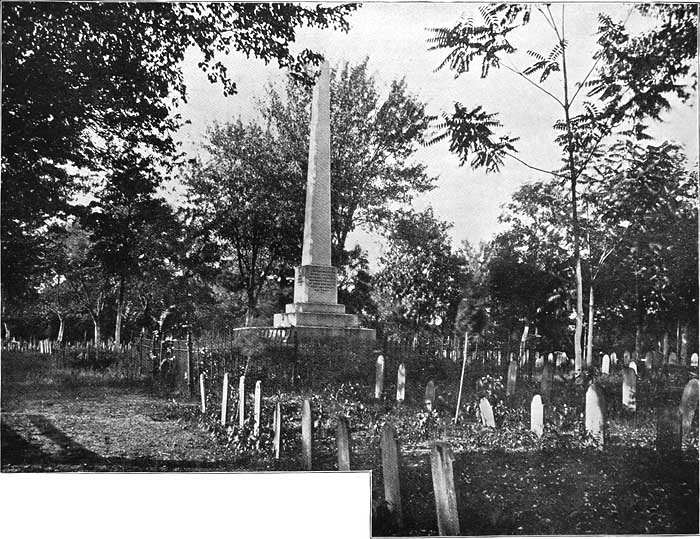
CONFEDERATE MONUMENT AND CEMETARY, RICHMOND, VA.
IMPORTANT HISTORY SUGGESTED BY A PICTURE GROUP OF SHERMAN AND HIS GENERALS.
(See page 30.)
This picture was to consist of General Sherman, his two army-commanders, and the four corps-commanders in charge at the close of the war.
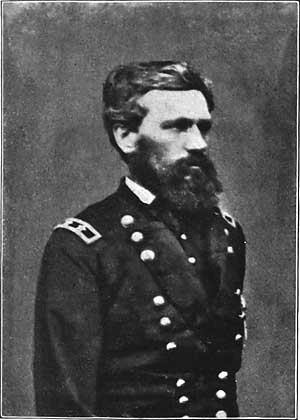
MAJOR-GENERAL OLIVER O. HOWARD.
It does not, however, contain the portrait of General Blair, who was absent on a short leave. At the time the photograph was taken, I [General Howard] was no longer connected with General Sherman's army. My picture was included for the following reason:
After the army's arrival near Washington, I was assigned to other duty, and General Logan took my place in command of the Army of the Tennessee. When the group was made up, as I had been so long identified with that army, General Sherman desired me to be included. General Logan was seated for the picture where I would have sat, had there been no late change of commanders. In all the field operations from Atlanta to the sea, and from Savannah through the Carolinas to Raleigh, and on to Washington, I was denominated "the right wing commander," and General Slocum "the left wing commander." The division of cavalry under Kilpatrick was sometimes independent of either wing, but usually reported for orders to one wing or the other, as Sherman directed.
The right wing was the "Army of the Tennessee;" the left wing, the "Army of Georgia." In the field service, from Atlanta on, each wing had two army corps, as follows: the right wing, the Fifteenth and Seventeenth; the left wing, the Fourteenth and Twentieth Corps. When General Logan passed to the charge of the Army of the Tennessee, General Hazen was assigned to command the Fifteenth Corps. Though absent, General Blair retained the Seventeenth Corps. After our march, for some reason—I think for Mower's promotion—Gen. A. S. Williams had been relieved from the Twentieth Corps, and General Mower assigned to his place. The Fourteenth Corps, which Gen. George H. Thomas had so long and so ably commanded, was during all that march under the direction of Gen. Jefferson C. Davis.
It may be of interest, while inspecting this noted picture, to recall something characteristic of the men who compose it. Let us begin with the junior officer of the group.
MAJOR-GENERAL JEFFERSON C. DAVIS.
General Davis, promoted to a volunteer appointment from the regular army, became early conspicuous as a successful commander in Missouri and other Western fields. For example, he captured one thousand prisoners at Milford, repelled Confederate attack upon Sigel's centre at Pea Ridge, commanded a division at Stone River, and took as prisoners one hundred and fourteen of Wheeler's raiders.
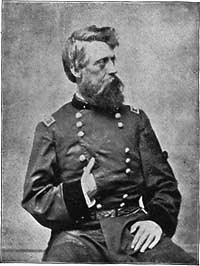
MAJOR-GENERAL JEFFERSON C. DAVIS.
In August, 1862, ill-health constrained him to leave the front for a short time, when he visited his home in Clarke County, Ind. The northward movement of the Confederates against Louisville subsequently caused him to hasten to that city and volunteer his services to General Nelson.
This general, William Nelson, a native of Kentucky, was a middle-aged naval officer at the breaking out of the war. His experience in Mexico, his strong character as a loyal Kentuckian, had caused his transfer to the army. Among undisciplined masses of volunteers he had already done wonders. He attained special distinction as a division commander under Buell at the fiercely contested battle of Shiloh; but with all his patriotism, energy, and capability, he was a martinet in discipline, very often giving great offence by his rough language and impatient ways.
Gen. Jefferson C. Davis had hardly come in contact with Nelson when he was subjected to treatment that offended him greatly.
Davis was of slender build, while Nelson was a large and powerful man. Davis endeavored, without success, to get an apology from Nelson for hard words and mistreatment. Abbott, in his History of the Civil War, shows how he was met:
"Here he (Davis) was outrageously insulted by General Nelson, and after demanding an apology and receiving only reiterated abuse, he (Davis) shot him on the stairs of the Galt House. General Nelson died in a few hours. General Davis was arrested, but was soon released, sustained by the almost universal sympathy of the public and of the army."
In subsequent years it was my lot to be on duty with General Davis. He reported to me and was under my command while pursuing the Confederates under Bragg, just after the battle of Missionary Ridge, November 25, 1863. His method of covering his front and flanks with skirmishers, and holding his troops well in hand for the prompt deployment, greatly pleased me. He was one of those officers constantly on the qui vive, impossible to surprise, difficult to defeat, and ever ready, at command, effectively to take the offensive. He succeeded to the Fourteenth Corps because Gen. John M. Palmer, offended at a decision of General Sherman, resigned the position. While Davis was a just man, he was strongly prejudiced against negroes, often, in his conversations, declaiming against them. But subsequent to the war, when commanding the State of Kentucky, acting as Assistant Commissioner for Freedmen, he took strong grounds against all lawless white men who sought to do them injury. In 1874, when a confusion of counsels had caused endless complications during the Modoc War in Southern Oregon, General Davis was, as a final resort, selected and despatched to the scene of operations. His unfailing courage and steady action soon ended the war. The Modocs were conquered, taken prisoners, and their savage and treacherous leaders punished.
I had many a conversation with General Davis. He would lead me when we were alone, in a few minutes, according to the bias of his heart, to the subject of his difficulty with Nelson. Though others exculpated him, his own heart never seemed to be at rest. It was more to himself than to others the one cloud in his otherwise unblemished, patriotic career.
MAJOR-GENERAL WILLIAM B. HAZEN
entered the military academy one year after me (1851), so that I was associated with him there for three years. As a young man, he was very thin of flesh, so much so as to cause remark. The first time I saw him after graduation, he was on a visit to West Point, in 1860. He had been in many Indian engagements in Texas and New Mexico, and had been brevetted for gallant conduct in battle; his arm at that time was in a sling, he having been wounded with an arrow.
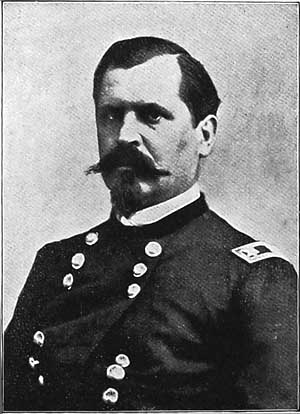
MAJOR-GENERAL WILLIAM B. HAZEN.
A most wonderful change had taken place in his personal appearance. Instead of a young man of cadaverous build, he was large, fleshy, handsome. As a cadet he had been very retiring; now quite the opposite—in fact, he soon became remarkable among us for his bold frontier stories and an increased self-esteem.
Such was Hazen at the breaking out of the war. He went to the front in Kentucky, commanding the Forty-first Ohio Volunteers. During the series of operations and battles in which he was engaged, he maintained in his commands unusual neatness of attire and excellent discipline, and received for himself four brevets for gallant and meritorious service; the last being that of major-general in the regular army. Probably his most distinguished effort, one which called the especial attention of General Sherman to his merit, was the taking, under my orders, of Fort McAllister, December 13, 1864. He at that time had charge of a division, assisted in building a long bridge over the Ogeechee, crossed with his men, and, pushing on rapidly southward, completely environed Fort McAllister from sea-shore to sea-shore. General Sherman, with myself, more inland, were watching his operations in plain view from a rice-mill on the other side of the Ogeechee. The sudden and persistent attack, the exploding of numerous torpedoes, the tremendous vigor of the defence, afforded us an exciting scene, which ended in a much-needed victory; for this fort at the mouth of the river was the last obstruction between our army and the supplies which were coming from the sea. This success of Hazen caused me to recommend him for further promotion to the command of the Fifteenth Army Corps; and this was his crowning honor in the great war.
MAJOR-GENERAL JOSEPH A. MOWER.
I found General Mower in command of the First Division Sixteenth Army Corps (a little later, of a division in the Seventeenth Army Corps, under General Blair); that was when I came to the Army of the Tennessee at Atlanta. He was already well known in that army. In conversation around campfires staff-officers spoke of him in this way: "Mower is a rough diamond;" "He is rather a hard case in peace;" "He cannot be beaten on the march;" "You ought to see him in battle."
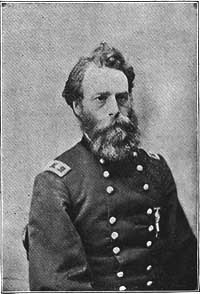
MAJOR-GENERAL J. A. MOWER.
These expressions indicate somewhat the character of the man. About six feet in height, well proportioned and of great muscular strength, probably there was no officer in our picture group who was better fitted in every way for hard campaigning. On one occasion during the march through the Carolinas, as we approached the westernmost branch of the Edisto, all the country had apparently been swept by the inhabitants clean of supplies. The cattle and horses had been driven eastward beyond the river, and all food carried off or hidden. As I approached a house near the river crossing, I saw General Mower and his staff apparently in conversation with the owner, who had, for some purpose, remained behind his fleeing people in his almost empty tenement. Mower was asking him questions: these the man at first evaded, or answered derisively. Then, becoming angry at Mower's persistence, he refused to tell anything. The general, just as I was passing through the gate, said to an orderly, in his deep, strong, decisive voice: "Orderly, fetch a rope!" He did not intimate what he proposed to do with the rope, but one glance at Mower's face was sufficient for the stranger. He immediately became courteous, and gave Mower all the information he desired as to the roads, bridges, and neighboring country. A few days later I was with Mower's division when he fought his way across the main stream near Orangeburgh. His energy in leading his men through swamps, directing them while they were cutting the cypresses, making temporary bridges, wading streams, constructing and carrying the canvas boats, ferrying the river, and appearing with marvellous rapidity upon the enemy's right or left flank on the open fortified bluff of the eastern shore, drew my attention more than ever to Mower's capabilities. I remember when we stood together inside the first captured work, while our men were rushing for the railroad above and below the city, Mower dismounted, and looking at me with his face full of glad triumph, said: "Fait accompli! General, fait accompli!"
At Bentonville, the 20th and 21st of March, 1865, I saw Mower ride into battle. As he approached the firing, the very sound of it gave him a new inspiration; his muscular limbs gripped his horse, and he leaned forward apparently carrying the animal with him into the conflict. He was the only officer I ever saw who manifested such intense joy for battle. At last, having brought his division through the woods and a little beyond the left flank of the Confederate commander (General Johnston), Mower and one or two of his staff dismounted, so as to work himself with his men through a dense thicket where he could not ride. The point sought in Johnston's left rear was just gained by the indomitable Mower, when General Sherman called us off, saying "that there had been fighting enough." Concerning this event, General Sherman, in his "Memoirs," makes a significant remark:
"The next day (21st) it began to rain again, and we remained quiet till about noon, when General Mower, ever rash, broke through the rebel line, on his extreme left flank, and was pushing straight for Bentonville and the bridge across Mill Creek. I ordered him back, to connect with his own corps; and lest the enemy should concentrate on him, ordered the whole rebel line to be engaged with a strong skirmish fire."
MAJOR-GENERAL FRANCIS PRESTON BLAIR, JR.,
whose biography is in every public library, is too well known to require a detail of introduction.
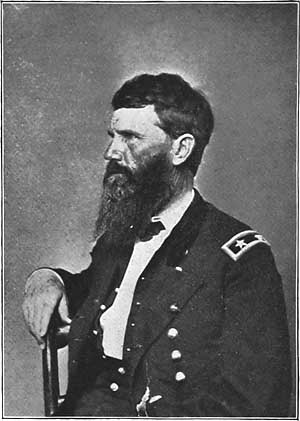
MAJOR-GENERAL FRANCIS P. BLAIR, JR.
As early as 1843 he formed a law partnership with his brother Montgomery, in the city of St. Louis, Mo.; here he worked till his health gave way. Requiring a change of climate, he went to New Mexico. While he was there General Kearney, as soon as the Mexican war came on, began operations which ended in his grand march to the Pacific coast. Young Blair was a volunteer aid, and by his intelligence and energy gave that general the effective help which he needed. This short service in the Mexican war was enough to beget in Blair a taste for military reading and study; so that, being in St. Louis at the fever period of the outbreak of the great rebellion in 1861, he was not unprepared for the double part he was soon called upon to play.
Having been elected and sent to Congress in 1858, previously having had a term in the Missouri Legislature, in both as a "Freesoiler," he threw all his political ability and knowledge upon the side of the Union. As a military man, he promptly acted and greatly helped in organizing and raising troops. Probably it is due to his energy more than to anything else that St. Louis and Missouri were kept to the Union. Mr. Lincoln, who had the greatest confidence in Blair, commissioned him a brigadier-general in August, 1862. He performed thereafter no obscure part in all those battles along the Mississippi, which ended in the capture of Vicksburg. He was rapidly advanced from command of a brigade to that of a division and corps in Grant's Army of the Tennessee. His name and able work are identified with both the Fifteenth and Seventeenth Corps.
The first time I saw General Blair was on November 25, 1863; it was in the evening after Sherman's first hot charge up the rough steeps on the north end of Missionary Ridge. Part of my command had participated in the bloody work of the day, and General Grant had detached the remainder of my corps from General Thomas on the straight front, and sent us around to strengthen Sherman. It was an informal council of war in the woods, by a small campfire, where I met for the first time Generals Tom Ewing, Jefferson C. Davis, and Blair. The latter, who was obliged at times to go to civil duties in Congress, had then, as I was told, just returned from Washington. He brought to us the latest messages from Mr. Lincoln. He had on a light blue soldier's overcoat; it was distinguished by a broad, elegant fur collar. In repose and in photograph, Blair's countenance might pass one as ordinary; but as soon as he spoke it was suffused with light and animation. He was five feet ten, and not fleshy. He walked about the fire, and with his ready talk, never too serious, kept Sherman and all the party, for such a sad night, in fair humor; for our best men had been stopped short of the coveted tunnel, and many of them were driven with heavy losses down the rugged slopes. The whole man so impressed me that night, that I never forgot him. During the march to the sea, in skirmish, campaign, and battle, Blair was often with me; many a day's journey we rode side by side.
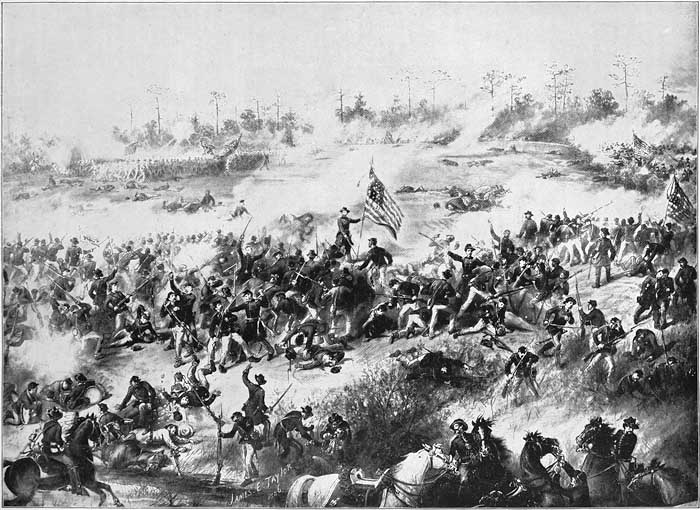
THE BATTLE OF ATLANTA, JULY 22, 1864—FULLER'S DIVISION RALLYING AFTER BEING FORCED BACK BY THE CONFEDERATES.
His mind was replete with knowledge. As we, talking together, recalled the battles of the Revolution in the Carolinas, and often differed in discussing them, Blair would say: "Well, general, let us go to Sherman; he never forgets anything!" I may add that the reference was always the settlement of the question, for Sherman's historic knowledge was unfailing. Blair's forte was the law. I knew fairly well the army regulations; but Blair always went back of the regulations to the statute law and the Constitution. His mind was a compendium—one always at hand for me; and it was pleasant to consult him, for he never took advantage in an ungenerous manner of the superiority of his knowledge, but ever, without abating his most loyal service, gave me the information I desired.
During the great march through Georgia and the Carolinas the necessity of "foraging liberally on the country," of destroying property, as cotton in bales, factories of all kinds, store-houses, and other buildings of a public and private nature, troubled General Blair very much. The conduct of bummers, camp-followers, and of many robbers, who preceded or followed in the wake of the armies in their destruction and depredation of private dwellings, vexed him still more. One day in May, 1865, as we were nearing North Carolina, Blair was riding with me for the day. After a period of silence, he said: "General, I am getting weary of all this business. Can't we do something to bring it to a close? All this terrible waste and destruction and bloodshed appear to me now to be useless." I do not remember my reply, but I do recall a visit I made to General Sherman about that time, when I urged him not to destroy the works at Fayetteville Arsenal, N. C. I said: "General, the war will soon be over; this property is ours [that is, the Government's]. Why should we destroy our own property?" The general replied with some little asperity to the effect: "They [meaning the Confederates] haven't given up yet. They shall not have an arsenal here!" In this matter General Blair's sentiment and mine had agreed.
At another time, noticing that Wheeler's (or Hampton's) cavalry were burning the cotton to prevent its falling into our hands, and that we were burning cotton to cripple the Confederate revenue, General Blair remarked: "Both sides are burning cotton; somebody must be making a mistake!"
These growing sentiments in genuine sympathy with the suffering people of the Carolinas, were Blair's thus early, and account, in a measure, for his subsequent political course; for, as Hammersley says:
"Brave and gallant soldier as he was, and uncompromisingly hostile as he was to the enemies of his country, when the war was over, and the Southern army had laid down their arms, he at once arrayed himself against those who were in favor of continuing to treat Southern people as enemies, and with voice and pen constantly urged the adoption of a liberal and humane policy. From this time he united with the Democratic party."
Blair died in July, 1875. He was of a jovial turn and convivial, but I think he enjoyed the relief of fun and frolic more than the pleasures which attend high living. Like his father and his brother, he was a man of marked ability; he had great acquirements; he was a determined enemy, but an unswerving and generous friend. In political life his course seemed to lack consistency; but when judged from an unpartisan bias, his was, we may be sure, the outward manifestation of a persistent, patriotic spirit.
MAJOR-GENERAL JOHN A. LOGAN.
A young man received a musket-shot wound through both thighs; he repaired to the doctor to have his wound dressed, and asked if he could have it dressed at once, so that he might return to the fight. The surgeon told him he was in no condition to admit of his return, but should go to the hospital. The youth remarked that he had fired twenty-two rounds after he was wounded, and thought he could fire as many more if his wound were dressed. Finding it impossible to detain him, the doctor dressed the wound, and the young man returned to his comrades in the struggle, dealing out his ammunition to good account until the day was over, as if nothing had happened to him.
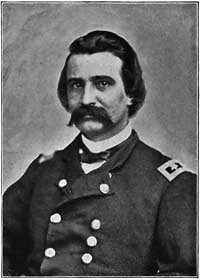
MAJOR-GENERAL JOHN A. LOGAN.
This brave young man afterwards became Gen. John A. Logan. He had such a striking face that, once seen, it was never forgotten. There was the straight and raven hair, that, thrown back from his forehead, was long enough to cover his ears, and make vertical lines just behind his eyes. There were the broad brow, the firm round chin, and strong neck. There was the broad, well-cut mouth, always crowned by a dark, heavy mustache. But the features first seen, and never forgotten, were those black eyes with brows and lashes to match. At times those eyes were gentle, pleasant, winning; at times they were cold and indifferent; but at the least excitement they would quicken, and under provocation flash fire. Logan's whole figure, not above five feet nine, was closely knit. His true portrait is everywhere caught by the photographer, the caricaturist, the painter; but we seldom meet with a portraiture of the man that animated that splendid tenement. Abbott compares him with McPherson and contrasts him with Hood. He says: "When Logan was McPherson's successor on the field of Atlanta, rivalling his predecessor in bravery, patriotism, and military ability." ... When speaking of him and Hood, he says: "General Logan was by no means his inferior in impetuous daring, and far his superior in all those intellectual qualities of circumspection, coolness, and judgment requisite to constitute a general."
I hardly think that one who knew both would speak just that way of Hood and Logan. The fact is, the two men were very much alike. Both were impetuous, both brave, and both able generals. Hood was put into the place of General Johnston by Davis with orders to fight desperately; had Logan been sent to Nashville to relieve General Thomas when it was contemplated, he would have done precisely as did Hood—he would have fought, and at once. He might have been defeated—as Thomas was not. Before Sherman threw his forces upon Hood's communications, Logan was greatly depressed concerning the proposed plan. "How can it succeed?" he asked. But when the first battle came on, all his pluck, forethought, energy, Samson-like, came to him. Permit me to repeat my words at the time concerning him, just after that action:
"I wish to express my high gratification with the conduct of the troops engaged. I never saw better conduct in battle. General Logan, though ill and much worn out, was indefatigable, and the success of the day is as much attributable to him as to any one man...."
As I now estimate General Logan, I think him like Napoleon's Marshal Murat. He was made for battle; the fiercer, the better it seemed to suit his temper; but the study of campaigns and military strategy was not his forte. His personal presence was not only striking, but almost resistless. The power of love and hate belonged to his nature. If a friend, like Andrew Jackson, he was a friend indeed; but if an enemy, it was not comfortable to withstand him. Logan had a good loyal heart; he sincerely loved his country and her institutions. He is justly enrolled as a hero and patriot.
MAJOR-GENERAL HENRY WARNER SLOCUM.
In the very beginning of Slocum's career, one characteristic becomes noticeable from his earliest childhood—he always had a wholesome object in view; so that, when he attained one elevation, he fixed his eye steadily upon another still higher, and bent his energies to attain it.
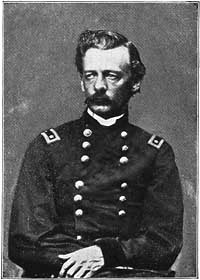
MAJOR-GENERAL HENRY WARNER SLOCUM.
Early in life he cherished a desire for a cadetship at West Point; this desire was gratified in 1848. Sheridan speaks in his "Memoirs" of his (Slocum's) studious habits and willingness to aid others. I was myself at the academy and remember his strong character when the pro-slavery sentiment at West Point was so great as to lessen the popularity of any one even suspected of entertaining abolition views. He fearlessly and openly expressed himself as an opponent to human slavery.
General Slocum graduated high in his class; saw service in the Seminole wars in Florida, and remained stationed in the South until 1857, when, having studied law, he resigned to practise his profession in Syracuse, N. Y., being a representative at Albany in 1859, and instructor of militia from 1859 to 1861. When Fort Sumter fell he tendered his services, and was given the command of the Twenty-seventh New York Volunteers, which he led in a charge at Bull Run, where he was severely wounded. In August, 1861, he was made brigadier-general of volunteers, and took a brigade in General Franklin's division. When Franklin passed to the command of a corps, Slocum took the division. His work was noticeable on the Peninsula, at Yorktown, West Point, Gaines's Mill, Glendale, and Malvern Hill, and on each occasion he received the praise of his commanders. At South Mountain his division drove the enemy from its position with such a rush as to prevent any chance of rallying, which act brought him still more commendation. It was Slocum who led the advance of Franklin's corps to the field of Antietam, and enabled us to recover and hold much ground that had been taken from us in the first struggle.
By October of 1862 Slocum's manifest ability had given him the Twelfth Corps, with which his name is so closely identified. In the Chancellorsville campaign it was Slocum who made the march around Lee's left, and showed himself the "cool, self-poised, and prompt commander that he had always been, and which made him distinguished even in the brilliant group of generals of which he was a member." It would require the whole history of Gettysburg to fairly portray Slocum's part there. The most impressive incident of that battle to me was Slocum's own battle on the 3d day of July, 1863. For five anxious hours Slocum commanded the field to our right; that dreadful struggle went on until Ewell with Early's and Edward Johnson's large divisions was forced to give up and abandon his prize of the night before. Slocum's resolute insistence, on the 2d, upon leaving Greene and his brigade as a precaution when General Meade ordered the Twelfth Corps to be sent to his (Meade's) left, with Greene's marvellous night battle, and more still, Slocum's organized work and engagement of the following morning, in my judgment prevented Meade losing the battle of Gettysburg.
The disaster at Chickamauga took Slocum's corps from the Rappahannock to Tennessee. Soon after his arrival he was sent to command the district of Vicksburg, where his work consisted of expeditions to break up bridges and railroads and to repel rebel raids. When the death of General McPherson, Slocum's department commander, at Atlanta, caused so many changes, Slocum was brought to that city to command the Twelfth Corps. When, a little later, we swung off on Hood's communications, Slocum being located south of the Atlanta crossing of the Chattahoochee River, it was his quick perception that recognized the significance of the final explosions, and it was he who pushed forward over the intervening six miles and took possession of that citadel of Georgia; and it was his despatch to his watchful commander, thirty miles away, that inspired that brief proclamation, "Atlanta is ours, and fairly won!"
In the march to the sea and through the Carolinas, General Sherman had given to Slocum the left wing, the Army of Georgia. He crossed the Savannah River when the high waters made it most difficult, pushing and fighting through the swamps of the Carolinas. He fought the battle of Averysboro, and later took a leading part at Bentonville, where Johnston, the toughest Confederate of them all, surrendered, and we turned our faces homeward.
At the close of the war General Slocum resigned from the army and engaged in civil pursuits, adding to his magnificent military reputation a civil repute for ability, honesty, and probity in business as well as in political affairs.
GENERAL WILLIAM TECUMSEH SHERMAN.
With regard to the central figure of this group, General Sherman himself, libraries are so full of his characteristic work and worth that I will simply add to the above sketches a few items. Those have been chosen which are the more personal. It is said that when his father gave him the name of the great Indian chief, Tecumseh, he remarked: "Who knows but this child may be a fighter?" It is indeed remarkable how often names are prophetic. A fighter he was, but one thoroughly equipped with that most valuable weapon to a general, namely, such knowledge of history as to make him an authority to all of us. Any disputed point we carried to him; we relied upon his being able to set us right. Indeed, one of his most marked characteristics was his quick perception and exceedingly retentive memory. This he evidenced in many ways; years after he ascended the Indian River in Florida he remembered with minute distinctness what he saw, from the shape of the inlet to the roosting pelicans along the mangrove islands. Talking with him before the battle of Kenesaw Mountain, I found him so conversant with the Chattahoochee Valley and the roads to and from Marietta, and all the features of that region, that I was astonished, and asked him where he had gotten such valuable information. He said he had gained it twenty years before, when travelling through the country as a member of a board of officers detailed to appraise horses lost in the Florida war. During his service in the South before the war he travelled much, and appears to have remembered ever after, with wonderful distinctness, the features of the country.
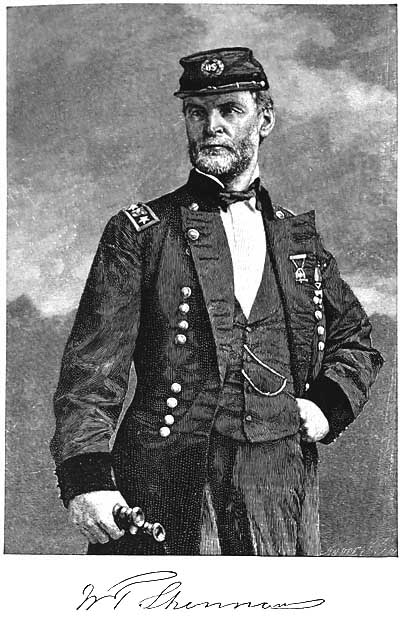
Sherman was, above all, pure in his patriotism and free from thought of self. When, from his position at the Military Seminary in Louisiana, he saw the conflict coming, he wrote: "I accepted this position when the motto of the seminary, inserted in marble over the main door, was, 'By the liberality of the General Government of the United States.'—'The Union'—'Este perpetua.' ... If Louisiana withdraws from the Federal Union, I prefer to maintain my allegiance to the old Constitution as long as a fragment of it survives;" adding, "for on no account will I do any act or think any thought hostile to or in defiance of the old government of the United States." When his clear perception of the magnitude of the struggle before us made him declare to Secretary Cameron that it "was nonsense to carry on a picayune war; that sixty thousand men were needed for immediate work to clear Kentucky and Tennessee; and two hundred thousand men to finish the war in that quarter;" and when the supposed extravagance of his demands led to the suspicion that his mind was unbalanced, thus placing him under a cloud, no selfish thought seems to have occurred to him. Instead of dwelling upon the injustice done him, he devoted all his knowledge, his wonderful energy and skill, to aiding General Grant; and, further, while under this cloud he gathered and sent forward to Grant much-needed supplies and men. He put order among quartermasters and commissaries anew, equipped new commands, and pushed them, never thinking of himself, to the front. This energy and generosity General Grant promptly acknowledged; and it was here, after the battle of Fort Donelson, that the celebrated Army of the Tennessee was born.
General Sherman's organizing powers have been tested by results. Doubtless his brilliant genius gave more or less inspiration to his subordinates, and his magnetic influence lifted up to prominence some very common men; yet, no proof-sustaining bridge can be condemned! He generously gave both confidence and scope to his officers, just as Grant had given confidence and scope to him; and such sunshine develops men and makes them strong. His memory was phenomenal; he had acquired knowledge with intense rapidity, from observation and from books, from childhood to age; and by a thousand tests he showed that he had forgotten nothing that he had once learned. Who could estimate the number of officers and men he knew at the close of the war? And at the time of his death thousands claimed his personal recognition.
He led his quartermasters in their plans and estimates for his army; he was quicker than his chief commissary in figuring the rations for a month's supply; he was equal to the great engineering general in everything that pertains to the construction of railroads and the running of trains; he was more than a match for his Confederate adversaries in field correspondence with them at Atlanta—a correspondence rapid and pungent, which involved laws of war and of nations.
When the Hon. Thomas Ewing, in kindness to General Sherman's family, offered to adopt a child, his choice fell upon Tecumseh. Mr. Ewing's testimony, after a little experience with him as a member of his family, is, "That he was a lad remarkable for accuracy of memory and straightforwardness."
When truthfulness is the corner-stone of a character—all things being equal—we have reason to anticipate a strong superstructure. How this was realized in Sherman, the world knows.
Loyalty to family, loyalty to friends, loyalty to society about him, loyalty to duty and country, he quickly observed in another. And this loyalty was a marked characteristic of his own great soul.
OLIVER OTIS HOWARD, Major-General U. S. Army.
GOVERNOR'S ISLAND, N. Y., July 6, 1894.
PRISONS AND ESCAPES.
BY GEORGE L. KILMER.
ESCAPE OF THREE WAR CORRESPONDENTS FROM SALISBURY PRISON—SEVENTY PRISONERS ESCAPED, BUT ONLY FIVE REACHED THE NORTH—LONG AND PERILOUS JOURNEY THROUGH THE ENEMY'S COUNTRY—"OUT OF THE JAWS OF DEATH, OUT OF THE MOUTH OF HELL"—A LEAP FOR LIBERTY—FOUR UNION PRISONERS ESCAPED NEAR CHARLESTON, S. C.—JOURNEY THROUGH SWAMPS AND OVER MOUNTAINS TO TENNESSEE—ESCAPES FROM ANDERSONVILLE—TUNNELLING UNDER THE STOCKADE—REMARKABLE ESCAPE OF THE CONFEDERATE GENERAL MORGAN—COLONEL ROSE'S TUNNEL AT LIBBY PRISON.
Albert D. Richardson and Junius Henri Browne, war correspondents of the New York Tribune, were taken prisoners from a Union vessel that attempted to pass the Confederate batteries at Grand Gulf, Miss. After passing some time in Castle Thunder and Libby Prison, Richmond, they were sent to Salisbury, N. C., as a punishment for endeavoring to escape, and while there, W. T. Davies of the Cincinnati Gazette united his fortunes with the Tribune men.
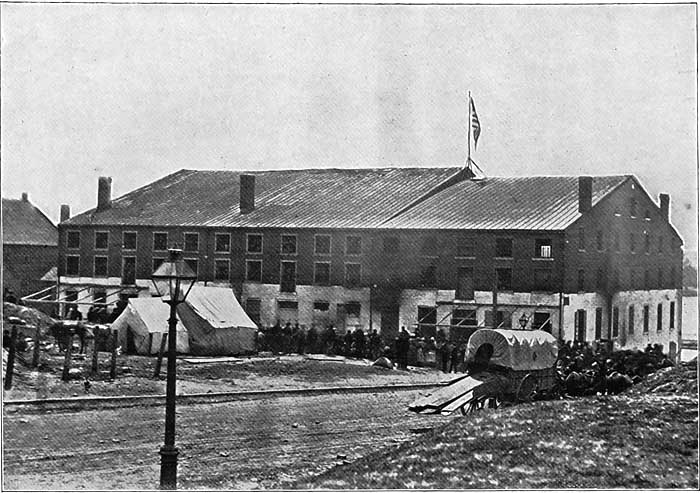
LIBBY PRISON, RICHMOND, VA. (From a war-time photograph.)
Again and again plans to obtain their freedom were frustrated by some trifle, until desperation spurred them to the most daring attempts, but these also ended in failure. One day a body of prisoners, led by Robert E. Boulger of the Twenty-fourth Michigan, rushed upon a guard relief, seized their muskets, and attacked the sentinels on their posts. In their haste, all rushed to one point and attempted to pass the fence; but a couple of field-pieces and the muskets of the reserve guard turned upon that one point, quelled the insurrection in three minutes, killing and wounding one hundred men. A scheme of tunnelling was then proposed and pushed far toward success, but the prison commandant took alarm and posted a second line of guards, one hundred feet outside the stockade, and that rendered egress by tunnels out of the question. After spending ten months in the Salisbury prison, Richardson and his two companions determined to take heavy risks in order to get out and make their way to the mountains of East Tennessee. The outlook, according to the statistics of escapes during their experiences in that prison, was not at all promising, for out of seventy prisoners that had passed the guard, but five had reached the North. The others had been retaken or had been shot in the mountains. By extraordinary good luck the trio passed the guards on the night of December 17, 1864. All three were on duty at the time in the hospital, and Davies and Browne held passes permitting them to go outside the first line of sentinels to a Confederate dispensary for supplies. This privilege had been enjoyed so long that they were allowed to go on sight. The night of the escape, Browne loaned his pass to Richardson, and with Davies walked coolly out to the dispensary. Richardson describes his exit as follows:
"A few minutes later, taking a box filled with the bottles in which the medicines were usually brought, and giving it to a lad who assisted me in my hospital duties, I started to follow them. As if in great haste, we walked rapidly toward the fence. When we reached the gate, I took the box from the boy and said to him, for the benefit of the sentinel, of course: 'I am going outside to get these bottles filled. I shall be back in fifteen minutes, and want you to remain right here to take and distribute them among the hospitals. Do not go away.' The lad, understanding me perfectly, replied, 'Yes, sir,' and I attempted to pass the sentinel by mere assurance. He stopped me with his musket, demanding:
"'Have you a pass, sir?'
"'Certainly I have a pass,' I replied with all the indignation I could assume. 'Have you not seen it often enough to know it by this time?'
"Apparently a little dumbfounded, he modestly replied: 'Perhaps I have; but they are strict with us, and I am not quite sure.'"
The sentinel examined the document which was all right in Browne's hands, but all wrong in Richardson's. But he did not know the difference, and told Richardson to pass on. Once outside he met several Confederate officials who knew him, and knew too that he was out of his place, but the "peculiarly honest and business-like look of that medicine box" threw them off their guard. Instead of entering the dispensary, Richardson hid his box and slipped under a convenient shelter. At dark his friends joined him, and the three passed the outer guard without difficulty. For the Tribune men this was the end of twenty months of captivity. The first night and day were passed in the barn of a friendly citizen within one mile of the prison. The second night, a Confederate lieutenant belonging to the Sons of America, an order of Southerners who secretly aided the Union, met them and gave them full directions how and where to reach friends on their journey. Then they set out on their long winter tramp, poorly clad, and weak from long confinement.
The main guide of the refugees was a railroad running west, but they were often obliged to leave the line to avoid crowded settlements, and were frequently lost in making those detours. In such emergencies they relied upon chance friends among the slaves to direct them aright.
On the morning of the seventh day of their escape, they found that they had made fifty miles of their direct journey. December 30th they crossed the Yadkin River, now getting into a region where Union homes were plenty. Communications had to be opened with women, as the men were "lying out" in order to avoid impressment by the hated Confederacy; and, after allaying all suspicion, our refugees found these people of great service.
"The men of the community were walking arsenals. Each had a trusty rifle, one or two navy revolvers, a great bowie-knife, a haversack, and a canteen."
Guided and fed by the friends they found here, the three reached Tennessee early in January; but their perils were not yet over, for the mountains were constantly patrolled by Confederate guerillas. Once they had to pass within a quarter of a mile of a notorious rendezvous, called Little Richmond. An invalid arose from his bed and guided them past the danger at the risk of his life. On another occasion their guide, the celebrated Dan Ellis, aroused the party from sleep with the startling announcement: "We have walked right into a nest of rebels. Several hundred are within a few miles, and eighty in this immediate vicinity!"
They scattered in various directions, Richardson and his party—for others had joined them—being led by a young woman who often performed this service, though her name, Melvina Stephens, was never revealed until the war had closed.
On the 14th of January, 1865, the Tribune printed this despatch from its long-lost correspondent:
"KNOXVILLE, TENN., January 13, 1865.
"Out of the jaws of death; out of the mouth of hell.
"ALBERT D. RICHARDSON."
He had travelled three hundred and forty miles since leaving the prison, twenty-seven days before.
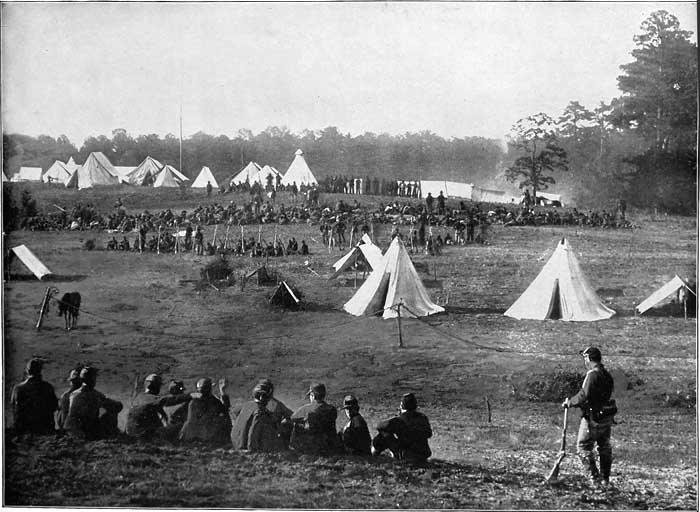
GUARDING CONFEDERATE PRISONERS. (From a War Department photograph.)
Of the thousands of prisoners held by either side during the four years of the war, those who escaped and succeeded in reaching their own lines were exceedingly few, although the attempts at escape were numerous, and a good many got away from the prisons only to be brought back captives again in a few days. The most notable adventure of this kind was an escape from Libby Prison by a hundred and eight officers in February, 1864. In that crowded prison, which was an old tobacco warehouse, the prisoners had little to do but play checkers on squares of the floor marked out with their pocket knives, play cards, tell stories, and devise plans for escape. One of them discovered a way of getting into the basement, and, by removing stones, making a hole through the eastern foundation wall. With a few assistants he then proceeded to dig a tunnel across the breadth of the yard. The earth that was taken out was dumped in a dark corner of the cellar where it never attracted attention. The work had to be carried on very secretly, not only to escape the notice of the guards, but even to prevent the knowledge of it from reaching any prisoner who might not be trustworthy. When the tunnel was about ten yards long a slight opening was made to the surface of the ground for light and ventilation; and an old shoe thrown out at this opening in the night, and resting near it upon the surface, enabled the tunnellers, looking from the windows of the prison in the daytime, to get their bearings and determine how much farther they must dig in order to pass under the fence. When all was done the night of February 9th was fixed for the escape. One of the officers who passed through the tunnel says of himself and two companions: "Each man had an entire suit of clothes, a double suit of underclothes, the pair of boots in which he stood on entering the prison, an overcoat, and a cap. In common we possessed a coil of rope, a diminutive hatchet, one pint of brandy, a half pint of extract of Jamaica ginger, two days' scant rations of dried meat and hard bread, one pipe, and a bit of tobacco. The tunnel was about fifty-three feet long, and so small in diameter that in order to pass through it was necessary to lie flat on one's face, propelling with one hand and the feet, the other hand being thrown over the back to diminish the breadth of the shoulders and carry overcoat, rations, etc. Early in the evening, as I was seated at the card table, Randolph tapped me on the shoulder. 'The work is finished,' he said. 'The first party went through soon after dark; there is no time to lose.' Every one knew it then. We possessed only the advantage of being perfectly cool and having a plan agreed upon. The excitement in the prison was of the wildest kind. Parties were formed, plans arranged, farewells exchanged, all in less time than one can describe. We dropped one by one into the cellar. I remember well the instructions: 'Feet first; back to the wall; get down on your knees; make a half face to the right, and grasp the spike in the wall below with your right hand; lower yourself down; feel for the knotted rope below with your legs.' Then one had but to drop in the loose straw shaken from hospital beds to be in the cellar. To walk across that foul pit in the dark was no easy matter; but it was soon accomplished, and together we crouched at the entrance of the tunnel. Only one at a time; and as about three minutes were consumed in effecting the passage, progress was quite slow. Of our party Randolph was the first to enter. 'I'm going. Wait till I get through before you start.' It seemed that his long legs would never disappear; but a parting kick in the face, as he wriggled desperately in, quite reassured me. When a cool blast of air drawing through the tunnel gave the welcome assurance that the passage was clear, in I went. So well did the garment of earth fit, that at moments my movements corresponded somewhat to those of a bolt forcing its way through a rifled gun. Breath failed when I was about two-thirds through, but a score or more of vigorous kicks brought me to the earth's surface where Randolph awaited my coming. With sundry whispered instructions about getting out without making undue noise and without breaking my skull against the bottom of a board fence, he then crept away toward the street, keeping in the shadow of a high brick wall, leaving me to assist in turn and instruct the colonel, who could now be heard thundering through the tunnel. Dirty but jubilant, we were soon standing in the shadow of a low brick arch, outside of which a sentinel paced backward and forward, coming sometimes within two yards of our position. One after another stole out of the archway, and we met, as agreed, at the corner of the second street below. Arm in arm, whistling and singing, we turned and struck out, strong and hopeful, for home and liberty." The one hundred and eight men who escaped through this tunnel followed different plans and routes for getting within the National lines, but the greater part of them were recaptured. The party of which the officer just quoted was one, after twelve days of journeying through swamps and by-ways, fed and guided by the friendly negroes, at length reached the National lines on the Pamunkey.
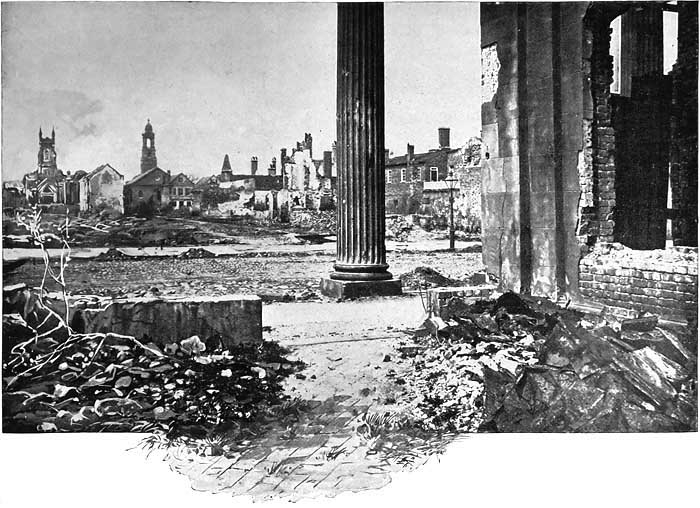
RUINS OF CHARLESTON, S. C.
A LEAP FOR LIBERTY1
1 Rewritten (by permission) from Captain Drake's narrative as printed in the private history of the Ninth New Jersey Volunteers.
On the morning of October 6, 1864, a party of six hundred captive Union officers were put on board of a train of box-cars to be transported from the jail yard at Charleston to prison quarters at Columbia. Among the number was Capt. J. Madison Drake, of the Ninth New Jersey volunteers, who had been a prisoner of war five months and an inmate during that time of three different prisons—Libby, Macon, Ga., and Charleston. Although he had been foiled in many attempts to escape, he resolved on one more effort, and, having received warning of the trip to Columbia, induced three fellow-prisoners to join him: Capt. H. H. Todd, Eighth New Jersey; Capt. J. E. Lewis, Eleventh Connecticut; and Capt. Alfred Grant, Nineteenth Wisconsin. While the train was crawling slowly on toward Columbia, the bold projector of the scheme managed to remove the gun-caps from the nipples of the muskets of several guards on the car where the four friends were; and as soon as dusk came on, the party at a signal took their daring leap. They landed in a cypress swamp on Congaree River, and found themselves waist deep in water and mud. A volley of shots from all the guards followed the fugitives, but no one was hurt, as the train was running under good headway. A night and a day were passed in the swamp, and although the barking of dogs and shouting of men indicated that pursuers had been sent out, the runaways were not disturbed. The second night a bright new moon arose, and they started on a systematic journey toward the Union lines in Tennessee.
Before leaving Charleston, one of the party had found a school map of South Carolina, and with this guide a course had been studied out. They decided to hug the swamps and woods by day, and at night use the fields and roads, and spend as little time as possible in sleep until the mountains of North Carolina were reached. Their chief guide-mark in South Carolina was the Wateree River.
At the end of a week their rations had all been consumed, and in desperation the wanderers began to think of food to the exclusion of all else. Captain Drake says that in these times they heartily yearned for the government "hard tack" and the contractor's beef they had so often anathematized on the march and in camp.
But fortune will favor the bold, and one night, as they halted on a roadside to debate whether it should be a quest for bread or for a road to liberty, a dark form came shambling along the road, and in the moonlight they saw at a distance that it was an old negro with a basket on his arm. Without ceremony the famished men crowded around the old man, and finding that he had in his basket a "pone" of corn-bread, they seized it and began to devour it ravenously. After a time the situation was explained, and when the negro learned who the highwaymen were, he supplied a quantity of meal and salt, and sent them on their way mentally resolved to cultivate acquaintance with colored folks as often as possible.
Not until several hundred miles had been placed between their fainting feet and Charleston did the hapless fugitives feel a sense of freedom. Often their fears and alarms were causeless, but they suffered loss of vitality all the same. Sometimes seeming misfortunes proved to be blessings. One night a pack of dogs chased them into a crowded village, and they took refuge in a graveyard vault. There Captain Drake found a copy of a local newspaper, warning the people to be on guard for escaped Union prisoners. The escaped prisoners themselves got the benefit of the hint. At another time some Confederate cavalrymen chased them on the high-road, and they escaped by getting into a dense wood, where the horses couldn't follow. While wandering about, they fell in with a loyal mountaineer, who took them to his home, fed them, and directed them to other Unionists.
Many of the men met with in the mountains were of the class known as "lyers out," deserters from the Confederate army, and fugitive conscripts. A hundred or more of these men were persuaded to join Drake's party on their tramp toward the Union lines. Thus reinforced with guides and armed companions, the prospects of the runaway prisoners began to brighten. But they were not out of the woods by a long way, as the sequel proved.
When the fugitives drew near the Union lines the danger of capture increased, for a cordon of mountain rangers patrolled the region to head off any fortunate ones who got thus far on the journey homeward. The mountains were simply barren wastes, the few cabins had to be shunned, and the only food to be obtained was wild game which the rifles of the "lyers out" brought down. In the uplands the poor fellows were hounded by "rangers," and in the valleys mounted Confederates dashed about on all sides.
At length the party reached the vicinity of Bull's Gap, a railway pass through the mountains, and guarded by Union troops as an outpost of Knoxville. The chief scout announced that the gap was fifteen miles from the foot of the hill whence it was first sighted, and that, once reached, the refugees would be safe. The news stimulated the men anew, and they started down the mountain with their eyes riveted on the gap, for fear, as Drake says, it would take wings and flee. Alas! alas! The unexpected happens in war if nowhere else.
The gap didn't exactly take wings and flee, but the ubiquitous General Breckenridge, with an army at his back, fell like a thunderbolt upon the Union garrison at the pass, defeated and routed the entire force and hurled them backward at mounted double-quick pace toward Knoxville; and, presto! the gap was closed in the very faces of the yearning-eyed, broken-bodied pilgrims. Think of it—at the end of those terrible weeks of endurance and suffering, to find a hostile army springing across the path at a bound, and its scouts and patrols beating every byway and bush in the region for the luckless strays of the fleeing enemy!
A young woman of the mountains volunteered to scout toward the gap and bring news to the refugee camp. She simply learned that Breckenridge was sweeping the country of Union troops and marching upon Knoxville.
At the same time it was discovered that a band of Confederate partisans were on the trail of the fugitives, and to escape this new danger they found comparative shelter in a ravine. Two of the men who had leaped from the car with Drake, Captains Todd and Grant, ventured out to obtain rations, which were sadly needed, as they were all living on dry corn. During the night mounted men attacked the bivouac, and the refugees scattered, every man for himself. At the end of a week they fell in with a cavalry patrol, and were once more, after forty-nine days' wandering, under the protection of the Stars and Stripes.
ATTEMPTS AT ESCAPE FROM ANDERSONVILLE.
Escapes from Andersonville, except through the portals of death—that is, complete escape to the Union lines—were exceedingly rare. Hundreds, through one device or another, succeeded in getting outside of the stockade, but the prison was so strongly surrounded with guards and forts and quarters occupied with zealous attendants, that it was difficult for a prisoner to elude the detective on the outside even when he had succeeded in passing the main barrier. Adding to this the existence of the deep swamps and vast forests just beyond the camp precincts, in which a stranger to the locality would be only too sure to lose his way, it will be seen that to enter Andersonville was indeed to leave "all hope behind." The favorite method of attempting escape was by tunnelling, for the great extent of the camp area, some twenty-five acres, and its crowded condition, made the work of excavation, without danger of discovery by the guards and keepers, comparatively easy. Another favorable circumstance was the fact that prisoners were allowed to dig wells to supply drinking water, and the grounds were everywhere dotted with piles of fresh earth that had been thrown up in consequence.
In order to excavate a tunnel, the prisoners contemplating escape would commence a lateral shaft a few feet below the mouth of one of these wells, located near the stockade; and as the work was done at night, the earth thus removed was carried in small quantities and deposited on the piles of fresh earth thrown out from the newly sunken wells. The tools used were of the rudest kind—tin plates, cups, and knives with which to loosen the earth, and bare hands to scoop it into the haversacks, or bags improvised from clothes and pieces of blanket; and in this manner these tunnels were frequently extended, not only beyond the stockade, but even beyond the outer line of prison guards. Yet, although hundreds passed out—as many as one hundred escaped through one tunnel in a single night, late in 1864—they were invariably brought back; sometimes through the treachery of spies, who mingled with the prisoners, and at other times by hunters with their dogs, who were constantly patrolling the vicinity of the camp, and, in fact, the entire region, in search of deserters from the Confederate army and runaway slaves, as well as fugitive prisoners. Not one well-authenticated case of a prisoner getting out through a tunnel, and making his way North, is to be found on record.
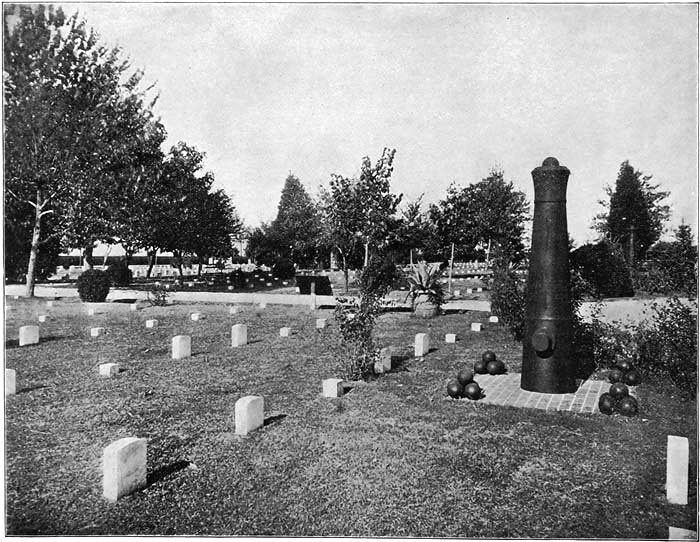
NATIONAL CEMETARY, RICHMOND, VA.
Another method of escape from the enclosure was by strolling beyond the sight of the guards when allowed to go out to the forests for wood; some, again, tried hiding in the huge boxes used for bringing prisoners into the camp, and many were missed from their quarters who had succeeded for the time being in misleading their guards, but eventually the fugitives turned up elsewhere; while such as enlisted in the Confederate army, this being their last hope of escape, soon reappeared, either as willing prisoners or deserters.
One tunnel, which had been carried under and beyond the stockade, was broken into by a severe flood, and the stockade undermined, which opened the celebrated "providential spring."
In August, 1864, when prisoners were dying from the use of unwholesome drinking water, a heavy thunder storm flooded the little brook that, running through the enclosure, passed in and out under the stockade. The rushing element not only broke in the roof of the tunnel, but loosened a quantity of earth which, since the construction of the stockade, had dammed up a copious stream of clear, fresh water, its original course passing right through the prison quarters. Some attributed the reopening to the action of lightning, while others looked upon it as a direct interposition of Heaven for their relief. But, whatever the cause, it supplied the prisoners with an abundance of good water through the remainder of their stay, and is still in existence.
MORGAN'S ESCAPE.
The account of the capture and escape of General Morgan as here given is condensed from an article by Samuel B. Taylor, originally published in the Cincinnati Tribune.
In the summer of 1863, General Morgan's command made, through Southern Ohio, one of those raids which were the most daring and successful in the history of modern and ancient warfare. In that instance he did not meet with his usual great success, for his raid terminated, in July of that year, with the capture of himself and sixty-eight of his officers and men. By order of General Burnside, he and a number of his officers were confined in the Ohio Penitentiary, at Columbus.
"We were each placed in a separate cell, in the first and second range or tier of cells on the south side of the east wing of the prison. These cells were let into a solid block of masonry, one hundred and sixty feet long and twenty-five feet thick. They opened into a hall twelve feet wide and one hundred and sixty feet in length. Then, as now, the prison buildings and their yard were enclosed by a solid stone wall thirty feet high and four feet in thickness, and level on top.
"We at length became so desperate from confinement that we determined to escape, no matter at what hazard. But how was escape to be effected?
"From five o'clock P.M. till seven A.M. we were locked in our cells, with no means of communication. Through the day we were allowed to roam about the large hall on to which our cells opened and to converse freely with each other, though there was an armed sentry at either end of this hall, through which the regular keepers of the prison passed at frequent and regular intervals. We discussed every possible and impossible plan of escape, as we thought, but could hit upon none that seemed feasible.
"We had been some three months in durance vile, when, in consequence of an insult that was offered to one of our number, Capt. Thomas A. Hines, by the deputy warden, a plan was evolved by which we did finally succeed in making our escape. Captain Hines retired to his cell about eight o'clock A.M., vowing that food should not pass his lips and that sleep should not rest upon his eyelids until he had thought out some plan of escape that should be practicable.
"About a quarter to twelve o'clock he came to me and said that he had hit upon a plan which he thought would do. At all events he was determined to try it. He then informed me that he had noticed that the walls of his cell, instead of being damp, as they naturally would have been from the fact that they were built upon a level with the ground outside, were perfectly dry. From this he concluded that there must be an air chamber beneath. Now, if such should be the case, Captain Hines's plan was to run a tunnel from it through the foundation into the yard, and then to escape over the prison wall.
"The cells were built in five tiers. Some of our party occupied the lowest or ground tier, while others, including General Morgan himself, occupied the second tier. Of course only those in the ground tier could escape by means of Captain Hines's plan, and in order for General Morgan to do so it would be necessary to have him exchange cells with some one in the tier below. The plan of Captain Hines was communicated to General Morgan and the other officers that afternoon, and after being fully discussed, it was decided that not more than seven of those on the lower tier could escape, because the greater the number the greater would be the danger of discovery. We arranged to have the work begin in the cell of Captain Hines, and in order to prevent the usual daily inspection being made of it, he asked permission to thereafter sweep it himself. The permission was granted, and he kept it so scrupulously clean that after a few mornings no inspection was made of it. Work was therefore begun in his cell on the morning of November 4th. With two small table-knives, obtained from sick comrades in the hospital, Captain Hines cut through six inches of cement, removed six layers of brick, concealing them in his bed tick, and came to an air chamber six feet in height. The work was carried on under his cot.
"Having progressed thus far, Captain Hines now mounted guard at the door of his cell, while the work was carried on by the rest of us. He pretended to be deeply engrossed in study, but in reality he was watching every movement of the guards and keepers. If one approached, he gave us warning by a system of taps on the floor. One tap meant to stop work, two to proceed, and three to come out.
"We cut a tunnel at right angles from the air chamber through the foundation wall of the cell block five feet, through twelve feet of grouting to the outer wall of the east wing of the prison, then through this wall six feet in thickness, and then four feet up near the surface of the yard in an unfrequented place. Our tunnel completed, it only remained to make an entrance from the cell of each man who was to escape into the air chamber. This could only be done by working from the air chamber upward.
"To do this we must have something to measure with in order to locate the spots at which to make these holes. We secured a measuring line by involving the warden in a dispute about the length of the hall, Captain Hines abstracting it long enough, after the hall had been measured, to answer our purpose. The chamber being very dark, we obtained matches and candles from our sick comrades in the hospital.
"It was very essential to our purpose that we should have an accurate knowledge of the prison yard and the wall inclosing it, but the windows of the hall were too high to afford us a view. Fortunately the warden ordered the walls and ceiling of the hall to be swept, and a long ladder being brought for that purpose, I offered the warden a wager that I could go hand over hand to its top, rest for a moment, and then descend in the same way. He took me up, and having been famous all my life for feats of strength and agility, I readily won the bet. While resting at the top of the ladder I made a thorough survey of the yard. There was a double gate to the outer wall south of the wing in which we then were and almost at right angles from its eastern end. Of this double gate, the outer portal was solid as the wall itself, while the inner was of wooden uprights four inches apart. By means of this latter gate we might ascend to the top of the prison wall. For that purpose we made a rope of our bed ticking, and fastened it to a grappling iron made out of the poker of the hall stove.
"All our money had been taken by our captors, but we obtained a fresh supply from friends in the South, secreted in the cover of an old book sent through the mail. An old convict, who was often sent into the city on errands by the warden, procured us a newspaper, from which we learned that a train left for Cincinnati—whither we were bound—at 1.15 o'clock A.M. At midnight the guards made a round of the cells, and we determined to start at that hour. I was to descend into the air chamber and notify the others by a tap under the floor of each cell.
"The evening of November 27th being dark and cloudy, we determined to try our luck that night. When we were locked up for the night, General Morgan contrived to change places with his brother, who occupied one of the lower cells, and who greatly resembled him in face and form. Every man arranged the stool, with which each cell was supplied, in his bed to look like a sleeping man when the guard should thrust his lantern through the cell door a few minutes later.
"I had General Morgan's gold watch, and punctually at midnight I broke with my boot-heel the thin layer of cement which separated my cell from the air chamber, and passing along the latter gave a tap under the floor of each of the others, who soon joined me. We crawled through our tunnel, and, breaking the thin layer of earth which separated its end from the surface, we were soon in the prison yard. Over the wooden gate, which I had seen from the ladder, we threw our grappling iron, and by its bed-ticking rope drew ourselves up till we stood on the wing wall, whence we readily passed to the outside wall in full view of freedom.
"The top of the latter wall was so broad as to form a walkway for the guards, who were stationed there during the day, but who at night were placed inside the walls. This walkway was supplied with sentry boxes, and in one of these we divested ourselves of the garments we had soiled in passing through the tunnel, each man having provided for this by wearing two suits. With one of the knives used in tunnelling, General Morgan then cut the rope running along the wall to the warden's office bell. Fastening our grappling iron to the railing running along the edge of the wall, we descended to the ground outside, and were free once more, though at that very moment the prison guards were sitting around a fire not sixty yards away.
"We now separated, and in parties of two and three made our way to the railroad station, and took the train for Cincinnati. During the journey General Morgan sat beside a Federal major in full uniform, and was soon on the best of terms with him. Our route lay directly past the prison whence we had just come, and, as we whizzed by it, the Federal officer said to our leader:
"'That is where the rebel General Morgan is now imprisoned.'
"'Indeed,' said General Morgan; 'I hope they will always keep him as safely as they have him now.'
"At Dayton our train was delayed for over an hour, and this made it unsafe for us to go on to Cincinnati, as we had intended, because we should now be unable to reach the city until long after seven o'clock in the morning, and by that time our escape was certain to be discovered and telegraphed all over the country, and we should be watched for in every large city in which there was any possibility of our going. We therefore alighted from the train as it was passing through Ludlow Ferry, a suburb of the city, and we quickly ferried across the Ohio River into Kentucky. There we found many kind friends, who aided us with hospitality, money, concealment when necessary, horses, and arms. The adventures, the dangers, hardships, hairbreadth escapes from capture, and serious and laughable incidents through which each one of us passed in making our way back into the Confederate lines, would fill an immense volume. For the purposes of this article, it must suffice to say that ultimately we all succeeded in rejoining our comrades at the front, though one or two of our number were recaptured before they could do so, but they again succeeded in escaping.
"What transpired in Columbus after the discovery of our escape we did not learn until long afterward. Then we found that we had created one of the greatest—if not the very greatest—sensations of the war. Our escape had been effected in such a seemingly impossible manner, and was so absolutely without parallel in the history of prison escapes, that the people of the North refused to believe that it had been accomplished without collusion on the part of some of our keepers. It is no wonder that they thought so, for everything in connection with the affair happened so fortunately for us that it really seemed as if we must have had some assistance from some one within the prison. The way in which we obtained the line with which to measure for the holes in the cell floors, the way I obtained a view of the prison yard, the way in which General Morgan and his brother changed cells on the night of our escape, all of which I have detailed before, would certainly seem impossibilities without connivance. Then, when it is considered that the digging of the tunnel consumed over three weeks, and that the keepers were almost constantly passing over where it was going on, it seems incredible that they never became aware of it.
"Nevertheless, there was never any bribery even attempted. It seemed as though fate or Providence or some controlling power had decreed that we were to escape, and directed everything to that end. The only bribery was that practised upon the old convict I have mentioned, to induce him to bring us a newspaper, contrary to the warden's rules, that we might find out about the trains for Cincinnati, and the convict in question had not the slightest idea what we wanted it for. I believe Warden N. L. Merion was perfectly loyal to the Union."
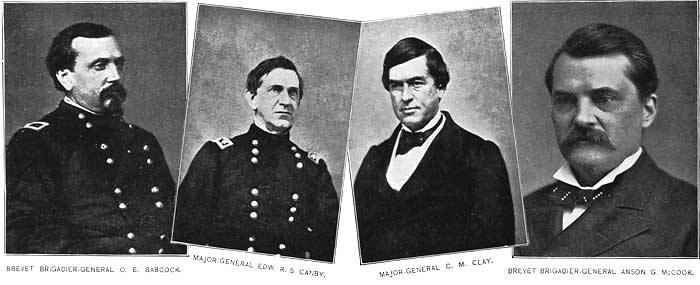
UNION AND CONFEDERATE RAIDS AND RAIDERS.
BY GEORGE L. KILMER.
BEALL, THE LAKE RAIDER—ANDREWS AND HIS DISGUISED RAIDERS—LIEUTENANT CUSHING'S BOAT RAIDS—KILPATRICK'S RAID BY RICHMOND—MORGAN'S KENTUCKY RAID—RAIDING A CITY.
The secret enterprise which placed Lieutenant Davis in a dungeon cell and nearly cost him his life had a deeply tragic ending for John Y. Beall, the young Virginian, executed at Fort Columbus, New York Harbor, the 24th of February, 1865. Beall was the chief promoter and the leader of the Lake Erie raid in the fall of 1864, but technically the offence for which he suffered was that of a spy. The judge advocate of the court which condemned him spoke of the prisoner as one "whom violent passions had shorn of his nature's elements of manliness, and led him to commit deeds which to have even suspected him of at an earlier stage in his career would have been a calumny and a crime."
Beall had been wounded in the Confederate service early in the conflict. As master in the navy, he had led for a time the daring, reckless life of a "swamp angel" in the lower Potomac, destroying the Union commerce in Chesapeake Bay and its adjacent waters.
While thus engaged, he planned a lake raid, but failed to get his government to sanction the project until 1864, when the Northwestern Confederacy movement made it necessary for Jacob Thompson and his co-conspirators in Canada to have a foothold upon Union soil along the border.
One of Thompson's cherished plans was an uprising of the notorious Sons of Liberty at Chicago, during the Democratic national convention in August, 1864. About this time Beall arrived at Sandusky, O., with authority to proceed on his raiding enterprise. Thompson had prepared the way for him by a careful investigation of the lake defences, through an emissary located at Sandusky—Capt. Charles H. Cole, formerly of Morgan's raiders. Cole was supplied with means to entertain and bribe such Union officials as might be of service to the Confederacy; and he finally concluded that the control of the lakes could be secured by the capture of the gunboat Michigan, the sole defender of the waters, and the liberation of the Confederate prisoners at Camp Douglas, Chicago, and at Johnson's Island in Sandusky Bay.
Thompson gave Cole authority to capture the Michigan, and appointed Beall to aid him. It was arranged between Cole and Beall that the former would remain in Sandusky and coöperate by bribing some of the men on the Michigan, and by preparing the prisoners on Johnson's Island for an outbreak. The Michigan lay off the island. The date was fixed for the night of September 19th, and Beall went to Canada to organize a force, hazarding everything, as will be seen, on the success of his confederate, who, at the decisive moment, when Beall's attacking party should arrive off Sandusky, was to make rocket signals from Johnson's Island that the expected aid was a certainty.
Beall secured the services of nineteen Confederate refugees, chiefly escaped prisoners of war harbored in Canada, and the party disguised in civilian dress took passage on a steamer plying between Sandusky and Detroit, carrying in their baggage a supply of revolvers and hatchets. At the proper time, the captain in his office, and the mate at the wheel, were told to vacate their stations, revolvers were suddenly brandished right and left to intimidate the officers and men, and Beall as spokesman declared, "I take possession of this boat in the name of the Confederate States."
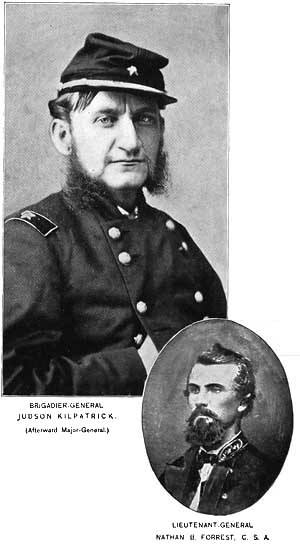
Under his direction the vessel was put about and headed for Middle Boss Island, in Ohio waters, where the passengers and regular crew were set ashore.
From the island Beall bore his vessel directly for the gunboat Michigan, steamed up within cannon range, and awaited a rocket signal. When the hour passed and no signal came, he decided to risk everything, board the gunboat at all hazards, and strike for Johnson's Island. In his crisis an unlooked-for event dashed his high resolves suddenly to the ground. The crew of the Philo Parsons mutinied. The absence of the shore signals was interpreted by them as a warning that the plot had been discovered; and, although Beall argued and pleaded, the men insisted that the death penalty awaited them if captured, and they felt certain that such would be the end of it all. Their boat was then run to the Canada shore, abandoned, and destroyed.
The scene now changes to Union soil. On the night of the 15th of December, 1864, the engineer on an eastern-bound express train on the Erie railroad, between Buffalo and Dunkirk, saw a railroad rail across the track, in front of his engine, just in time to reverse and strike the obstruction at reduced speed without severe damage. The next night two policemen at the New York Central depot, Niagara City, arrested two suspicious men who were about to take the cars for Canada. Beall was one of them, and, though he made some attempt to deny his identity, he was sent to New York City and accused of the lake raid and of the attempt at train wrecking. The clerk of the Philo Parsons, and one of the passengers, and also a confederate in the attempt on the train, identified him, and furnished ample evidence for a case.
The train-wrecking enterprise was doubtless a last resort by Beall to secure funds for the prosecution of his plans on the lake. Five men were engaged in it. The party lay hidden near the track when the train struck, and seeing that the damage was only trifling they hastened to Buffalo and secreted themselves. Subsequently the arrest of Beall took place, purely on suspicion.
He was arraigned on two charges—violation of the laws of war and acting as a spy. His defence was that his acts had been justifiable acts of war; and, if confined to his attempt on the gunboat Michigan and the Johnson's Island prison, the plea might have had weight. But every circumstance likely to weigh in his favor, his education, his noble bearing, his manly conduct toward the captives on the Philo Parsons, was lost sight of in the appalling railroad horror that had been planned with such cool deliberation, and with no purpose evident other than robbery—robbery at the sacrifice of innocent lives.
A most deplorable tragedy brought about by the spy system, or what was analogous to that, and involving the execution of six Ohio soldiers,1 also the imprisonment of sixteen others, who barely escaped the gallows, is the story of the Andrews railroad raid, or bridge-burning expedition, in Georgia, in the spring of 1862.
1 George D. Wilson, Marion A. Ross, and Perry G. Shadrack, Second Ohio; Samuel Slavens and Samuel Robinson, Thirty-third Ohio; and John Scott, Twenty-first Ohio.
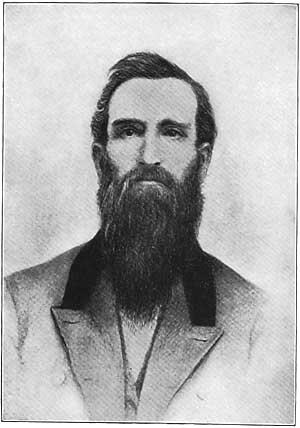
JAMES J. ANDREWS.
During General Buell's occupancy of Central Tennessee, before the armies marched to Shiloh, he had occasionally employed the services of a spy, named James J. Andrews, who carried on a contraband trade in quinine, and in the course of his travels across the border often managed to pick up information valuable to the Union generals. At his solicitation, Buell permitted a detail from three regiments belonging to General Sill's brigade, the Thirty-third, Twenty-first, and Second Ohio, to set out with him, disguised in civilian's dress. They were to burn the railway bridges east and west of Chattanooga, and thus isolate that important town, possibly insuring its speedy capture. The soldiers were given to understand that they took their lives in their hands, but none declined the dangerous honor. Guided by Andrews, they started from Shelbyville, April 7th, and in five days made their way to Marietta, Ga., losing but two of their number on the road. At Marietta two more disappeared, leaving Andrews with eighteen soldiers and a civilian volunteer to undertake the hazardous work mapped out by the leader, which was to capture an engine with a few cars attached, board them, and speed westward, firing the bridges as they passed. Securing tickets at Marietta, they entered a westbound train as ordinary passengers. At Big Sandy station, where the trainmen took breakfast, these pseudo passengers left their seats, and two of them, William Knight and Wilson Brown, professional engineers, leaped into the cab. The coupling bolt of the third car from the tender was pulled, and the remainder of the party scrambled on board as best they could. Off sped the stolen train in full view of scores of astonished bystanders and railroad men. What made the deed doubly risky was the fact that a camp of Confederate soldiers had been established at Big Sandy since Andrews's last visit there, and the station was surrounded by armed men. In fact, a sentinel, musket in hand, stood within a few yards of the engine, watching the whole proceeding, but too dazed to act or sound the alarm. But this amazement was short-lived. The railroad men were prompt to give chase, first with a hand-car, afterward with a chance engine picked up on the road. The raiders were delayed by eastward trains, it being a single-track line; but with singular good fortune ran over half the distance to Chattanooga, having stopped to cut telegraph wires and remove rails, in order to baffle their pursuers. The attempt to fire bridges failed. It was raining, and the would-be incendiaries had provided no combustibles beyond what the train supplied. In the meanwhile their pursuers picked up a car-load of armed men, and came up with the runaway train west of Dalton, where the fuel of the stolen engine gave out, bringing the raiders to a dead stop. Andrews gave the word, "Save who can," and all sprang for the woods, but were captured within a few days. Taken within the enemy's lines in citizen's dress, a court-martial pronounced them spies worthy of death. Andrews, with six of the soldiers, also the citizen volunteer, were executed at Atlanta. The others, including the two Marietta delinquents who had been arrested and identified, were thrown into dungeons; but preferring death in any form to the fate which seemed to await them, they succeeded one day in overpowering their guards, and so escaping to the woods. Eight of the party made their way North, while the other six were recaptured and held until the spring of 1863, when they were exchanged for a like number of Confederate soldiers held by the Union authorities, to answer for a similar offence.
Cushing was not picturesque in figure, though marked by strong individual peculiarities. His height was five feet ten inches, his form slender, his face grave and thoughtful. With steps springy and quick, prominent cheek bones, a piercing eye and restless habit, he seemed to his associates like some spirited Indian in the garb of a paleface.
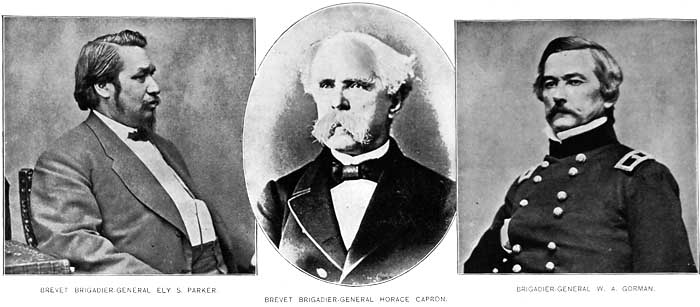
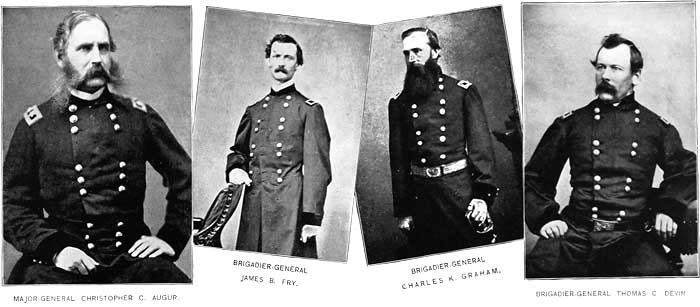
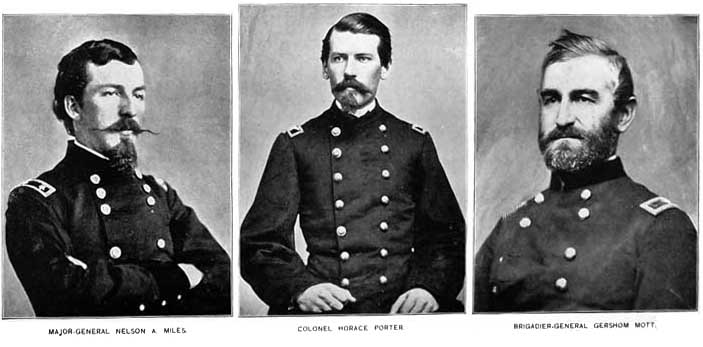
In July, 1862, a lieutenant's straps were given him for acts of bravery performed in his routine duties with the blockading squadron off North Carolina. Four months later, at the age of twenty, he commanded his first expedition, a gunboat raid into New River Inlet, waters wholly in the possession of active enemies. His vessel, the Ellis, stranded within range of the Confederate batteries, but he brought his crew and equipments off in schooners captured before the disaster. A few weeks later he entered Little River at night with twenty-five men, in a cutter, dispersed the gunners of a shore battery by land assault, and got out with the loss of one man. Cushing sometimes volunteered, and at others was chosen, for these fugitive exploits.
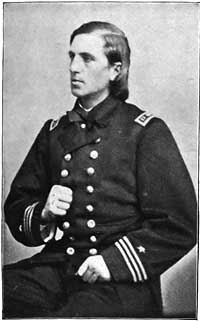
LIEUTENANT WILLIAM B. CUSHING.
In the summer of 1863 it was known on the blockading fleet that the Confederates possessed a couple of rams and some torpedo boats in Cape Fear River around Wilmington; and on the night of June 25 Cushing set out from his ship Monticello in a cutter, with two officers and fifteen men, and crossed the bar, passing some forts and the town of Smithville without discovery. On the way his boat nearly collided with a blockade runner putting to sea, and also with a Confederate guard-boat. The night was dark until the cutter was abreast of a fortified bluff known as the Brunswick batteries, when the moon suddenly emerged from a cloud and disclosed the strange craft to the enemy's sentinels on shore. Shots were fired at the cutter, and the garrison was alarmed. Cushing directed his men to pull to the opposite shore and proceed up the river. When within seven miles of Wilmington the boat was hidden in a marsh, and the party lay all next day within sight of passing blockade runners.
After dark the cutter took to the wave and captured two rowboats filled with men, who proved to be fishermen from Wilmington. Cushing impressed them for guides and reconnoitred all the batteries and forts on the river. He discovered that the ram Raleigh was a hopeless wreck, the ram North Carolina useless because her draught didn't admit of passing the bar to attack the Union blockading fleet, and that the Confederate torpedo boats had been destroyed during a scare. On the way to sea the cutter was headed off by a gunboat and several small boats filled with men. It was night and the moon shone, and Cushing managed to turn and double on his pursuers until he got a start on them, and by vigorous rowing dashed into the breakers at the Carolina shoal, where the enemy dare not follow. The cutter was so heavy that she outrode the breakers and escaped to the fleet. On this raid two days and three nights were spent in the enemy's territory.
In the month of February, 1864, the Administration at Washington proposed a cavalry raid to Richmond. One object was to circulate, within the Confederate lines, the President's amnesty proclamation, offering full pardon and a restoration of rights to any individuals, or to States, that might wish to return to their allegiance. Another was the release of the Union prisoners in Belle Isle and Libby prisons. The expedition was intrusted to Kilpatrick, who was to have a picked force of four thousand cavalrymen and a horse battery.
It was believed in the Union camps that a surprise could be effected, and with this end in view, Kilpatrick set out one Sunday night, the 28th of February, for the lower fords of the Rapidan. Reaching Spottsylvania unmolested, he sent out from here a detachment of five hundred men, under Col. Ulric Dahlgren, toward the Virginia Central Railroad, instructing him to enter Richmond from the south, while he himself should attack from the north. Through the treachery or ignorance of a negro guide engaged by Dahlgren, his column failed to find a ford in the James River, which was a serious drawback, because he had intended to enter Richmond from the rear, the weakest point. On March 1st, Dahlgren was eight miles west of Richmond on the James, and Kilpatrick at Atlee's station, eight miles north, the distance between them being only about twelve miles. Kilpatrick, however, was returning from his raid, and the two forces were destined to remain apart and receive severe handling from enemies now swarming about them.
Kilpatrick had passed the outer defences of Richmond by one o'clock of the 1st, but on approaching the inner line he was met by infantry and artillery. Skirmishing continued for several hours, the object of the Union leader being to prolong the situation until he should hear Dahlgren on the opposite side of the city. Finally, as he saw Confederate troops moving in large bodies, he withdrew to Atlee's to pass the night.
The Confederate cavalry command of Gen. Wade Hampton was strung along the railroad between Lee's army and Richmond, and Gen. Bradley T. Johnson, leading a brigade under him, had learned of Kilpatrick's march and telegraphed to Richmond on the 29th that a raid was abroad. He also had notified the troops all along the line, and both himself and Hampton followed in Kilpatrick's path, about a day behind him. On the night of the 1st Hampton attacked Kilpatrick's camp at Atlee's and drove him out. The following morning Kilpatrick started down the Peninsula toward White House, on the Pamunkey.
On the day of Kilpatrick's farthest advance Dahlgren had drawn to within five miles of the city and then retired. After dark of that day he, too, started to move down the peninsula along the Pamunkey. Placing the main body in reserve, Dahlgren rode on ahead with the advance guard, and on the next night fell into ambush prepared by a number of cavalry officers who were at their homes in the vicinity on recruiting service or leave of absence.
A challenge to halt Dahlgren answered by a threat, and the commander of the Confederate outpost gave the order instantly to fire. At the first volley Dahlgren fell dead. His men were surrounded and held until daylight, when the whole party of survivors surrendered.
The chief victim of this raid, Colonel Dahlgren, was the son of Admiral John A. Dahlgren, and at his death was twenty-two years old. Early in the war he had served as an artillerist with Generals Sigel, Frémont, and Pope in northern Virginia. On the retreat of Lee from Gettysburg toward the Potomac, Dahlgren was at the front under Kilpatrick, leading about one hundred men, and in the encounter with Stuart at Hagarstown, July 6th, he received a wound in the foot that cost him his leg. Having been commissioned colonel in the cavalry service, he returned to the front wearing a cork leg, but was obliged to depend on crutches. He volunteered for the expedition in which he lost his life.
Morgan the raider had given the North an exhibition of his boldness before he entered upon that celebrated ride across Ohio in 1863. On the 13th of July, 1862, President Lincoln telegraphed from Washington to the Union commander in the far West, "They are having a stampede in Kentucky. Please look to it."
The whole trouble was caused by Colonel Morgan, with a couple of cavalry regiments, and a clever telegraph operator named Ellsworth. Ellsworth tapped the wires between Nashville and Louisville, and sent a bogus despatch to the Union authorities in the latter city, stating that Morgan was operating around the former, when, in reality, he was riding northward toward the heart of Kentucky. Moving along the railroad lines, Union operators were everywhere surprised at their keys and compelled to serve the raider's commands, while Ellsworth manipulated the wires. In this way the Union forces ahead on the line of march were ordered out of the road, or drawn off by false alarms, and Morgan was able to get exact knowledge as to the location and numbers of the Union garrisons. At Georgetown, only sixty miles from Cincinnati, he halted for two days, producing, by means of the wires, a terrible scare in Lexington, and drawing all the Union forces to that region. He himself then moved southward to cross into Tennessee, Ellsworth managing to counteract the Union orders for pursuit during the retreat by his bogus telegrams. So the raiders finished their long ride without once encountering an armed foe.
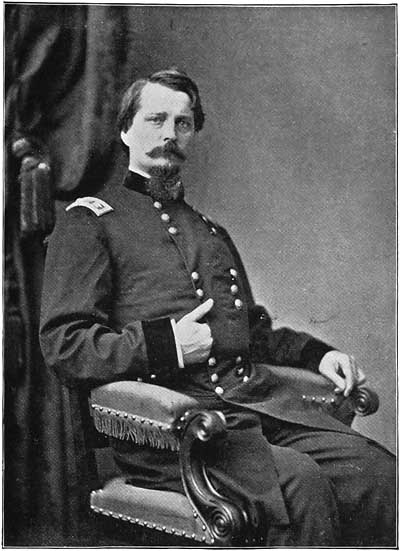
MAJOR-GENERAL WINFIELD S. HANCOCK.
Forrest marched to Memphis on his memorable raid in August, 1864, with a detachment of his choicest cavalry, numbering fifteen hundred men. The leader of the advanced guard was his brother, Captain W. H. Forrest, and into his hands the general gave the difficult task of opening the main road to the town. Captain Forrest approached the outer pickets about daylight on Sunday morning, knocked the challenging vidette senseless with the handle of his sabre, and with ten athletic followers disarmed the reserves on the nearest post. A musket accidentally discharged during the mêlée aroused others near by, and the entire main camp of ten thousand soldiers stretching around the city soon caught the alarm.