Chapter XLIV · (continued 3)
Reading edition
NEARING THE END.
My men were drawn up in the little town of Appomattox that night. I still had about four thousand men under me, as the army had been divided into two commands and given to General Longstreet and myself. Early on the morning of the 9th I prepared for the assault upon the enemy's line, and began the last fighting done in Virginia. My men rushed forward gamely and broke the line of the enemy and captured two pieces of artillery. I was still unable to tell what I was fighting; I did not know whether I was striking infantry or dismounted cavalry. I only knew that my men were driving them back, and were getting further and further through. Just then I had a message from General Lee, telling me a flag of truce was in existence, leaving it to my discretion as to what course to pursue. My men were still pushing their way on. I sent at once to hear from General Longstreet, feeling that, if he was marching toward me, we might still cut through and carry the army forward. I learned that he was about two miles off, with his face just opposite from mine, fighting for his life. I thus saw that the case was hopeless. The further each of us drove the enemy the further we drifted apart, and the more exposed we left our wagon trains and artillery, which were parked between us. Every line either of us broke only opened the gap the wider. I saw plainly that the Federals would soon rush in between us, and then there would have been no army. I, therefore, determined to send a flag of truce. I called Colonel Peyton of my staff to me, and told him that I wanted him to carry a flag of truce forward. He replied:
"General, I have no flag of truce."
I told him to get one. He replied:
"General, we have no flag of truce in our command."
Then said I, "Get your handkerchief, put it on a stick, and go forward."
"I have no handkerchief, General."
"Then borrow one and go forward with it."
He tried, and reported to me that there was no handkerchief in my staff.
"Then, Colonel, use your shirt!"
"You see, General, that we all have on flannel shirts."
At last, I believe, we found a man who had a white shirt. He gave it to us, and I tore off the back and tail, and, tying this to a stick, Colonel Peyton went out toward the enemy's lines. I instructed him to simply say to General Sheridan that General Lee had written me that a flag of truce had been sent from his and Grant's headquarters, and that he could act as he thought best on this information. In a few moments he came back with some one representing General Sheridan. This officer said:
"General Sheridan requested me to present his compliments to you, and to demand the unconditional surrender of your army."
"Major, you will please return my compliments to General Sheridan, and say that I will not surrender."
"But, General, he will annihilate you."
"I am perfectly well aware of my situation. I simply gave General Sheridan some information on which he may or may not desire to act."
THE FLAG OF TRUCE.
He went back to his lines, and in a short time General Sheridan came forward on an immense horse, and attended by a very large staff. Just here an incident occurred that came near having a serious ending. As General Sheridan was approaching I noticed one of my sharp-shooters drawing his rifle down upon him. I at once called to him: "Put down your gun, sir; this is a flag of truce." But he simply settled it to his shoulder and was drawing a bead on Sheridan, when I leaned forward and jerked his gun. He struggled with me, but I finally raised it. I then loosed it, and he started to aim again. I caught it again, when he turned his stern white face, all broken with grief and streaming with tears, up to me, and said: "Well, General, then let him keep on his own side." The fighting had continued up to this point. Indeed, after the flag of truce, a regiment of my men, who had been fighting their way through toward where we were, and who did not know of a flag of truce, fired into some of Sheridan's cavalry. This was speedily stopped, however. I showed General Sheridan General Lee's note, and he determined to await events. He dismounted, and I did the same. Then, for the first time, the men seemed to understand what it all meant, and then the poor fellows broke down. The men cried like children. Worn, starved, and bleeding as they were, they had rather have died than have surrendered. At one word from me they would have hurled themselves on the enemy, and have cut their way through or have fallen to a man with their guns in their hands. But I could not permit it. The great drama had been played to its end. But men are seldom permitted to look upon such a scene as the one presented here. That these men should have wept at surrendering so unequal a fight, at being taken out of this constant carnage and storm, at being sent back to their families; that they should have wept at having their starved and wasted forms lifted out of the jaws of death and placed once more before their hearthstones, was an exhibition of fortitude and patriotism that might set an example for all time.
THE END.
Ah, sir, every ragged soldier that surrendered that day, from the highest to the lowest, from the old veteran to the beardless boy, every one of them, sir, carried a heart of gold in his breast! It made my heart bleed for them, and sent the tears streaming down my face, as I saw them surrender the poor, riddled, battle-stained flags that they had followed so often, and that had been made sacred with the blood of their comrades. The poor fellows would step forward, give up the scanty rag that they had held so precious through so many long and weary years, and then turn and wring their empty hands together and bend their heads in an agony of grief. Their sobs and the sobs of their comrades could be heard for yards around. Others would tear the flags from the staff and hide the precious rag in their bosoms and hold it there. As General Lee rode down the lines with me, and saw the men crying, and heard them cheering "Uncle Robert" with their simple but pathetic remarks, he turned to me and said, in a broken voice: "Oh, General, if it had only been my lot to have fallen in one of our battles, to have given my life to this cause that we could not save!" I told him that he should not feel that way, that he had done all that mortal man could do, and that every man and woman in the South would feel this and would make him feel it. "No, no!" he said, "there will be many who will blame me. But, General, I have the consolation of knowing that my conscience approves what I have done, and that the army sustains me."
In a few hours the army was scattered, and the men went back to their ruined and dismantled homes, many of them walking all the way to Georgia and Alabama, all of them penniless, worn out, and well-nigh heartbroken. Thus passed away Lee's army; thus were its last battles fought, thus was it surrendered, and thus was the great American tragedy closed, let us all hope, forever.
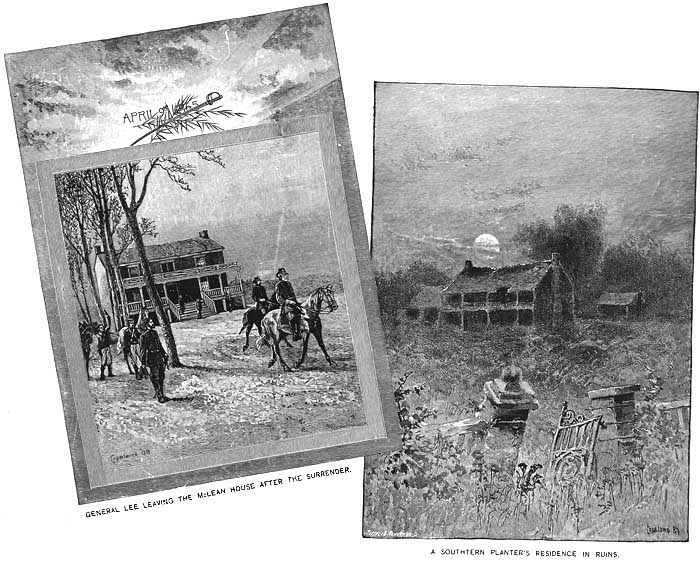
CAMP LIFE.
BY GENERAL SELDEN CONNOR.
A MAJORITY OF SOLDIERS IN THE UNION ARMY WERE YOUNG MEN—THE WAR A COLOSSAL PICNIC—THE ATTRACTIONS OF CAMP LIFE FOR YOUNG MEN—DRILLING AND GUARD DUTY—STYLES OF TENTS USED IN THE ARMY—LOG HUTS FOR WINTER QUARTERS—A NEW USE FOR WELL-SEASONED FENCE RAILS—RISE AND FALL OF A LIGHT "TOWN OF CANVAS"—GENUINE LOVE FOR HARD-TACK—THE TRIALS AND DANGERS OF AN ARMY SUTLER—DRAMATIC AND MINSTREL ENTERTAINMENTS IN CAMP—HORSE-RACING AND THE "DERBY" OF THE ARMY OF THE POTOMAC—CARD-PLAYING AND OTHER GAMES—CAMPS OF NORTHERN SOLDIERS KEPT IN BETTER CONDITION THAN THOSE OF SOUTHERN SOLDIERS—FENCING, BOXING, AND DRILLING—STUDYING GEOLOGY.
From one point of view the war for the Union was a colossal picnic. Not that it was in the spirit of a summer holiday, with pure gayety of heart, that a million of the bravest and best of the country took to the tented field to interpose their lives between their country and all that would do her harm. No soldiers were ever more impressed with the serious nature of the contest for which they had enlisted than were those of '61. But the "men" who composed the Union armies were by far and away a majority very young men; they were then really "the boys" in the sight of all the world, as they are now to each other when veteran comrades meet and "Bill" greets "Joe," and the wrongs of time are forgotten in the vividness of their memories of the time when they wore the blue livery and ate the very hard bread of Uncle Sam. They were real human boys, like those of to-day, and as the boys of '76 very likely were; and so, mingled with the glow of patriotic ardor in their breasts, and the determination to do their duty whatever might betide, there was a keen sense of the novelty of the soldier's life. They had read of wars and soldiers from Cæsar to Zack Taylor, and were filled with the traditional pride of American citizens in the heroism and exploits of the men who achieved independence. The greater number of them had recollections, more or less clear, of cheering for Buena Vista and Resaca de la Palma. But wars were "old, unhappy, far-off things," entirely out of date, inconsistent alike with "the spirit of the times" and "the principles of free popular government." "The American boys of this peaceful age would never be called upon"— But, hark! the drum! Partings were sad, with home, kindred, friends. The old life-plans with all their courses, ambitions, hopes, and dreams, were temporarily turned to the wall. There was no room for regrets or forebodings. Duty called, and their country's flag waved its summons to them. War's dangers were before them; but there were in prospect also the experience of a soldier's life, the zest of the sharp change from the dull monotony of peaceful pursuits to the stir and novelty of the camp. They took up the new life with a kind of "fearful joy." It had its drawbacks, but on the whole it had many and strong attractions to lusty and imaginative youth. "It amuses me," said a veteran of the Mexican war to a company just enlisted in a three-months regiment under the President's first call for troops, "to hear you boys talk about coming home when your term of service is out. When you once follow the drum you are bound to keep on just as long as the music lasts." The boys found that the veteran was right. At the conclusion of their three months' service they reënlisted almost, if not quite, to a man, and most of them became officers.
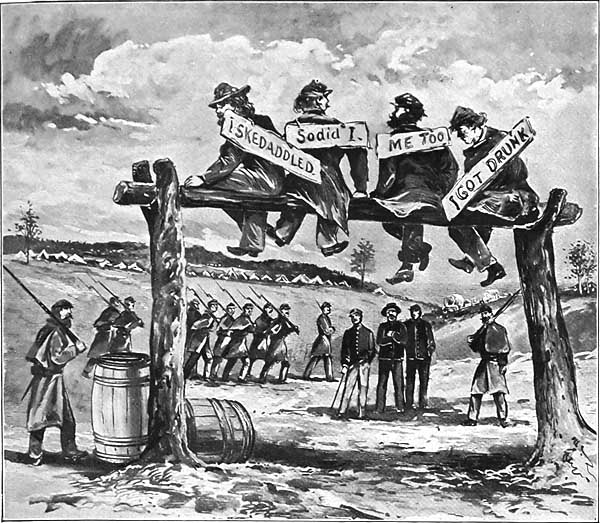
PUNISHMENT INFLICTED FOR MINOR OFFENCES.
It did not quite suit the dignity of the young soldiers, as free and independent American citizens, to yield implicit obedience to any man, and especially to be "bossed" by officers who, as their neighbors, had no claim to superiority, and to have all their incomings and outgoings regulated by the tap of the drum. When they realized, as they were not long in doing, that officers as well as men had to obey at their peril, and that good discipline was essential to their well-being and efficiency as soldiers, they accepted the situation, and rendered a ready and dutiful obedience.
The secret of the charm of the soldier's life is not far to seek. The soldier is care-free, absolved from that "pernicious liberty of choice" which makes ordinary life weary and anxious, and his responsibility is limited to his well-defined line of duty. Above all, the bond of sympathy is closer than in any other form of association. To pursue the same routine, to go to bed and rise up at a common call, to be served with the same food, drink, and clothes by a common master, to share the same hardships and perils, to own one leadership, and to be engaged in a common purpose with hundreds of thousands of others, constitutes in the highest degree that unity which Cicero found to be the essence of friendship, the bond of nearness and dearness known to the soldier as "comradeship." Allied to this feeling, and aiding to exalt the soldier's profession, is that "esprit de corps" which fills his heart with pride in his company, his regiment, corps, and army. As a rider feels that he shares the sinewy strength of the steed under him, so the soldier, though a unit among thousands, exults in the dread power and beauty of the bounding column or long line of which he forms a part; in the order and precision which transform a multitude of individuals into one terrible engine. The Roman citizen was not more proud of his country than the Union soldier was of his army. A soldier of the Army of the Potomac writes in a home letter dated April, 1863: "I have just taken a ride of about fifteen miles through the army. It is really a sight worth while to go through this vast army and see how admirably everything is conducted. The discipline is fine, the men look healthy and are in the best possible spirits, and the cleanliness of the camps and grounds is a model for housewives." The delights of the gypsy-like way of living of the soldier had a large part in forming the bright side of the new vocation. It seemed good to turn from the comforts and luxuries of easeful homes, and go back to the simple and nomadic habits of the hardy primitive man; to live more closely with Nature, and be subject to her varying moods; to have the sod for a couch, and the winds for a lullaby, and to be constantly familiar with the changing skies from early morning through the day and the watches of the night. The pork and beef boiled in the kettles hung over the campfire, the beans cooked in Dutch ovens buried in the embers, owed their sweet savor to the picturesque manner of the cooking as well as to uncritical appetites sharpened by living in the open air, and by plenty of exercise, drilling, guard duty, and "fatigue." And what feast could compare with the unpurchased chicken broiled on the coals, sweet potatoes roasted in the ashes—trophies of his "bow and spear" in foraging—and his tin cup of ration coffee; the product of the marauder's own culinary skill, over his private fire, served "à la fourchette" and smoking hot; with perhaps the luxury of a soft hoe-cake, acquired by barter of some "auntie," in lieu of the daily hard bread!
Not least among the fascinations of the soldier's life is the uncertain tenure he has of his camp. He has no local habitation. He may flatter himself that the army is going to remain long enough to make it worth his while to provide the comforts and conveniences within the compass of his resources and ingenuity, and when he has fairly established himself and contemplates his work with complacency, the ruthless order comes to "break camp," and down goes his beautiful home as if it were but a child's house of blocks. He grumbles a little at the sacrifice, but the prospect of fresh scenes and adventures is sufficient solace of his disappointment, and he cheerfully makes himself at home again at the next halt of his regiment.
In the matter of habitation the soldier did not pursue the order of the pioneer who begins with a brush lean-to, then builds a log house, and continues building nobler mansions as his labors prosper and fortune smiles, until, maybe, a brownstone front shelters him. The home of the soldier of the War for the Union was, like the bumble-bee, "the biggest when it was born." In 1861 the volunteer regiments were generally fitted out, before leaving their respective States, with tents, wagons, mess furniture, and all other "impedimenta," according to the requirements of army regulations. The tents commonly furnished for the use of the rank and file were the "A" and the "Sibley" patterns. The "A" was wedge-shaped, as its name indicates, and was supposed to quarter five or six men. The "Sibley" was a simple cone, suggested by the Indian "tepee," with an opening at the apex for ventilation and the exit of the smoke of the fire, for which provision was made in the centre of the tent by the use of a tall iron tripod as a foundation for the pole. It comfortably accommodated fifteen or sixteen men, lying feet to the pole, and radiating thence like the spokes of a wheel. This tent, improved by the addition of a curtain, or wall, is now in use by the regular army, and it is known as the "conical wall tent." Officers were provided with wall tents, canvas houses, two to each field or staff officer above the rank of captain, one to each captain, and one to every two subaltern officers. Each company had a "cook tent," and the cooking was done over a fire in the open. The fires of the cooks of companies from the northern lumbering regions could always be distinguished by the "bean holes," in which the covered iron pot containing the frequent "pork and beans," the favorite and distinctive article of Yankee diet, was buried in hot embers and, barring removal by unauthorized hands, allowed to remain all night. The lumberman and the soldier declare that he who has not eaten them cooked in this manner does not really "know beans." The regimental camp of infantry was arranged according to regulations, with such modifications as the nature of the ground might make desirable. The company "streets" were at right angles with the "color line" or "front" on which the regiment was formed, and began ten paces in rear of it. The tents of the "rank and file" of each company were pitched on both sides of its street. In rear of them, with an interval of twenty paces between the lines, and in successive order, was the line of "kitchens," the line of non-commissioned staff, sutler and police guard, the line of company officers, and the line of field and staff officers. In the rear of the camp were the baggage train and officers' horses.
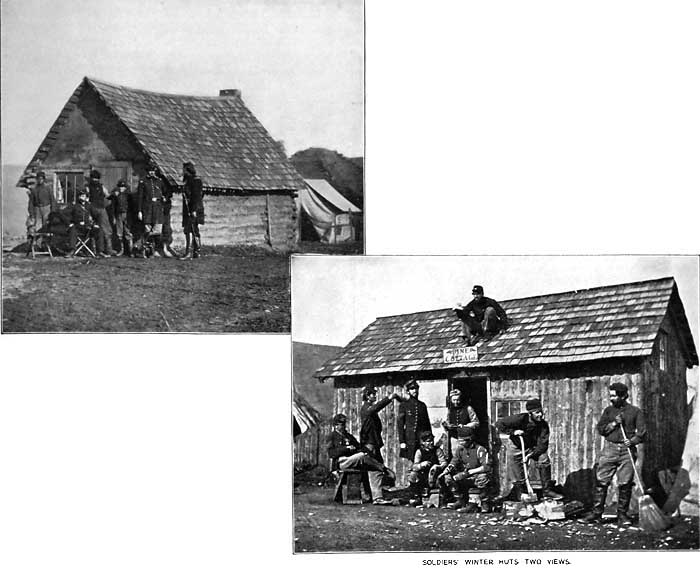
The first winter of the Army of the Potomac was to a large part of the army one of much suffering from cold. The hills of Virginia, along the Potomac, are anything but tropical in the winter. The frequent light snows and rains, followed by thawy, sunny days, produced a moisture in the air which, combined with winds from the mountains, struck a chill to the very marrow of the bones of even the men from the far North accustomed to a much lower temperature but in a dry atmosphere. The commander of the army gave no encouragement to the building of winter quarters, and the prevailing impression was that the army must remain on the qui vive, ready to move on slight notice whenever the commander (or the enemy) might give the word. There was plenty of fine timber in the section of country occupied by the army, and it would have been an easy matter to the skilled axemen and mechanics in which most regiments abounded, and entailing comparatively slight expense, to build log huts that would have housed them in comfort and saved many a stout soldier for the impending days of battle. Some commands, either by special permission or taking the responsibility upon themselves, did build huts, and were snugly and warmly housed for months, while their less fortunate or unenterprising neighbors were shivering under their canvas. The rude fireplaces made of stones, with the tenacious Virginia mud for mortar, having chimneys of sticks and clay, or barrels, served fairly well to heat a well-chinked hut; but their small, sputtering fires could make but little impression on the temperature of a space which had only a thin cotton barrier as a defence against the keen wintry blasts. The unnecessary hardships of such exposure inflicted severe loss on the army, especially in those regiments which had been visited in the autumn by that scourge common to new levies, the measles. That disease, though not dangerous in itself, leaves its subjects in an enfeebled condition for a long time after apparent recovery, and incapable of withstanding exposures and ailments ordinarily regarded as slight. In the camps of regiments which had been afflicted with it, the burial party marching with slow and solemn step to the wail of the dirge was an all too frequent ceremony through the long winter, and far from inspiriting to young soldiers, while the number of the dead was as great as that of the slain in a hard-fought battle. Perhaps the relentless necessities attending the hasty gathering and organization of a great army made it difficult or impossible to bestow upon convalescents the care necessary to preserve their lives; but, leaving aside the question of humanity, an intelligent self-interest should have induced the responsible head of the army to make every effort to guard against such deplorable impairment of the strength of his command as arose from causes which seem to have been preventable. If the men who perished miserably on the bleak hillsides of Virginia, and who never had a chance to strike a blow for the cause that was so dear to them, had been sent where they could have received proper care and treatment, the number of these restored to health and strength would have constituted a powerful reinforcement in the following campaign where the cry for help was raised so lustily.
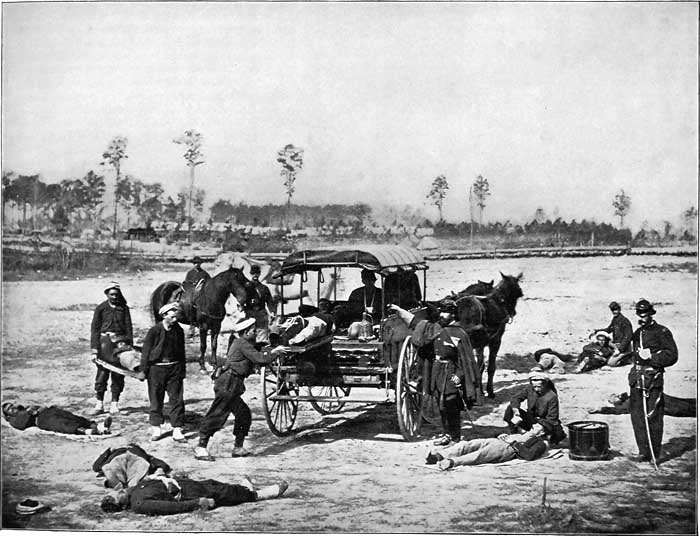
HOSPITAL CORPS—AMBULANCE DRILL.
The mistake of the first winter was not repeated. The fact was recognized that the army must go into winter quarters, and timely and adequate preparations to encounter the rigors of the season were made by the whole army. An officer writing from "Camp near White Oak Church, Virginia," in the winter of 1862-63, says: "We have fixed up our camp so that it is quite comfortable. Each squad of four men has its hut, made by digging into the ground a foot or two and then placing on the ground at the sides several logs, and roofing with their shelter tents. At the side they dig a fireplace, and build a chimney outside with sticks and mud. It is Paddy-like, but much more comfortable than no house at all. My 'house' is very nice; it is built up with split hardwood logs about four feet above the ground, and on this foundation my wall tent is pitched, making a room nine by nine, with walls six feet high. At one end there is a fine fireplace, which does not smoke at all. I told Captain C., who was just in, that if I had a cat on the hearth it would be quite domestic." The general style of architecture throughout the army was the same; but there were wide differences in the manner of construction and the details of the work. The huts of some commands were rudely built and without uniformity, giving to the camp a mean and squalid appearance, while other camps were very attractive with their rows of solid and trim-looking structures, as like each other as the houses of a builder in a city addition.
The real soldiering and camping began when, after a period of stripping for the campaign by sending the sick to hospitals and all unnecessary baggage to the rear for storage, of outfitting with all the required clothing, arms, equipments, and ammunition, and of repeated inspections and reviews to make sure that everybody and everything was in readiness, the troops were drawn out of winter quarters and put on the march toward the enemy. Every man had to be his own pack animal and carry upon his shoulders and hips his food—rations for one day or a week, according to the nature of the enterprise in hand and the prospect of making a connection with the wagon trains; drink in his canteen; cartridges—a cartridge box full and oftentimes as many more as could be crowded into knapsacks and pockets; and, lastly, his lodging, a woollen blanket and one of rubber, and the oblong piece of cotton cloth which was his part of the "shelter tent." This tent was invented by the French and had long been in use by them. It is one of the most useful articles of the soldier's equipment. It is but a slight addition to his burden, and a very great one to his comfort. Two or more comrades, by buttoning their several sections together, and the use of a few slight sticks, or sticks and cord, can speedily prepare a very effective protection against the dew, the wind, and "the heaviest of the rain." Generally three comrades joined their sections to form a tent; two sections made the sides and one an end, the other end either remaining open to admit the heat of a fire or being closed by a rubber blanket. When four men tented together, which they could do by "packing close," the extra section was used instead of the rubber blanket, and then the squad was very thoroughly housed.
Schiller's word-picture of a military camp vividly recalls to the soldier one of the most characteristic and impressive pictures of his army life:
"Lo there! the soldier, rapid architect! Builds his light town of canvas, and at once The whole scene moves and bustles momently. With arms and neighing steeds, and mirth and quarrel, The motley market fills: the roads, the streams, Are crowded with new freights; trade stirs and hurries. But on some morrow morn, all suddenly, The tents drop down, the horde renews its march. Dreary and solitary as a churchyard The meadows and down-trodden seed-plot lie, And the year's harvest is gone utterly."
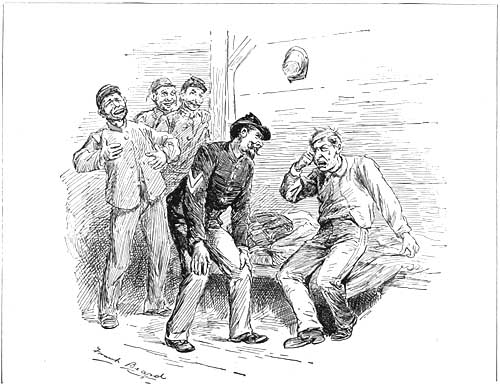
A NEW RECRUIT BEING INITIATED.
The rise and fall of "the light towns of canvas," movable cities that attended the progress of the army, seemed wonderful and magical. Imagine a broad plantation stretching its sunny acres from river to forest, a vast and lonely area with no signs of human occupancy anywhere, except, perhaps, the toil-bent figures of a few bondservants of the soil at their tasks in the fields, under the eye of the overseer, lending by the unjoyous monotony of their labor an air of gloom and melancholy to the oppressive loneliness of the scene. Suddenly and quietly from the road at the edge of the forest a few horsemen ride into the open, a banneret bearing some cabalistic device fluttering over them, closely followed by a rapidly moving column of men whose gleaming muskets indicate afar off their trade; and presently, when the centre of the regiment breaks into view and Old Glory appears in all its beauty against the background of dark forest, it announces to all who may behold that one of the grand armies of the Republic is on the march. As the regiment emerges in the easy marching disorder of "route step" and "arms at will," it seems to be a confused tide of men flowing steadily along and filling the whole roadway. A few sharp orders ring out, and the throng is transformed almost instantly to a solid military machine; officers take their posts, "files cover," arms are carried uniformly, the cadence step is taken—"short on the right" that the men may "close up" to the proper distance—and, under the guidance of a staff officer, the regiment marches to its assigned camping-ground, where it is brought to a front, arms are stacked, and ranks broken. With whoops and cries expressing their gratification that the day's march is over and a rest is in prospect, the released soldiers scatter, unstrapping their irksome knapsacks and throwing them off with sighs of relief, and betake themselves to the preparation of their temporary home. If there be any prize which these old campaigners have discovered as with wise prevision and hawk-like ken they surveyed their environment in marching to the camping-ground—a comely fence of well-seasoned rails, for instance—they "make a break" for it on the instant of their deliverance from the restraint of discipline, and with a unanimity and alacrity that give little hope of a share to the slow-footed, and fill the hearts of the incoming regiment, not yet released, with envy and unavailing longing. When the scramble is over, and the foragers have swarmed in like ants, laden with their plunder, each squad with practised skill proceeds to its domestic duties. One man pitches the "dog tent," and utilizes any material that may be at hand for making the couch dry and soft. Another, laden with the canteens, explores the hollows and copses for the cool spring of which he has had tantalizing visions on the dusty march. The rest build the fire, if one is needed for warmth, or for cooking in case the wagons containing the company mess kettles and rations are not with the command or have not come up, and therefore every man is left to boil his coffee and fry his pork to his own taste, and lend a hand whenever needed. Every man is expected to contribute of the best that the country affords, and not to be nice as to the method of acquisition, to eke out the plain fare of the marching ration. Foraging in Virginia, except to the cavalry, was not a very prosperous pursuit after the country had been occupied a few months by the army. There was, however, game almost anywhere for those emancipated from vulgar prejudices in the matter of diet, as De Trobriand's Zouaves appear to have been, for he says of them that they "discovered the nutritive qualities of the black snake." The menu including a black snake hash suggests a wide range of possibilities. By the time the first arrivals have leisure to look about them, the plain far and near is covered with tents: the "rapid architect" has done his work, and the "light town" is established.
Perhaps before the next morning's sun was high in the heavens the town had disappeared like a scene conjured up by a magician, leaving the plain to resume its wonted loneliness so strangely interrupted.
The routine of camp-life so absorbed the time of the soldier that there was little left to hang heavy on his hands. The odd minutes between drills, roll-calls, police and fatigue duty, could be well utilized in cleaning his musket and equipments, washing and mending his clothes, darning his stockings, procuring fuel, improving his quarters, writing home, and re-reading old letters. After a hard night's duty on camp guard or picket, with sleep on the instalment plan, it was luxury to lie warm and make up the arrears undisturbed by fear of the dread summons, "Fall in, second relief." Very restful it was, too, to stretch out at full length on the spring bunk, made of barrel staves across poles, with a knapsack for a pillow, and indulge in the fragrant briarwood, conversing with comrades of home and friends, or discussing the gossip of the camp. In spring and summer camps each tent commonly had an arbor of foliage for a porch, and when there swung in its shelter a shapely hammock ingeniously woven of withes and grapevines, attached to spring poles driven into the earth, and filled with the balmy tips of cedar boughs, the extreme of sybaritish appointments was attained. It was always in order to hunt for "something to eat," not perhaps so much to appease absolute hunger as to vary the tiresome monotony of the regulation diet. Desirable articles of food were acquired in all ways recognized by civilized peoples as legitimate: by purchase, by barter, and by—right of discovery. In camp and all accessible places on the march the sutler tempted appetites weary of hard-tack and pork, with dry ginger cakes, cheese, dried fruits, and apples in their season. Sardines, condensed milk, and other tinned food preparations were so expensive that they could not be indulged in to a great extent. The canning industry was then in its infancy. If it had then attained its present development, and all kinds of fruits, vegetables, and meats had been accessible to the soldier, he would have been in full sympathy with the Arizona miner who said to his "pard," as they were consuming the customary flapjacks and bacon, "Tom, I hope I shall strike it rich; I should just like to strike it rich."—"Well, Bill, s'pose you should strike it rich, what then?"—"If I should strike it rich, Tom, I'd live on canned goods one six months."
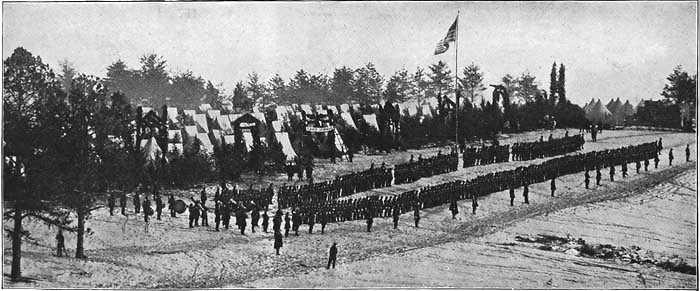
THE ARMY OF THE POTOMAC—FIRST YEAR IN WINTER QUARTERS. (From a War Department photograph.)
Although the old soldier would growl about his hard-tack and feign to have slight regard for it, the sincerity of his attachment was attested by an incident occurring in a command which halted for a few days, after the battle of Gettysburg, at a rural town in Pennsylvania. It was far from the base of supplies, and the commissary's supplies had become exhausted, and he was obliged to purchase flour and issue it to the companies. Having no facilities for baking, they had their flour made into bread at the farmhouses in their vicinity. The bread was fairly good and there was plenty of it; nevertheless, when the wagons appeared laden with the familiar boxes of veteran "squares," cheers went up all along the line as if for a victory or the return of missing comrades.
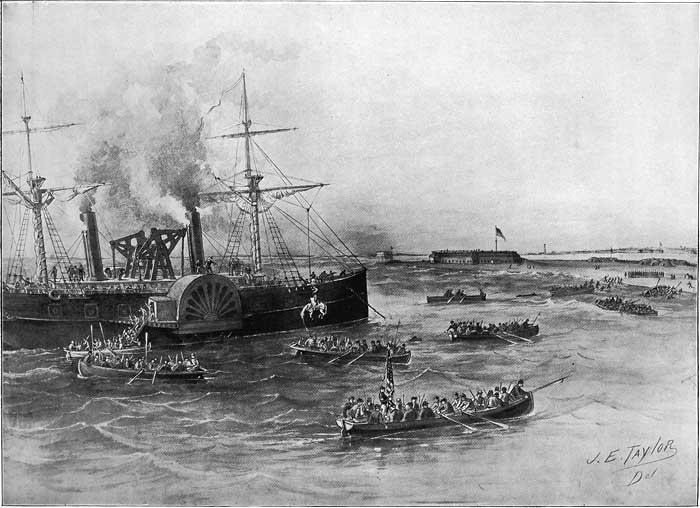
LANDING REINFORCEMENTS FOR FORT PICKENS, FLORIDA, JUNE, 1861.
The sutler was an institution of the camp not to be overlooked. When transportation was safe and not expensive, he kept a general store of everything that officers and men required or could be tempted to buy, save such articles as were prohibited by the Council of Administration which had the general oversight of his business. Where carriage was difficult and dangerous, a choice of articles had to be made in order to supply those most needed. Tobacco and matches were easily first in order of selection. Soldiers of the Army of the Potomac will remember the blue-ended matches that left such a track behind when struck; they touched nothing they did not adorn.
The sutlers of German-American regiments were expected to accomplish the impossible in order to supply lager, Rhine wine, and bolognas. Whenever a fresh stock of such goods had been received, the crowd around the sutler's tent mustered in far greater numbers than appeared at the parade of the regiment. It was popularly considered very desirable to have a German regiment in a brigade. In one respect the sutler's business was a safe one: he could collect at the paymaster's table the sums due him, if he took care not to give men credit in excess of the proportion of their pay permitted by regulations. On the other hand, his profits were in danger of diminution from many quarters. In camp the sutler and his clerks could not always distinguish, among a crowd of customers coming and going, who paid and who did not; storehouses were slight and penetrable, and marauders were watchful and cunning. Those commands were very exceptional that were in Falstaff's condition, "heinously unprovided with a thief." On the march, dangers to the sutler's stock multiplied. To say nothing of ordinary risks attending carriage over bad roads, and of the watchful guerilla, there was always an uneasy feeling in the breast of the purveyor when most surrounded by men in friendly uniform, that there might be "unguarded moments" when the cry, "Rally on the sutler," would be followed by a speedy division of his goods, leaving him lamenting. Personally the sutler was generally a prudent and tactful man, and gained the goodwill of his customers by an obliging disposition and a readiness to take a joke even if it was a little rough and at his expense. When the command was in the field he made himself especially serviceable as a medium of communication with the "base," and many and various were the commissions he was called upon to execute.
Camp life had its diversions in addition to the many interesting and enjoyable features of the daily round of duties. Military life in itself is necessarily spectacular, abounding in scenes of animation and display. He must be of an unsusceptible nature and void of enthusiasm who is indifferent to the splendid pageantry which attends the business of war; whose senses are not pleased and imagination excited by charging squadrons, batteries dashing across the field with a rumble and clang suggestive of the thunderbolts they bear, and by "heavy and solemn" battalions moving with perfect order and precision to the stormy music of martial airs, with banners flying, rows of bright arms reflecting the rays of the sun in streams of silver light, and horses proudly caracoling in excited enjoyment of the music, the glitter, and the movement.
Such spectacles thrill the breast of the soldier with pride in his profession, and cause him to feel that
"All else to noble hearts is dross, All else on earth is mean."
The daily ceremonies of "guard mounting" and "dress parade," and the frequent reviews and brigade and division drills, afforded splendid entertainments, entirely gratuitous except the contribution of personal services. Candor compels the admission that the soldier sometimes considered the show dear at the price. When weather and ground were favorable, the men played the game that then passed for "ball"—not so warlike an affair as the present contest by that name—and pitched quoits, using horse-shoes, when attainable, for that purpose. The Virginia winter often afforded material for snowballing, and there were occasions when whole regiments in order of battle were pitted against each other in mimic warfare, filling the air with snowy pellets, and Homeric deeds were done. Theatrical and minstrel entertainments were given by "native talent," and were liberally patronized. The first warm days of spring opened the season of horse-racing. The "Derby" of the Army of the Potomac was St. Patrick's Day. Running and hurdle races were held on a grand scale. The fine horses and their dashing riders, the grand stand filled with generals and staff officers, visiting dignitaries and ladies, the band composed of many regimental bands consolidated for the occasion and pouring forth a perfect Niagara of sound, mounted officers and soldiers in thousands occupying the central space of the track, and General Meagher, in the costume of "a fine old Irish gentleman," presiding as grand patron of the races—all combined, with the military accessories of glittering uniforms and comparisons, to make a scene of unusual animation and brilliancy. For "fireside games" the various inventions played with the well-thumbed pack of cards were greatly in favor. Sometimes it was a simple, innocent game "just to pass away the time." At other times it was a serious contest resulting to the unfortunate in "passing away" all that was left him of his last pay and perhaps an interest in his next stipend. The colored retainers and camp followers were generally votaries of the goddess of chance and were skilled in getting on her blind side. One day Major Blank, a gallant officer of the staff, was showing a friend some tricks with cards. Bob, his colored boy, was apparently very busy brushing up the quarters and setting things to rights, paying no attention to the exhibition. The next day the major saw his retainer counting over a whole fistful of greenbacks. "Why, Bob," said he, "where did you get all that money?" Bob, looking up with a grin and a chuckle: "I'se down ter de cavalry last night, major, and dem fellers down dar didn't know nuffin 'bout dat little trick wid de jacks what you's showin' to de cunnel." Bob had tasted the sweets of philosophy, and proved that "knowledge is power." The colored "boys" who came into camp when the army was in the enemy's country, for the purpose of gazing at the "Linkum" soldiers, or marching along with them in any capacity that would give them rations, gave much entertainment to their hosts by their simplicity, their stolidness, or their accomplishments as whistling, singing, or dancing darkies. The morning after "Williamsburg," half a dozen boys from some plantation in the vicinity came near several officers grouped about a fire. "Good morning, boys," said Captain C., "where did you all come from?"—"We come from Marsa Jones's place, right over yer," said the spokesman. "We h'ar de fightin' goin' on yes'erday, an' we jes come over dis mornin' to see about it and see you all."—"Do you think, boys," resumed the captain, "that it is quite the polite thing to wear such clothes as you have on when you come to visit gentlemen of President Lincoln's army?"—"Dese yer's de bes' close we got," was the earnestly uttered reply. "You must certainly have better hats than those?"—"No! no! no!" came in chorus, "we has only one hat to w'ar."—"It is a shame," said the captain, drawing a memorandum book from his pocket with a business-like air and poising his pencil, "that such good-looking boys as you are should only have one hat, and such bad ones at that; I must send back to Fortress Monroe and have some hats sent up for you. What kind of a hat do you want?" addressing himself to the spokesman. "I wants a low-crowned hat, massa," was the quick and earnest response; and then each boy in turn eagerly expressed his personal preference, "I wants a wide-rimmed hat," "I wants a hat ter fit me," etc., until the order was completed and apparently taken down by the guileful scribe. Their confidence made the deceit so easy as to greatly dull the point of the practical joke. Maybe they never questioned the good faith of their generous friend, and ascribed the non-delivery of the hats to other causes than his neglect.
It was not often that a camp had such a sensational and pleasurable incident as that which occurred to the First Vermont volunteer infantry, a three months' regiment, at Newport News, in the summer of 1861. The Woodstock company formed a part of the detachment of that regiment, which participated in the unfortunate expedition to Big Bethel; and on the return of the company, private Reuben Parker was missing. The company had been somewhat broken up in making an attack in the woods. Several men remembered seeing Parker, who was a brave fellow and a skilled rifleman, somewhat in advance of the rest of the company, busily loading and firing. Some were even quite sure they had seen him fall. Days and weeks having passed without his appearance or any further news of him, there seemed no doubt about his fate, and he was reported "killed in action." Funeral services were held at his home in Vermont, and his wife and children put on mourning for the lost husband and father. One day the surprising and joyful report spread swiftly through the camp, that Parker was alive and had returned. He came from Richmond under the escort of two Louisiana "tigers," sent in for exchange. He had been taken prisoner uninjured and carried to Richmond, where he enjoyed the distinction of being the first Yankee captive exhibited in that city, and the first occupant of "the Libby." Parker was the lion of the day for many days after his return to the company, and his accounts of the colloquies he held with curious rebels, and of the insults and revilings he was subjected to in prison, made him in great request among his comrades. His case was the first of the instances occurring in the war when Southern prisons "yawned" and yielded "their dead unto life again."
Mr. H. V. Redfield, whose home in Lower East Tennessee was visited several times by both the Union and the Confederate armies, observed and noted some of the differing characteristics of the two sides. It was the opinion of his neighbors that they would see none of the soldiers throughout the war, because they "could not get their cannon over the mountains." But it was not long before they learned to their cost that mountains offered no insurmountable obstacles to modern armies, or to their artillery either.
The first time that it dawned upon the inhabitants of this section that there was a possible fighting chance for the North, and that one Southern soldier was not necessarily equal to five from the North, was after the Confederate defeat at Mill Spring, Ky., where Zollicoffer was killed. The Confederate panic was so complete and so lasting, that some of the refugees ran fully one hundred and fifty miles from the scene of battle before they dared stop to take their breath and rest. They arrived wild-eyed and in confusion, and not only to the men themselves, but to all the neighborhood, it was an "eye-opener" as to the fact that there was a war on hand that was likely to last until there had been some hard fighting on both sides.
It was not long after this that General Floyd, the disloyal Secretary of War, who had done so much before his resignation to prepare the South for the conflict, came to Lower Tennessee in his flight from Fort Donelson. He sent for the Northern men in the town, and told them, in explanation of his flight from Donelson, that he would "never be captured in this war. I have a long account to settle with the Yankees, and they can settle it in hell!"
The Southern soldiers were always prone to talk back at their officers, lacking the discipline which was quickly established in the Union army; and when they suffered defeat they took it as a personal disappointment, for which they meant to get even with the Yanks after the war; and they also had a bad habit of laying the responsibility for every reverse on the shoulders of their superiors. When General Bragg retreated through Tennessee, his men were greatly cast down, though they insisted that their retreat did not mean that they were whipped, which they insisted they were not. "It is bad enough," said one of the soldiers, "to run when we are whipped; but d—n this way of beating the Yankees and then running away from them!" One of them was asked where they were retreating to. "To Cuba," he said angrily, "if old Bragg can get a bridge built across from Florida." A horse trade was proposed on this retreat, between two soldiers whose horses were pretty well spent, and a farmer who was willing to exchange fresher ones for these and a bonus. One of the soldiers objected to the horse that was offered to him, because it had a white face that the enemy could see for a mile. "Oh, that's no objection," said his companion; "it's the other end of Bragg's cavalry that is always toward the Yankees."
At the beginning of the war the Confederate cavalry was rather the better mounted, because so many of the men owned their own horses; but as the original supply gave out, and the renewing of the mounts became a question of the respective ability of the governments to furnish the best animals, this difference changed in favor of the Northern cavalry. Also, at the beginning the Confederates were by far the best riders, as might be expected of a race of men who spent much time in the saddle before the war. But it was not long before the Union cavalryman learned to ride, too, and then, with better horses, better equipments, and better fodder, the efficiency of the cavalry of the North was superior.
Before the war had gotten very far along, the greater facility of the Union Government for equipping, subsisting, and generally preparing its army, brought about a contrast between the two hostile armies distinctly favorable to that of the North. The Union men were better fed. To be sure, the Confederates had plenty of tobacco, while often the Union troops were rather short of that luxury, and were ready to make trades with the pickets of the enemy in order to secure it. But the Unionists had plenty of coffee, and that good, while coffee was an item that quickly disappeared from the Southern bill of fare. Meat and flour also became scarce, and through a good many campaigns corn-meal was the staple of the Confederate diet. The advantage of having coffee appeared in some cases to be a distinct military advantage. The story is told of a man who had volunteered in the Confederate army, and had been captured, paroled, and sent home. The Union army presently encamped near his home, and his two boys went down to camp to take a look around; and when some friends whom they met there regaled them with all the crackers and coffee they wanted, they made up their minds to enlist under Uncle Sam just to get an amount and quality of "grub" to which they had long been strangers. The old man was much disturbed, and went down to see what he could do to get the boys out of the scrape. But he found that he himself was like the man who said he could "resist anything except temptation," for his first taste of the Yankee coffee seduced him from his allegiance to the Stars and Bars, and he, too, enlisted for the war. This story is vouched for as a fact, illustrating the seductive power of a good commissariat for the enticement of recruits.
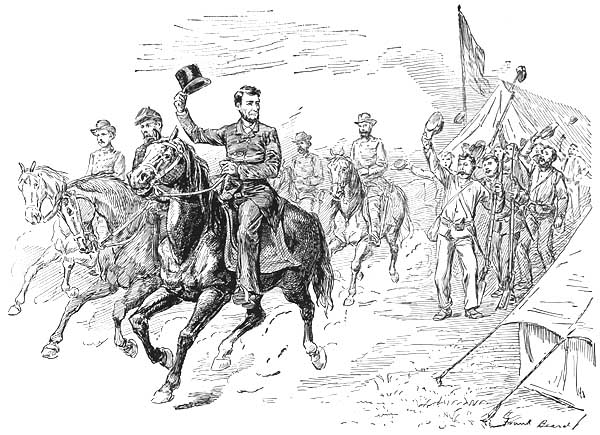
PRESIDENT LINCOLN VISITING CAMP.
The Northern soldier was the best clothed, and the clothing was uniform, which could not be said of that of the Southern soldier, who, although he was supposed to be dressed in gray or butternut, was really dressed in whatever he could pick up, which often did not include overcoats or oil-blankets. Supplied with good materials, and plenty of them, the Northern soldier was expected to take care of them, and he did so. But the Confederate soldier seldom took care to keep his weapons bright and free from dirt and rust. The Confederate lacked thoroughness in his camp housekeeping; he almost never fixed up the little comfortable arrangements that characterized a Union camp, if occupied for any length of time, nor did he "police" his camp carefully, to keep it neat or even clean, the lack of ordinary cleanliness being so marked as really to contribute materially to losses through disease. The way in which the Union soldier made even a temporary camp homelike was well described by an army correspondent, Benjamin F. Taylor:
"No matter where or when you halt them, they are at once at home. They know precisely what to do first, and they do it. I have seen them march into a strange region at dark, and almost as soon as the fires would show well they were twinkling all over the field, the Sibley cones rising like the work of enchantment everywhere, and the little dog-tents lying snug to the ground, as if, like the mushrooms, they had grown there, and the aroma of coffee and tortured bacon suggesting creature comforts, and the whole economy of life in canvas cities moving as steadily on as if it had never been intermitted. The movements of regiments are as blind as fate. Nobody can tell to-night where he will be to-morrow, and yet with the first glimmer of morning the camp is astir, and the preparations begin for staying there forever. An axe, a knife, and a will are tools enough for a soldier house-builder. He will make the mansion and all its belongings of red cedar, from the ridge-pole to the forestick, though a couple of dog-tents stretched from wall to wall will make a roof worth thanking the Lord for. Having been mason and joiner, he turns cabinetmaker; there are his table, his chairs, his sideboard; he glides into upholstery, and there is his bed of bamboo, as full of springs and comfort as a patent mattress. He whips out a needle and turns tailor; he is not above the mysteries of the saucepan and camp-kettle; he can cook, if not quite like a Soyer, yet exactly like a soldier, and you may believe that he can eat you hungry when he is in trim for it. Cosey little cabins, neatly fitted, are going up; here is a boy making a fireplace, and quite artistically plastering it with the inevitable red earth; he has found a crane somewhere, and swung up thereon a two-legged dinner-pot; there a fellow is finishing out a chimney with brick from an old kiln of secession proclivities; yonder a bower-house, closely interwoven with evergreen, is almost ready for the occupants; the avenues between the lines of tents are cleared and smoothed—'policed,' in camp phrase; little seats with cedar awnings in front of the tents give a cottage-look, while the interior, in a rude way, has a genuine homelike air. The bit of looking-glass hangs against the cotton wall; a handkerchief of a carpet just before the bunk marks the stepping-off place to the land of dreams; a violin case is strung to a convenient hook, flanked by a gorgeous picture of some hero of somewhere, mounted upon a horse rampant and saltant, 'and what a length of tail behind!'
"The business of living has fairly begun again. There is hardly an idle moment; and save here and there a man brushing up his musket, getting that 'damned spot' off his bayonet, burnishing his revolver, you would not suspect that these men had but one terrible errand. They are tailors, they are tinkers, they are writers; fencing, boxing, cooking, eating, drilling—those who say that camp life is a lazy life know little about it. And then the reconnoissances 'on private account;' every wood, ravine, hill, field, is explored; the productions, animal and vegetable, are inventoried, and one day renders them as thoroughly conversant with the region round about as if they had been dwelling there a lifetime. Soldiers have interrogation points in both eyes. They have tasted water from every spring and well, estimated the corn to the acre, tried the watermelons, bagged the peaches, knocked down the persimmons, milked the cows, roasted the pigs, picked the chickens; they know who lives here and there and yonder, the whereabouts of the native boys, the names of the native girls. If there is a curious cave, a queer tree, a strange rock anywhere about, they know it. You can see them with chisel, hammer, and haversack, tugging up the mountain, or scrambling down the ravine, in a geological passion that would have won the right hand of fellowship from Hugh Miller, and home they come with specimens that would enrich a cabinet. The most exquisite fossil buds just ready to open, beautiful shells, rare minerals, are collected by these rough and dashing naturalists."
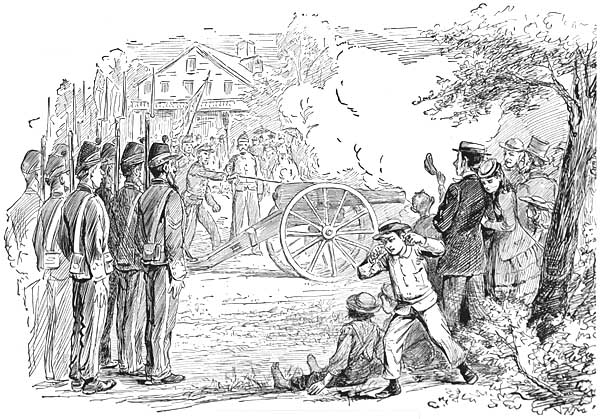
AN OLD-FASHIONED TRAINING DAY.
In the larger equipments of the army there was again a superiority in those of the North. Their wagon trains were better, the wagons of a uniform style, and they were marked with the name of regiment and brigade, so that there never was any doubt as to where a stray wagon belonged. The Confederate wagons were of all sorts and shapes and sizes, a job lot, ill-matched, ill-kept, and ill-arranged, and the harnesses were patchwork of inferior strength.
Residents of the South observed with pain one distinction between the armies, which reminds one of Henry W. Grady's remark about General Sherman, that he was a smart man, "but mighty careless about fire." Encamped in a Southern community, a Southern army was careful not to forage promiscuously, or appropriate to its own uses the various provisions and live-stock of the non-combatant people who lived near. But the Northern troops had a feeling that they were in the enemy's country and that they were entitled to live on it. There were orders against unauthorized foraging; but the temptation to bring into camp an occasional chicken, sundry pigs, cows, vegetables, and in some cases even money and jewelry, is said by Southern residents to have sometimes overcome a soldier here and there; so that the visit of a Northern army was the signal for the good people of the neighborhood to get as much of their belongings out of sight as possible. What was taken in this way was taken without the formality of a request, of payment, or of a receipt given, except when the victim claimed to be a loyal Unionist. The Southern soldiers usually paid for what they took, even if it was in Confederate script; but the Northern pillagers did not do even that. Those who recall and chronicle this habit, admit that it was due in great measure to the foreign element in the Northern army, and to the recruits from the large cities, elements which in the Confederate army were comparatively scarce.
The practical jokes that were played on some of the Southern farmers illustrate the tendency on the part of the Northern soldier to "do" a rebel. One farmer drove into a Union camp with a forty-gallon barrel of cider, which he sold by the quart to the men, over the side of his wagon. He was astonished to find that his barrel was empty after he had sold only about twenty quarts, and on investigating the cause, he discovered that while he was engaged in peddling the cider over the side board, some soldiers had put an auger through the bottom of his wagon and into the barrel, and had drawn the rest off into their canteens. Another trader lost the contents of a barrel of brandy which he had stored in a shanty overnight, in a similar manner; while several farmers concluded that it was in vain to go to the Yankee camp with wagon loads of apples or other fruit, unless they had a detachment to guard every side of the wagon, for while they dealt fair over one side, their stock would disappear over the other. One who had suffered in this way came to the conclusion that "the Yankees could take the shortening out of a gingercake without breaking the crust."
SOUTHERN SPIES AND SCOUTS IN THE WAR.
BY F. G. DE FONTAINE.
THE INGENIOUS DEVICE OF A WOMAN—DESPATCHES CONCEALED UNDER THE HIDE OF A DOG—"DEAF BURKE," THE MAN OF MANY DISGUISES—FREQUENT COMMUNICATIONS BETWEEN THE LINES—BISCUIT A MEDIUM OF CORRESPONDENCE—DEATH OF COON HARRIS AT SHILOH—A BOLD UNION SPY—AN EXECUTION AT FRANKLIN, TENN.
The secret service or "spy" system of the South did not differ greatly from that of the North. There may have been in that section a lack of available gold with which to pay expenses when desirable information was required, but there was certainly no absence of courage or patriotism on the part of those who were willing to risk their lives or imprisonment in the event of capture. This was especially true of Southern women; and those who are familiar with their achievements in this field of war will bear witness to the shrewdness, persistence, and fidelity with which they often pursued their dangerous investigations.
One or two incidents will illustrate. It was of the utmost importance to General Beauregard, in 1862, to learn the strength of McClellan's army and whatever facts might relate to his suspected designs on Centreville, Va. For this mission a woman was chosen. She was a young widow whose husband had been killed at the second battle of Manassas; a Virginian of gentle birth; prior to the war a resident of Washington, and a frequent visitor in the society circles of Baltimore, Philadelphia, and New York. Making her way across the lines, she promptly entered upon her task, and through trusty agents was soon enabled to obtain a complete roster of the Federal army, together with much valuable information concerning its probable movements. She was absent two months.
Returning at the end of this time, she crossed the Potomac opposite Dumfries, Va., an outpost then under the command of Col. (afterward Gen.) Wade Hampton, and the fair spy was promptly forwarded to the Confederate headquarters at Centreville. Her baggage consisted of a small grip-sack and a tiny Scotch terrier. Warmly welcomed by Beauregard, she proceeded with true womanly volubility to entertain him with a description of her adventures and their result. The general patiently permitted the lingual freshet to flow on without interruption, supposing that when she got tired she would produce the expected despatches from other secret agents in the North. But the little woman's tongue seemed to be hung in the middle and to wag at both ends; moreover, she was too pretty to be abruptly silenced by the polite creole commander.
Finally, unable to restrain his anxiety any longer, he said, "Well, Mrs. M., I shall be glad to see your papers."—"I didn't dare to bring them on my person," was the reply; "it was unsafe. In fact, I have been suspected and searched already, and so I familiarized myself with their contents. You see it is fortunate that I have a good memory." At this remark, Beauregard showed his chagrin, and frankly told the lady he could place but little reliance on her memory of so many figures and details, and therefore that her mission had proved of little use.
Listening to his scolding with a demure air, and looking at him with a mischievous twinkle in her eye, she called her dog: "Here, Floy!" The Skye terrier jumped in her lap. "General, have you a knife about you?" The knife was produced. Then she turned the animal over on its back, and, to the amazement of Beauregard, deliberately proceeded to rip him open. In less time than it takes to tell the story, she held in one hand the precious papers and in the other the skin of the Skye terrier, while prancing about the floor was a diminutive black-and-tan pup overjoyed at his relief from an extra cuticle.
The shrewd woman had sewed the despatches between the two skins in a manner that defied detection, and under the very noses of the Federal outposts had brought through the lines some of the most important information transmitted during the war. It is needless to say that Beauregard was delighted, and it was but a little while after this incident that McClellan advanced on Centreville only to find deserted camps, batteries of "Quaker guns," and the Confederate army falling back toward Richmond and Yorktown.
* * * * *
Combining in his person the qualities of scout, sharp-shooter, dare-devil, and spy, a Texan known as "Deaf Burke" made himself famous among the higher officers of Longstreet's corps during the early part of the war. Like Terry of Texas, afterward notorious in California, Adams of Mississippi, Mason of Virginia (brother of the United States senator who with Slidell of Louisiana, became the subject of international complications with England), and many other daring spirits, he was at first merely a volunteer or independent fighter subject to no orders; but his temerity in passing the lines, mingling in disguise with Union officers and soldiers, and his adroitness in securing valuable information quickly brought him to the notice of Lee and Longstreet. He was about forty-five years of age, a natural mimic and dialectician—could talk to you like a simpleton from the backwoods, or a thoroughbred gentleman—and he never lost his nerve. Not far from the Potomac, the writer met him in the garb of a Quaker, but only recognized him at night when incidentally he became a tent mate. Then it was learned that he had just returned from Washington, where during the preceding three weeks he had mingled among Southern sympathizers and secured the information for which he had been sent. Prior to this, disguised as an old farmer living in Fairfax County, Va., he had driven a load of wood across the Federal lines. In one of the logs were concealed the despatches intended for headquarters. Later in the war, when transferred to the West, he distinguished himself as one of twelve sharp-shooters chosen to handle as many Whitworth rifles that had been imported; and still later was killed in battle among the Texans, of whom it was his pride to be considered one.
The comparative ease with which communications were established between the lines is further illustrated by an incident. General Rosecrans and a portion of his staff, when in Tennessee, occupied a mansion not far from the outposts of the two armies. The hostess, Mrs. Thomas, was the wife of a Confederate colonel whose regiment was but a few miles distant. Her negro cook made excellent biscuit, which had become the subject of frequent comment at the table, the general being especially pleased. Mrs. Thomas taking advantage of this circumstance, and her acquaintance with him, suggested the propriety of sending some of the warm breakfast to their mutual friend—her husband. Rosecrans readily agreed, and under his own flag of truce, and through one of his own orderlies, a package of biscuit was duly forwarded to Colonel Thomas with an open letter from his wife. Two hours later, the Confederate officer was in possession of all the available secrets at Federal headquarters, and for weeks afterward the bake oven was the mute agent of communications, some of which proved important to the Southern commanders. The housewife had enclosed her tissue-written missives in the pastry, and the ruse was not discovered until after the war, when the story was told to mutual friends.
In the category of Southern women who in one way or another made their way through the lines, might be included many who carried to the Confederacy supplies of quinine and other articles that could be easily concealed on the person. It is safe to say that hundreds passed backward and forward across the borders of Virginia and Maryland, and with but rare exception their native shrewdness enabled them to escape the vigilance of the pickets on guard.
The bravery of Northern spies in the South is a theme not to be forgotten in this connection. Before General Sherman in his "March to the Sea" reached the several cities through which he was to pass, one or more of his secret agents was sure to be found mingling sociably among the residents. In Savannah, a gentleman appeared as a purchaser of the old wines for which that city was once famous, and remained undiscovered until the end came. In Charleston, news was communicated to the Union officers through the medium of two or three whites and of negroes who made their way to the islands on the coast, and there met and delivered to waiting boats' crews the papers consigned to their care. In Columbia, S. C., an officer wearing the uniform of the Confederate navy visited the best families for more than a month; escorted young ladies to fairs held for the benefit of army hospitals and other entertainments, and made himself generally popular. One of these newly made acquaintances was the daughter of the mayor. After Sherman entered, and the conflagration that destroyed the city was in progress, he repaired to her house and tendered his services. Then for the first time she learned the truth of the saying that she had "entertained an angel unawares." He aided materially in saving the property of the family and affording desired protection.
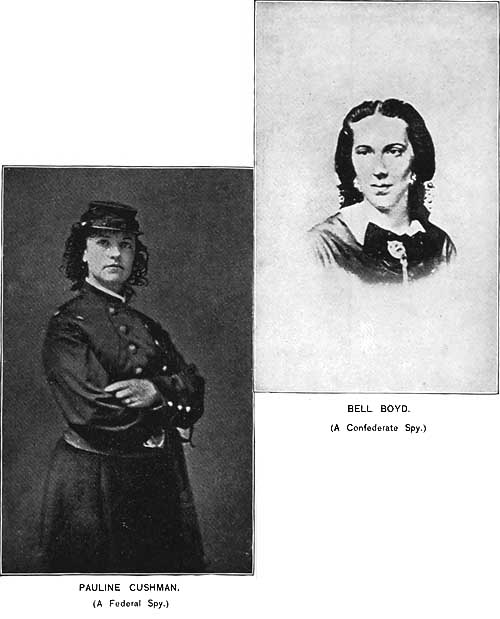
The task of a spy in the army was not so easy. It was full of personal danger. Success meant the praise of his superiors and possible promotion. Failure might mean an ignominious death. After the battle of Shiloh, or Pittsburg Landing as it is sometimes known, one Coon Harris, a Tennesseean, went through the Confederate army without detection, but in a skirmish a few days afterward he was captured while acting as guide to a column moving to attack a weak point in the Confederate lines. Bragg was in command, and the poor fellow had but a short shrift. Tried by a drum-head court martial, he was sentenced to be shot at daylight.
In his calm demeanor he illustrated how a brave man animated by a high principle can die. There was no pageantry, no clergyman with his last rites, no nothing, save a handful of curious spectators following a rude army wagon wherein, on a rough box called by courtesy a coffin, sat unbound a middle-aged farmer in his butternut suit, riding to his death. Not the closest observer could have discovered any difference in coolness between him and a bystander. Arriving at the place of execution he jumped lightly from the wagon, lingered a moment to see his coffin removed, and then sauntered carelessly down the little valley to the tree beneath which he was to meet his fate.
The ceremony was brief. The officer in charge of the shooting squad asked him if he had any final message to leave. "Yes," was the reply; "tell my family that my last thoughts were of them, and that I died doing my duty to my State and country!" Then his arms were pinioned, the faded brown coat was buttoned across his breast, and he sat down upon his coffin. A handkerchief was tied over his eyes, and voluntarily he laid his head back against the tree. Even now, preserving his remarkable self-possession, he called for a piece of tobacco, and, chewing upon it vigorously, occupied several seconds in adjusting his head to the bark of the tree, as one would fit himself to a pillow before going to sleep. Then he quietly said, "Boys, ready!"
A file of eight men stepped forward until within ten paces of the doomed man; the order was given to "Fire!" and with a splash of brains, and a trickling rivulet of blood down his hairy breast, the soul of the brave man passed into the keeping of the Creator.
During the first march of the Confederate army into Maryland, a handsome young fellow, one Charles Mason, who gave his home as Perrysville, Penn., boldly intercepted a courier who was carrying an order. "What division do you belong to?" he inquired. "Longstreet's," was the reply; "what's yours?" asked the courier. "Jackson's." The presence of a gray uniform favored this statement, and the two rode together. The courier, however, observed a disposition on the part of his companion to drop behind, and suddenly was confronted by a pistol and a demand for the delivery of his despatches. Not being promptly forthcoming, the spy fired, secured the papers, and galloped away. The Confederate lived long enough to describe his assailant and make his identification certain.
A few hours afterward the man became a victim to his own daring. Riding up to the head of a column, he said to the general in command: "I am from General Jackson; he desires me to request you to halt and await further orders."—"I am not in the habit of receiving my orders from General Jackson," answered the officer; "what command do you belong to?" Hesitating an instant, the spy said: "To the Hampton Legion." "In whose brigade and division is that?" continued the general. The pretended courier confessed that he had forgotten. Taken into custody, a search revealed his true character. On his person were found shorthand and other notes, a pair of lieutenant's shoulder straps, and other evidences of his calling. A drum-head court martial was promptly convened, and he was sentenced to be hanged then and there. He met his fate stoically, and without other expressed regret save that, since his mission had been a failure, he could not die the death of a soldier.
"On June 9, 1863," wrote a correspondent of the Nashville Press, "two strangers rode into the Union camp, at Franklin, Tenn., and boldly presented themselves at Colonel Baird's headquarters. They wore Federal regulation trousers and caps, the latter covered with white flannel havelocks, and carried side arms. Both showed high intelligence. One claimed to be a colonel in the United States army, the other a major, and they represented that they were inspecting the outposts and defences. Official papers purporting to be signed by General Rosecrans, and also from the War Department at Washington, seemed to confirm this statement. So impressive was their manner, in fact, that Colonel Baird, at the request of the elder officer, loaned him fifty dollars, the plea being that they had been overhauled by the enemy and had lost their wardrobe and purses.
"Just before dark they left camp, saying they were going to Nashville, and started in that direction. Suddenly, said Colonel Baird, in describing the occurrence, the thought flashed upon him that they might be spies; and turning to Colonel Watkins, of the Sixth Kentucky cavalry, who was standing near by, he ordered him to go in pursuit. Being overtaken, they were placed under arrest, and General Rosecrans was informed by telegraph. He quickly answered that he knew nothing of the men, and had given no passes of the kind described.
"With this evidence in hand their persons were searched, and various papers still further showing their guilt were found. On the major's sword was found etched the name, 'Lieutenant W. G. Peter, Lieutenant Confederate Army.' They then confessed.
"Colonel Baird at once telegraphed the facts to General Rosecrans, and asked what should be done. The reply was: 'Try them by a drum-head court martial, and if found guilty, hang them immediately.' The court was convened, and before daylight the prisoners knew they must die. A little after nine o'clock that morning the whole garrison was marshalled around the place of execution, the guards, in tribute to their gallantry, being ordered to march with arms reversed. The unfortunate men made no complaint of the severity of their punishment, but regretted, as brave men might do, the ignominy of being hung, and a few hours afterward both were buried in the same grave."
The history of the war on both sides is full of similar instances of daring, and since the curtain has fallen upon the bloody drama, and the voices of passion are hushed amid the anthems of peace, it is no longer in the hearts of true Americans to withhold the honor that belongs to all our heroes, whether they wore the blue or the gray.
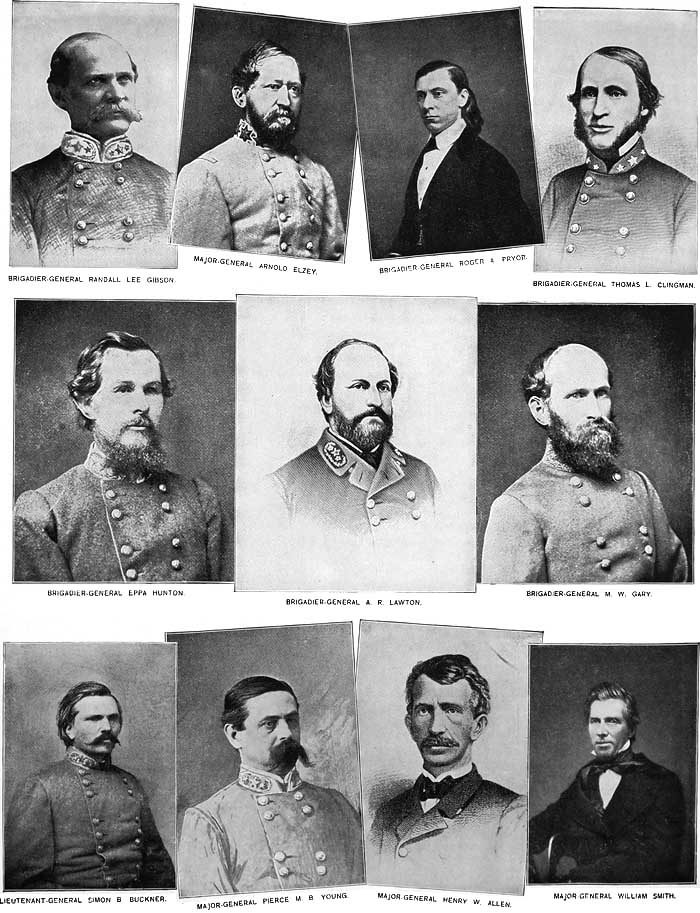
A GROUP OF CONFEDERATE OFFICERS.
NORTHERN SPIES AND SCOUTS IN THE WAR.
BY HENRY W. B. HOWARD.
IS THE RÔLE OF A SPY DISHONORABLE?—THE SPY A NECESSARY ELEMENT IN A CAMPAIGN—REMARKABLE HEROISM—ONE OF GENERAL GRANT'S SPIES—HOW HE ESCAPED BEING BURIED ALIVE—THE FIGHT OF A SPY WITH A BLOODHOUND—THE PERILOUS ADVENTURES OF CAPTAIN LEIGHTON, OF MICHIGAN—THE VARIED AND THRILLING ADVENTURES OF COL. L. C. BAKER—HIS EXPERIENCES AS A YANKEE SPY IN RICHMOND—MISS EMMA EDMONDS, A NOTED NORTHERN SPY—PASSING THROUGH THE CONFEDERATE LINES DISGUISED AS A NEGRO BOY—A FEMALE UNION SPY IN THE CONFEDERATE CAVALRY.
Military writers have not been entirely agreed as to whether the rôle of spy is an honorable part to play in warfare. Much stress has been laid on the necessarily disgraceful nature of a calling that can justly subject one to the hangman. The ignominy of this punishment is held to relieve all soldiers from the duty of service as spies, even under orders, and in consequence all spies are necessarily volunteers. But it is agreed, on the other hand, that the death penalty which is inevitable for the detected spy is intended, not as a punishment for the individual, but as a measure of preventing the spy from carrying on his work, so full of danger to his enemy. This lack of personal responsibility is so well understood, that a spy successful in his expedition is not liable to death after its completion, and if subsequently captured in battle may not be executed for having previously been a spy.
But however at variance they may be as to the nature of his calling, all critics are of one mind in regarding the work of the spy an absolutely necessary element in the conduct of a campaign by the commander. Without it, he would be at a loss as to the most essential facts that must govern his movements. The strength of the enemy, the nature and advantages of his position, the best approaches to it, the ground commanded by his batteries, as well as his intentions—all these and many other details must be in some degree known to a commander who would direct his troops with safety or success. Some of this information he can pick up from resident non-combatants; some he can wrest from his unwilling prisoners; some he can purchase from treacherous members of the force opposing him. But for most of it he is absolutely dependent on the brave men in his own command who are willing, for the sake of their cause, to risk the death that awaits the spy caught in the enemy's country.
These men certainly cannot be regarded with the contempt which a commander feels for the mere tools of whose treachery, cupidity, or indifference he avails himself while scorning the instrument. And, if not that, then they must be regarded as heroic even beyond those of their fellows who are as brave as lions on the field of battle. For their mission is a solitary one, and they have none of the cheering companionship and stimulating emulation that bring courage for the charge. Instead of being under fire for a few brief moments or hours, their nerves are on the rack for days and weeks. With no commanding officer to obey as he orders them here or there, they are thrown on their own resources in the most perilous and trying situations. They must avoid dangerous meetings, disarm suspicions, turn aside questions, invent lies by the hundred without having one contradict another. A constant play of quick wits, steady nerves, and, at the right moment, prompt and courageous physical force, elevates the work of a spy to a fine art, in comparison with which the mere enthusiastic bravery of the battlefield is child's play. Darkly threatening throughout all this perilous work is the imminent and ever-present risk of detection, with its certainty of a death, not glorious like that of those who fall in the hand-to-hand conflict, not the ordinary fortune of war like that of the sharp-shooter's victim brought down at long range, not even invested with the pathos of a death, however sudden, among sympathizing comrades—but the death of a dog, promptly dealt out, without a friendly face among the spectators.
A good illustration of the consummate skill, coolness of head, and strength of will and nerve required in this duty was given by a scout named Hancock, attached to General Grant's army in Virginia. He had failed to escape detection, and was sent under guard to Castle Thunder, in Richmond. His situation was most perilous; but this did not prevent his utilizing his innate joviality to lighten the life of his fellow-prisoners, and bringing his wonderful power of facial expression to bear on the great object of his own escape. In the midst of one of his songs in the prison he suddenly threw up his hands with a cry, fell to the ground in a heap, and lay there so obviously dead that the post surgeon—not over-solicitous to keep a Yankee above ground—pronounced him a case for the grave-digger, and he was bundled into a pine coffin and started on his last journey. But when the driver reached the burying-place, the coffin was empty. Hancock had dexterously slid from the wagon, and, it being night, had joined the followers on foot without detection. When the driver reported back to the prison, the trick was suspected, and a sharp lookout was ordered, which he evaded in the most unexpected way. He went direct to the best hotel in Richmond and registered from Georgia, had a good night's rest, and spent the following day, in the character of a government contractor, in learning what he wanted to know about the city. He was twice arrested by the guards, and escaped the first time through the intervention and identification of the hotel clerk. The second time he was returned to the prison, where for seven days he concealed his identity by assuming a squint and a distortion of feature, which he abandoned when he learned that imprisonment was all he had to fear, as by that time the war was virtually over. Ten days later he was set at liberty with his fellow-prisoners.
The peril of a spy's career is not intermittent, like that of active fighting; it is continuous. A moment may give him his liberty or may bring him face to face with death. An unnamed scout of the Army of the Potomac—so many of these heroic men are even to this day unnamed—had collected his intelligence in the enemy's country, and had arrived close to the stream beyond which were the Union lines. In the darkness of the night, with the sense of danger keen within him, he groped his way along the shore, seeking the skiff he had concealed there for his return. To his horror it dawned on him that he had missed his landmark and could not find the boat. There he stood, the evidences of his calling unmistakably on him, knowing that he had been suspected and followed, and realizing that only a few minutes were his in which to complete his escape. Nothing could exceed the mental agony of the next quarter hour. Under stress of danger he had just let himself into the water, determined to attempt to swim the wide stream as a forlorn hope, when suddenly the baying of a bloodhound dashed even this faint hope from him, and presently the crackling of twigs announced the near approach of the savage pursuer. But there were evidences that for the moment the dog was at fault, and in mere desperation the hunted man waded beneath the overhanging banks where he might sell his life as dearly as possible. Something struck against his breast. He could not restrain a cry as he seized what proved to be his missing boat. In an instant he had clambered in and cast off the line, when a sudden gleam of moonlight breaking through the clouds revealed at the other end of the log to which the boat had been moored the crouching figure of the bloodhound, poising for a spring. Simultaneously with the leap of the dog, the skiff darted out into the stream. A blow with the oar aimed at the head of the animal nearly upset the fragile craft and was easily eluded by the dog, which, swimming forward, laid its forepaws on the gunwale and attempted to seize the edge of the boat with his teeth. The situation was desperate. Laying aside his revolver, a shot from which would have drawn a volley from the shore, the brave scout seized his bowie-knife, and with one frenzied stroke cut the throat of the bloodhound, severing its neck clean to the back. The dog sank from sight, and the man was free! A few minutes' quiet pulling landed him on the further shore, whence a brief walk brought him to camp, to tell his adventures and turn in his stock of information.
Perhaps as thrilling an experience as ever was reported was that which fell to the lot of Captain Leighton, formerly of a Michigan battery, but led by the fascination of adventure into scout and spy duty. It was brief, but so charged with peril and nerve-tension that in a few short hours he seemed to have lived days, and needed a long sleep after it, as though he had been awake for a week. In a single afternoon he left his own camp and rode into the enemy's country, passing two pickets, killed a guard, listened to the council of war in the tent of the rebel general, fought his way back through the pickets, who now knew his mission, set off the signal agreed on, and rode to safety on his unusually fleet horse. The first picket he met on his way out was misled by supposing him to be a spy of their own returning with information, and from them he got what sounded like the countersign, but was not, as he discovered when, riding on, he attempted with it to pass the sentry near the rebel general's tent. The sentry pulled trigger on him, but the cap snapped on the musket, there was a hand-to-hand scuffle not a hundred yards from the camp, and the sentry was stabbed to the heart. Clad in the sentry's uniform, under cover of the night, he heard from the very lips of the general and his council the secret he was in search of—that the enemy would mass on the left wing to meet the attack of the morrow—sauntered carelessly about as the council dispersed, and then mounted his superb gray and was off. It was a perilous ride, for every picket he had passed in the afternoon fired on him as he rode through, and it was indeed a charmed life that escaped their bullets. The last picket he had to pass—the same that had mistaken him for a rebel scout—was numerous, and met him with a volley, followed up by a sharp attack with sabres and revolvers. Shooting, stabbing, slashing, and swearing like a fiend, wounded and wounding, he fought his way through them, and then fled onward, reeling in his saddle with excitement and loss of blood, until, arrived at the hollow stump where his rockets were concealed, he set them both off (thus giving the desired information to his own commander). Then, emptying his revolver at his nearest pursuer, he again rode away, unharmed further by the shots that followed him like hail. What added to the bravery of this deed was the fact that he knowingly went out to replace a scout who had been killed the night before on the very same mission.
REDUCED FACSIMILE OF POSTER ISSUED BY THE WAR DEPARTMENT.
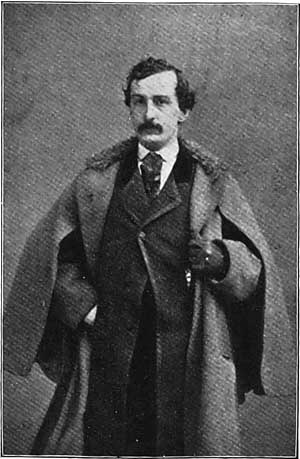
JOHN WILKES BOOTH.
All spies were not so fortunate as to complete their expeditions in one day. Sometimes, although in comparative safety, they were unable to get out of the enemy's territory for many days. An Illinois private, named Newcomer, who had just missed some important battles, was accustomed to vary the monotony of his camp life in Alabama by making secret trips after information overnight. This work suited him so well that he determined on a more extensive expedition among the guerilla cavalry that he learned from a negro lay some miles below the Union camp. His first bold act was to crawl into a corn-crib where a number of these men lay sleeping, their horses picketed outside, and, feeling around, he calmly drew a good revolver from the belt of one of the unconscious sleepers, having the good luck to wake none of them up. He had provided himself with a forged certificate of discharge from the rebel army, by means of which he was by some unsuspecting Southern sympathizers put in communication with a Southern agent for the purchase of stores, named Radcliffe, who was known to everybody in and about Franklin, Tenn., and who vouched for him throughout his stay among the Confederates. He took on the character of one seeking office in the rebel army, and as a seller of contraband articles obtained from the North. In this guise, turning up at Radcliffe's house as occasion required, he explored the situation and reported back to his superiors at Nashville. Before he got back he had serious trouble in getting away from Shelbyville, for lack of a pass. A good-natured crowd, to whom he had dispensed the contents of his whiskey flask, were willing to help him away, but stuck at telling the provost marshal that they knew him; but it was finally managed by writing his name on the collective pass on which they travelled. Lagging behind them on the road, he turned off in the direction he wanted to go, only to fall into the hands of one of Morgan's bands of scouts, who swore he was a Yankee, and actually had the halter around his neck to hang him on the spot, when he succeeded in persuading them to take him back to Radcliffe for identification, where he was released, and then was furnished by Radcliffe with a written voucher on which he succeeded in making his way, after many exciting and perilous adventures, to his commander. He brought him the important news, confided to him by a rebel who took him for a fellow spy, of a projected attack on the Union fleet on the river, and steps were taken that saved the ships.
Perhaps the most varied experience was that of Col. L. C. Baker, who organized the secret service, and performed himself every duty, from that of actual spy to that of chief of the national police, beginning with a personal expedition to Richmond and ending with the capture of Wilkes Booth, the assassin of President Lincoln. His first Richmond trip was made in July, 1861, under cover of a general movement of Southern sympathizers away from the North. General Scott himself sent him to obtain information concerning the strength and disposition of troops in the Confederate capital. His greatest difficulty at the outset was to get through the Northern lines without betraying his errand, and three times he was sent back to General Scott as a Southern spy. Finally he got through, and, armed with letters to prominent residents of Richmond, he was promptly forwarded on his way, but was carefully turned over to Jefferson Davis himself, who kept him under guard while he made up his mind whether the stranger was a spy or the "Mr. Munson" he pretended to be with business in Richmond. Succeeding in getting satisfactorily identified through a sort of "bunco" self-introduction to a man from Knoxville, where he claimed to have lived, he was paroled and turned loose in Richmond. When he had picked up the information he desired, he began his efforts to get back to Washington with his precious news. A pass to visit Fredericksburg enabled him to leave Richmond, but an attempt to go further on the same pass only got him into the hands of a patrol. But he soon not only eluded his sleepy guard, but rode off on the sentry's horse as well. Followed and surrounded in a negro cabin where he had stopped to rest, he managed to hide under a haystack, where he narrowly escaped the searching sabre-thrust of his pursuers, and then made again for the Potomac. Hunger induced him to risk introducing himself to two German pickets guarding the bank on the Confederate side of that river, and they hospitably kept him in their tent overnight, though they watched him closely and made him a semi-prisoner. The watches of the night he consumed in vain endeavors to crawl out of the tent while his captors slept; but they slept "with one eye open," as it were, and it was not until dawn that he managed unobserved to get down to the river-bank, secure the pickets' boat with its single broken oar, and push for liberty out into the stream. The men were quickly after him, however, and he had to shoot one of them to save himself, while the other ran for assistance. The detachment that quickly reached the shore made the water about his craft uncomfortably lively with their bullets; but he fortunately managed to paddle out of range without being hit, and after a row of four miles, which was the width of the river at that point, he reached the Maryland shore and made his way to Washington.
The papers with which Baker had been intrusted at Richmond gave him much information involving Northern traitors who were aiding the Southern cause, and for some time he was engaged in the work of bringing them to justice. But he occasionally returned to special duty, as he did in the autumn of 1863, when, after Pope's defeat by Lee, great solicitude was felt for the safety of Banks's army, the whereabouts of which even was unknown, and in ignorance of Lee's success Banks was supposed to be seeking a junction with Pope. Baker undertook to carry informing despatches to Banks, and to bring that officer's report back to Washington. Mounted on the famous race-horse "Patchen," he succeeded in reaching Banks near Manassas without adventure, but his return trip was full of peril. Conscious of the great importance of haste, he started straight for the rebel lines between himself and Washington, and after riding two miles to the eastward he caught sight of the hostile army near the old Bull Run battlefield. To save time, instead of making a detour to avoid them, he halted and awaited an opportunity of slipping through, availing himself of the detached order of march in which the enemy was proceeding. A break in the column soon gave him this chance, and although he knew that he would become a target for every marksman that saw him, the intrepid Baker nerved himself for a quick and desperate dash and gave spurs to his splendid steed. Lying close to Patchen's neck, he flew like an arrow within thirty feet of a squad of infantry, but had the good luck to bring both himself and his horse through without harm from the bullets that whistled thick about them. A squad of cavalry quickly took up the pursuit; but, tired as he was, Patchen soon distanced all but a few who were particularly well mounted. For nine miles the chase continued, the pursuers dropping off until only three remained, when fatigue began to tell on both horse and rider. Then, turning a low hill, Baker wheeled sharply about and concealed himself in a clump of pines, while his pursuers rode past unconscious of his presence. But they soon discovered that there was no longer any one in front of them. Returning, one of them was apprised of Baker's whereabouts by a slight movement of the latter's horse, and the crisis of the adventure was at hand. Baker shot down one Confederate cavalryman, and then turned sharply off the path to avoid the other two, who were now on their way back. But, although he passed them, it was not without their seeing him, and, firing their carbines, they renewed the pursuit. Spurring Patchen to a final burst of speed, Baker plunged into the swollen waters of Bull Run, hoping to get across before his pursuers could reach the bank and fire at him in mid-stream. This he accomplished, and had even clambered up the almost perpendicular bank beyond by the time the rebels had plunged in to follow him over. Before Baker could fire on them the Union pickets, attracted by the shots, came running to the edge of the bluff. Baker shouted out his errand, and the pickets with a volley emptied one of the Confederate saddles, while the remaining pursuer escaped to tell the tale. This was a pretty close call for Baker, but it was typical of the scout's experience, and illustrated well the many serious chances taken by every successful seeker after information in the enemy's territory.