Volume 8 — Evans’s Pedestrious Tour of Four Thousand Miles—1818
Reading edition
Reprint of the original edition: Concord, New-Hampshire, 1819
94
95
96
DISTRICT OF NEW-HAMPSHIRE, TO WIT:
BE IT REMEMBERED, That on the 10th day of December, 1818, and in the forty-third year of the Independence of the United States of America, ESTWICK EVANS, of the said District, has deposited in this Office the title of a Book, the right whereof he claims as Author, in the words following, TO WIT:
“A Pedestrious Tour of Four Thousand miles, through the western States and Territories, during the winter and spring of 1818; interspersed with brief reflections upon a great variety of topics: religious, moral, political, sentimental, &c. &c. By ESTWICK EVANS.
“The blast of the north is on the plain; the traveller shrinks in the midst of his journey.”
In conformity to an act of the Congress of the United States, entitled, “An Act for the encouragement of learning, by securing the copies of Maps, Charts, and Books, to the Authors and Proprietors of such copies,” during the times therein mentioned: and also to an act entitled “An Act supplementary to An Act,” entitled an act for the encouragement of learning, by securing the copies of Maps, Charts, and Books, to the authors and proprietors of such copies during the times therein mentioned; and extending the benefits thereof to the Arts of Designing, Engraving, and Etching Historical and other Prints.
PEYTON R. FREEMAN,
Clerk, of the District of New-Hampshire.
98
DISTRICT OF NEW-HAMPSHIRE, TO WIT:
BE IT REMEMBERED, That on the 18th day of January, 1819, and in the forty-third year of the Independence of the United States of America, ESTWICK EVANS, of the said District, hath deposited in this Office the title of a Book, the right whereof he claims as Author, in the words following, TO WIT:
“A Pedestrious Tour of Four Thousand miles, through the western States and Territories, during the winter and spring of 1818; interspersed with brief reflections upon a great variety of topics: religious, moral, political, sentimental, &c. &c. By ESTWICK EVANS.
“The blast of the north is on the plain; the traveller shrinks in the midst of his journey.”
In conformity to the act of the Congress of the United States, entitled, “An Act for the encouragement of learning, by securing the copies of Maps, Charts, and Books, to the Authors and Proprietors of such copies,” during the times therein mentioned.
PEYTON R. FREEMAN,
Clerk, of the District of New-Hampshire.
A true copy of Record,
Attest, Peyton R. Freeman, Clerk.
The author is sensible that there are some typographical and other errors in the following work; but as they will be found few and inconsiderable, it is not deemed worth while to notice them.
99
PREFACE
An author, however inconsiderable he may be, always feels that he has something to say to the public concerning his work; he must, therefore, have a preface. I think, however, that such a course is seldom necessary; the world, after all which the writer can express, will judge impartially of his motives, and of the execution of his plan.—My introduction will be very brief.
In justice to myself I ought to observe, that until after finishing my tour, I did not entertain the least idea of publishing an account of it; and that I have been induced to take this step by the request of many of my fellow-citizens.
It will be readily perceived, that a work of this kind does not admit of the display of much reasoning or erudition; and I shall speak as little of myself as will be consistent with the nature of the publication. This little volume cannot possibly merit much praise; and I trust that it will escape unqualified censure.
Portsmouth, N. H. 1818.
101
TOUR
The supposed singularity of the tour, an account of which I am about to write, suggests a few preliminary observations.
Customs and manners often produce more influence than principle. Whilst the former are strictly adhered to, the latter is often violated. Here we see the comparative influence of self-reproach and the reproach of the world: a deviation from custom, in relation to modes of living and acting, may excite animadversion. We shrink from the unfriendly gaze of the multitude; and tremble even at the undeserved censure of the superficial and ill-natured:—at the same time we disregard the condemnation of our own hearts, and endeavour to cancel the obligations of morality by the good, yet false, opinion of the world.
But it is readily acknowledged, that unless excentricity ought always to be avoided; it invariably proceeds from error in taste, from uncontrouled feeling, or from mental imbecility. The dispositions and powers of men, however, are various; and the beaten track is not always the field for improvement.
Civil society is not without its disadvantages. Whilst it adds to the information, and polishes the manners of man, it lessens the vigour of his mind and the generosity of his heart. He no longer experiences the sublime inspirations of Nature. A creature of habit and the slave of form, she will not [6] deign to visit him. From the factitious grandeur of cities, she wings her eagle flight, to communicate to the uncontaminated children of her forests her instruction and blessing.
102In the savage state there is, no doubt, much individual depravity; as great a degree of it, however, may be found in the most civilized communities. But in the latter are never witnessed that nobleness of spirit, that eloquence of thought, that force of expression, and that wonderful aspect which the former affords.
It is true, that the aggregate advantages of civil society are much greater than those of a state of nature; and how happy should we be if we could ingraft the instruction, and impress the polish of civilization upon the lofty virtues of untutored life. But, with us, courage gives place to cowardice; and the native disinterestedness of man, the source of his greatest virtues and highest happiness, yields to the calculations of meanness and fraud. Even in public life we please ourselves with the tinsel of narrow views, whilst we disregard those great principles of national policy which alone can render us truly great.
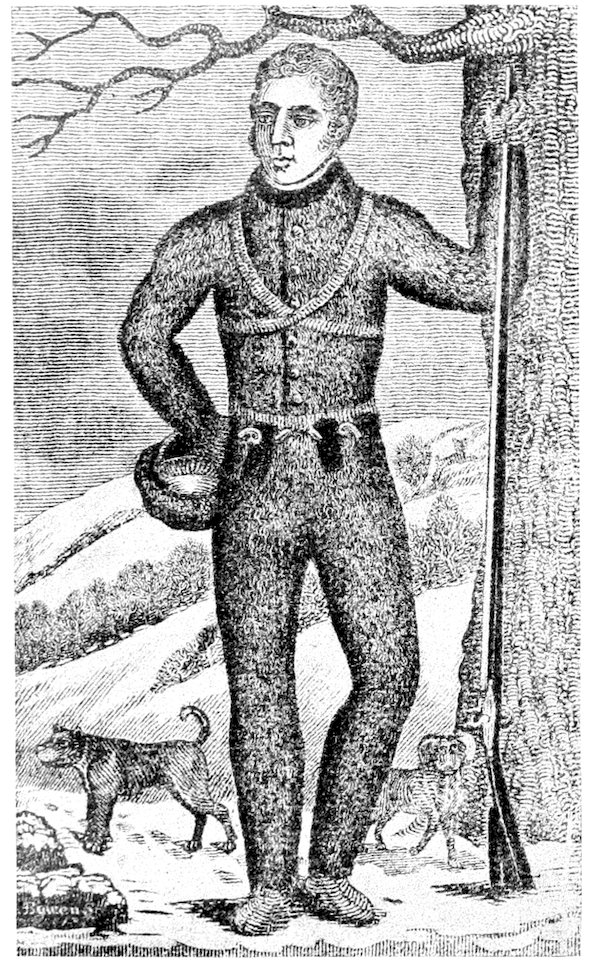
I have often been questioned as to the objects of my tour; and I am willing to gratify a reasonable and friendly curiosity. My views were various. Besides the ordinary advantages of travel, and of becoming acquainted with a country comparatively but little known, I wished to acquire the simplicity, native feelings, and virtues of savage life; to divest myself of the factitious habits, prejudices and imperfections of civilization; to become a citizen of the world; and to find, amidst the solitude and grandeur of the western wilds, more correct views of human nature and of the true interests of man. The season of snows was preferred, that I might experience the pleasure of suffering, and the novelty of danger. [7] On the second of February, 1818, I left the residence of my friends, in Hopkinton, New-Hampshire, prepared, according to the frontispiece, to meet the inclemency of the season, the hostilities either of man or beast, and also to provide myself, in the way of game, with provisions.
103It may gratify some to know the particulars of my habiliment: Mine was a close dress consisting of buffalo skins. On my shoulders were epaulettes made of the long hair of the animal; and they were for the purpose of shielding the shoulder from rain. Around my neck and under one arm was strapped a double leather case, with brass chargers, for shot and ball; and under the other arm a case for powder strapped in the same way, and also having a brass charger. Around the waist was a belt, with a brace of pistols, a dirk, two side cases for pistol balls, and a case for moulds and screw. Also around the waist was buckled an Indian apron, which fell behind: it was about eighteen inches square, covered with fine bear skin, trimmed with fur, and having over the lower part of it a net for game. This apron contained a pocket compass, maps, journal, shaving materials, a small hatchet, patent fire works, &c. My cap and gloves were made of fur, my moccasons were of deerskin, and on my shoulder I carried a six feet rifle. The partners of my toils and dangers were two faithful dogs.
In this situation I arrived at Detroit on the 20th of March. My dogs, however, were destroyed by wolves, on the night of the tenth of that month, in the vicinity of the Miami Swamp.
I had, in my juvenile days, voluntarily accustomed myself to fatigues, hardships, and privations of every kind; but not having recently exercised much, the snow being deep, and my dress and baggage heavy, my fatigue, in the early stages of my tour, [8] was excessive: My first day’s travel was only eight miles. In a short time, however, my daily progress was from fifteen to twenty miles, through trackless snows and over tremendous mountains. The universal curiosity which my appearance excited was oppressive; but I had fortified my mind by reflection, and endeavoured to present to all an aspect at once grave and 104mild. In the course of my tour, I met, as might have been expected, a great variety of character; from the savage of the wood to the savage of civil life; and I sometimes found it necessary to appeal to my arms, for the defence of the privileges of the traveller and the rights of the man.
My title-page promises reflections upon various subjects. I hope they will neither be too frequent nor too lengthy. The study of man, both as it respects the abstract principles of his nature and the almost infinite variety of modes in which these principles, through the influences of education and customs, develope themselves, should be one great object of the traveller. In order to become well acquainted with these principles, he must frequently and maturely examine his own heart. Here alone can he ascertain the secret springs of action; here alone can he define and classify the passions; and lastly, here alone can he find the means of their controul, or of giving to them a proper direction. Much information, in relation to this subject, may be collected from books, and much by travel; but he who is ignorant of his own heart must be ignorant of human nature.
In my way to the interior I passed through Amherst;[40] and reached this place towards evening, during a heavy fall of snow. I had been anticipating the pleasure of visiting the family of Judge C. who reside there; but the ladies of the family, supposing me to be an indian, barred the doors against me. I [9] soon, however, obtained a herald, and then the castle gates were elegantly thrown open. On account of this little adventure, which arose 105principally from the lateness of the afternoon and from my being covered with snow, some captious scribblers took the liberty, in the papers of the day, to be impudent. Could I condescend to be offended with them, I should here tender my forgiveness.
For the above anecdote I am indebted, principally, to the interesting Miss L******, whose vivid imagination, aided by the story of the giants, magically converted her habitation into an embattled tower, and gave to a harmless knight a consequence which he did not deserve.
Amherst is a considerable inland town. The plain upon which the village is situated is very spacious; and some of its buildings are large and elegant.
From this place I proceeded to Milford,[41] the residence of my friend P. whose love of principle, independence of character, and talents, entitle him to much consideration. With him I passed some pleasant hours. The appearance of this town is pleasant. The contrast between its extensive intervales, and the rise of ground upon which its bridge, manufactories, and village are situated, renders its aspect quite interesting.
The distance between Amherst and Milford is only a few miles; but in travelling from the former to the latter I found the snow deep and stiffened by rain, and the road trackless.
The next day I began to ascend the mountains of New-Hampshire:—my native hills!—Oh, may they be the everlasting abode of Liberty! The weather here was variable, the snow in some drifts ten feet deep, my fatigue extreme, and my health impaired. The towns 106of Milton and Temple,[42] [10] situated in this part of the country, are pleasant; and the scenery about them highly picturesque. Several branches of the Sowhegan in the former, and the streams which pass into this river from the westerly part of the latter, add much to the variety and beauty of the prospect.
The next evening I found myself in Marlborough. The weather had become severe, and my ability to travel without fatigue was increasing. The mountainous aspect of the country, the front of my cap, &c. whitened by frost, and the creaking of the snow beneath my step, reminded me of Wallace and Tell; those champions of freedom, whose physical nature was as rugged as the rocks which they inhabited, and whose hearts, at the same time, could glow with generosity, or soften with compassion. The Grand Monadnock here attracted particular attention. It is more than two thousand feet in height, and is remarkable for its cave and its fossils. Peterborough and Dublin, the towns between Temple and Marlborough, are interestingly situated. The former is very mountainous, and its numerous brooks render it a fine grazing township. A principal branch of the Contoocook passes near the centre of the town, and here unites with Goose river flowing from Dublin. The latter place is exceedingly well watered, and its two villages, together with some scattered houses, make a pleasant appearance.
The coldness of the weather continued to increase. I passed on through Keene[43] and Chesterfield. The appearance 107of the former excited much interest. It is almost an inland city; and promises to make a very conspicuous figure. It is also, evidently, a place of much business; and from the appearance of some of its buildings, together with what little knowledge I possess of its society, I should suppose [11] it a place of considerable polish and refinement. Chesterfield too is a very pretty town. The undulatory aspect of its hills, the quiet of its vales, and the neatness of its village made a very pleasant impression upon my mind.
Soon after leaving Keene I passed over high and steep hills. Some of them were, apparently, several miles in length. In one of the vallies of these mountains an amusing incident occurred. It is a trifle, and may be thought not worth mentioning; I feel a pleasure, however, in doing justice to good nature: I met three six feet fellows in a single sleigh. They were, probably, going to Keene in their best. There had fallen, the night before, a light snow of a few inches; and their horse, not fancying my appearance, took it into his head, notwithstanding I gave him the whole road, to sheer against the wall, and to turn all these well-looking grenadiers into the snow. I was preparing to make an apology; but it was unnecessary: the good nature of these liberal men furnished for them and myself a hearty laugh.
During the following day I passed Connecticut river; and entering Brattleborough, Vermont, proceeded to the further part of the adjoining town.[44] The appearance of the country just before my crossing the Connecticut, was truly interesting. My course was around a mountain about half way between its summit and the river below. 108It was the sabbath day; and the mildness of the christian religion seemed to breathe around. The rays of the sun, with a kind of vivid obscurity, darted through the wood; and the solemn, yet cheerful, gospel bell of a neighbouring villa spake of the pure and peaceful communion of saints. Even the game seemed to know it was the sabbath, and did not shun my path. Perhaps it was wrong in me thus to travel. I had [12] never done so before. My situation, however, was peculiar, and I endeavored to confine my thoughts to the appropriate views of this holy season.
I am now upon the borders of my own peculiar country. A single step carries me from New-Hampshire; and when I shall again behold her pleasant hills is uncertain—Perhaps never!
The term banishment is, in this part of the world, seldom employed; and its introduction here may appear unmeaning. But those who have been exiled by their country, by misfortune, or by themselves, will hear the word with a glow of interest, and find, in their own hearts, its true and ready definition. Is there no exile beyond the limits of our land?—no spirit which sighs for the scenes of childhood?—where the light of Heaven was first beheld, and the impression of thought first created?—where friendship first warmed, and love etherialized, and patriotism fired? Oh! if prayer is heard on High, it must be the exile’s prayer.
The tears of patriotism need no apology. The name of New-Hampshire is identified with that of freedom. Her mountains were never intended for slavery; and tyrants, I know, could not exist in the presence of her people. Were she just to herself, she would always excite fear in her enemies and admiration in her friends. Her institutions are dictated by the spirit of self-government, and her will is the supreme law of the land. Her citizens are 109hardy, intelligent and virtuous; her climate is salubrious and her soil fertile; her hills are covered with cattle, and her vallies wave with grain. Industry, economy, and mechanical genius are conspicuous characteristics of her people; and a thousand streams, intersecting the whole country, tender to the manufacturing interest their powerful agencies. In point of hospitality too she [13] is second to none; and the virtue, benevolence, and beauty of her daughters are, at once, the inspiration and the reward of valour.
Within a few years I have visited nearly all the states and territories of United America. I have noticed their respective moral and physical character, and have viewed them in relation to the ordinary causes of the rise and fall of nations. Should the freedom of this country ever perish, one of her last intrenchments will be in the mountains of New-Hampshire. Her citizens, however, must, by adhering to her constitution, and by proper systems of education, preserve in their minds a knowledge of the first principles of civil liberty, a due sense of the importance of morality, and a lively interest in the transactions of the Revolution. The whole history of that great event should, with us, constitute an indispensable part of education. But in speaking much of its battles, we must think more of its principles. The latter were so perfectly correct; and the manner of acting upon them was so candid, so humane, so firm, so steady, and so persevering, that no political event, since the creation of man, merits half so much admiration as the achievement of our independence.
Before leaving New-Hampshire I may say a word respecting Connecticut river. It is one of the most pleasant and useful rivers in the world. It generally preserves a distance of from eighty to one hundred miles from the ocean, and meanders through a very fertile country to the 110distance of more than three hundred miles. It waters New-Hampshire, Vermont, Massachusetts, and Connecticut, and at length passes into Long-Island Sound.
I am now in Vermont.[45] This is a noble state, and may well be termed the peculiar sister of New-Hampshire. The same mountainous and fertile [14] country; the same moral and physical energies characterize them both. Should their liberties ever be assailed, they will sympathetically unite their efforts, and triumph or fall together. In both of these states I met with Revolutionary men, and they were still the champions of liberty. The tranquil charms of rural avocations had preserved the purity and peace of their bosoms; whilst the grandeur of their mountains, and the rudeness of their storms had continually reminded them of the blasts of tyranny, and of the unconquerable spirit of freedom.
In both of these states I experienced unlimited hospitality and kindness. Money could not have purchased so rich a boon. Amidst their lofty hills, covered with deep snows and assailed by piercing winds, I found the humble cottager; and in the benevolence of his aspect, and the hospitality of his board, I seemed to hear the chorus in Gustavus Vasa:—[46]
“Stranger, cease through storms to roam;
Welcome to the cotter’s home;
Though no courtly pomp be here,
Yet, my welcome is sincere.”
111In some parts of these states one may travel many miles without meeting a habitation; and during deep snows and severe weather there is no little danger of perishing.
In passing the Green Mountains, I experienced a very narrow escape. The weather was remarkably severe, and scarcely any one thought travelling practicable. The wind being high the snow was whirled in every direction, and the road was trackless. About 4 o’clock in the afternoon I passed a house, and, imprudently, omitted to inquire as to the distance to the next dwelling. Fortunately, [15] however, I met, after travelling three miles, an express from a neighbouring village; and he informed me that the next habitation was at the distance of two miles. To this circumstance I owe, probably, the preservation of my life.
About dark I arose a steep hill, and found myself in an open and uncovered situation. The weather was intensely cold, and the wind very high. I realized that owing to the depth of the snow, the consequent difficulty of obtaining fuel, and the probable chill which I should experience after ceasing to travel, that the wood, from which I had just emerged, could not afford me sufficient shelter. I should, however, have resorted to its partial protection in preference to exposing myself to an unsheltered opening, had I not fully presumed, from the information above noticed, that a habitation was near. There was not a moment for indecision. I marked a central course, redoubled my efforts, and in a half hour reached a comfortable hut. Here, upon taking off my cap, I found my ears frozen to an almost incredible degree.
It is high time for me to acknowledge some obligations, which have a particular claim to my gratitude, not only as it respects these stages of my tour, but throughout the whole of that part of it which was enlivened by civilization.
112Benevolence and kindness are peculiar characteristics of the female heart. The mildness of her nature comports with the delicacy of her appearance; and well may Charity always be represented in feminine apparel. During my tour, the hospitality of the husband was always more than seconded by that of the wife and daughter.
Such are my respect for, and admiration of the female character; so high an opinion do I entertain both of her understanding and heart; and so narrow [16] are the views of many, even in this enlightened age, in relation to these particulars, that I may be permitted, in this little work, to become her advocate. A thousand arguments in her behalf challenge my attention; but I must not transgress the proper limits of incidental remark.
The influence of woman, in civilized life, has not yet reached its acme. The effects of her ancient condition are not entirely removed. Hereditary ignorance and oppression still partially obstruct her intellectual progress. She has, in times past, not only had to contend with an almost entire seclusion from the world, where alone theoretical and practical knowledge are blended for the improvement of the human mind, but the other sex, unconscious of moral force and influenced only by a sense of physical strength, have, in various parts of the globe, treated her as an inferior. Oh, wretched pride!—oh, disgraceful ignorance!—oh, vulgar barbarity!—the Dove of Paphos is oppressed by the Egyptian Vulture.
Even in Greece and Rome the state of woman, to speak generally, was degrading. She was suffered to share but little in the general intercourse of life; and Metellus Numidicus, in an oration to the people of Rome, speaks of her with contempt. Yet some exultingly inquire,—where are your female philosophers and poets of antiquity?
Greece and Rome were the principal theatres of ancient 113literature. Had the men of those times and countries been treated as the females were, we should have looked in vain for those galaxys of genius and erudition, which are the constant theme of the modern world. Had this been the case the Peripatetic Philosopher would not have written, the Mantuan Bard would not have sung. Yet, even here, Corinna was the instructress of Pindar, and in competition [17] with him obtained the prize. Mamaea too was so distinguished for wisdom, that the worthy and renowned Ulpian thought it an honor to be appointed one of her counsellors. Other cases might be introduced; but this topic is leading me too far from my main subject. One example more, however, shall be mentioned. The mighty genius of Zenobia rose above the indolence incident to the climate and manners of Asia. Her administration was guided by the most judicious maxims. She was too a linguist and historian, and expatiated upon the beauties of Homer and Plato, with the learned and eloquent Longinus.
Perhaps I may venture a little further. The peculiar sphere of the understanding is mathematics; and because there have not been great mathematicians among the female sex, she, to be sure, is to be deprived of her proper station in the department of intelligence.
Would men have been mathematicians if their education had been like that of woman? Surely not. Why then should woman, whose sphere is foreign to this pursuit, be represented as incapable of successfully engaging in it? Besides, many men of the first genius, and of the most vigorous intellect, have entertained an aversion to mathematics amounting to an incapacity to attend to them with success. The learned Gibbon declares that he entirely lost those seasons in which he was obliged to prosecute this branch of study; and Gray, in his time the first scholar in 114Europe, asserts that if mathematics would insure him wealth and fame, he would relinquish its advantages for the charms of general literature.
There is a diversity of taste among mankind; and the same privilege of enjoying it without censure should be granted to both sexes. The great mathematician Archimedes had but little inclination [18] for any other branch of learning than geometry; and Gray could not endure metaphysics.
There is also a diversity of talents among both sexes. The logical, learned, and eloquent Cicero failed in his attempts in poetry. How unreasonable would it be to consider him inferior to our great female poets on this account! and, of course, how unfair to deny strength of intellect to woman, because she is not conspicuous for her knowledge of mathematics!
A sense of propriety, relative to this digression, constrains me to conclude. In what respect, I ask, is woman inferior to the other sex? Heroism is a test of intellectual vigour; and woman has evinced superlative bravery, by a sudden transition from the gentle avocations of domestic life to the battle’s rage. An enlightened fortitude also argues strength of intellect. Here let men admire what they can never imitate: how much physical suffering, and how much anguish of spirit are peculiar to the female character! yet, resignation and hope are the cherub companions of her tribulation.
Modern times are throwing wonderful light upon this subject; and are developing those astonishing combinations of female sentiment and genius, which in past ages scintillated through the gloom of barbarism. A splendid list of names illustrative of this position might be here introduced; but the whole list would be too long, and a selection would be difficult. Sentiment is emphatically the 115highest sphere of genius; and it is the sphere where the heart becomes the great magician of intellectual life. Men are indebted to woman for what they possess of this principle; and until she made them acquainted with it they were barbarians.
Wherever I stopped, in my course through the settled parts of the country, I was much pleased [19] with the interest which my appearance excited in little children. There was a conflict exhibited in their countenances between the fears implanted by domestic education, and the native fondness of man for the hunter state. By my assuming, however, the aspect and the smile of civilization, they would come to my arms of fur, and listen attentively to the simple stories of the chase. Afterwards, they would reward my kindness to them by more solid attentions to my dogs.
In travelling from Connecticut River to Bennington, I passed through a part of Marlborough, Wilmington, Reedsbury, Stanford, and Woodford. Whilst in the latter place the weather was severe beyond a parallel. When, however, in Brattleborough, which lies immediately upon the river, the weather was much more moderate.
Whilst upon the Green Mountains my thoughts were particularly directed to the days of the Revolution, when, in the language of a British Chief, the sons of New-Hampshire and Vermont hung like a cloud upon his left. Here too I remembered that thunderbolt of war, the veteran Stark, in whose heart dwelt the very genius of his country, and who discomfited her enemies by the strength of his native hills.
On these mountains my attention was attracted by the appearance of a thick fall of snow during a clear sunshine. This appearance is not common here; and proceeds, I presume, from the little influence which the sun produces 116upon the state of the atmosphere in this situation. On the west side of these mountains the snow was not so deep as on the east side; and I apprehend that this is usually the case.
Within about two miles beyond this lofty ridge, Bennington is situated.[47] This town presents an ancient [20] aspect, and appears unflourishing; it is situated, however, upon a fertile tract of country, and contains several handsome buildings. The number of its houses is perhaps two hundred. Mount Anthony, in the south part of the town, makes a pleasant appearance; and the town itself is rendered interesting by the two famous battles, fought a little west of it, on the 16th of August, 1777. In these battles the celebrated General Stark acquired imperishable fame. Owing to the severity of the weather I did not visit the noted cave of Mount Anthony.
From Bennington I proceeded through Hoosuck, Pittstown, Troy, and Albany. From the former to the latter place, the distance is about thirty-five miles.
In passing through Pittstown the weather was still severe; and night having overtaken me before I could reach a public house, I was under the necessity of lodging in a log hut. The family were very poor; but the wealth of Kings could not purchase their virtues. As is the case with many other honest people, they had experienced a series of misfortunes which ultimately reduced them to penury. Two years before the period of my seeing them, their mills, the principal part of their property, had been carried away by a freshet; and a year after this event, their dwelling was consumed, with all its contents. Yet these good people were cheerful, and their poverty sat gracefully 117upon them. They were unable to furnish me with a bed, a comfort with which I had learned to dispense, but very readily shared with me their last loaf. For their services they charged nothing; and it was with difficulty that I persuaded them to take compensation.
The blessings of poverty are neither few nor small. It attaches an extraordinary interest to the most common acquisitions; and, when there is little [21] or no apprehension of want, it furnishes a constant source of pleasing anticipation. Under such circumstances, parents and children experience their happiest moments. Mutual love, and mutual gratulation, here heighten and sanctify every expression of the care and bounty of Providence.—There is something in virtuous poverty, which speaks of treasures laid up in Heaven.
In entering Troy I left Lansingburgh on my right. The former place is exceedingly compact and flourishing, and extends between one and two miles on the east bank of the Hudson. On the other side of the river, at the distance of six miles, Albany is situated.
This city, in relation to the state, ranks next to that of New-York; but its appearance is far from being elegant. The streets are generally narrow and crooked; and its numerous buildings in the Gothic style give to it an ancient and unpolished aspect. It is, evidently, however, a place of great trade; and must, in the nature of things, rapidly increase in wealth and population. The back country is extensive and fertile; and the public spirit of the state of New-York is affording every facility to the inland transportation of its produce.
The variety of people in Albany is great. The Dutch here still make a considerable figure; but the Americans are more numerous. This place has received many names. Its scite was originally called Aurania; and the town itself 118was afterwards named Beverwych, Fort Orange, Williamstadt, and, upon its capitulation to the English in 1664, it received its present appellation. This city, next to Jamestown, in Virginia, is the oldest in the United States.
This place contains many large public buildings, among which is the city-hall, hospital, armoury, [22] &c. There are here also some elegant dwelling houses; but I should not suppose the city, from its appearance, the residence of much taste or erudition. It contains, however, what some may consider an equivalent:—many families of wealth and fashion. The population of the place is about twelve thousand.
After leaving Albany I shaped my course for Niagara Falls by the way of Cherry Valley. From the city there are two roads; the left hand one leading to the last mentioned place, and the right hand one to Schenectady. The great Western Turnpike extends from Schenectady, lying on the south bank of the Mohawk, and sixteen miles from Albany, to Buffalo, a distance of about three hundred miles. The two roads above mentioned intersect about one hundred and twenty miles from Albany.[48] Upon both of them are many flourishing villages; and the produce which is conveyed from the interior to Albany, Troy, and other places in the state, is immense.
The state of New-York is very conspicuous for her public spirit. She is affording every facility, within the grasp of her mighty genius and resources, to her inland commerce. In arts, and arms, and internal improvement, she 119is already a Rome in miniature; and her grand Canal will vie with those of China and the Russian Empire.
In travelling over a part of the great western turnpike; and in collecting information as to the settlements and business both here and on the Mohawk, I was led to make some statistical calculations, the general result of which, together with some additional reflections, I transcribe from my journal.
The state of New-York is, of itself, a mighty republic. Her moral and physical energies; her agriculture, [23] manufactures, and commerce; and her individual enterprise and public spirit, render her omnipotent. She could contend alone and unassisted with Great-Britain. What then is the aggregate force of all our states and territories? The contemplation of their potential, and even probable physical power, within a short succession of years, presents such a manifold ratio as to overwhelm the boldest calculator.
But the moral energies of the country will, no doubt, become proportionably less. The friends of political virtue, however, must not be discouraged. The moral hero can do much towards stemming the torrent of political corruption. Besides, the vast surface over which the elements of this corruption will spread themselves, will render it, for a long course of time, comparatively harmless; and beyond this period, the influence of some Heavenly star may give to ambition and the love of power a purer spirit and a nobler aim.
In relation to this topic, the prevailing spirit of emigration, from the maritime to the inland frontier, will have a very beneficial influence. In a public point of view, great and permanent advantages will arise from the settlement of our western states and territories. But individuals from the east are not always benefitted by a removal. The 120principal advantages arising from such a step, are the profits on the purchase of new lands, and better crops obtained with less labour. The disadvantages are numerous. Those who can, by their industry, live well at home, will act wisely in remaining where they are. By a removal they lose a climate to which they are accustomed, good society, an opportunity to educate their children, and scenes to which their hearts will often fondly turn—The sons of New-Hampshire never forget her mountains!
[24] I shall speak more fully upon the subject of emigration in another place.
I may here introduce some facts relative to the grand canal in the State of New-York.[49] The object of this great undertaking is to facilitate the inland commerce of the State, by uniting the waters of Lake Erie with those of the Hudson. The former are much higher than the latter; but still the labour and expence necessary to complete the undertaking, will prove to be immense. To the State of New-York, however, such a work scarcely requires an effort. Her almost inexhaustible resources, directed by the genius and energy of her Clinton, could accomplish a hundred times as much. The Canal passes in the direction of Genessee river, and Seneca and Cayuga lakes; and will turn much of the trade of the west from Montreal to the city of New-York.
Soon after leaving Albany I met with Colonel P. formerly an officer under General Wayne, during his famous expedition against the indians.[50] From this gentleman I obtained many interesting facts; and spent a pleasant evening in conversing with him upon the subject of 121expatriation. This subject involves an abstract question of principle; and should be settled by the United States without the least reference to the opinion of civilians, or the practice of other nations. It is humiliating to see with what reverence we turn in relation to this subject, to the opinion of Blackstone, and to the contradictory positions of the British Government. The United States is the place, above all others, for correct opinions, upon questions involved in the great science of morals, as far as it respects the natural rights of individuals, the necessary modification of those rights in civil society, and the rights of nations as collective moral agents. Europe ever has been, [25] and still is a school of wrong; and those who are instructed by her participate in the sophistry of her reasoning, the tyranny of her views, and the inconsistency of her practice. The question of expatriation, is a question involving individual right, for the defence of which the aggregate strength of the whole community is guaranteed. This question, in the United States, arises from the claims of other nations to those of their subjects, who have left the territory to which they belonged without violating any municipal law upon the subject. The United States should protect all within her jurisdiction, whether upon her territory or under her flag, unless some municipal regulation of the adverse party in the question, shall have rendered the individual concerned incapable of acquiring the right to protection from the defending power. These principles should be adhered to for three reasons: the United States have a right to do so; they are bound by the civil compact, which renders protection and obedience inseparable, to do so; and it is their duty as a collective moral being to guard any individual, not under the jurisdiction of another sovereignty, from arbitrary power.
122Such a course is dictated by the eternal and omnipotent principles of justice; and therefore no law of nations, which is a rule created or supposed by man, can resist them. Even that law which civilians call the voluntary law of nations, cannot, in relation to this subject, exonerate a government from those obligations which result from the social compact; because the question is grounded in the very germ of civil society; and the welfare of the whole community of nations, so far from requiring in this case an adherence to this law, renders it, upon its own principles, entirely inoperative.
[26] The internal law of nations does not militate with the above principles, because it requires only what is fair and conscientious. The customary law of nations must yield to those older and better rules which are dictated by justice. And as to the conventional law of nations, it rests upon the terms of contracts in subordination to previously existing and indispensable duties.
On the 12th of February I passed through Guelderland, Princeton, Schoharie, and Carlisle; and on the following day through Sharon, Cherry Valley, and Warren.[51] Schoharie is one of the wealthiest inland farming towns in the state of N. York.
The weather still continued remarkably severe; but my dress was so comfortable, that I had no occasion for a fire.
123During my whole tour through the settled parts of the country, I found a constant source of amusement in the curiosity and variety of observation, which my appearance excited. I must, however, confess that I often wished myself less conspicuous.
It is in the moment of surprise that the human character most fully developes itself; and in travelling, during the constant operation of this cause, one may acquire much knowledge of the almost infinite variety of disposition which exists among mankind. I met, in my course, with every shade of character, from the man of reading to the totally ignorant; and from the real gentleman to the rude and vulgar.
It may amuse a portion of my readers to know some of the various impressions which were made by my appearance, and the receptions which I experienced.
People seldom knew from whence I came, or what was my place of destination; and surprise and speculation were universal. Speculation was as various [27] as the dispositions and capacities of individuals.—Some honoured me with the idea that I was Bonaparte in disguise; and some secretly suggested that I was a Wizard:—
“Who prowl’d the country far and near,
Bewitch’d the children of the peasants,
Dry’d up the cows, and lam’d the deer,
And suck’d the eggs, and kill’d the pheasants.”
Some too, imagined me an Icelander; and some a British Spy. A few treated me with rudeness, many in a very gentlemanly manner, and some, not knowing what to make of my appearance, conferred upon me the title of General, and invited me to drink with them.
With respect to the first class, I made a point of taking no notice of them, when I could with propriety avoid it; but when I could not, I always made an example of them 124upon the spot. Such men seldom possess even animal courage; and there are very few, even of their associates, who are not pleased to see them punished.
I may here observe, that I was impressed by the general ignorance, with respect to the manners and customs of other nations, which appeared to exist in the civilized places through which I passed; and especially in and about Albany.
It is well known, that in Russia and many other countries in the north of Europe, people generally dress, more or less, in furs; and there are some instances of such a practice, even in the Canadas.—These facts, connected with the severity of the weather which prevailed during the early stages of my tour, might, one would think, have rendered a suit of fur a less general object of surprise. Severe as our winters are, I think a garment or two of Buffalo or some other warm skin, to be worn occasionally, [28] would, to say nothing of comfort, save many a man from rheumatism, and even from being frozen to death. It is only a year or two, since the stage driver from Albany to Bennington, froze and fell from his seat. The passengers were not apprized of the event, until the horses had proceeded several miles. The power of frost upon human life is astonishing. In an unsuspecting moment the blood chills in the veins and ceases to move. The memorable winter of 1709 saw two thousand men, under the celebrated Charles the XIIth, fall dead with cold in one day.
Many other similar instances might be mentioned. As to Charles, however, he had, by habit, rendered himself almost superhuman. His person was as invulnerable to the frosts of Denieper, as was his mind to the misfortunes which finally made him a prisoner at Bender.[52]
125On the evening of the 14th of February I had passed Otsego, Richfield, &c. and arrived at Plainfield. The towns between Albany and the last mentioned place are generally inconsiderable, and offer no interesting materials. They are, however, flourishing villages. During the whole of the 14th instant it snowed, and the travelling was very heavy. The general aspect of this part of the country is rather level than otherwise; there are here, however, many high and long hills. I had not yet ceased to be vulnerable to fatigue; but hardships had, in a measure, become familiar to me. I do not pretend that I did not sometimes stand in need of resolution; but men have only to move on, and difficulties become less. It is in looking ahead at the aggregate obstacles which present themselves in an undertaking, and in embodying them, as it were, in the space of a moment, that one’s mind is appalled. By meeting these obstacles in detail, we easily overcome [29] them; and then look back astonished at our apprehensions.
The Dutch mode of building, both with respect to their houses and barns, is visible in every part of the state of New-York; but American manners and customs are here absorbing all others.
The interior of this state, like that of New-Hampshire and Vermont, presents many small and ill contrived log huts; and those who have been unaccustomed to seeing such, would be surprised to find how comfortably people may live in them. These huts are sometimes without a floor, and have wooden chimnies. Men who are acquainted only with polished life, would tremble at the idea of spending their days in one of these buildings; yet, they are generally the abode of virtue, health and happiness.
On the 15th and 16th of February I passed through Eaton, Nelson, Casnove, Pompey and Manlius. The 126weather was very severe, the snow deep, and continually blowing. At Pompey I was so beset by ignorant impertinence and loquacious curiosity, that I found it necessary to harrangue the multitude. Having laid down for them some salutary rules upon the subject of manners, and taking their silence for an apology, I proceeded to Manlius.
Even in this part of the country, bears, wolves, and deer are numerous. During the preceding fall the depredations of the two former were very great; and the bounty offered for wolves, by some of the counties in the state, was ninety dollars.
During the 17th the weather was still severe and the wind high. I passed Onondago[53] and Marcellus. Throughout these townships there are high and low hills. Owing to them, and to the depth of snow, my fatigue was great. My health also had suffered by many days and nights of severe tooth-ache. In [30] passing through these and many other places, I experienced attentions from people of consideration; and was frequently introduced to their families.
Onondago was formerly the chief town of the Six Nations; and lies on the south of the lake of that name. This lake is sometimes called salt lake; and the springs near its shores produce immense quantities of salt. The Onondago Indians reside near this lake; but their numbers are diminishing.
During the 18th, 19th and 20th of February I travelled through Brutus, Aurelius, Auburn, Cayuga, Junius, and Waterloo.[54] The weather in this part of the country had 127been for several days, and still was colder than had been before known there. The snow likewise was remarkably deep. Cayuga Lake is about forty miles in length, and from two to four miles broad. The famous bridge across it is more than one mile in length. On the banks of this lake the Cayuga Indians reside.
The Six Nations of Indians above mentioned are the Mohawks, Oneidas, Onondagoes, Senecas, Cayugas and Tuscaroras. The Stockbridge and Brotherton Indians now live with the united tribes.[55] Notwithstanding these, and many other tribes are still in possession of vast tracts of land, and receive annually considerable sums from the United States, and also from individual states, they are occasionally emigrating to the wildernesses of Canada. Still wild and untameable, the surrounding aspect of civilization alarms them; and they silence the suggestions of jealousy by removing to pathless and illimitable forests.
Many of the villages on the Western Turnpike have made their appearance within a very few years; and the vast resources of the interior of the state of New-York are daily developing.
[31] During this part of my tour a little incident occurred, 128which resulted so pleasantly, and so fully evinced the policy as well as propriety of a certain course of conduct, that I am induced to mention it. In one of the last named towns, I was, whilst at a public house, furiously assailed by words and threats, by a man, who evidently had been of considerable consideration in society, but who had become a sot, and was at this time much intoxicated. As he was not in a situation to defend himself, there could have been no display of true courage in punishing him; and besides, he was already an object of pity. To his imbecile fury, therefore, I presented only a steady eye. He drew back. In a few minutes, however, he made another assault; and again yielded to a firm and silent aspect. A few hours after I met him in another place. His inebriety had, in a great measure, left him; he was very sorry for his conduct, and expressed towards me much good will.
I have observed, that I was seldom known; and as I appeared to be a person travelling in disguise, some pains were taken to ascertain who I was. The suggestions respecting me were very numerous; and a great many bets were made, and many expedients resorted to in relation to my origin, destination, and business. Some imagined me to be upon a secret expedition for the government. My manners seldom comporting with my mode of living, the multitude were at a loss to know to what class in society I belonged. They heard me converse like other people; but seldom saw me eat or drink, and were surprised to view me sleeping with my dogs upon the bare floor.
In my course through the upper part of the state of New-York, I spent many a pleasant evening, surrounded by a great variety of character, and seated [32] by a huge western fire. During these seasons some political question would often arise, and it was interesting to witness 129the debates. Upon one occasion a serious legal question, long agitated in the neighbourhood, was introduced; and being a limb of the law, I involuntarily made an observation upon it. Bets soon began to run high, and the Pedestrian was appointed umpire.
It is unpleasant for one to speak of himself.—Many anecdotes, which would be interesting to my friends, must be omitted.
In the course of a few days after leaving Waterloo, I passed through many towns, the principal of which are Romulus, Ovid, Hector, Ulysses, and Geneva; also Canandaigua, the two Bloomfields and Lima; and in addition to these Avon, Caledonia and Batavia.[56] Some of these towns, especially the two Bloomfields and Lima, constitute a remarkably handsome and rich tract of country.
Canandaigua is situated at the north of the lake of this name; and many of the buildings of this place are large and elegant. The lake is about eighteen or twenty miles long, and two or three miles broad.
But it would have been in order first to speak of Seneca lake, which lies east of lake Canandaigua. Seneca lake is about thirty-five miles long, and about two miles wide. The numerous lakes in the interior of the state of New-York, are admirably calculated to promote her inland commerce. Whilst they furnish by their numbers, and their positions the means of connecting her resources, and promoting the trade and intercourse of her people, they are not so large as to occupy an unnecessary portion of her territory. Every thing, in relation to New-York, is conspiring to render her a wonderfully powerful State.
[33] Whilst in Canandaigua the court was sitting; and 130owing to some novel proceedings there, one or two thousand people were assembled. After pressing through the crowd, and obtaining some information respecting my course, I proceeded on my way.
Not long after I formed a particular acquaintance with Doctor S. He introduced me to his family, and entertained me in a very hospitable and friendly manner. The Doctor, being no less fond of an innocent joke than he was conspicuous for his good sense and benevolence, proposed in the course of the evening, his introducing me to a shrewd old neighbour of his, as a relation who lived on some far distant mountain, and who had been long absent. I readily assented to the proposition, and we both agreed upon the parts which we were to act. Owing, however, to an unnatural performance on my part, or to some other cause, the neighbour detected the deception. But the assay resulted in considerable amusement; and after drinking to the health of each other, the Doctor and myself left the old gentleman to exult in his penetration.
At 3 o’clock the next morning, I was awakened by the rich and lofty notes of the bugle-horn, and entertained by several superb martial songs. At daylight we sat down to a good breakfast; and immediately after I resumed my march.
Amidst all these pleasant circumstances, my dogs had accidentally been neglected; and seeing their master fare so well, they at length took the liberty to help themselves. The larder of Mrs. S. being open, they espied there a large pan of baked pork and beans; and without ceremony,—or knife and fork divided the former between them; leaving the beans for those who were less carnivorous. After this broad hint on their part, the lady of the house fed them to their heart’s content.
131[34] During my tour, thus far, I formed many valuable acquaintances.
Here I may remark that from Albany to the remote interior of New-York, there is, generally speaking, but little hospitality; and the love of money there displays itself in the high prices which are charged for provisions. Immense profits are realized by the retailer at the expense of the traveller. I have always noticed in my travels, that the newer a settlement is, the more prevalent is hospitality. This great virtue is much more conspicuous among the poor, than among those who possess more than a competency. Here avarice begins its reign; and every virtue is blasted by its poisonous influence.
In this part of the country, and in many other places I often found it convenient to stop at the log huts of poor emigrants. From the inmates of these huts I always experienced a kind and generous welcome; and in almost every case I ascertained that they were from New-Hampshire or Vermont.—They would generally refuse to take any compensation for their services; and were so afraid of violating the sacred principles of hospitality, that I could only leave my money upon their table, or cast it as a play thing to their children. Oh! how many tutelary angels shield the cot of the poor and virtuous man, whilst the splendid habitations of the rich and dissipated, receive only the averted eye of offended Heaven.
I have omitted to mention, that whilst in Albany I was informed that robberies had been frequently committed on the Western Turnpike. This information appeared peculiarly important, on account of the frequent suggestions of people that I probably had with me a large sum of money. Besides, war, which always produces a greater or less number of abandoned and desperate characters, having [35] recently ceased, and there being many 132dark and solitary tracts of wood on the turnpike, I thought there was much cause for apprehension. I had, however, previously concealed my money in different parts of my cloaths, and was careful to keep my arms in a state of preparation. Fortunately I met with no attack. The appearance of my arms, and the apparent fierceness of my dogs, were, probably, preventatives.
I was frequently told too, that owing to my mode of dress, there would be much danger of my being shot by the hunters in passing through the bushes. Many accidents, sanctioning the idea, had from time to time occurred. A hunter, not long before, had killed a deer, and throwing it upon his shoulder was proceeding home. Another hunter, having an obscure view of the deer through the bushes, fired and killed the man. I did not, however, experience any injury from this quarter.
Such was the depth of snow and such the severity of the weather during the first month of my tour, that no game was to be found in the woods excepting a few squirrels; and those only during a momentary sunshine. Numerous as had been the beasts of prey throughout the preceding fall, they seemed now to be waiting in their dens for the storms to be overpassed. All nature appeared to be congealed; and the tyrant winter presented an unrelenting aspect.
In the remote parts of the State of New-York provisions were scarce. There are so many emigrants travelling and settling in that quarter during winter, that want is frequently the consequence.—The emigrants, who settle during that season of the year, must be fed, for many months, from the common stock of provisions, before they can, by their labour, add to it. Some of them have money, but [36] money will not save them from want. Here we see the importance of the agricultural interest, and, generally, of 133the productive power of labour. Agriculture and domestic manufactures will render a people perfectly independent. Money is of no real consequence excepting when employed as a circulating medium; fancy however has cherished for it an irrational partiality. Thank Heaven! we have no considerable mines of silver and gold to corrupt our country; but plenty of iron to plough her fields and to defend her liberties.
Agriculture is the most natural, necessary, and honourable employment of man. Ignorant pride and vain folly may represent it as derogatory; but in so doing they show how very far they are from true greatness. Agriculture furnishes for vigorous constitutions the most salutary exercise; and here the brightest geniuses may find ample employment.—An unlimited field for experiment in many branches of natural philosophy is here presented, and there is no sphere in life so well calculated as this to promote individual virtue and public advantage.
Here man is engaged in the peculiar work assigned him by his Creator, and many interesting reflections naturally result from it. The field which he cultivates is his parent earth. According to the righteous appointment of Heaven, he must here obtain his bread by the sweat of his brow, until he returns to the dust. The employment naturally directs his thoughts to his origin and destinies; and impresses his mind with a sense of his mortality, dependence, and accountability to God. Here too he reflects, with peculiar advantage, upon the gracious plan of Redemption. The return of spring joyfully reminds him of the Resurrection; and in the perishing grain which he has sown, he recognizes St. Paul’s similitude of this great event.
[37] The further a man’s employment is from rural scenes and avocations, the further he is from the original dignity and simplicity of his nature. Here may be acquired the 134greatest comparative degree of physical and mental vigour, the noblest virtues, the truest piety, the most sincere and ardent patriotism, the loftiest independence of character, and all the pleasures which flow from the sprightliness of the imagination and the susceptibility of the heart.
The great and good of every age have spoken in behalf of agriculture; and the Egyptians ascribed the discovery of it to their gods. The worthies of Greece and Rome were well acquainted with the plough; and Cincinnatus left his team, vanquished the Æqui and Volsci, who were besieging the Roman army, and then returned to his beloved employment. Our Washington too, charmed his pure and noble spirit with the rural occupations of his endeared Vernon; and the Emperor of China attends, every spring, to the ceremony of opening the ground, by holding the plough himself.
In my course to Niagara Falls I passed Genesee river. This river rises in Pennsylvania, and enters Lake Ontario about eighty miles east of Niagara river. It contains several falls, from fifty to one hundred feet in height, and offers many fine seats for mills. This river, and those which are connected with it are generally sluggish in their motion.
The tract of country lying upon the Genessee is rich, and well watered. The celebrated Genessee Flats are situated on the borders of the river, and is about twenty miles by four.
The Holland Purchase is a part of the Genessee Country.[57]
Although I have not yet surveyed the whole field of domestic emigration, I may, with propriety, introduce in this place some ideas which I [38] have heretofore entertained upon the subject; these ideas having been fully sanctioned by the experience of my whole tour. The 135subject should be examined both in a national and individual point of view.
Supposing, for a moment, that my reflections upon this topic may produce some effect upon the feelings and opinions of those who are disposed to emigrate, there is little or no danger of lessening the interests of the nation, in relation to it, by checking too much the existing locomotive disposition of the people.
Dear as home is to man, he is, in his best estate, a wanderer. An alien from the purity and peace of Heaven, he will sigh for other scenes until his highest hopes eventuate in a habitation there.
Upon this general disposition of mankind to change their views of happiness and their place of residence, the people of the United States have engrafted an unusual degree of enterprise. This enterprise has at once enriched and ennobled their country. Naturally fond of agriculture, and fully sensible of its consequence, both in a public and private point of view, our citizens have combined, in relation to this subject, the powerful influences of inclination, interest, and patriotism. But the impulse to emigration under these circumstances may have been too great. When a spring naturally overflows, the superabundance of its water may well be spared to fertilize the adjacent country; but when some extraordinary influence produces an ebullition in the spring, it may, in consequence of this cause, exhaust its own resources and ultimately become dry.
Extraordinary causes, in relation to those subjects which concern the growth of a nation, should always be watched and sometimes checked. Under ordinary circumstances the natural operation of cause and effect will keep every thing within its proper [39] sphere,—will direct every thing to its proper level.
136With respect to emigrations from our seaboard to the inland states and territories, there is danger of the strength of the nation being, for a time, lessened. The physical force of a country should always be kept compact. By dividing its powers its energies will be weakened.
Such, with us, has been the impetus of the spirit of emigration, that the influence of example and habit, in relation to it, will continue to operate for some time to come. Indeed such is the fascinating nature of the subject, that it will always be more or less popular; and as to the habit of moving from place to place, it is, in some, so completely fixed, that after they have passed through every part of the land of promise, they will, for the sake of one more change, return to the seaboard again. In a national point of view I am far from wishing to discourage domestic emigration; and I am far too from thinking that it does not frequently result in individual advantage.
It is essential to the preservation of our free and economical institutions, that the seaboard should from time to time transplant a part of its population to the interior. The existence of liberty in a state ultimately depends, in no small degree, upon rural avocations, and upon a particular climate and scenery. In some of our western states and territories liberty will exist for a great length of time. Transplanted from the seaboard, their citizens will acquire a new moral force, and that force will be cherished by the local peculiarities of their situation. These states will produce a happy balance between the agricultural and commercial interests, and prove at once the check and the political salvation of the maratime states.
[40] In proportion to the population of our maratime cities will be their luxury, dissipation, and indifference to simple and rational modes of government. No doubt the interests of commerce ought to be cherished; not, however, 137so much because they are essential to our independence and happiness, as because they encourage industry at home by furnishing a foreign market for surplus produce. The other advantages of foreign trade, both literary and commercial, are not inconsiderable; and they ought to be appreciated:—but not without a due reference to the contaminating influences of foreign manners and customs. With respect to manners and customs, other nations, in their intercourse with us, are, no doubt, gainers; but we, I am satisfied, experience from them much injury. It may be added, that a certain extent of population in our sea ports is essential to that degree of commercial enterprise, which will set afloat our surplus capital; and therefore we ought to view the spirit of emigration in relation to this particular.
I may improve this opportunity to make a few additional reflections upon foreign commerce. The advocates of this interest, under the pretence of attaching to it a consequence only equal to that of agriculture, have laboured to prove that the former is even paramount to the latter,—that the country is almost exclusively a commercial nation. One of these advocates, in a speech delivered in Congress in January 1814, advances such a principle. Much as I admire the sublime complexion of his intellect, and the enlightened majesty of his heart, I must say that his position is altogether exceptionable.—He observes, in the above mentioned speech, that the principal motive for adopting the constitution of the general government was the protection and extension of commerce. So far from this being the [41] case, the great and principal conditions and objects of our national compact, were individual security and the advancement of the true interests of the country. It must have been well known, that a state of things might exist which would render an 138abandonment of foreign commerce absolutely necessary to the preservation of our liberties,—to the protection of individual right, and even the very existence of the nation.
But I go much further. Our commercial interests are of far less consequence than those of agriculture. The former are not essential to our independence and comfort. They do not even exist until agriculture has so far advanced as to furnish more than sufficient provisions for the support of the whole community; not only for those who labour in agriculture, but also for labourers in manufactures and other mechanical employments; for those who are engaged in domestic commerce; for those who are engaged in promoting intellectual improvement; and lastly, for those who, owing to infancy, old age, disease and other causes are unable to work. When this state of things commences, and not before, foreign commerce begins its career. Here the people inquire what they shall do with their surplus produce, and being unable to find a market for it at home, endeavour to find for it a foreign market. Hence arise foreign commercial relations. As to the luxuries which foreign commerce produces, our constitution certainly never made provision for their introduction.
It remains for me to notice the subject of domestic emigration, in relation to the individual advantage which may arise from it.
The views of mankind with respect to the sources of true happiness are, generally speaking, very erroneous. This effect arises principally from inconsideration. [42] We see enough in the Divine Word in the book of nature, and in the suggestions of conscience to convince us, that our relation to a future state of existence is of wonderful import. The first questions which we should ask ourselves 139are:—what was the design of our creation? and what duties does this design inculcate? As far as is consistent with these great views, man may innocently consult his inclinations. Indeed they were given for the twofold purpose of rational gratification, and to furnish him with an opportunity, when their indulgence would be irrational, to display his virtue by self controul. The more strictly we conform to that purity of heart and holiness of life which the gospel inculcates, the more exalted will be our nature, the higher our standard of happiness, and the more perfect our preparation for the society of Heaven.
The present life is, no doubt, a season of probation. Here we are to form a character for a future and permanent state of existence. Consistently with the endeavour duly to improve our intellectual, moral, and religious nature, it is important for man to exert himself to obtain a comfortable support. Generally speaking, however, this should be the limit of his views. It is most consistent with the uncertain tenure of human life, and most congenial to the growth of virtue and the production of happiness. A wish to acquire a great estate can be sanctioned only by an equal desire to employ it in effecting charitable purposes, and in aiding institutions which have in view individual and public advantage. The desire of great wealth for other purposes is criminal. It is dictated by a spirit of luxury, by pride, by extravagance, by a spirit of vain competition, or, what is worse than all, by avarice. As for leaving great estates to children, no wise or kind parent will ever do it. Industry will, generally speaking, produce a [43] competency; and economy will, in time, convert that competency into wealth.
But I must speak more directly to the point.—From motives of patriotism one may emigrate from the east to 140the west, especially to a frontier state or territory; and he will, perhaps, find in this removal great individual profit. The circumstances of men are various. Emigrations are sometimes advantageous and sometimes otherwise;—advantageous in point of health and in point of property. Many, however, lose both instead of gaining either by a removal. There are many erroneous views entertained upon this subject: and it is, principally, because men are governed, in relation to it, more by feelings than by ideas. The subject interests the imagination; and pleasing anticipations upon a new topic, always afford more satisfaction, than the actual possession of that which is as valuable as the object itself, the future possession of which is anticipated. Many persons by emigration have become rich; but does it follow that they might not have become so at home? Many too by moving from place to place have become poor. Had they been stationary they might at least have secured to themselves a competency. There are almost innumerable advantages and disadvantages in relation to this subject, and the balance must be stricken according to the circumstances of each individual. Those whose object is to acquire a good living by their industry, and who can obtain this at home, will act unwisely in changing their situation. They cannot more fully gratify their views by a removal: and by such a step they abandon what is necessary and certain for what is at once unnecessary and precarious. They might, perhaps, obtain abroad, with less labour, what they now obtain at home; but they are not aware how essential industry is to their happiness. [44] It gives a zest to food, and sleep, and social intercourse; and also furnishes substantial rest;—a luxury of which the idle are ignorant. Some have been so imprudent as to abandon the home of their infancy, where the comforts of life could have been 141obtained by a good degree of industry. What were the consequences? perhaps wealth;—but it was unnecessary;—perhaps poverty, disease and premature death. Some too, even in advanced life, and after spending their time in clearing a tract of land, so as to render it fertile and easy of cultivation, have sacrificed a comfortable and pleasant old age for new perils and labours in the western wilds.
The great complaint of the people of the east is, that their agricultural labours are great and their crops small. This declaration is, in some degree, correct; but its truth arises, principally, from our cultivating too much land. And yet we are ready to make great sacrifices for the purpose of obtaining vast tracts in the west. It is admitted that the land of the west is, generally speaking, more fertile than ours; but it does not follow that it will always be so, or that ours may not be rendered sufficiently fertile. New land is always most productive. It has been enriching itself for ages. But its fertility will, upon being cultivated, become less. We see the truth of these remarks in the cultivation of our own new lands. But I will not conceal the fact, that the western lands are naturally more fertile than those of the east. Some of the former are almost inexhaustibly rich; but others of them will, in time, become poor; and then will not be so easily rendered fertile as those of the east. The eastern land too is stronger, more durable, retains moisture longer, and of course more easily preserves its fertility. This is particularly the case in its comparison with the land of Kentucky. That State is exposed [45] to great drouth. Its pan being limestone, and its soil consisting of loam, but little rain is imbibed, and that little is soon lost through the pores of the limestone, and by evaporation. To the great quantities of limestone in Kentucky, its caves and petrefactions 142are to be attributed. Moisture is absolutely necessary to vegetation. The richest land without it is entirely unproductive. Upon this principle it is decidedly injurious to deprive land of its small stones. They not only cause it to retain moisture; but, by keeping it light, enable it to receive much rain. They also render the earth warm, and admit into it the necessary quantity of air. By depriving land of its stones the earth falls into a solid mass, and the consequence is, that it imbibes but a small portion of rain. The stones of our fields should be rolled in as soon as the grain is sowed. On the surface they will be useless, and very troublesome.
I have suggested, that we cultivate too much land to render agriculture profitable. I speak in relation to the means which we employ for fertilizing our land. Much may be done without the aid of manure; but the use of this article is the most ready and efficient mode of rendering the cultivation of the earth profitable. Instead, however, of increasing this article by compost, we misapply that which is incident to our farms. By spreading a small quantity of manure upon a large piece of poor land, it is almost entirely lost; in as much as it remains in an inactive state. There is not a sufficient quantity to give an impetus to the cold and barren earth with which it is mixed. This is one great cause of poor crops; and the great surface over which the labour of the husbandman is spread is the principal ground of the excessive labour of which he complains. Should the farmer plough [46] only as much land as he could highly manure, his labour would be comparatively small, his crops great, and his land constantly improving. By this mode of proceeding the crops would not exhaust the land; and the quantity of manure upon it, beyond what is necessary to the production of the crops, would, by its fermentation, fertilize and render 143of the nature of compost the whole cultivated surface. Such land may, with a trifling expense, be kept very rich. Whilst this process is operating upon a part of the poor lands of a farm, the residue of them may lie fallow, or be fertilized by ploughing in such green crops as may be produced upon a lean soil.
The extraordinary means of enriching land are numerous. A little reflection upon the most common principles of philosophy will point them out. The elements, acting upon each other, are constantly producing effects, and the latter operate as causes in the production of effects more remote. Different soils, and different manures, and different crops must all be connected according to their respective and relative natures.
The materials for making compost upon a farm are almost innumerable; and leisure hours, which would otherwise be lost, may be employed in collecting them. Another extraordinary mean of fertilizing the earth is frequent ploughing. This work, especially when performed at particular times, is highly useful. It separates the unproductive masses, and opens the soil more fully to the impregnations of that vegetable nourishment which is contained in rain, dew, and even the air itself. Ploughing land when the dew is on the ground is very beneficial. I may add, that the ploughing in of stubble as soon as the crops are off, is of much consequence.
[47] Wet land should be drained, and, when practicable, land comparatively high should be overflown. The soil of the former should, in some cases, be spread upon the latter; and that of the latter applied in the same way upon the former. Overflowing may sometimes be employed conveniently and to much advantage.
I have said that moisture is absolutely necessary to vegetation. This country is rather subject to drouth than 144otherwise; and hence, principally, arises the occasional failure of our crops. One cause of the great fertility of England is the frequent rains there. With us there is more rain than in Great-Britain; but in the latter place it falls, not in torrents as is sometimes the case with us, but in gentle and more frequent showers. Wet seasons are never unfruitful.
Another mode of rendering land productive is by a change of crops. Different plants require a different kind of nourishment, and a piece of land may contain a greater quantity of one kind of vegetable food than of another. All crops, in a greater or less degree, consume, in time, their peculiar food; and of course require a change of situation. To make this change, among the variety of crops on a farm, with judgment, requires both theoretical and practical knowledge in husbandry.
A change of seed also is of consequence. Seed carried from the north to the south, and likewise from the east to the west will do better than that which comes from a milder climate. Sowing seed upon the ground which produced it is highly disadvantageous. By a change of seed the action of the soil upon it is more animated. Improvement of seed too in agriculture is of consequence. That which is first ripe and most perfect should be selected; [48] and the mode of preserving it requires attention.
With respect to the raising of cattle too we act as unwisely as we do in relation to the cultivation of our land. According to the limited productions of our farms, our cattle are too numerous. We lose one half of the food appropriated for them, by applying it to too great a number. In many cases our cattle are not worth so much in the spring of the year as they were in the preceding fall. Our swine, in particular, are kept poor until 145the crops come in, and then it costs to fatten them three times as much as they are worth: the consequence is that the farmer, before another fall, complains of his want of corn.
Great improvements may be made in relation to the breed and feeding of cattle. A change of stock is as important here as in agriculture. It may also be observed, that present profit is too frequently consulted at the expense of ultimate loss. The farmer sells all his best cattle to the butcher, or kills them for his own use, before their real value is suffered to develope itself, and to eventuate in the improvement of his stock.
The agricultural societies established in New-England, and in other states of the Union, within a few years, have produced much individual and public benefit. That of Massachusetts is rendering her, with respect to this subject, the rival of Great-Britain. New-Hampshire is doing something in this way; and her legislature should immediately encourage her agricultural interests.
As to the means of increasing our crops, much more might be offered; but the nature of this work will not warrant it. Although many of our farmers do well, all might do better; and it cannot be denied that many of us are very negligent agriculturalists. How many of our lands are [49] ploughed only once, and that very imperfectly!—How many of our pastures are injured by the promiscuous range of swine, geese, and every other creature on a farm! How many of our orchards are left for years uncultivated and unpruned! How many of our mowing fields are, both in the spring and fall, shamefully poached and grubbed by horses and sheep, as well as horned cattle! How much neglect is there in the collection of fodder, and how much waste in the application of it! With us there are many errors to be corrected, and many improvements 146to be made. This topic is important, interesting, and exhaustless; but I must dismiss it, after making a very few additional remarks. As to our orchards, and the grazing of our mowing fields in the spring, I trust that we shall speedily abandon practices which are so disgraceful and so injurious. The most vigorous roots of grass shoot first. Those our cattle crop. The future growth is feeble; and grass, which springs after the season for it, is always puny. With respect to our orchards, we seem to think that they require no cultivation; that we have only to set down the trees, and all will be well: but the nature of things should convince us of the irrationality of our views upon this point. Trees require manuring and cultivating as much as any other plant.
I return to the comparison between the east and the west. However high may be the reputation of [50] the western lands, they are decidedly inferior to ours, as a grazing country. Another advantage which we possess over the west is, the superiority of our market. There is a much greater disproportion between the prices, than between the crops of the two sections of the country. Our crops are something less; but the prices which we obtain for our produce are much higher than those of the west. As to the prices too, of many articles, such as clothing and groceries, the advantage is with us; the people of the west being obliged to pay for the expense of transportation, and also the profits of the western retailer.
In point of health, the air of the west is not so salubrious as that of the east. The country being still covered with forests, its streams are noxious; and being too, a level country, its evaporations are great. These circumstances produce diseases of a peculiar and fatal nature. Our mountains are entirely free from them.
With respect to religious privileges, morals, means of 147education, and social intercourse, the west is at present, and will be for some time to come, far inferior to the east.
As to relations and friends, which emigrants frequently leave behind them, every one will judge for himself; but surely to a disinterested and susceptible heart, this sacrifice is not inconsiderable. When persons of this cast of character reflect upon the fleeting nature of time, its vicissitudes, and the need which they frequently feel of the society and solace of their friends, they will wish to spend with them the days of their pilgrimage, to participate with them in the little joys of life, and to commune together upon the hopes of a better world.
In concluding my reflections upon the subject of emigration, I may observe that in no case is it necessary [51] for the people of the east to emigrate to the western country. There is in the former an ample field for labour; and the reward of this labour is sufficient for every rational purpose of life. Whilst men complain of labour, they add to it by speculating upon foreign means of enjoyment, when at the same time they possess every source of happiness, excepting gratitude and contentment. Many persons, by extravagance, become embarrassed, and then censure the times, and complain of their lot instead of applying to industry and economy for relief. Economy will perform wonders. Nothing is more true than the adage that a penny saved is a penny earned. The state of things, for several years past, has been teaching us a salutary lesson upon this subject; and all can now live within their income without wounding their pride. In economising, however, we must avoid parsimony, which soon leads to avarice—the source of all crime, and all littleness.
I have already written much; but, according to my journal, it is still February, I have progressed only within 148sixty miles of the Heights of Queenstown, and the storms of winter still rage.
In my course through the western parts of the state of New-York, I generally travelled within forty miles of Lake Ontario. In this part of the country many of the people entertain strange notions respecting supernatural agencies. Solitude, whilst it strengthens the mind, and fortifies the heart of the well informed, renders the ignorant timid and superstitious. The whisper of their forests, and the echo of their hills, alarm their unenlightened imaginations. Those inhabitants of the west, of whom I am now speaking, believe in witchcraft, and often suppose it the source of disease both in man and beast. Whilst on the borders of Ontario, I stopped for a few moments at a log hut where there was a man in a convulsion [52] fit. During the operation of the malady, my attention was attracted by the conversation of two young women upon the subject. One of them observed that if a garment of the man should be taken off and thrown into the fire, the fit would leave him, and never again return. The other assented to the idea; but the prescription was not attended to. Perhaps they were afraid of being bewitched themselves. It is a very common idea too, in the remote parts of New-York, that if a man should shoot an owl with his rifle, it would be rendered so crooked as never to throw ball true again.
I may here say a word of the backwoodsmen. They are hardy, active, industrious, and in the employment of the axe, wonderfully strong and dexterous. But, with respect to manners, some of them are no less rude than the wilds which they inhabit.
The upper part of the state of New-York is, comparatively, a wilderness. There are here many Indian reserves. They are solitary places; they are dark spots on 149the face of civilization. The tawny inhabitants of these gloomy forests generally establish themselves in the most remote situations, and render the access to them indirect and difficult. Whenever I entered their villages, they seemed, by their manner towards each other, to say: “This civil wretch has found out our retreat.” There is a shyness and wildness in their aspect, no less significant than such a declaration. No cause of wonder is it, that these persecuted beings look with a jealous eye upon the descendants of those Europeans, who drove their ancestors from the pleasant regions of the east. They see no end to the avarice, the claims, or the progress of white men; and view themselves between the horrors of civilization, and the illimitable expanse of the Pacific ocean.
[53] Barbarous as are the Indians of North America, they possess much greatness, and many virtues. Considering their prejudices against us, which prejudices are incident to their education, and by no means groundless, they evince much forbearance, and even friendship towards us.
Near one of the Indian reserves, I met five of these children of nature. As I had not seen one for fifteen years before, I was much interested in their appearance. In approaching them I presented a grave but friendly aspect. Their gravity at first exceeded mine, but they soon became rather sociable. After some little conversation we parted, not, however, until they had taken much notice of my “varm drase.” In the course of a few hours, I passed what is called an Indian opening. It was an exposed situation of many miles in extent; the weather was severe, the snow deep, and the wind continually whirled it about the unsheltered traveller.
Not knowing the extent of this opening, and fearing that night might find me without fuel, or materials for a tent, I exerted myself to reach in season, the adjoining 150wood. By this means I became fatigued, and very much in want of refreshment. I had no provisions with me, and indeed no means of carrying any. I soon perceived, in the edge of the forest, a small log hut; but poverty resided there, and I could obtain only an ear of corn; this, however, I found palatable and nutritious. Dyonysius[58] did not like the fare of the public tables, under the institutions of Lycurgus, because, as the cook said, it was not seasoned with fatigue and hunger. Towards evening, as I was travelling through a dark wood, I discovered what I presumed to be an Indian trail, and, for the sake of adventure, concluded to follow it. It snowed fast, darkness was approaching, and [54] the wilderness presented a dreary aspect. Had not my heart been afraid of me, it would have communicated a secret alarm to my imagination, and then I should have seen around me a thousand ambuscades. But I had so often cried down to its contemptible obtrusiveness, that it feigned, at least, a tranquil mood.
The snow was deep, and the track exceedingly serpentine; so that I seemed, occasionally, to be travelling back to the point at which I commenced the adventure. It, however, finally led me over a gradual descent into a dark plain. The first evidence which I had of there being human habitations here, was a few sticks of recently cut wood piled above the snow. Soon after, I heard the distant bay of dogs. At length I came in open view of a large collection of wigwams. It was now, however, so dark, and it snowed so fast, that I could only see obscurely the objects which presented themselves. But upon going nearer, my attention was arrested by the appearance of many Indians, going in their blankets, from several of the huts to a long and low building, which 151I afterwards ascertained was their council house. Thinking that I should here have a good opportunity to see many of the Indians together, I knocked at the door, lifted the latch, and entered. I made a slight bow, and took off my cap. They presented me, in return, a serious and unmoved aspect, but offered me a seat. Soon after, I thought that I perceived in them some degree of timidity. They had, within a few days, been performing some religious ceremonies, and were, probably, unusually superstitious. They had been wearing masks, for the purpose of driving the evil spirit from their village; and, perhaps, they began to think that they had not affected their object. I endeavoured, however, to render my society agreeable [55] to them. When I entered the council house, there were about fifty or sixty persons there. The building was about eighty feet long, and about twelve or fourteen wide. Across the beams overhead were several poles, hanging from which were some traces of mouldy corn; and on each side of the building were benches for seats. There was no floor to the house, and at each end of it there was, upon the ground, a large council fire. At a little distance from these, there were two parties engaged in a war-dance. This is a custom which these Indians will not relinquish. Some of them were naked, and many of them covered with ornaments. They wore strings of trinkets around their ankles, the object of which appeared to be to produce music in dancing. They also had much jewelry in their ears and noses. In their war dances, they imitate every part of an engagement: the onset, retreat of the enemy, pursuit, &c. Here the young warrior acquires a martial spirit, and the love of fame; and here too the aged veteran reminds his tribe of what he has done, and of what his spirit tells him he could do again. During the dances, I was much interested in the appearance of a 152youth, a son of a chief, whose zeal for his nation caused him, in the feigned pursuit of the enemy, to leap over the prescribed circle of the dance, into the fire. An old and decrepit chief too, here evinced no less devotion to his country. His appearance excited admiration and pity. He was emaciated by disease, scarred in battle, and bent with the weight of years. He evinced in his efforts the greatest energy of spirit, whilst such was his decrepitude that he could not lift his eyes from the ground. His trinkets rattled upon his aged limbs, and his wheezing lungs sounded in his hollow trunk. Poor child of nature!—Heaven careth for thee!
[56] The dances commenced with the beat of an old kettle drum, and was ended by a rap with a club upon one of the benches. At the conclusion of each dance one of the chiefs addressed the company, and passed a piece of tobacco as a token, which they understood much better than myself.
In the course of an hour or two after I left this scene of war, I entered one of the huts. Many came here to see me, and seemed desirous to know from whence I came, whither I was going, &c. A few of them could imperfectly speak English. An old chief attracted, by his ugliness, my particular attention. He was about sixty years of age; his skin was coarse and shrivelled, his face was covered with scars, one of his eyes was protuberant, bloodshot and sightless, and his hair was matted by thick red paint, having the appearance of blood. Some of the men were likely, the old women squalid, and the young ones uninteresting. The children, however, were pretty.