Front matter
Reading edition
Barr’s Buffon.

Buffon’s Natural History.
CONTAINING
A THEORY OF THE EARTH, A GENERAL HISTORY OF MAN, OF THE BRUTE CREATION, AND OF VEGETABLES, MINERALS, &c. &c.
FROM THE FRENCH. WITH NOTES BY THE TRANSLATOR. IN TEN VOLUMES. VOL. VIII.

PRINTED FOR THE PROPRIETOR, AND SOLD BY H. D. SYMONDS, PATERNOSTER-ROW.
1807. T. Gillet, Printer, Wild-court.

CONTENTS OF THE EIGHTH VOLUME.
Of Carnivorous Animals.
Page
The Camel and the Dromedary 1
The Buffalo, the Bonasus, the Aurochs, the Bison, &c. 18
The Zebu 58
The Muflon and other Sheep 59
The Axis 75
The Tapir 83
The Zebra 86
The Hippopotamus 94
The Elk and the Rein-Deer 117
The Wild, Chamois, and other Goats 146
The Saiga 172
The Gazelles or Antelopes 173
The Bubalus, and other Animals which have an affinity to the Gazelles and Goats 204
The Condoma 207
The Guib 211
The Grim 212
The Chevrotains 216
The Mazames 221
The Coudous 227
The Musk 231
The Babiroussa 238
The Cabiai 242
The Porcupine 246
The Coendou 251
The Urson 256
The Tanred and the Tendrac 259
The Giraffe, or Camelopard 260
The Lama and the Pacos 274
The Unau, or Four-toed, and the Aï or Three-toed Sloth 287
The Surikat 299
The Tarsier 303
The Philander 306
The Coquallin 307
The Hamster 309
The Bobak, and other Marmots 322
The Jerboa 324
The Ichneumon 330
The Fossane 334
The Vansire 236
The Maki 338
Directions for placing the Plates in the Eighth Volume.
Page 1 Fig. 135, 136.
22 Fig. 137, 138.
65 Fig. 139, 140.
73 Fig. 141, 142.
75 Fig. 143, 144.
83 Fig. 145, 146.
86 Fig. 147, 148.
117 Fig. 149, 150.
146 Fig. 151, 152.
174 Fig. 153, 154.
211 Fig. 155, 156.
221 Fig. 157, 158, 159.
238 Fig. 160, 161.
246 Fig. 162, 163, 164.
260 Fig. 165, 166, 167.
306 Fig. 168, 169.
309 Fig. 170, 171, 172.
338 Fig. 173, 174, 175.
BUFFON’S
NATURAL HISTORY.
Engraved for Barr’s Buffon
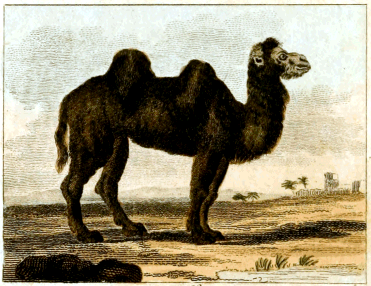
FIG. 135. Camel.
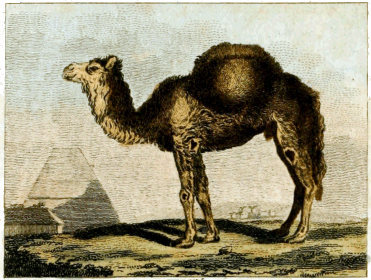
FIG. 136. Dromedary.
THE CAMEL AND THE DROMEDARY.
These two names do not include two different species, but only two distinct races, subsisting from time immemorial in the camel species. The principal, and perhaps the only perceptible character by which they differ, consists in the camel’s bearing two hunches on the back, and the dromedary only one, who is also less, and not so strong as the camel; but both of them herd and intermix together, and the production from this cross breed is more vigorous, and of greater value, than the others.
These mongrels form a secondary race, which mix and multiply among themselves, and with the first race; so that in this species, as well as in that of other domestic animals, there are many varieties, the most general of which are relative to the difference of climate. Aristotle has judiciously marked the two principal races; the first, which has two hunches, under the name of the Bactrian Camel; and the second under that of the Arabian Camel: the first are called Turkish and the others Arabian Camels. This distinction still subsists, but it appears, since the discovery of those parts of Africa and Asia which were unknown to the ancients, that the dromedary is, without comparison, more numerous and more universal than the camel: the last being seldom found in any other place than Turkestan, and some other parts of the Levant; while the dromedary, more common than any other beast of burthen in Arabia, is found in all the northern parts of Africa, from the Mediterranean to the river Niger, and is also met with in Egypt, in Persia, in Southern Tartary, and in all the northern parts of India. The dromedary, therefore, occupies an immense tract of land, while the camel is confined to narrow limits. The first inhabits hot and parched regions; the second, a more moist soil and temperate climate; and the whole species, as well the one as the other, appears to be confined to a zone of three or four hundred leagues in breadth, which spreads from Mauritania to China, for they subsist neither above nor below this zone, and although a native of warm climates, this animal is averse to those where the heat is excessive; his species ends where that of the elephant begins, and it cannot exist either under the burning heat of the torrid zone, or in the milder climates of the temperate. It appears to be originally a native of Arabia, for that is not only the country where they are the greatest in number, but where they seem to be in the best condition. Arabia is the most dry country in the world, and one in which water is the most scarce. The camel is the least thirsty of all animals, and can pass several days without any drink. The land is almost in every part dry and sandy. The feet of the camel are formed to travel in sand; and he cannot support himself on moist and slippery ground. Herbage and pasture are wanting in this country, as is also the ox, whose place is supplied by the camel.
We cannot be deceived as to the native country of these animals, when we consider their nature and structure which must be conformable thereto; especially when those are not modified by the influence of other climates. It has been tried, but without effect, to multiply camels in Spain; they have also in vain been transported to America, but they have neither succeeded in the one climate, nor in the other, and they are seldom to be met with in the East Indies beyond Surat and Ormus: not that we mean to say absolutely that they cannot subsist and increase in the East Indies, Spain, America, and even in colder countries, as in France, Germany, &c. By keeping them during the winter in warm stables, feeding and treating them with care, not letting them labour, or suffering them to walk out but when the weather is fine, they might be kept alive and we might even hope to see them multiply; but such productions are small and imbecile, and the parents themselves are weak and languid. They lose, therefore, all their value in these climates, and, instead of being useful, they are very expensive to bring up, while in their native country they may be said to compose all the wealth of their masters.
The Arabs regard the camel as a present from Heaven, a sacred animal, without whose aid they could neither subsist, trade, nor travel. The milk of these beasts is their common nourishment: they likewise eat their flesh, especially that of the young ones, which they reckon very good. The hair of these animals, which is fine and soft, and is renewed every year, serves them to make stuffs for their clothing and their furniture. Blest with their camels, they not only want for nothing, but they even fear nothing. In a single day they can traverse a tract of fifty leagues into the desert, and thus escape from their enemies. All the armies in the world would perish in pursuit of a troop of Arabs; and hence they are no further submissive than they please. Let any one figure to himself a country without verdure and without water; a burning sun, a sky always clear, plains covered with sand, and mountains still more parched, over which the eye extends and the sight is lost, without being stopped by a single living object; a dead earth constantly whirled about by the winds, presenting nothing but bones, flints scattered here and there, rocks perpendicular, or overthrown; a desert entirely naked, where the traveller never drew his breath under a friendly shade, where nothing accompanies him, and where nothing reminds him of an animated nature; an absolute solitude, a thousand times more frightful than that of the deepest forests; for trees appear as beings to the man, who thus desolate, thus naked, and thus lost, in an unbounded void, looks over all the extended space as his tomb: the light of the day, more dismal than the shade of the night, serves but to renew the idea of his own wretchedness and impotencies, and to present before his eyes the horror of his situation, by extending round him the immense abyss which separates him from the habitable parts of the earth; an immensity which he, in vain, attempts to overrun; for hunger, thirst, and burning heat, haunt every weary moment that remains between despair and death.
Nevertheless, the Arab has found means, by the aid of the camel, to surmount these difficulties, and even to appropriate to himself these frightful gaps of Nature: they serve him for an asylum, they secure his repose, and maintain his independence.—But why does not man know how to make use of any thing without abuse? This same free, independent, tranquil, and even rich Arab, instead of respecting these deserts as the ramparts of his liberty, sullies them with his guilt; he traverses them to rob the neighbouring nations of their slaves and gold; he makes use of them to exercise his robberies, which, unfortunately he enjoys more than his liberty; for his enterprizes are almost always successful. Notwithstanding the caution of his neighbours, and the superiority of their forces, he escapes their pursuit, and carries away with impunity all that he has plundered them of.
An Arab, who destines himself to this business of land piracy, early hardens himself to the fatigue of travelling; he accustoms himself to the want of sleep, to suffer hunger, thirst, and heat. For the same purpose he instructs his camels, he brings them up, and exercises them in the same method. A few days after their birth, he bends their legs under their bellies, forces them to remain on the earth, and in this situation loads them with a heavy weight, and which he only relieves them from to put on greater. Instead of suffering them to feed at pleasure, and to drink when they are thirsty, he regulates their repasts, and by degrees increases them to greater distances between each meal, diminishing also, at the same time, the quantity of their food. When they are tolerably strong, he exercises them in the course; he excites their emulation by the example of horses, and by degrees renders them as swift, and more robust. At length, when he is assured of the strength and swiftness of his camels, and that they can endure hunger and thirst, he then loads them with whatever is necessary for his and their subsistence, departs with them, arrives unexpected at the borders of the desert, stops the first passenger he sees, pillages the straggling habitations, loads his camels with his booty, and if he is pursued, if he is obliged to expedite his retreat, it is then that he displays all his own, and his animal’s talents. Mounted on one of his swiftest camels, he conducts the troop, makes them travel day and night, almost without stopping either to eat or drink; and in this manner, he easily passes over the space of three hundred leagues in eight days; and during all that time of fatigue and travel, he never unloads his camels, and only allows them an hour of repose, and a ball of paste each day. They often run in this manner for nine or ten days without meeting with any water, and when, by chance, there is a pool at some distance, they smell the water at more than half a league before they come to it. Thirst makes them redouble their pace, and then they drink enough for all the time past, and for as long to come; for they often travel many weeks, and their abstinence endures as long as they are upon their journey.
In Turkey, Persia, Egypt, Arabia, Barbary, &c. all their merchandize is carried by camels, which of all conveyances is the most ready and cheapest. Merchants and other travellers assemble themselves in caravans to avoid the insults and robberies of the Arabs. These caravans are often very numerous, and always composed of more camels than men. Each camel is loaded according to his strength,[A] and of this they are themselves so conscious that when overloaded they refuse to proceed, but remain in their resting posture till their burthen be lighted.
Large camels generally carry 1000, or even 1200lbs. weight, and the smaller 6 or 700. In these commercial journeys, they do not travel quick, and as the route is often seven or eight hundred leagues, they regulate their motions and journeys; they only walk, and go every day ten or twelve leagues; they are unloaded every evening, and are suffered to feed at liberty. In a country where there is plenty of pasture, they eat enough in one hour to ruminate the whole night, and to serve them twenty-four; but they seldom meet with such pastures, and this delicate food is not necessary for them. They even seem to prefer worm-wood, thistles, nettles, furze, and other thorny vegetables to the softest herbs; and as long as they can find plants to brouze on, they easily dispense with drink.
But, this facility, with which they abstain so long from drink, is not pure habit, but rather an effect of their formation. Independently of the four stomachs, which are common to ruminating animals, the camel is possessed of a fifth bag, which serves him as a reservoir to retain the water. This fifth stomach is peculiar to the camel; it is so large as to contain a great quantity of water, where it remains without corrupting, or the other aliments being able to mix with it. When the animal is pressed with thirst, or has occasion to macerate his dry food for ruminating, he causes a part of this water to re-ascend into the paunch, and even into the œsophagus, by a simple contraction of the muscles. It is, therefore, by virtue of this very singular conformation, that the camel can remain several days without drink, and that he can take at one time a prodigious quantity of water, which continues pure and limpid in this reservoir, because neither the liquors of the body, nor the juices of digestion are able to mix with it.
If we compare the deformities, or rather the non-conformities of the camel with other quadrupeds, we cannot doubt but his nature has been considerably altered by constraint, slavery, and continual labour. The camel is the most completely, the most laboriously, and the most anciently enslaved of all domestic animals; the most anciently, because he inhabits climates where man was the most early civilised; the most completely, because in the other species of domestic animals, such as the horse, the dog, the ox, the sheep, the hog, &c. we find some individuals in their natural state, which have not yet been subjected by man; but the whole species of the camel is enslaved, and not any of them are to be found in their primitive state of independence and liberty; and lastly, he is the most laborious slave, because he has never been trained, either for shew, as are many horses, or for amusement, as are almost all dogs, or for the use of the table, as are the ox, the hog, the sheep, &c. He is the only beast of burden whom man has not harnessed, or taught to draw, but whose body is looked upon as a living carriage, which may be loaded and oppressed, even during his time of rest; and when in haste sleeps under the pressure of a heavy burden, his legs bent under him, and the weight of his body resting upon his stomach. This animal always bears the marks of slavery and pain. Below the breast, upon the sternum, there is a large callosity, as tough as horn, and similar ones upon the joints of his legs; although these callosities are to be met with on every camel, yet they themselves prove that they are not natural, but produced by excessive constraint and pain, from being often found filled with pus. The breast and legs, therefore, are deformed by these callosities: the back is also disfigured with a double or single hunch, and both these hunches and callosities are perpetuated from one generation to another. As it is evident, that the first deformity proceeds from the custom of forcing them when quite young to lay on their stomachs, with their legs bent under them, and in that cramped posture, to bear not only the weight of their bodies, but also the burthens which are put upon them; it must be presumed, that the hunch or hunches, owe their origin to the unequal compression of heavy burthens, which may have raised the flesh, and puffed up the fat and skin; for these hunches are not bony, but composed of a fleshy substance, partly of the same consistence as the udder of a cow. Thus the callosities and the hunches should be equally regarded as deformities produced by the continuance of labour, and constraint of body; and though at first accidental and individual, they are now become general and permanent in the whole species. It may also be presumed, that the bag which contains the water, and which is only an appendix to the paunch, has been produced by a forced extension of this viscera. The animal after enduring thirst for a long time by taking at one time as much, and, perhaps more water than the stomach could contain, this membrane would become extended and dilated, as has been observed in the stomach of sheep, which extends and acquires a capacity in proportion to the quantity of its aliment. The stomach is very small in sheep that are fed with grain, while it becomes very large in those that are fed with herbage.
These conjectures would be fully confirmed, or destroyed, if any of these animals could be found wild to compare with the domestic; but these animals do not exist any where in a natural state, or if they do, no one has yet remarked or described them; we must, therefore, suppose, that all which is good and fair about them they owe to Nature, and that all that is defective and deformed is occasioned by the labour and slavery imposed on them by the empire of man. These poor animals must suffer a great deal, as they make lamentable cries, especially when overloaded; but, notwithstanding they are continually oppressed, they have as much spirit as docility. At the first sign they bend their legs, and kneel upon the ground, to be loaded, thus saving the trouble of lifting up the burden to any great height. As soon as they are loaded they raise themselves up again without any assistance, and the conductor, mounted on one of them, precedes the whole troop who follow in the same pace as he leads. They want neither whip nor spur, but when they begin to be fatigued their conductors support their spirit, or rather charm their weariness, by a song, or the sound of some instrument. When they want to prolong the day’s journey they give the animals but one hour’s rest, after which, renewing their song, they proceed on their way for several hours more, and the singing continues until they come to another resting place; then the camels again kneel down, and are eased of their loads, by the cords being untied, and the bales rolling down on each side. In this cramped posture, with their bellies couched upon the earth, they sleep in the midst of their baggage, which is tied on again the next morning with as much readiness and facility as it was untied before they went to rest.
The callosities and tumours on their breast and legs, the bruises and wounds of the skin, the entire shedding their hair, the hunger, thirst, and leanness of these animals are not their only inconveniences; they are prepared for all these evils by one still greater, namely, castration. They leave but one male for eight or ten females, and all the camels of burden are commonly geldings; they are weaker without doubt than those which are not mutilated, but they are more tractable, and ready for employ at all times; while the others are not only ungovernable but even furious, in the rutting time, which remains forty days, and returns every spring; when, it is affirmed, they continually foam, and one or two red vesicles, as large as a hog’s bladder, issue from their mouths. At this time they eat very little, attack and bite animals, and even their masters, to whom at other times they are very submissive.
The camel does not copulate like other quadrupeds, for the female sinks upon her knees and receives the male in the same situation as she rests, sleeps, or is loaded. This posture, to which they are easily accustomed, becomes natural to them, since they assume it at the time of their copulation. The female goes about twelve months with young, and, like all large quadrupeds, produces but one at a birth: they have great plenty of milk, which is thick and nourishing, even for the human species, when mixed with a great quantity of water. The females seldom do any labour when with young, but are suffered to bring forth at liberty. The advantages derived from their produce, and their milk, perhaps surpasses that which would be gained by their labour; nevertheless, in some places a great part of the females undergo castration, in order to render them more fit for labour; and it is pretended, that this operation, instead of diminishing augments their strength and vigour, and adds to the beauty of their appearance. In general the fatter camels are, the more capable they are of enduring great fatigue. Their hunches appear to be formed from the superabundance of nourishment, for in long journeys, where they are stinted in their food, and where they suffer both hunger and thirst, these hunches gradually diminish, and are reduced so flat that their places are only discovered by the length of the hair, which is always longer on these parts than on the rest of the back; the leanness of the body increases in proportion as the hunches diminish. The Moors, who transport all their merchandize from Barbary and from Numidia into Ethiopia, depart with their camels well loaded, who are then very fat and vigorous, but bring the same animals back so lean that they commonly sell them at a low price to the Arabs of the desart, who fatten them anew
The ancients have affirmed that these animals are capable of generating at the age of three years: this appears to me rather doubtful, for at that age they have not attained half their growth. The genital member of the male, like that of the bull, is very long and slender; it tends forward during copulation, like that of every other animal; but in its usual state, it is bent backwards, and voids the urine between the legs, so that the male and female pass their urine in the same manner. The young camel sucks its mother twelve months, and when designed for labour, to make him strong and robust they leave him at liberty to suck or graze for a longer time, nor begin to load or put him to work till he has attained the age of four years. The camel commonly lives forty or fifty years, which term of life is proportioned to the time of its growth. It is without any foundation that some authors have advanced that he lives a hundred years.
By uniting under one point of view all the qualities of this animal, and all the advantages which are gained by him, he must be acknowledged to be the most useful of all the creatures under subordination to man. Gold and silk are not the true riches of the east, the camel is the treasure of Asia. He is of greater value than the elephant, as he does as much labour, and consumes not a twentieth part of the food. Besides the whole species is subjected to man, who propagates and multiplies it as much as he pleases. But it is not so with the elephants, whom they cannot multiply, can only subdue them individually, and that with great trouble and difficulty. The camel is not only of greater value than the elephant but perhaps not of less than the horse, the ass, and the ox, when all their advantages are united. He carries as much as two mules, and not only eats less, but feeds on herbs as coarse as the ass. The female furnishes milk longer than the cow; the flesh of young camels is as good and wholesome as veal; their hair is finer, and more sought after than the best wool. Even their excrements are useful, for sal ammoniac is made of their urine, and their dung, when dried and powdered, serves them for litter, as well as the horses, with whom they often travel in countries where neither straw nor hay is known. To conclude, they also make excellent fewel of this dung, which burns freely, gives a flame as clear, and almost as lively, as that of dry wood, and which is of great use in the deserts, where not a tree is to be seen, and where, from the deficiency of combustible matters, fire is almost as scarce as water.
THE BUFFALO, THE BONASUS, THE AUROCHS, THE BISON, AND THE ZEBU.
Although the Buffalo is now common in Greece, and tame in Italy, it was known by neither the ancient Greeks nor Romans; for he never had a name in the language of these people. The word buffalo, even indicates a foreign origin, not derived either from the Greek or Latin tongues. In effect, this animal is originally a native of the warmest climates of Africa and India, and was not transported and naturalized in Italy, till towards the seventh century. The moderns very improperly apply the name of bubalus to this animal, which, in Greek and Latin implies indeed, an African animal, but very different from the buffalo, as it is easy to demonstrate, by many passages of ancient authors. If we would ascribe the bubalus to any particular genus, it rather belongs to that of the antelope, than to that of the ox or the buffalo[B]. Belon having seen a small hunched ox at Cairo, which differed from the buffalo and common ox, imagined it might be the bubalus of the ancients; but if he had carefully compared the characters of the bubalus given by the ancients, with those of this small ox, he would have discovered his error; besides, we can speak of it with decision, for we have seen this small hunched ox alive, and having compared the description we have given of it with that of Belon, we can have no doubt of its being the same animal. It was shewn at the fair at Paris in 1752, under the name of the zebu; which we have adopted to describe this animal by, for it is a particular breed of the ox, and not a species of the buffalo or bubalus.
Aristotle, speaking of oxen, only mentions the common ox, except saying, that among the Arachotas in India, there are wild oxen, which differ from the domestic ones as much as wild boars differ from hogs; but in another part, he gives the description of a wild ox of Pæonia, a province adjoining to Macedonia, which he calls bonasus. Thus the common ox and the bonasus, are the only animals of this kind taken notice of by Aristotle; and what must appear singular, the bonasus, although fully described by this great philosopher, has not been recognised by any of the Greek or Latin naturalists who have written after him, all of whom have literally copied him on this subject; so that to this day, there is no more than the name of bonasus known, without the knowledge of the animal which it ought to be applied to. If we consider, that Aristotle, in speaking of the wild oxen of temperate climates, has only mentioned the bonasus; and that, on the contrary, the Greek and Latin authors of succeeding ages, have not spoken of the bonasus, but describe these wild oxen by the names of urus and bison, we shall be led to believe, that the bonasus must be either the one or the other of these animals; indeed by comparing what Aristotle has said of the bonasus, with what we know of the bison, it is more than probable, that these two names indicate the same animal. Julius Cæsar is the first who mentions the urus. Pliny and Pausanias are also the first who speak of the bison. Since Pliny’s time, the name of bubalus has been given indiscriminately to the urus, or the bison, and this confusion has increased with time. To the bonasus, bubalus, urus, and bison, have been added, the catopleba, the thur, the bubalus of Belon, the bisons of Scotland and America, and all our naturalists have made as many different species as they have found names. The truth is here so obscured by clouds, and so surrounded with errors, that it will be difficult to clear up this part of Natural History, which the contradiction of reports, the variety of descriptions, the multiplicity of names, the diversity of places, the difference of languages, and the obscurity of the times, seems to have condemned to perpetual darkness.
I shall, therefore, give my opinion upon this subject, and afterwards present the proofs upon which it is founded.
1. The animal at present called buffalo, (fig. 137.) was not known to the ancients.
2. The buffalo, at present domestic in Europe, is the same as the tame or wild buffalo of India and Africa.
3. The bubalus of the Greeks and Romans is neither the buffalo nor the small ox of Belon, but the animal that the gentlemen of the Academy of Sciences have described in treating of the Barbary cow, and which we call the bubalus.
Engraved for Barr’s Buffon
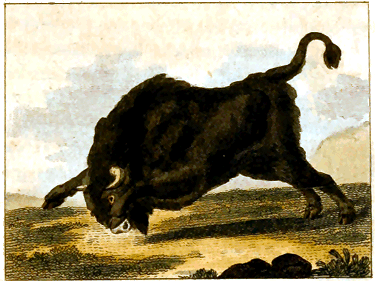
FIG. 137. Buffalo.
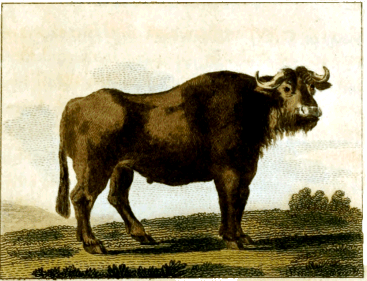
FIG. 138. Bison.
4. The small ox of Belon which we have seen, and call by the name of zebu, is no more than a variety in the species of the ox.
5. The bonasus of Aristotle is the same animal as the bison (fig. 138.) of the Latins.
6. The bison of America might originally come from the bison of Europe.
7. The urus or aurochs, is the same animal as our common bull, in his wild and natural state.
8. The bison only differs from the aurochs by accidental varieties, and consequently he is, as well as the aurochs, of the same species as the domestic ox; so that, it appears, all the denominations, and all the pretended species of the ancient and modern naturalists may be reduced to three; namely, the ox, the buffalo, and the bubalus.
I do not doubt that some of the propositions which I have laid down will appear mere bold assertions, particularly to those who are employed with the nomenclature of animals, or have endeavoured to give a catalogue of them; nevertheless, there is not one of these assertions which I am not able to prove. But before I enter into critical discussions, each of which demand particular propositions, I shall explain the observations and facts which conducted me into this enquiry, and which having satisfied me, may also prove satisfactory to others.
Domestic animals in very few respects resemble wild ones; their nature, their size, and their form, are less constant, and more subject to changes, especially in the exterior parts of the body. The influence of climate, so powerful over all Nature, acts with more force upon captive animals, than upon free. Food prepared by the hand of man, oftentimes scantily given and ill-chosen, joined to the inclemency of a foreign sky, in time produces alterations sufficiently deep to become constant, and to be perpetuated from one generation to another. I do not pretend to say, that this general cause of alteration is so powerful as to essentially alter the nature of beings, whose constitution is so fixed as that of animals; but it changes them in certain respects; it disguises and transforms them externally; it takes away from some parts, and gives rise to others; it paints them with various colours, and by its action upon the habit of the body, it has an influence on their dispositions, instincts, and most interior qualities. A single part changed in a composition so perfect as that of an animal body, is sufficient to make the whole sensible of the alteration; and it is for this reason, that our domestic animals differ almost as much in dispositions and instincts as in figure from those who continue at large in their natural state. Of this, the sheep furnishes a striking example; this species, such as it is at present, perishes in a very short time, if man ceases from tending it with care: it is also greatly changed, and very inferior to its original species. But to adhere to our present subject; we see what changes the ox has gone through, from the combined effects of climate, nourishment, and treatment, in a wild, and in a domestic state.
The most general, and most remarkable variety in domestic and even wild oxen, consists in that sort of hunch which some have between the shoulders: this race of oxen are called bisons, and it has been hitherto believed, that they were of a different species from the common ox; but as we are assured, that they produce together, and that the hunch diminishes in the first generation, and disappears in the second or third, it is evident, that this hunch is only a variable and accidental character, which does not prevent the bison from belonging to the same species with the common ox. There were formerly in the desart parts of Europe, wild oxen, some without hunches, and others with them; thus the variety seems to be natural, and to proceed from the abundance and more substantial quality of food; for we remarked, when treating of the camels, that when those animals are lean, and badly fed, they have not even the appearance of a hunch. The ox without a hunch was named vrochs, and turochs, in the German tongue; and the ox with a hunch, in the same language, was termed visen. The Romans, who knew neither of these wild oxen before they saw them in Germany, adopted those names; of vrochs they made vrus; and of visen, bison; and they never imagined that the wild ox described by Aristotle, under the name of bonasus, could possibly be either of these oxen, whose names they had thus latinised.
Another difference between the aurochs and the bison is the length of the hair; the neck, shoulders, and throat of the bison are covered with very long hairs; while the aurochs have all these parts covered with a short hair, resembling that of the rest of the body, the front excepted, which has frizzled hair. But this difference of the hair is still more accidental than that of the hunch, and, like that, depends on the food and climate, as we have already proved in the goats, sheep, dogs, cats, &c. Thus, neither the hunch, nor the difference in the quantity of hair, are specific characters, but merely simple and accidental variations.
A variety still more extended, and to which naturalists have given more of character than it really deserves, is the form of the horns; they have not considered that, in our domestic cattle, the shape, size, position, direction, and even number of horns, vary so strongly, that it would be impossible to pronounce which is the true model of Nature. The horns of some cows are curved and bent downwards; others have them straight, long, and elevated. There are whole races of sheep, who have sometimes two, sometimes four horns, and there are breeds of cows who have no horns. These exterior, or, as I may say, accessory parts of the body, have as little permanency as the colours of the hair, which in domestic animals vary and combine in every manner. This difference in the shape and direction of the horns, which is so common, must not then be regarded as a distinctive character of the species; though, it is upon this character alone that our naturalists have established their species; and, as Aristotle, in the description he gives of the bonasus, says, that its horns turn inwards, they have from that alone separated it from all other oxen, and made it a particular species, without having ever seen the individual. Upon this variation of the horns, in domestic animals, we have quoted cows and ewes, rather than bulls and rams, because the females are more numerous than the males, and we may every where observe thirty cows or ewes for one bull or ram.
The mutilation of animals by castration seems to hurt the individual only, and not to affect the species; nevertheless, it is certain, that this custom restrains Nature on one side and weakens it on the other. A single male, condemned to serve thirty or forty females, must exhaust himself without satisfying them. The ardour of love must be unequal; indifferent in the male, who exceeds the designs of Nature, and too ardent in the female, who must be so limited; from thence all the productions must chiefly be tinctured with feminine qualities, a greater number of females will be produced than males; and even the males possess more of the mother than the father. This is, without doubt, the reason there are more girls than boys born in the countries where men have a great number of wives, while among those where the men are permitted to have but one, more males than females are born. It is true, that among domestic animals they commonly withhold the most beautiful from castration, to become the parent of a numerous generation. The first productions of these chosen males will be strong and vigorous; but from having too many copies from this single mould the impression of Nature is deformed, or at least impaired, and not preserved in its full perfection; the race must, therefore, be weakened and degenerate; and this, perhaps, is the cause why more monsters are to be found among domestic than wild animals, where the number of males, which concur to generation, is equal to that of the females. Moreover, when there is but one male to a great number of females they have not the liberty of consulting their own taste, and, consequently, deprived of those emotions which arise from spontaneous pleasures. In the females there remains nothing poignant in their amours, and they languish in expecting the cold approaches of a male that is not of their own choice, who is frequently not accommodated to them, and from whom they do not receive those flattering caresses as if he were obliged to court a preference. From these sluggish amours insipid beings must proceed, who will have neither that courage, spirit, nor strength, which Nature only can bestow on every species by leaving to individuals their faculties quite entire, especially the liberty of choice between the sexes. It is well known, in the example of horses, that the cross breed is always the finest; we ought not, therefore, to confine our female cattle to a single male of their own country, who already has too much the resemblance of his mother, and who, consequently, far from improving the species, can only continue to degrade it. Mankind, in this practice, have preferred their convenience to every other advantage; they have not endeavoured to support, or to embellish Nature, but submit her operations to them, that they may enjoy her productions in a more despotic manner. The males are the superior of each species; they have the most spirit, and are the least tractable; a greater number of males in our flocks therefore would render them less docile, more difficult to conduct and to watch.
To these causes of degeneration in domestic animals we must yet mention another, which alone is capable of producing more changes than all the rest put together, viz. the transportation of animals from one climate to another; oxen, sheep, and goats, have been carried to all parts; in every place they have felt the influence of the climate, and imbibed impressions from every soil and every sky, so that nothing is more difficult than to recognize, in this great number of varieties, those who are the least estranged from the type of Nature.
Having thus explained the general causes of varieties among domestic animals, I shall proceed to the particular proofs of what I have advanced on the subject of oxen and buffaloes. I have said, 1st. That the animal at present known by the name of the buffalo was not known by the ancient Greeks, and Romans. This is evident, since none of their authors have described, or even used, a name which can be applied to it; besides, we are informed, by the annals of Italy, that the first buffalo was brought there towards the end of the fifth century, A. D. 595.
2. The Buffalo, at present domestic in Europe, is the same as the wild or tame buffalo of India and Africa. This needs no other proof, than the comparison of our description of the buffalo, taken from an animal we saw alive, with the remarks that travellers have given of the buffaloes of Persia, Mogul, Bengal, Egypt, Guinea, and the Cape of Good Hope. In all these countries this animal is the same, and does not differ from our buffalo but in very slight differences.
3. The Bubalus of the Greeks and Romans, is not the buffalo, nor the small ox of Belon; but the animal that the gentlemen of the Academy has described under the name of the cow of Barbary. This appears clear from Aristotle placing the bubalus with the stags and fallow deer, and not with the oxen. In other parts, he speaks of him among the roe-bucks, and says, that he but badly defends himself with his horns, and that he flies from ferocious animals. Pliny, in speaking of the wild oxen of Germany, says, that it is through ignorance that the common people give the name of bubalus to these oxen, for the bubalus is an animal of Africa, which in some measure resembles a calf or a stag. The bubalus is then a timid animal, who has no other resource than by flight to avoid the attack of ferocious animals, who consequently from this circumstance must be swift, and possess something of a make between the calf and a stag; all these characters, not one of which apply to the buffalo, are found perfectly united in the figure of the animal which Horatius Fontana sent to Aldrovandus, and of which the gentlemen of the Academy have given a figure and description under the name of the cow of Barbary; and they have thought, with me, that it was the bubalus of the ancients.[C]
4. The small ox of Belon is only a variety in the species of the ox. We shall easily prove this, by only referring to the figure of the animal given by Belon, Prosper Alpinus, Edwards, and to the description we have made. We have seen it alive; his conductor told us, that he brought him from Africa, where he was called Zebu; that he was domestic; and that they used him to ride on. This animal is, in fact, very gentle and familiar; he is of an agreeable figure, though heavy and thick; nevertheless he so perfectly resembles the ox, that I cannot give a more just idea of him, than by saying, if we were to look at a very handsome bull, through a glass that diminishes objects one half, the figure would very near approach that of the zebu.
5. The Bonasus of Aristotle is the same as the bison of the Latins. This proposition cannot be proved, without a critical discussion, with the whole detail of which I shall not trouble the reader. Gesner, who was a learned man, as well as a naturalist, and who thought with me, that the bonasus might be the bison, has more carefully than any other person examined and discussed the observations which Aristotle gives on the bonasus, and at the same time has corrected many erroneous expressions in the translation of Theodore Gaza, which nevertheless all the naturalists have followed without examination: in adopting, therefore, his elucidations, and in suppressing from the remarks of Aristotle, whatever is obscure, contradictory or fabulous, they appear to me reduced to the following description:
The bonasus is a wild ox of Pœonia, and is at least as big as a domestic ox, and of the same make; he is covered from the shoulders to the eyes with a long hair, like the mane of a horse; his voice is like the ox; his horns are short, and curved round the ears; his legs are covered with long hair, soft as wool, and his tail is small compared to his size, although in other respects it resembles that of the ox. Like the bull, he has the custom of pawing the ground with his feet; his hide is hard, his flesh is tender, and good. By these characters, which are all we can rely on from Aristotle, we see how near the bonasus approaches towards the bison. Every part, in fact, agrees, the shape of the horns excepted, but which, as we have already observed, greatly varies in animals, who are, notwithstanding, of the same species. We have seen such crooked horns, taken from an hunched ox of Africa, and we shall hereafter prove, that this hunched ox is no other than the bison. This we shall be able to confirm by the testimonies of ancient authors. Aristotle mentions the bonasus as an ox of Pœonia; and Pausanias, speaking of the Pœonian bulls, says, in two different parts of his works, that these bulls are bisons; he even expressly says, that the bulls of Pœonia, which he saw at the public games at Rome, had very long hair upon the breast, and about the jaws. In short, Julius Cæsar, Pliny, Pausanias, Solinus, &c. in speaking of wild oxen, mention the aurochs and the bison, but take no notice of the bonasus. It must, therefore, be supposed, that in less than four or five centuries the species of the bonasus has been lost, unless we allow that the names bonasus and bison indicate only the same animal.
6. The bison of America might come originally from the bison of Europe. We have already laid down the foundation of this opinion in our discourse on the animals of the two continents; they are the result of the experience of M. de la Nux, who has given much information on this subject. He has informed us, that the bisons, or hunched oxen, of India and Africa, copulate with the bulls and cows of Europe, and that the hunch is only an accidental character, which diminishes in the first generation, and disappears in the second or third. Since the bisons of India are of the same species as our oxen, and have, consequently the same origin, is it not natural to extend this organ to the bison of America? Every thing seems to concur in support of this supposition. The bisons appear to be originally of cold and temperate regions; their name is derived from the German language; the ancients say that they were found in that part of Germany which borders on Scythia; and there are now bisons in the north of Germany, in Poland, and in Scotland; they might, therefore, have passed into America, or even have come from thence, as they are animals common to the two continents. The only difference between the bisons of Europe and those of America is, that the latter are less. But even this difference is a new presumption that they are of the same species, for we have already remarked, that generally both domestic and wild animals, which have passed of themselves, or have been transported, into America, have, without any exception, diminished in size; besides, all the characters, even the hunch, and the long hairs at the hinder parts, are the same in the bisons of America and in those of Europe; thus we cannot refuse to regard them, not only as animals of the same species but also of the same race.
7. The urus, or aurochs, is the same animal as the common bull, in his wild and natural state. This position is clear, as the figure and constitution of the body of the aurochs is perfectly similar to that of our domestic bull. The aurochs is only larger and stronger, like every other animal who enjoys his liberty. The aurochs are still to be met with in some provinces of the north. The young aurochs have been taken from their mothers, and being reared, when of a proper age have copulated with the domestic bulls and cows, so that we cannot doubt but they are of the same species.
8. To conclude, the bison differs from the aurochs by accidental varieties only, and, consequently, is also of the same species as the domestic ox. The hunch, the length and quality of the hair, and the form of the horns, are the sole characters by which we can distinguish the bisons from the aurochs. But we have known the hunched oxen produce with the domestic kind; we likewise know, that the length and quality of the hair, in all animals, depend on the nature of the climate; and we have remarked, that in oxen, goats, and sheep, the form of the horns frequently varies. These differences, therefore, are not sufficient to establish two distinct species; and since our domestic oxen produce with the hunched oxen of India, we have reason to think they would copulate with the bison, or hunched ox of Europe. There are, in the almost innumerable varieties of these animals, in different climates, two primitive kinds, both of which have long continued in a natural state; the hunched ox, or bison, and the aurochs, or ox without an hunch. These kinds have subsisted till this present time, either in a wild or domestic state, and are scattered, or rather have been transported, into all the climates of the earth. All the domestic oxen without hunches have proceeded originally from the aurochs, and those with the hunch from the bison. To give a just idea of these varieties we shall make an enumeration of them as they are found in the different parts of the world.
To begin with the north of Europe; the few oxen and cows of Iceland are deprived of horns, although they are of the same kind as our oxen. The size of these animals is rather relative to the plenty and quality of pasture than to the nature of the climate. The Dutch fetch lean cows from Denmark, which fatten prodigiously in their rich meadows, and give a great deal of milk: these Denmark cows are larger than ours. The bulls and cows of the Ukraine, where there is excellent pasture, are said to be the biggest in Europe, and they are of the same kind as our oxen. In Switzerland, where the tops of the mountains are covered with an abundant and flourishing verdure, and which is solely reserved as food for the cattle, the oxen are nearly double the size of those in France, where commonly they are fed on the coarsest herbage, which is refused by horses. Bad hay, and leaves, are the common food of our oxen in winter, and in spring, when they should be refreshed, they are excluded from the meadows; they, therefore, suffer still more in that season than in winter, for they then have little or nothing given them in the stable, but are driven into the roads, into fallow fields, or into the woods, and are always kept at a distance from the fertile lands, so that they are more fatigued than fed; at last, in summer, they are permitted to enter the meadows, which are then stripped, and parched with heat and drought; there is not, therefore, a single season throughout the year in which these animals are amply or agreeably fed. This is the sole cause which renders them weak, poor, and small; for, in Spain, and in some cantons of the provinces of France, where there is good pasture, and solely reserved for the oxen, they are much stronger and larger.
In Barbary, and most part of Africa, where the ground is dry, and the pasture poor, the oxen are still smaller, the cows give much less milk than those in France, and the greatest part of them lose their milk when their calves are taken from them. They are the same in some parts of Persia, of Lower Ethiopia, and in Great Tartary, while in the same countries, and at very small distances, as in Calmuck Tartary, in Upper Ethiopia, and in Abyssinia, the oxen are a prodigious size. This difference, therefore, depends more on the plenty of their food than on the temperature of the climate. In the northern, temperate, and warm regions, we equally find, at very small distances, small or large oxen, according to the quantity and quality of the pasture, they are fed upon.
The breed of aurochs, or ox without a hunch, inhabits the cold and temperate zones, and is not much dispersed in the southern countries. On the contrary the breed of the bison, or hunched ox, occupies all the southern provinces. In the whole continent of India, in the eastern and southern islands of all Africa, from Mount Atlas to the Cape of Good Hope, we find no others but hunched oxen; it even appears, that this breed, which has prevailed in all the warm countries, has many advantages over the others; for, like the bison, of which they are the issue, their hair is softer, and more glossy than our oxen, who, like the auroch, are furnished but with little hair, of a harsh nature. These hunched oxen are also swifter, and more proper to supply the place of the horse[D]; at the same time they are less clumsy, stupid, and indolent than our oxen. They are more tractable, and sensible, have more of that intelligence which renders them useful; they are also treated with more care than our finest horses. The regard the Indians have for these animals is so great that it has degenerated into superstition, the last mark of blind respect. The ox, as the most useful animal, has appeared to them the most worthy of being revered; and they have made an idol of the object of their veneration, a kind of beneficent and powerful divinity; for we are desirous of rendering all we respect, great, and capable of doing much good, or much harm.
These hunched oxen vary perhaps more than ours in the colours of the hair, and the figure of their horns, the handsomest are all white, like the oxen of Lombardy. Some are destitute of horns, while others have them very much elevated, and others so bent down, that they are almost pendent. It even appears, that we must divide this first race of bisons, or hunched oxen, into two secondary kinds; the one large, and the other small, and this last is that of the zebu. Both of them are found nearly in the same climates, and are equally mild and easily managed; both have soft hair, and a hunch upon the back; this hunch is nothing but an excrescence, a kind of wen, a piece of tender flesh, as good to eat as the tongue of an ox. The hunches of some oxen weigh from forty to fifty pounds, others have them much smaller. Some of these oxen have prodigious large horns; there is one in the French king’s cabinet, which is three feet and a half in length, and seven inches in diameter at the base; many travellers affirm that they have seen them, of a capacity sufficient to contain fifteen, and even twenty pints of water.
The method of castrating large cattle is not known in any part of Africa, and it is but little practised in India. When the bulls undergo this operation, it is not by cutting, but compressing their testicles; and although the Indians keep a number of these animals to draw their carriages, and work in their grounds, they do not by any means train up so many as we do. As in all hot countries the cows give but little milk; as the natives are but little acquainted with cheese and butter; and as the flesh of the calves is not so good as in Europe, they multiply the horned beasts less than we do. Besides, all those southern provinces of Africa and Asia, being much less peopled than Europe, there are a great number of wild oxen, who are taken when young; these become tame of themselves, and submit to labour without any resistance; they become so tractable, that they are managed with greater ease than horses, the voice of their master is only requisite to direct and make them obey; they are very careful of them in every respect, and give them plenty of the best food. These animals, thus raised, appear to be of a different nature from our oxen, who only know us by our bad treatment; the goad, whip, and scarcity of food, render them stupid and weak: in short, if we knew our own interest, we should treat what is dependent on us with better usage. Men of inferior rank, and people the least polished, seem to have a better sense than others of the laws of equality, and the shades of natural equality. The servant of the farmer may be said to be upon a level with his master; the horses of the Arabs, and the oxen of the Hottentots, are favourite domestics, companions in their exercises, assistants in their labour, and with whom they share their habitation, their bed, and their tables. Man, by this community, debases himself less than the beasts are elevated and humanized. They become affectionate, sensible, and intelligent; they there perform, through love, all that they do here through fear. They do more; for as their nature is raised by the gentleness of their education, and by the continuance of attention towards them, they become capable of actions almost human. The Hottentots bring up their oxen to war, and make use of them nearly in the same manner as the Indians do of the elephants; they instruct these oxen to guard their sheep, to conduct them from place to place, and to defend them from strangers and ferocious beasts; they teach them to know friends from enemies, to understand signs, and to obey the voice. Thus the most stupid of men are the best preceptors of beasts.
All the southern parts of Africa and Asia are then inhabited with bisons, or hunched oxen, among which is a great variety in respect to size, colour, shape of the horns, &c. On the contrary, all the northern countries of these two parts of the world, and the whole of Europe, comprehending the adjacent island, as far as the Azores, have only oxen without hunches, who derive their origin from the aurochs; and as the aurochs, which is our ox in a wild state, is larger and stronger than our domestic ones, so the bison, or wild hunched ox, is also stronger and larger than the tame ox of India. He is also sometimes smaller, but that depends only on the quantity of food. At Malabar, in Abyssinia, and Madagascar, where the meadows are naturally spacious and fertile, the bisons are of a prodigious size; in Africa and Arabia Petrea, where the land is dry, the zebus, or bisons, are of a small size.
In every part of America oxen without hunches are generally diffused, which the Spaniards and other Europeans have successively transported thither; these oxen have considerably multiplied, but are become less in these new countries. The species was absolutely unknown in South America; but in all the northern parts, as far as Florida, Louisiana, and even nearly to Mexico, the bisons, or hunched oxen, were found in great numbers. These bisons, which formerly inhabited the woods of Germany, Scotland, and other northern countries, have probably passed from one continent to the other, and are become, like other animals, smaller in this new world; and as they lived in climates more or less cold, their hair became longer or shorter. Their beards and hair is longer at Hudson’s Bay than at Mexico, and in general their hair is softer than the finest wool. We cannot, therefore, avoid believing these bisons of the new continent are of the same species as those of the old; they have preserved all the principal characters, as the hunch upon the shoulders, the long hair under the muzzle, and on the hinder parts of the body, and the short legs and tail; and by comparing what Hernandes, Fernandes, and every other historian and traveller of the new world have said, with what has been written concerning the bison of Europe, we shall be convinced, that these animals are not of a different species.
Thus the wild and domestic ox, the ox of Europe, Asia, America, and Africa; the bonasus, the aurochs, the bison, and the zebu, are all animals of the same species, which according to the differences of climate, food, and treatment, have undergone all the variations we have explained. The ox is the most useful animal, and also the most universally dispersed; for, excepting South America, he has been found in all parts; his constitution being equally formed to withstand the ardour of the south, or rigours of the north. He appears to be ancient in every climate; he is domestic in civilized nations, and wild in desart countries or among unpolished people. He supports himself by his own resources when in a state of nature, and never loses the qualities relative to the service of man. The young wild calves, which are taken from their mothers in India or Africa, become in a very short time, as tractable as those of the domestic kind; and this natural conformity is another striking proof of the identity of the species. The gentleness of character in these animals indicates the natural flexibility of their bodies; for in all species in which we have discovered the character of gentleness, and which have been subjected to a domestic state, there are more varieties than can be found in those which have remained wild through their character of inflexibility.
If it be asked, whether the aurochs or the bison be the primitive race of oxen, a satisfactory answer may be drawn from the facts we have just laid down. The hunch of the bison is, as it has been observed, no more than an accidental character, which is defaced and lost in the mixture of the two kinds. The aurochs, or ox without a hunch, is, then, the most powerful and predominant kind; if it were otherwise, the hunch, instead of disappearing, would extend and remain upon every one of this mixt breed. Besides, this hunch of the bison, like that of the camel, is less the production of Nature than the effect of labour, and the mark of slavery. From time immemorial, in almost every quarter of the globe, the ox has been obliged to carry burdens; the habitual, and often excessive load, has deformed their backs; and this deformity has been afterwards propagated through generations. Undeformed oxen are no longer to be seen, but in those countries where they have not made use of them as beasts of burden. In all Africa, and in the eastern continent, the oxen are hunched, occasioned by their having always carried loads on their shoulders. In Europe, where they are only employed for draught, they have not undergone this deformed alteration, which in the first place probably proceeds from the compression of the loads, and in the second from the abundance of food; for it disappears when the animal is lean and poorly fed. Some enslaved and hunched oxen might have escaped or been abandoned in the woods, and where their posterity would be loaded with the same deformity, which, far from disappearing, may have encreased by the abundance of food peculiar to uncultivated countries, so that this second breed would spread over all the desart lands of the north and south, and pass into the New Continent, like other animals, whose nature can support the cold. What still more confirms the identity of the species of the bison and aurochs, is, the bisons of North America have so strong a smell, that they have been called Musk Oxen by most travellers; and, at the same time, we find, by the accounts of many persons, that the aurochs, or wild ox of Prussia and Livonia, has the same scent of musk.
There remains, therefore, but two species, the buffalo and the ox, out of all the names placed at the head of this article, each of which the ancient and modern naturalists have treated as separate and distinct. These two animals, although greatly resembling each other, both domestic, often living under the same roof, and fed in the same meadows, have nevertheless constantly refused to unite though excited to it by their keepers. Their natures are more distant than that of the ass and the horse; there even appears to be a strong antipathy between them, for it is affirmed, that cows will not suckle young buffaloes, and the female buffaloes refuse the same kindness to the other calves. The buffalo is of a more obstinate nature, and less tractable than the ox. He obeys with great reluctance, and his temper is more coarse and brutal. Next to the hog, he is the filthiest of all domestic animals, and is very unwilling to be cleaned and dressed. His figure is very clumsy, and forbidding; his look stupidly wild; he stretches out his neck in an ignoble manner, and carries his head in a very bad posture, almost always inclined towards the ground. He bellows hideously, with a tone much stronger and deeper than that of the bull. His legs are thin, his tail bare, his physiognomy dark, and his skin as black as his hair. He differs chiefly from the ox by the colour of his hide, which is easily perceived under his spare covering of hair. His body is thicker and shorter than that of the ox; his legs are longer; his head proportionally much less; his horns are not so round, black, and partly compressed, and he has a tuft of frizzled hair over his forehead. His hide is likewise thicker and harder than that of the ox. His flesh is black, and hard, and not only disagreeable to the taste, but repugnant to the smell. The milk of the female is not so good as that of the cow, but she yields a greater quantity. In hot countries, almost all the cheese is made of buffalo’s milk. The flesh of the young buffaloes, though killed during the sucking time, is not a bit better. The hide alone is of more value than all the rest of the animal, whose tongue is the only part that is fit to eat: this hide is firm, pretty light, and almost impenetrable. As these animals are larger and stronger than oxen they are very serviceable; they make them draw, and not carry burdens; they lead them by the means of a ring passed through their nose. Two buffaloes harnessed, or rather chained, to a carriage, will draw as much as four strong horses. As they carry their necks and heads low, they employ the whole weight of their body in drawing, and their mass greatly surpasses that of a labouring horse, or ox.
The height and thickness of the buffalo alone indicates, that he is a native of warm countries. The largest quadrupeds belong to the torrid zone of the Old Continent; and the buffalo, for his magnitude, ought to be placed next to the elephant, the rhinoceros, and the hippopotamus. The camel is taller but less thick, and also a native of the southern countries of Africa and Asia. Nevertheless, buffaloes live and multiply in Italy, in France, and in other temperate provinces. Those kept in the royal menagerie, have brought forth two or three times; the female has but one at a birth, and goes with young about twelve months, which is another proof of the difference between this species and that of the cow, who only goes nine months. It appears also, that these animals are more gentle and less brutal in their native country, and the warmer the climate the more tractable is their nature. In Egypt they are more tractable than in Italy; and in India more so than in Egypt. Those of Italy have also more hair than those of Egypt, and those of Egypt more than those of India. Their coat is never entirely covered, because they are natives of hot countries; and in general, large animals of these climates have little or no hair.
There are a great number of wild buffaloes in the countries of Africa and India, which are watered by large rivers, and where extensive pasturages are found. The wild buffaloes go in droves and make great havock in cultivated lands, but they never attack the human species, unless they are wounded, and are then very dangerous; for they make directly at their enemy, throw him down, and trample him under their feet. They are, however, greatly terrified at the sight of fire, and are displeased at a red colour. Aldrovandus, Kolbe, and many other naturalists and travellers, assure us, that no person dare wear red cloaths in the country where the buffaloes are.[E] I know not whether this aversion to fire and a red colour be general among the buffaloes: for there are but few among our oxen who grow angry at the sight of red cloaths.
The buffalo, like all large animals of warm climates, is fond of bathing, and even of remaining in the water; he swims well, and boldly traverses the most rapid floods. As his legs are longer than those of the ox, he runs also quicker. The Negroes of Guinea, and the Indians of Malabar, where the buffaloes are very numerous, often hunt them. They neither pursue nor attack them openly, but climbing up the trees, or hiding themselves in the thickets, which the buffaloes cannot penetrate, on account of their horns, they wait for and kill them. Those people are fond of the flesh of the buffalo, and gain great profit by vending their hides and horns, which are harder and better than those of the ox.
The animal, called, at Congo, Empacassa or Pacassa, though very badly described by travellers, seems to me to be the buffalo; and that which they have spoken of, under the name of Empabunga, or Impalunca, in the same country, may possibly be the bubalus, whose history we shall give with that of the antelope.
SUPPLEMENT.
M. De Querhoent says, that altho’ the bisons invariably differ from the common oxen by the hunch on their backs, and their hair being longer, yet they breed in the Isle of France, and their flesh is preferable to that of European oxen; their hair is also smoother, their legs thinner, and their horns are longer, and after some few generations the hunch entirely disappears. There was one brought to Holland from North America, which was carried about to different towns, by a Swede, in a large cage; this one had an enormous mane round his head, which was not hair, but a very fine wool, divided into locks like a fleece; the skin was of a black colour, excepting on the hunch, where the hair was longer, and under that the skin was rather tawny; and to us this animal seemed to differ from the European by the hunch and wool only.
Bisons are said to have existed formerly in the north of Europe, and Gesner asserts, that even in his time there were some in Scotland; but I have been credibly informed by letters, both from England and Scotland, that not the smallest remembrance of them can be traced in that country. Mr. Bell, in his travels from Russia to China, mentions seeing two species of oxen in the northern parts of Asia, one of which was the aurochs, and the other what we, after Gmelin, have called the Tartarian, or Grunting Cow, which seemed to be of the same species as the bison; and in which we find, by comparison, a perfect coincidence of characters, excepting that the former grunts and the latter bellows.
Although the race of the bisons appear diffused in the Old Continent, from Madagascar and the point of Africa, and from the extent of the East Indies even to Siberia, and that though they are met with in the new continent, from the country of the Ilionois to Louisiana and Mexico, they have never passed the isthmus of Panama, for there are not any bisons in South America, notwithstanding the climate is perfectly agreeable to their nature, and European oxen multiply there as well as in any other place.
The best bulls and cows at Madagascar were brought from Africa, and have a hunch on their backs; but the cows give very little milk. In this island there are wild bisons in the forests, the flesh of which is not so good as that of our oxen. The natives of Agra hunt them on the mountain of Nerwer, in the road from Surat to Golconda, and which is surrounded with wood.
The zebu, as we formerly observed, is the bison as well as the ox in miniature, and though originally a native of warm regions, can nevertheless exist and multiply in temperate ones, for in a letter I received from Mr. Colinson, dated London, December, 1764, he assures me, that the Dukes of Richmond and Portland had several of these animals in their parks, and which brought forth calves every year: they were originally brought from the East Indies. He adds, that the females were much larger than the males, but that the hunch on the back was twice as big on the latter as the former; that the young zebu sucks the mother like other calves, but that in our climate the milk soon dries up, and that it is necessary to have another female to bring them up; that the Duke of Richmond ordered one of them to be killed, when its flesh was found not to be near so good as that of the common ox.
There may also be small oxen without the hunch, which, like the zebu, constitute a particular race; for Careri, in his journey from Ispahan to Schiras, saw two small cows, which had been sent as a present to the king, that did not exceed the size of calves; they were fed entirely upon straw, and yet were very fat.
As to the buffaloes, although they can make but little use of their horns, they are compelled to fight lions and tigers in the Mogul’s country. These animals are numerous in warm and marshy countries, especially near rivers, for water and a moist soil seems to be more necessary to them than a warm climate; there are not any of them therefore in Arabia, where the country is dry. They hunt the wild buffaloes, but with great caution, as they are very dangerous, and when wounded rush at their opponents with great fury.
M. de Querhoënt says, the body of the buffalo, at the Cape of Good Hope, is about the size of our oxen, but his head is larger, and his legs shorter. They generally keep about the edge of the woods; and as he has a bad sight he keeps his head near the ground, and when he observe any disagreeable object near him he makes a sudden dart upon it, making at the same time a most hideous bellowing, and on those occasions it is difficult to escape him; but he is not so much to be feared in the open fields: his hair is commonly red, with a few black spots, and they are often seen together in large flocks.
THE ZEBU.
We have already spoken of this little ox under the article buffalo; but as there has been one brought to the royal menagerie since the impression of that article, we can now speak of it with greater exactness, and give an engraving of it done from life. I have also learned, by making new researches, that this small ox, to which I have given the name of zebu, (fig. 145.) is very probably the same animal which is called lant, or dant, in Numidia, and in some other northern provinces of Africa, where it is very common, and that the name dant, which can belong to no other animal but this we are treating of, has been transported from Africa into America, and given to an animal which only resembles this by the size of his body, and who belongs to a different species. This dant of America is the tapir, or the maipouri; and in order that it may not be confounded with the dant of Africa, which is our zebu, we shall give the history of it in this volume.
THE MUFLON, AND OTHER SHEEP.
The weakest species of useful animals were rendered domestic the earliest of any. The sheep and goat were subjugated before the horse, the ox, or the camel. They were also transported from one climate to another with greater ease; hence the great variety which are to be met with in these species, and the difficulty of recognizing the original breed of each. It is certain, as we have proved, that our domestic sheep, as they at present exist, could not support themselves without the assistance of man; it is, therefore, evident that Nature did not produce them as they at present are, but that they have degenerated under our care; consequently we must search among the wild animals for those which come the nearest to the sheep; we must compare them with the domestic sheep of foreign countries, examine the different causes of the alteration, change, and degeneration, which has had such influence upon the species, and endeavour to restore all these various and pretended species to a primitive race, as we have done in that of the ox.
The sheep, with which we are acquainted, is only to be met with in Europe, and some of the temperate provinces of Asia; if transported into Guinea, it loses its wool, and is covered with hair, it decreases in fertility, and its flesh has no longer the same taste. It cannot subsist in very cold countries, though a breed of sheep is to be found in cold climates; especially in Iceland, who have many horns, short tails, and harsh thick wool, under which, as in almost every animal in the north is a second lining, of a softer, finer, and thicker wool. In warm countries, on the contrary, the sheep have generally short horns and a long tail, some of which are covered with wool, others with hair, and a third kind with a mixture of wool and hair. The first of these sheep of a warm country is that commonly called Barbary sheep, or the Arabian sheep, which resembles the domestic kind, excepting the tail which is so loaded with fat, as to be often more than a foot broad, and weighs upwards of twenty pounds. This sheep has nothing remarkable but his tail which he carries as if a pillow was fastened to his hinder parts. Among this kind of sheep, there are some whose tails are so long and heavy, that the shepherds are obliged to fasten small boards with wheels to them, to enable the animal to walk along. In the Levant, these sheep are cloathed with a very fine wool, while in warm countries, as Madagascar, and the Indies, they are covered with hair. The superabundance of fat, which in our sheep fixes about the kidneys, in these animals descends upon the vertebræ of the tail; the other parts of their body are less charged with it than our fed sheep. This variety is to be attributed to the climate, the food, and the care of men; for these broad, or long-tailed sheep, are domestic like ours, and even demand more care and management. This breed is much more dispersed than the common kind. They are common in Tartary, Persia, Syria, Egypt, Barbary, Ethiopia, Madagascar, and even as far as the Cape of Good Hope.
In the islands of the Archipelago, and chiefly in the island of Candia, there is a breed of domestic sheep, of which Belon has given the figure and description under the name of strepsiceros: this sheep is of the make and size of our common kind; it is like that covered with wool, and only differs from it by the horns, which are erect, and in form of a screw.[F]
In short, in the warmest countries of Africa and India, there is a breed of large sheep with rough hair, short horns, hanging ears, and a kind of dewlap under the neck. This sheep, Leo Africanus, and Marmol call adimain, and it is known to the naturalists by the names of the Senegal ram, the Guinea ram, the Angola sheep, &c. He is domestic, like ours, and like him, subject to varieties. The sheep, though they differ in particular characters, resemble each other so much in other respects that we cannot doubt they are of the same kind. Of all domestic sheep, this appears to approach nearest to a state of nature; he is larger, stronger, quicker, and consequently more capable of supporting himself; but as he is only found in the hottest countries, and cannot bear cold, and as he does not exist in his own climate in a wild state, but is domestic and obliged to the care of man for his support we cannot regard him as the primitive breed, from which all the rest have derived their origin.
In considering domestic sheep, therefore, according to the difference of climate, we find, 1. The sheep of the north, who have many horns, and whose wool is coarse. The sheep of Iceland, Gothland, Muscovy, and other parts of the north of Europe, have all coarse hair, and appear to be of the same breed.
2. Our sheep whose wool is very good and fine in the mild climates of Spain and Persia, but in hot countries changes to a rough hair. We have already observed the conformity in the influence of the climates of Spain and Chorazan, a province of Persia, upon the hair of goats, cats, and rabbits; it acts in the same manner upon the wool of sheep, which is very fine in Spain, and still finer in that of Persia.
3. The broad-tailed sheep, whose wool is also very fine in temperate countries, such as Persia, Syria, and Egypt; but which in warm countries, changes into hair more or less coarse.
4. The strepsiceros, or Canadian sheep, who resembles ours both in wool and make, excepting the horns, which are erect, and in the form of a screw.
Engraved for Barr’s Buffon
FIG. 139. Mouflon.
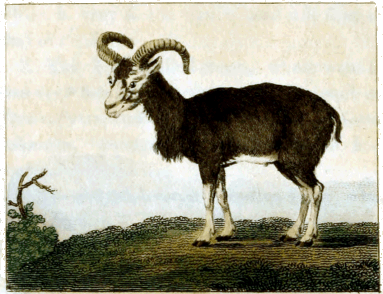
FIG. 140. Iceland Ram.
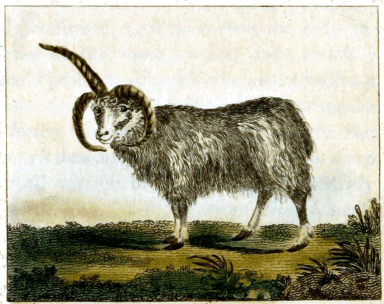
5. The adimain, or great sheep of Senegal and India, which are covered with hair more or less short or coarse according to the heat of the climate. All these sheep are only varieties of the same species, and certainly would produce with each other, since we know from experience that the he goat, whose species is further distant, copulates with our ewes. But though these five or six races of domestic sheep are all varieties of the same species, entirely produced by the difference of climate, treatment, and food, yet none of them appear to be the primitive stock from whence the others sprung; nor is there any of them strong or swift enough either to resist, or avoid, carnivorous animals, by flight. They all equally need care and protection, and must all, therefore, be looked upon as degenerate races, formed by the hands of man, and multiplied for his use. At the same that he fed, cultivated, and increased these domestic races, he neglected, hunted, and destroyed the wild breed, which being stronger and less tractable, would, consequently, be more troublesome, and less useful; they are, therefore, only to be met with in small numbers, and in thinly inhabited places, where they can support themselves. In the mountains of Greece, in the islands of Cyprus, Sardinia, and Corsica, and in the desarts of Tartary, the animal, which we call the muflon (fig. 139.), is still to be found, and which in my opinion is the primitive stock of all the varieties of sheep; he lives in a state of nature, and subsists and multiplies without the help of man; he resembles the several kinds of domestic sheep more than any other wild animal; he is more lively, stronger, and swifter, than any of them; his head, forehead, eyes, and face, are like the ram’s; he resembles him also in the form of the horns, and in the whole habit of the body; in short, he produces with the domestic sheep, which alone is sufficient to demonstrate that he is of the same species, and the primitive stock of the different breeds. The only difference betwixt the muflon and our sheep is, that the first is covered with hair instead of wool; but we have already observed, that even in domestic sheep the wool is not an essential character, but a production of temperate climates, since in hot countries these same sheep have no wool, and are all covered with hair; and that, in cold countries, their wool is as coarse as hair. Hence it is not astonishing that the primitive wild sheep, who must have endured cold and heat, have lived and increased without shelter in the woods and deserts should not be covered with wool, which he would soon be deprived of among the thickets; and its nature would, in a short time, be changed by the action of the air, and in temperature of the seasons. Besides, when a he-goat copulates with a domestic ewe, the produce is a kind of muflon, for the lamb is covered with hair, and is not a barren mule, but a mongrel, which returns towards the original species, and which appears to indicate, that the goats and domestic sheep have something in common with their origin; and, as we know by experience, that the he-goat very readily copulates with the ewe, but that the ram is incapable of impregnating the she-goat, it is not to be doubted, that, when these animals are in a domestic state, the goat is the predominant species. Thus our sheep is a species much more degenerated than that of the goat, and there is every reason to believe that if the muflon were brought to the she-goat, instead of a domestic ram, she would produce kids approaching nearer to the species of the goat, as the lambs produced between the he-goat and ewe return nearer to the species of the ram.
I know that naturalists, who have founded their knowledge of Natural History on the distinction of some particular characters, may make some objections to this doctrine, and, therefore, I shall endeavour to anticipate them. The first character of the sheep, they will say, is to be clothed with wool, and that of the goat with hair. The second character of the ram is to have circular horns, which turn backwards, and that of the he-goat is to have them straight and erect. These, they will affirm, are the distinctive and infallible marks by which sheep and goats will always be distinguished; for as to the rest, they cannot avoid acknowledging, they belong to them both in common. Neither have incisive teeth in the upper jaw, but each of them have eight in the lower; both want the canine teeth, and both have cloven feet, simple and permanent horns, teats in the same parts of the belly, both live upon herbage, and ruminate. The internal organization has still a greater resemblance, for it appears to be absolutely the same; the number and form of their stomachs, the disposition of the viscera and intestines, the substance of their flesh, the qualities of the fat and seminal liquor, the time they go with young, and the length of their lives, are perfectly the same. There only remains, then, the wool and the horns, by which these two species can be distinguished; but we have already demonstrated by facts, that wool is not so much a substance of nature as a production of climate, assisted by the care of man. The sheep of hot and cold countries, and those which are wild, have no wool, but hair, while the goats in very mild countries have rather wool than hair, for that of the Angola goat is finer than the wool of our sheep. This character, therefore, is not essential, but purely accidental, and even equivocal, since it equally belongs to, or is deficient, in both species, according to the difference of climate. The character of the horns appears to be still more uncertain; they vary in number, size, form, and direction. In our domestic sheep the rams have commonly horns, and the ewes have none; nevertheless, I have seen in our flocks rams without horns and ewes with them; and sheep not only with two but four horns. The sheep of the North, and of Iceland, (fig. 140.) have sometimes even eight. In hot countries the rams have only two very short horns, and often are deficient of them as well as the ewes. In some the horns are smooth and round, in others they are furrowed and flat, and the points instead of turning back, are often bent and come forward, &c. This character, therefore, is not more constant than the first, and consequently, not sufficient to constitute a different species; the largeness of the tail has also been considered, by some naturalists, as an essential distinction, and from the difference in the size of that, the wool, and the horns, they have made seven or eight different species of these animals, which we have reduced to one; and this reduction appears to be so well founded, that we are not afraid of its being contradicted by future observation.
It appeared necessary in composing the History of Wild Animals, to consider them one by one, and independently of genus; but on the contrary, in domestic animals, it appears requisite even to extend the genera; because, in Nature, there only exists individuals, and succession of individuals, that is, species. Men have had no influence on independent animals, but they have greatly altered, modified, and changed domestic ones; therefore, we have made physical and real generas, greatly different from metaphysical and arbitrary ones, which have never existed but in idea. These physical genera, are in reality composed of all the species, which by our management have been modified and changed, and as all these species so differently altered by the hand of man, have but one common and simple origin in nature, the whole genus ought to form but one species. For example, in writing the history of tigers, we have admitted as many species as are found in all the different parts of the world, because, we are certain that man has never subjected, nor changed the species of those untractable animals, which subsist at present such as Nature produced them. It is the same with all other free and independent animals. But in composing the history of oxen and sheep, we have reduced all the first under the species of a single ox; and the latter under that of a single sheep, because, it is also certain, that man, and not Nature, has produced the different kinds which we have enumerated. Every thing concurs to support this idea, which, although clear in itself, may not, perhaps, be sufficiently understood. That all the different oxen produce together, we have demonstrated by the experience of M. de la Nux, and the testimonies of Messrs. Mentzelius and Kalm; that the sheep also produce with one another, with the muflon, and even with the he-goat; I know from my own experience. All the different kinds of oxen, therefore, are no more than one species, and all the sheep but another, however extended the genus of both may be.
I shall never cease to repeat (seeing the importance of the subject) that it is not by trivial particular characters we can judge of Nature, or distinguish the species; that methodical arrangements, far from elucidating the History of Animals, serve but to obscure it by multiplying unnecessary denominations and species; by making arbitrary genera which are not in Nature, and perpetually confounding real beings with imaginary creatures; by giving false ideas of the characteristics of the species, and mixing or separating them without foundation, without knowledge, and often without having seen a single individual. It is hence that our nomenclators constantly deceive themselves, and write almost as many errors as lines. We have already given so many examples of this, that he must be blindly prejudiced indeed, that can in the least doubt them. Monsieur Gmelin speaks very sensibly on this subject, when treating of the animal in question.[G]
We are convinced, as M. Gmelin observes, that we cannot acquire a knowledge of Nature, but by making a judicious use of our senses, by reflecting, seeing, comparing, and, at the same time, by rejecting the bold freedom of forming methodical orders, and minute systems, in which animals are classed without the authors having seen them, and of which they are only acquainted with the names; names which are often equivocal, obscure, and misapplied. The wrong use of these names confounds the ideas in vague and indefinite words, and drowns the truth in a torrent of error. We are also convinced, after having compared the living mouflon with the description of M. Gmelin, that the argali is the same animal. We have said they are found in Europe, and in warm countries, such as Greece, the island of Cyprus, Sardinia, and Corsica; nevertheless, they are found also, and in great numbers, in all the mountains of the southern parts of Siberia, under a climate rather cold than temperate, and where they appear even to be bigger, stronger, and more vigorous. He might, therefore, have stocked the north and south parts, and his posterity have become domestic; after having long endured the rigours of this condition, he might have degenerated, taking relative characters, and new habits of body, according to the different climates, and the different treatments he has received; which being afterwards perpetuated by generation, have given rise to our domestic, and all other kinds of sheep, of which we have heretofore spoken.