Front matter (continued 3)
Reading edition
These, like most other possible accounts, must be found in Nature; it even appears, that the females in general contribute more to the support of the species than the males; for though both concur in the first formation of the fœtus, the female, who afterwards alone furnishes all that is necessary to its growth and nutrition, modifies and assimilates it more to her own nature, which cannot fail of effacing the impression of the parts derived from the male. Thus, if we would judge deliberately and rationally of a species, the females should be the objects examined. The male gives half of the living substance, the female gives as much, and furnishes besides all the necessary matter for its formation. A handsome woman has almost always fine children; a handsome man with an ugly woman, commonly has children who are still more ugly.
Thus, in the same species, there may sometimes be two races, the one masculine, and the other feminine, both of which subsisting and perpetuating their distinctive characters, seem to constitute two different species; and this is the point where it appears almost impossible to fix the term between what naturalists call species and variety. Suppose, for example, we should constantly couple he-goats with some sheep, and rams with others; it is evident, that after a certain number of generations, there would be established in the species of the sheep, a breed which would tend greatly towards the goat, and would afterwards perpetuate itself; for, though the first produce with the he-goat would be very little removed from the species of the mother, and would be a lamb and not a kid, nevertheless this lamb would have hair, and some other characteristics of its father. If we afterwards couple the he-goat with these female bastards, the production of this second generation will approach nearer to the species of the father, still nearer in the third, and so on. By this method the adventitious characters would soon prevail over the natural ones, and this fictitious breed might support itself, and form a variety in the species, whose origin it would be very difficult to recognize; therefore what can be done by the influence of the one species on another, may still be more effectually produced by the same species. If strong females have continually only weak males, in course of time, a feminine race will be established; and if very strong males are put to females of inferior strength and vigour, a masculine race will be the result, and will appear so different from the first, as hardly to be allowed to have one common origin, and which consequently will be regarded as really distinct and separate species.
To these general reflections, we shall add some particular observations. Linnæus speaks of two animals which he had seen in Holland, that were of the goat kind; the horns of the first were short, almost resting upon the skull, and its hair was long; the second had erect horns, the points turned back, and the hair short. These animals, which appeared to be more in species than the chamois and the common goat, nevertheless produced together, which sufficiently demonstrates that these differences in the shape of the horns, and length of the hair, are not specific and essential characters; for as these animals produced together, they must be regarded as the same species. From this example we may draw a very probable induction, that the chamois and our goat, whose principal differences consist in the shape of the horns and the length of the hair, are probably one and the same species.
In the royal cabinet there is a skeleton of an animal which was given to the menagerie under the name of capricorne; it perfectly resembles the domestic goat in the make of the body and the proportion of the bones, and in the form of the lower jaw, that of the wild-goat; but he differs from both in the horns; those of the wild-goat have prominent tubercles, and two longitudinal ridges; those of the common he-goat have but one ridge, and no turbercles, the horns of the capricorne have but one ridge and no tubercles, but only rugosities which are larger than those of the goat; these differences indicate, therefore, an intermediate race between the wild and the domestic goat. The horns of the capricorne are also short and crooked at the point, like those of the chamois, and, at the same time, they are compressed, and have rings; thus they partake at once of the common goat, the wild goat, and the chamois goat.
Mr. Brown, in his History of Jamaica, relates, that in that island there is actually to be found, 1. The common domestic goat of Europe; 2. The chamois; and 3. The wild goat. He affirms, that neither of these three animals are natives of America, but have been transported from Europe; that they have, like the sheep, degenerated and become smaller in this new country; that the wool of the sheep is changed into a rough hair like that of the goat; that the wild goat appears to be a bastard race, &c. From this we are induced to suppose that the small goat, with erect horns and crooked at the points, which Linnæus saw in Holland, and was said to come from America, is the chamois of Jamaica, that is, the chamois of Europe degenerated, and become less by the climate of America; and that the wild goat of Jamaica, which Mr. Brown calls the bastard wild goat, is our capricorne, which appears to be only a wild goat degenerated, and whose horns might have varied by the influence of the climate.
M. Daubenton, after having scrupulously examined the affinities of the chamois with those of the he-goat and the ram, says, that in general, it resembles more the first than the last; the principal differences besides the horns are the form and size of the forehead, which is less elevated and shorter in the chamois than in the goat, and the form of the nose, which is more contracted; so that in these two, the chamois bears a greater resemblance to the ram than to the goat. But supposing, for which there is much reason, that the chamois is a constant variety of the species of the he-goat, as the bull-dog and greyhound are fixed varieties in the species of the dog, we shall see that these differences in the size of the forehead and the position of the nose, are not nearly so great in the chamois, relatively to the goat, as in the bull-dog relative to the greyhound, which, nevertheless produce together, and are certainly of the same species. In other respects, as the chamois resembles the goat by a greater number of characters than the ram, if it constitute a particular species, it must necessarily be an intermediate one betwixt the goat and the ram. We have observed, that the he-goat and the sheep produce together, therefore the chamois, which is an intermediate species between the two, and at the same time is much nearer the goat than the ram, by the number of resemblances, ought to copulate with the she-goat and consequently must not be considered but as a variety constant in this species.
As the chamois which was transported to and became less in America, produces with the small goat of Africa, there can be little doubt but he would also produce with the she-goats of the common kind. The chamois, therefore, is only a constant variety in the species of the goat, as the bull-dog is in that of the dog; and, on the other hand, we can scarcely question that the wild goat is the primitive goat in the state of nature and, is with respect to domestic goats, what the muflon is to the sheep. The wild goat exactly resembles the domestic he goat, in figure, conformation, and in natural and physical habits; it only varies by two slight differences the one exterior, the other interior; the horns of the wild goat are larger than those of the common he-goat the former having two longitudinal ridges, and the latter but one; they have also large transverse rings which mark the number of years of their growth, while those of the common he-goats are only marked with transverse strokes. The figure of their bodies is in other respects perfectly alike. The interior part is also similar, excepting the spleen, which is oval in the wild goat, and approaches nearer to that of the roe-buck, or stag than that of the he-goat, or ram. This last difference may proceed from the violent exercise of this animal. The wild goat runs as fast as the stag, and leaps lighter than the roe-buck; the spleen, therefore, ought to be made like that of the swiftest running animals. This difference, then, is owing less to Nature than to custom, and it is to be presumed, that if our domestic he-goats were to become wild, and were forced to run and to leap like the wild goats, the spleen would soon assume the form most convenient to this exercise. With respect to his horns, the differences, though very apparent, do not prevent their more resembling those of the he-goat than of any other animal. Thus the wild and common he-goat approaching nearer to each other than to any other animal, even in this part, which is the most different of all, we must conclude, as they are alike in every other particular, that, notwithstanding this slight and single disagreement, they both are animals of the same species.
I consider, therefore, the wild, the chamois, and the domestic goat, as one species, in which the males have undergone greater varieties than the females; and I find, at the same time, secondary varieties in the domestic kind, which are less equivocal, as they belong equally to the males and females. We have seen that the goats of Angora, though very different from ours, in the hair and horns, are, nevertheless, of the same species. The same may be said of the Juda goat, which Linnæus with much reason has considered as a variety of the domestic species. This goat, which is common in Guinea, Angola, and other parts of Africa, differs from ours only in being smaller, fatter, and more squat; his flesh is also better, and preferred in that country to mutton, as we prefer the flesh of the sheep to that of the goat. It is the same with the Levant, or Mambrina goat,[T] with long hanging ears; which is only a variety of the goat of Angora, who has also hanging ears, but not so long. The ancients were acquainted with these goats, but they did not separate them from the common species. The variety of the Mambrina goat is more diffused than that of the goat of Angora; for we find these very long-eared goats in Egypt, and the East Indies, as well as in Syria; they give plenty of good milk, and which the eastern nations prefer to that of the cow, or female buffalo.
With respect to the small goat that Linnaeus saw alive, and which produced with the American chamois, it must have, as we observed, been originally transported from Africa; for it so greatly resembles the African he-goat, that we cannot doubt of its being of the same species, or that it, at least, owes its first origin to it. This goat is small in Africa, and would become still less in America; and we know, by the testimony of travellers, that it has for a long time been as customary to transport from Africa, as from Europe into America, sheep, hogs, and goats, whose races still subsist without any other alteration than a diminution in the size.
After having examined the different varieties of goats, and considered them relatively to each other, it appears to me, that of the nine or ten species of which the nomenclators speak, there is, in reality, but one; for instance, 1. The wild he-goat is the principal stock of the species. 2. The capricorne is the wild goat degenerated by the influence of climate. 3. The domestic he-goat derives his origin from the wild he-goat. 4. The chamois is only a variety in the species of the she-goat, with whom he would be able to produce as well as the wild goat. 5. The small goat with erect horns, crooked at the points, which Linnæus speaks of, is the chamois of Europe become smaller in America. 6. The other small goat with horns lying flat, and which produced with the small chamois of America, is the same as the he-goat of Africa, and the production of these two animals prove, that our chamois and domestic he-goat would also produce together, and are, consequently, of the same species. 7. The dwarf goat, which is probably the female of the African buck, and, like the male, only a variety of the common kind. 8. It is the same with the bucks and she-goats of Juda, they are only varieties of our domestic goats. 9. The goat of Angora is also of the same species, since it produces with our goats. 10. The Membrina goat, with large pendulous ears, is a variety in the race of the goats of Angora. These ten animals, therefore, are only ten different races of one species, produced by the difference of climate. Capræ in multos similitudines, transfigurantur, says Pliny; and in effect, we see by this enumeration, that the goats, although essentially like each other, yet vary much in their external form; and if we should comprehend, with Pliny, under the generic name of Goats, not only all those we have mentioned but also the roe-buck, the gazelle, the antelope, &c. this would be the most extended species in Nature, and contains more kinds and varieties than that of the dog. But Pliny was not sufficiently informed of the real differences of species when he joined the roe-buck, antelope, &c. to the species of the goat. These animals, though bearing much resemblance to the goat in many respects, yet are different species; and we shall see, from the following articles, how much the antelopes vary, both in species and races; and after enumerating all the goats and all the antelopes we shall find many animals still remain, which participate of both. In the whole history of quadrupeds I find nothing more difficult to explain, nor more confused or uncertain, than the accounts given by travellers of goats, antelopes, and other species which have an affinity to them. I have exerted all my endeavours, and employed all my attention, to throw some light upon it, and shall not regret my labour, if what I now write may contribute to prevent errors, fix ideas, and bring forth the truth, by extending the views of those who would study Nature.—But to our subject.
All goals are liable to vertigos; this disease is also common to the wild and chamois goats, as well as the inclination to climb up rocks, and the custom of continually licking stones, especially those which are impregnated with nitre or salt. In the Alps are rocks which have been hollowed by the tongues of the chamois; these are commonly composed of soft and calcinable stones, in which there is always a certain quantity of nitre. These natural agreements, these conformable customs, appear to be sufficient indexes of the identity of species. The Greeks, as we have said, did not separate these into three different species; and our hunters, who, probably, never consulted the Greeks, have always looked upon them as the same species. Gaston Phœbus, when speaking of the wild goat, particularises him under the name of the wild buck; and the chamois, which he calls ysarus and sarris, is also, according to him, but another wild goat. I own that all these authorities do not make a complete proof, but by uniting them with the facts and reasons we have produced, they form such strong presumptions upon the unity of the species of these three animals, that we can harbour no doubt on the subject.
The wild and chamois goats, one of which I look upon as the male, and the other as the female stock of the goat kind, are only found, like the muflon, who is the stock of the sheep, in deserts, and in the most craggy and highest mountains. The Alps, the Pyrennees, the mountains of Greece, and those in the islands of the Archipelago, are almost the only places where the wild and the chamois goats are to be found. But although both dislike heat and inhabit the regions of snow and ice, yet they have also an aversion to excessive cold. In summer, they chuse the north side of the mountains; in winter they move to the southern and even descend from the summits. Neither can support themselves on their legs upon the ice when it is smooth, but if there be the least inequalities on its surface, they bound along with security.
The chace of these animals is very laborious, and dogs are almost useless in it. It is likewise very dangerous, for the animal finding himself hard pushed will turn and strike the hunter with his head, and sometimes throw him over a precipice. The chamois is as swift, though not so strong, as the wild goats; they are more numerous, and commonly go in herds; they are not, however, so numerous as they were formerly, at least in our Alpine and Pyrenean mountains.
M. Peroud, surveyor of the chrystal mines in the Alps, brought over a living chamois, and gave the following excellent information on the natural habits and manners of this animal. “The chamois is a wild animal, yet very docile; he inhabits only rocks and mountains. He is about the size of a domestic goat, and resembles him in many respects. He is most agreeably, lively, and active beyond expression. His hair is short like that of the doe; in spring it is of an ash-colour; in summer rather yellow; in autumn a deep yellow mixed with black, and in winter of a blackish brown. The chamois are found in great numbers in the mountains of Dauphiny, Piedmont, Savoy, Switzerland, and Germany: they live sociably together, and are found in flocks of from eight to fifteen or twenty, and sometimes they are seen to the number of from sixty to a hundred dispersed in small flocks upon the crags of a mountain. The large males keep separate from the rest, except in their rutting-time, when they approach the females. During this time they have a very strong smell; they bleat often and run from one mountain to another. The time of their coupling is from the beginning of October to the end of November, and they bring forth in March and April. The young female receives the male at a year and a half old. The young follow the dam for about five months, and sometimes longer, if the hunters, or the wolves, do not separate them. It is asserted that they lire between twenty and thirty years. Their flesh is very good, and some of the fattest afford ten or twelve pounds of suet, which is better and harder than that of the goat. The blood of this animal is extremely hot, and is said to approach very nearly to that of the wild goat in its qualities and virtues, and may prove of the same service, for the effects are the same when taken in a double quantity: it is reckoned very good against pleurisies, a great purifier of the blood, and a restorative of perspiration. The hunters very often mix the blood of the wild and chamois goats together, and sometimes they sell the blood of the wild goat for that of the chamois. It is very difficult to distinguish the one from the other, which proves there can be but very little difference in them. The cry of the chamois is not distinct but faint, and resembling that of a hoarse domestic goat: it is by this cry they collect together, and by which the mother calls her young. But when they are frightened, or perceive an enemy, or any object which they cannot distinguish, they warn the rest of the flock by a kind of whistling noise. The chamois has a very penetrating sight, and his hearing and smell are not less discriminating. When he sees a man near he stops for a moment, and then flies off with the utmost speed. When the wind is in its favour he can smell a human creature for more than half a mile distance; therefore when he hears or scents any thing which he cannot see, he begins to whistle or blow with such force that the rocks and the forests re-echo the sound; if others are within hearing they are all alarmed; this whistling continues as long as the breath will permit: in the beginning it is very shrill, and deeper towards the close. The animal then rests a moment, after the alarm, to inspect farther into the danger, and having confirmed his suspicion, he commences his whistling, and continues it, by intervals, till it has spread the alarm to a great distance. During this time he is most violently agitated; he strikes the ground with his feet; he bounds from rock to rock; he turns and looks round; leaps from one precipice to another; and when he obtains a sight of his enemy he flies from it with all speed. The whistling of the male is more acute than that of the female: it is performed through the nostrils, and is no more than a very strong blowing, and resembles the noise which a man would make by fixing his tongue to the palate, keeping the teeth nearly shut, the lips open, and a little lengthened, and blowing with all his force. The chamois feeds on the best herbage, and chuses the most delicate part of plants, as the flowers and most tender buds. He is not less fond of several aromatic herbs, which grow upon the side of the Alps. He drinks very little while he feeds upon the succulent herbage. He ruminates like the common goat. The food he makes use of strongly marks the warmth of his constitution, as do his large eyes, which are admired for their roundness and sparkling, and the vivacity of his disposition. His head is crowned with two small horns, of about half a foot long; they are of a beautiful black, and rise from the forehead almost betwixt the eyes, and, instead of bending backwards like other animals, they jet forward above the eyes, and bend backward at the extremities in a small circle, and end in a very sharp point. His ears are placed in a very elegant manner near the horns, and there are stripes of black on each side of the face, the rest being of a whitish yellow, which never changes. The horns of this animal are often made use of for the heads of canes; those of the female are less, and not so much bent; and some farriers make use of them for bleeding cattle. The hides of these animals are very strong, nervous, and supple, and when dressed, excellent breeches, vests, and gloves, are made of them; this sort of cloathing is very durable, and of very great service to labouring men. The chamois is a native of cold countries, and generally prefers craggy rocks and high places; they indeed frequent the woods, but it is only those in the highest regions, where the forests consist of firs, larch, and beech trees. These animals have so much dread of heat, that in summer they are only to be found in the caverns of rocks amidst fragments of congealed ice, or in forests where the high and spreading trees form a shade for them, or under rough and hanging precipices that face the north, where the rays of the sun seldom disturbs them. They go to pasture both morning and evening, but seldom during the day. They traverse over rocks with great facility, where the dogs cannot follow them. There is nothing more wonderful than to see them climbing and descending precipices, inaccessible to all other quadrupeds. They mount and descend always in an oblique direction, and throw themselves down a rock of twenty or thirty feet, and alight with great security. In descending they strike the rock with their feet, three or four times, to stop the velocity of their motion; and when they have got upon the base below, they at once seem fixed and secure. In fact, to see them thus leaping among the precipices, they seem rather to have wings than legs, so great is the strength of their nerves. Some writers have pretended that they use their horns for climbing and descending the precipices. I have seen and killed many of these animals, but I never saw them use their horns for that purpose, nor have I ever found any hunter who could confirm this assertion. The chamois ascends and descends precipices with great ease, by the agility and strength of his legs, which are very long; the hind ones being somewhat the longest and always crooked, assist them in throwing themselves forwards, and are of great service by breaking the force of the fall. It is asserted, that when they feed, one of them is deputed to stand sentinel for the security of the rest. I have seen many flocks of these animals, but never observed that to be the case. It is certain that when there are a great number of them there will always be some looking about while the rest are grazing; but there is nothing in this particularly distinguishable from a flock of sheep; for the first who perceives any danger warns all the rest, and in an instant the terror with which he is struck spreads through the whole flock. During the rigours of winter, and in the deep snows, the chamois retreats to the lower forests, and feeds upon the pine-leaves, buds of trees, bushes, or such dry or green shrubs and grass as they can discover by scratching off the snow with their feet. The more craggy and uneven the forest, the more this animal is pleased with its abode. The hunting of the chamois is very difficult, and laborious. The most usual way is by hiding behind some of the clefts of the rocks, and shooting them as they pass; for this method the sportsman is obliged to take great precaution in concealing himself; observing, at the same time, to keep the wind in his face. Others hunt this animal as they do the stag, by placing some of the hunters at all the narrow passages, while others beat round to alarm the game. Men are more proper for this sort of hunting than dogs, who when employed, often disperse the chamois too soon, when they immediately fly to a considerable distance; the men also find it a dangerous sport, for when the animal observes his retreat shut up, he directly makes at the hunter with his head, and frequently knocks him down.”
With regard to the specific virtues attributed to the blood of the wild goat, in the cure of certain diseases, especially in the pleurisy, a virtue thought to belong particularly to this animal, and which would indicate it to be of a particular nature, it is now known that the blood of the chamois, and also of the domestic he-goat, has the same properties when fed on the same aromatic herbs; so that even by this property these three animals appear to be united in the same species.

SUPPLEMENT.
Besides the Syrian goat, which we formerly mentioned as having pendulous ears, there is a species in Madagascar, which are much larger, and with pendulous ears so long, that they hang entirely over their eyes, which obliges the animal to be almost continually throwing them back, and therefore whenever pursued, he invariably makes to the rising ground. The accounts which we received of this animal came from M. Comerson, but were not sufficiently particular to determine whether it was a different species or only a variety of the Syrian race with pendulous ears.
M. le Vicomte de Querhoënt says, that the goats left on Ascension Island have increased abundantly, but they appear very thin, and so weak, that men can often outrun them; they are of a very dark brown, much less than our goals, and in the nights conceal themselves in the holes of the mountains.
THE SAIGA.

There is a species of goat found in Hungary, Poland, Tartary, and in South Siberia, which the Russians call Saigak, or Saiga; it bears a resemblance to the domestic goat in the shape of its body and its hair; but by the form of the horns, and the want of a beard, it approaches nearer to the antelopes, and, in fact, appears to be the shade between those two animals; for the horns of the saiga are in every respect like those of the antelope; they have the same form, transverse rings, longitudinal streaks, &c. and they differ only by the colour. The horns of the antelopes are black and opaque; those of the saiga, on the contrary, are whitish and transparent. Gesner has mentioned this animal under the name of colus, and Gmelin under that of saiga. The horns which are in the royal cabinet, were sent under the denomination of the horns of the Hungarian buck; they are so transparent and so clear, that they are used for the same purpose as tortoise-shell.
The saiga, by its natural habits, resembles more the antelopes, than the wild or chamois goats; for it does not delight in mountainous countries, but lives on the hills and plains. Like them also he moves by bounds and leaps; he is very swift, and his flesh much better eating than that of either the tame or wild goat.[U]
THE GAZELLES, OR ANTELOPES.
There have been thirteen species, or, at least, thirteen distinct varieties made of these animals; in this uncertainty, whether they are varieties, or species, we thought it best to treat of them all together, assigning to each a particular name. The first of these animals, and the only one to which we retain the generic name of gazelle, is the common gazelle, (fig. 153.) which is found in Syria, Mesopotamia, and the other provinces of the Levant, as well as in Barbary, and in all the northern parts of Africa. The horns of this animal are about a foot long, entirely annulated at the base, lessening into half-rings towards the extremities which are smooth. They are not only surrounded with rings, but also furrowed longitudinally by small streaks. These rings mark the years of their growth, which is commonly about twelve or thirteen. The gazelles in general, and this tribe in particular, greatly resemble the roe-buck in the proportions of the body, natural functions, swiftness, and the brightness and beauty of the eyes. These resemblances would tempt us to think, as the roe-buck does not exist in the same countries with the gazelle, that the latter was only a degeneration of the first; or, that the roe-buck is a gazelle, whose nature had been altered by the influence of the climate and effects of food, did not the gazelles differ from the roe-buck in the nature of their horns; those of the roe-buck are a kind of solid wood, which fall off, and are renewed every year, like those of the stag; the horns of the gazelles, on the contrary, are hollow and permanent like those of the goat. The roe-buck has also no gall-bladder, which is to be found in the gazelle. The gazelles have, in common with the roe-bucks, deep pits under the eyes, and they resemble each other still more in the colour and quality of the hair, in the bunches upon their leg, which only differ in being upon the fore-legs of the gazelle, and upon the hinder legs of the roe-buck. The gazelles, therefore, seem to be intermediate animals between the roe-bucks and goats; but, when we consider that the roe-buck is an animal which is to be found in both continents, and that the goats, on the contrary, as well as the gazelles, belong only to the old world, we shall be induced to conclude that the goats and gazelles are more nearly related to each other, than they are to the roe-buck. The only characters peculiar to the gazelles, are the transversed rings and longitudinal depressions on the horns, the bunches of hair on the fore-legs, the thick streaks of black, brown, or red hair upon the lower part of the sides, and three streaks of whitish hair to the internal surface of the ears.
Engraved for Barr’s Buffon
FIG. 153. Gazelle.
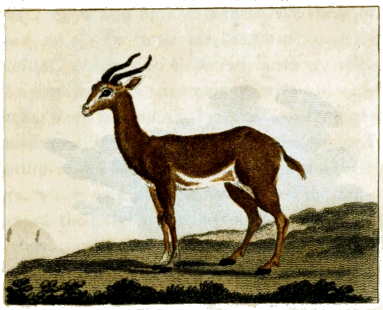
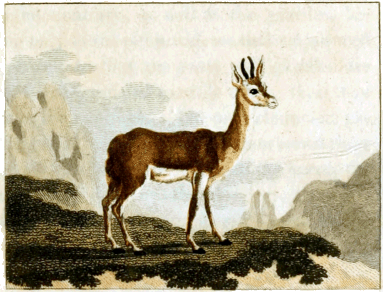
FIG. 154. Corine.
The second gazelle is an animal found in Senegal, which M. Adanson informs us, is there called kevel. It is something less than the former, and nearly of the size of a small roe-buck; it differs also in its eyes, which are much larger; and its horns, instead of being round, are flattened on the sides, and this flattening of the horns is not a sexual difference; the male and female gazelles have them round, or more properly speaking, compressed; in other respects, they entirely resemble each other. They both have yellow-coloured hair, thighs and belly white, the tail black, a brown stripe under the flank, three white streaks in the ears, black horns surrounded with rings, with the longitudinal depressions, &c. but it is certain, that the number of these rings is greater in the kevel than in the gazelle, the last having generally but twelve or thirteen, and the former at least fourteen, and often eighteen or twenty.
The third is called corine (fig. 154.) from korin, the name it bears in Senegal. It greatly resembles the gazelle and the kevel, but is still less than either; its horns are also thinner and smoother, the rings being scarcely discernible. M. Adanson, who communicated to me his description of this animal, says, that it seemed a little tending to the chamois goat, but that it is much smaller, being in length only two feet and a half, and not quite two feet in height; that its ears are four inches and a half long, its tail three inches, its horns six inches long, and not an inch thick; that they are two inches distant from each other at the base, and about five or six at their extremities; that, instead of annular prominences, they have only transverse wrinkles very close to each other in the lower part, and more distant in the upper, and that these wrinkles, which are in the place of rings, are about sixteen in number; that its hair is short, fine, and glossy, yellow on the back and flanks, and white under the belly and the inside of the thighs and a black tail; and that there are some of these animals whose bodies are often sprinkled with irregular white spots.
These differences between the gazelle, the kevel, and the corine, although very apparent, especially in the corine, do not appear to be essential, nor sufficient to divide these animals into different species; for they resemble each other so much in every other respect, that they seem to be all three of the same species, more or less varied by the influence of climate and food. There is much less difference between the kevel and the gazelle, than the corine, whose horns in particular bear no resemblance to those of the other two; but all three have the same natural habits; they assemble and feed together in herds; they are of mild dispositions, and easily accustomed to a domestic state and the flesh of all three is very good to eat. We think ourselves therefore, authorised to conclude that the gazelle and kevel are certainly of the same species, and that it is uncertain, whether the corine be only a variety of the same species or whether it be a different one.
In the royal cabinet of France, there are skins of these three different antelopes, besides which, there is a horn that bears a great resemblance to those of the gazelle and kevel, but much larger; this horn is engraven in the works of Aldrovandus, Lib. I. de Bisulcis, c. xxi. Its thickness and length seem to indicate a much bigger animal than the common gazelle, and it appears to me to belong to an antelope which the Turks call tzeiran, and the Persians ahu. This animal, according to Olearius, in some measure resembles our fallow-deer, except being rather of a red than yellow colour; the horns, likewise, are without antlers, and rest upon the back, &c. M. Gmelin, who describes it under the name of dsheren says, it resembles the roe-buck, with this exception, that the horns like those of the wild goat, are hollow and never fall off. He also adds, that in proportion as the horns increase in growth, the cartilage of the larynx thickens, and forms a considerable prominence under the throat when the animals are advanced in years. According to Kœmpfer the ahu differs not in the least from the stag in its form, but that his horns appear nearer to those of the goat, which are single, black, and annulated, as far as the middle, &c. Some other authors have likewise made mention of this species of antelope under the name of geiram and jarain, which it is easy to restore, as well as that of dsheren to the primitive name of tzeiran. This antelope is common in South Tartary, in Persia, in Turkey, and is also to be met with in the East Indies.
To these four first species, or races of antelopes, may be added two other animals, which greatly resemble them; the first is called koba at Senegal where the French have stiled it the great brown cow; the second is also a native of Senegal, and is there called kob, but our countrymen denominate it the small brown cow. The horns of the kob greatly resemble those of the gazelle and kevel, but the shape of the head is different, the muzzle is longer, and there are no pits under the eyes. The koba is much larger than the kob; the latter is about the size of the fallow-deer, and the other is as large as the stag. From the remarks of M. Adanson, it appears that the koba is five feet long, from the extremity of the muzzle to the insertion of the tail; that its head is fifteen inches, its ears nine, and its horns from nineteen to twenty, that its horns are flattened on the sides and surrounded with ten or twelve rings, while those of the kob have only eight or nine, and are not more than a foot in length.
The seventh animal of this species is found in the Levant but more commonly in Egypt, and in Arabia. We call it, from its Arabian name, algazel; it is shaped pretty much like the other antelopes, and is nearly the size of the fallow-deer, but its horns are long, thin, and but little bent till toward their extremities, when they turn short with a sharp flexion; they are black and almost smooth, and the annular prominence scarcely observable, except towards the base, where they are a little more visible. They are about three feet in length, while those of the gazelle are not more than one foot, those of the kevel fourteen and fifteen inches, and those of the corine (which, nevertheless resembles this the most) only six or seven inches.
The eighth animal is generally called the Bezoar antelope, but by the eastern nations pasan, which name we retain. A horn of this animal is very well represented in the German Ephemerides, and the figure of the animal itself has been given by Kœmpfer, but his description is faulty in the horns, which are neither sufficiently long nor straight. His description likewise, does not appear to be exact, for he says, that this animal has a beard like the he-goat; and yet, he has given a figure of it without one, which seems more conformable to truth; for the want of a beard is the principal character by which antelopes are distinguished from goats. This antelope is of the size of our domestic he-goat, and has the colour, shape, and agility of the stag. We have seen a skull of this animal with the horns on it, and two other horns separate. The horns which are engraved in Aldrovandus, de quad. Bisulcis, p. 765. C. 24 de Orige, bear a great resemblance to these. In most respects, the algazel and the pasan, appear to have a great affinity; they are also natives of the same climate, and are found in the Levant, Egypt, Arabia, and Persia; but the algazel feeds upon the plains, and the pasan is only found on the mountains. The flesh of both is very good food.
The ninth antelope is an animal which, according to M. Adanson, is called nangueur, or nanguer (fig. 155.) at Senegal. It is three feet and a half long, and two feet and a half high; it is of the colour of the roe-buck, yellow on the upper part of the body, white under the belly and inside of the thighs, with a spot of the same colour under the neck. Its horns are permanent like those of the other antelopes, and are about six or seven inches in length; they are black and round, but what is singular, they bend forwards, at the points nearly in the same manner as those of the chamois goats bend backwards. These nauguers are very beautiful animals, and very easy to tame. All these characters, and principally that of the horns bending forward, induces me to think, that the nanguer may possibly be the dama, or fallow-deer, of the ancients. “Cornua rupicapris in dorsum adunca, damis in adversum,” says Pliny. As these are the only animals who have their horns bent in this manner, we may presume that the nanguer of Africa, is the dama of the ancients; especially, as Pliny says in another place, that the dama is only to be found in Africa. In short, by the testimonies of other ancient authors, we find, that the dama was a timid and peaceable animal, who had no other resource for his safety than in the swiftness of his running. The animal which Caius has given the figure and description of, under the name dama Plinii being found, according to that author’s own testimony in the north of Great Britain and in Spain, cannot possibly be the dama mentioned by Pliny, because he says, it was only to be found in Africa. Besides, this animal, which Caius has described, is furnished with beard like a goat, and not one of the ancients has spoken of the dama as having a beard. I am inclined therefore to believe that this dama of Caius is only a goat, whose horns being a little bent at their extremities, like those of the common gazelle, made him imagine it to be the dama of the ancients. Besides this character of the horns being bent forwards, which is the most certain index of the dama, is not properly marked in any other animal except the nanguer of Africa. From the remarks of M. Adanson, it appears, there are three varieties of these nanguers, which only differ in the colour of the hair, but all their horns bend forwards in a greater or lesser degree.
The tenth gazelle is a very common animal in Barbary and Mauritania, and which the English call antelope, a name we shall likewise adopt. This animal is of the size of a roe-buck, and greatly resembles the gazelle and the kevel, yet it differs from them in so many particulars, that it may be looked upon as a different species. The antelope has deeper eye-pits than the gazelle; its horns are near fourteen inches long almost touching each other at the bottom, yet their points are fifteen or sixteen inches asunder. They are surrounded with rings and semi-rings like the gazelle and kevel, but not so distinguishable; but what particularly discriminates the antelope, is its horns having a double flexion, which gives them the appearance of an antique lyre. The antelope, like other gazelles, is yellow on the back, and white under the belly; but these two colours are not separated by the black streak which is to be found in all the rest of the gazelle kind.
There seems to be different races of the antelope as there are in the other gazelles. 1. In the royal cabinet is a horn, which must be attributed to a much larger antelope than that we have been speaking of; it is called lidmee, a name, which according to Dr. Shaw, the Africans give to the antelopes. 2. In the cabinet of the Marquis de Marigny is a kind of an offensive weapon composed of two sharp-pointed horns about the length of a foot and a half which, by their double flexion, seem to belong to a much smaller antelope than any of the rest. It must be very common in the Indies, as their Faquirs, and other priests, carry this sort of weapon as a mark of dignity. We shall call it the Indian antelope, from its having the appearance of being only a simple variety of the African species.
By this enumeration of the gazelles, or antelopes, we find there are twelve species, or distinct varieties: viz. 1. The common gazelle; 2. The kevel; 3. The corine; 4. The tzeiran; 5. The koba, or great brown cow; 6. The kob, or small brown cow; 7. The algazel, or antelope of Egypt; 8. The pasan, or pretended bezoar; 9. The nanguer, or dama of the ancients; 10. The antelope; 11. The lidmée; and, 12. The Indian antelope. After having carefully compared them, we are induced to conclude that the common gazelle, kevel, and corine, are only three varieties of one species: 2. That the tzeiran, koba, and kob, are varieties of another: 3. That the algazel and the pasan are probably only two varieties of the same species; and that the name bezoar-gazelle, which has been given to the pasan, is no distinctive character; for we think ourselves able to prove, that the Oriental bezoar does not come from the pasan alone, but from all the gazelles and goats which live in the mountains of Asia: 4. That the nanguers, whose horns are bent forwards, and of which there are two or three varieties, have been indicated by the ancients under the name of the dama: 5. That the antelopes, which are three or four in number, and differ from all others by the double flexion of their horns, were also known to the ancients by the names of strepsiceros, and addax. All these animals are to be found in Asia and Africa that is in the old continent, and to these five principal species, which contain twelve very distinct varieties, we shall not add two or three other kinds, of America, to which the indefinite name of gazelle has also been given, although they are different from all those we have already noticed; as it would only increase the confusion, which is already too great. We shall give the history of these American animals, under their real names of Mezame, Temamaçame, &c. and shall here speak only of those animals of this species which are found in Africa and Asia: we shall also refer to the following articles, several other animals of Africa and Asia, which have been considered as antelopes or goats, though they appear to be an intermediate species; such as the bubalus, or Barbary cow, the condoma, the guib, the grimm, &c. without including the chevrotains, which greatly resemble the small goats or antelopes, but of which we shall speak in a separate article.
It is now easy to perceive how difficult it was to arrange all these animals, which amount to thirty, ten goats, twelve or thirteen antelopes, three or four of the bubalus, and as many chevrotains, all different from each other; many of them were unknown, the others confusedly mentioned by naturalists, and confounded one for another by travellers. This is the third time that I have written their history, and I must say, that the trouble much exceeded the produce, though I have done as much as possible with the materials and knowledge I was able to acquire.
By comparing the remarks which have been made by ancient and modern authors, with the knowledge we have acquired by experience, we find, 1. That the dorcas of Aristotle is not the gazelle but the roe-buck; notwithstanding that this name has been used by Ælian, not only to denote wild goats in general but particularly the Lybian or common gazelle. 2. That the strepsiceros of Pliny, or the addax of the Africans, is the antelope. 3. That the dama of Pliny is the nanguer of Africa, and not our fallow-deer, or any other European animal. 4. That the prox of Aristotle agrees with the zorkes of Ælian, and is the same with the platycerotas of the more modern Greeks, which name the Latins have adopted to denote the fallow-deer, “Animalium quorumdam cornua in palmas finxit natura; digitosque emisis exiis unde platycerotas vocant,” says Pliny. 5. That the pygargos of the Greeks is probably the gazelle of Egypt, or that of Persia; that is, the algazel or pasan. The word pygargos is only used by Aristotle to denote a bird, the white-tailed eagle; but Pliny employed it to denote a quadruped. The etymology of pygargus indicates, 1. An animal with white haunches, such as the roe-bucks or gazelles. 2. A timid animal; the ancients imagining that white thighs were an index of timidity, attributed the intrepidity of Hercules to his having black ones. But as almost every author, who speaks of the pygargus as a quadruped, mentions also the roe-buck; it is clear that the name can only be applied to some species of gazelle, which is different from the dorcas Lybica, or common gazelle, and from the strepsiceros, or antelope, which the same authors speak of. We therefore think, that the pygargus denotes the algazel or gazelle of Egypt, which must have been known to the Greeks as well as to the Hebrews; for we find the name of pygargus in the Septuagint version[V], among the number of animals whose flesh is deemed clean; the Jews, therefore, eat the pygargus, or that species of gazelle which is common in Egypt and the adjacent countries.
Mr. Russel, in his History of Aleppo, says, that near that city there are two sorts of gazelles; the one called the mountain gazelle, which is the most beautiful, and whose hair on the neck and back is of a deep brown; the other, called the gazelle of the valley, which is neither so swift nor so well made as the first, and whose hair is also much paler. He adds, that these animals run so quick and so long that the swiftest dogs cannot catch them, without the assistance of a falcon; that in winter the gazelles are lean, but yet their flesh is of a good flavour; that in summer it abounds with fat, like our venison; and that those which are fed at home do not eat so well as the wild ones. From this testimony of Mr. Russel, and from that of M. Hasselquist, we may perceive that the gazelles of Aleppo are not the common gazelles, but those of Egypt, whose horns are straight, long, and black, and whose flesh is excellent eating. We find also from these testimonies, that they are half domestic animals; that they have been early tamed, and that consequently many different varieties or kinds have been formed among them, as well as in other domestic animals. These Aleppo gazelles are the same therefore as those we have called algazells, and are still more abundant in the Thebaid and Upper Egypt than the environs of Aleppo. They feed on aromatic herbs and the tender bark of young trees: they are commonly found in herds, or rather in families, consisting of five or six. Their cry resembles that of the goat. They are hunted not only with dogs, assisted by the falcon, but also with the ounce[W].
In some places they take the wild gazelles by means of a tame one, to the horns of which they fasten a snare made of ropes. When a herd of wild gazelles is found, the tame one is sent among them, but he no sooner approaches than one of the males of the wild herd advances to oppose him, and in butting with his horns is soon entangled in the noose. In this struggle they both commonly fall to the ground, when the hunter coming up kills the one and disengages the other.
The antelopes, especially the largest sort, are much more common in Africa than in India, they are stronger and fiercer than the other gazelles, from which they are easily distinguished by the double flexion of their horns; and not having either the black or brown streak on their sides. The middling antelopes are about the size of the fallow-deer; their horns are very black, their belly very white, and their fore-legs shorter than the hind ones. They are well made, and extremely clean animals, never lying down but in dry places; they are likewise very swift, watchful, and apprehensive of danger; in open places they look round, and when they see a man, a dog, or any other enemy, they fly with all speed. But, notwithstanding this natural timidity, they have a kind of courage, for if surprised, they turn suddenly round, and face those who attack them with great firmness.
The antelopes, in general, have large black eyes, very brilliant, and so beautiful that the Orientals employ them proverbially, in praising the eyes of their mistresses. A gazelle-eyed beauty is the highest compliment a lover can pay. Their limbs are finer and more delicate than those of the roe-buck; their hair is as short, and more soft and glossy; their hind legs are longer than those before; like the hare, therefore, they have greater security in ascending than in descending steep places. Their swiftness is equal to that of the roe-buck; but the latter hastens on by bounds, while the former runs in an uninterrupted course. Most of them are yellow upon the back, white under the belly, with a black stripe which separates these two colours below the flanks. Their tails are of various lengths, but always covered with a pretty long blackish hair; their ears are long, erect, open, and terminating in a point: they all have cloven hoofs nearly like the sheep; both males and females have permanent horns, but the latter have them thinner and shorter than the former.
Such is the whole information which we have been able to acquire concerning the different species of gazelles, and their natural dispositions and habits. Let us now see how far naturalists have been right in attributing the production of the oriental bezoar to one kind of those animals only; and whether this animal be really the pasan or pazan, which they have described by the name of the bezoar gazel. In examining the description and the figures of Kœmpfer, who has written a great deal on this subject, it is doubtful whether he means that the pazan or the algazel is the only animal which produces the oriental bezoar. If we consult other naturalists and travellers, we shall be tempted to believe that this stone is the production not only of gazelles but of wild and domestic goats, and even sheep, the formation of which probably depends more on the temperature of the climate, and the quality of the food, than on the nature or the species of the animal. If we believe Rumphius, Seba, and some other authors, the true oriental bezoar is the production of apes and not of gazelles, goats, or sheep. But this opinion of Rumphius and Seba is not founded, for we have seen many of these concretions, to which the name of ape bezoar has been given, but they are quite different from the oriental bezoar, which is certainly produced by a ruminating animal, and is easily distinguished from all other bezoars by its shape, substance, and colour, which is generally that of an olive, and brown within, while the occidental bezoar is of a pale yellow. The substance of the first is soft and porous; that of the last hard, dry, and as it were petrified. Besides, as prodigious quantities of the oriental bezoar was consumed in the last century; and as it was used in Europe and Asia for all cases in which our present physicians give cordial medicines, and antidotes against poison, may we not presume, from the great quantities which were formerly, and are still, in some degree, consumed, that this stone is produced, not from a single species of animal but from many, and that it is equally the production of gazelles, goats, and sheep, who cannot produce it but in certain climates of the Levant and Indies.
In all that has been written on this subject we have not met with one distinct observation, nor a single decisive argument. It only appears, by what Monard, Garcias, Clusius, Aldrovandus, and others, have said, that the oriental bezoar animal is not the common and domestic goat, but a species of wild goat which they have not characterised. Thus, likewise, all that can be gathered from Kœmpfer is, that the bezoar animal is a kind of wild goat, or rather gazelle; but by the testimonies of Thevenot, Chardin, and Tavernier, it seems that this stone is obtained more from sheep and wild or domestic goats, than from gazelles. What gives great weight to the assertions of these travellers is, that they speak from ocular inspection, and because, although they do not mention the gazelles on this occasion, there is no appearance of their being deceived, as they knew them perfectly well, and mention them in other parts of their works. We must not, therefore, conclude, with our ancient naturalists, that the oriental bezoar is exclusively the production of a particular species of gazelle, for I must own, that after having examined not only the testimonies of authors, but such facts as might decide the question, I am inclined to believe, that this stone proceeds equally from the greatest number of ruminating animals, but more commonly from goats and gazelles. This stone is formed of concentric layers, and often contains foreign matter in its centre. I have endeavoured to find out the nature of this matter, which serves as a nucleus to the bezoar, supposing from that a judgment might be formed of the animal that possesses them. This nucleus is of various kinds; sometimes I found them to consist of pieces of flint, stones of plumbs, tamarinds, seeds of cassia, and particularly pieces of straw and buds of trees, therefore I could not hesitate to attribute this production to those animals which brouze upon shrubs and leaves.
The oriental bezoar then is clearly not the production of one particular animal but of many different ones; and it is not difficult to reconcile the testimonies of most travellers with this opinion. The ancients, both Greeks and Latins, have no knowledge of the bezoar. Galen is the first who speaks of its virtues as an antidote against poison. The Arabs, likewise, praise the bezoar as possessing those qualities; but neither the Greeks, Latins, nor Arabians, particularly describe the animals which produce it. Rabi Moses, an Egyptian, only says, that some pretend this stone is formed in the angles of the eyes, and others in the gall-bladder of the eastern sheep. Indeed there are bezoars, or, more properly speaking, concretions, formed in the eyes of stags, and some other animals; but these concretions are very different from the oriental bezoar, and all the concretions in the gall-bladder are of a light, oily, and inflammable matter, which bears no resemblance to the substance of the bezoar. Andreas Lacuna, a Spanish physician, says, in his Commentaries on Dioscorides, that the oriental bezoar is extracted from a certain kind of wild goat which feeds in the mountains of Persia. Amatus Lusitanus confirms Lacuna’s remarks, and adds, that this mountain-goat greatly resembles our stag. Monard, who quotes all three, still more positively affirms, that this stone is produced from the internal parts of a mountain-goat in India, to which, he says, I have affixed the name of cervi-capra, because it inclines both to the goat and the stag; for it is nearly of the size and shape of the stag, but its horns, like those of the goat, are very simple, and very much bent backwards. Garcias ab Horto says, that in Corasson, and in Persia, there is a kind of he-goats, called pasans, and that it is in their stomachs the oriental bezoar is formed; that as well as in Persia it is found in Malacca, and near Cape Comorin, and that in great numbers of the goats killed for the subsistence of the troops these stones are regularly sought for and found in their stomachs. Christopher Acosta confirms what Garcias and Monard have said, without adding any thing new; in short, not to omit any thing which has a relation to the historical detail of this stone, Kœmpfer, a man of more learning than exactness, being in the province of Laar, in Persia, says, that he went with the natives of that country to hunt the pasan, which produces the bezoar, and that he saw them extract that stone; besides which, he affirms, that the true oriental bezoar proceeds from this animal; that the buck ahu, of which he has also given a figure, produces the bezoar, but that they are of a very inferior quality. By his figures of the pasan and ahu we might be induced to believe, that the first represents the common gazelle rather than the true pasan; and from his description we might imagine his pasan to be a he-goat and not a gazelle, as he gives it a beard resembling that of the goat; and from the name ahu, which he gives to his other buck, as well as by his second figure, we might rather suppose it to be the wild goat than the true ahu, which is our tzeiran, or large gazelle. What is yet more singular, Kœmpfer, who seems willing to decide the species of animal that produces the oriental bezoar, and affirms, that it is the wild buck called the pasan, quotes, at the same time, a man, whose word, he says, may be relied on, who felt the bezoar stones in the belly of the gazelles of Golconda. Thus all the positive conclusions that can be drawn from Kœmpfer is, that there are two kinds of wild goats, the pasan and ahu, which produce the bezoar in Persia, and that in the Indies this stone is likewise found in the gazelles.
Chardin positively says, that oriental bezoar is found in the wild and domestic goats on the shore of the Persian gulph, and in many provinces of India; and that in Persia it is also to be met with in sheep. Dutch travellers say the same; Tavernier still more positively affirms, that they are found in the stomachs of domestic goats, whose hair is as fine as silk, and that having bought six of these goats alive, he extracted from them seventeen bezoar stones, and a portion of another, about the size of half a nut, and then adds, that there are other bezoars supposed to proceed from apes, the virtues of which are still greater than those of the goats; that there is also cow bezoar, but the virtues are inferior to the others, &c. What can we infer from such a variety of opinions and testimonies? What can we conclude from them? unless it be admitted that the oriental bezoar proceeds not from one single species but from many different animals, particularly gazelles and goats.
With respect to the occidental bezoar we can affirm they proceed neither from goats nor gazelles, for we shall prove there is neither of them, nor even any animal of that genus, in all the extent of the new world. Instead of gazelles we only meet with roe-bucks in the woods of America; instead of wild goats and sheep, lamas and pacos animals of a quite different nature, and of which we have already treated. The ancient Peruvians had no other cattle, and, at the same time, that these two species are almost reduced to a domestic state, they subsisted in much greater numbers in their natural condition upon the mountains. The wild lamas were called huanacus, and the pacos vicunnas; from whence the French have derived the name of vigogne, which denotes the same animal as the pacos; both the pacos and the lamas produce bezoars, but the tame ones more seldom than the wild.
M. Daubenton, who has more minutely inspected the nature of bezoar stones than any other person, thinks they are composed of something similar to that which fastens itself to the teeth of ruminating animals in the form of a shining tartareous matter; and it is evident, from the collection of bezoars, of which there are a great number in the royal cabinet, that there are essential differences between the oriental and occidental bezoars. Thus the East Indian goats, or the gazelles of Persia, are not the only animals which produce the concretions, called bezoars for the chamois, and, perhaps, the wild goat of the Alps, the he-goats of Guinea, and many animals of America, afford this substance; and, if we comprehend under this name all concretions of this nature, which are met with in different animals, we may be assured, that most quadrupeds, excepting carnivorous ones, and even crocodiles and alligators, produce bezoars.
To form, therefore, a clear idea of these concretions it will be necessary to divide them into several classes, and refer them to the animals which produce them, and the climates and food which mostly assist in their production.
First, then, the stones formed in the bladder and kidneys of men, and other animals, must be distinguished from the class of bezoar, and described by the name of calculi, their substance being quite different from that of the bezoars; they are easily known by their weight, their urinous smell, and their structure, which is not regular, nor formed with concentric layers, like that of the bezoar.
2. The concretions that are often found in the gall-bladders and liver, of the human species, and other animals, must not be regarded as bezoars; they may easily be distinguished by their lightness, colour, and inflammability; besides they are not formed by layers encircled round a nucleus, as in the bezoar.
3. The balls frequently found in the stomachs of animals, and especially in those that ruminate, are not true bezoars. These balls, which are called ægagropili, are composed internally of the hair the animal has licked off his hide and swallowed, or from hard roots, which he could not digest, their external part is encrusted with a viscous substance, something like that of the bezoar. The ægagropili, therefore, have nothing in them, except this external layer, in common with the bezoar, and simple inspection is sufficient to distinguish one from the other.
4. Ægagropili are often found in the animals of temperate climates, but never any bezoars. Our oxen and cows, the Alpine chamois, and the porcupine of Italy, produce only ægagropili. Animals of hotter countries, on the contrary, only produce bezoars. The elephant, the rhinoceros, the goats, the gazelles of Asia and Africa, the lama of Peru, and others, produce, instead of ægagropili, solid bezoars, whose substance and size vary according to the difference of the animals and the climates in which they live.
5. The bezoars, to which such virtues and properties have been attributed, are the oriental kind, which, as we have said, proceed from goats, gazelles, and sheep, which feed on the mountains of Asia. The bezoar of an inferior quality, which is called occidental, proceeds from the lamas and pacos, which are found in the mountains of South America. In a word, the goats and gazelles of Africa also produce bezoars, but not of so good a quality as those of Asia.
From all these facts we may conclude, that, in general, the bezoar is only a residue of vegetable nutriment which is not to be found in carnivorous animals, and is peculiar to those who feed on plants; that in the southern mountains of Asia, the herbs being stronger than in any other part of the world, the bezoar, which is the residue of that food, has also more virtues than any other; that in America, where the heat is less, and the mountain herbs being weaker, the bezoars produced there are also inferior; and that in Europe, where the herbs are still weaker, and in all the valleys of both continents, where they are coarse, no bezoars are produced, but only ægagropili, which contain nothing but hair, roots, or filaments, which the animal was unable to digest.
THE BUBALUS, AND OTHER ANIMALS WHICH HAVE AN AFFINITY TO THE GAZELLES AND GOATS.
We have already taken notice in our description of the buffalo, of the name bubalus being improperly applied to that animal. This name belonged formerly to the animal which we are now about to describe, and which is of a very distant nature from the buffalo. It resembles the stag, the gazelle, and the ox, in many respects; to the stag, by the size and shape of its body, particularly in its legs, but its horns are permanent, and nearly like those of the largest gazelles, to which it has an affinity both in this character and in its natural habits; its head, however, is much longer than that of the gazelles, or even that of the stags. He resembles the ox by the length of the muzzle and the disposition of the bones of the head, the cranium not advancing beyond the os frontalis: these different marks of conformation, joined to its ancient name, being forgotten, is the reason why it has obtained the several names of busephalus, the bull-stag, bucula-cervina, the cow-hind, the Barbary cow, &c. Even the name of bubalus comes from bubulus, and has been applied to this animal from its similitude to the ox.
The head of the bubalus is narrow and very long, the eyes are placed very high, the forehead very short and narrow, the horns permanent, black, thick, and very closely annulated: they are close to each other at the root, but spread very distant at their extremities; they are crooked backwards, and twisted like a corkscrew; his shoulders are so elevated that they form a sort of bunch upon the withers; the tail is nearly a foot long, and furnished with a bunch of hair at its extremity; and the ears resemble those of the antelope. Kolbe calls this animal by the name of elk, although it only resembles the elk by its hair being finer at the root, than in the middle or at the points; this character is peculiar to these two animals, for the hair of almost every other quadruped is thicker at the root than at the middle and point. The hair is nearly of the same colour as the elk, though much shorter, thinner, and softer. These alone are the resemblances between the bubalus and the elk; in every other respect these two animals are entirely different. The horns of the elk are larger and heavier than those of the stag, and are renewed every year; the bubalus, on the contrary, does not shed its horns, but they continue their growth during life, and in form and texture are like those of the gazelles. He resembles the gazelles also by the shape of his body, the smallness of his head, the length of his neck, the position of his eyes, ears, and horns, and in the shape and length of the tail. The gentlemen of the Academy of Sciences, to whom one of these animals was presented by the name of the Barbary cow, and who adopted that denomination, did not hesitate to acknowledge it to be the bubalus of the ancients. Though we have rejected this denomination of Barbary cow, as equivocal and confused, yet as for the rest, we could not do better than copy the exact description those gentlemen have given of this animal, and by which we perceive it is neither gazelle, goat, cow, elk, nor stag, but a particular and distinct species. This animal is also the same that Caius has described under the name of buselaphus, and I was surprised that the gentlemen of the Academy did not make this remark, since all the characters which Caius gives to his buselaphus agree with their Barbary cow.
In the royal cabinet is, first, the skeleton of a bubalus the gentlemen of the Academy bad described and dissected, by the name of the Barbary cow. Secondly, a head much larger than that of this skeleton, the horns of which are also much longer and thicker. Thirdly, a part of another head, with horns as large as the foregoing, but their form and direction are different. There are, therefore, in the bubalus, as well as in the gazelles, antelopes, and others, varieties in the size of the body, and in the shape of the horns; but these differences do not appear to be considerable enough to make distinct and separate species.
The bubalus is common in Barbary, and in all the northern parts of Africa; he is nearly of the same nature as the antelopes, and has, like them, short hair, black hide, and his flesh is good to eat.
THE CONDOMA.
The Marquis de Marigny, who embraces every opportunity of encouraging the arts and sciences, shewed me in his cabinet the head of an animal, which, at first sight, I imagined to belong to a large bubalus. It resembled those of our largest stags; but instead of solid horns, like those of the stag, it had two large and hollow ones with a ridge, like those of the he-goat, and with double flexions, like those of the antelope. In examining the royal cabinet for what might be relative to this animal, we found two horns; the first without any mark or name, came from his Majesty’s wardrobe; the second was given to me in 1760 by M. Baurhis, commissary of the Marines, with the name of condoma of the Cape of Good Hope affixed to it. This name we have adopted, as the animal which it denotes has never before been described nor denominated.
By the length, thickness, and, above all, the double flexion of the horns, the condoma approaches very near the strepsiceros of Caius; the shape and contours of the horns are exactly the same, and from which it seems reasonable to presume that they are the same animal, especially if we attend to the following reflections: first, Caius was evidently deceived in considering this animal as the strepsiceros of the ancients; for the strepsiceros of the ancients is certainly the antelope, whose head is very different from that of the stag; while Caius affirms, that the head of his strepsiceros is like that of the stags, therefore his strepsiceros is not the same as that of the ancients. Secondly, the horns of the animal Caius describes, are thick, more than three feet in length, covered with rugosities, and not with rings or tubercles; while those of the strepsiceros of the ancients, or antelope, are much thinner and shorter, and are furnished with rings and tubercles. Thirdly, although the horns of the condoma, which is in the Marquis de Marigny’s cabinet, as well as those which came from the wardrobe of the king, have been polished and used, it is, nevertheless, plainly perceivable, that they never had rings; this is farther demonstrated by the horns M. Baurhis gave to me, which had never been polished, and yet it was rough, like the horns of the he-goat, and not annulated like those of the antelope; besides, Caius himself says, that the horns of his strepsiceros had only rugosities, therefore his strepsiceros is not the same as that of the ancients, but the animal here spoken of, and which, in fact, is furnished with every character Caius has given to that which he describes.
In looking over the works of travellers for those marks which might have an affinity with the remarkable size of the horns of this animal, we can find none that have a nearer relation to it than those of the animal mentioned by Kolbe, under the name of the wild goat of the Cape of Good Hope. “This goat, says he, to which the Hottentots have not as yet given a name, and which I call the wild goat, is remarkable in many respects; it is about the size of a large stag; its head is very handsome, ornamented with two smooth crooked and pointed horns, about three feet long, and at their extremities about two feet asunder.” These characters appear perfectly to agree with the animal in question; but having seen no more than the head, we cannot affirm that the rest of Kolbe’s descriptions equally agrees with it; we, therefore, can only presume it as a probability, which requires confirmation by future observations. Kolbe remarks, that “All along the back there runs a white stripe, which ends at the insertion of the tail; another of the same colour crosses this at the bottom of the neck, which it entirely surrounds; there are two more which surround the body, the one behind the fore legs and the other before the hind ones. The colour of the rest of the body is grey, with some reddish spots, except the belly, which is white; it has also a long grey beard, and its legs, though long, are well proportioned.”
Engraved for Barr’s Buffon
FIG. 155. Nanguer.
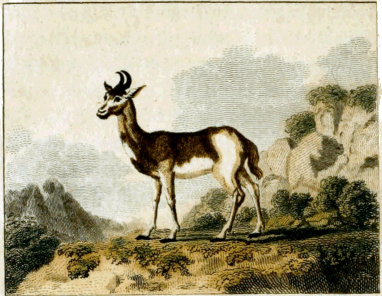
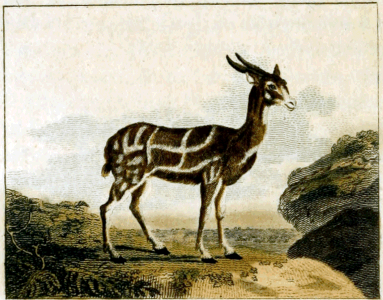
FIG. 156. Guib.
THE GUIB.
The Guib (fig. 156.) is an animal, which, though not noticed by any naturalist or traveller, is very common in Senegal, from whence M. Adanson brought over some of their skins. It resembles the gazelles, especially the nanguer, in the size and shape of its body, in the fineness of its legs, in the form of its head and muzzle, in the eyes and ears, in the length of its tail, and by the want of a beard but every gazelle, especially the nanguer, has the colour of the belly white, while the breast and belly of the guib are of a deep brown. It also differs from the gazelles in the horns, which are smooth, without annular prominences, and have two longitudinal ridges, the one above and the other underneath, forming a spiral twist from the base to the point; they are also a little compressed. In these particulars the guib is more like the goat than the gazelle, nevertheless it is neither the one nor the other, but rather an intermediate species. It is also remarkable for white stripes on a brown ground, that are disposed along and across the animal’s body, as if it were covered with a harness. It is a gregarious animal, and they are found in numerous herds in the plains of Podor.
THE GRIM.
This animal is only known to naturalists by the name of Grimm, or the Wild Goat of Grimmius; and which, as we were not acquainted with the name it bears in its own country, we shall adopt. We find a figure of this animal in the German Ephemerides, which has been copied in the Academical Collection. Dr. Herman Grimmius was the first who mentioned this animal, and what he said of it has been copied by Ray, and afterwards by all the nomenclators. Although his description[X] is incomplete, he denotes two characters so remarkable, that we can have no doubt that the head of an animal of Senegal, given us by M. Adanson, belongs to the goat of Grimmius. The first is a very deep cavity under each eye, so deep, indeed, as to leave but a thin partition of bone between the cavities and the partition of their nose; the second is a tuft of hair standing upright on the top of the head. These are sufficient to distinguish the grimm from every other goat or gazelle. It resembles both, however, not only in the shape of its body, but even in its horns, which are annulated towards the base, and have longitudinal streaks like those of the gazelles; at the same time, they are very short, and bend backwards in a horizontal direction, like the small African goat before mentioned. Besides, from being much smaller, and from having short horns, we are almost led to conclude that this animal forms the shade between the goat and small antelopes.
There is some reason to think, that the male grimm is alone furnished with horns; for the individual of which Dr. Grimmius has given the description and figure, had no horns: and the head which M. Adanson has given us was, on the contrary, ornamented with two, very short, and almost concealed by the hair, but yet sufficiently visible not to escape the notice of the observer; besides, we shall find, in the history of the chevrotains or small antelopes, that in the chevrotain of Guinea, the male only has horns, whence it is presumable, that it is the same with the grimm species, which in every respect approaches nearer the chevrotain than any other animal.
SUPPLEMENT.
In the year 1777, M. Vosmaër published a description of this animal, which he calls the Small Beautiful Buck of Guinea, and from whom we have extracted the following account. “This was one of the most beautiful animals I ever saw; it was sent from Guinea with thirteen others of both sexes, but twelve of them died in their voyage to Holland, and those two which survived were males; these were put into the menagerie of the Prince of Orange, and one of them died the following winter, 1764. They are remarkable timid animals, and are much frightened at any noise, especially at thunder. When they are suddenly surprised, they express their fear by whistling strongly with their nose. The one now living, (in 1766) though very wild at first, is now so familiar, that upon holding a piece of bread to him, and calling him by the name they have given him of tetje, he will not only approach, but allow himself to be stroaked. He is a particularly clean animal, and will not suffer the smallest piece of dirt to remain on any part of his body, but is constantly scratching himself with his hind feet. He is very active, and when standing still, keeps one of his fore-legs rather in a bent position, which gives him a graceful appearance. He eats bread, rye, carrots, is fond of potatoes, and is a ruminating animal. His horns are rather large in proportion to his size, and he has a small quantity of hair between them which he rises to a point. He is about the size of a young kid of two months old, and his limbs are extremely well proportioned. His head somewhat resembles that of a roe-buck; his nose is black and naked, but always moist; his upper lip appears as if divided; he has no beard but a kind of small whiskers on the sides, and a wart covered with hair under his chin; his horns are black, about three inches long, quite straight, and end with a sharp point; they are furnished with three rings, which rise a little backward; from the black tuft between the horns, there is a stripe of that colour down to the nose; his ears are large, with some short hairs on the insides, and on the tops, but all the other parts of them are black and naked; the eyes are large, and of a deep brown, between the eyes and nose there are black cavities, from the middle of which a viscid gummy humour exudes, that soon becomes hard and black, but I could never perceive that it contained that odour which Dr. Grimmius and those who have followed him, describe it to possess; the upper part of the neck and the head are of a yellowish grey, the back black, the sides a bright brown, the belly grey, and the limbs white as far as his knees; his legs have a black band, and the hair becomes blackish towards the hoofs; he had no heels, his feet were cloven, he had beautiful black pointed hoofs, and his tail was very short and white, with a black band on the upper part.”
THE CHEVROTAINS.
We have given the name of Chevrotain (tragulus) to the small animals of the warm regions of Africa and Asia, which almost every traveller has mentioned by the denomination of the little stag, or little hind. In fact, the chevrotain is a miniature resemblance of the stag, from the shape of its muzzle, lightness of its body, shortness of tail, and form of its legs; but differs greatly in size, the largest never exceeding that of the hare. Some of them are entirely without horns, and those which have any, are hollow, annulated, and nearly resemble those of the gazelles. Their small cloven foot, is also more like that of the gazelle than of the stag; and they differ both from the gazelle and the stag, by not having any depressions or hollows under their eyes: in that particular they approach the goat, but in reality they are neither stags, gazelles, nor goats, but constitute one or more distinct species. Seba gives the figures and descriptions of five chevrotains. The first he calls the little red Guinea kind without horns; the second, the fawn, or the young delicate stag of Africa; the third, the little young stag of Guinea; the fourth, the little red and white hind of Surinam; and the fifth, the red-haired African stag. Of these five chevrotains, the first, second, and third, are evidently the same animal; the fifth, which is larger than the three first, and whose hair is much stronger, and of a deep yellow, seems to be only a variety of the first; the fourth, which the author mentions as an animal of Surinam, appears to be only a second variety of this species, which is found only in Africa and the southern parts of Asia; and I am greatly inclined to think that Seba was misinformed, when he says this animal came from Surinam. Every traveller, who speaks of these little stags, mentions them as being found in Senegal, Guinea, and the East Indies; but not one affirms that he has seen them in America; and if the spotted chevrotain which Seba speaks of, did really come from Surinam, we must presume that it had been transported from Guinea, or from some other southern province of the old continent. But there appears to be a second species of chevrotain, different from all those we have mentioned, which seem to be only simple varieties of the first. This second species has small horns, not more than an inch in length, and the same in circumference: these horns are hollow, black, somewhat crooked, very sharp at the points, and surrounded at the bottom with two or three transverse rings. We have seen the feet and one of the horns of this animal in the royal cabinet, which sufficiently demonstrate it is either a chevrotain or a very small gazelle. Kolbe, speaking of this animal, says, it has horns like those of the stag, and that the branches were in proportion to their age; this is an evident error, which a single inspection of the horns will clearly prove.
These animals are of an elegant make, and their limbs finely proportioned for their size. But though they leap and bound with prodigious swiftness, yet, apparently, they cannot continue it long, for the Indians often hunt and frequently knock them down with their sticks: they are greatly sought after on account of the superior excellence of their flesh.
By comparing the different testimonies of travellers it appears, first, that the chevrotain without horns is peculiar to the East Indies; secondly, that the one with horns is the chevrotain of Senegal, and which is called guevei by the natives; thirdly, that only the male guevei is furnished with horns; fourthly, that the chevrotain marked with white spots, and which Seba says comes from Surinam, is, on the contrary, a native of the East Indies, especially of Ceylon, where it is called memina, (fig. 158.) and we must therefore, conclude, that there are but two kinds of chevrotains, namely, the memina, (fig. 157.) or the Indian chevrotain without horns; and the guevei, or Guinea chevrotain with horns; that the five species spoken of by Seba are only varieties of the memina; and that the smallest kind, which in Senegal is called guevei-kaior, is only a variety of the guevei.
These little animals can only live in excessive hot climates; they are so exceedingly delicate that it is with the greatest difficulty they are transported into Europe alive, where they perish in a short time. They are gentle, familiar, and very beautiful. They are, unquestionably, the smallest of all cloven-footed animals. According to this character of being cloven footed, they should not bring forth many young; but if we reason from their small size they should produce several at a litter. As to the fact on this point we must wait until opportunity is procured to make the observation; we are inclined to think they bring forth but one or two at a time, like the gazelles, roe-bucks, &c. but possibly they produce more frequently, for they are exceedingly numerous in India, Java, Ceylon, Senegal, Congo, and in every other country that is excessively hot, but are not to be found in America, nor in any of the temperate climates of the old continent.
Engraved for Barr’s Buffon
FIG. 159. Cariacou.
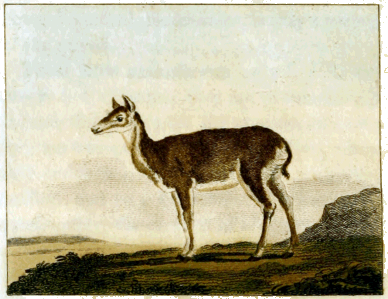
FIG. 158. Cariacou of Ceylon. FIG. 157. Memina.
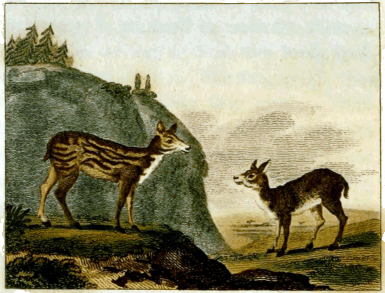
THE MAZAMES.
Mazame, in the Mexican language, was the name of the stag, or rather a generic name, including the whole race of stags, fallow-deer, and roe-bucks. Hernandes, Recchi, and Fernandes, who have transmitted this name to us, distinguish two species of mazames, both common in Mexico and New Spain. The first and largest, to which they give the simple name of mazame, has horns like those of the roe-buck of Europe, that is, about six or seven inches in length, with the extremities divided into two points, and a single antler. The second, called temamaçame, is much less, and has but a single horn, and without any antlers. These two animals seem to be roe-bucks, the first being the same species as the European roe-buck, and the second only a variety of it. It also appears, that these mazames and temamaçames of Mexico are the same as the cuguacu-apara, and the cuguacu-été of Brasil, and that in Cayenne the first is called cariacou, (fig. 157.) or the forest hind; the second, the small cariacou, or the hind of the marshes. Though we are the first who have pointed out these relations, yet we should not have presumed that there were either difficulties or doubts on this subject, if Seba had not mentioned the mazame and the temamaçame as two different animals: they are not roe-bucks with solid and branched horns, but gazelles with hollow and wrinkled ones: they are not animals of New Spain, as this author describes them, but natives of Africa. These errors of Seba have been adopted by most authors who have written since. They have not suspected that the animals mentioned by Seba, under the names of mazame and temamaçame, were the same as those mentioned by Hernandes, Recchi, and Fernandes. The confusion of the names has been followed by a confusion of the animals, and, in consequence, some naturalists have indicated these animals by the name of chevrotains, and others by that of gazelles, or goats. It appears that Linnæus suspected this error, for he has not adopted it. He has placed the mazame in the list of stags, and has thought, as we do, that the Mexican mazame is the same animal as the cuguacu of Brasil.
To demonstrate what we have advanced, we will suppose that there were neither gazelles, nor chevrotains, in New Spain, or in any other part of America, and that all those, as well as goats, which are at present there, have been carried from the old continent; that the true mazame of Mexico is the same animal as the cuguacu-apara of Brasil; that the name cuguacu is pronounced couguacou; and that, by corruption, this animal is called cariacou at Cayenne, from whence we had a living one sent us by this name of cariacou. We shall now endeavour to find out what species of animals these may be to which Seba has applied the names mazame and temamaçame, for to destroy an error it is not sufficient to reject it, but we should also explain the cause and demonstrate the effects.
The gazelles and chevrotains inhabit only the hottest countries of the Old World; they cannot exist in temperate climates, and still less in those that are cold. They could not, therefore, have ever frequented the northern countries, and have passed, by that means, from one continent to the other; nor have any travellers or historians of the New World, ever pretended to have seen them in that part of the globe. On the contrary, stags and roe-bucks, which inhabit cold and temperate climates, might have passed over the northern lands, and therefore are met with in both continents. We have observed, in our history of the stag, that the Cardian stag is the same as that of Europe; that he is only smaller, and has some slight variations in the shape of his horns and the colour of his hair. We may add, to what has been already said, that in America there are as many varieties among stags as in Europe, notwithstanding which they are of the same species. One of these varieties is the Corsican stag, which is smaller and browner than the common kind. We have also mentioned white stags, and hinds, and have said, that this colour proceeds from their domestic state; this kind is also found in America, as well as our common and small brown stags. The Mexicans, who keep these white stags in their parks, have denominated them Royal Stags. It is a native of Germany, and commonly called the Stag of Ardennes; and Brandhirts, by the Germans: it is at least as big as the large French stags, but differs from them by several particular characters. Its coat is thicker, and of a lighter colour under its belly: its throat and neck is furnished with long hairs, like the he-goat, which has caused both ancients and moderns to give it the name of tragelaphus, or stag-like goat. There are also a great number of roe-bucks in America: we are only acquainted with two varieties in Europe, the red and the brown; the latter are smaller than the former, but they perfectly resemble each other. The mazame of Mexico, the cuguacu-apara of Brasil, and the cariacou, or forest hind of Cayenne, entirely resemble our red roe-bucks. Comparing the descriptions given of them is a sufficient proof, that all these names denote the same animal. But the temamaçame, which we suppose to be the cuguacu-été of Brasil, the small cariacou of Cayenne may be a variety different from those of Europe. The temamaçame is less, and whiter on the belly than the mazame, in the same manner as our brown roe-buck has a whiter belly, and is smaller than our red one; it seems also to differ by the horns, which is single and without antlers in the figure given by Recchi; but if we consider that our roe-bucks, and stags, have no antlers in the first, and sometimes even in the second year of their age, we shall be inclined to think, that Recchi’s temamaçame was too young to have antlers: these two animals, therefore, appear to be only simple varieties in the roe-buck species.