Front matter (continued 2)
Reading edition
Engraved for Barr’s Buffon
FIG. 141. Barbary Wedder.
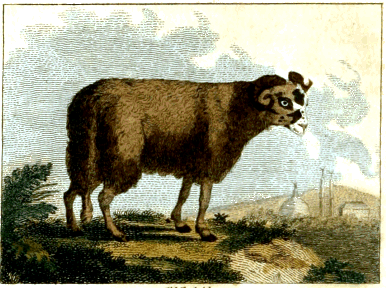
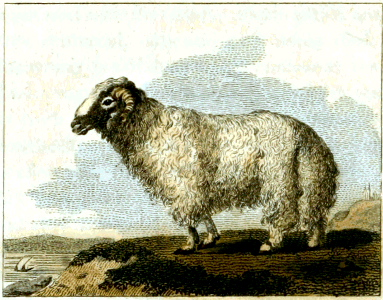
FIG. 142. Ram of Tunis.

SUPPLEMENT.
In the year 1774, a ram was exhibited at the fair of St. Germain, as a ram of the Cape of Good Hope; but we found it had been purchased at Tunis, and considered it to be of the same species as the Barbary sheep, (fig. 141.) before mentioned, for it differed only by the head and tail being somewhat more short and thick; yet by way of distinction, we have called it the ram of Tunis. (fig. 142.) His legs were shorter than those of our common sheep; he was plentifully clothed with wool, and his horns both in size and shape nearly resembled the Barbary sheep. In the same year, and at the same place, there was also another shewn under the name of the Morvant of China, (fig. 143.) which was remarkable for having a sort of mane on his neck, and long hairs hanging down under his throat, which were a mixture of red and grey, and full ten inches long; the mane extended to about the middle of the back, the hairs of which were not so long as those under the throat, were more red, mixed with a few brown and black ones; the wool which covered the other part of the body was rather curled, near three inches long, and of a bright yellow; his legs were red, spotted with yellow, and his tail yellow and white; he was not so high as the common rams, and more resembled the Indian rams than them; he had a very large belly, in appearance like that of an ewe with young, and his horns were like those of the common kind.
From what we have since observed we are the more convinced in our former opinion, that the muflon is the original stock of all other sheep, and that he has a constitution sufficiently strong to live either in cold, temperate, or warm climates. M. Steller says, that the rams of Kamtschatka have the manner of the goat, and the hair of the rein-deer; that some of their horns weigh more than thirty pounds; that they are as active as roe-bucks, and live upon the edges of mountains, that their flesh is good, but they are principally hunted for their skins.
There remain but very few real muflons in Corsica, the many wars in that island having probably been the cause of their destruction, but the present race of sheep still retain a resemblance to them in their figures, as I observed to be the case in one I saw in August, 1774, belonging to the Duc de Vrilliére.
Engraved for Barr’s Buffon
FIG. 143. Morvant.
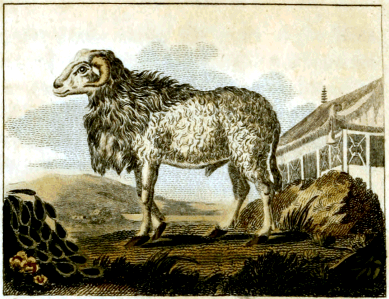
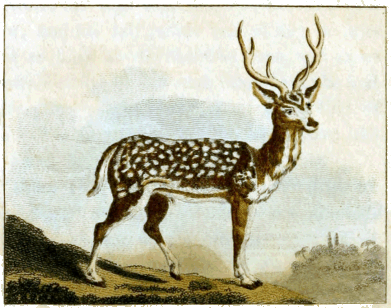
FIG. 144. Axis.
THE AXIS.

This animal being only known by the vague names of the hind of Sardinia, and the deer of the Ganges, we have preserved the name given him by Belon, and which he borrowed from Pliny; because, the character of Pliny’s axis agrees with this animal, and the name has never been applied to any other; and, therefore, we are not afraid of falling into confusion or error, for a generic denomination, joined to an epithet derived from the climate, is not a name, but a phrase, by which we may confound one animal with others of his genus, as this with the stag, although, perhaps, it is really distinct both in species and climate. The axis (fig. 144.) is one of the small number of ruminating animals who has horns like the stag. He has the shape and swiftness of the fallow-deer. But what distinguishes him from both is, his having the horns of the former, and figure of the latter; his body is marked with white spots,[H] elegantly disposed, and separated one from another; and lastly, he is a native of warm countries;[I] while the stag and fallow-deer have their coats generally of a uniform colour, and are to be met with in greater numbers in cold and temperate regions than in warm climates.
The gentlemen of the Academy of Sciences have given the figure and description of the interior parts of this animal, but say very little of his exterior form, and nothing with respect to his history. They have only called him the Sardinian hind, because, probably, they received that name from the royal menagerie, where there is one of them; but there is no proof of this animal’s being a native of Sardinia. No author has mentioned that he exists in that island, as a wild animal; but on the contrary, we see by the passages we have quoted, that he is found in the warmest countries of Asia. Thus the denomination of Sardinian hind, has been falsely applied; that of the Ganges stag agrees best, if he really were of the same species as the stag, since that part of India, which the Ganges waters, appears to be his native country. He is also to be met with in Barbary, and, it is probable, that the spotted fallow-deer of the Cape of Good Hope, is the same animal.
We have already remarked, that no species approaches so near each other, as that of the fallow-deer to the stag: nevertheless, the axis appears to be an intermediate shade between the two. He resembles the fallow-deer in the size of his body, length of his tail, and his coat, which is the same during his whole life: the only essential difference is in his horns, which nearly resemble those of the stag. The axis, therefore, may be only a variety depending on the climate, and not a different species from that of the fallow-deer; for, although he is a native of the warmest countries of Asia, he exists and multiplies easily in Europe. There are many herds of them in the royal menagerie; and they produce together as freely as the fallow-deer. It has never, however, been observed, that they mix either with the fallow-deer, or with the stags, and this is the cause of our presuming, that they are not a variety of one or the other, but a particular and intermediate species. But as no direct and decisive experiments on this subject have yet been made, and as no necessary means has been used to oblige these animals to unite, we will not positively affirm that they are two different species.
We have already seen, under the articles of stag and fallow-deer, how many instances these animals give of varieties, especially in the colour of their hair. The species of the fallow-deer and stag, without being very numerous in individuals, is universally diffused; both are met with in either continent, and both are subject to a great number of varieties, which appear to form lasting kinds. The white stags, which are a very ancient race, since the Greeks and Romans mention them, and the small brown stags, which we have called Corsican stags, are not the only varieties of this species. There is in Germany another race, known in that country by the name of Brandhertz, and by our hunters by that of the Stag of Ardennes. This stag is larger than a common stag, and differs from other stags not only by its deeper colour, being almost black, but also by long hair upon the shoulders and on the throat. This kind of mane and beard give him some affinity, the first to the horse, and the latter to the goat. The ancients have given to this stag the compound names of Hippelaphus and Tragelaphus. As these denominations have occasioned critical discussions, in which the most learned naturalists are not agreed, and as Gesner, Caius, and others, have said, that the hippelaphus was the rein-deer, we shall here give the reasons which have occasioned us to think differently, and have led us to suppose that the hippelaphus of Aristotle is the same animal as the tragelaphus of Pliny, and that both these names equally denote the stag of Ardennes.
Aristotle gives to his hippelaphus a kind of mane upon the neck and upon the upper part of the shoulders, a beard under the throat, horns to the male resembling those of the roe-bucks, and no horns to the female. He says, that the hippelaphus is of the size of a stag, and is found among the Arachotas, a people of India, where wild oxen are also to be met with, whose bodies are robust, their skins black, their muzzles raised, and their horns bent more backwards than those of the domestic oxen. It must be acknowledged, that Aristotle’s characters of the hippelaphus, agree nearly with those of the rein-deer and the stag of Ardennes; they both have long hair upon the neck and shoulders, and also on the throat, which forms a kind of beard on the gullet, and not on the chin; but the hippelaphus, being only of the size of the stag, differs in that from the rein-deer, who is much larger: and what appears to me decisive on the question is, that the rein-deer being an animal belonging to cold countries, never existed among the Arachotas. The country of the Arachotas is one of the provinces which Alexander travelled over in his expedition into India; it is situated beyond Mount Caucasus, between Persia and India. This hot climate never produced any rein-deer, as they cannot exist even in temperate countries, and are only to be met with in the northern regions of both continents. Stags, on the contrary, are not particularly attached to the north, but are to be found in great numbers in warm and temperate climates. Thus we cannot doubt but the hippelaphus of Aristotle, which is met with among the Arachotas, and in the same countries with the buffalo, is the stag of Ardennes, and not the rein-deer.
If we now compare what Pliny says upon the tragelaphus with what Aristotle says upon the hippelaphus, and both with Nature, we shall find, that the tragelaphus is the same animal as the hippelaphus, and therefore the same as our stag of Ardennes. Pliny says, that the tragelaphus is of the stag species,[J] and only differs from him by the beard and the hair on his shoulders. These characters are positive, and can only be applied to the stag of Ardennes; for Pliny speaks elsewhere of the rein-deer under the name of Alcé. We think ourselves, therefore, sufficiently warranted to pronounce, that the tragelaphus of Pliny, and the hippelapus of Aristotle, both denote the animal we call the Stag of Ardennes; and that the axis of Pliny is the animal commonly called the Ganges Stag. Though names have no influence on Nature, yet an explication of them is doing service to those who study her productions.
SUPPLEMENT.
In a letter I received from Mr. Colinson, in 1765, he informed me that the Duke of Richmond had several of the species of the Ganges Stags, or, as I have called it, Axis, in his park; that they lived familiarly with the fallow-deer, did not form separate herds, but even propagated together, and that from the intermixture beautiful varieties were produced.
There was a male and female Chinese fallow-deer in the royal menagerie in the year 1764; they were above two feet four inches in height; they were dark brown on the body and tail, mixed in several places with large yellow hairs, and yellow on the belly and legs. Though smaller than either the fallow-deer or axis, it was probably only a variety of the latter, and with whom it might intermix and be perpetuated even in France, especially as they are both natives of the eastern regions of Africa.[K]
Engraved for Barr’s Buffon
FIG. 145. Zebu.
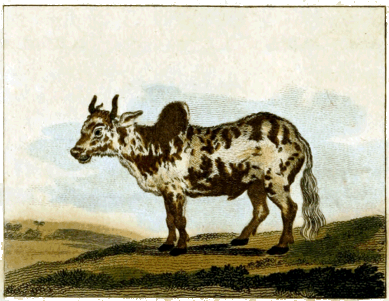
FIG. 146. Tapir.
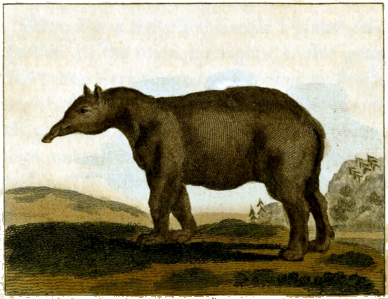
THE TAPIR.
The Tapir (fig. 146.) is the largest animal in America, of that New World, where, as we have before observed, animated Nature seems to be lessened, or rather has not had time to arrive at its full dimensions. In place of the colossal masses, which the ancient lands of Asia produce; instead of the elephant, rhinoceros, hippopotamus, camel, &c. we only meet in these new countries with animals modelled upon a small scale; the tapir, lama, pacos, and cabiais, are above twenty times smaller than those they should be compared with in the old continent. Matter is not only used here with prodigious parsimony, but even the forms are imperfect, and appear to have failed or been neglected. The animals of South America, which alone properly belong to this new continent, are almost all without tusks, horns, and tails; their figure is grotesque, their bodies and limbs ill proportioned, and some, as the ant-eaters, sloth, &c. are so miserably formed, that they scarcely have the faculties of moving or of eating; with pain they drag on a languishing life in the solitude of a desart, and cannot subsist in the inhabited regions, where man and powerful animals would have soon destroyed them.
The tapir is of the size of a small cow or zebu, but without horns or tail; his legs are short, and his body arched like that of a hog. When young his coat is spotted like that of the stag, and afterwards becomes of an uniform dark brown colour. His head is thick and long, with a kind of trunk like the rhinoceros; he has ten cutting teeth, and ten grinders, in each jaw; a character which separates him entirely from the ox, and other ruminating animals. As we have only some skins of this animal, and a drawing which M. de la Condamine favoured us with, we cannot do better than refer to the descriptions given of him from life, by Marcgrave[L] and Barrere[M], at the same time, subjoining what travellers and historians have said concerning him.
The tapir appears to be a dull and gloomy animal, who never stirs out but in the night,[N] and delights in the water, where he oftener lives than upon land: he chiefly lives in marshes, and seldom goes far from the borders of rivers or lakes. When alarmed, pursued, or wounded, he plunges into the water, and remains under it until he has passed to a considerable distance. These customs, which he has in common with, the hippopotamus, have made some naturalists imagine him to be of the same species; but they differ as much from each other in nature as the climates are distant which they inhabit. To be assured of this, there needs no more than to compare the descriptions we have recited, with those we have given of the hippopotamus. Although the tapir inhabits the water, he does not feed upon fish; and although his mouth is armed with twenty sharp and incisive teeth, he is not carnivorous. He lives upon plants and roots, and makes no use of his weapons against other animals. He is of a mild and timid nature, and flies from every attack or danger. His legs are short, and his body heavy, but, notwithstanding, he runs very swift, and swims still better than he runs. His skin is of a very firm texture, and so bound together that it often resists a bullet. His flesh is insipid and coarse; nevertheless the Indians eat it. They commonly go in companies, and are found in Brasil, Paraguay, Guiana, and in all the extent of South America, from the extremity of Chili to New Spain.
Engraved for Barr’s Buffon
FIG. 147. Zebra.
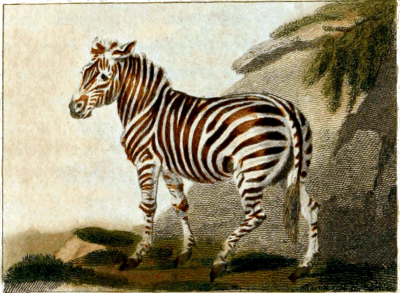
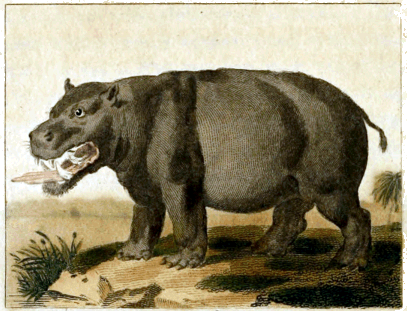
FIG. 148. Hippopotamus.
THE ZEBRA.
The Zebra (fig. 146.) is perhaps the handsomest and most elegant of all quadrupeds. He has the figure and gracefulness of the horse, with the swiftness of the stag. His striped robe of black and white ribbands, is alternately disposed with so much regularity and symmetry, that it seems as if nature had made use of the rule and compass. The alternate bands of black and white, are the more singular, as they are strait, parallel, and as exactly divided, as those of a striped stuff; besides they extend not only over the body, but over the head, thighs, legs, and even the ears and tail; so that, at a distance, this animal appears as if he was adorned with ribbands, disposed in a regular and elegant manner over every part of the body. In the females, these bands are alternately black and white; in the males they are black and yellow; but the shades are always lively and brilliant, upon a short, fine, and thick hair, the lustre of which increases the beauty of the colours. The zebra, in general, is less than the horse, and bigger than the ass. Although he has often been compared to these two animals, by the names of the wild horse and the striped ass, he is a copy of neither, but might rather be called their model, if all were not equally original in Nature, and if every species had not an equal right to creation.
The zebra, then, is neither a horse nor an ass, for we have never learnt that he intermixes with either, though trials have often been made for that purpose. She-asses, when in heat, were presented to the zebra, which was in the menagerie of Versailles, in the year 1761; but he disdained them, or rather, shewed no sign of emotions; he played with, and even mounted on them, but without any external marks of desire; and this coldness could be attributed to no other cause than the disagreement of their natures; for this zebra was then four years of age, and was very lively and alert in every other exercise.
The zebra is not the animal the ancients have mentioned under the name of onagre. In the Levant, in the eastern parts of Asia, and in the north of Africa, there exists a beautiful race of asses, which, like the finest horses, are natives of Arabia. This race differs from the common kind, by the largeness of the body, the slenderness of the legs, and the lustre of the hair. They are of an uniform colour, commonly of a fine mouse grey, with a black cross on the back and shoulders, sometimes they are of a bright grey, with a flaxen cross. These asses of Africa and Asia, although more beautiful than those of Europe, are originally, and equally descended from the onagres, or wild asses, which are still in great plenty in East and South Tartary, Persia, Syria, the islands of the Archipelago, and all Mauritania. The onagres differ from our domestic asses only by the qualities resulting from freedom and independence: they are stronger and swifter, and have more courage and vivacity; the form of their body is the same, but they have longer hair, and this difference varies again according to their condition, for our asses would have hair equally long, if it was not cut off at the age of four or five months. The hair of young asses is at first nearly as long as that of young bears. The hide of the wild ass is also harder than that of the domestic kind, and we are informed that it is covered with small tubercules, and it is even said that the shagreen brought from the Levant, and which we employ for so many purposes, is made of these wild asses skin. But neither the onagres, nor the beautiful asses of Arabia, can be looked upon as the stock of the zebra species, though they resemble them in figure and swiftness. That regular variety of the climate of the zebra has never been exhibited by either of them. This beautiful species is singular, and very distant from any other. The zebra is also of a different climate from the onagre, being only to be met with in the most eastern and southern parts of Africa, from Ethiopia to the Cape of Good Hope, and from thence into Congo. He exists neither in Europe, Asia, America, nor in the northern parts of Africa. Those, which some travellers tell us they saw at the Brasils, had been transported thither from Africa. Others, which have been seen in Persia and in Turkey, have been brought thither from Ethiopia; and, in short, those which we have seen in Europe come almost entirely from the Cape of Good Hope. This point of Africa is their native climate, and where the Dutch have employed all their endeavours to tame and render them domestic, without having hitherto been able to succeed. That which was the subject of this description was very wild when he arrived at the royal menagerie in France, and is not yet entirely tamed; nevertheless, he has been brought to let a man sit on a saddle, but great precaution is necessary, as two men are obliged to hold the bridle while the third is on his back. His mouth is very hard; his ears are so sensible that he winces whenever they are touched. He is restive, like a vicious horse, and obstinate as a mule. But, perhaps, the wild horse, and the onagre, are equally untractable, and, possibly, if the zebra was accustomed to obedience, and to a domestic state, from his earliest days, he might become as gentle as the ass or the horse, and might be substituted in their room.
SUPPLEMENT.
Although the ass is to be met with, either in a wild, or domestic state, in almost every country of the old continent, under a warm or temperate climate, yet there was no such animal in the new, upon its first discovery. They were, however, soon after transported from Europe, and multiplied so fast in America, that they may be said to be equally numerous in the four quarters of the globe; but it is not so with the zebra; he seems confined to the southern parts of Africa, and especially about the Cape of Good Hope, although Lopez has asserted that they are more abundant in Barbary than in Congo, and Dapper says the same in favour of the forests of Angola.
Notwithstanding the superiority this animal maintains over the ass, from the elegance of his figure, and beauty of colours, yet he appears to be somewhat of the same species, for almost all travellers have given it the name of striped ass, from being struck at the first sight with his having a greater resemblance to the ass than the horse; it is not, however, with the common ass that they compared him, but that large and beautiful part of the species we have before alluded to; I am, notwithstanding, inclined to the opinion, that the zebra makes a nearer approach to the species of the horse, as he possesses a similar elegance of figure. In favour of this opinion it has been observed, near the Cape of Good Hope, which appears to be the native country of the zebra, but there are horses spotted on the back and bellies, with yellow, black, red, and blue. We will not, however, pretend to undertake the decision of this question; but as the Dutch have transported a number of these animals to Holland, and even yoked them in the Stadtholder’s chariot, there is some hopes that their nature will soon be clearly exemplified. In Holland there are many judicious naturalists, and, therefore, we cannot suppose they will fail to make these animals unite among themselves, if not with the horse and the ass: for that attempted in the royal menagerie in 1761, was but a single experiment; it is possible, that as the zebra was but four years old he might not have arrived to maturity, at all events he was not rendered familiar with the females presented to him, a circumstance, which seems requisite throughout nature, even in an intercourse with individuals of the same species.
In Tartary they have an animal called czigithai, which possibly is of the same species as the zebra, as the principal difference between them is in the colour; a difference which, we have repeatedly observed, may be occasioned by the varieties of the climates. This czigithai is common in the southern parts of Siberia, Thibet, Dauria, and Tartary. Gerbillan says they are to be met with in the country of the Mongoux and Kakas; that they differ from mules, and cannot be brought to carry burthens. Muller and Gmelin both assert that there are numbers of them in the countries of the Tongusians, who hunt them like other game: that they resemble a bright bay horse, excepting they have long ears, and a tail like a cow. It is probable that if they had compared him with the zebra they would have found a much greater resemblance. In the Petersburgh cabinet there are stuffed skins both of the zebra and czigithai; they differ very much in colour, but yet they may belong to the same, or nearly the same species. Besides there is no other animal in Africa but what is to be found in Asia, and, therefore, if these are different species the zebra alone would stand as an exception to that general rule. If the czigithai does not belong to the zebra species it may possibly be the onagre, or wild ass of Asia; which latter should not by any means be confounded with the zebra. According to all travellers there are various kinds of wild asses, and the onagre is supposed to rank at the head of them. The horse, ass, onagre, and czigithai, may form four distinct species; and if there are but three, it will remain uncertain whether the latter is an onagre or zebra. The onagre is said to exceed the horse in swiftness, and the very same remark is made of the czigithai. Let this particular fact be as it may, the horse, ass, zebra, and czigithai, belong to the same genus, and are only different branches thereof. From the two first being rendered domestic, mankind have received great advantages, and the two last being reduced to a similar state would, no doubt, prove likewise a useful acquisition.
THE HIPPOPOTAMUS.
Though the Hippopotamus has been celebrated from the earliest ages; though mentioned in the sacred writings under the name of behemoth, and though his figure is engraved upon the obelisks of Egypt, and on the Roman medals; yet he was but imperfectly known to the ancients. Aristotle scarcely mentions him, and in the little he does say, there are more errors than facts. Pliny copied Aristotle, and far from correcting, adds to the number of his errors. It was only towards the middle of the sixteenth century that we had any precise information concerning this animal; Belon being then at Constantinople, saw a living one; of which, however, he has given but an imperfect representation, for the two figures which he has joined to his description, were not taken from the hippopotamus he has seen, but were copied from the reverse of a medal of the Emperor Adrian, and from the colossus of the Nile at Rome; so that we must carry the epoch of the knowledge of this animal to the year 1603, when Frederico Zerenghi, a surgeon of Narni, in Italy, printed at Naples, the history of two of these animals, which he had killed in Egypt, in a great ditch he had caused to be dug in the environs of the Nile, near Damietta. This little work was written in Italian, and appears to have been neglected by his contemporary and succeeding naturalists; notwithstanding, it is the only good and original one on the subject, and has so strong pretensions to credit, that I shall here give an extract and translation from it.
“With a view of obtaining an hippopotamus, (says Zerenghi) I suborned the people about the Nile, (who had seen two of these animals come from the river) to dig a large pit in the place where they passed over, and to cover it with light wood, earth, and grass. Returning in the evening to the river, they both fell into the pit. The people came immediately and acquainted me with the event, and I hastened thither with my Janissary. We killed both the animals by firing three charges from a large arquebuse into each of their heads. They expired immediately, uttering a doleful cry, which more resembled the bellowing of a buffalo, than the neighing of a horse. This exploit was performed on the 20th of July, 1600. The following day I had them drawn out of the pit, and skinned with care; the one was a male and the other a female. I had both the skins salted, and filled with the leaves of the sugar cane, in order to transport them to Cairo, where I had them salted a second time with greater attention and more convenience. In doing of which we used near 400lbs. of salt to each skin. At my return from Egypt, in 1601, I brought these skins to Venice, and from thence to Rome. I shewed them to many learned physicians. Doctor Jerome Aquapendente and the celebrated Aldrovandus, were the only persons who knew them to be the skins of the hippopotamus; and as the work of Aldrovandus was then printing, he had (with my consent) a figure drawn from the skin of the female, which he has given with his book.
“The hippopotamus has a very thick and hard skin; it is impenetrable, unless it be soaked some time in water: the mouth is not, as the ancients have said, of a moderate size, but enormously large; neither are his feet as they say, divided into two hoofs, but into four. His size is not that of an ass, for he is much bigger than the largest horse, or buffalo; he has not a tail like that of the hog, but rather that of the tortoise, except being incomparably larger; his mouth or nose is not elevated, but resembles that of the buffalo, and is much larger; he has no mane like the horse, but only some short hairs; he does not neigh like the horse, but his voice is between the bellowing of the buffalo, and the neighing of the former. His teeth do not jut out of his mouth, for when it is shut, the teeth, although extremely large, are all hid under the lips. The inhabitants of this part of Egypt call him foras l’bar, which signifies a sea-horse. Belon is much deceived in his description of this animal, he attributes to him teeth like those of a horse, which would induce me to think he had never seen him, although, as he tells us he had, for the teeth of the hippopotamus are very large and very singular. To clear up every doubt and uncertainty, continues Zerenghi, I have here given the figure of the female hippopotamus; every proportion has been taken exactly after nature, as well as the measure of its body and limbs.
“The length of this hippopotamus, from the extremity of the upper lip to the beginning of the tail, is nearly eleven feet two inches.[O]
“The circumference of the body is about ten feet.
“The height, from the bottom of the foot to the top of the back, is four feet five inches.
“The circumference of the legs near the shoulders is two feet nine inches; and taken lower, is one foot nine inches and a half.
“The height of the legs, from the bottom of the feet to the breast, is one foot ten inches and a half.
“The length of the feet, from the extremity of the nails, is about four inches and a half.—Note. I have taken the medium measure between the two that Zerenghi gives, for the length of the feet.
“The nails are as long as they are broad, being rather more than two inches.
“There is one nail on each toe, and four toes on each foot.
“The skin upon the back is nearly an inch, and that upon the belly about half an inch thick.
“The skin is so hard when dried, that it cannot be pierced by a musket shot. The people of the country make great shields of it, and cut it into thongs or kind of whips. On the surface of the skin there are a few very fine hairs of a greyish colour, and which cannot be perceived at first sight; on the neck there are some longer, but they are all placed one by one, more or less distant from each other; but on the lips they form a kind of mustachio: for there springs out ten or twelve of them from the same points; these hairs are of the same colour as the rest, they are only harder, thicker, and somewhat longer, though the longest is not more than half an inch.
“The length of the tail is rather more than eleven inches, and its circumference, taken at the beginning, is something more than a foot, and at its extremity, is two inches and upwards.
“The tail is not round, but from the middle to the end is flat, like an eel. Upon the tail and the thighs, there are some round scales of a whitish colour, broad as a French bean; these small scales are also seen upon the breast, the neck, and upon some parts of the head.
“The head, from the extremity of the lips to the beginning of the neck, is two feet four inches, and its circumference about five feet eight inches.
“The ears are two inches and near an half long, more than two inches in breadth, are a little pointed, and furnished on the inside with thick, short, and fine hairs, of the same colour as the others.
“The space between each angle of the eyes is two inches and upwards, and from one eyelid to the other, is one inch and one line.
“The nostrils are two inches four lines long, and little more than one inch broad.
“The mouth, when open, measures about one foot six inches; it is of a square form, and furnished with forty-four teeth of different shapes. All these teeth are so hard, that they strike fire with steel. The enamel of the canine teeth in particular, have this hardness; the interior substance being not so hard. When the hippopotamus keeps his mouth shut there are no teeth to be seen, for the lips, which are extremely large, completely cover them.
“In respect to the figure of this animal, it may be said to be constructed between that of the buffalo and hog, because it participates of both, except the incisive teeth, which have no resemblance to those of either of these animals. The grinders are a little like those of the buffalo or horse, but much larger. The colour of the body is dark and blackish. It is affirmed that the hippopotamus produces but one young at a birth; that he lives on fish, crocodiles, and even the flesh of dead bodies; however, he eats rice, grain, &c. though on considering his teeth, we should conclude that Nature had not made him for grazing, but for the destruction of other animals.”
Zerenghi finishes his description by affirming that all the above measures were taken from the female hippopotamus, whom the male perfectly resembled, excepting that he was a third bigger in all his dimensions. It were to be wished that the figure given by Zerenghi had been as good as his description; but the drawing was not taken while this animal was living, but from the skin of the female. It appears also, that it was from this same skin preserved in salt, that Fabius Columna designed his figure; but the description Columna has given, is not so good as that of Zerenghi’s, and he must be reproached for only quoting the name and not a word about the work of this author, though published three years before his own: he must also be accused of swerving from his description in many essential points, without giving any reason for it; for example, Columna says, that in his time, in 1603, Frederico Zerenghi brought from Egypt to Italy an hippopotamus preserved in salt, while Zerenghi himself says, he brought only the skin. Columna also gives to his hippopotamus thirteen feet in length, to the circumference fourteen, and the legs three feet and a half long; while the measures of Zerenghi makes the length of the body but eleven feet two inches, the circumference ten, and the legs one foot ten inches and a half, &c. We must not, therefore, rely on the description of Columna; nor excuse him upon the supposition that he took it from another subject; for it is evident, from his own words, that he made it from the smallest of Zerenghi’s two hippopotami; since he acknowledges that some months after Zerenghi shewed a second hippopotamus much larger than the first. What makes me so strenuous on this point is, that no one has rendered justice to Zerenghi, who, notwithstanding, is the only person who deserves eulogiums on this subject. On the contrary, every naturalist, for this hundred and sixty years, have attributed to Fabius Columna what they should have given to Zerenghi; and instead of searching for the work of the last they have set down contented with copying and applauding that of Columna’s, who, however deserving of praise in other respects is, upon this, neither original, exact, nor even honest.
The description and figures of the hippopotamus that Prosper Alpinus published more than a hundred years after, are still worse than those of Columna, having been drawn from skins but badly preserved; and M. de Jussieu, who wrote of the hippopotamus in 1724, has only described the skeleton of the head and feet.
By comparing these descriptions, and especially that of Zerenghi, with the information we have drawn from travellers, the hippopotamus appears to be an animal whose body is longer and as thick as that of the rhinoceros; that his legs are much shorter; that his head is not so long, but larger in proportion to his body: that he has no horns, either on the nose like the rhinoceros, or on the head like the ruminating animals. His cry when hurt, according to ancient and modern travellers, resembles the neighing of a horse and the bellowing of the buffalo; his usual voice may be like the neighing of a horse, from which, however, he differs in every other respect. If thus be the fact, we may presume that this resemblance in the voice has been the reason for giving him the name of hippopotamus, which signifies the river horse, as the howling of the lynx, which resembles that of the wolf, occasioned him to be called the lupus cervarius. The cutting teeth of the hippopotamus, and especially the two canine of the lower jaw, are very long, and so hard and strong that they strike fire with a piece of steel. This is probably what, gave rise to the fable of the ancients, that the hippopotamus vomited fire: these canine teeth are so white, so clean, and so hard, that they are preferable to ivory for making artificial teeth. The cutting teeth, especially those of the lower jaw, are very long, cylindrical and furrowed; the canine teeth are also very long, crooked, prismatic, and sharp, like the tusks of a boar: the grinders are square, or rather oblong, nearly like those of a man, and so large that a single one weighs more than three pounds; the largest of the cutting, and the canine teeth are twelve and even sixteen inches in length, and sometimes weigh twelve or thirteen pounds each.
In short, to give a just idea of the size of the hippopotamus we shall make use of Zerenghi’s measures, increasing them one third, because his measures were taken from the female, who was one third less than the male in all her dimensions. This male hippopotamus was consequently sixteen feet nine inches long, from the extremity of the muzzle to the beginning of the tail; fifteen feet in circumference, and six feet and a half in height; his legs were about two feet ten inches long; the length of the head three feet and a half, and eight feet and a half in circumference ; the width of the mouth two feet four inches, and the largest teeth more than a foot long.
Thus powerfully armed, and with such prodigious strength of body, he might render himself formidable to every animal; but he is naturally gentle, and is besides so heavy and slow that he could not outrun any other quadruped. He swims quicker than he runs, pursues the fish, and makes them his prey. He delights much in the water, and lives in it as freely as upon land, yet he has no membranes between his toes like the beaver and otter, and it is plain, that the great ease with which he swims is owing to the great capacity of his body, which makes his specific gravity nearly equal to the water. Besides, he remains a long time under water, and walks at the bottom as well as in the open air; and when he quits it to graze upon land he eats sugar-canes, rushes, millet, rice, roots, &c. of which he consumes great quantities, and does much injury to cultivated lands; but as he is more timid on land than in the water he is very easily driven away, and his legs are so short that he cannot save himself by flight, if he be far from any water. His resource, when in danger, is to plunge into the water, and proceed under it to a great distance before he reappears. He commonly retreats from his pursuers, when hunted, but if wounded he becomes irritated, and faces about with great fury, rushes against the boats, seizes them with his teeth, tears pieces off, and sometimes sinks them. “I have seen, says a traveller,[P] an hippopotamus open his mouth, fix one tooth on the gunnel of a boat, and another on the second plank under the keel (that is at least four feet distant), pierce the side through and through, and in this manner sink the boat. I have seen one lying by the side of the sea-shore, upon whom the waves tossed a Dutch boat heavily laden, and then retreating left it dry on his back, and which was afterwards carried off again by another wave, without the animal appearing to have received the least injury. I could not discover the exact arrangement of his teeth, but they appear to form the figure of a bow, and were about sixteen inches long. We fired several times at one of them, but the shot rebounded from his skin. The natives consider him as a kind of deity, and that he cannot be destroyed, and frequently declare, if they were to use him as we do he would soon be the destruction of their nets and canoes. When they go a fishing in their canoes, and meet with an hippopotamus, they throw fish to him, and then he passes on without disturbing their fishery any more. He does the most injury when he can rest himself against the earth, but when he floats in the water he can only bite. Once, when our boat lay near the shore, I saw one of them get underneath, lift her above water upon his back, and overset her with six men aboard, but fortunately they received no hurt.”——“We dare not, says another traveller, irritate the hippopotamus in the water, since an adventure that had nearly proved fatal to three men; they had proceeded in a small canoe to attack one in a river where there was about ten feet water; they discovered him walking at the bottom, according to his usual custom, and wounded him with a long lance, upon which he rose immediately to the surface of the water, looked at them with a dreadful aspect, and, at one bite, took a great piece out of the side of the canoe, which had very nearly overturned it, and it was with difficulty they could make the shore.” These two examples are sufficient to give an idea of the strength of these animals; and a number of like facts are to be met with in the General History of Voyages, by the Abbé Prevost, who has given a summary of whatever travellers have reported concerning the hippopotamus.
These animals are not numerous, except in particular places, and it even appears that they are confined to the rivers of Africa. The greatest part of naturalists have said, that the hippopotamus is to be found also in the Indies, but the evidence they have of this circumstance is very equivocal; the most positive would be that of Alexander, in his letter to Aristotle, if we could assure ourselves, that the animals of which Alexander speaks, were really hippopotami. What occasions me to have some doubts on this head is, that Aristotle, in describing the hippopotamus in his history of animals, must have said, that they were natives of India, as well as Egypt, if he had thought that the animal, of which Alexander speaks in his letter, had been the true hippopotamus. Onesicritus, and some other authors, say the hippopotamus is to be found in the river Indus, but modern travellers, at least those who merit most confidence, have not confirmed this fact; they all agree, that this animal is found in the Nile, the Senegal, or Niger, the Gambia, the Zara, and other great rivers and lakes of Africa, especially in the southern and eastern parts. Father Boyn is the only one who seems to insinuate that the hippopotamus is to be met with in Asia, but his recital appears suspicious, and I think only proves that he is common in Mosambique, and all the eastern parts of Africa. At present the hippopotamus, which is called the Nile-horse, is so rare in the lower Nile, that the inhabitants of Egypt have no idea of the name. He is equally unknown in all the northern parts of Africa, from the Mediterranean to the Bamboo river, which flows at the foot of Mount Atlas; the climate which the hippopotamus actually inhabits, therefore extends only from Senegal to Ethiopia, and from thence to the Cape of Good Hope.
As most authors have called the hippopotamus the sea-horse, or sea-cow, it has sometimes been confounded with the latter, which is a very different animal, and which only inhabits the northern seas. It appear, then, to be certain, that the hippopotami, which the author of the description of Muscovy says are found upon the borders of the sea of Petzora, are no other than sea-cows, and Aldrovandus merits reproach for adopting this opinion without examination, and asserting that the hippopotamus is found in the northern seas: for he not only does not inhabit the north seas, but it appears that he is rarely found in those of the south. The testimonies of Odoardus, Barbossa, and Edward Wotton, recounted by Aldrovandus, and which seem to prove that the hippopotamus inhabits the Indian seas, appear to be almost as equivocal as that in the description of Muscovy; and I am inclined to believe that the hippopotamus is not to be found, at least at present, but in the greatest rivers of Africa. Kolbe, who says, he has seen many of them at the Cape of Good Hope, affirms, that they equally plunge themselves into the sea and rivers, and which is asserted by other authors. Although Kolbe appears to be more exact than common in his description of the hippopotamus, yet it is doubtful whether he saw it so often as he says, since the figure he has joined to his description is worse than those of Columna, Aldrovandus, and Prosper Alpinus, which are all drawn from stuffed skins. It is easy to discover that the figures and description in Kolbe’s works, have neither been made on the spot, nor taken from Nature. His descriptions are written from memory, and most of the figures been copied from those of other naturalists; the figure which he gives of the hippopotamus, in particular, bears a great resemblance to the cheropotamus of Prosper Alpinus.
Kolbe, therefore, in affirming, that the hippopotamus lives in the sea, might possibly have copied Pliny, and not spoken from his own observations. Most other authors tell us, that this animal is only to be found in the fresh water lakes and in rivers, sometimes at their mouths, but oftener at a great distance from the sea. There are even travellers, who, like Merollo, are surprised, that the hippopotamus should have been called the sea-horse, because, say they, this animal cannot bear salt water. He commonly remains all day under water, and only quits it at night to graze upon land. The male and female rarely separate. Zerenghi caught both male and female the same day, and in the same ditch. Dutch travellers say, that they bring forth three or four young at a time, but this fact appears to me very suspicious from the evidence which Zerenghi has mentioned. Besides, as the hippopotamus is of an enormous bulk, he is in the class of the elephant, rhinoceros, whale, and all other large animals, who bring forth but one at a time; and this analogy appears to me more certain than all the suppositious testimonies of different travellers.
SUPPLEMENT.
I have been informed by Mr. Bruce that in his travels through Africa he frequently saw hippopotami in Lake Tzana, in Upper Abyssinia, near the sources of the Nile; that in this lake these animals are more numerous than in any other part of the world, and that he saw some which were at least twenty feet in length.
Dr. Klockner, in his translation of the present work, printed at Amsterdam, says, he is surprised that M. de Buffon should have taken no notice of a passage in Diodorus Siculus, respecting the hippopotamus, in which that author observes, “that among the various animals produced by the Nile, the crocodile and hippopotamus deserve the most particular attention; the latter is five cubits long; he has cloven feet like ruminating animals, and in each of his jaws he has three large tusks, somewhat like those of a wild boar; while the prodigious size of his body resembles that of an elephant. His skin is exceedingly hard and strong, possibly more so than that of any other animal. He is amphibious, and remains as perfectly at ease under water as upon land; he, however, comes on shore in the night to seek pasture, and if the species were numerous, they would prove very destructive to the cultivated lands of Egypt. To hunt this animal a number of men assemble, and going in several boats attack him; when once fastened to a rope, they leave him till he is exhausted with plunging and the loss of blood: his flesh is hard, and not good for digestion.” Dr. Klockner has also given an account of the manner in which the skin was prepared of the one sent from the Cape of Good Hope, and is now in the Prince of Orange’s cabinet, the dimensions of which corresponded very nearly with those of Zerenghi’s. He likewise adds, that he was informed by the nephew of Charles Marias, a peasant of French extraction, who shot this hippopotamus, and from whom he had the relation, that the animal had wandered a considerable way upon land, almost to a place called the Mountains of Snow; this Marias asserted that the hippopotamus runs very swift upon land, and for which reason these peasants, though good hunters, never attempted to attack him but when he was in the water; that it was the practice to watch for him about sun-set, at which time he raises his head above water, and perceiving any object of prey, darts upon it with surprising quickness; during his thus floating on the surface, he keeps his ears in perpetual motion, constantly listening if any noise is near, and while in this position the hunters endeavour to shoot him in the head; when wounded he plunges under the water and traverses about as long as life remains, and then floats to the top; some of the party swim to him, and being fastened by ropes he is dragged on shore by oxen, where he is immediately dissected. A full grown hippopotamus generally yields about 2000 lbs. weight of fat, which is salted and sent to the Cape, where it is much esteemed and sells very dear. By compression a mild oil is drawn from it, which in Africa is considered as a certain remedy for diseases in the breast.
In our preceding description of this animal we remarked, that it was probable the hippopotamus was so called from his voice having a resemblance to the neighing of a horse, but from many authentic accounts, we understand that it comes nearer to the cry of the elephant, or the indistinct stammerings of persons who are deaf. When asleep he also makes a snorting noise by which his retreat is discovered at a distance; and of this he seems aware, as he generally lies among reeds upon marshy grounds, and where it is very difficult to come near him.
I cannot consider the remark of Marias, relative to the speed of this animal, as correct; since so far from its being corroborated, all others affirm that the hunters rather attack him on land than in the water, which is a proof they are not afraid of his swiftness; nay, some affirm that it is customary to impede his return by trees and ditches, from his constantly endeavouring to regain the water, where he has no enemy to apprehend, as both crocodiles and sharks carefully avoid him.
As we before observed, his skin is so extremely hard on his back, &c. that neither arrows nor musket balls can pierce it, but it is thinner on the belly and insides of the thighs, at which parts therefore the hunters constantly aim. They sometimes endeavour to break his leg with large blunderbusses, and if they succeed in that their conquest is certain. The negroes who do not hesitate to attack the sharks and crocodiles, commonly avoid the hippopotamus, and would probably never dare to encounter him, but from a presumption that if they fail he cannot overtake them; those of Angola, Congo, Elmina, and the western coasts of Africa, consider him as an inferior deity, but yet they feel no repugnance in devouring his flesh when they can procure it with safety.
The female brings forth among the rushes upon land, but she soon teaches her young to take refuge in the water, and which they do on the smallest alarm. P. Labat asserts, that this animal has sufficient intelligence to let himself blood when he feels a necessity, and that he performs the operation by rubbing a particular part of his skin against a sharp-pointed rock, and that when he thinks he has bled enough he rolls himself in the mud until he has stopped the wound; and it has also been affirmed that the Indian painters make use of his blood as one of their colours.
Engraved for Barr’s Buffon
FIG. 150. Rein-Deer.
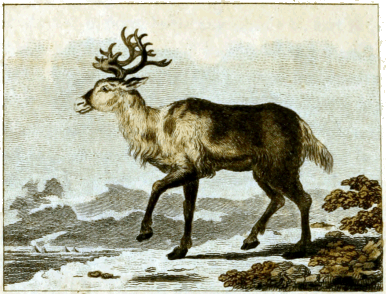
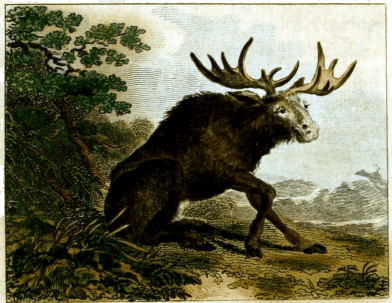
FIG. 149. Elk.
THE ELK AND THE REIN-DEER.
Although the Elk (fig. 149.) and the Rein-deer (fig. 150.) are animals of different species, we shall treat of them together, because it is scarcely possible to write the history of the one without borrowing a great deal from the other. The greatest part of ancient, and even modern authors, have confounded them, or described them by equivocal denominations which might be applied to both. The Greeks had no knowledge either of the elk or the rein-deer, for Aristotle makes no mention of them; and, among the Latins, Julius Cæsar is the first who has made use of the word Alce. Pausanias, who wrote above a hundred years after Julius Cæsar, is also the first Greek author who takes notice of this name of [Greek: Alchê]; and Pliny, who was nearly contemporary with Pausanias, has very obscurely indicated the elk and the rein-deer under the names alce, machlis, and tarandus. We cannot, therefore, say, that the name alce, is properly Greek or Latin; it seems to have been derived from the Celtic tongue, in which the elk is named elch or elk. The Latin name of the rein-deer is still more uncertain; many naturalists have thought that this was the machlis of Pliny, because this author, in speaking of the animals of the north, quotes, at the same time, the alce and the machlis, and says that the last particularly belongs to Scandinavia, and was never seen at Rome, nor even in all the extent of the Roman empire. Nevertheless, we find in Cæsar’s Commentaries a passage that we can scarcely apply to any other animal than the rein-deer, and which seems to prove, that he existed at that time in the forests of Germany; and fifteen centuries after Julius Cæsar, Gaston Phœbus seems to speak of the rein-deer under the name of the rangier, as an animal which existed in his time in our forests of France: he even gives a tolerable description of this animal[Q], and of the method of taking and hunting him. As his description cannot be applied to the elk, and as he gives, at the same time, the manner of hunting the stag, the fallow-deer, the wild goat, the chamois goat, &c. it cannot be supposed, that under the article of the rangier he intended to speak of any of those animals, or that he was deceived in the application of the name.
It appears, then, from these positive testimonies, that the rein-deer formerly existed in France, at least in the mountainous parts, such as the Pyrennees, near which Gaston Phœbus dwelt as lord of the county of Foix, and that since his time they had been destroyed like the stags, who were heretofore common in this country. It is certain that the rein-deer is now to be found only in the most northern countries; but we also know, that the climate of France was formerly much more damp and cold, occasioned by the number of woods and morasses, which have since been cut down and drained. By the letter of the Emperor Julian, we learn what was the rigour of cold at Paris in his time: the description he gives of the ice on the Seine perfectly resembles what the Canadians say of the ice on the rivers of Quebec. Gaul, under the same latitude as Canada, was, two thousand years ago, what Canada is at present; that is to say, a climate cold enough for these animals to live in, which are now only to be met with in the regions of the north.
By comparing and combining the above testimonies, it appears to me, that the forests of Gaul and Germany were stocked with elks and rein-deer, and that the passages in Cæsar’s Commentaries, can only be applied to those two animals. As the land was cultivated, and the waters became gradually dried up, the temperature of the climate became more mild, and those animals, who delight in cold, immediately abandoned the flat countries, and retired into the snowy region, where they lived in the time of Gaston de Foix; and if they are no longer to be found there, it is because this temperature has been ever since increasing in heat by the almost entire destruction of the forests, by the successive lowering of the mountains, the diminution of the waters, the multiplication of mankind, and by the continual increase of culture, and every other improvement. I am likewise of opinion that Pliny has borrowed from Cæsar almost all he has written of these two animals, and that he was the first author of the confusion in their names. He mentions at the same time the alce and the machlis, from which we ought naturally to conclude, that these two names mean two different animals: however, if we remark, 1. That he only simply names the alce without any description whatever. 2. That he alone has used the name machlis, which word is not to be found in either Greek or Latin, but appears to be coined, and which, according to Pliny’s commentators, is changed into that of alce in many ancient manuscripts. 3. That he attributes to the machlis all what Julius Cæsar gives to the alce; we cannot doubt but the passage in Pliny is corrupted, and that these two names mean the same animal, namely, the elk. This question once decided will also decide another. The machlis being the elk, the tarandus must be the rein-deer. This name of tarandus is not to be found in any author before Pliny, and in the interpretation of which, authors have greatly varied; however, Agricola and Elliot have not hesitated to apply it to the rein-deer; and for the reasons just deduced, we subscribe to their opinion. Besides, we must not be surprised at the silence of the Greeks on the subject of these two animals, nor at the ambiguity with which the Latins have spoken of them, since the northern climates were absolutely strangers to the first, and only known to the second by relation.
The elk is only found on this, and the rein-deer on the other, side of the polar circle in Europe and in Asia. We find them in America, in the lower latitudes, because the cold is greater there than in Europe. The rein-deer can bear the most excessive cold; he is found in Spitsbergen; he is common in Greenland, and in the most northern parts of Lapland and Asia. The elk does not approach so near the pole; he inhabits Norway, Sweden, Poland, Lithuania, Russia, and all the provinces of Siberia and Tartary, even to the north of China. We meet with him under the name of Orignal, and the rein-deer under that of Caribou in Canada, and in all the northern parts of America. Those naturalists, who doubted whether the Orignal was the elk, and the Caribou the rein-deer, had not compared Nature with the testimonies of travellers. These are certainly the same animals, though like all the rest in the New Continent smaller than those in the Old.
We may form a more perfect idea of the elk and rein-deer, by comparing them with the stag; the elk is taller, thicker, and stands more erect upon his legs; his neck is shorter, his hair longer, and his antlers wider and heavier than those of the stag. The rein-deer is shorter, his legs are smaller and thicker, and his feet much larger; his hair is very thickly furnished, and his horns much longer and divided into a great number of branches, with flat terminations; while those of the elk appear to have been cut or broached at the edges. Both have long hair under the neck, short tails, and ears much longer than those of the stag; they do not leap nor bound like the roe-buck, but their pace is a kind of trot, so easy and quick, that they go over almost as much ground in the same time, without being in the least fatigued; for they will sometimes continue their trot for two days together, without resting. The rein-deer lives upon the mountains; and the elk dwells in low lands and damp forests; both go in herds like the stags, and both can be tamed, but the rein-deer with greater ease than the elk. The last, like the stag, has never lost his liberty, while the rein-deer has been rendered domestic by the most unenlightened part of mankind. The Laplanders have no other cattle. In this icy climate, which receives only the oblique rays of the sun, where the night and the day comprehend two seasons; where the snow covers the earth from the beginning of autumn to the end of spring, and where the verdure of the summer consists in the bramble, juniper, and moss, where could man expect to procure necessary nourishment for cattle? The horse, the ox, the sheep, and all the other useful animals, could not find subsistence there, nor resist the rigour of the cold; it was therefore necessary to search among the inhabitants of the forest for the least wild and profitable animals; the Laplanders have done what we should be obliged to do ourselves if we were to lose our cattle; we should then be forced to tame the stags, and the roe-bucks of our forests to supply their place; this I am persuaded, we should easily accomplish, and soon derive as much advantage from them as the Laplanders do from their rein-deer. This example ought to make us sensible how far Nature has extended her liberality towards us; we do not make use of one half her treasure, for her bounty is more immeasurable than we can imagine; she has bestowed on us the horse, the ox, the sheep, and all other domestic animals, to serve, to feed, and clothe us; and she has other species in reserve, which would ably supply the deficiency, and which only require us to subdue, and make them useful to our wants. Man is not acquainted with the powers of Nature, nor how far her productions are to be improved by the exertions of his capacity; instead of exploring her unknown treasures, he is constantly abusing those with which he is acquainted.
By comparing the advantages which the Laplanders derive from the rein-deer with those we experience from the domestic animals, we shall see that he is worth two or three of them. He is used as a horse to draw sledges and carriages; he travels with great speed and swiftness, travelling thirty leagues a day with ease, and runs with as much certainty on frozen snows as upon the mossy down. The female affords milk more substantial and nourishing than that of the cow. The flesh is excellent food. His hair makes an exceeding good fur, and his hide makes a very supple and durable leather. Thus the rein-deer alone affords all that we derive from the horse, the ox, and the sheep.
The manner in which the Laplanders rear and train these animals deserves our particular attention. Olaus, Schæffer, and Regnard, have given interesting details on this subject, of which the following is an abstract: The horns of the rein-deer, say these authors, are larger and divided into a greater number of branches than those of the stag. The food of this animal, in the winter season, is a white moss, which he finds under the deepest snow, and which he ploughs up with his horns, or digs up with his feet. In summer he lives upon the buds and leaves of trees in preference to herbs, which his forward spreading horns will not permit him to brouze on with facility. He runs upon the snow and sinks but little, by reason of his broad feet. These animals are very mild, and are kept in herds, which turn out greatly to the profit of their owners; the milk, hide, sinews, bones, hoofs, horns, hair, and the flesh, are all useful and good. The richest Laplanders have herds of four or five hundred, and the poorest have ten or twelve. They are led out to pasture, and shut up in inclosures during the night, to shelter them from the outrages of the wolves. If taken to another climate they die in a short time. Many centuries since, Steno, prince of Sweden, sent six to Frederic, duke of Holstein; and more recently, in 1533, Gustavus, king of Sweden, sent ten over to Prussia, both males and females; but they all perished, without producing either in a domestic or free state. “I would fain (says M. Regnard) have brought some rein-deer alive into France; many persons have in vain attempted it, and last year three or four were conducted to Dantzic, where they soon died, not being able to bear the heat of that climate.”
There are both wild and tame rein-deer in Lapland. In the rutting season the females are let loose to seek the wild males in the woods; and as these wild males are more robust, and stronger than the domestic ones, the breed from this mixture are preferred for harness. These rein-deer are not so gentle as the others, for they not only sometimes refuse to obey those who guide them, but often turn and furiously attack them with their feet, so that they have no other resource than to cover themselves with the sledge until the fury of the beast is subsided. This sledge is so light that the Laplander can with ease turn it over himself; the bottom of it is covered with the skins of young rein-deers, the hair of which is turned backwards, so that the sledge glides easily forwards, and is prevented from recoiling on the mountains. The harness of the rein-deer is only a collar made of the skin, with the hairs remaining on it, from whence a trace is brought under the belly, between the legs, and fastened to the fore part of the sledge. The Laplander has only a single cord, as a rein, fastened to the animal’s horn, which he throws sometimes on one side and sometimes on the other of the beast, according as he would direct him to the right or left. They can travel four or five leagues an hour; but the quicker he goes the more inconvenient is the motion, and a person must be well accustomed, and travel often, to be able to sit in the sledge, and prevent it from turning over.
The rein-deer have outwardly many things in common with the stag, and the formation of their interior parts is nearly the same. From this conformity of Nature, analogous customs and similar effects result. The rein-deer sheds his horns every year like the stag, and, like him, makes very good venison. The rutting season of both is towards the end of September. The females of both species go eight months with young, and produce but one at a birth. The males have the same disgustful smell in their rutting time; and among the female rein-deer there are also found some who are barren. The young rein-deer, like the young fawns of the stag, are variously coloured; it is at first of a reddish colour, and becomes, as they grow old, almost of an entire brown. The young follow their mothers two or three years, and they do not attain their full growth till the age of four; it is at this age that they begin to dress and exercise them for labour. In order to render them more manageable they are castrated when young, which operation the Laplanders perform with their teeth. The uncastrated males are very difficult to manage, and they therefore make use only of those which are gelded, among which they choose the most lively and nimble to draw their sledges, and the more heavy to carry their provisions and baggage. They keep only one stallion rein-deer for five or six females. These animals are troubled with an insect, called the gad-fly, who burrowing under their skins deposit their eggs, so that sometimes by the end of winter the worms that proceed from them render their skins as full of holes as a sieve.
The herds of rein-deer require a great deal of care; they are subject to elope, and voluntarily strive to regain their natural liberty: they must be closely attended, and narrowly watched, and never led to pasture but in open places; and in case the herd is numerous they have need of many persons to keep them together, and to run after those which attempt to stray. They are all marked, that they may be known again, for it often happens that they stray in the woods, or mix with other herds. In short, the Laplanders are continually occupied in the care of their rein-deer, which constitute all their wealth, and they know well how to procure every convenience, or, more properly, all the necessities of life, from these animals. In the winter season they cloath themselves from head to foot with the furs of the rein-deer, which are impenetrable to frost or rain; and in summer they make use of the hides from which the fur has fallen off. They also spin the hair, and cover the sinews which they take from the body of the dead animal, for cordage and thread. They eat the flesh, drink the milk, and of the latter they also make very rich cheese. This milk, when churned, gives, instead of butter, a kind of suet. This particularly, as well as the largeness of the horns, and the plenty of fat he affords at the beginning of the rutting season, are so many proofs of the superabundance of nourishment; and what still more strongly proves his superabundance to be excessive, or at least greater than any other species, is that the rein-deer is the only animal where the female has horns as well as the male, and this last is the only one also who sheds his horns and renews them even when castrated. For in stags, fallow-deer, and roe-bucks, who have undergone this operation, the horns of the animal remain always in the same state they were at the moment of castration. Thus the rein-deer is, of all animals, that in which the superfluity of nutritive matter is the most apparent, and this, perhaps, is less owing to the nature of the animal than to the quality of its food, for the white moss, which is his only aliment during the winter, is a lichen, whose substance resembles that of the mushroom; it is very nourishing, and is more loaded with organic molecules, than the leaves or buds of trees, and it is for this reason that the rein-deer has larger horns, and affords more fat than the stag; and that the females, and those that are castrated, are not deprived of horns: it is the cause also of the great variety that is found in the size of the horns, and of the figure and number of the branches, beyond what is possessed by any other of the deer kind. The males who had been neither hunted nor confined, and who feed amply, and at pleasure, on this substantial aliment, have prodigious large horns, which extend backward as far as the crupper, and forwards beyond the muzzle. Those which are gelded have smaller horns, yet much larger than the stag, and those of the females are still less. Thus the horns of the rein-deer, differ not only, like others, according to age, but also according to sex and castration. The horns, therefore, are so exceedingly different in individuals, that it is not to be wondered at that authors have differed so much upon this subject.
Another singularity, which is common to the rein-deer and the elk, we must not omit. When these animals run, their hoofs at every step make a crackling noise, as if all their limbs were disjointed; and it is this noise, or perhaps the scent, which informs the wolves of their approach, who way-lay them, and if the wolves are many in number, they will attack and kill him; for the rein-deer is able to defend himself against a single wolf, not, as may be imagined, with his horns, for they are rather of disservice than of use, but with his fore-feet, which are very strong, and with which he strikes the wolf with such force, as to stun, or drive him away; after which he flies with such speed as to be no longer in danger of being overtaken. He has a more dangerous, though a less numerous, and a less frequent enemy, in the rosomack, or glutton; this animal is more voracious, but heavier than the wolf; he does not pursue the rein-deer, but conceals himself in a tree, and waits the arrival of his prey; as soon as the rein-deer comes within his reach, he darts upon him, fastens himself with his nails upon his back, and tearing his head or neck with his teeth, never quits his place till he has killed him. He makes the like attacks, and uses the stratagems to conquer the elk, who is stronger than the rein-deer. This rosomack, or glutton of the north, is the same animal as the carcajou or quincajou, of North America; his battles with the orignal are celebrated; and, as we have formerly said, the orignal of Canada is the same as the elk of Europe. It is singular, that this animal, who is scarce bigger than a badger, is able to conquer an elk, whose size exceeds that of a horse, and whose strength is so great, that with a single stroke of his foot he can kill a wolf. But it is attested by so many authorities, that we cannot have the least doubt of its being the fact.
The elk and rein-deer are both ruminating animals, as their method of feeding, and the formation of their interior parts demonstrate; nevertheless, Tornæus Scheffer, Regnard, Hulden, and others, have affirmed, that the rein-deer does not ruminate. Ray justly declares this to be incredible; and, in fact, the rein-deer does ruminate like every other animal who has many stomachs. A domestic rein-deer does not live more than fifteen or sixteen years, but it must be presumed, that his life is of a longer duration in a wild state; for this animal being four years before he arrives at his full growth, ought to live twenty-eight or thirty years when in his natural state. The Laplanders hunt the wild rein-deers by different methods, according to the difference of seasons. In the rutting season they make use of their domestic females to attract the wild males. They shoot them with the musket, or with the bow, and they deliver their arrows with such strength, that notwithstanding the thickness of their hair and hide, they often kill one of these beasts with a single arrow.
We have collected the facts in the history of the rein-deer with the greater care and circumspection, because we could not acquire personal information on the subject, as it is impossible to keep such an animal alive in these parts. Having mentioned my regret on this subject to some of my friends, Mr. Colinson, Member of the Royal Society in London, a gentleman as commendable for his virtues, as for his literary merit, was so kind as to send me over the skeleton of a rein-deer, and I received from Canada the fœtus of a caribou. By means of these two species, and of several horns which were brought to me from different places, I have been enabled to verify the general resemblances, and the principal differences between the rein-deer and the stag.
With respect to the elk, I saw a living one about fifteen years ago; but as he continued only a few days in Paris, I had not time to have a drawing finished; and that was the only one by which I had an opportunity to verify the description which the gentlemen of the Academy of Sciences had formerly given of this animal, and to assure myself that it was exact, and perfectly conformable to Nature.[R]
“The elk (says the compiler of the Memoirs of the Academy) is remarkable for the length of his hair, the bigness of his ears, the smallness of his tail, and the form of his eye, the great angle of which is very wide, as well as the mouth, which is much larger than that of oxen, stags, or other animals who have cloven feet. The elk which we dissected was nearly of the size of a stag. The length of his body was five feet and a half, from the end of the muzzle to the beginning of the tail, which is only two inches long; as it was of a female, the head had no horns; and the neck was only nine inches long and nearly of the same breadth. The ears were nine inches long, and four wide. The colour of the hair was not much unlike that of the ass, the grey tinge of which sometimes approaches that of the camel; but it differed in other respects, for it was shorter, and from that of the camel, which is much finer. The length of the hair was three inches, and its thickness equalled that of the largest mane of a horse; this thickness gradually diminished towards the extremity which was very pointed; towards the root it also diminished, but, all of a sudden, grew thicker again; and this end was of a different colour from the rest of the hair, being white and diaphanous, like the bristles of a hog. The hair was as long as that of a bear, but straighter, thicker, flatter, and all of the same kind. The upper lip was large and loosened from the gums, but not so large as Solinus has described it, nor as Pliny has given to the animal which he terms machlis. These authors say, that this beast is constrained to go backwards when he is at pasture to prevent his lip from entangling between his teeth. We observed in the dissection, that Nature had provided against this inconvenience by the size and strength of the muscles, destined to elevate the upper lip. We also found the articulations of the leg very strongly bound together by ligaments, whose firmness and thickness might have given rise to the opinion that the alce was not able to raise himself up when once he was down. His feet were like those of the stag, having no peculiarity except that of being larger. We have observed, that the great angle of the eye was slit downwards much more than in the stag, fallow-deer, and roe-buck, but this slit was not in the direction of the opening of the eye, but made an angle with the line which goes from one corner of the eye to the other; the inferior lachrymal gland was an inch and a half long. We found a part in the brain, which, from its size, seemed to point out a connection with that of the smell, which, according to Pausanias, is more exquisite in the elk, than in any other animal; for the olfactory nerves, commonly called the namillary nocesses, were without comparison larger than in any other animal we ever dissected. As for the bit of flesh which some authors have placed upon his back, and others under his chin, if they have not been deceived, or have not been too credulous, those things were peculiar to those elks of which they have spoken.”
We can add our own testimony to that of the gentlemen of the Academy, for in the female elk, which we saw alive, there was no bunch either under the chin or on the neck; nevertheless, Linnæus, who ought to be acquainted with elks better than we can pretend to be, as he lives in the same country, makes mention of this bunch, and has even given it as an essential character of the elk: Alces cervus cornibus a caulibus palmatis caruncula gutturali. Linnæus, Syst. Nat. Edit. X. p. 66.—There is no other method of reconciling this assertion of Linnæus, with our negation, than by supposing this bunch, or guttural caruncula, to belong to the male elk which we have not seen. But if that be the case, this author should not have made it an essential character of the species, since the female has it not; perhaps also, this bunch is only a common disorder among the elks, a kind of wen; for in the two figures of this animal, given by Gesner, the first, who has no horns, has a thick caruncula under the neck; and in the second, which represents a male elk with horns, there is no caruncula.
In general the elk is much larger and stronger than the stag or rein-deer. His hair is so rough, and his hide so hard, that a musket ball can scarcely penetrate it. His legs are very firm, with so much agility and strength, especially in the fore feet, that he can kill a man or a wolf, and even break a tree by one single stroke with his foot. Nevertheless, he is hunted nearly as we hunt the stag, with men and dogs. It is affirmed, that when he is pursued he often falls down all at once, without being either shot or wounded. From this circumstance some have presumed that this animal was subject to the epilepsy, and on this presumption (which is not well founded, since fear alone might produce the same effect) this absurd conclusion has been drawn, that his hoof is a remedy for the epilepsy, and even a preventative against it; and this ridiculous opinion has been so universally dispersed, that many people still wear rings, the collet of which incloses a small piece of the hoof of an elk.
As there are but few people in the northern parts of America, all animals, and particularly elks, are in greater numbers there than in the north of Europe. The savages are not ignorant of the art of hunting and taking the elks; they follow them by the track of their feet, and very often for many days together, and by address and perseverance they often gain their end. Their method of hunting them in winter is particularly singular. “They make use of rackets (says Denys), by means of which they walk on the snow without sinking. The orignal does not get forward very fast, because his sinking in the snow greatly fatigues him. He eats nothing but the young shoots of the trees, therefore, where the savages find the trees eaten, they presently meet with the animals, which are never far off, and which they approach very easily. They throw darts at them, which are large clubs, having at the end a large pointed bone, which pierces like a sword. If there be many orignals in one troop the savages put them to flight, for then the orignals, placing themselves in a rank, describe a large circle, sometimes more than two leagues, and which, by frequently traversing, they harden so much with their feet that they no longer sink in. The savages wait for and kill them as they pass, with their darts.” In comparing this relation with those we have already quoted, we find, that the savage and the orignal of America, are exact copies of the Laplander and elk of Europe.
SUPPLEMENT.
M. Allemand, in his edition, has added some remarks respecting the elk and rein-deer, and, among them, says, that M. de Buffon appears to be warranted in the opinion that the elk of Europe is the orignal of North America, and that the only difference between them is in the size; but that most travellers differ from M. de Buffon’s general conclusion, that the latter is the largest. Mr. Dudley, in particular, has described an orignal to the Royal Society, which had been killed by some hunters, that was more than ten feet high; a stature requisite to carry the horns which La Hontan has affirmed to weigh from three to four hundred pounds.
The Duke of Richmond had a female orignal in his park, in the year 1766, which he received as a present from General Carleton, then governor of Canada; it was not more than a twelvemonth old, and was about five feet in height; its back and thighs were of a deep brown, and the belly much lighter; but this animal did not live more than nine or ten months. M. Allemand says, that he received the head of a female orignal from Canada, which was much larger, as it measured, from the end of the muzzle to the ears, two feet three inches, was two feet eight inches round at the ears, and one foot ten inches near the mouth, and its ears were nine inches long; this head being dried was consequently less in its dimensions than when the animal was alive.
In the same manner this gentleman considers M. de Buffon’s opinion, that the caribou of America is the same animal as the rein-deer of Lapland, and he is induced so to do by comparing the drawing of the rein-deer (taken from life by Ridinger) with that of the drawing of an American caribou, sent him by the Duke of Richmond, who had kept one of those animals a considerable time in his park.
To the remarks already given concerning the rein-deer, there is little to add, yet the opportunity must be embraced of giving the figure (fig. 150.) of a female, drawn from life while in the possession of the Prince of Condé; he received it from the King of Sweden, who also sent him two males, one of which died on his way, and the other almost as soon as he arrived in France. This animal was about the size of a hind, though her legs were somewhat shorter, and in her body she was more bulky. She had also horns like the male, but shorter, and which were separated into antlers, some of them pointing forwards, and others bent backwards. M. de Sevé gave me a very particular description of this animal; he said, the length of the body, from the muzzle to the crupper, was five feet one inch; the height of the withers, two feet eleven inches, and nine lines more at the crupper; the hair was very close, about an inch long on the body, longer on the belly, and very short on the legs; upon the body it was a reddish brown, intermixed in some places with a yellowish white, being of a deeper colour on part of the back, on the thighs, on the top of the head, and on the eye-pits; round the eyes and nostrils were black; the point of the muzzle white; the ears, over which the hair was thick, a yellowish white mixed with brown, the inside of them had long white hairs; the neck, and the long hairs below the breast, and upon the upper part of the back, were of a yellowish white; the legs and thighs were of a deep brown, and of a greyish white on the insides, of which colour were also the hairs which covered the hoofs; the feet were cloven; the two fore toes being broader than the hind ones; they were all very thin, and extremely black.
No conclusion must be drawn as to the size of the rein-deer’s horns from the figure we have given, as some of them have horns so enormous as to reach back to their cruppers, at the same time branching out above a foot in the front. There can be little doubt but the large fossil horns found in Ireland have belonged to a species of the rein-deer, and of which Mr. Collinson informed me that he had seen some which had an interval of ten feet between their extremities; it must be to this species and not to the elk which the fossil bones of the animal, called mouse-deer, must be attributed. But it must be admitted, that there do not at present exist any rein-deer of sufficient size and strength to carry horns of that magnitude as are found in a fossil state in Ireland, in many parts of Europe, and even in North America. I have lately been informed there are two kinds of the rein-deer, the one considerably larger than the other, of which I was not acquainted when I gave my former description; the one I referred to, and compared to the caribou of America, and the Greenland fallow-deer, was of the small sort.
It has been asserted by some travellers, that the rein-deer is the fallow-deer of the north; while Pontoppidan says the rein-deer is not able to exist but in the northern regions, and even there they are obliged to dwell on the tops of the highest mountains; this author also asserts that their horns are moveable, that they can turn them about at pleasure, and that over the eyelids they have an opening in the skin, through which they see, when the glare of the snow prevents them from opening their eyes.
Upon almost the slightest motion these animals make a crackling noise; when running, touched, or even surprised, this noise is heard. I have been informed it is the same with the elk but I cannot ascertain it as the fact.
THE WILD, CHAMOIS, AND OTHER GOATS.
Although it appears that the Greeks were acquainted with the wild and chamois goats yet they have not described them by any particular denomination, nor even by characters sufficiently exact by which to distinguish them; they have only mentioned them under the general name of Wild Goats. They probably presumed, that these animals were of the same species as the domestic goats, never having given them proper names, as they have done to every other species of quadrupeds. On the contrary, our modern naturalists have regarded the wild and chamois goats as two real and distinct species, and both different from that of the common goat. There are facts and reasons for and against both opinions, of which we shall give a detail, and wait until it be ascertained whether they intermix together and produce fertile individuals, experience having taught us, that this is the sole criterion on which can the question be decided.
Engraved for Barr’s Buffon
FIG. 151. Chamois Goat.
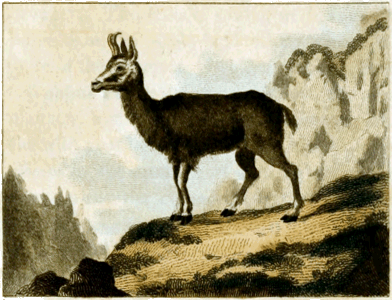
FIG. 152. Buck of Juda.
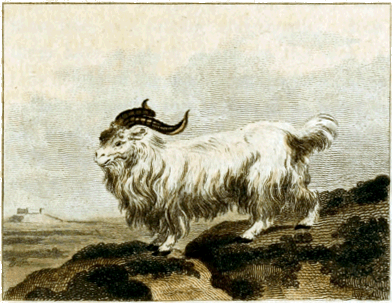
The male wild goat differs from the chamois, by the length, thickness, and form of his horns; he is also more bulky, vigorous, and stronger. The female wild goat has smaller horns than the male, and nearly resembling those of the chamois. In other respects, these two animals have the same customs, the same manners, and inhabit the same climate; only the wild goat being more agile, and stronger, climbs to the summits of the highest mountains, while the chamois never goes higher than the second stage; but neither of them are to be found in the plains; both clear their way in the snow, and both bound from one rock to another. Both are covered with a firm solid skin, and cloathed in winter with a double fur, with very rough hair outwardly, and a more fine and thicker underneath. Both of them have a black stripe on the back, and tails nearly of the same size. The number of exterior resemblances in fact is so great, and the conformity of the exterior parts is so complete, that we might be led to believe these two animals were only simple varieties of the same species. The wild, as well as the chamois goats when taken young, and brought up with domestic goats, are easily tamed, imbibe the same manners, herd together, return to the same fold, and probably, copulate and produce together. But this last fact, the most important of all, and which alone would decide the question, is not ascertained.[S] We have never learnt for a certainty whether the wild and the chamois copulate with our goats; we only suppose it, and in this respect agree with the ancients. But our presumption appears founded upon those analogies which experience has seldom contradicted.
Let us, nevertheless, take a view of the reasons against it. The wild and chamois goats both subsist in a state of nature, and both are constantly distinct. The chamois sometimes comes of his own accord and joins the flock of our domestic kind, but the wild goat never associates with them, at least before he is tamed. The male wild goat and the common he-goat have very long beards and the chamois has none. The male and female chamois have very small horns: those of the male wild goat are so thick and so long, that they would scarcely be imagined to belong to an animal of his size. The chamois also appears to differ from the wild goat and the common he-goat, by the direction of his horns, which are inclined a little forwards in their lower parts, and bent backwards at the point in the form of a hook; but, as we have already remarked, in speaking of oxen and sheep, the horns of domestic animals vary prodigiously, as do also those of wild animals, according to the differences of climate. Our female goats have not their horns absolutely resembling those of the male. The horns of the male wild goat are not very different from those of our he-goat; and as the female wild goat approaches the domestic kind, and even the chamois, in size and smallness of the horns, may we not conclude, that the wild, the chamois, and the domestic goat, are, in fact, but one species, in which the nature of the females is invariably alike, while the males are subject to variations? In this point of view, which, perhaps, is not so distinct from Nature as might be imagined, the wild goat would be the male in the original race of goats, and the chamois the female. This is not imaginary, since we can prove by experience, that there are in Nature, animals where the females will equally serve the males of different species, and produce young from both. The sheep produces with the he-goat as well as with the ram, and always brings forth lambs of its own species; the ram, on the contrary, does not copulate with the she-goat. We may, therefore, look upon the sheep as a female common to two different males, and consequently, constitutes a species independent of the male. It may be the same in that of the wild goat; the female alone represents the primitive species, because her nature is constant; the males, on the contrary, vary, and there is a great appearance that the domestic she-goat, which may be considered as the same female as the chamois and the wild kind, would produce with these three different males, which alone make the variety in the species, and consequently do not alter the identity, although they appear to change the unity of it.