Front matter (continued 4)
Reading edition
It now remains to enquire what these two animals, mentioned by Seba, by the false names of mazame and temamaçame really are. The bare inspection of the figures, independently of his description, demonstrates, that these animals belong to the goats or gazelles, and not to the stags or roe-bucks. The want of a beard, and the shape of the horns, prove, they are not goats, but gazelles; and, by comparing Seba’s figures with the gazelles which we have described, I found that his pretended temamaçame of New Spain, is the kob, or little brown cow of Senegal. The figure, colour, and size of the horns are the same; the colour of the hair is also the same, and differs from that of other gazelles, by not being white, but yellow under the belly and upon the flanks. With respect to the pretended mazame, although it resembles the gazelles in general, yet it differs in particular from all those we have before enumerated; but we saw in M. Adanson’s cabinet, where he has collected the most rare productions of Senegal, a stupid animal which we call nagor, by reason of the resemblance of its horns with those of the nanguer. This animal is found in the neighbouring island of Goree, from whence he was sent to M. Adanson by M. Andriot, and possesses all the characters which Seba gives to his pretended mazame; its body is of a pale red, and its belly is not white, like the other gazelles; it is of the size of the roe-buck; its horns are not six inches long, almost smooth, and slightly bent forwards, but not so much as those of the nanguer. Therefore this animal, mentioned by Seba, by the name of mazame, or American stag, is only an African goat, or gazelle, which we have added here by the name of the nagor to the twelve other gazelles, whose history we have already given.

THE COUDOUS.

The class of ruminating animals is, of all others, the most numerous and the most varied. It contains, as we have seen, a great number of species, and, perhaps, a still greater number of distinct races, or constant varieties. Notwithstanding all our enquiries, and the considerable details into which we have been obliged to enter, we freely confess, that we have not exhausted the subject, and that there still remain even very remarkable animals which we are only acquainted with by imperfect fragments, and are unable to ascertain with precision to what class they belong. For example, in the very great collection of horns in the royal cabinet, as well as those dispersed in private museums, each of which, after much labour, and a multiplicity of comparisons, we have referred to the animal it belonged; there still remained one without label, or any mark affixed to it, absolutely unknown. This horn is large, almost straight, and composed of a very thick black substance; it is not solid, like that of the stag, but resembles that of the ox. From the base to beyond the middle of the horn is a thick ridge, raised about an inch; and although the horn is straight, this prominent ridge makes a spiral turn and a half in the interior part, and is wholly effaced in the superior part of the horn, which terminates in a point. This horn, which differs from every other, seems to have the nearest affinity to that of the buffalo; but we were ignorant of the name of the animal to which it belonged, and it was not till hunting through the different cabinets that we found in that of M. Dupleix part of a head adorned with two similar horns, and to which was affixed a label with these words: “the horns of an animal nearly like a horse, of a greyish colour; with a mane on the fore part of its head like a horse; it is called at Pondicherry coësdoës, which should be pronounced coudous.” This little discovery gave me great pleasure; but I have not been able to meet with this name coësdoës, or coudous, in the writings of any traveller; the label only has informed us that it is of a large size, and to be met with in the hottest countries of Asia. The buffalo is of the same climate, and has likewise a mane; it is true his horns are crooked and flat, while those of the coudous are round and straight, which, together with the colour, are sufficient indications of the difference of these two animals; for the buffalo has a black skin and hair, and, according to the label, the hair of the other is grey. These relations suggest others: the travellers in Asia speak of the large buffaloes of Bengal, of red buffaloes, and of the grey buffaloes of the Mogul empire, which are called nil-gauts; the coudous may possibly be one or other of these animals, and the travellers into Africa, where the buffalo is as common as in Asia, more precisely mention a species of buffalo, called pacassa at Congo, which from their indications seems to be the coudous. “In the route from Louanda to the kingdom of Congo[Y], we perceived two pacassas, which are animals resembling buffaloes, and which roar like lions. The male and female go always together; they are white, spotted with red and black; their ears are about half an ell long, and their horns are perfectly straight: they neither fly at the sight of the human species nor do any injury, but only stare at them as they pass along." We have before mentioned, that the animal, called at Congo, empacassa, or pacassa, appeared to be the buffalo. It is, in fact, a kind of buffalo, but differs from it by the shape of the horns and the colour of the hair; in one word, the pacassa is the coudous, which perhaps forms a separate species from that of the buffalo, and perhaps, also, may only be a variety of it[Z].
THE MUSK.
To finish the history of goats, gazelles, chevrotains, and other animals of this genus, which are all found in the old continent, it only remains to give that of the Musk, an animal as famous as it is unknown. This is the animal which produces the real musk; all modern naturalists, and the greatest part of travellers through Asia, have mentioned it, some by the name of a stag, a roe-buck, or a musk-goat, and others have considered it as a large chevrotain. It seems indeed to be of an ambiguous nature, participating of all the above animals, yet at the same time we can assert, that its species is different from all other quadrupeds. It is about the size of a small roe-buck, but its head is without horns, and by this character it resembles the memina or chevrotain of India. It has two great canine teeth or tusks in the upper jaw, and by this it approaches the chevrotain of India; but what distinguishes the musk from all other animals is a kind of bag about two or three inches in diameter, which grows near the navel, and in which the liquor, or rather the greasy humour called musk is secreted, and which differs from that of the civet both in smell and consistence. Neither the Greeks nor Romans mention the musk animal. The first that noticed it were the Arabs. Gesner, Aldrovandus, Kircher, and Boym have given more extended accounts of this animal; but Grew is the only person who has made an exact description of it, from a skin which was preserved in the cabinet of the Royal Society of London. His description is as follows:—“The musk stag is about three feet six inches in length, from the head to the tail; the head is about half a foot long; the neck seven or eight inches; the fore part of the head three inches broad, and the nose sharp like that of a greyhound; the ears are erect, like those of a rabbit, and about three inches long; the tail is not above two inches; the fore-legs, including feet and thighs, are thirteen or fourteen inches long; he is cloven-footed, armed on his fore-feet behind and before with two horny substances: the hind feet were wanting. The hair of the head and legs about half an inch long, and very fine; thicker under the belly, and an inch and a half in length; on the back and crupper they are three inches, and three or four times thicker than the bristles of a hog, of course more so than that of any other animal. It is brown and white alternately, from the root to the point; on the head and thighs it is brown; under the belly and tail white; a little curled, especially on the back and belly; it is very soft, and has the appearance of being something between a common hair and a quill; on each side of the lower jaw, under the corners of the mouth, there is a small tuft of thick hair, which is short and hard, about three-fourths of an inch long, and somewhat resembling the bristles of a hog. The bladder, or bag, which contains the musk is about three inches long, two broad, swells out from the belly about an inch and a half, and stands near as much before the groin. The animal has twenty-six teeth, sixteen in the lower jaw, of which the eight in front are incisive, the four grinders behind, are rugged and continuous, and as many similar grinders in the upper jaw. There is also a tusk about two inches and a half long on each side in the upper jaw, which terminate in the form of a hook, not round but flat, and have a sharp edge behind. They have no horns, &c.[AA]”
In 1681, a year after Grew’s publication, Luc Schrockius printed a history of this animal at Vienna, in which we do not find any thing very exact, nor absolutely new. We shall, however, select such facts as may be collected from it, and which agree with those in other authors, and especially in the works of the more modern travellers. We have been under the necessity of contenting ourselves with collecting what has been said of this animal, which we have never seen, and which we have not been able to procure. By Grew’s description, which is the only authentic work we can rely on, it appears, that the hair of this animal is long and rough, the muzzle pointed, and the tusks somewhat like those of the hog: in these characters it approaches the boar kind, or perhaps still more the babiroussa, which the naturalists have denominated the Indian boar; and which, though resembling the hog in many characters, like the musk animal, he is much smaller, and has longer and slender legs, like those of the stag, or roe-buck. On the other hand, the American hog, which we have called pecari, has a bag, or cavity, on its back, containing an odoriferous humour. The musk animal has a similar bag, not on his back, but under the belly. In general, those animals which produce odoriferous liquors, as the badger, the bearer, the pecari, the musk-rat, the civet, the zibet, are not of the stag or goat genus: thus we might be tempted to think, that the musk animal is nearer the hog kind, of which he has the tusks, if he had, at the same time, incisive teeth in his upper jaw; but his deficiency in that respect, makes him come nearer the ruminating animals, and especially the chevrotain, which ruminates, though it has no horns; but all these external indexes can only furnish us with conjectures. It is the inspection of the internal parts alone that can decide the nature of this animal, which is not even as yet perfectly known; nor have I placed him after the goats and antelopes from any conviction or even reason to conclude he belongs to those species.
Marco Polo, Barbosa, Thevenot, and Marini, are all more or less deceived in the characters they have given of this animal[AB]. The only true point in which they agree is, that the musk is formed in a bag, or tumour, near the navel, and it appears by their testimonies, as well as those of other travellers, that the male only produces the musk; that the female has a similar bag near the navel, but that the humour which gathers there, has not the same smell; that this tumour of the male is only filled with musk at the rutting-time, and that at other times the quantity of this humour is less, and the odoriferous scent much weaker.
In respect to the musk itself, its essence, or pure substance, is, perhaps, as little known as the nature of the animal which produces it. All travellers agree, that the musk is always mixed and adulterated with blood, or some other drugs, by those who sell it. The Chinese not only increase the quantity by this mixture, but they endeavour likewise to increase the weight, by incorporating with it lead very finely ground. The purest musk, and that which is the most sought after, even by the Chinese themselves, is that which the animal deposits upon trees or stones, against which he rubs himself when the quantity becomes too great, or renders the pouch uneasy. That which is found in the bag is seldom so good, because it is not fully ripe, or because perhaps it is only in their rutting season that it acquires all its strength and smell; and that it is at this time the animal endeavours to disburthen himself of a matter which then causes violent itchings, and possibly some degree of pain.
Chardin and Tavernier have both described the means, which the eastern nations make use of to adulterate the musk[AC]: the merchants must necessarily increase the quantity of it beyond conception, since in one year Tavernier purchased 1673 bags, which supposes an equal number of animals to have been taken. But as this animal is no where domestic, and as the species is confined to some few provinces of the East, it is impossible to be sufficiently numerous to produce so great a quantity of this matter. We cannot, therefore, doubt the greatest part of these pretended bags, or bladders, are only artificial ones made of the skin of the other parts of the animal, and filled with its blood, mixed with a very small quantity of true musk. Its scent is, in fact, the strongest of any yet known; a single grain is sufficient to perfume a great quantity of other matter; the odour of the smallest particle will perfume a considerable space; and the perfume itself is so permanent, that at the end of several years it does not seem to have lost much of its power.[AD]
Engraved for Barr’s Buffon
FIG. 161. Cabiai.
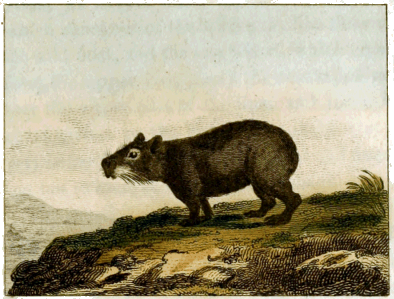
FIG. 160. Babiroussa.
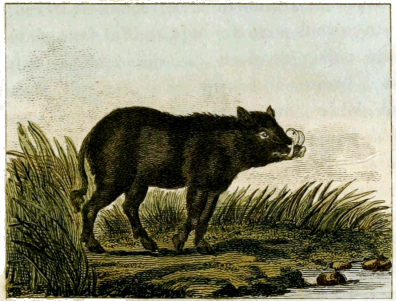
The Babiroussa.
Although we have only the head of this animal in the royal cabinet, it is too remarkable to be passed over in silence. All naturalists have looked upon it as a kind of hog, though either its head, size, bristles, nor tail, resemble that animal: its legs are longer, and its muzzle shorter; it is covered with short hair, as soft as wool, and its tail is terminated by a tuft of this wool; its body is likewise not so thick and clumsy as that of the hog; its hair is grey, mixed with red and a little black; its ears are short and pointed; but the most remarkable character, and which distinguishes it from all other animals, are four enormous tusks, or canine teeth, the two shortest of which shoot out of the lower jaw, like those of the wild boar, and the two others, which come from the upper jaw, pierce the checks, or rather the upper part of the lips, and rise in a curve almost to the eyes. The tusks are a very beautiful ivory, much smoother and finer, but not so hard as that of the elephant.
The position and the direction of these two upper tusks, which rise upright, and then bend in the form of a circle, have made some skilful naturalists, such as Grew, imagine that these tusks ought not to be looked upon as teeth, but as horns. They founded their opinion upon the circumstance that in all animals the sockets of the teeth in the upper jaw open downwards; that in the babiroussa, as in the other animals, the sockets are turned downwards, except those of these two great tusks, which, on the contrary, are turned upwards; and they concluded from thence, that from this essential character of the upper teeth, these tusks, whose sockets are directed upwards, ought to be looked upon as horns and not as teeth. But these philosophers were deceived; the position or direction is only a circumstance, and not essential to the existence of an object. These tusks, though situate in an opposite manner to that of the other teeth, is only a singularity in the direction, which cannot change the nature of the thing, nor make an ivory horn of a true canine tooth.
These enormous tusks give this animal a very formidable appearance; they are, however, less dangerous than our wild boars. They go in herds, and have a very strong smell, by which they are easily discovered, and are hunted by dogs with good success. They growl terribly, defend themselves, and wound their enemies with their under tusks; for the upper are rather of disservice than of use to them. Although savage and ferocious, they are tamed with great ease; and their flesh, which is very good, putrifies in a short time. As their hair is fine, and their skin delicate, it is soon penetrated by the teeth of dogs, who hunt them in preference to wild boars, and sooner accomplish their purpose. They fasten their upper tusks in the branches of trees, to rest their heads, or to sleep standing. This habit they have in common with the elephant, who, in order to sleep in a standing posture, supports his head by fixing the end of his tusks in the holes which he makes in the walls of his lodging.
The babiroussa differs still more from the wild boar, by his natural appetites; he feeds upon grass and leaves of trees, and does not endeavour to enter gardens to feed on beans, pease, and other vegetables; while the wild boar, who lives in the same country, feeds upon wild fruit, roots, and often destroys the gardens. Besides, these animals who go together in herds, never intermix; the wild boars keep on one side, and the babiroussas on the other. The latter walk quicker and have a very fine smell, and often stand erect against the trees to scent the approach of dogs or hunters. When they are pursued to any great distance they make towards the sea, and, swimming with great dexterity, very often escape their pursuers, for they swim for a long time, and often to very great distances, and from one island to another.
The babiroussa is found not only in the island of Bouro, or Boero, near Amboyna, but also in many parts of the South of Asia, and Africa; as at Celebes, Estrila, Senegal, and Madagascar, for it appears that the wild boars of this island, which Flaccourt speaks of, and says, that the males chiefly have two horns on the side of their nose, are babiroussas. We have not had it in our power to determine whether the female has the two tusks which are so remarkable in the male, but most authors seem to agree that they have.
SUPPLEMENT.
Having been favoured with two drawings of this animal, we are now enabled to present a figure of the Babiroussa, (fig. 160.) and which we believe will give a tolerable idea of him, since it was taken with much care, and is a combination of both; the one of them we received from M. Sonnerat, which represented him in a standing posture, and the other lying on its belly, was sent us from England by Mr. Pennant, with the following label; “a Babiroussa from the island of Banda, drawn from nature;” it is of a blackish colour, grows to the size of a large hog, and its flesh is very good to eat.
THE CABIAI.
This American animal had never been seen in Europe until the Duke of Bouillon procured one to be sent to him from America. As this prince is curious in foreign animals, he has often done me the honour of inviting me to see them; and he has even given me several species for the advantage of this work. This animal (fig. 161.) was sent very young to him, and had not arrived at its full growth when the cold killed it. It is not a hog, as naturalists and travellers have pretended; it only resembles that animal by trifling marks, and differs from it by striking characters. The largest cabiai is scarcely as big as a hog of eighteen months growth. The head is shorter, and its mouth less; the eyes are larger, the number and form of the teeth are different, it wants a tail, and is web-footed; the hoofs before are divided into four parts, and those behind into three; between the divisions there is a prolongation of the skin, so that the feet, when opened in swimming, can beat a greater surface of water in which it frequently lives; it swims like an otter, seeks the same prey, and seizes the fish with its feet and teeth, and carries them to the banks to eat. It also eats fruits, corn, and sugar-canes. As its feet are broad and flat it often sits upon its hind ones. Its cry more resembles the braying of an ass than the grunting of a hog. It seldom stirs out but at night, and almost always in company without going far from the sides of the water. It can find no safety by flight, from the length of its feet and the shortness of its legs. To escape its enemies it plunges into the water, and remains at the bottom so long that the hunters lose all hopes of seeing it again. It is fat, and the flesh is tender, but, like that of the badger, it tastes more like bad fish than good flesh; the head, however, is not bad, and this agrees with what is said of the badger, his fore parts are pretty good, while his hind ones taste like fish.
The cabiai is quiet and gentle; it is neither quarrelsome nor savage with other animals. It is easily tamed, comes at call, and willingly follows those who feed and treat it with kindness. It was fed at Paris with barley, sallad, and fruit, and was healthy while the weather kept warm. By its number of paps we should suppose that the females produce several young at a litter. We do not know how long they go with young, the time of their growth, nor, consequently, their length of life. The natives, or colonists, of Cayenne might inform us of these particulars, for it is very common in Guiana, as well as in Brasil, in Amazonia, and in all the lower countries of South America.
SUPPLEMENT.
We have been informed by M. de la Borde, that the Cabiai is a common animal in Guiana, and on the borders of the Amazon river; he says that the male and female always go together; that they avoid the habitations of men, and always live by the sides of rivers, into which they go whenever they are disturbed, swimming like hogs to a great distance, sometimes diving to the bottom, where they will remain a considerable time; that the natives frequently take them when very young, and bring them up in their houses, where they soon become familiar, and will eat bread, millet, and herbs, although they principally live on fish when in their wild state; that the females produce but one at a time; that they are perfectly harmless; and that their flesh is white and well tasted. Although this last fact may seem to contradict what we have formerly stated upon the authority of other authors yet it is by no means improbable that their flesh may be bad when in their wild state, from feeding on fish, and yet very good when they live on bread and grain.
As one of these animals lived some time in Paris I am of opinion they would propagate in our climate; and the more especially as I find the one I formerly alluded to was not killed by the cold, but that the winter had no particular effect upon it. I have since been informed that this animal, was confined in an upper room, from the window of which it jumped, and falling into a vessel of water was drowned.
Engraved for Barr’s Buffon
FIG. 162. Porcupine.
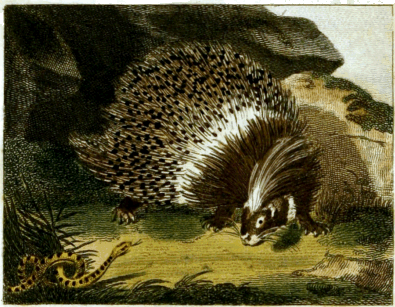
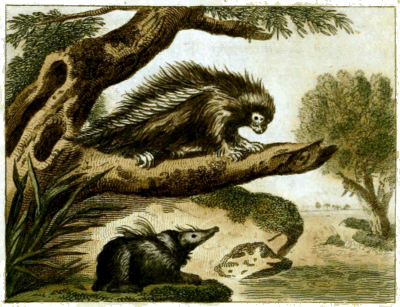
FIG. 164. Tendrac. FIG. 163. Coendou.
THE PORCUPINE.
The name given this animal leads to a supposition that it is a hog covered with thorny quills,[AE] when, in fact, it only resembles that animal by its grunting; in every other respect it differs from the hog as much as any other animal, both in its outward appearance and inferior conformation. Instead of a long head and ears, armed with tusks, and terminated with a snout; instead of cloven feet, furnished with hoofs like the hog; the porcupine has a short head like the beaver, two large incisive teeth in each jaw, no tusks or canine teeth, the upper lip divided like that of the hare, the ears round and flat, and the feet armed with claws. Instead of a large stomach, with an appendix in form of a cowl, the porcupine has only a single stomach, with a large cæcum gut. The parts of generation are not apparent, as in the boar, and its testicles are concealed in the groin. By all these marks, together with its short tail, long whiskers, and divided lip it approaches more to the hare or beaver than to the hog. The hedge-hog, indeed, who, like the porcupine, is covered with prickles, somewhat resembles the hog, for it has a long muzzle, terminated by a kind of snout; but all these resemblances being so very slight it is clear that the porcupine (fig. 162.) is a particular and different species from the hedge-hog, the beaver, the hare, or any other animal whatever.[AF]
Travellers and naturalists have almost unanimously declared this animal has the faculty of discharging its quills, and with such force as to wound its foes at a great distance; and that these prickly quills have the extraordinary property of penetrating farther into the flesh of their own accord and power, as soon as the point has made an entrance. This last circumstance is purely imaginary, without any foundation, and the first is as false as the second. The error seems to have arisen from this animal raising his prickles upright when he is irritated; and as some of them are only inserted into the skin by a small pellicle they easily fall off. We have had many living porcupines, but never saw them dart any of their quills, even though violently agitated. It is a matter of astonishment, therefore, that the gravest authors, both ancient and modern, as well as the most sensible travellers, should join in opinion respecting a circumstance so entirely false. Some affirm that they have been wounded by this sort of darting; others, assert that the quills are darted with such vengeance, as to pierce a plank at a great distance. The marvellous commonly is pleasingly believed, and increases in proportion to the number of hands it passes through. Truth, on the contrary, diminishes in the same degree; and in spite of the positive negative which I have placed on these two fictions, I am persuaded, that many future writers will assert that the porcupine darts his quills to a distance, and that when those quills are separated from the body of the animal, they will of themselves, and with their own exertions, penetrate deeper into those bodies in which the point has entered.
However, in justice to Dr. Shaw, we must except him from the number of these credulous travellers; “Of all the number of porcupines (says he) which I have seen in Africa, I have never yet met with one, who could dart their quills, however strongly he was irritated; their common method of defence is to lie on one side, and when the enemy approaches very near, to rise suddenly and wound him with the points of the other.”
The porcupine, although originally a native of the hottest climates of Africa and India, lives and multiplies in colder countries, such as Persia, Spain, and Italy. Agricola says, that the porcupine had not been transported into Europe, much before his time. They are found in Spain, but more commonly in Italy, especially on the Appenine mountains, in the environs of Rome.
Pliny, and other naturalists, have said, after Aristotle, that the porcupine, like the bear, conceals himself during winter, and that they bring forth in thirty days. We have not had it in our power to verify these facts; and it is singular, that in Italy where this animal is common, and where there has ever been skilful philosophers and excellent observers of nature, that its history has never been written by any of them. Aldrovandus in speaking on this subject, has, like the rest, only copied Gesner; and the gentlemen of the academy, who have dissected eight of these animals, say very little that has any relation to their natural habits. We only learn from the testimonies of travellers, and persons who have kept them in menageries, that the porcupine in its domestic state, is neither savage nor furious, but only anxious for liberty; that with the assistance of its fore teeth, which are sharp and strong like those of the beaver, he easily cuts through his wooden prison. It is also known that he feeds willingly on fruits, cheese, and crumbs of bread; that in his wild state, he lives upon roots and wild grain; that when he can enter a garden he makes great havock[AG], eating the herbs, roots, fruit, &c. that he becomes fat, like most other animals, toward the end of summer; and that the flesh of this animal, although a little insipid, is tolerable eating.
When the form, substance, and organization of the prickles of the porcupine are considered, they are found to be tubes to which only vanes are wanting to make them real feathers. They strike together and make a noise as the animal walks; he can easily erect them in the same manner as the peacock spreads the feathers of his tail, and as easily smooths them again by the contraction of the cuticular muscle. This muscle, therefore, has the same power, and is nearly of the same formation in the porcupine as in some birds.
THE COENDOU.
In every article we have to treat of we always meet with more errors to confute than facts to relate. This arises from the history of animals having been only written of late by prejudiced persons, who take the list of their little systems for the genuine register of Nature. There are not any animals of the warm climates of the old continent existing in America, and reciprocally there are not any of the South American animals to be met with under the torrid zone of Africa and Asia. The porcupine, as already observed, is a native of the hot countries of the old world, and having never been found in the new, they have not hesitated to give his name to animals which seemed to resemble him, and particularly to that which we have now under consideration. On the other hand, the Coendou (fig. 163.) of America has been transported to the East Indies; and Piso, who probably was not acquainted with the porcupine, has made Bontius, who only speaks of animals in the southern parts of Asia, engrave the coendou of America under the name and description of the true porcupine; so that, at the first view, we should firmly believe, that this animal existed equally in America and in Asia. It is easy, however, to discover, with a little attention, that Piso, who is in this, as well as in most parts of his work, only a plagiarist of Marcgrave, has not only copied his figure of the coendou, into his history of Brasil, but has copied it again for the work of Bontius, of which he was the editor. Therefore, though we find the figure of the coendou in Bontius, we must not conclude, that it exists in Java, or in any other part of the East Indies, nor take this figure for that of the porcupine, which, in fact, the coendou only resembles by its quills or prickles.
It is to Ximenes, and afterwards to Hernandes, that we owe the first knowledge of this animal, which they have indicated under the Mexican name of hoitztlacuatzin. The tlacuatzin is the opossum and the hoitztlacuatzin should be translated the bristly or spinous opossum. This name has been misapplied, for these animals resemble each other very little. Marcgrave has not adopted this Mexican denomination, but calls this animal cuandu. The only thing we can reproach Marcgrave with, is his not having known, that the cuandu of Brasil was the same animal as the hoitztlacuatzin of Mexico, especially as his description and figure agree with those of Hernandes; and as Laët, the editor and commentator of Marcgrave expressly says, that the spiny tlacuatzin of Ximenes, and the cuandu, are probably the same animal. By collecting the scattered accounts of travellers there appears to be two varieties of these animals, which the naturalists, after Piso, have inserted in their lists as two different species, namely, the great and the little coendou: but what immediately proves the error, or negligence of Piso, is, that although he describes these coendous in two separate and distinct articles, and seems to look on them as different species, he represents both by the same figure: which, we think, sufficient foundation to pronounce them the same animal. There are likewise other naturalists who have not only made two species of the great and little coendou but have also separated the hoitztlacuatzin, and given all three as different animals. I own, indeed, that although it is probable, the coendou and the hoitztlacuatzin are the same animal, yet this identity is not so certain as that of the great and little coendou.
However that may be, the coendou is not the porcupine. He is much smaller; his head and muzzle shorter; he has no tuft on its head nor is his upper lip divided; his quills are proportionally shorter and much finer; his tail is long, and that of the porcupine very short: he is carnivorous rather than frugivorous, and endeavours to surprize birds, small animals, and poultry, while the porcupine only feeds upon herbs, roots, and fruits. He sleeps all the day like the hedge-hog, and only stirs out in the night: he climbs up trees, and hangs on branches by his tail. All travellers agree, that his flesh is very good eating. He is easily tamed, and commonly lives in high places. These animals are found over all America, from Brasil and Guiana, to Louisiana and the southern parts of Canada; while the porcupine is only to be found in the hottest parts of the Old Continent.
By conferring the name of porcupine on the coendou, the same faculties have been attributed to him, especially that of shooting his quills. It is astonishing that naturalists and travellers should agree on this circumstance, and that Piso, who ought to have been less superstitious, as he was a physician, should gravely assert, that the quills of the coendou pierce into the flesh by their own power, and penetrate into the body even to the most internal viscera. Ray is the only person who has denied these circumstances, although they evidently appear to be absurd. How many absurdities have been exposed by men of sense, which, nevertheless, are affirmed by other men who think they are endowed with a greater degree of understanding!
SUPPLEMENT.
To our former account of this animal we may now add that there are two species of it in Guiana, the one larger than the other; the former weigh from twelve to fifteen pounds, and the latter about six: their principal food is the leaves of trees, in the holes of which the females bring forth their young; they commonly bring forth two at a time, and yet they are not very numerous. The negroes are very fond of their flesh and describe it as extremely good. From the account of M. de la Borde they are solitary animals, except in the season of love, when they go in pairs; they seldom venture to appear during the day, and they find a most inveterate enemy in the tiger who destroys them at every opportunity.
THE URSON.
This animal has never yet received a distinct name: placed by Nature in the desert part of North America, it exists in independence far distant from man, and has not even received from him a name, which is the first mark of an animal’s subjection. Hudson having discovered the country where he inhabits, we shall give him a name which has an affinity with his first master, and which, at the same time, indicates his sharp bristly nature. It was likewise necessary to give him a name, that he might not be confounded with the porcupine or coendou, which he resembles in some few characters, but so materially differs from them in other respects that he ought to be looked upon as a different species. He is also a native of the northern climates, while the others particularly belong to that of the south.
Edward, Ellis, and Catesby, have all spoken of this animal: the figures given by the two first agree with ours, and we have no doubt of their being the same animal. We are likewise strongly inclined to believe, that the figure and description Seba has given, under the name of the remarkable porcupine of the East Indies, and which afterwards Klein, Brisson, and Linnæus, indicated in their methodical lists by characters extracted from Seba, may be the same animal as we are now treating of. This would not, as we have already observed, be the only time that Seba has spoken of American animals as belonging to the East Indies. However we cannot be so positive with respect to this as we have been with many other animals; all that we can say is, that the resemblances appear to be very great, and the differences very slight, and that these differences may possibly be only varieties between individuals, or such as distinguish the males from the females.
The urson might be called the bristly beaver, he being of the same country, the same size, and the same form of body. He has, like the beaver, two long, strong, and sharp incisive teeth at the end of each jaw. Besides his prickles, which are short, and almost covered with hair, like the beaver, he has a double coat, the first consists of long and soft hairs, and the second of a down, which is still more soft and smooth. In the young ursons the prickles are proportionably larger, more apparent, and the hair shorter and scarcer than in the adults.
This animal avoids moist places, and is even fearful of wetting himself. They make their habitations under the roots of great hollow trees, sleep very much, and chiefly feed upon the bark of juniper-bushes. In winter the snow serves them for drink; and in summer they lap water like a dog. The savages eat their flesh, and strip the bristles off the hide, which they make use of instead of pins and needles, and clothe themselves with the fur.
THE TANREC AND THE TENDRAC.
The Tanrecs, or Tendracs, are small animals of the East Indies, which resemble a little our hedge-hogs, but differ from them sufficiently to constitute a distinct species. This is strongly proved by its not rolling itself up in the shape of a ball, like the hedge-hog; and besides the tanrecs are found at Madagascar, where there are also hedge-hogs of the same species as ours, which are not called there tanrecs but soras.
There appears to be two species of tanrecs, or, perhaps, two different races; the first, which is nearly as large as our hedge-hog, has its muzzle proportionably longer than the second; its ears are also more apparent, and is more furnished with prickles than the second, to which we have given the name of tendrac to distinguish it from the first. The tendrac (fig. 164.) is not bigger than a large rat; its muzzle and ears are shorter than those of the tanrec, which is also covered with shorter prickles, but they are as numerous as those of the hedge-hog; the tendrac, on the contrary, has them only on the head, neck, and withers, the rest of the body being covered with a coarse hair resembling the bristles of a hog.
These small animals, whose legs are short, move but slowly; they grunt, and wallow in the mire like hogs; they are chiefly in creeks and harbours of salt water; they multiply in great numbers, and dig themselves holes in the ground, whither they retire and sleep for several months. During this torpid state their hair falls off, which grows again upon their revival. They are usually very fat, and although their flesh is insipid, soft, and spongy, yet the Indians consider it as a very great delicacy.
Engraved for Barr’s Buffon
FIG. 165. Giraffe.
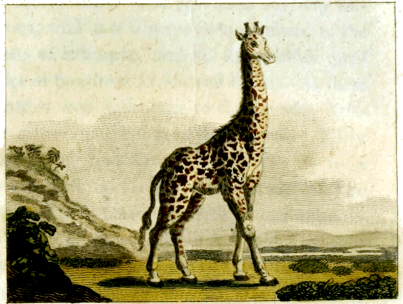
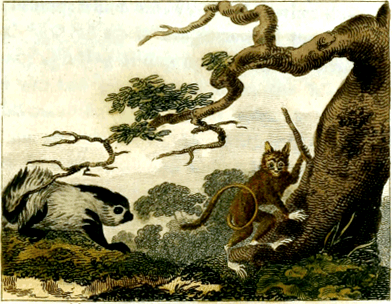
FIG. 166. Two toed Sloth. FIG. 167. Tarsier.
THE GIRAFFE, OR CAMELOPARD.
The Giraffe (fig. 165.) is one of the tallest, most useful, most beautiful, and harmless animals in nature. The enormous disproportion of his legs, the fore ones being as long again as those behind, is a great obstacle to the exercise of his powers. His motion is waddling, slow, and stiff; he can neither fly from his enemies in a free state, nor serve his master in a domestic one. The species is not very numerous, and has always been confined to the desarts of Ethiopia, and to some other provinces of Southern Africa and India. As these countries were unknown to the Greeks, Aristotle makes no mention of this animal. Pliny speaks of it, and Oppian describes it in a manner that is far from equivocal. “The camelopardalis (says this author) has some resemblance to the camel; it has a spotted skin like the panther, and a neck as long as the camel; its head and ears are small, its feet broad, and its legs long, but the last are very unequal, the fore ones being much longer than those behind, which are so short, that when the animal is standing it has somewhat the appearance of a dog sitting upon his posteriors. There are two prominences upon the head just between the ears, which resemble two small and straight horns. Its mouth is like the stag’s; its teeth small and white; its eyes full of fire; its tail short, and furnished with black hairs at the end.” By adding to this description of Oppian those of Heliodorus and Strabo, we shall have a sufficient idea of the camelopard. “The ambassadors of Ethiopia (says Heliodorus) brought an animal about the size of a camel, whose skin was speckled with beautiful and glossy spots, the hinder parts were much lower than the anterior; the neck was slender, although rising from a tolerably thick body; the head resembled that of the camel, and in size was scarce double that of the ostrich; the eyes appeared tinctured with different colours. The motion of this animal was different from that of all other quadrupeds, who in walking lift their legs diagonally, that is, the right leg before with the left leg behind; but the camelopard goes naturally in an amble, with its two right or its two left legs pacing together. It is a gentle animal, and may be conducted any where with a small cord tied round its head.” “There is (says Strabo) a large animal in Ethiopia called camelopardalis, although it bears no resemblance to the panther, for its skin is not spotted in the same manner; the spots of the panther are circular, and those of this animal are long, and nearly resembling those of the fawn, or young stag. The posterior parts of its body are much lower than the anterior; so that towards the rump it is not higher than the ox, while its shoulders are higher than those of the camel. From this disproportion it cannot run very swift. This animal is gentle, does no injury, and feeds upon grass, leaves, and vegetables.” Among the moderns, the first good description we meet with is that of Belon. “I saw (says he) an animal at the castle of Cairo, which is commonly called zurnapa; the Latins anciently stiled it camelopardalis, a name compounded of leopard and camel, for it is sprinkled with spots like the first, and has a long neck like the latter. It is a very beautiful animal, as gentle as a lamb, and more sociable than any other wild beast. Its head is almost like that of the stag, excepting its size; on it are two small horns, about half a foot long, covered with hair; those of the male are longer than those of the female. They both have ears as large as those of a cow, and the tongue black, like that of the ox; it has no incisive teeth in the upper jaw; its neck is long, straight, and slender; its horns round; its legs thin and long, but so low behind that the animal appears to be sitting; its feet are like those of the ox; its tail, which hangs down almost to its hoof, is round, and the hair on it is three times as thick as that of a horse; the colour of the hair on the body is white and red; its manner of running is like the camel’s; when it runs its two fore feet go together; it lies on its belly, and has a callous substance on the breast and joints like that animal. When it grazes it is obliged to spread its fore legs very wide, and even then feeds with great difficulty, therefore it rather chooses to feed on the leaves of trees than to graze in the fields, especially as its neck is exceedingly long, and can reach to a great height.”
Gillius’s description seems still better than that of Belon. “I have seen (says Gillius, chap. ix.) three camelopards at Cairo; on their heads are two horns six inches long, and in the middle of their forehead a tubercle rises to about the height of two inches, which appears like a third horn. This animal is sixteen feet high when he holds up his head. Its neck alone is seven feet, and it is twenty-two feet long from the tip of the nose to the end of the tail; its fore and hind legs are nearly of an equal height; but the thighs before are so long in comparison to those behind, that its back inclines like the roof of an house. Its whole body is sprinkled with large yellow spots which are nearly of a square form. Its feet are cloven like the ox; its upper lip hangs over the under; its tail is slender, with hair on it to the very point; it ruminates like the ox, and, like that animal, feeds upon herbage; its mane extends from the top of the head to the back. When it walks it seems as if its legs and flanks on both sides were alternately lame; and when it grazes, or drinks, it is obliged to spread its fore legs prodigiously wide.”
Gesner affirms, upon the authority of Belon, that this animal sheds its horns like the deer; but I must confess that I never could find such a fact asserted in that author. He merely says, as above, that the horns of the camelopard are covered with hair; and he only speaks in one other place of that animal, namely, when treating of the axis, where he says, “The camelopard has a white skin, with broad spots sprinkled over it, which, though red, are not so deep as those of the axis.” This fact, which however I have not been able to meet with in any part of Belon’s work, would be of great importance to decide the nature of the giraffe, for if it sheds its horns every year it belongs to the stag kind; and, on the contrary, if its horns are permanent, it must be considered as belonging to the ox or goat species; but, without this precise knowledge, we cannot assert, as our nomenclators have done, that the giraffe is of the stag genus; and we are not a little surprised that Hasselquist, who has given a very long and dry description of this animal, has been silent as to its nature. After having methodically, that is to say, scholastically, heaped together a hundred useless and trifling characters, he does not say a single word on the substance of the horns, and leaves us ignorant whether they are solid or hollow, or whether they fall off or not. I refer to the description of Hasselquist, not for its utility, but for its singularity, and to excite travellers to make use of their own knowledge, and not to view objects through the spectacles of other men.
In the year 1764 a drawing and an account of the giraffe was sent to the Academy of Sciences, by which we are informed that this animal is not particular to Ethiopia, but is also found in the neighbourhood of the Cape of Good Hope.[AH] The drawing was so badly executed that no use can be made of it,[AI] but as the account contains a sort of description we have given it a place. “In an excursion from the Cape, made in 1762, we travelled about two hundred leagues up the country, and met with the camelopardalis, a drawing of which we have subjoined. Its body resembles that of an ox, and its head and neck those of the horse. All we met with were of a white colour, sprinkled with brown spots. They have two horns on the head, about a foot long, and their feet are hoofed. We killed two of these animals, and sent their skins to Europe, the several measurements of which were as follows: the length of the head one foot eight inches; the height, from the bottom of the fore foot to the withers, ten feet; and from the withers to the top of the head seven feet; in all seventeen feet in height. The length from the withers to the reins is five feet six inches, and from thence to the tail one foot six; the length, therefore, of the whole body is seven feet, and the height, from the hind feet to the reins, eight feet five inches. The great disproportion in the height and length of this animal seems to prevent its being of any service. It feeds on the leaves of trees, and when it wants to drink, or take any thing off the ground, it is obliged to kneel with its fore legs.”
In inspecting the accounts travellers have given of the giraffe, I find they all agree that it can reach with its head to the height of sixteen or seventeen feet when standing erect, and that the fore legs are as high again as the hind ones, so that it seems as if it was seated upon its crupper. They likewise agree that it cannot run very swift, by reason of this disproportion; that it is very gentle, and that by this quality, other habits, and even by the shape of the body, it partakes more of the nature of the camel than of any other animal; that it is among the number of ruminating animals, and, like them, is deficient of the incisive teeth in its upper jaw. By the testimonies of some travellers we also find that the giraffe is to be met with in the southern parts of Africa, as well as in those of Asia.
It is very evident, from what we have mentioned, that the giraffe is a peculiar species, and totally different from every other animal. If we would refer it to any it should rather be to the camel than the stag, or the ox. It is true the giraffe has two small horns, and the camel none; but they resemble each other so much in other respects that I am not surprised at some travellers having given it the name of the Indian camel. Besides, we are ignorant of the substance of the horns of the giraffe, and, consequently, we know not if in that part he approaches nearer to the stag than to the ox; and, possibly, they may be of a substance different from either; they may be composed of united hairs like those of the rhinoceros, or of a substance and texture peculiar to themselves. The reasons which have induced nomenclators to rank the giraffe with the stag kind, seem to have arisen from the pretended passage of Belon, quoted by Gesner, which indeed would be decisive if it were true. They seem also to have misunderstood what authors have said of the hair of those horns; they have imagined that the writers have said the horns of the giraffe were covered with hair, like the fresh-sprung horns of the stag, and from thence concluded they were of the same nature; but, in fact, the giraffe’s horns are only surrounded with coarse hair, and not covered with a down, or velvet, like those of the stag. This circumstance tends to support the probability that the horns of the giraffe are composed of united hair, like those of the rhinoceros, and their bluntness at the extremities greatly favours this idea. If, again, we consider that the elk, rein-deer, stag, roe-buck, &c. have their horns always divided into branches or antlers, and that, on the contrary, the horns of the giraffe are only simple, and consist of one stem, we must be convinced that they are not of the same nature, unless analogy be entirely violated. The tubercle is in the middle of the head, which, according to travellers, seem to form a third horn, is another strong circumstance in favour of this opinion. The two horns which are not pointed, but blunt at the ends, are, perhaps, only tubercles somewhat longer than the former. All travellers also uniformly inform us that the female giraffes have horns like the males, but that they are smaller. If this animal were really of the stag kind, analogy would here also be violated, for of all animals of that genus there is only the female rein-deer that has horns, the reason of which we have before mentioned. On the other hand, as the giraffe cannot graze but with great difficulty on account of the excessive height of its fore legs; as it chiefly and almost solely feeds on the leaves and buds of trees, it may be presumed, that the horns, which are the most apparent superfluity of the organic particles derived from the food, would be analogous to the nature of the food, as well as the horns of the stag. Time will confirm the propriety of one or other of these conjectures. One word more in Hasselquist’s description would have fixed these doubts, and clearly determined the genus of this animal. But scholars, who have only the gamut of their master in their heads, or rather in their pockets, cannot avoid making blunders and essential omissions, because they entirely renounce investigation, which should guide every observer of Nature, and view her productions through the false medium of arbitrary method, which only serves to hinder them from reflecting on the objects they meet with, and to calculate the description of them on a bad and erroneous model. As, in reality, all objects differ materially from each other, so they ought all to be treated differently; one single striking character happily discovered, is sometimes decisive, and often conveys more knowledge of a subject than a thousand trifling indexes. Whenever they are numerous they consequently become equivocal and common, and then they are at least superfluous, if not prejudicial, to the real knowledge of Nature, who sports with the forms we prescribe, soars above all method, and can only be perceived by the penetrating eye of Genius.
SUPPLEMENT.
From M. Allemand we received a letter, dated October, 1766, containing a number of excellent observations respecting this animal, and from which the following is an extract: “I am in possession of a stuffed giraffe, and since you expressed a desire to know the nature of its horns I cut one of them off, and send it to you; it is, however, necessary to observe, that it belonged to a very young one. I received it from the governor of the Cape, who informed me that it was killed as it was lying by the side of its mother; it was about six feet in height, and its horns did not exceed two inches and a half. These horns were covered all over with skin and hairs; the base was more than an inch broad, forming an obtuse cone; and to be certain whether it was solid or hollow I sawed it through longitudinally with that part of the skull to which it adhered, and I found its texture to resemble that of the horns of the stag more than any other animal. If indeed I were positive that a horn which was sent me as belonging to a giraffe did really belong to that animal, I should not hesitate to say there was no difference between them, except in the figure, this being straight, and without branches. With respect to the legs I conceive their disproportion in length has been greatly magnified, for the difference between the fore and hind ones of this young animal is very slight.”
The horns of the giraffe being solid, and their substance similar to those of the stag, there could be no doubt of his ranking in the same genus, especially if he sheds his horns annually of which, however, we are still uncertain; but we may safely assert he ought to be separated from that of the ox, and all those animals whose horns are hollow; and, indeed, until the contrary be proved to be the fact, we cannot do otherwise than consider the giraffe as a peculiar species, in the same manner as the elephant, rhinoceros, the hippopotamus, forming a species which has no collaterals, and which seems to be a privilege conferred by Nature simply on those which are of the largest magnitude.
In the description of M. Allemand we freely acknowledge that he has displayed much accuracy, and a perfect intimacy with the subject; but yet I apprehend that the longest of the horns he did me the favour to transmit does not belong to a giraffe, for the short one is very thick, and that quite thin, comparatively with their different lengths. In an anonymous description which I received from Holland of this animal it is stated, that the horns of a full-grown giraffe are a foot long, and as thick as a man’s arm; according to which the horn we are now considering being six inches long, it ought to be full twice as thick, as it is, in reality; and, indeed, it so perfectly resembles the first horns of a young stag, that we can have little doubt of its belonging to that animal.
As to the nature of the giraffe’s horns I feel no hesitation in coinciding with the opinion of M. Allemand. The protuberance on the front is osseous, and may be considered as a third horn; and as the horns adhere to the cranium, they should be considered as osseous prolongations of the head. In short the horn of the giraffe appears to be a bone, differing from that of the ox by its covering, the latter being entirely surrounded with a horny substance, and the former with hair and skin.
THE LAMA AND THE PACOS.
There are examples in every language, of two different names being applied to the same animal, one of which has a relation to its wild state, and the other to its domestic. The wild boar and the hog are the same animal, under two names, no ways relative to any difference in their natures, but to the condition of the species; one part of which is under the power of man and the other independent. It is the same with respect to the lamas and the pacos, which were the only domestic animals of the ancient Americans: these names belonged to them in their domestic state. The wild lama was called huanacus, or guanaco; and the wild pacos, vicuna, or vigogne.[AJ] I conceived this remark necessary to avoid the confusion of names. These animals are to be found only in he New World: they seem even to belong to some particular parts, beyond the limits of which they are never to be seen. They appear confined to that chain of mountains which stretches from New Spain to Terra Magellanica: they inhabit the highest regions of the globe, and seem to require a purer and more refined air than that of our highest mountains.
It is singular, that although the lama and the pacos are domestic in Peru, Mexico, and Chili, like the horses in Europe, or the camels in Arabia, we scarcely know any thing of them; and notwithstanding the Spaniards have had possession of those vast countries for above centuries, not one of their authors have given us complete histories, nor an exact description of these animals, which they are using every day! It is pretended indeed, that they cannot be transported into Europe, nor even be brought from their heights, without, at least, risking their lives in a short time; but at Quito, Lima, and many other towns, where persons of literature reside, they might have designed, described, and dissected these animals. Herrera says but very little about them, and Garcilassa only speaks from other authors. Acosta and Gregoire de Bolivar have made the greatest collections of facts relative to the natural dispositions of lamas, and the advantages to be derived from them; but they have left us in the dark as to their interior conformation, and of the length of time they go with young; whether the lama and the pacos are two species absolutely separate from each other; whether they mix together, or whether there are any intermediate breed, and a number of other facts necessary to render their history complete.
Although it is pretended these animals die if they are removed from their native country, yet it is certain that after the conquest of Peru, and for a long time after, some of them were transported into Europe. The animal spoken of by Gesner, by the name of allocamelus, and of which he has given a figure, is a lama, which was brought alive from Peru to Holland in 1558. It is the same with that Matthiolus mentions by the name of elaphocamelus, the description of which he has given with great care and accuracy. The pacos, and, perhaps, also the lamas, have been often transported into Spain, to endeavour to naturalize them. We ought, therefore, to be better informed of the nature of these animals, which might prove very useful to us; for, probably, they would thrive as well upon the Pyrenean and Alpine mountains as on the Cordeliers.
Peru, according to Gregoire de Bolivar, is the native country of the lamas: they have indeed been conducted into other provinces, as New Spain, &c. but this is rather from curiosity than utility. But in Peru, from Potosi to Caracas, these animals are in great numbers; they constitute the chief riches of the Indians, and add not a little to the wealth of the Spaniards, who rear them. Their flesh is excellent food; their wool may be spun into beautiful cloathing; and they are capable of carrying heavy loads in the most rugged and dangerous ways. The strongest of them will travel with from one hundred and fifty, to two hundred and fifty pounds weight on their backs; their pace is but slow, and their journey is seldom above fifteen miles a day; but, then, they are sure-footed, descend precipices, and travel safely among the most craggy rocks, where even men can scarce accompany them. They commonly travel for five days together, and then they are obliged to rest, which they do of their own accord for two or three days before they resume their journey. They are much employed in carrying the riches dug out of the mines of Potosi. Bolivar affirms, that in his time about three hundred thousand of these animals were thus kept in actual employ.
The growth of the lama is very quick, and its life is but of short duration. This animal couples at three years of age, and remains strong and vigorous till twelve, after which it begins to decline, and becomes entirely useless at fifteen.[AK] Their nature appears to be modelled on that of the Americans; they are gentle and phlegmatic, and do every thing with the greatest leisure and caution. When they stop on their journeys to rest, they bend their knees very cautiously, in order to lower their bodies without disordering their load; and as soon as they hear their driver whistle, they rise up again with the same precaution, and proceed on their journey. They feed as they go along, whenever they can find grass; but they never eat in the night, even though they have fasted all day; they employ that time to ruminate. When they sleep or ruminate, they rest with their feet folded under their bellies. When overloaded, or fatigued, they sink down, and will not rise again though the driver strikes him with his utmost force. His last resource to urge them forward by means of anguish, is to compress their testicles; this often is of no effect, and if the driver continues his torments the animal grows desperate, and kills himself by violently beating his head against the earth: they do not make any defence either with their feet or teeth, and it may be said, they have no other arms than those of indignation. When persecuted they spit in the face of those who oppress them; and the Indians say, that this saliva is of such an acrimonious nature, as to cause very dangerous eruptions on the skin.
The lama is about four feet high; its body, comprehending the neck and head[AL], is five or six feet long. The head is small and well proportioned; the eyes large, the nose somewhat long, the lips thick, the upper one being divided, and the under a little pendulous. He has neither incisive nor canine teeth in the upper jaw. His ears are four inches long, which he moves with great agility. His tail is seldom above eight inches long; small, straight, and a little turned up at the end. He is cloven footed, like the ox, but he has a kind of spur behind, which assists the animal to support himself over precipices and rugged ways. His back, crupper, and tail, are cloathed with a short wool, but it is very long on the belly and sides. These animals differ in colour; some are white, others black, but most of them a mixed brown. The dung of the lamas is like that of the goat. The genital members in the male are slender and turned back, so that it passes its water backwards; they are much inclined to venery, although they copulate with difficulty. The female has a very small aperture; she prostrates herself to receive the male, whom she invites with her sighs; but a whole day is sometimes passed before they can accomplish their purpose; and all this time is spent in growling, quarrelling, and spitting at each other; and as these long preludes fatigue them, the Indians assist them to commence the operation. They seldom produce more than one at a time. The mother has but two teats, and the young one follows her as soon as it is brought forth. The flesh of the young lamas is excellent food, but that of the old ones is dry and tough. In general, both the flesh and wool of the domestic lamas is preferable to that of the wild: their skin is firm: the Indians make their shoes of it, and the Spaniards use it for harness. These useful, and even necessary, animals in the countries they inhabit, are attended with no expence to their masters; as they are cloven-footed they do not require to be shod, and their wool renders saddles unnecessary. Satisfied with a small portion of vegetables and grass they want neither corn nor hay; and they are still more moderate in what they drink, as their mouths are continually moistened with saliva, which they have in greater quantity than any other animal.
The huanacus, or wild lamas, are stronger, brisker, and swifter, than the domestic ones; they run like a stag, and climb over the most craggy precipices like the goat: their wool is shorter, and their colour tawny. These animals, even when in a state of freedom, assemble in herds, sometimes to the number of two or three hundred. When they see any of the human species, they regard him at first with astonishment, without marking any fear or surprise; but shortly, as if by common consent, they blow through their nostrils, neigh somewhat like horses, and then by a general flight, take refuge on the tops of the mountains. They are fonder of the north than the south side of the hills. They climb, and often remain above the snowy tracts of the mountains; and when travelling on the ice covered with hoar-frost, they seem in the best condition, and appear vigorous in proportion to the coldness of their situation. The natives hunt the wild lama for the sake of its fleece: the dogs have much trouble to follow them; and if they once gain the rocks, both hunters and dogs are obliged to desist from the pursuit. They are very numerous all along the chain of the Cordeliers which are full 3000 fathoms above the level of the sea at Peru, and preserve that elevation from Chili, to the straits of Magellan; but on the coast of New Spain, where the mountains sink in height, none of these animals are to be found.
The pacos are a subordinate kind to the lamas, much in the same proportion as the ass is to the horse: they are smaller, and not so serviceable, but their fleeces are more useful. Their wool is fine and long, and it constitutes a sort of merchandize, as dear and valuable as silk. When in a domestic state they are called alpaques; they are then sometimes black, or brown mixed with yellow, but the natural colour of the pacos is that of a dried rose-leaf, which is so fixed, that it undergoes no alteration under the hands of the manufacturer. They not only make good gloves and stockings of this wool, but also form it into quilts and carpets, which sell at a very high price, and form a valuable part of the Spanish commerce.
The pacos possesses many things in common with the lamas; they belong to the same country, are of the same dispositions, manners, and nearly the same temperament; they also resemble the lamas in their figure; being however smaller, their legs shorter, and their muzzles thicker and closer: they have no horns; they inhabit and pasture on the highest parts of the mountains. Snow and ice seem rather to refresh than to disagree with them: they keep together in flocks, and run very swift; they are very timid, and as soon as they perceive any person they take flight, driving their young before them. The ancient monarchs of Peru rigorously prohibited the hunting of them, because they multiply so slowly; and since the arrival of the Spaniards in those parts their number is greatly decreased. The flesh of these animals is not so good as that of the huanacus, and they are only sought after for their fleece, and the bezoars they produce. The method of taking them, proves their extreme timidity, or rather their weakness. The hunters drive a flock of them into a narrow passage, across which they have stretched cords about four feet from the ground, with a number of pieces of linen or woollen cloth hanging to them. The animals are so intimidated at these rags, agitated by the wind, that they stop, and crowding together in a heap, great numbers of them are killed with the greatest ease. But if there happen to be any hunacus among the flock, as they are less timid than the pacos, they leap over the cords; the example is immediately followed by the whole group, and then they escape from their pursuers.
In respect to the domestic pacos; they are employed to carry burdens, like the lamas; but they carry a much less weight even in proportion to their size. They are likewise of a more stubborn nature, and when once they lie down with their load, they will suffer themselves to be cut to pieces sooner than rise. The Indians never make use of the milk of these animals, because they have scarcely enough to supply their own young. The great profit derived from their wool, induced the Spaniards to endeavour to naturalize them in Europe: they transported numbers of them into Spain, but the climate was so inimical to their nature that they every one perished: nevertheless, I am persuaded, as I have already observed, that these animals, more valuable than the lamas, might live and procreate upon our mountains, especially upon the Pyrennees. Those who brought them into Spain, did not consider that they cannot exist even in Peru, but in the cold regions, that is on the tops of the highest mountains; that they are never to be found in the valleys, and die if brought into warm countries. That on the contrary, they are still very numerous in the neighbourhood of the Straits of Magellan, where the cold is much greater than in the south of Europe; and that, consequently, in order to preserve them, they should be landed, not in Spain, but in Scotland, or even in Norway; or probably with greater certainty at the foot of the Pyrenean, Alpine, or other mountains, where they might climb to the region that most agrees with their nature. I have dwelt the more on this subject, because I imagine these animals would prove an excellent acquisition to Europe, and would produce more real advantage than all the metals of the New World, which only load us with a useless weight; for before the discovery of those mines, a pennyweight of gold or silver was of as much value as an ounce is at this present time.
Animals which feed upon vegetables, and live on the high mountains of Asia and Africa, produce the oriental bezoar, the virtues of which are so highly extolled. The animals of the mountains of Europe, where the qualities of the plants are more temperate, only produce the ægagropili; and in South America those animals which dwell upon the mountains of the torrid zone, afford another kind of bezoar, called occidental, more solid, and perhaps possessing greater virtues than the oriental. The wild pacos produces it in great quantities, as do the huanacus; and it is also extracted from the stags or roe-bucks of New Spain. The lamas and the pacos afford the best bezoar when in their natural or wild state: those produced in their state of slavery are small, black, and of but little or no virtue. The best bezoars are those of a dark green colour, which commonly proceed from the wild pacos, especially those which feed in the snow on the tops of the mountains. Of these, both the male and female produce bezoars; and these Peruvian bezoars are the next in rank to the oriental, and are much more esteemed than those of New Spain, which are produced by stags, and are the least efficacious of any.
THE UNAU, OR FOUR-TOED, AND THE AÏ, OR THREE-TOED, SLOTHS.
These two animals have had the name of Sloths given to them on account of their slowness, and the difficulty with which they walk. Though they resemble each other in many respects, nevertheless they differ externally and internally by such strong characters that it is impossible to mistake the one for the other, or doubt of their being very distinct species. The unau (fig. 166.) has no tail, and only two claws on the fore feet. The aï has a short tail, and three claws on each foot. The nose of the unau is likewise longer, the forehead higher, and the ears larger than the aï. They differ also in the hair. Some parts of their viscera are formed and situated different; but the most distinct and singular character is, the unau has forty-six ribs; and the aï but twenty-eight; this alone proves them to be two species quite distinct from each other. These forty-six ribs in an animal whose body is so short is a kind of excess, or error, in nature; for even in the largest animals, and those whose bodies are relatively longer than they are thick, not one of them is found to have so many; the elephant has only forty, the horse thirty-six, the badger thirty, the dog twenty-six, the human species twenty-four, &c. This difference in the construction of the sloths supposes a greater dissimilitude between these two species than there is between the cat and dog, both of which have the same number of ribs. External differences are nothing in comparison with internal ones. The internal frame of living animals is the groundwork of Nature’s design, it is the constituent form, and the cause of all figure; and the external parts are only the surface or drapery. In our comparative examination of animals, how many have we seen who often differed very much in their outward appearance and yet were perfectly alike internally; and, on the contrary, the least internal distinction has produced great external differences, and even changed the natural habits, faculties, and attributes of the animal? How many also are there armed, cloathed, and even ornamented with superfluous parts, which, nevertheless, in their internal organization entirely resemble others who are deficient in these excrescences? but we shall not here dwell on this subject, which supposes, not only a reflected comparison, but also an exposition of all the parts of organization; we shall only observe, that in proportion as Nature is lively, active, and exalted in the ape species, she is slow, constrained, and cramped in the sloths. These animals have neither incisive nor canine teeth; their eyes are dull, and almost concealed with hair; their mouths are wide, and their lips thick and heavy; their fur is coarse, and looks like dried grass; their thighs seem almost disjointed from the haunches; their legs very short and badly shaped; they have no soles to their feet, nor toes separately moveable, but only two or three claws excessively long and crooked downwards, which move together, and are only useful to the animal in climbing. Slowness, stupidity, and even habitual pain, result from its uncouth conformation. They have no arms either to attack or defend themselves; nor are they furnished with any means of security, as they can neither scratch up the earth nor seek for safety by flight, but confined to a small spot of ground, or to the tree under which they are brought forth, they remain prisoners in the midst of an extended space, unable to move more than three feet in an hour; they climb with difficulty and pain; and their plaintive and interrupted cry they dare only utter by night. All these circumstances announce their wretchedness, and call to our mind those imperfect sketches of Nature, which, having scarcely the power to exist, only remained a short time in the world, and then were effaced from the list of beings. In fact, if it were not a desart country where the sloths exist, but had been long inhabited by man and powerful animals, they would not have descended to our time; the whole species would have been destroyed, as at some future period will certainly be the case. We have already observed, that it seems as if all that could be, does exist; and of this the sloths appear to be a striking proof. They constitute the last term of existence in the order of animals endowed with flesh and blood. One more defect and they could not have existed. To look on these unfinished creatures as equally perfect beings with others; to admit final causes for such disparities, and from thence to determine Nature to be as brilliant in these as in her most beautiful animals, is only looking at her through a straight tube, and making its confines the final limit of our judgment.
Why should not some animals be created for wretchedness, since in the human species the greatest number are devoted to pain and misery from their birth? Certainly, evil is more our own production than that of Nature. For one man who is unhappy from being born weak and deformed, thousands are rendered so by the oppression and cruelty of their fellow-creatures. Animals are, in general, more happy, because each species has nothing to dread from their individuals; to them there is but one source of evil, but to the human species there are two. Moral evil, which he has produced himself, is a torrent which is increased into a sea, whose inundation covers and afflicts the whole face of the earth. Physical evil, on the contrary, is confined to very narrow limits; it seldom appears alone or unaccompanied with an equal if not a superior good. Can animals be denied happiness when they enjoy freedom, and have the faculty of easily procuring subsistence, when they are less subject to ill health, and possess the necessary or relative organs of pleasure in a more eminent degree than the human species? In these respects animals in general are very richly endowed; and the degraded species of the sloths are, perhaps, the only creatures to whom Nature has been unkind, and the only ones which present us the image of innate misery and wretchedness.
Let us now inspect their condition more closely; being unfurnished with teeth they cannot seize upon prey, nor feed upon flesh or vegetables; reduced to live on leaves and wild fruits, they consume much time in crawling to a tree, and still more in climbing up to the branches; and during this slow and painful labour, which sometimes lasts many days, they are obliged to support the most pressing hunger. When they have accomplished their end they cling to the tree, crawl from branch to branch, and, by degrees, strip every twig of its leaves. In this situation they remain several weeks without any liquid; and when they have consumed the store, and the tree is entirely naked, they still continue, unable to descend until the pressure of hunger becomes more powerful than the fear of danger or death, and they suffer themselves to fall to the ground like an inanimate mass, without being capable of exerting any effort to break the violence of the fall.
When on the ground they are exposed to all their enemies, and as their flesh is not absolutely bad they are sought after both by men and beasts of prey. They seem to multiply but little, or if they produce often it is only a small number at a time, as they are furnished with but two teats: every thing, therefore, concurs to their destruction, and the species supports itself with great difficulty. Although they are slow, heavy, and almost incapable of motion, yet they are hardy, strong, and tenacious of life; they can exist a long time deprived of all food; they are covered with a thick, coarse fur, and being unable to take much exercise they waste little by perspiration, and therefore they fatten by rest, however poor their food. Though they have neither horns nor hoofs, nor incisive teeth in the lower jaw, they belong, notwithstanding, to the number of ruminating animals, and have four stomachs, so that they may compensate for the quality of their food by the quantity they take at a time; and what is still more singular, instead of having, like other ruminating animals, very long intestines, they are very short, like those of the carnivorous kind. The ambiguity of Nature seems somewhat discovered by this contrast. The sloths are certainly ruminating animals, as they have four stomachs; but they are deficient in all the other external and internal characters which belong to all animals in that class. There is also another singularity in these animals, instead of distinct apertures for the discharge of the urine, excrements, and the purposes of generation, these animals have but one, which terminates in a common canal, as in birds.
Finally, if the misery which results from a defect of sensation be not the greatest of all, the miserable state of these animals, although very apparent, seems not to be real, for they appear to have little or no sensation, and their dull and heavy look, their indifference to blows, which they receive without being in the least affected, prove their insensibility. But what still further demonstrates this fact is, their not instantly dying upon their hearts and bowels being taken out. Piso, who made this cruel experiment, says, that the heart, after being separated from the body, beat forcibly for more than half an hour, and that the animal continued to contract its limbs in the same manner as when asleep.[AM] From these circumstances this quadruped approaches not only the tortoise but also other reptiles who have no distinct centre of sensation: thus all these animals are miserable without being unhappy; and Nature, even in her most unfinished productions, appears always to act more as a real parent, than a step-mother.
Both these animals belong to the southern parts of the New Continent, and are never to be met with in the Old. We have already observed, that the editor of Seba’s cabinet was deceived in calling the unau by the name of the Ceylon sloth. This error, which has been adopted by Klein, Linnæus, and Brisson, is now more evident than formerly. The Marquis de Montmirail has a living unau, which was brought him from Surinam: those in the royal cabinet came from the same place, and from Guiana; and I am persuaded, that both species exist in the desarts of America, from Brasil to Mexico; but as it never inhabited the northern countries, it could not have passed from one continent to the other; and if these animals have been seen either in the East Indies, or on the coast of Africa, it is certain, that they must have been transported thither. They can endure neither cold nor rain; the change from wet to dry spoils their fur, which then resembles bad dressed hemp, rather than wool or hair.
I cannot conclude this article better than by inserting the observations which the Marquis de Montmirail communicated to me concerning the unau, which had been above three years in his menagerie. “The fur of the unau is much softer than that of the aï. It is probable that what travellers have said of the excessive slowness of the sloths, only belongs to the aï. The unau, although very heavy, and of an excessively aukward motion, ascends and descends the highest tree many times in a day: he is most active in the evening and during the night, which makes it probable that he sees but badly in the day, and that his eyes are of no use to him but in the dark. When I bought this animal at Amsterdam, it was fed with sea-biscuit, and I was told, that when the winter was over, and the verdure began to appear, it would require nothing but leaves. We supplied him with leaves which he ate freely while they were green and tender; but the moment they began to be dry, shrivelled, or worm-eaten, he refused them. During the three years that I preserved him in my menagerie, his common food was bread, apples, and roots; and his drink always milk. He always took his food in one of his fore-claws, but with difficulty, and which was increased in proportion to the size. His cry, though plaintive and melancholy, does not resemble that of the aï; it is short, and seldom uttered. The most natural situation of the unau, and which he prefers to all others, is suspending himself on a branch of a tree, with his body downwards. He sometimes even sleeps in this position, his four claws fastened on the same point, and his body describing the figure of a bow. The strength of his muscles is incredible; but it becomes useless to him when he walks, for his motion then is not the less constrained or tottering. This formation alone seems to be the cause of the slowness of this animal, who besides has no violent sensation, and does not recognize the hand that feeds him.”
SUPPLEMENT.
We have been informed by M de la Borde, that in Cayenne there are two species of sloths, whose principal differences consist in the length of their bodies, the one, which is called the sheep sloth, being nearly twice as long as the other, known by the name of the bashful sloth. The first has bushy hair of a dirty white; he weighs about twenty-five pounds; he climbs to the tops of trees, from whence he throws himself down in a very aukward manner. The latter does not weigh more than twelve pounds; he has some black spots on different parts of his body, and his hair is not so rough as the other. Both species produce but one young at a time, and which they carry with them on their backs; and there is some reason to believe the female brings forth on the trees; the leaves of which, form the general food of both species, and which are equally common. They frequently suspend themselves by their claws from the branches of the trees, and when so situated they may be taken at pleasure, as they will suffer the branch to be cut asunder without letting go their hold. They ascend the trees by sticking in their fore claws alternately, and so drag up their bodies, but the slowness of their motion, is almost incredible. When kept in the house, they climb up the sides of a door or post, and never rest upon the ground; and if a stick is put to them, they will climb to the top and cling to it with their whole body.
It is plain from the above description, that the sheep sloth is the same as that we have spoken of under the name of the unau, and that this bashful sloth of our aï.
M. Vosmaër has denied the assertion in my history of these animals, that they are unable to descend from a tree, but allow themselves to drop down like inanimate blocks; I had the fact from eye-witnesses, and it is now supported by the testimony of M. de la Borde.[AN] With respect to my other assertion, that the sloths have no teeth, I readily admit my mistake and feel myself indebted to M. Vosmaër for correcting the error.
THE SURIKAT.
This animal was purchased in Holland by the name of the Surikat. It is a native of Surinam, and other provinces of South America. We kept one for some time; and afterwards delivered it to M. de Sevé, who has so carefully drawn the animals in this Work: during the time that gentleman kept him alive, he made some remarks of his natural habits, which he communicated to me. This animal is very handsome, lively, and subtle; he sometimes walks on his hind legs, and often sits upright on them, with his fore paws hanging down, his head erect, and moving on the neck as on a pivot. He always assumed that posture when he came near the fire for warmth. He is not so big as a rabbit, and nearly resembles the ichneumon in size and hair; his tail is somewhat shorter. His snout is prominent and raised; and by which character he is more like the coati than any other animal. He has also a character peculiar to him and the hyæna; as these two are the only animals who have four toes to every foot.
At first we fed this animal with milk, as he was very young; but his inclination for flesh soon shewed itself. He ate raw meat with eagerness, and was particularly fond of poultry. He also endeavoured to seize young animals. A small rabbit would have fallen a prey to him if he had not escaped. He was very fond of fish, and still more of eggs. He would take out eggs that were put in water to be boiled, and carry them off with his paws. He would eat neither fruit nor bread. He used his fore-feet, like a squirrel, to carry food to his mouth. He lapped his drink like a dog, but would not touch water unless it was luke-warm. His common drink was his own urine, although of a very strong smell. He played with cats with the greatest familiarity. He did no injury to children, and never bit any person in the house but its master, against whom he had taken an aversion. He never gnawed with his teeth, but often scratched plaister and furniture with his nails. He was so well tamed, that he answered to his name, when called, and went loose about the house. He had two kind of voices, one like the barking of a young dog, when it was left long alone, or heard an unusual noise; and when caressed, or desirous of expressing pleasure, he made a noise as strong as that of a rattle briskly turned. This was a female animal, and only lived one winter, notwithstanding all the care that was taken to feed and keep her warm.
SUPPLEMENT.
Besides the master of the house, which we formerly observed, we have since been informed that the Surikat bit a number of other persons and to which it seemed induced by some particular smell; for when laid hold of, it always curled up its nose to smell the person, and an observation was made that it never failed to bite those whom it had bit before, however often they came near it, and this experiment was made by several people; to some persons it seemed to have such an aversion that it would use various stratagems to get at them, and if it could not bite their legs, it would lay hold of their shoes or petticoats.