Front matter
Reading edition
Barr’s Buffon.

Buffon’s Natural History.
CONTAINING
A THEORY OF THE EARTH, A GENERAL HISTORY OF MAN, OF THE BRUTE CREATION, AND OF VEGETABLES, MINERALS, &c. &c.
FROM THE FRENCH. WITH NOTES BY THE TRANSLATOR. IN TEN VOLUMES. VOL. VII.

PRINTED FOR THE PROPRIETOR, AND SOLD BY H. D. SYMONDS, PATERNOSTER-ROW.
1807. T. Gillet, Printer, Wild-court.

CONTENTS OF THE SEVENTH VOLUME.
Of Carnivorous Animals.
Page
Of Tigers 1
Animals of the Old Continent 4
Animals of the New World 24
Animals common to both Continents 33
The Tiger 57
The Panther, Ounce, and Leopard 68
The Jaguar 81
The Cougar 87
The Lynx 92
The Hyæna 107
The Civet and the Zibet 117
The Genet 129
The Black Wolf 132
The Canadian Musk-rat, and the Muscovy Musk-rat 133
The Peccari, or Mexican Hog 141
The Rousette, or Ternat Bat, the Rougette, or Little Ternat, and the Vampyre 149
The Senegal Bat 162
The Bull-dog Bat 163
The Bearded Bat 164
The striped Bat 165
The Polatouch 165
The Grey Squirrel 173
The Palmist, the Squirrel of Barbary and Switzerland 177
The Ant Eaters 181
The Long and Short-tailed Manis 193
The Armadillo 197
The Three-banded 202
Six-banded 205
Eight-banded 207
Nine-banded 208
Twelve-banded 210
Eighteen-banded 212
The Paca 222
The Opossum 229
The Marmose 251
The Cayopollin 253
The Elephant 255
The Rhinoceros 322
Directions for placing the Plates in the Seventh Volume.
Page 57 Fig. 101, 102.
68 Fig. 107, 108.
77 Fig. 103, 104.
85 Fig. 105, 106.
117 Fig. 109, 110.
118 Fig. 111, 112, 113.
133 Fig. 114, 115, 116.
150 Fig. 117, 118, 119.
165 Fig. 120, 121, 122, 123.
181 Fig. 124, 125, 126.
205 Fig. 127, 128.
222 Fig. 129, 130, 131, 132.
236 Fig. 133, 134.
BUFFON’S
NATURAL HISTORY.
OF CARNIVOROUS ANIMALS.
OF TIGERS.
As the word Tiger is a generic name, given several animals of different species, it is proper to begin with distinguishing them from each other. Leopards and Panthers have often been confounded together, and are called Tigers by most travellers. The Ounce, a small species of Panther, which is easily tamed, and used by the Orientals in the chace, has been taken for the Panther itself, and described as such by the name of Tiger. The Lynx, and that called the Lion’s provider, have also sometimes received the name of Panther, and sometimes Ounce. In Africa, and in the southern parts of Asia, these animals are common; but the real tiger, and the only one which ought to be so called, is scarce, was little known by the ancients, and is badly described by the moderns. Aristotle does not mention him; and Pliny merely speaks of him as an animal of prodigious velocity; tremendæ velocitatis animal;[A] adding, that he was a much more scarce animal than the Panther, since Augustus presented the first to the Romans at the dedication of the theatre of Marcellus, while so early as the time of Scaurus, this Ædile sent 150 panthers, and afterwards 400 were given by Pompey, and 420 by Augustus, to the public shews at Rome. Pliny, however, gives no description of the tiger, or any of its characteristics. Oppian and Solinus appear to be the first who observed that the tiger is marked with long streaks, and the panther with round spots. This, indeed, is one of the characteristics which distinguishes the true tiger from a number of animals that have been so called. Strabo, in speaking of the real tiger, gives Megasthenes as his authority, for saying that in India there are tigers twice as large as the lion. The tiger then stands described by the ancients as an animal that is fierce and swift, marked with long stripes, and exceeding the lion in size; nor has Gesner, nor the other modern naturalists, who have treated of the tiger, added any thing to these observations of the ancients.
In the French language all those skins of which the hair is short, and are marked with round and distinct spots, are called tiger-skins, and travellers sharing in this error, have called all animals so marked by the general name of tigers; even the academy of sciences have been borne away by this torrent, and have adopted the appellation to all, although by dissection they found them materially different.
The most general cause, as we intimated in the article of the lion, of these ambiguous terms in Natural History, arose from the necessity of giving names to the unknown productions of the New World, and thus the animals were called after such of the old continent to whom they had the smallest resemblance. From the general denomination of tiger to every animal whose skin was spotted, instead of one species of that name, we now have nine or ten, and consequently the history of these animals is exceedingly embarrassed, writers have applied to one species what ought to have been ascribed to another.
To dispel the confusion which necessarily results from these erroneous denominations, particularly among those which have been commonly called tigers, I have resolved to give a comparative enumeration of quadrupeds, in which I shall distinguish, 1. Those which are peculiar to the old continent, and were not found in America when first discovered. 2. Those which are natives of the new continent, and were unknown in the old. 3. Those which existing alike in both continents, without having been carried from one to the other by man, may be considered as common to both. For which purpose it has been necessary to collect and arrange the scattered accounts given by the historians of America, and those who first visited this continent as travellers.
ANIMALS OF THE OLD CONTINENT.
AS the largest animals are the best known, and about which there is the least uncertainty, in this enumeration they shall follow nearly according to their size.
Elephants belong to the Old World; the largest are found in Asia, and the smallest in Africa. They are natives of the hottest climates, and, though they will live, they cannot multiply in temperate ones; they do not propagate even in their own countries after they are deprived of their liberty. Though confined to the southern parts of the old continent their species is numerous. It is unknown in America, nor is there any animal there that can be compared to it in size and figure. The same remark applies to the Rhinoceros, which is less numerous than the elephant; he is confined to the desarts of Africa, and the forests of southern Asia; nor has America any animal that resembles him.
The Hippopotamus inhabits the banks of the large rivers of India and Africa, and is less numerous than the Rhinoceros. It is not found in America, nor even in the temperate climates of the Old Continent.
The Camel and Dromedary, so apparently similar, yet in reality so dissimilar, are very common in Asia and Arabia, and in all the eastern parts of the ancient continent. The name of camel has been given to the Lama and Pacos of Peru, which are so different from the camel as by some to have been called sheep, and by others camels of Peru; though the pacos has nothing in common with the European sheep but the wool, and the lama resembles the camel only by the length of its neck. The Spaniards formerly carried camels to Peru; they left them first at the Canaries, whence they afterwards transported them to America; but the climate of the new world does not seem favourable to them, for though they produced, their numbers have always remained very small.
The Giraffe or Camelopard, an animal remarkable for its height, and the length of its neck and fore legs, is a native of Africa, particularly Ethiopia, and has never spread beyond the tropics in the temperate climates of the old continent.
In the preceding article we have seen that the lion exists not in America, and that the puma of Peru is an animal of a different species; and we shall now find that the tiger and panther belong also to the old continent, and that the animals of South America, to whom those names have been applied, are also different. The real tiger is a terrible animal, and more, perhaps, to be dreaded than the lion himself. His ferocity is beyond comparison; but an idea of his strength may be drawn from his size; he is generally from four to five feet high, and from nine to fourteen in length, without including his tail; his skin is not covered with round spots, but with black stripes upon a yellow ground, which extend across the body, and form rings from one end of the tail to the other. These characteristics alone are sufficient to distinguish him from all the animals of prey belonging to the new continent, as the largest of them scarcely ever exceed the size of our mastiffs. The leopard and panther of Africa and Asia, though much smaller than the tiger, are larger than the rapacious animals of South America. Pliny, whose testimony cannot be doubted (since panthers were daily exposed, in his time, at the theatres in Rome), indicates their essential characteristics, by saying, their hair is whitish, diversified throughout with black spots, like eyes, and that the only difference between the male and female were the superior whiteness of her hair.
The American animals, which have been called tigers, have a greater resemblance to the panther, and yet their difference from that species is very evident. The first is the Jaguara, or Janowra, a native of Guiana, Brasil, and other parts of South America. Ray, with some propriety, calls the animal the Pard, or Brasilian lynx. The Portuguese call him Ounce, because they had first, by corruption, given that name to the lynx, and afterwards to the small panther of India; and the French, without his having the smallest affinity, have called him tiger. He differs from the panther in size, in the position and figure of the spots, in the colour and length of the hair, which is frizzled when young, and never so straight as that of the panther, differing also in disposition, being more savage, and cannot be tamed; still, however, the jaguar of Brasil resembles the panther more than any other animal of the new world. The second we call Cougar, by contracting the Brasilian name cougouacou-ara, and which the French, with still less propriety, have called the Red Tiger. From the real tiger it differs in all, and from the panther in most respects, its hair being red, and without spots; and in the form of its head, and length of his muzzle, it differs also from them both. A third species, which has also been called tiger, though equally remote, is the Jaguarette, which is nearly of the size of the jaguar, and resembles him in natural habits, but differs in some exterior characters. He has been called black tiger, because his hair is black, interspersed with spots of a still blacker hue. Besides these three species, and perhaps a fourth, which is smaller, that have been named after the tiger, there is another American animal, which appears to have a greater right to it, namely, the Cat-pard, or mountain cat, which resembles both the cat and the panther. Though smaller than either of the above three animals, it is larger than the wild cat, which it resembles in figure, but its tail is much shorter, and it differs also by having its hair diversified with black spots, long upon the back and round upon the belly. These four American animals have, therefore, very improperly been named tigers. The cougar and cat-pard I have seen alive, and am convinced they are of different species, and still more so from the tiger or panther; and as for the puma and jaguar, it is evident, from the testimony of those who have seen them, that the former is not a lion, nor the latter a tiger, and therefore, without scruple, we may pronounce, that neither the lion, tiger, nor even the panther, exist in America, any more than the elephant, rhinoceros, hippopotamus, camel, or the camelopard. All these species require a hot climate for propagation, and as none of them exist in the northern regions, it is impossible they should have had any communication with America. This general fact is too important not to be supported by every proof; we shall, therefore, continue our comparative enumeration of the animals of the old continent with those of the new.
It is generally known, that upon horses being first transported into America they struck the natives with surprise and terror; and that this animal has thriven and multiplied so fast, as to have become almost as numerous there now as it is in Europe. It is the same also with the ass, which has thriven equally in these warm climates, and from which mules have been produced, that are more serviceable than the lamas for carrying heavy loads over the mountainous parts of Chili and Peru. The Zebra is also an animal of the old continent, and which, perhaps, has never been even seen in the new; it seems to require a particular climate, and is found only in that part of Africa which lies between the Equator and the Cape of Good Hope.
Oxen were unknown in the islands and on the continent of South America. Soon after the discovery of these countries, the Spaniards transported bulls and cows to them from Europe. In 1550 oxen were employed, for the first time, in tilling the ground in the valley of Cusco. On the continent these animals multiplied prodigiously, as well as in the islands of St. Domingo, Cuba, Barlovento, &c. and in many places they even became wild. The species of horned cattle found at Mexico, Louisiana, &c. which is called the wild ox or Bison, is not produced from the European oxen. The bison existed in America before our race was carried thither; and from the latter he is so different as to authorize the opinion of his being a different species. He has a rise between his shoulders, his hair is softer than wool, is longer before than behind, is curled upon the neck and along the spine of the back; he is of a brown colour, and faintly marked with some whitish spots; he has also short legs, which, like the head and neck, are covered with long hair; and the male has a long tail with a tuft of hair at the end, like that of the lion. These differences seem to be sufficient grounds for considering the ox and bison of different species, yet I will not pretend to determine they are so, because the only characteristic which identifies animals to be of the same species, is their propagating and producing similar individuals, and which fact has never been determined between the bison and the oxen of Europe. M. de la Nux, a member of the royal council of the isle of Bourbon, has favoured me with a letter, in which he says, the hunched-back ox of that island propagates with the common horned cattle; and of great advantage would it be, if persons who live in remote countries would follow the example of this gentleman, in making experimental observations upon animals. Nothing could be more easy than for the inhabitants of Louisiana, to try if the American bison would copulate with the European cow. It is probable they would produce together, and in that case it would be ascertained that the European ox, the hunched-backed species of the isle of Bourbon, the East India bull and American bison, form only one species. M. de la Nux proved by experiments, that the hunch is not an essential characteristic, since it disappeared after a few generations; and I have myself discovered that the protuberance upon a camel’s back, which, though as in the bison, is very common, is not a constant characteristic, and is probably owing to the healthful state of the body, as I once saw a sickly camel which had not the smallest appearance of a lump. As to the other difference, namely, the hair being more long and soft, that may be entirely owing to the influence of the climate, as is the case with goats, hares, and rabbits. With some appearance of probability, it may be supposed, (especially if the American bison produces with the European cow) that our oxen may have found a passage over the northern districts to those of North America, and having afterwards advanced into the temperate regions of this New World, they received the impressions of the climate, and in time became bisons. But till the essential fact of their producing together be fully confirmed, I think it right to conclude that our oxen belong to the old continent, and existed not in America before they were carried thither.
To sheep America has no pretensions; they were transported from Europe, and have thriven both in the warm and temperate climates; but, however prolific, they are commonly more meagre, and their flesh less juicy and tender than those in Europe. Brasil seems to be the most favourable to them, as it is there alone that they are found loaded with fat. Guinea sheep, as well as European, have been transported to Jamaica, and they have prospered equally well. These two species belong solely to the old continent. It is also the same with goats, and those we now meet with in America in such great numbers, all originated from goats introduced from Europe. The latter has not, however, multiplied so fast at Brasil as the sheep. When the Spaniards first carried goats to Peru they were so rare as to be sold for 110 ducats a piece; but afterwards they multiplied so prodigiously as to be held of little value but for their skins; they produce there from three to five kids at a time, while in Europe they seldom have more than one or two. In all the islands they are equally numerous as on the continent. The Spaniards transported them even into the islands of the South Sea; and in the island of Juan Fernandez their increase became prodigious. But proving a supply of provisions to the free-booters who afterwards infested those parts, the Spaniards resolved to extirpate them, and for that purpose put dogs upon the island, who, multiplying in their turn, not only destroyed all the goats in the accessible parts, but became so fierce as to attack even men.
The hogs which were transported from Europe to America succeeded better, and multiplied faster, than the sheep or goat. The first swine, according to Garcilasso, sold still dearer than the first goats. Piso says the flesh of the ox and sheep is not so good at Brasil as in Europe, but that of the hog, which multiplies very fast, is better; and Laet, in his History of the New World, affirms that it is preferable at St. Domingo, to what it is in Europe. In general it may be remarked, that of all domestic animals which have been carried from Europe to America, the hog has thriven the best and most universally. In Canada and in Brasil, which includes the warmest and coldest climates of the new world, hogs multiply, and their flesh is equally good; while the goat, on the contrary, multiplies in warm and temperate climates only, and cannot maintain its species in Canada without continual supplies. The ass multiplies in Brasil, Peru, &c. but not in Canada, where neither mules nor asses are to be seen, although numbers of the latter have been transported thither in couples. Horses have multiplied nearly as much in the hot as in the cold countries throughout America; but have diminished in size, a circumstance which is common to all animals transported from Europe to America; and what is still more singular, all the native animals of America are much smaller in general than those of the old continent. Nature in their formation seems to have adopted a smaller scale, and to have formed man alone in the same mould. But to proceed in our enumeration:—The hog, then, is not a native of America, but was carried thither; and he has not only increased in a domestic state but has even become wild, and multiplied in the woods without the assistance of man. A species of hog has also been transported from Guinea to Brasil, which has likewise multiplied; it is much smaller, and seems to form a distinct species from the European hog; for although the climate of Brasil is favourable to every kind of propagation, these animals have never been known to intermingle.
Dogs, whose races are so varied, and so numerously diffused, were not found in America, unless in a few rude resemblances, which it is difficult to compare with the species at large. At St. Domingo, says Garcilasso, there were little animals called gosques, not unlike little dogs; but there were no dogs like those of Europe. He adds, that the latter, on being transported to Cuba and St. Domingo, had become wild, and diminished the number of cattle which had become wild also; that they committed their devastations in troops of ten or twelve, and were more destructive than wolves. According to Joseph Acosta, there were no real dogs in the West Indies, but only an animal resembling small dogs, called by the Peruvians alcos, which attach themselves to their masters, and seem to have nearly the same dispositions as the dog. If we may believe Father Charlevoix, who quotes no authority, “The goschis of St. Domingo were little mute dogs, which served as an amusement to the ladies, and were also employed in the chace of other animals. Their flesh was good for eating, and they were of great benefit to the Spaniards during the first famines, which these people experienced, so that they would have been exhausted, had there not been numbers of them afterwards brought from the continent. Of this animal there were several sorts; of some the hair was straight, others had their bodies covered with a wool exceedingly soft; but the greatest number had only a thin covering of tender down. In colours they exceeded the varieties in the European dogs, forming an assemblage of all colours, the most lively not excepted.”
If this species of the goschis ever existed, especially as described by Father Charlevoix, why have other authors never mentioned it? why does it no longer exist? or if in existence, by what means has it lost all its beautiful peculiarities? It is most likely that the goschis of Charlevoix, and of which he never found the name but in Father Pers, is the gosques of Garcilasso; and it is also probable that these gosques of St. Domingo, and the alcos of Peru, are the same animal; for certain it is, that of all American animals this has the most affinity to the European dog. Several authors have considered it as a real dog; and Laet expressly says, that when the West Indies were discovered they in St. Domingo employed a small dog in hunting, but which was absolutely dumb. We observed, in the history of the dog, that he loses the faculty of barking in hot countries, but instead thereof they had a kind of howl, and are not like these American animals, perfectly mute. European dogs have thriven equally well in the hot and cold climates of America, and of all animals they are held in the highest estimation by the savages; but they have undergone essential changes, for in hot countries they have lost their voice, in cold ones they have decreased in size, and in general their ears have become straight. Thus they have degenerated, or rather returned to their primitive species, the shepherd’s dog, whose ears are erect, and who barks the least. From whence we may conclude, that the dog belongs to the old continent where their nature has been developed in the temperate regions only, and where they appear to have been varied and brought to perfection by the care of man, for in all uncivilized countries, and in very hot or cold climates they are ugly, small, and almost mute.
The Hyæna, which is nearly the size of the wolf, was known to the ancients, and I have myself seen a living one. It is remarkable for having an opening between the anus and tail, like the badger, and from which issues a humour that has a strong smell; also for a long bristly mane which runs along its neck; and for a voracity which prompts it to scrape up graves and devour the most putrid bodies.
This horrid animal is only to be found in Arabia, and other southern provinces of Asia; it does not exist in Europe and has never been found in the New World.
The jackall, which of all animals not excepting the wolf makes the nearest approach to the dog though differing in every essential characteristic, is very common in Armenia and Turkey, and is very numerous in several other provinces of Asia and Africa; but it is absolutely unknown in the new world. It is about the size of the fox, and of a very brilliant yellow; this animal has not extended to Europe, nor even the northern parts of Asia.
The Genet, being a native of Spain, would doubtless have been noticed had he been found in America, but that not being the case, we may consider him as peculiar to the old continent; he inhabits the southern parts of Europe, and those of Asia under the same latitude.
Though it has been said the Civet was found in New Spain, I am of opinion it was not the African, or Indian Civet, which yields the musk that is mixed and prepared with that of the animal called the Hiam of China; this civet I conceive to belong to the southern part of the old continent, has never extended to the north, and consequently would not have found a passage to the New World.
Cats as well as dogs were entire strangers to the New Continent, and though I formerly mentioned that a huntsman had taken to Columbus a cat which he had killed in the woods of America, I am now convinced that the species did not then exist there. I was then less aware of the abuses which had been made in names, and I acknowledge I am not yet sufficiently acquainted with animals to distinguish them with precision in the fictitious and misapplied denominations given them by travellers. Nor is this to be wondered at, since the nomenclators, whose researches were directed to this object, have rendered it more dark and intricate by their arbitrary names and arrangements. To the natural propensity of comparing things which we see for the first time, with those already known, and the almost insuperable difficulty of pronouncing the American names being added, we are to impute this misapplication of names which have since been productive of so many errors. It is much more easy, for example, to call a new animal, a wild boar, than to pronounce its name at Mexico, quab-coya-melt; to call another American fox, than to retain its Brasilian appellation, tamandua-guacu; to give the name of Peruvian sheep, or camel, to those animals which in the language of Peru are called pelon ichiath oquitli. It is the same with almost all the other animals of the New World, whose names were so strange and barbarous to the Europeans, that they endeavoured to apply others to them, from the resemblance they had to those of the old continent, but they were often from affinities too remote to justify the application. Five or six species of small animals were named hares, or rabbits, merely because their flesh was palatable food. They called cow and elk an animal without horns, although it had no affinity to either, except a small resemblance in the form of the body. But it is unnecessary at present to dwell upon the false denominations which have been applied to the animals of America, because I shall endeavour to point out and correct them when we come to treat of each of those animals in particular.
We find, then, that all our domestic animals, and the largest animals of Asia and Africa were unknown in the New World; and the same remark extends to several of the less considerable species, of which we shall now proceed to make a cursory mention.
The gazelles, of which there are various kinds, and of which some belong to Arabia, others to the East Indies, and some to Africa, all require a hot climate to subsist and multiply, they therefore never extended to the northern climates, so as to obtain a passage to America; it appears, indeed, that the African gazelle, and which Hernandes, in his History of Mexico calls algazel ex Aphrica must have been transported thither. The animal of New Spain, which the same author calls temamaçame, Seba cervus, Klein tragulus, and Brisson the gazelle of New Spain, appears to be a different species to any on the old continent.
It is natural to conclude, that the Chamois Goat, which delights in the snow of the Alps, would not be afraid of the icy regions of the north, and thence might have passed to America, but no such animal is found there. This animal requires not only a particular climate, but a particular situation. He is attached to the tops of the Alpine, Pyrenean, and other lofty mountains, and far from being scattered over distant countries, he never descends even to the plains at the bottom of his hills; but in this he is not singular, as the marmot, wild goat, bear, and lynx, are also mountain animals, and very rarely found in the plains.
The buffalo is a native of hot countries, and has been rendered domestic in Italy; he resembles less than the ox, the American bison, and is unknown in the new continent. The wild goat is found on the tops of the highest mountains of Europe and Asia, but was never seen on the Cordeliers. The Musk-animal, which is nearly the size of a fallow-deer, inhabits only a few particular countries of China and Eastern Tartary. The little Guinea Deer, as it is called, seems also confined to the provinces of Africa and the East Indies. The Rabbit, which comes originally from Spain, and has been diffused over all the temperate climates of Europe, did not exist in America; for the animals of that continent which are so called, are of a different species, and all the real ones were transported thither from Europe. The Ferret, brought from Africa to Europe, was unknown in America; as were also our rats and mice, which having been carried there in European ships, have since multiplied prodigiously.
The following then are nearly all the animals of the old continent, namely, the elephant, rhinoceros, hippopotamus, camel, dromedary, giraffe, lion, tiger, panther, horse, ass, zebra, ox, buffalo, sheep, goat, hog, dog, hyæna, jackall, genet, civet, cat, gazelle, chamois goat, wild goat, Guinea deer, rabbit, ferret, rat, mouse, loir, lerot, marmot, ichneumon, badger, sable, ermine, jerboa, the maki, and several species of monkeys, none of which were found in America on the first arrival of the Europeans, and which consequently are peculiar to the Old World, as we shall endeavour to prove in the particular history of each animal.
ANIMALS OF THE NEW WORLD.
THE animals of the New World were not more known to the Europeans, than were our animals to the Americans. The Peruvians and Mexicans were the only people on the new continent, which were half civilized. The latter had no domestic animals; and those of the former consisted of the lama, the pacos, and the alco, a small animal which was domestic in the house like our little dogs. The pacos and the lama, like the chamois goat, live only on the highest mountains, and are found on those of Peru, Chili, and New Spain. Though they had become domestic among the Peruvians, and consequently spread over the neighbouring countries, their multiplication was not abundant, and has even decreased in their native places, since the introduction of European cattle, which have succeeded astonishingly in all the southern countries of the American continent.
It appears singular that in a world, occupied almost entirely by savages, whose manners somewhat resembled those of the brutes, there should be no connection, no society existing between them and the animals by which they were surrounded; and this was absolutely the case, for there were no domestic animals, excepting where the people were in some degree civilized. Does not this prove that man, in a savage state, is nothing more than a species of animal, incapable of ruling others; and possessing only individual faculties, employs them for procuring his subsistence, and providing for his security, by attacking the weak, and avoiding the strong, but without entertaining any idea of real power, or endeavouring to reduce them to subjection? Every nation, even those which are but just emerging from barbarism, has its domestic animals. With us the horse, the ass, the ox, the sheep, the goat, the hog, the dog, and the cat; in Italy the buffalo; in Lapland the rein-deer; in Peru the lama, the pacos, and the alco; in the eastern countries, the dromedary, the camel, and various species of oxen, sheep, and goats; in the southern ones the elephant; all these animals have been reduced to servitude, or admitted into society; while the savage, hardly desirous of the society of his female, either fears or disdains that of other animals. Of these species, rendered domestic, it is true, not one existed in America; but if the savages, with whom it was peopled, had anciently united, and had communicated to each other the mutual aids of society, they would have rendered subservient the greatest part of the animals of that country, most of them being mild, docile, and timid, few mischievous, and scarcely any formidable. Their liberty, therefore, has been preserved solely from the weakness of man, who has little or no power without the aid of society, upon which even the multiplication of his species depends. The immense territories of the new world were but thinly inhabited; and, I believe it may be asserted, that on its first discovery, it contained not more than half the number of people that may now be reckoned in Europe. This scarcity of men allowed every other animal to multiply in abundance; every thing was favourable to their increase, and the number of individuals of each species was immense; but the number of species were comparatively few, and did not amount to more than a fourth, or a third of those of the old continent. If we reckon 200 species of animals in the known world we shall find that more than 130 of them belonged to the old continent, and less than 70 to the new; and if we except the species common to both continents, that is, such as by their natures are capable of enduring the rigours of the north, and might have passed from one to the other, there will not remain above forty species peculiar to, and natives of, America. Animated nature, therefore, is in this portion of the globe less active, less varied, and even less vigorous; for by the enumeration of the American animals we shall perceive, that not only the number of species is smaller, but that in general they are inferior in size to those of the old continent; not one animal throughout America can be compared to the elephant, rhinoceros, hippopotamus, dromedary, buffalo, tiger, lion, &c. The Tapir of Brasil is the largest of all the South American animals, and this elephant of the new world exceeds not the size of a very small mule, or a calf at six months old; with both which animals he has been compared, although he does not resemble either. The Lama is not so big as the tapir, and appears large only from the length of his neck and legs; and the Pacos is much smaller still. The Cabiai, which, next to the tapir, is the largest of the South American animals, is not bigger than a common-sized hog; he differs as much as any of the preceding from all the animals of the old continent; for although he has been called the water-hog, he has essentially different characteristics from that animal. The Tajacou is smaller than the cabiai, and has a strong external resemblance to the hog, but differs greatly in his internal conformation. Neither the tajacou, cabiai, nor the tapir, are to be found in any part of the old continent; and the same may be said of the Tamanduacuacu, or Ouariri, and of the Ouatiriou, which we have called Ant-eaters. These last animals, the largest of which is below mediocrity, seem confined to the regions of South America. They are remarkable in having no teeth, their tongue is long and cylindrical, and their mouth is so small that they can neither bite nor hardly take hold of any thing; they can only procure subsistence by putting out their long tongue in the way of the ants, and drawing it in when loaded with them. The sloth, which is called ai, or hai, by the natives of Brasil, on account of the plaintive cry of ai, which it continually sends forth, seems likewise to be confined to the new continent. It is smaller than either of the preceding ones, being not more than two feet long, and is scarcely so quick in his motion as the turtle; it has but three claws on each foot, its fore legs are longer than its hind ones, it has a very short tail, and no ears. Besides, the sloth and armadillo are the only quadrupeds, which have neither incisive nor canine teeth, but whose grinders are cylindrical, and round at the extremities, nearly like those of some cetaceous animals.
The Curiacou of Guiana is an animal of the nature and size of our largest roe-bucks; the male has horns, which he sheds every year, but the female has none. At Cayenne it is called the Hind of the Woods. There is another species, called the little cariacou, or hind of the fens, which is considerably smaller than the former, and the male has no horns. From the resemblance of the names I suspected that the cariacou of Cayenne might be the caguacu, or cougouacou-ara, of Brasil, and comparing the accounts given by Piso and Marcgrave of the latter with the cariacou I had alive, I was persuaded they were the same animal, yet so different from our roe-buck as to justify our considering them distinct species.
The tapir, cabiai, tajacou, ant-eater, sloth, cariacou, lama, pacos, bison, puma, juguar, coujuar, juguarat, and the mountain-cat, &c. are therefore the largest animals of the new continent. The middle-sized and small ones are the cuandus, or gouandous, agouti, coati, paca, opossum, cavies, and armadillos; all which I believe are peculiar to the new world, although our latest nomenclators speak of two other species of armadillos, one in the East Indies, and the other in Africa; but we have only the testimony of the author of the description of Seba’s cabinet for their existence, and that authority is insufficient to confirm the fact, for misnomers frequently happen in the collections of natural objects. An animal, for example, is purchased under the name of a Ternat, or American bat, and another under that of the East India Armadillo; they are then announced by those names in a descriptive catalogue, and are adopted by our nomenclators; but when examined more closely the American bat proves to be one of our own country, and so may the Indian or African armadillo be merely an armadillo of America.
Hitherto we have not spoken of Apes, their history requiring a particular discussion. As the word Ape is a generic term applied to a number of species, it is not surprising that it should be said they abound in the southern parts of both continents; but it is for us here to enquire whether the apes of Asia and Africa be the same animals as those so called in America, and whether from among more than thirty species of apes, which I have examined alive, one of them is alike common to both continents.
The Satyr, Ourang-outang, or Man of the Woods, as it is indiscriminately termed, seems to differ less from man than from the ape, and is only to be found in Africa or the south of Asia. The Gibbon, whose fore legs, or arms, are as long as the whole body, even the hind legs included, is a native of the East Indies alone. Neither of these have tails. The ape, properly so termed, whose hair is greenish, with a small intermixture of yellow, has no tail, belongs to Africa, and a few other parts of the old continent, but is not to be found in the new. It is the same also with the Cynocephali-apes, of which there are two or three species; neither of them having any tails, at least they are so short as scarcely to be perceivable. All apes which are without tails, and whose muzzles, from being short, bear a strong resemblance to the face of man, are real apes; and the species above-mentioned are all natives of the old continent, and unknown in the new; from whence we may pronounce that there are no real apes in America.
The Baboon, an animal larger than the dog, and whose body is pursed up like that of the hyæna, is exceedingly different from those we have noticed, and has a short tail: it is equally endowed with inclination and powers for mischief, and is only to be met with in the desarts of the southern parts of the old continent.
Besides these without tails, or with very short ones, (which all belong to the old continent) almost all the large ones with long tails, are peculiar to Africa. There are few even of the middling size in America, but those called little long-tailed monkeys are very numerous, of which there are several species; and when we give the particular history of these animals, it will appear the American monkeys differ very much from the apes of Asia and Africa. The Maki, of which there are three or four species, has a near resemblance to the monkeys with long tails, but is another animal, and peculiar also to the old continent. All the animals, therefore, of Asia and Africa, which are known by the name of apes, are equally as strange in America as the rhinoceros or tiger; and the more we investigate this subject, the more we shall be convinced that the animals of the southern parts of one continent did not exist in the others and the few found in them must have been carried thither by men. Between the coasts of Brasil and Guinea, there are 500 leagues of sea; and between those of the East Indies and Peru, the distance exceeds 2000 leagues: It appears, therefore, that all those animals which from their nature are incapable of supporting cold climates, or, if supporting, cannot propagate therein, are confined on two or three sides by seas they cannot cross, and on the other by lands so cold they cannot live in them. At this one general fact, then, however singular it may at first appear, our wonder ought to cease, namely, that not one of the animals of the torrid zone of one continent, are natives of the torrid zone of the other.
ANIMALS COMMON TO BOTH CONTINENTS.
BY the preceding enumeration it appears, that not only the quadrupeds of the hot climates of Asia and Africa, but many of those in the temperate climates of Europe, are strangers in America; but we find many there of such as can support cold and propagate their species in the regions of the north; and though there is an evident difference in them they cannot but be considered as the same animals; and this induces us to believe, they formerly passed from one continent to the other by lands still unknown, or possibly long since buried by the waves. Of the contiguity of the two northern provinces, the proof thus drawn from Natural History is a stronger confirmation than all the conjectures of speculative Geography.
The Bears of the Illinois, of Louisiana, &c. seem to be the same with ours; the former being only smaller and blacker. The stag of Canada, though smaller than ours, differs only in the superior loftiness of his horns, number of antlers, and length of his tail. The roe-buck, found in the south of Canada, and in Louisiana, is also smaller and has a longer tail than that of Europe. The Orignal is the same animal as the Elk, but not so large. The rein-deer of Lapland, the fallow-deer of Greenland, and the Caribou of Canada, appear to be one and the same animal. Brisson has indeed classed the latter with the cervus Burgundicus of Johnston, but which animal remains unknown, and possibly received that name from accident or caprice.
The hares, squirrels, hedge-hogs, otters, marmots, rats, shrew-mice, and the moles, are species which may be considered as common to both continents; though there is not one perfectly similar in America, to what it is in Europe; and it is very difficult, if not impossible, to pronounce whether they are in reality different species, or mere varieties rendered permanent by the influence of the climate.
The Beavers of Europe seem to be the same as those of Canada. These animals prefer cold countries, but can subsist and propagate in temperate ones. In the islands of the Rhone in France, there still remain a few of the number which formerly subsisted there; and they seem more desirous of avoiding a too populous than a too warm country. They never form their societies but in desarts remote from the dwellings of men; and even in Canada, which can be considered as little more than a vast desart, they have retired far from any human habitation. The Wolf and Fox are common to both continents. They are met with in all parts of North America, and of both species; there are some entirely black. Though the Weasel and Ermine frequent the cold countries of Europe, they are very rare in America, which is not the case with the pine-weasel, marten, and pole-cat. The Pine-weasel of North America seems to be the same with that of the northern parts of Europe. The Vison of Canada has a strong resemblance to our Marten; and the streaked Pole-cat of North America, is perhaps a mere variety of the European kind. The Lynx of America is, to all appearance, the same with that in Europe. Though it prefers cold countries, it lives and multiplies in temperate ones, and is seldom seen but in forests and on mountains. The Seal, or sea-calf, seems to be confined to the northern regions, and is alike to be found on the coasts of Europe and North America.
Such, with a few exceptions, are all the animals common to the old and new world; and from this number, inconsiderable as it is, we ought, perhaps, to deduct one third, whose species, though similar in appearance, may be different in reality. But admitting the identity of species, those common to both continents are very small in number, compared with those peculiar to each; and it is also evident, that such only as can bear cold, and can multiply in these climates, as well as in warm ones, are to be found in both. From which there cannot remain a doubt but that the two continents are, or have been contiguous towards the north, and that the animals common to both, found a passage over lands which at present are to us unknown. There is reason to believe, from the discoveries made by the Russians to the north of Kamtschatka, that the lands of Asia and America are contiguous, while the north of Europe appears always to have been separated from the latter by seas too considerable for any quadruped to have crossed; nevertheless, the animals of North America have a stronger resemblance to those of the northern parts of Europe than to those of the north of Asia. Neither the Argali, Sable, Mole of Siberia, nor Chinese Musk, are to be found at Hudson’s Bay, or any other north-west part of the new continent; while in the north-east parts we not only find the animals common to the north of Europe and Asia, but even such as appear to be peculiar to Europe. But it must be acknowledged, that the north-east parts of Asia are so little known that we cannot attempt to affirm, with certainty, whether the animals of the north of Europe are to be found there or not.
We have already remarked, as a striking singularity, that the animals in the southern provinces of the new continent are small, in comparison with those of the warm regions of the old; the elephant, &c. of the latter being some of them eight and ten times larger than the tapir, &c. of the former. And this general fact, as to size, is further corroborated, by all the animals which have been transported from Europe having become less, and also those common to both continents being much smaller in America than those of Europe. In this new world, then, there must be something in the combination of the elements, and other physical causes, which opposes the aggrandisement of animated nature; there must be obstacles to the development, and perhaps to the formation of the principles of life. Under this sky, and on this vacant land, even those which, from the benign influence of other climates, had received their full form and complete extension, lose both, and become shrivelled and diminished. These extensive regions were thinly inhabited by a few wandering savages, who, instead of acting as masters, had no authority in it: for they had no controul over either animals or elements; they had neither subjected the waves nor directed the motions of rivers, nor even cultivated the earth around them; they were themselves nothing more than animals of the first rank, mere automatons, incapable of correcting Nature, or seconding her intentions. Nature, indeed, had treated them more as a stepmother than as an indulgent parent, by denying to them the sentiment of love, and the eager desire to propagate their species. The American savage, it is true, is little less in stature than other men, yet that is not sufficient to form an exception to the general remark—that all animated nature is comparatively diminutive in the new continent. In the savage the organs of generation are small and feeble; he has no hair, no beard, no ardour for the female; though more nimble than the European, from being habituated to running, he is not so strong; possessed of less sensibility, yet he is more timid and dastardly; he has no vivacity, no activity of soul, and that of the body is less a voluntary exercise than a necessary action occasioned by want. Satisfy his hunger and thirst and you annihilate the active principle of all his motions; and he will remain for days together in a state of stupid inactivity[B]. Needless is it to search further into the cause for the dispersed life of savages, and their aversion to society. Nature has withheld from them the most precious spark of her torch; they have no ardour for the female, and consequently no love for their fellow-creatures. Strangers to an attachment the most lively and tender, their other kindred sensations are cold and languid: to their parents and children they are little more than indifferent; with them the bands of the most intimate of all society, are feeble, nor is there the smallest connection between one family and another; of course they have no social state among them; cold in temperament, their manners are cruel, their women they treat as drudges born to labour, or rather as beasts of burthen, whom they load with all the produce of the chace, and whom they oblige, without pity or gratitude, to perform offices repugnant to their natures, and frequently beyond their strength. They have few children, and to those they pay little attention. The whole arises from one cause; they are indifferent because they are weak, and this indifference to the female is the original stain which defaces nature, prevents her from expanding, and, while it destroys the seeds of life, strikes at the root of society. Man, therefore, forms no exception; for Nature, by retrenching the faculty of love, has diminished him more than any other animal. Before we examine the causes of this general effect, it must be acknowledged, that although Nature has reduced all the quadrupeds of the new world, yet she has preserved the size of reptiles, and enlarged that of insects; for although there are larger lizards and larger serpents at Senegal than in South America, yet in these animals the difference is not near so great as in the quadrupeds; the largest serpent at Senegal is not twice as large as the great adder of Cayenne, whereas the elephant is ten times as big as the tapir, which is the largest animal of South America. In no part are the insect tribes so large as in South America. At Cayenne, the spiders, caterpillars, and butterflies, surpass all the insects of the old continent, not only as to size, but in richness of colours, delicacy of shades, variety of forms, number of species, and the prodigious multiplication of individuals. The toads, frogs, and other creatures of this kind, are also very large in America. Of the birds and fish we shall say nothing; for since they possess the power of migrating from one continent to the other, it would be almost impossible to distinguish which properly belongs to either, but insects and reptiles, like quadrupeds, are confined nearly to the spot in which they came into existence.
Let us now then enquire why, in this new world, the reptiles and insects are so large, the quadrupeds so small, and the men so cold. These effects must depend on the quality of the earth and atmosphere, on the degrees of heat and moisture, on the situation and height of mountains, on the quality of running and stagnate waters, on the extent of forests, and, in a word, on the state in which inanimate nature presents itself in that country. In the new world there is much less heat and more moisture than in the old. If we compare the heat and cold, in each degree of latitude, we shall find a very great difference; that at Quebec, which is under the same degree of latitude as Paris, the rivers are covered with ice for months in the year, and the grounds with snow several feet thick; the air, indeed, is so cold, that the birds fly off at the approach of winter, and return not till invited by the warmth of spring. This difference of heat under the same latitude in the Temperate Zone, though considerable, is perhaps less so than the difference of that under the Torrid Zone. At Senegal, we are scorched, while at Peru, situate under the same line, we enjoy the benign influence of a temperate climate. In such a situation is the continent of America placed, and so formed, that every thing concurs to diminish the action of heat. There we find the highest mountains and greatest rivers in the known world; these mountains form a chain which seems to terminate the length of the continent towards the west, while the plains and low grounds are all situated on this side of the mountains, from whose base they extend to the sea, which separates the American from the European continents. Thus the east wind, which constantly blows between the tropics, does not reach America until it has traversed a vast extent of ocean, and has consequently been greatly cooled; and for this reason it is much less warm at Brasil and Cayenne, for example, than at Senegal and Guinea, where this east wind arrives, charged with the heat of all the burning sands and desarts which it necessarily passes in traversing both Asia and Africa.
In treating of the different colours of men, particularly negroes, it appeared to be demonstrated that the strong tincture of brown or black depends entirely on the situation of the country; that the negroes of Nigritia, and those of the west coast of Africa are the blackest, because those countries are so situated as to contain more heat than any other part of the globe, from the east wind not reaching them until it had passed immense tracks of land; that the American Indians, under the line, are only tawny, and the Brasilians brown, though under the same latitude as the negroes, because the heat of the climate is not so great, and the east wind has been cooled with the water, and loaded with humid vapours. The clouds which intercept the sun, and the rains which refresh the earth, are periodical, and continue several months at Cayenne, and other countries of South America. The first cause renders all the east coasts of America more temperate than either Asia or Africa; this wind arriving in a cool state begins to assume a degree of heat in traversing the plains of America, but which is checked by the enormous chain of mountains of which the western part of the new continent is composed, so that it is less hot under the line at Peru and Cayenne, and the natives are of a less dark complexion. If the Cordeliers were reduced to a level with the adjacent plains, the heat would be excessive in the western territories, and there would soon be men as black at Chili and Peru, as on the western coasts of Africa. It is evident then that diminution of heat in the new continent is owing entirely to situation; and we shall now make it appear, that there is a much greater degree of moisture in America. The mountains being the most lofty of any upon the globe, and directly facing the east wind, they stop and condense the vapours of the air, and thus give rise to a number of springs, which, by their junction, form the greatest rivers in the world. In proportion, therefore, to its extent there are more running waters in the new continent than in the old, and which are augmented by their confined situations; for the natives having never checked the torrents, directed the rivers, nor drained the marshes, immense tracts of land are covered by the stagnant waters, by which the moisture of the air is increased and the heat diminished. Besides, the earth being every where covered with trees and coarse weeds, it never dries, but constantly produces humid and unwholesome exhalations. In these gloomy regions, Nature remains concealed under her old garments, never having received a new attire from the cultivation of man, but totally neglected, her productions languish, become corrupted, and are prematurely destroyed. It is principally then from the scarcity of men in America, and from most of them living like the brutes, that the earth has been neglected, remains cold, and is unable to produce the active principles of Nature. To develope the seeds of the largest animals and enable them to grow and multiply, requires all the heat which the sun can communicate to a fertile soil; and for a reason directly opposite it is, that insects, reptiles, and all the little animals which wallow in the mud, whose blood is watery, and whose increase depends on putrefaction, are more numerous and large in the low, humid, and marshy lands of the new continent.
When we reflect on these very striking differences between the old and new continents, we can hardly help supposing that the latter is, in fact, more recent, and has remained buried under the ocean longer than the rest of the globe; for, the enormous western mountains excepted, which seem to be monuments of the most remote antiquity, it has all the appearance of being a land newly sprung up. We find sea-shells in many places under the very first stratum of the vegetable earth, formed into masses of lime-stone, though usually less hard and compact than our free-stone. If this continent is in reality as ancient as the other, why did so few men exist on it? why were the most of that few wandering savages? why did the Mexicans and Peruvians, who alone had entered into society, reckon only 200 or 300 years from the first man who taught them to assemble? why had they not reduced the lama, pacos, and other animals, by which they were surrounded, into a domestic state? As their society was in its infancy, so were their arts; their talents were imperfect, their ideas unexpanded, their organs rude, and their language barbarous. The names of their animals[C], of which we have subjoined a few as a specimen, were so difficult to pronounce, that our only astonishment is, how the Europeans should have taken the trouble to write them.
Thus every circumstance seems to indicate, that the Americans were new men, or rather men who had been so long estranged from the rest of their species that they had lost all idea of the world from which they had issued; that the greatest part of the American continent was new land, unassisted by man, and in which Nature had not had time to establish all her plans, or to display their full extent; that the men are cold and the animals diminutive, because the ardour of the former, and the largeness of the latter, depend on the heat and salubrity of the air; and that, in the course of a few centuries when the lands are cultivated, the forests cut down, the rivers confined within proper channels, and the marshes drained, this very country will become the most fruitful, healthy, and opulent in the world; as it appears already in every part which has been cultivated by man. We mean not to infer that large animals would then be produced, for the tapir and cabiai will never attain the size of the elephant or hippopotamus, but those which may be transported there will no longer diminish. By degrees man will fill up the vacuums in these immense territories, which, when discovered, were perfect desarts.
The first writers who recorded the conquests of the Spaniards, to heighten the glory of their arms exaggerated the number of their enemies; but is it possible for any reasonable man to credit that there were millions of inhabitants at Cuba and St. Domingo, when those writers admit there was neither a monarchy, a republic, nor scarcely any society among them; and that in these two neighbouring islands, situated at but a little distance from the continent, there were only five species of animals, the largest of which was not bigger than a rabbit? Than this fact, as affirmed by Laet, Acosta, and Father du Tertre, in their different histories, no stronger proof can be adduced of the empty and desart state of this new-discovered world.
M. Fabry, who travelled for fifteen months over the western parts of America, beyond the Mississippi, assured me that he sometimes did not meet a single man for the space of 300 or 400 leagues; and all our officers who went from Quebec to the Ohio, and from that river to Louisiana, agree that it is not uncommon to travel upwards of 100 leagues without seeing a single family of savages. From these testimonies it is plain, that the most agreeable countries of this new continent were little better than desarts; but what is more immediately necessary to our purpose, they prove that we should distrust the evidence of our nomenclators, who set down in their catalogues animals as belonging to the new world which solely belong to the old, and others as native of particular districts where in fact they never existed; and in the same manner they have classed some animals as natives of the old world, which belong exclusively to America.
I do not pretend to affirm positively that none of the animals which inhabit the warm climates are not common to both. To be physically certain of this it is necessary they should have been seen; but it is evident, with respect to the large animals of America, that none of them are to be found in the old continent, and very few of the small ones. Besides, allowing there to be some exceptions, they must relate to a trifling number of species, and in no degree affect the general rule which I intend to establish, and which seems to me to be our only certain guide to the knowledge of animals. This rule, which leads us to judge of them as much by climate and disposition as from figure and conformation, will seldom be found wrong, and it will enable us to avoid and discover a multitude of errors. If, for example, we mean to describe the hyæna of Arabia, we may safely affirm that it does not exist in Lapland; but we will not say with Brisson, and some others, that the hyæna and the glutton are the same animal; nor with Kolbe, that the crossed-fox, which inhabits the northern parts of the new continent, is found at the Cape of Good Hope, as the animal he mentions is not a fox, but a jackall. But it is not my object at present to point out all the errors of nomenclators; my intention is solely to prove that their blunders would have been less had they paid some attention to the differences of climates; if the history of animals had been so far studied as to discover, which I have done, that those of the southern parts of each continent are never found in both; and lastly, if they had abstained from generic names, which have confounded together a number of species, not only different, but even remote from each other.
The true business of a nomenclator is not to enlarge his list, but to form rational comparisons in order to contract it. Nothing can be more easy than, by perusing all the authors on animals, and by selecting their names and phrases, to form a table which however will always be long, in proportion as the enquiry is superficial; while nothing can be more difficult than to compare them with that judgment and discernment which is necessary to reduce that table to its proper dimensions. I said before, and now repeat, that in the whole known part of the globe there are not above 200 species of quadrupeds, including among them 40 species of apes. To each of these, therefore, we had only to appropriate a name; and to retain 200 names, only a very moderate exertion of memory is required; for what purpose then are quadrupeds formed into classes and genera, which are nothing more than props to serve the memory in the recollection of plants, which are so very numerous, and often so very similar. But instead of a list of 200 quadrupeds we have volumes heaped upon volumes full of intricate names and phrases. Why introduce an unintelligible jargon, when we may be understood by pronouncing a simple name? Why change terms merely to form classes? When a dozen animals are included under the name, for example, of the Rabbit, why is the Rabbit itself omitted, and must be sought for under the genus of the Hare? Is it not absurd and ridiculous to form classes in which the most remote genera are assembled together; to put in the first, for example, man and the bat; the elephant and scaly lizard in the second; the lion and ferret in the third; the hog and the mole in the fourth; and the rhinoceros and the rat in the fifth? Ideas so vague and ill-conceived can never maintain their ground. These works are destroyed by their own authors, one edition contradicting another, and neither of them approved but by children, or by such as are always the dupes of mystery, mistaking the appearance of method for the reality of science. By comparing the fourth edition of Linnæus’s Systema Naturæ with the tenth, we find man is no longer classed with the bat, but with the scaly lizard; that the elephant, hog, and rhinoceros, instead of being classed as before with the scaly lizard, mole, and rat, are all three huddled together with the shrew-mouse. In the former he had reduced all quadrupeds to five classes, but in the latter he divides them into seven. From these alterations we may form some idea of those introduced among the genera, and how the species have been jumbled and confounded. According to the same author there are two species[D] of men, the man of day and the man of night, and that these are so very distinct that they ought not to be regarded as varieties of the same species. Is not this adding fable to absurdity? and were it not better to remain silent with respect to matters of which we are ignorant, than to found essential characters, and general distinctions upon the grossest error? But to whatever length criticisms of this kind might be extended, I shall proceed no farther, especially as it does not form my principal object, having already said enough to put every reader on his guard, against the general as well as particular errors which abound so much in the works of nomenclators.
In drawing general conclusions, from what has been advanced, we shall find that man is the only animated being in whose nature there is sufficient strength, genius, and flexibility, to subsist and multiply in all the different climates of the earth. It is evident that no other animal possesses this grand privilege, for, far from being able to multiply in every part of the globe, most of them are confined to certain climates, and even particular districts. In every respect man is the work of heaven, while many animals are the mere creatures of the earth. These of one continent exist not on another, and if there are a few exceptions, they are so changed and diminished as hardly to be known. Can a stronger proof be given that the impression of their form is not unalterable? that their nature, less permanent than that of man, may in time be varied, and even absolutely changed? that from the same cause those species which are least perfect, least active, and furnished with the fewest engines of defence, as well as the most delicate and the most cumbrous, have already, or will disappear, for their very existence depends on the form which man gives to the surface of the earth, or permits it to retain.
The prodigious Mammoth, whose enormous bones I have often viewed with astonishment, and which were at least six times bigger than those of the largest elephant, exists no longer; although its remains have been found in Ireland, Siberia, Louisiana, and other places remote from each other. Of all species of quadrupeds this was certainly the largest and strongest, and since it has disappeared, how many smaller, weaker, and less remarkable, must have perished, without having left any evidence of their past existence? How many others have been improved or degraded by the great vicissitude of the earth and waters, by the culture or neglect of nature, by their long continuance in favourable or repugnant climates, that they are no longer the same! and yet, next to man, quadrupeds are beings whose nature is most fixed, and whose form most permanent. Birds and fishes vary more: those of insects are subject to greater variations still; and if we descend to plants, which ought not to be excluded from animated nature, we shall be astonished at the celerity and facility with which they vary and assume new forms.
It may not be impossible, then, without inverting the order of nature, that all the animals of the new world originated from the same stock as those of the old; that having been afterwards separated by immense seas or impassable lands, they, in course of time, underwent all the effects of a climate which was new to them, and which must also have had its qualities changed by the very causes which produced its separation; and that they, in consequence, became not only inferior in size, but different in nature. But these circumstances, if true, ought not to prevent us from considering them now as animals of different species. From whatever causes these changes may have proceeded, whether produced by time, climate, or soil, or whether originating with the creation, they are not the less real. Nature is, indeed, in a perpetual fluctuation. It is sufficient for man to watch her in his own time, to look a little backward and forward, by way of forming a conjecture of what she might have been formerly and what she may hereafter be.
As to the utility to be derived from this comparison of animals, it is evident, that independent of correcting the errors of our nomenclators, our knowledge of the animal creation will be enlarged, rendered less imperfect and more certain; that we shall be in less hazard of attributing to American animals, properties which belong to those of the East Indies, because they may have the same name; that in treating of foreign animals, from accounts given by travellers, we shall be more able to distinguish names and facts, and to refer them to their true species; and, in fine, that the history in which we are now engaged will be less erroneous, and perhaps more luminous and complete.
Engraved for Barr’s Buffon.
FIG. 102. Black Cougar
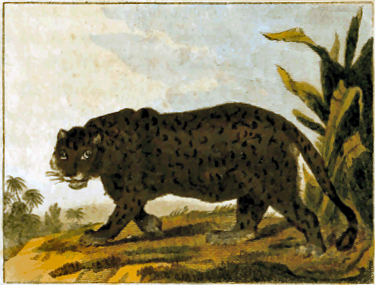
FIG. 101. Tiger
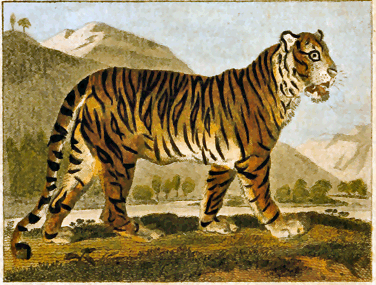
THE TIGER.
IN the class of carnivorous animals, the lion stands foremost, and he is immediately followed by the tiger, who, possessing all the bad qualities of the former, is a stranger to his good ones. To pride, courage, and strength, the lion adds dignity, clemency, and generosity, while the tiger is ferocious without provocation and cruel without necessity. Thus it is throughout all nature where rank proceeds from the superiority of strength. The first class, sole master of all, are less tyrannical than their immediate inferiors, who, denied unlimited authority, abuse those powers which they possess; thus the tiger is more to be dreaded than the lion. The latter often forgets that he is the sovereign, or strongest of animals; with an even pace he traverses the plains and forests; man he attacks not unless provoked, nor animals but when goaded by hunger. The tiger, on the contrary, though glutted with carnage, has still an insatiate thirst for blood; his rancour has no intervals. With indiscriminate fury he tears in pieces every animal he comes near, and destroys with the same ferocity a fresh animal as he had done the first. Thus he is the scourge of every country he inhabits; and of the appearance of man or his weapons, he is fearless. He will destroy whole flocks of domestic animals if he meets with them, and all the wild animals that come in his way. He attacks the young elephant and rhinoceros, and will sometimes brave the lion himself.
The form of the body usually corresponds with the nature and disposition. The noble air of the lion, the height of his limbs in exact proportion to the length of his body, his large thick mane, which covers his shoulders and shades his face, his determined aspect, and solemn pace, seem to announce the dignity and majestic intrepidity of his nature. The tiger has a body too long, limbs disproportionally short, naked head, and haggard eyes; strong characteristics of desperate malice and insatiable cruelty. He has no instinct but an uniform rage, a blind fury, so undistinguishing that he not unoften devours his own progeny, and even tears the dam in pieces if she offers to defend them. Would he were to gratify his thirst for blood to its utmost, and by destroying them at their birth extinguish the whole race of monsters which he produces!
Happy is it for other animals that the species of tiger is not numerous, and that it is chiefly confined to the warmest provinces of the East. They are found in Malabar, Siam, Bengal, and in all the countries inhabited by the elephant and rhinoceros. It is, indeed, said, that they accompany the latter for the purpose of eating their dung, which serves to purge them. Be this as it may, they are often seen together at the sides of lakes and rivers, where they are probably compelled to go by thirst, having often occasion for water to cool that fervor they so constantly endure. It is also a convenient situation to surprise his victims, since the heat of the climate compels all animals to seek for water several times a day; here he chooses his prey, or rather multiplies his massacres, for having killed one animal, he often proceeds to the destruction of others, tearing open their bodies, and swallowing their blood by long draughts; for which their thirst seems never to be appeased.
When, however, he has killed a large animal, as a horse, or buffalo, he does not devour it on the spot, for fear of being disturbed, but drags it off to the forest, which he does with such ease, that the swiftness of his course seems scarcely retarded by the enormous load which he trails after him. From this circumstance we might judge of his strength, but we shall have a more just idea of it by considering his bodily dimensions. Some travellers have compared him for size to the horse, others to the buffalo, and others merely say he is larger than the lion; but we have accounts more recent, which deserve the utmost confidence. I have been assured by M. de la Lande-Magon that he saw a tiger in the East-Indies fifteen feet long; allowing that he includes the tail, and granting four feet for that, the body would still be more than ten. It is true that the skin preserved in the Royal Cabinet of France is not more than seven feet from the tip of the nose to the insertion of the tail; but this tiger had been taken very young, and was afterwards always confined in a very narrow apartment, where the want of exercise, and space to range in, restraint and, perhaps, not having proper nourishment, not only its life might have been shortened, but the growth of its body prevented. From the dissection of animals of every species that have been reared in houses or court-yards, we find that their bodies and members for want of exercise, never attain their natural dimensions, and that the organs which are not used as those of generation, are so little expanded as to be scarcely perceivable.
The difference of climate alone is capable of producing the same effects as confinement and want of exercise. None of the animals of hot countries produce in cold ones, even though well fed, and at full liberty; and as reproduction is a natural consequence of full nutrition, it is evident that when the former does not operate the latter must be incomplete; and that, in such animals, cold of itself is sufficient to restrain the powers of the internal mould, and to diminish the growth, since it destroys the active faculties of reproduction. It is not, therefore, surprising that the tiger above alluded to should not have acquired its natural growth; yet from a bare view of its stuffed skin, and an examination of its skeleton, we may form an idea of its formidable strength as an animal. Upon the bones of the legs there are inequalities which denote muscular ligatures stronger than those of the lion. These bones are also to the full as strong, though shorter; and, as already intimated, the height of the tiger’s legs bear no proportion to the length of his body. Thus that velocity which Pliny ascribes to him and which the word tiger seems to imply, ought not to be understood of his ordinary movements, or the celerity of his continued course; for it is evident, that as his legs are short and he can neither walk nor run so fast as those animals which have them proportionally longer; but this prodigious swiftness, may with great propriety, be applied to the extraordinary bounds he is capable of making without any particular effort, for if we suppose him to have the same strength and agility in proportion with the cat, which he greatly resembles in conformation, and which in an instant will leap several feet, we must allow that the bounds of a tiger, whose body is ten times as large, must be immense. It is not, therefore, the quickness of his running, but of his leaping that Pliny meant to denote, and which from the impossibility of evading, when he has made a spring, still renders him more formidable.
The tiger is, perhaps, the only animal whose spirit cannot be subdued. Neither force nor restraint, violence nor flattery, can prevail, in the least, on his stubborn Nature. He is equally indignant at the gentle and harsh usage of his keeper; and time instead of mollifying his disposition, only serves to increase his fierceness and malignity. With equal wrath he snaps at the hand that feeds as that which chastises him. He roars at the sight of every object which lives, and seems to consider all as his proper prey; he seems to devour beforehand with a look, menacing it with the grinding of his teeth, and, regardless of his chains, makes efforts to dart upon it, as if to shew his malignity when incapable of exerting his force.
To complete the idea of the strength of this terrible animal we shall quote Father Tachard’s account of a combat between a tiger and three elephants, at Siam, of which he was an eye-witness; he says, “a lofty palisade of bamboo cane was built, about a hundred feet square, into which inclosure three elephants were introduced, for the purpose of fighting a tiger. Their heads, and part of their trunks, were covered with a kind of armour like a mask. As soon as we arrived at the place a tiger was brought forth, of a size much larger than any we had seen before; he was not at first let loose, but held by two cords, so that he could not make a spring; one of the elephants approached and gave him three or four blows on the back with his trunk, with such force as to beat him to the ground, where he lay for some time without motion, as if he had been dead, although this first attack had greatly abated his fury, he was no sooner untied, and at liberty, than he gave a loud roar, and made a spring at the elephant’s trunk, which was stretched out to strike him; but the elephant drew up his trunk with great dexterity, received the tiger upon his tusks, and tossed him up into the air. This so discouraged him that he no more ventured to approach the elephant, but made several turns round the palisade, making several efforts to spring at the spectators. Shortly after a second, and then a third elephant was set against him, each of which gave him such blows that he once more lay for dead, and they certainly would have killed him had not an end been put to the combat.” From this account we may form some idea of the strength and ferocity of the tiger; for this animal, though young, and not arrived at his full growth, though reduced to captivity, and held by cords, yet he was so formidable to three such enormous foes, that it was thought necessary to protect those parts of their bodies which were not defended by impenetrable skin.
The tiger, of which an anatomical description was made by the Jesuits at China, and communicated by Father Gouie to the Academy of Sciences, seemed to be the true species,[E] as does also that which the Portuguese have distinguished by the name of Royal Tiger. Dellon expressly says, in his Travels, that tigers abound more in Malabar than in any other part of the East Indies; that their species are numerous, but that the largest, which is as big as a horse, and called by the Portuguese the Royal Tiger, is very rare. To all appearance, then, the Royal Tiger is not a different species; he is found in the East Indies only; and, notwithstanding what has been said by Brisson, and others, is an utter stranger at Brasil. I am even inclined to think that the real tiger is peculiar to Asia, and the inland parts of the south of Africa; for though the generality of travellers, who have frequented the African coasts, speak of tigers as very common, yet it is very plain, from their own accounts of them, that they are either leopards, panthers, or ounces. Dr. Shaw says, that the lion and panther hold the first rank at Tunis and Algiers, and that in those parts of Barbary the tiger is an animal unknown. This observation seems founded in truth, for they were Indian, and not African, ambassadors, who presented Augustus, while at Samos, the first tiger the Romans had ever seen; and it was also from the Indies that Heliogabalus procured those tigers, with which, in order to represent the god Bacchus, he proposed that his car should be drawn.
Thus the species of the tiger has always been more rare and less diffused than that of the lion. The female, like the lioness, however, produces four or five cubs at a time. She is fierce at all times, but, upon her young being in danger, her fury becomes excessive. She then braves every danger to secure them, and will pursue the plunderers of them with such ferocity, that they are often obliged to drop one to secure the rest; this she takes up and conveys to the nearest cover, and then renews the pursuit, and will follow them to the very gates of towns, or to the ships in which they may have taken refuge; and when she has no longer hopes recovering her young, she expresses her agony by the most dismal howls of despair.
The tiger testifies his anger in the same manner as the lion; he moves the skin of his face, shews his teeth, and roars in a frightful manner; but the tone of his voice is very different; and some travellers have compared it to the hoarse croak of certain large birds; and the ancients expressed it by saying, Tigrides indomitæ raucant, rugiuntque Leones.
The skins of these animals are much esteemed, particularly in China; the Mandarins cover their seats and sedans with them, and also their cushions and pillows in winter. In Europe, though scarce, they are of no great value; those of the panther and leopard being held in much greater estimation. The skin is the only advantage, trifling as it is, which man can derive from this dreadful animal. It has been said that his sweat is poisonous, and that the hair of his whiskers is more dangerous than an envenomed arrow; but the real mischiefs he does when alive are sufficient, without giving imaginary ones to parts of his body when dead; for certain it is, the Indians eat the flesh of the tiger, and that they neither find it disagreeable nor unwholesome, and if the hair of his whiskers, taken in the form of a pill, do destroy, it is that being hard and sharp it produces the same effect in the stomach as a number of small needles would.
THE PANTHER, OUNCE, AND LEOPARD.
IN order to avoid an erroneous use of names, to prevent doubt, and to banish ambiguity, it may be necessary to remark that, in Asia and Africa, there are, beside the tiger, whose history we have just given, three other animals of the same genus, but which not only differ from him, but also from each other. These are the Panther, Ounce and Leopard, which have been confounded together by naturalists, and also with a species of the same kind peculiar to America; but to prevent confusion, we shall, in the present instance, confine ourselves solely to those of the old continent.
Engraved for Barr’s Buffon.
FIG. 107. Panther
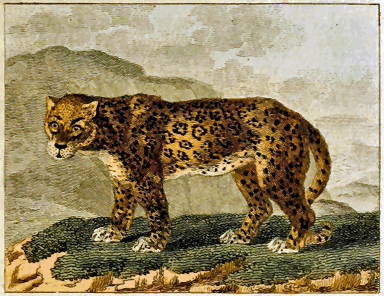
FIG. 108. Caracal
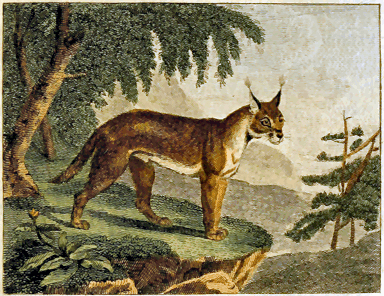
The first of these species is the Panther, (fig. 107) which the Greeks distinguished by the name of Pardalis, the Latins by that of Panthera, and Pardus, and the more modern Latins by Leopardus. The body of this animal, when it has attained its full growth, is five or six feet long, from the tip of the nose to the insertion of the tail, which is above two feet long. Its colour is of a yellow hue, more or less dark on the back and sides, and whitish under the belly; it is marked with black spots which are circular, or in the form of a ring, and in which rings there are generally lesser spots in the centre of the same colour; some of these are oval, others, circular, and are frequently above three inches in diameter; on the face and legs the black spots are single, and on the tail and belly they are irregular.
The second is the Little Panther of Oppian, which the ancients have distinguished by no particular name, but which modern travellers have called Ounce, corrupted from the name of lynx or lunx. To this animal we shall preserve the name of Ounce, because, in fact, it seems to have some affinity to the lynx. It is much less than the panther, its body being only about three feet and a half long, which is nearly the size of the lynx; its hair is longer than that of the panther, as is also its tail, which sometimes measures three feet, although its body is one-third less than that of the panther, whose tail never exceeds two feet and an half. The colour of the ounce is whitish grey upon the back and sides, and still more white under the belly; the back and sides of the panther are always yellow, but the spots are nearly of the same size and form in them both.
The third species was unknown to the ancients, being peculiar to Senegal, Guinea, and other southern countries which they had not discovered; and which we, following the example of travellers, shall call Leopard a name which has been improperly applied to the panther. The Leopard is larger than the ounce, though considerably smaller than the panther, being only four feet in length, the tail measures from two to two feet and a half. On the back and sides the hair is of a yellow colour, under the belly it is whitish; it has black annular spots like those of the panther and ounce, but smaller and less regularly disposed.
Each of these animals, therefore, forms a different species. Our furriers call the skins of the first species panther skins; those of the second, which we call ounce, African tiger skins; and those of the third, or leopard, very improperly tiger skins.
Oppian knew the panther and ounce, and was the first who observed there were two species of the former, the one large and the other small. Though alike in the form of their bodies and the disposition of the spots, yet they differed in the length of their tails, which in the small species was longer than in the large ones. The Arabians have named the large panther Nemer, and the small one Phet or Phed; which last seems to be a corruption of Faadh, the present name of this animal in Barbary. “The Faadh,” says Dr. Shaw, in his Travels, “resembles the leopard, (he should have expressed it panther) in having similar spots, in other respects they however differ, for the skin of the faadh is more dark and coarse, and its disposition is also less fierce.” Besides we learn from a passage of Albert, commented on by Gesner, that the phet, or phed of the Arabs, is called in the Italian, and some other European languages Leuaza, or Lonza. It is beyond a doubt then, that the little panther of Oppian, the phet or phed of the Arabians, the faadh of Barbary, and the onza, or ounce of the Europeans, is the same animal; and probably also is the Pard or Pardus of the ancients, and the Panthera of Pliny; since he mentions its hair is white, whereas, as we have observed, that of the great Panther is yellow. It is, besides, highly probable that the little panther was simply called pard or pardus, and that, in process of time, the large panther obtained the name of leopard, or leopardus, from a notion that it was a mongrel species, which had aggrandized itself by an intermixture with that of the lion. As this could only be an unfounded prejudice, I have preferred the primitive name of panther to the modern compound one of leopard, which last I have applied to another animal that has hitherto been mentioned by equivocal names only. The ounce therefore differs from the panther, in being smaller, having a longer tail, also longer hair, of a whitish grey colour; while the leopard differs from them both, by having a coat of a brilliant yellow, more or less deep, and by the smallness of his spots, which are generally disposed in groups, as if each were formed by three or four united.
Pliny, and several after him, have said, that the coat of the female panther was whiter than that of the male. This may be true of the ounce, but no such difference have we ever observed in the panthers belonging to the menagerie of Versailles, which were designed from life; and if there be any difference between the colour of the male and female it can be neither very permanent nor sensible; in some of the skins we have, indeed, perceived different shades, but which we rather ascribed to the difference of age or climate than of sex.
The animals described and dissected by the Academy of Sciences, under the name of Tigers, and that described by Caius, in Gesner, under the name of Uncia, are of the same species as our leopard; and of this there cannot remain a doubt, after comparing the figure, and the description which we have given, with those of Caius and M. Perrault. The latter, indeed, says, that the animals so dissected and described by the gentlemen of the Academy, under the name of tigers, were not the ounce of Caius; but the only reasons he assigns are, that the ounce is smaller, and has not white on the under part of its body. It may also be observed, that Caius, who does not give the exact dimensions, says, generally it was bigger than the shepherd’s dog, and as thick as the bull-dog, though shorter in its legs; how, therefore, Perrault should assert the ounce of Caius to be smaller than the tigers dissected by the gentlemen of the Academy I am at a loss to conceive, for those animals measured only four feet from the nose to the tail, which is the exact length of the leopard we are now describing. On the whole, then, it appears, that the tigers of the Academy, the ounce of Caius, and our leopard, are the same animal; and not less true do I conceive it that our panther is the same with the panther of the ancients, notwithstanding the distinctions which have been attempted to be made by Linnæus, Brisson, and other nomenclators, as they perfectly resemble each other in every respect but size, and that may safely be ascribed to confinement and want of exercise. This difference of size at first perplexed me, but after a scrupulous examination of the large skins sold by the furriers with that of our own, I had not the smallest doubt of their being the same animals. The panther I have described, and two other animals of the same species kept at Versailles, were brought from Barbary. The two first were presented to the French King by the Regency of Algiers, and the third was purchased for his Majesty of an Algerine Jew.