Front matter (continued 2)
Reading edition
It is particularly necessary to observe, that neither of the animals we are now describing can be classed with the pardus of Linnæus, or the leopardus of Brisson, as they are described with having long spots on the belly, which is a characteristic that belongs neither to the panther, ounce, or leopard, and yet the panther of the ancients has it, as well as the pardus of Gesner, and the panthera of Alpinus; but from the researches I have made I am convinced that these three animals, and perhaps a fourth, which we shall treat of hereafter, and which have not these long spots on the belly, are the only species of this kind to be found in Asia and Africa, and therefore we must hold this character of our nomenclators as fictitious, especially when we recollect, that if any animals have these long spots, either in the old or new continent, they are always upon the neck or back, and never on the belly. We shall merely observe further, that in reading the ancients we must not confound the panther with the panthera, the latter is the animal we have described, but the panther of the scholiasts of Homer and other authors, is a kind of timid wolf, perhaps the jackall, as I shall explain when I come to the history of that animal.
After having dissipated the cloud under which our nomenclators seem to have obscured Nature, and removed every ambiguity, by giving the exact description of the three animals under consideration, we shall now proceed to the peculiarities which relate to them respectively.
Of the panther, which I had an opportunity of examining alive, his appearance was fierce, he had a restless eye, a cruel countenance, precipitate motions, and a cry similar to that of an enraged dog, but more strong and harsh; his tongue was red and exceedingly rough, his teeth were strong and pointed; his claws sharp and hard; his skin was beautiful, of a yellow hue, interspersed with black spots of an annular form, and his hair short; the upper part of his tail was marked with large black spots, and with black and white ringlets towards the extremity; his size and make was similar to that of a vigorous mastiff, but his legs were not so large.
Engraved for Barr’s Buffon.
FIG. 103. Leopard
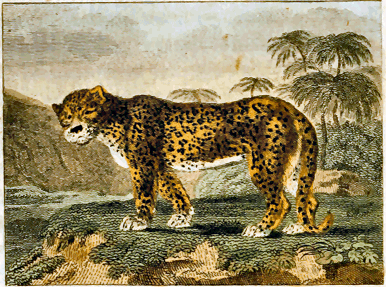
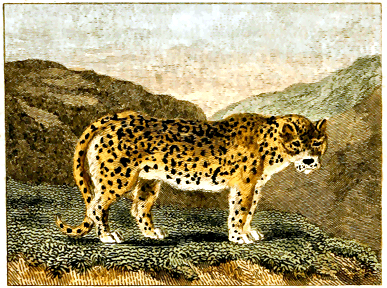
FIG. 104. Ounce
All our travellers confirm the testimonies of the ancients as to the large and small panther, that is, our panther and ounce. It appears that there now exist, as in the days of Oppian, in that part of Africa which extends along the Mediterranean, and in the parts of Asia which were known to the ancients, two species of panthers, the largest of which has been called panther or leopard, and the smaller ounce, by the generality of travellers. By them it is universally allowed that the ounce is easily tamed, that he is trained to the chace and employed for this purpose in Persia, and in several other provinces of Asia; that some ounces are so small as to be carried by a horseman on the crupper, and so mild as to allow themselves to be handled and caressed.[F] The Panther appears to be of a more fierce and stubborn nature; when in the power of man, and in his gentlest moments, he seems rather to be subdued than tamed. Never does he entirely lose the ferocity of his disposition; and in order to train him to the chace, much care and precaution are necessary. When thus employed, he is shut up in a cage and carried in one of the little vehicles of the country; as soon as the game appears, the door is opened, and he springs towards his prey, generally overtaking it in three or four bounds, drags it to the ground and strangles it; but if disappointed of his aim he becomes furious, and will even attack his master, who to prevent this dangerous consequence usually carries with him some pieces of flesh or live animals, as lambs or kids, one of which he puts in his way to appease the fury arising from his disappointment.
The species of the ounce (fig. 104) seems to be more numerous, and more diffused than that of the panther; it is very common in Arabia, Barbary, and the southern parts of Asia, Egypt, perhaps, excepted.[G] They are even known in China, where they are distinguished by the name of hinen-pao.[H] The ounce is employed for the chace, in the hot climates of Asia, because dogs are very rarely to be found unless transported thither, and then they very soon lose not only their voice but their instinct.[I] Besides the panther, ounce, and leopard, have such an antipathy to dogs, that they attack them in preference to all other animals.[J] In Europe our sporting dogs have no enemy but the wolf; but in countries full of tigers, lions, panthers, leopards, and ounces, which are all more strong and cruel than the wolf, to attempt to keep dogs would be in vain. As the scent of the ounce is inferior to that of the dog, he hunts solely by the eye; with such vigour does he bound, that a ditch, or a wall of several feet high, is no impediment to his career; he often climbs trees to watch for his prey, and when near, will suddenly dart upon them; and this method is also adopted by the panther and leopard.
The Leopard, (fig. 103) has the same manners and disposition as the panther; but in no part does he appear to have been tamed like the ounce; nor do the Negroes of Senegal and Guinea, where he greatly abounds, ever make use of him in the chace. He is generally larger than the ounce, but smaller than the panther; and his tail, though shorter than that of the ounce, is from two to two feet and a half in length. This leopard of Senegal and Guinea, to which we have particularly appropriated the name of leopard, is probably the animal which at Congo is called the Engoi; and perhaps also the Antamba[K] of Madagascar. I quote these names, from a persuasion that an acquaintance with the denominations applied to them in the countries which they inhabit would increase our knowledge of animals.
The species of the leopard seems to be subject to more varieties than that of the panther and the ounce. I have examined many leopards’ skins which differed from each other, not only in the ground colour, but in the shade of the spots which last are always smaller than those of the panther or the ounce. In all leopards’ skins, the spots are nearly of the same size and the same figure, and their chief difference consists in their colour being deeper in some than in others; in being also more or less yellow, consists also the difference in the hair itself; but as all these skins are nearly of the same size, both in the body and tail, it is highly probable they belong to the same species of animals.
The panther, ounce, and leopard, are only found in Africa, and the hottest climates of Asia; they have never been diffused over the northern, nor even the temperate regions. Aristotle speaks of the panther as an animal of Asia and Africa, and expressly says, it does not exist in Europe. It is impossible, therefore, that these animals, which are confined to the torrid zone of the old continent, could ever have passed to the new world by any northern lands; and it will be found, by the description we shall give of the American animals of this kind, that they are a different species, and ought not to be confounded with those of Africa and Asia, as they have been by most of our nomenclators.
These animals, in general, delight in the thickest forests, and often frequent the borders of rivers, and the environs of solitary habitations, where they surprise their prey, and seize equally the tame and wild animals that come there to drink. Men they seldom attack, even though provoked. They easily climb trees in pursuit of wild cats and other animals, which cannot escape them. Though they live solely by prey, and are usually meagre, travellers pretend that their flesh is not unpalatable; the Indians and negroes eat it, but they prefer that of the dog. With respect to their skins, they are all valuable, and make excellent furs. The most beautiful and most costly is that of the leopard, which, when the colours are bright, not unfrequently sells for eight or nine guineas.

THE JAGUAR.
THE jaguar (fig. 105) resembles the ounce in size, and nearly so in the form of the spots upon his skin, and in disposition. He is less ferocious than the panther or the leopard. The ground of his colour, like that of the leopard, is a bright yellow, and not grey like that of the ounce. His tail is shorter than that of either; his hair is longer than the panther’s, but shorter than that of the ounce; it is frizzled when he is young, but smooth when at full growth. I never saw this animal alive, but had one sent me entire and well preserved in spirits, and it is from this subject the figure and description have been drawn; it was taken when very young, and brought up in the house till it was two years old, and then killed for the purpose of being sent to me; it had not therefore acquired its full growth, but it was evident, from a slight inspection, that its full size would hardly have equalled that of an ordinary dog. It is, nevertheless, an animal the most formidable, the most cruel, it is, in a word, the tiger of the new world, where Nature seems to have diminished all the genera of quadrupeds. The Jaguar, like the tiger, lives on prey; but a lighted brand will put him to flight, and if his appetite is satisfied, he so entirely loses all courage and vivacity, that he will fly from a single dog. He discovers no signs of activity or alertness but when pressed with hunger. The savages, by nature cowardly, dread his approach. They pretend he has a particular propensity to destroy them, and that if he meets with Indians and Europeans asleep together, he will pass the latter and kill the former. The same thing has been said of the leopard, that he prefers black men to white, that he scents them out, and can distinguish them as well by night as by day.
Almost all the authors who have written the History of the New World, mention this animal, some by the name of tiger or leopard, and others under the names given them at Brasil, Mexico, &c. The first who gave a particular description of him were Piso and Marcgrave, who called him jaguara, instead of janouara, his Brasilian name. They also speak of another animal of the same genus, and perhaps of the same species, under the name of jaguarette; but, like those two authors, we have distinguished them from each other, because there is a probability of their being different species; but whether they are really so, or only varieties of the same species, we cannot determine, having never seen but one of the kinds. Piso and Marcgrave say, that the jaguarette differs from the jaguar, by its hair being shorter, more glossy, and of a different colour, being black, interspersed with spots of a still deeper black. But from the similitude in the form of his body, in his manners, and disposition, he may, nevertheless, be only a variety of the same species, especially as, according to the testimony of Piso, the ground colour of the jaguar, as well as that of the spots, vary in different individuals; he says that some are marked with black, and others with red or yellowish spots; and with regard to the difference of colour, that is, of grey, yellow, or black, the same is to be met with in other species of animals, as there are black wolves, black foxes, black squirrels, &c. If such variations are not so common among wild as tame animals, it is because the former are less liable to those accidents which tend to produce them. Their lives being more uniform, their food less various, and their freedom less restrained, their nature must be more permanent, that is, less subject to accidental alterations and changes in colour.
The jaguar is found in Brasil, Paraguay, Tucuman, Guiana, in the country of the Amazons, in Mexico, and in all parts of South America. At Cayenne, however, this animal is more scarce than the cougar, which they denominate red tiger, nor is the jaguar so common now in Brasil, which appears his native country, as it was formerly. A price has been set upon his head, so that many of them have been destroyed, and the others have withdrawn themselves from the coasts to the inland parts of the country. The jaguarette appears to have been always more scarce, or at least to have inhabited those places which were distant from the haunts of men, and the few travellers who mention him appear to have drawn their accounts entirely from Marcgrave and Piso.
Engraved for Barr’s Buffon.
FIG. 105. Jaguar of New Spain
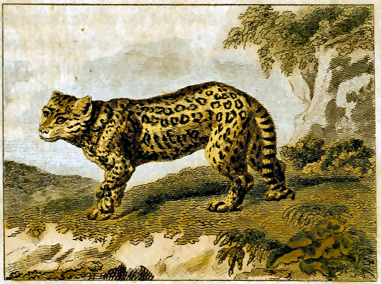
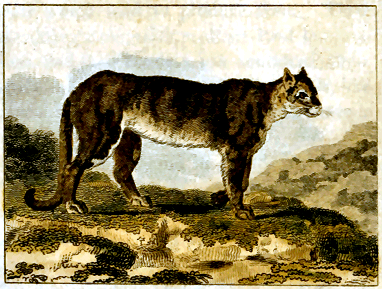
FIG. 106. Cougar
SUPPLEMENT.
M. Le BRUN had a female Jaguar of New Spain (fig. 105) sent him in the year 1775; it appeared very young, and was much less than the one described in the original work, this measuring one foot eleven inches long, and the former two feet five inches; there was a great resemblance between them, and the differences only such as are common to the varieties of the same species. The ground colour of the one we are now speaking of was a dirty grey intermixed with red: the spots were yellow, bordered with black; its head yellow, and ears black, with a white spot on the external part.
Among a number of excellent remarks made by M. Sonnini de Manoncour, respecting the jaguars of Guiana, he says, “the hair of the young jaguar is not frizzled, as stated by M. de Buffon, but perfectly smooth, and with regard to their only equalling the size of an ordinary dog, I have had the skin of one that measured near five feet from the nose to the tail, which was two feet long; and from the tracks I have seen of these animals I have little doubt of the American tigers being as large as those of Africa, except the royal tiger, the largest animal to which that name is given; for the panther, which M. de Buffon considers the largest, does not exceed five or six feet when full grown, and it is certain that some of these animals exceed those dimensions. When young their colour is a deep yellow, which becomes lighter as they advance in years. He is not by any means an indolent animal; he constantly attacks dogs, commits great devastation among flocks, and in the desarts is even formidable to men. In a journey I made through these forests, we were tormented with one for three successive nights, and yet he avoided all our attempts to destroy him; but finding we kept up large fires, of which they are much afraid, he at last left us with a dismal howling. At Cayenne the natives have an idea that the jaguar would rather destroy them than the whites, but it is not so with the savages, with whom I have travelled through the desarts, and never found them to have any particular terror; they slept as we did, with their hammocks suspended, making a little fire under them, which often went out before the morning; and, in short, took no particular precautions, where they knew themselves surrounded with those animals. (This, observes M. Buffon, is a strong proof that they are not very dangerous animals to men.) The flesh of the jaguar is not good. All the animals of the new continent fly from him, not being able to withstand his power: the only one capable of making any tolerable resistance is the ant-eater, who, on being attacked, turns on his back, and often preserves himself by the strength of his long claws.”
THE COUGAR.
THE Cougar, (fig. 106) is longer but less thick than the jaguar; he is more agile, more slender, and stands higher on his legs; he has a small head, long tail, and short hair, which is nearly of one entire colour, namely, a lively red, intermixed with a few blackish tints, particularly on his back. He is neither marked with stripes like the tiger, nor with spots like the panther, ounce, or leopard. His chin, neck, and all the inferior parts of his body are whitish. Though not so strong as the jaguar he is as fierce, and perhaps more cruel. He appears more ravenous, for having once seized his prey, he kills it, and without waiting to tear it to pieces, he continues to eat and suck alternately, until he has gorged his appetite and glutted his blood-thirsty fury.
These animals are common in Guiana. They have been known formerly to swim over from the continent to Cayenne, in order to devour the flocks; insomuch that they were at first considered as the scourge of the colony; but by degrees the settlers lessened their numbers, and by continually hunting them have compelled the remainder to retire far from the cultivated parts of the country. They are found in Brasil, Paraguay, and in the country of the Amazons; and there is reason to believe that the animal, described by some travellers, under the name of the Ocorome, in Peru, is the same as the cougar, as well as that in the country of the Iroquois, which has been considered as a tiger, though it is neither striped like that animal, nor spotted like the panther.
The cougar, by the lightness of his body, and length of his legs, seems to be more calculated for speed, and climbing of trees, than the jaguar. They are equally indolent and cowardly, when glutted with prey; and they seldom attack men unless they find them asleep. When there is a necessity for passing the night in the woods, the kindling a fire is the only precaution necessary to prevent their approach.[L] They delight in the shades of forests, where they hide themselves in some bushy tree, in order to dart upon such animals as pass by. Though they live only on prey, and drink blood more often than water, yet it is said their flesh is very palatable. Piso says, it is as good as veal; and Charlevoix, and others, have compared it to mutton. I think it is hardly credible that the flesh can be well tasted; and therefore prefer the testimony of Desmarchais, who says, the best thing about this animal is his skin, of which they make horse-cloths, his flesh being generally lean and of a disagreeable flavour.
SUPPLEMENT.
MR. COLINSON mentions another species of cougar, which is found on the mountains of Carolina, Georgia, Pennsylvania, and the adjacent provinces, and which, from his account, seems to differ very much from that just described; his legs being shorter, and his body and tail much longer, but in colour, and in the shape of the head, they have a perfect resemblance.
M. de la Borde describes three species of rapacious animals at Cayenne; first, the jaguar, which they call tiger; the second, the cougar, or red tiger; (the former is about the size of a large bull-dog, and the latter much smaller) and the third they call black tiger, which we have termed black cougar. (fig. 102) “Its head, continues M. de la Borde, is somewhat like that of a common cougar; it has long black hair, a long tail, and large whiskers, but is much less than the other. The skin of both the jaguar and cougar are easily penetrated even with the arrows of the Indians. When very hard set for food, they will attack cows and oxen; in this case they spring upon their backs, and having brought them to the ground, they tear them to pieces, first opening their breasts and bellies, to glut themselves with their blood; they then drag pieces of flesh into the wood, covering the remainder with branches of trees, and keeping near to feed upon it, until it begins to putrify, when they touch it no more. They will keep near a flock of wild hogs, for the purpose of seizing the stragglers, but cautiously avoid being surrounded by them. They often seek for prey on the sea-shore, and devour the eggs left there by the turtles: they also make prey of the caïmans, or alligators, lizards, and fishes; to take the former, they use the craft of lying down by the edge of the water, which they strike so as to make sufficient noise to attract his attention, who will come towards the place, and no sooner puts his head above water, than his seducer makes a certain spring at him, kills and drags him to some convenient place where he may devour him at leisure. It is said by the Indians that the jaguar decoys the agouti in the same manner, by counterfeiting his cry. They sometimes eat the leaves and buds of the Indian figs; they are excellent swimmers, and cross the largest rivers. They seldom have more than one young at a time, which they hide in the trunks of hollow trees. They eat their flesh at Cayenne, and, when young, it is as white as that of a rabbit.”
The cougar is easily tamed, and rendered nearly as familiar as domestic animals.
THE LYNX.
THE gentlemen of the Academy of Sciences have given a very accurate description of the Lynx, and have discussed with equal ingenuity and erudition the circumstances and names relative to this animal, which occur in the writings of the ancients. They have shewn that the lynx of Ælian is the same animal which they have dissected and described under the name of Lupus-cervarius, and justly censure those who have taken it for the Thos of Aristotle. This discussion is enriched with observations and reflections equally interesting and pertinent; it is a pity, therefore, they had not adopted its real name of lynx, instead of that which is the same that Gaza gave to the thos of Aristotle. Having, like Oppian, intimated that there are two species or races of the lynx, the one large, which chaces the stag and fallow-deer, and the other smaller, which scarcely hunts any thing but the hare, they appear to have confounded the two species together, namely, the spotted lynx, which is commonly found in the northern countries; and the lynx of the Levant or Barbary, whose skin is of an uniform colour. I have seen both these animals alive, and they closely resemble each other in many particulars. They have both long stripes of black hair at the extremities of their ears. This very circumstance, by which Ælian first distinguished the lynx, belongs, in fact, to these animals only, and perhaps it was this which induced the Academy to consider them as the same species. But, independently of the difference of colour and spots upon the hair, it will appear extremely probable that they belong to two distinct species.
Klein says, that the most beautiful lynx belongs to Africa and Asia in general, and to Persia in particular; that he had seen one at Dresden, which came from Africa, which was finely spotted, and of a considerable height; that those of Europe, especially from Prussia, and other northern countries are less pleasing to the eye, that their colour is little, if at all, inclined to white, but rather of a reddish hue, with spots confused and huddled together. Without absolutely denying what M. Klein has here advanced, I must declare I could never learn from any other authority that the lynx is an inhabitant of the warm climates of Asia and Africa. Kolbe is the only writer who mentions the lynx as common at the Cape of Good Hope, and as perfectly resembling that of Brandenburg in Germany; but I have discovered so many mistakes in the writings of this author, that I never gave much credit to his testimony, unless when supported by that of others. Now all travellers mention having seen the spotted lynx in the North of Germany, in Lithuania, Muscovy, Siberia, Canada, and other northern regions of both continents; but not one, whose accounts I have read, asserts he met with this animal in the warm climates of Africa or Asia. The lynxes of the Levant, Barbary, Arabia, and other hot climates, are, as I before observed, of one uniform colour, and without spots; they cannot, therefore, be the same as that mentioned by Klein, which he says was finely spotted, nor that of Kolbe, which, according to his statement, perfectly resembled those of Brandenburgh. It would be difficult to reconcile these testimonies with the information we have from other hands. The lynx is certainly more common in cold than in temperate climates, and is at least very rare in hot ones. He was, indeed, known to the Greeks and Romans; a circumstance which does not, however, infer that he came from Africa, or the southern provinces of Asia. Pliny, on the contrary, says, that the first of them which were seen at Rome, came from Gaul in the time of Pompey. At present there are none in France, except possibly a few in the Alpine and Pyrenean mountains. But the Romans, under the name of Gaul, comprehended several of the northern countries; and, besides, France is not at this time so cold as it was in those times.
The most beautiful skins of the lynx come from Siberia, as belonging to the Loup-cervier, and from Canada, under the name of chat-cervier, because, like all other animals, they are smaller in the new than in the old world; and are therefore compared to the wolf in Europe, and to the cat in Canada. What seems to have deceived M. Klein, and might have deceived even more able writers is, first, that the ancients have said that India furnished lynxes to the god Bacchus; secondly, Pliny has placed the lynx in Ethiopia, and has said their hides and claws were prepared at Carpathos, now Scarpantho or Zerpantho, an island in the Mediterranean, between Rhodes and Candia; thirdly, Gesner has allotted a particular article to the lynx of Asia or Africa, in which there is the following extract of a letter from Baron Balicze. “You have not,” says he to Gesner, “mentioned in your history of animals, the Indian or African lynx. As Pliny has mentioned it, the authority of that great man has induced me to send you a drawing of this animal, that you may include it in your list. This drawing was made at Constantinople. This animal is very different from the lynx of Germany, being much larger, has shorter and rougher hair, &c.” Gesner, without making any reflections on this letter, contents himself with giving the substance of it, and intimating within a parenthesis, that the drawing never came to hand.
To prevent a continuance of these errors, let it be observed, first, that poets and painters have affixed tigers, panthers, and lynxes, to the car of Bacchus, as best pleased their fancies; or rather because all fierce and spotted animals were consecrated to that god; secondly, that it is the word lynx which constitutes the whole of the ambiguity, since by comparing what Pliny says in one[M] passage with two others[N] it is plain that the Ethiopian animal which he calls lynx, is by no means the same as the chaus, or lupus-cervarius, which comes from the northern countries; and that it was from this name being improperly applied that the Baron Balicze was deceived though he considers the Indian lynx as a different animal from the German luchs, or our lynx. This Indian or African lynx, which he has described as larger and more full of spots than our lynx, was in all probability, a kind of panther. However true or erroneous this last conjecture may be, it appears that the lynx, of which we are now treating, is a stranger in the southern countries, and is found only in the northern parts of the new and old continents. Olaus says this animal is common in the forests of the North of Europe; Olearius, in speaking of Muscovy, asserts the same thing; Rosinus Lentilius observes that the lynx is common in Courland and Lithuania, and that those of Cassubia, a province of Pomerania, are very small, and not so much spotted as those of Poland and Lithuania; and lastly, Paul Jovius confirms these testimonies by adding, that the finest skins of the lynx come from Siberia, and that there is a great traffic carried on with them at Ustivaga, a town about 600 miles from Moscow.
This animal, which as we have shewn, prefers the cold to the temperate climates, is one of those which might have passed from one continent to the other through the northern regions, and this is probably the reason why we find him a tenant of the northern parts of America. Travellers have described him in such a manner as to preclude all mistake; and besides its skin forms an article of commerce between Europe and America. The lynx of Canada, as we have already remarked, is only smaller and whiter than those of Europe, and it is from this difference in size that they have been distinguished with the appellation of chat-cervier, and been considered by our nomenclators as animals of a different species. Without pronouncing decisively upon this question we shall only observe, that to all appearance the lynxes of Canada and of Muscovy are of the same species, first because the difference in size is not very considerable, since it is almost relatively the same as that which takes place between all animals common to both continents; the wolf, fox, &c. being smaller in America than they are in Europe, it cannot be expected to be otherwise with the lynx. Secondly, because, even in the north of Europe, these animals are found to vary in size; and authors mention two kinds, the one large and the other small. Thirdly, because they equally require the same climate, are of the same dispositions, the same figure, differing only in size, and a few trifling particulars of colour, circumstances not sufficient to authorize our pronouncing them to be two distinct species.
The lynx, of which the ancients have said his sight could penetrate opaque bodies, and whose urine possessed the properly of hardening into a precious stone, called Lapis Lyncurius, is an animal that never existed, any more than the properties attributed to him, except in fable. To the true lynx this imaginary one has no affinity but in name. We must not, therefore, following the example of most naturalists, attribute to the former, which is a real being, the properties of this imaginary one, the existence of which even Pliny himself does not seem disposed to believe, since he speaks of it as an extraordinary animal, and classes it with the sphynx, the pegasus, and other prodigies, or monsters, the produce of Ethiopia, a country with which the ancients were very little acquainted.
Our lynx, though he cannot see through stone walls, has bright eyes, a mild aspect, and an agreeable lively appearance. His urine produces not precious stones, but he covers it with earth, like the cats, to whom he has a near resemblance, and whose manners, and love of cleanliness are the same. In nothing is he like the wolf but in a kind of howl, which being heard at a considerable distance often deceives the hunters, by making them suppose they hear a real wolf. This alone, perhaps, is the cause of his having received the appellation of loup, and to distinguish him from the real wolf, and because he attacks the stags, the epithet of cervarius might have afterwards been added. The lynx is not so big as the wolf, has shorter legs, and generally about the size of a fox. He differs from the panther and ounce in the following particulars; he has longer hair, his spots are less lively, and are badly disposed; his ears are much longer, and they have tufts of black hairs at the points; his tail is shorter, and is also black at the end; his eyes have a whitish cast, and his countenance is more agreeable, and less ferocious. The skin of the male is more spotted than that of the female. He does not run like the wolf, but walks and bounds like the cat. He lives upon other animals, and those he pursues to the tops of the highest trees, so that neither the wild-cat, pine-weasel, ermine, nor squirrel, can escape him. He also seizes birds, lies in wait for the stag, roe-buck, and hare, whom he seizes by the throat, sucks their blood, and then opens their heads to devour the brains; this done he frequently abandons them to go in search of fresh prey, and is seldom known to return to the former one; which has given rise to the remark, that of all animals the lynx has the shortest memory. His colour changes with the climate and the season. In winter his fur is much better than in summer, and his flesh, like that of all beasts of prey, is not good to eat.
SUPPLEMENT.
THERE is a Canadian Lynx in the Royal Cabinet in France, in fine preservation; it is only two feet three inches long, and rather more than thirteen inches high; its body is covered with long grey hair, striped with yellow, and spotted with black; its head also is grey, interspersed with white and yellow hairs, and shaded with a kind of black stripes; it has long white whiskers; its ears are more than two inches high, white on the inside, with yellow edges, the outside of a mouse colour, edged with black, and at the tip of each ear is a tuft of black hair seven lines high; it has a short tail, which is black from the end to about the middle, and the other part is of a reddish white; its belly, hind-legs, inside of the fore-legs and feet are of a dirty white, and it has long white claws. This lynx strongly resembles the one we have just described, except in the length of the tail and tuft on the ears, from which we may infer that the Canadian Lynx is a variety from that of the old continent.
Pontoppidan describes the lynx of Norway to be white with deep spots, and claws like those of a cat; he says there are four species there, some being like the wolf, others the fox, others the cat, and others with a head like that of a colt; the last of which is not only doubtful in itself, but throws a degree of suspicion on the veracity of the remainder.
The species of the lynx is very common throughout Europe, and also in the northern provinces of Asia. Their skins are very valuable, and much esteemed for muffs, &c. in Norway, Russia, and even as far as China, and notwithstanding they are very common, they sell at a high price.
THE CARACAL.
THOUGH the Caracal[O] resembles the lynx in size, formation of the body, aspect, and the tufts of black hair at the extremities of the ears, I do not scruple from their disagreement in other respects, to treat of them as animals of a different species. The Caracal is not spotted like the lynx; his hair is rougher and shorter; his tail is longer, and of a uniform colour; his snout is longer, in aspect he is less mild, and in disposition more fierce. The lynx inhabits cold and at most temperate climates, while the caracal is to be found only in the warmest countries. It is as much from these differences of disposition and climate, that I judge them to be of different species, as from the inspection and comparison of the two animals, both of which I have examined and had designed from life.
The Caracal is common in Barbary, in Arabia, and in all those countries inhabited by the lion, panther, and ounce. Like them he depends on prey for subsistence, but from the inferiority of his size and strength, he has much difficulty to procure a sufficiency; frequently being obliged to be content with the leavings of the more powerful. He keeps at a distance from the panther, because that animal exercises its cruelty after being gorged with food; but he follows the lion, who, when the cravings of his appetite are satisfied, never injures any creature. From the remains left by this noble animal, the caracal not unoften enjoys a comfortable repast. Sometimes he follows, or even goes before, at no great distance, taking a refuge in the trees, when self-preservation renders it necessary, and where the lion cannot, like the panther, follow him. For all these reasons it is that the caracal has been called the Lion’s Guide, or Provider; and it is said that the lion, whose smell is far from being acute, employs him to scent out his prey, and is permitted to enjoy the remains as a reward for his trouble.
The caracal[P] (fig. 108) is about the size of a fox, but more fierce, and much stronger. He has been known to attack, and in a few minutes, to tear in pieces a large dog, which defended himself to the utmost. He is very difficult to tame, yet if taken very young, and reared with care, he may be trained to the chace, to which he is by nature inclined, and in which he is very successful, especially if he be only let loose upon such animals as are inferior in strength, for he declines a service of danger with every expression of reluctance. In India they made use of him to catch hares, rabbits, and even large birds, whom he seizes with singular address and facility.
SUPPLEMENT.
MR. BRUCE has informed me that he saw a caracal in Nubia, which differed from the one of barbary, just described; his face was more round, his ears black on the outside, intermixed with white hairs, and on the breast, belly, and inside of the thighs he had yellow spots. But this is a mere variety, of which there are several: for instance, in Lybia there is a caracal with white ears, and a white tail with four black rings at the end, and which is not bigger than a domestic cat; and if this were to establish a difference we might say there are two species of caracals in Barbary, the one large, with black ears and long tufts, and the other smaller, with white ears and short tufts.
THE HYÆNA.
ARISTOTLE has left us two accounts by which alone the hyæna (fig. 110) might easily be distinguished from all other animals. Nevertheless, travellers and naturalists have confounded him with no less than four other species, namely, the jackall, glutton, civet, and the baboon; all of which are carnivorous and ferocious like the hyæna, and all have some few particular resemblances to him, whence these errors may have originated. The jackall inhabits the same countries, and like the hyæna resembles the wolf in form; like him also he feeds upon dead carcasses, and digs up graves to devour their contents. The glutton has the same voracity, the same appetite for corrupted flesh, the same propensity for digging the dead out of their graves; and though he belongs to a different climate, and his figure is widely different from that of the hyæna, yet from this affinity of disposition authors have thought themselves warranted in considering them as of the same species. The civet is a native of the same countries as the hyæna, and like him has a streak of long hair along the back, and also a particular opening, or glandular pouch; characteristics which belong only to a few animals, and which induced Bellon to suppose the civet was the hyæna of the ancients. As to the baboon, which has hands and feet like those of a man or a monkey, he resembles the hyæna still less than the other three, and it must be solely from their name that they have been confounded together.
The hyæna, according to Dr. Shaw, is called dubbah in Barbary; and Marmol, and Leo Africanus, say, the baboon is distinguished by the name of dabuh; and as the baboon belongs to the same climates, scratches up the earth and is nearly of the same form with the hyæna; these circumstances first deceived travellers, and naturalists adopted their blunders without investigation; and even those who distinguished the two animals, retained the name of dabuh to the hyæna, which in fact belongs to the baboon. It appears, then, that the hyæna is neither the dabuh of the Arabians, the jesef or sesef of the Africans, nor the deeb of Barbary. But to put a final stop to this confusion of names, I shall give, in a few words, the substance of the inquiries I have made with respect to those animals.
Aristotle calls it by two names, hyæna and glanus; names which we may be assured are applied to the same animals by comparing the passages wherein they are mentioned.[Q] The ancient Latins retained the name hyæna, and never adopted that of glanus. In the writings of the modern Latins, however, we find the ganus, or gannus, and belbus employed as names for the hyæna. According to Rasis, the Arabians call it kabo, or zabo, names that appear to be derived from the word zeeb, which, in their language denominates a wolf. In Barbary the hyæna bears the name of dubbah, as appears from the description given of this animal by Dr. Shaw.[R] In Turkey it is called zirtlaat, according to Nieremberg; in Persia kaftaar, as stated by Kæmpfer; and castar, according to Pietro della Valle. These are the only names which seem actually to refer to the hyæna; though it is nevertheless probable that the lycaon and the crocuta of India and Ethiopia, of which the ancients speak, are no other than the hyæna. Porphyry expressly says that the crocuta of the Indies is the hyæna of the Greeks; and, indeed, all they have written, whether true or fabulous, respecting the lycaon and crocuta, bears some analogy to the nature of the hyæna. But we shall make no further conjectures on this subject until we treat of fabulous animals, and the affinities they have with real ones.
The panther of the Greeks, the lupus canarius of Gaza, and the lupus armenius of the modern Latins and Arabians, seem to be the same animal, that is, the jackall, which the Turks call cical, according to Pollux, and thacal according to Spon and Wheeler; which the modern Greeks distinguish by the name of zachalia, the Persians siechal, or schachal, and the Moors of Barbary deeb; that of jackall, however, having been adopted by a number of travellers, to that we shall give the preference, and only remark at present, that he differs from the hyæna not only in size, figure, and colour, but in natural habits, for the hyæna is a solitary animal, while the jackall is seldom seen but in troops. After the example of Kæmpfer, some of our nomenclators have called the jackall lupus aureus, because his hair is of a lively yellow hue.
It is therefore evident, that the jackall is a very different animal from the hyæna; and no less so than the glutton, which is an animal confined to the northern regions of Lapland, Russia, and Siberia; it is a stranger even in the temperate climates, and therefore could never have inhabited Arabia, or any of the other warm countries in which the hyæna resides. It differs also in form, for the glutton bears a strong resemblance to a very large badger; his legs are so short that his belly almost reaches the ground; he has five toes on each of his feet, has no mane, and his body is covered with black hair, excepting sometimes a few reddish yellow hairs upon his sides; in short, he resembles him in nothing but in being exceedingly voracious. He was unknown to the ancients, who had made no great progress into the north of Europe. Olaus is the first author who mentions this animal and from his prodigious gluttony he called him gulo. In Sclavonia he afterwards obtained the name of rosomak, and in Germany jerff, or wildfras, and the French travellers have called him glouton. There are varieties in this species, as well as in that of the jackall, which we shall speak of when we come to the particular history of those animals, and shall only here observe, that those varieties, instead of assimilating them with the hyæna, render them additionally a more distinct species.
The civet has nothing in common with the hyæna but the glandular pouch, under the tail, and the mane along the neck and back-bone. It differs from the hyæna in figure and size, not being more than half as large; his ears are short and covered with hair, whereas those of the hyæna are long and naked; he has also short legs, and five toes upon each foot, while the legs of the hyæna are long, and he has only four toes upon each foot; nor does the civet dig up the earth in search for dead bodies. From these differences these animals are easily to be distinguished from each other.
With respect to the baboon, which is the papio of the Latins, and as we have before observed, has been mistaken for the hyæna, merely from the ambiguity of names, which seems to have arisen from a passage of Leo Africanus, and since copied by Marmol. “The dabuh say these authors, is of the size and form of the wolf; and scratches up dead bodies from their graves.” From which it was supposed to mean the dubbah, or hyæna, although it is expressly stated in the same passages that the dubbah has hands and feet resembling those of a man; a remark which, however applicable to the baboon, cannot be applied to the hyæna.
From taking a view of the lupus-marinus of Bellon, which Gesner has copied, we might mistake it for the figure of the hyæna, to which it bears a great resemblance; but his description corresponds not with our hyæna, for he says, the lupus-marinus is an amphibious animal which feeds on fish, and has sometimes been seen on the coasts of the British ocean; besides this author says nothing of the peculiar characteristics which distinguish the hyæna from all other animals. It is possible that Bellon, prepossessed with the notion that the civet was the hyæna of the ancients, has given the figure of the real one under the name of lupus-marinus, for so striking and singular are the characters of that animal, that it is hardly possible to be deceived in them; he is, perhaps, the only quadruped that has four toes upon each foot. Like the badger he has an aperture under the tail, which does not penetrate into the body; his ears are long, straight, and naked; his head is shorter and more square than that of the wolf; his legs are longer, especially the hind ones; his eyes are placed like those of the dog; the hair of his body and mane is of a dark grey, with a small intermixture of yellow and black, and disposed all along in waves, and though in size he equals the wolf, yet he has, nevertheless, a contracted appearance.
This wild and solitary animal resides in the caverns of mountains, the clefts of rocks, or in dens, which he forms for himself under the earth. Though taken ever so young he is not to be tamed; he is naturally ferocious. He lives like the wolf, by depredation, but he is more strong and daring. He sometimes attacks men, and darts with a ferocious resolution on all kinds of cattle; he follows the flocks, and even breaks down the sheep-folds in the night to get at his prey. His eyes shine in the dark, and it is asserted that he sees better by night than day. All naturalists who have treated of this animal, except Kæmpfer, say, that his cry resembles the noise of a man who is vomiting, while the latter asserts it to be like the lowing of a calf. He defends himself against the lion, stands in no awe of the panther, and attacks the ounce, which is incapable of resisting him. When at a loss for prey he scrapes up the earth with his feet, and tears out the carcasses of animals and men, which in the countries he inhabits are promiscuously buried in the fields. He is found in almost all the hot climates of Africa and Asia, and it is probable that the animal called farasse, at Madagascar, which resembles the wolf in figure, but is larger and stronger, is the same animal.
Of this animal more absurd stories have been told than of any other. The ancients have gravely written that the hyæna is alternately male and female; that when it brings forth, suckles and rears its progeny, it remains as a female the whole year, but the year following it resumes the functions of the male, and obliges its companion to submit to those of the female. The circumstance which gave rise to this fable is plainly the orifice under the tail, in both males and females, independently of the organs of generation peculiar to both sexes, and which are the same in the hyæna as in all other animals. It has also been affirmed that this animal could imitate the human voice, remember the names of shepherds, call upon, fascinate, and render them motionless; that he can terrify shepherdesses, cause them to forget and neglect their flocks, to be distracted in love, &c. All this might surely happen without the intervention of the hyæna! But I shall conclude here, to avoid the reproach which has been cast upon Pliny, that of taking pleasure in compiling and relating absurd fables.
SUPPLEMENT.
AT the fair of St. Germain, in the year 1773, I saw a male hyæna; the one just described was very ferocious, and as I mentioned untameable, but this was perfectly gentle, for though his keeper made him angry for the purpose of erecting his mane, yet he seemed to forget it in a few moments, and suffer himself to be played with without any appearance of dislike. He exactly accorded with the description I have given, except his tail being entirely white.
In the island of Meroë there is a large kind of hyænas, so strong that they can run off with a man to the distance of more than a league without stopping. These are also of a darker colour, and erect their long hairs on the hind parts and not the front. Mr. Bruce informs me that he has observed, that when the hyænas are forced to take to flight, they are at first exceedingly lame of the left hind leg, and which continues for more than an hundred paces, so much so indeed as to give them the appearance of falling, and that it is the same also with those of Syria and Barbary.
Engraved for Barr’s Buffon.
FIG. 109. Lynx.
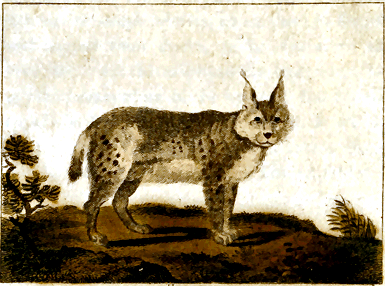
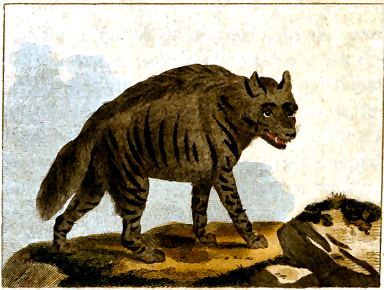
FIG. 110. Hyæna.
THE CIVET AND THE ZIBET.
THE generality of naturalists are of opinion that the perfume called civet, or musk, is furnished only by one species of animals. I have, however, seen two animals that furnish it, which, though they have many essential affinities, both in their external and internal conformations, yet differ in so many characteristics, that there is sufficient reason to consider them as two distinct species. To the first I have continued the original name of Civet, (fig. 111.) and the second, for the sake of distinction, I have called Zibet (fig. 113) The civet seems to be the same as that described by the Academy of Sciences; by Caius, in Gesner, page 837, and by Fabius Columna, who has given both the male and female figures in the publication of Faber, which follows that of Hernandes. The zibet appears to be the same animal as M. de la Peyronnie has described under the name of Musk Animal, in the Memoirs of the Academy of Sciences for the year 1731. Both differ from the civet in the very same characters; both want the mane, or the long hair, on the back-bone, and both have the tail marked with strong annular streaks. The civet, on the contrary, has a mane, but no rings on the tail. It must, however be acknowledged that our zibet, and the musk animal of M. de la Peyronnie, are not so perfectly similar as to leave no doubt of the identity of their species. The rings on the tail of the zibet are larger than those of the musk animal, and the length of his tail is shorter in proportion to that of his body; but these differences are slight, and appear to be mere accidental varieties, to which the civet must be more subject than any other wild animal, as they are reared and fed like domestic ones in many parts of the Levant and East Indies. Certain it is, that our zibet bears a stronger resemblance to the musk animal than to the civet, and consequently they may be considered as the same species. Nor, indeed, do we mean positively to affirm that civet and zibet are not varieties of the same species, but from their different characteristics there is a strong presumption they really are so.
Engraved for Barr’s Buffon.
FIG. 111. Civet
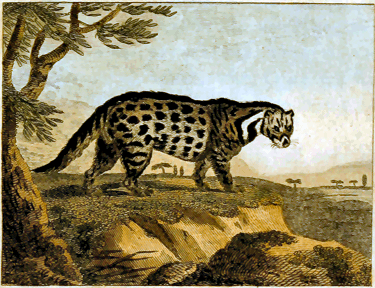
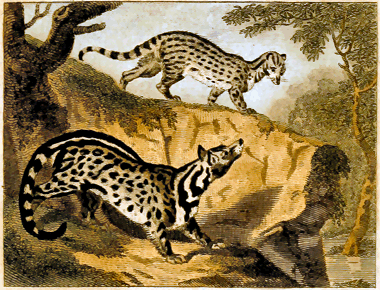
FIG. 112. Genet FIG. 113. Zibet
The animal which we here name the Civet, is called the falanoue, at Madagascar, nzime, or nzfusi at Congo, kankan in Ethiopia, and kastor in Guinea. That it is the civet of Guinea I am certain, for the one I had was sent from Guinea, to one of my correspondents at St. Domingo, where, after being fed for some time, it was killed for the more easy conveyance to Europe.
The zibet is probably the civet of Asia, of the East Indies, and of Arabia, where he is called zebet, or zibet, an Arabic word, which likewise signifies the perfume of that animal, and which we have adopted to signify the animal itself. He differs from the civet in having a longer and less thick body; a snout more thin and slender, and somewhat concave on the upper part; whereas that of the civet is more short, thick, and rather convex. The ears of the zibet are also larger and more elevated; his tail is longer, and more strongly marked; his hair is shorter and much more soft; he has no mane, or long hair on the neck or back-bone; no black spots under the eyes, or on the cheeks; all of which are remarkable characteristics in the civet. Some travellers have suspected there were two species of civets; but no person has examined them with sufficient accuracy as to give a distinct description. I have seen both; and after a careful comparison, am of opinion, that they not only differ in species, but perhaps belong to different climates.
These animals have been called musk-cats, though they have nothing in common with the cat, except bodily agility. They rather resemble the fox, especially in the head. Their skins are diversified with stripes and spots, which has occasioned them to be mistaken for small panthers, when seen at a distance; but in every other respect they differ from the panther. There is an animal called the Genet, which is spotted in the like manner, whose head is nearly of the same shape, and which, like the civet, has a pouch where an odoriferous humor is formed; but this animal is smaller than our civet; its legs are shorter, and its body thinner; its perfume is very faint, and of short duration; while the perfume of the civet is very strong, and that of the zibet is so to an excess.
This humor is found in the orifice which these animals have near the organs of generation; it is nearly as thick as pomatum, and though the odour is very strong, it is yet agreeable, even when it issues from the body of the animal. This perfume of the civet must not be confounded with musk, which is a sanguineous humor, obtained from an animal very different from either the civet or zibet, being a species of roe-buck, or goat, without horns, and which has no one property in common with the civet, but that of furnishing a strong perfume.
These two species of civets have not been distinguished with precision. They have both been sometimes confounded with the weasel of Virginia, the genet, the musk-deer, and even with the hyæna. Bellon, who has given a figure and description of the civet, insists that it was the hyæna of the ancients, and his mistake is the more excusable not being destitute of some foundation. Certain it is, that most of the fables which have been related of the hyæna, took their rise from the civet. The philters said to have been obtained from certain parts of the hyæna, and their power to excite love, sufficiently indicate that the stimulating virtues of the preparations of civet, were not unknown to the ancients, and which are still used for this very purpose in the East. What they have said of the uncertainty of the sex of the hyæna, is still more applicable to the civet, for the male has no external appearance, but three apertures so perfectly similar to those of the female, that it is hardly possible to determine the sex but by dissection. The opening which contains the perfume, is situated between the other two, and in the same direct line which extends from the os sacrum to the pubis.
Another error, which has made more progress, is that of Gregoire de Bolivar, with respect to the climates in which the civet is found. After stating them to be common in Africa and the East Indies, he positively affirms they are also very numerous in all parts of South America. This assertion, transmitted by Faber, has been copied by Aldrovandus, and adopted by all the authors who have since treated of the civet. But the truth is, that they are animals peculiar to the hottest climates of the old continent, and which could not have found a northern passage into the New World; where, in fact, no civets ever existed until they were transported thither from the Philippine Islands and the coasts of Africa. As the assertion of Bolivar is positive, and mine only negative, it is necessary I should give my particular reasons, to prove the falsity of the fact. Besides my own remarks, I refer to the very words of Faber himself.[S] On this head it is to be observed, that the figure given by Faber, was left to him by Recchi, without any description[T]; and of which the inscription is, animal zibethicum Americanum; but this figure has no resemblance to the civet or zibet, and rather represents the badger; secondly, Faber gives a description and the figures of a male and female civet, which resemble our zibet; but these civets are not the same animal as that represented in the first figure; nor do they represent animals of America, but civets belonging to the old continent, of which Fabius Columna had procured drawings at Naples, and furnished Faber with their figures and descriptions; thirdly, after having quoted Bolivar respecting the climates in which the civet is found, Faber concludes with admiring Bolivar’s prodigious memory, and that he was indebted for this recital to the oral information of that gentleman. These three remarks are alone sufficient to create a suspicion respecting the pretended animal zibethicum Americanum, but what completely proves the error, Fernandes, in his description of the animals of America, flatly contradicts Bolivar, and affirms that the civet was not a native of America, but that, in his time, they had began to transport some of them from the Philippine Islands to New Spain. In fine, if we add this positive testimony of Fernandes, to that of all the travellers, who mention that civets are very common in the Philippine Islands, in the East Indies, and in Africa, not one of whom intimates having seen this animal in America, every doubt will vanish of what we advanced in our enumeration of the animals of the two continents, and it will be admitted that the civet is not a native of America, but an animal peculiar to the warm climates of the old continent, and that he was never found in the new, until after he had been transported thither. Had I not guarded against such mistakes, which are too frequent, I should have described my civet as an American animal, from its having been sent to me from St. Domingo, and not directly from Guinea, the place of its nativity, of which I was, however, assured by the letter from M. Pages which accompanied the animal. These particular facts I consider as confirmations to the general position, that there is a real difference between all the animals of the southern parts of each continent.
Both the civet and zibet are then animals of the old continent, nor have they any other external differences, besides those already pointed out; and as to their internal differences, and the structure of their reservoirs which contain the perfume, they have been so accurately described by Messrs. Morand and Peyronnie, in the Memoirs of the Academy for 1728 and 1731, that I could do little more than give a repetition of their accounts. With regard to what remains to be further observed of those two animals, as the few facts are hardly more applicable to the one than the other, and as it would be difficult to point out the distinction, I shall collect the whole under one head.
The civets, (by the plural number I mean the civet and zibet) though natives of the hottest climates of Asia and Africa, can yet live in temperate and even cold countries, provided they are carefully defended from the injuries of the weather, and supplied with succulent food. In Holland they are frequently reared for the advantage obtained by their perfume. The civet brought from Amsterdam is preferred to that which comes from the Levant or the Indies, as being the most genuine. That imported from Guinea would be the best, were it not that the Negroes, as well as the Indians, and the people of the Levant, adulterate it with the mixture of storax, and other balsamic and odoriferous drugs and plants.
Those who keep these animals collect the perfume in the following manner; they put them into a narrow cage, in which they cannot turn themselves; this cage opens behind, and two or three times in a week the animal is drawn a little out by the tail, and kept in that position by putting a bar across the fore-part of the cage; this done, the person takes out the perfume from the pouch with a small spoon, scraping all the internal parts, and then, putting the matter into a vessel, the greatest care is taken to keep it closely covered. The quantity so procured depends greatly upon the appetite of the animal, and the quality of his nourishment, as he always produces more in proportion to the goodness of his food. Hashed flesh, eggs, rice, small animals, birds, young poultry, and particularly fish, are the best, and which he most prefers; and these ought to be so varied as to excite his appetite and preserve his health. He requires but little water, and though he drinks seldom, yet he discharges urine very frequently; and even on such occasions, the male is not to be distinguished from the female.
The perfume of the civets is so strong that it communicates itself to all parts of the body; the hair and skin is impregnated with it to such a degree, that it preserves the odour for a long time after it is stripped off. If a person be shut up in a close room with one of them alive, he cannot support the perfume, it is so copiously diffused. When the animal is enraged, its scent is more violent than ordinary, and if tormented so as to make him sweat, that is also collected and serves to adulterate, or at least increase the perfume which is otherwise obtained.
The civets are naturally wild, and even ferocious; and though tameable to a certain degree, they are never perfectly familiar. Their teeth are strong and sharp, but their claws are blunt and feeble. They are light and active, and live by prey, pursuing small animals, and surprising birds. They can bound like cats, and run like dogs; and sometimes steal into yards and out-houses to carry off the poultry. Their eyes shine in the dark, and they probably see better in the night than in the day. When they fail in procuring animal food, they subsist on roots and fruits. As they seldom drink they never inhabit moist places, but cheerfully reside among arid sands and burning mountains. They breed very fast in their native climates; but though they can live, and even produce perfume in temperate climates, yet they cannot multiply. They have a voice more powerful, and a tongue less rough than the cat, and their cry is not unlike that of an enraged dog.
The odorous humor which exudes from these animals is called civet in England and France, and zibet, or algalia, in Arabia, the Indies, and the Levant, where it is more used than in Europe. It is now very little employed as a medicine, but it is still used as an ingredient in the compositions of perfumers and confectioners. The smell of the civet, though stronger, is more agreeable than that of the musk. Both, however, lost their repute when the method of preparing ambergris was discovered; and even that seems now to be proscribed from the toilets of the polite and delicate.
THE GENET.
THE Genet (fig. 112) is a smaller animal than the civet. He has a long body, short legs, a sharp snout, slender head, and smooth soft hair, of a glossy ash colour, marked with black spots, which are round, and separated on the sides, but so nearly united on the back as to have the appearance of stripes along the body. Upon the neck and back it has a kind of mane, which forms a black streak from the head to the tail, the latter of which is as long as the body, and is marked with seven or eight rings, alternately black and white; the black spots on the neck also appear to form streaks, and it has a white spot under each eye. Under the tail, and in the very same place with the civets, it has a pouch, in which is secreted a kind of perfume, but is much weaker, and its scent soon evaporates. It is somewhat longer than the marten, which it greatly resembles in form, habit, and disposition; and from which it seems chiefly to differ in being more easily tamed. Bellon assures us, that he has seen them in the houses at Constantinople as tame as cats, that they were permitted to run about without doing the least mischief, and that they were called Constantinople cats; Spanish cats; genet cats, &c. though, indeed, they have nothing in common with that animal, except the skill of watching and catching mice.[U] Naturalists pretend that genets inhabit only moist grounds, and reside along the banks of rivers, and that they are never found on mountains or dry grounds. The species is not numerous, or, at least, not much diffused; for there are none of them in any part of Europe, except Spain and Turkey. They seem to require a warm climate to subsist and multiply in, and yet they are not found in India or Africa. The fossane has been called the genet of Madagascar, but that animal is of a different species, as will hereafter be shewn.
The skin of the genet makes a light and handsome fur, it was formerly fashionable for muffs, and consequently very dear; but the manufacturers having got the art of counterfeiting them, by painting the skins of grey rabbits with black spots, their value is abated, from being no longer esteemed.
SUPPLEMENT.
I formerly stated that genets were not to be found in any parts of Europe, except Spain and Turkey, but since then I have learned that they are common in the southern provinces of France, and that at Poitou they are known by that name even to the peasantry. In April, 1775, the Abbé Roubard sent me a genet that was killed at Livray, in Poitou, which, except some trifling variations in the colour of the hair, was similar to that I have described; and he assured me that the species was also to be found in the neighbouring provinces; and M. Delpeche informed me, in a letter, that it was a constant practice with the peasants of the province of Rouergue to bring dead genets to the merchants in the winter; he added, that they were not very numerous, that they were principally found near Villefranche, and that they burrow in holes like the rabbits, especially in winter.
THE BLACK WOLF.
WE mention ibis animal merely as a supplement to the description we have given of the wolf, for there can be little doubt of his belonging to the same species. We have already said, that in the northern parts of Europe there were some wolves black, and others white, and that the black wolves were generally the largest; but the one we are now about to describe came from Canada, and was smaller than the common wolf; but we have had repeated occasions to remark, that the animals of the northern parts of America are less in size than those belonging to the north of Europe, and this difference in size was the chief, if not the only variation in him; besides, he had been taken very young, and ever after kept in a state of captivity, which also might have prevented the completion of his growth. Our common wolf is less in Canada than in Europe; and in that country black wolves and foxes are not uncommon. We saw this animal alive, and to us it appeared perfectly to resemble the common wolf both in figure and disposition.
Engraved for Barr’s Buffon.
FIG. 115. Muscovy Rat. FIG. 114. Canadian Musk Rat.
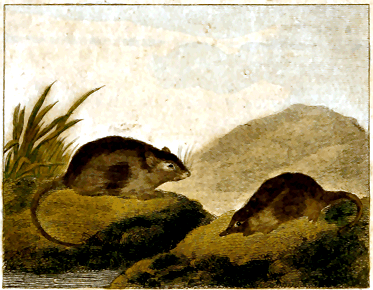
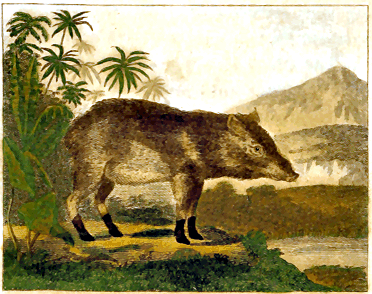
FIG. 116. Mexican Hog.
THE CANADIAN MUSK-RAT, AND THE MUSCOVY MUSK-RAT.
THOUGH these two animals have been denominated musk-rats, and have a few common characteristics, yet they ought not to be confounded; they must also be distinguished from the Pilori, or Musk-rat, of the Antilles; all three forming different species, and belonging to different climates; the first, also called Ondatra, is found in Canada; the second, or Desman, in Lapland and Muscovy; and the Pilori, in Martinico and other of the Antille islands.
The Musk-rat of Canada (fig. 115) differs from that of Muscovy in having all its toes separate, eyes very conspicuous, and a short nose; whereas the latter (fig. 114) has the toes of the hind feet united by a membrane, exceedingly small eyes, and a long nose like the shrew-mouse. The tail of both is flat, in which, as well as in many other characteristics, they differ from the pilori of the Antilles. The tail of the pilori is short, and, like that of other rats, cylindrical; the other two have long tails, and the head of the first is like that of a water-rat, and the head of the second resembles a shrew-mouse.
In the memoirs of the Academy of Sciences, for 1725, we meet with a very accurate description of the Canadian musk-rat. M. Sarrasin, a correspondent of the Academy, dissected a number of them at Quebec, and made some striking and singular remarks; by comparing his description with our own, we have not the least doubt but the animal which he calls the musk-rat of Canada, is the same with that now before us.
This animal is of the size of a small rabbit, and of the figure of a rat. Its head is short, and similar to that of the water-rat; its hair is soft and glossy, with a thick down underneath, like that of the beaver; its tail is long and covered with little scales, like that of the other rats, though of a different form, for instead of being cylindrical it is flat from the middle to the tip, and rather round at the insertion. The toes are not united by membranes, but furnished with a long thick hair, which enables the animal to swim with ease. Its ears are very short, but not naked, as in the common rat, but covered with hair, both outwardly and inwardly; its eyes are large; it has two incisive teeth, about an inch long, in the under jaw, and two shorter ones in the upper; these four teeth are very strong, and by them the animal is enabled to gnaw through wood.
The striking singularities remarked by M. Sarrasin, in this animal are, first, the muscular force and great expansibility in the skin, which enables the animal to contract and compress its body into a smaller size. Secondly, the suppleness of the false ribs, which admits a contraction of body so considerable that the musk-rat can obtain an easy passage through holes where smaller animals cannot find admission. Thirdly, the manner in which the female voids her urine, the urethra not terminating, as in other animals, under the clitoris, but at a hairy eminence above the os pubis, and in which there is an orifice, that serves the urine to escape. This strange organization is found in only a few species of animals, as rats and apes have three apertures; and these two are perhaps the only animals who have a passage for the urine distinct from the organs of generation: to the females alone, however, does this singularity belong, for the conformation of the males is the same with that of other quadrupeds. M. Sarrasin observes, fourthly, that the testicles which, as in other rats, are situated on each side of the anus, become exceedingly large, considering the size of the animal, during the rutting season; but that over, they not only change in size, consistency, and colour, but even in situation, and with the seminal vessels, and all the organs of generation become almost invisible. And, lastly, that the vessels which contain the musk, or perfume, of this animal, under the form of a milky humor, and which adjoin the parts of generation, undergo the same changes; that during the rutting season they enlarge in a great degree, and then the perfume is exceedingly strong, and may be sensibly distinguished at a considerable distance, but at its expiration they become wrinkled, decay, and at length entirely disappear. The change in the vessels, which contain the perfume, is effected more quickly, and more completely, than that of the parts of generation. These vessels are common to both sexes, and at the above periods contain a considerable quantity of milky humor; and the secretion is formed, and the humor voided, nearly in the same place as the urine of other quadrupeds. These singularities were worthy the attention of so able an anatomist as M. Sarrasin. We have already mentioned similar alterations in the parts of generation in the water-rat, the campagnol, and the mole; but this is not the place for us to enlarge on the general consequences which might be drawn from these singular facts, nor even on the immediate references they may have to our theory of generation. These we shall soon have occasion to present with more advantage, by uniting them with other facts to which they relate.
As the Canadian musk-rat belongs to the same country as the beaver, is fond of water, and has nearly the same figure, colour, and hair, they have been often compared to each other; it is even affirmed, that, at the first glance, a full grown musk-rat may be mistaken for a beaver of a month old. But in the form of their tails there is a considerable difference; that of the beaver being oval and flat horizontally; whereas that of the musk-rat is of a considerable length, and flat, or compressed vertically. In disposition and instinct, however, these animals have a strong resemblance. The musk-rats, as well as the beavers, live in societies during the winter. They form little dwellings about two feet and a half in diameter and sometimes larger, in which is often an association of several families. These habitations are not for the purpose of resorting to, in order to sleep like the marmots, for five or six months, but to obtain a shelter from the inclemency of the weather; they are of a round form, and covered with a dome about a foot thick; the materials for making which are herbs and rushes interwoven together, and cemented with clay, which they prepare with their feet; these huts are impenetrable by the rain, and secured from the effects of inundations by being elevated on the inside, and tho’ covered with snow several feet thick in the winter these animals do not seem to be incommoded by this circumstance. They do not provide a stock of provisions for that season, but dig a sort of passages round their dwellings, for the purpose of procuring roots and water. As winter is not their season of love, they reap but little advantage from associating. All this period they remain totally deprived of light, and therefore no sooner has the mild breath of spring begun to dissolve the snow, and uncover the tops of their little mansions, than the huntsmen open their dome suddenly, dazzle them with the light, and kill or seize all those who have not obtained shelter in their subterraneous passages; but as their skins are valuable, and their flesh not unpalatable, thither they are also pursued for slaughter. Such as escape quit their habitations about the same time. They wander about during the summer but always in pairs, for then is the time of their amours; then it is that all their vessels expand, and feeding largely upon the fresh roots and vegetables which the season affords, they acquire a strong smell of musk; a scent which, though agreeable to Europeans, is so disgustful to the savages, that they distinguish one of their rivers, from being frequented by a number of them, the Stinking River, and the animal itself the Stinkard.
They produce once a year, and generally have five or six young. Their time of gestation cannot be long, as they are not in season till the summer, and their young are full grown by October, when they seek for shelter; they construct new huts every year, and are never known to revisit their former habitations. Their cry is a kind of groan, which the huntsmen imitate in order to allure them. So strong are their fore-teeth, and so calculated for gnawing, that if shut up in a box, they soon make a hole large enough to escape through, a faculty which they possess in common with the beaver. They do not swim so fast, or so long as the beaver, and are often seen upon the ground; they run very indifferently, and in their walk they waddle like a goose. Their skin retains the smell of musk, which renders it of little value to the furriers, but their under hair, or down, is used in the manufacture of hats. These animals are not very wild, and when taken young are easily tamed; and are then tolerably handsome, for their tail, which is afterwards long and disagreeable, is very short. They play with all the innocence and sprightliness of young cats, and they might be reared with ease but for their disagreeable smell.
The Canadian and Muscovy musk-rats, are the only animals belonging to the northern regions which yield any perfume, for the odour of the castoreum (obtained from the badger) is highly disagreeable; and it is only in warm climates that we meet with the animals which furnish the real musk, the civet, and other delicate perfumes.
The musk-rat of Muscovy might, perhaps, present singularities analogous to those of the Canadian, and not less remarkable, but it does not appear that any naturalist has yet had an opportunity to dissect, or examine it alive. Of its exterior form alone we can speak, as that sent from Lapland, for the king’s cabinet, was in a dry state, and therefore I can only add my regret that so little is known about it.
THE PECCARI, OR MEXICAN HOG.
AMONG the animals of the New World, few species are more numerous, or more remarkable, than that of the Mexican Hog.[V] (fig. 116) At the first glance he resembles our wild boar, or rather the hog of Siam, which, as we have already observed, is nothing more than a variety of the wild boar; and for which reason this has been called the American wild boar, or American hog. He is, however, of a distinct species, and refuses to engender either with our wild or domestic kinds; a circumstance of which I was convinced, by having reared one of these animals in company with several sows.
He differs also from the hog in a number of characteristics, both external and internal. He is less corpulent, and his legs are shorter; in the stomach and intestines, there is a difference of conformation. He has no tail, and his bristles are much stronger than those of the wild boar; and, lastly, he has on his back, near the crupper, an opening from which there is discharged an ichorous humor of a very disagreeable smell. This is the only animal which has an opening in this part of the body. In the civets, the badger, and the genet, the reservoir for their perfume is situated beneath the parts of generation; and in the musk-animal, and the musk-rat of Canada, we find it under the belly. The moisture which exudes from this aperture in the back of the Mexican hog, is secreted by large glands, which M. Daubenton has described with much attention, as well as the other singularities of this animal; Dr. Tyson also in the Philosophical Transactions, No. 153, has given a good description of it. Without minutely detailing the observations of these two able anatomists, I shall barely remark, that the latter was mistaken in asserting that this animal has three stomachs, or, as Mr. Ray says, a gizzard and two stomachs. M. Daubenton plainly shews, that it is only one stomach divided by two similar pouches, which give it the appearance of three; that only one of these pouches has a pyrolus, or orifice below, for the discharge of its contents; that, consequently, we ought to consider the two others merely as appendages to, or rather portions of, the same stomach.
The Mexican hog might be rendered a domestic animal like the common kind; he has nearly the same habits and natural inclinations; feeds upon the same aliments, and his flesh, though more dry and lean, is not unpalatable, and may be improved by castration. When killed, not only the parts of generation, if the flesh is intended to be eaten, (as is also done with the wild boar) must be taken instantly away, but also the glands at the opening in the back, and which are common to both male and female, must likewise be removed, for if this operation be deferred for only half an hour, the flesh becomes utterly unfit to be eaten.
These animals are extremely numerous in all the warm climates of South America. They go in herds of two or three hundred together, and unite, like hogs, in the defence of each other. They are particularly fierce when their young are attempted to be taken from them. They surround their plunderers, attack them without fear, and frequently make their lives pay the forfeit of their rashness. In their native country they prefer the mountainous parts to the low and level grounds; neither do they seek marshes nor mud, like our hogs, but remain in the forests, where they subsist upon wild fruits, roots, and vegetables; they are an unceasing enemy to all the serpent kinds, with which the uncultivated forests of the New Continent abound: as soon as they perceive a serpent or viper, they seize it with their fore hoofs, skin it in an instant, and devour the flesh.
These animals are very prolific; the young ones follow the dam, and do not separate from her till they are full grown. If taken young they are very easily tamed, and soon lose all their natural ferocity, but they never shew any signs of docility, but continue stupid, without attachment, or even seeming to know the hand that feeds them. They do no mischief, and may be permitted to run tame, without apprehending any dangerous consequence. They seldom stray far from home, but return of themselves to the sty: they never quarrel among each other, except when they are fed in the same trough. At such times they have an angry grunt, much stronger and harsher than that of a common hog; but they seldom scream, only when suddenly surprised, or frightened, when they have a shrill manner of blowing like the wild boar. When enraged they draw their breath with great force, and point their bristles upward which more resemble the sharp armour of the hedge-hog than the bristles of the wild boar.
The species of the Mexican hog is preserved without alteration, and altogether unmixed with that of the European hog, which has been transported to, and become wild in, the forests of America. These animals meet in the woods, and even herd together, and yet never produce an intermediate breed. It is the same with the Guinea hog, which has greatly multiplied in America, after being brought thither from Africa.
However approximate the species of the European hog, the Guinea-hog, and the peccari, may appear, it is, nevertheless, evident, that they are each distinct, and separate from the others since they inhabit the same climate without intermixture. Of the three, the strongest, most robust, and most formidable, is our wild boar. The peccari, though equally fierce, is yet less active, and inferior as to the engines of defence, his tusks being much shorter. This animal dreads the cold, and cannot subsist, without shelter, even in our temperate regions; nor can our wild boar exist in countries which are very cold; therefore it is impossible that either of them could have found a passage from the one continent to the other, over any northern country; and therefore the Mexican hog cannot be considered as an European hog degenerated, or changed, by the climate of America, but as an animal peculiar to the southern regions of that continent.
Ray and other naturalists, have maintained, that the humor discharged from the back of the Mexican hog is a kind of musk, an agreeable perfume, even as it exudes from the body of the animal; that it is perceived at a considerable distance, and perfumes every place he inhabits, and through which he passes. I have, I must own, a thousand times experienced very contrary effects; for so disagreeable is the smell of this moisture, on being separated from the body of the animal, that I could not collect it without being exceedingly incommoded. It becomes less fœtid by being dried in the air, but never acquires the agreeable smell of musk, or of civet; and naturalists would have expressed themselves with more propriety, if they had compared it to that of castoreum.
SUPPLEMENT.
M. de la BORDE says, there are two kinds of the Peccari, or Mexican hog, in Cayenne, which never intermix; the largest of which is black, excepting two white spots upon its jaws, and that the hair of the small one is rather red; but I apprehend the differences are occasioned by age, or some accidental circumstance. He adds, that those of the large size do not associate with men; but that they live in the woods, upon seeds, roots, and fruits; that they dig in the damp soils for worms, and that they go in flocks of two or three hundred. It is no difficult matter to shoot them, as, instead of flying, they collect together, and will stand several discharges; nay, they will even attack the dogs, and sometimes men. He mentions an instance where he was out with a party that were surrounded by a flock of these hogs, who were not to be intimidated by a continual firing, and could not be dispersed until several of them were killed. When taken young, they are soon rendered familiar, but they will not intermix with the domestic hogs. When living in their natural state of freedom, they often reside in the marshes, and will swim across rivers. Their flesh, though palatable, is not so good as the common hog; it has a strong resemblance to that of the hare, and is without lard or grease.
M. de la Borde speaks of another species of hog found in Guiana, which he calls patira, in these terms: “The patira is about the size of the small Mexican hog, and the only difference is the former having a white stripe along the back; they live in large forests, and, in general, herd in families. They will defend themselves against dogs, when hunted by them: when likely to be overpowered, they seek shelter in hollow trees, or in holes of the earth, that have been made by armadilloes, which they entered backwards. To get them out, the hunters employ every means to irritate them, (having first inclosed a space round the hole) for when angry they will quit their retreat, and the men, standing prepared, destroy them with pitchforks and sabres. If a hunter observes a single one in a hole, and does not then wish to take it, he closes up the entrance, and is sure to have him the next day. Their flesh is superior to that of other hogs. When caught young they are easily rendered domestic, but even then they preserve their natural inveteracy against dogs, whom they attack on all occasions. They constantly live in the marshes, unless when entirely covered with water. The females produce two at a time, and they breed at all seasons of the year. Their hair is soft, like that of the Mexican hog. When tamed they follow their masters, and allow themselves to be handled by those they know, but strangers they always threaten by shewing their teeth.”
THE ROUSETTE, OR TERNAT BAT, THE ROUGETTE, OR LITTLE TERNAT, AND THE VAMPYRE.
THE Roussette[W] and the Rougette[X] seem to form two distinct species, but they so nearly resemble each other that they ought not to be presented apart, as they differ only in the size of the body and colour of the hair. The Great Ternat, (fig. 117) whose hair is of a reddish brown, is nine inches in length, from the tip of the nose to the insertion of the tail, and in breadth three feet, when the membranes, which serve it for wings, are fully extended. The Rougette, whose hair is of a reddish ash colour, is hardly more than five inches and a half in length, and two feet in breadth, when the wings are extended; and its neck is half encircled with a stripe of lively red, intermixed with orange, of which we perceive no vestige on the neck of the roussette. They both belong to nearly the same hot climates of the old continent, are met with in Madagascar, in the island of Bourbon, in Ternat, the Philippines, and other islands of the Indian Archipelago, where they seem to be more common than on the neighbouring continents.
In the hot countries of the New World, there is another flying quadruped, of which we know not the American name, but shall call it Vampyre, because it sucks the blood of men, and other animals while asleep, without causing sufficient pain to awaken them. This American animal is of a different species from the bats just mentioned, both of which are to be found solely in Africa, and in the southern parts of Asia.
Engraved for Barr’s Buffon.
FIG. 117. Ternat Bat.
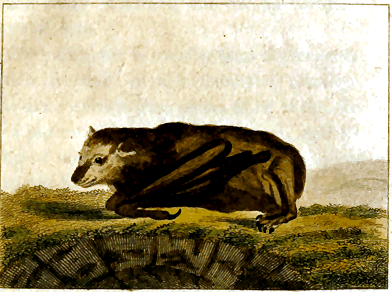
FIG. 118. Bull Dog Bat FIG: 119. Senegal Bat
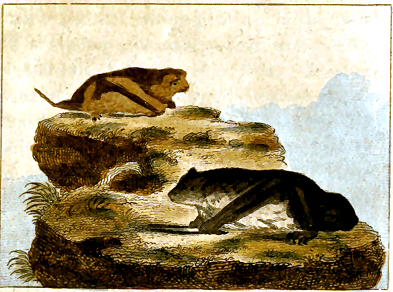
THE vampyre[Y] is smaller than the rougette, which is itself smaller than the roussette. The first, when it flies, seems to be of the size of a pigeon, the second of a raven, and the third of a large hen. Both the roussette and rougette have well shaped heads, short ears, and round noses, nearly like that of a dog. Of the vampyre, on the contrary, the nose is long, the aspect as hideous as that of the ugliest bats; its head is unshapely, and its ears are large, open, and very erect; its noise is deformed, its nostrils resembling a funnel, with a membrane at the top, which rises up in the form of a sharp horn, or cock’s-comb, and greatly heightens the deformity of its face. There is no doubt, therefore, that this species is different from the Ternat bats. It is an animal not less mischievous than it is deformed; it is the pest of man, and the torment of other animals. In confirmation of this, the authentic testimony of M. de la Condamine may be produced. “The bats,” says he, “which suck the blood of horses, mules, and even men, when they do guard against it by sleeping under the shelter of a pavilion, are a scourge common to most of the hot countries of America. Of these some are of a monstrous size. At Borja, and several other places, they have entirely destroyed the large cattle which the missionaries had brought thither, and which had begun to multiply.” These facts are confirmed by many other historians and travellers. Petrus Martyr, who wrote not long after the conquest of South America, says, that there are bats in the isthmus of Darien which suck the blood of men and animals while they are asleep, so as to much weaken, and frequently kill them. Jumilla, Don George Juan, and Don Ant. de Ulloa, assert the same. Though from the above testimonies it appears that these blood-sucking bats are numerous, particularly in South America, yet we have not been able to obtain a single individual. Seba has presented us with a figure and description of this animal, of which the nose is so extraordinary, that I am astonished travellers should not have remarked a deformity so palpable as to strike the most superficial beholder; possibly the animal of which Seba gives the figure, is not the same with that which we distinguish by the name of the vampyre, or blood-sucker; It is also possible, that this figure of Seba’s is false or exaggerated, or at least that this deformed nose is only a monstrous accidental variety; though of these deformities there may be found permanent examples in some other species of bats. By time alone will these obscurities be removed.