Front matter (continued 4)
Reading edition
Seba says, “that according to Valentin, this last philandre is the largest species seen in the East Indies, and particularly among the Malays, where he is called pelandor aroé, which signifies a rabbit of Aroé, though Aroé is not the only place where these animals are found; that they are common in the island of Solor; that they are kept promiscuously with rabbits, to whom they do no harm; and that the inhabitants eat their flesh, which they reckon excellent.” These facts are very doubtful, not to say absolutely false, for according to Seba, this is not the largest species of the oriental philandre, that it bears no resemblance to the rabbit, therefore is very improperly termed the rabbit of Aroé; and that no person who has travelled in the East Indies has mentioned this remarkable animal; neither is he found in the island of Solor, nor in any other part of the ancient continent. Seba himself seems to have perceived not only the incapacity, but also the inaccuracy of the author whom he quotes: F. Valentin has written a Natural History of the East Indies in five volumes folio, and for the credit due to his testimony, both Artedi and Seba refer to a passage wherein he affirms, “that the pouch of the philandre is the womb in which the young are conceived; that having himself dissected a female, he found no other; and if that pouch is not the real womb, the teats are to the young, what the pedicles are to fruits, that they stick to them till they are sufficiently grown, and then they are separated like the fruit, when it is come to ripeness.” What seems to be the truth is, that Valentin, who affirms that those animals are common in the East Indies, especially at Solor, had never seen any there; that all he says, even his most manifest errors, are copied from Piso and Marcgrave, who are themselves copyists of Ximenes, and are mistaken in everything they have advanced of their own authority; for Marcgrave and Piso say expressly and observatively, as well as Valentin, that the pouch is the true womb where the young of the opossums are conceived. Marcgrave says, he dissected one, and found no other womb: Piso, who says he dissected many, affirms he never could discover any womb in the internal parts, and also maintains the opinion, equally ill-grounded, that this animal is found at Amboyna. One may judge of what credit ought to be given to Marcgrave, Piso, and Valentin’s assertions, the first of whom had not examined with accuracy; the second had added to the errors of the first, and the last copied from both.
I should willingly ask pardon of my reader for the length of this critical disquisition, but when obliged to correct errors, we cannot be too exact or too attentive, even to the smallest circumstances.
M. Brisson, in his work upon the quadrupeds, has adopted whatever he found in that of Seba, and adopts both his denominations and descriptions; he goes even farther than his author, in making three distinct species of the philandres, described by Seba; for, if he had adhered to Seba, he would have observed that the latter did not give them as really different from each other. Seba had no doubt that an animal of the warm climates of America, could be found also in the torrid regions of Asia; but he distinguished them according as they came to him from one or the other continent. It seems clear that he does not use the word species in its most strict sense, nor did Seba ever pretend to make a methodical division of animals into classes, genera, and species; he has only given the figures of the different animals in his cabinet, distinguishing by names, according as he saw some difference in their size, colour, or the countries from which he received them. It appears, therefore, that M. Brisson was not authorised by Seba, in making three different species of philandres, especially as he has not employed the distinctive characters, and makes no mention of the want of the claws, in the hind toes of the hind feet; he only says, in general, that the toes of the philandres have claws, without making any exception; yet the one which he saw in the King’s cabinet, and which is our opossum, had no claws to the hind toes of the hind legs, and which seems to be the only one he has seen. The work of M. Brisson is very useful, but in his catalogue the species are more numerous than in that of Nature.
Engraved for Barr’s Buffon.
FIG. 133. Elephant.
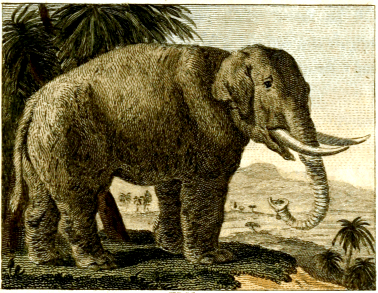
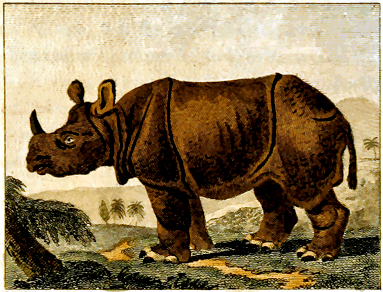
FIG. 134. Rhinoceros.
We have now only to examine the nomenclature of Linnæus, which in this article is much less erroneous than in many others, for he suppresses one of the three species of Seba; but he should have reduced them to one. Besides, he employs the distinctive character of the toes behind without claws, which none but Tyson had observed. The description which Linnæus gives of the opossum as the marsupialis, seems to be a good one, and agreeable to Nature, but he is in an error when under the name of opossum he designs an animal different from his marsupialis, upon the authority of Seba, acknowledging, however, that this opossum had no claws to the toes behind, whilst they are very visible in the figures of Seba. Another error is, considering the maritacaca of Piso, as the same animal as the carigueya, whilst these two animals, though mentioned in the same chapter, are mentioned by Piso as two different animals, and he describes them one after the other. But his greatest error is in making two different species of the marsupialis and the opossum; they have both, according to Linnæus, the pouch, the hind toes of their hind feet have no claws, are both natives of America, and only differ in this respect, by the first having eight paps, and the second only two, and the spot above the eyes more pale. These characteristics cannot be sufficient to distinguish them as distinct species; for the first can scarcely be called a difference; nor can any thing be established as fixed or certain, in regard to the order and the number of the paps, since they vary in the same species of most animals.
From this examination, which we have made with strict impartiality, it appears, that the philandre, opossum, seu carigueya Brasiliensis, and the philander orientalis maximus of Seba; those of M. Brisson, and the marsupialis and opossum of Linnæus are all of them the same animal, which is our opossum whose natural climate is South America; and who was never seen in the East Indies, but when transported thither. Upon this subject, some uncertainty still remains in regard to the taiibi, which Marcgrave does not mention as an animal different from the carigueya, but which Johnston, Seba, Klein, Linnæus, and Brisson, have presented as distinct from the preceding. In Marcgrave the two names of carigueya and taiibi are found in the same article, where it is said, that this animal is called carigueya in Brasil, and taiibi in Paraguay. There is afterwards a description of the carigueya taken from Ximenes; and then another is given of the animal called taiibi, by the Brasilians; cachorro domato, by the Portuguese, and hooschratte, or the rat of the wood, by the Dutch. Marcgrave does not say this is an animal different from the carigueya, but on the contrary, considers it as the male of that species; and it appears clearly, that the male and female opossum were called taiibi in Paraguay, and that in Brasil they gave the name of taiibi to the male, and that of carigueya to the female. Besides, the difference between those two animals, such as it is indicated by their descriptions, is too inconsiderable to conclude they are not the same species. The most essential is, the colour of the hair, which in the carigueya is yellow and brown, and grey in the taiibi, the hairs of which are white at their bottom, and brown or black at the extremities. It is therefore more than probable, that the taiibi is the male opossum. Mr. Ray seems to be of that opinion, when speaking of the carigueya, and the taiibi. Yet, notwithstanding Marcgrave’s authority, and the rational doubt of Ray, Seba gives the figure of an animal, under the name of the taiibi; and says, at the same time, that this taiibi is the same animal as the tlaquatzin of Hernandes; this is adding error upon error; for even according to Seba, his taiibi, which is a female, has no bag under the belly; and Hernandes gives to his tlaquatzin this bag as a particular characteristic; consequently the taiibi of Seba cannot be the tlaquatzin of Hernandes, as it has no pouch, nor the taiibi of Marcgrave, since it is a female; it is certainly, therefore, another animal badly designed, and badly described, to whom Seba thought proper to give the name of taiibi, and which he confounds with the tlaquatzin of Hernandes, which as we have said before, is our opossum. Brisson and Linnæus have, in regard to the taiibi, literally followed Seba; they have copied even his error in regard to the tlaquatzin of Hernandes, and both, have made an equivocal species of this animal, the first under the name of philandre of Brasil, and the second under that of philander. The true taiibi of Marcgrave and Ray, is not therefore the taiibi of Seba, the philander of Linnæus, nor the Brasilian philander of Brisson; nor are the two latter the tlaquatzin of Hernandes. The taiibi of Seba (supposing his existence) is a different animal from all those treated of by the above authors, and ought to have had a particular denomination, and not been confounded with the taiibi of Marcgrave, which has nothing in common with him; besides, as the male opossum has no pouch, it is not surprising that they have been taken for different animals, as that the female is called carigueya, and the male taiibi.
Edward Tyson dissected and described the female opossum with care; in the individual which served him for subject, the head was six inches, the body thirteen, and the tail twelve in length: the fore legs were six inches, and the hind legs four inches and a half in height: the body was fifteen or sixteen inches in circumference; the tail three inches round in the beginning, and only one inch towards the extremities; the head three inches betwixt the two ears, decreasing gradually to the nose; and was more like that of a pig than a fox; the sockets of the eyes are much inclined in the direction from the ears to the nose; the ears are rounded, and about an inch and a half long; the mouth was two inches and a half wide from one of the corners of the lip to the extremity of the snout; the tongue narrow, three inches long, and rough; his fore feet had five toes armed with crooked claws, but in the hind feet he had only four toes with claws, and the fifth toe, or thumb, was separated from the others, was placed lower, and had no claws. All his claws were without hair, and covered with a skin of a reddish colour, and very near an inch in length; his hind and fore paws were large, and he had fleshy callosities under all the toes. The tail was covered with hair for two or three inches from the beginning, and the rest of it with a smooth scaly skin to the end. These scales were whitish, almost hexagonal, and placed regularly, so that they did not encroach upon each other, but were divided by a skin browner than the scales. The ears were without hair, thin and membranous like the wings of a bat, and very open. The upper jaw longer than the under; the nostrils large, the eyes small, black, and lively; the neck short, the breast wide, and the whiskers like those of a cat: the hairs of the forehead whiter and shorter than those of the body; his colour a yellowish grey, intermixed with black on the back and sides, more brown on the belly, and still deeper on the legs. Under the belly of the female (fig. 131) is a skin two or three inches long, which forms a kind of pouch by a double fold thinly covered with hair on the inside, and which pouch contains the teats. The young enter into this pouch to suck, and soon acquire the habit of hiding themselves in it, so that they retire thither whenever they are frightened. This pouch opens and shuts according to the will of the animal; which it effects by several muscles and two bones, which are peculiar to the opossum; these two bones are about two inches in length, placed by the os pubis, they decrease gradually from the basis to the extremities, and support the muscles which open the pouch; the antagonists of these muscles serve to shut it so exactly, that in the living animal the opening cannot be seen, without forcibly dilating it with the fingers. The inside of this pouch is full of kernels, which contain a yellow substance, the smell of which is so offensive, that it infects the whole body of the animal; yet when this matter is dried, it not only loses its disagreeable smell, but acquires a perfume which may be compared to that of musk. This pouch is not, as Marcgrave and Piso have falsely asserted, the place in which the young are conceived; the female opossum has an internal womb, different indeed from that of other animals, but in which the young are conceived, and remain till they are brought forth. Tyson says, that in this animal there are two wombs, two vaginas, and four ovariums. M. Daubenton does not agree with Tyson in these particulars; but by his description, it is at least certain, that in the organs of generation of the opossums, there are several parts double which are single in other animals. The glans penis of the male, and the glans clitoridis in the female, which are forked, and seem double. The vagina, which is single at the entrance, is afterwards divided into two channels; this conformation is very singular, and differs from that of all other quadrupeds.
The opossum belongs to the south parts of the new world, but he does not, like the armadillo, seem confined to the hottest climates, for he is found not only in Brasil, Guiana, and Mexico, but also in Florida, Virginia, and other temperate regions of this continent. They are very common in these countries, as they bring forth often, and most authors say four or five, others six or seven, at a time. Marcgrave affirms, that he has seen six young ones alive in the pouch of the female; they were about two inches in length, were very nimble, and went in and out of the pouch many times in a day. They are very small when just brought forth: some travellers say they are not bigger than flies when they go out of the womb into the pouch, and attach themselves to the teats. This fact is not so much exaggerated as might be imagined, for we have seen in an animal, whose species is somewhat like that of the opossum, young ones sticking to the teats not bigger than beans; and it is not improbable, that, in these animals, the womb is only the place of conception and first formation of the fœtus, whose unfolding is completed in the pouch. No one has observed the time of their gestation, which we think is shorter than in any other quadruped; and as this early exclusion of the fœtus is a singularity in nature, we wish those who have an opportunity of observing the opossums in their native country would contrive to discover how long the females go with young, and how long the young remain attached to the teats. This observation is curious in itself, and may become useful, in pointing out some means of preserving the lives of children born before their natural period.
That the young opossums stick to the teats of the mother till they have acquired strength, and a sufficient growth to move with ease, is a fact not to be doubted; nor is it peculiar to this species only, since we have seen it in that of the marmose. The female marmose has not, like the opossum, a bag under the belly; it is not, therefore, in consequence of the assistance which the young receive from the pouch that they stick so long to the teats, and increase in that immoveable situation. I make this observation to prevent the pouch being considered as a second womb, or at least an asylum necessary to the young before they are unfolded. Some authors pretend that they stick to the teats for several weeks, others say that they remain in the pouch only the first month after they came out of the womb. The pouch may be opened, the young counted, and even felt, without disturbing them, for they do not leave the teats, which they hold with their mouths, before they are strong enough to walk; then they fall into the bag, and afterwards go out to seek for their subsistence; they often go in again to sleep, to suck, and to hide themselves when terrified; in cases of danger the mother flies, and carries the whole of her young with her. Her belly does not seem to have any increased bigness when she is breeding, for in the time of the true gestation it is scarcely perceivable that she is with young.
From inspecting the form of the feet it is easy to perceive that he walks and runs aukwardly; it is said a man can overtake him without hastening his steps. He climbs up trees with great facility, hides himself in the leaves to catch birds, or hangs by the tail, the extremity of which is so muscular and flexible that he can clasp with it any thing he seizes upon. He sometimes remains a long while in this situation, his body suspended, with his head hanging downward, waiting for his prey. At other times he jumps from one tree to another, as the monkeys, with like muscular flexible tails, which he resembles also in the conformation of his feet. Though carnivorous, and even greedy of blood, which he sucks with avidity, he feeds also upon reptiles, insects, sugar-canes, potatoes, roots, and even leaves and bark of trees. He may easily be rendered a domestic animal, for he is neither wild nor ferocious; but he creates disgust by his smell, which is more offensive than that of the fox; his figure is also forbidding, for his ears are like those of an ounce, his tail resembles that of a serpent, his mouth is cleft to the very eyes, his body appears always dirty, because his hair is neither smooth nor curled, and seems as if covered with dirt. His bad smell resides in the skin, for his flesh is eatable. The savages hunt this animal by preference, and feed on his flesh heartily.

SUPPLEMENT.
M. de la BORDE has sent me an account of three opossums, which he kept in a cask at Cayenne; in most particulars it agrees with the description already given; he says they are very easily tamed, and feed upon fish, flesh, bread, &c. that those he had possessed no disagreeable smell, but that there are two species, the one which has so strong an odour as to be called stinking by the inhabitants, and that their flesh is not good to eat.
M. de Vosmaër, to his description of the flying squirrel, has added a note, in which he says, “the coes-coes is the bosch of the East Indies, the philandre of Seba, and the didelphiè of Linnæus. M. de Buffon has confined this animal to the new world, and positively denies its existence in the East Indies; but I can assure that learned naturalist that Valentin and Seba said no more than the truth, in affirming they were common to both Asia and America, for I have had a male and female sent me from the East Indies, and Dr. Schlosser, at Amsterdam received one of the same species from Amboyna. The principal difference between those of the East and West Indies is in the colour of the hair, the male of the former being of a yellowish white, and the female a little darker, with a brown line on the back, and their ears are less than those of the latter. The heads also of the West India species are much shorter than those of the East.” I have not the smallest reason to doubt M. Vosmaër’s receiving two animals from the East Indies, under the name of coes-coes, but am of opinion the differences which he points out are sufficient to induce us not to consider them the same species as the opossums. I, however, confess the justice of his observation upon my making the three philandres of Seba the same animal, when, in fact, the third is a different species, and found in the Philippine islands, and possibly in many parts of the East Indies, where it is called coes-coes, or cous-cous. Christopher Barchewitz gives a description of this animal found in the island of Lethy, and from the similarity it plainly appears, that the East India cuscus is of the same genus as the American opossum; but that is no proof of their being of the same species; and I am still of opinion, that the animals of one continent will not be found in the other, unless they have been transported thither. I do not mean to deny the possibility of the same climates in the two continents producing some animals of exactly the same species, provided other circumstances were the same; I am not, however, treating here of possibilities, but of general facts, of which we have given many instances in our enumeration of animals peculiar to the two continents; and, upon the whole, I am inclined to consider the coes-coes of the East Indies as an animal whose species approaches very near to that of the opossums of America, but that they have similar differences, to those which are observable between the jaguar and leopards, which of all animals peculiar to the southern climates of the two continents, without being the same species, come the nearest to each other.
THE MARMOSE.
THE species of the Marmose, or Murine Opossum, (fig. 132) resembles that of the preceding; they are natives of the same climate and the same continent; they are very much alike in the form of the body, the conformation of the feet, in the tail, which is mostly covered with scales, except the upper part, which is hairy, and by the teeth, which are more numerous than in other quadrupeds. But the marmose is smaller, and his snout sharper; the female has no pouch under the belly, she has only two loose skins near the thighs, between which the young fix themselves to the teats. The parts of generation of the male and female marmose resemble, by their form and their position, those of the opossum. When the young are brought forth, and fix themselves to the teats, they are not so big as small beans. The brood is also more numerous; I have seen ten young ones, each sticking to a different teat, and the mother had four more teats, which made fourteen in all. It is particularly on the females of this species that the observations, recommended in the preceding article, should be made; as I am persuaded they bring forth a few days after conception, and that the young are only fœtuses which are not come to the fourth part of their growth. The mother always miscarries, and the fœtuses save their lives by sticking to the teats, and never leaving them till they have acquired the growth and strength which they would naturally have got in the womb, if they had remained until the proper period.
The marmose has the same manners, and the same inclinations, as the opossum; both of them dig burrows to dwell under the ground, hang by the extremities of their tails to the branches of trees, and rush upon birds and small animals; they eat fruit, corn, and roots, but they are still more greedy of fish and craw-fish, which, it is affirmed, they catch with their tails. This fact, however, is doubtful, and does not agree with the natural stupidity attributed to those animals, who, according to the relation of most travellers, do not even know how to move, fly, or defend themselves, with any degree of art.
THE CAYOPOLLIN.
FERNANDES is the first author who has mentioned this animal. The Cayopollin, says he, is a small animal, little bigger than a rat, very much resembling the opossum in the snout, ears, and tail, and which he makes use of as we do our hands; he has thin transparent ears; his belly, legs, and feet, are white. The young, when frightened, seize hold of the mother, who carries them up on the trees. This species is found on the mountains of New Spain. Nieremberg has copied Fernandes verbatim, without any addition of his own. Seba, who first caused this animal to be engraved, gives no description of it; he only says, that he has the head thicker, and the tail a little bigger than the marmose, and that though he is of the same kind he belongs to another climate, and even to another continent. He refers his readers to Nieremberg and Johnston for a further description of this animal; but it seems evident that neither of them had seen him, as they only follow Fernandes. Neither of these three authors say that he is a native of Africa, on the contrary, they assert, that he comes originally from the mountains of the warm climates of America, and yet Seba, without any authority, has pretended, that it is an African animal. That which we have seen certainly came from America; he was larger, the snout not so sharp, and the tail was longer than those of the marmose, and he resembled the opossum more even than the marmose does. These three animals are much alike in the conformation of their interior and exterior parts, in their additional bones, form of their feet, in being brought forth before their entire formation, their long and continued adherence to the teats, and in their habits and dispositions. They are all three natives of the new world, and of the same climate; they are never found in the cold regions of America, nor can hardly live in temperate climates. All of them are very ugly; their mouths extended like that of a pike, their ears like those of a bat, their tails like that of a snake, and their monkey’s feet present a very odd form, which is rendered still more disagreeable by their bad smell, and by the slowness and stupidity which accompany their actions and manners.
THE ELEPHANT.
THE Elephant, the human species excepted, is the most considerable animal of this world; he surpasses all terrestrial beings in size, and approaches near to man in understanding, as much, at least, as matter can approach to mind. The elephant, dog, beaver, and ape, of all the animated beings, have the most admirable instinct; but this instinct, which is only the product of all the interior and exterior faculties of the animal, manifests itself very differently in every one of these species. The dog is naturally as cruel and bloody as the wolf; but his ferocious nature is to be conquered by gentleness: he only differs from the other animals of prey, by possessing a degree of sensibility, which makes him susceptible of affection, and capable of attachment. He has from nature this disposition, which man has cultivated and improved by a constant and ancient society with this animal. The dog alone was worthy of this attention, as he is more capable than any other quadruped of foreign impressions, his social nature has improved all his relative faculties. His sensibility, tractable temper, courage, talents, and even his manners, are modified by the example and qualities of his matter. He has not then, from nature, all those qualifications he appears to possess, but has acquired them from his intercourse with men; he is only more susceptible of tuition than other animals; far from having, like most of them, a disgust for man, his inclination leads him to seek their society: actuated by a desire of pleasing, his tractability, fidelity, constant submission, and that attention necessary to act in consequence of man’s orders, are the result of this natural sentiment.
The ape, on the contrary, is untractable and eccentric; his nature is perverse; he has no relative sensibility, no gratitude for good treatment, and no remembrance of favours; he is naturally averse from the society of man, he hates constraint, is mischievous by nature, and inclined to do every thing hurtful and disagreeable. But these real faults are compensated by seeming perfections. His exterior conformation resembles that of man, he has arms, hands, and fingers. The use of these parts alone, makes him superior in dexterity to other animals; and the affinities to us which he then possesses by a similarity of motions, and the conformity of his actions, please and deceive us, and induce us to attribute to interior qualities, what depends merely on the formation of his members.
The beaver, who seems inferior to the dog and ape, by his individual faculties, has nevertheless received from Nature a gift almost equivalent to that of speech; he makes himself so well understood by those of his own species, as to bring them together; to act in concert, and to undertake and execute extensive and continued labours in common; and this social love, as well as the product of their reciprocal understanding, have better claims to our admiration, than the dexterity of the ape, or the faithfulness of the dog.
Thus the dog’s genius is only borrowed; the ape has but the appearance of sagacity, and the beaver is only sensible in regard to himself, and those of his species. The elephant is superior to them all three, for in him are united all their most eminent qualities. The hand is the principal organ of the ape’s dexterity; the elephant is equally so with his trunk, which serves him instead of arms and hands, by it he can lift up, and seize small as well as large objects, carry them to his mouth, place them on his back, hold them fast, or throw them to a distance; he has at the same time the docility of the dog; he is, like him, susceptible of gratitude, capable of a strong attachment, attends upon man without reluctance, and submits to him, not so much by force as good treatment; serves him with zeal, intelligence, and fidelity; in fine, the elephant, the same as the beaver, likes the society of his own species, and by whom he is understood. They are often seen to assemble together, disperse, and act in concert, and if they do not carry on any work in common, it is, perhaps, only for want of room and tranquillity; for men have been very anciently multiplied in all the regions inhabited by the elephant; he consequently lives in fear and anxiety, and is no where a peaceful possessor of a space large and free enough to establish a secure habitation. We have seen that all these advantages are requisite to manifest the talents of the beaver, and that wherever men are settled, he loses his industry, and ceases to build. Every being has its relative value in Nature. To judge of the elephant, we must allow him to possess the sagacity of the beaver, the dexterity of the ape, the sentiment of the dog with the peculiar advantages of strength, bigness, and longevity. We must not forget his arms, or tusks, with which he can pierce through and conquer the lion. We should also recollect that he shakes the ground at every step; that with his trunk he roots out trees; that with the strength of his body, he makes a breach in the wall; that though tremendous by his strength, he is more invincible by the resistance of his bulky massiveness, and the thickness of his skin; that he can carry on his back an armed tower filled with many men; and that he alone moves machines, and carries burthens, which six horses cannot move. To this prodigious strength, he joins courage, prudence, coolness, and an exact obedience; he preserves moderation even in his most violent passions; he is more constant than impetuous in love: in anger he does not forget his friends; he never attacks any but those who have given him some offence; and he remembers favours as long as injuries. Having no taste for flesh, and feeding chiefly upon vegetables, he is not naturally an enemy to any living creature; he is beloved by them all, since all of them respect, and no one has cause to fear him. For these reasons, men at all times have had a sort of veneration for this first of animals. The ancients considered the elephant as a prodigy, a miracle of Nature, and he is in reality her greatest effort; they have attributed to him without hesitation, intellectual qualities and moral virtues.
Pliny, Ælian, Solinus, Plutarch, and other more modern authors, have even given to this animal rational faculties, a natural innate religion, the observation of a daily worship, such as that of the sun and moon, the use of ablution before adoration, a spirit of divination, piety towards heaven and their fellow creatures whom they assist at their deaths; and after their decease, express their regret by tears, and cover them with earth. The Indians, prepossessed with the opinion of the metempsychosis, are to this day persuaded, that a body so majestic as that of the elephant cannot be animated but by the soul of a great man, or a king. They respect at Siam,[AE] Laos, and Pegu, white elephants as the living manes of the emperors of India. They have each of them a palace, a number of servants, golden vessels, exquisite dainties, magnificent trappings, and are absolved from all labour and obedience; the living emperor is the only one before whom they kneel down, and the monarch returns the salute. These flattering attentions, this respect, these offerings flatter them but do not inspire them with vanity; they have not consequently a human soul, and this circumstance should be sufficient to prove it to the Indians.
Without adopting the credulities of antiquity, and the puerile fictions of superstition, the elephant is an animal still worth the attention of a philosopher, who ought to consider him as a being of the first distinction. He deserves to be known, and to be observed; we shall therefore write his history with impartiality; we shall consider him at first in his state of nature when he is free and independent, and afterwards in his servile condition, when the will of his master becomes the cause of his actions.
In a wild state, the elephant is neither sanguinary nor ferocious; he is of a mild temper, and never makes a bad use of his arms, or his strength; for he never employs or exerts them but in his own defence, or in protecting others of his species. His manners are social, for he is seldom wandering alone: they commonly walk in troops, the oldest leading, and the next in age bringing up the rear; the young and the weak keeping in the middle. The females carry their young, and hold them close with their trunks. They only observe this order in perilous marches when they go to feed on cultivated lands; they travel with less precaution in forests and solitary places, but without separating to such a distance as not to be able to give to each other mutual assistance, and warnings of danger. Some, however, straggle, and remain behind, and it is none but these the hunters dare attack, for a small army would be requisite to assail the whole herd, and they could not conquer without a great loss of men. It is even dangerous to do them the least injury, for they go straight to the offender, and notwithstanding the great heaviness of their bodies they walk so fast that they easily overtake the most agile man; they pierce him through with their tusks, or seize him with their trunks; throw him like a stone, and then kill him by treading him under their feet. But it is only when they have been provoked that they become so furious and so implacable; they do no harm to those who do not disturb them; yet, as they are very suspicious, and sensible of injuries, it is proper to avoid them; and the travellers who frequent the countries where they are numerous, light great fires in the night, and beat drums, to prevent their approach. It is said that when they have been once attacked by men, or have fallen into a snare, they never forget it, but seek for revenge on all occasions. As they have a most exquisite sense of smelling, perhaps more perfect than that of any other animal, they smell a man at a great distance, and can easily follow him by the scent. The ancients have asserted that the elephant tears up the grass where the hunters have passed, and with their trunks convey it to each other, in order to give information of the passage and march of the enemy. These animals are fond of the banks of rivers, deep valleys, shady places, and marshy grounds. They cannot go long without water, which they make thick and muddy before they drink it. They often fill their trunks with water, either to convey it to their mouths, or only to cool their noses, and to amuse themselves in sprinkling it around them. They cannot support cold, and suffer equally from excessive heat; to avoid the burning rays of the sun, they penetrate into the thickest recesses of the forests. They bathe often in the water; the enormous size of their bodies is rather an advantage to them in swimming, and they do not sink so deep in the water as other animals; besides, the length of their trunks, which they erect in the air, and through which they breathe, takes from them all fear of being drowned.
Their common food is roots, herbs, leaves, and young branches; they also eat fruit and corn, but they have a dislike to flesh and fish. When one of them finds a good pasture, he calls the others, and invites them to come and feed with him. As they consume a great quantity of fodder, they often change their place, and when they find cultivated lands they make a prodigious waste; their bodies being of an enormous weight, they destroy ten times more with their feet, than they consume for their food, which may be reckoned at 150lbs. of grass daily; and as they always keep in great numbers together, they will lay waste a large territory in an hour’s time; for this reason the Indians and Negroes exert every means to prevent their visits, and to drive them away; they make great noises, and large fires round their cultivated lands; yet, notwithstanding these precautions, the elephants often take possession of them, drive away the cattle and men, and sometimes pull down their cottages. It is difficult to frighten them, as they are little susceptible of fear; the only things that can stop their progress are fire-works, and crackers thrown amongst them; the sudden and repeated noise of which sometimes occasions them to turn back. It is very difficult to part them, for they commonly act together whether they attack, proceed, or turn back.
When the females come in season this social intercourse yields to a more lively sentiment; the herd separate in pairs, having each chosen their mates; they then seek for solitary places, and in their march love seems to precede and modesty to follow them; for they observe the greatest mystery in their amours, and they have never been seen to couple. They avoid the inspection of their own species, and, perhaps, know better than ourselves the pure delight of secret pleasure, being wholly taken with one beloved object. They retire into shady woods and most solitary places, to give themselves up, without disturbance or restraint, to the impulses of Nature, which are strong and lasting, as they have long intervals between their seasons of love. The female goes two years with young; when she is in that condition the male abstains from her, and thus are they subjected to the influence of love but once in three years. They bring forth only one young, which has teeth at its birth, and is then bigger than a wild boar; his tusks are not visible, but they appear soon after, and when six months old they are some inches long. At that age the elephant is bigger than the ox, and the tusks continue to increase till he is much advanced in years, provided the animal is in health, and at liberty, for it is scarcely to be imagined how much slavery and unnatural food change his natural habit and constitution.
The elephant is easily tamed, brought into submission, and instructed, and as he is the strongest and most sensible of animals, he is more serviceable than any of them; but he seems always to feel his servile condition, for though subject to the powerful impressions of love they never couple, nor produce in a state of domesticity. His passion, irritated by constraint, degenerates into fury; as he cannot indulge it without witnesses he becomes violent and intractable, and the strongest chains and fetters are often found necessary to stop his impetuosity, and subdue his anger. Thus the elephant differs from all domestic animals which man treats or manages as beings without will; he is not like these born slaves, which we mutilate or multiply for our use. Here the individual alone is a slave, the species remains independent, and constantly refuses to increase for the benefit of their tyrants. This alone shews in the elephant elevated sentiments superior to the nature of common brutes. To be agitated by the most ardent desires, and to deny themselves the satisfaction of enjoying them; to be subjected to all the fury of love, and yet not to violate the laws of modesty, are, perhaps, the highest efforts of human virtue, but which in these majestic animals are all suggested by instinct, and from which they never deviate. Enraged that they cannot be gratified without witnesses their fury becomes stronger than their passion of love, destroys the effects of it, and provokes, at the same time, that anger which, in those instants, renders the elephant more dangerous than any other wild animal.
We should be inclined to doubt this fact, were it possible, but naturalists, historians, and travellers, all agree, that the elephants never produce in a domestic state. The kings of India keep a great number of them, and after having endeavoured in vain to make them multiply, like other domestic animals, they found it necessary to part the males from the females, to prevent that fury which is occasioned by the irritation of desires they will not satisfy in a state of subjection. There are, therefore, no domestic elephants but what have been wild, and the manner of taking, taming, and bringing them into submission deserves particular attention. In the middle of forests, and in the vicinity of the places frequented by the elephants, a spot is chosen, and encircled with palisadoes; the strongest trees of the forest serve for stakes, to which are fastened cross pieces of timber, which support the other stakes. A man may easily pass through this palisado; a large opening is also left, through which the elephant may go in, and over it is a trap, or large stake, which is let down to shut the opening after the animal has entered. To bring him to this inclosure the hunters take a tame female with them into the forest, who is in season, and when when they think she is near enough to be heard they oblige her to make the cry of love, the wild male answers immediately, and begins his march to meet her. She is then led towards the inclosure, repeating her call now and then; she arrives first, and the male following her track enters through the same gate. As soon as he perceives himself enclosed his ardour vanishes, and when he discovers the hunters he becomes furious; they throw ropes at him with a running knot, by which they fetter his legs and trunk; they then bring two or three tame elephants, led by dextrous men, and endeavour to tie him to one of them; in short, by dint of dexterity, strength, terror, and caresses, they succeed in taming him in a few days.
I shall not enter into more particulars on this subject, but refer to those travellers who have been ocular witnesses of the manner of hunting the elephants;[AF] it varies according to different countries, and according to the power and the abilities of those who make war against them, for instead of erecting, like the kings of Siam, walls, terraces, or making palisades around large inclosures, the poor negroes use the most simple snares; they dig pits in the passages, where the elephants are known to pass, so deep as to prevent their getting out again when fallen in.
The elephant, when once tamed, becomes the most tractable and submissive of all animals; he conceives an affection for his leader, caresses him, and seems to foresee whatever can please him; in a little time he understands signs, and even the expression of sounds; he distinguishes the tones of command, anger, or approbation, and acts accordingly. He never mistakes the voice of his master; he receives his orders with attention, executes them with prudence and eagerness, but without precipitation, for his motions are always measured, and his character seems to participate of the gravity of his body. He is easily taught to bend his knees to assist those who ride on his back; he caresses his friends, salutes the persons he is directed to take notice of, lifts up burdens, and helps to load himself with his trunk; he has no aversion to being clothed, and seems to delight in a golden harness or magnificent trappings; he is easily put into traces, and often employed in drawing; he draws evenly, without slopping or any marks of dislike, provided he is not insulted by unseasonable correction, and that his driver seems to approve the spontaneous exertion of his strength. His conductor is mounted on his neck, and makes use of an iron rod, hooked at the end, with which he strikes him on the head, or sides, to make him turn, or increase his pace; but a word is commonly sufficient, especially, if the animal has bad time to make himself well acquainted with his conductor, and has a confidence in him. His attachment is sometimes so strong, and so lasting, and his affection so great, that he will refuse to serve a second person, and has been known to die of grief when in a fit of rage he has happened to destroy his keeper.
The species of the elephant is numerous, though they bring forth but one in two or three years. In proportion to the shortness of the life of an animal is its multiplicity of production; and in the elephant the duration of its existence compensates for the smallness of its number; and if it be true that they live 200 years, and propagate until they are 120, each couple may bring forth forty in that time. Besides, having nothing to fear from other animals, and being taken by men with great difficulty and danger, the species has not decreased, and is generally dispersed in all the southern parts of Africa and Asia. They are numerous at Ceylon, in the Mogul dominions, in Bengal, Siam, Pegu, and the other territories of India. They are perhaps, in a greater number in the South of Africa, except some parts which they have abandoned, since they have been so fully inhabited by men. They are faithful to their country, and constant to their climate, for though they can live in temperate regions it does not seem that they ever attempted to settle, or even to travel into them. They were formerly unknown in Europe. It does not seem that Homer, who speaks of the ivory, knew the animal from whom it is obtained. Alexander was the first who rode upon an elephant in Europe. He sent into Greece those which he took at Porus, and were, perhaps, the same which Pyrrhus employed several years after against the Romans, in the Tarentine war, and with which Curius adorned his triumph into Rome. Hannibal afterwards brought them from Africa, made them pass the Alps, and led them almost to the gates of Rome.
From time immemorial the Indians have made use of elephants in war. Among those nations, unacquainted with military discipline, they formed their best troop, and as long as battles were decided by iron weapons they commonly vanquished. Yet we learn by history that the Greeks and Romans soon used themselves to those monsters of war; they opened their ranks to let them go through; they did not attempt to wound them, but threw all their darts against their leaders, who were obliged to turn all their attention to the elephant, when separated from their troops. Now that fire is become the element of war, and the principal instrument of death, elephants, who are afraid of noise and flame, would be rather an incumbrance in battle, and more dangerous than useful. The kings of India still arm their elephants in war, but it is more for shew than for real service; yet they derive from these animals the same utility that arises from an army which is to enslave their equals; they make use of them to subdue the wild elephants. The most powerful monarchs of the Indies have now above 200 elephants for war. They keep many others for different services, and to carry the large cages in which their women travel; it is a perfectly safe way of travelling, for the elephant never stumbles; but time is required to be used to the motions of his pace. The best place is upon the neck, as you there ride more easy than on the shoulders or the back; but in war, or hunting, several men ride the same elephant: the conductor rides on his neck, and the hunters, or warriors, are placed on other parts of his body.
In those happy regions, where our cannon and our murdering arts are yet scarcely known, they fight still upon elephants. At Cochin, and in the other parts of Malabar, they make no use of horses, and all those who do not fight on foot are mounted upon elephants. In Tonquin, Siam, and Pegu, the king, and all the grandees, ride on nothing but elephants; on festival days they are preceded and followed by a great number of these animals, superbly caparisoned, and covered with the richest stuffs. They surround their tusks with gold and silver rings; they paint their ears and cheeks; they crown them with garlands, and their harness is ornamented with little bells; they seem to delight in magnificent attire, and the more their trappings are rich and splendid the more they are cheerful and caressing. It is only in the East Indies that the elephants are so far improved, for in Africa they can scarcely tame them. The Asiatics, anciently civilized, have reduced the education of the elephant into a system, and they have instructed and modified him according to their manners. But of all the Africans the Carthaginians were the only people who trained up the elephants to war, because at the time of the splendor of their commonwealth they were, perhaps, more civilized than any other of the eastern nations. At present no wild elephants are found in all that part of Africa on this side Mount Atlas; there are even few beyond those mountains, as far as the river Senegal. But they are numerous in Senegal, in Guinea, in Congo, and on the Teeth Coast, in the countries of Anto, Acra, Benin, and all the other southern parts of Africa, as far as the Cape of Good Hope, except some provinces very populous, such as Fida, Ardra, &c. They are also found in Abyssinia, in Ethiopia, in Nigritia, on the eastern coast, and in the inland parts of Africa. They are also in the great islands of India and Africa, such as Madagascar, Java, and the Philippines.
After comparing the relations of travellers and historians it seems that elephants are actually more numerous in Africa than in Asia; they are there also less mistrustful, and not so shy, as if they knew the unskilfulness and the little power of the men who inhabit this part of the world; they come daily without fear to their habitations, and treat the negroes with that natural and scornful indifference they have for other animals; they do not consider those men as powerful and formidable beings, but as a species whose skill consists in laying snares, without having the courage to encounter them, and absolutely ignorant of the art of reducing them into subjection. It is by this art known, from the earliest times, to the eastern nations, that their species is diminished. The wild elephants, which they tame, become by their captivity, like so many voluntary eunuchs, which daily drain the source of generation; but, on the contrary, in Africa, where they are all free, the whole species propagate, and all the individuals constantly concur to its increase. I do not know any other cause for this difference in their numbers, for, in considering the other effects, it seems the south of India, and the east of Africa, are the natural countries, and the most suitable to the elephant. He is there much larger and stronger than in Guinea, or in the other western parts of Africa. He fears excessive heat, and never inhabits the burning sands; he is most frequently found on the flat countries near the rivers, and never on the hilly parts of Africa; but in India the most powerful and the most courageous of the species, and who have the strongest and longest tusks, are the elephants of the mountains; they inhabit the high grounds, where the air being more temperate, the water more pure, and the food more wholesome, they gradually arrive to the full perfection of their nature.
In general the elephants of Asia are larger and superior in strength, to those of Africa; particularly those of Ceylon, which exceed in courage and sagacity even those of Asia. Probably they owe these qualifications to their more improved education; it is, however, certain, that all travellers have celebrated the elephants of this island, where the ground is interspersed with mountains, which rise gradually towards the centre, and where the heat is not so excessive as in Senegal, Guinea, and other western parts of Africa. The ancients, who knew no more of this part of the world, but the countries seated between Mount Atlas and the Mediterranean, had observed, that the elephants of Lybia were much smaller than those of India. There are not any elephants at this time, in that part of Africa, which proves, as mentioned in the article of the Lion, that men are more numerous there now than they were in the ages of Carthage. The elephants have retired in proportion as men have molested them; but in travelling through the climates of Africa, they have not changed their nature; for those of Senegal, Guinea, &c. are at this time smaller than those of India.
The strength of these animals is proportionate to their bigness. The elephants of India carry with ease burdens of three or four thousand pounds weight; the smallest, that is, those of Africa, lift up freely with their trunks, burdens of two hundredweight, and place them on their shoulders; they take into their trunks a great quantity of water, which they throw out around them, at seven or eight feet distance; they can carry a weight of a thousand pounds upon their tusks; with their trunks they break off branches, and with their tusks they root out trees. Their strength may be judged of by their agility, comparatively to the bulk of their bodies; they walk as fast as a horse goes on an easy trot; and they run as fast as a horse can gallop; which seldom happens in their wild state, except when they are provoked or frightened. The tame elephants are commonly walked; they travel easily, and without fatigue, fifteen or twenty leagues a day; and, when hurried, they can travel thirty-five or forty. Their steps are heard at a great distance, and they may be followed by their tracks, for the marks they leave on the ground are fifteen or eighteen inches in diameter.
A domestic elephant does, perhaps, to his master more real service than five or six horses; but he requires much care and abundance of good food; it is computed that he consumes to the amount of an hundred pence per day. He is commonly fed with raw or boiled rice mixed with water; and it is reckoned he wants one hundred pounds of rice daily to be kept in his full vigour; they give him also grass to cool him, for he is often over-heated, and must be led to the water that he may bathe two or three times a day; he easily learns to wash himself; he takes the water up in his trunk, carries it to his mouth, drinks part, and then by elevating his trunk, lets the remainder flow over every part of his body. To give an idea of the services he is able to perform, it is sufficient to observe, that all the bags, bales, and parcels, which are transported from one place to another in the Indies, are carried by elephants; that they carry burdens on their bodies, their necks, their tusks, and even with their mouths, by giving them the end of a rope which they hold with their teeth.
When the elephant is taken care of he lives a long time even in captivity; and it is to be presumed, that in a state of liberty his life is still longer. Some authors say he lives four or five hundred years; others, two or three hundred; and others, one hundred and twenty, thirty, and even one hundred and fifty years. I take this last opinion to be the nearest to the truth; and if it is certain, that captive elephants live one hundred and twenty or thirty years; those who are free, and enjoy all the conveniences and rights of Nature, must live at least two hundred; besides, if their gestation lasts two years, and thirty years are required to bring them to their full growth, we may be assured that their life extends to the term we have mentioned. It is not so much the captivity, as the change of climate which shortens their existence: whatever care is taken of the elephant, he does not live long in temperate, and still shorter in cold climates. The elephant which the King of Portugal sent to Louis XIV. in 1668, and who was then but four years old, died in his seventeenth, in January 1681, and lived only thirteen years in the menagerie of Versailles, where he was treated with care and tenderness, and fed with profusion; he had every day four score pounds of bread, twelve pints of wine, two buckets of porridge, with four or five pounds of bread in it, the last was changed every other day for two buckets of rice boiled in water, without reckoning what was given him by visitors. He had, besides, every day a sheaf of corn to amuse himself; for, after eating the ears, he made large whisps of the straw, and used them to drive away the flies. He delighted in breaking the straw in small bits, which he did with great dexterity with his trunk; and as he was led to walk daily, he pulled and eat the grass. The elephant who was lately at Naples, though the heat is greater than at Paris, lived there but a few years. Those which have been transported to Petersburg perished successively, notwithstanding they were well sheltered, covered, and warmed with stoves; consequently, we may conclude, that this animal cannot live in a state of nature, nor multiply in Europe. But I am surprised that the Portuguese, who first knew the use and value of these animals in the East Indies, did not transport them into the warm climate of Brasil, where they might have propagated, if left at liberty.
The common colour of the elephant is of ash grey, or blackish. White ones, as we have observed, are extremely scarce: and some have been seen in the Indies of a reddish colour; these and the white are much esteemed; but these varieties are so scarce, that they cannot be considered as a race distinct from the species, but rather as accidental qualities peculiar to individuals; for otherwise, the countries of the white, red, and black elephants would be known, as well as the climates of white, red, and black men, and those of a copper colour. “Elephants of three different sorts are found in the Indies; (says Father Vincent Marie) the white, which are the largest, most gentle, and of the best temper, are worshipped as gods by several nations; the red, such as those of Ceylon, though the smallest, are the most valiant, the strongest, and best for war, and the other elephants, either from natural inclination, or perceiving in them something superior, shew them a great respect; the third species, is that of the black, which are the most common, and the least esteemed.” This author is the only one who has intimated that Ceylon was the peculiar climate of red elephants; other travellers make no mention of such a fact. He also affirms, that the elephants of Ceylon are smaller than the others. Thevenot says the same thing in his voyage, but others assert the contrary. Father Vincent Marie also, is the only author who has said the white elephants are the largest. Father Tachard assures us on the contrary, that the white elephant of the king of Siam was rather small, though very old. After comparing the relations of travellers, in regard to the size of elephants in different countries, it seems, that the smallest are those of North and West Africa, and that the ancients, who only knew the northern part of Africa, had some reason to say that, in general, the elephants of the Indies were much larger than those of Africa. But in the eastern parts of this quarter of the world, unknown to them, the elephants are at least as large as those of India; for those of Siam and Pegu excel in bulk the elephants of Ceylon; which, however, are the most courageous and intelligent, according to the unanimous opinion of travellers.
Having thus collected the different facts relative to the species, let us now examine minutely the faculties of the individual; his senses, motion, size, strength, address, sagacity, and intelligence. The elephant has very small eyes, compared to the enormous size of his body, but they are bright and lively; and what distinguishes them from the eyes of all other animals, is their pathetic expression of sentiment, and an almost rational direction of all their motions. He turns them slowly and gently towards his master, and when he speaks, the animal has the appearance of listening to him with an eye of friendship and attention, and by an expressive glance seems to penetrate into his wishes, and anticipate his desires. He seems to reflect, to think, and to deliberate, and never acts till he has examined and observed several times, without passion or precipitation, the signs of which he is to obey. Dogs, the eyes of which have much expression, are animals too lively to allow us to distinguish their successive sensations; but as the elephant is naturally grave and sedate, we may read in his eyes, whose motions are slow, the order and succession of his interior affections.
He has a quick hearing, and this organ, like that of smelling, is outwardly more marked in the elephant than in any other animal. His ears are very large, even in proportion to his body; they are flat, and close to the head, like those of a man; they commonly hang down, but he raises and moves them with such facility that he makes use of them to defend his eyes against the inconveniency of dust and flies. He delights in the sound of musical instruments, and moves in exact time to the sound of the trumpet and tabor. He has an exquisite sense of smelling, and he is passionately fond of perfumes of all sorts, and especially of fragrant flowers; he gathers them one by one, makes nosegays of them, which he smells with eagerness, and then carries to his mouth, as if he intended to taste them. Orange flowers are one of his most exquisite dainties; he strips with his trunk an orange tree of all its verdure, eating the fruit, the flowers, the leaves, and even the young branches. He chuses in meadows odoriferous plants, and in the woods he gives the preference to cocoa, palm, and sago trees, and as these trees are pithy and tender he not only cats the leaves and fruits but even the branches, the trunk, and the roots, for when he cannot break the branches with his trunk, he roots up the trees with his tusks.
In regard to the sense of feeling, it centres in his trunk; but it is as delicate and as distinct in that as in the human hand. This trunk, composed of membranes, nerves, and muscles, is, at the same time, a member capable of motion, and an organ of sentiment. The animal can not only move and bend it, but he can shorten, lengthen, and turn it all ways. The extremity of the trunk is terminated by a protuberance, which projects on the upper part like a finger, by which the elephant does the same as we do with our fingers; he picks up from the ground the smallest pieces of money; he gathers herbs and flowers, chusing them one after another; he unties knots, opens and shuts doors, by turning the keys or slipping the bolts: he learns to draw regular characters with an instrument as small as a pen. We cannot even deny that this hand of the elephant has several advantages over ours: it is equally flexible and as dexterous in feeling or laying hold of objects. These operations are made by means of that sort of finger, seated at the superior part of the border, which surrounds the extremity of the trunk, in the middle of which there is a concavity, in the form of a cup, and at the bottom of it are the two apertures, which convey the sense of smelling and respiration. The elephant, consequently, unites in his trunk both the senses of feeling and smelling; and he may join the power of his lungs to the action of his hand, either drawing liquids by suction, or lifting up very heavy burdens, by applying the extremity of his trunk, and making within an empty place by respiration.
Thus the delicacy of feeling, exquisiteness of smelling, facility of motion, and the power of suction, are united in the trunk of the elephant. Of all the instruments which Nature has so liberally bestowed on her favourite productions, the trunk of the elephant is, perhaps, the most complete and the most admirable; it is not only an organic instrument, but a triple sense, whose united functions are, at the same time, the cause, and produce the effect of that intelligence, and of those peculiar faculties which distinguish the elephant, and raise him above all other quadrupeds. He is less subject than other animals to errors of sight, because he rectifies them quickly by the sense of feeling; and making use of his trunk as a long arm to feel distant bodies, he acquires, like men, distinct ideas of distance. But other animals (except the monkey, and some others, who have the fore feet similar to arms and hands) cannot acquire the same ideas without running over that space with their bodies. Feeling is, of all the senses, that which has the most relation to knowledge. The delicacy of feeling gives the idea of the substance of the bodies; the flexibility of the trunk gives the idea of their exterior form; the power of suction, that of their weight; smelling, that of their qualities; and its length, that of their distance. They, therefore, with the same member, and by one simultaneous act, feel, perceive, and judge of divers things at once. His multiplied sensations are equivalent to reflection; and though this animal is, like others, incapable of thinking, as his sensations are combined in the same organ, are coeval and undivided, it is not surprising that he has ideas of his own, and that he acquires in a little time those we inculcate to him. His remembrance should be more perfect than that of any other animal, for memory only depends chiefly on the circumstances of action; and no sensation, however lively, can leave a lasting impression, when single and abstractedly taken; but several combined sensations leave deep impressions, so that if the elephant cannot recall an idea by feeling alone, the sensations of smelling and suction, which act at the same time, help him in recalling them to remembrance. With us the best method to improve the memory is to make use successively of all our senses to consider an object; and it is for want of that combined use of the senses that man forgets more things than he can recollect.
Although the elephant has a more retentive memory, and more intelligence than any other animal, his brain is proportionally smaller than most of them, which I only mention as a proof that the brain is not the seat of sentiment, the sensorium commune, which resides, on the contrary, in the nerves of the senses, and in the membranes of the head, which are so numerously distributed on the trunk of the elephant, as to be equal to all those on the rest of the body. It is, therefore, by virtue of this singular combination of faculties in the trunk, that this animal is superior to all others in intelligence, notwithstanding his enormous size, and the disproportion of his form; for the elephant is, at the same time, a miracle of intelligence, and a monster of matter. His body is very thick, without any suppleness; his neck short and stiff, his head small and deformed, his ears and nose exceedingly large; his eyes, mouth, genital members, and tail, very small in proportion; his legs are like massive pillars, straight and stiff; his feet so short and small, that they are hardly perceptible, and his skin hard, thick, and callous; all these deformities are more remarkable, from being exhibited on a large scale, and most of them being peculiar to himself alone, no other animal having either the head, feet, nose, ears, or tusks, placed like those of the elephant.
From this singular conformation he suffers several inconveniences; he can scarcely move his head, or turn back without making a circuit. The hunters who attack him behind, or on the flanks, avoid the effects of his vengeance by circular motions, and they have sufficient time to strike him again whilst he is turning against them. His legs, which are not so stiff as his neck and body, yet bend very slowly, and with difficulty; their articulation with the thighs is very strong. His knee is situated like that of a man, and his feet as low; but his foot has no strength nor elastic power, and the knee is hard, without suppleness; yet whilst the elephant is in his youth and vigour, he bends it to lay down, to let himself be loaded, or to help his leaders to mount him; but when he is old or infirm, this motion becomes so difficult that he sleeps standing; and, if he is compelled to lay down, the use of engines are necessary to raise him. His tusks, which become of an enormous weight when he grows old, not being seated in a vertical position, as the horns of other animals, form two long levers, and being in an almost horizontal direction, fatigue his head prodigiously, and draw it downwards, so that the animal is sometimes obliged to make holes in the wall of his lodge to support them, and ease himself of their weight. He has the disadvantage of having the organ of smelling far distant from that of tasting; and likewise the inconvenience of not being able to seize any thing on the ground with his mouth, because his neck is too short to let his head reach the earth; he is forced, therefore, to take his food, and even his drink with his nose; and to carry it not only to the entrance of his mouth, but to his very throat; and when his trunk is full of water, he thrusts the extremity of it to the very root of the tongue, probably to push back the epiglottis, and to prevent the liquor which passes through with impetuosity, from entering into the larynx; for he thrusts out the water by the strength of the same air which he had employed to suck it up, and it goes out of the trunk with noise, and enters into the throat with precipitation. Neither the tongue, the mouth, nor the lips, are of any service to him, as to other animals, in sucking or lapping their drink. From this description seems to result the singular consequence, that the young elephant must suck with his nose, and afterwards carry the milk to his throat. Yet the ancients have written that he sucks with the mouth, and not with the trunk; but they were not, probably, witnesses of the fact, and have founded their opinion on the analogy with all other animals. If the young elephant had once been used to suck with his mouth, how could he lose that habit the remainder of his life? Why does he never use the mouth to take water within his reach? Why does he constantly employ two actions, where one would be sufficient? Why does he never take any thing with his mouth, but what is thrown in when it is open? It appears probable, therefore, that the young elephant sucks with his trunk only. This presumption is not only proved by the subsequent facts, but is also founded on a better analogy than that which decided the opinion of the ancients. We have said, that animals in general, at the instant they are brought forth, can have no indication of the food they want, from any other sense but that of smelling: the ear is certainly of no use in that respect; neither is the eye, since the eyes of most animals are not open when they begin to suck: feeling can give but a vague idea of all the parts of the mother’s body, or rather indicates nothing relative to the appetite. Smelling alone directs him: it is not only a sort of taste, but a species of fore-taste, which precedes, accompanies, and determines the other. The elephant, like other animals, perceives by this fore-taste the presence of his food; and as the seat of smelling is united with the power of suction at the extremity of his trunk, he applies it to the teats, sucks the milk, and conveys it afterwards to his mouth to satisfy his appetite. Besides, the two paps being seated on the breast, like those of women, and the teats being very small in proportion to the size of the mouth of the young elephant, who cannot bend his neck, he could not reach the teat of his mother with his mouth, unless she laid upon her back, or on her side, and even in that situation he would find it very difficult to suck her, on account of the largeness of the mouth, and the smallness of the nipples. The margin of the trunk, which the elephant contracts as much as he pleases, is easily proportioned to the nipple, and the young elephant may suck his mother with it, either when she stands, or lies on her side. Thus, every thing agrees to confute the opinion of the ancients on this subject, for none of them, nor even any of the moderns, pretend to have seen the elephant sucking, and I think, I may affirm, that whenever that observation is made, it will appear, that he does not suck with his mouth, but with his trunk. I likewise believe, that the ancients have been mistaken in telling us, that elephants couple like other quadrupeds, the position of the parts seeming to make it almost impossible. The female has not, like other quadrupeds, the orifice of the vagina near the anus, being near three feet distance from it, and seated almost in the middle of the belly. Besides, naturalists and travellers agree that the male elephant has not the genital member longer than a horse, and therefore it is impossible for them to copulate like other quadrupeds, and that the female must necessarily lie on her back, and which De Feynes and Tavernier positively affirm must be the fact, though I should not pay much attention to their testimony were it not in conformity with the physical conformation; they require, therefore, for this operation, more time and conveniences, than other animals; and it is, perhaps, for this reason they never couple, but when at full liberty. The female must not only consent, but even place herself in an indecent situation, to provoke the male, which probably, she never assumes but when she thinks herself without witnesses. Is not modesty then a physical virtue of which animals are susceptible? It is at least like softness, moderation, temperance, a general attribute of the female sex.
Thus the elephant neither sucks, eats, or drinks, like other quadrupeds. The sound of his voice is also very singular. If we believe the ancients, he has, as it were, two voices: the one issuing from the trunk, which is rough, and from the length of the passage is somewhat like that of a trumpet; and the other coming from his mouth, which is interrupted by short pauses and hard sighs. This fact, advanced by Aristotle and afterwards repeated by naturalists and some travellers, is at least doubtful. M. de Bussy affirms positively, that the elephant does not utter any sounds through the trunk; yet as in shutting the mouth close, man can make a sound through the nose, it is possible that the elephant, with so long a nose may issue sounds in the same manner. From wherever it proceeds, the cry of the elephant is heard at more than a league’s distance; and yet, it is not so terrifying as the roaring of the lion or the tiger.
The elephant is yet more singular in the conformation of his feet, and the texture of his skin. He is not clothed with hair like other quadrupeds, but his skin is perfectly bare; some bristles issue out in different parts, they are thinly scattered on the body, but more thick on the eye-lids, on the back part of the head, within the ears, the thighs, and the legs. The epidermis has two sorts of wrinkles, which are hard and callous, some sinking, others prominent, which gives a divided appearance, like the bark of an old oak. In man, and in other animals, the epidermis sticks every where close to the skin, but in the elephant, it is only fastened by some points, like two quilted stuffs one above the other. This epidermis is naturally dry, and soon acquires three or four lines of thickness, by the divers crusts, which are regenerated one above the other, drying up. It is this thickness of the epidermis which produces the elephantiasis, or dry leprosy, to which man, whose skin is bare like that of the elephant, is sometimes subject. This distemper is very common to elephants, and to prevent it the Indians rub them often with oil, to preserve the skin clean and supple. It is very tender wherever it is not callous; in the fissures, and other places, where it is neither dry nor hard, the elephant is so sensible of the sting of the flies, that he not only employs his natural motions, but even the resources of his intelligence to get rid of them. He makes use of his tail, ears, and trunk, to strike them; he contracts his skin and squeezes them to death betwixt his wrinkles; he takes branches of trees, boughs, and handfuls of straw, to drive them away, and when all this does not answer the purpose, he gathers dust with his trunk, and covers with it all the tender parts of his body. He often covers himself with dust several times in a day, particularly after bathing. The use of water is almost as necessary to these animals as air. When at liberty they seldom leave the banks of rivers, but often go into them, and remain for hours together up to the belly. In India, where they are treated most suitable to their nature and constitution, they wash them with care, and give them all the necessary time and opportunity to wash themselves. They clean their skins by rubbing it with pumice-stones, and afterwards they pour on them perfumed oil, and paint them with various colours.
The conformation of the elephant’s feet and legs is also different from that of other animals; the fore legs seem to be higher than those behind, yet the hind legs are the longest; they are not bent in two places, like the hind legs of a horse, or an ox, the thigh-bones of which seem to be of the same piece with the buttock, the knee very near the belly, and the bones of the foot so high and so long that they seem to make a great part of the leg; in the elephant, on the contrary, the foot is very short, and rests on the ground; he has the knee like man, in the middle of the leg; his short foot is divided into five toes, which are all covered with a skin, so as not to appear outwardly; we are only able to perceive a kind of nails, the number of which varies, though that of the toes is constant, for he has always five toes to each foot, and commonly five nails, but sometimes he has no more than four, or even three, and in this case they do not correspond exactly with the extremities of the toes. However, this variety, which has only been observed in young elephants transported to Europe, seems to be merely accidental, and depends, probably on the treatment the elephant has received in his youth. The sole of the feet is covered with a skin, as hard as the hoof, which projects all round; the nails are formed of the same substance.
The ears of the elephant are very long; he makes use of them as a fan, and moves them as he pleases: his tail is not longer than his ears, being commonly near three feet in length; it is rather thin, sharp, and garnished at the extremity with a tuft of large black, shining, and solid bristles; these bristles are as big and as strong as wire, and a man cannot break them by pulling with his hands, though they are elastic and pliant. This tuft of hair is an ornament which the negro women are particularly partial to, from superstitious notions. An elephant’s tail is sometimes sold for two or three slaves, and the negroes often hazard their lives to cut and snatch it from the living animal. Besides this tuft at the extremity, the tail is covered throughout with hard bristles, bigger than those of a wild boar; some are also found on the convex part of the trunk, and on the eye-brows, where they sometimes are a foot in length. The hairs on the eye-lids are peculiar to men, monkeys, and elephants.
The climate, food, and condition, have great influence on the growth and size of the elephant. In general those who are taken young, and early lose their liberty, never come to their full growth. The biggest elephants of India, and the eastern coasts of Africa, are fourteen feet high; the smallest, which are found in Senegal, and in the other western parts of Africa, are not above ten or eleven feet; and those which are brought young into Europe acquire not that height. That which was in the menagerie of Versailles, which came from Congo, was but seven feet and a half high, in his seventeenth year. During thirteen years that he lived in France he did not grow above a foot, so that at the age of four, when he was sent he was only six feet and a half high, and as the growth gradually diminishes as animals advance in years, if he had lived thirty years, which is the ordinary term of their full growth, he would not have been more than eight feet high. Thus a domestic state reduces the growth of the animal at least one third, not only in height but in all other dimensions. The length of the body, measured from the eye to the tail, is very near equal to his height; an elephant of the Indies, therefore, of fourteen feet high, is seven times bigger and heavier than was the elephant of Versailles. In comparing the growth of this animal with that of man we shall find, that an infant, being commonly thirty-one inches, that is half his height when he is two years old, and coming to his full growth at twenty, the elephant, who increases in height and bulk to his thirtieth year, should come to half his height in three years. In the same manner, if we judge of the enormity of the bulk of the elephant, it will be found, that the volume of a man’s body being supposed to be two cubic feet and a half, the body of an elephant of fourteen feet in length, allowing him only three feet in thickness, and of a middling breadth, would be fifty times as big, and, consequently, an elephant ought to weigh as much as fifty men.
“I have seen (says father Vincent Marie) some elephants who were fourteen or fifteen feet high, long and thick in proportion. The male is always larger than the female. The price of these animals increases in proportion to their size, which is measured from the eye to the extremity of the back, and after exceeding certain dimensions, the price increases like that of precious stones.”
“The elephants of Guinea (says Bosman) are ten, twelve, or thirteen feet in height, and yet they are incomparably smaller than those of the East Indies, since those who have written the history of that country, give to those more cubits in height, than the others have feet.”
“I have seen elephants thirteen feet high, (says Edward Terry) and I have met with many, who affirmed they have seen elephants fifteen feet high[AG]."
From these, and many other attestations, we may conclude, that the most common size of the elephant is from ten to eleven feet; that those of thirteen or fourteen feet are very scarce, and that the smallest are at least nine feet high when they come to their full growth in a state of liberty. These enormous lumps of matter, as we have observed, move with much celerity; they are supported by four members, which are more like pillars, or massive columns, than legs, and are from fifteen to eighteen inches in diameter, and five or six feet in height; their legs are therefore twice as long as those of a man; thus, though the elephant took but one step to a man’s two, he would overtake him in running. The common pace of the elephant is not swifter than that of the horse; but when he is pressed, he goes a sort of amble, equivalent for quickness to a gallop. He executes with speed, and even with ease, all direct motion; but he has no facility for oblique or retrograde motions. It is commonly in narrow and deep roads, where he can hardly turn, that the negroes attack him, and cut off his tail, which they value as much as the whole animal. He cannot go down a steep declivity without much difficulty, he is then obliged to bend the hind legs, in order to keep the fore part of his body on a level with the hind, and that his own weight may not throw him down. He swims well, though the form of his legs and feet seem to indicate the contrary; but as the capacity of his breast and belly is very large, as the volume of the lungs and intestines is enormous, and as those parts are full of air, or matter lighter than water, he sinks less deep than any other animal; he finds less resistance to overcome, and, consequently, can swim faster in making less efforts with his limbs. Thus, he is very useful for crossing rivers; besides two field-pieces, each of them four-pounders, with which he is loaded on these occasions, he carries heavy baggage, and several persons holding him by the ears and tail. When thus loaded, he swims deep in the water, and nothing is seen but his trunk, which he keeps erect to enable him to breathe.
Though the elephant commonly feeds on herbs and young branches, and requires prodigious quantities of these aliments, to extract from them the nutrition necessary to such a body, yet he has not many stomachs, like most animals who feed on the same substances. He has but one stomach, does not ruminate, and is formed more like the horse than the ox, or other ruminating animals. The want of a paunch is supplied by the bigness and length of his intestines, and especially of the colon, which is two or three feet in diameter, and fifteen or twenty in length. The stomach is much smaller than the colon, being but four feet, at the most, in length, and a foot and a half in diameter. To fill such a capaciousness, the animal must eat almost continually, especially when he has no food more substantial than herbage; therefore the wild elephants are almost always employed in grubbing up trees, gathering herbs, or breaking young boughs; and those that are tame, though fed with great quantities of rice, pluck up herbs whenever they find an opportunity. However great the appetite of the elephant, he eats with moderation, and his taste for cleanliness gets the better of his wants. His dexterity in parting, with his trunk, the good leaves from the bad, and the care he takes to shake off the sand or insects, are convincing marks of his delicacy. He is very fond of wine, spirituous liquors, brandy, and arrack. He is prevailed upon to exert his greatest efforts, and to undertake the most arduous task, by shewing him a vessel full of these liquors, and promising it to him as the reward of his labours. He seems also to like the smoke of tobacco, but it stupifies and intoxicates him: he has a natural aversion to bad smells, and such an antipathy for hogs, that the cry of that animal disorders and puts him to flight.
To give a complete idea of the nature and intelligence of this singular animal, I shall insert here some particulars communicated to me by the Marquis de Montmirail, President of the Royal Academy of Sciences, who has taken the trouble to translate from some Italian and German books, which were not known to me, whatever relates to the history of the animal creation. His taste for arts and sciences, his zeal for the advancement of them, his exquisite judgment, and a very extensive knowledge of all the parts of Natural History, entitle him to the greatest respect, and it is with pleasure and gratitude I refer to the information he has given me, and which I shall have frequent occasion to refer to in the subsequent part of this work:—"They make use of the elephant to carry artillery over mountains; and it is then that he gives the greatest proofs of his intelligence: when the oxen, yoked together, endeavour to draw a piece of artillery up a mountain, the elephant pushes the breech of the cannon with his forehead, and at every effort he supports the carriage with his knee, which he places against the wheel. He seems as if he understood what is said to him. When his leader employs him in some hard labour, he explains what is his work, and the reasons which ought to engage him to obey. If the elephant shews any repugnance to comply, the cornack, so his leader is called, promises to give him arrack, or some other thing that he likes; then the animal agrees to every thing proposed; but it is dangerous to break a promise with him, as many cornacks have fallen victims by such conduct. An instance of this happened at Dekan, which deserves to be recorded; and which, however incredible it may appear, is perfectly true. An elephant, in revenge, killed his cornack; the man’s wife being witness of this dreadful catastrophe, took her two children and threw them to the feet of the still enraged animal, saying, Since thou hast killed my husband, take also my life and that of my children. The elephant stopped short, grew calm, and, as if moved with regret and compassion, took with his trunk the biggest of the two children, placed him on his neck, adopted him for his cornack, and would never suffer any other to mount him afterwards.
“If the elephant be vindictive he is no less grateful. A soldier at Pondicherry, who commonly gave one of these animals a certain measure of arrack every time he received his pay, having one day drank more than common, and seeing himself pursued by the guard, who wanted to conduct him to prison, took refuge under the elephant, and there fell asleep. In vain did the guard attempt to draw him out from this asylum, the elephant firmly defending him with his trunk. The next day, when the soldier became sober, he was struck with terror to find himself under an animal of such enormous bulk. The elephant, who no doubt perceived his consternation, caressed him with his trunk, and made him understand that he might depart freely.