Front matter (continued 3)
Reading edition
Both the roussette and rougette are in the cabinet of the King of France; and it is to the island of Bourbon that we are indebted for them. They belong exclusively to the Old Continent; and in no part either of Africa or Asia are they so numerous as the vampyre is in America. These animals are larger, stronger, and perhaps more mischievous than the vampyre. But it is by open force, and in the day as well as night, that they commit hostilities. Fowls and small birds are the objects of their destructive fury; they even attack men, and wound their faces; but no traveller has accused them of sucking the blood of men and animals while asleep.
The ancients had but an imperfect knowledge of these winged quadrupeds, which may, indeed, be termed monsters; and it is probable, that from those whimsical models of Nature, they received the idea of harpies. The wings, the teeth, the claws, the cruelty, the voracity; the nastiness, and all the destructive qualities, and noxious faculties of the harpies, bear no small resemblance to those of the Ternat bat. Herodotus seems to have denoted them, when he mentions that there were large bats which greatly incommoded the men employed in collecting cassia round the marshes of Asia, and that, to shield themselves from the dangerous bites of these animals, they were obliged to cover the body and face with leather. Strabo speaks of very large bats in Mesopotamia, whose flesh was palatable. Among the moderns, these large bats have been mentioned, though in vague terms, by Albertus, Isidorus, and Scaliger. With more precision have they been treated of by Linscot, Nicholas Matthias, and Francis Pyrard; Oliger Jacobeus has given a short description of them with a figure; and lastly, in Seba, and in Edwards, we find well-executed description and figures, which correspond with our own.
The Ternat bats are carnivorous animals, voracious, and possessed of an appetite for every thing that offers. In a dearth of flesh or fish, they feed on vegetables and fruits of every kind. They are fond of the juice of the palm-tree, and it is easy to take them by placing near their retreats vessels filled with palm-tree water, or any other fermented liquor, with which they are sure to intoxicate themselves. They fasten themselves to trees, and hang from them by their claws. They usually fly in flocks, and more by night than by day. Places which are much frequented they shun, and their favourite residence is uninhabited islands. To copulation they are strongly inclined. In the male the sex is very apparent, and not concealed in a scabbard, like that of quadrupeds, but extends forwards from the body, nearly as it does in the ape. In the female the sex is equally conspicuous; she has but two nipples, and those situated upon the breast; she produces more than once a year, but the number at each time is but small. Their flesh, when young, is not unpalatable; the Indians[Z] are fond of it, and compare its flavour to that of the partridge or the rabbit.
The American travellers unanimously agree, that the great bats of the new continent suck the blood both of men and animals while they are asleep, and without awakening them. Of this singular fact, no mention is made by any of the Asiatic or African travellers, who speak of the Ternat bats. Their silence, nevertheless, is no adequate proof of their being guiltless, especially as they have so many other resemblances to those great bats, which we denominated vampyres. I have, therefore, thought it worth while to examine how it is possible that these animals should suck the blood of a person asleep, without causing a pain so sensible as to awake him. Were they to cut the flesh with their teeth, which are as large as those of other quadrupeds of the same size, the pain of the bite would effectually rouse any of the human species, however soundly asleep; and the repose of animals is more easily disturbed than that of man. Thus it would also be, were they to inflict the wound with their claws. With their tongue only, then, is it possible for them to make such minute apertures in the skin, as to imbibe the blood through them, and to open the veins without causing an acute pain.
The tongue of the vampyre I have not had an opportunity of observing, but those of several Ternat bats which M. Daubenton attentively examined, seemed to indicate the possibility of the fact; their tongues were sharp, and full of prickles directed backward; and it appears that these prickles, or points, from their exceeding minuteness, may be insinuated into the pores of the skin, and may penetrate them so deep as to command a flow of the blood, by the continued function of the tongue. But it is needless to reason upon a fact of which all the circumstances are imperfectly known to us, and of which some are perhaps exaggerated, or erroneously related.

SUPPLEMENT.
AMONG other remarks which I received from the ingenious M. de la Nux upon this work, after its first publication, were the following respecting these animals. He says, in general terms, that the size and number of the Great Ternat Bats are both exaggerated; that instead of attacking men they invariably endeavour to get from them, consequently never bite but when taken, or defending themselves, which they do then most dreadfully; and that instead of being ferocious animals, they are perfectly gentle in their dispositions. Speaking from his own experience, he says, both the great and small Ternat bats are natives of Bourbon, the isles of France, and Madagascar, in the former of which he had resided upwards of fifty years; when he first arrived there they were very numerous in many places where at present they are not to be found, and for these reasons, that the forests were then adjacent to them, which had been cleared away by the settlements, and that it is only in forests they can subsist; besides, they bring forth but once a year, and are hunted, both by whites and negroes, for the sake of their flesh and grease. The females are in season about the month of May, and produce towards the end of September. They appear to come to maturity in about eight months, since there are no small ones to be seen after April or May, and the young are to be known from the old by their colours being more vivid: they become grey with age, but it is uncertain at what period; at this time their flesh is very disagreeable, and their fat alone, of which they have plenty during the summer, is eaten by the negroes. They never feed upon any kind of flesh, but entirely on bananas, peaches, and other fruits and flowers with which these forests abound: they are exceedingly fond of the juices of certain umbellated flowers; and it is possibly for the purpose of sucking the different species of them that they have such a number of sharp papillæ on their tongues. They never touch the skins of the mango, perhaps because it is resinous. Some of them which have been caught, and kept alive, have been known to eat bread and sugar-canes, but I believe, even in that state, no kind of meat, either raw or prepared. There cannot be any thing to apprehend from these animals, either personally, or even for poultry, because they are incapable of seizing upon the smallest bird, for if they come too near the ground they fall, and are then under the necessity of climbing up some elevated object before they can resume their flight, and in this case they climb up the first thing they meet with, even if it be a man. They trail their bodies along, consequently move very slow, and which is of itself sufficient to prove their incapacity for seizing birds. These animals, when going to take wing, cannot, like birds, dart at once into the air, but are obliged to beat their wings several times to fill them, and to release their claws from what they have hold of, and even then the weight of their bodies frequently bears them to the ground; from this necessity of filling their wings they cannot take flight from any part of the tree, but are obliged to crawl to a part of the branch where they can act with perfect freedom. They are much alarmed at the firing of a gun, or at a peal of thunder; and if a large flock of them, resting upon a tree, are surprised by either of these reports, in their haste to fly, numbers of them fall to the ground, not having sufficient air in their wings; in this case they hasten to climb up the first object they met with; let us therefore only suppose that object to be a traveller unacquainted with these animals; he would naturally be struck with terror at being suddenly surrounded with a number of creatures of such an ugly form and aspect, and especially when they began to climb up his body; he would of course endeavour to extricate himself from them, and they, in turn, finding themselves roughly treated, might begin to scratch and bite. Would not a circumstance of this nature be sufficient to give rise to the idea that these bats were ferocious animals, rushing upon men for the purpose of wounding and destroying them? when the whole would arise from the rencounter of different animals mutually afraid of each other. They are led to reside in forests by instinct, it being there only they can procure subsistence, and not from any savage disposition; besides this, neither of these bats ever light upon carrion, nor do they eat upon the ground, but generally in a hanging posture, and which appears to be necessary when they feed all of which is surely enough to prove they are neither carnivorous, voracious, nor cruel animals; and as their flight is both heavy and noisy, there cannot remain a doubt of their being a species very distant from the vampyre. The great Ternat bats have also been charged with feeding on fish, because they sometimes fly very near the water; but this is equally untrue, for it is certain that they live entirely on vegetables, and it is solely for the purpose of washing themselves that they go so near the water, being an exceedingly clean animal, for of the numbers I have killed I never found dirt upon any of them.
When near, the great Ternat bat is certainly rather disgustful, and all his motions are disagreeable, and it is only when perched on a tree that his natural deformity is concealed; he then hangs with his head downward, his wings are folded close to his sides, his vibrating wings, which are his greatest defects, as well as hind paws, by which he is suspended, are concealed, and there then appears only a round plump body, covered with a clean, smooth brown hair, terminated with a head rather agreeable than otherwise. This is the only attitude in which they take repose, they frequently remain in it the greatest part of the day, and in it they are seen to the greatest advantage, especially if they are at the height of 40 or 50 feet, and about 100 feet distant. The great Ternat bat is always placed for shew with his wings extended, by which means he is seen to the greatest disadvantage. The representation given of him in your work is not exact, as they never rest with their four feet on the ground. Both species are excellent food, and have never been known to produce any bad effects, although frequently eaten to excess; nor is that in the least surprising when we consider they feed entirely on ripe fruits, the juices, flowers, and according to Herodotus, “the exudations of trees.”
THE SENEGAL BAT.
THE Senegal Bat[AA] (fig. 119) or as it is called by some, the Marmotte Volante, is of a dark brown colour upon its head and back, with a light mixture, which increasing under the belly, renders that considerably paler; the tail, as well as the membrane of the wings, are quite black. That which I saw and had been brought from Senegal, by M. Adanson, was not more than four inches in length, and his wings extended to about 21 inches; his head was long, ears short, and his nose rather pointed; he had 20 teeth in the whole, two incisive, two canine, and eight grinders in the upper jaw and six incisive and two canine in the under.
THE BULL-DOG BAT.
The Bull-Dog Bat, (fig. 118) has a short thick nose, and large broad ears, which bend forward. The greatest part of its body is a dark ash-colour; the middle of its belly is brown, and its chest and throat a clear ash, without any mixture; the tail and membrane of the wings are nearly black, from the latter of which there comes a part of the tail, composed of five false vertebræ. It has 26 teeth, two incisive, and two canine, in each jaw; eight grinders in the upper, and ten in the lower; it is not more than two inches in length, measuring from the top of the nose, nor does its wings extend to quite ten.
THE BEARDED BAT.
THE head of this bat (fig. 120) is very peculiarly constructed; the nose is sunk in the front, and, contrary to all other animals, it has not its nostrils divided by a partition, but are placed on the sides of a kind of gutter entirely open from one end to the other; the exterior edges of them join above the upper lip, forming a cavity from thence to the front, where it terminates with a deep hole covered all round with long hairs. It has long narrow ears; the hair on the top and hind part of the head, along the neck, back, tail, and shoulders, is of a reddish brown, and all the remainder is of a yellowish white; the membrane of the wings and tail have a kind of mixture of black and reddish brown and its claws are yellow. Its body is about an inch and a half long, and its wings extend to about seven.
Engraved for Barr’s Buffon.
FIG. 121. Polatouch FIG. 120. Bearded Bat
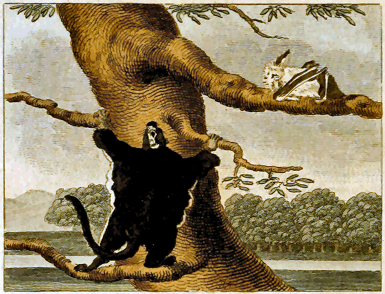
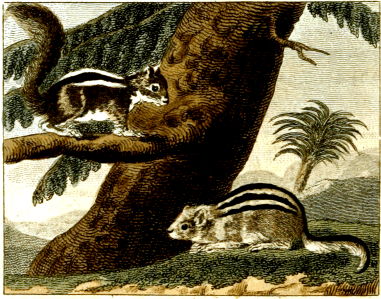
FIG. 122. Swiss Squirrel FIG. 123. Palmist
THE STRIPED BAT.
THIS bat is very small, has a short nose and broad ears, bending forward; it is of a whitish yellow colour, excepting under its throat, breast, and belly, which is a light blue, with a yellow shade; the tail, and membrane of the wings are a mixture of yellow and brown.
THE POLATOUCH.
I HAVE chosen to continue the name this animal bears in Russia, its native country, rather than to adopt those vague and uncertain ones since appropriated to it, such as, the Flying-rat, Flying-squirrel, &c.
The Polatouch (fig. 121) resembles but in a few particulars either the squirrel, loir, or rat. To the squirrel it has no affinity but in the largeness of the eyes, and form of the tail, the latter of which, however, is neither so long, nor bushy as in the former. He is more like the loir by the shape of his body, his short and naked ears, and the hairs of his tail, which are of the same form and length; but he is not like him, subject to numbness in cold weather. The polatouch is a different species from the squirrel rat, or dormouse, though he participates of the nature of all three. M. Klein gave the first exact description of this animal, in the Philosophical Transactions, 1733; he was, however, known long before that time. He is found in the northern parts both of the ancient and New Continent,[AB] but he is more common in America than in Europe, where he is seldom seen, except in Lithuania and Russia. This little animal dwells upon trees, like the squirrel; he goes from branch to branch, and when he leaps from one tree to another, his loose skin stretches forward by his fore-legs, and backward by his hind ones; his skin thus stretched and drawn outwardly more than an inch, increases the surface of his body, without adding to its weight, and consequently retards the acceleration of his fall, so that he is enabled to reach in one leap a great distance. This motion is not like the flight of a bird, nor the fluttering of a bat, both of which are made by striking the air with repeated vibrations. It is one single leap, caused by the first impulsion, the motion of which is prolonged, because the body of the animal presents to the air a larger surface, and thence finds a greater resistance, and falls more slowly. This singular extension of the skin is peculiar to the polatouch, and this characteristic is sufficient to distinguish him from all other squirrels, rats, or dormice. But the most singular things in Nature are not unparalleled; there is another animal of the same kind, with a similar skin, which is not only stretched from one leg to another, but from the head to the tail. This animal, whose figure and description has been given by Seba, under the denomination of the flying-squirrel of Virginia, seems so different from the polatouch, as to constitute another species; though probably it may be only a simple variety, or an accidental and monstrous production, for no traveller or naturalist makes mention of it. Seba is the only one who has seen it in the cabinet of Vincent; and I always distrust descriptions of animals made in cabinets of curiosities, which are often disfigured to make them appear more extraordinary.
I have seen and kept a long while the living polatouch. He has been well described by travellers, particularly Sagard, Theodat, John of Laet, Fernandes, Le Hontan, Denys, Catesby, Dumont, Le Pague du Pratz, &c. and Messrs. Klein, Seba, and Edwards, have given exact descriptions of him, with his figure. What I have seen of this animal agrees with their relations. He is commonly smaller than a squirrel. That which we had weighed little more than two ounces, about the weight of a middling sized bat, and the squirrel weighs eight or nine ounces. However, there are some of a greater size, since we have a skin of a polatouch much larger than usual.
The polatouch has some analogy with the bat by this extension of the skin, which unites the fore and hind legs, and supports him in the air; he seems also to participate of his nature, for he is quiet and sleepy in the day time, having no activity but towards the evening. He is easily tamed, but soon offended, and must be kept in a cage, or fastened with a small chain; he feeds upon bread, fruits, seeds, and is remarkably fond of the buds and shoots of the birch and pine trees. He does not seek after nuts and almonds like a squirrel. He makes a bed of leaves, in which he buries himself, and sleeps through the day, leaving it only in the night, or when pressed by hunger. As he has little agility, he becomes easily the prey of martens, and other animals who climb up the trees, so that the species is not numerous, although they have commonly three or four young at a time.
SUPPLEMENT.
IN the original work I remarked having seen the skin of a polatouch larger than the common size, but the difference was very trifling, to one the Prince de Condé has since permitted me to examine, whose bulk was perfectly gigantic, compared with those of Russia or America, the latter never exceeding five inches in length, and this measured twenty-three. It was taken upon the Malabar coast, where they are very common, as well as in the Philippine Islands, and other parts of India, where they are called taguans, or great flying squirrels; but notwithstanding they resemble the polatouch in figure, and the extension of their skin, yet I think they ought to be considered as different species; for among other varieties, the tail of the taguan is round, and that of the common kind flat; the hair of the former’s tail is also of a blackish brown, the face is quite black, the sides of the head have a mixture of white hairs, and on the nose and round the eyes, there are also some red ones; it has long brown hairs that cover the neck, the whole back is a mixture of black and white, the belly of a dirty white; the upper part of the extended skin is brown, and the under a greyish yellow, the legs black with a reddish shade, the tail brown, deepening by degrees until it becomes quite black at the end, the toes are black, and the claws hooked like those of the cat, from which, and the resemblance of the tail, it has been called by some the flying cat. M. de Vosmaër, in his Description of an Ecureuil Volant, gives a very particular account of both species, as does M. l’Abbé Prevost, and both of which perfectly coincide with the above.
At this time, March 17, 1775, I have one of the small species alive; I kept it in a cage, with a box at the bottom filled with cotton, in which it covers itself all day, and only comes out at night to seek for food. Whenever it is forced to come out, it cries somewhat like a mouse; its teeth are small, but sharp, and it bites violently; it can only be made to extend its wings by letting it fall from some height; and it is so very chilly, that I am astonished how it preserves itself in the northern climates, since it would very soon perish, even in France, if it were not supplied with plenty of cotton to cover itself all over.
Of the Great Flying Squirrel M. de Vosmaër remarks, “that it has a great affinity to the smaller species described by M. de Buffon; they both have the same kind of membranes, with which they support themselves in the air when they leap from tree to tree.” These animals were first mentioned by Valentine, who states them to be found in the island of Gilolo, where they are called flying civets; he describes them to have long tails, and says, when at rest their wings are not to be seen; that they are very wild and fearful; that their heads are reddish, intermixed with grey, that their membranes are covered with hair, their teeth so strong and sharp that they would soon escape from a wooden cage; that they are sometimes called flying monkeys; and that they are also to be met with in the island of Ternat, where they were at first mistaken for squirrels.
M. l’Abbé Prevost says, it is also found in the Philippine Islands, where it is called taguan; that he saw two females, the one at the Hague, whose body was a light chesnut, rather darker on the back, and black towards the extremity of the tail; and that he had also seen two males in the Prince of Orange’s cabinet, which were one foot five inches long in the body, and their tails one foot eight. The hind part of their heads, back, and the commencement of the tail are covered with long hairs, black at the bottom, and of a greyish white at the ends; the other part of the tail is black, and the hair is so disposed as to make the tail have a round appearance, the cheeks are brown, and their throats, breasts, and bellies are of a whitish grey. The membranes are the thinnest in the middle where they are covered with chesnut hairs, increasing in thickness towards the paws, and the colour growing darker until it is nearly black at the extremities.
THE GREY SQUIRREL.
THIS animal is found in the northern parts of both continents. He is in shape like a common squirrel, and his external difference consists in his being larger, and the colour of his hair not being red, but of a grey more or less deep; his ears are not so hairy towards the extremity as those of our squirrels. These differences, which are constant, seem sufficient to constitute a particular species. Many authors think this species is different in Europe and America, and that the grey squirrels of the former are of the common kind, and that they change their colour with the season in the northern climates. Without denying absolutely this assertion, which does not seem sufficiently proved, we look upon the grey squirrel of Europe and America as the same animal, and as a distinct species from common squirrels, who are found in the northern parts of both continents, being of the same size, and of a red, more or less bright according to the temperature of the country.
At the same time, other squirrels of a larger size, whose hair is grey, or somewhat black, in all seasons, breed in the same latitude. Besides, the fur of the grey squirrel is more fine and soft than that of our squirrels; we are, therefore, authorised to believe that though very nearly alike, they ought to be distinguished as different species.
M. Regnard says affirmatively, that the grey squirrels of Lapland are the same animals as the French squirrels. This assertion is so positive that it would be satisfactory were it not contradicted by others; M. Regnard has written excellent dramatic pieces, but he did not give a sufficient application to Natural History, nor did he continue long enough in Lapland to see the squirrels change their colour. It is true that some naturalists, and among them Linnæus, have said, that in the north of Europe the hair of the squirrel changes colour in the winter. This may be true, for the hares, wolves, and weasels, also change their colour in those climates; but from red they grow white, not grey; and to give no other instance but that of the squirrel, Linnæus in the Fauna Suecica, says, æstate ruber hieme incanus, consequently from red he becomes white; and we do not see why this author should substitute for the word incanus that of cinereus, which is found in the last edition of the Systema Naturæ. M. Klein asserts, on the contrary, that the squirrels in the vicinity of Dantzic, are red in the winter as well as in the summer, and that there are others frequently found in Poland grey and blackish, who do not change their colour any more than the red; these last also breed in Canada, and in all parts of North America, consequently we may consider the grey squirrel as an animal common to both continents, and of a different species from that of the common squirrel.
Besides, we do not perceive that the squirrels which are very frequent in our forests unite in troops; we do not see them travel in companies, approach the waters, nor cross rivers upon the bark of trees. Thus they differ from the grey squirrels, not only in size and colour but in natural habits; for although the navigations of the grey squirrels seem almost incredible, they are attested by so many witnesses that we cannot deny the fact.[AC]
Of all quadrupeds that are not domestic, the squirrel is, perhaps, the most subject to vary in shape and colour, and whose species has the greatest numbers of others that approach it. The white squirrel of Siberia seems to differ only in colour from our common squirrel. The black and the grey of America are, perhaps, only varieties of the grey squirrel. The squirrels of Barbary, Switzerland, and the palmist, are three species very much like each other.
We have very little information with regard to the grey squirrel. Fernandes says, that the grey or blackish squirrels of America dwell upon trees, particularly upon pines; that they feed upon fruits and seeds; that they provide provisions for the winter, and heap it up in some hollow tree, where they retire during that season, and where the female brings forth her young. The grey squirrel differs, then, from the others who make their nests at the tops of trees like birds, yet we do not pretend to affirm that the blackish squirrel, mentioned by Fernandes, is the same as the grey squirrel of Virginia, or that both of them are the same as the grey squirrel of Europe; we only think it is probable, as these three animals are nearly of the same size and colour, inhabit the same climates, are precisely of a similar form, and their skins being equally used in the furs, called the fur of the grey squirrel.
THE PALMIST, THE SQUIRRELS OF BARBARY AND SWITZERLAND.
THE palmist is about the size of a rat, or a small squirrel; he lives upon the palm-trees, from which he takes his name. Some call him the palm-rat, and others the palm-tree squirrel; but as he is neither a rat nor a squirrel, we call him palmist. (fig. 123) His head is nearly the same form as that of the campagnol, and covered with rough hair. His long tail does not lie on the ground, like that of the rat, but he carries it erect vertically, without, however, throwing it down on his back like the squirrel; it is covered with hair longer than that of his body, but shorter than the hair of the tail of a squirrel. His back is variegated with white and brown stripes, which distinguish the palmist from all other animals, except the squirrels of Barbary and Switzerland. These three animals are so much alike, that Mr. Ray thought they made but one species; but if we consider that the palmist and the squirrel of Barbary, are only found in the warm climates of the ancient continent, and that the squirrel of Switzerland, described by Lister, Catesby, and Edwards, is only to be met with in the cold and temperate regions of the New World, we must judge them to be different species. By minute observation it is easy to perceive that the white and brown stripes of the Swiss are disposed differently from those of the palmist, whose white stripe extends all along the back, while it is black or brown in the Swiss; and this brown stripe in the latter is followed by a white stripe, in the same manner as the white stripe in the former is by a brown; besides, the palmist has but three white stripes, while the Swiss has four; he also brings down his tail on his back, which the palmist does not: the latter dwells upon trees, and the Swiss is an inhabitant of the earth; from which difference he is called the land squirrel. In fine, he is smaller than the palmist, consequently there can be no doubt of their being two different species.
As for the squirrel of Barbary, as he is of the same continent and climate, of the same size, and nearly the same form as the palmist, they might be considered as varieties of the same species; yet in comparing the description and figure of the squirrel of Barbary, given by Caius, and copied by Aldrovandus and Johnson, with the description given here of the palmist, and comparing afterwards the description and figure of the squirrel of Barbary, given by Edwards, it is easy to discern that they are different animals. We have seen them all in the king’s cabinet. The squirrel of Barbary has the head and forehead more round, the ears longer, and the tail more bushy than the palmist; he is more like a squirrel than a rat, by the form of his head and body; and a palmist resembles more a rat than a squirrel. The squirrel of Barbary has four white stripes, and the palmist has no more than three; the white stripe is on the palmist’s back bone, but that on the squirrel of Barbary is brown and red. These animals have very near the same habits and dispositions as the common squirrel. Like him they feed upon fruit, and use their fore paws in carrying it to the mouth; they have the same voice and cry, the same instinct, and agility; they are lively and tractable, easily tamed, and so fond of their habitations, that they never go out but on diversion, and return spontaneously to their residence. They are both of a pretty figure; their coats, which has white stripes, is more valuable than that of the squirrel; their size is shorter, their body lighter, and their motions equally quick. The palmist, and the squirrel of Barbary, dwell on trees like the common squirrel, but the Swiss lives upon the earth, and, like the field mouse, forms a retreat that the water cannot penetrate; he is also less docile and less gentle than the two others; he bites without mercy, except completely tamed, from which it appears he is more like a rat, or a field mouse, than a squirrel, by instinct and nature.
Engraved for Barr’s Buffon.
FIG. 124. Great Ant Eater.
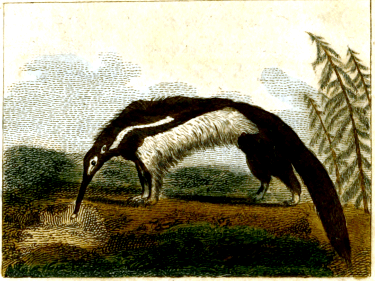
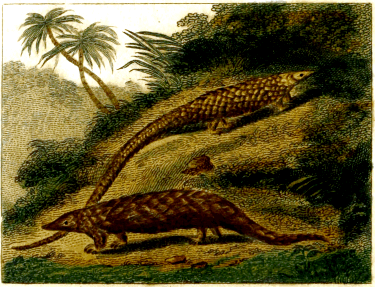
FIG. 125. Short tail’d Manis. FIG. 126. Long tail’d Ditto.
THE ANT EATERS.
SOUTH America produces three animals with a long snout, a small mouth, without teeth, and a large round tongue; with which they penetrate into the ants’ nests, and draw them out again when covered with those insects, which are their principal food. The first of these ant-eaters is that which the Brasilians call Tamandua-Gaucu, or Great Tamandua, and to which the French settled in America have given the name of Tamanoir. This animal (fig. 124) is about four feet in length from the extremity of the muzzle to the origin of its tail; his head is fourteen or fifteen inches long, his muzzle stretches out to a great length; his tail is two feet and a half long, is covered with rough hair, more than a foot in length; his neck is short, his head narrow, his eyes black and small, his ears round, his tongue thin, more than two feet long, and which he folds up in his mouth. His legs are but one foot high; the fore-legs are a little higher, and more slender than those behind: he has round feet; the fore-feet are armed with four claws, the two middle ones are the longest; those behind have five claws. The hair of his tail and body are black and white. Upon the tail they are disposed in a bunch, which he turns up on his back, and covers with it his whole body, when he is inclined to sleep, or wants to shelter himself from the rain or heat of the sun. The long hair of his tail and of his body is not round in all its extent; it is flat towards the ends, and feels like dry grass. He waves his tail frequently and hastily when he is irritated, but it hangs down when he is composed, and sweeps along the ground. The hair of the fore-part of his body is longer than that on the hind part. On the neck and back it is somewhat erect, and towards the tail, and on the flanks, close to the skin; his fore-parts are variegated with white, and his hind-parts wholly black; he has also a white stripe on the breast, which extends on the sides of the body and terminates on the back near the thighs; his hind-legs are almost black, and the fore-legs almost white, with a large black spot towards the middle. The Great Ant-eater moves so slow that a man can easily overtake him in running; his feet seem less calculated to walk than to climb, and to fasten round bodies; for he holds so fast a branch, or a stick, that it is not possible to force it from him.
The second of these animals is called by the Americans only Tamandua; he is much smaller than the former, being not above eighteen inches from the extremities of the muzzle to the tail; his head is five inches long, his muzzle crooked, and long; his tail ten inches long, without hair at the end; his ears are erect, and about an inch long; his tongue is round, eight inches long, and placed in a sort of hollow canal within the lower jaw; his legs are not above four inches in height, his feet are of the same form, and have the same number of claws as the Great Ant-Eater. He climbs and holds fast a branch, or a stick, like the former, and his motions are equally slow. He cannot cover himself with his tail, the hair being short, and the end almost bare. When he sleeps he hides his head under his neck and fore-legs.
The third of these animals, the natives of Guiana call ouatiriouaou. He is still smaller than the second, being not above six or seven inches in length from the extremities of the snout to the tail; his head is two inches long; and his muzzle proportionally short; his tail is seven inches in length, the hair curls downwards, and it is bare at the end; his tongue is narrow, long, and flat; his neck is very short, his head big in proportion to the body; his eyes are placed low, and at a little distance from the corners of the mouth, his ears are small, and hidden by the hair; his legs are but three inches long, the fore-feet have only two claws, the outward of which is much thicker and longer than the inward; the hind feet have four claws, the hair of the body is about nine inches long; smooth, and of a shining colour, diversified with red and yellow, his feet are not made to walk, but to climb and to take hold of branches of trees, on which he hangs himself by the extremity of his tail.
We know of these kind of animals only the three species we have mentioned. M. Brisson, after Seba, speaks of a fourth species, under the denomination of the long-eared ant-eater, but we doubt its existence; because Seba has been guilty of more than one error in enumerating animals of this kind; he says expressly, “we preserve in our cabinet six species called ant-eaters,” and yet he gave only a description of five; and amongst them he reckoned the ysquiepatl, or mouffette, an animal, not only of a species, but even of a genus, widely different from the ant-eaters, as he has teeth, and a flat short tongue, like other quadrupeds, and comes very near a kind of weasels or martens. Out of these six species, pretended to be preserved in the cabinet of Seba, four only remain, as the ysquiepatl, which he reckoned the fifth, is no ant-eater, and the sixth is not even mentioned, unless the author meant to comprehend among these animals the Pangolin or scaly lizard, which he does not intimate in his description of that animal. The scaly lizard feeds upon ants; he has a long muzzle, a narrow mouth, without visible teeth, and the tongue round; characteristics which he has in common with ant-eaters; but he differs from it as well as from all other quadrupeds, by having the body covered with thick scales instead of hair. Besides, this animal belongs to the hottest climates of the old continent, and the ant-eaters, whose bodies are covered with hair, are found only in the southern parts of the new world. There are therefore no more than four species instead of six, mentioned by Seba, and out of these four there is but one species discernible by its description; which is our third or smallest ant-eater, to whom Seba allows but one claw to each foot, though he has two. The three others are so imperfectly described, that they cannot be traced to their true species. One may judge by this of the credit which Seba’s voluminous book deserves. This animal which he calls tamandua murmecophage of America, and the figure of which he has given[AD], cannot be compared with either of the three we are now treating of, it is sufficient to be convinced of his error by reading his description. The second which he terms tamandua-guacu of Brasil, or the bear ant-eater, is described in a vague, equivocal manner; yet I am inclined to think with Klein and Linnæus, that he meant the true tamandua-guacu, or great ant-eater, but it is so badly described, and so imperfectly represented, that Linnæus has comprehended, under one species, the first and second of Seba’s animals. M. Brisson considered the last as a particular species, but I do not believe his establishment of this species better founded than his criticism on M. Klein, for having confounded it with that of the great ant-eater. The only just reproach M. Klein has incurred, is to have added to the good description he has given of this animal, the erroneous indications of Seba. In fine, the third of these animals, whose figure is given in that work, is so badly described, that I cannot persuade myself, notwithstanding the respect I have for Linnæus and Brisson’s authority, this animal from Seba’s description and figure can be the middle ant-eater; I only wish that his description may be attended to in order to judge of its fallacy. These discussions, although tedious and disagreeable, cannot be avoided in the details of a Natural History. Before we write upon a subject very little known, we must, as much as possible, remove all obscurities, and point out the numberless errors before we can come to the truth. The result of this criticism is a proof that three species of ant-eaters really exist, namely the tamanoir, the tamandua, and the ouatiriouaou, and that the fourth called the long-eared ant-eaters, mentioned by M. Brisson, is doubtful, as well as the other species indicated by Seba. I have seen the first and last with their skins, in the king’s cabinet; and they are certainly very different from each other. We have not seen the tamandua, but have described it, after Piso and Marcgrave, the only authors that ought to be consulted upon this animal, as all others have only copied them. The tamandua, and the small ant-eater have the extremities of their tails bare, with which they hang on the branches of trees, and when they perceive hollows, they put their tongues within, and draw them instantly back in their mouths, to swallow the insects which they have gathered.
These three animals, so different in size and proportions of the body, have many things in common, both as to conformation and instinct. All feed upon ants, and put their tongues into honey, and other liquid and viscous substances; they gather quickly crumbs of bread and small pieces of meat; they are easily tamed; they can subsist a long while without food; they do not swallow all the liquor which they take into their mouths, a part returning through their nostrils; they commonly sleep in the day-time, and change their station in the night; they go so slow that a man may overtake them easily whilst running in open ground. The savages eat their flesh, but which has an unsavoury taste.
The great ant-eater looks, at a distance, like a fox, and for that reason some travellers call him the American fox; he is strong enough to defend himself against a large dog, and even the jaguar. When attacked he at first fights standing on his hind legs, like the bear, and makes use of his fore claws, which are powerful weapons; afterwards he lies down on his back, and uses all four feet, and in that situation he is almost invincible, and fights with obstinacy till the last extremity; even after he has put to death his adversary he keeps hold of him a long while. He maintains the fight longer than most animals, from being covered with long bushy hair and a very thick skin, besides his flesh is remarkably hard, and he seldom loses his life in these engagements.
The three ant-eaters are natives of the hottest climates of America, are found in Brasil, Guiana, the country of the Amazons, &c. but they are not met with in Canada, or in the northern regions of the new world, they consequently do not belong to the ancient continent; yet Kolbe and Desmarchais have stated these animals to live in Africa, but they seem to have confounded the scaly lizard with the ant-eaters. Perhaps this mistake is in consequence of a passage of Marcgrave, who says: “Tamandua-guacu Brasiliensibus, congensibus (ubi et frequens est) umbula dictus;” but Marcgrave certainly never saw this animal in Africa, since he confesses that he had seen only his skin in America. Desmarchais only says that the great ant-eater is found in Africa as well as America, but he adds no circumstance to prove this fact. In regard to Kolbe’s attestation, we reckon it nothing, for a man who has seen at the Cape of Good Hope, elks and lynxes, like those of Prussia, might also see the ant-eaters in the same climate. But they are not mentioned by any authors among the animals of Asia or Africa, while all the travellers, and most of the historians, of America, make a particular mention of them. De Lery, de Laët, Father d’Abbeville, Maffèe, Faber, Nieremberg, and M. de la Condamine, agree with Piso and Barrere, in declaring that the ant-eaters are peculiar to the warm countries of America; thus we cannot doubt that Desmarchais and Kolbe were mistaken, and that these three species of animals do not exist in the ancient continents.
SUPPLEMENT.
I HAVE received from M. Maudhuit, residing at Guiana, an ant-eater in excellent condition, which appears to be of the same species as those just described, differing somewhat in the length of the muzzle and the toes.
M. de la Borde has also transmitted several particulars; he says, “There are two species of ant-eaters which inhabit the woods of Guiana, the one larger than the other; they run very slow, and when they swim across large rivers which is a common practice, it is easy to knock them on the head with a stick; but in the woods it is necessary to use muskets, for the dogs refuse to hunt them. The great ant-eater tears up the nests of wood-lice, which he easily discovers; he is a dangerous animal to encounter, as he gives most severe wounds with his claws, with which he successfully defends himself against the most fierce animal of this continent, such as the jaguars, cougars, &c. and with which he also kills many dogs, who are therefore afraid of him. He is said to feed on ants, for which his tongue appeared well calculated, but I found in the stomach of one a great number of wood-lice, which had just been swallowed. The females bring forth in the holes of trees, and have one at a time, and at those periods they will even attack men. The savages at Cayenne eat the flesh, although it is black and unsavory; their skins are thick and hard; they do not attain their full size before they are four years old; and the whole of their respiration is performed through their nostrils. The smaller one has whitish hair, about two inches long; it has no teeth, but its claws are very long; this, as well as the former feeds during the night; the female also has but one at a time, and they perfectly resemble each other, but the latter is more scarce to be met with than the former.”
This gentleman sent me also the following remarks upon our third species. “It has bright hair, rather of a golden colour; it feeds upon ants, which adhere to its tongue; it is not bigger than a squirrel, runs very slow, and is easily taken; it fixes itself so fast to a stick or branch that it may be carried in that manner to any distance, and they are frequently found thus fixed; these, like the former bring forth but one at a time, in the holes of trees, and feed also in the night; they are not by any means scarce, though it is difficult to distinguish them on the trees.”
THE LONG AND THE SHORT-TAILED MANIS.
THESE animals are commonly known under the name of scaly lizards; we reject this denomination; 1st, because it is a compound; 2dly, because it is ambiguous, and applied to both species; 3dly, because it is wrongly imagined; these animals being not only of another species, but even of a different class, than the lizards, which are oviparous reptiles, while the pangolin, and the phatagen, as they are called in their native countries of the east, are viviparous quadrupeds.
All lizards are covered with a sleek speckled skin, in representation of scales, but these animals have no scales on their throat, breast, or belly, the phatagen, or long-tailed manis, (fig. 126) like other quadrupeds, has hair on all these under parts of the body; the pangolin, or short-tailed manis (fig. 125) has nothing but a smooth skin without hair. The scales with which all the other parts of the bodies of these two animals are covered do not stick to the skin, they are only strongly fixed at the lower parts, being moveable, like the quills of a porcupine, at the will of the animal; they raise these scales when exasperated, and when particularly so, they roll themselves up like a ball, resembling the hedge-hog: these scales are so big, so hard, and so sharp, that they repel all animals of prey; it is an offensive armour which wounds while it resists. The most cruel and voracious animals, such as the tiger and the panther, make but useless efforts to devour these animals, they tread upon, and roll them about, but when they attempt to seize them, they receive severe wounds; they can neither destroy them by violence, nor bruize, or smother them with their weight. The fox is averse to attacking the hedge-hog when rolled up, but he forces him to stretch himself by treading on, and squeezing him with all his weight, and as soon as his head appears, he seizes the snout, and thus secures him as a prey. But of all quadrupeds, without even excepting the porcupine, the armour of the manis is the strongest and most offensive, and which animals, by contracting their bodies and presenting their weapons, brave the fury of all their enemies. When they contract themselves, they do not take, like the hedge-hog, a globose figure, but form an oblong, their thick and long tail remaining outwardly and encircling their bodies; this exterior part, by which it would seem these animals could be seized, carries its own defence; it is covered with scales equally hard and sharp as those with which the body is cloathed, and as it is convex upwards and flat below, nearly in the form of half a pyramid, the sides are covered with square scales folding in a right angle, as thick and as cutting as the others, so that the tail seems to be still more strongly armed than the body, the under parts of which are unprovided with scales.
The short-tailed manis is larger than the long-tailed kind; his fore feet are covered with scales, but the feet of the latter, and part of his fore legs are clothed with hair only. The former has also larger scales, thicker, more convex, uniformly cutting, and not so close as those of the latter, which are armed with three sharp points; he is also hairy upon the belly; the other has no hair on that part of his body, but between the scales which cover his back, some thick and long hair issues like the bristles of a hog, which are not on the back of the long-tailed species. These are all the essential differences which we have observed in the skins of both these animals, and which distinguish them from all other quadrupeds so much, that they have been looked upon as a species of monsters. From these general and constant differences, we dare affirm them to be two animals of distinct species. We have discovered their analogies and differences, not only by the inspection of three of them, which we have seen, but also by comparing all which has been observed by travellers and naturalists.
The short-tailed manis is from six to eight feet in length, his tail included, when he comes to his full growth; the tail is nearly as long as the body, though it appears shorter when the animal is young; the scales are not then so large nor so thick, and of a pale colour; the colour becomes deeper in the adult, and the scales acquire such a hardness, as to resist a musket ball. Both these animals have some affinity with the great and middle ant-eater, for like them they feed on ants, have very long tongues, narrow mouths, without apparent teeth; their bodies and tails are also very long, and the claws of their feet very near of the same length and the same form, but they have five toes on each foot, while the great and middle ant-eaters have but four to their fore feet; these are covered with hair, the others are armed with scales; and besides they are not natives of the same continent. The ant-eaters are found in America, and both the species of the manis belong to the East Indies and Africa, where the negroes call them quogelo; they eat their flesh, which they reckon a delicate wholesome food, and use their scales for different purposes. They have nothing forbidding but their figure; they are gentle and innocent, feeding upon insects only; they never run fast, and cannot escape the pursuit of men, except by hiding themselves in hollow rocks, or in holes, which they dig themselves, and in which they breed. They are two extraordinary species, not numerous, and seemingly useless: their odd form seems to exist as an intermediate class betwixt the quadrupeds and reptiles.
THE ARMADILLO.
WHEN we speak of a quadruped, the very name seems to carry the idea of an animal covered with hair; as when we mention a bird, or fish, feathers and scales present themselves to our imagination, and seem to be inseparable attributes of those beings: yet Nature, as if willing to deviate from this characteristic uniformity, and to elude our views, offers herself, contrary to our general ideas, and in contradiction to our denominations and characters, and amazes more by her exceptions than by her laws. Quadrupeds, which we look upon as the first class of living nature, and who are, next to man, the most remarkable beings of this world, are neither superior in every thing, nor separated by constant attributes from all other animals. The first of those characters which constitutes their name, and which consists in having four feet, is common to lizards, frogs, &c. which differ, however, from quadrupeds in so many other respects, as to make them be considered as a separate class. The second general property, to produce young alive, is not peculiar to quadrupeds, since it is also common with cetaceous animals. And the third attribute, which seems the less equivocal, as it is the most apparent, that of being covered with hair, exists not in several species which cannot be excluded from the class of quadrupeds, since this single characteristic excepted, they are like them in all other respects: and, as these exceptions of nature are but gradations calculated to join in a general chain, the links of the most distant beings, we should seize these singular relations as they offer themselves to our view. The armadillos, instead of hair, are covered, like turtles, craw-fish, &c. with a solid crust. The manis is armed with scales like fish; the porcupine carries a sort of prickly feathers, the quill of which is like that of the birds. Thus in the class of quadrupeds, and in the most constant characteristic of these animals, that of being covered with hairs, Nature varies in bringing them near the three different classes of birds, fishes, and the crustaceous kinds. We must be cautious then in judging of the nature of beings by one single character, as that would always lead us into error; even two or three characters, though general, are often insufficient, and it is only, as we have often repeated, by the union of all the attributes, and by enumerating all the characters, that we can judge of the essential qualities of the productions of nature. A good description without definitions, an exposition more exact on the differences than the analogies, a particular attention to exceptions and almost imperceptible gradations, are the true rules, and I dare assert, the only means of estimating nature. If the time lost in forming definitions had been employed in making good descriptions, we should not at this day have found Natural History in its infancy; we should have had less trouble in taking off her bawbles, disentangling her from her swaddling clothes, and, perhaps, have anticipated her slow discoveries, for we should have written more for science; and less against error.
But to return to our subject; it appears then that there exists several species of animals which are not covered with hair among the viviparous quadrupeds. Armadillos form alone a whole genus, in which may be reckoned many distinct species, all of whom are, however, covered with a crust, resembling bone; it covers the head, neck, back, flanks, rump, and the tail, to the very extremity. The crust is covered with a thin skin, sleek and transparent: the only parts that are not sheltered by this buckler are the throat, breast, and belly, which have a white grainy skin, like that of a plucked fowl, by inspecting these parts with attention, we perceive the rudiments of scales of the same substance as the crust; the skin of these animals, even in the places where it is most soft, is therefore inclined to become bony, but the ossification is only realized on the superior and external parts of the body. This crust is not in one piece, like that of the turtle, but consists of several bands, joined to each other by membranes, which allow this armour a degree of motion. The number of these bands does not depend, as might be imagined, on the age of the animal. The young armadillos, and the adults, have the same number of stripes, of which we have been convinced by comparing them; and though we cannot be certain that all these animals do not intermix and produce promiscuously, yet it is very probable, that since the difference in the number of these moveable bands is constant, they are really distinct species, or at least lasting varieties, produced by the influence of various climates. In this uncertainty, which time alone can remove, we have thought proper to mention all the armadillos under one head, enumerating each of them as if they were, in fact, so many different species.
Father d’Abbeville seems to be the first who has distinguished them by different names or epithets, and which have been, for the most part, adopted by the authors who have written after him. He has clearly indicated six species of them: first, tatououasso, or, as we call it, twelve-banded armadillo; 2. the tatouette, or eight-banded; 3. the encuberto of Marcgrave, or six-banded; 4. the tatua-apara, or three-banded; 5. the cinquinçon, or eighteen-banded; 6. cachichame, or nineteen-banded. Other travellers have confounded the species; but we have borrowed only the description of the apar and the cinquinçon, having seen the other four.
All, except the cinquinçon have two long bucklers, one at the shoulders, and another on the rump; they each consist of one solid piece; but the cuirass, which is also bony, and covers the body, is transversely divided, and parted into more or less moveable bands, separated from each other by a flexible skin. But the cinquinçon has but one buckler, and that on his shoulder, the rump being covered with moveable bands, like those of the cuirass of the body. But we shall now proceed to a description of them particularly.
THE THREE-BANDED ARMADILLO.
THE first author who described this animal was Clusius, and though his description was from a drawing only, it is evidently the same species which Marcgrave calls the tatua-apara; from its three moveable stripes, and its short tail; he has an oblong head, almost pyramidal; the snout sharp, small eyes, short round ears, and the upper part of the head covered with a helmet of one piece; he has five claws to each foot; the two middle claws of the fore feet are very long, and the two lateral shorter; the fifth, which projects, is the least. In the hind feet they are shorter and more even. The tail is but two inches in length, and is entirely covered with a crust; the body is a foot long, and above eight inches in its largest breadth. The cuirass, which covers it, is divided into four parts, and composed of three moveable transverse bands, which give the animal liberty to bend and contract his body in a round form; the skin between the stripes is very supple. The bucklers which cover the shoulders and rump are composed of five pieces, equally disposed in five angles; the three moveable bands betwixt these two bucklers consist of square pieces, ornamented with little scales of a straw colour. Marcgrave adds, that when he lies down to sleep, or any person touches him, he brings his fore feet together, lays his head under his belly, and bends himself so perfectly round that he looks more like a sea-shell than a terrestrial animal. This contraction is made with the assistance of two great muscles on the sides of his body, and the strongest man finds it difficult to force him with his hands to stretch out. Piso, and Ray, have added nothing to the description of Marcgrave, but it is singular that Seba, who has given us a description and figure of this animal evidently copied after Marcgrave, not only not mentions that author, but tells us, “that no naturalist has known this animal, that it is extremely scarce, and found in the most remote countries of the East Indies,” when in fact this animal is well described by Marcgrave, and the species is well known, not indeed in the East Indies, but in America, where it is very common. The only real difference between the description of Seba, and that of Marcgrave is, that the latter gives the animal five claws to each foot, and Seba allows him but four, and yet they evidently speak of the same animal.
Fabius Calumna has given the description and figure of an armadillo contracted into a ball, which seems to have had four moveable bands, but as this author was absolutely unacquainted with the animal, whose skin or shell he has described, as he did not even know the name of the armadillo, though mentioned by Bellon fifty years before, but gave him a Greek name, (cheloniscus); besides, as he confesses, that the skin had been pasted together, and wanted several pieces, we do not see ourselves authorised to pronounce, as our modern nomenclators have done, that a species of armadillo, with four moveable bands, exists in Nature; and more especially since these imperfect indications given in 1606, by Fabius Calumna, no mention is made of it in the works of any naturalists; and, if he really did exist, he certainly would have been introduced into some cabinets, or have been observed by some travellers.
Engraved for Barr’s Buffon.
FIG. 127. Six Banded Armadillo.
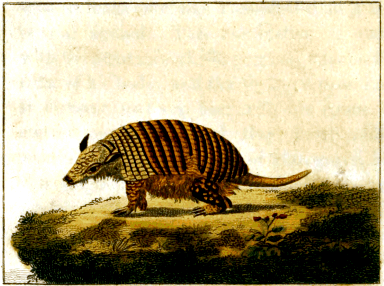
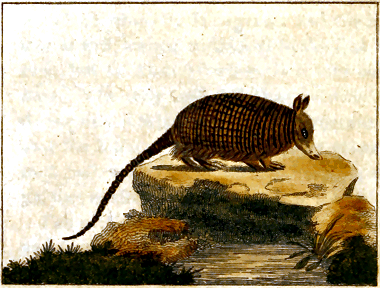
FIG. 128. Long-tailed Armadillo.
THE SIX BANDED.
THIS species (fig. 127) is larger than the former; he has the upper part of the head, neck, body, legs, and tail, covered with a very hard crust, composed of several large pieces, elegantly disposed. He has a buckler on each shoulder, and another on the rump, each of which are in one piece; only there is beyond the buckler on the shoulders, and near the head a moveable band, which enables the animal to bend its neck. The buckler on the shoulders is formed by five parallel rows, composed of pieces which represent five angles, with an oval in each; the cuirass on the back, that is the part betwixt the two bucklers, is divided into six bands, which are united together and to the bucklers, by seven joints of a supple and thick skin. These bands are composed of large square pieces; from the skin of these joints some white hairs issue out, like those on the breast and belly; all these inferior parts are covered only by a grainy skin, and not by a crustaceous substance like the upper. The buckler on the rump has a border, the mosaic work of which is similar to that of the moveable bands, and the rest consists of pieces like those of the bucklers of the shoulders. The crust of the head is long, broad, and consists of one piece, extending to the moveable band on the neck. He has a sharp muzzle, small and hollow eyes, a narrow and sharp tongue; the ears are without hair, naked, short, and brown, like the skin of the joints; he has eighteen teeth in each jaw, five claws to each foot, long, in a round form, and rather narrow; the head and the snout are like those of a pig, the tail is thick at its origin, diminishing gradually towards the extremity, where it is very slender and round. The colour of the body is a reddish yellow; the animal is commonly thick and fat, and the male has the sexual organ very visible; he digs into the ground with great facility with his snout and claws; he dwells in the day-time underground, and only goes out towards the evening to seek for food; he drinks often, lives upon fruit, roots, insects, and birds, when he can catch them.
THE EIGHT BANDED.
THIS is not so large as the last, he has a small head, a sharp snout, the ears erect, and rather long, the tail still longer, and the legs rather short. He has small black eyes, four toes on the fore-feet, and five on those behind; the head is covered with a helmet, the shoulders and rump with shields, and the body with a cuirass composed of eight moveable bands connected together, and with the bucklers, by nine joints of a flexible skin; the tail has also a similar number of bands. The colour of the cuirass on the back is iron grey, and on the flanks and tail of a light grey with spots of iron grey. The belly is covered with a whitish skin, grainy and hairy. The individual of this species, described by Marcgrave, had a head three inches long, the ears near two, the legs about three, the two middle toes of the fore-feet an inch; the body from the neck to the origin of the tail seven inches, and the tail nine inches in length; the bucklers had small white spots; the moveable bands were marked by triangular figures; this crust was not hard, being penetrable to the smallest shot which would kill the animal, whose flesh is very white, and good to eat.
THE NINE BANDED.
NIEREMBERG has described this animal very imperfectly: Wormius and Grew have described him much better. The individual which Wormius mentioned was adult, and one of the largest of the species; that of Grew was younger and smaller. We shall only give their descriptions as far as they agree with our own specimens. Besides, it may be presumed, that this nine-striped armadillo is not really a distinct species from the eight, which he resembles in every other respect. We have two eight-banded armadillos which are dried, and seem to be both males; we have seven or eight with nine bands, one well preserved, which is a female, and the others are so dried up that we could not discern the sex. It is probable, therefore, that the eight-banded is the male and the nine-banded the female. But this is merely a conjecture for we shall give in the following article the description of two armadillos, one of which has more rows than the other upon the buckler on the rump, and yet they are so alike in every other respect, that one should be inclined to think this difference arises only from that of the sex, for it is not improbable, that greater numbers of these moveable bands may be necessary to facilitate the gestation and delivery of the female. The head of the armadillo, the skin of which Wormius has described, was five inches from the end of the snout to the ears, and eighteen inches from the ears to the tail, which last was a foot in length, and composed of twelve rings. The head of that described by Grew was three inches, the body seven and a half, and the tail eleven; the proportions of the head and body agree, but the difference of the tail is too great; and it is probable that the tail of that described by Wormius had been broken, for it should have exceeded a foot in length. As in this species the tail diminishes to the size of an awl, and is, at the same time, very brittle; few of the skins therefore have the whole tail preserved as that described by Grew.
THE TWELVE BANDED.
THIS seems to be the largest of the species. He has a larger and broader head, and a snout not so sharp as the others; his legs and feet are thicker, and his tail has not any crust; a particularity which is alone sufficient to distinguish this species from all others. He has five toes on each foot, and twelve moveable bands. The buckler on the shoulders is formed of five or six rows, each composed of large quadrangular pieces. The moveable bands are also formed of large pieces, almost square; those which compose the buckler on the rump are like those on the shoulder. The helmet of the head consists of large irregular pieces. Between the joints of the moveable bands and in the other parts of the armour, there appear some hairs like the bristles of a hog; there are also upon his breast, belly, legs, and tail, round scales, almost imperceptible, hard and polished like the crust, and between which are small tufts of hair. The pieces which compose the helmet, the two bucklers, and the cuirass, being proportionally larger and less in number in this than in other armadillos, evidently prove he is the largest of the kind. The head of that from which we took this description was seven inches long, and the body twenty-one.
THE EIGHTEEN BANDED.
MR. GREW first described this animal from a skin preserved in the cabinet of the Royal Society in London. All the other armadillos have two bucklers, one on the shoulders, and the other on the rump, but this has but one, which is upon his shoulders. He is called the weasel armadillo, because his head is nearly of the same form as a weasel. From the description of this animal given by Grew, it appears, that his body is about ten inches in length, his head three, and his tail five; the legs two or three inches in height; the forehead large and flat, small eyes, and the ears an inch long, he has five toes on each foot, the three in the middle being the largest. The armour of the head and legs is composed of round scales, about a quarter of an inch diameter, that on the neck consisted of one piece, as did the buckler on the shoulders composed of several rows of scales like those of the armour; these rows on the buckler, in this species, as in all others are continuous, and join by a symphysis. The rest of the body, from the buckler on the shoulders to the tail, is covered with moveable bands, parted from each other by a supple membrane: these bands are eighteen in number; those nearest the shoulders are the largest, and are composed of small squares. The posterior are intermixed with round and square pieces, and the extremity of the armour near the tail is of a parabolic figure. The first half of the tail is encircled with six rings, composed of small square pieces, and the lower part is covered with irregular scales. The breast, belly, and ears, are naked, as in the other species. It should seem that, of all armadillos, this has the most facility to contract and roll himself up in a ball, by his moveable bands which extend to the tail.
Linnæus who must have seen the descriptions of Grew and Ray, who both agree with that we have given, has indicated this animal with one band only, instead of eighteen: founded on an evident mistake, by having taken the tatu seu armadillo Africanus of Seba for the tatu mustelinas of Grew, which even according to the descriptions of these two authors, are very different from each other. It is doubtful whether the tatou of Seba exists, at least as he has described him, but the animal given in Grew’s description is a real existing species.
All the armadillos come originally from America; they were unknown before the discovery of the New World. The ancients never mentioned them, and modern travellers all agree, that these animals are natives of Mexico, Brasil, Guiana, &c. and no one pretends to have seen this species in Asia or Africa. Some have, indeed, confounded the scaly lizards of the East Indies with the armadillos of America. Others thought they existed on the western coasts of Africa, because they have sometimes been transported from Brasil into Guinea. Bellon, who wrote above two centuries ago, and is one of the first who has given a short description, with the figure of a tatou, from a skin which he had seen in Turkey, says, that it came from the new continent. Oviedo, De Lery, Gomara, Thevet, Ant, Herrera, Father d’Abbeville, François, Ximenes, Staddenius, Monard, Joseph Acosta, De Laët, and all the more recent authors mention these animals as natives of the southern countries of America. Piso is the only one who has pretended, without any authority, that the armadillos were found in the East Indies, as well as in America; and it is probable, that he has confounded the scaly lizards with the armadillos, especially as they have been so called by the Spaniards; this error has been adopted by nomenclators, and those who have given descriptions of cabinets; who have not only admitted the existence of armadillos in the East Indies, but even in Africa, though none were ever in those two parts of the world, except such as have been transported from America.
The climate of these animals is not therefore, equivocal; but it is more difficult to determine the relative bulk of each species. For this purpose we have compared great numbers which are preserved in the king’s cabinet and those of others. We have also compared the descriptions of all authors with those of our own, without being able to ascertain the fact. It appears that the twelve and six banded are the largest, and that the three, eight, nine, and eighteen banded are the smallest. In the larger species the crustaceous substance is harder and more solid; the pieces which compose it are larger, and in a smaller number; the moveable bands encroach, less one upon the other; the flesh, as well as the skin, is harder, and not so savory. Piso says, that the flesh of the six banded is not eatable; and Nieremberg affirms, that it is unwholesome and pernicious. Barrere says, that the twelve banded has a strong smell of musk; and all authors agree in praising the flesh of the three banded, and particularly that of the eight, which is as white, and equally good as the flesh of a pig. They say also, that the small species dwell in marshy and low grounds, and that those of the large species are found on dry and high lands only.
These animals can all contract their bodies into a round form, with more or less facility. When they are contracted the defects of their armour is most visible in those who have it composed of the smallest number of pieces; the three banded then shews two large voids betwixt the bucklers and the armour on the back. None of them can roll themselves up in a ball so exact as that formed by the hedge-hog; when so contracted they represent the figure of a globe flattened at the two ends.
This singular crust, which covers them, is a bone composed of small contiguous pieces, and being neither moveable nor jointed, except at the partitions of the bands, are united by a symphysis, and may all be separated from each other if put on the fire. When the animal is alive these small pieces, both of the bucklers and the moveable bands yield to his motions, especially when he contracts himself, otherwise he could not possibly roll himself up. These pieces in different species are of different figures always as regularly disposed as an elegantly contrived mosaic work. The pellicle which covers the crust is a transparent skin, and has the effect of a varnish on the whole body; this skin, when taken off, changes the relievo of this natural mosaic, and gives it a different appearance. This crustaceous covering is only a surface independent of the interior parts of the animal’s body, his bones, and other organs, being composed like those of other quadrupeds.
The armadillos, in general, are innocent, harmless animals, unless they can penetrate into gardens, where they will eat the melons, potatoes, pulse, and roots. Though they originally belong to the hot climates of America, they live in temperate regions. I once saw one in Languedoc, which was fed in the house, and went about every where without doing any mischief. They walk quickly, but they can neither leap, run, nor climb up trees, so that they cannot escape those who pursue them; they have no resource but to hide themselves in their holes, or if at too great a distance from their habitations, to endeavour to dig one before they are overtaken, for which they want but a few instants, the mole itself not being more expert in digging the ground. Sometimes before they can get quite concealed they are caught by the tail, and when they make such a strong resistance that the tail is often broke without bringing out the body; in order to take them without mutilation the burrow must be opened, when they are taken without any resistance; when caught they roll themselves up into a ball, and will not extend again unless they are placed near the fire. Hard as their coat of mail is, the animal, on being lightly touched with the finger, receives so quick an impression that he contracts instantaneously. When in deep burrows they are forced out by smoking them, or letting water run down the holes. It is said that they remain under ground above three months in the year; be that as it may, it is certain that they never come out of their holes but in the night, when they seek for food. The armadillo is hunted with small dogs, by whom he is soon overtaken; but before they have reached him he contracts himself, in which condition he is seized, and carried off. If near the brink of a precipice, he escapes both dogs and hunters, for contracting he rolls himself down like a ball, without hurt or prejudice to his coat of mail.
These animals are fat, and very prolific: the male has exterior signs of great generative faculties; the female brings forth, as it is said, every four months, of course their species are very numerous. As they are good to eat they are hunted in different manners; they are easily taken with snares laid for them on the banks of rivers, and in marshy grounds, which they inhabit by preference. They never go to any great distance from their burrows, which are very deep, and which they endeavour to reach whenever they are alarmed. It is pretended they are not afraid of the bite of the rattle snake, though it is as dangerous as that of the viper; nay, it is asserted, that they live in peace with these reptiles, which are often found in their holes. The savages make different uses of their crusts; they paint them with divers colours, and make baskets, boxes, and other small vessels, of them. Monard, Ximenes, and many other writers, have attributed great medicinal properties to different parts of these animals; they assure us that the crustaceous covering, reduced into powder, and taken inwardly, even in a small quantity, is a powerful sudorific; and that the bone of the hip, pulverised, cures the venereal disease; that the first bone of the tail, applied to the ear, cures deafness, &c. We give no credit to these extraordinary properties; the crust and bones of the armadillos being of the same nature as the bones of other animals. Such marvellous effects are never produced but by imaginary virtues.
SUPPLEMENT.
I RECEIVED the drawing of a six-banded armadillo, taken from life, from M. de Séve, and with it a description; in which, after stating that it corresponds pretty much with that we have given, observes, that the rows on the bucklers, and their pieces, vary in form and number: this animal was fourteen inches long, independent of the tail, which he supposed to be about six inches, as part of it was broken off; his head was rather more than three inches long, and his ears a little above one; on the broadest part of the body the crust measured six inches seven lines; the fore legs were two inches long, and his hind ones three.
M. de la Borde says, there are two species of Armadillos at Guiana, the largest black and the other a greyish brown; the former are so prolific as sometimes to bring forth eight or ten at a litter: they reside in very deep holes, and when any attempts are made to take them by digging, they penetrate further in the earth, and almost perpendicularly; they only quit their holes in the night, and then for the purpose of seeking for food, which commonly consists of worms, ants, and wood-lice; their flesh is of an excellent flavour, and resembles that of a pig. The small one has not more than four or five young at a time, and they are more hard to be taken; these sometimes come out of their holes in the day, but never when it rains. The hunters know when they are in their holes by the number of flies which hover round: and when they begin to dig the animal digs also, and by throwing the earth behind, so effectually closes up the holes that smoke cannot penetrate to them. I conceive the first of these animals to be that we have mentioned, as the twelve-banded, and the other the eight-banded armadillos.
Dr. W. Watson has given a description of an armadillo with nine bands, and a long tail, (fig. 128) in the Philosophical Transactions, where he says, This animal was brought from America, and kept alive in the house of Lord Southwell; but the drawing was not taken till after its death; he weighed seven pounds, and was not bigger than a common-sized cat; while in possession of Lord Southwell it grew considerably; it was fed with flesh and milk, but would not eat grain or fruits. Those by whom it was brought from America asserted, that it dug a hole for itself in the earth in which it lived.
Engraved for Barr’s Buffon.
FIG. 129. Paca. FIG. 132. Marine Opossum.
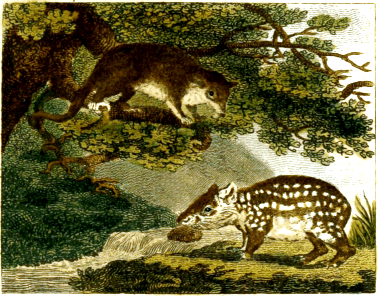
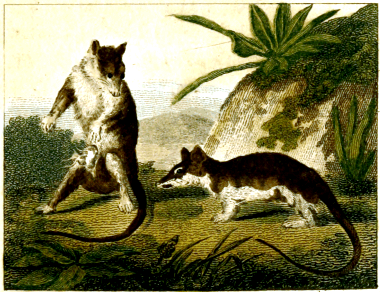
FIG. 130-131. Virginian Opossum Male and Female.
THE PACA.
THE paca (fig. 129) is an animal of the new world, which digs itself a borough like a rabbit, to whom he has often been compared, though there is scarce any likeness between them; he is much larger than the rabbit, or even the hare; his body is bigger and more compact; he has a round head and short snout; he is fat and bulky, and is more like a pig in form, grunting, waddling, and manner of eating, for he does not use, like the rabbit, his fore feet to carry food to his mouth, but grubs up the earth like the hog to find subsistence. They inhabit the banks of rivers, and are found only in the damp and warm places of South America: their flesh is very good to eat, and excessively fat; their skin is eaten like that of a pig. For these reasons a perpetual war is carried on against these animals. Hunters find it very difficult to take them alive; and when they are surprised in their burrows, which have two openings, they defend themselves, and bite with great rage and inveteracy. Their skins, though covered with short and rough hair, make a fine fur because it is regularly spotted on the sides. These animals bring forth very often, and in abundance: men, and animals of prey, destroy great numbers of them, and yet the species remains undiminished in numbers; he is peculiar to South America, and is found no where in the old continent.
SUPPLEMENT.
OUR former description of the Paca was taken from a young one which had not nearly come to its full growth. Since then I have had one sent me, which was much bigger even when he arrived, and continued to grow while I kept him, namely from August 1774, to May 28, 1775. From the Sieur Trécourt I received an account of his natural habits, in which that gentleman says: “This animal remains perfectly quiet in the day, if he is provided with a wooden cage, or box, and has plenty of provisions, to which he readily retires of himself while the day continues, but as soon as night comes on he becomes in a perpetual agitation to get out, and will even use violent efforts to effect that purpose if he is fastened in; this he never attempts during the day, unless pressed to make some natural evacuation, in which case he always gets to the furthest corner, having an aversion to any kind of dirt in the place he lives in; even his straw he pushes out with his nose when it begins to smell, and will seek about for rags, or paper, to supply its place. He had no particular attachment to his box, for he would often forsake it for some obscure corner, and when once his bed was made, he could only be made to leave his new habitation by force. This animal, which was a female, gave a strong proof of her propensity to cleanliness, for a large male rabbit being put with her when she was in season, she received him with a degree of fondness, and something was expected from them; she would lick his nose, ears, and body, and even suffer him to take away the greatest part of her food; but upon voiding his excrement, in their common apartment, she immediately took an aversion to him, and retired to the bottom of an old press, making herself a bed with paper and rags, nor would she return to her house again, until she perceived it was cleared of the dirt and her filthy companion.”
The Paca very easily becomes domesticated, and is very gentle and tractable, unless when much irritated. He is very fond of being noticed, and will lick the hands of those who caress him; he very readily distinguishes the voices of those who take care of him, and when stroked on the back, he will lie down on his belly, stretch himself out, and, with a gentle cry, express his gratitude for the favour, and seem to ask a continuance; but if laid hold of in a rough manner, he will struggle violently to escape. His muscles are very strong, yet his feeling is so delicate that the slightest touch on the skin will excite in him the most sensible emotions; and which sensibility, though commonly producing good humour, will sometimes, by irritation, or presenting an offensive object, put him in the most violent passion. A strange dog invariably produces the latter effect; and he has been observed, when shut in his cage, to make violent efforts to get out upon the appearance of one. It was at first thought he had no desire to come out but upon natural occasions; but one day, when he was at liberty, he flew out upon a poor dog, and bit him very severely; but in a few days after he became perfectly familiar with the same dog. He will also fly at strangers, if they plague him, but he never offers to bite those by whom he is taken care of. He has a dislike to children, and will run after them; and when in a passion he makes a kind of grunting, and at the same time a chattering with his teeth. He very frequently sits for a considerable time together on his posteriors, and has a common practice of appearing to comb his head and whiskers with his paws, which he repeatedly licks with his tongue. When thus employed, he scratches all parts of his body which he can reach with his fore paws, and afterwards the remainder with his hind ones. He is, however, a gross animal; he does not appear delicate; his coat is not smooth; he is far from active, but moves heavily and somewhat like a hog; whom he also resembles by the whiteness and thickness of his skin; he seldom attempts to run, and when he does, it is very aukwardly.
This animal, though not full grown, measured more than eighteen inches from the point of his nose to the extremity of his body, and he could stretch himself out to near two feet, while the one which I formerly described was not more than seven inches five lines, and this difference was evidently to be attributed to their ages, as in all other respects they were perfectly similar.
This animal measured about seven inches high before, and nine and a half behind, by which his head always appeared lower than his hind parts: his head is five inches long, and rather convex; he has large brown eyes, two inches asunder, short round ears, covered with a fine down, a broad black nose, divided like that of a hare, very large nostrils, and in which he has great strength; the upper jaw comes out above an inch beyond the lower; he has a fold along them that may at first sight be taken for the mouth, but which is scarcely perceptible unless it is open; he has two large yellow teeth in each jaw, with which he can cut through wood, and I have known him make a hole in a plank in a single night through which he could put his head; but, although several times attempted, he would never permit us to count his grinders; he has a thick rough tongue, and whiskers on each side his nose, consisting of black and white hairs; he has five toes on each foot, and long claws on them, of a flesh colour; and his tail is merely a kind of button, does not exceed five lines in length, and requires a close inspection to discover it.
The paca, when domesticated, will eat any thing that is given him, and if fed with bread he seems to have an equal relish for it, whether soaked in water, wine, or vinegar; he is extremely fond of sugar and fruits, and will leap about for joy when they are given him; he seems to have the same relish for grapes, celery, onions, or garlic; he will also eat grass, moss, the bark of trees, or even wood; he drinks like a dog; his urine has a disagreeable smell, and his excrements are like those of the rabbit.
As there can be little doubt but these animals would produce in the climates of France; as they are easily tamed, and their flesh is excellent food, they might be rendered an advantageous acquisition, especially as one individual would be equal to seven or eight rabbits, and their flesh not inferior.
M. de la Borde agrees with most of the foregoing particulars, and says also that the paca generally has his hole on the banks of rivers, and that he so forms it as to have three ways to enter or retreat; that when disturbed he takes to the water, and endeavours to effectuate his escape by diving frequently, and that he makes a stout defence when attacked by dogs.
THE OPOSSUM.
THE opossum is an animal of America, which is easily distinguished from all others by two singular characters; first, the female has under the belly a large cavity where she receives and suckles her young; secondly, both male and female have no claws on the great toes of the hind feet, which is separated from the others, as the thumb on the human hand, whilst all the other toes are armed with crooked claws, like the feet of other quadrupeds. The first of these characters has been observed by most travellers and naturalists, but the second had escaped their observation. Edward Tyson, an English physician, seems to be the first who made this remark; and he only has given a good description of the female in a treatise printed in London in 1698, under the title of The Anatomy of an Opossum. Some years after, W. Cooper, a celebrated English anatomist, communicated to Tyson the observations which he had made Upon the male. Other authors, and especially the nomenclators, who have multiplied beings without necessity, have here fallen into numerous errors respecting this animal.
Our opossum, described by Tyson, is the same animal as the oriental philandre of Seba, since of all the animals which Seba has described, and to which he gave the name of philandre, opossum, or carigueya, this is the only one who has a bag under the belly, and thumbs without claws behind. This animal is a native of the warm climates of the new world; for the two we have in the king’s cabinet came from America. That which Tyson had, was sent him from Virginia. M. de Chanvallon, correspondent of the Academy of Sciences in Martinico, who has given us a young opossum, acknowledged the two others to be true opossums of America. All the travellers agree, that this animal is found in Brasil, New Spain, Virginia, and the Antilles; and none mention having seen it in the East Indies; thus Seba was mistaken in calling it the oriental philandre. He says, his philandre was sent him from Amboyna, under the name of coes-coes, with other curiosities, but he confesses, at the same time, that it had been transported from some other remote countries to Amboyna. This should be sufficient to shew, that the denomination of oriental philandre was improper; for it is possible that travellers have transported this animal from America to the East Indies, but nothing proves that he is a native of Amboyna; and even the passage of Seba, which we have quoted, seems to indicate the contrary. The cause of this error and even of the name coes-coes, is found in Piso, who says, that in the East Indies, and only in the island of Amboyna, is found an animal very much like the opossum of Brasil to whom the natives give the name of cous-cous. Piso quotes no authority for this assertion. It would be strange, if it was true, as Piso affirms, that this animal is only found in Amboyna, while Seba, on the contrary, says, that the opossum sent him from Amboyna, was not a native of that island, but had been brought there from more distant countries; though he was ignorant of the native country of his philandre, he nevertheless gave him the epithet of oriental, though he is certainly the same animal as that of the West Indies; the proof of it will clearly appear by comparing the figure he has given with Nature. But another error of this author is, that while he gives to the opossum of America the name of great oriental philandre he presents us another animal, which he thinks a different one, under the name of the philandre of America; and which according to his own description, differs only from the former by being smaller, and having the spots above the eyes of a deeper brown colour; which differences are merely accidental, and too inconsiderable to constitute two different species, for he does not mention another difference more essential, if it existed, that Seba’s philandre of America has sharp claws on the hind toes of the hind feet, while his oriental philandre has no claws upon his two thumbs. It is certain, that our opossum, which is the true one of America, has no claws to his toes behind; if an animal with sharp claws did exist, such as is represented by Seba, it could not be, as he asserts, the opossum of America. But this is not all, Seba mentions a third animal, under the name of oriental philandre, of whom, however, he speaks only after Valentin, an author who, as we have observed already, deserves little credit: and this third animal is yet the same as the two first. We are, therefore, persuaded that the three animals of Seba are individuals of the same species, and which species is the same as our opossum; and that the difference between them might be occasioned by their age, as it entirely consists in their size and slight variations in their colour, particularly in the spots above their eyes.