Front matter
Reading edition
Barr’s Buffon.

Buffon’s Natural History.
CONTAINING
A THEORY OF THE EARTH, A GENERAL HISTORY OF MAN, OF THE BRUTE CREATION, AND OF VEGETABLES, MINERALS, &c. &c.
FROM THE FRENCH. WITH NOTES BY THE TRANSLATOR. IN TEN VOLUMES. VOL. VI.

PRINTED FOR THE PROPRIETOR, AND SOLD BY H. D. SYMONDS, PATERNOSTER-ROW.
1807. T. Gillet, Printer, Wild-court.
CONTENTS OF THE SIXTH VOLUME.
Of Domestic Animals.
The Cat 1
Chap. III. Of Wild Animals 18
The Stag, or Red Deer 27
The Fallow Deer 64
The Roe-buck 70
The Hare 87
The Rabbit 106
Chap. IV. Of Carnivorous Animals 115
The Wolf 145
The Fox 158
The Badger 167
The Otter 172
The Martin 177
The Pine-Weasel 182
The Polecat 185
The Ferret 188
The Weasel 193
The Ermine 197
The Grison 200
The Squirrel 201
The Rat 207
The Mouse 213
The Field-Mouse 215
The Water-Rat 220
The Campagnol 221
The Guinea-Pig 224
The Hedge-Hog 227
The Shrew-Mouse 231
The Water Shrew-Mouse 233
The Mole 234
The Bat 239
The Loir 246
The Lerot 253
The Dormouse 255
The Surmulot 257
The Alpine Marmot 260
The Bear 270
The Beaver 287
The Raccoon 312
The Coati 317
The Agouti 320
The Lion 325
Directions for placing the Plates in the Sixth Volume.
Page 8, Fig. 50, 51.
10, Fig. 52, 53.
37, Fig. 54, 55.
64, Fig. 56, 57.
106, Fig. 58, 59.
112, Fig. 60, 61.
158, Fig. 62, 63.
172, Fig. 64, 65.
185, Fig. 66, 67.
193, Fig. 68, 69, 70, 71.
200, Fig. 72, 73.
207, Fig. 74, 75, 76, 77, 78.
224, Fig. 79, 80, 81.
238, Fig. 82, 83, 84, 85, 86.
246, Fig. 87, 88, 89, 90, 91.
270, Fig. 92, 93.
310, Fig. 94, 95.
318, Fig. 96, 97, 98.
335, Fig. 99, 100.
BUFFON’S NATURAL HISTORY.
OF DOMESTIC ANIMALS.
THE CAT.
The cat is a faithless domestic, and only kept through necessity to oppose to another domestic which incommodes us still more, and which we cannot drive away; for we pay no respect to those who, being fond of all beasts, keeps cats for amusement. Though these animals are gentle and frolicksome when young, yet they even then possess an innate cunning, and perverse disposition, which age increases, and which education only serves to conceal. They are naturally inclined to theft, and the best education only converts them into servile and flattering robbers; for they have the same address, subtilty, and inclination for mischief or rapine. Like all knaves they know how to conceal their intentions, to watch, wait, and choose opportunities for seizing their prey; to fly from punishment, and to remain away until the danger is over and they can return with safety. They readily conform to the habits of society, but never acquire its manners; they have only the appearance of attachment, as may be seen by the obliquity of their motions, and the duplicity of their looks; they never look in the face of those who treat them best and of whom they seem to be the most fond, but either through fear, or falsehood, they approach him by windings to seek for those caresses they have no pleasure in but only to flatter those from whom they receive them. Very different from that faithful animal the dog, whose sentiments are all directed to the person of his master, the cat appears only to feel for himself, only to love conditionally, only to partake of society that he may abuse it; and by this disposition he has more affinity to man than the dog, who is all sincerity.
The form and temperament of the cat’s body perfectly correspond with his disposition. He is handsome, light, adroit, cleanly, and voluptuous; he loves ease, and searches out the softest places for rest and repose. The cat is very amorous, and what is uncommon among animals, the female appears more ardent than the male; she seeks for and invites him, and by her loud cries announces the fury of her desires or rather the pressure of her wants; if he flies from or disdains her, she pursues, tears, and though their approaches are always accompanied with acute pain, she forces him to comply with her desires. This passion of the female continues nine or ten days, and commonly happens only twice a year in the spring and autumn, but sometimes three and even four times. They go with young 55 or 56 days, and they usually have from four to six at a litter. As the males are apt to devour their progeny, the females commonly conceal themselves when they litter, and if suspicious of a discovery, they carry their young ones away in their mouths and hide them in holes or inaccessible places. After suckling them a few weeks, the old one takes them mice or small birds, to accustom them to eat flesh; but by an unaccountable caprice, these very mothers so tender and careful, become sometimes so cruel and unnatural, as to devour their offspring themselves.
Young cats are gay, sprightly, and full of frolic, and would be very good amusement for children if nothing was to be feared from their claws. Their play however, though always light and agreeable, is never innocent, and soon turns into habitual mischief. As they can only exert their talents on small animals, they watch birds, mice, and rats with the greatest patience, which they seize with avidity, and without being taught, become more expert hunters than the best instructed dogs. Their dispositions being naturally averse to all restraint, they are incapable of a regular education; we are told however that the Greek monks of Cyprus[A] taught cats to hunt and destroy the serpents with which that island was infested; but perhaps this hunting was more from their natural inclination to destroy than from obedience, for they take great delight in watching, attacking and destroying all feeble animals without distinction, as birds, young rabbits, leverets, rats, mice, bats, moles, frogs, toads, lizards, and serpents. They are without docility, and their scent, which in the dog is so eminent a quality, is very indifferent, and therefore they hunt by the eye only; neither do they properly pursue, but rather lie in wait and attack the animals by surprise; and after having played with, and tormented them a long time, they kill them without any necessity, even when well fed and in no want of prey to satisfy their appetites.
The most immediate physical cause of their inclination to seize other animals by surprise, comes from the advantage they receive from the particular conformation of their eyes. The pupil in man, and many other animals, is capable of a certain degree of contraction and dilatation; it enlarges a little when the light is faint, and contracts when it becomes too strong; in cats and nocturnal birds, as owls, &c. this contraction and dilatation is so considerable that the pupil, which in the dark is large and round, becomes in the day, long and narrow like a line; and therefore these animals see better in the night than in the day. There is a perpetual contraction in the eye of the cat during the day, and it is only by a great effort that he can see in a strong light, whereas, in the twilight, the pupil resumes its natural form, he sees perfectly, and profits from this superiority to know, attack, and surprise his prey.
It cannot be said that cats, though living in our houses, are entirely domestic. The most familiar are not under any subjection, but rather enjoy perfect freedom, as they only do just what they please, and nothing is capable of retaining them in a place which they are inclined to desert. Besides, most of them are half wild, know not their masters, frequent other granaries, and never visit the kitchens and offices belonging to the house but when pressed to it by hunger.
Cats have less attachment to persons than to houses. When taken to the distance of a league or two they will return to their former abode of their own accord, possibly because they there know all the retreats of the mice, the outlets and passages about the house, and because the labour of the journey back is less than it would be to acquire the same facility in a new place. They fear water, cold, and bad smells; they love to be in the sun, and to lie in warm places; they are very fond of perfumes, and willingly allow themselves to be taken and caressed by those who make use of them. The scent of the valerian root has so powerful an effect on them that it appears to transport them with pleasure; to preserve this plant in the gardens it is necessary to surround it with a close fence, for the cats smell it at a distance, will come about it in numbers, and by rubbing and passing and repassing over it very soon destroy the plant. They do not come to their full growth in less than fifteen or eighteen months, but they are capable of engendering before the end of the first year, and they can procreate all their lives, which seldom exceeds eight or nine years; they are notwithstanding, very lively and hardy, and more nervous than most other animals which live longer.
Cats can only chew slowly, and with difficulty; their teeth are so short and so badly placed, that they rather serve them to tear than grind their food, and, therefore, they always give the preference to tender victuals; they are very fond of fish, which they will eat either raw or boiled; they drink frequently; their sleep is not sound, and they often assume the appearance of sleep for some artful design; they walk gently, and without making any noise. They are very cleanly, and as their coat is always dry their hair easily electrifies, and the sparks are seen to come from it merely by rubbing the hand across it in the dark. Their eyes also sparkle in the dark like diamonds, and seem to reflect in the night the light they may be said to have imbibed during the day.
Engraved for Barr’s Buffon.
FIG. 50. Wild Cat.
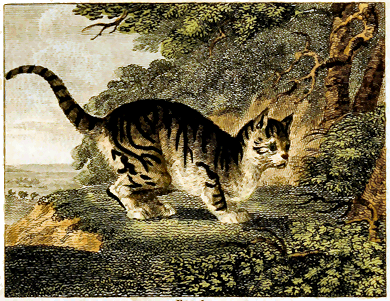
FIG. 51. Domestic Cat.
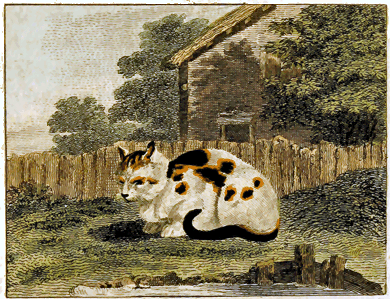
The wild cat (fig. 50.) couples with the domestic one (fig. 51.) and consequently form but one species. It is not uncommon for both males and females to quit their houses when they are proud and go into the woods to seek wild cats, and afterwards return to their former habitations; it is for this reason that some of our domestic cats so entirely resemble the wild ones. The greatest difference between them is internally, the intestines of the domestic cat being longer than those of the wild cat, although the latter is much the largest and strongest; his lips are also always black, his ears more stiff, his tail larger, and his colour more uniform. In this country we know but one species of wild cat, and it appears from the testimony of travellers that this species is found in almost all climates without any great variety. There were some of them upon the new Continent before its discovery: a huntsman carried one to Christopher Columbus which was of the common size, of a dark grey colour, and had a very long strong tail. There were wild ones found at Peru, but none in a tame state; as also in Canada, in the county of Illinois, &c. They have been seen in many parts of Africa, as in Guinea, and the Gold Coast, at Madagascar, where the natives had domestic cats, and at the Cape of Good Hope, where Kolbe says, there are also, though in a small number, wild cats of a blue colour; and these blue or rather slate-coloured cats are also found in Asia. Pietro della Valle says[B], "In Persia there are cats of a species which properly belong to the province of Charazan. Their size and form are like those of the common cat; their beauty consists in their colour, and in their hair which is grey, spotless, and uniform over the whole body, except that it is darker on the back and the head, and shaded lighter on the breast and belly, until it approaches a degree of whiteness; which agreeable mixture, to use the language of the painters, forms a kind of chiaro-obscuro that has a wonderful effect. Besides their hair is shining, soft and delicate as silk, and so long, that, though more smooth than rough, yet it is curled, particularly under the neck. These cats are to the rest of their species, what the water-dogs are to that of the dog. The most beautiful part of their body is the tail, which is very long and covered with hair of five or six inches in length, and which they turn up over their backs like the squirrel, and the upper point resembles a plume of feathers. They are very tame, and the Portuguese have brought them from Persia into the Indies." From this description it appears, that, except in colour, these cats resemble those of Angora (fig. 52.). It is probable, therefore, that the cat of Chorazan, in Persia, and the cat of Angora, in Syria, are of the same race, and whose beauty proceeds from the particular influence of the climate of Syria; in the same manner as the Spanish cats (fig. 53.) which are red, white, and black, and whose hair is soft and glossy, are indebted for their beauty to the climate of Spain.
Engraved for Barr’s Buffon.
FIG. 52. Spanish Cat.
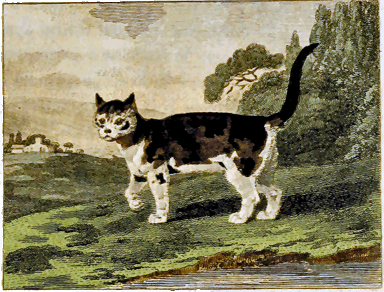
FIG. 53. Angora Cat.
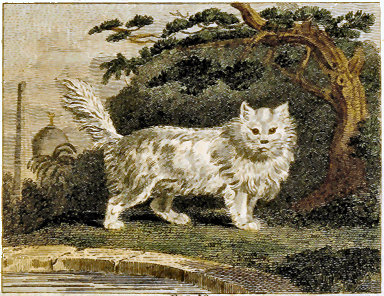
In general it may be remarked, that of all the climates of the inhabited globe, those of Spain and Syria are the most favourable to these beautiful varieties in nature. The sheep, goats, dogs, cats, rabbits, &c. of those countries, have the finest wool, the most beautiful and longest hair, and the most agreeable and most varied colours. Both the hair and colour of the wild cat, like those of most other animals, are coarse; when tamed the former becomes more soft and the latter more variegated, and in the favourable climates of Chorazan and Syria, the hair becomes more long, fine, and copious, and the colours more delicate; the black and red change into a transparent brown, and the dark brown into an ash-coloured grey. By comparing a wild cat of our forests with those of Chorazan, we shall find their greatest difference consists in this shaded variety of colours. As these animals have more or less white upon the belly and sides, it is easy to conceive that to have cats entirely white and with long hair, such as the cats of Angora, we have only to unite those with the most white, in the same manner as is done with rabbits, dogs, goats, stags, &c. In the Spanish cat, which is only another variety of the wild cat, the colours instead of being weakened by uniform shades, as in the Syrian cat, become more bright; the yellow is changed into red, the brown into black, and the grey into white. These cats retain their colours and do not degenerate when transported into America. "In the Antilles, says Father du Tertre, there are a number of cats, probably brought thither by the Spaniards; most of them have red, white, or black marks, and many of the French after eating the flesh, send their skins to France for sale. When we came to Guadeloupe these cats were so accustomed to feed on partridges, doves, thrushes, and small birds, that they would not deign to look upon rats; but no sooner did they find the game diminish than they broke their truce with the rats and fought them vigorously."
In general cats are not, like dogs, subject to degenerate when transported into warm climates. Bosman says, “the European cats when carried into Guinea preserve their original figure the same.” Their nature is indeed more constant, and as their domestic state is neither so entire, universal, nor perhaps so ancient as that of the dog, it is not surprising that they should have undergone less variation. Our domestic cats, though they differ in colour, do not form distinct and separate races; the climates of Spain and Syria having alone produced varieties which are permanent. To these might indeed be added the climate of Pe-chi-ly, in China, where there are cats with long hair and pendant ears, and of which the Chinese ladies are very fond. These domestic cats with pendant ears, of which we have descriptions, are more removed than those with straight ears, from the wild primitive race.
We shall here close the history of the cat, and with it that of domestic animals; of these our number is confined to the horse, the ass, the ox, the sheep, the goat, the hog, the dog, and the cat. We add not to this list the camel, the elephant, the rein-deer, and others, which though domestic in other countries, are not familiar to us; nor shall we enter upon the history of foreign wild animals, till we have given that of the wild animals of our own country. Besides, as the cat may be said to be only half domestic, he forms the shade between the real wild and real domestic animals; for among the domestic we ought not to include such troublesome neighbours as rats, mice, and moles, which, though inhabitants of our houses and gardens, are not less wild and unsubjected; since instead of being attached or subservient to man, they fly from him, and in their obscure retreats, retain their manners, habits, and their liberties inviolate.
In the history of each domestic animal we have seen to what a degree the education, protection, and care of man, influence its disposition, manners, and even form. We have seen that these causes, added to the effects of climate, modify and change the species so as to render them very different from what they originally were, whence is occasioned such a dissimilarity among the individuals of the same species that we should be led to consider them as different animals, did they not produce together fertile individuals, which is the sole essential characteristic of every species. We have seen that the different races of domestic animals observe nearly the same order in the different climates with the human race; that like men they are more strong and courageous in cold countries, more civilized and mild in temperate ones, and more dastardly, feeble, ugly, and deformed, in the hot regions; that moreover it is in temperate climates, and among the most civilized nations, that the greatest diversity, mixture, and numerous varieties of each species are found; it is among them also that animals exhibit evident signs of the antiquity of their servitude; their pendant ears, their varied colours, their long and delicate hair, are so many effects produced by the length of time they have been in a domestic state. Of almost all wild animals the ears are erect. Those of the wild boar are erect and stiff, but those of the domestic hog are inclined and half pendant. Among the Laplanders, the savages of America, the Hottentots, the Negroes, and other uncivilized people, all the dogs have erect ears; whereas in Spain, France, England, Turkey, Persia, China, and all other civilized countries, the generality of them have soft and pendant ears. The ears of the tame cat are not so stiff as those of the wild one; and in China, which is an empire of very ancient civilization, and whose climate is very mild, there are cats with pendulous ears. It is for the same reason that the goat of Angora, whose ears are pendant, should be considered as the animal of his species the furthest removed from his natural state; the influence so evident of the climate of Syria, added to the domestic state of these animals among a people civilized from great antiquity, would in process of time have produced this variety, which cannot be maintained in any other climate. The goats of Angora brought forth in France, have their ears neither so long nor so pendant as those produced in Syria, and would, probably, after a certain number of generations, assume the ears and hair of the goats of our country.
SUPPLEMENT.
It has been supposed that I denied the cat the power of sleeping, but this must have arisen entirely from a misconception of my expression; for although I was not aware of their sleeping so soundly, as I am now informed is sometimes the case, yet I always knew they slept in some degree. M. Pasumot, of the academy at Dijon, has communicated to me a letter on this subject; he says, “Although the cat sleeps seldom, it is very sound, and might sometimes be considered as a kind of lethargy. I have had at least ten instances; a favourite cat used to lay upon the feet of my bed; one night I pushed him away, but found him so immoveable that I conceived him to be dead. I pulled and tossed him about for some time before he shewed any kind of life, when at last he began to awake, but it was even then very slowly. This sound sleep, and difficulty of awaking cats, I have often observed; and I am acquainted with a gentleman who has also been witness of their sleeping in this sound manner, and which he says is always at the time of great heat, or previous to stormy weather.”
M. de Lestrie, a merchant of Chalons, in Champagne, has remarked to me, that the breath of cats frequently exhales an odour resembling musk; particularly when they purr and are tranquil, or when suddenly alarmed and make a hissing noise, from which he inclines to conclude that there are some vessels in the breast of a cat filled with an aromatic quality; but nothing of this nature is to be discovered by anatomy.
In my former history of this animal, I remarked there were cats in China, whose ears were pendant, but as this variety is not found in any other place, it is possibly an animal of a different species; and I am led to this supposition from there being an animal called Sumxu, mentioned by travellers, which they say they can compare to nothing but the cat, which it greatly resembles. It is found among the Chinese, who are extremely partial to it, both on account of its beauty, its hair being of a bright black or yellow colour, and because it readily destroys rats.
We have also another variety of cats in our own climates; as there are some produced with pencils at their ears. M. de Save writes me word, that in November, 1773, he had a young kitten brought forth at his house in Paris, very like what we have described as a Spanish cat, with pencils at her ears, although neither of the parents had them, and that in a few months they were as large in proportion to her size as those of a Canadian lynx. At Madagascar they have tamed some wild cats which have twisted tails, and are called Saca by the inhabitants; but they intermix with the domestic, and are of course of the same species. I have had the skin of an animal sent me from Cayenne, which much resembles a wild cat. They call it Haïra in Guiana, and the natives there eat its flesh, which is white and palatable; I therefore suspect a mistake has been made in its name, and that it is the Taïra, a small martin, of which notice is taken in the latter part of this work.
CHAP. III. OF WILD ANIMALS.
In the History of Man, and of Domestic Animals, we have seen Nature solely as she is constrained; we have rarely seen her perfect, often altered and deformed, and always either surrounded with shackles or loaded with extraneous ornaments. We shall now behold her decked out by simplicity alone, but more attractive by her artless beauty, by her free air, by the sprightliness of her movements, and by all the other attributes of true dignity and independence. We shall behold her traversing the surface of the earth with sovereign sway, portioning her domain among the other animals, and dividing to each species its element, climate, and subsistence; we shall survey her in the forests, in the waters, and in the plains, dictating her simple but immutable laws; imprinting upon every species her indelible characters; dispensing her gifts with equity, and counter-balancing evil with good; we shall observe her giving to some strength and courage accompanied with hunger and voracity; to others mildness, temperance, and agility, attended with fear, inquietude, and timidity; and to all liberty, with uniformity of manners, and ardour in love, which they can easily satisfy, and is always followed by a happy fecundity.
Love and liberty, what blessings! Have those animals which we call savage, because they are not subjected to our will, need of aught more to make them happy? If so, they enjoy another blessing, that of living in a state of equality; they are neither the slaves nor tyrants of each other; the individual has not, like man, to dread the rest of his species; they enjoy peace among themselves, and are strangers to war, but when brought on them by other animals or men. No wonder then that they should shun the human race, steal from our view, live in solitudes remote from our habitations, employ all the resources of their instinct to provide for their safety; and in order to exempt themselves from the power of man, that they should exert every expedient of that liberty which Nature has bestowed on them, together with the desire of independence.
Some animals, and they are the most mild, innocent, and tranquil, are contented with remaining at a certain distance from us, and living in our fields; others more fierce and distrustful, conceal themselves in the recesses of woods; others, as if they knew there was no safety on the surface of the earth, dig themselves subterraneous abodes, take shelter in caverns, or gain the summits of most inaccessible mountains; and others, the most ferocious and most powerful, inhabit deserts only, and reign like sovereigns in those burning climates, where man, as savage as themselves, is unable to dispute the empire with them.
As all beings, even the most independent, are subjected and governed by physical laws, and as brute animals, as well as man, experience the influences of the air and soil, so it appears, that the same causes which have softened and civilized the human species in our climates, have produced similar effects upon all other species. The wolf, which is perhaps the most ferocious animal in the temperate zone, is by no means so terrible or cruel as the tiger, the panther, and the lion of the torrid zone; or as the white bear, the lynx, and the hyæna of the frozen zone. And this difference is not only general, as if Nature, to give a degree of harmony to her productions, had calculated the climate for the species, or the species for the climate, but in each particular species the climate is calculated for the manner, and the manners for the climate. In America, where the heat is less violent, and the air and soil more benign than in Africa, though under the same line, the lion, tiger, and panther, have nothing terrible in them but the name. They are no longer tyrants of the forests, intrepid enemies of mankind, monsters which delight in blood and carnage: but they usually run from before man, and instead of waging open war even against other animals, employ stratagem and artifice to take them by surprise; in a word, they may be rendered subservient and almost domestic; therefore were ferocity and cruelty the characteristic of their natures, they must have degenerated, or rather felt the influence of the climate; under a milder sky their dispositions have become milder; every excess in them has been tempered, and by these changes they have become more conformable to the nature of the country which they inhabit.
The vegetables which cover this earth and are more connected with it than the animal that feeds upon them, partake in a superior degree of the nature of the climate. Every country, every degree of temperature, has its particular plants. At the foot of the Alps we find those of France and Italy, and on their summit those of the northern regions, which very plants we also meet with on the frozen pinnacles of the African mountains. On the south side of the mountains which separate the Mogul empire from the kingdom of Cashmire, we see all the plants of the Indies, and on the other side we are surprised to find none but those of Europe. It is from intemperate climates that we also derive drugs, perfumes, poisons and all the plants whose qualities are excessive. The productions of temperate climates, on the contrary are always mild. Of such happy spots, herbs and roots the most wholesome, the sweetest fruits, the gentlest animals and the most polished men, are the delightful appurtenances. Thus the earth produces plants, the earth and plants make animals, and of the earth, plants, and animals, are formed men; for the qualities of vegetables, proceed immediately from the soil and air; the temperament and other relative qualities of animals which feed on herbs, have a close affinity to the particular kinds they use, and the physical qualities of men, and other animals which subsist on flesh, as well as on vegetables, depend, though more remotely, on the same causes, whose influence extends even to disposition and manners. Size and form, which appear to be absolute and determined qualities, depend, nevertheless, like the relative qualities upon the influence of the climate. The size of our largest animals are greatly inferior to that of the elephant, rhinoceros, or hippopotamus; our largest birds are but small if we compare them with the ostrich, condor, or the cassowary; and what comparison can be made between the fishes, lizards, and serpents of our regions, and the whale, the walrus, and manati, which inhabit the northern seas; or the crocodiles, large lizards, and enormous adders which infest the southern climes, both by land and water? And if we consider each species in different climates, we shall find sensible varieties both in size and figure, as we have already evinced in the history of the horse, goat, hog, and dog. These changes are, however, produced but slowly and imperceptibly; the grand workman of nature is Time, and his operations are equal, uniform, and regular; he performs nothing by starts; nothing but by degrees, by shades, and by succession; and what he does, however imperceptible at first, becomes gradually sensible, and is, at length, marked by effects which it is impossible to mistake.
Wild and independent animals are, of all living beings, man not excepted, the least subject to changes and variations of any kind. Possessed of absolute liberty in the choice of their food and climate, their nature varies less than that of domestic animals, which we enslave, transport, mal-treat, and feed without consulting their taste. Wild animals live uniformly in the same manner; they wander not from climate to climate; their native wood is a country to which they are faithfully attached, and from which they never remove but when they feel they can no longer live in it with security. When they fly it is less to avoid their natural enemies than the presence of man. Nature has supplied them with resources against other animals; with them they are on a level; they know their strength, their cunning, their designs, their haunts, and if they cannot avoid, they oppose them with force to force. But how can they guard against beings who can seize without seeing, and can destroy without approaching them? It is man, therefore, who disturbs, and who disperses these wild animals, and renders them a thousand times more savage than they would otherwise be, for the greater part require nothing but tranquillity, nothing but a moderate and innocent use of the air and earth.
By Nature they are prompted to reside together, to unite in families, and to form a kind of social intercourse. Of this intercourse we still find vestiges in countries not totally engrossed by man; we there find works achieved in common, designs which, without being founded on reason, seem, nevertheless to be projected for rational convenience, and the execution of which supposes at least an union and concurrence of individuals occupied in it. Nor is it by physical force or necessity, like the ants, the bees, &c. that the beavers labour and build; unconstrained either by space, time, or number, they assemble from choice. Those that agree dwell together; and those that disagree live apart; and some, from being perpetually repulsed by the body, are obliged to lead a solitary life. It is only in remote and desert countries, where there is little dread of the approach of man, that they endeavour to establish themselves, and render their habitations more fixed and commodious, by constructing dwellings, or, as it were, small hamlets, which not unaptly represent the first efforts and feeble labours of an infant commonwealth. In countries, on the contrary, over which man is diffused, terror seems to dwell, all society is lost among animals, all industry ceases, and every art is suppressed; they relinquish the occupation of building, and neglect every accommodation; always pressed by fear and necessity, their only study is to live, and their only employment flight and concealment; and if, as may reasonably be supposed, the whole surface of the earth should, in process of time, be equally inhabited by the human species, in a few centuries the history of a beaver would be considered as a fable. The faculties and talents of animals, therefore, instead of increasing are constantly diminishing, for time may be said to oppose them. The more the human species are multiplied and improved the more they become subjected to the dominion of an absolute tyrant, who will hardly permit their individual existence, deprives them of liberty, of every avenue to society, and destroys the very root of their intelligence. What they are become, or what they may become, is an inadequate indication of what they have been or might be. Who can say, if the human species were annihilated, to which of the animals would the sceptre of the earth belong?
THE STAG, OR RED DEER.[C]
The Stag is one of those mild, peaceable, and innocent animals, which seem created to adorn and animate the solitudes of the forest, and to occupy, remote from man, the peaceful retreats of Nature. His light and elegant form, his flexible yet nervous limbs, his grandeur, strength, and swiftness, his head, rather adorned than armed with living branches, which, like the leaves of a tree, are every year renewed, sufficiently distinguish him from the other inhabitants of the forest. As he is the noblest among these, he has been made subservient to the pleasures, and employed the leisure of the greatest heroes. The exercise of the chace may well succeed, or should rather precede the fatigues of war. To be acquainted with the management of horses and arms are talents equally common to the warrior and the hunter. A familiarity with address, bodily exercise and fatigue, so necessary to support courage, are found in the chace, and carried into the field of battle. Hunting is an agreeable school of a necessary art; the only amusement which entirely detaches diversion from business; the only recreation that is totally unaccompanied with effeminacy, and always produces a lively pleasure, that never satiates or cloys. In what manner can those men be better employed who, from their situations, are constantly fatigued with company, than in hunting? Continually, as it were, beset with a multitude, exposed to the importunity of their demands, forced to attend to the affairs of others, to embark in matters of the greatest concern, and, in effect, to be the more constrained in proportion to the elevation of their stations; great men would only feel the irksome weight of grandeur, and exist only for others, if they did not occasionally abstract themselves from a crowd of attendant flatterers. To enjoy themselves in real social affections, to preserve private friendships, to nourish sentiments a thousand times more precious than all the ideas of grandeur, they have need of retirement from the bustle of business, and what retirement can afford greater variety, or be accompanied with more animation than the chace? what exercise can be more beneficial to the body? what relaxation more agreeable to the mind?
To be always acting, or holding intercourse with man, would be as fatiguing as perpetual thinking. Man is not intended by Nature for the contemplation of abstract matters; to occupy himself in different pursuits, to lead a sedentary life, and to make his study his centre of existence, is, by no means, a natural situation, any more than it is to be perpetually agitated by the caprices of other men, and to be continually constrained to keep a guard over his looks, words, and actions. Whatever ideas we may entertain of ourselves, it is evident that to personate is not to be, and that we are less calculated to think than to act, to reason that to enjoy. True pleasure consists in the unrestrained use of ourselves. Our best possessions are those we have from Nature. It is the air and the earth, the plains and the forests, that yield us full enjoyments, full of utility, and never to be exhausted. A taste for the chace, fishing, gardening, and agriculture, is therefore natural to all men; and in societies more simple than ours there subsists but two orders both relative to this mode of life; the nobles, whose employment is war and hunting, and the lower people whose sole office is the cultivation of the earth.
In polished societies, where every thing is refined and brought to perfection, to render the pleasures of the chace more lively and delightful, and to ennoble an exercise which is in itself noble and beneficial, it has been formed into an art. The chace of the stag requires a species of knowledge which can only be acquired by experience; it supposes a royal assemblage of men, horses, and hounds, all so practised, trained and disciplined, as by their mutual intelligence to contribute to one end. The huntsman ought to be able to judge of the age and sex of the animal. He should be able to distinguish exactly whether the stag which his hound has harboured, be a brock, or a staggard; whether it be a young stag, not passed his seventh year, or an old one: the principal data to obtain this knowledge from, are the print of his foot, or his excrement. The foot of the stag is better formed than that of the hind; her leg[D] is larger and nearer to the heel. His steps leave rounder impressions, and are further asunder; he walks more regularly, and brings the hind foot exactly into the impression made by the fore foot; whereas the paces of the hind are not only shorter, but her hind foot does not so regularly fall into the track of her fore foot. A stag of the fourth head, that is, has acquired his fourth horns are easily distinguished; but it requires much experience to know the foot of a young stag from that of a hind. A stag of six or seven years is still more easily distinguished, for his fore feet are much larger than his hind ones, and the older he grows the thicker, or more worn, are the sides of his feet; the distance of his steps are also more regular, his hind foot resting always with tolerable exactness upon the track of his fore foot, unless when they shed their horns, when the old stag is as liable to mistake as the young ones, though in a different manner, and with a regularity unknown to the young stag or the hind, for they rest the hind foot always at the side of the fore one, and never either beyond or within that reach.
In the dry season, when the huntsman cannot judge by the footstep, he is obliged to return upon the track of the animal, and endeavour to find his dung. To be able to determine by which requires perhaps more experience than a knowledge of the footsteps, yet without it the huntsman could not make a just report to the sportsmen assembled. When, in consequence of this report, the dogs are led to the shelter of the stag, the huntsman should know how to animate his hound, and make him rest upon the track of the stag until he be dislodged. Instantly the horn is sounded to uncouple the dogs, which the huntsman should encourage both by the horn and his voice; he should also carefully mark the footsteps of his stag, that he may discover if he should start another, and substitute him in his place; it will, in that case, sometimes happen that the dogs will divide and form a double chace; when so, the huntsmen should divide also and recall those dogs which have thus gone astray. The huntsman should always accompany his dogs, and continue to animate without pressing them too hard; he should also assist them in order to prevent their being deceived by the stag, who will try a number of artifices to elude them; he will frequently trace and retrace his own steps, mix with others, and endeavour to draw a young one to accompany him, and so put a change upon the dogs; he will then redouble his speed, dart off one side, or lie down upon his belly to conceal himself. In this case, when the dogs have lost his foot, the huntsman and the hounds labour in conjunction to recover it; but if unable to hit upon his track, they conclude he is resting within the circuit they have made; if their endeavours continue unsuccessful, they have no other way left them than to take a view of the country, which may give them an idea of the place of his refuge. When discovered, and the dogs are again put upon his track, they pursue with more advantage, as they perceive that the stag is fatigued; their ardor augments in proportion as his strength diminishes; and their perception is more lively, as the animal becomes heated; they then redouble their cries and their efforts, and though he is now more full of stratagems than ever, yet as his swiftness diminishes, his doublings and artifices become less effectual, and he has no other resource but to abandon the earth which has betrayed him, and get into the water to make the dogs lose their scent. The huntsmen traverse these waters, and again put the dogs upon the track of his foot; after which he is incapable of running far, and reduced to the last extremity, stands at bay.
He still endeavours to defend his life, and often wounds dogs, horses, and even huntsmen with his horns, until one of them ham-string him that he may fall, and then put him to death by a stroke of his hanger. They then celebrate the death of the stag with a flourish of horns, and the dogs partake of the victory by their perquisite of his flesh.
All seasons are not alike proper for hunting the stag. In spring, when the forests begin to be cloathed with leaves, and the earth to be covered with verdure and flowers, their odour diminishes the scent of the hounds, and as the stag is then in his full strength it is difficult for them to overtake him. The huntsman also agree that the season when the hinds are about to bring forth is that in which the chace is attended with the most difficulty; and that, at that time the dogs will quit a fatigued stag, to follow any hind that gambols before them: and in like manner, at the beginning of autumn, which is the stag’s rutting season, the blood-hounds lose all their ardour in hunting; the strong scent of the rut probably renders the track less distinguishable, and very possibly the scent of all stags is at this season nearly the same. In winter, when the snow lies on the ground, it is also improper to hunt the stag, as the hounds have no scent, and appear to follow the track rather by the sight than the smell. At this season, as the stags find not sufficient food in the forests, they issue forth into the open country, and go even into inclosures and cultivated lands. They unite in herds in the month of December, and when the frosts are severe, they endeavour to find shelter by the side of a hill or in a thicket, where they lie close, and keep themselves warm by means of their breath. At the end of winter they frequent the borders of the forests, and frequently destroy the rising corn. In spring they shed their horns, which fall off spontaneously, or by a small effort after entangling them with the branch of some tree. It is seldom that the horns of both sides fall at the same time, there usually being an interval of a day or two between them. The old stags shed their horns first, which happens about the end of February, or beginning of March; those in the seventh year in the middle of March; those in the sixth year, the beginning of April; the young stags, those from three to five years old, the beginning, and the prickets not till the middle, or latter end of May. But in all this there is much variety, for old stags sometimes shed their horns later than those which are young; besides they are more forward in casting their horns when the winter has been mild, than when severe and of a long continuance.
After the stags have cast their horns they separate, the young ones only keeping together. They remain no longer in deep covert, but seek the beautiful part of the country, and continue among the coppices during the summer, and until their antlers are renewed. In this season they carry their heads low for fear of rubbing their horns against the branches, for they are very tender until they arrive at perfection. The horns of the eldest stags are not more than half renewed by the middle of May, nor acquire their full growth and hardness before the end of July; the younger stags are later both in shedding and having them renewed; but when completely lengthened and hardened, they rub them against the trees to clear them from a scurf with which they are covered; and as they continue this practice for several days successively, it has been said their horns receive a tint from the juices of the trees against which they are rubbed; that they derive a red cast from the beech and birch, a brown one from the oak, and a black one from the elm, or trembling poplars. It is also asserted that the horns of the young stags, which are smoother and unpearled, are not so much tinged as those of the old ones, which are rougher, and covered with these pearlings, which retain the sap of the tree. But I cannot be persuaded that this is the true cause, for I have had tame stags shut up in inclosures, where there was not a single tree, whose horns were, nevertheless, coloured in the same manner as those of other stags.
Engraved for Barr’s Buffon.
FIG. 54. Stag.
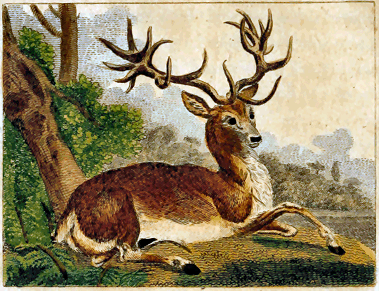
FIG. 55. Hind.
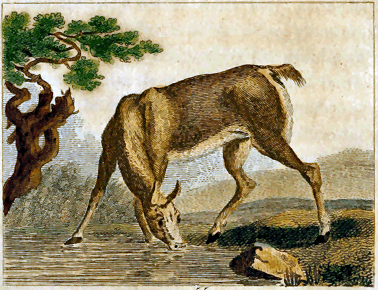
Soon after the stag (fig. 54.) has polished his horns he begins to feel an inclination for the females, and in which respect the oldest are most forward. By the end of August, or beginning of September, they leave the coppice, return to the forest, and begin to search out for favourite hinds; (fig. 55.) they cry with a loud voice, their necks and throats swell, they grow restless, and traverse the fallow grounds and plains in open day, and they dart their horns against the trees and hedges; in a word they seem transported with fury, and range from place to place till they have found their females, whom they then have to pursue and overcome, as the hind flies from him, and never becomes subservient to his passion until she is subdued by fatigue: those hinds which are most advanced in years are first in season. If two stags approach the same hind a combat must precede the enjoyment; if their strength is nearly equal, they threaten, plough up the earth with their paws, make a terrible noise, and dart upon each other with the utmost fury, carry on their battles to such extremities that they often inflict mortal wounds with their horns; nor is the combat ever concluded but by the defeat or flight of one of them. The conqueror loses not an instant to enjoy the fruits of his victory, unless another male happens to appear, when he is again obliged to quit his mate, and put him to flight as he had done the other. The oldest stags are sure to gain the battle, because they are more fierce and stronger than the young ones, who are obliged to wait patiently until their seniors are satisfied and quit the hind; though sometimes indeed, they take the advantage while the two old ones are fighting, and then make a precipitate retreat. The hinds also prefer the old stags, not merely because they are the most valiant, but because they are more ardent. They are also the most inconstant, and commonly have several females at the same time; and when they happen to have but one, they remain attached to her but a very few days, when they go in search of a second, with whom they remain a still shorter time, and then wander from female to female until they are quite exhausted. This amorous fury, however, lasts not above three weeks, during which time they eat but little, and are strangers to all repose; night and day are they on foot, ranging about, fighting with the males, or enjoying the females, and of course, when the rutting season is over, they are so wasted, meagre, and fatigued, that they require a length of time to recover their strength. They then retire to the borders of the forests and graze on the best cultivated lands, where they find food in abundance, and where they continue until their strength is restored.
The rutting time among the old stags commences about the first and concludes about the 20th of September; with those in the sixth or seventh year it begins in the middle of September, and ends the beginning of October; with the young stags it begins about the 20th of September and lasts to the 15th of October, by the end of which month the rutting is all over, except among the prickets, who, as well as the young hinds, are the latest in coming in season; thus by the beginning of November the rutting time is entirely finished; and at that time the stags, being in their weakest state, are most easily hunted down. In those seasons when acorns are plentiful they recover in a very short time, and a second rut will take place towards the end of October, but this is always of a much shorter duration than the first. In warmer climates, as the seasons are more forward, so is the rutting time. Aristotle has told us that in Greece it commences at the beginning of August, and concludes towards the end of September. The hinds carry their young eight months and a few days, and seldom produce more than one fawn; they bring forth in May or the beginning of June; they take the greatest care to conceal their fawns, and will even present themselves to be chased, in order to draw off the dogs, and afterwards return to take care of their young. All hinds are not prolific, and some of them are even barren: these kinds are more gross and fat than the others, and are sooner in heat. It is also said that some hinds have horns like the stags, and this is not void of probability. The fawns are not so called after the sixth month, then the knobs begin to appear, and they take the name of knobbers, which they bear until their horns lengthen into spears, and then they are called brocks, or prickets. Though they grow very fast, they do not quit their mothers all the first summer. In winter they all resort together, and their herds are more numerous as the season is more severe; in the spring they divide; the hinds retiring to bring forth, and it is only the prickets and young stags which then keep together. In general stags are inclined to associate, and it is only from fear or necessity that they are ever found dispersed. At 18 months the stags are capable of engendering, for those brought forth in the spring of the preceding year will couple with the hinds in autumn, and it is to be presumed that such copulations are prolific. If any thing can create a doubt on this subject, it is that the stags have not then attained more than half their growth, for they continue increasing in size till their eighth year, and to that period their horns continue to augment. But it is to be observed that the young fawns gain strength in a little time, that his growth is very quick, both in the first and second years, and that it has already a redundance of nourishment, because it shoots forth its knobs, which are certain indications of its ability to engender. Animals in general, it is true, are not in a condition to procreate till they have nearly acquired their full growth; but those which have certain times allotted for copulation, or spawning, seem to be an exception to this rule: fishes spawn and produce young before they have attained a fourth, or even an eighth of their full growth, and among quadrupeds, those that like the stag, elk, fallow-deer &c. have the rutting time precisely marked, copulate sooner than other animals.
There are so many affinities between the nutrition, the production of the horns, the rutting and the generation of these animals, that, for the better conception of the particular effects that flow from them, it is necessary to recapitulate a few of the general principles of procreation. It depends solely on the redundancy of nourishment; as long as the growth of the body continues, (and it is always in early age that this growth is quickest) the nourishment is totally employed in this operation; at that period, therefore, there is no superabundance, consequently no production, no secretion of the seminal fluid, and hence it is that young animals are not in a condition to engender; but when their growth is nearly acquired, the redundancy begins to manifest itself by new productions. In the human race, the beard, hair, increase of the breasts, and organs of generation, appear at the age of puberty. In the brute creation, and particularly the stag, the redundancy manifests itself by effects still more sensible, as the shooting of the horns, the swelling of the neck and throat, the rutting, &c. and as the stag is very quick at first in his growth, a year does not pass before this redundance shews itself, by the appearance of his horns. If brought forth in May the horns begin to appear in the May following, and they continue to increase to the end of August, by which time they are full grown, and so hard that he rubs them against the trees to clear them of the scurf; the fat also at this time begins to accumulate, is determined towards the parts of generation, and excites in the stag that ardour and desire which renders him so furious. That the production of horns, and power for generation, proceed from the same cause is evident, for by castration the growth of the horns is effectually prevented; if this operation is performed after he has shed his horns they will never be renewed, and if done when they are perfect he will never shed them again; in fact he will remain all the rest of his life in the same state as when he suffered castration; and as he no longer experiences the ardour of the rut, so the accompanying signs also disappear, and he becomes a tame and peaceable animal. From hence it appears that the retrenched parts were necessary for collecting and diffusing them over his whole body in the form of fat, particularly at the top of the head where it gives rise to the horns. It is true, indeed, that castrated stags become fat, but the productions of their horns ceases, their necks and throats never swell, and their fat is very different from that of the perfect stag, which in the rutting season is so very strong as not only to render the flesh uneatable but offensive to the smell, and will corrupt in a very short time, while that of the former may be long preserved sweet, and eaten at all times. Another proof that the horns are produced by a redundance of the nutritive juices may be drawn from the circumstance, that those of stags of the same age will be either thick or thin, in proportion to the supply of food; for the stag which lives in a plentiful country, where he feeds at his pleasure, and rests at his ease, undisturbed by dogs or men, will always have much larger and more beautiful antlers than he who has scanty subsistence, and is disturbed in his repose; so that it is easy to determine by the horns of a stag whether he have inhabited a rich and quiet country. Those also which are in bad health, have been wounded, or frequently disturbed by hunting, have seldom fine horns or good flesh; they are later in beginning to rut, and their horns are neither shed nor renewed so early as others. Thus every circumstance concurs to prove, that the horns, like the seminal fluid, are merely the redundant superfluity of the organic juices which cannot be employed in developing and supporting the animal body.
It is the insufficiency of food, therefore, that retards the growth of the horns and diminishes their size; and perhaps it would not be impossible, by scanty diet, greatly to prevent their growth without having recourse to castration. It is certain that castrated stags eat less than others; and the reason the females of this species, as well as the fallow deer, the roe, and the elk, have no horns, is because they eat less than the males, and because at the very time the redundance would naturally happen, and appear externally, they are with young, and consequently the superfluous juices are first employed in nourishing the fœtus and afterwards in producing milk for the fawn. The objection that the female rein deer is furnished with horns rather supports what is here advanced; for of all quadrupeds which have horns, the rein deer has by much the largest in proportion to his size, as they frequently extend the whole length of his body; he also abounds more in fat, and those of the females are very small comparatively with those of the male; the instance therefore only serves to prove, that when the redundancy exceeds what can be exhausted by gestation, it diffuses itself outwardly in the same manner as that of the males. These remarks respecting nourishment, are not, however, to be applied to the quantity of provisions, but solely to the quantity of organic molecules which they contain; the latter being that active and prolific matter which supports animate beings, and the former a dead mass which has no effect upon the body of the animal; and as the lichen rangiferinus, which is the ordinary food of the rein deer, is a more substantial nutriment than the leaves, bark, or buds of trees, on which the common stag feeds, it is not wonderful that the former should have a greater redundance of organic nutriment, and consequently more fat and larger horns than the latter. It must be allowed, however, that the organic matter, which produces these horns, is not entirely separated from inanimate particles, but preserves even after it has passed through the body of the animal, characteristics of its former vegetable state. The horns of the stag in their make and growth resemble the branches of a tree; and its substance is perhaps more of the nature of wood than bone; it is, as it were, a vegetable grafted upon animal, partaking of the nature of both, and forms one of those shades by which nature always approximates to the two extremes.
In animals the bones grow at the two extremities at the same time, at first becomes hard in the middle, and at the two ends continue soft and receding therefrom until it has acquired its full length. In vegetables, on the contrary, the wood advances by one extremity only; the bud which unfolds to form a branch is only attached to the old wood by its lower end, and it is from this point that it exerts its power of extension in length. This remarkable difference between the growth of bones and the solid parts of plants, does not take place in the horns of the stag, as nothing can bear a stronger resemblance to their growth than that of a branch of a tree; they extend from one extremity only, they are at first as tender as an herb and then harden like wood. The scurf which covers and grows with them is their bark, which the animals rub off when they are arrived at their full growth; until this is completed the ends remain soft, and likewise divide themselves into a number of branches. In a word there is a perfect resemblance in the development of both, and therefore the organic molecules, which constitute the living substance of the horns of the stag, still retain the image of the vegetable, because they are arranged in the same manner as in vegetables. Here we see that matter has an influence over form. The stag, which lives in the forest, and feeds only on the leaves of trees, receives from them so strong an impression that he produces a sort of tree, of whose origin it is impossible to mistake. This effect, though surprising, is not singular, but depends on that general cause which we more than once have already had occasion to point out.
The most constant and invariable thing in Nature is the image or model allotted to each particular species, both in animals and vegetables; what is most variable is the substance of which they are composed. Matter, in general, seems to receive all forms with indifference, and to be capable of all configurations; the organic and living particles of this matter pass from vegetables into animals, without suffering dissolution or alteration, and equally form the living substance of herbs, trees, flesh, or bones. It may seem from this first glance that matter can never predominate over form, and that no sort of nourishment taken by the animal, provided he can draw out the organic particles, and assimilate them to himself by nutrition, can occasion any change upon his form, and can have no effect but that of supporting, or adding to the growth of his body. Of this we have a proof in those animals which live solely upon herbage, who, though a substance widely different from their own bodies, draw from it every thing necessary to constitute flesh and blood, and will even exceed in bulk those who feed upon animal food. In taking a more particular view of Nature we find this is not always the case. Height, for example, which is one of the attributes of form, varies in every species according to the difference of climate; as do the quantity and quality of the flesh, two other attributes of form, according to the different kinds of food. This organic matter, therefore, which the animal assimilates to its body by nutrition, is not absolutely indifferent to the reception of this or that modification: it is not deprived of its original figure; it continues to act in its own form, and though this action be almost imperceptible, yet, in process of time, it necessarily produces very sensible effects. The stag, who inhabits the forests, and lives only upon wood, produces a species of trees, which is nothing more than the superabundant part of his food. The beaver which inhabits the water, and feeds upon fish, has a tail covered with scales; and the flesh of the otter, as well as of most aquatic fowls, is of a fishy nature. It may therefore be presumed, that animals which live constantly upon one kind of food will, in time, imbibe a tincture of its aliment; and however strong the original impression of nature may be, a kind of transformation will take place by an assimilation contrary to the first. In this case the nourishment no longer assimilates entirely to the form of the animal, but the animal assimilates in part to the form of the nourishment, as is seen in the horns of the stag and the tail of the beaver.
The horns, then, are but an excrescence, a part foreign to the body of the stag, and only esteemed as an animal substance because it grows from him; it is in reality a vegetable production, since it retains all the marks of that vegetable from which it derives its origin, and resembles the branch of a tree in the manner it grows, expands, hardens, dries, and separates; for it falls off spontaneously, after having acquired its full degree of solidity, like a ripe fruit from the branch. The very name given to this production in the French language[E] is a proof that it has been considered as a species of wood, and not as a horn, a bone, a tusk, a tooth, &c. In addition to these arguments, we may add a fact recorded by Aristotle, Theophrastus, and Pliny, who all assert that ivy has been seen to grow round the horns of stags while they were in a tender state. If this be true and it would be easy to make the experiment, it would still more fully establish the analogy between the wood of the stag and that of trees. The horns and tusks of other animals are not only of a substance different from the branches of a stag, but also in their growth, texture, and form, both exterior and interior, there is nothing which bears any analogy to wood: these and the nails, claws, hair, feathers, scales, &c. grow, it is true, by a kind of vegetation, but a vegetation widely different from that of trees. The horns of oxen, goats, antelopes, &c. are hollow within, whereas those of the stag are entirely solid; the substance of the former is the same with that of nails, claws, scales, &c. but the horns of the stag resemble wood more than any other substance. All these hollow horns are covered on the inside by a periosteum, and contain in their cavities a bone which serves to support them; they never fall off but continue to increase during the life of the animal, and will assist in determining its age, by the number of annual rings. Instead of growing like those of the stag, from the upper extremity, they grow like nails, feathers, and hair from the lower extremity. Thus it is also with the tusks of the elephant, sea-cow, boar, and all other animals; they are hollow within, and grow only from the lower extremity. These horns or tusks have therefore no more resemblance than nails, hairs, or feathers, to the horns of the stag.
All vegetation is reducible then to three kinds; the first is, when the growth proceeds from the superior extremity, as in herbs, plants, trees, and the antlers of stags; the second, when it is made from the inferior extremity, as in horns, claws, nails, hair, scales, tusks, teeth, feathers, and other exterior parts of animal bodies; the third when the growth advances from both extremities at the same time, as in bones, cartilages, muscles, tendons, and other internal parts of animals. Of all three the proximate cause is the superabundance of organic nourishment, and the only effect, the assimilation of that nourishment, to the mould wherein it has been received. Thus the animal grows more or less quickly in proportion to the quantity of such nourishment, and when the growth is nearly completed, it then seeks to employ itself in the propagation of new organized beings in the manner as we have before stated. The difference between animals, which, like the stag, have fixed seasons, and those which can engender at all times, proceeds likewise from the manner of their feeding. Man and domestic animals, which every day receive an equal quantity of sustenance, and frequently to an excess, may engender at all seasons. The stag, and most wild animals on the contrary, who suffer much from want in the winter, have no superabundance, nor are in a state to engender till they have recruited themselves during the summer; and it is then the rutting season commences, and during which he exhausts himself so much that he remains the whole winter in a state of langour. His flesh and blood are then so impoverished that worms breed under his skin, which still adds to his misery, and which do not perish till the spring, when he recovers new life from the active nourishment he is abundantly furnished with by the fresh production of the earth.
Thus does this animal pass his whole life in alternate plenty and want, vigour and inanition, health and sickness, without having his constitution much affected by the violence of those extremes; nor is the duration of his life inferior to those animals which are not subject to such vicissitudes. As he is five or six years in growing, so he lives seven times that number, or from 35 to 40 years. What has been reported of the prodigious longevity of the stag has no foundation, being only a popular prejudice, which took place in the days of Aristotle, and which he did not consider as probable, because, as he observes, neither the time of gestation nor of growth, indicated long life. Notwithstanding this authority, which ought to have abolished the prejudice, it was again renewed in the days of ignorance, and supported by the story of a stag which was taken by Charles VI. in the forest of Senlis, with a collar upon his neck, bearing the inscription “Cæsar hoc me donavit;” and the people rather choose to believe this stag had lived a thousand years, and had received his collar from a Roman Emperor, than that he came from Germany, where the Emperors yet assume the name of Cæsar.
The horns of the stag increase in bulk and height from the second year to the eighth, and from that time remain with equal beauty during all the vigor of life; but when he begins to decline with age they decline also. It rarely happens that our stags have more than 20 or 22 antlers, and even this number is by no means constant, but he will have a greater number one year than another, according to the nourishment and repose he has enjoyed; and upon the same circumstances the size and quality of the horns likewise depend. It is like the wood of the forest, large, tender, and light, in moist and fertile countries, and short, hard, and heavy in such as are dry arid barren. The size and shape of the animals also vary according to the districts they inhabit. Those which range in valleys, or gently-rising hills, abounding in grain, are much larger than those which frequent dry and rocky mountains; the latter are short and thick; they are not so swift as the former, but can run much longer; they are likewise more mischievous; their horns are short and black, like a tree stinted in its growth, whose bark is always of a darkish hue; whereas the horns of those which feed on plains are lofty, and of a clear red, like the wood and bark of trees which grow in a good soil. These little thick stags generally inhabit among the underwood, where they can the more easily conceal themselves from the pursuit of the dogs. Those of Corsica appear to be the smallest of these mountain stags, and are hardly more than half the size of those common among us, and are, as it were, the terrier among stags; his body is squat, his legs are short, and his hair is dark brown. I am convinced that the size and stature of stags depend upon the quality and quantity of their food, from having reared one, and supplied him very plentifully, who at the end of four years was taller, plumper, and in every respect better furnished than the oldest stags in my woods, though they are of a very large size.
The most common colour of the stag is yellow, though many of them are brown, and some red. White stags are more uncommon, and seem to be a race which have been domesticated, but in very early times, for both Aristotle and Pliny mention them, though as very rare. The colour of the horns, as well as the hair, seems to depend on the nature and age of the animal, and the impression of the air. The horns of the young stags are more white and untinged than those of the old ones. Those stags whose hair is a light yellow have often sallow coloured horns; those of a lively yellow their horns are red, and brown ones, especially those which have black hair on their necks, have black horns. It is true that the interior parts of the horns of all stags are almost equally white, but they differ greatly in point of solidity and texture. Some of them are even spongy and have large cavities. The difference of texture is sufficient to account for their difference in colour, without having recourse to the sap of trees as productive of that effect; especially since we daily see the whitest ivory change brown or yellow if exposed to the air, although its substance is more complete than that of the horns of the stag.
The stag seems to have good eyes, an exquisite smell, and excellent ears. When listening he raises his head, pricks up his ears, and then hears from a great distance; when going into or issuing from a coppice, or half-covered place, he stops to take a full view round him, and scents the wind by way of discovering whether any thing is near that is likely to give him disturbance. Though rather simple he has curiosity and cunning. If any one whistle or call to him from a distance, he stops short, gazes attentively, and with a kind of admiration; and if those who disturbed him have neither arms nor dogs, he passes along quietly and without altering his pace. With equal tranquility and delight he appears to listen to the shepherd’s pipe, and the hunters to embolden them sometimes make use of those instruments. In general he fears men much less than dogs, and entertains neither distrust nor artifice but in proportion as he is disturbed. He eats slow, selects his food, and when full he seeks out a place to lie down and ruminate at leisure; though he does not seem to perform the act of rumination with the same ease as the ox, and it is not without violence that he can make the food rise from his first stomach; this is occasioned by the length and direction of the passage through which the aliment has to pass. The ox has a straight, short neck, but that of the stag is long and arched; efforts, therefore, are necessary to raise the food, and which efforts are made by a kind of hiccough, the action of which is manifest as long as he continues to ruminate. As he advances in age his voice is more strong and tremulous: that of the hind is weaker and shorter, and she never exerts it from love but only from fear. The stag raises a frightful cry in rutting time, for he is so transported that nothing disquiets or terrifies him; he is therefore easily surprised, and being loaded with fat cannot long maintain the chace; but when reduced to an extremity he is dangerous, and will attack the dogs with a kind of fury. He seldom drinks in the winter and not at all in the spring, the dew with which the tender grass is surcharged being then sufficient; but in the heat of summer, he has recourse to brooks, marshes and fountains, and in rutting time he is so overheated that he searches every where for water, not only to appease his immoderate thirst, but to bathe himself and refresh his body. He swims much better at this than at any other time because of his fat, which is specifically lighter than an equal quantity of water. He has been seen to cross large rivers; it has even been asserted that, allured by the scent of the hinds in rutting time, stags will throw themselves into the sea, and pass from one island to another at the distance of several leagues. They leap still better than they swim, for when pursued they easily clear a fence or hedge of six feet high. Their aliment differs according to the seasons: In autumn, after the rutting season, they search out the buds of green shrubs, the flowers of the heath, brambles, &c. In the winter, during snow, they peel the bark off the trees, and feed upon that and the moss, &c. and in mild weather they range for provender among the corn fields. In the spring they seek out the trembling poplar, willow, hazel, &c. In summer, when they have abundance, they seem to like no grain so well as rye, and no wood equal to the black-berry bearing alder.
The flesh of the fawn is very delicate, that of the hind and pricket not bad, but that of the full-grown stag has always a strong and disagreeable taste. The skin and the horns are the most useful parts of this animal; from the former is made a very pliable and durable leather. The horns are used by cutlers, and other mechanics, and a volatile salt, much used in medicine, is drawn from it by chemists.
SUPPLEMENT.
By a letter I received from M. Beccaria, a celebrated Professor at Pisa, dated October 28, 1767, it appears the pupil of the eye of the stag, as well as that of the cat, owl, &c. contracts in the light, and dilates in the dark; of this he was perfectly convinced by some experiments he made with a stag confined in a darkened apartment, but he found the effect was very different from that in the animals above mentioned, for their contraction and dilation is made vertically, while those of the stag are horizontally.
I have also received information of a fact from M. le Marquis d’Amazaga, that merits being noticed in the history of the stag. We have already observed that their horns begin to acquire the form and existence, which they retain for the remainder of the year, at the beginning of August, and after noticing this fact he proceeds in the relation, "that on the 17th of October the attendants of the Prince of Condé chaced a stag six years old, and it being the rutting season they were greatly surprised at the swiftness of his pace and the distance he led them, which was full six leagues from his harbour; and this surprise received no small addition when he was taken, by his horns appearing white and sprinkled with blood, as they are at the season when they rub them against the trees; and it was evident, on his being opened, from the situation of his interior parts, that he had never experienced the effects of the rut, and as he had not been in a condition for rutting he was as loaded with fat as though it had been the month of June, July, or August. Besides this he had another singularity; his right foot wanted the middle bone, and which in the left was at least half an inch long, large, and pointed. As the stag, if he be castrated when he has no horns, never acquires any after, or never loses them if performed when his horns are in perfection, it is but reasonable to suppose that they were retarded, in the present instance, from the imbecility of his organs, but which however were sufficient to effect the fall and renewal of his horns, as it was evident when he was killed that he had had horns annually from the second to the sixth year." These observations strongly prove the justness of our former remarks upon the renovation of the horns of the stag.
In remarking on the Norwegian stags, Pontoppidan says, “they are only in the dioceses of Bergen and Drontheim, and that they have been seen to swim in numbers across the straits, from the continent to the adjacent islands, resting their heads upon each other’s cruppers, and when those who lead are fatigued they retire behind, and the most vigorous take their places.”
Some attempts have been made to render our stags domestic, by treating them with the same gentleness as the Laplanders do their rein-deer; upon which subject M. le Vicomte de Querhoënt has informed me of the following fact: “The Portuguese first brought stags to the Isle of France, and although they took their origin from those of Europe, they were small and their colour grey; there were great numbers of them upon the island when the French took possession of it; they destroyed many of them, but a great proportion secured themselves in the most retired places; these by degrees have become quite domestic, and some of the inhabitants keep them in large flocks.”
There is a small kind of stag at l’Ecole Vétérinaire, which I have seen, and which is said to have come from the Cape of Good Hope. It was spotted with white, somewhat like the axis, and was called the hog stag, merely, as it should seem, because its legs were shorter, and it was not so agile as the common kind. The length of this from the muzzle to the extremity of the body, was only three feet four inches; its legs were short, and its feet and hoofs small; it was yellow with white spots, black eyes, and black hair on the upper eyelid; the nostrils were also black, as were the corners of the mouth; the head was nearly of the same colour as the belly, and it had large ears, white on the in and yellow on the outside. Its horns were above eleven inches long and ten lines thick. Its back was dark brown, its tail was yellow above and white beneath, and its legs were of a brownish black. From all which it appears this animal approaches nearer to the species of the stag than to the fallow-deer.
Engraved for Barr’s Buffon.
FIG. 56. Female Fallow Deer.
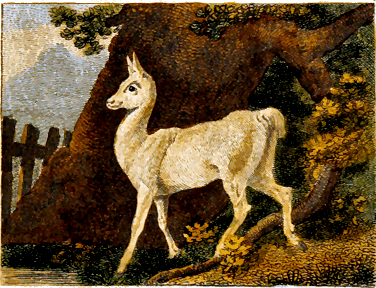
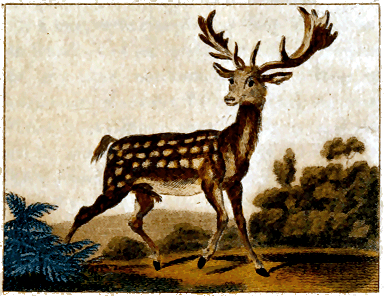
FIG. 57. Fallow Deer.
Published Oct: 29, 1791 by I.S. Barr.
THE FALLOW-DEER.[F]
No two animals can make a more near approach to each other than the stag and the fallow-deer, and yet no two animals keep more distinct, or avoid each other with more fixed animosity; they never herd or intermix together, and consequently never give rise to an intermediate race. It is even rare, unless they have been transported thither, to find fallow-deer in a country where stags are numerous. They seem to be of a nature less robust and less rustic than the stag; are less common in the forests, but are kept in parks, where it may be said they are half domestic. They abound more in England than in any other country in Europe; and there the people are extremely partial to their venison. The dogs also prefer the flesh of this deer to that of all other animals; and having once tasted it, they will quit the chase of the stag or roe, when they come across the track of a fallow-deer. There are some of them in the neighbourhood of Paris, in some provinces of France, Spain, and Germany, as also in America, where probably they have been carried from Europe. It seems to be an animal formed for a temperate climate, for there are not any in Russia, and are rarely met with in Sweden, or any other northern country. Stags are much more generally diffused. They are found throughout Europe, even in Norway, and over all the north, Lapland, perhaps, excepted; in Asia, especially in Tartary, they are numerous, as well as in the northern provinces of China. They are likewise found in America; for those of Canada differ only from ours in the height of their horns, and in the direction of their antlers, which is sometimes not straight forward, as in the heads of the common stags, but turned backward by a very evident inflection; but this form of the horns is not confined to the Canadian stag, as it is nearly the same in the Corsican stags; and some that came from Russia and Germany, have a kind of crown at the summit of their antlers, but these are only varieties, and not different species. There are large and small stags in America as well as in Europe, and yet, however diffused their species may be, they seem to be confined to cold and temperate climates. The stags of Mexico, and other parts of South America; those of Cayenne; those called stags of the Ganges, which are spoken of by M. Perault, under the name of the Sardinian hinds; those to which travellers have given the appellation of Cape stags; those of Guinea, and other warm countries, belong not to the common species, as will appear from the particular history we shall give of each of those animals.
As the fallow-deer is less savage, more delicate, and indeed more domestic than the stag, he is also subject to a greater number of varieties. Besides the common and white fallow-deer, we know of several other kinds, as those of Spain, which are almost as large as stags, but whose necks are more slender, their colour darker, their tails black underneath, and longer than those of the common deer; those of Virginia, which are almost as large as those of Spain, and are remarkable for the size of their genital organs. There are others with compressed foreheads, whose ears and tails are longer than those of the common fallow-deer, and who have the hoofs of their hind legs marked with a white spot; others are spotted or streaked with white, black, or yellow, and there are others entirely black, all of which have their horns more flat, broad, and are better furnished with antlers than those of the stag, they likewise incline more inwardly, and are more palmated at the points. Of the common fallow-deer the tail is longer than that of the stag, and its hair is lighter. The horns of the buck, like those of the stag, are shed every year, and are nearly the same time in being renewed; but as this change happens later, so is their rutting season, by from fifteen days to three weeks later than that of the stag. They are neither so furious at this time, nor exhaust themselves so much by the violence of their ardour: they never quit their own pastures in search of the females, though they will dispute and fight furiously for the possession of them. It often happens, that when there is a great number in one park they will divide into two parties and engage each other with much resolution: these contests generally occur from a wish they both have of grazing upon some particular spot. Each of these parties has its own chief, namely, the oldest and strongest in the herd. These lead on to the engagement, and the rest follow under their direction. Their combats are singular, from the conduct by which their efforts seem to be regulated; they attack with order, and support the assault with courage; mutually assist each other, retire, rally, and never yield the victory upon a single defeat; for the battle is daily renewed till the weakest party are quite defeated, from which time they are obliged to retire to some secluded part of the park, and be contented with the worst pasturage. They love elevated and hilly countries. When hunted they do not fly far before the hounds, like the stag, but study entirely how to escape from the dogs by stratagem; when pressed and heated they will plunge into the water, though it is very rare that they will take to a great river. In the chace, therefore, between the fallow-deer and the stag, there is no essential difference; their instincts and artifices are the same, though more put into practice by the former; which, together with the lightness of his step, render it more difficult for the dogs to avoid being deceived.
The fallow-deer is easily tamed and feeds upon many things which the stag refuses; he also preserves his venison better; nor does it appear that the rutting, followed by a long and severe winter, exhausts him, but he continues nearly in the same state throughout the year. He browzes closer than the stag, for which reason he is more prejudicial to young trees, and often strips them too close for recovery. The young deer eat faster and with more avidity than the old. At the second year they seek the female, and, like the stag, are fond of variety. The doe goes with young eight months and some days; she commonly produces one fawn, sometimes two, but very rarely three. They are capable of engendering at the age of two years to that of fifteen or sixteen; and in fine, they resemble the stag in all his natural habits, and the greatest difference between them is the duration of their lives. From the testimony of hunters it has been remarked that stags live to the age of 35 or 40 years, and from the same authority we understand that the fallow-deer does not live more than 20. As they are smaller than the stag, it is probable that their growth is soon completed. In all animals the duration of life is proportioned to that of the growth, and not to that of gestation, for here the gestation is the same; and in other species, as the ox, though the time of gestation be long, that of the duration of life is very short; whence it follows that we ought not to calculate the duration of life by the time of gestation, but by that which Nature has required for perfecting the growth, reckoning from the birth to the almost entire expansion of the body.
THE ROE-BUCK.[G]
The stag, as being the noblest inhabitant of the wood, occupies the most secret shades of the forest, and the elevated parts of mountains, where the spreading branches form a lofty covert; while the roe-deer, as if an inferior species, contents himself with a more lowly residence, and is seldom found but among the thick foliage of young trees. But if he is less noble, strong, and elevated in stature than the stag, he has more grace, vivacity, and courage; and when the fawns are attacked, he will defend them even against the stag himself. He is more gay and active, his shape is more agreeable and elegant; his eyes are more brilliant and animated; his limbs are more supple; his movements quicker, and with equal vigour and agility he seems to bound without effort. His hair is always clean, smooth, and glossy; he never rolls in the mud like the stag; he frequents the dryest and most elevated places, where the air is the most pure; he has also more cunning and finesse; he is more difficult to chace, and derives a greater number of resources from his instinct. Though he has the disadvantage of leaving a stronger scent behind him than the stag, which excites in the dogs a greater degree of ardour, he knows better how to avoid their pursuit by a rapid flight and repeated doublings; for he does not, like the stag, delay the application of art till his strength begins to fail him; but even in the first instance, when he finds his efforts of speed are not likely to save him, he immediately begins to retrace his former steps, and continues going backwards and forwards till, by his various windings, he has confounded the scent and joined the last emanations to those of his former course; having done which, by a great bound he withdraws to one side, lies flat upon his belly, and suffers the whole pack to pass close by him without attempting to move.
The roe-buck differs also from the stag in his natural appetites, inclinations, and whole habits of living. Instead of herding together, they live in separate families; the sire, dam, and young, form a little community, and never admit a stranger into it. All other animals of the deer kind are inconstant in their amours, but the roe-deer never forsake each other. As the females generally produce two fawns, one of each sex, they are brought up together, and acquire an attachment so strong, that they never separate, unless by some misfortune. This attachment is something more than love, for though they are always together, they do not feel the ardour of the rut more than fifteen days in the year, that is, from the end of October to about the middle of November. They are not at that time like the stag, overloaded with fat; they have no strong smell, no fury, nothing, in short, which alters their state; the only observable difference is, that they drive away their fawns; the buck forcing them off to make room, as it were, for a succeeding progeny. When the rutting season is over, however, the fawns return to their dams, and remain with them some time, after which they quit them entirely to form separate families of their own.
The female goes with young five months and a half, and brings forth about the end of April or beginning of May. The hinds, as already observed, go more than eight, which is alone sufficient to prove their difference of species, that they can never intermix, nor produce an intermediate race. In this respect, as well as in figure and make, they approach the species of the goat, as much as they recede from that of the stag; for the goat goes with young nearly the same time, and perhaps the roe-deer ought to be regarded as a wild goat, which, by feeding solely on trees, carries branches on his brows instead of horns. When about to bring forth, the female separates from the male, and conceals herself in the deepest recesses of the woods, to avoid the wolf, who is her most dangerous enemy. At the expiration of ten or twelve days, the fawns attain sufficient strength to follow her. When threatened with any danger, she hides them in some deep thicket, and by way of preserving them presents herself to be chaced. But all her care is not sufficient to secure them from being frequently carried off by dogs and wolves. This is indeed their most critical time, when this species, which is not very numerous, suffers the greatest destruction, as I have found by experience. I often reside in a part of the country (Montbard in Burgundy) famous for roe-bucks, and where not a spring passes without a great number being brought me, some taken alive by men, and others killed by dogs; insomuch that, without counting those killed by wolves, I am convinced more are destroyed in the month of May than in all the rest of the year; and I have observed, for more than twenty-five years, that as if there subsisted a perfect equilibrium between the causes of destruction and renovation, their number is nearly the same in the same districts. It is not difficult to count them, as they are no where very numerous, and keep together in separate families, and distinct from that of any other. In a coppice, for example, of 100 acres in circumference, there will be found one family, or from three to five individuals, for the females will sometimes have but one fawn, and at others three, but either case seldom happens; in another district more extensive, there will be seven or eight, that is two families; and I have remarked that in each district their numbers have been uniform, excepting in those years when the winters have been remarkably severe; in that case the whole family is destroyed, but by the next year it is succeeded by another; and those districts to which they give the preference are always stocked with nearly the same quantity of them. Notwithstanding this, it is asserted, that this species, upon the whole, is diminishing in number; and, indeed, it is true, that there are provinces in France where not one of them is to be found; that though common in Scotland there are none in England; very few in Italy, and they are more scarce in Sweden than formerly, &c. But these effects might arise from the diminution of forests, or from the excessive rigour of some winters, like that of 1709, by which they were almost all destroyed in Burgundy, and a number of years elapsed before they were renewed. Besides they are not equally fond of every country, and even in the same country they are partial to particular spots. They love hilly grounds, and never remain in the deep recesses of extensive forests, but prefer the skirts of those woods which are surrounded with cultivated fields, and open coppices, where the brambles, buck-thorn, &c., grow in plenty.