Front matter (continued 4)
Reading edition
The females, as well as males, are covered with prickles from the head to the tail, and the under parts of their bodies only are covered with hair; wherefore these arms, so useful to them against their enemies, are highly inconvenient in their amours, as they cannot unite, like other quadrupeds, but face to face, either upright or lying. They come in season in spring, and bring forth at the beginning of summer. I have frequently had the mother and her young brought me in the month of June; their litters generally consist of from three to five; they are white at first, and only the marks of their prickles appear. Desirous to rear some of them, I put a dam and her little family into a tub, with plenty of meat, bread, bran, and fruit, but, instead of suckling, she devoured them one after another. I was surprised that so indolent an animal should discover such marks of impatience at confinement. A hedge-hog which had one day got into the kitchen, took some meat out of a small kettle, and then defiled it with its excrement. I kept males and females in the same apartments, but though they lived they never coupled. I put several of them in my garden, where they did so little damage that it was hardly perceivable they were there; they lived upon the fallen fruits, and dug the earth to a small depth with their snouts; they eat caterpillars, worms, beetles, and some roots; and they are also very fond of flesh, which they devour either raw or roasted.
In the country they are commonly found in the woods, under the trunks of old trees, in the clefts of rocks, and in vineyards. I do not believe they climb trees, as has been asserted, or make use of their prickles to carry off the fruit; they seize with the mouth every thing they eat, and though they are very numerous in our forests, I never heard of one being seen upon a tree, but are always found in hollow places, or under moss. They remain inactive all day, and only go about during the night. They seldom approach human habitations; they prefer dry and elevated grounds, yet are sometimes found in meadows. When touched they do not offer to escape or defend themselves, either with their feet or teeth; but roll themselves up, and are only to be made to extend by plunging them into cold water; they sleep during the winter, and therefore if, as it is said, they amass provisions in summer, they would be entirely useless. They at no time eat much, and can exist a long time without any food. Like all other animals who sleep in winter, their blood is cold; their flesh is not good to eat, nor is their skin, though it was formerly employed in the preparation of hemp, converted to any use.
According to some authors there are two species of the hedge-hog, one with a snout like a hog, and the other with a short muzzle like a dog; but I know of but one, and of which there are even no varieties in our climates. This animal is pretty generally diffused; they are in every part of Europe, except Lapland, Norway, and the other very cold countries. Flacourt says there are hedge-hogs at Madagascar, where they are called Sora. The hedge-hog of Siam, mentioned by Father Tachard, seems to be another animal. Those of America and Siberia evidently approach the nearest to our common hedge-hogs, and lastly, the hedge-hog of Malacca seems to be more of the porcupine than the hedge-hog.
THE SHREW MOUSE.
The shrew mouse (fig. 81.) seems to form a shade in the order of small animals, and to fill up the interval between the rat and the mole, which though they resemble each other in size, differ greatly in form, and are a totally distinct species. The shrew is smaller than the common mouse, resembles the mole in its snout, which is longer than the jaw-bones; in its eyes which, though larger than those of the mole, are in the same manner concealed, and smaller than those of the mouse; in the number of its toes, having five on each foot, in its tail and legs, particularly the hind ones, which are shorter than those of the mouse; in its ears, and lastly, in its teeth. This extremely little creature has a strong smell peculiar to itself, and so offensive to cats, that though they chace and kill, they will not eat it. This noisome odour, and the aversion of the cats, most probably gave rise to the notion that the shrew mouse is a venomous animal, and that its bite is hurtful, particularly to horses; but the truth is, that it is neither venomous nor able to bite, for its mouth is not capable of sufficient extension to take in the double thickness of another animal’s skin, which is absolutely necessary in order to bite. Besides, the distemper among horses, which is vulgarly attributed to the shrew mouse, is a swelling proceeding from an internal cause, and therefore can have no connexion with the bite, or the puncture of this little animal.
The shrew mouse, especially in winter, fixes its residence in stables, hay-lofts, or barns; it feeds on grain, insects, and putrid flesh. It also resides in woods and fields, where it lives on grain; it sometimes conceals itself under moss, leaves, the trunks of trees, and sometimes in holes abandoned by moles, or in holes of a smaller size, which it digs for itself, with its claws and snout. The shrew produces, it is said, as many young at a time as the common mouse, but not so frequently. Its cry is more sharp, but it is not near so nimble, and as it sees imperfectly, and runs slowly, there is very little difficulty in taking it. Their usual colour is brown mixed with red, though some are ash-coloured, and all of them are white under the belly. They are very common throughout Europe, but do not seem to exist in America. The animal of Brasil, which Marcgrave mentions as the shrew mouse, and describes with three black stripes upon the back, is larger, and appears to be of a different species.
THE WATER SHREW MOUSE.
This animal, though a native of these climates, was unknown to any of our naturalists, until M. Daubenton first discovered and described it in the Memoires de l’Academie, in 1756. To the former animal we have only to add, that this is taken near the source of fountains, as the sun rises and sets; that in the day it remains concealed in the clefts of rocks, or in holes at the edges of rivulets; that it brings forth in spring, and has generally nine young ones at a time.
THE MOLE.
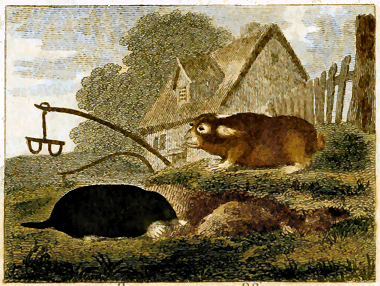
The mole, (fig. 82.) without being blind, has eyes so small, and so concealed, that it can make but little use of seeing, but in recompence Nature has supplied it with an ample portion of the sixth sense. Of all animals the mole is the most profusely furnished with generic organs, and of course with the relative sensations. The senses of hearing and feeling it enjoys in an eminent degree; a skin as soft as velvet, and its little paws, with five claws, are very different from other quadrupeds, and nearly resemble the hand of a human being; they have great strength in proportion to the size of their bodies, and so strong and reciprocal an attachment subsists between the male and female, that they seem to have a dread of, and a disgust to, all other society. They enjoy the mild habitudes of solitude and repose; the art of securing themselves, of instantaneously forming an asylum, of extending it, and of obtaining a plentiful subsistence without a necessity for relinquishing it. Such are the dispositions, manners, and talents, of this animal, and they doubtless are preferable to qualities more brilliant, which are perhaps more incompatible with happiness than even an absolute deprivation of sight.
The mole shuts up the entrance to its retreat, which it seldom leaves, unless forced by heavy rains, or it becomes demolished by man. It prefers cultivated grounds, and is never to be found in those which are muddy, hard, or stony; and delights in a soft soil, well supplied with esculent roots, insects and worms, of which its principal nourishment consists. As they seldom come above ground they have but few enemies, and easily elude the pursuit of carnivorous animals. Their greatest calamity is an inundation, and when that happens, they are seen swimming in great numbers, and using every effort to save themselves by reaching the high grounds; but the greatest part of them perish, as well as their young who remain in the holes. Were it not for such accidents, from their great fecundity, they would be extremely incommodious to farmers. They couple at the beginning of spring, and their young ones are found as early as May. They generally have four or five at a time, and it is easy to distinguish the mole-hill under which they have littered, as they are more elevated, and made with greater art than the rest. I am inclined to think they bring forth more than once a year, but I cannot absolutely assert it; this however is certain, that young ones are met with from April to August, which, however, may be owing to some coupling later in the year than others.
The hole in which they deposit their young is formed with singular skill and deserves a particular description. They begin by raising the earth and forming a tolerably ample roof, leaving divisions or pillars at certain distances to support it, all round which they beat and press the earth, interweave it with roots and plants, and render it so firm that the water cannot penetrate it; the apartment in the hillock is above the level of the ground, and therefore less subject to accidents from slight inundations; under this they form another kind of hill, upon the top of which they lay grass and leaves as a bed for their young. Here they lay secure from wet, and the female proceeds to make their retreat equally free from danger; for all round this internal hillock she pierces holes still deeper, which part from the middle apartment like rays from a centre, and extend about fifteen feet in every direction; into these the mother makes her subterraneous excursions, and from them supplies her young with roots and insects; but they contribute still more to the general safety, for as the mole is very quick of hearing, the instant she finds her habitation attacked she takes to one of the burrows, and unless the earth be dug away by several men at once, she and her young always make good their retreat.
Some authors have asserted that the mole and badger sleep the whole winter: but that this is not true with respect to the badger, we have already observed, from the traces which he leaves upon the snow; and so far is the mole from sleeping the whole winter, that she continues to raise the earth then as well as in the summer; and it is almost proverbial with the peasantry of France, that “when the mole is at work a thaw is at hand.” They are indeed fond of warm places, and the gardeners often catch them round their beds in the months of December, January, and February. This animal is never to be met with in barren deserts or cold climates, where the ground is frozen for the greatest part of the year. The Siberian mole, with green and yellow hair, is of a different species from our mole, which abounds only from Sweden to Barbary; at least from the silence of travellers we may presume it is not an inhabitant of hot climates. The moles of America, particularly the red ones, are also different. The Virginian mole, however, is not unlike ours, except in the colour of the hair, which is mixed with a deep purple. In our common moles there are only two or three varieties; some are more or less brown or black, and some few we have seen entirely white. Seba mentions, and gives a figure of a mole with black and white spots[P], which he found in East Friesland, and which was rather larger than our moles.
I received from M. Sonnerat the skin of what he calls the Mole of the Cape of Good Hope (fig. 83.) which bears a near resemblance to the common moles, excepting the fore-feet and the head, which is much larger, and has a snout somewhat like the Guinea Pig. Its hair is dark brown, with yellow tips, which gives it a bright shade, and its tail is covered with long hairs of a yellowish white. Upon the whole, I am inclined to think that it cannot be considered as a simple variety, but that it is a different species.
Engraved for Barr’s Buffon.
FIG. 82. Mole. FIG. 83. Cape Mole.
Bats.
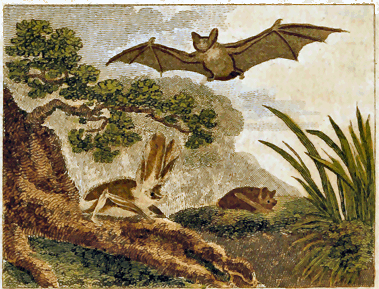
FIG. 86. Common Bat. FIG. 84. Long Ear’d. FIG. 85. Pipistiell.
THE BAT.
Though all beings are equally perfect in themselves, as coming from the hands of the Creator, yet, in their relation to man, some appear more accomplished, and others more imperfect or deformed. The former are those whose figures are agreeable to us, and which we esteem complete, because all their parts are well connected, their members proportioned, and their functions easy and natural. The latter are those whose qualities are offensive to us, whose nature deviates from other beings, and whose forms differ from those whence we drew our first sensations, and those ideas which serve to model our judgments. The head of a man upon the neck of a horse, its body covered with feathers, and terminated with the tail of a fish, is a picture of enormous deformity, only because it is an assemblage of the most incongruous diversities of nature. An animal, like the bat, which is half quadruped and half bird, and which, in fact, is neither the one nor the other, is a kind of monster, because it unites the attributes of two such different genera, and resembles none of those models presented to us in the grand classes of Nature. It is an imperfect quadruped, and a still more imperfect bird; as a quadruped it should have four feet, and as a bird it should have feathers and wings. In the bat the fore feet are, properly, neither feet nor wings, though the animal uses them for the purpose of flying and dragging himself along the ground; they are two shapeless extremities, of which the bones are of an enormous length, and connected by a membrane neither covered with feathers nor hair like the rest of the body; they are a kind of small wings or winged paws, in which we only see one claw about an inch in length, and with which the other four, though very long, must act in conjunction, as they have no peculiar movements, no separate functions; they are a kind of hands ten times larger than the feet, and four times longer than the whole body of the animal; in a word, they are parts which have rather the appearance of caprice and accident, than a regular production. This membrane covers the arms, forms the wings, or hands, of the animal, is united to the skin of the body, and, at the same time envelopes not only its legs, but even its tail, which by this whimsical junction becomes, as it were, one of its toes. To these incongruities, these disproportions of the body and members, may be added the still more striking deformities of the head. In some species the nose is hardly visible; the eyes are sunk near the tip of the ear, and confounded with the cheeks; in others the ears are as long as the body, or else the face twisted into the form of a horse-shoe, and the nose covered with a kind of crust. Many of these animals have four substances from their heads, resembling ears, and of all of them the eyes are small, obscure, and covered; their noses are ill-formed, and their mouths extend from ear to ear; they shun society and the light, inhabit dark places, which they quit only for nocturnal excursions, return before the break of day, and in a manner glue themselves against the walls. Their motion in the air is less a flight than an uncertain flutter, which they execute by struggles and in a very awkward manner; they raise themselves from the ground with difficulty, and never soar to a great height; their flight being far from either rapid or direct, but is performed by hasty vibrations in an oblique and winding direction; in their flight they, however, seize gnats, moths, and other nocturnal insects. These they swallow entire, and in their excrements we meet with the remains of wings and other dry parts which they were unable to digest.
Having one day descended into the grottoes of Arcy to examine the stalectites, I was surprised to find, upon a spot covered with alabaster, and in a place so gloomy, a kind of earth so very different; it consisted of blackish matter several feet in width and breadth, and composed almost entirely of wings and legs of insects, as if immense numbers had collected there and perished together. This heap, however, was nothing more than the dung of bats, amassed, probably, from their having made that their favourite residence for many years; for in the whole extent of the grottoes, which is more than the eighth of a league, I saw no other similar mass; I therefore concluded that they had fixed upon this spot, because a small gloomy light reached it from the top, and that they had not proceeded further, lest they should have been too much enveloped in obscurity.
Bats have nothing in common with birds, except the faculty of flying, and therefore must be classed among quadrupeds; but as the ability to fly implies a great degree of force in the superior and anterior parts of the body, the pectoral muscles of the bat are more strong and fleshy than those of any other quadruped, a circumstance in which they have some resemblance to birds; in every other respect their conformation both external and internal is different. The lungs, heart, organs of generation, and all other viscera, except the prominent sexual distinction, which is similar to that of a man or a monkey, are the same as in other quadrupeds; like them also they are viviparous, and have teeth and nipples. It has been affirmed that they bring forth only two at a time, that they suckle their young, and even carry them when they fly. It is in summer they couple and bring forth, for during winter they are in a state of torpor; some cover themselves with their wings as with a cloak, and suspend themselves by their hind legs in subterraneous caverns; others cling to walls, or conceal themselves in holes. When they retire they do it in numbers, and collect together to defend each other from the cold; and they pass the whole winter, from the end of autumn to the spring, without either food or motion. They can support hunger better than cold; and though they can subsist many days without food, they are nevertheless carnivorous; for when opportunity serves, they will devour meat of all kinds, whether raw or roasted, fresh or corrupted.
There were but two species of bats described as natives of our climate, until M. Daubenton discovered five others equally common and abundant, which renders it astonishing they should have remained so long unnoticed. The whole of them are widely different, and never dwell together. The first is the common bat, (fig. 86.) which we have already described. The next is the long-eared, (fig. 84.) which is perhaps more numerous than the common bat; its body is more diminutive, its wings are shorter, its snout smaller and more pointed, and its ears large beyond all proportion. The third species, which I call the noctule, from the Italian word noctula, was not known, though very common in France, and more frequently met with than the two preceding. It is found under the roofs of houses, castles, and churches, and in hollow trees; it is almost as large as the common bat, its ears are broad and short, its hair of a reddish cast, and its voice sharp and piercing. The fourth is distinguished, by the name of the serotine; it is smaller than the common bat or the noctule, and nearly the size of the long-eared; its ears, however, are sharp, and pointed, its wings are black, and its body of a deep brown. The fifth I call the pipistrelles, (fig. 85.) from the Italian word pipistrello, which signifies also a bat. Of all the bats this is the smallest and least ugly, though the upper lip is swelled, its eyes small and hollow, and its forehead covered with hair. The sixth is named the barbastelle (fig. 89.) from barbestello another Italian word, signifying a bat. This is nearly of the same size as the long-eared; its ears are as broad but not so long. The name barbastelle is the more applicable to it, as it seems to have whiskers, which nevertheless are only protuberances over the lips; its snout is short, nose flat, and its eyes close to its ears. The seventh, and last, is distinguished as the horse-shoe bat, (fig. 88.). The face of this animal is singularly deformed, of which the most apparent feature is a membrane in the form of an horse-shoe round the nose and upper lip; this species is very common in France, among the walls and in the vaults of old ruinous castles, and of which there are large and small, but in form, and in every other particular, they are similar. As I have not met with any of the intermediate sizes, I cannot determine whether this difference is produced by age, or a permanent variety in the same species.
THE LOIR.
Of the loir, or great dormouse, or as some naturalists have termed it, the fat squirrel, there are three species; and, like the marmot, they all sleep during the winter; namely, the loir, the lerot, and the muscardin, or common dormouse. These three species have been confounded together although they are very different, and easily distinguished. The loir is nearly of the size of the squirrel, and like that animal, has its tail covered with long hair; the lerot is not so large as a rat, has very short hair on its tail, except at the extremity, where there is a tuft of long hair; the dormouse is not bigger than the common mouse, its tail is covered with longer hair than the lerot’s, but shorter than the loir’s, and it also has a tuft at the extremity. The loir differs from the other two, by having black spots about its eyes, and the dormouse by having white hair upon his back. They are all white or whitish under the neck and belly; the white of the lerot is beautiful, that of the loir more dark, and that of the dormouse has a yellow line in all the inferior parts.
Engraved for Barr’s Buffon.
FIG. 89. Barbastelle Bat. FIG. 87. Scrotine Bat. FIG. 88. Horse-shoe Bat.
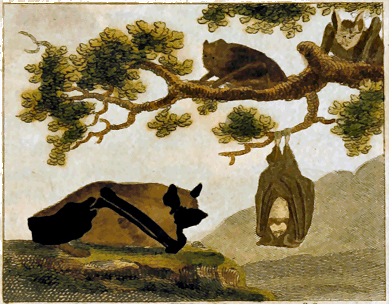
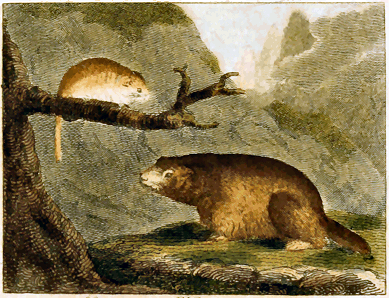
FIG. 90. Dormouse. FIG. 91. Alpine Marmot.
There is no truth in the assertion that these animals sleep during winter, for they are not in a state of natural sleep, but in a torpor produced by the coldness of the blood, by which they lose the use of their senses and members. Their internal heat does not exceed the temperature of the air. When the heat of the air is ten degrees above the freezing point, their heat is exactly the same. The ball of a small thermometer I have plunged into the bodies of several living lerots, and always found the heat of their bodies was nearly equal to the temperature of the air; and sometimes when applied to the very heart, I have observed the thermometer fall from half a degree to a whole one, the temperature of the air being at eleven. Now it is well known that the internal heat of man, and of the generality of quadrupeds, at all times exceeds thirty, and therefore there is little reason to be surprised that these animals, whose heat is so small, should become torpid, when their little internal heat ceases to be assisted by the external heat of the air; a circumstance that naturally happens when the thermometer is not above ten or eleven degrees above the freezing point. This is the real cause of the torpor of these animals, a cause which has been overlooked, although it extends to all animals which sleep during winter. Alike are its effects upon these animals, the hedge-hog and bats; and though I have never had the opportunity of trying them upon the marmot, I am persuaded its blood is not less cold, since like them it is subject to a torpor during winter.
The torpor continues as long as the cause which produces it, and ceases with the cold. A few degrees of heat above ten or eleven is sufficient to reanimate them, and if kept in a warm place during winter they do not become torpid, but go about and eat and sleep, from time to time, like other animals. When they feel the cold they crowd close together, and roll themselves up like balls, in order to present a smaller surface to the air, and to preserve some warmth. It is thus they are found during winter in hollow trees, and in holes of walls exposed to the south: in these they lie without motion, on moss and leaves, and when taken, if tossed or rolled about they never stir, or shew any signs of life; it is by a mild and gradual heat alone they are to be recovered, for if carried suddenly near a fire they perish. Though in this state they are without motion, though their eyes are shut, and they seem to be deprived of all their senses, yet they feel pain when it is very acute; they testify it when burned or wounded by a contraction, and a little hollow cry, which they will repeat several times; hence it is plain the internal sensibility must subsist, as well as the action of the heart and lungs, yet it is to be presumed that these vital motions act not with the same force and power while in the torpid as in the usual state. The circulation, probably, is not performed then but in the larger vessels; the respiration is slow and feeble, the secretions are very scanty, and perspiration must be nearly annihilated, since they could not pass several months without eating were they to lose as much of their substance in proportion by perspiration as they do when they have an opportunity of repairing it by taking of sustenance; they do lose some part, however, since in very long winters they die in their holes. Perhaps indeed it is not the duration but the severity of the cold that cuts them off, as they soon die if exposed to an intense frost. What induces me to believe that it is not from waste of substance they perish in long winters, is their being very fat in autumn, and equally so on their reviving in spring; this abundance of fat being an internal substance, sufficient to supply what they lose by perspiration. Besides, as cold is the sole cause of their torpor, and they never fall into that state but when the temperature of the air is beyond the tenth or eleventh degree, they often revive during the winter, for in that season there are frequently hours, and even days, in which the liquor will be found at the twelfth, thirteenth, or fourteenth degree, and during this mild weather the dormice quit their holes in search of food, or rather eat what they had amassed the preceding autumn.
Aristotle asserted, and he has been followed by succeeding naturalists, that dormice pass the whole winter without eating, and that during this period of abstinence they become very fat, being more nourished by sleep alone than other animals by food. This is both untrue and impossible. In its torpid state, which lasts four or five months, it could only fatten by the air it breathes; and allowing (which however is granting too much) that part of this air is converted into nourishment, could so considerable an increase result from it? Would it be sufficient to recompense the waste by perspiration? Aristotle might have been led into this error by the winters in Greece being very mild, where the dormice do not sleep continually, but taking nourishment every time they were revived by the warmth they might become fat, though in a torpid state. The truth is they are always fat, especially in autumn and summer. Their flesh is not unlike that of the guinea-pig. They were reckoned delicacies by the Romans, who reared great numbers of them. Varro describes the method of making warrens for them, as does Apicius of dressing them in the best manner. Their instructions, however, have been neglected, either from a disgust to a loir from his near resemblance to a rat, or from his flesh being unpalatable. I have been told by peasants who had eaten them, that it is hardly preferable to that of the water-rat.
The loir has a considerable resemblance to the squirrel in its natural habits; it lives in forests, climbs up trees, and leaps from branch to branch, though not so nimbly as the latter, because his legs are not so long, and he is as remarkable for being fat as the other is for being slender. Nuts, and other wild fruits, compose the usual nourishment of both; the loir likewise eats small birds, which he takes in their nests. He does not, like the squirrel, nestle on the upper parts of trees, but makes a bed of moss in the trunks of those which are hollow; he also shelters himself in the clefts of rocks, and always prefers dry places. He avoids moisture, drinks little, and rarely descends to the ground; but there is a material difference between him and the squirrel, as the latter is easily tamed, but the loir always remains wild. They couple about the end of spring, and the females bring forth in summer, generally producing four or five at a time. Their growth is quick, and it is asserted that they do not live more than six years. In Italy, where they still eat them, the inhabitants dig pits in the woods, which they line and cover with straw and moss; for these pits they chuse a dry spot, sheltered by rocks and exposed to the south; to which the loirs resort in great numbers, and the people find them there in a torpid state, about the end of autumn, when they are fittest to eat. They are full of courage, and will defend their lives to the last extremity; their fore-teeth are both long and strong, and they bite violently; they have no fear of the weasel nor small birds of prey; they baffle the attempts of the fox by mounting to the tops of the trees, nor have they any very formidable enemies but the martens and wild cats.
This species is not very much diffused; it is not met with in the cold climates, such as Lapland and Sweden; at least the naturalists of the north do not mention it; the species they describe being the muscardin, the smallest of the three; neither, I presume are they to be met within very hot climates, travellers being silent about them. There are few or none of them in open countries like England; they require a temperate climate, and the country covered with wood. We meet with them in Spain, France, Greece, Italy, Germany, and Switzerland, where they live in forests, upon hills, and not on the tops of mountains, like the marmot, which, though subject to a torpor from the cold, seems to delight in frost and snow.
THE LEROT.
The loir lives in forests and seems to shun our habitations, but the lerot, (called sometimes the middle dormouse, at others the garden squirrel) on the contrary, inhabits our gardens, and is sometimes to be found in our houses; this species is likewise more numerous and more generally diffused; and there are few gardens which are not infested with them. They nestle in the holes of walls, climb up trees, choose the best fruits, and devour them as they begin to ripen. Peaches seem to be their favourite fruit, and whoever wishes to preserve them must take pains to destroy the lerot. They likewise climb up pear, plum, and apricot trees, and in a scarcity of fruits, they eat almonds, nuts, and even leguminous plants. These they carry off in great quantities to their holes, which they dig in the earth, above all, in well cultivated gardens, where they make themselves beds of herbs, moss, and leaves. The cold stupefies them, but they are revived by the heat; eight or ten of them are sometimes found in one place, in a state of torpor, all huddled together, and rolled up in the midst of their hoard of provisions. They couple in spring and bring forth in summer. They commonly have five or six young at a time; they are very quick of growth, but do not engender till the second year; their flesh is not eatable like that of the loir; they have the same disagreeable smell as the house rat, whereas the loir has no bad smell; they never become so fat as the latter. This animal is found in all the temperate climates of Europe, and even in Poland and Prussia, but they do not appear to exist in Sweden and the more northern countries.
THE DORMOUSE.
Of all the species of the rat, the dormouse (fig. 90.) is the least ugly. It has brilliant eyes, and a full tail, which is rather white than red. It never lives in houses, and seldom in gardens, but like the loir, chiefly frequents the woods, and shelters itself in the hollows of old trees. This species is by no means so numerous as that of the lerot. The dormice are always found alone in their several holes, and I had much difficulty to procure a few of them; they however, seem to be pretty common in Italy, and not unknown in the northern climates, since they are comprised by Linnæus in his list of Swedish animals; but they do not appear to exist in England, for Mr. Ray in his Synopsis, who had seen it in Italy, says the small dormouse found in England is not red on the back like the Italian muscardin, and that it probably belongs to a different species. In France it is the same as in Italy, and is justly described by Aldrovandus in his History of Quadrupeds; but he adds there are two species in Italy, one of which is scarce, and has the smell of musk, the other more general without any particular odour, and that at Bologna they are both called muscardino from their resemblance in figure and size. Of these two species we only know the latter, as the dormice of France have no smell either good or bad. Its flesh, however, is unfit to eat, and it never becomes so fat as the loir.
The dormouse becomes torpid with cold and revives in mild weather, and like the loir and lerot hoards up nuts and other dry fruits. It forms its nest upon trees, like the squirrel, though generally lower among the branches of nut-trees, and underwood; the nest is made of herbs interwoven, is about six inches in diameter and is only open at the top. Many countrymen have assured me that they have found the nests of dormice in coppices and in hedges, that they were surrounded with leaves and moss, and that each nest contained three or four young ones. As soon as they grow up they quit their rests, shelter themselves in the hollows or under trunks of trees, where they repose, lay up provisions, and sleep through the winter.
THE SURMULOT.
This species of rat has been known but for a few years, and is not mentioned by any naturalist except M. Brisson, who calls it the Rat of the Woods, but as it bears a greater resemblance to the field-mouse, in colour and habitudes, than to the rat, I have termed it the Surmulot, or large Field-mouse. This animal is more strong and mischievous than the rat; it has reddish hair, long naked tail, the backbone is arched like that of a squirrel, its body is much thicker, and it has whiskers like a cat. It is but a few years since this species has been spread in the neighbourhood of Paris; from whence they came is not known, but they have multiplied prodigiously, which is not wonderful when it is considered that they produce from twelve to nineteen young ones at a time. They were first discovered at Chantilly, Marly, and Versailles. From M. le Roi I received a great number of them both alive and dead, and he also favoured me by communicating the remarks he had made upon this new species. The males are larger, stronger, and more mischievous than the females. When pursued or endeavoured to be taken, they turn and bite the stick or hand which touches them: their bite is sharp and dangerous, for it is immediately followed by a considerable swelling, and the wound, though small, does not soon heal. They bring forth three times in a year, so that two individuals may produce 36 in twelve months. Some of the females which I received were with young, and as I kept them in cages, two or three days before they brought forth I observed them busily gnawing the wood of their cages and putting the pieces into a kind of order, making beds for their little ones.
The surmulot, in some of its habits, resembles the water-rat. Though they take up their residences anywhere, they seem to prefer the banks by the water; the dogs also chase them with the same furious eagerness as they do the water-rat. When pursued, and they can equally take to the water, or shelter themselves in a thorny thicket, they prefer the former, plunge in without dread, and swim with great facility. This particularly happens when they cannot regain their burrows, for, like the field-mouse, they dig holes in the earth, or occupy those made by rabbits. They may also be taken by means of ferrets, who pursue them into their hole with the same ardour as they do the rabbit. These animals pass the summer in the country; they live principally on fruits or grain, yet are carnivorous, devouring young hares, rabbits, partridges, and other birds, and when they get into a hen-roost they destroy, like the polecat, more than they can eat. About November the females and the young ones quit the fields, and proceed in troops to barns, where they commit infinite havock, by destroying the straw, consuming the grain, and infecting every thing with their ordure. The old males remain in the fields each in his respective hole, where they accumulate acorns, beech-mast, &c. filling it to the very edge, and remaining themselves at the bottom. They do not become torpid in the winter, like the dormouse, but come out of their holes every fine day. Those which reside in barns drive away all the mice and rats; and it has even been remarked, that the common rats are less frequent in the environs of Paris since the surmulot became so numerous.
THE ALPINE MARMOT.
Of all modern writers upon Natural History Gesner has done most to enlarge our knowledge in this science. Aldrovandus is little more than his commentator, and those of less repute are his mere copyists; we shall not, therefore, hesitate to follow him in treating of the Marmots, (fig. 91.) which are natives of his own country (Switzerland), and of which he must have been better informed than those who may have accidentally kept a few in their houses. And as his remarks perfectly coincide with those observations we had an opportunity to make, we can have no reason to doubt that what he further relates is equally to be depended upon. The marmot, when taken young, is easily tamed; more than most wild animals, and almost as much as our domestic ones. It is soon learnt to perform feats with a stick, to dance, and to readily obey the voice of its master. Like the cat it has an antipathy to dogs; when it has become familiar in the house, and finds itself protected by its master, it will attack the largest dog, and fasten on them with his teeth. It is not quite so large as a hare, but more stout, and has great strength joined to peculiar agility. He has four strong teeth in the front, with which he bites terribly; but unless provoked he neither attacks dogs nor men; but if care is not taken he will gnaw furniture, and even make holes through wooden partitions. As his thighs are short, and his toes formed like the bear, he often sits erect, and walks with ease upon his hind feet; he puts food to his mouth with the fore paws, and eats like a squirrel. He runs much swifter up hill than on a plain; climbs trees, and mounts the clefts of rocks, or contiguous walls, with great facility; so much so that it is said the Savoyards, who are the general chimney-sweepers of Paris, learned from the marmot their trade. They eat indiscriminately whatever is given them, whether flesh, bread, fruit, herbs, roots, pulse, or insects, but of milk and butter they are particularly fond; and, though less inclined to theft than the cat, they industriously endeavour to get into a dairy, where they will lap great quantities of milk, purring all the while like a cat when she is pleased. Milk, indeed, is the only liquid for which they shew any inclination, as they seldom drink water, and refuse wine.
There seems to be a combination of the bear and the rat in the form of the marmot, yet it is not the arctomys, or rat-bear of the ancients, as Perrault, and several others have imagined. Its nose, lips, and form of the head, are like those of the hare; it has the hair and claws of the badger, the teeth of the beaver, the whiskers of the cat, the eyes of the loir, the feet of a bear, with a tufted tail and short ears. The hair on its back is a reddish brown, more or less dark, and very harsh, that on the belly is reddish, and more soft. Its voice resembles that of a young dog when played with or caressed, but when irritated or frightened it raises a cry, so loud and shrill, that it hurts the drum of the ear. It is a very clean animal, and retires, like the cat, upon necessary occasions; but, like the rat, it has a very strong disagreeable smell, especially in the summer. In autumn it is loaded with fat, though all parts of the body are never equally so. The back and reins are loaded with fat which is firm and solid; therefore the marmot would make very good eating, if it did not retain a disagreeable smell, which would require the strongest seasoning to conceal.
This animal, which delights in the regions of frost and snow, and which is only found on the highest mountains, is, of all others, most liable to be benumbed with the cold. About the end of September, or beginning of October, it retires to its hole, and appears no more till the beginning of April. His retreat is formed with precaution, and furnished with art. It is rather wider than long, and very deep, so that it will hold several of them without crowding, or injuring the air they breathe. Their feet and claws appear as if designed for digging, and with which they remove the earth with great facility, throwing it behind them as they proceed. The form of their hole resembles the letter Y; the two branches having an opening which terminates in one wherein they reside. As the whole is made on the declivity of a mountain there is no part on a level but the innermost apartment. One branch of the Y slopes downward, and in which they void their excrements, and the other slopes upwards, and serves them as a door to go in and out. The inner part is warmly lined with moss and hay, of which they make an ample provision during summer. It is even asserted that this is a public work, that some cut the finest grass, that others collect it, and that they take their turns in conveying it to their hole; upon this occasion, it is added, that one of them lies upon his back, permits the hay to be heaped upon his belly, keeps his legs extended, and in this manner the others drag him by the tail to their common retreat; and this practice is assigned as the reason for the hair being generally worn away from their backs. But it appears more probable, that their being constantly employed in digging up the earth is the cause of that appearance. Be this as it may, certain it is that they dwell together, and labour in common to make their habitations, in which they pass three-fourths of their lives; they retire to it in stormy or rainy weather, and at the approach of danger; they never go out but in the finest weather, and even then to no great distance: on these occasions one stands as sentinel upon an elevated place, while the others are sporting in the fields, or cutting the grass for hay, and no sooner does he perceive a man, an eagle, a dog, &c. than he gives the alarm by a kind of whistle, and is himself the last to enter the cell.
They make no provision for winter, as if they foresaw that such a precaution would be useless; but when they perceive the first approaches of the season, in which they will be in a torpid state, they close up the entrance of their dwelling, and which they effect with so much solidity and care, that it is much more easy to dig up the earth in any other part. They are at this time very fat, and some of them will weigh twenty pounds; in this plight they remain three months, after which they waste by degrees, and are quite thin by the end of winter. When discovered in their retreats they are rolled up like balls, and covered with hay; in this state they may be taken away, and even killed, without shewing any sense of pain. The fattest are generally taken for food, and the young ones kept for taming. Like the dormouse they are revived by a gradual heat, and those kept warm in a house never become torpid, but are as lively in the winter as at any other time. We have already observed that the torpid state is occasioned by the congelation of the blood, and it is remarked in the Philosophical Transactions, No. 397, that when in this state of torpor, the circulation of the blood is slow, the secretions languid, and the blood not being renewed by fresh acquisitions of chyle, is then without serum. Besides it is uncertain whether they remain for seven or eight months in a torpid state as most authors pretend. Their burrows are deep, and they live together in great numbers; they therefore must retain their heat some time, and may then feed on the grass they have treasured up. M. Altman, in his Treatise on the animals of Switzerland, says, that the hunters let the marmots remain three weeks or a month unmolested in their cells; that they never dig for them in mild weather, as without this precaution the animals awake, and penetrate deeper in the earth; but that on opening their cells in hard frosts they find them in so torpid a state, as to be carried off without difficulty; it may therefore be concluded that, in all respects, they resemble the dormice, and that if they are longer in a torpid state, it is because the winter is longer in the climates which they inhabit.
These animals produce but once a year, and rarely more than three or four at a time. They grow very fast, their lives do not extend beyond nine or ten years, and this species is neither numerous nor much diffused. The Greeks knew it not, or at least have not mentioned it. Pliny is the first who takes notice of it among the Latins under the name of mus Alpinus, or Alpine rat; and, indeed, though there are many other species of rats in the Alps, there is none so remarkable as the marmot, or like it dwells upon the brow of the loftiest mountains; all the other species fix their abode in the valleys, or at least on the sides of the lower hills or mountains; besides the marmot never descends to the lower grounds but seem particularly attached to the Alpine heights, where it chooses such places as are exposed to the south or east in preference to the north or west. They are also found on the Appenine and Pyrenean mountains, and on the highest ones in Germany.
The Bobak of Poland, to which M. Brisson, and after him Mess. Arnault of Nobleville, and Salerne, have given the name of Marmot, differs from that animal in colour, and also in the number of toes, having five on the fore-feet. From which we may conclude that the bobak, or Polish marmot, the mouax, or Canadian marmot, the cavia, or marmot of Bahama, and the cricet, or Strasburgh marmot, are different species from the marmot of the Alps.
SUPPLEMENT.
I have received the drawing of a monax, or marmot of Canada, from Mr. Collinson, but which appears to differ very much from the Alpine marmot, its head not being of the same shape, and less covered with hair, as is also the tail which is considerably longer. The whistler mentioned by Baron Hontan, as found in Canada, is most probably of this species, as his description nearly answers to it. He says it is called whistler by the Canadians, because in fine weather they whistle at the mouth of their holes; which we have before remarked is done by our Alpine marmots, especially by the one appointed to stand as a guard.
An animal in Kamtschatka is called marmot by the Russian travellers: they say its skin is beautiful, and at a distance it resembles the plumage of a bird; and add, that it uses its fore-feet like a squirrel, and feeds on roots, berries, and cedar-nuts; the latter however seems to indicate an error, as the real cedar bears cones, and the other trees so called, berries.
There is another species which comes from the Cape of Good Hope; this was first spoken of by M. Allamand, but more fully described by M. Pallas, and M. Vosmaer, who had one of them alive at Amsterdam; he says it is known at the Cape by the name of the Rock Badger, merely because it lives under the earth and in rocks, but has no resemblance to that animal; and, as Kolbe justly remarks, that it resembles more the marmot than the badger, we have called it the Marmot of the Cape. M. Vosmaer observes in his description of it, that it was about the size of a rabbit, had a large belly, fine eyes, and black hair upon its eyebrows, above which it had a few long black hairs that turned towards the head, and long whiskers. Its colour was grey, or rather a yellowish brown intermixed with black hairs, much darker upon the head and back than upon the belly, which as well as the breast was whitish, and it had a white stroke across the shoulders which ended at the top of the fore-legs.
THE BEAR.
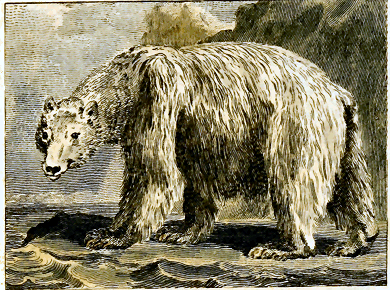
There is no animal so generally known, about which naturalists have differed so much as the bear, their doubts and even contradictions, with respect to the nature and manners of this animal, seem to have arisen from their not distinguishing the different species, and consequently ascribing to one the properties belonging to another. In the first place, the land-bear (fig. 92.) must not be confounded with the sea-bear, or as it is commonly called the white bear (fig. 93.), or bear of the frozen sea; these animals being very different both in the form of their bodies and natural dispositions. The land bears must be also distinguished into two species, the brown and the black, because having neither the same inclinations nor natural appetites, they cannot be considered as varieties of the same species. Besides, there are some land bears that are white, but which, although they resemble the sea-bear in colour, differ from it in every other particular. These white land-bears we meet with in Great Tartary, Muscovy, Lithuania, and other northern countries. It is not the rigour of the climate which renders them white during the winter, like the hares and ermines, for they are brought forth white and remain so all their lives. We ought, therefore, to consider them as a fourth species, if there were not also found bears with an intermixture of brown and white, which denotes an intermediate race between the white land-bear, and the brown or black, consequently the former is only a variety of one of those species.
Engraved for Barr’s Buffon.
FIG. 92. Brown Bear.
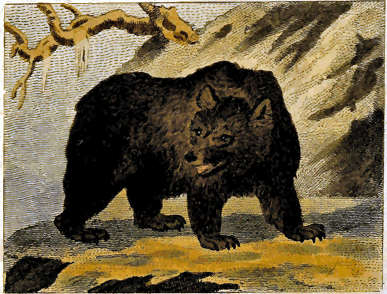
FIG. 93. White Bear.
We frequently meet with the brown bear in the Alps, but the black-bear very rarely. But in the forests of the northern countries of Europe and America, the latter is very common. The brown one is both fierce and carnivorous, but the black-bear is only wild, and constantly refuses to eat flesh. Of this we cannot give a more striking testimony than what M. du Pratz relates in his history of Louisiana. “The bear,” says he, (speaking of the black one) "appears in Louisiana in winter, because the snows which cover the northern countries prevent him from procuring his usual food, which consists of roots, acorns, and vegetables in general; but milk and honey form his favourite repast, and when he meets with those articles he will sooner die than relinquish them. In defiance of the prevailing notion that the bear is carnivorous, I maintain, with every person of this province, and the circumjacent countries, that he is not so. These animals have never been known to devour men, nor even to eat butcher’s meat, notwithstanding their multitude, and the excesses of hunger which they often suffer. While I resided at the Natches, one winter was so severe in the northern regions, that the bears flocked from them in great numbers; so great indeed that they starved each other, and were very meagre. In the night they were frequently seen roaming into houses and farm-yards, which were not properly shut, where they might have feasted upon meat, but they never touched it, nor devoured aught but such grain as they could pick up. If they had possessed a carnivorous disposition, it must have shewn itself upon such a pressing occasion. They never kill animals to devour them; and were they in reality carnivorous, they would not abandon their own snowy regions, where they might find men and animals at discretion, to search for fruit and roots, an aliment which carnivorous tribes reject." M. du Pratz adds in a note, that since writing the above passage, he had learned, with certainty, that in the mountains of Savoy there are bears of two sorts, the one black, like those of Louisiana, not carnivorous, and the other red, which are as much so as wolves.
De Hontan remarks in his travels that the bears of Canada are very black, but by no means dangerous, and that they never attack the human species unless when fired at and wounded. In another place he adds that the reddish ones are exceedingly mischievous, and that they uniformly attack the huntsmen, whereas the black ones fly from them. According to Wormius there are three kinds in Norway. The first (Bressdiur) is very large, not altogether black but rather brownish, is not destructive, but lives solely on herbs and leaves of trees; the second (Ildgiersduir) is smaller, blacker, and carnivorous, frequently attacking horses and other animals, especially in autumn; the third (Myrebiorn) is still smaller and mischievous, he feeds on ants and delights in demolishing their hillocks. It has been remarked, adds this author (but without any proof) that these three kinds copulate together and produce intermediate species; that those which are carnivorous attack flocks like the wolf, killing the whole and eating only one or two; that they also eat wild fruits, and that when the fruit of the service tree is in season, they are the most dangerous, because it sets their teeth on an edge which can only be allayed by blood or grease. But the generality of what Wormius relates on this head is highly equivocal, for we have no example of animals whose appetites are so different as the two first, the one living on herbs, and the other on flesh and blood, copulating together and producing intermediate species. Besides he mentions the black bear as carnivorous, and the brown one as frugivorous, which is inconsistent with truth, and contradicted by facts. It is also to be observed that Father Rzaczynski, of Poland, and M. Klein, of Dantzic, in treating of the bears of their own countries, admit of but two species, the black and the brown, or red; describing two kinds of the latter, the one large and the other small. They state the black bears to be rare, and the brown ones very common; that the black kind are the largest and feed on ants, and that the largest of the red or brown are most carnivorous and destructive. These testimonies, as well as those of Du Pratz and de la Hontan are contradictory to what Wormius asserts. Indeed it seems to be a certain fact that the red or brown bears which are found not only in Savoy, but on the high mountains, in the vast forests, and in almost all the desarts of the earth, devour live animals and even carcasses when in a putrid state. Black bears are seldom found in cold countries, but the red or brown ones we find in the cold, temperate, and even in the southern regions. In Greece they were common, and to heighten their shews the Romans introduced them from Lybia. They are now to be met with in China, Japan, Arabia, Egypt, and as far as the island of Java. Aristotle also speaks of white land bears, but considers this difference in colour as accidental, and originating from a defect in generation. Thus the bear is a resident in all desart, mountainous, and woody countries; but in open, populous, and cultivated regions he is a stranger. There are none in England or France, except possibly a few in the most unfrequented mountains of the latter.
The bear is not only a savage but a solitary animal; he takes refuge in the most unfrequented places, and dangerous precipices of uninhabited mountains: he chooses his den in the most gloomy parts of the forests, in a cavern hollowed out by time, or in the decayed trunk of some old tree. Thither he retires alone, and passes part of the winter without eating or ever stirring abroad. He is not, however, deprived of sensation, like the dormouse or marmot, but being exceedingly fat towards the end of autumn, which is the time he retires, he seems rather to subsist on the exuberance of his former flesh, and does not quit his retreat until he is nearly wasted. We are told that the male quits his den towards the expiration of forty days, but that the female remains four months, by which time she has brought forth her young; that they not only subsist but nourish their young, without taking any food for such a length of time I think highly improbable. I allow that when with young they are exceedingly fat, and also, that being covered with very thick hair, sleeping the greatest part of the time, and taking no exercise, they must lose little by perspiration. But, if it be true, that the males are impelled by hunger to quit their retreats at the end of forty days, it is not natural to imagine that the females should feel a less want of food, after bringing forth and suckling their young ones, unless we suppose that, like cats, they sometimes devour their offspring, of which, in my opinion, there is no probability. Besides, at present we speak only of the brown bear, the males of which do, in reality, devour their new-born cubs when they find them; but the females seem to love their offspring with a ferocious ardour. When they have brought forth their fury is more violent and dangerous than that of the males. They will expose themselves to any danger, they will combat any thing in defence of their young, which are not, as the ancients have said, without form when born, but attain their full growth nearly as soon as other animals; before they leave the womb their formation is perfect, and if the fœtus, or young cub, seems at first glance to be unformed, it is merely because there is a want of proportion in the body and members of the grown bear; and that the fœtus, or new-born animal, is more disproportioned than the aged, is well known to be the case in all species.
The bears couple in autumn; and the female is said to be more ardent than the male. It is pretended that she lies on her back to receive him, that she folds him with her paws, and holds him a long time, but the fact is they copulate like other quadrupeds. Bears, while confined with a chain, have been seen to copulate and produce, but how long the females go with young is not accurately known. Aristotle has limited it to thirty days, a fact which has never been contradicted, and which as I cannot authenticate, I will neither affirm nor deny, but assign my reasons for thinking it doubtful; which are, first because the bear is a large animal, and the larger the animal the longer time is required for its formation in the womb; secondly, because the young bear is very slow of growth, follows the mother, and requires her succour for a year or two; thirdly, because the female produces only from one to four, and never more than five, a circumstance common to all large animals who produce but few and carry them long; fourthly, because the bear lives from 20 to 25 years, and the time of gestation, and that of growth, are usually proportioned to the duration of life. From these analagous principles I conclude that the bear carries her young several months. Be this as it may, the mother takes the greatest care of her offspring. She brings forth in winter, previous to which she provides a bed of hay and moss at the bottom of her den, and suckles her young till they are able to follow her in the spring. The male and female reside not together, but have separate retreats, and that at a distance from each other. When they cannot find a cavern for a den they break and collect branches which having placed they cover with herbs and leaves, so as to render it impenetrable to rain.
The voice of the bear is a kind of harsh deep murmur, which, when he is enraged, is heightened by the grinding of his teeth. He is susceptible of anger, which is always furious and often capricious. However mild, and even obedient he may appear to his master, he ought to be treated with distrust and circumspection; nor upon any account should he be struck upon the nose, or on the parts of generation. He may be taught to stand on his hind legs, and to dance in a rude and awkward measure; but for this it is necessary he should be taken young, and held in constant restraint. An old bear is not to be tamed, nor even held in awe, and shews himself, if not intrepid, at least fearless of danger. The wild bear turns not out of his path, nor offers to shun the sight of man; and yet, it is said, that by a certain whistle he is so far surprised and confounded as to rise upon his hind feet. This is the time to shoot and endeavour to kill him, for when only wounded in an attack he darts with fury on his foe, and clasping him with his fore paws is sure to stifle or strangle him, unless immediately assisted.
Bears are chaced and taken in several manners; in Sweden, Norway, Poland, &c. the least dangerous method, it is said, is to intoxicate them, by pouring brandy, or other spirits, upon honey, which being their favorite food they search for in the hollows of trees. In Louisiana and Canada, where the black bears are common, and where they reside in the decayed parts of old trees, they are taken by setting fire to their retreats, which, as they climb trees with great ease, are sometimes 30 or 40 feet high. If this attack be made upon a female with her young, she descends first and is killed before she reaches the ground; as the cubs follow they are easily secured, by throwing a noose round their necks, and are carried home, either to rear, or kill for eating. The flesh of the young is delicate and good, and that of the old one eatable; but as the latter is mixed with an oily fat, the paws alone, which are more firm, can be considered as a delicacy.
The hunting of the bear without being dangerous, is highly profitable, when attended with success; of all coarse furs their skins are the most valuable, and the quantity of oil procured from one bear is considerable. The flesh and fat are boiled together, and then the oil is separated; “this done”, says Du Pratz, "it is purified by throwing into it, while very hot a large quantity of salt and water; a thick smoke arises which carries off the disagreeable smell of the fat; when the smoke is evaporated they pour the grease, while still warm, into a pot, where it is left to settle for eight or ten days, at the expiration of which a clear oil is found swimming at the top; this is taken off with ladles, is equally good with the best olive oil, and is used for the same purposes. Under it remains a lard as white as hog’s-lard, but rather more soft, and which has neither a disagreeable taste or smell." This account of M. du Pratz is perfectly acceded to by M. Dumont, who adds, that the savages of Louisiana carry on a considerable traffic with the French in this oil from the bears, that it never loses its fluidity but in intense frosts, when it becomes clotted, is of a dazzling whiteness, and is then eaten upon bread like butter. The author of the Dictionnaire du Commerce says, that good bear’s-grease should be grey, viscid, and of a disagreeable flavour, and when very white it is adulterated with suet. It is used as a topical remedy for tumours, rheumatic, and other complaints, and many people have a high opinion of its salutary properties.
From their great quantity of fat, bears are excellent swimmers. In Louisiana, Dumont says, they cross that great river with perfect ease; they are very fond of the fruit of the guiacana, the trees of which they climb, and sit astride upon the branches to eat it; they are also partial to potatoes and yams. In autumn they are so fat that they can hardly walk, at least they cannot run as fast as a man; it is sometimes ten inches thick on their sides and thighs. The under part of their paws is large and swelled, and when cut there issues out a white milky juice. This part seems composed of glands resembling small nipples, and this is the reason why they continually suck their paws when confined to their dens during winter.
The bear enjoys the sense of seeing, hearing, and feeling, in great perfection, although compared with his size, his eye is small, his ears short, and his skin coarse and covered with a quantity of hair. His smell, is, perhaps, more exquisite than that of any other animal; the internal surface of his nose being very extensive and excellently calculated to receive impressions from odoriferous bodies. Their legs and arms are fleshy, like those of man, and they strike with their paws in the same manner as he does with his fists; they have also a short heel bone, which makes part of the sole of the foot; in their kind of hands the thumb is not separated, and the largest finger is on the outside; but whatever rude resemblance they may have to the human species, they only render them the more deformed without giving them the smallest superiority over other animals.
SUPPLEMENT.
Since the publication of the original work I have received the following particulars from M. de Musly, a major in the service of the States General. He says, that at Berne, they have several bears in a kind of domestic state, which are kept in large square ditches lined at the sides and bottom with stone, and where they have room to walk about they have dens made for them, which are also paved, on a level with the bottom of the ditch; these are divided into two by walls, and are occasionally shut with iron gates; troughs of fresh water are set for them in each ditch, and holes are left in the pavement sufficient to set up large trees on an end. Thirty-one years since two young brown bears were brought thither from Savoy, the male of which was killed by a fall from one of the trees into the ditch about two months ago (this account is dated October 17, 1771), and the female is still alive. At the age of five years they began to generate, and from that time they regularly came in season in the month of June, and the female brought forth in January. The first time, she had only one; since she has had from one to three, but never more; the three last years she had one each time, and the man who looks after her thinks she is now pregnant. When first whelped they are yellow, and white round the neck, and have not the smallest appearance of bears; they are blind four weeks; they measure about eight inches at first, and at the end of three months fourteen or fifteen; they are then almost round, and have a sharp pointed snout; they are by no means strong until they are full grown, before which time the white hair is quite gone, having decreased by degrees, and the yellow is changed into a brown.
The male and female sometimes fight furiously, growling horribly at each other, but when in season the latter generally gets the better. The ditches in which these two bears were formerly kept, being to be filled up, they were necessarily separated for a few hours while removing to the other ditches prepared for them; on their meeting again they raised themselves on their hind legs, and embraced each other in a kind of rapture; and upon the death of the male, the female was much affected, and refused to eat for several days. But this attachment is not common to them, for unless brought up and fed together from very young cubs they cannot bear each other; yet after living thus together, the survivor will not admit the approaches of another. They are very fond of climbing the trees put into the ditches, which are green larches, and placed there every May. They are commonly fed with rye-bread soaked in water; and they will eat all sorts of fruits. When the female is near her time, she is furnished with plenty of straw, which she appropriates for her use, and then the male is removed, lest he should devour the young ones; they are allowed to remain with their mother for the space of ten weeks, when they are removed, and fed for some time with bread and biscuit.
M. de Musly afterwards informed me that the female they had thought pregnant was supplied with straw at the necessary time, but though she made a bed and rested upon it for three weeks, she did not bring forth anything; therefore the last time she brought forth she had but one, and was at the age of thirty-one years. He likewise adds, that there are brown bears on Mount Jura, in Franche-comté, and in the county of Gex, which come into the plains in autumn, and do great damage in the chesnut woods.
There are two species of bears in Norway, one of which is much smaller than the other; in both there are different colours, such as dark and light brown, grey, and every shade of white, at least so says Pontoppidan; and also that they retire to the dens which they have prepared in October. Being very formidable, when wounded, three or four hunters usually go together, and as he easily kills large dogs, they use small ones, which run under his belly and seize him by the genitals; when nearly overpowered, he places himself against a tree, and throws tufts or stones at his foes, until he is dispatched.
In the menagerie of Chantilly there is an American bear, with fine, soft, straight black hair, whose head is longer, and snout shorter than the bears of Europe. And M. de Bertram mentions a bear that was killed near St. John’s river in East Florida, which was seven feet long, weighed 400lbs. and from which 60 Paris pints of oil were drawn.
THE BEAVER.
AS man becomes civilized and improved, other animals are repressed and degraded. Reduced to servitude, or treated as rebels, and dispersed by force, all their societies are dissolved, and their talents rendered nugatory; their arts have disappeared, and they now retain nothing but their solitary instincts, or those foreign habits which they have acquired by example or human education. For this reason there remain no traces of their ancient talents and industry, except in those countries where man is a stranger, and where, undisturbed by him for a long succession of ages, they have freely exercised their natural talents, brought them to their limited perfection and been capable of uniting in their common designs. The beaver seems to be the only remaining monument of that intelligence in brutes, which though infinitely inferior in principle to that of man, supposes common projects and relative views; projects which having society for their basis, and for their object the construction of a dike, the erection of a residence, or the foundation of a republic, imply some method of understanding each other, and of acting in concert.
The beaver is said to be among quadrupeds what the bee is among insects. Of societies there are three species in nature which we ought to consider attentively before we begin to compare them; namely, the free society of man, to which, next to God, he is indebted for all his power; the constrained society of large animals, always rendered transitory by the human species; and the forced society of certain little animals, which, coming into existence at one time, and in the same place, are obliged to live together. An individual, solitary as he comes from the hands of the Creator, is a sterile being, whose industry is confined to the use of his senses; nor is man himself, in a state of pure nature, unassisted by the aids of society, capable of multiplying or of being edified. All society, on the contrary, necessarily becomes fruitful, provided it be composed of beings of the same nature. From the necessity of seeking or avoiding each other, a succession of common movements will follow, from which frequently some work will result that has the appearance of having been conceived, conducted, and executed with intelligence. Thus the labours of the bee, which in a given place, such as a hive, or the hollow of an old tree, forms its own cell; those of the Cayenne fly, which is not only the architect of its own cell but the hive which is to contain it, are labours purely mechanical, and suppose no intelligence, no concerted project, no general views, but nothing more than physical necessities. A result of common movements, is at all times and places, performed in the same manner, by a swarm of little creatures not assembled from choice, but united by the force of nature. It is not society but numbers that operate in this case; it is a blind power which cannot be compared to that light by which all society is directed; I speak not of that pure light, that ray of divinity which has been communicated to man alone, and of which the beaver is certainly as destitute as any other animal. As their society is formed rather by a kind of choice than necessity, so it supposes at least a general concurrence and common views; it implies also a beam of intelligence, which, though widely different from that of man in principle, produces effects so similar as to warrant a comparison, not indeed with society, as it is found among civilized nations, but as it appears among savages just emerging from absolute solitude; a society which, with propriety, can alone be compared with that of animals.
Let us then examine the produce of these societies, let us inquire how far the art of the savage extends, and where the talents of the beaver is limited. To break down a branch, to use it as a staff, to build a hut and cover it with leaves for shelter, to collect moss or hay, and to make a bed of them, are acts common to the animal and to the savage. To rub a stone so as to render it an edged instrument for cutting or stripping the bark of trees, for sharpening arrows, for flaying an animal, in order to make a covering of its skin; to make bow-strings of its sinews, to fix those sinews to a thorn or bone, and use them as needles and thread, these are acts which may all be performed by a man in a state of solitude, and without assistance from others, since they depend solely on his conformation, and only suppose him to have the use of his hands. But, to cut down, and transport a large tree, to raise a mole, or build a village, are, on the contrary, operations which necessarily suppose common labours and concerted views; these are the only performances which result from immature society in savage nations; while the operations of the beavers are the fruits of a perfected society among those animals; for it is to be observed, that they never attempt to build but in countries where they are in no danger of having their tranquillity interrupted.
There are beavers in Languedoc, in the islands of the Rhone, and many in the northern provinces of Europe; but as all those countries are inhabited, or at least frequented by men, the beavers there, as well as all other animals, are dispersed, forlorn, and timid creatures. There they have never been known to assemble, or undertake any common work: whereas in desert regions, where human society was formed later, where some few vestiges of savages alone could be traced, beavers were every where seen united, forming societies, and constructing works which were the admiration of every beholder. Of this I shall endeavour to quote such testimonies as are most judicious and least liable to censure, and shall only consider as certain those facts which are confirmed by common consent. Less inclined to indulge admiration, perhaps, than some writers, I shall not hesitate to doubt, and even to criticise, whatever may seem too improbable to demand our belief.
It is generally allowed that the beaver, far from having a superiority over other animals, seems to be inferior to many of them, in his merely individual qualities; and this fact I am enabled to confirm, by having had a young beaver, which was sent me from Canada, in 1758, alive in my possession for more than a twelvemonth. This animal is mild, peaceable, and familiar; it is rather inclined to be gloomy and melancholy; it has no violent or vehement passions, its movements are slow, it makes few efforts, unless to gain its liberty, which it frequently attempts by gnawing the gate of its prison, but without violence or precipitation. In other respects it seems to be perfectly indifferent, forming no attachments,[Q] and is as little inclined to offend as to please. He is inferior to the dog in the relative qualities which might make him approach to man; he appears formed neither to serve, command, or even to associate with any species but his own. His talents are repressed by solitude, and it is by society with his own kind they are brought into action. When alone he has little industry, few tricks, and not sufficient distrust to avoid the most obvious snares. Far from attacking any other animal, he has scarcely art to defend himself; always preferring flight to combat, he only resists when driven to an extremity, and then bites very hard with his teeth.
If then we consider this animal, in a state of nature, or rather in his dispersed and solitary state, we shall find that his internal qualities are not superior to other animals; he has not the genius of a dog, the sense of an elephant, nor the cunning of a fox; and he is rather remarkable for external singularities than for any apparent superiority of internal qualities. The beaver is the only animal who has a flat, oval tail, covered with scales, which serves as a rudder to direct his course in the water; the only one that has his hind-feet webbed, and the toes of his fore-feet separate, which he uses to convey food to his mouth; the only one which resembles a land animal in the fore parts, and approaches the nature of an aquatic one in the hinder, in short he forms the same shade between quadrupeds and fishes, as the bat forms between quadrupeds and birds. But these singularities would be rather defects than perfections, if the beaver did not derive from this conformation peculiar advantages which render him superior to all other animals.
The beavers begin to assemble in June or July in order to form themselves into a society. They arrive in numbers from all sides, and soon form a company of two or three hundred; the place of meeting is generally that where they intend to fix their abode, and is always by the side of some lake or river. If it be a lake wherein the waters always remain upon a level they dispense with making a dam; but if it be a running stream, subject to floods and falls, they build a bank or pier quite across so as to secure a piece of water always at the same height, and this bank is frequently from 80 to 100 feet long, and ten or twelve thick at the base. If we compare the greatness of the work with the size[R] of the architect, it will appear enormous, but the solidity with which it is constructed is still more astonishing. They commonly choose that part of the river which is most shallow, and if possible, where some large tree is growing by the side of the stream; this they instantly set about cutting down, and although it is sometimes much thicker than a man’s body, they very soon accomplish it without any other instrument than their four incisive teeth; and they always contrive to make it fall across the stream; they next cut off the top branches to make it lie level. These operations are performed in common. Several are employed at the foot of the tree in gnawing it down, others sever the branches, while others are, at the same time, engaged in parties along the banks of the river in cutting smaller trees, from the size of a man’s leg to that of his thigh; these being cut to a certain length, they drag, by land, to the brink of the river, and then by water to the place allotted for their building; having pointed them at one end, they sink them down at small distances from each other, and then interweave them with pliant branches; the placing of these piles is the most difficult part of their operations, but they accomplish it by one party supporting the thick end with their teeth, while others plunge to the bottom and dig holes with their feet to receive the points that they may stand upright. While some are thus employed, others bring earth and clay, which they prepare for their purpose with their feet and tails; and they transport it in such large quantities, that they block up all the intervals between the piles. These piles are formed by a number of stakes in several rows, exactly of a height; they are placed opposite to each other, and extend across the river: that this embankment may sustain the weight of the water, it is made sloping, so that although it is twelve feet at the base, it is not more than three at the top; from which ingenious contrivance it has not only the requisite thickness and solidity, but also a form of others the most proper for confining the water, maintaining its weight, and baffling its attacks. Near the top of this bank they make two or three openings for the superfluous water to escape, and which they occasionally enlarge or contract as the river rises or falls; and when by any sudden inundations their work is damaged on the retreat of the waters they repair it with the utmost diligence.
After this display of their public labours, it would be superfluous to add a description of their private constructions, were it not necessary that, in history, an account should be given of every fact, and where not this first great work of the beaver, made with an uniform intention to render their smaller habitations more commodious. These habitations are partly built upon piles on the banks of the river, and have two openings, one for the purpose of land, and the other for water excursions; they are either round or oval, and are of various sizes, from four to eight or ten feet in diameter; some of them consist of three or four stories, and their walls are about two feet thick, raised upon planks, which serve at once for foundations and floors. When they consist of but one story, the walls are only a few feet perpendicular, and then raised in a curve, which terminates in a doom or vault, and serves as a covering. They are constructed with such solidity as to be impenetrable to the heaviest rains, to defy the most impetuous winds, and are plastered with excessive neatness, both within and without, as much so as if they were actually done by the hand of man; yet they use no other instrument for the preparation of this mortar than their feet, or for its application than their tails. They chiefly use wood, stone, sandy earth, and such materials as are not easily dissolved with water; for the wooden work they take such trees as grow on the banks of rivers, which are more easily cut down, stripped of their bark, and carried, than solid timber, all which they are sure to accomplish upon a tree which they have once attacked. They begin to cut a tree at the distance of a foot, or a foot and a half from the ground, and they sit as they work, for besides the advantage of this convenient posture, they have the pleasure of continually gnawing fresh bark and soft wood, both of which they prefer to most other kinds of aliment; and of these they provide an ample store for their subsistence during winter[S], being averse to dry wood. It is in the water, and near their habitations, that they establish their magazines; there is one allotted to each cabin, proportioned to the number of its inhabitants, to which they have all a common right, and never plunder their neighbours. Some hamlets, if we may so call them, are composed of 20 or 25 cabins, but such large settlements are rare; generally they do not consist of more than ten or a dozen families, each of which has its own district, magazine, and habitation; nor will they allow strangers to come into their neighbourhood. The smallest dwellings contain two, four, or six; and the largest eighteen, twenty, and it is even asserted thirty beavers; and it very seldom happens, that the males and females are not of an equal number. Moderately speaking, therefore, their society may be said frequently to consist of 150 or 200, who having at first exerted their united industry in raising a great public work, afterwards form themselves into different bodies to construct private habitations.
However numerous the society may be, peace and good order are uniformly maintained; their union is strengthened by a common quantity of toil, and confirmed by the conveniences they have jointly procured; and the abundance of provisions which they amass and consume together, render them happy within themselves. Having moderate appetites, and an aversion to flesh and blood, they have not the smallest propensity to hostilities or rapine, but actually enjoy all those blessings which man knows only how to desire. Friends to each other, if they have threatened enemies abroad they know how to avoid them; and on the first alarm they give notice of their mutual danger by striking the water with their tail, the sound of which is heard in their most distant dwellings; immediately each provides for himself as he thinks most expedient; some plunge into the water, others conceal themselves within the walls of their own habitations, which is in no danger but from the fire of heaven, or weapons of man, and which no animal dares attempt to open or overturn. These asylums are not only secure but neat and commodious. The floors are covered with verdure; young branches of the box and fir serving them for carpets, and upon which they do not suffer the smallest dirt. The window that fronts the water they use as a balcony to enjoy the fresh air, and to bathe, which they do the greatest part of the day, sitting in an upright posture in the water, with their heads and fore parts only visible. This element appears so necessary, or at least so pleasing, that they seem unable to do without frequent immersions in it; therefore, in making this window, they are very careful to guard against its being blocked up by the ice; when the river is frozen over, they make an opening in it, and swim a considerable way under the ice; at which times they are easily taken, by attacking the dwelling on one hand, and at the same time lying in wait for them at a hole purposely made in the ice at some distance, and to which they are obliged to come for breath. The habit of continually keeping their tails and hinder parts in the water, seems to have changed the nature of their flesh: that of the fore parts, as far as the reins, has the taste and consistency of the flesh of land-animals, while the tail and posteriors have the smell, savour, and other qualities of fish. As for the tail it is even an extremity, an actual portion of a fish fixed to the body of a quadruped; it is a foot long, an inch thick, and five or six inches broad; it is entirely covered with scales, and has a skin altogether the same as that of a large fish. These scales may be scraped off with a knife, and then the impressions are to be seen on the skin as in all scaly fishes.
It is in the beginning of summer that the beavers assemble; they employ July and August in the construction of their banks and habitations; in September they collect their provisions of bark and wood, and afterwards, enjoying the fruits of their labour, they experience the sweets of domestic tranquillity; this is the time of repose, and what is more the season of love. Acquainted with, and prepossessed in favour of each other, from habit, from the pleasures and fatigues of a common labour, no couple is formed at random, nor by physical necessity, but by inclination and choice. Happy in each other, they pass the months of autumn and winter together, and scarcely ever separate. With every thing at home they can wish for, they never go out but upon agreeable and useful excursions; on which occasions they bring home fresh bark, which they prefer to what is too dry, or has been too much soaked in water. The females are said to go four months with young; they bring forth towards the close of winter, and have two or three at a time. Nearly at this period the males leave them, and retire into the country to enjoy all the sweets of the spring; they pay occasional visits to their habitations, but reside there no more. The females, however, remain in them employed in sucking, tending, and rearing their young, who are in a condition to follow them at the expiration of a few weeks; at which time they, in their turn, make some excursions, feeding on crabs, fishes, and bark of young trees; and pass the whole of the summer upon the water or in the woods. They are not thoroughly collected again till autumn, unless their bank, or dwellings, should happen to be damaged by an inundation, in which case they assemble betimes to make the necessary repairs. They are more fond of residing in some places than others, and have been observed to return every summer, after their works have been repeatedly demolished, to repair them, till harassed by this persecution, and weakened by the loss of several of their troop, they have, with one consent, deserted it, and retired to some more secure and less frequented neighbourhood.