Front matter (continued 5)
Reading edition
Winter is the season principally allotted for hunting them, as it is then only that their fur is in perfection; and when, after their dwellings are demolished, a number of them are taken, their society is never restored; but those which escape captivity or death, become houseless wanderers. Their genius is overcome by apprehension, and they never more attempt to exert it, but conceal themselves in holes under ground, and reduced to the condition of other animals, they lead a timid life, employing themselves only to satisfy their immediate and urgent wants; nor do they any longer retain those qualities which they so eminently possess in their social state. However marvellous the description we have just given of the society of the beaver may appear, it is beyond a doubt strictly consonant to truth. A number of ocular witnesses have agreed in their writings to every fact I have mentioned; and if the present recital differs from some authors whom I have followed, it is only in such points as appeared to me to be too marvellous and improbable to be believed. Many writers, not content with ascribing to the beaver social manners, and evident talents for architecture, have attributed to them general ideas of policy and government. They have asserted that when their society is formed, they reduce travellers and strangers of their own species into slavery; that they employ them in carrying their clay and wood; that they treat in the same manner the idle who will not, and the old who cannot, work; that is, they throw them upon their backs, and use them as so many vehicles to carry their materials; that they never assemble in an even number, for the purpose of having, in all their deliberations, a casting voice; that each tribe has its peculiar chief; that they have sentinels established for the public security; that when chased they tear off their testicles to satisfy the avarice of their pursuers; that when thus mutilated they turn about and present themselves to obtain mercy,[T] &c. Although we discredit these exaggerations, yet we must not reject those facts which have been established by moral certainties. A thousand times have the works of the beaver been viewed, overturned, measured, designed, and engraved; and every doubt is banished, by some of their fabrics still subsisting; for though less common than when North America was first discovered, the latest missionaries and travellers, who have visited the northern parts of that continent, unanimously concur in having met with them.
We are told by these that, besides the beavers who live in societies, there are others which lead a life of solitude; having been rejected from the body, for being guilty of some crime against it, and therefore are not allowed to partake of its advantages; they have neither house nor magazine, and are forced to live, like the badger, in holes under ground. They are easily distinguished, from their coats being always dirty, and their hair rubbed off by the friction of the earth. Like the otters they inhabit the edge of rivers, where some of them dig a ditch several feet deep, in order to make a pond that may reach to the mouth of their hole, which has an internal ascent; there are, however, others which live at a considerable distance from the water. All the European beavers are solitary, and their fur is by no means so fine as that of those who live in society. They differ in colour according to the climate they inhabit. In the northern countries they are black, and those are the finest, although among those there are some found entirely white, some grey, and others with red spots. The further they are removed from the north the more bright and varied we find their colour. In the north part of Canada they are chesnut, and among the Illinois they are yellow, or olive-coloured. There are beavers in America from the 30th degree of north latitude to beyond the 60th. They are common in the north part, and gradually decrease towards the south. This is also the case in the Old Continent; we never find them numerous except in the northern countries; in France, Spain, Italy, Greece, and Egypt, they are very rare. They were known to the ancients, and by the religion of the Magi it was forbidden to kill them. Upon the borders of the Euxine sea they were common, and were called canes pontici; but it is probable they did not enjoy much tranquillity in the neighbourhood of this sea, (which from the earliest time has been frequented by mankind) since none of the ancients speak either of their society or labours. Ælian, in particular, who had such a propensity to the marvellous, and who I believe was the first who mentioned their dismembering themselves to delay the hunters, would never have omitted enlarging on the wonders of their republic, and genius for architecture. Would Pliny, whose bold, gloomy, and sublime genius was always bent upon degrading man to exalt Nature; would he have forborne to have compared the labours of Romulus with those of the beavers? It seems, therefore, that their industry, and talents for building were unknown to the ancients; and although in latter ages, beavers have been found in Norway, and other northern parts of Europe, with habitations of their own construction; and though there be no reason to doubt the ancient beavers did not build as well as the modern, yet as the Romans did not penetrate so far north, it is not surprising they should have been unnoticed by their writers.
Several authors have said, that the beaver, being an aquatic animal, could not live solely on land; but this opinion is erroneous, for the young beaver sent me from Canada was reared in the house, and when taken to the water was afraid of it, and refused to go in; when plunged into the bason, there was a necessity to hold him there by force; but in a few minutes he became perfectly reconciled; afterwards, when left to his liberty, he would frequently return to it of himself, and even roll upon the dirt and wet pavement. One day he escaped and descended by a stair-case into the subterraneous vaults in the Royal Garden, and swam a considerable time in the stagnant water at the bottom of them, yet no sooner did he see the light of the torches, which were brought to search for him, than he returned, and suffered himself to be taken without the smallest resistance. He is familiar without fawning, and is sure to ask for something to eat from those he sees at table, which he does by a small plaintive cry, and some gestures with his fore paws. When he obtains a morsel he carries it off and conceals it, that he may eat it at his ease. He sleeps pretty often, and then lies upon his belly. No food comes amiss to him, meat excepted, which he constantly refuses either raw or dressed. He gnaws every thing he comes near, and it was found necessary to line with tin the barrel in which he was brought over.
Though the beavers prefer the borders of lakes, rivers, and other fresh waters, yet they are sometimes found on the sea-shores, especially mediterranean gulphs, which receive great rivers, and where the waters are less salt. They are professed enemies to the otters, whom they hunt, and will not even permit them to appear in the waters which they frequent. The fur of the beaver is more beautiful and thick than that of the otter; it is composed of two sorts of hair, the one short, bushy, soft as down, and impenetrable to the water, which immediately covers the skin; the other longer, bristly, and shining, but thinner, which serves as an upper coat, and defends the former from filth and dust. The latter is of little value, it is the first alone which is used by our manufacturers. The blackest furs are generally thickest, and consequently most esteemed; nor is the fur of the solitary beavers equal to that of those who live in society. These animals, like all other quadrupeds, shed their hair in summer, and therefore the furs of such as are taken in that season are of little value. The fur of the white beaver is esteemed because of its rarity; and the perfectly black is nearly as uncommon as the white. But, independent of the fur, which is the most valuable article, the beaver furnishes a substance which has been considerably used in medicine; it is known by the name of castoreum, and is contained in two large bladders, and which the ancients mistook for the testicles of this animal; but as they are to be found in every pharmacopæia, it is unnecessary to give here a description of them or their uses[U]. The savages are said to obtain an oil from the beaver’s tail, which they apply as a topical remedy for different complaints. The flesh of this animal, though fat and delicate, is yet bitter and disagreeable to the palate. It is affirmed that its bones are of an excessive hardness, a circumstance which we are unable to determine, having never dissected but one, which was very young. Their teeth are very hard, and so sharp, that the savages use them to cut, hollow, and polish their wood; they also clothe themselves with its skin, and in the winter wear it with the hair next their bodies.
Engraved for Barr’s Buffon.
FIG. 94. Beaver
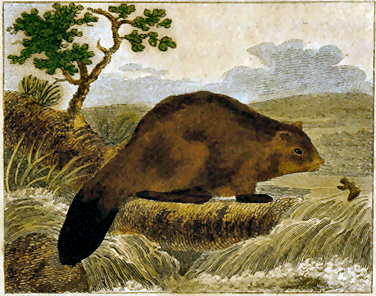
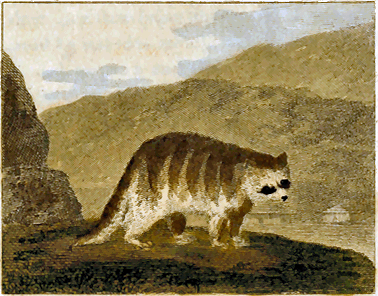
FIG. 95. Raccoon
The beaver uses its fore-feet like hands, with as much facility as a squirrel; the toes of the hind-feet being connected by a strong membrane, supply the place of fins, and expand like those of a goose, which the beaver somewhat resembles in its walk. He swims much better than he runs; and as his fore-legs are much shorter than his hind ones, he always moves along with his head very low and his back arched. His senses are very acute, and that of smelling so delicate, that he will not permit any dirt or filth to remain near him. When kept in confinement too long, and he is under the necessity of voiding his excrements, he drops them close to the threshold of the door, and as soon as that is opened pushes them out. This habit of cleanliness is natural to them, and our young beaver never failed to purify his apartment in this manner. At the age of one year he gave a sign of ardour for a female, which seems to be a proof he had then nearly attained his full growth; therefore their duration of life cannot be very long, and it is probably wrong to extend it to fifteen or twenty years. The beaver I had was very small for his age; a circumstance that is not surprising, since he had been in perpetual confinement from his earliest days, and from being unacquainted with water until he was nine months old, he could be expected to grow and expand like those who, while they enjoy their liberty, range at pleasure in that element which seems to be almost as necessary to them as that of land.
SUPPLEMENT.
In confirmation of our former remarks that beavers might be easily tamed, M. Kalm, in his Voyages, says, that he had seen beavers so tame that they would go out to fish and bring the prey home to their masters; nay that they would even follow men and dogs, go with them into their boats, jump into the water, and soon come up again with fish. And M. Gmelin affirms that he saw a beaver in Siberia, which had been reared in the house, who would go to considerable distance, and sometimes returning with a female whom he would suffer to go away by herself after the season of love.
THE RACCOON.
Several authors have described this animal under the name of coati, yet I have chosen to adopt the name given to it in England, that it may not be mistaken for, and confounded with, the real coati, or the coati-mondi, which appears to be nothing more than a variety of that species.
I had a raccoon (fig. 95.) alive, and which I kept more than twelve months; he was about the size of a small badger, his body short and bulky, his hair long, thick, black at the points, and grey underneath; his head was like that of a fox, but his ears round and shorter; his eyes were large, and of a yellowish green, and over them a black band went across; his snout was sharp, and his nose rather inclined upwards; his under lip was less prominent than his upper one; he had like the dog, six incisive and two canine teeth in each jaw; his tail was bushy but tapering towards the point, marked with alternate black and white rings from one end to the other, and was at least as long as the body; his fore legs were much shorter than his hind ones, and each had five toes armed with strong sharp claws. He used his fore feet to hold his food while eating, but his toes not being flexible he could not grasp any thing with one paw, but was obliged to use them both when food was presented him.
Though the raccoon is short and bulky he is very active; his pointed claws enable him to climb trees with great facility; he runs up the trunk with ease, and frolicks to the extremities of the branches in perfect security. On the ground he rather bounds than runs, and his motions, though oblique, are always quick and light. He is a native of the southern parts of America, nor has ever been found upon the old continent, at least if we may judge from the entire silence of travellers about him. In the regions of America, he is, however, very common, particularly in Jamaica, where he resides in the mountains, from whence he often descends to feed upon the sugar-cane. He is not met with in Canada, nor in the northern parts of the continent; and yet he is not afraid of cold. M. Klein reared one at Dantzic; and the one I had, passed a whole night with his feet in the ice, without being incommoded.
Every thing which is given him to eat he dips in water, especially bread, which he will not take out again, unless pressed with hunger before it is perfectly soaked; but when very hungry he will eat dry food, and any thing presented to him. He searches about in every corner, and eats every thing he meets with, whether flesh, dressed or raw, fish, eggs, live fowls, corn, roots, &c. He likewise devours insects, is fond of hunting spiders, and when at liberty in a garden, snails, worms, and beetles are his favorite prey. He is exceedingly fond of sugar, milk, and other kind of sweet aliments, fruit excepted, to which, however, he prefers either flesh or fish. He retires to void his excrements; is a familiar and even fawning animal; mine used to jump on those he loved, and to frisk and play about them cheerfully; he was cleanly, always in motion, and seemed to possess much of the nature of the maki, and some of the qualities of the dog.
SUPPLEMENT.
A letter I received from M. Blanquart des Salines, dated October 30, 1775, contained many particulars concerning the raccoon. This gentleman says that the one in his possession had constantly been kept chained, in which state he appeared gentle, yet shewed no inclination to be fond, but whenever he procured his liberty his docility disappeared, and on one occasion they had great difficulty to secure him again. M. Salines, however, often permitted him to go about with his chain loose, for which he would appear very grateful, but that was not the case whenever he procured his own liberty, as he would then roam about for three or four days together, and do a great deal of mischief, by getting into the hen-houses in the night, killing all the poultry, and eating only their heads. When chained he would use much art, permitting the fowls to partake of his food, until supposed security had put them off their guard, and they came within his reach, when he would seize and tear them to pieces. He opened oysters with great dexterity, putting them under his hind feet, and then entering the weakest part with his fore claws separated the shells in an instant: he performed this, as well as all other of his operations, by feeling alone, seldom making use either of his eye or his nose. He does not appear to have much gratitude for favors, but is very revengeful if ill treated, for a servant having given him a few strokes with a whip, he would never afterwards suffer him to come near without expressing the utmost rage; flying at the man, making the most violent cries, and refusing everything offered until he disappeared. When attacked by any thing stronger than himself he makes no resistance, but rolls himself up something in the manner of a hedge-hog, and in which state he will even suffer himself to be killed without uttering the smallest complaint. He never lies upon any bed, but invariably turns out the straw, or any thing put into his house to answer that purpose. He does not appear to be affected with cold, nor solicitous for warmth, for he has been covered with snow without injury, and one frost, on being presented with warm water and some almost frozen, for him to soak his food, he always used the latter; and notwithstanding he might have gone into the stable to sleep, he generally preferred a corner in the yard. He never wets fresh or bloody meat, but every thing that is dry he puts into water. He has an utter dislike to children, their crying puts him into a passion, and he would fly upon them if possible; this seems to spring from an abhorrence of sharp sounds, for he often chastised a small bitch, of which he is very fond, if she barked too loud.
THE COATI.
This animal has been called by many authors the Coati-mondi; I have had it alive; and, by comparing it with the coati mentioned by Thevet, and described by Marcgrave, I do not doubt that they are varieties of the same species; indeed Marcgrave after having given a description of the coati, says there are others of a blackish brown, and which, for the sake of distinction are called coati-mondi at Brasil. As the colour of the hair then is the only difference between them, they certainly ought to be considered as mere varieties of the same species.
The coati (fig. 96.) is very different from the animal described in the preceding article. He is of a smaller size than the raccoon; his body and neck, head and nose, are of a longer form; the upper jaw is terminated by a snout, which extends an inch, or an inch and a half, beyond the lower one; and this snout, which is moveable in every division, turns up at the point. The eyes of the coati are also smaller than those of the raccoon; his ears are shorter; his hair longer and coarser; his legs shorter; his feet longer; but, like the raccoon, his tail is diversified with rings,[V] and to all its feet there are five toes.
Engraved for Barr’s Buffon.
FIG. 96. Brown Coati. FIG. 97. Black Coati.
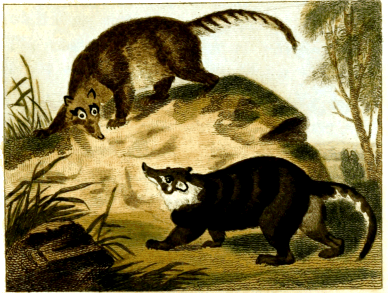
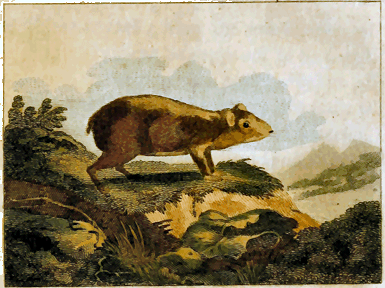
FIG. 98. Agouti
Some authors suppose that the sow badger, and the taxus suillus, of which Aldrovandus has given a figure, to be the same as the coati; but if we consider that the sow-badger, of which hunters speak, is supposed to be found in France, and even in some colder climates of Europe, and that, on the contrary, the coati is only known in the southern parts of America, this idea must be rejected, as having no foundation to support it; as the figure given by Aldrovandus is nothing more than a badger, to which the snout of a hog has been added. That author does not say this taxus suillus was drawn from Nature, nor does he give any description of the animal itself; and indeed the snout alone of the coati is sufficient to distinguish it from any other quadruped.
The coati has a practice of gnawing his own tail, which, when not mutilated, is longer than his body, and which he generally rears aloft, and moves with ease in any direction. This seemingly unnatural taste of gnawing their tails is not peculiar to the coati, for some monkies, and other animals with long tails, frequently shorten them a fourth, or even one-third, by eating the flesh and the joints. From this circumstance a general inference may be drawn, namely, that in very long members, the extremities of which must consequently be very remote from the centre of sensation, the feeling must be weak, and the more so the greater the distance and the smaller the part; for if the extremities of the tails of these animals were very sensible, the pain excited would prevail over the inclination to mutilate, and they would preserve their tails with as much care as any other part of their body.
The coati is an animal of prey, which subsists on flesh and blood, and which, like the fox or marten, destroys small animals and poultry, hunts for the nests of birds, and devours their eggs; and it is, probably, from this conformity of disposition, rather than from any resemblance to the marten, that the coati has been considered as a small species of the fox.
THE AGOUTI.
The Agouti (fig. 98.) is about the size of a hare, and has been considered by many writers as a kind of rabbit, or large rat; yet it bears a resemblance only in some trifling particulars to either, and in its natural habits it essentially differs from them both. It has the rough hair, grunting, and voracious appetite of the hog; and when fully satiated it hides the remainder of its food, like the fox, in different places. It delights in gnawing and spoiling every thing it comes near. When irritated it bites fiercely; its hair stands erect along the back, and it strikes the ground violently with its hind feet. It does not dig holes, like the rabbit, but lives in the hollows of trees. It feeds chiefly on roots, potatoes, yams, and fruits, when residing near habitations; those that reside in the woods also eat leaves, plants, and shrubs. It uses its fore paws, like the squirrel, in carrying food to its mouth; it runs very swiftly up hill, or on even ground, but its fore paws being much shorter than its hind ones, upon a descent it is in great danger of falling; it has a good sight and excellent hearing, and whenever it hears a whistle it stops to listen. They scald the agouti and dress it like a sucking pig, and the flesh of such as are fat and well fed is tolerable food, though it has always a peculiar taste, and is rather tough. When they go among the sugar-canes they are easily taken, for sinking every step in the straw and leaves, which covers the ground, a man may come up and even kill them with a stick. When in the open country it runs with great swiftness before the dogs; and having gained its retreat, nothing can force it to come out but smoke; for which purpose the hunters burn faggots and straw before the mouth of the hole, upon which the animal makes plaintive cries like that of a pig, but seldom quits the place of concealment until the last extremity. Its cry, which it repeats often when it is irritated or incommoded, is exactly like that of a young pig. When taken young they are easily tamed, and will go out and return alone. When in a wild state, they generally dwell in the woods, where the female chooses the most obscure parts, and there prepares a bed of leaves and grass for her young. They usually bring forth two or three in a year, and in a day or two afterwards, she carries them in her mouth like a cat, into the hollow of some tree, where she suckles them for a short space, for they are soon in a condition to run about and provide for themselves; from which it appears that the time required for their growth is but short, and of course the duration of their lives cannot be long.
The agouti appears to be a native of the south parts of America, not being known in the old continent. They are common in Brasil, Guiana, St. Domingo, and all the islands around. To subsist and multiply, they require a warm climate, yet they will live in France if well sheltered from wet and cold, especially in winter; it is even a stranger in the cold and temperate climates in America. In the islands there is only this one species of agouti, which we have described, but in the other places above named, it is affirmed there is another species called the agouchi, which is much smaller than the first; but we have the testimony of several persons who resided a long time at Cayenne, who were equally acquainted with the agouti and agouchi, that the one we have described is certainly the agouti. The latter we have never been able to procure, but the former we had alive; it was as large as a rabbit, its hair was coarse, and of a brown colour, with a small mixture of red; its upper lip was cloven like that of the hair, its tail was shorter than that of a rabbit, its ears very short and broad, and its upper jaw was more prominent than the under; its snout was like that of the loir, and its teeth resembled the marmot’s; its neck was long, its legs were slender, and on its fore feet it had four toes, and three on its hind ones. Marcgrave, and almost all naturalists after him, have said that the agouti has six toes on the hind-feet. M. Brisson is the only writer who has not copied this error of Marcgrave; but he described it from nature, and, like us, perceived only three toes on the hind-feet.
SUPPLEMENT.
M. de la Borde says, that the agouti is a very common animal in Guiana, that its flesh is as white as that of the rabbit, and is of a similar flavour; that they are hunted by dogs, taken in traps, and that the negroes take them in great numbers by whistling, or imitating their cries; that they principally feed upon nuts, which they collect and conceal in great quantities; that they are very prolific, producing as many, and as often as the rabbit; that they are easily tamed, but always retain somewhat of their savage disposition, yet if they go from home will return again of themselves; and that they keep in their holes during the night, unless the moon shines very clear, and are running about the greatest part of the day.
THE LION.
The influence of climate is marked with but slight variations in the human species; because that is entire in itself, and totally distinct from every other. Man, white in Europe, black in Africa, yellow in Asia, and copper-coloured in America, is still the same being, tinctured with the colour peculiar to the climate. And as he is formed to govern the earth, and as he has the whole globe for his habitation, it seems as if no situation was foreign to his nature; under the scorching south, or in the frozen regions of the north, he lives, he multiplies, and has been so anciently diffused over every country, that he does not appear to have a particular propensity to any. It is far otherwise with other animals; in them the influence of climate is marked with strong characteristics, because their species is diversified, and their nature is infinitely less perfect and more confined than that of man. Not only are the varieties in each species more numerous and more marked than in the human species, but even the differences in the species themselves seem to depend on the differences of climate. Some animals can only breed in hot countries, others cannot subsist but in cold ones. The lion has never inhabited the northern regions, nor has the rein-deer ever been found in the south; and perhaps no species has been universally diffused over the face of the earth, besides that of man. Each has its country, its native soil, to which it is confined by a physical necessity; each is the immediate offspring of the region which it inhabits; and it is in this sense alone we say, this animal is a native of one climate, and that a native of another. In hot countries the terrestrial animals are larger and stronger than in the frozen or temperate ones. They are also more bold and ferocious; all their natural qualities seeming to partake of the ardour of the climate. Lions born under the scorching sun of Africa or the Indies, are of all others the most fierce and formidable. Our wolves and other carnivorous animals, far from being their rivals, are hardly worthy to be their purveyors.[W] The lions of America, if they deserve to be so called, are, like the climate, infinitely more mild; and what proves that the degree of their ferocity depends on the degree of heat is, that in the same country, those which inhabit the high mountains, where the air is temperate, are different in disposition from those that dwell in the plains, where the heat is excessive. The lions of Mount Atlas, of which the top is sometimes covered with snow, have neither the boldness, strength, nor ferocity of the lions of Biledulgerid, or the desart of Zaara, whose plains are covered with burning sands. It is principally in these burning desarts that those terrible lions are found which are the dread of travellers and the scourge of neighbouring provinces. Happily for man this species is not numerous, and seems to diminish daily; for those who have travelled through this part of Africa affirm they are by no means so numerous now as they were formerly; and Mr. Shaw, in his travels, says, the Romans drew fifty times as many lions from Lybia, to combat in their amphitheatres, as are now to be found in the whole country. It is also remarked, that in Turkey, Persia, and India, lions are much less numerous than they were in ancient times. Since this animal preys on every other species of quadruped, and is himself the prey of none, it is obvious that its decrease can only be occasioned by the increase of mankind, who are the only beings in nature capable of making head against this king of beasts; and it must be allowed, powerful as he may be, he is no match for even a Hottentot or negro, who often attack him, and very seldom without coming off victorious. As the lion has no enemy but man, and his species being reduced to the fiftieth, or even the tenth part of what it was formerly, it follows that the human species instead of having suffered a considerable diminution since the time of the Romans, as is by some pretended, is on the contrary more generally diffused, and more numerous even in such countries as Lybia. The industry of man increases in proportion with his number, but that of other animals remains always the same. Every destructive species, like that of the lion, seems to be driven to distant countries, or reduced to small numbers, not only because man has become every where more numerous, but because he has become more skillful and invented dreadful arms of destruction, which nothing can resist; arms, which it were well, had they never been employed against aught but lions and tigers.
This superiority of numbers, and industry in man, which has subdued the lion, serves also to enervate and discourage him, for he is brave only in proportion to the success of his encounters. In the vast desarts of Zaara, in the burning sands which separate Mauritania and Negro-land, and in all the desarts of Asia and Africa, where man has disdained to fix his habitation, lions are still numerous and preserve their natural force and courage. Accustomed to measure their strength with every animal they meet, the habit of conquering renders them intrepid and terrible. Having never experienced the power of man, they have no apprehension of him, but boldly face and hold him in defiance. Wounds enrage, without repressing their ardour; they are not daunted even by the appearance of numbers. A single lion of the desart often attacks a whole caravan, and if, after an obstinate engagement, he finds himself overpowered, instead of flying, he retreats fighting, and faces the enemy to the last. On the contrary, those lions which inhabit the peopled countries of Morocco, or India, having become acquainted with man, and experienced the superiority of his arms, have lost their native courage to such a degree, that they are to be scared away with a shout, and seldom attack any but the unresisting flocks and herds, which even women and children are sufficient to protect against them.
This alteration, this amelioration in the disposition of the lion, proves that he might be tamed to a certain degree, and admit of a species of education. We read in history of lions being yoked to triumphal cars, led forth to the field of battle, or let loose to the chace, and that faithful to their master, they never exerted their strength or courage but against his enemies. Certain it is that the lion when taken young, and bred up with domestic animals, becomes familiar and sports innocently among them; that he will even be caressing to his master, and that if his natural ferocity returns, he seldom exercises it against his benefactor. As his passions are strong, and his appetites vehement, we ought not to presume that the impressions of education will always overbalance them; and therefore it would be dangerous to suffer him to remain too long without food, or wantonly to persist in irritating or tormenting him. He is not only enraged by bad treatment, but remembers it and meditates revenge; in the same manner he also remembers benefits and endeavours to shew his gratitude for them. In support of this we might recapitulate a number of facts, in which however there is probably much exaggeration; but it is sufficient that they prove his anger is noble, his courage magnanimous, and his disposition grateful and susceptible of impression. He has often been seen to despise contemptible enemies, and to pardon their insults when it was in his power to punish them. When in confinement he appears gentle, will caress the hand that feeds him, and will sometimes spare the lives of those animals which are thrown to him for prey; he will even live peaceably with them, spare them part of his subsistence, and has even been known to want food himself rather than be the means of depriving them of that life which his generosity had spared. The lion cannot be said to be cruel, since he acts from necessity and never kills more than he consumes; while the tiger, the wolf, and all the inferior species, such as the fox, marten, polecat, ferret, &c. kill without remorse, and seem rather to satisfy their malignity than their hunger.
The outward form of the lion speaks the superiority of his internal qualities. His figure is striking and grand; his look confident and bold; his gait stately, and his voice tremendous. His bulk is not overgrown like that of the elephant, or the rhinoceros; nor is his shape clumsy like the hippopotamus, or the ox. He is in every respect compact and well-proportioned; a perfect model of strength joined with agility. He is muscular, bold, and neither charged with fat nor unnecessary flesh. He manifests his muscular power by the ease with which he makes prodigious bounds and leaps; by the strong and swift movements of his tail, which is alone sufficient to strike a man to the earth; by the facility with which he moves the skin of his face, and particularly that of his forehead, which adds greatly to the expressions of fury in his countenance; and, lastly, by the power he has of moving the hair of his mane, which not only bristles up but is agitated on all sides when he is enraged.
To these eminent qualities the lion joins all the dignity of his species. By dignity of species I mean those whose nature is permanent, invariable, and not subject to degradation. In those animals to which this singular advantage belongs, the characteristics are so strongly marked, that they cannot be mistaken nor confounded with any other species. In man, the noblest being of the creation, the species is sole and entire, because all the individuals of it, of whatever race, climate, or complexion, may intermix and produce together; and because it cannot be said that any animal approaches to man in any natural degree. The horse is less noble considered as a species than as an individual, since the neighbouring one of the ass is so near, that one of each species will produce animals which Nature reprobates as bastards, unworthy of either race, and renders incapable of perpetuating either species from whence they sprung, but which in itself exhibiting a mixture of both, proves, beyond a doubt, their close affinity. The species of the dog is perhaps less noble, because he seems to be allied to that of the wolf, the fox, and jackall, who may all be considered as degenerate branches of the same family. In descending by degrees to the inferior species, such as the rabbit, weasel, rat, &c. we shall find that each of them has such a number of collateral branches that we cannot trace the original stock; and, lastly, in the tribes of insects, each species is accompanied with such a number of approximate ones that we are obliged to consider them as belonging to a certain genera. This is the only use of what is called method in Natural History, which ought never to be employed unless in the difficult enumerations of small objects, as it becomes useless and ridiculous when treating of beings of the first rank. To class man with the monkey, or to say that a lion is a cat with a long mane and tail, is rather to degrade and disfigure Nature than to describe and denominate her works. The species of the lion, therefore is one of the most noble since it is most entire, and cannot be confounded with those of the tiger, leopard, ounce, &c. and since those species, which appear to be the least remote from the lion, are so little distinct from each other, as to have been perpetually mistaken and confounded by travellers and nomenclators.
The largest lions are about eight or nine feet in length, from the snout to the tail, which is four feet long, and are between four and five feet high. Those of the small size are about five feet and a half long, three feet and a half high, and their tail rather more than three feet long. In all her dimensions the lioness is about one fourth less than the lion. Aristotle divides lions into the greater and smaller, and the latter, he says, are short in proportion, have their hair more frizzled, and are less courageous than the former. He adds, that in general all lions are yellow. The first of these assertions appears doubtful, since no traveller has mentioned lions with frizzled hair; some authors, indeed, who, in other respects do not merit entire confidence, speak of a tiger with curled hair found at the Cape of Good Hope; but almost all testimonies agree as to the colour of the lion, which is uniformly yellow on the back and within on the sides and belly. Ælian and Opian have asserted, that in Ethiopia the lions are as black as the men; that in India there are some white and others spotted and striped with red, black, and blue; but this is not confirmed by any authentic testimony, for Marco Polo the Venetian, does not speak of these striped and spotted lions as if he had seen them, and Gesner observes that he only mentions them on the authority of Ælian. It appears on the contrary, that there are few or no varieties in these species; that the lions of Asia and Africa perfectly resemble each other, and that those of the plains differ less in colour from those which dwell in the mountains than in size.
Engraved for Barr’s Buffon.
FIG. 99. Lion.
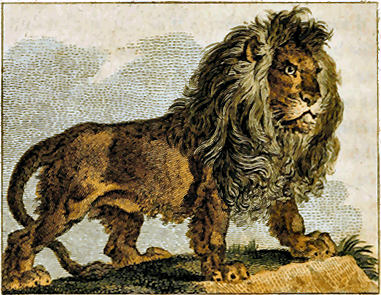
FIG. 100. Lioness.
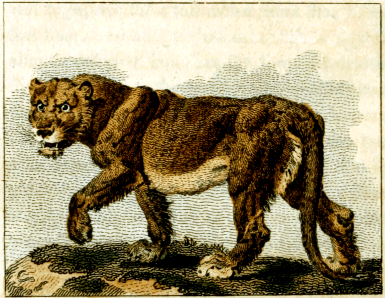
The lion (fig. 99.) is furnished with a mane, or rather long hair, which covers all his fore-parts, and becomes longer as he advances in age; but the lioness, (fig. 100.) however old, is without this appendage. The American animal, which the natives of Peru call Puma, and the Europeans Lion, has no mane, and is smaller, weaker, and more cowardly, than the real lion. It is not impossible that the mildness of the climate in South America might have such influence on the nature of the lion as to strip him of his mane, reduce his size, and repress his courage; but it appears absolutely impossible that this animal, which inhabits the tropical regions only, and to whom Nature, to all appearance, has shut up every avenue to the north, should pass from the southern part of Asia or Africa into America, those continents being divided towards the south by immense seas. From this circumstance it is probable that the puma is not the lion, deriving its origin from those of the old continent and since degenerated, but that he is an animal peculiar to America, like other animals found on the new continent.
When the Europeans first discovered America, the quadrupeds, birds, fishes, insects, plants, and almost every thing appeared to be different from what they had seen before. Of this new world it was therefore necessary to denominate the principal objects. As the names given by the natives were for the most part barbarous and difficult to pronounce or remember, names were borrowed from the European languages, especially from the Spanish and Portugueze. In this dearth of denominations, a small affinity in external appearance, size, or figure, was sufficient to attribute to unknown objects the names of those that were familiar. Hence the doubt, perplexity, and confusion which has considerably increased, since, at the same time that the productions of the new continent were receiving the denominations of those of the old one, plants and animals peculiar to the latter were transporting there in abundance. To remove this obscurity, and to avoid falling into perpetual errors, it is therefore necessary to distinguish carefully what belongs to the one continent from what belongs to the other. Of this distinction I shall shew the necessity in the next article, where I shall enumerate not only the animals which are natives of America, but those which have been carried thither.
M. de la Condamine, whose testimony deserves our full confidence, says expressly, that he does not know whether the American animal which the Spaniards call Lion, and the natives of Quito, Puma, deserves the name of Lion; he adds, that it is much smaller than the African lion, and that the male has no mane. Frezier also says, that the animals called lions in Peru are very different from those of Africa; that they avoid the sight of man, and commit no havock but among the cattle; and he further remarks that their heads bear a strong resemblance to the heads of both the wolf and the tiger, and have tails shorter than that of either. In more ancient relations, we are told that the lions of America by no means resemble those of Africa; that they have neither their size, nor fierceness, nor colour; that they are neither red, nor yellow, nor grey; that they have no mane, and that they have a custom of climbing up trees. Differing, then, from the lion in size, colour, form of the head, length of the tail, want of the mane, and lastly, in natural habits, no longer ought the Puma of America to be confounded with the real lion of Africa or Asia.
Though this noble animal inhabits only the hottest regions, yet he will live, and, with care, might even breed in temperate ones. Gesner mentions that lions were brought forth in the menagerie of Florence; and Willoughby tells us, that at Naples, a lioness which had been confined with a lion, produced five whelps at one litter. Such examples are rare, but if true, they prove that lions are not absolutely averse to mild climates. At present there are none of them in the southern parts of Europe; so early as the days of Homer, there were no lions in Peloponnesus, yet they existed in Thrace, Macedonia, and Thessaly, in the time of Aristotle. It is, therefore, evident that in all ages they have given the preference to the hottest climates; that they seldom resided in temperate ones, and never in the frozen regions of the north. The naturalists above quoted, though they mention lions being brought forth in Florence and Naples, are silent as to the time of gestation in the lioness, the size of the young, when whelped, and the degrees of their growth. Ælian says she goes only two months, while Philostratus and Edward Wotten affirm it to be six. I think the latter opinion is nearest the truth, because the lion is an animal of great magnitude, and in general the time of gestation is longer among the large than the small species. Thus it is also with the growth of the body. Both ancients and moderns allow that the new-born lion is not bigger than the weasel, that is from six to seven inches long; if so, several years must elapse before he can increase to eight or nine feet. It is also said that they cannot walk before they are two months old. But, without giving entire credit to these assertions, we may with probability presume, from the largeness of the size, that he is three or four years in acquiring his full growth, and that he consequently lives to about the age of twenty-five. The Sieur de St. Martin, master of the bull-fights at Paris, who willingly communicated to me the observations he had made upon the lions which he reared, assured me that he has kept lions for fifteen or sixteen years, and that he does not believe they live above the age of twenty or twenty-two. But it must be evident the want of exercise, constraint, and irksomeness of situation to those which are in confinement, must impair health and shorten life.
In two different parts of his treatise on animals, Aristotle states that the lioness produces five or six whelps at her first litter, four or five at the second, three or four at the third, two or three at the fourth, and one or two at the fifth, and after which she becomes barren. This assertion is ungrounded, since in all animals the first and last litters are always the least numerous. This philosopher erred also, as well as all the naturalists that came after him, in maintaining that the lioness had but two nipples, it being a certain and well known fact that she has four, as may be known by simple inspection. He likewise asserts that the lion, bear, and fox, are unformed at their birth; but it is now known that these animals are brought forth as perfect as any other, and that their members are distinct and developed. He says too that the lions copulate in a backward disposition; but from a bare inspection it is demonstrable that they engender in the same manner as other quadrupeds. I have noticed these errors in Aristotle minutely, as the authority of such a great man has misled all authors who have since given the history of animals. His assertion also, that the neck of the lion contains but one rigid and inflexible bone, has been contradicted by experience; for in all quadrupeds, without exception, and even in man, the neck is composed of seven vertebræ; and it is also another certain fact, that in general, carnivorous animals have a much shorter neck than granivorous, and especially than the ruminating ones. It is also stated by Aristotle, that the bones of lions have neither cavity nor marrow; that they are as hard as flint, and possess the property of striking fire by friction; but such errors ought not to have been repeated by Kolbe, nor handed down to posterity, since even in the days of Aristotle they were ridiculed by Epicurus.
The lion is particularly furious when rouzed by love. A female when in season will have eight or ten males in her train, who fight most bloody battles, till one of them becomes victorious over the rest. She brings forth in spring, and does not produce more than once a year, which also proves that she is employed for some months in tending and suckling her young, and consequently the time required for their first growth, while they are in need of the assistance of their dam, must at least be some months. In this animal all the passions, even of the most gentle kind, are in excess. The attachment of the lioness to her young is astonishingly great; though naturally less strong and courageous than the lion, she becomes terrible when she has young. She then makes her incursions without fear; attacks indiscriminately men and animals, destroys without distinction, loads herself with the spoil, and carries it home to her whelps, whom she accustoms betimes to blood and slaughter. She usually brings forth in the most retired and inaccessible places, and when afraid of having her retreat discovered, she hides her tracks by traversing back the ground, or brushing them out with her tail. She sometimes also, when her apprehensions are great, transports them to a different place, and if obstructed, she defends them with a determined fury, and fights to the last extremity.
It is asserted that the lion is not possessed of either the sense of smelling or seeing in such perfection as most other animals of prey; a strong light incommodes him, so that he seldom goes abroad in the middle of the day, but commits all his ravages in the night; and when a fire is kindled near a herd, he never approaches them. His smell is also so faulty, that he hunts by the eye only. A species of lynx, which has a piercing eye and acute smell, has indeed procured the name of the lion’s guide, or purveyor, and it is said that he always accompanies or precedes the lion, to direct him to his prey. This is a small weak animal, which sometimes follows the lion, though he would most probably avoid him, did he not frequently come in for a share of that spoil which the lion leaves.
The lion, when hungry, boldly attacks all animals that come in his way; but as he is very formidable, and they all seek to avoid him, he is often obliged to conceal himself for an opportunity of taking them by surprise. This he does by couching upon his belly in some thicket, where he patiently waits the approach of his prey, and which he springs at with such force as often to seize it the first bound; but if in the end his prey escapes, he stands motionless, and seems hurt at the disappointment. In the desarts and forests gazelles and monkeys are his common food; the latter, however, he only takes when upon the ground, as he cannot climb trees like the tiger or puma. He devours as much at once as will serve him for two or three days. His teeth are so strong that he easily breaks the bones and swallows them with the flesh. He is said to be capable of supporting hunger for a long time, but from the heat of his temperament he is less patient of thirst; he drinks as often as he can meet with water, which he laps like a dog, but with his tongue bent downwards. He requires about fifteen pounds of raw flesh every day; he prefers that of living animals, particularly of those he kills himself; he seldom devours putrid carcases, and chooses rather to hunt for fresh spoil than to return to what he had left on a former day. Though he usually feeds upon fresh provisions his breath is very offensive, and his urine insupportable.
The roaring of the lion is so loud, that when uttered in the desarts by night, and re-echoed by the mountains, it resembles thunder. This roar is his natural note, for when enraged he has a short and quickly reiterated growl; but the roar is a long, deep, hollow cry, which he sends forth five or six times a day, or oftener before rain. His cry of anger is much louder, and still more terrible. He then beats his sides and the earth with his tail, erects his mane, puts the skin of his face, and eyebrows, in motion, shews his tremendous teeth, thrusts out his tongue, which is covered with such sharp hard points, that it is alone sufficient to flay and chew the food without the aid of teeth or nails. He is much stronger in the head, jaws, and fore-legs, than in any of his hind parts. He sees better in the night than by day, and though his sleep is short, and he is easily awakened, yet there is no foundation for the assertion that he sleeps with his eyes open.
The usual pace of the lion is bold, solemn, and slow, though always oblique. When in chase he rather bounds than runs, and his motions are so precipitate, that he cannot stop suddenly, but generally surpasses his intention. When he darts on his prey he leaps the distance of twelve or fifteen feet, seizes it with his fore-feet, tears it with his paws, and then devours it with his teeth. While young and active he lives by the chace, and seldom quits the desarts or the forests, where he finds a sufficiency of wild animals for his purpose; but when he grows old, heavy, and less qualified for exercise, he approaches frequented places, and becomes a more dangerous enemy to man and domestic animals. It is observed, however, that when he sees men and animals together, he attacks the latter, and never the former, unless he is struck; in which case, always distinguishing from whom the blow came, he quits his prey to take revenge for the injury. He is said to prefer the flesh of the camel to that of any other animal; he is also exceedingly fond of young elephants, which, from their inability to resist until their tusks are grown, he easily dispatches, when unprotected by their mothers, nor are there any animals able to resist the lion but the elephant, rhinoceros, tiger, and hippopotamus.
However powerful this animal may be it is not uncommon for large dogs, supported by men on horseback, to chace, dislodge, and force him to retire; but it is necessary for both dogs and horses to have been well disciplined, as animals tremble and fly at the very smell of the lion. Though his skin is firm and compact it is not proof against a ball, or even a javelin; yet he is seldom dispatched with one blow. He is often taken like wolves, by slightly covering a pit, and fastening a live animal over it. When thus entrapped all his fury subsides, and if advantage is taken of the first moments of his surprise and shame, he may be chained, muzzled, and conducted any where without resistance.
The flesh of the lion is of a strong and disagreeable flavour, yet the Negroes and Indians do not dislike it, and frequently make it part of their food. The skin, formerly the tunic of heroes, serves these people for a mantle; they likewise preserve the grease, which is of a penetrating quality, and is of some use in medicine.
END OF THE SIXTH VOLUME.
T. Gillet, Printer, Wild-court.
Transcriber Note
All obvious typographical errors were corrected. Where several variant spellings were used, the most prevalent version was use to standardize them. All illustration headers were standardized to display “Engraved for Barr’s Buffon.” above each group and the captions were also standardized. Where paragraphs were split by illustrations, they were rejoined. To match the other volumes in this series, the list for the placement of images was positioned after the Table of Contents.