Front matter (continued 3)
Reading edition
Both males and females are capable of generating when two years old. It is probable that the female may be more forward than the male; it is, however, certain, that they are not inclined to copulate before the second winter, which necessarily implies 18 or 20 months of age; a she-wolf, which I reared, discovered no symptoms until the third winter, when she was more than two years and a half old. Huntsmen assert that in every litter there are more males than females, which seems to confirm the general remark, that Nature, in all species, produces more of the former than the latter. From them also we learn that some of the males attach themselves to the females, and accompany them until they are about to bring forth, when she steals from him, and carefully hides her young, lest he should devour them immediately after birth; but that when brought forth, he takes the same care of them as the female, carries them provisions, and if the mother happens to be killed, he carefully brings them up. I cannot, however, pretend to vouch for the truth of these facts, which appear to me contrary to their natural dispositions.
These animals require two or three years to complete their growth, and live to the age of 15 or 20; another proof of our position that the growth takes up one seventh part of life. As the wolf grows old he turns grey, and his teeth appear much worn. He sleeps when full or fatigued, but more by day than night, and is always very easily awakened. He drinks frequently, and in times of drought, when there is no water in holes or trunks of trees, he will come to the brooks or rivulets several times in the day. Although very voracious, he will go four or five days without meat, provided he is well supplied with water. He has great strength, particularly in his fore parts, in the muscles of his neck and jaws. He will carry off a sheep in his mouth, without letting it touch the ground, and at the same time outrun the shepherds, so that nothing but dogs can overtake or oblige him to quit his prey. He bites cruelly, and always with greater vehemence in proportion as he is less resisted, for with such as can defend themselves he is cautious and circumspect. He is cowardly, and never fights but from necessity. When wounded by a bullet he will cry out, and yet when surrounded and dispatched by clubs, he never complains like the dog, but defends himself in silence, and dies as hard as he lived. He is more savage, has less sensibility, and more strength than the dog. He travels and roams about for nights and days together, and perhaps of all animals is the most difficult to be hunted down. The dog is gentle and courageous; the wolf though savage is fearful. If entrapped in a snare he is for some time so frightened and overcome, that he may be killed or taken alive, without offering to resist; he will suffer himself to be chained, muzzled, and led along without giving the least signs of anger or resentment. His senses, particularly that of smelling, are very acute, and the odour of a carcass will strike him, though at more than a league distant; he also scents living animals a great way off, and will hunt them a long time by following their track. On leaving the wood he always goes against the wind, and upon coming to the extremity he stops, smells on all sides, and receives the emanations that may come either from living or dead bodies, and which he nicely distinguishes. He prefers living flesh to carrion, but will eat the most infected carcasses. He is fond of human flesh, and perhaps were he sufficiently powerful he would eat no other. Wolves have been known to follow armies, to go in numbers into the field after a battle, and devour such bodies as lay upon the surface, or were negligently interred: when once accustomed to human flesh, they will attack men, preferring the shepherd to his flock, devour women, and carry off children.[M]
It sometimes happens that whole countries are obliged to arm for the purpose of destroying them. Hunting of them is also a favourite diversion among the great, and is certainly a very useful one. Wolves are distinguished by huntsmen into young, old, and very old; they are known by the prints of their feet, which are large in proportion to their age; those of the females are longer and more slender. It is necessary to have a good bloodhound to put up the wolf, and when upon the scent every art must be used to encourage him, as all dogs have a natural antipathy to this animal, and are very cold in the pursuit. When the wolf is put up, greyhounds should be let after him in pairs, the first pair almost immediately supported by a man on horseback; the second when he is at the distance of eight or nine hundred paces, and a third pair when the other dogs have come up with and begin to bait him; he keeps them off for a considerable time, but the hunters coming up generally dispatch him with their cutlasses; when killed the dogs never shew the smallest appetite to enjoy the fruits of their victory. The wolf is sometimes hunted by harriers, but as he runs straight forward, and will hold his speed for a day together, the chace is very tedious without greyhounds to harrass and turn him at every view. Several arts have been adopted to destroy these noxious animals such as worrying them with large mastiffs, laying snares, digging pits, and spreading poisoned meats, yet their numbers remain nearly the same, especially in woody countries. The Britons are said to have extirpated them from their island, and yet I am assured they are still found in Scotland; as there are but few forests in South Britain, their destruction there was less difficult.
Their colour differs with the climate in which they live, and sometimes in the same country. Beside the common wolves, in France and Germany, there are others with thicker and yellow coloured hair; these, though more savage are less destructive than the others, as they neither approach flocks nor the habitations of men, but live solely by the chace. In the northern climates some are found quite black, and others entirely white. The common species are very generally diffused, being found in Asia, Africa, and America, as well as in Europe. The wolves of Senegal resemble those of France, except being larger and more fierce; those of Egypt are smaller than those of Greece. In the East, particularly in Persia, the wolf is trained up for a shew, being taught to dance, and exhibit a number of tricks; and, according to Chardin, when well taught, a single wolf will sell for 500 crowns. This fact proves, that by dint of time and restraint, these animals are susceptible of education. Several which I reared were very docile, and even courteous, during the first year, nor ever attempted to seize the poultry, or other animals, when properly fed, but when they arrived at 18 months I found it necessary to chain them, to prevent their doing mischief, or running away. I allowed one that I had to range at large among some fowls, and he never touched any of them till he was about 18 or 19 months old, when, as a specimen of what he could do, he killed the whole in one night, without eating any of them. I had another which broke his chain and ran off, but not till he had killed a dog with whom he had been very familiar, and a particular instance of the ferocity of a she-wolf I have given under the article Dog.
There is nothing valuable in this animal but his skin, which makes a warm durable covering. His flesh is so bad that it is abhorred by all animals, and no species will eat it, his own excepted. His breath exhales a most fetid odour. As to satisfy his voracious appetite he devours, without distinction, putrid flesh, hair, bones, skin half tanned, or even any thing that comes in his way, so he vomits frequently, and empties himself more often than he fills. In a word, he is every way offensive; he has a savage aspect, a frightful howl, an insupportable stench, a perverse disposition and fierce habit; he is hateful while living and useless when dead.
SUPPLEMENT.
We have it from Pontoppidan, that wolves did not exist in Norway before the year 1718, and that in the last war between Sweden and Norway they followed the provisions of the army.
The Viscomte Querhoënt has informed me that there are two species of wolves at the Cape of Good Hope, the one black and the other grey with black spots; that they are bigger than those of Europe, and have very large teeth, but their cowardice makes them little apprehended, though sometimes, as well as the ounces, they will steal into the city in the night.
THE FOX.
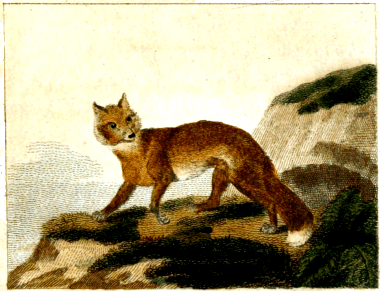
This animal is famous for his craft, and he partly merits the reputation he has acquired. What the wolf (fig. 62.) executes by superior strength, the fox (fig. 63.) accomplishes by cunning. Without attacking the shepherd, his dog, or even his flock, he finds a more certain way to subsist. Patient and prudent he waits the opportunity for depredation, varying his conduct according to circumstances always reserving some arts for unforeseen events. Self-preservation is his grand object, and though as indefatigable, and more nimble than the wolf, he never trusts entirely to the swiftness of his course, but contrives himself an asylum, where he retires in cases of necessity, and in which he dwells and brings up his young.
Engraved for Barr’s Buffon.
FIG. 62. Wolf.
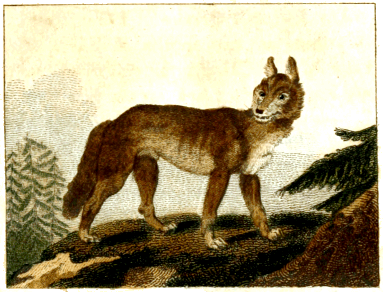
FIG. 63. Fox.
As among men, those who lead a domestic life are more civilized than perpetual wanderers; so, among animals, the taking possession of a home, supposes a superior degree of instinct. The choice of situation, the art of rendering it a convenient habitation, and concealing the entrance to it, likewise indicate superior skill and industry. Endowed with both these, the fox turns them to his advantage. He fixes his residence at the edge of the wood, yet not far from some cottage or hamlet; he listens to the crowing of a cock, and the cackling of other poultry; he scents them at a distance; he judiciously chooses his time; creeps slily along; suddenly makes the attack, and rarely returns without his booty. If he can get into the hen-roost, he puts all to death, and retires with part of his prey, which he conceals at some distance; he then returns for more, which he takes away and hides in the same manner, though in a different place; and this practice he continues, till, warned by the approach of day, or the movements of the family, he retires to his den. He makes use of similar arts with the fowler; visits the nets and springes very early in the morning, expertly takes the birds out of the snare, carries them off successively, and conceals them in different places, above all near the edges of the roads where he sometimes leaves them for two or three days, but is never at a loss to recover his hidden treasure when he is in need. The young hare and rabbit he hunts down; the old ones he seizes in their seats, and never misses those which are wounded; he discovers the nests of partridges and quails, seizes the old ones while they are sitting, and destroys a prodigious quantity of game; so that if he is less injurious than the wolf to the peasant, he is more noxious to the gentleman. The chace of the fox requires less preparation, and is more amusing than that of the wolf. Though all dogs have a great reluctance to the latter, they pursue the fox with pleasure, and often in preference to the stag or hare. He is usually hunted with hounds, assisted by terriers. The instant he finds himself pursued he makes to his den, and takes refuge at the bottom, into which the terriers will follow and keep him at bay, while the hunters remove the earth from above. But as his kennel is often under rocks, or among the roots of trees, he cannot then be dug out, nor is the terrier able to contend with him at the bottom of his hole. In this case he remains secure; but if he can be dug out, the usual way is to carry him in a bag to some distance, and there set him loose before the hounds. His shifts to escape, when all retreats to his kennel are cut off, are various and surprising. He will then proceed in a direct line before the hounds, but making to the most woody grounds, he takes to those paths most entangled with thorns and briars, and seldom fails to extremely harass and fatigue the dogs.
The most effectual method of destroying foxes, is to lay traps for them, baited with flesh, live pigeons, or fowls. I once suspended on a tree, nine feet high, some meat, bread, and bones, at which the foxes had been so eager in leaping, that in the morning the ground round it was beaten as smooth as a barn floor. The fox is extremely voracious; for besides flesh, he eats with equal avidity, eggs, milk, cheese, fruit, and particularly grapes. When he cannot procure a sufficiency of leverets and partridges, he falls upon rats, mice, serpents, toads, and lizards, which he destroys in great numbers, and thereby renders one service to mankind. Insects, shell-fish, and even the hedge-hog, at times, become his prey. He attacks bees and wasps for the sake of their honey; they at first seem to force him to retire, by repeated stings, but this is only to roll upon the earth and crush those which have stuck to his skin; he then returns to the charge, and by perseverance, obliges them to abandon their combs, when he devours both wax and honey.[N]
The fox greatly resembles the dog in the internal parts. His head, however, is larger in proportion to his body, his ears are shorter, his tail more bushy, and his eyes more oblique. He also differs from the dog by a strong offensive smell, which is peculiar to his species, and also in disposition; for he is not easily tamed, can never be rendered truly domestic, pines and dies of chagrin when long denied his liberty. As we have already stated, he refuses to copulate with the female dog. The foxes bring forth once a year, they generally have four or five, seldom six, and never less than three. When the female is pregnant, she seldom goes out of her kennel, where she prepares a bed for her young. She is in season in winter, and there are young foxes in April. When she finds her retreat is discovered, and that her cubs have been disturbed during her absence, she endeavours to find a place of greater security and carries them to it one after the other. They come blind into the world, and like dogs also they grow from eighteen months to two years, and live to the age of thirteen or fourteen.
The senses of the fox are as good as those of the wolf; his smelling is more acute, and the organs of his voice are more supple and more perfect. The wolf only howls, while the fox yelps, barks, and has a mournful cry like that of the peacock. He varies his tones also according as he is affected. He has tones expressive of desire, sorrow, and pain; the latter of which he never uses but when shot or deprived of some member, for he complains of no other wound, and like the wolf, when attacked with cudgels only, he never utters a sound, but defends himself with bravery and courage, though in obstinate silence until the last gasp. He bites dangerously and with such determined fury that it is difficult to make him quit his hold. His yelping is a kind of quick barking, which he generally terminates by raising his voice and resembling the cry of a peacock. In winter, especially during frost, he yelps continually, but in the summer he is almost entirely mute, and at this season he sheds his hair. The skin of young foxes, or those taken in summer, are held in little esteem. The flesh of the fox is not so bad as that of the wolf; dogs, and even men, eat it in autumn, especially if he has been fattened with grapes; and in winter good furs are made of his skin. He sleeps so sound that he may be closely approached without being awakened; he sleeps in a round position like a dog, but when he only means to rest, he stretches out his hind legs and lies flat upon his belly. In this posture he watches for birds as they perch on the hedges, who no sooner perceive him, than they set up shrill cries to warn their neighbours against their mortal enemy: the jays and magpies in particular will follow him for some hundred paces, constantly repeating their cries as a warning. The fox has a very disagreeable odour, which makes it necessary to keep them in stables at a distance from the house, and this perhaps might be the reason why those I reared were less tame than the wolf, with whom this precaution was unnecessary. At the age of five or six months the young foxes began to chace the ducks and fowls, upon which account I was obliged to chain them, and although I kept these very foxes for more than two years, they never attempted to touch a fowl while they were so confined; a live hen was frequently fixed near them for a whole night, and although they had previously been kept short of food, they never forget they were chained, and the hen invariably remained unmolested by them.
The fox is so subject to the influence of climate, that the species are almost as numerous as of any domestic animal. The generality of French foxes are red, some few are grey, but all have the tip of their tail white; the latter are sometimes called in Burgundy coal-foxes, from having very black feet. In the northern countries there are foxes of all colours; black, blue, dark and light grey, white, white with reddish legs, white with black heads, white with the end of the tails black, red with the throat and belly white, and lastly with a stripe of black along the back and another crossing it at the shoulders; of these the throats are also black and they are larger than the others. The common kind are most generally diffused; they are not only in Europe, but throughout northern and central Asia and in America; but in Africa and the countries near the equator they are very rare. Those who say they have seen them at Calcutta and other southern provinces, must have taken the jackall for the fox. Aristotle falls into a similar error, when he says, the foxes of Egypt were smaller than those of Greece; those little Egyptian foxes being only polecats, whose stench is intolerable. They are evidently the natives of cold climates, both from their not being affected by extreme cold and their living in the countries adjacent to both poles. The hair of the white fox is not much esteemed, because the hairs fall easily off; the silver-grey is better, and the blue and striped are prized on account of their rarity, but the black is the most valuable, and yields to none but the sable. There are foxes in Spitzbergen, Greenland, Lapland, and in Canada; in the latter place there are some of the striped species, the common kind are not so red as those in France, but their hair is longer and more plentiful.
SUPPLEMENT.
Some travellers assert that the heads and feet of the Greenland foxes resemble those of dogs, and that they bark like them; that they are of various colours, such as white, grey and blue, and that they live upon eggs, birds, flies, bees, and whatever they can procure from the holes of the rocks in the sea. At Kamtschatka there are some of a dark chesnut, others red with black bellies, and others of a dark grey, all of which have thick coats of hair very glossy and beautiful.
In Norway there are white, red, and black foxes, and also some with black lines along the back. Pontoppidan, who delights in the marvellous, relates several wonderful tales of these animals, and adds that they frequently catch lobsters with their tails.
THE BADGER.
The Badger is an indolent, diffident, solitary animal, who retires to the most secret places, and there digs for himself a subterraneous residence. He not only shuns society but even the light, spending three-fourths of life in his obscure retreat, and never venturing out but in search of food. He burrows the ground with great facility, as his body is elongated, his legs short, and the claws, those especially of his fore feet, are very long and compact; his habitation is often at a considerable distance from the surface, and the passage to it always oblique and winding. The fox, who is less expert at digging, often benefits from the labours of the badger; unable to force him to quit his retreat, he often drives him from it by stratagem. He stands sentinel, and defiles it with his ordure, which proves an infallible expedient. The badger gone, he takes possession, enlarges, and accommodates it for his own purpose. Though forced to remove, the badger leaves not the country, but digs himself a new habitation at a little distance, from which he never goes out but at night, even then not far, and returns upon the smallest appearance of danger. In this precaution alone consists his safety, for his legs being very short the dogs soon overtake him. Upon being attacked he throws himself backwards, and as his legs, claws, jaws, and teeth are very strong, he is enabled to fight with obstinacy, and it is seldom that he dies unrevenged.
Formerly, when badgers were more common, terriers were trained up to hunt and take them in their burrows; but this was no easy task, as his mode of defence is to retire, and doing so, to undermine great quantities of earth, either to stop up the passage or bury the dogs under it. The only certain way of taking him is to open the hole above, after the dogs have driven him to the extremity. He is generally taken hold of with pincers, and then muzzled to prevent his biting. I have had several brought me taken in this manner, some of which I kept a long time. The young ones are easily tamed; they will play with dogs, and follow the person from whom they receive their food; but the old ones always retain their savage dispositions. They are neither mischievous nor voracious like the fox and the wolf, yet they are carnivorous; they prefer raw meat, but will eat flesh, eggs, cheese, butter, bread, fish, fruit, nuts, grain, roots, &c. They sleep the whole night and three parts of the day, yet they are not subject to a lethargic torpor during the winter, like the dormouse, or mountain rat; this makes them very fat, although they eat moderately, and they can go several days without food.
They keep their holes extremely clean, nor ever defile them with their ordure. The male is seldom found with the female; when the latter is about to bring forth she collects a quantity of herbage, which having bundled up she trails along, between her feet, to the bottom of her hole, where she converts it into a commodious bed for herself and young ones; she brings forth in the summer, and generally has three or four at a time; she nourishes them at first with her milk, but very soon inures them to such food as she can provide. For them she seizes young rabbits, field-mice, lizards, grass-hoppers, takes birds' eggs from their nests, and uncovers bee-hives, where they are buried, and carries away their honey; all which she carries to her brood, whom she often brings to the mouth of the hole, in order to feed or suckle them. These animals are naturally chilly; and those reared in the house will scarcely ever quit the fire side, which they will approach so close as frequently to burn their feet, which are not easily cured. They are very subject to the mange, and will infect those dogs which penetrate their burrows, unless they are carefully washed. The hare of the badger is always filthy; between the anus and the tail there is an opening about an inch deep, but which has no communication with the interior of the animal, whence an oily ill-scented liquid is constantly emitted, which the animal is fond of sucking. Its flesh has not a very bad taste; and of its skin are made coarse furs, collars for dogs, trappings for horses, &c.
In this species we know of no varieties; and our researches have been fruitless to discover such as have been said to exist; indeed some of the differences are stated to be so trivial that they cannot fairly be considered as distinct from the others; besides those species in which there are actual varieties are usually very abundant, and generally diffused, whereas that of the badger is one of the least numerous and most limited. We are not certain that they are to be found in America, unless we regard as a variety the animal sent from New York, of which M. Brisson has given a short description, under the name of the White Badger. They exist not in Africa, for the animal from the Cape of Good Hope, which Kolbe describes under the name of the Stinking Badger, belongs to a different species; and we doubt whether the Fossa of Madagascar, mentioned by Flacourt, be an actual badger, although he says they resemble those in France. Other travellers take no notice of it, and Dr. Shaw even says it is unknown in Barbary. It seems, likewise, not to exist in Asia; and that the badger was unknown in Greece is plain from Aristotle’s not mentioning it, and its having no name in the Grecian language. This animal, therefore, is a native of the temperate climates of Europe, has never been diffused beyond Spain, France, Italy, Germany, England, Poland, and Sweden, and even in those countries it is not very common. There are not only no varieties, but the badger (fig. 64.) does not approach any other species. Its characteristics are striking and singular; to it exclusively belong the alternate stripes upon its head, and the kind of bag under its tail; its body is also nearly white above and black below, whereas in all other animals their bellies are always lighter than their backs.
Engraved for Barr’s Buffon.
FIG. 64. Badger.
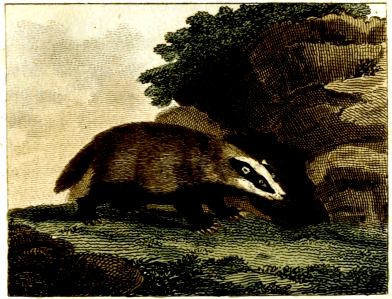
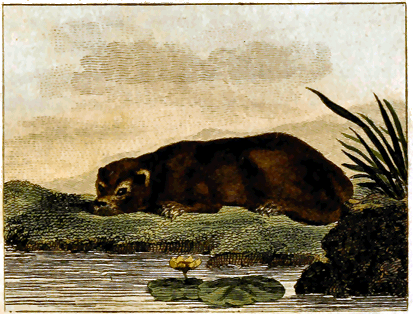
FIG. 65. Otter.
THE OTTER.
The Otter (fig. 65.) is a voracious animal, but more fond of fish than flesh, and is seldom found but at the sides of lakes and rivers. He swims with more facility than the beaver, who has membranes on his hind feet only, and whose toes on the fore feet are separate, whereas the otter has membranes on all his feet; and he can scarcely walk faster than he swims. He never ventures to the sea like the beaver, but swims up and down the rivers to considerable distances. Although he can remain a long time under water be cannot be properly called an amphibious animal; viz. one equally capable of living in air or in water; his conformation is not calculated for his living in the latter element, and he requires to breathe as much as any terrestrial animal. If they happen to be entangled in a net while pursuing a fish they drown, and this evidently for want of time to destroy a sufficient quantity of the meshes to effect their escape. His teeth are like those of the polecat, though larger and stronger in proportion to its size. For want of fish, frogs, water-rats, or other food, he will eat the young branches and bark of aquatic trees; and in the spring he will eat the young grass. He is as little afraid of cold as moisture. It couples in winter and brings forth in March, and commonly three or four at a time. In general young animals are pretty; but the young otters are not so handsome as the old: from the awkwardness of its motions deformity of figure, and a kind of mechanical cry, which it repeats almost without intermission, one should suspect it a stupid animal. He, however, becomes industrious with age, at least sufficiently so to wage a successful war with the fishes, who with respect to instinct and sentiment, are greatly inferior to other animals; and yet I can scarcely believe he has, I will not say the talents, but the habitudes of the beaver, such as always going up against the stream, in order to return more easily down the current when loaded with his prey; that of fitting up his house, and lining it with boards to exclude the water; that of laying in a quantity of fish against a future scarcity; and lastly, that of his being rendered so tame and subservient as to fish for his master, and even taking his booty into the very kitchen. All I know is, that the otter does not dig his own habitation, that he fixes his residence in the first hole he finds, under the roots of poplars or willows, in the clefts of rocks, and even among piles of floating wood; and in those they bring forth their young; where we also find heads and bones of fishes; that they frequently change their residence; that they drive away their young at the end of six weeks or two months; that those I attempted to tame endeavoured to bite, though then feeding on milk, and unable to chew fish; that a few days after they became more mild, probably from having become sick and weak; that so far from being easily habituated to a domestic life, all those that I endeavoured to rear died very young; that, in fine, the otter is of a savage and cruel disposition; that when he gets into a fish-pond he does the same as a polecat in a hen-house, that is kill more than he can eat, and then carry them away in his mouth.
Though the otter is not known to shed his hair, yet his winter coat is browner than in summer, sells for more money, and makes a very good fur. Some people eat their flesh, which has a disagreeable fishy taste; their retreats are always infected with the stench of fish, which they have suffered to rot around them. Dogs have no aversion to chace the otter whom they easily overtake when at a distance from his hole or the water; when seized he defends himself obstinately, bites cruelly, and sometimes with such force as to snap their leg bones, and he never quits his hold as long as he retains his breath. The beaver, however, though not remarkable for strength, drives the otters away, and will not suffer them to dwell near his residence.
Though this species is not very numerous, they are to be met with in Europe from Sweden to Naples, and also in North America. They were well known to the Greeks, and are probably to be found in all temperate climates, especially in those places which abound with water; for he can inhabit neither burning sands, nor dry desarts; and he equally avoids rivers which are sparingly inhabited, or too much frequented. I do not believe that they exist in hot countries; for the jiya, which is found at Cayenne, and called the Brasilian otter, though approximate, is of a different species. The North-American otter resembles the European in every respect, except that his fur is more black and beautiful than those found in Sweden or Muscovy.
SUPPLEMENT.
It is asserted by Pontoppidan, that the otters in Norway frequent the salt, as well as the fresh waters; that they live in the holes of rocks, and that they are drawn out by imitating their voices which is a sort of whistle; and he further says, that one that was tamed and fed on milk constantly, went into the water, and brought fish home with him to the house.
M. de la Borde has informed me there are three species of otters in Cayenne, being of different sizes: the largest weighing at least 50 pounds, and the smallest not above 3 or 4. He says they are so numerous in Guinea, as to be seen in troops, and so fierce that they will encounter the dogs, but that they are easily tamed and become very familiar. M. Aublit, and M. Oliver, both confirm this opinion of M. de la Borde, adding they have seen them considerably larger than he has mentioned; and I have received one from Guinea, which appears to be the small one he alludes to; it is no more than seven inches long, measuring from the tip of the nose to the tail, the latter of which is six inches long, its head and body is marked with regular dark spots mingled with a light yellow, its belly white, its tail brown, excepting just at the extremity, which is white also; its ears appear to be proportionally larger than the common otter, and its legs shorter.
THE MARTEN.
The generality of naturalists have considered the marten and pine-weasel, as animals of the same species. That they copulate together is a circumstance which, unsupported by any other testimony than Gesner and Ray, who only assert it on the authority of Albertus, appears to me so doubtful, that I am inclined to think that they have no intercourse, but form two distinct and separate species; for if the pine-weasel were only a wild marten, or the marten only a tame pine-weasel, the former would uniformly preserve the same characteristics, and the latter would vary; as in the wild cat, which always remain the same, and the domestic one assumes all sorts of colours. The marten, on the contrary, never varies; its characteristics are as peculiar and permanent as those of the pine-weasel; this alone is sufficient to prove they are not simple varieties, but different species. Indeed there is not the smallest reason for terming the marten a domestic animal, since he is in no degree more tame than the fox, who, like him, approaches the habitations of men in search of prey, nor has he any more communication with man than any other animal whom we call wild and savage. Equally in disposition and temperament does the marten differ from the pine-weasel; the latter shuns open countries, confines itself to the bosom of the forest, and is never in great numbers but in cold climates, while the former approaches our habitations, even takes up his residence in old buildings, hay-lofts, and in holes in the wall. Besides, this species is diffused in great numbers over all the temperate countries, and are even found in hot ones, as Madagascar, and the Maldive Islands, and is never met with in the northern regions.
The marten has a sharp countenance, a lively eye, supple limbs, flexible body, all its movements are quick, and he rather leaps and bounds than walks; with great facility he climbs walls, enters pigeon-houses, and devours eggs, pigeons, fowls, mice, rats, moles, and birds in their nests. I reared and kept one of them a considerable time. He was easily tamed to a certain degree, but appeared incapable of attachment, and retained so much of his wild disposition, that I could not suffer him to go at large. He made war upon the rats, and harassed the poultry whenever they came within his reach. Though fastened by the middle of the body, he often got loose; at first he went to no great distance, would return in a few hours, but without testifying the smallest joy or affection to any one person, and being hungry he would call for food like a cat or dog; his excursions became afterwards more and more long, and at length he finally disappeared. He was then about a year and a half old; seemingly at the age when Nature had assumed her full ascendancy. Salad and herbs excepted, nothing eatable came amiss to him; he was very fond of honey, and preferred hemp-seed to every other grain. We remarked that he drank frequently, that he sometimes slept two days without intermission, and at others he would keep awake for two or three days together; that before going to sleep he would fold himself up in a round posture, and cover his head with his tail; that while awake he was in a perpetual motion, so violent and troublesome, that even had he not worried the fowls, there would have been a necessity for chaining him to prevent his breaking every thing to pieces. I had several other martens of a more advanced age, which had been taken in traps, but they remained totally wild, bit every person who attempted to touch them, and would eat nothing but raw flesh.
This animal, it is said, brings forth as often as cats; and as we find young ones from spring to autumn, we may, indeed, presume that she breeds more than once a year; and though the younger females do not produce more than three or four, those more advanced in age have six or seven at a time. When about to be delivered they take up their residence in some hay-loft, or in the holes of a wall, which they stuff with straw or grass, in clefts of rocks, or in the hollow trunk of an old tree. When disturbed in their habitations they remove their young, of which the growth is very quick, for the one I reared had nearly attained his full growth at the expiration of the first year; from hence it may be inferred their lives do not exceed eight or ten. Its smell is not very disagreeable, but like that of counterfeit musk. Both the pine-weasel and marten, like several other animals, have interior vesicles which contain a strong-scented substance, like that which the civet furnishes. The flesh in some degree partakes of this odour, yet that of the pine-weasel is not altogether unpalatable: the flesh of the marten is more disagreeable, and its skin is of far less estimation.
SUPPLEMENT.
There is an animal in Guiana very similar to the common marten, its principal difference consists in its being some trifle larger, and in having its hair sprinkled with black and white, a shorter tail, and spotted on the head; there is also a material difference in the toes, those of the latter animal bearing a much greater resemblance to that of a rat or squirrel than to the toes of a marten.
THE PINE-WEASEL.
The pine-weasel, or as it is also called, the yellow breasted marten, is a native of the northern countries, where the quantity of furs produced by this species alone is really astonishing. In temperate climates they are seldom met with, and in warm ones never. There are some few in Burgundy, and also in the forests of Fontainbleau, but in general they are as rare in France as the other marten is common. There are none of them in England, because in that country they have no extensive woods. They are alike averse to open and inhabited countries; they remain in the recesses of the forests, and do not conceal themselves among rocks, but range through the thicket or climb the trees. They live by the chace, and destroy a prodigious quantity of birds, whose nest they seek, to devour the eggs; the squirrel and dormouse likewise become their prey, and they are also very fond of honey. They not only differ from the marten by avoiding the habitations of men, but also in their manner of endeavouring to escape in the chace. When the former finds himself pursued, he makes to his favourite hay-loft or hole; but the latter humours the chace for some time, and then will climb up the trunk of some tree, and from thence take a view of his pursuers as they pass along. The track which he leaves in the snow has the appearance of being made by some large animal, because he always leaps and his two feet strike the ground at the same time. Though rather larger than the marten his head is shorter, but his legs are longer, and consequently he runs with more ease. His neck is yellow, whereas that of the marten is white; his hair is also finer, more thick, and less subject to shed. The female does not prepare a bed for her young, and yet she lodges them very commodiously. Squirrels form nests on the tops of trees with as much skill as birds; when the pine-weasel is near her time she climbs to some squirrel’s nest, drives away the owner, enlarges it, and there deposits her young; she sometimes takes the nests of owls or buzzards, or holes in old trees, from which she soon dislodges the woodpeckers, and other birds. She brings forth in spring, and never more than two or three; the young ones come into the world with their eyes closed, but they nevertheless soon acquire their full growth. The mother brings them eggs and birds until they are able to go out, and then she takes them abroad to hunt with her. Birds are so well acquainted with their enemies that they send forth the same notice of danger upon seeing this animal as when they perceive a fox; and a proof that it proceeds more from hatred than fear, is their not only giving this alarm, but also following these and all other carnivorous animals, and never doing so at the approach of the stag, roe-buck, hare, &c.
Pine-weasels are as common in the northern parts of America as they are in Europe and Asia. They are found in Canada, at Hudson’s Bay, and as far north in Asia as the kingdom of Tonquin and the empire of China. They must not, however, be confounded with the sable, an animal whose fur is much more precious. The sable is black, but the pine-weasel is brown and yellow; the brown part of the skin is the most in estimation, and that extends along the back to the very extremity of the tail.
Engraved for Barr’s Buffon.
FIG. 66. Pole Cat.
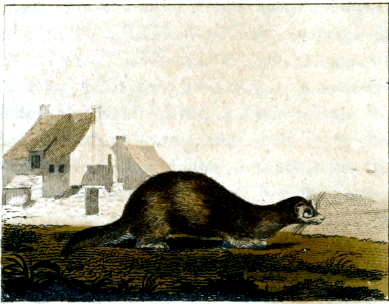
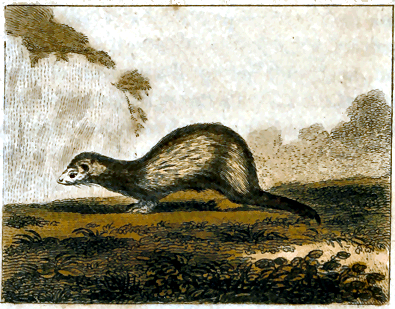
FIG. 67. Ferret.
THE POLECAT.
This animal, (fig. 66.) greatly resembles the marten in temperament, disposition, habits, and form of its body. Like him he approaches our dwellings, mounts to their roofs, and settles himself in hay-lofts, barns, and unfrequented places; from whence he steals by night into farm-yards, aviaries, and pigeon-houses, where, without making so much noise as the marten, he does more mischief; he twists off all their heads, and then carries them away, one by one, to his hole or dwelling. If, as it often happens, he cannot convey them away entire, from the smallness of the entrance, he eats the brains on the spot, and then retires with their heads. He is particularly fond of honey, will attack the hives in winter, and force the bees to abandon them. They are scarcely ever found at any great distance from inhabited places. They copulate in spring, when the males will fiercely contend on the roofs and sheds for the female. They then leave her, and go into the fields or woods for the summer, but she remains in her dwelling, and does not take her young ones out till towards the end of the summer; she produces from three to five, does not suckle them long, but soon accustoms them to suck blood, and the eggs of birds.
In towns they chiefly subsist on prey, and in the fields or woods on what the chace affords them; when in the latter they fix their residence in the burrows of rabbits, clefts of rocks, or trunks of hollow trees, from whence they issue at night in quest of the nests of partridges, larks, and quails; they climb trees to get at those of other birds; are constantly on the watch for rats, field-mice, and moles, and are at continual war with the rabbit, who cannot escape, as they enter their burrows with ease. A single family of polecats is sufficient to destroy a whole warren; and indeed this would be a simple method of diminishing their number where they are found too numerous.
The polecat is rather less than the marten; it has a shorter tail, a sharper snout, and its hair is more black and bushy. It has some white hair on its forehead, and about the nose and mouth. They differ very much in voice, that of the marten being sharp and loud, and that of the polecat deep and hollow, but both of them, as well as the squirrel, have a harsh, angry growl, which they often repeat when irritated; the odour they send forth is also very different, that of the former being rather agreeable, but the latter to the last degree fetid. When heated or enraged it sends forth an intolerable stench to a considerable distance. The dogs will not eat its flesh, and its skin, though good in itself, is of little value, because it can never be entirely divested of its natural odour; which odour proceeds from two little vesicles, situated near the anus, which contain and exclude an unctuous matter highly disagreeable, not only in the polecat but in the ferret, weasel, badger, &c. but which constitutes a perfume in the civet-cat, pine-weasel and several other animals.
The polecat seems to belong to the temperate climates. Few of them are found in the northern regions, and they are more scarce than the marten in the southern. The Stinkard of America is a different animal; nor does the species of polecat appear to extend further than from the confines of Italy to Poland; it is certain they fear the cold, and they resort to houses in the winter, and their footsteps are never seen in the snow either in the woods or fields distant from human dwellings, and we may fairly conclude they are averse from extreme heat as they are never found in the southern regions.
THE FERRET.
Some authors have doubted whether the Ferret (fig. 67.) and polecat did not belong to the same species. Perhaps the resemblance there sometimes is in their colour first gave rise to this doubt. The polecat, however, is a wild animal and a native of temperate climates, whereas the ferret is a native of warm countries, and cannot exist even in France, but in a domestic state. The ferret is preferred to the polecat for driving rabbits from their burrows, because he is more easily tamed. They both have a strong and disagreeable smell, yet as they never intermix, and differ in a number of essential characters, they may with safety be pronounced two distinct species. The ferret has a longer and thinner body, a narrower head, and a sharper snout than the polecat. It has not the same sagacity in providing its subsistence, and unless taken care of and nourished in the house, it cannot even exist, at least in our climates, for those which have been lost in the burrows of rabbits have never multiplied, but most probably perished by the severity of the winter. The ferret also, like other domestic animals, varies in colour, and is as common in hot countries as the polecat is scarce. The female is conspicuously smaller than the male; and when in season, Gesner says, she has even been known to die if her desires were not gratified. They are reared in casks or chests, where it is usual to furnish them with beds of flax. They sleep almost perpetually, but no sooner are they awake than they eagerly seek for food, which consists of bran, bread, milk, &c. The females bring forth twice a year, and go six weeks with their young. Some of them eat their young almost as soon as they are brought forth, are immediately in season again, and then have three litters in the year, each of which consists of from five to nine.
This animal is by nature a mortal enemy to the rabbit. If even a dead one is presented to a young ferret, although he have never seen a rabbit before, he flies at and tears it with fury; but if it be alive, he seizes it by the nose or throat, and sucks its blood. When let into the burrows of rabbits, it is necessary to muzzle him, that he may not kill them in their holes, but only oblige them to run out that they may be entrapped in the nets; besides, if he is suffered to go in unmuzzled, there is great danger of his being lost; for having sucked the blood of the rabbit, he will fall asleep; and smoking the hole is not always a successful expedient to bring him back, because as the burrows frequently communicate with each other, he is apt to be the more bewildered the more he is surrounded with smoke. The ferret is also made use of by boys in searching for bird’s nests in the holes of walls or trees.
Strabo says the ferret was brought from Africa into Spain; which does not appear void of foundation, as Spain is the native climate of rabbits, and the country where formerly these animals most abounded. It is probable, therefore, that the rabbits having increased so much as to become incommodious, the ferret was introduced to diminish them, instead of encouraging the race of polecats, from which no advantage could have accrued but the death of the rabbit, whereas by the ferret some benefit is also obtained by the hunter. The ferret, though easily tamed and rendered docile, is exceedingly irascible; he has always an ill smell, but more so when heated or irritated. He has lively but inflamed eyes; all his movements are quick, and is besides so strong, that he will easily master a rabbit three or four times as big as himself.
Notwithstanding the authority of interpreters and commentators, there are still doubts whether the ferret be the ictis of the Greeks. “The ictis (says Aristotle) is a kind of wild weasel, smaller than the little Maltese dog, but resembling the weasel in its hair, form, whiteness in the under parts of its body, and also in its cunning. Though easily tamed, it does mischief among the bee-hives, being extremely fond of honey. It will also attack birds, and like the cat, its genital member is bony.” It appears first a contradiction, in saying the ictis is a species of wild weasel, which is easily tamed, for with us the common weasel is not to be tamed at all; secondly, the ferret, though larger than the weasel, cannot be compared with the lap-dog in point of size; thirdly, it is evident that the ferret does not possess the cunning of the weasel, nor is it even capable of artifice; and lastly, it does no mischief to bee-hives, nor is it fond of honey. I enquired of M. de la Roy, intendant of the royal forests, as to this last fact, and this was his answer: “M. de Buffon may be assured that the ferret has no absolute inclination for honey; but if kept on slender diet, it may be forced to eat it. For four days I fed some with bread soaked in water mixed with honey; but though they ate pretty large quantities of it the last two days, the weakest of them was become sensibly more thin.” This is not the first time M. de la Roy has furnished me with facts for the advantage of this work. Having no ferret in my possession, I made the like experiment on the ermine, by giving him nothing but honey to eat, and milk to drink; but he died in a few days. It appears, then, that neither the ferret nor ermine are fond of honey, like the ictis of the ancients, which leads me to think that the word ictis is nothing more than a generic name; or if it denotes any particular species, it is rather that of the marten or polecat; both of which possess the cunning of the weasel, attack bee-hives and are particularly fond of honey.
Engraved for Barr’s Buffon.
FIG. 68. Pine Weasel. FIG. 69. Weasel.
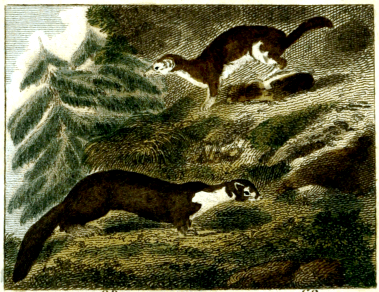
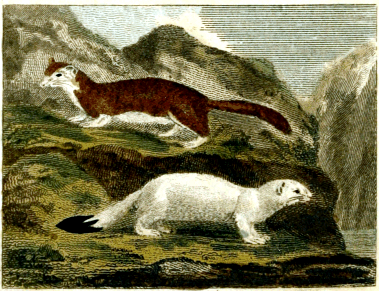
FIG. 71. Roselet. FIG. 70. Ermine.
THE WEASEL.
The Weasel (fig. 69.) is as frequent in warm and temperate climates, as it is scarce in cold ones; the ermine (fig. 70.) on the contrary, is numerous in the northern, is scarcely to be met with in the temperate, and never in the warm climates. These animals, therefore, form two distinct species. The circumstance who may have given rise to their being confounded, was possibly our common weasel being sometimes white during winter: in this characteristic they are alike; but there are others in which they widely differ. The ermine, red in the summer, and white in winter, has, at all times, the end of the tail black; whereas the end of the weasel’s tail is yellow, even of that which turns white in the winter; it is besides much smaller, and its tail is shorter; nor does the weasel shun the habitations of man like the ermine, to reside in woods and deserts. I have kept both species together, but found no reason to suppose that animals which differ in climate, temperament, and disposition, would intermix. Among the weasels, it is true, there are some larger than others; but this difference never exceeds an inch in the whole length of the body; but the ermine is full two inches longer than the largest weasel. Neither of them are to be tamed, but must always be kept in an iron cage. Neither of them will eat honey, nor ransack the bee-hives, like the marten and polecat; and therefore, the ermine is not the wild weasel, the ictis of Aristotle, which he says is easily tamed, and very fond of honey. So far are the weasel and ermine from being easily tamed, that they will not even eat if taken notice of, but are in continual agitations, endeavouring to conceal themselves; and in order to preserve them it is necessary they should be supplied with a parcel of wool or flax, in which they may hide themselves, and which they make a receptacle for whatever is given them, and seldom ever eat but in the night; and rather than eat fresh meat they keep it for two or three days that it may corrupt. They sleep three parts of the day, and even when at liberty they set apart the night for the search of their prey. When a weasel enters a hen-roost he never meddles with the cocks or old hens, but singles out the pullets and young chicks, which he kills by a single bite on the head, and then carries away the whole, one after another; he also destroys the eggs, and sucks them with incredible avidity. In winter they generally reside in granaries, or hay-lofts, where the females often continue in the spring, and bring forth their young among the hay and straw; and during this period she makes war with the rats and mice with more success than the cats, since she follows them into their holes, and so renders it impossible for them to escape; she also attacks and destroys the pigeons in their houses, and sparrows, and other birds, in their nests. In summer they remove to some distance from the houses, always choosing low grounds, about mills and streams, hiding themselves among the bushes, to catch the birds; they sometimes take up their abodes in old willows, where the females bring forth their young, for which she prepares a bed of grass, straw, and leaves; she litters in the spring, and it generally consists of from three to five. They are brought forth with their eyes closed but they very soon acquire growth and strength sufficient to follow the mother to the chace. They attack adders, water-rats, moles, field mice, &c. and traversing the meadows devour quails and their eggs. They have not a regular walk, but bound forward by unequal and precipitate leaps; when inclined to mount a tree they make a spring, by which they are elevated several feet at once; and thus they also act when they attempt to seize a bird.
These animals have also a very strong and disagreeable smell, which is much worse in summer than winter, and when pursued or irritated they infect the air to a great distance. They always move with all possible silence, and never exert their voices but when they are hurt, of which the sound is rough, and very expressive of anger. As their own odour is very bad they seem to feel no inconvenience from any foreign stench. A peasant in my neighbourhood took three new-littered weasels out of the carcass of a wolf, which had been suspended by its hind legs from a branch of a tree; for though the wolf was almost rotten, the female weasel had brought grass and leaves, and made a bed for her young in the thorax of this putrid carcass.
SUPPLEMENT.
The Comtesse Noyan declares in a letter which she favoured me with, that I have done great injustice to the character of the weasel, in saying that it is not to be tamed, since she had reared one who would lick her hand when she gave it food, and was as fond and familiar as a dog or squirrel. And N. G. de Mornas assures me that he trained one who would follow him about; and he says that they are to be tamed by frequent stroking them on their backs, and beating them when they offer to bite.
THE ERMINE.
The weasel with a black tail is called the Ermine or Roselet (fig. 71.) the ermine when it is white, and the roselet when it is red or yellowish. Though not so numerous as the common weasel, yet many of them are found in ancient forests, and sometimes during winter in the neighbourhood of woods. They are easy to be distinguished at all times, as the end of their tails are always black, and the extremities of their ears and feet white.
We have little to add, with respect to this animal, to those observations we made in treating of the weasel. I kept one for more than a twelvemonth, which to the last remained wild and also retained its noisome odour. It is a pretty little animal, and but for the last circumstance, an agreeable one; it has lively eyes, a pleasing countenance, and so rapid in its motions that it is impossible for the eye to follow them. It was always fed with eggs and flesh, but the latter he would not eat until it became putrid. It disliked honey, and having kept it three days without any other food, it died after eating a very little. The skin of this animal is very valuable; it is far more beautiful than that of the white rabbit; but it very soon changes somewhat yellow; though indeed the ermines of these climates have always a yellow shade.
Ermines abound in the north, particularly in Norway, Russia, and Lapland; where, as every where else, they are red in summer, and white in winter. They feed upon a species of rats and other small animals, very numerous in Norway and Lapland, and of which we shall hereafter treat. They are scarce in temperate, and never found in warm climates. The animal of the Cape, which Kolbe calls by that name, and whose flesh he says is wholesome and well-tasted, is not an ermine, but a different species. The weasels of Cayenne, mentioned by M. Barrere, and the grey ermines of Tartary and the North of China, mentioned by some travellers, are also animals different from our weasels and ermines.
SUPPLEMENT.
It is remarked by Pontoppidan that, in Norway, the ermines live among the fragments of rocks; that he catches mice, is very fond of eggs, and that when the weather is calm, he will swim across the sea to the neighbouring islands for the sake of sea fowls which are there in great numbers. He says it is asserted that when the female brings forth upon an island, she will bring her young to the continent upon a piece of wood, directing it with her snout; that this animal though very small, will kill bears and rein-deer, which it does by surprising them when asleep and fastening to their ears, where he holds so fast that they cannot disengage him; he also springs upon the backs of eagles and heath-cocks, and will suffer them to take him up in the air, from whence by sucking their blood he soon forces them to descend.
THE GRISON.
This animal is added by our author in his Supplement, it having been introduced in a Dutch Edition of his work, where he says, it is thus mentioned by M. Allamand. "This little animal, said he, was sent to me from Surinam, and was named in the catalogue grey-weasel, from which I derived Grison. (fig. 72.) The upper part of its body is brown, but the hair having white points, it has the appearance of being a brownish grey; the throat and neck is a bright grey; its nose, and the lower part of its body and legs are black, which forms a singular contrast with its head and neck; it is about seven inches long, its head is large in proportion to its body; its ears are nearly a half circle, its eyes are large, it has strong teeth, five toes upon each foot, yellow claws, and a long tail which ends with a point. It more nearly resembles the weasel than any other animal, but yet it certainly belongs to some other species. I cannot find it mentioned by any traveller, and many persons who had resided at Surinam to whom I shewed it, declared it to be a stranger to them; from which it is evident, it must be a scarce animal, even in its own country, and lives in unfrequented places; of course I have not been enabled to obtain any further particulars of it."
Engraved for Barr’s Buffon.
FIG. 72. Grison.
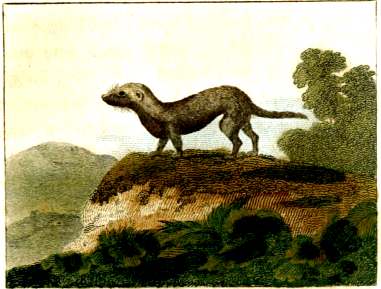
FIG. 73. Squirrel.
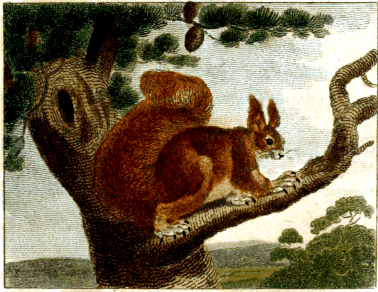
THE SQUIRREL.
The squirrel (fig. 73.) is a pretty little animal, is only half wild, and from its gentleness, docility, and even innocence of manners, is almost entitled to an exemption from this class. He is neither carnivorous nor injurious, though he sometimes seizes on birds; his common food consists of fruit, almonds, nuts, beech mast, and acorns; he is handsome, lively, alert, and industrious; his eyes are full of fire, he has a good countenance, nervous body, and supple limbs; the beauty of his form is heightened by a spreading tail, resembling a plume of feathers, which he raises above his head, to form a kind of shade against the sun. The under part of his body is furnished with an apparatus to the full as remarkable, and which indicate strong generative faculties. The squirrel may be said to be less a quadruped than any other four-footed animal. He generally holds himself almost upright, using his fore feet like hands in conveying food to his mouth. Instead of hiding under the earth he is continually in the air, approaching the birds by his lightness and activity, like them he dwells upon the tops of trees, traverses the forests, by leaping from branch to branch, builds himself a nest, picks up grains and seed, drinks the dew, and does not descend to the earth but when the trees are violently agitated by the wind. He is never found in fields nor open countries; he approaches not the habitations of men, remains not among bushes and underwood, but resides among the lofty trees of the forest. He avoids the water still more than the earth; and it is even asserted, that when he wants to cross a river, or stream, he uses the bark of a tree as a boat, and makes his tail supply the place of a rudder and sails. He does not sleep, like the dormouse, during winter, but is always awake and lively, insomuch, that if only the trunk of the tree is touched, on which he may be reposing, he instantly flies to another, or conceals himself under a branch. He collects a quantity of nuts during the summer, which he deposits in the hollow part of some old tree, and has recourse to them in the winter; which even then he will endeavour to obtain by scratching off the snow as he passes along. His voice is more shrill and loud than that of the marten; he has besides a loud growl of discontent, which he makes when irritated. As his motions are too quick to walk he generally leaps, or bounds forward; and such is the sharpness of his claws, and agility of body, that he instantaneously climbs a beech tree let the bark be ever so smooth.
During the fine nights in summer the squirrels may be heard crying as they chase each other among the trees. Seemingly averse from the heat of the sun they remain all day in their holes or nests, from which they come at night to feed, copulate, exercise and divert themselves. Their nests are clean, warm, impenetrable to rain, and generally formed where the large branches fork off into small ones. They begin its formation by carrying small twigs, which they interweave with moss; this they repeatedly press and stamp upon to give it capacity and solidity to hold themselves and their young; they only leave one opening, which is near the top, and that so small as to be hardly sufficient for them to go in and out; over the opening is a kind of roof, in a conic form, which shelters the whole, and occasions the rain to run off on each side. The females usually produce three or four at a litter; they come in season in the spring, and bring forth about the end of May, or beginning of June. They change their hair at the close of winter, and the new hair is more red than that which they throw off; they comb and dress it with their fore feet and teeth, are very cleanly, have no ill smell, and their flesh is tolerably good to eat. The hair of their tail is used to make brushes for painters, but their skin is of no value to the furrier.
Several species approach that of the squirrel, though there are few varieties in the species itself. Some few are of an ash-colour, but the most of them are inclined to red. The petits-gris are a different species, and remain always grey. And, without mentioning the flying squirrels, which are very different from the others, the white squirrel of Cambaye, which is very small, that of Madagascar, called tsitsihi, which is grey, and, as Flacourt says, is neither handsome nor easily tamed, the white squirrel of Siam, the grey spotted squirrel of Bengal, the streaked squirrel of Canada, the black squirrel, the large grey squirrel of Virginia, the white striped squirrel of New Spain, the white Siberian squirrel, the variegated squirrel, or mus ponticus, the little American squirrel, those of Brasil and Barbary, the palmist, &c. which form so many separate and distinct species from those which we have been treating of, we shall find them all nearly the same.
SUPPLEMENT.
The squirrel is so very numerous in Siberia, that we may rather suppose it to be a native of the northern than temperate regions. M. Gmelin says, they take them there in traps baited with dry fish. M. Aubry, curate of St. Louis, has an entire black squirrel sent him from Martinico, and which had also little or no hair on its ears.
M. de la Borde mentions a species of squirrel at Guinea, which he says is of a red colour, lives in the woods, feeds on grain, and is about the size of a rat; is always seen alone, and is easily tamed. But I very much doubt whether this is a real squirrel, from its being found in so warm a climate. M. Kalm says there are several species in Pennsylvania, that the smallest sort are the most handsome, and that the larger kind are very destructive to the plantations of maize, and that they will come in large bodies and destroy a whole field in a single night, nay, that they are so mischievous, that a price is set upon their heads. Their flesh is esteemed by the inhabitants, but no value is put upon their skins. Their figures, modes, and manners, he describes to be similar to those of Sweden, and states them to be more numerous in Pennsylvania than formerly.
Engraved for Barr’s Buffon.
FIG. 75. Water Rat. FIG. 74. Rat.
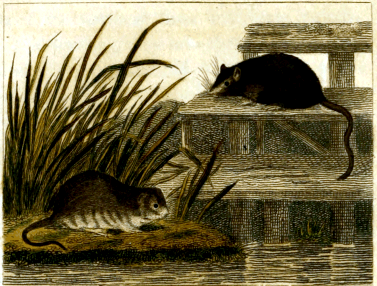
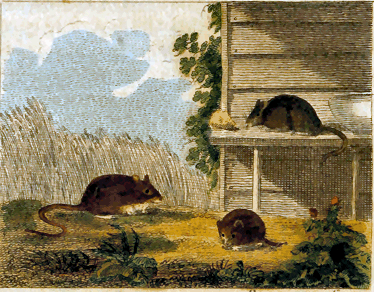
FIG. 76. Mouse. FIG. 77. Long tailed Field Mouse. FIG. 78. Short tail’d Mouse
THE RAT.
If we descend by degrees from great to small, from strong to weak, we find that Nature has uniformly maintained a balance throughout her works; attentive only to the preservation of each species, she creates a profusion of individuals, and supports by numbers those she has formed of a diminutive size, and left unprovided with arms, courage, or resources; she has not only enabled these inferior species to resist and maintain their ground by their own numbers, but has added a kind of supplement to each, by multiplying the neighbouring species. The rat (fig. 74.), the mouse (fig. 76.), the field mouse (fig. 77.), the water-rat (fig. 75.), the short-tailed field mouse (fig. 78.), the dormouse, the shrew mouse, with several others, which I shall not mention here, because they do not belong to our climate, form so many distinct and separate species, but yet so little varied, that should any one chance to fail, its absence would be hardly perceptible. It is this great number of approximate species that first gave naturalists the idea of genera, an idea which can only be employed when we view objects in the gross, but which vanishes when we apply it to reality, or when we consider Nature minutely.
Men began by appropriating different names to objects which appeared to them distinctly different, and at the same time, they gave general denominations to such as seemed to resemble each other. Among unenlightened nations, and in the infancy of languages, there are hardly any but general names, or vague or ill-formed expressions for objects of the same order, though in themselves highly different. Thus the oak, beech, linden, fir, yew, pine, had at first no name but that of tree; afterwards the oak, beech, and linden, were called oak, when they came to be distinguished from the fir, pine, and yew, which in like manner would be called fir. Particular names could proceed only from a minute examination of each species, and of course those names would be increased in proportion as the works of Nature were more studied and better understood; the more they studied her, the more generic and specific names would be introduced. To represent Nature, therefore, by general denominations, or genera, is to refer us back to the dark and infant state of human knowledge. Ignorance produced genera, but science will ever continue to create proper names; and we shall not be afraid of increasing the number whenever we have occasion to delineate different species.
Under the generic name of rat several species of little animals have been comprised and confounded; but we appropriate this name solely to the common rat, which is of a blackish colour, and lives in our houses; they generally inhabit barns and granaries, from whence, when food is scarce they invade our dwellings. The rat is carnivorous, or if the expression may be allowed, an omnivorous animal; he prefers hard substances to soft ones, he gnaws wool, linen, and furniture of all sorts; eats through wood, makes holes and hiding places in walls, ceilings, and behind wainscots, from whence he issues in search of food, and frequently returns with as much as he can drag along, forming, especially when he has young to provide for, a magazine of the whole. The females bring forth several times in the year, though mostly in the summer, and have five or six at a time. They love warmth, and in winter they generally shelter themselves near chimneys, or among hay and straw. In defiance of cats, poison, and traps, these animals multiply so much as frequently to do considerable damage. In old country-houses, where great quantities of grain are kept, and where neighbouring barns and hay-stacks favour their retreat and their increase, they often become so numerous that the inhabitants are under the necessity of quitting their dwellings, unless they happen to devour each other, and this is no uncommon thing when they are straightened for provisions; for in case of a famine being occasioned by their numbers the strong kill the weak, open their heads, first eat the brains, and then the rest of the body: the next day hostilities are renewed in the same manner, nor do they suspend their havock until the majority are destroyed; and this is the reason why, in a place that has been for some time infested with rats, they seem to disappear of a sudden, and return not for a long time. It is the same with field-mice, whose prodigious increase is checked solely by their cruelties to each other when provisions become scarce. Aristotle attributes their sudden destruction to the effect of rains, but rats are not exposed to the weather, and field-mice know well how to secure themselves from its effects, for their subterraneous habitations are not even moist.
Rats are as lascivious as voracious; they have a kind of yelp in their amours, and when they fight they cry. They prepare a bed for their young, and almost immediately provide them with food; and when they first quit their hole the mother watches, defends, and will even fight the cats to save them. A large rat is more mischievous, and almost as strong as a young cat; its fore-teeth are long and strong; and as the cat does not bite hard, but is obliged to depend upon her claws, she must not only be vigorous but well experienced in warfare. The weasel, though smaller, is yet a more dangerous enemy, because he can follow the rat into its hiding places: the combat between these two is often sharp and long, from their strength being nearly equal, but their manner of fighting is different. The rat can only wound by snatches, and with his fore-teeth, which are more calculated for gnawing than biting, and have but little strength; whereas the weasel bites fiercely with his whole jaw, and instead of letting go sucks the blood thro' the wound, and therefore the rat always falls a victim to this formidable enemy.
There are many varieties in this species, as in all those which have numerous individuals. Besides the common rat which is nearly black, there are some brown, grey, reddish, and quite white. The white rat, like all animals perfectly white has red eyes. The whole species, with all its varieties, appear to be natives of temperate climates, and have been diffused in much greater abundance over warm countries than cold ones. Originally they had none in America, but were transported with the first European settlers, and where they increased so fast as to become the pest of the colonies, and where indeed they had no enemies but the large serpents which swallowed them up alive. The European ships have also carried them into the East Indies, all the islands of the Indian Archipelago, and into Africa, where they are now found in great numbers. In the north they have never multiplied beyond Sweden, and those which are called Norway and Lapland rats, are animals of a different species.
SUPPLEMENT.
It is asserted by Pontoppidan, that rats cannot live further north than Norway, and that those on the banks of the south side of the river Vorman, very soon die if they are taken to the north, which he attributes to the exhalations of the soil. From the Vicomte Querhoënt I understand that rats multiplied so fast on their first introduction to the isle of France, as even to compel the Dutch to leave it: they have been somewhat lessened by the French, but they still remain in great numbers. He adds, that when a rat has resided some time in India he acquires a very strong smell of musk; and this is confirmed by M. la Boullaye-le-Goux in his voyages. The Dutch voyagers also say that there are scented rats in Madura.
THE MOUSE.
The mouse is much smaller than the rat, more numerous and more generally diffused. Its instinct, temperament, and disposition is the same; and it differs only in its weakness, and the habits resulting from it. Timid by nature, and familiar from necessity, fear and want are the sole springs of its actions. It never leaves its hiding place but to seek for food; nor does it go from house to house, like the rat, unless forced; nor is it near so mischievous; its manners are milder, and to a certain degree it may be tamed, but it is incapable of attachment; how indeed is it possible to love those who are perpetually laying snares for us! Though weak he has more enemies than the rat, from whom he has no means of escape but his agility and minuteness. The owls, birds of prey, cats, weasels, and even rats, make war upon mice, while man, by snares and other means, destroy them by thousands. But for their immense fecundity they could not subsist; they bring forth at all seasons, several times in the year, generally have five or six at a time, and which in less than 15 days are sufficiently strong to shift for themselves. As they so soon attain perfection, their duration of life must be short, a circumstance which must necessarily heighten our ideas of their prodigious multiplication. Aristotle[O] tells us that he put a pregnant mouse into a vessel with plenty of corn, and that he soon after found 120 mice all sprung from the same mother.
These little animals are not ugly, but have much vivacity and acuteness in their looks; nor is there any foundation for that horror some people hold towards them, but the little surprises and inconveniences they sometimes occasion. All mice are rather white under the belly, some are quite white, others more or less brown or black. The species is generally spread over Europe, Asia, and Africa; but it is said they had no mice formerly in America, and that, though now so very numerous, they were originally brought from the old continent. Certain it is that this little animal, while it fears human society, closely attends it, and this probably from its natural appetite for bread, cheese, bacon, oil, butter, and other kinds of food which man prepares for himself.
THE FIELD-MOUSE.
This animal sometimes called the mulot, is less than the rat, but larger than the common mouse. It is not to be found in houses, but lives in woods and fields. It is remarkable for its large and prominent eyes; and it differs also from the rat and mouse in the contour of its hair, which is tolerably white under the belly, and a reddish brown on the back; they are very generally and abundantly diffused, especially in hilly countries. They appear to be a long time in attaining their full growth, as they vary considerably in size. The largest are better than four inches in length, and the smaller, which appears to be aged, are an inch shorter; and as they are found of all the intermediate sizes there can be no room to doubt their being the same species. It was probably from ignorance of this fact that some naturalists have distinguished them into two species, calling the one the Great Field Rat, and the other the Field Mouse. Ray, who first fell into this error, seems to acknowledge himself unacquainted with any more than one species; and though the short description he gives of two species appear to differ, yet we ought not to conclude that both exist, first, because he himself knew but one; secondly, because we know only one, and notwithstanding all my researches, I have been enabled to discover but one kind; thirdly, because Gesner, and other naturalists, speak only of one, under the name of mus agrestis major, which they affirm to be common; and because Ray says the other kind, which he calls mus domesticus medius, is also very common; it is therefore impossible but that one or other of these authors must have seen both since they declare they are both common; fourthly, because as in this same species large and small individuals are found, that circumstance might lead them to consider the former as one, and the latter as another; and, lastly, because the descriptions of these two pretended species are in no respect complete; and we ought not to trust such vague characteristics to establish a specific difference.
The ancients, indeed, mention two species, the one under the denomination of mus agrestis major, the other under that of mus agrestis minor. These two species are very common, and we are as well acquainted with them as the ancients were; the first is our long-tailed field-mouse; and the other, known by the name of the short-tailed field-mouse, but as it materially differs both from the rat and long-tailed field-mouse, I have not followed the generic appellation, but adopted that of the Italian, and call it campagnol.
The long-tailed field-mice, as we have already intimated, are fond of dry and elevated grounds. They are to be found in great numbers in woods and in adjoining fields. They conceal themselves in holes under brush-wood, or trunks of trees, which they find already made, or which they dig, in which they amass such quantities of nuts and acorns, that a bushel has been found contained in one of them; and this provision is not proportioned to the wants of the animal, but to the capacity of the place allotted for its reception. These holes are generally more than a foot underground, and often divided into two cells, the one for living in with their young, and the other as a granary. I have often witnessed the considerable damage done by these animals in plantations. They will follow the furrow of a plough and take up all the new-sown acorns, which they convey to their holes; and in a nursery of trees they are more destructive than all the birds and other animals put together. The only method I could ever find to prevent this evil, was to set traps at every tenth pace distance, through the whole extent of the new-sown ground. No other bait is necessary than placing a roasted nut under a flat stone, supported by a piece of stick, to which the nut must be fastened; this they are very fond of, and will come eagerly to seize; but no sooner do they touch it than the stone falls and crushes them to death. I have made use of the same expedient against the campagnol, which is also very destructive. When I first adopted this method, I desired care might be taken to bring me all the animals that were caught in the traps, and it was with astonishment I found more than 100 were taken daily, and this in a piece of land consisting of not more than 40 acres. I obtained more than 2000 in this manner, from the 15th of November to the 8th of December; their numbers afterwards decreased gradually, till the hard frosts commenced, when they retire to their holes, and feed upon what they have collected. A number of years have elapsed since I first made this experiment, and which I always repeated when I sowed trees, and never had reason to complain of its inefficacy. It is in autumn they chiefly abound; in spring they are not so numerous, for if their provisions run short during the winter the strong devour the weak; they also eat the short-tailed species, and several sorts of birds, beginning always with the brains and finishing with the rest of the body. I once put a dozen of these field-mice in a cage, and accustomed them to be fed every morning by eight o’clock; but neglecting them one morning for about a quarter of an hour, one of them had been eaten by the rest; next day they devoured another, and in a few days only one remained; the others having been killed and in part devoured; even the one that survived had his legs and tail mutilated.
The rat multiplies very fast, but the increase of the long-tailed field-mouse is more considerable. The latter brings forth more than once a year, and generally nine or ten at a time, while the rat seldom produces more than five or six. A peasant, on my estate, took twenty-two out of one hole, consisting of two dams and twenty young ones.
This animal is very generally diffused over Europe. It is found in Sweden, and is called by Linnæus, mus cauda longa, corpore nigro flavescente, abdomine albo. It is very common in France, Italy, and Switzerland. Gesner calls it mus agrestis major. It is also in Germany and England, where it is called the field-mouse. Its greatest enemies are the wolf, fox, marten, birds of prey, and its own species.
THE WATER-RAT.
This animal is about the size of a common rat, but in habits and disposition more resembles the otter than the rat. Like the otter it frequents fresh water; is found on the borders of rivers, rivulets, and ponds, and seldom feeds on any thing but fish, though he will sometimes eat frogs, water insects, and even the roots of plants. He has not, like the otter, membranes between his toes; an error which originated with Willoughby, and has been copied by Ray and other naturalists. Though every toe is separated, he swims with facility, keeps a long time under water, and carries off his prey to eat upon the grass or in his hole. Sometimes he is surprised in his hole by fishermen who are searching for craw-fish, whose fingers he bites, and then plunges into the water as his only place of refuge. His head is shorter, his nose broader, his hair more erect, and his tail much larger than the common rat. Like the otter he avoids large rivers, or rather those which are too much frequented. The dogs pursue it very furiously. He is never found in houses or barns, nor does he wander so far from the borders of the waters as the otter, which is sometimes found at a league distant upon land. The water-rat does not frequent high grounds nor dry plains but in moist and marshy valleys they are very numerous. The females come in season about the close of winter, and bring forth in April, generally having six or seven in a litter; they may probably bring forth oftener than once a year, but of this we have no certain knowledge.
Their flesh is not absolutely bad, being eaten by the peasants in catholic countries during Lent, as well as that of the otter. This species is found throughout Europe, the very extremities of the north excepted. If Bellon may be believed they inhabit the banks of the Nile, but the figure he gives of it has so little resemblance to our water-rat, that there is great reason to suppose them different animals.
THE CAMPAGNOL.
The Campagnol, or short-tailed field-mouse, is still more common and generally diffused than the long-tailed kind. The latter generally prefers elevated grounds, while the former is found in woods, meadows, and even gardens. It is remarkable for the bigness of its head and shortness of its tail, which is not above an inch long. It digs holes in the earth, where it amasses corn, nuts, and acorns; the former of which it appears to prefer to every kind of food. About the month of July, when the corn begins to ripen they collect together from all quarters, and frequently do great damage by cutting the stalks to come at the ears; they also seem to follow the reapers and pick up all the grain that falls. When the gleanings are exhausted, they resort to the new-sown lands, and not unoften destroy the hopes of the succeeding year. At the end of autumn, and in winter, most of them withdraw into the woods where they feed on beech-mast, nuts and acorns. Some years they appear in such great numbers that they would destroy every thing were they to continue for any length of time, but for want of food they eat each other, and are also destroyed by the long-tailed field-mouse, the fox, wild cat, marten, and weasel. In its internal parts, this animal more resembles the water-rat than any other; but externally it differs from him in many essential characters: First, in size, the campagnol not being more than three inches long, whereas the water-rat is seven; secondly, by the dimensions of its head and body, those of the former being thicker in proportion than those of the latter; thirdly, by the length of the tail, that of the campagnol not exceeding one third, while that of the water-rat is nearly two thirds the length of its body; and lastly, by appetite and inclinations, for the former neither feeds upon fish nor plunges into the water, but lives upon grain, acorns, and bulbous roots. Their holes resemble those of the long-tailed field mouse, and are often divided into two apartments, though they are less spacious and are not dug so deep. Several of them sometimes live together. When the females are about to bring forth they collect grass to make beds for their young. They produce in spring and summer, and generally from five to eight at a time.
Engraved for Barr’s Buffon.
FIG: 79. Guinea-Pig.
FIG: 80. Hedge Hog. FIG: 81. Shrewmouse.
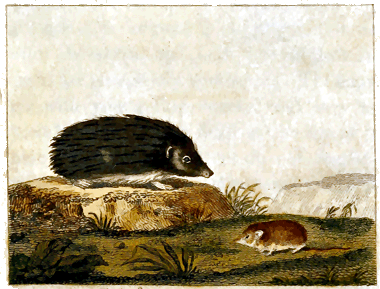
THE GUINEA PIG.
This little animal (fig. 79.) though a native of Brasil and Guinea, lives and breeds in temperate, and even in cold countries, provided it is properly taken care of and sheltered from the inclemency of the weather. The Guinea-pig is frequently reared in France, and though very prolific, they are far from being numerous, for the attention they require is poorly rewarded by the profits derived from them. Their skin is of little or no value, and their flesh, though people do eat it, is very indifferent; a circumstance which might in some measure be removed, by rearing them in warrens, where they might have air, space to range in, and an agreeable choice of herbs. Those kept in houses have the same kind of bad taste with the house rabbit, and those kept in gardens during summer their flesh is less disagreeable, but still insipid.
These animals are of so hot a nature that they begin to copulate so early as at five or six weeks old; their growth, however, is not completed before the end of eight or nine months, though their increase is in bulk and fat only after the sixth, by which time all their solid parts are completely developed. The females go with young three weeks, and they have been known to bring forth at the age of two months. The first litters do not consist of more than four or five, the second five or six, and afterwards they will sometimes have eleven or twelve. She does not suckle her young more than twelve or fifteen days, and when the male returns to her, which he never fails to do three weeks after she has littered, she drives them from her, and if they persist in following he often kills them. Thus these animals bring forth at least every two months; and as their young produce in the same period their multiplication is astonishing. In one year 1000 might be obtained from a single couple; but their consequent increase is checked by the various means of their destruction; they perish from cold and wet; without resistance they suffer themselves to be devoured by the cats; the females, not having had time to form an attachment to their young, see them destroyed without attempting to protect them. They seem to have no distinct sentiment but that of love, and when disputing for a particular female they will shew themselves susceptible of anger, fight bitterly, and are sometimes killed in the conflict before they will yield. They pass their lives in eating, sleeping and love: their sleep is short, but frequent; they eat every hour, night and day, and indulge in their amours as often as they eat; they emit urine every minute, although they scarcely ever drink. They feed on all sorts of herbs, especially parsley, which they prefer to grain or bread; of apples, and other fruits, they are also very fond. Like the rabbit they eat little at a time, but precipitately, and very often. They grunt like a young pig; make a chirping noise when pleased with their females, and have a sharp loud cry when hurt or irritated. They are very delicate, and so chilly that it is difficult to preserve them through the winter, therefore they must be kept in a place which is thoroughly warm, dry, and healthy. When they feel cold they assemble and press close together, and in this situation the frost often surprises them, and they are sometimes found dead. They are naturally mild and tame, seem equally incapable of doing harm or good, and never form any attachments. Mild by temperament, docile by weakness, almost insensible to every thing round them, they have the appearance of being so many living machines, merely possessed of abilities to propagate a species.
THE HEDGEHOG.
The hedge-hog (fig. 80.) possesses the power to defend itself without fighting, and to annoy without attacking. Having little strength and no agility to escape his foes, he has received from Nature a prickly armour, with the power of rolling himself up like a ball, and presenting from every part of his body a poignant weapon of defence. His fears prove an additional security, for the smell of his urine, which they make him throw out when attacked, and which he scatters over his whole body, always proves sufficient to disgust his enemy. Thus dogs content themselves with barking at the hedge-hog, and never shew an inclination to seize it. The fox, however, has the address to master it, by contriving to wound its feet, from which the blood runs into its mouth, but from the weasel, marten, polecat, ferret, or birds of prey, it has nothing to dread.