The 2. Booke.
Reading edition
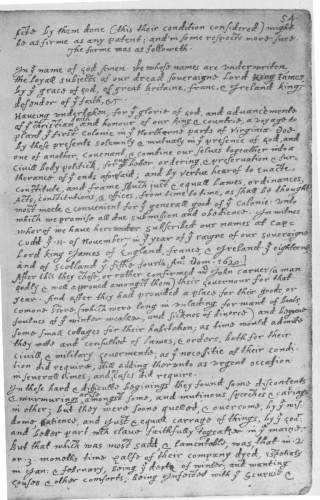
The rest of this History (if God give me life, & opportunitie) I shall, for brevitis sake, handle by way of annalls, noteing only the heads of principall things, and passages as they fell in order of time, and may seeme to be profitable to know, or to make use of. And this may be as ye 2. Booke.
The remainder of Ano: 1620.
I shall a litle returne backe and begine with a combination made by them before they came ashore, being ye first foundation of their govermente in this place; occasioned partly by ye discontented & mutinous speeches that some of the strangers amongst them had let fall from them in ye ship—That when they came a shore they would use their owne libertie; for none had power to com̅and them, the patente they had being for Virginia, and not for New-england, which belonged to an other Goverment, with which ye Virginia Company had nothing to doe. And partly that shuch an [54] acte by them done (this their condition considered) might be as firme as any patent, and in some respects more sure.
The forme was as followeth.
In ye name of God, Amen. We whose names are underwriten, the loyall subjects of our dread soveraigne Lord, King James, by ye grace of God, of Great Britaine, Franc, & Ireland king, defender of ye faith, &c., haveing undertaken, for ye glorie of God, and advancemente of ye Christian faith, and honour of our king & countrie, a voyage to plant ye first colonie in ye Northerne parts of Virginia, doe by these presents solemnly & mutualy in ye presence of God, and one of another, covenant & combine our selves togeather into a civill body politick, for our better ordering & preservation & furtherance of ye ends aforesaid; and by vertue hearof to enacte, constitute, and frame such just & equall lawes, ordinances, acts, constitutions, & offices, from time to time, as shall be thought most meete & convenient for ye generall good of ye Colonie, unto which we promise all due submission and obedience. In witnes wherof we have hereunder subscribed our names at Cap-Codd ye 11. of November, in ye year of ye raigne of our soveraigne lord, King James, of England, France, & Ireland ye eighteenth, and of Scotland ye fiftie fourth. Ano: Dom. 1620.
After this they chose, or rather confirmed, Mr. John Carver (a man godly & well approved amongst them) their Governour for that year. And after they had provided a place for their goods, or comone store, (which were long in unlading for want of boats, foulnes of winter weather, and sicknes of diverce,) and begune some small cottages for their habitation, as time would admitte, they mette and consulted of lawes & orders, both for their civill & military Govermente, as ye necessitie of their condition did require, still adding therunto as urgent occasion in severall times, and as cases did require.
In these hard & difficulte beginings they found some discontents & murmurings arise amongst some, and mutinous speeches & carriags in other; but they were soone quelled & overcome by ye wisdome, patience, and just & equall carrage of things by ye Govr and better part, wch clave faithfully togeather in ye maine. But that which was most sadd & lamentable was, that in 2. or 3. moneths time halfe of their company dyed, espetialy in Jan: & February, being ye depth of winter, and wanting houses & other comforts; being infected with ye scurvie & [55] other diseases, which this long vioage & their inacomodate condition had brought upon them; so as ther dyed some times 2. or 3. of a day, in ye foresaid time; that of 100. & odd persons, scarce 50. remained. And of these in ye time of most distres, ther was but 6. or 7. sound persons, who, to their great comendations be it spoken, spared no pains, night nor day, but with abundance of toyle and hazard of their owne health, fetched them woode, made them fires, drest them meat, made their beads, washed their lothsome cloaths, cloathed & uncloathed them; in a word, did all ye homly & necessarie offices for them wch dainty & quesie stomacks cannot endure to hear named; and all this willingly & cherfully, without any grudging in ye least, shewing herein their true love unto their freinds & bretheren. A rare example & worthy to be remembred. Tow of these 7. were Mr. William Brewster, ther reverend Elder, & Myles Standish, ther Captein & military comander, unto whom my selfe, & many others, were much beholden in our low & sicke condition. And yet the Lord so upheld these persons, as in this generall calamity they were not at all infected either with sicknes, or lamnes. And what I have said of these, I may say of many others who dyed in this generall vissitation, & others yet living, that whilst they had health, yea, or any strength continuing, they were not wanting to any that had need of them. And I doute not but their recompence is with ye Lord.
But I may not hear pass by an other remarkable passage not to be forgotten. As this calamitie fell among ye passengers that were to be left here to plant, and were hasted a shore and made to drinke water, that ye sea-men might have ye more bear, and one[AK] in his sicknes desiring but a small cann of beere, it was answered, that if he were their owne father he should have none; the disease begane to fall amongst them also, so as allmost halfe of their company dyed before they went away, and many of their officers and lustyest men, as ye boatson, gunner, 3. quarter-maisters, the cooke, & others. At wch ye mr. was something strucken and sent to ye sick a shore and tould ye Govr he should send for beer for them that had need of it, though he drunke water homward bound. But now amongst his company [56] ther was farr another kind of carriage in this miserie then amongst ye passengers; for they that before had been boone companions in drinking & joyllity in ye time of their health & wellfare, begane now to deserte one another in this calamitie, saing they would not hasard ther lives for them, they should be infected by coming to help them in their cabins, and so, after they came to dye by it, would doe litle or nothing for them, but if they dyed let them dye. But shuch of ye passengers as were yet abord shewed them what mercy they could, wch made some of their harts relente, as ye boatson (& some others), who was a prowd yonge man, and would often curse & scofe at ye passengers; but when he grew weak, they had compassion on him and helped him; then he confessed he did not deserve it at their hands, he had abused them in word & deed. O! saith he, you, I now see, shew your love like Christians indeed one to another, but we let one another lye & dye like doggs. Another lay cursing his wife, saing if it had not ben for her he had never come this unlucky viage, and anone cursing his felows, saing he had done this & that, for some of them, he had spente so much, & so much, amongst them, and they were now weary of him, and did not help him, having need. Another gave his companion all he had, if he died, to help him in his weaknes; he went and got a litle spise & made him a mess of meat once or twise, and because he dyed not so soone as he expected, he went amongst his fellows, & swore ye rogue would cousen him, he would see him choaked before he made him any more meate; and yet ye pore fellow dyed before morning.
All this while ye Indians came skulking about them, and would sometimes show them selves aloofe of, but when any aproached near them, they would rune away. And once they stoale away their tools wher they had been at worke, & were gone to diner. But about ye 16. of March a certaine Indian came bouldly amongst them, and spoke to them in broken English, which they could well understand, but marvelled at it. At length they understood by discourse with him, that he was not of these parts, but belonged to ye eastrene parts, wher some English-ships came to fhish, with whom he was aquainted, & could name sundrie of them by their names, amongst whom he had gott his language. He became proftable to them [57] in aquainting them with many things concerning ye state of ye cuntry in ye east-parts wher he lived, which was afterwards profitable unto them; as also of ye people hear, of their names, number, & strength; of their situation & distance from this place, and who was cheefe amongst them. His name was Samaset; he tould them also of another Indian whos name was Squanto, a native of this place, who had been in England & could speake better English then him selfe. Being, after some time of entertainmente & gifts, dismist, a while after he came againe, & 5. more with him, & they brought againe all ye tooles that were stolen away before, and made way for ye coming of their great Sachem, called Massasoyt; who, about 4. or 5. days after, came with the cheefe of his freinds & other attendance, with the aforesaid Squanto. With whom, after frendly entertainment, & some gifts given him, they made a peace with him (which hath now continued this 24. years) in these terms.
1. That neither he nor any of his, should injurie or doe hurte to any of their peopl.
2. That if any of his did any hurte to any of theirs, he should send ye offender, that they might punish him.
3. That if any thing were taken away from any of theirs, he should cause it to be restored; and they should doe ye like to his.
4. If any did unjustly warr against him, they would aide him; if any did warr against them, he should aide them.
5. He should send to his neighbours confederats, to certifie them of this, that they might not wrong them, but might be likewise comprised in ye conditions of peace.
6. That when ther men came to them, they should leave their bows & arrows behind them.
After these things he returned to his place caled Sowams, some 40. mile from this place, but Squanto continued with them, and was their interpreter, and was a spetiall instrument sent of God for their good beyond their expectation. He directed them how to set their corne, wher to take fish, and to procure other comodities, and was also their pilott to bring them to unknowne places for their profitt, and never left them till he dyed. He was a native [58] of this place, & scarce any left alive besids him selfe. He was caried away with diverce others by one Hunt, a mr. of a ship, who thought to sell them for slaves in Spaine; but he got away for England, and was entertained by a marchante in London, & imployed to New-foundland & other parts, & lastly brought hither into these parts by one Mr. Dermer, a gentle-man imployed by Sr. Ferdinando Gorges & others, for discovery, & other designes in these parts. Of whom I shall say some thing, because it is mentioned in a booke set forth Ano: 1622. by the Presidente & Counsell for New-England,[AL] that he made ye peace betweene ye salvages of these parts & ye English; of which this plantation, as it is intimated, had ye benefite. But what a peace it was, may apeare by what befell him & his men.
This Mr. Dermer was hear the same year that these people came, as apears by a relation written by him, & given me by a friend, bearing date June 30. Ano: 1620. And they came in Novembr: following, so ther was but 4. months differance. In which relation to his honored freind, he hath these passages of this very place.
I will first begine (saith he) wth that place from whence Squanto, or Tisquantem, was taken away; wch in Cap: Smiths mape is called Plimoth: and I would that Plimoth had ye like comodities. I would that the first plantation might hear be seated, if ther come to the number of 50. persons, or upward. Otherwise at Charlton, because ther ye savages are lese to be feared. The Pocanawkits, which live to ye west of Plimoth, bear an inveterate malice to ye English, and are of more streingth then all ye savags from thence to Penobscote. Their desire of revenge was occasioned by an English man, who having many of them on bord, made a great slaughter with their murderers & smale shot, when as (they say) they offered no injurie on their parts. Whether they were English or no, it may be douted; yet they beleeve they were, for ye Frenche have so possest them; for which cause Squanto can̅ot deney but they would have kiled me when I was at Namasket, had he not entreated hard for me. The soyle of ye borders of [59] this great bay, may be compared to most of ye plantations which I have seene in Virginia. The land is of diverce sorts; for Patuxite is a hardy but strong soyle, Nawsel & Saughtughtett are for ye most part a blakish & deep mould, much like that wher groweth ye best Tobaco in Virginia. In ye botume of yt great bay is store of Codd & basse, or mulett, &c.
But above all he comends Pacanawkite for ye richest soyle, and much open ground fitt for English graine, &c.
Massachussets is about 9. leagues from Plimoth, & situate in ye mids betweene both, is full of ilands & peninsules very fertill for ye most parte.
With sundrie shuch relations which I forbear to transcribe, being now better knowne then they were to him.
He was taken prisoner by ye Indeans at Manamoiak (a place not farr from hence, now well knowne). He gave them what they demanded for his liberty, but when they had gott what they desired, they kept him still & indevored to kill his men; but he was freed by seasing on some of them, and kept them bound till they gave him a cannows load of corne. Of which, see Purch: lib. 9. fol. 1778. But this was Ano: 1619.
After ye writing of ye former relation he came to ye Ile of Capawack (which lyes south of this place in ye way to Virginia), and ye foresaid Squanto wth him, wher he going a shore amongst ye Indans to trad, as he used to doe, was betrayed & assaulted by them, & all his men slaine, but one that kept the boat; but him selfe gott abord very sore wounded, & they had cut of his head upon ye cudy of his boat, had not ye man reskued him with a sword. And so they got away, & made shift to gett into Virginia, wher he dyed; whether of his wounds or ye diseases of ye cuntrie, or both togeather, is uncertaine. [60] By all which it may appeare how farr these people were from peace, and with what danger this plantation was begune, save as ye powerfull hand of the Lord did protect them. These things[AM] were partly the reason why they kept aloofe & were so long before they came to the English. An other reason (as after them selvs made know̅) was how aboute 3. years before, a French-ship was cast away at Cap-Codd, but ye men gott ashore, & saved their lives, and much of their victails, & other goods; but after ye Indeans heard of it, they geathered togeather from these parts, and never left watching & dogging them till they got advantage, and kild them all but 3. or 4. which they kept, & sent from one Sachem to another, to make sporte with, and used them worse then slaves; (of which ye foresaid Mr. Dermer redeemed 2. of them;) and they conceived this ship was now come to revenge it.
Also, (as after was made knowne,) before they came to ye English to make freindship, they gott all the Powachs of ye cuntrie, for 3. days togeather, in a horid and divellish maner to curse & execrate them with their cunjurations, which asembly & service they held in a darke & dismale swampe.
But to returne. The spring now approaching, it pleased God the mortalitie begane to cease amongst them, and ye sick and lame recovered apace, which put as it were new life into them; though they had borne their sadd affliction with much patience & contentednes, as I thinke any people could doe. But it was ye Lord which upheld them, and had beforehand prepared them; many having long borne ye yoake, yea from their youth. Many other smaler maters I omite, sundrie of them having been allready published in a Jurnall made by one of the company; and some other passages of jurneys and relations allredy published, to which I referr those that are willing to know them more perticulerly. And being now come to ye 25. of March I shall begine ye year 1621.
[61] Anno. 1621.
They now begane to dispatch ye ship away which brought them over, which lay tille aboute this time, or ye begining of Aprill. The reason on their parts why she stayed so long, was ye necessitie and danger that lay upon them, for it was well towards ye ende of Desember before she could land any thing hear, or they able to receive any thing ashore. Afterwards, ye 14. of Jan: the house which they had made for a generall randevoze by casulty fell afire, and some were faine to retire abord for shilter. Then the sicknes begane to fall sore amongst them, and ye weather so bad as they could not make much sooner any dispatch. Againe, the Govr & cheefe of them, seeing so many dye, and fall downe sick dayly, thought it no wisdom to send away the ship, their condition considered, and ye danger they stood in from ye Indeans, till they could procure some shelter; and therfore thought it better to draw some more charge upon them selves & freinds, then hazard all. The mr. and sea-men likewise, though before they hasted ye passengers a shore to be goone, now many of their men being dead, & of ye ablest of them, (as is before noted,) and of ye rest many lay sick & weake, ye mr. durst not put to sea, till he saw his men begine to recover, and ye hart of winter over.
Afterwards they (as many as were able) began to plant ther corne, in which servise Squanto stood them in great stead, showing them both ye maner how to set it, and after how to dress & tend it. Also he tould them excepte they gott fish & set with it (in these old grounds) it would come to nothing, and he showed them yt in ye midle of Aprill they should have store enough come up ye brooke, by which they begane to build, and taught them how to take it, and wher to get other provissions necessary for them; all which they found true by triall & experience. Some English seed they sew, as wheat & pease, but it came not to good, eather by ye badnes of ye seed, or latenes of ye season, or both, or some other defecte.
[62] In this month of Aprill whilst they were bussie about their seed, their Govr (Mr. John Carver) came out of ye feild very sick, it being a hott day; he complained greatly of his head, and lay downe, and within a few howers his sences failed, so as he never spake more till he dyed, which was within a few days after. Whoss death was much lamented, and caused great heavines amongst them, as ther was cause. He was buried in ye best maner they could, with some vollies of shott by all that bore armes; and his wife, being a weak woman, dyed within 5. or 6. weeks after him.
Shortly after William Bradford was chosen Gover in his stead, and being not yet recoverd of his ilnes, in which he had been near ye point of death, Isaak Allerton was chosen to be an Asistante unto him, who, by renewed election every year, continued sundry years togeather, which I hear note once for all.
May 12. was ye first mariage in this place, which, according to ye laudable custome of the Low-Cuntries, in which they had lived, was thought most requisite to be performed by the magistrate, as being a civill thing, upon which many questions aboute inheritances doe depende, with other things most proper to their cognizans, and most consonante to ye scripturs, Ruth 4. and no wher found in ye gospell to be layed on ye ministers as a part of their office. "This decree or law about mariage was published by ye Stats of ye Low-Cuntries Ano: 1590. That those of any religion, after lawfull and open publication, coming before ye magistrats, in ye Town or Stat-house, were to be orderly (by them) maried one to another." Petets Hist, fol: 1029. And this practiss hath continued amongst, not only them, but hath been followed by all ye famous churches of Christ in these parts to this time,—Ano: 1646.
Haveing in some sorte ordered their bussines at home, it was thought meete to send some abroad to see their new friend Massasoyet, and to bestow upon him some gratuitie to bind him ye faster unto them; as also that hearby they might veiw ye countrie, and see in what maner he lived, what strength he had aboute him, and how ye ways were to his place, if at any time they should have occasion. So ye 2. of July they sente Mr. Edward Winslow & Mr. Hopkins, with ye foresaid Squanto for ther guid, who gave him a suite of cloaths, and a horsemans coate, with some other small things, which were kindly accepted; but they found but short com̅ons, and came both weary & hungrie home. For ye Indeans used then to have nothing [63] so much corne as they have since ye English have stored them with their hows, and seene their industrie in breaking up new grounds therwith. They found his place to be 40. miles from hence, ye soyle good, & ye people not many, being dead & abundantly wasted in ye late great mortalitie which fell in all these parts aboute three years before ye coming of ye English, wherin thousands of them dyed, they not being able to burie one another; ther sculs and bones were found in many places lying still above ground, where their houses & dwellings had been; a very sad spectackle to behould. But they brought word that ye Narighansets lived but on ye other side of that great bay, & were a strong people, & many in number, living compacte togeather, & had not been at all touched with this wasting plague.
Aboute ye later end of this month, one John Billington lost him selfe in ye woods, & wandered up & downe some 5. days, living on beries & what he could find. At length he light on an Indean plantation, 20. mils south of this place, called Manamet, they conveid him furder of, to Nawsett, among those peopl that had before set upon ye English when they were costing, whilest ye ship lay at ye Cape, as is before noted. But ye Gover caused him to be enquired for among ye Indeans, and at length Massassoyt sent word wher he was, and ye Gover sent a shalop for him, & had him delivered. Those people also came and made their peace; and they gave full satisfaction to those whose come they had found & taken when they were at Cap-Codd.
Thus ther peace & aquaintance was prety well establisht wth the natives aboute them; and ther was an other Indean called Hobamack come to live amongst them, a proper lustie man, and a man of accounte for his vallour & parts amongst ye Indeans, and continued very faithfull and constant to ye English till he dyed. He & Squanto being gone upon bussines amonge ye Indeans, at their returne (whether it was out of envie to them or malice to the English) ther was a Sachem called Corbitant, alyed to Massassoyte, but never any good friend to ye English to this day, mett with them at an Indean towne caled Namassakett 14. miles to ye west of this place, and begane to quarell wth [64] them, and offered to stabe Hobamack; but being a lusty man, he cleared him selfe of him, and came run̅ing away all sweating and tould ye Govr what had befalne him, and he feared they had killed Squanto, for they threatened them both, and for no other cause but because they were freinds to ye English, and servisable unto them. Upon this ye Gover taking counsell, it was conceivd not fitt to be borne; for if they should suffer their freinds & messengers thus to be wronged, they should have none would cleave unto them, or give them any inteligence, or doe them serviss afterwards; but nexte they would fall upon them selves. Whereupon it was resolved to send ye Captaine & 14. men well armed, and to goe & fall upon them in ye night; and if they found that Squanto was kild, to cut of Corbitants head, but not to hurt any but those that had a hand in it. Hobamack was asked if he would goe & be their guid, & bring them ther before day. He said he would, & bring them to ye house wher the man lay, and show them which was he. So they set forth ye 14. of August, and beset ye house round; the Captin giving charg to let none pass out, entred ye house to search for him. But he was goone away that day, so they mist him; but understood yt Squanto was alive, & that he had only threatened to kill him, & made an offer to stabe him but did not. So they withheld and did no more hurte, & ye people came trembling, & brought them the best provissions they had, after they were aquainted by Hobamack what was only intended. Ther was 3. sore wounded which broak out of ye house, and asaid to pass through ye garde. These they brought home with them, & they had their wounds drest & cured, and sente home. After this they had many gratulations from diverce sachims, and much firmer peace; yea, those of ye Iles of Capawack sent to make frendship; and this Corbitant him selfe used ye mediation of Massassoyte to make his peace, but was shie to come neare them a longe while after.
After this, ye 18. of Septembr: they sente out ther shalop to the Massachusets, with 10. men, and Squanto for their guid and [65] interpreter, to discover and veiw that bay, and trade with ye natives; the which they performed, and found kind entertainement. The people were much affraid of ye Tarentins, a people to ye eastward which used to come in harvest time and take away their corne, & many times kill their persons. They returned in saftie, and brought home a good quanty of beaver, and made reporte of ye place, wishing they had been ther seated; (but it seems ye Lord, who assignes to all men ye bounds of their habitations, had apoynted it for an other use). And thus they found the Lord to be with them in all their ways, and to blesse their outgoings & incom̅ings, for which let his holy name have ye praise for ever, to all posteritie.
They begane now to gather in ye small harvest they had, and to fitte up their houses and dwellings against winter, being all well recovered in health & strenght, and had all things in good plenty; for as some were thus imployed in affairs abroad, others were excersised in fishing, aboute codd, & bass, & other fish, of which yey tooke good store, of which every family had their portion. All ye som̅er ther was no wante. And now begane to come in store of foule, as winter aproached, of which this place did abound when they came first (but afterward decreased by degrees). And besids water foule, ther was great store of wild Turkies, of which they tooke many, besids venison, &c. Besids they had aboute a peck a meale a weeke to a person, or now since harvest, Indean corne to yt proportion. Which made many afterwards write so largly of their plenty hear to their freinds in England, which were not fained, but true reports.
In Novembr, about ye time twelfe month that them selves came, ther came in a small ship to them unexpected or loked for,[AN] in which came Mr. Cushman (so much spoken of before) and with him 35. persons to remaine & live in ye plantation; which did not a litle rejoyce them. And they when they came a shore and found all well, and saw plenty of vitails in every house, were no less glade. For most of them were lusty yonge men, and many of them wild enough, who litle considered whither or aboute what they wente, till they came into ye harbore at Cap-Codd, and ther saw nothing but a naked and barren place. They then begane to thinke what should become of them, if the people here were dead or cut of by ye Indeans. They begane to consulte (upon some speeches that some of ye sea-men had cast out) to take ye sayls from ye yeard least ye ship [66] should gett away and leave them ther. But ye mr. hereing of it, gave them good words, and tould them if any thing but well should have befallne ye people hear, he hoped he had vitails enough to cary them to Virginia, and whilst he had a bitt they should have their parte; which gave them good satisfaction. So they were all landed; but ther was not so much as bisket-cake or any other victialls[AO] for them, neither had they any beding, but some sory things they had in their cabins, nor pot, nor pan, to drese any meate in; nor overmany cloaths, for many of them had brusht away their coats & cloaks at Plimoth as they came. But ther was sent over some burching-lane suits in ye ship, out of which they were supplied. The plantation was glad of this addition of strenght, but could have wished that many of them had been of beter condition, and all of them beter furnished with provissions; but yt could not now be helpte.
In this ship Mr. Weston sent a large leter to Mr. Carver, ye late Gover, now deseased, full of complaints & expostulations aboute former passagess at Hampton; and ye keeping ye shipe so long in ye country, and returning her without lading, &c., which for brevitie I omite. The rest is as followeth.
Part of Mr. Westons letter.
I durst never aquainte ye adventurers with ye alteration of ye conditions first agreed on betweene us, which I have since been very glad of, for I am well assured had they knowne as much as I doe, they would not have adventured a halfe-peny of what was necesary for this ship. That you sent no lading in the ship is wonderfull, and worthily distasted. I know your weaknes was the cause of it, and I beleeve more weaknes of judgmente, then weaknes of hands. A quarter of ye time you spente in discoursing, arguing, & consulting, would have done much more; but that is past, &c. If you mean, bona fide, to performe the conditions agreed upon, doe us ye favore to coppy them out faire, and subscribe them with ye principall of your names. And likwise give us accounte as perticulerly as you can how our moneys were laid out. And then I shall be able to give them some satisfaction, whom I am now forsed with good words to shift of. And consider that ye life of the bussines depends on ye lading of this ship, which, if you doe to any good purpose, that I may be freed from ye great sums I have disbursed for ye former, and must doe for the later, I promise you I will never quit ye bussines, though all the other adventurers should.
[67] We have procured you a Charter, the best we could, which is beter then your former, and with less limitation. For any thing yt is els worth writting, Mr. Cushman can informe you. I pray write instantly for Mr. Robinson to come to you. And so praying God to blesse you with all graces nessessary both for this life & that to come, I rest
Your very loving frend,
Tho. Weston.
London, July 6. 1621.
This ship (caled ye Fortune) was speedily dispatcht away, being laden with good clapbord as full as she could stowe, and 2. hoggsheads of beaver and otter skins, which they gott with a few trifling comodities brought with them at first, being alltogeather unprovided for trade; neither was ther any amongst them that ever saw a beaver skin till they came hear, and were informed by Squanto. The fraight was estimated to be worth near 500li. Mr. Cushman returned backe also with this ship, for so Mr. Weston & ye rest had apoynted him, for their better information. And he doubted not, nor them selves neither, but they should have a speedy supply; considering allso how by Mr. Cushmans perswation, and letters received from Leyden, wherin they willed them so to doe, they yeelded[AP] to ye afforesaid conditions, and subscribed them with their hands. But it proved other wise, for Mr. Weston, who had made ye large promise in his leter, (as is before noted,) that if all ye rest should fall of, yet he would never quit ye bussines, but stick to them, if they yeelded to ye conditions, and sente some lading in ye ship; and of this Mr. Cushman was confident, and confirmed ye same from his mouth, & serious protestations to him selfe before he came. But all proved but wind, for he was ye first and only man that forsooke them, and that before he so much as heard of ye returne of this ship, or knew what was done; (so vaine is the confidence in man.) But of this more in its place.
A leter in answer to his write to Mr. Carver, was sente to him from ye Govr, of which so much as is pertenente to ye thing in hand I shall hear inserte.
Sr: Your large letter writen to Mr. Carver, and dated ye 6. of July, 1621, I have received ye 10. of Novembr, wherin (after ye apologie made for your selfe) you lay many heavie imputations upon him and us all. Touching him, he is departed this life, and now is at rest [68] in ye Lord from all those troubls and incoumbrances with which we are yet to strive. He needs not my appologie; for his care and pains was so great for ye commone good, both ours and yours, as that therwith (it is thought) he oppressed him selfe and shortened his days; of whose loss we cannot sufficiently complaine. At great charges in this adventure, I confess you have beene, and many losses may sustaine; but ye loss of his and many other honest and industrious mens lives, cannot be vallewed at any prise. Of ye one, ther may be hope of recovery, but ye other no recompence can make good. But I will not insiste in generalls, but come more perticulerly to ye things them selves. You greatly blame us for keping ye ship so long in ye countrie, and then to send her away emptie. She lay 5. weks at Cap-Codd, whilst with many a weary step (after a long journey) and the indurance of many a hard brunte, we sought out in the foule winter a place of habitation. Then we went in so tedious a time to make provission to sheelter us and our goods, aboute wch labour, many of our armes & leggs can tell us to this day we were not necligent. But it pleased God to vissite us then, with death dayly, and with so generall a disease, that the living were scarce able to burie the dead; and ye well not in any measure sufficiente to tend ye sick. And now to be so greatly blamed, for not fraighting ye ship, doth indeed goe near us, and much discourage us. But you say you know we will pretend weaknes; and doe you think we had not cause? Yes, you tell us you beleeve it, but it was more weaknes of judgmente, then of hands. Our weaknes herin is great we confess, therfore we will bear this check patiently amongst ye rest, till God send us wiser men. But they which tould you we spent so much time in discoursing & consulting, &c., their harts can tell their toungs, they lye. They cared not, so they might salve their owne sores, how they wounded others. Indeed, it is our callamitie that we are (beyound expectation) yoked with some ill conditioned people, who will never doe good, but corrupte and abuse others, &c.
The rest of ye letter declared how they had subscribed those conditions according to his desire, and sente him ye former accounts very perticulerly; also how ye ship was laden, and in what condition their affairs stood; that ye coming of these [69] people would bring famine upon them unavoydably, if they had not supply in time (as Mr. Cushman could more fully informe him & ye rest of ye adventurers). Also that seeing he was now satisfied in all his demands, that offences would be forgoten, and he remember his promise, &c.
After ye departure of this ship, (which stayed not above 14. days,) the Gover & his assistante haveing disposed these late com̅ers into severall families, as yey best could, tooke an exacte accounte of all their provissions in store, and proportioned ye same to ye number of persons, and found that it would not hould out above 6. months at halfe alowance, and hardly that. And they could not well give less this winter time till fish came in againe. So they were presently put to half alowance, one as well as an other, which begane to be hard, but they bore it patiently under hope of supply.
Sone after this ships departure, ye great people of ye Narigansets, in a braving maner, sente a messenger unto them with a bundl of arrows tyed aboute with a great sneak-skine; which their interpretours tould them was a threatening & a chaleng. Upon which ye Govr, with ye advice of others, sente them a round answere, that if they had rather have warre then peace, they might begine when they would; they had done them no wrong, neither did yey fear them, or should they find them unprovided. And by another messenger sente ye sneake-skine back with bulits in it; but they would not receive it, but sent it back againe. But these things I doe but mention, because they are more at large allready put forth in printe, by Mr. Winslow, at ye requeste of some freinds. And it is like ye reason was their owne ambition, who, (since ye death of so many of ye Indeans,) thought to dominire & lord it over ye rest, & conceived ye English would be a barr in their way, and saw that Massasoyt took sheilter allready under their wings.
But this made them ye more carefully to looke to them selves, so as they agreed to inclose their dwellings with a good strong pale, and make flankers in convenient places, with gates to shute, which were every night locked, and a watch kept, and when neede required ther was also warding in ye day time. And ye company was by ye Captaine and ye Govr [70] advise, devided into 4. squadrons, and every one had ther quarter apoynted them, unto which they were to repaire upon any suddane alarme. And if ther should be any crie of fire, a company were appointed for a gard, with muskets, whilst others quenchet ye same, to prevent Indean treachery. This was accomplished very cherfully, and ye towne impayled round by ye begining of March, in which evry family had a prety garden plote secured. And herewith I shall end this year. Only I shall remember one passage more, rather of mirth then of waight. One ye day called Chrismasday, ye Govr caled them out to worke, (as was used,) but ye most of this new-company excused them selves and said it wente against their consciences to work on yt day. So ye Govr tould them that if they made it mater of conscience, he would spare them till they were better informed. So he led-away ye rest and left them; but when they came home at noone from their worke, he found them in ye streete at play, openly; some pitching ye barr, & some at stoole-ball, and shuch like sports. So he went to them, and tooke away their implements, and tould them that was against his conscience, that they should play & others worke. If they made ye keeping of it mater of devotion, let them kepe their houses, but ther should be no gameing or revelling in ye streets. Since which time nothing hath been atempted that way, at least openly.
Anno 1622.
At ye spring of ye year they had apointed ye Massachusets to come againe and trade with them, and begane now to prepare for that vioag about ye later end of March. But upon some rumors heard, Hobamak, their Indean, tould them upon some jealocies he had, he feared they were joyned wth ye Narighansets and might betray them if they were not carefull. He intimated also some jealocie of Squanto, by what he gathered from some private whisperings betweene him and other Indeans. But [71] they resolved to proseede, and sente out their shalop with 10. of their cheefe men aboute ye begining of Aprill, and both Squanto & Hobamake with them, in regarde of ye jelocie betweene them. But they had not bene gone longe, but an Indean belonging to Squantos family came runing in seeming great fear, and tould them that many of ye Narihgansets, with Corbytant, and he thought also Massasoyte, were coming against them; and he gott away to tell them, not without danger. And being examined by ye Govr, he made as if they were at hand, and would still be looking back, as if they were at his heels. At which the Governor caused them to take armes & stand on their garde, and supposing ye boat to be still within hearing (by reason it was calme) caused a warning peece or 2. to be shote of, the which yey heard and came in. But no Indeans apeared; watch was kepte all night, but nothing was scene. Hobamak was confidente for Massasoyt, and thought all was false; yet ye Govr caused him to send his wife privatly, to see what she could observe (pretening other occasions), but ther was nothing found, but all was quiet. After this they proseeded on their vioge to ye Massachusets, and had good trade, and returned in saftie, blessed be God.
But by the former passages, and other things of like nature, they begane to see yt Squanto sought his owne ends, and plaid his owne game, by putting ye Indeans in fear, and drawing gifts from them to enrich him selfe; making them beleeve he could stur up warr against whom he would, & make peece for whom he would. Yea, he made them beleeve they kept ye plague buried in ye ground, and could send it amongs whom they would, which did much terrifie the Indeans, and made them depend more on him, and seeke more to him then to Massasoyte, which proucured him envie, and had like to have cost him his life. For after ye discovery of his practises, Massasoyt sought it both privatly and openly; which caused him to stick close to ye English, & never durst goe from them till he dyed. They also made good use of ye emulation yt grue betweene Hobamack and him, which made them cary more squarely. And ye Govr seemed to countenance ye one, and ye Captaine ye other, by which they had better intelligence, and made them both more diligente.
[72] Now in a maner their provissions were wholy spent, and they looked hard for supply, but none came. But about ye later end of May, they spied a boat at sea, which at first they thought had beene some Frenchman; but it proved a shalop which came from a ship which Mr. Weston & an other had set out a fishing, at a place called Damarins-cove, 40. leagues to ye eastward of them, wher were yt year many more ships come a fishing. This boat brought 7. passengers and some letters, but no vitails, nor any hope of any. Some part of which I shall set downe.
Mr. Carver, in my last leters by ye Fortune, in whom Mr Cushman wente, and who I hope is with you, for we daly expecte ye shipe back againe. She departed hence, ye begining of July, with 35. persons, though not over well provided with necesaries, by reason of ye parsemonie of ye adventurers.[AQ] I have solisited them to send you a supply of men and provissions before shee come. They all answer they will doe great maters, when they hear good news. Nothing before; so faithfull, constant, & carefull of your good, are your olde & honest freinds, that if they hear not from you, they are like to send you no supplie, &c. I am now to relate ye occasion of sending this ship, hoping if you give credite to my words, you will have a more favourable opinion of it, then some hear, wherof Pickering is one, who taxed me to mind my owne ends, which is in part true, &c. Mr. Beachamp and my selfe bought this litle ship, and have set her out, partly, if it may be, to uphold[AR] ye plantation, as well to doe others good as our selves; and partly to gett up what we are formerly out; though we are otherwise censured, &c. This is ye occasion we have sent this ship and these passengers, on our owne accounte; whom we desire you will frendly entertaine & supply with shuch necesaries as you cane spare, and they wante, &c. And among other things we pray you lend or sell them some seed corne, and if you have ye salt remaining of ye last year, that yu will let them have it for their presente use, and we will either pay you for it, or give you more when we have set our salt-pan to worke, which we desire may be set up in one of ye litle ilands in your bay, &c. And because we intende, if God plase, [73] (and ye generallitie doe it not,) to send within a month another shipe, who, having discharged her passengers, shal goe to Virginia, &c. And it may be we shall send a small ship to abide with you on ye coast, which I conceive may be a great help to ye plantation. To ye end our desire may be effected, which, I assure my selfe, will be also for your good, we pray you give them entertainmente in your houses ye time they shall be with you, that they may lose no time, but may presently goe in hand to fell trees & cleave them, to ye end lading may be ready and our ship stay not.
Some of ye adventurers have sent you hearwith all some directions for your furtherance in ye com̅one bussines, who are like those St. James speaks of, yt bid their brother eat, and warme him, but give him nothing; so they bid you make salt, and uphold ye plantation, but send you no means wherwithall to doe it, &c. By ye next we purpose to send more people on our owne accounte, and to take a patente; that if your peopl should be as unhumane as some of ye adventurers, not to admite us to dwell with them, which were extreme barbarisme, and which will never enter into my head to thinke you have any shuch Pickerings amongst you. Yet to satisfie our passengers I must of force doe it; and for some other reasons not necessary to be writen, &c. I find ye generall so backward, and your freinds at Leyden so could, that I fear you must stand on your leggs, and trust (as they say) to God and your selves.
Subscribed,
your loving freind,
Tho: Weston.
Jan: 12. 1621.
Sundry other things I pass over, being tedious & impertinent.
All this was but could comfort to fill their hungrie bellies, and a slender performance of his former late promiss; and as litle did it either fill or warme them, as those ye Apostle James spake of, by him before mentioned. And well might it make them remember what ye psalmist saith, Psa. 118. 8. It is better to trust in the Lord, then to have confidence in man. And Psa. 146. Put not you trust in princes (much less in ye marchants) nor in ye sone of man, for ther is no help in them. v. 5. Blesed is he that hath ye God of Jacob for his help, whose hope is in ye Lord his God. And as they were now fayled of suply by him and others in this their greatest neede and wants, which was caused by him and ye rest, who put so great a company of men upon them, as ye former company were, without any food, and came at shuch a time as they must live almost a whole year before any could [74] be raised, excepte they had sente some; so, upon ye pointe they never had any supply of vitales more afterwards (but what the Lord gave them otherwise); for all ye company sent at any time was allways too short for those people yt came with it.
Ther came allso by ye same ship other leters, but of later date, one from Mr. Weston, an other from a parte of ye adventurers, as foloweth.
Mr. Carver, since my last, to ye end we might ye more readily proceed to help ye generall, at a meeting of some of ye principall adventurers, a proposition was put forth, & alowed by all presente (save Pickering), to adventure each man ye third parte of what he formerly had done. And ther are some other yt folow his example, and will adventure no furder. In regard wherof ye greater part of ye adventurers being willing to uphold ye bussines, finding it no reason that those yt are willing should uphold ye bussines of those that are unwilling, whose backwardnes doth discourage those that are forward, and hinder other new-adventurers from coming in, we having well considered therof, have resolved, according to an article in ye agreemente, (that it may be lawfull by a generall consente of ye adventurers & planters, upon just occasion, to breake of their joynte stock,) to breake it of; and doe pray you to ratifie, and confirme ye same on your parts. Which being done, we shall ye more willingly goe forward for ye upholding of you with all things necesarie. But in any case you must agree to ye artickls, and send it by ye first under your hands & seals. So I end
Your loving freind,
Tho: Weston.
Jan: 17. 1621.
Another leter was write from part of ye company of ye adventurers to the same purpose, and subscribed with 9. of their names, wherof Mr. Westons & Mr. Beachamphs were tow. Thes things seemed strang unto them, seeing this unconstancie & shufling; it made them to thinke ther was some misterie in ye matter. And therfore ye Govr concealed these letters from ye publick, only imparted them to some trustie freinds for advice, who concluded with him, that this tended to disband & scater them (in regard of their straits); and if Mr. Weston & others, who seemed to rune in a perticuler way, should come over with shiping so provided as his letters did intimate, they most would fall to him, to ye prejudice of them selves & ye rest of the adventurers,[AS] their freinds, from whom as yet they heard nothing. And it was doubted whether he had not sente [75] over shuch a company in ye former ship, for shuch an end. Yet they tooke compassion of those 7. men which this ship, which fished to ye eastward, had kept till planting time was over, and so could set no corne; and allso wanting vitals, (for yey turned them off wthout any, and indeed wanted for them selves,) neither was their salt-pan come, so as yey could not performe any of those things which Mr. Weston had apointed, and might have starved if ye plantation had not succoured them; who, in their wants, gave them as good as any of their owne. The ship wente to Virginia, wher they sould both ship & fish, of which (it was conceived) Mr. Weston had a very slender accounte.
After this came another of his ships, and brought letters dated ye 10. of Aprill, from Mr. Weston, as followeth.
Mr. Bradford, these, &c. The Fortune is arived, of whose good news touching your estate & proceēings, I am very glad to hear. And how soever he was robed on ye way by ye Frenchmen, yet I hope your loss will not be great, for ye conceite of so great a returne doth much animate ye adventurers, so yt I hope some matter of importance will be done by them, &c. As for my selfe, I have sould my adventure & debts unto them, so as I am quit[AT] of you, & you of me, for that matter, &c. Now though I have nothing to pretend as an adventurer amongst you, yet I will advise you a litle for your good, if you can apprehend it. I perceive & know as well as another, ye dispositions of your adventurers, whom ye hope of gaine hath drawne on to this they have done; and yet I fear yt hope will not draw them much furder. Besids, most of them are against the sending of them of Leyden, for whose cause this bussines was first begune, and some of ye most religious (as Mr. Greene by name) excepts against them. So yt my advice is (you may follow it if you please) that you forthwith break of your joynte stock, which you have warente to doe, both in law & conscience, for ye most parte of ye adventurers have given way unto it by a former letter. And ye means you have ther, which I hope will be to some purpose by ye trade of this spring, may, with ye help of some freinds hear, bear ye charge of trāsporting those of Leyden; and when they are with you I make no question but by Gods help you will be able to subsist of your selves. But I shall leave you to your discretion.
I desired diverce of ye adventurers, as Mr. Peirce, Mr. Greene, & others, if they had any thing to send you, either vitails or leters, to send them by these ships; and marvelling they sent not so much as a letter, I asked our passengers what leters they had, and with some dificultie one of them tould me he had one, which was delivered him with [76] great charge of secrecie; and for more securitie, to buy a paire of new-shoes, & sow it betweene ye soles for fear of intercepting. I, taking ye leter, wondering what mistrie might be in it, broke it open, and found this treacherous letter subscribed by ye hands of Mr. Pickering & Mr. Greene. Wich leter had it come to your hands without answer, might have caused ye hurt, if not ye ruine, of us all. For assuredly if you had followed their instructions, and shewed us that unkindness which they advise you unto, to hold us in distruste as enimise, &c., it might have been an occasion to have set us togeather by ye eares, to ye distruction of us all. For I doe beleeve that in shuch a case, they knowing what bussines hath been betweene us, not only my brother, but others also, would have been violent, and heady against you, &c. I mente to have setled ye people I before and now send, with or near you, as well for their as your more securitie and defence, as help on all occasions. But I find ye adventurers so jealous & suspitious, that I have altered my resolution, & given order to my brother & those with him, to doe as they and him selfe shall find fitte. Thus, &c.
Your loving freind,
Tho: Weston.
Aprill 10. 1621.
Some part of Mr. Pickerings letter before mentioned.
To Mr. Bradford & Mr. Brewster, &c.
My dear love remembred unto you all, &c. The company hath bought out Mr. Weston, and are very glad they are freed of him, he being judged a man yt thought him selfe above ye generall, and not expresing so much ye fear of God as was meete in a man to whom shuch trust should have been reposed in a matter of so great importance. I am sparing to be so plaine as indeed is clear against him; but a few words to ye wise.
Mr. Weston will not permitte leters to be sent in his ships, nor any thing for your good or ours, of which ther is some reason in respecte of him selfe, &c. His brother Andrew, whom he doth send as principall in one of these ships, is a heady yong man, & violente, and set against you ther, & ye company hear; ploting with Mr. Weston their owne ends, which tend to your & our undooing in respecte of our estates ther, and prevention of our good ends. For by credible testimoney we are informed his purpose is to come to your colonie, pretending he comes for and from ye adventurers, and will seeke to gett what you have in readynes [77] into his ships, as if they came from ye company, & possessing all, will be so much profite to him selfe. And further to informe them selves what spetiall places or things you have discovered, to ye end that they may supres & deprive you, &c.
The Lord, who is ye watchman of Israll & slepeth not, preserve you & deliver you from unreasonable men. I am sorie that ther is cause to admonish you of these things concerning this man; so I leave you to God, who bless and multiply you into thousands, to the advancemente of ye glorious gospell of our Lord Jesus. Amen. Fare well.
Your loving freinds,
Edward Pickering.
William Greene.
I pray conceale both ye writing & deliverie of this leter, but make the best use of it. We hope to sete forth a ship our selves with in this month.
The heads of his answer.
Mr. Bradford, this is ye leter yt I wrote unto you of, which to answer in every perticuler is needles & tedious. My owne conscience & all our people can and I thinke will testifie, yt my end in sending ye ship Sparrow was your good, &c. Now I will not deney but ther are many of our people rude fellows, as these men terme them; yet I presume they will be governed by such as I set over them. And I hope not only to be able to reclaime them from yt profanenes that may scandalise ye vioage, but by degrees to draw them to God, &c. I am so farr from sending rude fellows to deprive you either by fraude or violence of what is yours, as I have charged ye mr. of ye ship Sparrow, not only to leave with you 2000. of bread, but also a good quantitie of fish,[AU] &c. But I will leave it to you to consider what evill this leter would or might have done, had it come to your hands & taken ye effecte ye other desired.
Now if you be of ye mind yt these men are, deale plainly with us, & we will seeke our residence els-wher. If you are as freindly as we have thought you to be, give us ye entertainment of freinds, and we will take nothing from you, neither meat, drinke, nor lodging, but what we will, in one kind or other, pay you for, &c. I shall leave in ye countrie a litle ship (if God send her safe thither) with mariners & fisher-men to stay ther, who shall coast, & trad with ye savages, & ye old plantation. It may be we shall be as helpfull to you, as you will be to us. I thinke I shall see you ye next spring; and so I comend you to ye protection of God, who ever keep you.
Your loving freind,
Tho: Weston.
[78] Thus all ther hops in regard of Mr. Weston were layed in ye dust, and all his promised helpe turned into an empttie advice, which they apprehended was nether lawfull nor profitable for them to follow. And they were not only thus left destitute of help in their extreme wants, haveing neither vitails, nor any thing to trade with, but others prepared & ready to glean up what ye cuntrie might have afforded for their releefe. As for those harsh censures & susspitions intimated in ye former and following leters, they desired to judg as charitably and wisly of them as they could, waighing them in ye ballance of love and reason; and though they (in parte) came from godly & loveing freinds, yet they conceived many things might arise from over deepe jealocie and fear, togeather with unmeete provocations, though they well saw Mr. Weston pursued his owne ends, and was imbittered in spirite. For after the receit of ye former leters, the Govr received one from Mr. Cushman, who went home in ye ship, and was allway intimate with Mr. Weston, (as former passages declare), and it was much marveled that nothing was heard from him, all this while. But it should seeme it was ye difficulty of sending, for this leter was directed as ye leter of a wife to her husband, who was here, and brought by him to ye Govr. It was as followeth.
Beloved Sr: I hartily salute you, with trust of your health, and many thanks for your love. By Gods providence we got well home ye 17. of Feb. Being robbed by ye French-men by ye way, and carried by them into France, and were kepte ther 15. days, and lost all yt we had that was worth taking; but thanks be to God, we escaped with our lives & ship. I see not yt it worketh any discouragment hear. I purpose by Gods grace to see you shortly, I hope in June nexte, or before. In ye mean space know these things, and I pray you be advertised a litle. Mr. Weston hath quite broken of from our company, through some discontents yt arose betwext him and some of our adventurers, & hath sould all his adventurs, & hath now sent 3. smale ships for his perticuler plantation. The greatest wherof, being 100. tune, Mr. Reynolds goeth mr. and he with ye rest purposeth to come him selfe; for what end I know not.
The people which they cary are no men for us, wherfore I pray you entertaine them not, neither exchainge man for man with them, excepte it be some of your worst. He hath taken a patente for him selfe. If they offerr to buy any thing of you, let it be shuch as you can spare, and let them give ye worth of it. If they borrow any thing of you, let them leave a good pawne, &c. It is like he [78[AV]] will plant to ye southward of ye Cape, for William Trevore hath lavishly tould but what he knew or imagined of Capewack, Mohiggen, & ye Narigansets. I fear these people will hardly deale so well with ye savages as they should. I pray you therfore signifie to Squanto, that they are a distincte body from us, and we have nothing to doe with them, neither must be blamed for their falts, much less can warrente their fidelitie. We are aboute to recover our losses in France. Our freinds at Leyden are well, and will come to you as many as can this time. I hope all will turne to ye best, wherfore I pray you be not discouraged, but gather up your selfe to goe thorow these dificulties cherfully & with courage in yt place wherin God hath sett you, untill ye day of refreshing come. And ye Lord God of sea & land bring us comfortably togeather againe, if it may stand with his glorie.
Yours,
Robart Cushman.
On ye other sid of ye leafe, in ye same leter, came these few lines from Mr. John Peirce, in whose name the patente was taken, and of whom more will follow, to be spoken in its place.
Worthy Sr: I desire you to take into consideration that which is writen on ye other side, and not any way to damnifie your owne collony, whos strength is but weaknes, and may therby be more infeebled. And for ye leters of association, by ye next ship we send, I hope you shall receive satisfaction; in ye mean time whom you admite I will approve. But as for Mr. Weston's company, I thinke them so base in condition (for ye most parte) as in all apearance not fitt for an honest mans company. I wish they prove other wise. My purpose is not to enlarge my selfe, but cease in these few lins, and so rest
Your loving freind,
John Peirce.
All these things they pondred and well considered, yet concluded to give his men frendly entertainmente; partly in regard of Mr. Weston him selfe, considering what he had been unto them, & done for them, & to some, more espetially; and partly in compassion to ye people, who were now come into a willdernes, (as them selves were,) and were by ye ship to be presently put a shore, (for she was to cary other passengers to Virginia, who lay at great charge,) and they were alltogeather unacquainted & knew not what to doe. So as they had received his former company of 7. men, and vitailed them as their owne hitherto, so they also received these (being aboute 60. lusty men), and gave [79] housing for them selves and their goods; and many being sicke, they had ye best means ye place could aford them. They stayed hear ye most parte of ye som̅er till ye ship came back againe from Virginia. Then, by his direction, or those whom he set over them, they removed into ye Massachusset Bay, he having got a patente for some part ther, (by light of ther former discovery in leters sent home). Yet they left all ther sicke folke hear till they were setled and housed. But of ther victails they had not any, though they were in great wante, nor any thing els in recompence of any courtecie done them; neither did they desire it, for they saw they were an unruly company, and had no good govermente over them, and by disorder would soone fall into wants if Mr. Weston came not ye sooner amongst them; and therfore, to prevente all after occasion, would have nothing of them.
Amids these streigths, and ye desertion of those from whom they had hoped for supply, and when famine begane now to pinch them sore, they not knowing what to doe, the Lord, (who never fails his,) presents them with an occasion, beyond all expectation. This boat which came from ye eastward brought them a letter from a stranger, of whose name they had never heard before, being a captaine of a ship come ther a fishing. This leter was as followeth. Being thus inscribed.
To all his good freinds at Plimoth, these, &c.
Freinds, cuntrimen, & neighbours: I salute you, and wish you all health and hapines in ye Lord. I make bould with these few lines to trouble you, because unless I were unhumane, I can doe no less. Bad news doth spread it selfe too farr; yet I will so farr informe you that my selfe, with many good freinds in ye south-collonie of Virginia, have received shuch a blow, that 400. persons large will not make good our losses. Therfore I doe intreat you (allthough not knowing you) that ye old rule which I learned when I went to schoole, may be sufficente. That is, Hapie is he whom other mens harmes doth make to beware. And now againe and againe, wishing all those yt willingly would serve ye Lord, all health and happines in this world, and everlasting peace in ye world to come. And so I rest,
Yours,
John Hudlston.
By this boat ye Govr returned a thankfull answer, as was meete, and sent a boate of their owne with them, which was piloted by them, in which Mr. Winslow was sente to procure what provissions he could of ye ships, who was kindly received by ye foresaid gentill-man, who not only spared what he [90[AW]] could, but writ to others to doe ye like. By which means he gott some good quantitie and returned in saftie, by which ye plantation had a duble benefite, first, a present refreshing by ye food brought, and secondly, they knew ye way to those parts for their benifite hearafter. But what was gott, & this small boat brought, being devided among so many, came but to a litle, yet by Gods blesing it upheld them till harvest. It arose but to a quarter of a pound of bread a day to each person; and ye Govr caused it to be dayly given them, otherwise, had it been in their owne custody, they would have eate it up & then starved. But thus, with what els they could get, they made pretie shift till corne was ripe.
This som̅er they builte a fort with good timber, both strong & comly, which was of good defence, made with a flate rofe & batllments, on which their ordnance were mounted, and wher they kepte constante watch, espetially in time of danger. It served them allso for a meeting house, and was fitted accordingly for that use. It was a great worke for them in this weaknes and time of wants; but ye deanger of ye time required it, and both ye continuall rumors of ye fears from ye Indeans hear, espetially ye Narigansets, and also ye hearing of that great massacre in Virginia, made all hands willing to despatch ye same.
Now ye wellcome time of harvest aproached, in which all had their hungrie bellies filled. But it arose but to a litle, in comparison of a full years supplie; partly by reason they were not yet well aquainted with ye man̅er of Indean corne, (and they had no other,) allso their many other imployments, but cheefly their weaknes for wante of food, to tend it as they should have done. Also much was stolne both by night & day, before it became scarce eatable, & much more afterward. And though many were well whipt (when they were taken) for a few ears of corne, yet hunger made others (whom conscience did not restraine) to venture. So as it well appeared ye famine must still insue ye next year allso, if not some way prevented, or supplie should faile, to which they durst not trust. Markets there was none to goe too, but only ye Indeans, and they had no trading comodities. Behold now another providence of God; a ship comes into ye [91] harbor, one Captain Jons being cheefe therin. They were set out by some marchants to discovere all ye harbors betweene this & Virginia, and ye shoulds of Cap-Cod, and to trade along ye coast wher they could. This ship had store of English-beads (which were then good trade) and some knives, but would sell none but at dear rates, and also a good quantie togeather. Yet they weere glad of ye occasion, and faine to buy at any rate; they were faine to give after ye rate of cento per cento, if not more, and yet pay away coat-beaver at 3s. perli, which in a few years after yeelded 20s. By this means they were fitted againe to trade for beaver & other things, and intended to buy what corne they could.
But I will hear take liberty to make a litle digression. Ther was in this ship a gentle-man by name Mr. John Poory; he had been secretarie in Virginia, and was now going home passenger in this ship. After his departure he write a leter to ye Govr in the postscrite wherof he hath these lines.
To your selfe and Mr. Brewster, I must acknowledg my selfe many ways indebted, whose books I would have you thinke very well bestowed on him, who esteemeth them shuch juells. My hast would not suffer me to remember (much less to begg) Mr. Ainsworths elaborate worke upon ye 5. books of Moyses. Both his & Mr. Robinsons doe highly commend the authors, as being most conversante in ye scripturs of all others. And what good (who knows) it may please God to worke by them, through my hands, (though most unworthy,) who finds shuch high contente in them. God have you all in his keeping.
Your unfained and firme friend,
John Pory.
Aug. 28. 1622.
These things I hear inserte for honour sake of ye authors memorie, which this gentle-man doth thus ingeniusly acknowledg; and him selfe after his returne did this poore-plantation much credite amongst those of no mean ranck. But to returne.
[92] Shortly after harvest Mr. Westons people who were now seated at ye Massachusets, and by disorder (as it seems) had made havock of their provissions, begane now to perceive that want would come upon them. And hearing that they hear had bought trading comodities & intended to trade for corne, they write to ye Govr and desired they might joyne with them, and they would imploy their small ship in ye servise; and furder requested either to lend or sell them so much of their trading comodities as their part might come to, and they would undertake to make paymente when Mr. Weston, or their supply, should come. The Govr condesended upon equall terms of agreemente, thinkeing to goe aboute ye Cap to ye southward with ye ship, wher some store of corne might be got. Althings being provided, Captaint Standish was apointed to goe with them, and Squanto for a guid & interpreter, about ye latter end of September; but ye winds put them in againe, & putting out ye 2. time, he fell sick of a feavor, so ye Govr wente him selfe. But they could not get aboute ye should of Cap-Cod, for flats & breakers, neither could Squanto directe them better, nor ye mr. durst venture any further, so they put into Manamoyack Bay and got wt[AX] they could ther. In this place Squanto fell sick of an Indean feavor, bleeding much at ye nose (which ye Indeans take for a simptome of death), and within a few days dyed ther; desiring ye Govr to pray for him, that he might goe to ye Englishmens God in heaven, and bequeathed sundrie of his things to sundry of his English freinds, as remembrances of his love; of whom they had a great loss. They got in this vioage, in one place & other, about 26. or 28. hogsheads of corne & beans, which was more then the Indeans could well spare in these parts, for ye set but a litle till they got English hows. And so were faine to returne, being sory they could not gett about the Cap, to have been better laden. After ward ye Govr tooke a few men & wente to ye inland places, to get what he could, and to fetch it home at ye spring, which did help them something.
[93] After these things, in Feb: a messenger came from John Sanders, who was left cheefe over Mr. Weston's men in ye bay of Massachusets, who brought a letter shewing the great wants they were falen into; and he would have borrowed a ħħ of corne of ye Indeans, but they would lend him none. He desired advice whether he might not take it from them by force to succore his men till he came from ye eastward, whither he was going. The Govr & rest deswaded him by all means from it, for it might so exasperate the Indeans as might endanger their saftie, and all of us might smart for it; for they had already heard how they had so wronged ye Indeans by stealing their corne, &c. as they were much incensed against them. Yea, so base were some of their own company, as they wente & tould ye Indeans yt their Govr was purposed to come and take their corne by force. The which with other things made them enter into a conspiracie against ye English, of which more in ye nexte. Hear with I end this year.
Anno Dom: 1623.
It may be thought strang that these people should fall to these extremities in so short a time, being left competently provided when ye ship left them, and had an addition by that moyetie of corn that was got by trade, besids much they gott of ye Indans wher they lived, by one means & other. It must needs be their great disorder, for they spent excesseivly whilst they had, or could get it; and, it may be, wasted parte away among ye Indeans (for he yt was their cheef was taxed by some amongst them for keeping Indean women, how truly I know not). And after they begane to come into wants, many sould away their cloathes and bed coverings; others (so base were they) became servants to ye Indeans, and would cutt them woode & fetch them water, for a cap full of corne; others fell to plaine stealing, both night & day, from ye Indeans, of which they greevosly complained. In ye end, they came to that misery, that some starved & dyed with could & hunger. One in geathering shell-fish was so weake as he stuck fast in ye mudd, and was found dead in ye place. At last most of them left their dwellings & scatered up & downe in ye [94] woods, & by ye water sids, wher they could find ground nuts & clames, hear 6. and ther ten. By which their cariages they became contemned & scorned of ye Indeans, and they begane greatly to insulte over them in a most insolente maner; insomuch, many times as they lay thus scatered abrod, and had set on a pot with ground nuts or shell-fish, when it was ready the Indeans would come and eate it up; and when night came, wheras some of them had a sorie blanket, or such like, to lappe them selves in, the Indeans would take it and let ye other lye all nighte in the could; so as their condition was very lamentable. Yea, in ye end they were faine to hange one of their men, whom they could not reclaime from stealing, to give ye Indeans contente.
Whilst things wente in this maner with them, ye Govr & people hear had notice yt Massasoyte ther freind was sick & near unto death. They sent to vissete him, and withall sente him such comfortable things as gave him great contente, and was a means of his recovery; upon which occasion he discovers ye conspiracie of these Indeans, how they were resolved to cutt of Mr. Westons people, for the continuall injuries they did them, & would now take opportunitie of their weaknes to doe it; and for that end had conspired with other Indeans their neighbours their aboute. And thinking the people hear would revenge their death, they therfore thought to doe ye like by them, & had solisited him to joyne with them. He advised them therfore to prevent it, and that speedly by taking of some of ye cheefe of them, before it was to late, for he asured them of ye truth hereof.
This did much trouble them, and they tooke it into serious delibration, and found upon examenation other evidence to give light hear unto, to longe hear to relate. In ye mean time, came one of them from ye Massachucets, with a small pack at his back; and though he knew not a foote of ye way, yet he got safe hither, but lost his way, which was well for him, for he was pursued, and so was mist. He tould them hear how all things stood amongst them, and that he durst stay no longer, he apprehended they (by what he observed) would be all knokt in ye head shortly. This made them make ye more hast, & dispatched a boate away wth Capten Standish & some men, who found them in a miserable condition, out of which he rescued them, and helped them to some releef, cut of some few of ye cheefe conspirators, and, according to his order, offered to bring them all hither if they thought good; and they should fare no worse then them selves, till Mr. Weston or some supplie came to them. Or, if any other course liked them better, he was to doe them any helpfullnes he could. They thanked him & ye rest. But most of them desired he would help them with some corne, and they would goe with their smale ship to ye eastward, wher hapily they might here of Mr. Weston, or some supply from him, seing ye time of ye year was for fishing ships to [95] be in ye land. If not, they would worke among ye fishermen for their liveing, and get ther passage into England, if they heard nothing from Mr. Weston in time. So they shipped what they had of any worth, and he got them all ye corne he could (scarce leaving to bring him home), and saw them well out of the bay, under saile at sea, and so came home, not takeing ye worth of a peny of any thing that was theirs. I have but touched these things breefly, because they have allready been published in printe more at large.
This was ye end of these that some time bosted of their strength, (being all able lustie men,) and what they would doe & bring to pass, in comparison of ye people hear, who had many women & children and weak ons amongst them; and said at their first arivall, when they saw the wants hear, that they would take an other course, and not to fall into shuch a condition, as this simple people were come too. But a mans way is not in his owne power; God can make ye weake to stand; let him also that standeth take heed least he fall.
Shortly after, Mr. Weston came over with some of ye fishermen, under another name, and ye disguise of a blacke-smith, were he heard of ye ruine and disolution of his colony. He got a boat and with a man or 2. came to see how things were. But by ye way, for wante of skill, in a storme, he cast away his shalop in ye botome of ye bay between Meremek river & Pascataquack, & hardly escaped with life, and afterwards fell into the hands of ye Indeans, who pillaged him of all he saved from the sea, & striped him out of all his cloaths to his shirte. At last he got to Pascataquack, & borrowed a suite of cloaths, and got means to come to Plimoth. A strang alteration ther was in him to such as had seen & known him in his former florishing condition; so uncertaine are ye mutable things of this unstable world. And yet men set their harts upon them, though they dayly see ye vanity therof.
After many passages, and much discourse, (former things boyling in his mind, but bit in as was discernd,) he desired to borrow some beaver of them; and tould them he had hope of a ship & good supply to come to him, and then they should have any thing for it they stood in neede of. They gave litle credite to his supplie, but pitied his case, and remembered former curtesies. They tould him he saw their wants, and they knew not when they should have any supply; also how ye case stood betweene them & their adventurers, he well knew; they had not much bever, & if they should let him have it, it were enoughe to make a mutinie among ye people, seeing ther was no other means to procure them foode which they so much wanted, & cloaths allso. Yet they tould him they would help him, considering his necessitie, but must doe it secretly for ye former reasons. So they let him have 100. beaver-skins, which waighed 170li. odd pounds. Thus they helpt him when all ye world faild him, and with this means he went againe to ye ships, and stayed his small ship & some of his men, & bought provissions and fited him selfe; and it was ye only foundation [96] of his after course. But he requited them ill, for he proved after a bitter enimie unto them upon all occasions, and never repayed them any thing for it, to this day, but reproches and evill words. Yea, he divolged it to some that were none of their best freinds, whilst he yet had ye beaver in his boat; that he could now set them all togeather by ye ears, because they had done more then they could answer, in letting him have this beaver, and he did not spare to doe what he could. But his malice could not prevaile.
All this whille no supply was heard of, neither knew they when they might expecte any. So they begane to thinke how they might raise as much corne as they could, and obtaine a beter crope then they had done, that they might not still thus languish in miserie. At length, after much debate of things, the Govr (with ye advise of ye cheefest amongest them) gave way that they should set corne every man for his owne perticuler, and in that regard trust to them selves; in all other things to goe on in ye generall way as before. And so assigned to every family a parcell of land, according to the proportion of their number for that end, only for present use (but made no devission for inheritance), and ranged all boys & youth under some familie. This had very good success; for it made all hands very industrious, so as much more corne was planted then other waise would have bene by any means ye Govr or any other could use, and saved him a great deall of trouble, and gave farr better contente. The women now wente willingly into ye feild, and tooke their litle-ons with them to set corne, which before would aledg weaknes, and inabilitie; whom to have compelled would have bene thought great tiranie and oppression.
The experience that was had in this com̅one course and condition, tried sundrie years, and that amongst godly and sober men, may well evince the vanitie of that conceite of Platos & other ancients, applauded by some of later times;—that ye taking away of propertie, and bringing in com̅unitie into a comone wealth, would make them happy and florishing; as if they were wiser then God. For this comunitie (so farr as it was) was found to breed much confusion & discontent, and retard much imploymēt that would have been to their benefite and comforte. For ye yong-men that were most able and fitte for labour & service did repine that they should spend their time & streingth to worke for other mens wives and children, with out any recompence. The strong, or man of parts, had no more in devission of victails & cloaths, then he that was weake and not able to doe a quarter ye other could; this was thought injuestice. The aged and graver men to be ranked and [97] equalised in labours, and victails, cloaths, &c., with ye meaner & yonger sorte, thought it some indignite & disrespect unto them. And for mens wives to be commanded to doe servise for other men, as dresing their meate, washing their cloaths, &c., they deemd it a kind of slaverie, neither could many husbands well brooke it. Upon ye poynte all being to have alike, and all to doe alike, they thought them selves in ye like condition, and one as good as another; and so, if it did not cut of those relations that God hath set amongest men, yet it did at least much diminish and take of ye mutuall respects that should be preserved amongst them. And would have bene worse if they had been men of another condition. Let none objecte this is men's corruption, and nothing to ye course it selfe. I answer, seeing all men have this corruption in them, God in his wisdome saw another course fiter for them.
But to returne. After this course setled, and by that their cor̅e was planted, all ther victails were spente, and they were only to rest on Gods providence; at night not many times knowing wher to have a bitt of any thing ye next day. And so, as one well observed, had need to pray that God would give them their dayly brade, above all people in ye world. Yet they bore these wants with great patience & allacritie of spirite, and that for so long a time as for ye most parte of 2. years; which makes me remember what Peter Martire writs, (in magnifying ye Spaniards) in his 5. Decade, pag. 208. They (saith he) led a miserable life for 5. days togeather, with ye parched graine of maize only, and that not to saturitie; and then concluds, that shuch pains, shuch labours, and shuch hunger, he thought none living which is not a Spaniard could have endured. But alass! these, when they had maize (yt is, Indean corne) they thought it as good as a feast, and wanted not only for 5. days togeather, but some time 2. or 3. months togeather, and neither had bread nor any kind of corne. Indeed, in an other place, in his 2. Decade, page 94. he mentions how others of them were worse put to it, wher they were faine to eate doggs, toads, and dead men, and so dyed almost all. From these extremities the[AY] Lord in his goodnes kept these his people, and in their great wants preserved both their lives and healthes; let his name have ye praise. Yet let me hear make use of his conclusion, which in some sorte may be applied to this people: That with their miseries they opened a way to these new-lands; and after these stormes, with what ease other men came to inhabite in them, in respecte of ye calamities these men suffered; so as they seeme to goe to a bride feaste wher all things are provided for them.
They haveing but one boat left and she not over well fitted, they were devided into severall companies, 6. or 7. to a gangg or company, and so wente out with a nett they had bought, to take bass & such like fish, by course, every company knowing their turne. No sooner was ye boate discharged [98] of what she brought, but ye next company tooke her and wente out with her. Neither did they returne till they had cauight something, though it were 5. or 6. days before, for they knew ther was nothing at home, and to goe home emptie would be a great discouragemente to ye rest. Yea, they strive who should doe best. If she stayed longe or got litle, then all went to seeking of shel-fish, which at low-water they digged out of ye sands. And this was their living in ye som̅er time, till God sente ym beter; & in winter they were helped with ground-nuts and foule. Also in ye som̅er they gott now & then a dear; for one or 2. of ye fitest was apoynted to range ye woods for yt end, & what was gott that way was devided amongst them.
At length they received some leters from ye adventurers, too long and tedious hear to record, by which they heard of their furder crosses and frustrations; begining in this maner.
Loving freinds, as your sorrows & afflictions have bin great, so our croses & interceptions in our proceedings hear, have not been small. For after we had with much trouble & charge sente ye Parragon away to sea, and thought all ye paine past, within 14. days after she came againe hither, being dangerously leaked, and brused with tempestious stormes, so as shee was faine to be had into ye docke, and an 100li. bestowed upon her. All ye passengers lying upon our charg for 6. or 7. weeks, and much discontent and distemper was occasioned hereby, so as some dangerous evente had like to insewed. But we trust all shall be well and worke for ye best and your benefite, if yet with patience you can waite, and but have strength to hold in life. Whilst these things were doing, Mr. Westons ship came and brought diverce leters from you, &c. It rejoyseth us much to hear of those good reports yt diverce have brought home from you, &c.
These letters were dated Des. 21: 1622.
So farr of this leter.
This ship was brought by Mr. John Peirce, and set out at his owne charge, upon hope of great maters. These passengers, & ye goods the company sent in her, he tooke in for fraught, for which they agreed with him to be delivered hear. This was he in whose name their first patente was taken, by reason of aquaintance, and some aliance that some of their freinds had with him. But his name was only used in trust. But when he saw they were hear hopfully thus seated, and by ye success God gave them had obtained ye favour of ye Counsell of New-England, he goes and sues to them for another patent of much larger extente (in their names), which was easily obtained. But he mente to keep it to him selfe and alow them what he pleased, to hold of him as tenants, and sue to his courts as cheefe Lord, as will appear by that which follows. But ye Lord marvelously crost him; for after this first returne, and ye charge above mentioned, when shee was againe fitted, he pesters him selfe and taks in more passengers, and those not very good to help to bear his losses, and sets out ye 2. time. But [99] what ye event was will appear from another leter from one of ye cheefe of ye company, dated ye 9. of Aprill, 1623. writ to ye Govr hear, as followeth.