Of Plimoth Plantation.
Reading edition
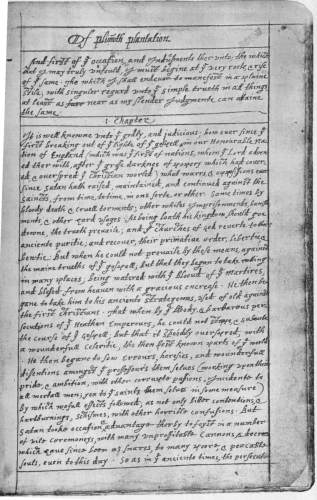
Of Plimoth Plantation.
And first of ye occasion and indũsments ther unto; the which that I may truly unfould, I must begine at ye very roote & rise of ye same. The which I shall endevor to manefest in a plaine stile, with singuler regard unto ye simple trueth in all things, at least as near as my slender judgmente can attaine the same.
1. Chapter.
It is well knowne unto ye godly and judicious, how ever since ye first breaking out of ye lighte of ye gospell in our Honourable Nation of England, (which was ye first of nations whom ye Lord adorned ther with, affter yt grosse darknes of popery which had covered & overspred ye Christian worled,) what warrs & opposissions ever since, Satan hath raised, maintained, and continued against the Saincts, from time to time, in one sorte or other. Some times by bloody death and cruell torments; other whiles imprisonments, banishments, & other hard usages; as being loath his kingdom should goe downe, the trueth prevaile, and ye churches of God reverte to their anciente puritie, and recover their primative order, libertie, & bewtie. But when he could not prevaile by these means, against the maine trueths of ye gospell, but that they began to take rootting in many places, being watered with ye blooud of ye martires, and blessed from heaven with a gracious encrease; He then begane to take him to his anciente strategemes, used of old against the first Christians. That when by ye bloody & barbarous persecutions of ye Heathen Emperours, he could not stoppe & subuerte the course of ye gospell, but that it speedily overspred with a wounderfull celeritie the then best known parts of ye world, He then begane to sow errours, heresies, and wounderfull dissentions amongst ye professours them selves, (working upon their pride & ambition, with other corrupte passions incidente to all mortall men, yea to ye saints them selves in some measure,) by which wofull effects followed; as not only bitter contentions, & hartburnings, schismes, with other horrible confusions, but Satan tooke occasion & advantage therby to foyst in a number of vile ceremoneys, with many unproffitable cannons & decrees, which have since been as snares to many poore & peaceable souls even to this day. So as in ye anciente times, the persecutions[2] by ye heathen & their Emperours, was not greater then of the Christians one against other; the Arians & other their complices against ye orthodoxe & true Christians. As witneseth Socrates in his 2. booke. His words are these;[B] The violence truly (saith he) was no less than that of ould practised towards ye Christians when they were compelled & drawne to sacrifice to idoles; for many indured sundrie kinds of tormente, often rackings, & dismembering of their joynts; confiscating of ther goods; some bereaved of their native soyle; others departed this life under ye hands of ye tormentor; and some died in banishmēte, & never saw ther cuntrie againe, &c.
The like methode Satan hath seemed to hold in these later times, since ye trueth begane to springe & spread after ye great defection made by Antichrist, yt man of sin̅e.
For to let pass ye infinite examples in sundrie nations and severall places of ye world, and instance in our owne, when as yt old serpente could not prevaile by those firie flames & other his cruell tragedies, which he[C] by his instruments put in ure every wher in ye days of queene Mary & before, he then begane an other kind of warre, & went more closly to worke; not only to oppuggen, but even to ruinate & destroy ye kingdom of Christ, by more secrete & subtile means, by kindling ye flames of contention and sowing ye seeds of discorde & bitter enmitie amongst ye proffessors & seeming reformed them selves. For when he could not prevaile by ye former means against the principall doctrins of faith, he bente his force against the holy discipline & outward regimente of the kingdom of Christ, by which those holy doctrines should be conserved, & true pietie maintained amongest the saints & people of God.
Mr. Foxe recordeth how yt besids those worthy martires & confessors which were burned in queene Marys days & otherwise tormented,[D] many (both studients & others) fled out of ye land, to ye number of 800. And became severall congregations. At Wesell, Frankford, Bassill, Emden, Markpurge, Strausborugh, & Geneva, &c. Amongst whom (but especialy those at Frankford) begane yt bitter warr of contention & persecutiō aboute ye ceremonies, & servise-booke, and other popish and antichristian stuffe, the plague of England to this day, which are like ye highplases in Israell, wch the prophets cried out against, & were their ruine; [3] which ye better parte sought, according to ye puritie of ye gospell, to roote out and utterly to abandon. And the other parte (under veiled pretences) for their ouwn ends & advancments, sought as stifly to continue, maintaine, & defend. As appeareth by ye discourse therof published in printe, Ano: 1575; a booke yt deserves better to be knowne and considred.
The one side laboured to have ye right worship of God & discipline of Christ established in ye church, according to ye simplicitie of ye gospell, without the mixture of mens inventions, and to have & to be ruled by ye laws of Gods word, dispensed in those offices, & by those officers of Pastors, Teachers, & Elders, &c. according to ye Scripturs. The other partie, though under many colours & pretences, endevored to have ye episcopall dignitie (affter ye popish man̅er) with their large power & jurisdiction still retained; with all those courts, cannons, & ceremonies, togeather with all such livings, revenues, & subordinate officers, with other such means as formerly upheld their antichristian greatnes, and enabled them with lordly & tyranous power to persecute ye poore servants of God. This contention was so great, as neither ye honour of God, the commone persecution, nor ye mediation of Mr. Calvin & other worthies of ye Lord in those places, could prevaile with those thus episcopally minded, but they proceeded by all means to disturbe ye peace of this poor persecuted church, even so farr as to charge (very unjustly, & ungodlily, yet prelatelike) some of their cheefe opposers, with rebellion & hightreason against ye Emperour, & other such crimes.
And this contētion dyed not with queene Mary, nor was left beyonde ye seas, but at her death these people returning into England under gracious queene Elizabeth, many of them being preferred to bishopricks & other promotions, according to their aimes and desires, that inveterate hatered against ye holy discipline of Christ in his church hath continued to this day. In somuch that for fear [4] it should preveile, all plotts & devices have been used to keepe it out, incensing ye queene & state against it as dangerous for ye com̅on wealth; and that it was most needfull yt ye fundamentall poynts of Religion should be preached in those ignorante & superstitious times; and to win̅e ye weake & ignorante, they might retaine diverse harmles ceremoneis; and though it were to be wished yt diverse things were reformed, yet this was not a season for it. And many the like, to stop ye mouthes of ye more godly, to bring them over to yeeld to one ceremoney after another, and one corruption after another; by these wyles begyleing some & corrupting others till at length they begane to persecute all ye zealous professors in ye land (though they knew little what this discipline mente) both by word & deed, if they would not submitte to their ceremonies, & become slaves to them & their popish trash, which have no ground in ye word of God, but are relikes of yt man of sine. And the more ye light of ye gospell grew, ye more yey urged their subscriptions to these corruptions. So as (notwithstanding all their former pretences & fair colures) they whose eyes God had not justly blinded might easily see wherto these things tended. And to cast contempte the more upon ye sincere servants of God, they opprobriously & most injuriously gave unto, & imposed upon them, that name of Puritans, which [it] is said the Novatians out of prid did assume & take unto themselves.[E] And lamentable it is to see ye effects which have followed. Religion hath been disgraced, the godly greeved, afflicted, persecuted, and many exiled, sundrie have lost their lives in prisones & otherways. On the other hand, sin hath been countenanced, ignorance, profannes, & atheisme increased, & the papists encouraged to hope againe for a day.
This made that holy man Mr. Perkins[F] crie out in his exhortation to repentance, upon Zeph. 2. Religion (saith he) hath been amongst us this 35. years; but the more it is published, the more it is contemned & reproached of many, &c. Thus not prophanes nor wickednes, but Religion it selfe is a byword, a moking-stock, & a matter of reproach; so that in England at this day the man or woman yt begines to profes Religion, & to serve God, must resolve with him selfe to sustaine [5] mocks & injueries even as though he lived amongst ye enimies of Religion. And this com̅one experience hath confirmed & made too apparente.
A late observation, as it were by the way, worthy to be Noted.[G]
Full litle did I thinke, yt the downfall of ye Bishops, with their courts, cannons, & ceremonies, &c. had been so neare, when I first begane these scribled writings (which was aboute ye year 1630, and so peeced up at times of leasure afterward), or that I should have lived to have seene or heard of ye same; but it is ye Lords doing, and ought to be marvelous in our eyes! Every plante which mine heavenly father hath not planted (saith our Saviour) shall be rooted up. Mat: 15. 13.[H] I have snared the, and thou art taken, O Babell (Bishops), and thou wast not aware; thou art found, and also caught, because thou hast striven against the Lord. Jer. 50. 24. But will they needs strive against ye truth, against ye servants of God; what, & against the Lord him selfe? Doe they provoke the Lord to anger? Are they stronger than he? 1. Cor: 10. 22. No, no, they have mete with their match. Behold, I come unto ye, O proud man, saith the Lord God of hosts; for thy day is come, even the time that I will visite the. Jer: 50. 31. May not the people of God now say (and these pore people among ye rest), The Lord hath brought forth our righteousnes; come, let us declare in Sion the work of the Lord our God. Jer: 51. 10. Let all flesh be still before the Lord; for he is raised up out of his holy place. Zach: 2. 13.
In this case, these poore people may say (among ye thousands of Israll), When the Lord brougt againe the captivite of Zion, we were like them that dreame. Psa: 126. 1. The Lord hath done greate things for us, wherof we rejoyce. v. 3. They that sow in teares, shall reap in joye. They wente weeping, and carried precious seede, but they shall returne with joye, and bring their sheaves, v. 5, 6.
Doe you not now see ye fruits of your labours, O all yee servants of ye Lord that have suffered for his truth, and have been faithfull witneses of ye same, and yee litle handfull amongst ye rest, ye least amongest ye thousands of Israll? You have not only had a seede time, but many of you have seene ye joyefull harvest; should you not then rejoyse, yea, and againe rejoyce, and say Hallelu-iah, salvation, and glorie, and honour, and power, be to ye Lord our God; for true and righteous are his judgments. Rev. 19. 1, 2.
But thou wilte aske what is ye mater? What is done? Why, art thou a stranger in Israll, that thou shouldest not know what is done? Are not those Jebusites overcome that have vexed the people of Israll so long, even holding Jerusalem till Davids days, and been as thorns in their sids, so many ages; and now begane to scorne that any David should meadle with them; they begane to fortifie their tower, as that of the old Babelonians; but those proud Anakimes are throwne downe, and their glory laid in ye dust. The tiranous bishops are ejected, their courts dissolved, their cannons forceless, their servise casheired, their ceremonies uselese and despised; their plots for popery prevented, and all their superstitions discarded & returned to Roome from whence they came, and ye monuments of idolatrie rooted out of ye land. And the proud and profane suporters, and cruell defenders of these (as bloody papists & wicked athists, and their malignante consorts) marvelously over throwne. And are not these greate things? Who can deney it?
But who hath done it? Who, even he that siteth on ye white horse, who is caled faithfull, & true, and judgeth and fighteth righteously, Rev: 19. 11. whose garments are dipte in blood, and his name was caled the word of God, v. 13. for he shall rule them with a rode of iron; for it is he that treadeth the winepress of the feircenes and wrath of God almighty. And he hath upon his garmente, and upon his thigh, a name writen, The King of Kings, and Lord of Lords, v. 15, 16.
Hallelu-iah.
Anno Dom: 1646.
But that I may come more near my intendmente; when as by the travell & diligence of some godly & zealous preachers, & Gods blessing on their labours, as in other places of ye land, so in ye North parts, many became inlightened by the word of God, and had their ignorance & sins discovered unto them, and begane by his grace to reforme their lives, and make conscience of their wayes, the worke of God was no sooner manifest in them, but presently they were both scoffed and scorned by ye prophane multitude, and ye ministers urged with ye yoak of subscription, or els must be silenced; and ye poore people were so vexed with apparators, & pursuants, & ye comissarie courts, as truly their affliction was not smale; which, notwithstanding, they bore sundrie years with much patience, till they were occasioned (by ye continuance & encrease of these troubls, and other means which the Lord raised up in those days) to see further into things by the light of ye word of God. How not only these base and beggerly ceremonies were unlawfull, but also that ye lordly & tiranous power of ye prelats ought not to be submitted unto; which thus, contrary to the freedome of the gospell, would load & burden mens consciences, and by their compulsive power make a prophane mixture of persons & things in the worship of God. And that their offices & calings, courts & cannons, &c. were unlawfull and antichristian; being such as have no warrante in ye word of God; but the same yt were used in poperie, & still retained. Of which a famous author thus writeth in his Dutch com̅taries.[I] At the coming of king James into England; The new king (saith he) found their established ye reformed religion, according to ye reformed religion of king Edward ye 6. Retaining, or keeping still ye spirituall state of ye Bishops, &c. after ye ould maner, much varying & differing from ye reformed churches in Scotland, France, & ye Neatherlands, Embden, Geneva, &c. whose reformation is cut, or shapen much nerer ye first Christian churches, as it was used in ye Apostles times.[J]
[6] So many therfore of these proffessors as saw ye evill of these things, in thes parts, and whose harts ye Lord had touched wth heavenly zeale for his trueth, they shooke of this yoake of antichristian bondage, and as ye Lords free people, joyned them selves (by a covenant of the Lord) into a church estate, in ye felowship of ye gospell, to walke in all his wayes, made known, or to be made known unto them, according to their best endeavours, whatsoever it should cost them, the Lord assisting them. And that it cost them something this ensewing historie will declare.
These people became 2. distincte bodys or churches, & in regarde of distance of place did congregate severally; for they were of sundrie townes & vilages, some in Notingamshire, some of Lincollinshire, and some of Yorkshire, wher they border nearest togeather. In one of these churches (besids others of note) was Mr. John Smith, a man of able gifts, & a good preacher, who afterwards was chosen their pastor. But these afterwards falling into some errours in ye Low Countries, ther (for ye most part) buried them selves, & their names.
But in this other church (wch must be ye subjecte of our discourse) besids other worthy men, was Mr. Richard Clifton, a grave and reverēd preacher, who by his paines and dilligens had done much good, and under God had ben a means of ye conversion of many. And also that famous and worthy man Mr. John Robinson, who afterwards was their pastor for many years, till ye Lord tooke him away by death. Also Mr. William Brewster a reverent man, who afterwards was chosen an elder of ye church and lived with them till old age.
But after these things they could not long continue in any peaceable condition, but were hunted & persecuted on every side, so as their former afflictions were but as flea-bitings in comparison of these which now came upon them. For some were taken & clapt up in prison, others had their houses besett & watcht night and day, & hardly escaped their hands; and ye most were faine to flie & leave their howses & habitations, and the means of their livelehood. Yet these & many other sharper things which affterward befell them, were no other then they looked for, and therfore were ye better prepared to bear them by ye assistance of Gods grace & spirite. Yet seeing them selves thus molested, [7] and that ther was no hope of their continuance ther, by a joynte consente they resolved to goe into ye Low-Countries, wher they heard was freedome of Religion for all men; as also how sundrie from London, & other parts of ye land, had been exiled and persecuted for ye same cause, & were gone thither, and lived at Amsterdam, & in other places of ye land. So affter they had continued togeither aboute a year, and kept their meetings every Saboth in one place or other, exercising the worship of God amongst them selves, notwithstanding all ye dilligence & malice of their adverssaries, they seeing they could no longer continue in yt condition, they resolved to get over into Hollād as they could; which was in ye year 1607. & 1608.; of which more at large in ye next chap.
2. Chap.
Of their departure into Holland and their troubls ther aboute, with some of the many difficulties they found and mete withall.
Ano. 1608.
Being thus constrained to leave their native soyle and countrie, their lands & livings, and all their freinds & famillier acquaintance, it was much, and thought marvelous by many. But to goe into a countrie they knew not (but by hearsay), wher they must learne a new language, and get their livings they knew not how, it being a dear place, & subjecte to ye misseries of warr, it was by many thought an adventure almost desperate, a case intolerable, & a misserie worse then death. Espetially seeing they were not aquainted with trads nor traffique, (by which yt countrie doth subsiste,) but had only been used to a plaine countrie life, & ye inocente trade of husbandrey. But these things did not dismay them (though they did some times trouble them) for their desires were sett on ye ways of God, & to injoye his ordinances; but they rested on his providence, & knew whom they had beleeved. Yet [8] this was not all, for though they could not stay, yet were ye not suffered to goe, but ye ports and havens were shut against them, so as they were faine to seeke secrete means of conveance, & to bribe & fee ye mariners, & give exterordinarie rates for their passages. And yet were they often times betrayed (many of them), and both they & their goods intercepted & surprised, and therby put to great trouble & charge, of which I will give an instance or tow, & omitte the rest.
Ther was a large companie of them purposed to get passage at Boston in Lincoln-shire, and for that end had hired a shipe wholy to them selves, & made agreement with the maister to be ready at a certaine day, and take them and their goods in, at a conveniente place, wher they accordingly would all attende in readines. So after long waiting, & large expences, though he kepte not day with them, yet he came at length & tooke them in, in ye night. But when he had them & their goods abord, he betrayed them, haveing before hand complotted with ye serchers & other officers so to doe; who tooke them, and put them into open boats, & ther rifled & ransaked them, searching them to their shirts for money, yea even ye women furder then became modestie; and then caried them back into ye towne, & made them a spectackle & wonder to the multitude, which came flocking on all sids to behould them. Being thus first, by the chatch-poule officers, rifled, & stripte of their money, books, and much other goods, they were presented to ye magestrates, and messengers sente to informe ye lords of ye Counsell of them; and so they were com̅ited to ward. Indeed ye magestrats used them courteously, and shewed them what favour they could; but could not deliver them, till order came from ye Counsell-table. But ye issue was that after a months imprisonmente, ye greatest parte were dismiste, & sent to ye places from whence they came; but 7. of ye principall were still kept in prison, and bound over to ye Assises.
The nexte spring after, ther was another attempte made by some of these & others, to get over at an other place. And it so fell out, that they light of a Dutchman at Hull, having a ship of his owne belonging to Zealand; they made agreemente with him, and acquainted [9] him with their condition, hoping to find more faithfullnes in him, then in ye former of their owne nation. He bad them not fear, for he would doe well enough. He was by appointment to take them in betweene Grimsbe & Hull, wher was a large com̅one a good way distante from any towne. Now aganst the prefixed time, the women & children, with ye goods, were sent to ye place in a small barke, which they had hired for yt end; and ye men were to meete them by land. But it so fell out, that they were ther a day before ye shipe came, & ye sea being rough, and ye women very sicke, prevailed with ye seamen to put into a creeke hardby, wher they lay on ground at lowwater. The nexte morning ye shipe came, but they were fast, & could not stir till aboute noone. In ye mean time, ye shipe maister, perceiveing how ye matter was, sente his boate to be getting ye men abord whom he saw ready, walking aboute ye shore. But after ye first boat full was gott abord, & she was ready to goe for more, the mr espied a greate company, both horse & foote, with bills, & gunes, & other weapons; for ye countrie was raised to take them. Ye Dutch-man seeing yt, swore his countries oath, "sacremente," and having ye wind faire, waiged his Ancor, hoysed sayles, & away. But ye poore men which were gott abord, were in great distress for their wives and children, which they saw thus to be taken, and were left destitute of their helps; and them selves also, not having a cloath to shifte them with, more then they had on their baks, & some scarce a peney aboute them, all they had being abord ye barke. It drew tears from their eyes, and any thing they had they would have given to have been a shore againe; but all in vaine, ther was no remedy, they must thus sadly part. And afterward endured a fearfull storme at sea, being 14. days or more before yey arived at their porte, in 7. wherof they neither saw son, moone, nor stars, & were driven near ye coast of Norway; the mariners them selves often despairing of life; and once with shriks & cries gave over all, as if ye ship had been foundred in ye sea, & they sinking without recoverie. But when mans hope & helpe wholy failed, ye Lords power & mercie appeared in ther recoverie; for ye ship rose againe, & gave ye mariners courage againe to manage her. And if modestie woud suffer me, I might declare with what fervente [10] prayres they cried unto ye Lord in this great distres, (espetialy some of them,) even without any great distraction, when ye water rane into their mouthes & ears; & the mariners cried out, We sinke, we sinke; they cried (if not with mirakelous, yet with a great hight or degree of devine faith), Yet Lord thou canst save, yet Lord thou canst save; with shuch other expressions as I will forbeare. Upon which ye ship did not only recover, but shortly after ye violence of ye storme begane to abate, and ye Lord filed their afflicted minds with shuch comforts as every one can̅ot understand, and in ye end brought them to their desired Haven, wher ye people came flockeing admiring their deliverance, the storme having ben so longe & sore, in which much hurt had been don, as ye masters freinds related unto him in their congrattulations.
But to returne to ye others wher we left. The rest of ye men yt were in greatest danger, made shift to escape away before ye troope could surprise them; those only staying yt best might, to be assistante unto ye women. But pitifull it was to see ye heavie case of these poore women in this distress; what weeping & crying on every side, some for their husbands, that were caried away in ye ship as is before related; others not knowing what should become of them, & their litle ones; others againe melted in teares, seeing their poore litle ones hanging aboute them, crying for feare, and quaking with could. Being thus aprehended, they were hurried from one place to another, and from one justice to another, till in ye ende they knew not what to doe with them; for to imprison so many women & innocent children for no other cause (many of them) but that they must goe with their husbands, semed to be unreasonable and all would crie out of them; and to send them home againe was as difficult, for they aledged, as ye trueth was, they had no homes to goe to, for they had either sould, or otherwise disposed of their houses & livings. To be shorte, after they had been thus turmolyed a good while, and conveyed from one constable to another, they were glad to be ridd of them in ye end upon any termes; for all were wearied & tired with them. Though in ye mean time they (poore soules) indured miserie enough; and thus in the end necessitie forste a way for them.
But yt I be not tedious in these things, I will omitte ye rest, though I might relate many other notable passages and troubles which they endured & underwente in these their wanderings & travells both at land & sea; but I hast to [11] other things. Yet I may not omitte ye fruite that came hearby, for by these so publick troubls, in so many eminente places, their cause became famouss, & occasioned many to looke into ye same; and their godly cariage & Christian behaviour was such as left a deep impression in the minds of many. And though some few shrunk at these first conflicts & sharp beginings, (as it was no marvell,) yet many more came on with fresh courage, & greatly animated others. And in ye end, notwithstanding all these stormes of oppossition, they all gatt over at length, some at one time & some at an other, and some in one place & some in an other, and mette togeather againe according to their desires, with no small rejoycing.
The 3. Chap.
Of their setling in Holand, & their maner of living, & entertainmente ther.
Being now come into ye Low Countries, they saw many goodly & fortified cities, strongly walled and garded with troopes of armed men. Also they heard a strange & uncouth language, and beheld ye differente man̅ers & customes of ye people, with their strange fashons and attires; all so farre differing from yt of their plaine countrie villages (wherin they were bred, & had so longe lived) as it seemed they were come into a new world. But these were not ye things they much looked on, or long tooke up their thoughts; for they had other work in hand, & an other kind of warr to wage & maintaine. For though they saw faire & bewtifull cities, flowing with abundance of all sorts of welth & riches, yet it was not longe before they saw the grim̅e & grisly face of povertie coming upon them like an armed man, with whom they must bukle & incounter, and from whom they could not flye; but they were armed with faith & patience against him, and all his encounters; and though they were sometimes foyled, yet by Gods assistance they prevailed and got ye victorie.
Now when Mr. Robinson, Mr. Brewster, & other principall members were come over, (for they were of ye last, & stayed to help ye weakest over before them,) such things were [12] thought on as were necessarie for their setling and best ordering of ye church affairs. And when they had lived at Amsterdam aboute a year, Mr. Robinson, their pastor, and some others of best discerning, seeing how Mr. John Smith and his companie was allready fallen in to contention with ye church yt was ther before them, & no means they could use would doe any good to cure ye same, and also that ye flames of contention were like to breake out in yt anciente church it selfe (as affterwards lamentably came to pass); which things they prudently foreseeing, thought it was best to remove, before they were any way engaged with ye same; though they well knew it would be much to ye prejudice of their outward estats, both at presente & in licklyhood in ye future; as indeed it proved to be.
Their remoovall to Leyden.
For these & some other reasons they removed to Leyden, a fair & bewtifull citie, and of a sweete situation, but made more famous by ye universitie wherwith it is adorned, in which of late had been so many learned men. But wanting that traffike by sea which Amsterdam injoyes, it was not so beneficiall for their outward means of living & estats. But being now hear pitchet they fell to such trads & imployments as they best could; valewing peace & their spirituall comforte above any other riches whatsoever. And at lenght they came to raise a competente & comforteable living, but with hard and continuall labor.
Being thus setled (after many difficulties) they continued many years in a comfortable condition, injoying much sweete & delightefull societie & spirituall comforte togeather in ye wayes of God, under ye able ministrie, and prudente governmente of Mr. John Robinson, & Mr. William Brewster, who was an assistante unto him in ye place of an Elder, unto which he was now called & chosen by the church. So as they grew in knowledge & other gifts & graces of ye spirite of God, & lived togeather in peace, & love, and holines; and many came unto them from diverse parts of England, so as they grew a great congregation. And if at any time any differences arose, or offences broak[13] out (as it cannot be, but some time ther will, even amongst ye best of men) they were ever so mete with, and nipt in ye head betims, or otherwise so well composed, as still love, peace, and communion was continued; or els ye church purged of those that were incurable & incorrigible, when, after much patience used, no other means would serve, which seldom came to pass. Yea such was ye mutuall love, & reciprocall respecte that this worthy man had to his flocke, and his flocke to him, that it might be said of them as it once was of yt famouse Emperour Marcus Aurelious,[K] and ye people of Rome, that it was hard to judge wheather he delighted more in haveing shuch a people, or they in haveing such a pastor. His love was greate towards them, and his care was all ways bente for their best good, both for soule and body; for besids his singuler abilities in devine things (wherin he excelled), he was also very able to give directions in civill affaires, and to foresee dangers & inconveniences; by wch means he was very helpfull to their outward estats, & so was every way as a commone father unto them. And none did more offend him then those that were close and cleaving to them selves, and retired from ye commōe good; as also such as would be stiffe & riged in matters of outward order, and invey against ye evills of others, and yet be remisse in them selves, and not so carefull to express a vertuous conversation. They in like maner had ever a reverente regard unto him, & had him in precious estimation, as his worth & wisdom did deserve; and though they esteemed him highly whilst he lived & laboured amongst them, yet much more after his death, when they came to feele ye wante of his help, and saw (by woefull experience) what a treasure they had lost, to ye greefe of their harts, and wounding of their sowls; yea such a loss as they saw could not be repaired; for it was as hard for them to find such another leader and feeder in all respects, as for ye Taborits to find another Ziska. And though they did not call themselves orphans, as the other did, after his death, yet they had cause as much to lamente, in another regard, their present condition, and after usage. But to returne; I know not but it may be spoken to ye honour of God, & without prejudice [14] to any, that such was ye true pietie, ye humble zeale, & fervent love, of this people (whilst they thus lived together) towards God and his waies, and ye single hartednes & sinceir affection one towards another, that they came as near ye primative patterne of ye first churches, as any other church of these later times have done, according to their ranke & qualitie.
But seeing it is not my purpose to treat of ye severall passages that befell this people whilst they thus lived in ye Low Countries, (which might worthily require a large treatise of it selfe,) but to make way to shew ye begining of this plantation, which is that I aime at; yet because some of their adversaries did, upon ye rumore of their removall, cast out slanders against them, as if that state had been wearie of them, & had rather driven them out (as ye heathen historians did faine of Moyses & ye Isralits when they went out of Egipte), then yt it was their owne free choyse & motion, I will therfore mention a perticuler or too to shew ye contrary, and the good acceptation they had in ye place wher they lived. And first though many of them weer poore, yet ther was none so poore, but if they were known to be of yt congregation, the Dutch (either bakers or others) would trust them in any reasonable matter when yey wanted money. Because they had found by experience how carfull they were to keep their word, and saw them so painfull & dilligente in their callings; yea, they would strive to gett their custome, and to imploy them above others, in their worke, for their honestie & diligence.
Againe; ye magistrats of ye citie, aboute ye time of their coming away, or a litle before, in ye publick place of justice, gave this comendable testemoney of them, in ye reproofe of the Wallons, who were of ye French church in yt citie. These English, said they, have lived amongst us now this 12. years, and yet we never had any sute or accusation came against any of them; but your strifs & quarels are continuall, &c. In these times allso were ye great troubls raised by ye Arminians, who, as they greatly mollested ye whole state, so this citie in particuler, in which was ye cheefe universitie; so as ther were dayly & hote disputs in ye schooles ther aboute; and as ye studients & other lerned were devided in their oppinions hearin, so were ye 2. proffessors or devinitie readers them selves; the one daly teaching for it, ye other against it. Which grew to that pass, that few of the discipls of ye one would hear ye other teach. But Mr. Robinson, though he taught thrise a weeke him selfe, & write sundrie books, besids his manyfould pains otherwise, yet he went constantly [15] to hear ther readings, and heard ye one as well as ye other; by which means he was so well grounded in ye controversie, and saw ye force of all their arguments, and knew ye shifts of ye adversarie, and being him selfe very able, none was fitter to buckle with them then him selfe, as appered by sundrie disputs; so as he begane to be terrible to ye Arminians; which made Episcopius (ye Arminian professor) to put forth his best stringth, and set forth sundrie Theses, which by publick dispute he would defend against all men. Now Poliander ye other proffessor, and ye cheefe preachers of ye citie, desired Mr. Robinson to dispute against him; but he was loath, being a stranger; yet the other did importune him, and tould him yt such was ye abilitie and nimblnes of ye adversarie, that ye truth would suffer if he did not help them. So as he condescended, & prepared him selfe against the time; and when ye day came, the Lord did so help him to defend ye truth & foyle this adversarie, as he put him to an apparent nonplus, in this great & publike audience. And ye like he did a 2. or 3. time, upon such like occasions. The which as it caused many to praise God yt the trueth had so famous victory, so it procured him much honour & respecte from those lerned men & others which loved ye trueth. Yea, so farr were they from being weary of him & his people, or desiring their absence, as it was said by some, of no mean note, that were it not for giveing offence to ye state of England, they would have preferd him otherwise if he would, and alowd them some publike favour. Yea when ther was speech of their remoovall into these parts, sundrie of note & eminencie of yt nation would have had them come under them, and for yt end made them large offers. Now though I might aledg many other perticulers & examples of the like kinde, to shew ye untruth & unlicklyhode of this slander, yet these shall suffice, seeing it was beleeved of few, being only raised by ye malice of some, who laboured their disgrace.
The 4. Chap.
Showing ye reasons & causes of their remoovall.
After they had lived in this citie about some 11. or 12. years, (which is ye more observable being ye whole time of yt famose truce between that state & ye Spaniards,) and sundrie of them were taken away by death, & many others begane to be well striken in years, the grave mistris Experience haveing taught them many things, [16] those prudent governours with sundrie of ye sagest members begane both deeply to apprehend their present dangers, & wisely to foresee ye future, & thinke of timly remedy. In ye agitation of their thoughts, and much discours of things hear aboute, at length they began to incline to this conclusion, of remoovall to some other place. Not out of any newfanglednes, or other such like giddie humor, by which men are oftentimes transported to their great hurt & danger, but for sundrie weightie & solid reasons; some of ye cheefe of which I will hear breefly touch. And first, they saw & found by experience the hardnes of ye place & countrie to be such, as few in comparison would come to them, and fewer that would bide it out, and continew with them. For many yt came to them, and many more yt desired to be with them, could not endure yt great labor and hard fare, with other inconveniences which they underwent & were contented with. But though they loved their persons, approved their cause, and honoured their sufferings, yet they left them as it weer weeping, as Orpah did her mother in law Naomie, or as those Romans did Cato in Utica, who desired to be excused & borne with, though they could not all be Catoes. For many, though they desired to injoye ye ordinances of God in their puritie, and ye libertie of the gospell with them, yet, alass, they admitted of bondage, with danger of conscience, rather then to indure these hardships; yea, some preferred & chose ye prisons in England, rather then this libertie in Holland, with these afflictions. But it was thought that if a better and easier place of living could be had, it would draw many, & take away these discouragments. Yea, their pastor would often say, that many of those wo both wrate & preached now against them, if they were in a place wher they might have libertie and live comfortably, they would then practise as they did.
2ly. They saw that though ye people generally bore all these difficulties very cherfully, & with a resolute courage, being in ye best & strength of their years, yet old age began to steale on many of them, (and their great & continuall labours, with other crosses and sorrows, hastened it before ye time,) so as it was not only probably thought, but apparently seen, that within a few years more they would be in danger to scatter, by necessities pressing them, or sinke under their burdens, or both. And therfore according to ye devine proverb, yt a wise man seeth ye plague when it cometh, & hideth him selfe, Pro. 22. 3., so they like skillfull & beaten souldiers were fearfull either to be intrapped or surrounded by their enimies, so as they should neither be able to fight nor flie; and therfor thought it better to dislodge betimes to some place of better advantage & less danger, if any such could be found. [16] Thirdly; as necessitie was a taskmaster over them, so they were forced to be such, not only to their servants, but in a sorte, to their dearest chilldren; the which as it did not a litle wound ye tender harts of many a loving father & mother, so it produced likwise sundrie sad & sorowful effects. For many of their children, that were of best dispositions and gracious inclinations, haveing lernde to bear ye yoake in their youth, and willing to bear parte of their parents burden, were, often times, so oppressed with their hevie labours, that though their minds were free and willing, yet their bodies bowed under ye weight of ye same, and became decreped in their early youth; the vigor of nature being consumed in ye very budd as it were. But that which was more lamentable, and of all sorowes most heavie to be borne, was that many of their children, by these occasions, and ye great licentiousnes of youth in yt countrie, and ye manifold temptations of the place, were drawne away by evill examples into extravagante & dangerous courses, getting ye raines off their neks, & departing from their parents. Some became souldiers, others tooke upon them farr viages by sea, and other some worse courses, tending to dissolutnes & the danger of their soules, to ye great greefe of their parents and dishonour of God. So that they saw their posteritie would be in danger to degenerate & be corrupted.
Lastly, (and which was not least,) a great hope & inward zeall they had of laying some good foundation, or at least to make some way therunto, for ye propagating & advancing ye gospell of ye kingdom of Christ in those remote parts of ye world; yea, though they should be but even as stepping-stones unto others for ye performing of so great a work.
These, & some other like reasons, moved them to undertake this resolution of their removall; the which they afterward prosecuted with so great difficulties, as by the sequell will appeare.
The place they had thoughts on was some of those vast & unpeopled countries of America, which are frutfull & fitt for habitation, being devoyd of all civill inhabitants, wher ther are only salvage & brutish men, which range up and downe, litle otherwise then ye wild beasts of the same. This proposition being made publike and coming to ye scaning of all, it raised many variable opinions amongst men, and caused many fears & doubts amongst them selves. Some, from their reasons & hops conceived, laboured to stirr up & incourage the rest to undertake & prosecute ye same; others, againe, out of their fears, objected against it, & sought to diverte from it, aledging many things, and those neither unreasonable nor unprobable; as that it was a great designe, and subjecte to many unconceivable perills & dangers; as, besids the casulties of ye seas (which none can be freed from) the length of ye vioage was such, as ye weake bodys of women and other persons worne out with age & traville (as many of them were) could never be able to endure. And yet if they should, the miseries of ye land which they should be [17] exposed unto, would be to hard to be borne; and lickly, some or all of them togeither, to consume & utterly to ruinate them. For ther they should be liable to famine, and nakednes, & ye wante, in a maner, of all things. The chang of aire, diate, & drinking of water, would infecte their bodies with sore sickneses, and greevous diseases. And also those which should escape or overcome these difficulties, should yett be in continuall danger of ye salvage people, who are cruell, barbarous, & most trecherous, being most furious in their rage, and merciles wher they overcome; not being contente only to kill, & take away life, but delight to tormente men in ye most bloodie man̅er that may be; fleaing some alive with ye shells of fishes, cutting of ye members & joynts of others by peesmeale, and broiling on ye coles, eate ye collops of their flesh in their sight whilst they live; with other cruelties horrible to be related. And surely it could not be thought but ye very hearing of these things could not but move ye very bowels of men to grate within them, and make ye weake to quake & tremble. It was furder objected, that it would require greater sum̅es of money to furnish such a voiage, and to fitt them with necessaries, then their consumed estats would amounte too; and yett they must as well looke to be seconded with supplies, as presently to be trāsported. Also many presidents of ill success, & lamentable misseries befalne others in the like designes, were easie to be found, and not forgotten to be aledged; besids their owne experience, in their former troubles & hardships in their removall into Holand, and how hard a thing it was for them to live in that strange place, though it was a neighbour countrie, & a civill and rich comone wealth.
It was answered, that all great & honourable actions are accompanied with great difficulties, and must be both enterprised and overcome with answerable courages. It was granted ye dangers were great, but not desperate; the difficulties were many, but not invincible. For though their were many of them likly, yet they were not cartaine; it might be sundrie of ye things feared might never befale; others by providente care & ye use of good means, might in a great measure be prevented; and all of them, through ye help of God, by fortitude and patience, might either be borne, or overcome. True it was, that such atempts were not to be made and undertaken without good ground & reason; not rashly or lightly as many have done for curiositie or hope of gaine, &c. But their condition was not ordinarie; their ends were good & honourable; their calling lawfull, & urgente; and therfore they might expecte ye blessing of God in their proceding. Yea, though they should loose their lives in this action, yet might they have comforte in the same, and their endeavors would be honourable. They lived hear but as men in exile, & in a poore condition; and as great miseries might possibly befale them in this place, for ye 12. years of truce were now out, & ther was nothing but beating of drumes, and preparing for warr, the events wherof are allway uncertaine. Ye Spaniard might prove as cruell as [18] the salvages of America, and ye famine and pestelence as sore hear as ther, & their libertie less to looke out for remedie. After many other perticuler things answered & aledged on both sids, it was fully concluded by ye major parte, to put this designe in execution, and to prosecute it by the best means they could.
The 5. Chap.
Shewing what means they used for preparation to this waightie vioag.
And first after thir humble praiers unto God for his direction & assistance, & a generall conferrence held hear aboute, they consulted what perticuler place to pitch upon, & prepare for. Some (& none of ye meanest) had thoughts & were ernest for Guiana, or some of those fertill places in those hott climats; others were for some parts of Virginia, wher ye English had all ready made enterance, & begining. Those for Guiana aledged that the cuntrie was rich, fruitfull, & blessed with a perpetuall spring, and a florishing greenes; where vigorous nature brought forth all things in abundance & plentie without any great labour or art of man. So as it must needs make ye inhabitants rich, seing less provisions of clothing and other things would serve, then in more coulder & less frutfull countries must be had. As also yt the Spaniards (having much more then they could possess) had not yet planted there, nor any where very near ye same. But to this it was answered, that out of question ye countrie was both frutfull and pleasante, and might yeeld riches & maintenance to ye possessors, more easily then ye other; yet, other things considered, it would not be so fitt for them. And first, yt such hott countries are subject to greevuos diseases, and many noysome impediments, which other more temperate places are freer from, and would not so well agree with our English bodys. Againe, if they should ther live, & doe well, the jealous Spaniard would never suffer them long, but would displante or overthrow them, as he did ye French in Florida, who were seated furder from his richest countries; and the sooner because they should have none to protect them, & their owne strength would be too smale to resiste so potent an enemie, & so neare a neighbor.
On ye other hand, for Virginia it was objected, that if they lived among ye English wch wear ther planted, or so near them as to be under their goverment, they should be in as great danger to be troubled and persecuted for the cause of religion, as if they lived in England, and it might be worse. And if they lived too farr of, they should neither have succour, nor defence from them.
But at length ye conclusion was, to live as a distincte body by them selves, under ye generall Goverment of Virginia; and by their freinds to sue to his majestie that he would be pleased to grant them freedome of Religion; and yt this might be obtained, they wear putt in good hope by some great persons, of good ranke & qualitie, that were made their freinds. Whereupon 2. were chosen [19] & sent in to England (at ye charge of ye rest) to sollicite this matter, who found the Virginia Company very desirous to have them goe thither, and willing to grante them a patent, with as ample priviliges as they had, or could grant to any, and to give them the best furderance they could. And some of ye cheefe of yt company douted not to obtaine their suite of ye king for liberty in Religion, and to have it confirmed under ye kings broad seale, according to their desires. But it prooved a harder peece of worke then they tooke it for; for though many means were used to bring it aboute, yet it could not be effected; for ther were diverse of good worth laboured with the king to obtaine it, (amongst whom was one of his cheefe secretaries,[L]) and some other wrought with ye archbishop to give way therunto; but it proved all in vaine. Yet thus farr they prevailed, in sounding his majesties mind, that he would connive at them, & not molest them, provided they carried them selves peacably. But to allow or tolerate them by his publick authoritie, under his seale, they found it would not be. And this was all the cheefe of ye Virginia companie or any other of their best freinds could doe in the case. Yet they perswaded them to goe on, for they presumed they should not be troubled. And with this answer ye messengers returned, and signified what diligence had bene used, and to what issue things were come.
But this made a dampe in ye busines, and caused some distraction, for many were afraid that if they should unsetle them selves, & put of their estates, and goe upon these hopes, it might prove dangerous, and but a sandie foundation. Yea, it was thought they might better have presumed hear upon without makeing any suite at all, then, haveing made it, to be thus rejected. But some of ye cheefest thought other wise, and yt they might well proceede hereupon, & that ye kings majestie was willing enough to suffer them without molestation, though for other reasons he would not confirme it by any publick acte. And furdermore, if ther was no securitie in this promise intimated, ther would be no great certainty in a furder confirmation of ye same; for if after wards ther should be a purpose or desire to wrong them, though they had a seale as broad as ye house flore, it would not serve ye turne; for ther would be means enew found to recall or reverse it. Seeing therfore the course was probable, they must rest herein on Gods providence, as they had done in other things.
Upon this resolution, other messengers were dispatched, to end with ye Virginia Company as well as they could. And to procure [20] a patent with as good and ample conditions as they might by any good means obtaine. As also to treate and conclude with such merchants and other freinds as had manifested their forwardnes to provoke too and adventure in this vioage. For which end they had instructions given them upon what conditions they should proceed with them, or els to conclude nothing without further advice. And here it will be requisite to inserte a letter or too that may give light to these proceedings.
A coppie of leter from Sir Edwin Sands, directed to Mr. John Robinson & Mr. William Brewster.
After my hartie salutations. The agents of your congregation, Robert Cushman & John Carver, have been in com̅unication with diverse selecte gentlemen of his Majesties Counsell for Virginia; and by ye writing of 7. Articles subscribed with your names, have given them yt good degree of satisfaction, which hath caried them on with a resolution to sett forward your desire in ye best sorte yt may be, for your owne & the publick good. Divers perticulers wherof we leave to their faithfull reporte; having carried them selves heere with that good discretion, as is both to their owne and their credite from whence they came. And wheras being to treate for a multitude of people, they have requested further time to conferr with them that are to be interessed in this action, aboute ye severall particularities which in ye prosecution therof will fall out considerable, it hath been very willingly assented too. And so they doe now returne unto you. If therfore it may please God so to directe your desires as that on your parts ther fall out no just impediments, I trust by ye same direction it shall likewise appear, that on our parte, all forwardnes to set you forward shall be found in the best sorte which with reason may be expected. And so I betake you with this designe (wch I hope verily is ye worke of God), to the gracious protection and blessing of the Highest.
Your very loving freind
Edwin Sandys.
London, Noṽbr 12.
Ano 1617.
Their answer was as foloweth.
Righte Worpl:
Our humble duties remembred, in our owne, our messengers, and our churches name, with all thankfull acknowledgmente of your singuler love, expressing [21] itselfe, as otherwise, so more spetially in your great care and earnest endeavor of our good in this weightie bussines aboute Virginia, which ye less able we are to requite, we shall thinke our selves the more bound to commend in our prayers unto God for recompence; whom, as for ye presente you rightly behould in our indeavors, so shall we not be wanting on our parts (the same God assisting us) to returne all answerable fruite, and respecte unto ye labour of your love bestowed upon us. We have with ye best speed and consideration withall that we could, sett downe our requests in writing, subscribed, as you willed, wth the hands of ye greatest parte of our congregation, and have sente ye same unto ye Counsell by our agente, & a deacon of our church, John Carver, unto whom we have also requested a gentleman of our company to adyone him selfe; to the care & discretion of which two, we doe referr ye prosecuting of ye bussines. Now we perswade our selves Right Worpp: that we need not provoke your godly & loving minde to any further or more tender care of us, since you have pleased so farr to interest us in your selfe, that, under God, above all persons and things in the world, we relye upon you, expecting the care of your love, counsell of your wisdome, & the help & countenance of your authority. Notwithstanding, for your encouragmente in ye worke, so farr as probabilities may leade, we will not forbeare to mention these instances of indusmente.
1. We veryly beleeve & trust ye Lord is with us, unto whom & whose service we have given our selves in many trialls; and that he will graciously prosper our indeavours according to ye simplicitie of our harts therin.
2ly. We are well weaned from ye delicate milke of our mother countrie, and enured to ye difficulties of a strange and hard land, which yet in a great parte we have by patience overcome.
3ly. The people are for the body of them, industrious, & frugall, we thinke we may safly say, as any company of people in the world.
4ly. We are knite togeather as a body in a most stricte & sacred bond and covenante of the Lord, of the violation[M] wherof we make great conscience, and by vertue wherof we doe hould our selves straitly tied to all care of each others good, and of ye whole by every one and so mutually.
5. Lastly, it is not with us as with other men, whom small things can discourage, or small discontentments cause to wish them selves at home againe. We knowe our entertainmente in England, and in Holand; we shall much prejudice both our arts & means by removall; who, if we should be driven to returne, we should not hope to recover our present helps and comforts, neither indeed looke ever, for our selves, to attaine unto ye like in any other place during our lives, wch are now drawing towards their periods.
[22] These motives we have been bould to tender unto you, which you in your wisdome may also imparte to any other our worpp: freinds of ye Counsell with you; of all whose godly dispossition and loving towards our despised persons, we are most glad, & shall not faile by all good means to continue & increase ye same. We will not be further troublesome, but doe, with ye renewed remembrance of our humble duties to your Worpp: and (so farr as in modestie we may be bould) to any other of our wellwillers of the Counsell with you, we take our leaves, com̅iting your persons and counsels to ye guidance and direction of the Almighty.
Yours much bounden in all duty,
John Robinson,
William Brewster.
Leyden, Desem: 15.
Ano: 1617.
For further light in these proceedings see some other letters & notes as followeth.
The coppy of a letter sent to Sr. John Worssenham.
Right Worpll: with due acknowledgmente of our thankfullnse for your singular care & pains in the bussines of Virginia, for our, &, we hope, the com̅one good, we doe remember our humble dutys unto you, and have sent inclosed, as is required, a further explanation of our judgments in the 3. points specified by some of his majesties Honbl Privie Counsell; and though it be greevious unto us that such unjust insinuations are made against us, yet we are most glad of ye occasion of making our just purgation unto so honourable personages. The declarations we have sent inclosed, the one more breefe & generall, which we thinke ye fitter to be presented; the other something more large, and in which we express some smale accidentall differances, which if it seeme good unto you and other of our worpl freinds, you may send in stead of ye former. Our prayers unto God is, yt your Worpp may see the frute of your worthy endeaours, which on our parts we shall not faile to furder by all good means in us. And so praing yt you would please with ye convenientest speed yt may be, to give us knowledge of ye success of ye bussines with his majesties Privie Counsell, and accordingly what your further pleasure is, either for our direction or furtherance in ye same, so we rest
Your Worpp in all duty,
John Robinson,
William Brewster.
Leyden, Jan: 27.
Ano: 1617. old stile.
The first breefe note was this.
Touching ye Ecclesiasticall ministrie, namly of pastores for teaching, elders for ruling, & deacons for distributing ye churches contribution, as allso for ye too Sacrements, baptisme, and ye Lords supper, we doe wholy and in all points agree [23] with ye French reformed churches, according to their publick confession of faith.
The oath of Supremacie we shall willingly take if it be required of us, and that conveniente satisfaction be not given by our taking ye oath of Alleagence.
John Rob:
William Brewster.
Ye 2. was this.
Touching ye Ecclesiasticall ministrie, &c. as in ye former, we agree in all things with the French reformed churches, according to their publick confession of faith; though some small differences be to be found in our practises, not at all in ye substance of the things, but only in some accidentall circumstances.
1. As first, their ministers doe pray with their heads covered; ours uncovered.
2. We chose none for Governing Elders but such as are able to teach; which abilitie they doe not require.
3. Their elders & deacons are anūall, or at most for 2. or 3. years; ours perpetuall.
4. Our elders doe administer their office in admonitions & excommunications for publick scandals, publickly & before ye congregation; theirs more privately, & in their consistories.
5. We doe administer baptisme only to such infants as wherof ye one parente, at ye least, is of some church, which some of ther churches doe not observe; though in it our practice accords with their publick confession and ye judgmente of ye most larned amongst them.
Other differences, worthy mentioning, we know none in these points. Then aboute ye oath, as in ye former.
Subscribed,
John R.
W. B.
Part of another letter from him that delivered these.
London. Feb: 14. 1617.
Your letter to Sr. John Worstenholme I delivered allmost as soone as I had it, to his owne hands, and staid with him ye opening & reading. Ther were 2. papers inclosed, he read them to him selfe, as also ye letter, and in ye reading he spake to me & said, Who shall make them? viz. ye ministers; I answered his Worpp that ye power of making was in ye church, to be ordained by ye imposition of hands, by ye fittest instruments they had. It must either be in ye church or from ye pope, & ye pope is Antichrist. Ho! said Sr. John, what ye pope houlds good, (as in ye Trinitie,) that we doe well to assente too; but, said he, we will not enter into dispute now. And as for your letters he would not show them at any hand, least he should spoyle all. He expected you should have been of ye archbp̃ minde for ye calling of ministers, but it seems you differed. I could have wished to have known ye contents of your tow inclosed, at wch he stuck so much, espetially ye larger. I asked his Worp what good news he had for me to write to morrow. He tould me very good news, for both the kings majestie and ye bishops have consented. He said he would goe to Mr. Chancelor, Sr. Fulk Grivell, as this day, & nexte weeke I should know more. I mett Sr. Edw: Sands on Wedensday night; he wished me to be at the Virginia Courte ye nexte Wedensday, wher I purpose to be. Thus loath to be troublsome at present, I hope to have somewhate nexte week of certentie concerning you. I com̅itte you to ye Lord. Yours,
S. B.
[24] These things being long in agitation, & messengers passing too and againe aboute them, after all their hopes they were long delayed by many rubs that fell in ye way; for at ye returne of these messengers into England they found things farr otherwise then they expected. For ye Virginia Counsell was now so disturbed with factions and quarrels amongst them selves, as no bussines could well goe forward. The which may the better appear in one of the messengers letters as followeth.
To his loving freinds, &c.
I had thought long since to have write unto you, but could not effecte yt which I aimed at, neither can yet sett things as I wished; yet, notwithstanding, I doubt not but Mr. B. hath writen to Mr. Robinson. But I thinke my selfe bound also to doe something, least I be thought to neglecte you. The maine hinderance of our proseedings in ye Virginia bussines, is the dissentions and factions, as they terme it, amongs ye Counsell & Company of Virginia; which are such, as that ever since we came up no busines could by them be dispatched. The occasion of this trouble amongst them is, for that a while since Sr. Thomas Smith, repining at his many offices & troubls, wished ye Company of Virginia to ease him of his office in being Treasurer & Goverr. of ye Virginia Company. Wereupon ye Company tooke occasion to dismisse him, and chose Sr. Edwin Sands Treasurer & Goverr of ye Company. He having 60. voyces, Sr. John Worstenholme 16. voices, and Alderman Johnsone 24. But Sr. Thomas Smith, when he saw some parte of his honour lost, was very angrie, & raised a faction to cavill & contend aboute ye election, and sought to taxe Sr. Edwin with many things that might both disgrace him, and allso put him by his office of Governour. In which contentions they yet stick, and are not fit nor readie to intermedle in any bussines; and what issue things will come to we are not yet certaine. It is most like Sr. Edwin will carrie it away, and if he doe, things will goe well in Virginia; if otherwise, they will goe ill enough allways. We hope in some 2. or 3. Court days things will setle. Mean space I thinke to goe downe into Kente, & come up againe aboute 14. days, or 3. weeks hence; except either by these afforesaid contentions, or by ye ille tidings from Virginia, we be wholy discouraged, of which tidings I am now to speake.
Captaine Argoll is come home this weeke (he upon notice of ye intente of ye Counsell, came away before Sr. Georg Yeardley came ther, and so ther is no small dissention). But his tidings are ill, though his person be wellcome. He saith Mr. Blackwells shipe came not ther till March, but going towards winter, they had still norwest winds, which carried them to the southward beyond their course. And ye mr of ye ship & some 6. of ye mariners dieing, it seemed they could not find ye bay, till after long seeking & beating aboute. Mr. Blackwell is dead, & Mr. Maggner, ye Captain; yea, ther are dead, he saith, 130. persons, one & other in yt ship; it is said ther was in all an 180. persons in ye ship, so as they were packed togeather like herings. They had amongst them ye fluxe, and allso wante of fresh water; so as it is hear rather wondred at yt so many are alive, then that so many are dead. The marchants hear say it was Mr. Blackwells faulte to pack so many in ye ship; yea, & ther were great mutterings & repinings amongst them, and upbraiding of Mr. Blackwell, for his dealing and dispossing of them, when they saw how he had dispossed of them, & how he insulted over them. Yea, ye streets at Gravsend runge of their extreame quarrelings, crying out one of another, Thou hast brought me to this, and, I may thanke the for this. Heavie newes it is, and I would be glad to heare how farr it will discourage. I see none hear discouraged much, [25] but rather desire to larne to beware by other mens harmes, and to amend that wherin they have failed. As we desire to serve one another in love, so take heed of being inthraled by any imperious persone, espetially if they be discerned to have an eye to them selves. It doth often trouble me to thinke that in this bussines we are all to learne and none to teach; but better so, then to depend upon such teachers as Mr. Blackwell was. Such a strategeme he once made for Mr. Johnson & his people at Emden, wch was their subversion. But though he ther clenlily (yet unhonstly) plucked his neck out of ye collar, yet at last his foote is caught. Hear are no letters come, ye ship captain Argole came in is yet in ye west parts; all yt we hear is but his report; it seemeth he came away secretly. The ship yt Mr. Blackwell went in will be hear shortly. It is as Mr. Robinson once said; he thought we should hear no good of them.
Mr. B. is not well at this time; whether he will come back to you or goe into ye north, I yet know not. For my selfe, I hope to see an end of this bussines ere I come, though I am sorie to be thus from you; if things had gone roundly forward, I should have been with you within these 14. days. I pray God directe us, and give us that spirite which is fitting for such a bussines. Thus having sum̅arily pointed at things wch Mr. Brewster (I thinke) hath more largly write of to Mr. Robinson, I leave you to the Lords protection.
Yours in all readines, &c. London, May 8.
Robart Cushman. Ano: 1619.
A word or tow by way of digression touching this Mr. Blackwell; he was an elder of ye church at Amsterdam, a man well known of most of them. He declined from ye trueth wth Mr. Johnson & ye rest, and went with him when yey parted assunder in yt wofull maner, wch brought so great dishonour to God, scandall to ye trueth, & outward ruine to them selves in this world. But I hope, notwithstanding, through ye mercies of ye Lord, their souls are now at rest with him in ye heavens, and yt they are arrived in ye Haven of hapines; though some of their bodies were thus buried in ye terrable seas, and others sunke under ye burthen of bitter afflictions. He with some others had prepared for to goe to Virginia. And he, with sundrie godly citizens, being at a private meēing (I take it a fast) in London, being discovered, many of them were apprehended, wherof Mr. Blackwell was one; but he so glosed wth ye bp̃s,[N] and either dissembled or flatly denyed ye trueth which formerly he had maintained; and not only so, but very unworthily betrayed and accused another godly man who had escaped, that so he might slip his own neck out of ye collar, & to obtaine his owne freedome brought others into bonds. Wherupon he so wone ye bp̃s favour (but lost ye Lord's) as he was not only dismiste, but in open courte ye arch-bishop gave him great applause and his sollemne blessing to proseed in his vioage. But if such events follow ye bp̃s blessing, happie are they yt misse ye same; it is much better to keepe a good conscience and have ye Lords blessing, whether in life or death.
But see how ye man thus apprehended by Mr. Blackwells means, writs to a freind of his.
Right dear friend & christian brother, Mr. Carver, I salute you & yours in ye Lord, &c. As for my owne presente condition, I doubt not but you well understand it ere this by our brother Maistersone, who should have tasted of ye same cupp, had his place of residence & his person been as well knowne as my selfe. Some what I have written to Mr. Cushman how ye matter still continues. I have petitioned twise to Mr. Sherives, and once to my Lord Cooke, and have used such reasons to move them to pittie, that if they were not overruled by some others, I suppose I should soone gaine my libertie; as that I was a yonge man living by my [26] credite, indebted to diverse in our citie, living at more then ordinarie charges in a close & tedious prison; besids great rents abroad, all my bussines lying still, my only servante lying lame in ye countrie, my wife being also great with child. And yet no answer till ye lords of his majesties Counsell gave consente. Howbeit, Mr. Blackwell, a man as deepe in this action as I, was delivered at a cheaper rate, with a great deale less adoe; yea, with an addition of ye Archp̃: blessing. I am sorie for Mr. Blackwels weaknes, I wish it may prove no worse. But yet he & some others of them, before their going, were not sorie, but thought it was for ye best that I was nominated, not because ye Lord sanctifies evill to good, but that ye action was good, yea for ye best. One reason I well remember he used was, because this trouble would encrease ye Virginia plantation, in that now people begane to be more generally inclined to goe; and if he had not nomminated some such as I, he had not bene free, being it was knowne that diverse citizens besids them selves were ther. I expecte an answer shortly what they intende conscerning me; I purpose to write to some others of you, by whom you shall know the certaintie. Thus not haveing further at present to acquaint you withall, com̅ending myselfe to your prairs, I cease, & com̅itte you and us all to ye Lord.
From my chamber in Wodstreete Compter.
Your freind, & brother in bonds,
Sabin Staresmore.
Septr: 4. Ano: 1618.
But thus much by ye way, which may be of instruction & good use.
But at last, after all these things, and their long attendance, they had a patent granted them, and confirmed under ye Companies seale; but these devissions and distractions had shaken of many of ther pretended freinds, and disappointed them of much of their hoped for & proffered means. By the advise of some freinds this pattente was not taken in ye name of any of their owne, but in ye name of Mr. John Wincob (a religious gentleman then belonging to ye Countess of Lincoline), who intended to goe with them. But God so disposed as he never went, nor they ever made use of this patente, which had cost them so much labour and charge, as by ye sequell will appeare. This patente being sente over for them to veiw & consider, as also the passages aboute ye propossitions between them & such marchants & freinds as should either goe or adventure with them, and espetially with those[O] on whom yey did cheefly depend for shipping and means, whose proffers had been large, they were requested to fitt and prepare them selves with all speed. A right emblime, it may be, of ye uncertine things of this world; yt when men have toyld them selves for them, they vanish into smoke.
The 6. Chap.
Conscerning ye agreements and artickles between them, and such marchants & others as adventured moneys; with other things falling out aboute making their provissions.
Upon ye receite of these things by one of their messengers, they had a sollemne meeting and a day of humilliation to seeke ye Lord for his direction; and their pastor tooke this texte, 1 Sam. 23. 3, 4. And David's men said unto him, see, we be afraid hear in Judah, how much more if we come to Keilah against the host of the Phillistines? Then David asked counsell of ye Lord againe, &c. From which texte he taught many things very aptly, and befitting ther present occasion and condition, strengthing them against their fears and perplexities, and incouraging them in their resolutions. [27] After which they concluded both what number and what persons should prepare them selves to goe with ye first; for all yt were willing to have gone could not gett ready for their other affairs in so shorte a time; neither if all could have been ready, had ther been means to have trasported them alltogeather. Those that staied being ye greater number required ye pastor to stay with them; and indeede for other reasons he could not then well goe, and so it was ye more easilie yeelded unto. The other then desired ye elder, Mr. Brewster, to goe with them, which was also condescended unto. It was also agreed on by mutuall consente and covenante, that those that went should be an absolute church of them selves, as well as those yt staid; seing in such a dangrous vioage, and a removall to such a distance, it might come to pass they should (for ye body of them) never meete againe in this world; yet with this proviso, that as any of ye rest came over to them, or of ye other returned upon occasion, they should be reputed as members without any further dismission or testimoniall. It was allso promised to those yt wente first, by ye body of ye rest, that if ye Lord gave them life, & meās, & opportunitie, they would come to them as soone as they could.
Aboute this time, whilst they were perplexed with ye proseedings of ye Virginia Company, & ye ill news from thence aboute Mr. Blackwell & his company, and making inquirey about ye hiring & buying of shiping for their vioage, some Dutchmen made them faire offers aboute goeing with them. Also one Mr. Thomas Weston, a mrchant of London, came to Leyden aboute ye same time, (who was well aquainted with some of them, and a furtherer of them in their former proseedings,) haveing much conferance wth Mr. Robinson & other of ye cheefe of them, perswaded them to goe on (as it seems) & not to medle with ye Dutch, or too much to depend on the Virginia Company; for if that failed, if they came to resolution, he and such marchants as were his freinds (togeather with their owne means) would sett them forth; and they should make ready, and neither feare wante of shipping nor money; for what they wanted should be provided. And, not so much for him selfe as for ye satisfing of such frends as he should procure to adventure in this bussines, they were to draw such articls of agreemente, and make such propossitions, as might ye better induce his freinds to venture. Upon which (after ye formere conclusion) articles were drawne & agreed unto, and were showne unto him, and approved by him; and afterwards by their messenger (Mr. John Carver) sent into England, who, togeather with Robart Cushman, were to receive ye moneys & make provissione both for shiping & other things for ye vioage; with this charge, not to exseede their com̅ission, but to proseed according to ye former articles. Also some were chossen to doe ye like for such things as were to be prepared there; so those that weare to goe, prepared them selves with all speed, and sould of their estats and (such as were able) put in their moneys into ye commone stock, which was disposed by those appointed, for ye making of generall provissions. Aboute this time also they had heard, both by Mr. Weston and others, yt sundrie Honbl: Lords had obtained a large grante from ye king, for ye more northerly parts of that countrie, derived out of ye Virginia patente, and wholy secluded from their Govermente, and to be called by another name, viz. New-England. Unto which Mr. Weston, and ye cheefe of them, begane to incline it was [28] best for them to goe, as for other reasons, so cheefly for ye hope of present profite to be made by ye fishing that was found in yt countrie.
But as in all bussineses ye acting parte is most difficulte, espetially wher ye worke of many agents must concurr, so it was found in this; for some of those yt should have gone in England, fell of & would not goe; other marchants & freinds yt had offered to adventure their moneys withdrew, and pretended many excuses. Some disliking they wente not to Guiana; others againe would adventure nothing excepte they wente to Virginia. Some againe (and those that were most relied on) fell in utter dislike with Virginia, and would doe nothing if they wente thither. In ye midds of these distractions, they of Leyden, who had put of their estats, and laid out their moneys, were brought into a greate streight, fearing what issue these things would come too; but at length ye generalitie was swaid to this latter opinion.
But now another difficultie arose, for Mr. Weston and some other that were for this course, either for their better advantage or rather for ye drawing on of others, as they pretended, would have some of those conditions altered yt were first agreed on at Leyden. To which ye 2. agents sent from Leyden (or at least one of them who is most charged with it) did consente; seeing els yt all was like to be dashte, & ye opportunitie lost, and yt they which had put of their estats and paid in their moneys were in hazard to be undon. They presumed to conclude with ye marchants on those termes, in some things contrary to their order & com̅ission, and without giving them notice of ye same; yea, it was conceled least it should make any furder delay; which was ye cause afterward of much trouble & contention.
It will be meete I here inserte these conditions, which are as foloweth.
Ano: 1620. July 1.
1. The adventurers & planters doe agree, that every person that goeth being aged 16. years & upward, be rated at 10li., and ten pounds to be accounted a single share.
2. That he that goeth in person, and furnisheth him selfe out with 10li. either in money or other provissions, be accounted as haveing 20li. in stock, and in ye devission shall receive a double share.
3. The persons transported & ye adventurers shall continue their joynt stock & partnership togeather, ye space of 7. years, (excepte some unexpected impedimente doe cause ye whole company to agree otherwise,) during which time, all profits & benifits that are gott by trade, traffick, trucking, working, fishing, or any other means of any person or persons, remaine still in ye com̅one stock untill ye division.
4. That at their com̅ing ther, they chose out such a number of fitt persons, as may furnish their ships and boats for fishing upon ye sea; imploying the rest in their severall faculties upon ye land; as building houses, tilling, and planting ye ground, & makeing shuch com̅odities as shall be most usefull for ye collonie.
5. That at ye end of ye 7. years, ye capitall & profits, viz. the houses, lands, goods and chatles, be equally devided betwixte ye adventurers, and planters; wch done, every man shall be free from other of them of any debt or detrimente concerning this adventure.
[29] 6. Whosoever cometh to ye colonie herafter, or putteth any into ye stock, shall at the ende of ye 7. years be alowed proportionably to ye time of his so doing.
7. He that shall carie his wife & children, or servants, shall be alowed for everie person now aged 16. years & upward, a single share in ye devision, or if he provid them necessaries, a duble share, or if they be between 10. year old and 16., then 2. of them to be reconed for a person, both in trāsportation and devision.
8. That such children as now goe, & are under ye age of ten years, have noe other shar in ye devision, but 50. acers of unmanured land.
9. That such persons as die before ye 7. years be expired, their executors to have their parte or sharr at ye devision, proportionably to ye time of their life in ye collonie.
10. That all such persons as are of this collonie, are to have their meate, drink, apparell, and all provissions out of ye com̅on stock & goods of ye said collonie.
The cheefe & principall differences betwene these & the former conditions, stood in those 2. points; that ye houses, & lands improved, espetialy gardens & home lotts should remaine undevided wholy to ye planters at ye 7. years end. 2ly, yt they should have had 2. days in a weeke for their owne private imploymente, for ye more comforte of them selves and their families, espetialy such as had families. But because letters are by some wise men counted ye best parte of histories, I shall shew their greevances hereaboute by their owne letters, in which ye passages of things will be more truly discerned.
A letter of Mr. Robinsons to John Carver.
June 14. 1620. N. Stile.
My dear freind & brother, whom with yours I alwaise remember in my best affection, and whose wellfare I shall never cease to com̅end to God by my best & most earnest praires. You doe throwly understand by our generall letters ye estate of things hear, which indeed is very pitifull; espetialy by wante of shiping, and not seeing means lickly, much less certaine, of having it provided; though withall ther be great want of money & means to doe needfull things. Mr. Pickering, you know before this, will not defray a peny hear; though Robart Cushman presumed of I know not how many 100li. from him, & I know not whom. Yet it seems strange yt we should be put to him to receive both his & his partners adventer, and yet Mr. Weston write unto him, yt in regard of it, he hath drawne upon him a 100li. more. But ther is in this some misterie, as indeed it seems ther is in ye whole course. Besids, wheras diverse are to pay in some parts of their moneys yet behinde, they refuse to doe it, till they see shiping provided, or a course taken for it. Neither doe I thinke is ther a man hear would pay any thing, if he had againe his money in his purse. You know right well we depended on Mr. Weston alone, and upon such means as he would procure for this commone bussines; and when we had in hand another course with ye Dutchmen, broke it of at his motion, and upon ye conditions by him shortly after propounded. He did this in his love I know, but things appeare not answerable from him hitherto. That he should have first have put in his moneys, is thought by many to have been but fitt, but yt I can well excuse, he being a marchante and haveing use of it to his benefite; wheras others, if it had been in their hands, would have consumed it. [30] But yt he should not but have had either shipping ready before this time, or at least certaine means, and course, and ye same knowne to us for it, or have taken other order otherwise, cannot in my conscience be excused. I have heard yt when he hath been moved in the bussines, he hath put it of from him selfe, and referred it to ye others;[P] and would come to Georg Morton, & enquire news of him aboute things, as if he had scarce been some accessarie unto it. Wether he hath failed of some helps from others which he expected, and so be not well able to goe through with things, or whether he hath feared least you should be ready too soone & so encrease ye charge of shiping above yt is meete, or whether he have thought by withhoulding to put us upon straits, thinking yt therby Mr. Brewer and Mr. Pickering would be drawne by importunitie to doe more, or what other misterie is in it, we know not; but sure we are yt things are not answerable to such an occasion. Mr. Weston maks himselfe mery with our endeavors about buying a ship, but we have done nothing in this but with good reason, as I am perswaded, nor yet that I know in any thing els, save in those tow; ye one, that we imployed Robart Cushman, who is known (though a good man, & of spetiall abilities in his kind, yet) most unfitt to deale for other men, by reason of his singularitie, and too great indifferancie for any conditions, and for (to speak truly) that[Q] we have had nothing from him but termes & presumptions. The other, yt we have so much relyed, by implicite faith as it were, upon generalities, without seeing ye perticuler course & means for so waghtie an affaire set down unto us. For shiping, Mr. Weston, it should seeme, is set upon hireing, which yet I wish he may presently effecte; but I see litle hope of help from hence if so it be. Of Mr. Brewer you know what to expecte. I doe not thinke Mr. Pickering will ingage, excepte in ye course of buying, in former letters specified. Aboute ye conditions, you have our reasons for our judgments of what is agreed. And let this spetially be borne in minde, yt the greatest parte of ye Collonie is like to be imployed constantly, not upon dressing ther perticuler land & building houses, but upon fishing, trading, &c. So as ye land & house will be but a trifell for advantage to ye adventurers, and yet the devission of it a great discouragmente to ye planters, who would with singuler care make it comfortable with borowed houres from their sleep. The same consideration of com̅one imploymente constantly by the most is a good reason not to have ye 2. daies in a weeke denyed ye few planters for private use, which yet is subordinate to com̅one good. Consider also how much unfite that you & your liks must serve a new prentishipe of 7. years, and not a daies freedome from taske. Send me word what persons are to goe, who of usefull faculties, & how many, & perticulerly of every thing. I know you wante not a minde. I am sorie you have not been at London all this while, but ye provissions could not wante you. Time will suffer me to write no more; fare you & yours well allways in ye Lord, in whom I rest.
Yours to use,
John Robinson.
An other letter from sundrie of them at ye same time.
[31] To their loving freinds John Carver and Robart Cushman, these, &c.
Good bretheren, after salutations, &c. We received diverse letters at ye coming of Mr. Nash & our pilott, which is a great incouragmente unto us, and for whom we hop after times will minister occasion of praising God; and indeed had you not sente him, many would have been ready to fainte and goe backe. Partly in respecte of ye new conditions which have bene taken up by you, which all men are against, and partly in regard of our owne inabillitie to doe any one of those many waightie bussineses you referr to us here. For ye former wherof, wheras Robart Cushman desirs reasons for our dislike, promising therupon to alter ye same, or els saing we should thinke he hath no brains, we desire him to exercise them therin, refering him to our pastors former reasons, and them to ye censure of ye godly wise. But our desires are that you will not entangle your selvs and us in any such unreasonable courses as those are, viz. yt the marchants should have ye halfe of mens houses and lands at ye dividente; and that persons should be deprived of ye 2. days in a weeke agreed upon, yea every momente of time for their owne perticuler; by reason wherof we cannot conceive why any should carie servants for their own help and comfort; for that we can require no more of them then all men one of another. This we have only by relation from Mr. Nash, & not from any writing of your owne, & therfore hope you have not proceeded farr in so great a thing without us. But requiring you not to exseed the bounds of your com̅ission, which was to proceed upon ye things or conditions agred upon and expressed in writing (at your going over about it), we leave it, not without marveling, that your selfe, as you write, knowing how smale a thing troubleth our consultations, and how few, as you fear, understands the busnes aright, should trouble us with such matters as these are, &c.