"Blue Jackets" (continued 7)
Reading edition
Ching shook his head.
“All velly funnee,” he said. “Shoot big gun and make big hole in junk; knockee all man into bit; makee big junk sink and allee men dlown.”
“Yes,” said Mr Brooke, wrinkling up his forehead.
“Why not make lit’ fire and bu’n junk, killee allee same?”
“He has me there, Herrick,” said Mr Brooke.
“Takee plisoner to mandalin. Mandalin man put on heavy chain, kick flow in boat, put in plison, no give to eat, and then choppee off allee head. Makee hurt gleat deal mo’. Velly solly for plisoner. Bette’ make big fi’ and bu’n allee now.”
Mr Brooke smiled and looked at me, and I laughed.
“We’d better change the subject, Herrick,” he said. “I’m afraid there is not much difference in the cruelty of the act.”
“No, sir,” I said, giving one of my ears a rub. “But it is puzzling.”
“Yes, my lad; and I suppose we should have no hesitation in shelling and burning a pirates’ nest.”
“But we couldn’t steal up and set fire to their junks in the dark, sir?”
“No, my lad, that wouldn’t be ordinary warfare. Well, we had better run into one of these little creeks, and land,” he continued, as he turned to inspect the low, swampy shore. “Plenty of hiding-places there, where we can lie and watch the junks, and wait for the Teaser to show.”
“Velly good place,” said Ching, pointing to where there was a patch of low, scrubby woodland, on either side of which stretched out what seemed to be rice fields, extending to the hills which backed the plain. “Plenty wood makee fire—loast goose.”
I saw a knowing look run round from man to man.
“But the pirates would see our fire,” I said.
“Yes, see fi’; tink allee fish man catch cookee fish.”
“Yes, you’re right, Ching. It will help to disarm any doubts. They will never think the Teaser’s men are ashore lighting a fire;” and, altering our course a little, he ran the boat in shore and up a creek, where we landed, made fast the boat under some low scrubby trees, and in a very short time after a couple of men were placed where they could watch the junks and give notice of any movement. The others quickly collected a quantity of drift-wood, and made a good fire, Ching tucking up his sleeves and superintending, while Mr Brooke and I went out on the other side of the little wood, and satisfied ourselves that there was no sign of human habitation on this side of the river, the city lying far away on the other.
When we came back, Ching was up to the elbows in shore mud, and we found by him a couple of our geese and a couple of ducks turned into dirt-puddings. In other words, he had cut off their heads, necks, and feet, and then cased them thickly with the soft, unctuous clay from the foot of the bank; and directly we came he raked away some of the burning embers, placed the clay lumps on the earth, and raked back all the glowing ashes before piling more wood over the hissing masses.
“Velly soon cook nicee,” he said, smiling; and then he went to the waterside to get rid of the clay with which he was besmirched.
Mr Brooke walked to the sentinels, and for want of something else to do I stood pitching pieces of drift-wood on to the fire, for the most part shattered fragments of bamboo, many of extraordinary thickness, and all of which blazed readily and sent out a great heat.
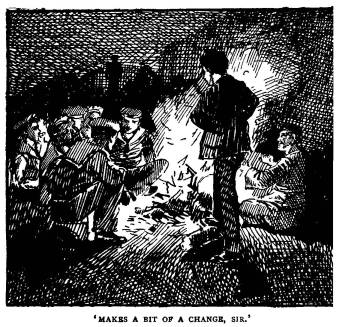
“Makes a bit of a change, Mr Herrick, sir,” said Jecks, as the men off duty lay about smoking their pipes, and watching the fire with eyes full of expectation.
“Yes; rather different to being on shipboard, Jecks,” I said.
“Ay, ’tis, sir. More room to stretch your legs, and no fear o’ hitting your head agin a beam or your elber agin a bulkhead. Puts me in mind o’ going a-gipsying a long time ago.”
“‘In the days when we went gipsying, a long time ago,’” chorussed the others musically.
“Steady there,” I said. “Silence.”
“Beg pardon, sir,” said one of the men; and Tom Jecks chuckled. “But it do, sir,” he said. “I once had a night on one o’ the Suffolk heaths with the gipsies; I was a boy then, and we had hare for supper—two hares, and they was cooked just like that, made into clay balls without skinning on ’em first.”
“But I thought they always skinned hares,” I said, “because the fur was useful.”
“So it is, sir; but there was gamekeepers in that neighbourhood, and if they’d found the gipsies with those skins, they’d have asked ’em where the hares come from, and that might have been unpleasant.”
“Poached, eh?”
“I didn’t ask no questions, sir. And when the hares was done, they rolled the red-hot clay out, gave it a tap, and it cracked from end to end, an’ come off like a shell with the skin on it, and leaving the hares all smoking hot. I never ate anything so good before in my life.”
“Yah! These here geese ’ll be a sight better, Tommy,” said one of the men. “I want to see ’em done.”
“And all I’m skeart about,” said another, “is that the Teaser ’ll come back ’fore we’ve picked the bones.”
I walked slowly away to join Mr Brooke, for the men’s words set me thinking about the gunboat, and the way in which she had sailed and left us among these people. But I felt that there must have been good cause for it, or Captain Thwaites would never have gone off so suddenly.
“Gone in chase of some of the scoundrels,” I thought; and then I began to think about Mr Reardon and Barkins and Smith. “Poor old Tanner,” I said to myself, “he wouldn’t have been so disagreeable if it had not been for old Smith. Tanner felt ashamed of it all the time. But what a game for them to be plotting to get me into difficulties, and then find that I was picked out for this expedition! I wish they were both here.”
For I felt no animosity about Smith, and as for Tanner I should have felt delighted to have him there to join our picnic dinner.
I suppose I had a bad temper, but it never lasted long, and after a quarrel at school it was all over in five minutes, and almost forgotten.
I was so deep in thought that I came suddenly upon Mr Brooke, seated near where the men were keeping their look-out. He was carefully scanning the horizon, but looked up at me as I stopped short after nearly kicking against him.
“Any sign of the Teaser sir?” I said.
“No, Herrick. I’ve been trying very hard to make her out, but there is no smoke anywhere.”
“Oh, she’ll come, sir, if we wait. What about the junks?”
“I haven’t seen a man stirring oh board either of them, and they are so quiet that I can’t quite make them out.”
“Couldn’t we steal off after dark, sir, and board one of them? If we took them quite by surprise we might do it.”
“I am going to try, Herrick,” he said quietly, “some time after dark. But that only means taking one, the other would escape in the alarm.”
“Or attack us, sir.”
“Very possibly; but we should have to chance that.” He did not say any more, but sat there scanning the far-spreading sea, dotted with the sails of fishing-boats and small junks. But he had given me plenty to think about, for I was growing learned now in the risks of the warfare we were carrying on, and I could not help wondering what effect it would have upon the men’s appetites if they were told of the perilous enterprise in which they would probably be called upon to engage that night.
My musings were interrupted by a rustling sound behind me, and, turning sharply, it was to encounter the smooth, smiling countenance of Ching, who came up looking from one to the other as if asking permission to join us.
“Well,” said Mr Brooke quietly, “is dinner ready?”
Ching shook his head, and then said sharply—
“Been thinking ’bout junks, they stop there long time.”
“Yes; what for? Are they waiting for men?”
“P’laps; but Ching think they know ’bout other big junk. Some fliends tell them in the big city. Say to them, big junk load with silk, tea, dollar. Go sail soon. You go wait for junk till she come out. Then you go ’longside, killee evelybody, and take silk, tea, dollar; give me lit’ big bit for tellee.”
“Yes, that’s very likely to be the reason they are waiting.”
“Soon know; see big junk come down liver, and pilates go after long way, then go killee evelybody. Muchee better go set fire both junk to-night.”
“We shall see,” said Mr Brooke quietly.
He rose and walked down to the two sentinels.
“Keep a sharp look-out, my lads, for any junks which come down the river, as well as for any movements on board those two at anchor. I shall send and relieve you when two men have had their dinner.”
“Thankye, sir,” was the reply; and we walked back, followed by Ching.
“That last seems a very likely plan, Herrick,” said Mr Brooke. “The scoundrels play into each other’s hands; and I daresay, if the truth was known, some of these merchants sell cargoes to traders, and then give notice to the pirates, who plunder the vessels and then sell the stuff again to the merchants at a cheap rate. But there, we must eat, my lad, and our breakfast was very late and very light. We will make a good meal, and then see what the darkness brings forth.”
We found the men carefully attending to the fire, which was now one bright glow of embers; and very soon Ching announced that dinner was cooked, proceeding directly after to hook out the hard masses of clay, which he rolled over to get rid of the powdery ash, and, after letting them cool a little, he duly cracked them, and a gush of deliciously-scented steam saluted our nostrils.
But I have so much to tell that I will not dwell upon our banquet. Let it suffice that I say every one was more than satisfied; and when the meal was over, Ching set to work again coating the rest of our game with clay, and placed them in the embers to cook.
“Velly good, velly nicee to-day,” he said; “but sun velly hot, night velly hot, big fly come to-mollow, goose not loast, begin to ’mell velly nasty.”
As darkness fell, the fire was smothered out with sand, there being plenty of heat to finish the cookery; and then, just when I least expected it, Mr Brooke gave the order for the men to go to the boat.
He counter-ordered the men directly, and turned to me.
“These are pretty contemptible things to worry about, Herrick,” he said, “but unless we are well provisioned the men cannot fight. We must wait and take that food with us.”
Ching was communicated with, and declared the birds done. This announcement was followed by rolling them out, and, after they had cooled a bit, goose and duck were borne down to the boat in their clay shells, and stowed aft, ready for use when wanted.
Ten minutes later we were gliding once more through the darkness outward in the direction of the two junks, while my heart beat high in anticipation of my having to play a part in a very rash and dangerous proceeding—at least it seemed to be so to me.
Chapter Thirty Eight.
Information.
It was too dark to make out the junks, but their direction had been well marked, and Mr Brooke took his measures very carefully.
“Perfect silence, my lads,” he said. “Perhaps the lives of all here depend upon it. Now, the sail half up; Jecks, hold the sheet; the others sit in the bottom of the boat. Every man to have his arms ready for instant use.”
There was a quick movement, a faint rattle, and then all still.
“Good; very prompt, my lads. Mr Herrick, come and take the tiller, and be ready to obey the slightest whispered command.”
I hurriedly seated myself by him in the darkness, and waited while our leader now turned to the last man to receive his orders.
“You, Ching,” he said, “will go right forward to keep a good look-out, ready to give a whispered warning of our approach to the junks. Do you know what a whispered warning means?”
“Yes; Ching say see junk so lit’ voice you can’t hear him.”
The men tittered.
“Silence! Yes, you understand. Now go, and be careful. But mind this, if our boat is seen and the pirates hail, you answer them in their own tongue; do you understand?”
“Yes; ’peakee Chinee all along.”
“That will do.”
Ching crept forward, and we were gliding along over the dark sea before a gentle breeze, which, however, hardly rippled the water.
“Keep a bright look-out for the Teaser, Jecks. We may see her lights.”
“Ay, ay, sir.”
Then on and on in a silence so deep that the gentle rattle and splash of the sea against our bows sounded singularly loud, and I almost felt drowsy at last, but started back into wakefulness on Mr Brooke touching my arm and whispering—
“I reckon that we shall be very near them in another ten minutes. I want to sail round at a little distance.”
I nodded, but doubted whether he could see me in the intense darkness, for there was not a star to be seen, the sky being covered with low down black clouds, which seemed to be hanging only a short distance above the sea. Right away behind us was a faint glow telling of the whereabouts of the Chinese city, but seaward there was no sign of the Teaser’s or any other lights, for it was like sailing away into a dense black wall, and I began to look forward more and more anxiously as I thought of the possibility of our running with a crash right on to the anchored junks.
But I was under orders, and waited for my instructions, keeping the light craft as straight on her course as I could contrive, and grasping the tiller with all my strength.
All at once there was a faint rustling, and suddenly I felt Ching’s soft hand touch my knee, and I could just make out his big round face.
“Listen,” he said.
Mr Brooke’s hand was laid on mine, and the tiller pressed sidewise slowly and gently, so that the boat glided round head to wind, and we lay motionless, listening to the dull creak and regular beat of oars a short distance to the north. Then came a faint groan or two of the oars in their locks, but that was all. We could see nothing, hear no other sound, but all the same we could tell that a large boat of some kind was being pulled in the same direction as that which we had taken.
“Men going out to the junks,” I said to myself, and my heart beat heavily, so that I could feel it go throb throb against my ribs. I knew that was what must be the case, and that the men would be savage, reckless desperadoes, who would have tried to run us down if they had known of our being there.
But they were as much in the dark as we, and I could hear them pass on, and I knew that we must have been going in the right direction for the junk. Then I had clear proof, for all at once there was a low, wailing, querulous cry, which sent a chill through me, it sounded so wild and strange.
“Only a sea-bird—some kind of gull,” I said to myself; and then I knew that it was a hail, for a short way to the southwards a little dull star of light suddenly shone out behind us, for the boat had of course been turned.
There was the answer to the signal, and there of course lay the junk, which in another five minutes we should have reached.
Mr Brooke pressed my arm, and we all sat listening to the beating of the oars, slow and regular as if the rowers had been a crew of our well-trained Jacks. Then the beat ceased, there was a faint rattling noise, which I know must have been caused by a rope, then a dull grinding sound as of a boat rubbing against the side of a vessel, and lastly a few indescribable sounds which might have been caused by men climbing up into the junk, but of that I could not be sure.
Once more silence, and I wondered what next.
Mr Brooke’s hand upon mine answered my wonderings. He pressed it and the tiller together, the boat’s sail filled gently once more, and we resumed our course, but the direction of the boat was changed more to the north-eastward. We were easing off to port so as to get well to the left of the junks, and for some distance we ran like this; then the hand touched mine again, and the rudder was pressed till we were gliding southward again, but we had not gone far when Ching uttered a low warning, and I just had time to shift the helm and send the boat gliding round astern of a large junk, which loomed up above us like ebony, as we were going dead for it, and if we had struck, our fragile bamboo boat would have gone to pieces like so much touchwood, leaving us struggling in the water.
“I don’t see what good this reconnoitring is doing,” I said to myself, as I sat there in the darkness wondering what was to happen next; but sailors on duty are only parts of a machine, and I waited like the rest to be touched or spoken to, and then acted as I was instructed. For from time to time Mr Brooke’s hand rested upon mine, and its touch, with its pressure or draw, told me at once the direction in which he wished me to steer; and so it was that, in that intense darkness, we sailed silently round those junks, going nearer and nearer till I knew exactly how they lay and how close together. But all the while I was in a violent perspiration, expecting moment by moment to hear a challenge, or to see the flash of a match, the blaze up of one of the stink-pots the junks would be sure to have on their decks, and then watch it form a curve of hissing light as it was thrown into our boat.
But not a sound came from the junks we so closely approached, and at last, with a sensation of intense relief, I felt Mr Brooke’s hand rest on mine for some time, keeping the rudder in position for running some distance away with the wind, before the boat was thrown up again full in its eye, and we came to a stand, with the mat-sail swinging idly from side to side.
Hardly had we taken this position, when once more from the direction of the river came the low beat of oars. As we listened, they came on and on, passed us, and the sounds ceased as before just where the junks were lying.
This time there was no signal and no answering light, the occupants of the boat finding their way almost by instinct, but there was a hail from the junk to our left, and we could distinguish the murmuring of voices for a time, and the creaking of the boat against the side as the fresh comers climbed on board.
“Ah, good information, Mr Herrick!” whispered Mr Brooke. “We have seen nothing, but we know that they have received reinforcements, and now in a very short time we shall know whether they are going to sail or wait till morning.”
“How?” I said.
He laughed gently.
“Easily enough. They will not sail without getting up their anchors, and we must hear the noise they make.”
“But I don’t quite see what good we are doing,” I whispered.
“Not see? Suppose we had stopped ashore, we should not have known of these men coming to strengthen the crews, and we should not have known till daylight whether they had sailed or were still at anchor. This last we shall know very soon, and can follow them slowly. Why, if we had waited till morning and found them gone, which way should we have sailed?”
“I’m very dense and stupid, sir,” I said. “I had not thought of that.”
“Allee go to s’eep,” whispered Ching; “no go ’way to-night.”
“What’s that mean?” said Mr Brooke in a low voice; and I felt his arm across my chest as he pointed away to the left.
I looked in that direction, and saw a bright gleam of light from the shore.
“Our fire blazing up, sir,” said Tom Jecks softly.
“Yes, I suppose so,” said Mr Brooke thoughtfully; and as we watched the bright light disappeared, but only to appear again, and this was repeated three times.
“That can’t be our fire,” said Mr Brooke.
“Fliends on shore tellee pilate what to do,” said Ching, with his face close to us.
“What do you mean?” said Mr Brooke.
“Ching know. Show big lamp. Mean big junk going sail mollow morning, and pilate go long way wait for them.”
“Why? Couldn’t they stay here and wait?”
“No; silk-tea-ship see pilate junk waiting for them, and come out lit’ way and go back again. ’Flaid to sail away.”
“Yes, that sounds reasonable,” said Mr Brooke thoughtfully.
Then all at once there came over the black water a peculiar squeaking, grinding sound, followed by a similar noise of a different pitch.
“Pilate not going to s’eep; allee look out for light and go sail away d’leckly.”
“Yes, we have not wasted our time, Herrick,” whispered Mr Brooke. “They’re getting up their anchors.”
“And are we going to follow them, sir?” I said softly.
“Yes, my lad; our work has only just begun.”
Chapter Thirty Nine.
Tricked.
They were singularly quiet, these people on board the junks, I suppose from old experience teaching them that noise made might mean at one time discovery and death, at another the alarming of some valuable intended prize.
This quietness was remarkable, for as we listened there was the creaking and straining of the rough capstan used, but no shouted orders, no singing in chorus by the men tugging at the bars; all was grim silence and darkness, while we lay-to there, waiting and listening to the various faint sounds, till we heard the rattling of the reed-sails as they were hauled up. Then we knew that the junks were off, for there came to us that peculiar flapping, rattling sound made by the waves against a vessel’s planks, and this was particularly loud in the case of a roughly-built Chinese junk.
“Are you going to follow them at once?” I said in a whisper.
“Yes, till within an hour of daylight,” was the reply. “Now, be silent.”
I knew why Mr Brooke required all his attention to be directed to the task he had on hand—very little reflection was necessary. For it was a difficult task in that black darkness to follow the course of those two junks by sound, and keep doggedly at their heels, so as to make sure they did not escape. And then once more the slow, careful steering was kept up, Mr Brooke’s hand guiding mine from time to time, while now for the most part we steered to follow the distant whishing sound made by the wind in the junk’s great matting-sails.
All at once, when a strange, drowsy feeling was creeping over me, I was startled back into wakefulness by Mr Brooke, who said in an angry whisper—
“Who’s that?”
I knew why he spoke, for, though half-asleep the moment before, I was conscious of a low, guttural snore.
“Can’t see, sir,” came from one of the men. “Think it’s Mr Ching.”
“No; Ching never makee nose talk when he s’eep,” said the Chinaman, and as he spoke the sound rose once more.
“Here, hi, messmate, rouse up!” said the man who had before spoken.
“Eh? tumble-up? our watch?” growled Tom Jecks. “How many bells is—”
“Sit up, Jecks,” whispered Mr Brooke angrily. “Next man take the sheet.”
There was the rustling sound of men changing their places, and I heard the coxswain whispering to the others forward.
“No talking,” said Mr Brooke; and we glided on again in silence, but not many yards before a light gleamed out in front.
“Quick, down at the bottom, all of you! Ching, take the tiller!”
We all crouched down; Ching sat up, holding the tiller, and the light ahead gleamed out brightly, showing the sails and hulls of the two great junks only fifty yards away, and each towing a big heavy boat. There were the black silhouettes, too, of figures leaning over the stern, and a voice hailed us in Chinese, uttering hoarse, strange sounds, to which Ching replied in his high squeak.
Then the man gave some gruff order, and Ching replied again. The light died out, and there was silence once more.
“What did he say?” whispered Mr Brooke.
“Say what fo’ sail about all in dark?”
“Yes, and you?”
“Tell him hollid big gleat lie! Say, go catchee fish when it glow light.”
“Yes.”
“And pilate say be off, or he come in boat and cuttee off my head.”
Mr Brooke hesitated for a few moments, and then reached up, took the tiller, and we lay-to again for quite an hour.
“Only make them suspicious if we are seen following, Herrick. Let them get well away; I daresay we can pick them up again at daybreak.”
But all the same he manipulated the boat so as not to be too far away, and arranged matters so well that when at last the dawn began to show in the east, there lay the two junks about six miles away, and nothing but the heavy sails visible from where we stood.
We all had an anxious look round for the Teaser, but there were no tell-tale wreaths of smoke showing that our vessel was on her way back, and there seemed to be nothing for us to do but slowly follow on along shore, at such a distance from the junks as would not draw attention to the fact of their being followed, till we could catch sight of our own ship and warn our people of the vessels; or, failing that, lie in on the way to warn the junk which Ching believed would sail from the river before long.
Mr Brooke reckoned upon our being provisioned for two days, and as soon as it was light he divided the little crew into two watches, one of which, self included, was ordered to lie down at once and have a long sleep.
I did not want to lie down then, for the drowsy sensations had all passed away; but of course I obeyed, and, to my surprise, I seemed to find that after closing my eyes for two minutes it was evening; and, upon looking round, there lay the land upon our right, while the two junks were about five miles away, and the boat turned from them.
“Have you given up the chase, Mr Brooke?” I said.
“Yes, for the present; look yonder.”
He pointed towards the north-west, and there, some three miles distant, and sailing towards us, was another junk coming down with the wind.
“Another pirate?” I cried.
“No, my lad; evidently the junk of which Ching told us.”
“And you are going to warn her of the danger, sir?”
“Exactly; we can’t attack, so we must scheme another way of saving the sheep from the wolves.”
As we sailed on we could see that the fresh junk was a fine-looking vessel, apparently heavily laden; and, after partaking of my share of the provisions, which Ching eagerly brought for me out of the little cabin, I sat watching her coming along, with the ruddy orange rays of the setting sun lighting up her sides and rigging, and brightening the showy paint and gilding with which she was decorated, so that they had quite a metallic sheen.
“Take a look back now,” said Mr Brooke. “What do you make of the pirate junks?”
“They seem to be lying-to, sir,” I said.
“Then they have seen their plunder, and the sooner we give warning the better. She must turn and run back at once, or they will be after and capture her before she can reach port again.”
Just then I saw him stand up and give a sharp look round, his face wearing rather an anxious expression.
“You can’t see the Teaser, sir?” I said.
“No, my lad; I was looking at the weather. I fear it is going to blow a hurricane. The sky looks rather wild.”
I had been thinking that it looked very beautiful, but I did not say so. Certainly, though, the wind had risen a little, and I noticed that Tom Jecks kept on glowering about him in a very keen way.
Just then Mr Brooke shook out the little Union Jack which we had brought from our sinking boat, and held it ready to signal the coming junk, which was now only about a mile away, and came swiftly along, till our leader stood right forward, holding on by a stay, and waved the little flag.
“Three cheers for the red, white, and blue!” muttered Tom Jecks. “Look at that now. We in this here little cock-boat just shows our colours, and that theer great bamboo mountain of a thing goes down on her marrow-bones to us, metty-phizickly. See that, Mr Herrick, sir?”
“Yes, Tom,” I said excitedly; “and it’s something to be proud of too.”
For, in obedience to our signals, I saw one of the many Chinamen on board wave his hands as he seemed to be shouting, and the great vessel slowly and cumbrously rounded to, so that in a few minutes we were able to run close alongside.
“Tell them to heave us a rope, Ching,” said Mr Brooke, and the interpreter shouted through his hands, with the result that a heavy coil came crashing down, and was caught by Tom Jecks, who was nearly knocked overboard.
“We said a rope, not a hawser,” growled the man, hauling in the rope. “Better shy a few anchors down too, you bladder-headed lubbers!”
“Now, say I want to speak to the captain,” said Mr Brooke.
A showily-dressed Chinaman leaned over the side of the huge tower of a poop, and smiled down on us.
“Are you the captain?” cried Mr Brooke, and Ching interpreted.
“Say he the captain,” said Ching; “and you please walkee up top sidee big junk.”
“Yes, it will be better,” cried Mr Brooke. “Come with me, Herrick. You too, Ching, of course. There, keep her off a bit, Jecks, or you’ll have the boat swamped.”
He seized the right moment, and began to climb up the junk’s side. I followed, and Ching was close at my heels, the clumsy vessel giving plenty of foothold; and we soon stood upon the deck, where some dozen or so Chinese sailors pointed aft to where the captain stood, bowing and smiling.
We had a rough set of bamboo steps to mount to the clumsy poop-deck, and there found the captain and half-a-dozen more of his men waiting.
“Now, Ching, forward,” I said. But he hung back and looked strange.
“Don’t be so jolly modest,” I whispered; “we can’t get on without you to interpret.”
At that moment there came a loud hail from our boat, invisible to us from where we stood, and there was a tremendous splash.
“What’s the matter?” cried Mr Brooke, making for the side; but in an instant the attitude of the Chinaman changed. One moment the captain was smiling at us smoothly; the next there was an ugly, look in his eyes, as he shouted something to his men, and, thrusting one hand into his long blue coat, he made a quick movement to stop Mr Brooke from going to the side.
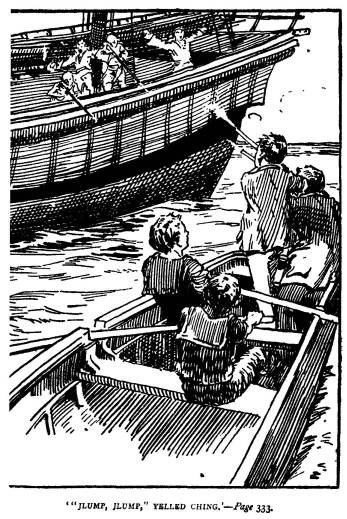
The various incidents took place so quickly that they almost seemed to be simultaneous. One moment all was peace; the next it was all war, and the warnings I heard came together.
“Pilate! pilate!” shouted Ching.
“Look out for yourself, my lad! Over with you!” roared Mr Brooke, as I saw him dash at the Chinese captain, and, with his left fist extended, leap at the scoundrel, sending him rolling over on the deck.
“Now!” cried Mr Brooke again, “jump!”
“Jlump! jlump!” yelled Ching; and with a bound I was on the great carven gangway, just avoiding three men who made a rush for me, and the next moment I had leaped right away from the tower-like stern of the huge junk, and appeared to be going down and down for long enough through the glowing air before striking the water with a heavy splash, and continuing my descent right into the darkness, from which it seemed to me that I should never be able to rise again.
At last my head popped out of the dark thundering water, and, blinking my eyes as I struck out, I was saluted with a savage yelling; the water splashed about me, and I heard shots; but for a few moments, as I looked excitedly round, I did not realise that I was being pelted with pieces of chain, and fired at as a mark for bullets.
But in those brief moments I saw what I wanted: Mr Brook and Ching safe and swimming towards me, and the boat not many yards behind them, with two of our men at the oars, and the others opening fire upon the people who crowded the side of the junk, and yelled at us and uttered the most savage throats.
“This way, Herrick, my lad,” panted Mr Brooke, as he reached me. “Ah! did that hit you?”
“No, sir, only splashed up the water; I’m all right!” I cried; “the bullet didn’t touch.”
“Swim boat! swim boat!” cried Ching excitedly.
But our danger was not from the water but the sharp fire which the Chinese kept up now, fortunately without killing any of us. Then the boat glided between us and the junk, ready hands were outstretched from the side, and I was hauled in by Tom Jecks, who then reached over and grasped Ching by the pigtail.
“No, no touchee tow-chang!” roared the poor fellow.
“All right; then both hands and in with you.”
“Lay hold of the sheet, Jecks!” cried Mr Brooke, who sprang over the thwart to the tiller, rammed it down, and the sail began to fill, but only slowly, for the towering junk acted as a lee, and all the time the men yelled, pelted, and fired at us.
“Look out, my lads; give it to them now. Make fast the sheet, Jecks, and get your rifle. Ten pounds to the man who brings down the captain!” roared Mr Brooke. “Here, Herrick, my gun!” he cried; and, handing it to him, I seized mine, thrust in two wet cartridges with my wet fingers, and, doubting whether they would go off, I took aim at a man on the poop, who was holding a pot to which another was applying a light.
The next minute the pot was in a blaze, and the man raised it above his head to hurl it right upon us, but it dropped straight down into the sea close to the junk, and the man staggered away with his hands to his face, into which he must have received a good deal of the charge of duck-shot with which my piece was charged.
Excited by my success, I fired the second barrel at a man who was leaning over the bulwarks, taking aim at us with his great clumsy matchlock, and his shot did not hit any one, for the man dropped his piece overboard and shrank away.
As I charged again, I could hear and see that our lads were firing away as rapidly as they could up at the crowded bulwarks, while Tom Jecks was making his piece bear upon the deck of the high poop whenever he could get a shot at the captain; and now, too, Mr Brooke was firing off his small-shot cartridges as rapidly as possible, the salt water not having penetrated the well-wadded powder enclosed in the brass cases.
By this time we were fifty yards away from the junk, and gliding more rapidly through the water, which was splashed up about us and the boat hit again and again with a sharp rap by the slugs from the Chinamen’s matchlocks.
The men were returning the fire with good effect as we more than once saw, and twice over one of the wretches who sought to hurl a blazing pot of fire was brought down.
“They can’t hurt us now,” I thought, as I ceased firing, knowing that my small-shot would be useless at the distance we now were, when I saw a spark of light moving on the poop, and then sat paralysed by horror as I grasped what was going to take place. It was only a moment or two before there was a great flash and a roar, with a puff of sunset-reddened smoke, hiding the poop of the junk; for they had depressed a big swivel gun to make it bear upon us, and then fired, sending quite a storm of shot, stones, and broken pieces of iron crashing through the roof of our little cabin, and tearing a great hole in our sail.
“That’s done it!” shouted Tom Jecks, giving the stock of his rifle a heavy slap.
“You’ve hit him?” cried Mr Brooke.
“Yes, sir; I caught him as he stood by watching the cannon fired.”
“Yes, that’s right,” cried Mr Brooke, shading his eyes and gazing hard at the scene on the high poop, where, in the last rays of the setting sun, we could see men holding up their captain, who was distinctive from his gay attire and lacquered hat, which now hung forward as the scoundrel’s head drooped upon his breast.
“Cease firing!” said Mr Brooke, for we were a hundred yards away now, and rapidly increasing the distance. “We can do no more good. Thank you, Jecks. Now then, who is hurt?”
There was no reply.
“What, no one?” cried Mr Brooke.
“Yes, sir: why don’t you speak out, Tom Jecks? You got it, didn’t you?”
“Well, so did you; but I arn’t going to growl.”
“More arn’t I, messmate. It’s nothing much, sir.”
“Let me see,” said Mr Brooke, as we sailed steadily away, while the junk still remained stationary; and, after a rapid examination, he plugged and bound a wound in the man’s shoulder, and performed a similar operation upon Tom Jeck’s hind-leg, as he called it, a bullet or slug having gone right through the calf.
I could not help admiring the calm stolidity with which the two men bore what must have been a painful operation, for neither flinched, but sat in turn gazing at his messmate, as much as to say, “That’s the way to take it, my lad; look at me.”
This done, Mr Brooke turned his attention to the wound received by the boat, where the charge from the swivel gun had gone crashing through the top of the cabin and out at the side. It was a gaping wound in the slight planking of the boat, but the shot had torn their way out some distance above the water-line, so that unless very rough weather came on there was no danger, and we had other and more serious business now to take up our attention.
For Ching pointed out to us a certain amount of bustle on board the junk, which was explained by a puff of smoke and a roar, as simultaneously the water was ploughed up close to our stern.
“Not clever at their gun drill,” said Mr Brooke coolly, as he took the helm himself now, and sent the boat dancing along over the waves, so as to keep her endwise to the junk, and present a smaller object for the pirate’s aim.
“That’s bad management under some circumstances, Herrick,” he said, smiling. “It’s giving an enemy the chance of raking us from stern to stem, but I don’t believe they can hit us.—I thought not.”
He said this smiling, as the water was churned up again by another shot, but several yards away upon our right.
Another shot and another followed without result, and by this time we were getting well out of range of the swivel gun, a poor, roughly-made piece, and our distance was being rapidly increased.
“Going away!” said Ching, as we saw the great mat-sails of the junk fill.
“Or to come in chase—which?” said Mr Brooke quietly. “It does not matter,” he added; “we shall soon have darkness again, and I think we shall be too nimble for them then.”
“Beg pardon, sir,” said Tom Jecks.
“Yes, what is it? Your wound painful?”
“Tidy, sir; but that warn’t it. I was only going to say, look yonder.”
He pointed right away east, and, as we followed his finger with our eyes, they lit upon a sight which would have even made me, inexperienced as I was, think it was time to seek the shelter of some port. And that something unusual was going to happen, I knew directly from Mr Brooke’s way of standing up to shelter his eyes, and then, after gazing for some time in one direction, he turned in that of the great Chinese port we had so lately left.
Chapter Forty.
Another Enemy.
For as I looked towards the horizon away to the east, a curious lurid glow spread upward half-way to the zenith, and for the moment I thought that in a short time we should see the full-moon come slowly up out of the sea. But a few moments’ reflection told me that we were long past the full-moon time, and that it would be the last quarter late on in the night. The sea, too, began to wear a singular aspect, and great frothy clouds were gathering rapidly in the south. And even as I looked there was a peculiar moaning sigh, as if a great wind were passing over us at a great height, though the sea was only just pleasantly rippled, and a gentle breeze was sweeping us rapidly along and away from the great junk, which now seemed hazy and distant, while those we had watched so long were quite out of sight.
“Feel cold?” said Mr Brooke quietly. “I ought to have told you to take off and wring out your clothes.”
“Cold, sir!” I said wonderingly. “I hadn’t thought about it; I was so excited.”
“Yes; we had a narrow escape, my lad. It is a lesson in being careful with these cunning, treacherous wretches. You made sure it was a trader, Ching?”
“Ching neve’ quite su’e—only think so,” was the reply, accompanied by a peculiar questioning look, and followed by a glance over his right shoulder at the sky.
“No, I suppose not. I ought to have been more careful. They threw something down at the boat as soon as we had mounted: did they not, Jecks?”
“Yes, sir; I see it coming. Great pieces of ballast iron, as it took two on ’em to heave up over the bulwarks. I just had time to give the boat a shove with the hitcher when down it come. Gone through the bottom like paper, if I hadn’t. But beg pardon, sir, arn’t we going to have a storm?”
“Yes,” said Mr Brooke quietly; “I am running for the river, if I can make it. If not, for that creek we were in last night. Take the tiller, Mr Herrick,” he said, and he went forward.
“Going blow wind velly high. Gleat wave and knock houses down,” said Ching uneasily.
“Yes, my lad; we’re going to have what the Jay-pans calls a tycoon.”
“No, no, Tom Jecks,” I said, smiling.
“You may laugh, sir, but that’s so. I’ve sailed in these here waters afore and been in one. Had to race afore it with bare poles and holding on to the belaying-pins. Tycoons they call ’em, don’t they, Mr Ching?”
“Gleat blow storm,” said Ching, nodding. “Hullicane.”
“There you are, sir,” said Jecks. “Hurricanes or tycoons.”
“Typhoons,” I said.
“Yes, sir, that’s it, on’y you pernounces it different to me. Don’t make no difference in the strength on ’em,” he continued testily, for his wound was evidently painful, “whether you spells it with a kay or a phoo. Why, I seed big vessels arterwards, as had been blowed a quarter of a mile inland, where they could never be got off again.”
“Yes, I’ve heard of that sort of thing,” I said. “They ride in on a great wave and are left behind.”
“Lookye here, sir,” whispered the coxswain, who seemed to ignore his wound; “I don’t want to show no white feathers, nor to holler afore I’m hurt, but if I was you, I should ask Mr Brooke to run straight for the nearest shore—say one o’ them islands there, afore the storm comes; you arn’t got no idea what one o’ them tycoons is like. As for this boat, why, she’ll be like a bit o’ straw in a gale, and I don’t want to go to the bottom until I’ve seed you made a skipper; and besides, we’ve got lots more waspses’ nests to take, beside polishing off those three junks—that is, if they’re left to polish when the storm’s done.”
“Stand up, Mr Herrick,” cried the lieutenant. “Look yonder, due north. What do you see?”
I held the tiller between my knees as I stood up and gazed in the required direction, but could see nothing for a few minutes in the dusk.
“Can’t you see?”
“Yes, sir, now. Small round black cloud.”
“Yes, of smoke.”
“Ay, ay, sir, I see it,” said one of the sailors. “Hooray! it’s the Teaser with the wind blowing hard astern and carrying the smoke of her funnel right over her and ahead.”
“The Teaser or some other steamer; and she’s running fast for harbour. Let’s see: those are the Black Gull Islands to port there. Were you with us when the cutter’s crew landed, Jecks?”
“Yes, sir; I rowed stroke-oar, sir.”
“To be sure. The second one from the north had the highest ground.”
“Yes, sir; but you couldn’t land for the surf and the shark-fin rocks, if you remember.”
“Exactly; and we rowed along the south channel till we found a sheltered sand-cove, where we beached the cutter, and then explored the island. We must make for that channel, and try to reach it before the storm comes down. We could not get half-way to the river, and, thank heaven, the Teaset will soon be in safety.”
“No, sir, you couldn’t make no river to-night.”
“It will be dark too soon.”
“Not to-night, sir,” said Jecks sturdily.
“Yes, man; there will be no moon.”
“No, sir; but in less nor an hour’s time the sea ’ll be white as milk, and all of a greeny glow, same as it is some still nights in port. There won’t be no difficulty, sir, about seeing.”
“But you think it will be hard to make the channel?”
“I hope not, sir, but I’m afraid so; we can only try.”
“Yes, we can only try,” said Mr Brooke slowly, as he came and sat beside me. “And we must try, Herrick—our best. For this is no night to be out in almost an open boat.”
“Then you think there is danger, sir?” I said anxiously.
“No, Herrick,” he replied, smiling; “sailors have no time to think of danger. They have enough to think about without that. We must get in the lee of that island to-night, and it the storm holds back, and the little boat spins along like this, we ought to do it.”
“And if it doesn’t, sir?”
“If it doesn’t? Ah, well, we shall see. Stand by, two of you, ready to lower that sail at a moment’s notice.”
“Ay, ay, sir,” was the ready reply as two of the men changed their places; and just then I looked at Ching, to see that his face was lit up by the reflection of the strange light on our right and behind, which grew more striking, while away before us the land disappeared, and we were gazing at a bank of clouds of an inky black.
The effect was very curious: behind us the dull coppery glow becoming fainter minute by minute, as the darkness increased the blackness before us; and one’s instinct seemed to warn one to turn from the black darkness to sail away towards the light. Tom Jecks took the same idea, and said, in an irritable whisper, exactly what I thought—
“Seems rum, sir, don’t it, sir?—makes believe as that’s the best way, when all the time the wussest looking is the safest.”
Just then, after a glance round, Mr Brooke uttered another warning to the men to be ready, and settled himself down to the tiller.
“Sit fast, all of you; the hurricane may be down upon us at any moment now.”
I looked at him wonderingly, for it was painfully still, though the darkness was growing intense, and the great junk seemed to have been swallowed up by the clouds that hung low like a fog over the sea.
“There will be such a turmoil of the elements directly,” continued Mr Brooke in a low voice, but only to me, “that I don’t suppose a word will be heard.” Then aloud, “Look here, my lads; I shall try and run the boat high upon the sands at the top of some breaker. Then it will be every man for himself. Never mind the boat—that is sure to be destroyed—but each man try to save his arms and ammunition; and if the two wounded men are in difficulties, of course you will lend a hand. Now then, one more order: The moment I say, ‘Down with the sail,’ drag it from the mast, and two oars are to be out on either side. The wind will catch them and send us along, and I want them to give a few dips to get on the top of a roller to carry us in.”
“Ay, ay, sir.”
“That’s all.”
His words in that terrible stillness sounded to me as almost absurd, for the sea was still calm, and save that sighing in the air of which I have before spoken, there was no further sound; and at last I said to him—
“Do you really think we shall have a hurricane?”
“Look at the sky, my lad,” he replied; “and take this as a lesson to one who will have men’s lives depending upon his knowledge and skill some day. If ever there were signs of an awful night in the Chinese seas, it is now. Hark at that!”
“Guns! The Teaser!” I exclaimed excitedly.
“Heaven’s artillery that, my lad,” he said solemnly. Then in a whisper, “Shake hands! I’ll help you all I can, Herrick, but heaven knows how we shall be situated soon.”
I felt a strange sensation of awe creep over me, as he gripped my hand warmly, and then snatched his away, and sat up firm and rigid, turning his head to the east as all now became suddenly black—so dark that I could hardly see the men before me and the sail. But still we glided rapidly on over the long smooth rollers, on and on toward the islands, which lay a short distance from the mainland.
“It will be all guess work,” whispered Mr Brooke. “I am keeping her head as near as I can guess for the channel, but the breakers will soon be our only guide.”
Then came the heavy roar again, which I had taken for guns, but it did not cease as before, when it sounded like a sudden explosion. It was now continuous, and rapidly increasing.
“Thunder?” I asked in a low voice.
“Wind. Tremendous. It will be on us in five minutes.”
But even then it seemed impossible, for we were still sailing swiftly and gently along towards the channel between the islands, and the roar like distant thunder or heavy guns had once more ceased.
“We shall get to the shore first after all,” I whispered.
“No.”
At that moment there was a sensation as of a hot puff of air behind us. It literally struck my head just as if a great furnace door had been opened, and the glow had shot out on to our necks.
“Here she comes,” growled Tom Jecks; “and good luck to us.”
And then, as if to carry out the idea of the opened furnace, it suddenly grew lighter—a strange, weird, wan kind of light—and on either side, and running away from us on to the land, the sea was in a wild froth as if suddenly turned to an ocean of milk.
“Down with the sail!” shouted Mr Brooke, who had held on to the last moment, so as to keep the boat as long as possible under his governance; and quickly as disciplined men could obey the sail was lowered, and as far as I could see they were in the act of stowing it along the side, when it filled out with a loud report, and was snatched from their hands and gone.
“Any one hurt?”
“No, sir,” in chorus.
“Oars.”
I heard the rattle of the two pairs being thrust out. Next Mr Brooke’s words, yelled out by my ear—“sit fast!” and then there was a heavy blow, heavy but soft and pressing, followed by the stinging on my neck as of hundreds of tiny whips, and then we were rushing along over the white sea, in the midst of a mass—I can call it nothing else—of spray, deafened, stunned, feeling as if each moment I should be torn out of my seat, and as if the boat itself were being swept along like lightning over the sea, riding, not on heavy water, but on the spray.
Then all was one wild, confusing shriek and roar. I was deafened; something seemed to clutch me by the throat and try to strangle me; huge soft hands grasped me by the body, and tugged and dragged at me, to tear me from my hold; and then, two arms that were not imaginary, but solid and real, went round me, and grasped the thwart on which I sat, holding me down, while I felt a head resting on my lap.
I could see nothing but a strange, dull, whitish light when I managed to hold my eyelids up for a moment, but nothing else was visible; and above all—the deafening roar, the fearful buffeting and tearing at me—there was one thing which mastered, and that was the sensation of being stunned and utterly confused. I was, as it were, a helpless nothing, beaten and driven by the wind and spray, onward, onward, like a scrap of chaff. Somebody was clinging to me, partly to save himself, partly to keep me from being dragged out of the boat; but whether Mr Brooke was still near me, whether the men were before me, or whether there was any more boat at all than that upon which I was seated, I did not know. All I knew was that I was there, and that I was safe, in spite of all the attempts made by the typhoon to drag me out and sweep me away like a leaf over the milky sea.
It cannot be described. Every sense was numbed. And if any lad who reads this were to take the most terrible storm he ever witnessed, square it, and then cube it, I do not believe that he would approach the elemental disturbance through which we were being hurled.
There was a rocky shore in front of us, and another rocky island shore to our left; and between these two shores lay the channel for which we had tried to make. But Mr Brooke’s rule over the boat was at an end the moment the storm was upon us, and, as far as I could ever learn afterwards, no one thought of rocks, channel, saving his life, or being drowned. The storm struck us, and with its furious rush went all power of planning or thinking. Every nerve of the body was devoted to the tasks of holding on and getting breath.
How long it lasted—that wild rush, riding on the spray, held as it were by the wind—I don’t know. I tell you I could not think. It went on and on as things do in a horrible dream, till all at once something happened. I did not hear it, nor see it, hardly even felt it. I only know that something happened, and I was being strangled—choked, but in another way. The hands which grasped my throat to keep me from breathing had, I believe, ceased to hold, and something hot and terrible was rushing up my nostrils and down my throat, and I think I then made some effort with my hands. Then I was being dragged along through water and over something soft, and all at once, though the deafening, confusing noise went on, I was not being swept away, but lying still on something hard.
I think that my senses left me entirely then for a few moments—not more, for I was staring soon after at the dull light of white water sweeping along a little way off, and breathing more freely as I struggled hard to grasp what it all meant, for I did not know. I saw something dim pass me, and then come close and touch me, as if it sank down by my side; and that happened again and again.
But it was all very dream-like and strange: the awful, overwhelming, crushing sound of the wind seemed to press upon my brain so that I could not for a long time think, only lie and try to breathe without catching each inspiration in a jerky, spasmodic way.
I suppose hours must have passed, during which I stared through the darkness at the dull whitish phosphorescent glow which appeared through the gloom, and died out, and appeared and died out again and again, passing like clouds faintly illumined in a ghastly way, and all mingled with the confusion caused by that awful roar. Then at last I began to feel that the rush of wind and water was passing over me, and that I was in some kind of shelter; and when I had once hit upon this, I had as it were grasped a clue. I knew that I was lying on stones, and saw that rising above me was a mass of rock, which I knew by the touch, and this stone was sheltering me from the wind and spray.
“We must have reached the shore safely, then,” I said to myself, for my head was getting clearer; “and—yes—no—I was not hurt. We were all saved, then.”
At that point a terrible feeling of dread came over me. I was safe, but my companions?
The shock of this thought threw me back for a bit, but I was soon struggling with the confusion again, and I recalled the fact that I had felt some one touch me as he sank down by my side.
Arrived at this point, I turned a little to look, but all was perfectly black. I stretched out my hand and felt about.
I snatched it back with a cry of horror. Yes, a cry of horror; for, though I could not hear it, I felt it escape from my lips. I had touched something all wet and cold lying close beside me, and I felt that it was one of my companions who had been cast up or dragged ashore—dead.
Shivering violently, I shrank away, and stretched out my hand in the other direction—my left hand now, with my arm numbed, and my shoulder aching when I moved it, as if the joint had become stiffened and would not work.
I touched somebody there—something cold and smooth and wet, and drew my hand away again, when, as it glided over the sand, it touched something else round and soft and long, and—yes—plaited. It was a long tail.
“Ching!” I ejaculated; and, gaining courage, I felt again in the darkness, to find that it grew thinner. I tried again in the other direction, and once more touched the round wet object, which did not seem so cold, and then the next moment a hand caught mine and held it.
I was right; it was Ching. I knew him by his long nails.
Not alone! I had a companion in the darkness, one who was nearly as much stunned as I, for he moved no more, but lay holding on by my left hand, and for a time I was content to listen to the savage roar of the wind. But at last, as my brain worked and I mastered the sensation of horror, I began to feel about again with my right hand, till I touched the same cold, wet object I had encountered before.
It was an arm, quite bare and cold; while now I could not withdraw my hand, but lay trembling and shuddering, till I felt that perhaps I was not right—that any one lying dead would not feel like that; and my hand glided down to the wrist.
I knew nothing about feeling pulses only from having seen a doctor do so, but by chance my fingers fell naturally in the right place in the hollow just above the wrist joint, and a thrill of exultation ran through me, for I could distinctly feel a tremulous beating, and I knew that my imagination had played me false—that the man was not dead.
Chapter Forty One.
After the Typhoon.
The repugnance and horror gave way to a sensation of joy. Here was another companion in misfortune, alive and ready to share the terrible trouble with us, but who was it?
I tried to withdraw my left hand from Ching’s grasp; but as soon as he felt it going, he clung to it spasmodically, and it was only by a sharp effort that I dragged it away, and turned to the side of my other companion, and began to touch him. There was the bare arm, but that was no guide; the face helped me no more; but the torn remnants of his clothes told me it was not Mr Brooke, and my heart sank. I felt again, and my hand encountered a drawn-up leg, and then I touched a bandage. It was Tom Jecks, who had been wounded by the fire from the junk.
I could learn no more. I tried to speak; I shouted; but he made no sign, and I could not even hear my own cries. The darkness remained profound, and the deafening roar of the wind kept on without cessation.
But, feeling more myself at last, I determined to crawl about a little, and find out whether any more of our crew were near us. Then I hesitated; but, summoning courage, I crept on my hands and knees, passed Ching, and then crouched down nearly flat, for I had crept to where the shelter ceased, and to have gone on would have been to be swept away.
To test this I raised one hand, and in an instant I suffered quite a jerk, and each time I repeated the experiment I felt more and more that to leave the shelter meant to die, for the power of the blast was appalling.
Crawling back, I proceeded in the other direction, and found that I could go what I guessed to be quite a dozen yards, feeling more and more in shelter. Then all at once I reached a point where the wind came through what afterwards proved to be a narrow pass between two masses of rock, and I shrank back disheartened at the barrenness of my search.
In that black darkness it was very difficult to find my former position, even in so confined a space, and I found myself completely going wrong, and into the rushing wind, the effect being horribly confusing again. But, after lying flat down on the sand, which kept flying up and nearly blinding me, I grew more composed, and, resuming my search once more, found where my two companions lay; and, after touching our wounded sailor, and finding him lying as I had left him, I began to think of what I could do to help him, but thought in vain. To give help was impossible in the midst of that awful storm, and, utterly exhausted now, I sank back and reached out my left hand once more to try and touch Ching.
He was on the alert, and caught my hand in both his, grasping it firmly, as if, boy as I was, he would gladly cling to me for protection; while I, in my horror and loneliness, was only too thankful to feel the touch of a human hand.
Then, amid the strange confusion produced by the roar of the wind and thunder of the waves whose spray hissed over our heads, I lay wondering what had become of Mr Brooke and the others—whether they had reached the land, and were screened behind the rocks as we were; then about the Teaser—whether she had been able to make the shelter of the river before the typhoon came down upon them in all its fury.
I seemed to see the men at their quarters, with the spars lowered upon deck, the boats doubly secured, and everything loose made fast. I fancied I felt the throb of the engines, and the whirr of the shaft, as it raced when the stern rose at some dive down of the prow; and the sharp “ting-ting” of the engine-room gong-bell struck on my ears above the yelling of the storm, for wild shrieks at times came mingled with the one tremendous overpowering roar.
Then I began thinking again about Mr Brooke, and whether, instead of lying there in shelter on the sand, I ought not to be striving with all my might to find him; and all at once the roar over my head, the thunder of the breakers somewhere near, and the hiss and splash of the cutting spray, seemed to cease, and I was crawling about the shore, over sand and rocks, and through pools of water, to find Mr Brooke, while Ching followed me, crying out in piping tones, “Velly long of you. Windee blow allee way.” But still I toiled on, lying flat sometimes, and holding tightly to the rocks beneath me, for fear of being snatched up and sent whirling over the sea. Then on again, to come to a mass of rock, up which I climbed, but only to slip back again, climbed once more and slipped, and so on and on till all was nothingness, save that the deafening roar went on, and the billows dashed among the rocks, but in a subdued far-off way that did not trouble me in the least. For my sleep—the sleep of utter exhaustion—had grown less troubled, the dreamy crawl in search of Mr Brooke died away, and I slept soundly there, till the sun glowing warmly upon my face made me open my eyes, to find Ching’s round smooth yellow face smiling down at me, and Tom Jecks nursing his leg.
I started up in wonder, but sank back with a groan, feeling stiff and sore, as if I had been belaboured with capstan bars.
“You feel velly bad?” said Ching.
“Horribly stiff.”
“Hollibly ’tiff; Ching lub you well.”
Before I knew what he was about to do, he seized one of my arms, and made me shout with agony, but he moved it here and there, pinching and rubbing and kneading it till it went easily, following it up with a similar performance upon the other. Back and chest followed; and in ten minutes I was a different being.
But no amount of rubbing and kneading did any good to my spirits, nor to those of our companion in misfortune, whose wound troubled him a good deal; but he sat up, trying to look cheerful, while, with my head still confused, and thought coming slowly, I exclaimed—
“But the storm—the typhoon?”
“Allee blow way, allee gone,” cried Ching, smiling; “velly good job. You feel dly?”
I did not answer then, for I felt as if I could not be awake. I had been lying in the lee of a huge mass of rock, amid stones and piled-up sand, upon which the sun beat warmly; the sky overhead was of a glorious blue; and there was nothing to suggest the horrors of the past night, but the heavy boom and splash of the billows which broke at intervals somewhere behind the rock.
At last I jumped up, full of remorse at my want of thought.
“Mr Brooke—the others?” I cried.
“We were talking about ’em, sir, ’fore you woke up,” said Jecks sadly; and I now saw that he had received a blow on the head, while he spoke slowly, and looked strange.
“And what—”
“I’m afraid they’re—”
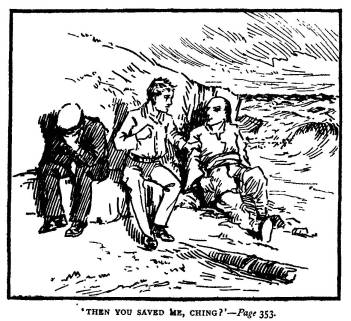
“Allee dlowned; velly much ’flaid.”
I groaned.
“I don’t know how we managed to get ashore, sir,” said Jecks faintly. “I think it was because there was so little undertow to the waves. When the boat struck, it felt to me as if I was being blown through the shallow water, and I shouldn’t have been here if I hadn’t come up against Mr Ching, who was pulling you along.”
“Then you saved me, Ching?” I cried.
“Ching takee hold, and pullee here. Velly pull wolk. Him get hold of tow-chang, and pullee him both together.”
“That’s right, sir. I snatched at anything, and got hold of his tail, and held on. But you don’t mind, Mr Ching?”
“No; mustn’t cut tow-chang off.”
“Let’s try if we can find the others,” I said; and, taking the lead, I walked round the mass of rock which had sheltered us, to gaze out at the heaving sea, which was rising and falling restlessly; but there was no white water, all was of a delicious blue, darker than the sky, and not a sail in sight.
To right and left extended a low cliff, at whose feet lay huge masses which had fallen from time to time; then an irregular stretch of sand extended to where the waves came curling over, the swell being very heavy, and the only trace of the storm to be seen was the way in which the sand had been driven up against the cliff, so as to form quite a glacis.
We could see about half a mile in either direction, but there was no sign of our companions, and my heart sank again. There were, however, here and there, ridges of rock, running down like breakwaters into the sea, and about which it fretted and tossed tremendously; and, in the hope that one of these ridges might hide our friends from our view, I climbed to the top of the highest piece of rock I could reach, and took a long and careful survey.
“See anything, sir?” said Tom Jecks.
“No,” I replied, “nothing. Yes; about a quarter of a mile on there’s a spar sticking up; it may be the boat’s mast.”
I came hurriedly down, and my announcement was enough to set my companions off, Jecks limping painfully through the loose sand, climbing rocks, and finding it no easy task to get over that so-called quarter of a mile, which, like all such spaces on the sea-shore, proved to be about double the length it looked, while the nearer we got the higher and more formidable the ridge seemed to grow, completely shutting out all beyond, where it ran down from the cliff at right angles into the sea.
All at once, as I was helping the coxswain over an awkward stone, the poor fellow being weak and rather disposed to stagger, but always passing it off with a laugh and an “All right, sir, I shall be better after breakfast,” Ching uttered an ejaculation, and pointed to something that the sea had washed up, and was pouncing upon again like a cat to draw it back.
My heart seemed to stand still, but a horrible fascination drew me to the spot along with the Chinaman, for my first thought was that it was the body of Mr Brooke.
“Not jolly sailor boy,” said Ching; and I felt a peculiar exaltation. “Not Mis’ Blooke. Pilate man dlowned. Ching velly glad.”
We turned away, and continued our route, for I shrank from going into dangerous breakers to try and drag the man out, and my companion was too weak. As to its being one of the pirates, it seemed possible, for I knew that one, if not two, had gone overboard in the fight, and it was probably one of these.
We trudged on and reached the ridge at last, to find it bigger and more precipitous than I had expected. It ran out evidently for hundreds of yards, its course being marked by foam and fretting waves, and I was just thinking what a fatal spot it would be for a vessel to touch the shore, when I reached the top and uttered a startled cry, which brought the others to my side; for there was the explanation of the presence of the drowned Chinaman! Spreading away for a couple of hundred yards, the shore was covered with timbers, great bamboo spars, ragged sails, and the torn and shattered fragments of some large Chinese vessel; while, before I could shape it in my mind as to the possibilities of what vessel this could be, though certain it was not the Teaser, Ching said coolly—
“That velly good job. That big junk blow all to pieces, and allee bad pilate man dlowned. No go choppee off poor sailor head now. No ’teal silk, tea, allee good thing, and burnee ship. Velly good job indeed; velly bad lot.”
“You think it was the junk which cheated us?”
“Yes, velly muchee same. Look, allee paint, lacquee, gold. Allee same junk; no use go find um now. No get head chop off for killee sailo’. Allee bad pilate allee dlowned.”
“Hold hard there, sir,” whispered Tom Jecks. “I can hear people talking. Quick! squat, hide; there’s a lot on ’em coming down off the cliff.”
We had just time to hide behind some rocks, when a party of about twenty Chinamen came cautiously and slowly down on to the sands, and Ching whispered as he peeped between the fragments of rock—
“Not allee pilate dlowned. Come along look at junk; take care; choppee off allee head; must hide.”
Ching was quite right, and I was awake to the fact that we three were prisoners on a little desert island, and in company with a gang of as savage and desperate enemies as man could have.
Chapter Forty Two.
For Dear Life.
It was all clear enough: the great junk which had so deceived Mr Brooke and Ching had been cast ashore and shattered, these men having escaped and been exploring the island, or perhaps they were only coming down now from the spot where they had taken refuge after being cast ashore.
“Why, Ching,” I whispered, “perhaps there are more of them about!”
“P’laps,” he replied.
We dared not move, but remained there watching; and it now became pretty evident that the men had come down to examine the wreck, for they began to hurry about, chattering away as they searched in all directions amongst the fragments, one or another setting up a shout from time to time, which brought others to him. Then we saw them drag out now a chest from the sand in which it was bedded, now a cask; and soon after there was a burst of excitement over something we could not make out; but it was evidently a satisfactory find, for they bore it up from the sea to the soft, warm, dry sand, and all sat down round about it.
“Find something velly good to eat,” whispered Ching. “Now allee velly busy; come along, hide.”
It was very good advice; and we followed him down from the ridge, and in and out at the foot of the cliff, seeking for some place of concealment; for I had not a doubt about our fate if we were seen. In fact, I did not breathe freely until the great ridge and several masses of rock were between us; and only then, a good half-mile away in the direction from which we had come, did we venture to speak above our breath.
“Velly big pity,” said Ching, whose face was all in wrinkles. “Velly muchee wish back at fancee shop.”
“Let’s find a place before we talk about that,” I said.
“Yes; soon findee place.”
“Here, what is it, Jecks?” I cried, catching our companion’s arm; for he suddenly gave a lurch as we struggled through the loose sand, and nearly fell.
“Bit done up, sir,” he said, with a piteous smile. “Wound in my leg makes me feel sick, and the sun’s hot. Is there a drop o’ water to be got at anywhere?”
I looked round at the glowing sand and rocks with a feeling of horrible despair coming over me. Yes, there was water—hundreds and thousands of miles of water, blue, glistening, and beautiful in the calm morning, but none that we could give a parched and fainting man to drink.
“Try and creep along a little farther,” I said. “Let’s get you in hiding, and then Ching and I will search for some and bring it—”
As I spoke I remembered that I had nothing that would hold water, and I felt constrained to add—
“Or fetch you to it.”
“All right, sir,” said the man, with a weary smile; “allus obey your officers.”
Ching went to his other side, and supported him some fifty yards farther, our way now being through quite a chaos of rocks, which had been loosened in bygone times from the cliff above. Then, so suddenly that we were not prepared, the poor fellow dropped with his full weight upon our arms, and we had to lower him down upon a heap of drifted sand.
“No go, sir,” he said softly; “I’m a done-er.”
“No, no; rest a bit, and we’ll find a cool place somewhere. I daresay we shall see a cave along here.”
“Can’t do it, sir,” he said feebly; “I’ve kep’ on as long as I could. It’s all up. Never mind me. If those beggars see you, they’ll have no mercy on you, so go on and try and get away.”
“Yes; velly muchee makee haste. Pilate come soon.”
“Yes, sir; he’s quite right, sir. You two cut and run.”
“And let them come and murder you, while we go?” I said.
“Well, yes, sir,” said the poor fellow faintly; “there’s no good in having three killed when one would do.”
“Look about, Ching,” I said sharply. “Is there any place where we can hide?”
“No,” he replied disconsolately. “Only place for lit’ dog; no fo’ man.”
“You can’t do it, sir,” said our poor companion. “Good-bye, sir, and God bless you; you’ve done all a orficer can.”
“Oh, have I? I should look well when Mr Reardon or the captain says, ‘What have you done with your men?’”
“Don’t! stop a-talking, sir,” he cried, clinging to my hand. “You know what these beggars are, and you’ll have ’em on to you, sir.”
“Yes; and we shall have them on to you if we don’t find a place soon. Here, Ching, don’t run away and leave us;” for I could see the interpreter climbing up a gap in the cliff.
“He’s quite right, sir; you go after him. I tell you it’s all over and done with me. If you got me along a bit farther, I should only go off all the same. It’s all up. Now, pray go, sir. It’s no use to stay.”
“Hold your tongue!” I cried angrily; for with the feeling on me strong that the pirates might be down on us directly, and the only thing to do was to set off and run for my life, the poor fellow’s imploring words were like a horrible temptation that I was too weak to resist.
“I must speak, sir,” he whispered, with his eyes starting, and his lips black and cracked by the heat and feverish thirst caused by his wound. “There, you see, Mr Ching’s gone, and your only chance is to follow him.”
I looked up, and just caught sight of one of the Chinaman’s legs as he disappeared over the edge of the cliff to which, high up, he had crawled. And once more the desire to escape came upon me, but with increased strength, that made me so angry at my weakness that I turned upon the poor fellow almost threateningly.
“Will you hold your tongue?” I whispered hoarsely.
“Will you go, sir?” he pleaded. “I tell yer it’s all up with me, and the Teapots can’t hurt me worse than what I’ve got now. Arn’t got your dirk, have you?”
“No; why?”
“’Cause it would ha’ been an act o’ kindness to put me out of my misery, and save me from being cut to pieces by them there wretches. Now, sir, good-bye, and God bless you, once more! Tell the skipper I did my duty to the last.”
I broke down as I sank on my knees by the poor fellow; and I didn’t know my voice—perhaps it was being husky from the heat-as I said to him, very chokily—
“And if you get away, tell the captain I did my duty to the last.”
“Yes, sir; but do go now.”
I jumped up again, ashamed of the blinding tears that came for a few moments into my eyes.
“Look here,” I said; “if you weren’t so weak, I’d kick you, old a man as you are. Likely thing for a British officer to sneak off and leave one of his men like this!”
“But the beggars are coming, I’m sure, sir.”
“Very well,” I said gloomily, “let them come. It’s all very well for a full-moon-faced Chinaman to go off and take care of himself, but it isn’t English, Tom Jecks, and that you know.”
The poor fellow hoisted himself a little round, so that he could hide his face on his uninjured arm, and as I saw his shoulders heave I felt weaker than ever; but I mastered it this time, and knelt there with a whole flood of recollections of home, school, and my ambitions running through my brain. I thought of my training, of my delight at the news of my being appointed to the Teaser, of my excitement over my uniform; and that now it was all over, and that in all probability only the sea-birds would know of what became of me after the Chinamen had done.
Then I thought of Ching’s cowardice in leaving me alone with the poor wounded fellow like this.
“I knew he wasn’t a fighting man,” I said sadly; “but I couldn’t have believed that he was such a cur.”
At that moment there was a quick scrambling sound, which made me start to my feet, and Tom Jecks started up on his elbow.
“Here they come, sir,” he gasped. “Now, sir,” he whispered wildly, “do, pray, cut and run.”
“With you,” I said resolutely.
He made an effort to rise, but fell back with a groan.
“Can’t do it, sir. Without me. Run!”
I put my hands in my pockets without a word, and then started, for a voice said—
“You think Ching lun away allee time?”
“Ching!” I cried, grasping his arm.
“Yes; no good. Can’t findee big hole to hide. Ching tumblee down off rock, and hurt him.”
“Much?” I said.
“Yes, plentee plentee. Time to go now. Pilate all come along this way.”
He passed his hand involuntarily straight round his neck edgewise, as if thinking about how a knife or sword would soon be applied.
“You saw them?” I cried.
“Yes,” he said sadly. “Allee come along. You lun away now with Ching?”
“I can’t leave Tom Jecks,” I said. “Off with you, and try and save yourself. Never mind us.”
Ching looked at the injured sailor.
“You no get up, lun?” he said.
“Can’t do it, mate,” groaned the poor fellow. “I want Mr Herrick to make a dash for his life.”
“Yes, velly good. You makee dashee you life, Mr Hellick.”
“No, I stay here. Run for it, Ching; and if you escape and see the captain or Mr Reardon again, tell him we all did our duty, and how Mr Brooke was drowned.”
“Yes, Ching tellee Mr Leardon evelyting.”
“Then lose no time; go.”
“No; Ching velly tire, velly hot; wantee bleakfast, flesh tea, nicee new blead. Too hot to lun.”
“But I want you to save yourself,” I said excitedly.
“Yes; allee save evelybody, alleegether. Ching won’t go leave Mr Hellick.”
“Ching!” I cried.
“Hush! No makee low. Lie down likee lit’ pigee in sand. Pilate come along.”
His ears were sharper than mine; for, as I dropped down at full length in the sand upon my chest, I saw him drag a good-sized stone in front of his face to screen it, while I, in imitation, rapidly scooped up some of the sand and spread it before me, so as to make a little mound of a few inches high, just as a couple of the junk’s crew came into sight about a hundred and fifty yards on our left, and as close down to the sea as the billows would allow. Then a few more appeared; and at last the whole party, walking almost in single file, and looking sharply from left to right as they came.
There was a space of about sixty yards from the face of the cliff to the edge of the water, and the shore, after about twenty yards of perfect hard level, rapidly rose, the interval being a rugged wilderness of rock half buried in the driven sand.
It was up nearly at the highest part of this chaos of rocks, where we had been seeking along the cliff face for a cavern, that we three lay, many feet above the level strip by the sea; and there were plenty of rocks protruding from the sand big enough to hide us; but it could only be from a few of the men at a time. To the others I felt that we must be so exposed that some one or other must of necessity see us if he looked our way.
There was no need to whisper, “Be silent,” for we lay there perfectly motionless, hardly daring to breathe, but forced, fascinated, as it were, into watching the long procession of our enemies, walking along, chattering loudly, and every now and then stooping to pick up something which had been driven up by the sea.
At times I saw them gazing right in our direction, and then up, over us, at the cliff with its patches of grey-green vegetation; but fully half of them passed by without making a sign of being aware of our presence, and hope began to spring up of the possibility of their all going by without noticing us.
The next moment it seemed impossible, and my heart sank as one active fellow stepped toward us, apparently coming straight to where we lay, and appearing to be watching me all the time.
And now more strongly than ever came the feeling that I must leap up and run for my life, though I knew that if I did the mob of Chinamen would give chase, like the pack of savage hounds that they were, and never give up till they had run me down; and then—
I felt sick with the heat of the sun, and the horror of my position. There, say it was all from the latter cause; and the rocks, sea, pirates, all swam before me in a giddy circle, with only one clear object standing out distinct upon the sands—imagination, of course, but so real and plain before my dilated eyes, that I shuddered at its reality—it was myself, lying in the baking sunshine, after the pirates had overtaken me and passed on!
It was very curious in its reality, and so clear before me that I could hardly believe it true, when the man who was coming toward us suddenly stooped, picked up something, and then turned and went back to his position in the line.
For I had not calculated in my excitement upon the deceptive nature of the ground upon which we lay, with its large masses of rock and scattered fragments of endless shapes, some partly screening, some blending with our clothes as we lay motionless; and above all, upon the fact that our presence there was not expected. Otherwise there might have been quite another tale to tell.
Even when I knew that they were passing on, I hardly dared to draw my breath, and lay still now, with my head pressed down sidewise in the sand; till at last I could keep from breathing no longer, and the dry sand flew at one great puff.
I lay trembling the next moment, fearing that the sound would bring the bloodthirsty wretches back, hot and eager to hack to pieces the foreign devil who had escaped from their clutches the day before; but the sound of their voices grew more and more faint, till the last murmur died away, and I raised my head slowly, an inch at a time, till I could gaze along the strand.
There was nothing visible but the scattered rocks, sun-bleached sand, and the dark, smooth surface over which the foaming water raced back each time a glistening billow curved over and broke. And in proof that the enemy were some distance away, I could see the pale-feathered, white-breasted gulls passing here and there in search of food, while able at any moment to spread their wings and escape.
Chapter Forty Three.
Our Refuge.
“Oh deah me!” said Ching in his most squeaky tones, “I velly hungly. You like nicee bleakfast, Mis’ Hellick?”
“Don’t speak to me as if I were a baby, Ching,” I cried angrily.
“No; speak like to offlicer, Mr Hellick. You likee bleakfast—something good eat?”
“I hadn’t thought of it before, Ching,” I said, feeling rather ashamed of my angry tone; “but I am faint, and I suppose that is through being hungry.”
“Yes; Ching go down among locks and sand, see if he find something eat.”
“No, no,” I cried excitedly; “it would be madness.”
“Eh? you tinkee Ching mad?” he said, with a smile.
“Oh no; but you would meet some of the pirates.”
“No; allee gone ’long shore. Not come back long time.”
“But it is too risky. Perhaps some of the wretches are waiting.”
“No; allee velly wicked—velly bad men. Feel ’flaid stop all alone. ’Flaid see men again headee chop off. Pilate allee keep together. No come long time; Ching go find something good eat.”
“But if they come on the cliffs and look back, they might see you.”
“Yes; might see Ching flom velly long way topside lock chop. Then think—”
“Think, yes, of course.”
“Not allee same you think. See Ching? Yes; see John Chinaman in blue flock allee torn, long tow-chang; that’s all.”
I did not grasp his meaning for a moment.
“Oh, I see,” I cried at last; “you mean that if they did see you, they would think it was one of their own crew?”
“Yes; think one of own clew. But Ching not pilate.”
“Of course. Then there would be no risk. You shall go, but we must find some place where we can hide.”
“Mis’ Hellick help soon makee velly nicee place.”
“Wait a minute,” I said. “Couldn’t we climb up on the cliff like you did?”
“Yes, Mr Hellick climb, but no cally jolly sailor boy, Tom Jeck, allee way.”
“No; we must make a place here if we cannot find one.”
He walked up to the face of the cliff, but there was no spot at all likely to answer the purpose till he had gone about fifty yards, when he turned and signalled to me.
I crept close up to the cliff, and then stooped down, after a timid look in the direction taken by the pirates, and found Ching standing by a piece of the rock which had split away from above, fallen clear, and then its top had leaned back against the rock face, leaving a narrow rift between its base and the cliff, through which we could see the light dimly, some twelve or fourteen yards away, but it was only a faint gleam showing that the far end was nearly closed.
“Velly nice beautiful place; ought to come here last night.”
“Yes, capital. We can hide here; and once inside, if we had arms, we could keep the wretches at a distance.”
“Don’tee want fight now,” said Ching, quietly. “No swold, no shoot gun, no jolly sailor boy. Wantee eat and dlink.”
“Yes; let’s get poor Jecks here at once.”
“You go fetch him; tly to walkee now: Ching go fetch eat, dlink.”
He hurried off toward the ridge, while I went back to my wounded man, who seemed to be lying asleep, but he opened his eyes as I approached.
“We’ve found a place,” I said. “Do you think you can limp a little way?”
He tried to rise, and fell back with a moan, but upon my placing my arm under his, he made a fresh effort, and stood upright, taking step for step with mine, till I had him right up to the narrow opening of our shelter, into which he slowly crawled, and then spoke for the first time, but in a hoarse voice I did not know—
“Water.”
“I’ll try,” I said; “don’t stir from there till I come back.”
Creeping along close under the cliff, I soon reached the ridge, and was about to mount, but dropped down and hid, for I saw something move in the direction taken by the pirates.
A minute’s investigation, however, showed it to be some bird on the strand, and I began to climb, reached the top, took a careful observation in both directions, and then up at the cliff, and,—lastly, looked out for Ching.