"Blue Jackets" (continued 4)
Reading edition
“Oh, there you are, sir. Now look here, I’m going to mast-head you. Got your glass?”
“Yes, sir.”
“Then up with you, right to the main-topgallant cross-trees. Notice everything you can.”
My heart began to beat before I reached the main shrouds, and it beat more heavily as I toiled up the rattlins, reached the top, and then went on again, too much excited to think of there being any danger of falling, my mind being partly occupied with thoughts of what Barkins and Smith were saying about my being favoured in this way.
“Just as if they could have come up,” I said half-laughing; “one with a game leg, the other with a game arm.”
My thoughts ran, too, as much upon what I was about to see, so that beyond taking a tight hold, and keeping my spyglass buttoned up in my jacket, I paid little heed to the height I was getting, I reached the head of the topmast, and then began to mount the rattlins of the main-topgallant mast, whose cross-trees seemed to be a tremendous height above my head.
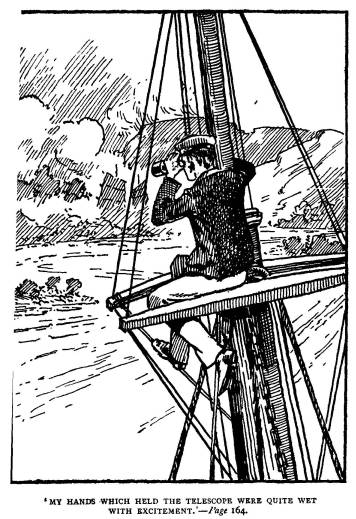
But I was soon there, and settled myself as comfortably as I could, sitting with an arm well round a stay, and one leg twisted in another for safety; but the wood did not feel at all soft, and there was a peculiar rap, rap, rap against the tapering spar which ran up above my head to the round big wooden bun on the top of all, which we knew as the truck.
For a moment or two I couldn’t make out what the sound was. Then I saw it was caused by the halyards, the thin line which ran up through the truck and down again to the deck, for hoisting our colours. This doubled line, swayed by the breeze, was beating against the tall pole, but I checked the noise by putting my arm round it and holding the thin halyard tight.
I looked down for a moment or two at the deck which lay beneath, giving me a bird’s-eye view through the rigging of the white decks dotted with officers and men, and the guns glistening in the sunshine. There were several faces staring up at me, and I made out Barkins and Smith, and waved my hand. But these were only momentary glances; I had too much to see of far more importance. For there, spread out round me, was a grand view of the low, flat, marshy country, through which the river wound like a silver snake. Far away in the distance I could see villages, and what seemed to be a tower of some size. Beyond it, cultivated land and patches of forest; behind me, and to right and left, the shimmering sea, and straight in front the two junks; while almost at my feet, in spite of their hard rowing, there were our four boats, with the oars dipping with glorious regularity, and making the water flash and glitter, but not so brightly as did the bayonets of the few marines in each, as they sat in the stern-sheets with their rifles upright between their legs, and the keen triangular blades at the tops of the barrels twinkling at every movement of the boats.
It was a sight to make any one’s heart throb, and in spite of my splendid position for seeing everything I could not help wishing I was there to help make a part of the picture I saw, with the men in their white ducks and straw hats, the marines glowing like so many patches of poppies, and the officers with their dark blue coats faintly showing a lace or two of gold.
How I longed to be with them bound upon such an exciting trip, and all the time how glad I was to be up there in so commanding a position, as, after watching the progress of the boats for a few moments, I opened and focussed my glass, rested it against a rope, and fixed it upon the junks.
The first thing I noticed was that one of them lay a little over to port, as if from being too heavily laden on one side; while, as I gazed, the other was evidently settling in the other direction.
I wondered what they were doing to them, and whether it meant changing heavy guns over to one side, when I grasped the fact,—they had gone as high up-stream as they could, and then run aground, and were fixed in the sticky mud of which the bottom of the river was composed.
“Ahoy! there aloft,” shouted Mr Reardon. “What do you make out?”
I did not take the glass from my eye, but shouted down to him—
“Both junks fast aground, sir. Chinese crews running backwards and forwards, trying to work them off, sir.”
An eager conversation ensued between Mr Reardon and the captain, during which I carefully scanned the two Chinese vessels, and could see the men swarming here and there, as if in an intense state of agitation, but they soon ceased trying to rock the junks, and, as I judged, they were waiting for the tide to rise higher and float them off.
There was nothing between to hinder my having a thoroughly good view of where they lay, just round a slight bend, but I felt certain that they could not see our boats, and I had proof that this was the case, on noticing that a group of men had landed, and were running towards a clump of tall trees, where they disappeared amongst the growth.
“Cowards!” I said to myself, for I felt that they were deserters, and, after watching for their reappearance, I was about to turn the glass upon the junks again, when I noticed a peculiar agitation of the branches of one tree, which stood up far above the others.
“Well, Mr Herrick, I am waiting for your reports,” cried the first lieutenant.
“Yes, sir,” I shouted. “Half-a-dozen men landed from one of the junks, and ran across to a patch of wood.”
“Deserters? Any more leaving the ship?”
“No, sir.”
“Ah, they saw the boats coming, I suppose?”
“No, sir, but they soon will. One of them is climbing a big tree, much higher than the junk’s masts.”
“For a look-out, eh?”
“Yes, sir, I think so,” I shouted; and then to myself, “Oh, bother! It’s hard work talking from up here. There he is, sir, right up at the top. You could see him from the deck.”
“No, I can see nothing from here. Well, what is he doing?”
“Making signals with his hands, sir, and now he’s coming down again.”
“Then you think he has seen the boats?”
“No, sir; they are following one another close in under the bank.”
“Then they can’t see them,” cried Mr Reardon, “and Mr Brooke will take them by surprise.”
He did not shout this, but said it to the captain. Still the words rose to where I sat watching, till the Chinamen ran out from among the bushes at the foot of the trees, and I saw them making for the junks again.
I could not see them climb on board, but I felt that they must have jumped into a boat and rowed off to their friends, and, fixing my glass upon the deck of first one and then the other, I began to make out more and more clearly the actions of the crews, and, judging from the glittering, I saw some kind of arms were being distributed.
I announced this at first as a supposition, telling Mr Reardon what I thought it was.
“Yes, very likely,” he replied; and a few minutes after I saw something else, and hailed.
“Yes,” he said, “what now?” and I saw that, though he did not speak, the captain was listening attentively.
“They’re burning something, sir.”
“Confound them! Not setting fire to the junks?”
“I don’t know, sir; I think so,” I replied, still watching intently; and, as I gazed through my glass, I saw black smoke rising in little coils from both junks, at first very thick and spreading, then growing smaller.
“I think, sir, they’ve set fire to the junks in several places,” I said.
He asked me why, and I told him.
“Watch attentively for a few minutes.”
I did so, and felt puzzled, for it seemed so strange that the fire should grow smaller.
“Well,” he said, “are the junks burning?”
“The little curls of smoke are rising still, sir.”
“Have the men left the decks?”
“Oh no, sir! They’re running here and there, and seem very busy still.”
“Then they have not set fire to the vessels,” he cried decisively. “Pirates, without a doubt. Those are stink-pots that they have been getting ready. Go on watching, and report anything else.”
A noise below, familiar enough, with its rattle and splash, told me that an anchor had been dropped from the bows; and as the Teaser slowly swung round from the force of the tide, I also had to turn, so as to keep the telescope fixed upon the enemy, who were as busy as ever, though what they were doing I could not make out. The flashes of light came more frequently, though, as the sun played upon their weapons; and now I had something else to report—that they had both assumed a different position, being lifted by the tide and floated upon an even keel.
My first idea was, that now they would sail on beyond our reach; in fact, one moved a good deal, but the other stopped in its place, so that at last they were so close together that they seemed to touch.
“Make out the boats?” came from the deck.
“No, sir; they’re close under the bank.” Yes, I caught a glimpse of the marines’ bayonets just then.
“How far are they away from the junks, do you think?”
“I can’t tell, sir; about a quarter of a mile, I think.”
Mr Reardon was silent while I gazed intently at a patch of open water just beyond a curve of the bank, hoping to see the boats there, though I felt that as soon as they reached that spot, if the enemy had not seen them before, they would be certain to then, for beyond that the junks lay clearly to be seen from where I sat.
“Well? See the boats?” came from the deck.
“No, sir, not yet.”
I glanced down to answer, and could see that every one who possessed a glass was gazing anxiously aft, the only face directed up to me being the first lieutenant’s. Then my eye was at the glass again.
“More smoke from the junks, sir,” I cried; but there was no sign of fire, and I felt that Mr Reardon must be right, for if they had set a light to the inflammable wood of the vessels, they would have blazed up directly.
“Can’t you see the boats yet?” cried the first lieutenant impatiently, and his voice sounded as if he were blaming me.
“No, sir, but the junks are more out in the middle of the stream. I can see them quite clearly now, away from the trees. They are crowded with men, and—”
“The boats—the boats?”
“No, sir;—yes, hurrah! There they go, sir, all abreast, straight for the junks.”
“Ha!” came in one long heavy breath from below, as if all left on board had suddenly given vent to their pent-up feelings.
“How far are they away from the junks?” cried Mr Reardon.
“About two hundred yards, sir; you’ll see them directly.”
“Yes, I see them now, sir,” cried Barkins, who was a little way up the mizzen-shrouds, where I had not seen him before.
“Silence!” cried the captain sternly. “Go on, Mr Herrick; report.”
“Smoke from the junks, sir—white,” I cried, and the words were hardly out of my mouth when there came the report of guns—first one and then another; then two together; and I fancied that I could see the water splashing up round about the boats, but I could not be sure.
“Boats separating,” I shouted.
“Go on.”
“Pulling hard for the junks.”
“Yes, go on; report everything.”
I needed no orders, for I was only too eager to tell everything I saw.
“Two boats have gone to the right; two to the left.—More firing from the junks.—Boats separating more.—Two going round behind.—Both out of sight.”
By this time, in addition to the sharp reports of the small guns on board the junks, the sharper crackle of matchlocks and muskets had begun; but so far I had not seen a puff of smoke from our boats.
“Are our men firing?”
“No, sir; the two boats I can see are pulling straight now for the junks.—Now the water splashes all about them.”
“Yes? Hit?”
“Don’t think so, sir.—Now.—Ah!”
“What—what is it, boy?”
“Can’t see anything, sir; they’ve rowed right into the smoke.”
My hands which held the telescope were quite wet now with the excitement of the scene I had tried to describe to my superior officer, and I thrust the glass under my left arm, and rubbed them quickly on my handkerchief, as I gazed at the distant smoke, and listened to the crackle of musketry alone, for the guns had now ceased from fire.
This I felt must be on account of the boats coming to closer quarters, and then to the men boarding. But I could see nothing but the smoke, and I raised the glass to my eye again.
Still nothing but smoke. I fancied, though, that the firing was different—quicker and sharper—as if our men must have begun too.
“Well, Mr Herrick?” now came from below. “Surely you can see how the fight is going on?”
“No, sir, nothing but smoke,—Yes,” I cried excitedly, “it’s lifting now, and floating away to the left. I can see close up to the junks. Yes; now the decks. Our right boat is empty, and there is a great fight going on upon the junk.”
“And the other?”
“There are two boats close up, and our men are firing. There is black smoke coming out of one boat. Now the men are climbing up, and—now, the smoke is too thick there.”
“Go on, boy; go on,” shouted the first lieutenant, stamping about, while the captain stood perfectly still, gazing at the rising smoke, from the bridge.
“They seem to be fighting very hard, sir,” I said, trembling now like a leaf. “I can see quite a crowd, and that some of the people are in white.”
“But who is getting the best of it?”
“I can’t see, sir,” I said sadly.
“Then for goodness’ sake come down, and let some one else come up,” roared Mr Reardon.
“Yes, sir.”
“No, no; stay where you are, boy. But use your glass—use your glass.”
I tried my best, but I could only make out a blurred mass of men on board both junks. They seemed to be swaying to and fro, and the smoke, instead of passing off, once more grew thicker, and in place of being white and steamy, it now looked to be of a dirty inky black, completely enveloping the vessels and our boats.
This I reported.
“They surely cannot have set them on fire?” said Mr Reardon.
“I can’t see any flames, sir.”
Silence again; and we found that the firing had ceased, all but a sharp crack from time to time, sounds evidently made by rifles. But there was nothing more to see, and, in spite of the angry appeals of the lieutenant, I could report no more than that the black smoke was growing thicker, and hanging down over the water, hiding everything, to the bushes and trees upon the bank.
And now, as I gave one glance down, I saw that the captain was walking to and fro upon the bridge, evidently in a great state of excitement, for there was not a sound now; the firing had quite ceased; the black cloud seemed to have swallowed up our four boats and men; and a chilly feeling of despair began to attack me, as I wondered whether it was possible that our poor fellows had been beaten, and the boats burned by the stink-pots the pirates had thrown in.
The thought was almost too horrible to bear, and I stared hard through the glass again, trying to make out the junks beyond the smoke, and whether it was really our boats which where burning, and raising the black cloud which hid all view.
“I can see a boat now, sir,” I cried excitedly, as one of them seemed to glide out of the end of the cloud; but my heart sank as I made the announcement, for I saw only that which confirmed my fears.
“Well, go on, lad,” cried Mr Reardon, stamping with impatience, “what are they doing in her?”
“She’s empty, sir, and floating away, with a cloud of black smoke rising from her.”
“Ah!” he exclaimed, with quite a savage snarl, and I saw the captain stop short and raise his glass again, though I knew that from where he stood he could see nothing.
“We’re beaten,” I said to myself. “Oh, our poor lads—our poor lads!”
A mist rose before my eyes, and I nearly dropped the glass, but I passed my hand across my face and looked again, sweeping the telescope from the left side, where the boat was gliding up-stream smoking more than ever, to the right and the shore.
“Hooray!” I yelled.
“Yes! what?” roared the captain and Mr Reardon together.
“Chinese running in a regular stream away from the shore; making for the woods. One down—another down.”
At the same moment almost came a couple of volleys, then several men went down, and the crackle of firing commenced again.
“Go on, Herrick!” cried Mr Reardon.
“Our fellows ashore, and running Jacks and jollies together, sir. Stopping to fire. Running again.”
“And the enemy?”
“Running like deer, sir. More of them down. Making for the wood.”
“One man stopped, sir, and returning.”
“Yes, yes, that’s good. What now?”
“Boat out from the smoke, rowing after the other one, sir. They’ve got it. Yes, I can see. They’re throwing something out that smokes—now something more.”
“Bah! stink-pots!” roared Mr Reardon. “Now then, quick!—quick! Don’t, go to sleep, sir. What next?”
“I’ll shy the spyglass at you directly,” I muttered; and then aloud, “Fire, sir; both junks blazing.”
“Hurrah!” came from the deck as the rest of the crew set up a tremendous cheer, for the smoke had suddenly grown less dense; and the junks gradually grew visible as it floated away; while even in the bright sunlight the flames were visible, and I could now make out that they were two floating furnaces with the great tongues of fire licking the broad matting-sails: and, best news of all, there, quite plainly, were our four boats, with the men just visible above their sides.
I reported this, and cheer after cheer rose again. After which there was dead silence once more, so that my reports could be heard.
“Now, Mr Herrick, what now?” cried Mr Reardon.
“Two boats lying in mid-stream, sir; the others are rowing to the side.”
“To pick up the men who were sent ashore, I suppose. Good.”
“Junks burning very fast, sir; and they’re floating across to the other side. The wind’s taking them straight, for the smoke floats that way.”
“Very likely,” said Mr Reardon; and there was a long pause.
“One junk has taken the ground, sir,” I said, “and—”
“Yes, well, what?”
“Her masts and sails have fallen over the side.”
“And our boats?”
“Lying-to, sir, doing nothing.”
But that was as far as I could see, for they were doing a good deal, as we afterwards heard.
“Other junk has floated over, sir, nearly to the same place.”
“Good; burning still?”
“Oh yes, sir—very fast.”
He need not have asked; for, as Barkins told me afterwards, they could see the flames from the deck, though our boats were invisible.
“Well, what now?” cried Mr Reardon, as I saw the captain quietly pacing to and fro on the bridge.
“Other two boats pushed off from the shore, sir.”
“Ha! that’s right. See anything of the Chinamen?”
“No, sir; the forest goes right away for miles. There isn’t one to be seen.”
“And the boats?”
“All rowing back, sir, close under the left bank.”
“Can you see them?”
“Only three of them, sir,” I replied. “Now another is out of sight.”
“Then, as soon as they are all invisible, you can come down,” cried Mr Reardon.
“Yes, sir; all out of sight now.”
“Then come down.”
“Thankye for nothing,” I muttered; and then aloud, “Yes, sir;” and I closed my glass, and wiped my wet forehead, feeling stiff and sore, as if I had been exerting myself with all my might.
“I suppose I’m very stupid,” I said to myself, as I began to descend slowly, “but I did try my best. What a height it seems up here! If a fellow slipped and fell, he would never have another hour up at the mast-head.”
I went on downward, with my legs feeling more and more stiff, and a sense of heavy weariness growing upon me. My head ached too, and I felt a pain at the back of my neck, while mentally I was as miserable and dissatisfied as ever I remember being in my life.
“I hope he’ll send old Barkins up next time,” I thought. “He wouldn’t feel so precious jealous then. Nice job, squinting through that glass till one’s almost blind, and nothing but bullying for the result.”
It seemed to be a very long way down to the deck, but I reached the remaining few rattlins at last, and I was nearly down to the bulwarks, meaning to go below and bathe my head, if I could leave the deck, when I was stopped short, just in my most gloomy and despondent moments, by the captain’s voice, his words sounding so strange that I could hardly believe my ears.
For, as I held on to the shrouds, and looked sharply aft at the mention of my name, he said—
“Thank you, Mr Herrick; very good indeed;” while, as I reached the deck, Mr Reardon came up—
“Yes, capital, Mr Herrick. A very arduous task, and you have done it well.”
Chapter Twenty.
After the Fight.
“Bravo, Gnat! Well done, little ’un!” whispered Barkins the next minute, as I walked aft, feeling quite confused, while my headache and sensation of misery passed off as if by magic. “Blacksmith would have done it better, of course; wouldn’t you, Smithy?”
“Done it as well as you would,” said my messmate sulkily; and there was a heavy frown on his brow; but, as he met my eyes, it cleared off, and he smiled frankly. “I say: Well done our side!” he whispered. “What would they do without midshipmen!”
“I say, though,” said Barkins, “we’ve given John Pirate another dressing-down; but what about the plunder?”
“Ah, of course,” said Smith. “Junks both burned, and no swag. What about our prize-money? Eh, Gnat?”
“I wasn’t thinking about that, but about our poor lads. They must have had a sharp fight. I hope no one is hurt.”
My companion were silent for a moment or two. Then Barkins said quietly—
“I thought it would be only the teapots that were broken. Think our chaps were hurt? You couldn’t see?”
“I could see that there was a big fight going on; and look here!”
I nodded in the direction of one of the companion-ways, from which the doctor suddenly appeared with his glasses on, and an eager, expectant look in his eyes as he bustled up to us.
“I’m all ready,” he said. “Boats in sight yet?” I shuddered, and I noticed that Smith looked white. “Well, why don’t you answer? What’s the matter, my lads? Oh, I see.” He laughed.
“Horrible sort of person the doctor, eh? But you didn’t look like that when I tackled your wounds the other day. But if you people will fight, the surgeon must be ready. Oh, let’s see: you were up at the cross-trees, Mr Herrick, with your glass, and saw all. Will there be much work for me to do?”
“I don’t know, sir,” I said, trying hard to speak quietly. “I couldn’t see much for the smoke. I hope not.”
“So do I, boy, heartily. I don’t mind the wounds so long as they’re not too bad. It’s painful to have fine strong lads like ours slip through one’s fingers. But we must do our best. Any Chinese prisoners? Sure to be, I suppose.”
“I should think so, sir.”
“And wounded. Well, if there are, you three lads ought to come and be my body-guard with your dirks. Like to see the operations, I daresay?”
“Ugh!” I said, with a shudder.
“Bah! Don’t act like a great girl, Herrick,” said the doctor scornfully. “You would never have done for a doctor, sir. I never shudder at the worst cases.”
“But then you are hardened, sir,” said Barkins.
“Hardened be hanged, sir!” cried the doctor indignantly. “A clever surgeon gets more and more softened every time he operates, more delicate in his touches, more exact in his efforts to save a limb, or arrange an injury so that it will heal quickly. Hardened, indeed! Why, to judge from your faces, any one would think surgery was horrible, instead of one of the greatest pleasures in life.”
“What, cutting and bandaging wounds, and fishing for bullets?” blurted out Smith; “why, sir, I think it’s hideous.”
“And I think you are an impertinent young coxcomb, sir,” cried the doctor indignantly. “Hideous, indeed! Why it’s grand.”
He looked round at us as if seeking for confirmation of his words, but neither spoke.
“Hideous? horrible?” he said, taking off his glasses and thrusting his hand into his pocket for his handkerchief to wipe them, but bringing out something soft and white, which proved to be a piece of lint. “Oh, I do call it cool. If there’s anything hideous it’s your acts, sir; having those thundering guns fired, to send huge shells shivering and shattering human beings to pieces for the doctor to try and mend; your horrible chops given with cutlasses and the gilt-handled swords you are all so proud of wearing—insolent, bragging, showy tools that are not to be compared with my neat set of amputating knives in their mahogany case. These are to do good, while yours are to do evil. Then, too, your nasty, insidious, cruel bayonets, which make a worse wound than a bullet. Oh, it’s too fine to call my work horrible, when I try to put straight all your mischief.”
“Here they are,” cried Barkins excitedly, as a hail came from the top.
We ran aft to see the first boat come steadily along close in shore, which was being hugged so as to avoid the full rush of the tide.
Directly after the others came in sight, and glasses were all in use from the bridge and quarter-deck.
I adjusted mine directly, and saw at the first glance that there was plenty of work for Dr Price, for men were lying in the stern-sheets with rough bandages on limbs and heads, while several of those who were rowing had handkerchiefs tied round their foreheads, and others had horrible marks upon their white duck-frocks, which told tales of injury to them as well as to their enemies.
The third boat was given up to men lying down or sitting up together, leaving only just room for the rowers, while the fourth and largest boat was being towed; the thwarts, that in an ordinary way would have been occupied by rowers, now holding the marines, who sat with their rifles ready, and fixed bayonets, while the stern-sheets were filled with Chinamen, seated in three groups, and all in the most uncomfortable-looking way. I could see that their hands were tied behind their backs, and it was horribly plain that several of them were wounded; but why they should have formed these three groups, and sat there with their heads laid close together, was what puzzled me.
A loud cheer rose from our deck as the boats came near; and this was taken up directly by the returning party, the men rowing harder as they shouted, and the little triumphant procession reached the side.
The first hail came from the captain.
“Mr Brooke—where’s Mr Brooke?”
“Here, sir,” cried that officer, standing up with a stained handkerchief about his head, and his uniform all black and scorched.
“Any fatalities?”
“No, sir; not one.”
I saw the captain’s lips move, but no one heard him speak. I guessed, though, what he said, and I felt it.
Then as quickly as possible the boats were run up to the davits, and the uninjured men leaped on deck. Next the wounded, such as could stir, descended from the boats, one poor fellow staggering and nearly falling as soon as he reached the deck. After which the badly wounded were carefully lifted out and carried below, to be laid in a row to wait the doctor and his assistant make their first rapid examination, to apply tourniquets and bandaged pads to the most serious injuries.
“Good heavens, Mr Brooke, what a condition you are in! The doctor must take you first.”
“Oh no, sir,” said the young lieutenant quietly. “I’m not very bad; a cut from a heavy sword through my cap. It has stopped bleeding. My hands are a little bruised.”
“But how was this?”
“As we advanced to board, they threw quite a volley of stink-pots fizzing away into us. I burned myself a little with them.”
“Chucking ’em overboard, sir,” cried the boatswain. “Splendid it was.”
“Nonsense!” cried Mr Brooke. “You threw ever so many. But it was hot work, sir.”
“Hot! it is horrible. How many prisoners have you there?”
“Eighteen, sir; the survivors escaped.”
“But you shouldn’t have fired the junks, man,” said the captain testily. “There may have been wounded on board.”
“Yes, sir,” said Mr Brooke, with his brow puckering; “wounded and dead there were, I daresay, thirty; but the enemy set fire to their vessels themselves before they leaped overboard, and it was impossible to save them: they burned like resin. We saved all we could.”
“I beg your pardon; I might have known,” cried the captain warmly. “Come to my cabin. Mr Reardon, be careful with those prisoners; they are savage brutes.”
“Enough to make ’em, Gnat. Look! What a shame!”
I looked, but I could not see any reason for Smith’s remark.
“Beg pardon, sir,” growled one of the men, who had a bandage round his arm; “you wouldn’t ha’ said so if you’d been there. They was all alike. The junk we took was burning like fat in a frying-pan, and me and my mate see one o’ them chaps going to be roasted, and made a run for it and hauled him away—singed my beard, it did; look, sir.”
Half of his beard was burned off, and his cheek scorched.
“Then my mate gets hold of his legs, and I was stooping to get my fists under his chest, when he whips his knife into my arm ’fore I knowed what he was up to. But we saved him all the same.”
“Here,” cried Mr Reardon, as the marines descended from the third boat, and stood at attention in two parties facing each other; “who was answerable for this? Why, it is an outrage. Brutal!”
“S’pose it was my doing, sir,” said the boatswain, touching his cap; “but I asked leave of Mr Brooke first, and he said yes.”
“What, to tie the poor wretches up like that, sir, and half of them wounded!”
“Beg pardon, sir; there was no other way handy. We lashed their arms behind ’em to keep ’em from knifing us, and then they kept on jumping overboard, and trying to drown themselves. We haven’t hurt them.”
“Cast them loose at once.”
“Yes, sir; I should like half-a-dozen strong chaps in the boat, though.”
“Well, take them,” said Mr Reardon, who was speaking less severely now. “I’ll have the uninjured men in irons this time. Be careful.”
“And if I’d my way, I’d have ’em all in iron boxes, ’cept their hands.”
The boatswain said this to me, with a nod, as the first lieutenant turned away, and, unable to control my curiosity, I sprang up on the bulwark to look into the boat.
“Let’s have a look too,” cried Smith, and he jumped up to gain a position much closer than mine, but quitted his hold and dropped back on deck, lost his footing, and came down sitting; for, as he leaned over the boat’s gunnel, one of the prisoners made a sudden snap at him, after the fashion of an angry dog, and the marines burst into a roar of laughter.
Smith got up scowling and indignant.
“My hands slipped,” he said to me aloud. And then, to carry off his confusion, “How many are there, Herrick?”
“Three lots of six,” I said, as I now saw plainly enough how it was that the prisoners were in such a strange position. For they had been dragged together and their pigtails lashed into a tight knot, a process admirably suited to the object in hand—to render them perfectly helpless; and their aspect certainly did not excite my anger.
Meanwhile the boatswain had stepped into the swinging boat, and he turned to me, but looked at Smith as he spoke.
“Like to try whether either of the others will bite, Mr Herrick?” he said.
Smith coloured and frowned.
“No, thank you,” I replied; “I’m satisfied.”
“Now then, you two,” said the boatswain, “stand by with your bayonets; and you, my lads, be ready as we cast them loose. Get a good grip of each fellow by the tail; he’ll be helpless then.”
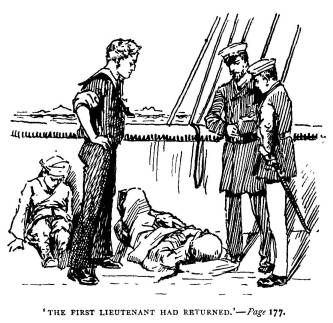
I stood looking on at the curious scene, and the next minute was conscious of the fact that the first lieutenant had returned to supervise the putting of the prisoners in irons himself; and, as the tails were unlashed, he took note of the men who were injured, and had them lifted out and laid on deck.
The others made no attempt to escape, for they were too firmly held; but, as the armourer fitted on the irons, I could see their wild-beast-like eyes rolling in different directions, and then become fixed with a look of savage hate on our men, who were certainly none too tender with a set of wretches who only waited an opportunity to destroy life without the slightest compunction.
At last they were all lying on the deck—nine with serious wounds, the other half for the most part injured, but only to a very slight extent, and these were soon after taken one by one between a file of marines to the place in the hold appointed once more for their prison.
Then the doctor came up for ten minutes, and, after a few words with the sergeant of marines, examined the nine prisoners, passing over six to the sergeant with orders, and having three laid aside for his own ministrations.
We three lads stood watching the sergeant, who had evidently had some practice in ambulance work, and skilfully enough he set to work sponging and bandaging injuries. But all the time a couple of marines stood, one on either side, ready to hold the prisoners down, for each seemed to look upon the dressing of his wounds as a form of torture which he was bound to resist with all his might.
“Nice boys, Mr Herrick,” said the boatswain drily. “Do you know why we are taking all this pains?”
“To save their lives and give them up to the authorities at Tsin-Tsin, I suppose.”
“Yes, sir.”
“For them to be put on their trial for piracy on the high seas.”
“Yes, sir, that’s it; but it would be a greater kindness to let the wretches die out of their misery.”
“But some of them mayn’t be guilty,” I said.
The boatswain laughed.
“I don’t think there’s much doubt about that, sir,” he said. Just then, as the last man was treated by the sergeant, the doctor came on deck with his assistants, both in white aprons and sleeves—well, I’m a little incorrect there—in aprons and sleeves that had been white.
“I’ve no business here,” said the doctor hurriedly; “but these men cannot be left. Keep an eye on them, my men, and don’t let them do me any mischief. I can’t be spared just now.”
The next moment he was down on his knees by the side of one of the prisoners, who, in his eyes for a few minutes, was neither enemy nor piratical Chinaman, but a patient to whom he devoted himself to the full extent of his skill, performing what was needful, and leaving his assistant to finish the bandaging while he went on to the next.
In another ten minutes he had finished, and rose from his knees.
“There, Mr Herrick,” he said; “do you call that horrible? because I call it grand. If those three ill-looking scoundrels had been left another hour they would have died. Now, with their hardy constitutions, they will rapidly get well, perhaps escape and begin pirating again. Possibly, when we give them up—oh my knees! how hard that deck is!—the authorities will—”
“Chop off all head. Velly bad men—velly bad men indeed.”
The doctor laughed, and hurried away while the last prisoner was carried down below.
“There,” said the boatswain, when all was over, “that job’s done, Mr Herrick. Nice fellows your countrymen, Ching.”
“Not allee nice fellow,” replied Ching seriously. “Pilate velly bad man. No use. Why captain save him up?”
“Ah, that’s a question you had better ask him. But I say, Ching, those fellows came up here with cargo, didn’t they?”
“Calgo?” said Ching.
“Yes; plunder out of the ships they took.”
“Yes,” said Ching.
“Then where is it? There was none on board the junks.”
“Ching know,” said the interpreter, laying his finger to the side of his nose. “You likee Ching show?”
“Yes, of course. Prize-money, and you’d share.”
“Ching likee plize-money. You bling ship along, and Ching show.”
Chapter Twenty One.
In the Creek.
Ching’s announcement cleared up what had been somewhat of a mystery. It had appeared strange to everybody that the junks had been up this river apparently for no purpose, and more strange that they should have been light, and not laden with the plunder of the vessels they had taken. And now, as without any need for taking soundings the Teaser slowly steamed back, Ching pointed out a kind of landing-place in a little creek hidden amongst dense growth, so that it had been passed unnoticed on our way up.
The country here on both sides of the river was wild, and no trace of a dwelling could be seen; but about half a mile from the shore there was a low ridge, round one end of which the creek wound, and toward this ridge Ching pointed, screwing his eyes up into narrow slits, and wrinkling up his face in all directions.
“Velly bad man live along-along there. Plenty plize-money; plenty tea, lice, silk; plenty evelyting. Come and see.”
The Teaser was moored, and a couple of boats manned with well-armed crews, Ching looking on the while and cunningly shaking his head.
“No wantee big piecee sword gun. Pilate all lun away and hide.”
“Never mind,” said Mr Reardon, who was going in command of the expedition; “we may find somebody there disposed to fight.”
“Takee all along big empty boat; cally tea, silk, lice, plize-money?”
“Better see first,” said the captain; “there may not be anything worth carriage. Go with them,” he said to Ching. “They may want an interpleter.”
“Yes, Ching interpleter. Talk velly nice Inglis.”
“You can come if you like in my boat, Mr Herrick,” said the lieutenant; and I jumped at the opportunity, but before I reached the side I turned, and saw Barkins and Smith looking gloomily on.
“Well, what are you waiting for?” said Mr Reardon.
“Beg pardon, sir,” I said; “I was only thinking that Mr Barkins and Mr Smith would be very glad to go ashore.”
“Of course they would, but I suppose you don’t want to give up your place to them?”
“No, sir,” I said; “but I will.”
“Oh, very well. Here, Mr Barkins, Mr Smith; do you feel well enough to go in my boat?”
“Yes, sir,” they cried together eagerly.
“Jump in, then.”
“Thank you, sir,” cried Smith, and he mounted into the first boat; but Barkins hesitated a moment.
“Thank you, old chap,” he whispered, “but I don’t like to go.”
“Off with you,” I said, and I hurried him forward. “Shall I give you a leg up?” I added, for he limped a good deal still.
“No, no; I don’t want to let them see I’m lame. But I say, Gnat, you go.”
“Be off,” I whispered. “Quick!” and I helped him in.
“Here, Ching, you had better go in the second boat,” said Mr Reardon sharply; and, as the Chinaman rolled out of the first boat, blinking and smiling, orders were given to lower away, and the first boat kissed the water.
I was looking down at my two messmates, feeling a little disappointed, but glad that they had a chance at last, when Mr Reardon looked up.
“Here, Mr Herrick,” he cried. “You had better come on in the other boat, and take charge of the interpreter. Look sharp.”
I did look sharp, and a few minutes later I was sitting in the stern-sheets, being rowed ashore.
“Plenty loom in littlee liver,” said Ching, pointing to the creek. “Pilate take allee plize-money in sampan up littlee liver.”
“Ching thinks the boats could go up the creek, sir, and that the pirates go that way.”
“Try, then; go first, Mr Grey,” cried the first lieutenant; and, ordering his boat’s crew to lie on their oars, he waited till we had passed, and then followed.
“Ching going showee way,” whispered the Chinaman to me.
“But how do you know there is a place up there?” I said. “Have you ever been?”
Ching shook his head till his black tail quivered, and closed his eyes in a tight smile.
“Ching interpleter,” he said, with a cunning look. “Ching know evelyting ’bout Chinaman. Talkee Chinee—talkee Inglis—velly nicee.”
“But talking English velly nicee doesn’t make you understand about the pirates.”
“Yes; know velly much allee ’bout pilate,” he said. “Velly bad men—velly stupid, allee same. Pilate get big junk, swordee, gun, plenty powder; go killee evelybody, and hide tea, silk, lice up liver. One pilate—twenty pilate—allee do same. Hide up liver.”
“Perhaps he’s right,” said Mr Grey, who sat back with the tiller in his hand, listening. “They do imitate one another. What one gang does, another does. They’re stupid enough to have no fresh plans of their own.”
By this time we were in the creek, which was just wide enough for the men to dip their oars from time to time, and the tide being still running up we glided along between the muddy banks and under the overhanging trees, which were thick enough to shade as from the hot sun.
The ride was very interesting, and made me long to get ashore and watch the birds and butterflies, and collect the novel kinds of flowers blooming here and there in the more open parts, the lilies close in to the side being beautiful.
But we had sterner business on hand, besides having the first lieutenant in the following boat, so I contented myself with looking straight ahead as far as I could for the maze-like wanderings of the creek, and I was just thinking how easily we could run into an ambuscade, and be shot at from the dense shrubby growth on the bank, when Mr Reardon called to us from his boat.
“Let your marines be ready, Mr Grey,” he said, “in case of a trap. If the enemy shows and attacks, on shore at once and charge them. Don’t wait to give more than one volley.”
“Ay, ay, sir,” said the boatswain; and the marines seized their pieces, and I looked forward more sharply than ever.
But Ching shook his head.
“No pilate,” he whispered to me. “Allee too velly much flighten, and lun away from foleign devil sailor and maline.”
“But they might have come down to their place here,” I said.
Ching smiled contemptuously.
“Pilate velly blave man, fight gleat deal when allee one side, and know sailor can’t fightee. When plenty sailor can fightee, pilate lun away velly fast, and no come back.”
“Can you understand him, Mr Grey?” I said.
“Oh yes, I understand him, and I daresay he’s right, but there’s no harm in being on the look-out;” and, to show his intention of following out his words, the boatswain took his revolver from its case, and laid it ready upon his knees.
“How much farther is this village, or whatever it is?” said Mr Reardon from behind.
“Do you hear, Ching?” I said.
“Ching hear; Ching don’tee know; not velly far,” was the unsatisfactory reply.
“I’m afraid we’ve come on a cock-and-bull hunt,” said the boatswain, looking to right and left as he stood up in the boat, for the creek now grew so narrow that the men had to lay in their oars, and the coxswain also stood up and drew the boat onward by hooking the overhanging boughs.
“Do you think they do come up here, Ching?” I said.
He nodded, and looked sharply about him.
“There can be no big traffic up here, Mr Grey,” said the lieutenant. “What does the interpreter say?”
“Do you hear, Ching?” I whispered; “what do you say?”
“Allee light,” he replied. “Pilate come along in littlee sampan; cally silk, tea, lice.”
“Oh, bother!” I said. Then aloud to Mr Reardon, whose boat was half hidden by the growth overhead, “He seems quite sure they do come up here, sir.”
“Well, then, go a little farther, but I feel far from sure. Push right in at the next place where there’s room for the boat, and climb up the bank.”
“Yes, sir,” I cried; and we went on again for another hundred yards, when all at once I caught sight of an opening where I could land, and pointed it out to Mr Grey.
“Yes,” said Ching, “allee light. That place where pilate land allee plize-money.”
I laughed, and Mr Grey told the coxswain to draw the boat close to the bank, when, to my intense surprise, I found there was a broadly-trampled path, beaten into soft steps, and I turned in my glee and shouted—
“Here’s the place, sir.”
The boat glided rustling in; two men sprang out, and then we followed. The second boat came alongside, and five minutes later our sturdy little force was tramping along through a dense patch of wood by a well-beaten path, and in about ten minutes more were out at the foot of a low ridge which hid the river from our sight, and in face of a couple of dozen or so low bamboo huts, two of which were of pretty good size.
“Steady! halt! form up!” cried the lieutenant, and skirmishers were sent forward to feel our way, for no one was visible; but open doors and windows, suggested the possibility of danger in ambush.
A few minutes settled all doubts on that score, and the word to advance was given. We went up to the front of the huts at the double, and examination proved that the places must have been occupied within a few hours, for the fire in one hut was still smouldering; but the people had fled, and we were in possession of the tiny village so cunningly hidden from the river.
Our men were pretty quick, but Ching surpassed them.
“Look at him running!” cried Barkins, as, with his tail flying, Ching ran from hut to hut, and finally stopped before the two more pretentious places, which were closely shut.
“Hong—warehouse,” he cried to me, and an attempt was made to enter, but the doors of both were quite fast.
“Steady!” said Mr Reardon; “there may be some of the enemy inside;” and our men were so placed that when the door was burst in, any fire which we drew would prove harmless.
One of the sailors came forward then with a heavy flat stone, which looked as if it had been used to crush some kind of grain upon it, and, receiving a nod from the lieutenant, he raised it above his head, dashed it against the fastening, and the door flew open with a crash, while the sailor darted aside.
But no shot issued from within, and Mr Reardon stepped forward, looked in, and uttered an ejaculation.
“Look here, Grey,” he cried; and the boatswain stepped to his side. Then my turn came, and there was no doubt about Ching’s idea being correct, for the place was literally packed with stores. Chests, bales, boxes, and packages of all kinds were piled-up on one side; bags, evidently of rice, on the other; while at the end were articles of all kinds, and crates which seemed to be full of china.
“Sentry here,” said the lieutenant sternly; and, leaving a marine on guard, he led the way to the other store, whose door was burst in, and upon our entering, without hesitation now, this place proved to be choked with the cargo of different junks which the pirates had rifled, for everything of value had been packed in tightly, and the pirates’ treasure-houses were no doubt waiting for some favourable opportunity for disposing of the loot.
“Sentry here,” cried Mr Reardon again; and the man having been planted, we stood together in one of the huts, while the lieutenant made his plans.
“You wantee big empty boat?” said Ching suddenly.
“Yes, my man, and I wish we had brought one.” Then, after a few minutes’ consideration, Mr Reardon decided what to do.
“Now, Mr Herrick,” he said, “take a marine and one man with the signal flags, and go up to the ridge yonder. Place your marine where he can command the plain, and he will fire if he sees the enemy approaching. The man is to signal for two more boats.”
I started for the ridge after getting my two men, which was about two hundred yards away, the ground rising in a slope; and, as we went off at the double, I heard orders being given, while, by the time we were up on the top, I looked back to see our men going in a regular stream down to the boats, laden with bales of silk, the white frocks of the Jacks showing through the thick growth from time to time.
My sentry was soon posted in a position where he could command the plain for miles, and the Jack hard at work waving flags till his signal was answered from the ship, which seemed from where we stood to be lying close at hand.
Then we two returned, to find that one boat was already packed as full as it would hold; and Barkins and Mr Grey went off with it back to the river, while the second was rapidly laden, and in half an hour followed the first. Then Smith and I followed the lieutenant into the store, with its low reed-thatched roof, and gazed about wonderingly at the richness of the loot upon which we had come.
“I say, Gnat, we shan’t go home without prize-money this voyage,” whispered Smith; and then, nothing more being possible, the sentries—four, posted at different distances—were visited, and we all sat down in the shade to rest, and partake of the refreshments in the men’s haversacks.
Chapter Twenty Two.
Fresh Danger.
“They’re a long time sending those boats, Herrick,” said the lieutenant to me soon after we had finished our meal.
“It’s rather a long way, sir,” I ventured to suggest.
“Oh yes, it’s a long way; but with the state of dishipline to which I have brought the Teaser they ought to have been here by now. Suppose we were surrounded by the enemy, and waiting for their help to save us!”
“We should think it longer than we do now, sir.” Mr Reardon turned to me sharply, and looked as if in doubt whether he should treat my remark as humorous or impertinent. Fortunately he took the former view, and smiled pleasantly.
“So we should, Herrick, so we should. But if they knew it was to fetch all this loot on board, they’d make a little more haste.”
“They know it by this time, sir,” I said. “They must have met the first boat.”
“Oh, I don’t know,” he said rather sourly. “The men are very slow when I am not there.”
“Here they are, sir!” I cried; for the marine sentry down by the river challenged, and then there was a loud cheering, and soon after Mr Brooke appeared, followed by a long train of fully-armed Jacks.
“Why, I thought when we started that we had come to fight,” cried Mr Brooke as he reached us. “We met the two loaded boats. Is there much more?”
“Come and look,” said Mr Reardon; and we went first into one and then the other store, while our party of Jacks communicated our luck to the newcomers, the result being that, as we came out of the second long hut, the men cheered again lustily.
Then no time was lost; and the way in which the crew attacked those two stores of loot was a sight to see. It was tremendously hot, but they laughed and cheered each other as those returning met the laden ones going down to the boats. They would have liked to make a race of it to see which crew could load up their boat first, but Mr Reardon stopped that; and the strength of all was put to work to load one boat and get it off, so that there were two streams of men going and coming; and the first boat was deeply laden in an incredibly short space of time, the men leaving themselves no room to row, but placing the chests amidships to form a platform, and two smaller ones in the bow and stern.
They would have laden the boat more deeply still but for Mr Brooke, who superintended at the side of the creek, while Mr Reardon was at the stores.
Then the first of the boats Mr Brooke had brought was sent off, and by the time the next was loaded one of those we had previously sent off returned.
“Velly plime lot of plize-money,” Ching said to me every time we met; and he toiled away with the rest, his face shining, and while our men grew red he grew more and more yellow. But, in spite of the tremendously hard work of carrying down those loads, the men took it all as a party of pleasure; and when, later on in the day, after boatload after boatload had gone down the creek for hours, I had to go up to Mr Reardon with a message from Mr Brooke, I was astonished to see how the contents of the stores had disappeared.
It was getting close upon sundown when the last load was packed into the longboat. Silk bale, tea-chest, rice-bag, crate, and box, with an enormous amount of indescribable loot, including all kinds of weapons, had been taken aboard; and the men who had come up for fresh burdens began cheering like mad as they found the task was done.
“That will do, my lads; steady—steady!” cried Mr Reardon. “Fall in.”
Bang!
It was not a loud report, only that of the rifle fired by the sentry on the ridge; and immediately the men stood to their arms, and were ready for what promised to be an interruption.
“See the sentry, Mr Herrick?” cried the lieutenant.
“Yes, sir,” I said; “he’s running in fast.”
The next minute the man came up, breathless.
“Strong body of John Chinamans, sir, coming across from over yonder.”
“Time we were off, then,” said Mr Reardon; and, giving the word, we started away at the “double” from before the empty stores and huts, toward the creek.
Our run through the wood, though, was soon brought to a walk, for we overtook the last laden men, and had to accommodate our pace to theirs. But they hurried on pretty quickly, reached the boat just as another empty one returned; the loading was finished, and as soon as the boat was ready, an addition was made to her freight in the shape of a dozen Jacks and marines, and she pushed off just as a loud yelling was heard from the direction of the empty stores.
“They’ll be down on us directly,” muttered Mr Reardon; and we all crowded into the empty boat and pushed off after the loaded one, but had not descended the creek far before we were stopped by the loaded boat, and had to arrange our pace by hers.
“Now for a slow crawl,” I thought, “and they’ll be after us directly.”
A loud bang behind us told that I was right, and the handful of rough slugs in the heavy matchlock flew spattering amongst the leaves overhead, cutting off twigs which fell into the boat.
“Lie down all who can,” cried the lieutenant; and we waited for the next shot, which, to be rather Irish, was half-a-dozen in a scattered volley.
But though the twigs and leaves came showering down, no one was hit; and the coxswain steadily poled us along as fast as the progress of the other boat would allow.
I saw that Mr Reardon was on the qui vive to order a return of the fire; but so far we could not see from whence it came, and it seemed as if nothing could be done but keep steadily on with our retreat.
“They might have given us another half-hour, Herrick,” he said. “I should like to get the boys on board unhurt.”
“Think they can get on ahead, sir?” I whispered.
“I hope not. The forest on each side is so dense that I don’t fancy they can get along any faster than we do. Make haste, my lads, make haste,” he said, almost in a whisper; “we shall have it dark here under these trees before long.”
Crash came another volley, accompanied by a savage yelling, but we were so low down between the muddy banks that again the slugs went pattering over our heads.
“Would you mind passing the word to the other boat, messmate,” said a familiar voice. “Tell ’em not to hurry themselves, as we’re very comfortable.”
“Who’s that? Silence!” cried Mr Reardon.
No reply came to his question, but I could hear the men chuckling.
The next minute they were serious enough, for there was a burst of voices from very near at hand.
“Aim low, my lads,” said Mr Reardon. “You six in the stern-sheets, as near to where the shooting is as you can.”
The rifles were levelled, three of the barrels being passed over our shoulders. Then came the usual orders, and the pieces went off like one.
This silenced our pursuers for a few minutes, during which we continued our progress, snail-like at the best, for the boat in front looked like a slug.
“I’d give the order to them to draw aside and let us pass, Herrick,” whispered the lieutenant, who now, in this time of peril, grew very warm and friendly; “but—ah, that’s getting dangerous.”
For another volley from very near at hand rattled over us, and was answered by our men.
“What was I going to say?” continued the lieutenant coolly, “Oh, I remember! If we tried to get by them they might take the ground with all that load, and be stuck.”
“And it would be a pity to have to leave that load, sir,” I said.
“Velly best load—allee best silk!” cried Ching excitedly, “Good, velly good plize-money!”
There was a roar of laughter at this, and Mr Reardon cried—
“Silence!”
Then, sharply, “Fire, my lads, if you see any one following.”
“Ay, ay, sir.”
“Yes, it would be a pity,” said the lieutenant thoughtfully; “but it’s tempting. If we could get in front, Herrick, we could tow the load, and it would shelter us all from the firing.”
“Unless they got to be level with us, sir,” I said.
“And—quick! right and left, my lads. Fire!” cried the lieutenant; for there was the breaking of undergrowth close at hand on either side, and a savage yelling commenced as our pursuers forced their way through.
The men, who had been like hounds held back by the leash, were only too glad to get their orders; and in an instant there was quite a blaze of fire from both sides of the boat, the bullets cutting and whistling through the thick trees and undergrowth; and the movement on the banks, with the cracking and rustling of the bushes and tufts of bamboo, stopped as if by magic.
“Cease firing!” cried Mr Reardon; and then, as if to himself, “Every shot is wasted.”
I did not think so, for it had checked the enemy, who allowed us to go on slowly another hundred yards or so.
“Allee velly dleadful,” whispered Ching to me, as he crouched in the bottom of the boat. “You tinkee hit Ching?”
“I hope not,” I said. “Oh no; we shall get out into the river directly.”
“No,” he said; “velly long way yet.”
“But who are these?” I said—“some village people?”
“Pilate,” he cried. “Allee come home not kill, and findee plize-money gone. Makee velly angly. Wantee chop off sailor head.”
“Like to catch ’em at it,” growled Tom Jecks, who had been very silent for some time.
“Silence there!” cried Mr Reardon sternly. Then to me, “We seem to have checked them, Herrick.”
At that moment there was a sudden stoppage in front, and our coxswain growled—
“Starn all!”
“What is it?” cried Mr Reardon, rising.
There was a rattle of matchlocks from our right, and Mr Reardon fell sidewise on to me.
“Hurt, sir?” I cried in agony.
“Yes, badly—no—I don’t know,” he cried, struggling up with his hand to his head. “Here! why has that boat stopped?”
His voice was drowned by the reports of our men’s rifles, as they fired in the direction from which the shots had come; and just then a voice from the laden boat came through the semi-darkness—
“Ahoy!”
“Yes; what is it?” I said, as I saw that a man had crawled over the stack-like load.
“There’s a gang in front, sir; and we’re aground.”
“And the tide falling,” muttered Mr Reardon. “Herrick, I’m a bit hurt; get our boat close up; half the men are to come astern here, and check the enemy; the other half to help unload and get enough into our boat to lighten the other.”
“Yes, sir,” I said; and I gave the orders as quickly and decisively as I could.
The men responded with a cheer; and, with scarcely any confusion, our boat’s head was made fast to the other’s stern, and the men swarmed on to the top of the load, and began to pass down the bales rapidly from hand to hand.
Crash came a ragged volley from right ahead now; but this was answered by three rifles in the stern of the laden boat, and repeated again and again, while the strong party in the stern of ours kept up a fierce fire for a few minutes.
It was a perilous time, for we knew that if the enemy pushed forward boldly we should be at their mercy. They could come right to the edge of the bank unseen, so dense was the cover; and, working as our men were at such a disadvantage in the gloom, which was rapidly growing deeper, there was no knowing how long it would be before the first boat was sufficiently lightened to float again; it even seemed to be possible that we might not keep pace with the fall of the tide, and then perhaps we should also be aground.
“Hurt much, sir?” I said to Mr Reardon, who was now seated resting his head upon his hand.
“Don’t take any notice of me, my lad,” he said, pressing my hand. “Hit by a bullet. Not very bad; but I’m half stunned and confused. The men and boats, Herrick; save them.”
“If I can,” I thought, as I hurried forward again, and gave orders to the men to pass the silk bales that were nearest to the bows.
“Ay, ay, sir,” they shouted, as readily as if I had been the captain.
From here I went back to the stern, where I found that Mr Reardon was seated now in the bottom of the boat, supported by Ching, while the men were keeping up a steady fire at every spot from which a shot or yell came.
“We’re hard at it, sir,” said Tom Jecks, who was handling his rifle as coolly as if it had been a capstan bar; “but I don’t think we’re hitting any of ’em. How’s the first luff seem?”
“I don’t know,” I said excitedly.
“Well, sir, we’re all right,” said the man, “and are doing our best. You needn’t stop if you can hurry the boys on forward.”
It was a fact; I could do no good at all, so I hurried forward again. But even here I could do nothing; the men had their task to do of lightening the first boat, and they were working as hard as if they had been lying down in the shade all day, and just as coolly, though every now and then the rough slugs the pirates fired from their clumsy matchlocks went spattering through the trees overhead and sent down fresh showers of leaves and twigs.
But I was obliged to say something, and I shouted first one order and then another.
“That’s your sort, lads,” cried a cheery voice. “Down with ’em, and I’ll stow. It’s like bricklaying with big bricks.”
“Who’s that?” I said sharply, for the man’s back was towards me, and it was getting quite dark where we were.
“Me it is, sir—Bob Saunders, sir. Beg pardon, sir.”
“Yes; what is it?”
“Tide’s going down very fast, sir, arn’t it?”
“Yes; why?”
“’Cause we don’t seem to get no forrarder. Hi! steady there! D’yer want to bury yer orficer?”
“Never mind me, man. Stow away; she must soon be lightened enough to make her float.”
“Then we’ll lighten her, sir; but don’t you go and give orders for any of the stuff to be chucked overboard. It’s too vallerble for that.”
“Only as a last resource, Bob,” I replied.
“Beg pardon, sir.”
“Don’t,” I cried to the man who touched me. “Never mind ceremony now; go on firing.”
“Yes, sir; but Tom Jecks says, sir, would you like six on us to land and have a go at the beggars?”
“No,” I cried. “Keep together; we may be afloat at any moment.”
“Right, sir; on’y we’re all willing, if you give the word.”
“I know that,” I cried. “But be careful, my lads. It’s a terrible position, with our chief officer down like this.”
“So it is, sir,” said the man, taking careful aim at a part of the bank where he thought that he saw a movement. Then, almost simultaneously, there was a flash from the place, and another from his rifle muzzle.
“Either on us hit?” he said coolly, as I clapped my hand to my ear, which felt as if a jet of cold air had touched it. “Don’t think I touched him, sir, but he has cut off. I can hear him going. Not hurt, are you, sir?”
“No; a bullet must have gone close to my ear,” I said.
“Oh yes; I felt that, sir. It went between us. But it’s no use to take no notice o’ misses.”
“Well?” I said; for one of the men behind me now touched my arm, and I found it was Bob Saunders.
“We’re getting dead down at the head, sir; hadn’t we better begin stowing aft?”
“Yes, yes, of course,” I said excitedly, and feeling annoyed that I had not thought of this myself.
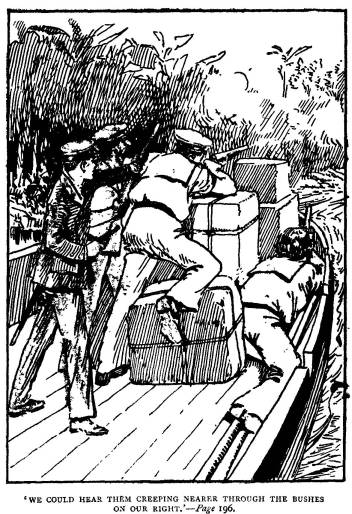
“Then, if you’ll make the lads ease off to starboard and port, sir, we’ll soon pack a row of these here little bales between ’em. Or look here, sir! how would it be to bring ’em a bit amidships, and let us begin right astarn, and build up a sort o’ bulwark o’ bales? They could fire from behind it when we’d done.”
“Yes, capital!” I cried, once more annoyed with myself because I, a mere boy, had not the foresight of an experienced man.
“No, no,” I cried the next moment. “How could we get at the tiller?”
“You won’t want no tiller, sir; we can row aboard easy enough, once we get out o’ this fiddling little drain.”
“You are right, Saunders,” I said. “Go on.”
All the while the men astern were keeping up a steady fire, which certainly had one effect, that of checking the enemy’s advance. And now Saunders came aft with a bale on his head, keeping his balance wonderfully as he stepped over the thwarts.
“Mind yer eye, Pigtail,” he cried.
“Keep back! Where are you coming?” growled a man who was loading.
“Here, matey,” cried Saunders; and he plumped the bale down right across the stern.
“Hooroar!” cried Tom Jecks, stepping behind it, and resting his rifle on the top.
No more was said, the men easing off out of the way as bale after bale was brought and planted in threes, so that when six had been placed there was a fine breast-work, which formed a splendid protection for those in the stern, and this was added to, until we were fairly safe from enemies behind. But once more we could hear them creeping nearer through the bushes on our right; the firing grew more dangerous, and there was nothing for it, I felt, but to order every man in the two boats to take his piece, shelter himself behind the bales, and help to beat the enemy back.
It was a sad necessity, for I knew that the tide was falling very fast, and that before long we should be immovable; but to have kept on shifting the load and allow the enemy to get close in over our heads on the densely-clothed sides of the stream would, I knew, be madness; and the men showed how they appreciated the common-sense of the order by getting at once under cover, and then the sharp rattle of our fire was more than doubled.
But, enraged by their defeat, and doubly mortified to find that we had discovered their treasure, the pirates seemed now to have cast aside their cowardice, and were creeping in nearer and nearer, yelling to each other by way of encouragement; and, in addition to keeping up an irregular fire, they strove, I suppose, to intimidate us by beating and making a deafening noise on gongs.
“They will be too much for us,” I thought, when we seemed to have been keeping up the struggle for hours, though minutes would have been a more correct definition; and, with the longing for help and counsel growing more and more intense, I was about to kneel down and speak to Mr Reardon, and ask him to try and save himself.
But I started to my feet, for there was a louder yelling than ever, and the pirates made quite a rush, which brought them abreast of us.
“Cutlasses!” I cried; and there was the rattle made in fixing them, bayonet fashion, on the rifles, when—boom!—thud!—came the roar of a heavy gun; there was a whistling shrieking in the air, and then somewhere overhead an ear-splitting crash, followed by the breaking of bushes and trampling down of grass and bamboo.
Then perfect silence, followed by a cheer from our men.
“Well done, Teaser!” shouted Tom Jecks.
It was a diversion which, I believe, saved us, for the enemy fled for some distance, and gave us time to go on lightening the foremost boat.
But before we had been at work many minutes there was a cheer from close at hand, and upon our answering it, another and another, with splashing of oars, and the next minute I heard Mr Brooke’s voice from beyond the first boat.
Chapter Twenty Three.
Saved.
“Look sharp, sir,” I said, after going forward, and in a few words explaining our position.
“Right, my lad. Get your men together in the stern of your boat, and keep up the fire, while we make fast and try and tow you off. Hi! quick there!” he roared; and a cheer told us that another boat was close at hand.
But my work was cut out, the men placed well under cover, and we waited listening for the first sounds of the returning enemy, while from time to time Mr Brooke’s clear, short orders came out of the darkness behind us, and we knew that he had sent a party into the fixed boat to rock it from side to side. Then came a cheer, as the water rolled hissing and whispering among the reeds; there was the simultaneous plash of oars, and a creaking sound.
Then another sound from the bank of the creek, which I knew well enough.
“Say when, sir,” whispered Tom Jecks. “They’re a-coming on.” To our astonishment, for the enemy had crept forward so silently that we had hardly heard a sound, there was a hideous yell, and a crashing volley, the bullets hissing over our heads again, and once more the gong-beating began.
“Fire!” I said.
“Yes, fire, my lads, steady—where you see the flashes of their matchlocks.”
The voice came from close to my ear.
“Mr Reardon!” I cried in astonishment.
“Yes, Herrick; that bullet quite stunned me for a minute or two. I’m better now. But hasn’t it grown dark rather suddenly?”
“Yes, sir,” I said; for I felt in my excitement as if it would be impossible to enter into explanations then.
“But we’re in motion.”
“Hooray!”
Every one took up that cheer; for the combined efforts of the men who rowed the laden craft, and the tugging of two boats’ crews of men straining with all their might at their stout ashen blades, had the required effect. We were indeed in motion, and going steadily down the stream.
“Ahoy, there: Mr Reardon!”
“Answer him, Herrick,” said Mr Reardon; and I hailed again.
“Can you keep them off with your fire?”
“Say, yes.”
“Yes; all right,” I cried.
“Then we’ll tow you out as fast as we can.”
“Thank Heaven,” I heard Mr Reardon whisper, as he crouched there, listening to the yelling, gong-beating, and firing, and with our men replying from time to time whenever there seemed a chance.
And now the bullets from the matchlocks began to patter upon the bales; for the banks were growing lower and lower, and the trees more open, but not a man was hit; and after another quarter of an hour’s sharp replying we heard fresh cheering, the overshadowing trees on the banks suddenly began to grow distant. Then it became lighter still, with the stars twinkling over head and the lights of the Teaser apparently close at hand.
But the enemy, enraged at our escape, now crowded down to the bank and began to fire rapidly, while the men replied till the crack crack and ping ping of the rifles was silenced,—the men stopping as if by mutual consent. For there was a flash from the side of the Teaser right in front of us, a shell whistled over our heads and crashed in among the trees where the petty firing of the matchlocks was kept up. Then—crash! the shell sent shrieking amongst them exploded, and all was still but the steady beating of our oars.
“Are you much hurt, sir?” I said to Mr Reardon; but Ching took the inquiry to himself.
“Velly stiff; velly hungly,” he said.
“I wasn’t speaking to you,” I cried angrily; for my temper seemed to have suddenly grown painfully acid, and a titter rose from among the men.
“No, Mr Herrick, scarcely at all. The bullet struck my cap-band, just above my temple, and glanced off. I can think more clearly now. How many men are hurt in this boat?”
There was no reply; and as we at the same moment glided alongside, the question seemed to be echoed from the Teaser’s side high above our heads.
Still no reply, and the captain said sharply—
“Who is below there, Mr Reardon—Mr Brooke?”
“Ay, ay, sir,” cried the latter.
“How many men did you find they had lost?”
“None, sir.”
“Brought all off safely?”
“Yes, sir.”
A tremendous cheer arose from the deck.
“I felt too giddy to speak just then, Herrick,” said Mr Reardon. “Not one man injured except myself. It is marvellous, my lad. But there; we had plenty of poor fellows wounded aboard.”
Ten minutes later two of the boats were swinging at the davits, and our two were being towed astern, as the head of the Teaser once more swung round, and we went down with the tide. We anchored off the mouth of the muddy river till morning, to which time was put off the hoisting on deck of the rest of the loot, the account of whose amount and probable value did more, they said, toward helping on the wounded than any of Dr Price’s ministrations.
But he had serious work with two of the wounded men, who tried very hard, as he put it, to go out of hand; but he wouldn’t let them. Two of the pirates did die, though, and were cast overboard, sewn up decently in hammocks, and with shot at their heels.
Seven days later we came to an anchor again off Tsin-Tsin, by which time Mr Reardon’s right eye and temple were horribly discoloured, but in other respects he was quite well, and was present at what he called our second gaol delivery, for he came on deck to see the prisoners, wounded and sound, handed over to the Chinese authorities; but there was no such display of pomp as on the first occasion, one row-boat only coming alongside, with a very business-like officer, who superintended the chaining of the pirates, and bundled them down.
“Just as if they had been so many sacks,” Barkins said; and he was very apt in his comparison.
I only said one word in allusion to the Chinese soldiery and their officers. That word was—
“Brutes!”
Chapter Twenty Four.
A Surprise.
I don’t think the Chinese authorities were very grateful to us of the Teaser,—there, you see, I say us, for I did do something to help in routing out and destroying two nests of pirates; but the merchants, both Chinese and English, fêted us most gloriously, and if it had not been for Mr Reardon we three middies might have always been ashore at dinners and dances.
“But,” cried Barkins, “so sure as one gets an invitation he puts his foot down.”
“Yes,” said Smith; “and it is such a foot.”
“But it’s such a pity,” grumbled Barkins; “for Tsin-Tsin is after all rather a jolly place. Mr Brooke says the ball at the consul’s last night was glorious, no end of Chinese swells there, and the music and dancing was fine.”
“Don’t be so jolly envious, Tanner,” sneered Smith. “You couldn’t have danced if you had gone.”
“Dance better than you could,” cried Barkins hotly.
“No, you couldn’t. Fancy asking a young lady to waltz, and then going dot-and-go-one round the room with your game leg.”
“You’ve a deal to talk about, Smithy; why, if you asked a lady to dance you couldn’t lift your right arm to put round her waist.”
“Couldn’t I?” cried Smith. “Look here.”
He swung his arm round me, took three steps, and dropped on to the locker, turning quite white with pain.
“Told you so,” cried Barkins, springing up. “Waltz? I should just think!—oh, murder!”
He sat down suddenly to hold his leg tightly with both hands, giving Smith a dismal look.
“Oh dear!” he groaned; “what a long time it does take a wound to get well in this plaguey country. I know that knife was poisoned.”
“Nonsense!” I cried, unable to restrain my mirth. “Why, you are both getting on famously.”
“But Dishy might have let us go to the ball last night.”
“Play fair,” I said; “we’ve been out to seven entertainments.”
“Well, what of that? They’ve been to a dozen. It’s all old Dishy’s way of showing his authority. I’m sure we all work hard when we’re on duty, and run risks enough.”
“Go on, you old grumbler. Aren’t we to go up the river shooting on Thursday with Mr Brooke and the doctor?”
“Yes, that’s right enough; but we shall be off again soon on another cruise, and get no more fun for long enough.”
“I say, let’s ask for a run ashore to-day.”
“And get chivvied by the pigtails, same as we did down at that other place.”
“Oh, but perhaps they’ll be more civil here,” I said.
Smith burst out laughing.
“Why, didn’t they pelt you, and shy mud at the skipper?”
“Oh, if you’re afraid, you can stop,” I said. “Tanner and I can go.”
“Afraid!” cried Smith, doubling his fist and holding it within an inch of my nose. “Say afraid again, you miserable insect, and I’ll flatten you.”
“Couldn’t with that hand,” I said, and I caught his wrist.
“Oh, don’t! Murder!” he roared. “I say, you shouldn’t. It’s like touching one’s arm with red-hot iron.”
“Then be civil,” I said.
“Ah, only wait. I say, Tanner, our day’s coming. As soon as we’re both quite strong he has got to pay for all this, hasn’t he?”
“Oh, bother! I say, the skipper and Dishy are both going ashore to-day with an escort of Jacks and marines.”
“Are they?” I said eagerly.
“Yes; there’s some game or another on. Let’s ask leave, and take old Ching with us.”
“Want to try puppy-pie again?” said Smith, grinning.
“I want to do something for a change. I know! I’ll go and see the doctor, and tell him we want a walk in the country to collect flowers, and ask him if he’ll name them.”
“Well, he can’t give us leave.”
“No; but he’ll ask Dishy to let us off.”
“Bravo!” cried Smith. “Off you go. I say, though, we must have old Ching too. You see if he don’t come out in his new gown!”
“What new gown?” I said.
“Hallo! didn’t you know? He went ashore yesterday and bought himself a new blue coat. Not a cotton one, but silk, real silk, my boy, and beckoned me to come and see it,—beckoned with one of his long claws. He’s letting his fingernails grow now, and getting to be quite a swell.”
“Oh yes; old Ching’s getting quite the gentleman. He says he wrote home to his broker to sell the fancee shop. What do you think he said, Gnat?”
“How should I know?” I replied.
“That it wasn’t proper for a gentleman in Queen Victolia’s service to keep a fancee shop.”
“Murder! Look at that!” cried Smith. “Why, you yellow-skinned old Celestial, you were listening!”
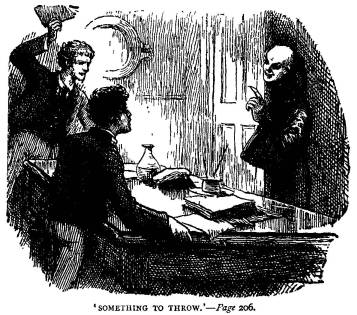
Barkins and I picked up each something to throw at the round, smooth, smiling face thrust in at the door, which was held close to the neck, so that we saw a head and nothing more.
“No flow thing at Ching,” the Chinaman said softly. “Offlicer don’t flow thing. Ching come in?”
“Yes,” said Barkins, “come in. What is it?”
Ching entered looking very important, and gave his head a shake to make his tail fall neatly between his shoulders, and drew the long blue sleeves of his gown over the backs of his hands till only the tips of his fingers, with their very long nails, were visible.
He advanced smiling at us each in turn, and bowing his round head like a china mandarin.
“You all velly good boy?” he said softly.
“Oh yes; beauties,” said Barkins. “What’s up?”
“You likee ask leave go for bit walkee walkee?”
“Don’t!” roared Smith. “Don’t talk like a nurse to us. Why don’t you speak plain English?”
“Yes; Ching speak ploper Inglis. No speakee pigeon Englis. All ploper. Interpleter. You likee go shore for walkee, see something?”
“You beggar, you were listening,” cried Barkins. “How long had you been there?”
“Ching just come ask young genelman likee walkee walkee.”
“Yes, allee likee walkee walkee velly much,” said Barkins, imitating the Chinaman’s squeak. “Why? Can you give us leave?”
Ching shook his head.
“Go ask offlicer. Go for walkee walkee, take Ching; you likee see something velly nice ploper?”
“Yes,” I cried eagerly. “Can you take us to see a Chinese theatre?”
Ching closed his eyes and nodded.
“You come ’long o’ Ching, I showee something velly nice ploper.”
“All right,” I cried. “Now, Tanner, go and try it on with the doctor.”
“No, no. Ask offlicer. Doctor only give flizzick. Velly nastee. Ugh!”
Ching’s round face was a study as he screwed it up to show his disgust with the doctor’s preparations.
Barkins went off and returned directly.
“Well,” we cried; “seen Price?” and Ching, who was squatted on the floor, looked up smiling.
“No.”
“Not seen him?”
“No; I ran against Dishy, and thought I’d ask him plump.”
“And you did?”
“Yes.”
“What did he say?”
“I know,” cried Smith; “that we were always going out.”
“That’s it exactly.”
“And he won’t let us go?” I said in a disappointed tone.
“Who says so?” cried Barkins, changing his manner. “The old chap was in splendid fettle, and he smiled,—now, now, don’t both of you be so jolly full of doubts. On my honour as an officer and a gentleman, he smiled and clapped me on the shoulder.”
“Yes, my lad, of course,” he said. “We shall be off again soon, and then it will be all work and no play again, and we mustn’t make Jack a dull boy, must we?”
“He’s going off his head,” said Smith.
“Let him go, then,” I cried, “if it makes him like this.”
“Don’t chatter so, Gnat,” cried Smith. “I say, did he really say we might go?”
“Yes; and that we ought to start at once before the day grew hotter, and that we were to take great care of ourselves.”
“Hurra!”
“And be sure and wash our faces and our hands before we started,” added Barkins.
“Get out; I can see where it joins,” I cried. “But did he say any more?”
“Only that we were to mind and not get into any trouble with the people, and that we had better take Ching.”
“Yes,” said that individual gravely. “Much better take Ching. Velly useful take care.”
“To be sure,” I cried, full of excitement at the idea of a run through the mazes of the quaint town, and the prospect of seeing a Chinese performance. “I say, Ching,” I cried, striking an attitude, “take us where you can give us a tune, ‘Ti—ope—I—ow.’”
“Yes; velly nicee music,” he said, nodding and smiling. “Ching takee see something velly good. You leady?”
“In five minutes,” cried Barkins. “Gnat, go and tell them to have the boat ready. Mr Reardon said we were to be rowed ashore.”
“Ching leady in five minutes,” said the interpreter, running towards the door.
“Eh? Why, you are ready,” said Smith.
“No. Go put on new blue silk flock. Leady dilectly.”
Ten minutes later we were being rowed ashore, to be landed at the wharf where we met with so unpleasant an attack a short time before. But there was no mob of idlers there now, and we stepped ashore, leaving the good-natured-looking crew smiling at us, and giving the shops many a longing look, as they pushed off and began to row back at once.
“Plenty time,” said Ching. “You likee fust go lestaulant—eatee, dlinkee, spend plize-money?”
“Can’t spend what we haven’t yet got, Ching,” said Barkins. “What do you say, lads? I’m hungry again, aren’t you?”
Smith sighed.
“I’m always hungry,” he said.
“Of course you are. I believe he’s hollow all through, Gnat. How do you feel?”
“As if I haven’t had any breakfast,” I said earnestly.
Ching smiled.
“Velly much nicee bleakfast all along o’ Ching.”
He led the way in and out among the narrow streets, apparently again as much at home as in his own city; and it was hard work to keep from stopping to gaze at the hundreds of objects which attracted and set me longing to make purchases to take home for curiosities. But Ching bustled us along.
“No time now. Come along get good bleakfast. Wantee good bleakfast before go to see gland show.”
“Here, what is it you are going to take us to see, Ching?” cried Barkins—“all right; I wasn’t talking to you,” he added, as a couple of Chinamen turned round to gaze at the young outer barbarian.
“You waitee,” cried Ching, smiling; “all velly ploper gland. You likee see the show.”
“Oh, all right. Where’s the restaurant?”
“Nex’ stleet,” said Ching; and after a few minutes he turned into a showy-looking eating-house, where his blue silk gown and long nails seemed to command the most profound respect from the attendants; and where, after laying down the law very stringently to Ching, that we were to have neither dog, cat, nor rat, we resigned ourselves to our fate, and ate birds’-nest soup, shark-fin, and a variety of what Barkins called messes, with midshipmen appetites.
Ching smiled, and seemed to be very proud of our performance.
“You all eat dlink velly much,” he said, as we gave up, defeated. “You all velly quite full?” he said, rubbing his hands carefully, so as not to injure his long nails.
“Yes, full up, and the hatches battened down,” cried Barkins. “Now then, ask for the bill. How much apiece?”
Ching smiled and nodded his head.
“You come have bleakfast ’long o’ Ching. Ching velly glad to see you; Ching pay.”
“What? nonsense!” cried Smith, while we others stared.
“Yes; Ching plenty money. Captain gave Ching plenty plize-money; make him velly happy to see young offlicer to bleakfast.”
“Oh, but we can’t let him pay for us, Smithy,” cried Barkins.
“No, of course not,” we chorussed.
“Ching velly much hurt you want to pay,” he said, with dignity.
“But—” I cried.
“You ask Ching bleakfast like Chinese genelman another time, make Ching velly glad. Come along, makee haste, see gland show.”
“But the bill isn’t paid,” I cried.
“Ching pay long time ’go,” he said, rising; and there was nothing for it but to follow him out and along three or four streets to where there was a dense crowd in front of a gateway in a high mud wall.
There were some soldiers there too, and Ching walked up full of importance, showed them some kind of paper, when one, who appeared to be their officer, spoke to those under him, and they cleared a way for us to pass to the gate.
Here Ching knocked loudly, and the gate was opened by another soldier; the paper was shown; and an important-looking official came up, looked at us, and made way for us to enter.
“It’s all right,” said Smith. “Ching knows the manager. It will be a private box.”
The official pointed to our left, and Ching led the way behind a kind of barricade where there were seats erected, and, selecting a place, he smilingly made us sit down.
“Ching know gleat mandalin,” he said. “Askee let come see gland show.”
“But what’s it going to be?” I asked, as I looked curiously round the square enclosure surrounded by a high wall, and with seats and pens on three sides. “I thought we were coming to a theatre!”
“No,” said Ching, smiling. “Velly gland show; wait.”
We waited, and saw that the space in front of us was neatly sanded, that posts stood up here and there. In other places there were cross bars, and in two there were ropes hanging.
“I know!” cried Barkins; “he needn’t make such a jolly mystery of it. It’s Chinese athletic sports. Look, there’s the band coming.”
He pointed to a military-looking party marching in with drums, gongs, and divers other instruments; and almost at the same time quite a crowd of well-dressed people entered, and began to take the different places reserved behind the barriers.
Then a body of soldiers, with clumsy spears and shields, marched in and formed up opposite the band, the place filling up till only the best places, which were exactly opposite to us, remained empty.
“You’re right, Tanner,” said Smith just then; “but they’re military athletic sports. I say, here come the grandees.”
For in procession about twenty gorgeously-arrayed officials came marching in, and the next moment I gave Barkins a dig in the ribs.
“Look,” I said.
“All right; I see. Well, we needn’t mind. But I say, what a game if we hadn’t got leave!”
“I say,” whispered Smith, “look over there. The skipper and old Dishy! This was where they were coming, then; they’ll see us directly.”
“Let ’em,” said Barkins, as the party settled themselves. “Now then, we’re all here. All in to begin. We ought to have a programme. Here, Ching, what’s the first thing they do?”
“Ching no quite sure; p’laps lichi.”
“Lichi?” I said.
“You don’t know? You see velly gland—velly ploper for bad, bad man.”
He turned away to speak to a Chinese officer close at hand, while we began to feel wondering and suspicious, and gazed at each other with the same question on our lips.
Ching turned to us again, and I being nearest whispered—
“I say, what place is this? What are they going to do?”
“Bring out allee wicked men. Choppee off head.”
Chapter Twenty Five.
The Entertainment.
I felt as it were a sudden jar run through me when I heard Ching’s words. It was as if I had been awakened by a sudden revelation. This, then, was the grand show he had contrived for us as a treat! It was all clear enough: our officers had been invited to the execution of the pirates we had taken, and conceiving, with all a Chinaman’s indifference to death, that we three lads, who had been present at their capture, would consider it as a great treat to be witnesses of the punishment awarded by the Government, Ching had contrived to get permission for us to be present.
I glanced at the Tanner, who had grasped the situation, and was screwing his face up so as to look perfectly unconcerned; but it was a dismal failure, for I could see a peculiar twitching going on at the corners of his eyes, and he passed his tongue rapidly over his lips and went through the action of swallowing as if his mouth and throat were dry.