"Blue Jackets" (continued 5)
Reading edition
I next looked at Smithy, whose eyes showed more white than usual, and whose complexion was of a sickly-green, just as I had seen it during some very rough weather we had going down the Channel on first starting for this voyage.
How I looked I have only Barkins’ word for, and he told me afterwards that I seemed as if I was waiting for my turn to suffer with the pirates.
After the sharp glance I gave at my fellows neither of us stirred, but sat there as if petrified. I was horror-stricken, and there was a strong impulse upon me to jump up and run out, but shame and the dread of being considered cowardly kept me in my place. In fact, as after-confessions made clear, we were absolutely stunned, and I don’t think we could have stirred had we made up our minds to go.
Then I felt dizzy, and the brilliant group of officials and military magnates and judges opposite to where we sat grew blurred and strange-looking in the bright sunshine.
At last I felt as if I must argue out the question, and with my teeth set firm, and my eyes fixed upon the sandy ground of the enclosure, some such thoughts as these ran through my brain— “It is only just that these men should suffer for their horrible crimes, for they are more dangerous than venomous serpents, and I suppose that Captain Thwaites and Lieutenant Reardon are obliged to come as a kind of duty; but we three came under the idea that we were to see some kind of exhibition, and old Ching did it out of kindness, not knowing of what kind of stuff we were made. I shan’t stop.”
There I paused to fight with other ideas.
“Tanner and Blacksmith will laugh at me and think I am a coward. Well, let them,” I said to myself at last. “It isn’t cowardice not to wish to see such a horror as this. I didn’t feel cowardly when they were shooting at us down in the creek, and it would be far more cowardly to sit here against my will without speaking. I will tell them I want to go.”
I should think that every lad of the age I then was, will pretty well understand my feelings, and what a bitter thing it was to turn and confess what they would jeer at and call “funk.” It was hard work indeed.
“I don’t care,” I muttered. “I know they’ll protest and say they don’t want to come, but be very glad to come away all the time. I will speak.”
Just then that horrible Chinaman turned to me with his round fat face, all smiling and delighted.
“You velly glad you come?” he said. “You feel velly happy?”
My mind was made up at this, and I spoke out.
“No,” I said in a husky whisper. “I didn’t know we had come to see this. I shall go.”
“What?” said Barkins, with a forced laugh. “Look here, Blacksmith, he’s showing the white feather.”
“Ho! ho!” laughed Smith. “Come, Gnat, I thought you had a little more spirit in you. Serve the beggars right.”
“Yes, I know that,” I said firmly enough now, as I looked at their faces, which, in spite of the masks they had assumed, looked ghastly; “and I daresay I haven’t pluck enough to sit it out. But I don’t care for your grins; I’m not ashamed to say that I shall go.”
“Oh, well, if you feel that it would upset you,” said Barkins, in a tone of voice full of protest, “I suppose that we had better see you off, and go somewhere else.”
“Poof!” ejaculated Smith in a low tone. “Look at him, Gnat; he’s in just as much of a stew as you are. Well, it’s too bad of you both, but if you must go, why, I suppose we must.”
“You beggar!” snarled Barkins angrily. “Why, you’re worse than I am. Look at him, Gnat! There, I will own it. I felt sick as soon as I knew what was going to happen, but I won’t be such a bumptious, bragging sneak as he is. Look at his face. It’s green and yellow. He wants to go worse than we do.”
Smith did not seem to be listening, for his starting eyes were fixed upon the far right-hand gate, over which there was a kind of pagoda, and he rose from his seat.
“Come on at once,” he whispered, “they’re going to begin.”
“Confessed!” whispered Barkins, pinching my knee. “Come on then quick, Gnat, old man; it’s too horrid.”
We all rose together, and were in the act of turning when a low hoarse murmur rose from behind, and we saw that a crowd of angry faces were gazing at us, and that they were nearly all armed men.
But before we had recovered from our surprise, Ching had caught my arm and pressed me to my seat.
“No go now,” he whispered, with a look of alarm in his face, and he leaned over me and dragged my companions down in turn. “No can go now. Allee gate fasten. Makee blave velly angly and dlaw sword; fightee fightee. Ching velly solly. Must stop now.”
There was a low hissing noise all about us, and threatening looks, while a fierce man in embroidered silk said something in his own tongue to Ching, who answered humbly, and then tamed to us and whispered—
“Small-button mandalin say make big-button peacock-feather mandalin velly angly. You no sit still. Sh! sh!”
“We must sit it out, boys,” I said, with a shudder; “but we need not look.”
My words were quite correct to a certain extent, but as my companions, who now looked more ghastly than ever, sank back in their seats, I felt compelled to gaze across to where I could now see a red table exactly facing me. Then a movement to the right caught my attention, and through the far gateway, and lowering it a little as he passed under the archway, rode an officer with a yellow silk banner, upon which were large black Chinese characters. Behind him came some more showily-dressed officials; and then, in a kind of sedan chair, one whom I at once saw to be the chief mandarin, for whom we had been waiting.
He was carried across to the front, where he alighted and walked slowly across to the red table, followed by sword, spear, and matchlock men, who, as he took his place at the table, ranged themselves on either side facing us, and completing a spectacle that, seen there in the bright light, strongly suggested the opening of some grand pantomime.
I remember thinking this, and then shuddering at the horrible thought, and at the same time I began wondering at the intense interest I could not help taking in what was going on.
Two more grandees in chairs of state followed, and then there was a pause. I could see that our officers were politely saluted, and that care was taken that no one should be in front of them. And now came the more exciting part of the terrible exhibition.
Suddenly there was the loud booming of a gong, and the head of an escort of spearmen marched through the gateway, followed by a group of men in twos, each pair bearing a long bamboo pole, from which, hanging in each case like a scale, was a large basket, and heavily chained in each basket was a man, whom we knew at once to be one of the pirates we had captured, without Ching whispering to us—
“Velly bad men, killee evelybody. They killee now.”
My eyes would not close. They were fascinated by the horrible procession; and I now saw, just in front of the bearers, a tall-looking bare-headed man carrying a large bright sword, curved in the fashion we see in old pictures of the Turkish scimitar, a blade which increases in width from the hilt nearly to the end, where it is suddenly cut off diagonally to form a sharp point.
Behind this man marched five more, the procession moving right to the front between us and the brilliant party whose centre was the principal mandarin.
I now saw, too, that every one of the miserable culprits was ticketed or labelled, a bamboo upon which a piece of paper was stuck being attached to his neck and head.
A low murmur ran round among the spectators, as, at a signal from the man with the great sword, who I saw now must be the executioner, the bearers stopped, and with a jerk threw the poles off their shoulders into their hands, bumped the baskets heavily down upon the ground, and shot the malefactors out as unceremoniously as if they had been so much earth.
I heard Barkins draw a deep breath, and saw Smith leaning forward and gazing wildly at the scene, while I felt my heart go throb throb heavily, and found myself wishing that I had not shared in the capture of the wretched men.
The chief mandarin then turned to the officer on horseback, who carried the imperial yellow flag, said a few words in a low tone, and he in turn pushed his horse a little forward to where the executioner was waiting, and evidently conveyed the mandarin’s orders.
Then suddenly the pirates, as if moved by one consent, struggled to their feet and began shouting.
Ching placed his lips close to my ear—
“Say, please no choppee off head. Velly bad men, killee lot always; velly bad.”
And now I felt that the time had come to close my eyes, but they remained fixed. I could not avert my gaze from a scene which was made more horrible by a struggle which took place between the first pirate of the long row in which they stood and the executioner.
The man shouted out some words angrily, and Ching interpreted them in my ear, his explanation being in company with a strange surging noise—
“Say he come back and killee him if he choppee off head. Oh, he velly bad man.”
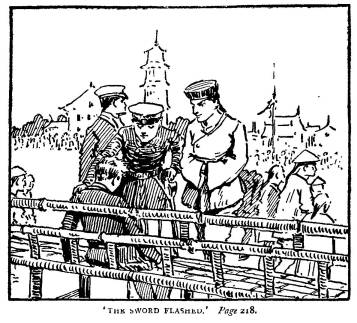
But quickly, as if quite accustomed to the task, two of the executioner’s assistants rushed at the pirate; one of them forced him down into a kneeling position; they then seized his long tail, drew it over his head and hung back, thus holding the pirate’s neck outstretched; lastly, I saw the executioner draw back, the sword flashed, I heard a dull thud—the head fell, and the body rolled over on one side.
Before I could drag my eyes from the horror there was the same terrible sound again, and another head fell upon the ground, while, with a rapidity that was astounding, the assistants passed from one culprit to the other in the long row, the miserable wretches making not the slightest resistance, but kneeling patiently in the position in which they were thrust, while whish, whish, whish, the executioner lopped off their heads at one blow.
“Allee done,” said Ching. “Execution man have velly much plactice.”
He said this to me, but I made no reply, for the whole place seemed to be going round and round.
“You thinkee they all come back again and have junk? Go kill shoot evelybody, pilate ghost-man?”
“No,” I said hoarsely; “can we go now?”
“Velly soon. Gleat clowd all along gate. Lookee, Mis’ Tanner go s’eep.”
These words roused me, and I turned to Barkins, who was lying back with his eyes nearly closed and looking ghastly, while Smith sat staring straight before him, with his hands grasping the seat on either side, in a stiff, awkward position.
“Here, Smithy,” I said, “quick, Tanner has fainted;” but he took no notice, and I whispered to him angrily—
“Get up. It’s all over now. Come and help me. Don’t let these horrible people see Tanner like this.”
He turned to me then, and let his eyes fall on our messmate.
“Can you get me a drink of water, Ching?” he murmured.
“Yes, d’leckly; wait lit’ bit. Po’ Mr Barki’ Tanner leg velly bad, makee sick. You’ alm velly bad still?”
“Very bad; it throbs,” murmured Smith.
“Ah, yes! Wait lit’ bit and no clowd. Ching take you have cup flesh tea, and quite well d’leckly. You not likee execution?”
I shook my head.
“Velly good job cut allee head off. No go killee killee, burn ship no more.”
“We’re not used to seeing such things,” I said weakly, as I supported Barkins to keep him from slipping to the ground.
“You no go see execution when Queen Victolia cut off bad men’s head?”
I shook my head.
“Ah, I see,” said Ching. “Me tink you have velly gleat tleat. But I see, not used to see. Velly blave boy, not mind littlee bit next time.”
“What’s the matter? Don’t, doctor. It’s getting well now.”
It was Barkins who spoke, and his hands went suddenly to his injured leg, and held it, as he bent over towards it and rocked himself to and fro.
“Throbs and burns,” he said, drawing in his breath as if in pain. “I—I—”
He looked round wildly.
“I remember now,” he said faintly. “Don’t laugh at me, you chaps. I turned sick as a dog as soon as that butchering was over. I never felt like this over the fighting. I say, Gnat, did I faint right away?”
“Yes, dead!” I said; “I was nearly as bad.”
“Enough to make you. But oh, my leg, how it does sting! I say, isn’t it queer that it should come on now? Did the fainting do it?”
“I dunno,” said Smith hastily, “but my arm aches horribly. I say, do let’s get away from here, or I shall be obliged to look over yonder again.”
“Yes, I’m all right again now,” said Barkins quietly. “Let’s get away. I say, lads, it’s of no use to be humbugs; we did all feel precious bad, eh?”
We looked at each other dolefully.
“Yes, let’s get away,” I said. “I thought we were coming out for a jolly day.”
Barkins shuddered and now stood up.
“Yes,” he said; “I hope the skipper liked it. Can you see him now?”
“Skipper? Cap’n?” said Ching, whose ears were always sharp enough to catch our words. “Gone along, Mr Leardon. Make gland plocession all away back to palace. You go sail, soon catch more pilate.”
“I hope, if we do,” said Smith, “that we shall not bring back any prisoners.”
The enclosure was thinning fast now, as we walked toward the gateway by which we had entered, where a strong body of soldiers had been on guard over the barricades, in case of an attempt being made by the pirates’ friends to rescue them, and we saw plainly enough that had we wanted there would have been no getting away.
“You likee go in and see plison?” said Ching insinuatingly. “Plenty bad men lock up safe.”
“No, thank you,” I said eagerly. “Let’s get out of this, and go and have some tea.”
“Yes, plenty tea. Ching show way.”
The Chinese soldiers stared at us haughtily as we walked by, and I drew myself up, hoping that no one there had witnessed our weakness, for if they had I knew that they could not feel much respect for the blue-jackets who hunted down the scoundrels that infested their seas.
Both Barkins and Smith must have felt something after the fashion that I did, for they too drew themselves up, returned the haughty stares, and Barkins stopped short to look one truculent savage fellow over from head to foot, especially gazing at his weapons, and then, turning coolly to me, he said, with a nod in the man’s direction—
“Tidy sort of stuff to make soldiers off, Gnat, but too heavy.”
The man’s eyes flashed and his hand stole toward his sword hilt.
“’Tention!” roared Barkins with a fierce stamp, and though the order was new to the guard, he took it to be a military command and stepped back to remain stiff and motionless.
“Ha! that’s better,” cried Barkins, and he nodded and then passed on with us after Ching, whose eyes bespoke the agony of terror he felt.
“Come long quickee,” he whispered excitedly. “Very big blave that fellow. Killee—fightee man. You no ’flaid of him?”
“Afraid? No,” said Barkins shortly. “There, let’s have this tea.”
Ching glanced round once, and we were about to imitate his example, but he said excitedly—
“No, no, don’t lookee. Big blave talkee talkee soldier, and tink Inglis offlicer ’flaid. Walkee past.”
He led us as quickly as he could get us to go towards the tea-house he sought, and I must own that I was only too anxious about the Chinese guards to help feeling in a good deal of perturbation lest they should feel that they had been insulted, and follow us so as to take revenge. Hence I was glad enough to get within the tea-house’s hospitable walls, and sat there quite content to go on sipping the fragrant infusion for long enough.
I suppose we were there quite an hour and a half drinking tea, until we were satisfied, and then passing a look round to draw attention to our interpreter, who sat back with his eyes half closed, sipping away cupful after cupful, till Smith whispered to me that he thought he had kept correct account.
“How many do you think Ching has had?” he whispered.
“Don’t know; nearly a dozen?”
“Fifty-three, or thereabouts,” whispered Smith.
But I did not believe him, and I do not think he believed himself.
“Now, you likee go ’long see somethin’ else?” said Ching, when he had really drunk tea enough.
“Yes,” said Barkins, “I feel ready. What do you say to going to see the Teaser, lads?” he continued.
“I’m willing,” said Smith. “I want to lie down.”
“You ready, Gnat?”
“Oh yes,” I replied. “I don’t feel as if I could enjoy anything to-day.”
“Right, then. No, Ching; back on board ship.”
“You go velly soon? Now?”
“Yes, directly.”
Ching smiled—he had a habit of smiling at everything nearly, and we paid our reckoning and followed him down to the landing-place, to arrive there just in time to see the barge with the captain and his escort gliding rapidly away toward the ship.
“Too soon findee boat,” said Ching. “Tellee man come when sun go out of sight.”
“Yes, and that means two hours good,” said Barkins. “Look here, Ching, hire a boat cheap. Get a fellow with a sailing-boat, if you can.”
“Yes,” said the Chinaman, nodding his head in a satisfied way, “Good boat—velly nice boat—boat with velly big sail fly over water, eh?”
“Yes, that’s it,” said Barkins. “And look sharp, for there are a lot of low blackguardly-looking fellows coming up, and we don’t want another row.”
Barkins was quite right, for, as in our own seaports, there were plenty of roughs about, and whether in blue frocks and pith boots or British rags, the loafer is much the same. Ching saw at a glance that the sooner we were off the better, and hurried us a little way along the wharf till he saw a boat that seemed suitable.
“You all get in velly quick,” he said.
“But we must make a bargain with the man.”
“Plesently,” he replied, as we hurried in, and he ordered the man in charge to put off.
The man began to protest volubly, but Ching rose up, and with a fierce look rustled his new coat and sat down again, with the result that the man loosened the rope which held his boat to the side, and the swift tide began to bear us away directly, the man hoisting up a small matting-sail and then meekly thrusting an oar over, with which to steer.
“Why, what did you say to him, Ching?” I asked; and the interpreter smiled, and wrinkled up his eyes till he resembled a piece of old china on a chimney-piece.
“Ching say velly lit’ bit; only shake his new coat till common man see it silk. He feel velly much flighten all a same, as if big-button mandalin get in him boat.”
“And what shall we have to pay him?”
“P’laps nothing ’tall.”
“Oh, nonsense!” I said. “We must pay him the proper fare.”
“Velly well, pay him ploper money.”
I anticipated trouble, but when we got to the side and a dollar was handed to the man, his heavy round face lit up with pleasure, and he said something aloud.
“What does he say, Ching?” I asked.
“Say velly glad, and didn’t tink he get anything ’tall.”
We made the best of our way below, fully expecting that, if the captain and Mr Reardon saw us, they would take us to task for being at the execution, and ask; us how we dared to follow them there. But, as luck had it, they had been too much occupied by the horrible affair in progress, and our presence had escaped them. But it was a long while before I could get the scene out of my head or think of our trip ashore that day as anything but a horrible mistake.
Chapter Twenty Six.
“Man Overboard.”
It was a great relief to us all to find that our visit to the Chinese prison had not been noticed. We of course kept silence about it, not even telling Mr Brooke, who was the most friendly of our officers, and we had the satisfaction of finding that Ching obeyed our orders, and kept his peace.
I used to be rather sorry for him, his position being so solitary on board. For he could not make himself at home with the sailors in the forecastle, and though as frank, good-hearted fellows as ever lived, they seemed to look upon him only in one way, that of being a butt for their sharp witticisms, an object upon whom they were to play practical jokes.
Consequently I used often, when I found him standing alone by the bulwarks watching the shore, to edge up to him, and stop to talk; our conversation being directed by me toward some little unpleasantry in the forecastle, which if he had complained about to the first lieutenant, there would have been a severe reprimand.
I remember one of these occasions, when Ching came flying up out of the hatch, followed by a roar of laughter, and as he reached the deck, clang-clang went something against the sides of the hatch; but Ching paid no heed, running forward till he was right up by the side of the bowsprit.
I followed quickly, feeling angry on the man’s behalf.
“What’s the matter?” I cried. “What have they been doing?”
“No know,” he said rather pitifully, as he stood there trembling. “Done something. Thlow tin-kettle after.”
“But what for? What were you doing?”
“Doing? fass ’sleep, dleam ’bout big fly come and bite leg. Jump up and lun. Then thlow kettle after.”
“Here, let’s look,” I said; for as he shook his head there was the same hollow sound again, just like that made by a tin sheep-bell.
“Why, they’ve tied it to you,” I said sharply.
“Tie to Ching flock? Don’t matter. Not bess blue silkee.”
“Here, let me see,” I cried. “Turn round.”
He turned sharply, and something banged against the bulwark.
“What a shame!” I cried. “They’ve tied the old canister to your tail.”
“Tie canny all along Ching tow-chang?” he cried.
“Yes, and it’s a rascally shame.”
“Yes, allee lascally shame,” he said, nodding his head. “Not hurt velly. Only flighten velly much, makee lun fass.”
“Stand still, and I’ll soon have it off,” I cried, whipping out my knife.
“No, no,” he cried, dragging the long plait from my hand; “mightee cut tow-chang, and that velly dleadful. Take long time glow.”
“Very well, then. I’ll unfasten it, and show it to Mr Reardon.”
“What for? make Mis’ Leardon velly angly, scold jolly sailor boy. Then they not like Ching ’tall.”
“But it’s too bad; treating you just as if you were a dog.”
“Jolly sailor boy tie tin-pot dog tow-chang? No. Mr Hellick make laugh. Dog not got tow-chang.”
“No,” I said, trying very hard to get the pot off, “but dogs have got tails.”
“Yes, got tails. Don’t tellee, make no good. Didn’t hurt Ching.”
“But it’s an insult to you,” I said. “Any one would think they were a pack of boys.”
“Yes, jolly sailor boy. You no makee come off?”
“No,” I said. “They’ve made a big hole through the bottom of the canister, pushed the end of the tail—”
“Tow-chang.”
“Well, tow-chang, if you like to call it so—through into the inside, and then hammered the tin back round it and made it as fast as fast. Here, I shall have to cut it, Ching.”
“No, no,” he cried, seizing the canister. “No cuttee piece of tow-chang.”
“Then how are we to get it off?”
“Don’t know, Mr Hellick; look velly bad?”
“Horrible—absurd; every one will laugh at you.”
“Yes, velly bad. Ching put it in pocket.”
“Oh, you’re there, are you?” I cried, as Tom Jecks came cautiously on deck. “I should have thought that a man of your years would have known better than to help torment this poor Chinaman.”
“Not velly poor,” he whispered. “Ching got fancee shop. Plenty plize-money now.”
“Didn’t have nought to do with it,” growled Tom Jecks.
“Then who did, sir?”
“Dunno, sir; some o’ the boys. I was caulking till they wakened me wi’ laughing.”
“But you saw it done?”
“No, sir; it was all done aforehand. They’d turned his tail into a bull-roarer, and if you was to swing it round now like a windmill, it would make no end of a row.”
“Silence, sir,” I cried. “It’s disgraceful.”
“Lor’, sir, they on’y meant it for a bit of a lark.”
“Then they should lark among themselves, and not take advantage of a poor foreigner whom they ought to protect.”
“Yes, sir, that’s right enough. But he were asleep, and it didn’t hurt him till one on ’em stuck a pin in his leg to waken him up.”
“Ah!” I cried. “Who did?”
“Well, sir,” said Tom Jecks. “Now you do puzzle me above a bit. It was one o’ the lads, because the pin must have gone into his leg, for he squeaked out and then run up the ladder with the tin-pot banging about right and left, but who it was stuck that pin in, it were so dark that I couldn’t say.”
“You mean that you won’t say, Tom?”
“Well, sir, you’re orficer, and I’m on’y AB, and I shan’t contradict you; have it that way if you like.”
“I shall say no more, but we’ll see what Mr Reardon says when he hears about it.”
“Why, Mr Herrick, sir, yo’ wouldn’t go and tell upon the poor lads, would you? It were on’y a bit of a game, were it, Mr Ching?”
“No, only bit game,” said the Chinaman.
“There, you hear, sir. There wasn’t no bones broke.”
“Hold your tongue, sir.”
“Cert’n’y, sir.”
“And come here.”
Tom Jecks stepped forward obsequiously.
“Look, the tin sticks all round fast into the tail as if it were a rabbit trap.”
“Ay, sir, it do; and if I might say so, they managed it very cleverly.”
“Cleverly?”
“Yes, sir. If I’d been doing it, I should on’y have thought of tying it on with a bit o’ spun-yarn; but this here tin holds it wonderful tight.”
“How are we to get it off?”
“Oh, I can soon get it off,” cried Tom Jecks, who seemed to be imbued with the same notion as Alexander of old, who unsheathed his sword to cut the Gordian knot. For he hauled out his knife by the lanyard, opened the blade with his teeth, and took a step forward, but Ching held the canister behind him and dodged round me.
“Steady, my lad,” growled Tom Jecks, “it arn’t a operation. Stand by.”
“No, no, no!” shrieked Ching.
“Steady, my lad, I’ll soon have it off. I won’t cut down to the bone.”
“No, no!” cried Ching, who was excited and alarmed, and who now began chattering in his own tongue, all pang ang nong wong ong, and a series of guttural sounds, while I could do nothing for laughing, but had to stand like a post for Ching to dodge behind.
“Why don’t you stand by, messmate?” growled Tom Jecks. “You can’t go through life with that there tin-kettle tied to your tail. Fust one as see yer will be calling, ‘Mad dog.’”
By this time the watch had come to see what was going on, and I now began to feel sorry for the Chinaman.
“Here, Ching,” I said. “Come down below.”
But he was too much alarmed for the moment to listen to my words, expecting every moment as he was that some one would make a snatch at his tail, to obviate which accident he was now holding the canister tightly beneath his arm, and looking wildly round for a way to escape.
“Hadn’t we better have it took off, sir?” said Tom Jecks, and there was a roar of laughter. “Let’s ketch him and take him to the doctor.”
“No, no!” cried Ching, dodging round me again, for Tom Jecks, to the delight of the others, made a snatch at him.
“You’ll be a deal more comfortable, messmate—you know you will. Here, let’s have it?”
Tom Jecks made another snatch at him, but Ching avoided it, and to save him from further annoyance I too made a snatch.
Poor fellow, interpreter though he was, he misinterpreted my intentions. He tore away from my grasp and made a rush forward, but several men were coming in that direction, and he dashed back to find himself faced by Tom Jecks again. In his desperation he charged right at the sailor, lowering his head as he did so, and striking him with so much force that Tom Jecks went down sprawling, and Ching leaped over him.
There was no way open to him for escape, as it seemed, and he made a rush for the side, leaped up, was on the bulwarks in an instant, and made a snatch at the foremast shrouds as if to climb up into the rigging, when either his foot slipped or his long loose cotton jacket caught in something, I don’t know how it was, but one moment I saw him staggering, the next there was the terrible cry of “Man overboard” raised as I rushed toward the side, heard the splash, and got upon the bulwark in time to see the agitated water.
That was all.
It was rapidly getting dark, the tide was running swiftly seaward, and even if the Chinaman could swim it seemed very doubtful whether he could maintain himself long, hampered as he was by his loose clinging clothes.
But at the raising of the cry, “Man overboard,” there is not much time lost on board a man-of-war. A crew leaped into the boat; the falls were seized; and in a minute the keel touched the water, and I found myself, as I stood on the bulwark holding on by a rope, called upon to direct those who had gone.
“Which way, sir? See him?”
I could only answer no, and then reply to Mr Reardon, who came up panting.
“Who is it?” he cried. “Mr Herrick?”
“No, sir, I’m here,” I shouted. “It’s the interpreter.”
“And what business had he up on the hammock-rail?” roared the lieutenant as he climbed up there himself. “Steady, my lads, he can’t be far.”
At that moment there was a flash, and a brilliant blue-light burst out on the surface of the black water, sending a glare all round from where it floated on the trigger life-buoy, which had been detached and glided away astern, while directly after a second blue-light blazed out from the stern of the boat, showing the men dipping their oars lightly, and two forward and two astern shading their eyes and scanning the flashing and sparkling water.
“Can’t you see him?” roared the lieutenant.
“No, sir.”
We leaped downward, hurried right aft where the captain and the other officers were now gathered, and the orders were given for a second boat to be lowered and help to save the poor fellow.
“He ought to float, sir,” said Mr Reardon in answer to some remark from the captain. “He’s fat enough.”
Then he began shouting orders to the men to row to and fro; and my heart sank as I vainly searched the lit-up water, for there was no sign of the unfortunate Chinaman.
“What a horrible ending to a practical joke!” I thought, and a bitter feeling of disappointment assailed me, as I asked myself why I had not gone in the second boat to help save the poor fellow.
Perhaps it was vanity, but in those exciting moments I felt that if I had been there I might have seen him, for it never occurred to me that I had a far better chance of seeing him from my post of vantage high up on that quarter-deck rail.
“See him yet?”
“No, sir!”—“No, sir!”
The first hail loudly from close by, the other from far away where the blue-lights shone.
“Bless my soul!” cried Mr Reardon, with an angry stamp. “I can’t understand it. He must have come up again.”
“Unless his pockets were heavily laden,” said the captain, going to where Mr Reardon stood. “These men carry a great deal about them under their long loose clothes. Some heavy copper money, perhaps. A very little would be enough to keep a struggling man down.”
“Ha!” ejaculated Mr Reardon, while I shivered at the idea of poor old Ching coming to so terrible an end.
“A glass here!” cried Mr Reardon, and one was handed up to him.
“Try the life-buoy,” cried the captain.
“Bless me, sir, I was going to,” retorted the lieutenant irritably; “but the idiot who uses this glass ought to be turned out of the service for being short-sighted. I shall never get it to the right focus.”
The captain gave a dry cough, and I turned round sharply, expecting to hear some angry exclamation.
“No,” cried Mr Reardon, “he is not clinging to the life-buoy. I wouldn’t for anything that it should have happened. Poor fellow! Poor fellow!”
“Ay, poor fellow!” muttered Captain Thwaites. “Any use to lower another boat, Reardon?”
“No, sir, no,” cried the lieutenant, “or I would have had one down. Ahoy there!” he roared. “Light another blue!”
“Ay, ay, sir!” came from far away, for the tide ran hissing by our sides in full rush for the sea, and the third blue-light which blazed out looked smaller and smaller, while those of the first boat and the life-buoy began to show faint, and then all at once that on the buoy seemed to go out.
“That blue-light ought to have burned longer on the buoy,” cried Mr Reardon.
“They’ve picked up the buoy and laid it across the bows of the boat,” said Mr Brooke, who was watching through his night-glass, and at that moment the light blazed out again like a star.
And still the halos shed by the lights grew fainter and fainter. Then one light burned out, and the lieutenant stamped with anger, but there was no cause for his irritation. Another flashed out directly.
The boats were too far away now for us to see much of what was going on, the heads of the men growing blurred, but we saw that they were zig-zagging across the tide, and we listened in vain for the hail and the cheer that should accompany the words—
“Got him, sir!”
The buzz of conversation among the men, who clustered on deck, in the shrouds and tops, grew fainter, and I was thinking whether I was very much to blame, and if I could in any way have saved the poor fellow. Then I began thinking of the men in the forecastle, and their punishment for being the cause, in their boyish way of playing tricks, of the poor Chinaman’s death.
I wouldn’t be Tom Jecks for all the world, I muttered, and then I turned cold and shuddered, as the hope, faint though it was, of Ching being picked up went out like one of the lights that now disappeared; for Captain Thwaites said sadly—
“I’m afraid we must recall the boats, Mr Reardon.”
“Yes, sir,” said the lieutenant in a husky voice. “I don’t think any one is to blame about the attempt to save the poor fellow, sir. The life-buoy was let go, and the boat lowered promptly; the dishipline of the men was good.”
“Excellent, Mr Reardon. I have nothing to say there. It would have been better perhaps to have lowered down the second boat sooner. But I think we have done our best. Can you make them hear from this distance?”
“Yes, I think so; a voice will travel far over the smooth water on a still night like this. Shall I recall them?”
Captain Thwaites was silent for a full minute, and we all stood gazing aft at the faint stars on the black water, while to right and left were those that were more dim and distant, being the paper lanterns of the house-boats moored a short distance from the bank.
Then the captain spoke again, and his words re-illumined the parting light of hope which flashed up like an expiring flame.
“Do you think he has struck out straight for the shore?”
“He may have done so, sir,” replied Mr Reardon, as we all stood in a knot together on the quarter-deck, “but he could never have reached it.”
“Not in this mill-race of a tide!” said Captain Thwaites. “Recall the boats.”
But Mr Reardon made no sign. He stood there gazing through the night-glass for some moments, and the captain spoke again.
“Recall the boats, Mr Reardon.”
“I beg your pardon, sir,” said the lieutenant, with quite a start. “Aloft there! Who’s in the foretop?”
“Ay, ay, sir; Jecks, sir.”
I shivered.
“Hail the boats to come back.”
The man did not answer for a moment, and Mr Reardon made an angry gesture, but just then Tom Jecks, with his hands to his mouth, sent forth a hoarse deep-toned roar.
Then there was a pause and a faintly-heard hail came from far away, the zig-zagging movement of the boats ceased, and we saw one of them, that is to say one of the lights, glide slowly toward the other, till one was apparently only a short distance in front, and the other following.
“Let me know when the boats come alongside, Mr Reardon,” said the captain quietly.
“Yes, sir.”
“And, by the way, I’ll trouble you for my night-glass.”
Mr Reardon gave a violent start.
“Your night-glass, sir?” he said.
“Yes, mine; you borrowed it.”
The lieutenant handed the telescope without a word, and at another time we should all have had to turn away to smother the desire to burst out laughing, as we recalled the irritable remarks about the idiot to whom the glass belonged, and the wretchedness of his eyesight, coupled with an opinion that he ought to be dismissed the service.
But it was not a time for mirth: we were all too sad, and Barkins contented himself with whispering—
“I say, I’m jolly glad it wasn’t I who said that. Don’t the skipper take it coolly now? But he’ll give old Dishy a talking-to for it when he gets him alone.”
Mr Reardon’s face was not visible to us, but we could see his movements, which were, so to speak, fidgety, for he began to walk up and down hastily, and once or twice I heard him mutter—
“How could I be such a fool?”
A dead chill had settled down upon the ship, and I felt as I stood there as if eight or nine years had suddenly dropped away from me—that I was a little child again, and that I should like to creep below somewhere out of sight, or sit down and cry and sob.
For it was such a horrible lesson to me of the nearness of death, and I felt as if it was impossible for it all to be true—that it must be some terrible dream.
And now for the first time it dawned upon me that I had a liking for the strange, simple-hearted Chinaman, who had always shown himself to be frank, honest, and brave in our service. He had been comic and peculiar, but always devoted to me as a faithful servant; and now, just too as I was joining in the mirth against him, instead of being indignant on behalf of one who had been insulted by the men’s horseplay, he was as it were snatched from life to death.
I was brought back to the present by a voice at my ear—
“Poor old Ching! I am sorry, Gnat.”
“Yes, and so am I.”
I had not seen my messmates all through the trouble, and now they appeared close to me in the darkness in a way which made me start.
I turned to them, and I don’t know how it was, but as we three stood there in the darkness, which was hardly relieved by a lantern here and there, Barkins held out his hand and shook mine, holding it tightly without letting go. Directly after, Smith took my other hand to give it a warm, strong pressure; and then we three parted without a word more, Barkins going one way, Smith another, while I went to the stern rail and leaned my arms upon it, and then rested my chin upon my arms to gaze out over the rushing water at the two blue stars.
But they were not there now. They had burned out some time before, and I could see nothing, only take it for granted that the boats were being slowly rowed back against the heavy tide, our anchor-lights acting as their guide.
“Is it possible that they have found him after all?” I thought, and for a minute I was hopeful. But once more the hope died out, for I knew well enough that if they had picked the poor fellow up they would have cheered.
Chapter Twenty Seven.
A Surprise.
That night had set in very dark. The clouds were heavy overhead, and the river now looked intensely black, but toward the shore there were the dull lights of the Chinese town glimmering in the water, while from some building, whether on account of a religious ceremony or a festival, a great gong was being beaten heavily, its deep, sonorous, quivering tones floating over the place, and reaching my ears like the tolling of a church bell.
It only wanted that depressing sound to make my spirits at the lowest ebb, and set me thinking of home, the perils of the career in which I was engaged, and wondering whether I should ever see England again.
The watch had been set, and from time to time Mr Reardon came aft to look anxiously astern.
The last time Mr Brooke was with him, and they stopped near where I was standing.
“But they ought to be back by now,” Mr Reardon said.
“It’s a long pull,” Mr Brooke replied, “and the tide is terribly sharp at this time.”
“Yes, yes—it is; but I want to see them back. Who’s that?”
“Herrick, sir.”
“Oh! Looking out for the boats?”
“Yes, sir.”
“That’s right. I like to see a young officer take an interest in the men.”
They moved away to walk forward, while my face burned, for I did not deserve the praise, and my words had not been quite so honest as I could have wished.
All at once, from out of the blackness astern, I heard the regular dip of oars, and at the same moment one of the watch challenged and received an answer. A minute later they were close up, and I shouted—
“Found him?”
“No, sir; not a sign of him anywhere.”
I uttered a low groan, and the boats separated, one going to starboard and the other to port, to be hauled up to their quarters, and there was the customary trampling of the men going to their positions to run them up.
“Poor old Ching!” I said aloud; and then I started back as if I had received a stroke, for my name was uttered from below in a sharp whisper.
“Mister Hellick! Mister Hellick!”
“Ching!” I cried, leaning over as far as I could reach, and gazing down at the water. “Help!—help!” I shouted. “Here he is!”
Mr Brooke ran to me.
“What do you mean, my lad?”
“He’s down here,” I cried, “clinging to the chains.”
“Nonsense! the boats would have seen him.”
“But he is,” I cried. “He has just called me. Below there! Ching!”
“Yes; help! Velly cold,” came up in a piteous wail.
“Hold hard there!” shouted Mr Brooke. “Port boat back here under the counter.”
The falls were unhooked, and the boat drawn back by the coxswain till she passed round close to the rudder.
“Any one there?” cried Mr Brooke.
“Ay, ay, sir!” and a cheer broke out from the men hurrying aft.
“Help! help!” came in a sharp wail. “No cut tow-chang! No cut tow-chang!”
“Nobody’s going to cut it, my lad. All right, we’ve got you,” came up from close under the stern windows, where even if it had been light we could not have seen.
“Found him?” cried the captain, who now came up.
“Ay, ay, sir! Will you lower us down a lantern, sir? He’s tied up somehow to the chain and a ring-bolt. We can’t quite lee.”
The next minute, as I stood there longing to lower myself down into the boat, a lantern was swung over to them; while the men came swarming up the hatchway, for the news had soon spread, and they came running as far aft as they dared.
“Now then, steady,” came from beneath us. “Let go; we’ve got you, I say.”
“No cuttee tow-chang! No cuttee tow-chang!”
“Then he must have caught at the rudder-chains as he was swept along the side,” said the captain. “Why didn’t the fellow hail us, instead of letting the boats go on such a fool’s errand?”
“Too much scared, sir,” replied Mr Reardon. “Below there! Got him in the boat?”
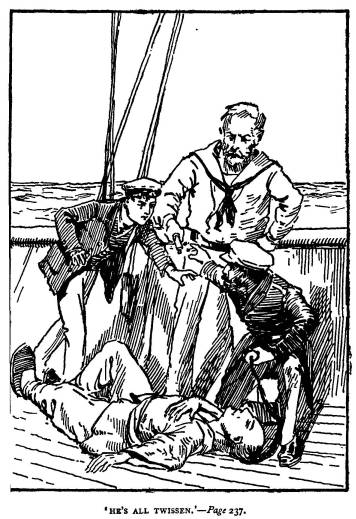
“Got him, sir, and we can’t get him,” said one of the men. “He’s all twissen up round the chain in a knot somehow.”
“What?”
“He’s tied hisself up somehow.”
“Well, then, cut him loose, man,” cried Mr Reardon.
“No cuttee tow-chang! No cuttee tow-chang!” cried Ching in a piteous wail.
“Not cut his toe?” said the captain in a tone full of disgust. “What does he mean? He can’t have tied his foot to the chain.”
“Hold still, will yer!” growled a deep voice; “I’m only untwisten on it. Nobody wants to cut yer pigtail.”
“Oh, no cuttee tow-chang!” wailed Ching piteously.
“Tow-chang?” said the captain.
“Yes, sir; his tail,” I said.
“Oh, I see! They’re very proud of the length.”
“Well, I’m blessed if ever I see such a snarl,” cried the man below. “That’s it. There you are. Here, cut this hankychy thing.”
“Got him now?”
“Ay, ay, sir! all right,” came from the boat; and at this the men burst out cheering again like mad, while the boat was drawn along the side with difficulty till the falls were reached, hooked on, and with a stamp and a run she was hauled up, and I was close up to the side as she was swung in, and Ching lifted out dripping, and sank down in a heap as soon as the men tried to set him on his feet.
“Here, let me have a look at him,” said the doctor.
“But first of all, why did you cling there instead of calling for help?” cried Mr Reardon angrily.
“Bah! don’t worry the man, sir,” said the doctor sharply. “He’s nearly insensible. What’s this canister doing at the end of his tail?”
“Bah!” ejaculated the captain angrily, and he said something to Mr Reardon, and then went down to the cabin.
“Look here,” cried the lieutenant angrily, “I want the names of the men who played this blackguardly trick upon the poor fellow.”
“Yes, afterwards,” said the doctor. “He’s insensible, poor fellow. Here, one of you, a knife?”
Half-a-dozen jack-knives were opened and presented to the doctor, but I sprang forward.
“Don’t do that, sir, please!” I cried excitedly.
“Eh? Not cut off this absurd thing?”
“No, sir. The poor fellow went overboard to escape having the pigtail cut, and it would break his heart.”
Mr Reardon turned upon me sharply, and I anticipated a severe reproof, but he only gave me a nod.
“Carry him below,” he said. And I walked beside the men to save the poor fellow from any fresh indignity, while half-an-hour later he had had a good rubbing and was lying in hot blankets fast asleep, partly from exhaustion, partly consequent upon having had a tumbler of mixture, steaming and odorous, which the doctor had administered with his own hands.
“Not to be taken every three hours, Herrick,” he said, with a curious dry smile. “Fine mixture that, in its proper place. Know what it was?”
“It smelt like grog, sir,” I replied.
“Oh, did it? Now, do you for a moment suppose that when a carefully-trained medical man of great experience is called in to a patient suffering from shock and a long immersion he would prescribe and exhibit such a commonplace remedy as grog?”
“Don’t know, sir,” I said. “But I should.”
“Then, my good lad, as soon as you get back from this unpleasant voyage, the best thing you can do will be to go straight to your father and tell him that you have made a mistake in your vocation, and that he had better enter you for a series of terms at one of the universities, and then as a student at one of the hospitals.”
“But I’m going to be a sailor, sir.”
“Yes, a bad one, I daresay, my lad, when you might become a good doctor or surgeon.”
“But I don’t want to be one,” I replied, laughing.
“Of course not, when it is the grandest profession in the world.”
“But do you think he will come round all right, sir?” I said anxiously.
“Oh yes, of course. But you are not going to let that absurd thing stop on the end of his tail?”
“No, sir,” I replied. “I’m going to try and get it off directly.”
“How?”
“Lay it on a stool and stamp upon it.”
“Good! that will flatten it and make the opening gape.”
It did, after the exercise of a fair amount of pressure; and then, by the help of Tom Jecks, who was wonderfully penitent now, and eager to help with a tool he brought—to wit, a marlinespike—the star-like points of tin were one by one forced out, and the tail withdrawn uninjured, except that the silk ribbon at the end was a good deal frayed.
“Ha!” ejaculated Tom. “We’ve made an end of it at last. My word, Mr Herrick, sir, it’s truly-thankful-Amen I am that the poor chap’s all right again.”
“And so am I, Tom Jecks,” I replied.
“O’ course you is, sir; I never meant to cut his tail, only to frighten him a bit; but, poor heathen, he took it all as serious as seas. Shall I go and chuck the tin-can overboard?”
“No; leave it here for him to find when he wakes up.”
“Right it is, sir. But what a fuss for a man to make about a bit o’ hair. He never howls about having his head shaved.”
“No,” I said; “but you see he would have given anything sooner than have his tail touched.”
“And most got drownded, sir. Well, that all come o’ the lads skylarking. If ever I’m skipper of a ship, no skylarking then. I s’pose there’ll be a reglar hooroar in the morning, and Mr Reardon wanting to know who started the game.”
“And you’ll tell him, Tom?” I said.
“O’ course, sir,” he replied, with a solemn wink. “I’m just the man to go and split upon my messmates.”
“But you’ll be punished if you don’t tell. You can’t get out of it, because it’s known that you were teasing him; and it wouldn’t be fair for you to be punished and for them to escape.”
“No, sir, it wouldn’t; but sech is life. Wrong chap generally gets the kick as some one else ought to have ketched, but ’tarn’t your fault, and it’s no use to grumble.”
“But it is your fault, if you know who were the offenders and will not tell.”
“Is it? Humph! S’pose it is, sir. You’re right. That’s where you gents as is scholards gets over the like of me. I see it now; you are right, sir. What a wonderful head you’ve got for arguing, sewerly!”
“Then you’ll tell Mr Reardon in the morning?”
“I didn’t say as I would, sir.”
“No; but you will?”
“No, sir, but I won’t!” he said emphatically. “But I say, sir, do you think if I was to go overboard, and then hitch myself on to the rudder-chains till I was took aboard, the doctor’d give me a dose of that same physic as he give him?”
“Very likely, Tom,” I said. “But you’d rather be without, wouldn’t you?”
He smiled.
“But it was physic?”
“Oh yes, sir, it was physic. But then you see there’s physic as he takes out of one of his little bottles with stoppers, and there’s physic as he makes out of the ship’s rum, hot with sugar. I could take a dose now easy, and it would do me good.”
“Nonsense!” I said, after a glance at the sleeping Chinaman. “But I say, Jecks, how did he manage?”
“Oh, easy enough, sir. Tide would suck him right along the side, and he’d catch the chains.”
“But how did he get in such a tangle?”
“Tied hisself on, sir, with a handkerchy round his left arm, to the chain; and then Dick Spurling says he twissened his tow-chang, as he called it, round and round, and tucked the canister in at the neck of his frock and buttoned it. Dick had no end of a job, as you know, to get him undone.”
“Yes,” I said thoughtfully, “I know that; but a man couldn’t hang by his hair.”
Tom Jecks laughed softly.
“Oh yes, he could, sir. There’s no knowing how little a man can hang by when he’s obliged. Why, ain’t you heard how we men hangs on to the yards when we’re aloft?”
“Oh yes, I’ve heard,” I said; “by your eyelids.”
“That’s it, sir,” he said, with a dry grin; “and that’s harder than a man hanging on by his hair.”
Ching was still sleeping heavily, and our conversation did not disturb him, and after a few moments’ thought I said—
“But I don’t feel at all sure why he did not hail the boats when they were going off.”
“Oh, I do, sir,” replied Tom Jecks. “I wouldn’t ha’ thought it possible, but the poor fellow was regularly scared, and wouldn’t speak at first, because he thought that if he was hoisted on board the first thing we would do would be to go for his tail.”
“Yes,” I said, “that sounds likely; but he did hail after all.”
“And enough to make him, sir; poor chap. Do you know why?”
“Well, not exactly,” I said.
“A’cause the first fright had gone, and the bigger one had come. At first he was all in a squirm about losing his tail, but after a bit he got wacken up to the fact that if he didn’t get took aboard he’d precious soon lose his life.”
Chapter Twenty Eight.
Ching has a Note.
I suppose that Mr Reardon thought better of his threat, or probably he came to the conclusion that the expectation of punishment would prove as effective as the punishment itself. At all events nothing was said, and the routine of the ship went on as usual. The decks were scrubbed, the guns polished, and the marines drilled, till, as Barkins said, they could walk up to the top of a ladder and down the other side without touching.
The Jacks, too, had their gun drill and sword exercise, till their cutlasses flashed about with an exactness that promised to shave a head without cutting off an ear—promised: the performance might have been another thing.
As soon as I had an opportunity I started to go below and see Ching, but before I was half-way there I ran against Smith.
“Where are you going in such a hurry?”
“To see how Ching’s getting on.”
“Did you put on a clean shirt?”
“No,” I said innocently. “I can’t stand one every day.”
“Oh, come, this won’t do!” cried Smith. “Here, hi, Barkins!”
“What’s the row?” said our messmate, coming up.
“Row enough. Look here, this won’t do. The Gnat’s going below to see His Excellency Ching Baron fancee shop, and Knight of the Tow-chang, without putting on a clean shirt.”
“Go and report him to the captain. Why, worse and worse, he hasn’t shaved!”
“No, that he hasn’t.”
“Well, I haven’t got any razors like you fellows have,” I retorted. “I say, Tanner, have you stropped yours up lately? Smithy’s are getting rusty with the sea air.”
“You’re getting rusty with the sea air,” grumbled Smith, who was very proud of the possession of a pair of razors with Sunday and Monday etched on the blades. He had once or twice shown them to me, saying that they were a present from his father, who was going to leave him the other five, which completed the days of the week, in his will.
I remember how I offended him at the time by saying—
“Well, that will be quite as soon as you want them.”
“Look here,” said Smith rather haughtily, after a look at Barkins; “we’ve been talking this business over, and it is time it was stopped.”
“What do you mean?” I said.
“Oh, you know well enough. You came on board the Teaser to take your place as an officer and a gentleman, and we your seniors received you in a gentlemanly way.”
“Yes, you were right enough,” I said. “A bit cocky and bounceable at first, till you found that I wouldn’t stand it, and then you were both civil.”
“Well, I am blessed!” cried Barkins, blowing out his cheeks and looking down at me. “Of all the impudent little cockboats of boys you are about the most cheeky. Pretty strong turn that for a Gnat, Smithy.”
“Yes; we shall have to put him down, and the sooner the better. Will you speak to him, or shall I?”
“Oh, I’m just in the humour for it,” said Barkins; “so I’ll give him his dose at once. Look here, young fellow: as aforesaid, when you interrupted, we received you as gentlemen should, and have taken great care of you, and tried to smooth you down into something like a budding officer.”
“Thank you,” I said humbly; “I’m so grateful.”
“And so you ought to be, sir. But look here, what in the name of thunder do you mean by forsaking us and taking to bad company?”
“Who does?”
“Why, you do, sir. Smithy and I talked it over last night, and we both agreed that you’re never happy unless you’re along with the forecastle Jacks, or sneaking about with old Ching.”
“Get out!” I said indignantly.
“None of your impudence, sir, because that won’t do. It’s come to this: either you’ve got to give up low society, or high.”
“Which is which?” I said.
“What?”
“I said which is which? Do you mean you two fellows are high society?”
“Do you hear this beggar, Smithy?”
“Oh yes, I hear him. Isn’t it awful to find so much depravity in such a small body? But keep him to it, and make him speak. He has got to choose.”
“Yes, you’ve got to choose, Gnat. We can’t have a brother officer always associating with the low Chinee.”
“Do you mean that I oughtn’t to go and see the poor fellow now he’s below ill?”
“Something of the sort: you’re not a doctor. Of course he ought to visit the men.”
“So ought an officer when his men are in trouble.”
“Yes; but not to make friends of them. It won’t do, Gnat, and we’ve made up our minds not to stand it. That will do now. You have heard what I had to say, and I hope you will profit by it.”
I burst out into a roar of laughter, for Barkins’ assumption of dignity was comic.
“What do you mean by that, sir?” he cried in an offended tone.
“Second-hand captain’s rowing!” I cried. “Why, I heard him say those very words to you.”
“Hi! stop!” cried Smith, as Barkins turned red with annoyance. “Where are you going, sir?”
“Down below to see Ching,” I replied coolly; and I descended the companion-ladder to where the man lay.
He was looking very yellow and gloomy, but as soon as he caught sight of me his face lit up.
“You come along see Ching?” he said in his high voice; and upon my nodding— “Velly glad. Doctor say stop along, velly much, not gettee up to-day.”
“But you are ever so much better?”
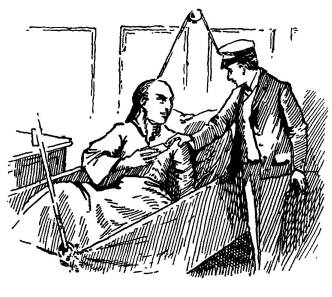
“Yes, quite well. Not velly wet now. Captain velly closs Ching tumb’ overboard?”
“No, he hasn’t said anything.”
“Ching velly glad. You go tell captain something?”
“What about?” I said.
“Ching get lettee flom fliend.”
“That’s right,” I said. “How is he?”
“Velly glad you catchee pilate.”
“Oh, he is, is he?”
“Yes, velly muchee glad, and send lettee.”
“Yes, you said so.”
“Allee ’bout pilates.”
He took a piece of paper from somewhere and handed it to me.
“You no lead lettee?”
I shook my head as I glanced at the queer Chinese characters.
“No; what does he say about the pirates?”
“Say two muchee big junk in river going to sail, catchee tea-ship, lice-ship, silkee-ship.”
“Going to sail from here?” I cried.
“Yes.”
“But how does he know?”
“Know evelyting. Muchee big man. Wantee catchee more pilate.”
“But do you mean your friend knows of these junks sailing?”
“Yes.”
“When did you get the letter?”
“Chinese coolie bling lettee in flesh-vegetable boat.”
“What, this morning?”
“Yes, bling lettee.”
“When are the junks going to sail?”
“No know. Keepee watchee and catchee.”
I sat thinking for a few moments, and I made up my mind to go and tell the first lieutenant, but found the Chinaman looking at me smiling the while.
“You likee this?” he said, holding out a tiny thin stoppered bottle, covered with Chinese characters.
“Like it? No. What for?”
“Velly good. Headache: lub lit’ dlop here. Toothache: lub lit’ dlop there. Got pain anywhere, lub lit’ dlop.”
I took out the stopper and smelt it.
“Smell velly good; all nicee.”
“Why, it smells of peppermint drops,” I said carelessly.
“Yes, smell beautiful, all peppimint. Velly gleat stlong. Muchee lit’ dlop, so.”
He took the bottle, drew out the stopper, and covered the neck with one finger, turned the vial upside down, and then rubbed the tiny drop of moisture upon his temples, replaced the stopper, and gave it back to me.
“Thank you, Ching,” I said, placing it in my pocket, but without valuing the gift in the slightest degree. “I’m going now to tell the first lieutenant what you say.”
“Yes, tell Mr Leardon watchee watchee, killee allee pilate.”
“Yes,” I said; and I hurried away, muttering, “Watchee watchee, killee. What stuff they do talk! Any one would think they were all big babies, who had been taught to speak English by a nurse.”
As I reached the deck I saw Barkins and Smith standing by the first lieutenant, and he was nodding his head.
“Why, they’ve been telling him about me,” I thought as I went aft. “No; they wouldn’t be such sneaks.”
But all doubt was at an end directly, for they came down to meet me, and Smith cried—
“Mr Reardon wants to speak to you directly, Herrick;” while, as I looked up and caught Barkins’ eye, he coloured a little, and hurriedly avoided my gaze.
“Thank you, tale-bearer,” I said to Smith.
“Don’t you be insolent, sir, unless you wish me to give you a severe thrashing.”
“With fists?” I said.
“Yes, sir, with fists. I suppose the rules of the service will not allow us to use such weapons as officers are accustomed to.”
“Do you mean officers like you?” I said contemptuously.
“Yes, sir; officers like me.”
“Oh, you mean knives and forks, then,” I said carelessly. “I say, Barkins, I didn’t think you could have been such a jerry sneak.”
He turned upon me with an apologetic look, but his lips began to bluster.
“What do you mean, sir?”
“Oh, nothing; I am not going to quarrel with old Barkins. He wouldn’t have done this, if it had not been for Blacksmith.”
“Go and obey the first lieutenant’s orders, sir,” said Smith haughtily. “We will talk to you later on.”
“You go and show Doctor Price your arms and legs,” I said contemptuously and spitefully; for, to use a common phrase, my monkey was up. “Fight? With fists? Where are your muscles? Why, I could upset you both with a swab.”
I hurried aft, and ran up the steps to the quarter-deck in time to encounter the first lieutenant, who was coming from the wheel with an angry look upon his face.
Chapter Twenty Nine.
A Queer Quarrel.
“I sent a message to you, Mr Herrick,” he cried angrily, and I could then guess that he had been coming to see why I had delayed. “I have something to say to you, sir, respecting the company you keep, and the society you affect, which I am given to understand is not that which conduces to good dishipline.”
“Oh, that’s what Mr Smith thinks, sir,” I said coolly.
“Oh, indeed!” he cried sarcastically.
“Yes, sir; he said something about it to me this morning, but he does not know.”
“Indeed!” he cried, growing black as a thundercloud; “then I am to take it, sir, that you do?”
“I hope so, sir; I try to know.”
“Then you know, sir, possibly why it was that when I sent you a summons I am kept waiting?”
“Yes, sir; I was delayed a little—”
“Oh, thank you. I am glad to hear that, Mr Herrick. Perhaps you have something else of importance to communicate?”
“Yes, sir, very.”
“Thank you. I am sorry I cannot ask you to sit down.”
“Don’t name it, sir,” I said quietly, while he began to breathe very hard.
“I was down with Ching the interpreter, sir, this morning—”
“Were you really, Mr Herrick?” he said sarcastically. “Dear me, I hope he is much better?”
“Yes, sir, he’s nearly all right. I was coming to you when I met Mr Barkins, and Smith.” I couldn’t say Mr Smith, I felt so exasperated against him.
“What a curious coincidence, Mr Herrick! If I had known I might have spared myself the trouble of sending.”
“Yes, sir.”
“And pray, may I know for what reason I was to be honoured?”
“Of course, sir,” I said coolly enough, for I was enjoying the way in which he was working himself up for an explosion to fall upon my unfortunate head. “The fact is, sir—”
“Oh, it is a fact, is it?”
“Yes, sir—Ching has friends ashore.”
“And wants leave of absence? Are you his envoy?”
“Oh no, sir. One of his friends sent him an important letter this morning by the vegetable boat.”
“Eh? letter?” said Mr Reardon, beginning to grow interested.
“Yes, sir. This friend is a kind of a merchant or something; and he has news of two big junks—piratical junks—lying in this very river.”
“The dickens he has! Here, Herrick, come down to my cabin.”
He took my arm and marched me quickly to the ladder and down to his cabin. On the way I caught sight of Barkins and Smith watching us, and I gave them a nod.
“Now, my lad, sit down,” cried Mr Reardon excitedly. “Let’s hear.”
I sat down, and he walked to and fro—two steps and turn.
“There’s very little more to tell you, sir,” I said; “but there are two very large junks assuming to be merchantmen. They are anchored close by here somewhere.”
“You don’t know which two?”
“No, sir; but we shall know them by their sailing at once, and I should say by boats coming off to them with extra men directly after.”
“Yes, that’s good, Herrick—very good. But you have no other information about them?”
“Only, sir, that they are just off on a cruise, and if we could catch them—”
“We will catch them, my lad. But is that all?”
“Yes, sir, that’s all; I thought it rather big news.”
“So it is, Herrick—very big news. Just what we wanted. It’s time we made another capture. And to Ching has a friend on shore who sent this information?”
“Yes, sir.”
“Not a trap, is it—to get us away?”
“Oh no, sir; Ching is as honest as the day.”
“Humph, yes,” said Mr Reardon, with his fingers to his lips. “I think he is, for he seems to have taken to us and to be working hard in our service. But he may have been deceived. He is cunning enough; but so are his countrymen, and they would glory in tricking the man who has taken up with the English. I don’t know what to say to it, Herrick.”
“But suppose we see two big junks setting sail, watch them with a boat, sir, and find that they take others on board, there could be no mistake then.”
“Oh yes, there could, my boy. We might follow these junks, seize them, and spend a long time in their capture and bringing back into port. Then we should apply to the authorities, and find that we had got into sad trouble, for we had seized two vessels which the occupants could prove were intended for peaceable pursuits. We could not contradict them possibly, and all the time the scoundrels we wanted to take had sailed off upon a piratical expedition, consequent upon our absence. Now, sir, what do you say to that?”
I shook my head.
“I think Ching ought to know best,” I said.
“Perhaps so,” he replied. “We shall see. Come on now to the captain.”
He opened the door, and I followed. I had forgotten all about Barkins and Smith for the time, but now all that had passed occurred to my mind, and I felt certain that they would be waiting somewhere to meet me and make sport of the tremendous setting-down which I had had.
I was not wrong: they were talking together amidships, just where they could command the companion-way, and as soon as we appeared I saw Smith’s features expand into a malicious grin, while Barkins remained perfectly stolid.
As we passed to the ladder Smith looked after us wonderingly, and I saw him turn and whisper something, which I felt sure was—
“Taking him to the skipper.”
For the captain was not in his cabin, but walking up and down the quarter-deck with his hands clasped behind him, and the telescope which had made Mr Reardon so angry under his left arm.
As we reached the deck he was going aft, so we followed him, and timed our pace so that when he turned we had only a step or two to take to be facing him.
“Yes, Mr Reardon,” he said in response to our salute, “anything fresh?”
“Yes, sir, something very fresh. Will you listen to what Mr Herrick has to say?”
“Certainly,” he replied, and he made room for me on his right Mr Reardon placed himself on my right, and as I narrated all I had said before as nearly as I could, they marched me up and down between them, from the binnacle to the end of the quarter-deck, turned and marched me back again.
As we approached the rail I could see Barkins and Smith watching us with all their eyes, and as we came in sight again they were still watching intently, evidently in the full belief that I was being, as we should have called it, wigged tremendously. And certainly they had some excuse for this idea, for I had been summoned by the first lieutenant, taken into his cabin, talked to, and then marched off to the captain. It almost looked like being dismissed from the ship in their eyes, and now I could see them scanning my features with intense interest for sight of my breaking down.
The captain heard me out, and then listened to Mr Reardon’s objections.
“Yes,” he said quietly at last, “that’s very true, Mr Reardon, but we must not let an opportunity slip. I was intending to sail to-morrow for the north; now we will sail which way the junks lead. That will do for the present, Mr Herrick, and I thank you for your diligence in Her Majesty’s service.”
I touched my cap and went to the ladder, and as I descended there were my two messmates coming towards me.
Trying to make my face as mobile as possible, I stretched it here and there into wrinkles, and was walking straight along the deck looking the image of despair, when they stopped me.
“Serve you right!” said Smith exultantly. “There, be off below, and don’t let the men all see what a setting-down you have had.”
I gave each of them a piteous look, turned as they had suggested, and hurried down to our cabin to have a good laugh all to myself.
To my surprise, though, they followed me, Barkins to seat himself on the table, and Smith to lean up against the door.
“Well, Skeeter,” said the latter, “you’ve had it pretty hot. Serve you right for being sarcy; you’ll behave better next time.”
“I hope so,” I said meekly.
“Dishy gave you his lecture, then, and walked you off to the skipper, eh?”
“Yes,” I said.
“Well, it’s of no use for you to be grumpy. You’ve had your lesson, and now you’ve got to behave yourself.”
“Yes.”
“And I am very glad to see you are so humble. Aren’t you, Tanner?”
“Yes,” said Barkins gruffly.
“You see it won’t do for a little gnat of a fellow to think he is going to do what he likes on board one of Her Majesty’s ships. It was quite time you were taken down a few pegs—wasn’t it, Tanner?”
“I suppose so,” said Barkins.
“Then I don’t see that it’s any use for us to jump upon him, and show bad blood.”
“No, not a bit,” cried Barkins, with more animation. “We won’t.”
“No, I said we wouldn’t; so look here, youngster: we’re going to forgive you, if you promise to behave better and do as you’re bid. This isn’t school, you know, where a boy can set himself up against his elders, but the Queen’s service, where every one has his place, and has to keep it too—mind that. There, that’s all I’ve got to say.”
“And very nicely said too,” I replied.
He looked at me sharply, but my face was like marble, and he concluded that I had spoken seriously, for he turned to Barkins—
“There, Tanner, I’ve done; now it’s your turn.”
“What for?”
“To give him a few words.”
“Oh, I don’t think I want to say anything,” said Barkins slowly. “I’m sorry the poor little beggar got into such a row.”
“It’ll do him good.”
“I hope so,” said Barkins slowly and reluctantly, and there was rather a mournful look in his eyes as he spoke.
“You’d better give him a few words of advice,” said Smith in an off-hand tone.
“Oh no, he’s had enough jawing. I shan’t say anything.”
“Thank you, Tanner,” I said.
“Oh, all right,” he cried, and he held out his hand and shook mine, brightening up the next moment, and looking as pleased as if he had just got a great trouble off his mind.
“You needn’t be in such a jolly hurry to forgive him,” said Smith in a remonstrant tone; “he has been a cheeky little beggar, and deserved all he got.”
“But it isn’t nice to be wigged, all the same,” said Barkins sharply.
“No, but it don’t matter if you deserved it. Now then, Gnat, tell us what Dishy said.”
“What about?” I asked innocently.
“What about? Why, your associating with Ching so much.”
“Oh, that!” I cried.
“Oh, that!” he said, mocking my way of speaking. “Why, what did you think I meant?”
“I don’t know.”
“Well, what did he say?”
“Nothing at all.”
“What! no lies now.”
“Who’s telling lies? He didn’t say a word about it. We had something of more consequence to talk about.”
“Now, Tanner, hark at that. Did you ever hear such a miserable cheeky little beggar in your life? It’s of no use; we must give him a regular good towelling.”
“Better tell us what the luff said, Gnat,” growled Barkins, in so strange an accession of gruffness that I began to laugh.
“Why, what’s the matter with you?” I said. “Don’t gruff and grow hoarse like that.”
“Can’t help it; got a cold, I s’pose,” he cried. “But I say, stop it now; we want to be friends. Tell us what the luff said.”
“Precious little,” I replied. “I did all the speaking till we went up on the quarter-deck.”
“Don’t listen to him,” cried Smith, growing wroth with me. “I never saw such cheek. One tries to be friends with him, but it’s of no use; directly you open your mouth he jumps down your throat.”
“Then you shouldn’t have such a big mouth, Smithy,” I said sharply, and then the storm burst.
Tanner roared with laughter, for the width of Smith’s mouth had often been food for our mirth; and, as Barkins afterwards said, my remark came out so pat.
“Look here,” cried Smith, “I’m not going to stand this sort of thing. You may be fool enough to put up with it, but I won’t.”
“If you call me a fool I’ll punch your head, Smithy,” growled Barkins.
“No, you won’t,” was the retort; “and that’s the way you take sides against me, and encourage the miserable little beggar in his impudent ways? Now then, you Herrick, you’ve got to go down on your knees and beg my pardon, and then tell me everything the skipper and the first luff said.”
“When?” I asked coolly.
“When? Why, now, directly,” cried Smith fiercely. “Now then, no nonsense,” he cried, seizing me by the collar; but I wrested myself away, and in the slight struggle sent him staggering against Barkins.
“Now then, keep off me, please,” growled Barkins.
“Keep off yourself; why don’t you get out of the way?”
“How was I to know that a blundering idiot was coming up against me?”
“It’ll tell you when I’ve done with the Gnat,” said Smith angrily; for I had unintentionally hurt his arm. “Now you, Skeeter.”
“Let him alone,” said Barkins gruffly.
“When I’ve done with him,” said Smith; “you could have had first go at him if you had liked.”
“I don’t want to hit the little fellow, I’m not overbearing like you are. Let him alone, I say.”
“I shall let him alone when I choose,” retorted Smith fiercely. “I’m not going to let our junior ride roughshod over me, if you’re fool enough to.”
“I shall be fool enough to kick you out of the cabin if you touch him,” cried Barkins angrily. “I won’t have him bullied; and it was a mean sneaking thing to go telling tales as you did to old Dishy.”
“Look here,” cried Smith, “if any one is a sneak it’s you, for harking back and taking the miserable little beggar’s side.”
“Never mind about that; you let him alone.”
“Oh, I say, Tanner,” I said, “don’t quarrel with him about me. What he said did no harm. Mr Reardon was as friendly as could be.”
“That’s a cracker,” cried Smith sharply.
At that moment a marine came to the door.
“First lieutenant wants to see Mr Herrick directly.”
“Yes; where is he?” I said, smiling—purposely, of course.
“With the cap’n, sir, on the quarter-deck.”
“All right; I’ll be there directly.”
The man saluted and marched off, while I followed to the door, where I turned, thrust in my head, and said banteringly—
“Now be good boys and don’t fight while I’m gone.”
Bang!
A book off the table, flung by Smith, struck the door which I was holding half open, for I saw the missile coming, and dodged it. Then I popped my head in again.
“Don’t take any notice of him, Tanner,” I cried; “he’s bilious. Thankye for sticking up for me. Can I say a word for you to the captain?”
“Here, get up,” cried Smith, with a snarl. “Touch your hat to him. He’s promoted; and they’ll send poor old Brooke a step lower. All hail, Lieutenant Skeeter!”
“All right!” I cried, and I hurried away, leaving Barkins looking as if he could not believe his ears.
The next minute I was facing the captain and Mr Reardon.
Chapter Thirty.
A Fresh Start.
“Mr Herrick,” said the captain, as I saluted, “I have decided that, as you know so much about this business, you shall go with Mr Brooke in one of the boats; but I wish you to observe what I say: the success of our expedition depends a great deal upon secrecy, so do not chatter anything about your mission in the hearing of the men.”
“No, sir, certainly not,” I said, wondering what the mission might be, and whether we were going to cut out the junks.
“That’s right; you had better take the interpreter with you.”
“To search for the junks, sir?”
“Hush; guard your tongue, sir. You are ostensibly going up the river with Mr Brooke upon a little shooting expedition for wild-fowl, so get rid of your uniform. I daresay we can lend him a gun, Mr Reardon?”
“If he’ll take care of it, he can have mine, sir,” said Mr Reardon.
“Then off with you, my lad, and be as observant as you can. Mr Brooke will tell you, I daresay, all about his instructions.”
I saluted, and darted away in time to see that Smith had been watching me, for he drew back as I approached, and I found him standing by where Barkins sat, looking exceedingly glum.
I daresay it was very petty, but Smith had been so malicious, and had so often made himself disagreeable, that I could not help feeling a delicious sensation of triumph as I bustled into the cabin and rushed to my locker, without taking any notice whatever of Smith, while I felt sorry for big burly Barkins, who I felt would not say an unkind word if it were not for Smith’s influence.
I remember Charles Dickens saying in one of his tales something about it being hard enough to live with any one who had a bad temper in a large house, but to be shut up with the said person in a cart or travelling van was terrible. Of course I am not giving his exact words, only making the allusion to illustrate the fact that it is quite as bad to exist with an ill-tempered person in the small cabin of a vessel at sea. For you may depend upon it there is no better—or worse—way of finding out a companion’s peculiarities than that.
I acted pettily, but then I was only a boy; and now I am a man, getting on in years, I don’t know that I am much better. But it was very comic all the same to see those two fellows try to ignore my proceedings, poor old Barkins following Blacksmith’s lead once more. They did not want to know what I was going to do—not a bit. And I laughed to myself as I hurriedly kicked off my shoes and put on a pair of strong boots, carefully took off my uniform jacket and replaced it by a thin tweed Norfolk, after which I extricated a pith helmet from its box, having to turn it upside down, for it was full of odds and ends.
Smith had taken up a book and pretended to read, while Barkins sat back on a locker with his hands in his pockets, and his lips thrust out and screwed as if he were whistling, but no sound came, and he stared hard at the bulkhead facing him.
But try how he would he could not keep his eyes fixed there—they would follow my movements; and twice over I caught Smith peeping round the side of the book with which he was screening his face.
I began to whistle as I rapidly made my preparations, and at last Smith could bear it no longer.
“What’s the idiot dressing himself up for?” he cried contemptuously.
That started Barkins, and he burst out with—
“What’s up, Gnat? Shore leave?”
“Eh! Didn’t you know?” I said coolly. “Shooting.”
“What!” they exclaimed in a breath, and Smith’s eyes were more wide open than I had ever seen them.
“Shooting,” I said coolly. “Brooke and I are going after ducks.”
“Gammon!” cried Barkins. “Why, you have no gun.”
“No,” I said. “Reardon is going to lend me his double breech-loader, central fire, number twelve.”
Barkins gave his leg a sharp slap.
“We’re going up the river; plenty of sport up there among the marshes.”
“Going to walk?” said Barkins.
“Oh no; we’re to have a crew and one of the cutters.”
“Don’t you believe him, Barkins, it’s all gammon. The little humbug can’t deceive me.”
“All right, call it gammon,” I said, stooping to tighten my boot-laces. “Roast duck for dinner, Tanner, to-morrow.”
Barkins rushed on deck, leaving me with Smith, and the next minute he was back again.
“It’s all right, Smithy,” he cried; “and they’re shoving in a basket of prog for the beggars.”
“What!” yelled Smith. “Do you mean to say that Brooke and this—this—thing are going off wasting Her Majesty’s time shooting?”
“Yes; I saw Brooke, and he said it was so.”
“Then I shall resign. Hang me if I’ll stop in a service where such beastly favouritism is shown. Profession for gentlemen’s sons, is it? I call it a mockery!”
“Oh, don’t be so snaggy, Smithums,” I said banteringly; “wait till his poor old wing’s all right again, and he shall go a shooting too.”
That was too much. He made a rush at me, but Barkins flung an arm round his waist, and as they struggled together I dodged to the other side of the table and escaped from the cabin, but popped my head in again.
“Don’t hit him, Tanner,” I cried; “he ain’t got no friends. Good-bye, old chap, I wish you were coming too.”
Our eyes met, and I suppose my tone and the look I gave him seemed sincere, for, as he held Smith, his arms tightly round him from behind, and his chin resting upon our messmate’s shoulder, he gave me a friendly nod.
“All right, old chap,” he said; “I hope you’ll enjoy yourself.”
“And I hope the John Teapots ’ll get hold of you, you miserable little cad!” cried Smith. “I shan’t be there to help you this time.”
I burst out laughing and ran on deck, to find the men mustered ready, and Mr Brooke standing there in sun helmet and gaiters, looking as unlike a naval officer as he could be.
“Oh, there you are, Herrick,” he said, giving me a look over. “Yes, that will do.”
“But the men,” I whispered. “Oughtn’t they to be armed?”
“All right, my lad; plenty of tackle in the boat under the thwarts.”
“But my gun—I mean Mr Reardon’s?”
“In the stern-sheets, with plenty of cartridges. Where’s Ching?”
“I don’t—down below, I suppose.”
“Fetch him up; we’re off at once.”
There was no need, for the interpreter appeared smiling and happy, looking as if he had not passed through such a terrible ordeal a short time before.
The captain and Mr Reardon came up then.
“Ready, Mr Brooke?”
“Yes, sir.”
“Order the crew into the boat, Mr Reardon.”
As the men sprang in, the captain came close to us.
“You’ll keep up the appearance of a sporting expedition, Mr Brooke,” he said in a low voice. “I expect you’ll find the junks in the river off some village. The rest I must leave to you.”
“Take them, sir, if I feel pretty certain?”
Captain Thwaites knit his brows, and stood as if thinking for a few moments.
“No,” he said at last; “but that I leave all to your discretion. Don’t risk your men, if they are strong. I’m afraid some of these mandarins are mixed up with the piratical expeditions, and share in the plunder, and I am certain that every movement we make is watched. There, off with you; don’t let Mr Herrick get hurt. I trust you to do your best.”
We sprang into the boat, which was lowered down; the falls were unhooked; and as Tom Jecks, who was coxswain, gave us a shove off, the tide, which was running up, bore us right aft; then the oars dropped with a splash, the rudder lines were seized, and away we went up-stream on as glorious a day as ever made a dirty Chinese city look lovely.
I looked back, and there were Barkins and Smith leaning over the side watching us, but I hardly noticed them, for something else caught my eye.
“Why, they’re getting up steam, Mr Brooke!” I said.
“Yes, my lad, they’re getting up steam, and I hope your information may mean some good active service for us. Here, Ching,” he whispered, “you have not told the men anything about our business?”
Ching shut his eyes and shook his head solemnly.
“Velly muchee keepee mouf shut,” he said, with the addition now of a few nods of the head. “Nobody but Ching an’ officer know.”
Chapter Thirty One.
Getting Warm.
The men were in high glee, and, had they not been checked, would have sent the boat spinning up the river, in their delight to escape from the monotony of harbour-life, and the natural love there is in Englishmen for a bit of sport.
“Steady, my lads,” said Mr Brooke quietly. “Just give her headway, and back water the moment I speak.”
I did not hear what one of the men whispered to his messmate, but I saw his face as he leaned forward, and it certainly suggested to me that he said—
“They mean some of the tame ducks to make sure.”
“No, we do not, my man,” said Mr Brooke, and I stared at him in astonishment, that he should have taken the same idea as I had.
The man coloured through his tan, and Mr Brooke; said in a low voice to me—
“Our work’s cut out, Herrick; how are we to pick out the right two junks from all this crowd?”
“I don’t know, sir,” I said. “But I don’t fancy they would be down here where other people might talk about them. I should think they would be up the river.”
“Well, we must find them, my lad, so use our brains as much as you can, and if you see a junk with a very evil-looking lot aboard, just give me a hint as we pass.”
“I’ll ask Ching what he thinks, sir.”
Mr Brooke nodded, and I turned to the interpreter, who was squatting in the bottom of the boat right aft, his eyes half shut, and apparently taking no heed of anything.
“How are we to know which are the junks we want, Ching?” I said.
“Oh, velly soon find,” he said. “Ching look along. Not these. Pilate boat big and tall. Empty. No got big calgo aboard. Stand high up now. Velly full and low down when full of plize-money.”
“Then you don’t think they are down here?”
He shook his head as he glanced at the various forms of trading-boat moored off the town, from the tiny sampan to the heavy, clumsy mat-sailed vessel, whose stern towered up, and whose great bamboo yards looked as if they must be perfectly unmanageable.
“What do you think we had better do, then—row about here and watch?”
“No good,” he said; “makee men low fast light up liver, findee, pilate junk.”
“But suppose we pass them?” I said.
“No pass pilate boat: Ching here.”
“And so you think you will know them?”
The Chinaman screwed his face up into a curiously comic smile.
“Ching know pilate when he see him.”
“And you think it better to go right up the river?” said Mr Brooke, turning suddenly to join in the conversation.
“Yes; pilate junk long way.”
“How do you know?”
He gave a cunning smile at us both, his little eyes twinkling in a singularly sly manner.
“You see vegetable boat come along mo’ning?”
“Yes, I saw the boat come alongside.”
“Blought Ching ’nothee lettee, allee same fliend. Say pilate boat long way uppee liver in big cleek, waitee come down along lunning water in the dalk.”
“Then you pretty well know where they are?” said Mr Brooke.
“No; far uppee liver; in cleek.”
“I suppose this is right?” said Mr Brooke to me.
“Yes, quite light. Ching likee see Queen Victolia ship killee catch pilate.”
“Give way, my men,” said Mr Brooke, and the boat shot forward, while, relieved for the moment from the task of scanning the different boats, I sat gazing at the beautiful panorama of quaint houses, narrow streets debouching on the river, and the house-boats all along the edge of the river, while smaller boats were swinging here and there wherever there was room.
It was a wonderfully interesting sight, for, in addition to the curious shapes of the buildings, there was plenty of brilliant colour, and every now and then patches of brightest blue and vivid scarlet were heightened by the glistening gilding which ornamented some particular building. Then there were temples dotted about amongst the patches of forest, which fringed the high ground at the back of the city, and away beyond them the steep scarps of rugged and jagged mountains, which stood up looking of so lovely a pinky-blue, that I could for the moment hardly believe they were natural, and was ready to ask whether it was not some wonderful piece of painting.
The house-boats took my fancy greatly, for, in endless cases, they were of a variety of bright colours, pretty in shape, and decorated with showy flowers in pots and tubs; some had cages containing brightly-plumaged birds, and in most of them quaint bald-headed little children were playing about or fishing.