"Blue Jackets" (continued 6)
Reading edition
Higher up we saw men busy with nets which were attached to the end of a great bamboo pole, balanced upon a strong upright post fixed in the river’s bottom, and by means of this balanced pole the net was let down into the depths of the river, and hoisted from time to time, sometimes with a few glittering little fish within the meshes, sometimes having nothing but weed.
“Yes, catchee fish; catchee velly big fish some time.”
About ten minutes after, Ching pulled my sleeve and pointed to the other side of the river, where I caught sight of a very familiar old friend sitting in his boat, just as I had seen him in an old picture-book at home.
There he sat with a big umbrella-like sunshade fixed up over him on a bamboo pole, in front of him a kind of platform spread across the front of his moored boat, and upon it sat perched eight or nine of my old friends the cormorants, one of which dived into the river from time to time, and soon after emerged and made its way back to the boat with a fish in its beak.
“See that, Mr Brooke?” I cried eagerly. “I suppose we can’t stop to watch them?”
“Not when on Her Majesty’s service, Herrick,” he said, with a smile, and we glided rapidly on, till the houses, which had long been growing scattered, finally disappeared, and we were following the windings of the river in company with a few small junks and sampans, which seemed bound for one of the cities higher up the great waterway.
“Shoot bird now,” said Ching, in answer to an inquiring look from Mr Brooke.
“Yes; but do you think the junks are up here?”
“Oh yes, velly quite su’e. Plenty eye in boat watchee see what Queen Victolia offlicer going to do uppee river.”
“What does he mean?” said Mr Brooke, who was puzzled by this last rather enigmatical speech. “Of course we have watchful eyes in our boat, but I don’t see anything yet worth watching.”
“He means that very likely there are friends of the pirates in one of these boats, and that we had better begin shooting, so as to take off attention from our real purpose.”
“Yes, allee same; p’laps pilate fliend in lit’ boat go and tell Queen Victolia foleign devil sailor boy come catchee.”
“Oh, I see,” said Mr Brooke. Then, turning to me, “You do understand a little French, don’t you?”
“Well, sir, I used to learn some at school,” I replied, feeling very doubtful about my proficiency.
“I daresay you can understand my Stratford-atte-Bow French,” said Mr Brooke, laughing.
“I’ll try, sir,” I said; and he said to me directly in excellent French—
“I feel doubtful about this man. You have seen more of him than I have. Do you think he is honest, or leading us into a trap?”
“Honest, sir,” I said, “I feel certain.”
“Well, then, we will trust him fully; but if he betrays us, and I can get a last shot—well, then—”
“He’ll be sorry for it, sir,” I said, for Mr Brooke did not finish his remark.
“Exactly; get out your gun and put on your cartridge belt.”
I followed his example, and Ching smiled.
“Velly good thing,” he said. “Now pilate fliend, see jolly sailor boy, and say—Come killee duck-bird, goose-bird to make nicee dinner, not come catchee catchee pilate.”
“You hear what this man says, my lads?” said the young lieutenant, addressing the men.
“Ay, ay, sir.”
“Then you understand now that we have not only come up to shoot?”
“Ay, ay, sir.”
“Keep your rifles and cutlasses quite handy in case they are wanted. No confusion, mind, but at the word be ready.”
Mr Brooke’s words seemed to send a thrill through the men, who pulled on now with a more vigorous stroke, while, with our guns charged, and the butts resting on our knees, we gave place to the coxswain, who took the tiller.
“We’ll go forward, Herrick,” said my companion; and he stepped over the thwarts into the coxswain’s place, and I sat by him, watching alternately for birds, junks, and creeks, up which the latter might lie.
“Begin shootee soon,” said Ching rather anxiously.
“Why?”
“Velly muchee sail boat behind think why we come.”
“There goes something, Herrick,” said Mr Brooke just then, and I looked up and saw a bird flying over the river at a tremendous rate.
I raised my piece quickly, fired, and as soon as I was a little clear of the smoke, fired again.
“You hit him, sir!” said our stroke-oar. “I see him wag his tail.”
“It was a miss,” I said quietly.
“Velly good,” whispered Ching. “Allee men in other boat look see;” while I replaced the cartridges in my gun, and looked shoreward, to see that the land was level for miles, and that little flocks of duck or other birds were flying here and there. Soon after a wisp of about a dozen came right over head, and as they approached the men rested upon their oars till Mr Brooke had fired, without result.
He looked at me and smiled, while the men pulled again, and we went merrily along, getting a shot now and then, but the result for the game-bag was very meagre indeed, at which I was not surprised on my own account, but I fully expected Mr Brooke to have done some good.
And still we went on along the great river, with the country, save for the distant mountains, looking wonderfully English, and making it hard to believe that we were in China. In places where we were close to the shore I could see forms of growth different to our own, but at a little distance the trees, shrubs, and reeds looked much the same as those we should have encountered at home, and I confess to feeling a little disappointed. Then all at once, as if he too were suffering from the same sensation, Mr Brooke spoke.
“They will laugh at us when we get back, Herrick,” he said, “as far as our birds are concerned, but I am beginning to think that we shall find the pirate junks are somewhere up here.”
“You think so, sir? Look, a flock coming this way!”
“Of pirate junks?” he said drily.
“No, sir, ducks.”
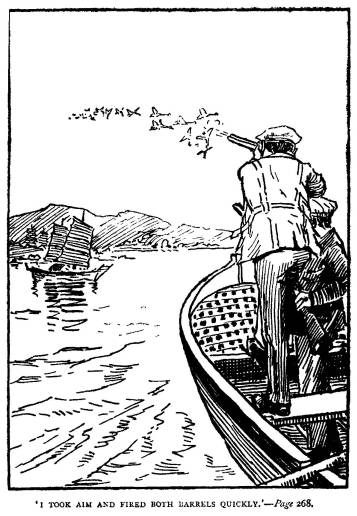
“Give it them, then, my lad—both barrels.”
I took aim and fired both barrels quickly one after the other, but as I drew trigger I felt that I had done wrong, for I had aimed right in front of the swiftly-flying flock.
“Umbrellas up!” shouted one of the men. “Rains geese!” and there was a cheer and a roar of laughter, as one by one five geese fell with a splash in the river, two to lie perfectly still while they were retrieved—the others, poor birds, to make desperate efforts to swim broken-winged away, but to be shot one by one by Mr Brooke, and after a sharp row dragged into the boat.
“Velly nicee,” said Ching, smiling.
“Yes, I must take lessons in shooting from you, Mr Herrick,” said the young lieutenant, smiling. “It’s my turn next.”
I felt hot and uncomfortable, for my success seemed to be the result of pure accident, and I said so, but Mr Brooke laughed and shook his head.
“Never mind the birds, Herrick,” he said; “I feel sure our other game is close by somewhere.”
“Yes, up cleek somewhere,” said Ching.
“Why do you say that?”
“No pointee—no look. I tell you,” said the Chinaman, taking up and pretending to examine the mottled brown wing of the goose he opened out. “Boat come behind, pilate fliend come see which way we go.”
“Yes, I’m sure you are right,” said Mr Brooke, taking up another of the birds; “and if I’m not very much mistaken, that other boat you see ahead has his eye upon us.”
“Ching not velly sure, p’laps; only see one man look over side thlee times.”
“There’s a bit of a river runs off here, sir, to the right,” said one of the men, nodding to his left, where there was an opening in a patch of forest which came down to the river, with fine timber trees overhanging the muddy banks, and their branches every here and there showing dead grass and reeds caked with mud, as if at times this part of the country was deeply flooded.
“Yes,” said Ching very quietly; “p’laps plenty mud up there. Go see.”
“And while we are up a side branch of the river, they may come down the main stream and escape.”
Ching shook his head.
“Fliend say pilate junk hide up liver in cleek.”
“Yes, but—”
“Wait lit’ bit,” said Ching, with a cunning look. “Go up lit’ way, shoot birds, and no lit’ boat come after, no pilate fliend. If come after, plenty muchee pilate fliend, and junk not vellee far.”
“He’s right, Herrick,” said Mr Brooke, nodding. “Turn up the side branch, my lads. Keep up the comedy of the shooting, and have a shot at something.”
“But there’s nothing to shoot at, sir,” I said, feeling rather doubtful of the accuracy of Ching’s ideas.
But as we turned up the narrow branch of the river—a creek not much wider than an English canal, I caught sight of a black-looking bird, which rose from the water and flew away paddling the surface with its feet.
I fired and dropped the bird, but it flapped along, and the men cheered and pulled in chase for two or three hundred yards before it was retrieved.
“It’s a sort of moor-hen,” I said, as I looked up from my captive.
“One of the pirate’s hens, perhaps, Herrick,” said Mr Brooke, smiling.
“Well, Ching, had we better go on?”
“Yes, go ’long,” said the Chinaman rather huskily. “Velly good place.”
We rowed on for another three or four hundred yards, the branch winding a great deal, so that we seemed to be in a succession of lakes, while the trees on either side completely shut us in.
“Stream runs very fast,” I said.
“Yes, velly fast,” said Ching.
“There, I think we had better turn back now,” said Mr Brooke, but Ching smiled in a curious way.
“What go turnee back? Pilate fliend both come in cleek after, to see what Queen Victolia jolly sailor boy go to do.”
“Are you sure?” said Mr Brooke excitedly.
“Yes, sir, I see the top of one of their sails,” said Tom Jecks.
“Then, by George, we are in the right track,” cried Mr Brooke, and, as my heart began to beat rapidly, “Give way, my lads,” he cried, “give way.”
Chapter Thirty Two.
A Startling.
“What are we going to do?” I said, with my heart beating fast.
“Afraid?” said Mr Brooke in a whisper.
“I don’t know, sir—a little,” I replied.
“We’re not going to fight, Herrick. I shall go on and find the junks so as to know them again—take their portraits in our minds—and then go back for help. They can’t escape out of the river, and once we know them, our boats can soon follow and bring them to book.”
The men pulled as if their hearts were in their work, and upon rounding a bend, there, about a quarter of a mile away, lay two large vessels, moored close up to the trees.
“We’ll keep up the idea that we are shooting,” said Mr Brooke. “No, there is no need now. We have kept it up long enough. We must reconnoitre and go back. They will think still that we are a shooting-party, and not know that we are making for them.”
“Of course not,” I said thoughtfully. “How could they know we had heard?”
We rowed steadily on for a minute or two, and then Ching said quietly—
“One boat—two boat come behind.”
We glanced back, and there, sure enough, were the sailing craft, which had been hanging about in front and aft, coming steadily along in our wake. A moment or two later Ching spoke again—
“Look over boat side, see jolly sailor boy.”
“Never mind those boats,” said Mr Brooke impatiently.
“Steady, my lads, hold hard now; that’s right,” he continued, as the oars were held, and checked the boat’s progress. “Now, Mr Herrick, take a good look at them. Do you think we should know them again if you saw them coming down the river?”
“Yes, sir,” I said; “the stern of this one and bows of the other would be unmistakable. I don’t think I could make a blunder.”
“No; almost impossible; pull starboard, back water, port side. Now, we’ll just turn and row gently back. I don’t see any men on board.”
“All lie down flat,” said Ching sharply. “Plenty men aboard.”
“Ah, well, it does not matter. I’m not going to run risks by attacking the savages. Lift your gun and look about, Herrick. Let them keep in the same mind.”
I stood up in the boat at this, and noted how rapidly the tide was running up as Mr Brooke gave the word to pull again.
The movement of the boat brought me in full view of the two sampans which had followed us, each with a man and boy aboard; and now, as I looked, I was surprised to see a yellow head raised and begin watching us. Then another; and Ching said quickly—“Lot men in both boats.”
I don’t know how they had stowed themselves, but now, to our intense astonishment, head after head appeared, till Mr Brooke exclaimed—
“Why, the boats are packed full of men.”
“Yes, and the junks too,” I whispered hastily; for their decks, which a few moments before had appeared to be bare, were now crowded.
“Trapped, Herrick!” said Mr Brooke through his set teeth. “Is this a trick on the part of Mr Ching?”
The men were looking hard at us, and they did not have long to wait.
“Arms ready, my lads?”
“Ay, ay, sir.”
“That’s right. Now then, lay your backs to it, and row with all your might.”
“Ay, ay, sir.”
“What are you going to do?” I said huskily.
“Run for it. The junks can’t follow against this tide. We must row out into the river. Keep your fire till I give orders. They may not try to stop us. If they do, I shall try and ram one. We have four barrels for the other, without troubling the men.”
“You don’t think it’s a false alarm?”
“No,” he said sternly; “the falsity lies somewhere else.”
“He means Ching,” I said, but there was no time for much thought, not even to see a great deal. The men grasped the situation as soon as the boat’s head was straight, and Mr Brooke took the tiller in his left hand, his gun in his right, and cocked it, while I followed suit.
Then I felt disposed to laugh as Ching made a dive down, and began to crawl under the thwarts among the men’s legs, but the laugh changed to a serious grin as Mr Brooke steered to pass between the two boats, when the course of one was changed so as to throw her right athwart our way, and quite a dozen men rose up in each, armed with clumsy swords, yelling at us, and dancing about as they gesticulated and seemed to be trying to frighten us back.
“Very well, if you will have it,” said Mr Brooke between his teeth. “Be ready, my lads. Cutlasses, if they try to board.”
A sound like the exhaustion of a heavy breath escaped from the men, and Mr Brooke roared at them to pull, while I sat with my finger on the first trigger and the gun lowered a little, gazing wildly at the savage crew before us.
Those moments were like long minutes, but I could make out that, instead of frightening us, the men in the boat which crossed us were now frightened themselves, and they made an effort to give us room.
But there were too many of them—they got in each other’s way. Then there was a wild shriek, a crash, and the head of our fast cutter crashed into them, driving their bows round, partly forcing them under water, and the flimsily-built boat began rapidly to fill.
The second party held a little aloof, too much startled by the boldness of our manoeuvre to attempt to help their companions, so that we had only the first boat to tackle, as such of the men as could trampled over one another in their struggle to get on board us.
But the moment the crash had come our lads sprang up with a cheer, and, forgetting their proper weapons, let go at the enemy with their oars, using them as spears and two-handed swords, and with such effect that in less than a minute the wretches were driven back or beaten into the water, to swim to and cling to their half-sunken boat, whose light bamboos refused to go right down.
“Now pull—down with you—pull!” roared Mr Brooke, and, thanks to Mr Reardon’s grand “dishipline,” every man dropped into his place, and the boat, which had come to a standstill, now began to move forward, while the tide carried the enemy towards their junks, from whence came now as savage a yelling as that from the boats.
“Without firing a shot,” cried Mr Brooke exultantly. “Pull, boys. Now, a cheer! they can’t follow us against this tide.”
The men sent up a triumphant shout, and, as we swept round the next bend, we lost sight of the junks, and directly after of the two boats, the last I saw of them being that the crew of the second were dragging their companions of the first out of the water, and loading their own down to the gunwale edge.
“Now,” cried Mr Brooke, “who’s hurt?”
There was no answer for a moment or two. Then one of the men said, with a grin—
“I arn’t drownded, sir; but I shall ketch cold if something arn’t done—my feet’s wet.”
“Yes, so velly wet,” cried a plaintive voice, and Ching struggled up from the bottom of the boat, and stood up, showing his blue cotton garments to be drenched with water.
“What, have we sprung a leak?” cried Mr Brooke.
“Yes, sir,” said Tom Jecks, “she’s got a hole in her skin here forrard; but if I might be so bold, sir, if you was to send Mr Ching to lean up agin it, we shouldn’t hurt much.”
“Pull—pull steady,” cried Mr Brooke. “Here, take the tiller, Mr Herrick.”
He laid his gun behind us and handed me the rudder, before going right forward to the coxswain, while I sat envying the men their coolness as they sat pulling away nonchalantly enough, though the water was rising fast and nearly covered their bare feet and ankles, while it soon invaded the grating upon which my own boot-covered feet were placed.
“Much injured, sir?” I shouted; and Mr Brooke gave me back poor Mercutio’s answer to his friend, in Romeo and Juliet—
“’Tis not so deep as a well, nor so wide as a church door: but ’tis enough; ’twill serve.”
“Here, my lads, one of you; I must have a frock.”
“Right, sir, mine’ll do,” said the coxswain, unfastening and dragging his white duck garment over his head.
This was soaked and wrung out to make it softer, and then thrust into the hole in our bows.
“There, you must sit forward here, and plant both feet against it, my lad,” said Mr Brooke.
“Ay, ay, sir. Men never knows what he may come to. Fancy my toots being used to caulk a leak!”
He, laughing, sat down on the forward thwart, and pressed his feet against the jacket.
“Now then, a man to bale,” cried Mr Brooke, and the coxswain fished the tin baler out of the locker forward. “No; pass it here,” continued our leader. “Pull away, my lads, and Mr Herrick and I will take it in turns to bale. We must get out of this narrow creek as soon as we can.”
“Me balee water out,” squeaked Ching, who looked very wet and miserable.
“No, thank you,” said Mr Brooke coldly.
“Beg pardon, sir; I’ve got nothin’ to do but sit here like a himage,” said the coxswain; “I can reach down and bale.”
“Without shifting your feet?”
“Yes, sir; look here.”
The man took the baler, and began to send the water, which still came in but slowly, over the side; while, after satisfying myself that we should not be obliged to run our boat ashore and tramp back to the city, I kept on directing anxious glances backward to see if we were pursued.
“We shan’t sink, Herrick,” said Mr Brooke, returning to my side; while, after glancing at my very serious, and at the young lieutenant’s stern countenance, Ching crept forward under the oars to where the coxswain was baling, and, getting a second tin from the locker, he seated himself, tucked his loose things out of the way, and began meekly to toss out the water as fast as he could scoop it up.
“That fellow’s a traitor,” said Mr Brooke to me in a low voice, after a glance back by Ching.
“Oh no, I hope not, sir,” I said.
“I wish I could hope so too, my lad. There’s a deal of cunning in his plans, and he tried hard to make it seem that he was all the time working upon our side; but I feel as if he has led us into a trap, and we were very nearly coming to our end in it without a man left to tell the tale.”
“But why, sir? What object could he have?”
“Plunder, for one thing; our boat, and weapons such as they cannot get. Yes, I believe that he is in league with those pirates.”
“Oh, I can’t think it, Mr Brooke,” I cried. “He has served us so well.”
“Yes, to gain his own ends.”
“But surely he wouldn’t do such a base thing for the sake of getting a paltry share in these rifles and cutlasses?”
“He would have the satisfaction of seeing us massacred.”
“But what satisfaction could that be, sir?” I cried. “We have always been his friends.”
“The Chinese hate the outer barbarians and foreign devils, as they call us, my lad. They are obliged to tolerate our presence, but the common people, as you know well, would feel an intense pleasure in murdering every European they came across.”
“All the same, sir,” I said, “I don’t believe poor old Ching would do anything that was against us.”
“Well, we shall see. But what an escape, my lad! What a trap we were in!”
“And how capital to get out of it without having a man hurt.”
“It’s splendid, my lad. The captain will be delighted at that, and forgive me about the boat.”
“But we had to run away, sir,” I said.
“Rather strange running away to charge that boat as we did! But don’t you take it into your head, my lad, that it is cowardly to retreat at the proper time. It is madness to go throwing away the lives of your men when you can do no good by fighting. It might sound very grand and heroic for us to have fought both those boats, and then tried to capture the junks; but we must have been cut to pieces in the attempt, and what then—”
“We should have been able to say that we did not turn tail upon our enemies.”
“No, we should not, my boy, because there would not have been a soul left to tell the story. There, my lad, don’t indulge in romance. He is the best commander who gains victories at the smallest cost of blood to his country.—Ha, at last! how much longer the creek seems coming back than it did going up.”
“Running against the tide, too,” I cried; and the next minute we glided out into the big stream, crossed the river, and settled down to a quiet, steady row on the far side, where the eddy enabled us to make a very fine rate of speed.
But our rate did not satisfy Mr Brooke, who kept on looking at his watch as the time went on, and we found that the swift tide had carried us much farther than we thought for.
“We shall never get back at this rate,” said Mr Brooke, “and it can’t be very long before the tide turns, and then those scoundrels will come sailing down, perhaps pass us before we can get to the Teaser.”
“Hardly,” I ventured to observe.
“Well, no; you are right,” he said. “I am too impatient. We have a good start, and must get to the gunboat long before they can.”
Meanwhile Tom Jecks sat fast, pressing his feet against the jacket placed over the hole, and kept baling, while Ching took his time from him, and used his baler with enough skill to help get rid of a great deal of water, so that the boat was freed to an extent which set aside all danger of our sinking; but with all their efforts they never got beyond a certain point, for the water oozed in pretty constantly through and round the extempore plug.
At last, faint with heat and nearly exhausted, we came in sight of the first straggling houses, then they grew more close together, and fields and gardens gave place to the closely-packed habitations. For we had reached the town, though even then we had quite a long row before we could reach the Teaser.
The final stretch came at last—just about a quarter of a mile to traverse, and then we should be alongside.
“Thank goodness!” said Mr Brooke, drawing a deep breath; “I don’t know when I have felt so anxious. Now, my lads, only another five minutes—a long pull and a strong pull, and all together.”
The men cheered and pulled, sending the boat merrily along now, for the tide was close upon its highest point, and for some little time it grew more and more sluggish before the coxswain cried out—
“She’s swung round, sir; tide’s with us.”
“Ha!” ejaculated Mr Brooke. “Then we shall get to the Teaser in time. They couldn’t start from the creek with those light junks till now.”
“How much farther is it, sir?” I said, as he stood up and shaded his eyes with his hand.
“It can’t be many hundred yards,” he replied. “It must be just beyond that head where the boats lie so thick. Yes, off that temple there up on the hill.”
The men gave a cheer, and the boat sped on fast now, feeling the push given by the falling tide, and the short distance that lay between us; and the spot where we had lain at anchor so many days was soon traversed—the latter part in perfect silence, with Mr Brooke standing in the stern-sheets gazing straight ahead, and turning his eyes from side to side of the busy water thoroughfare.
“She has shifted her moorings,” he said at last.
“Has she, sir?” I replied, as I recalled how the furnace fires were going and the Teaser was getting up steam when we started.
“Yes; how tiresome!” he muttered. “Just, too, when we want to communicate at once.”
“But you can see her, sir?”
“No, my lad, no,” he cried. “How can I see her if she is not here?”
“But I thought you said she had shifted her moorings, sir?”
“Yes, and gone down the river somewhere. Hang it all, she can’t have sailed without us.”
“They wouldn’t do that, sir,” I cried, feeling quite startled at the idea of the ship leaving us with our small boat in the midst of strangers. “Why, she must have had news of some other junks, sir, and gone in pursuit, or is it a mistake? We can’t have come far enough. No; this is the spot.”
The men were looking at me inquiringly, just as men accustomed to be led lean on their superiors for orders, even if one of those superiors be a mere boy, while I, acting in precisely the same spirit, looked up to Mr Brooke, and listened excitedly for what he would say next.
It seemed to be a long time before he spoke, and then it was between his teeth and with angry vehemence, as he dropped down into his seat.
“After all this hard struggle to get back with our news,” he muttered, in so low a tone that I only heard his words, while the men sat with their oars balanced gazing forward to see if they could make out the Teaser’s funnel and tall spars. “They ought not to have stirred; it’s playing at dog and the shadow. Here have we brought the substance, and they are snapping at the reflection.”
“Mr Brooke!” I said in a whisper.
“All right, my boy; don’t be down-hearted. It’s the fortune of sea life. Here we are, tired, hungry, and hot, with a badly leaking boat, and a far from friendly place to land in and get her repaired.”
“But they can’t have gone far,” I said.
“I don’t know, my lad. Had some news of pirates, perhaps. All I know now is that they’ve left us in the lurch.”
Chapter Thirty Three.
An Exchange.
“Now then,” said Mr Brooke, after a few minutes’ pause, “what’s the first thing, Herrick? We can’t keep watch for the junks in this boat.”
“The first thing is to get her mended, sir.”
“Yes; but how?”
“Let’s ask Ching.”
“Ching!” said Mr Brooke angrily.
“You wantee Ching?” came in the familiar highly-pitched voice from forward. “You wantee Ching go buy new boatee?”
He came hurrying aft, nearly tumbling once; while, left to his own power alone, the coxswain redoubled his efforts to keep down the water, and the tin baler went scoop scroop, scoop scroop, and splash splash, as he sent the water flying.
But the dark, angry expression of Mr Brooke’s countenance repelled the Chinaman, and he stopped short and looked from one to the other in a pleading, deprecating way, ending by saying piteously—
“You no wantee Ching?”
Mr Brooke shook his head, and our interpreter went back over the thwarts, reseated himself, and began to bale again, with his head bent down very low.
“Give way, my lads,” said Mr Brooke, bearing hard on the tiller, and the boat began to bear round as he steered for the landing-place a quarter of a mile away.
I looked up at him inquiringly, and he nodded at me.
“We can’t help it, Herrick,” he said; “if we stop afloat with the boat in this condition we shall have a serious accident. But we shall lose the junks.”
“Oh!” I ejaculated, “and after all this trouble. We had been so successful too. Couldn’t we repair the boat?”
“If we could run into a good boat-builder’s we might patch it up, but we can do nothing here.”
“Couldn’t Ching show us a place?”
“I can’t ask the scoundrel.”
I winced, for I could not feel that Ching had deceived us, and for a few moments I was silent. Then a thought struck me.
“May I ask him, sir?”
Mr Brooke was silent for a while, but he spoke at last.
“I hate risking his help again, but I am ready to do anything to try and carry out my instructions. We ought to patrol the river here to wait for the junks coming down, and then follow them, even if it is right down to sea. Well, yes; ask him it he can take us to a boat-builder’s, where we can get some tarpaulin or lead nailed on.”
I wasted no time. “Ching!” I cried; and he looked up sadly, but his face brightened directly as he read mine.
“You wantee Ching?”
“Yes; where is there a boat-builder’s where they will mend the boat directly?”
“No,” he said; “takee velly long time. Boat-builder same slow fellow. No piecee work along. Take boatee out water, mend him to-mollow, next week.”
“Then what are we to do?” I cried. “We want to watch the junks.”
“Why no takee other fellow big boatee? Plenty big boatee evelywhere. Get in big sampan junk, pilate man no sabby jolly sailor boy come along. Think other piecee fellow go catch fish.”
“Here, Mr Brooke,” I cried excitedly; “Ching says we had better take one of these boats lying moored out here, and the pirates won’t think of it being us. Isn’t it capital?”
Mr Brooke gazed sharply at us both for a few moments, and then directed the boat’s head as if going up the river again.
“Where is there a suitable boat?” he said hoarsely, and speaking evidently under great excitement, as he saw a means of saving the chance after all.
“Velly nice big boat over ’long there,” said Ching, pointing to a native craft about double the size of our cutter, lying moored about a hundred yards from the shore, and evidently without any one in her.
“Yes, that will do,” cried Mr Brooke. “Anything fits a man who has no clothes. Pull, my lads—give way!”
The men dragged at the oars, and I saw that since Ching had left off baling the water was gaining fast, and that if more power was not put on it would not be long before the boat was waterlogged or sunk.
In a minute we were alongside the boat, one of a superior class, possibly belonging to some man of consequence, and Mr Brooke had run the cutter along her on the side farthest from the shore, so that our proceedings were not noticed, as we made fast.
“Now then, tumble in, my lads,” he cried; “take the oars and everything movable. Throw them in, our game and all. Here, Herrick, take both guns.”
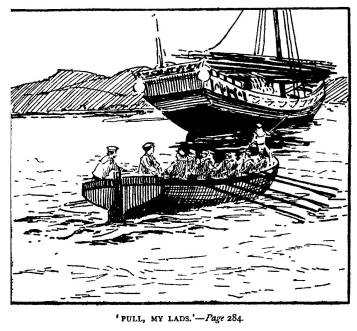
Everything was transferred in a very short time; and this done, Mr Brooke stepped aboard the little junk-like craft, gave his orders, and a line was attached to a grating, the other end to one of the ring-bolts. Then the craft’s anchor-line was unfastened, and our painter hitched on to it instead. Next the grating was tossed overboard, with plenty of line to float it as a buoy and show where the boat had sunk, as it was pretty certain to do before long; and we, in our tiny junk, began to glide away with the tide, furnished with a serviceable boat, boasting of sails, even if they were not of a kind our men were accustomed to manage.
“Why, it is grand, Herrick!” cried Mr Brooke excitedly. “We shall get them after all.”
“And all Ching’s doing, sir,” I said quietly.
“Ah, yes, perhaps; he is repentant now he has been found out. But we shall see—”
“That he is quite innocent, sir,” I said.
“I hope so, my lad. Now, let’s make sail, and beat about here, to and fro. We must keep a good watch for our two friends, and if they come down we can follow till we see the Teaser in the offing. We may, I say, capture them yet.”
A sail was hoisted, and in a few minutes we found that the craft went along easily and well, answering to her helm admirably. Her high bulwarks gave plenty of shelter, and would, I saw, well conceal our men, so that we had only to put Ching prominently in sight to pass unnoticed, or as a Chinese fishing or pleasure boat.
Just then I turned and found him close behind me, rubbing his hands.
“You ask Mr Blooke he likee Ching sit where pilate see him ’gain?” he said.
“I am sure he would,” I replied.
He looked sad again directly, and just touched the sleeve of my Norfolk jacket with the long nail of his forefinger.
“Ching velly solly,” he said.
“What about?”
“Mr Blooke think Ching fliends with pilates. Velly shocking; Ching hate pilates dleadfully; hollid men.”
“Yes, I am sure you do,” I said.
The Celestial’s face lit up again directly, and he rubbed his hands.
“Ching velly—”
“Yes?” I said, for Mr Brooke called to me from the little cabin contrived for shelter in the after part of the vessel.
“Look here,” he said, as I joined him, “we can keep below here, and command the river too, without being seen. Why, Herrick, my lad, this is capital; they will never suspect this Chinese boat to be manned by a crew of Her Majesty’s Jacks.”
“Then everything has turned out for the best,” I cried eagerly.
“Humph! that remains to be proved, my lad. We’ve got to return and face Mr Reardon and the captain, and the first question asked of an officer who has been entrusted with one of Her Majesty’s boats, and who returns without it, is— What have you done with the boat or ship? We—yes, you are in the mess, sir—have to go back and say that we have lost it.”
“Why, the captain owned to Pat that a thing couldn’t be lost when you knew where it was.”
“I don’t understand you, my lad,” said Mr Brooke.
“Don’t you remember about the captain’s tea-kettle, sir, that Pat dropped overboard? It was not lost, because Pat knew where it was—at the bottom of the sea.”
“Oh yes, I remember; but I’m afraid Captain Thwaites will not take that excuse.”
“Why, she has gone down already, sir,” I said, as I looked over the side for the boat we had left.
“Yes; but I can see the grating floating. The coxswain took his jacket out of the hole.”
He pointed to the stout piece of woodwork which we had turned into a buoy, but I could not make it out, and I thought it did not much matter, for something else had begun to trouble me a great deal just then, and I waited very anxiously for my officer to make some proposal.
But it did not come at once, for Mr Brooke was planning about the watch setting, so as to guard against the junks coming down the river and passing us on their way out to sea.
But at last all was to his satisfaction, one man keeping a look-out up the river for the descending junks, the other downward to the mouth for the return of the Teaser, whose coming was longed for most intensely.
Then, with just a scrap of sail raised, the rest acting as a screen dividing the boat, we tacked about the river, keeping as near as was convenient to the spot where the Teaser had anchored, and at last Mr Brooke said to me, just in the grey of the evening—
“I’m afraid the lads must be getting hungry.”
“I know one who is, sir,” I said, laughing.
He smiled.
“Well, I have been too busy and anxious to think about eating and drinking,” he said; “but I suppose I am very hungry too. Here, my lad, pass that basket along, and serve out the provisions.”
“You likee Ching serve out plovisions?”
Mr Brooke frowned, and the Chinaman shrank away. I noticed too that when the food was served round, the men took each a good lump of salt pork and a couple of biscuits, Ching contented himself with one biscuit, which he took right forward, and there sat, munching slowly, till it was dark and the shore was lit up with thousands of lanterns swinging in shop, house, and on the river boats moored close along by the shore.
“Bad for us,” said Mr Brooke, as we sat together astern steering, and keeping a sharp look ahead for the expected enemy.
“Why?” I asked.
“Getting so dark, my lad. We shall be having the junks pass us.”
“Oh no, sir. Ching is keen-sighted, and all the men are looking out very eagerly.”
“Ah, well, I hope they will not slip by. They must not, Herrick. There is one advantage in this darkness, though: they will not find us out.”
The darkness favouring the movement, and so as to save time, ready for any sudden emergency, he ordered the men to buckle on their cutlass-belts and pouches, while the rifles were hid handy.
“In case we want to board, Herrick.”
“Then you mean to board if there is a chance?” I said.
“I mean to stop one of those junks from putting to sea, if I can,” he replied quietly. “The Teaser having left us, alters our position completely. She has gone off on a false scent, I’m afraid, and we must not lose the substance while they are hunting the shadow.”
Very little more was said, and as I sat in the darkness I had plenty to think about and picture out, as in imagination I saw our queer-looking boat hooked on to the side of a great high-pooped junk, and Mr Brooke leading the men up the side to the attack upon the fierce desperadoes who would be several times our number.
“I don’t know what we should do,” I remember thinking to myself, “if these people hadn’t a wholesome fear of our lads.”
Then I watched the shore, with its lights looking soft and mellow against the black velvety darkness. Now and then the booming of gongs floated off to us, and the squeaking of a curious kind of pipe; while from the boats close in shore the twangling, twingling sound of the native guitars was very plain—from one in particular, where there was evidently some kind of entertainment, it being lit up with a number of lanterns of grotesque shapes. In addition to the noise—I can’t call it music—of the stringed instruments, there came floating to us quite a chorus of singing. Well, I suppose it was meant for singing; but our lads evidently differed, for I heard one man say in a gruff whisper—
“See that there boat, messmate?”
“Ay,” said another. “I hear it and see it too.”
“Know what’s going on?”
“Yes; it’s a floating poulterer’s shop.”
“A what?”
“A floating poulterer’s shop. Can’t you hear ’em killing the cats?”
This interested me, and I listened intently.
“Killing the cats?” said another.
“Ay, poor beggars. Lor’ a mussy! our cats at home don’t know what horrible things is done in foreign lands. They’re killing cats for market to-morrer, for roast and biled.”
“Get out, and don’t make higgerant observations, messmate. It’s a funeral, and that’s the way these here heathens show how sorry they are.”
“Silence there, my lads,” said the lieutenant. “Keep a sharp look-out.”
“Ay, ay, sir.”
Just at that moment, as the lit-up boat glided along about a couple of hundred yards from us, where we sailed gently up-stream, there was a faint rustling forward, and Tom Jecks’ gruff voice whispered—
“What is it, messmate?”
“Ching see big junk.”
There was a dead silence, and we all strained our eyes to gaze up-stream.
“Can’t see nought, messmate,” was whispered.
“Yes; big junk come along.”
Plash! and a creaking, rattling sound came forth out of the darkness.
“It is a big junk,” said Mr Brooke, with his lips to my ear; “and she has anchored.”
Then from some distance up the river we saw a very dim lantern sway here and there, some hoarse commands were given, followed by the creaking and groaning of a bamboo yard being lowered, and then all was perfectly still.
What strange work it seemed to be out there in the darkness of that foreign river, surrounded by curious sights and sounds, and not knowing but what the next minute we might be engaged in deadly strife with a gang of desperadoes who were perfectly indifferent to human life, and who, could they get the better of us, would feel delight in slaughtering one and all. It was impossible to help feeling a peculiar creepy sensation, and a cold shiver ran through one from time to time.
So painful was this silence, that I felt glad when we had sailed up abreast of the great vessel which had dropped anchor in mid-stream, for the inaction was terrible.
We sailed right by, went up some little distance, turned and came back on the other side, so near this time that we could dimly make out the heavy masts, the huge, clumsy poop and awkward bows of the vessel lying head to stream.
Then we were by her, and as soon as we were some little distance below Mr Brooke spoke—
“Well, my lads, what do you say: is she one of the junks?”
“No pilate junk,” said Ching decisively, and I saw Mr Brooke make an angry gesture—quite a start.
“What do you say, my lads?”
“Well, sir, we all seem to think as the Chinee does—as it arn’t one of them.”
“Why?”
“Looks biggerer and clumsier, and deeper in the water.”
“Yes; tlade boat from Hopoa,” said Ching softly, as if speaking to himself.
“I’m not satisfied,” said Mr Brooke. “Go forward, Mr Herrick; your eyes are sharp. We’ll sail round her again. All of you have a good look at her rigging.”
“Ay, ay, sir,” whispered the men; and I crept forward among them to where Ching had stationed himself, and once more we began gliding up before the wind, which was sufficiently brisk to enable us to easily master the swift tide.
As I leaned over the side, Ching heaved a deep sigh.
“What’s the matter?” I whispered.
“Ching so velly mislable,” he whispered back. “Mr Blooke think him velly bad man. Think Ching want to give evelybody to pilate man. Ching velly velly solly.”
“Hist! look out!”
I suppose our whispering had been heard, for just as we were being steered pretty close to the anchored junk, a deep rough voice hailed us something after this fashion, which is as near as I can get to the original—
“Ho hang wong hork ang ang ha?”
“Ning toe ing nipy wong ony ing!” cried Ching.
“Oh ony ha, how how che oh gu,” came from the junk again, and then we were right on ahead.
“Well,” whispered Mr Brooke, “what does he say? Is it one of the pirate vessels?”
“No pilate. Big boat come down hong, sir. Capin fellow want to know if we pilate come chop off head, and say he velly glad we all good man.”
“Are you quite sure?” said Mr Brooke.
I heard Ching give a little laugh.
“If pilate,” he said, “all be full bad men. Lightee lantern; thlow stink-pot; make noise.”
“Yes,” said Mr Brooke; “this cannot be one of them. Here, hail the man again, and ask him where he is going.”
“How pang pong won toe me?” cried Ching, and for answer there came two or three grunts.
“Yes; what does he say?”
“Say he go have big long sleep, ’cause he velly tired.”
Mr Brooke said no more, but ran the boat down the river some little distance and then began to tack up again, running across from side to side, so as to make sure that the junks did not slip by us in the darkness. But hour after hour glided on, and the lights ashore and on the boats gradually died out, till, with the exception of a few lanterns on vessels at anchor, river and shore were all alike one great expanse of darkness, while we had to go as slowly as possible, literally creeping along, to avoid running into craft moored in the stream.
And all this time perfect silence had to be kept, and but for the intense desire to give good account of the junks, the men would soon have been fast asleep.
“Do you think they will come down and try to put to sea, Ching?” I said at last, very wearily.
“Yes, allee ’flaid Queen Victolia’s jolly sailor boy come steam up liver and send boat up cleek, fight and burn junks. Come down velly quick.”
“Doesn’t seem like it,” I said, beginning at last to feel so drowsy I could not keep my eyes open.
“So velly dark, can’t see.”
“Why, you don’t think they will get by us in the darkness?” I said, waking up now with a start at his words, and the bad news they conveyed.
“Ching can’t tell. So velly dark, plenty junk go by; nobody see if velly quiet. Ching hope not get away. Wantee Mr Brooke catchee both junk, and no think Ching like pilate man.”
“Here, I must go and have a talk to Mr Brooke,” I said; and I crept back to where he sat steering and sweeping the darkness he could not penetrate on either side.
“Well, Herrick,” he said eagerly. “News?”
“Yes, sir; bad news. Ching is afraid that the junks have crept by us in the night.”
“I have been afraid so for some time, my lad, for the tide must have brought them down long enough ago.”
He relapsed into silence for a few minutes, and then said quietly—
“You can all take a sleep, my lads; Mr Herrick and I will keep watch.”
“Thankye, sir, thankye,” came in a low murmur, and I went forward to keep a look-out there; but not a man lay down, they all crouched together, chewing their tobacco, waiting; while Ching knelt by the bows, his elbows on the gunwale, his chin resting upon his hands, apparently gazing up the river, but so still that I felt he must be asleep, and at last startled him by asking the question whether he was.
“No; too much head busy go sleep. Want findee allee pilate, show Mr Blooke no like pilate. Velly ’flaid all gone.”
How the rest of that night went by, I can hardly tell. We seemed to be for hours and hours without end tacking to and fro, now going up the river two or three miles, then dropping down with the tide, and always zig-zagging so as to cover as much ground as possible. The night lengthened as if it would never end; but, like all tedious times of the kind, it dragged its weary course by, till, to my utter astonishment, when it did come, a faint light dawned away over the sea beyond the mouth of the river, just when we were about a mile below the city.
That pale light gradually broadened, and shed its ghastly chilly beams over the sea, making all look unreal and depressing, and showed the faces of our crew, sitting crouched in the bottom of the boat, silent but quite wide-awake.
Then all started as if suddenly electrified, for Ching uttered a low cry, and stood up, pointing right away east.
“What is it?” I said.
“Two pilate junk.”
We all saw them at the same time, and with a miserable feeling of despondency, for there was no hiding the fact. The river was wide, and while we were close under one bank they had glided silently down under the other, and were far beyond our reach.
Chapter Thirty Four.
The Untrustworthy Agent.
“Eaten, Herrick,” said Mr Brooke in a low voice.
“Not yet, sir,” I said.
I don’t know how it was that I said those words. They came to my lips and I uttered them, making Mr Brooke turn round upon me sharply, in the grey light of dawn.
“What do you mean by that, boy?” he said.
“Mean? I don’t—I—that is,”—I stammered; “I wouldn’t give up yet, sir.”
“What would you do? wait for them to come back?” he said bitterly.
“No,” I cried, gaining courage; “go after them, sir.”
“And attack and take them with this boat, Herrick?” he said, smiling at me rather contemptuously.
“Of course we couldn’t do that, sir,” I said, “but we might follow and keep them in sight. We should know where they went.”
“Yes,” he said, after a moment’s thought; “but we may be away for days, and we must have provisions. What is to be done?”
“You likee me buy blead and fish, and plenty good to eat?” said Ching in rather a shrinking way.
“Yes,” said Mr Brooke, turning upon the Celestial sharply. “Where shall we land you?”
“There,” said Ching, pointing to the shore about a mile up from where we lay.
“But it’s going back, and we shall lose sight of the junks, Ching,” I said.
“Plenty blead there. Ching know the way.”
“But one moment, Mr Brooke,” I said; “are we sure that those are the right junks?”
“I feel sure,” he said. “What do you say, my lads?”
“Ay, ay, sir, them’s right,” chorussed the men.
“Yes, Ching velly sure those pilate junk.”
“I know one on ’em, sir,” said Jecks, “by her great yard. I never see a junk with such a big un afore. Talk about the cut of a jib—I says, look at the cut of her mainsail.”
“Well, we must have food and water, if we are going out of the mouth of the river,” said Mr Brooke, and he turned the boat’s head shoreward.
“No makee haste,” said Ching deprecatingly. “Too soon, evelybody fas’ asleep.”
Mr Brooke gave an impatient stamp on the frail bamboo half-deck, but said no more for a few moments.
“We must wait if we are too soon, for it would be madness to go without food and water.”
He was silent for a time, during which the men watched the distant junks, and as they stood out more and more boldly in the morning light, we compared notes, and made comments upon them, all growing more and more satisfied that these were the two of which we were in search.
“Yes, they must be,” said Mr Brooke at last, after listening for some time to the men’s conversation. “The very fact of their sailing in company is suggestive. Seems odd, though, doesn’t it, Herrick?” he half whispered.
“What? their getting by us, sir, in the dark?”
“No; I mean, after making up my mind that this fellow Ching was a traitor, and that I would have no more to do with him, to find myself forced at every turn to rest upon him for help. Lesson for you, lad.”
“In what way, sir?”
“Not to have too much faith in yourself. I am beginning to hope that I have been deceived about him, but we shall soon have proof.”
“I feel sure you are misjudging him, sir,” I said eagerly.
“Yes, with a boy’s readiness to trust.”
“But I feel sure he is honest, sir.”
“Well, we shall soon see.”
I looked at him for an explanation, and he smiled.
“I am going to give him some money, and send him ashore to buy provisions. If he is dishonest he will not come back.”
“But he will come back,” I said confidently.
“We shall see, my lad,” he replied; and once more he was silent, after handing the tiller to me, and looking back longingly at the two junks, which were apparently making no way, for the wind was blowing dead now into the mouth of the river.
Early as it was, there were people stirring as we approached the landing-place Ching had pointed out, and he nodded with satisfaction.
“Allee light,” he said, smiling. “Get plenty blead, meat. You fillee big tub with water;” and he pointed to a large rough vessel, and another which was a great earthenware jar.
“But where are we to get the water?” I said.
“Out o’ liver. Plenty water in liver.”
“We can’t drink that peasoup,” I said, as I looked over the side in disgust at the yellow solution of mud.
“Velly good water. Allee salt gone now. Plenty clear by and by.”
“We must make the best of it, Herrick,” said my companion; and then turning to Ching, he said rather sternly—
“Here are eight dollars: buy as much bread and cooked meat as you can, and get back as quickly as possible, when we set you ashore.”
Ching nodded and smiled.
“Be velly quick,” he said; “and you take boat lit’ way out, and stop till come back.”
“Of course; trust us for that, my man.”
Ten minutes later we ran alongside some rough bamboo piles, to which about half-a-dozen Chinamen hurried, to stand staring at us. But Ching paid no attention to them. He only made a leap from the boat when we were a couple of yards from the platform, landed safely but with tail flying, and his blue cotton garment inflating balloon-like with the wind. Then he walked away among the houses, and one of our men pushed the boat off again, evidently to the intense wonder of the people, who stared hard to see a British sailor managing a native vessel; while two others, in a costume perfectly new to them, sat looking on.
Then our men were packed out of sight, some in the little cabin, others hidden at the bottom of the boat, beneath a matting-sail.
When we were about a hundred yards from the shore, a clumsy wooden grapnel, to which a heavy stone was bound with a twisted rope of bamboo, was dropped overboard, and then we lay in the swift tide, with the boat tugging at the line as if eager to be off on the chase the stern necessity concerning food kept us from carrying on at once.
“How these people do seem to detest us, Herrick!” said Mr Brooke, after we had been waiting patiently for about a quarter of an hour, impatiently another, but not quite in idleness, for, after tasting the river water to find that it was very slightly brackish now, the tub and the jar were both filled and left to settle.
“Yes, they’re not very fond of us,” I replied, as I noted how the numbers were increasing, and that now there was a good deal of talking going on, and this was accompanied by gesticulations, we evidently being the objects of their interest. “They can’t have much to do.”
Mr Brooke made no reply, but moment by moment he grew more uneasy, as he alternately scanned the people ashore and the junks in the offing.
“Oh,” I said at last, “if we could only see the Teaser coming up the river!”
“I’d be content, Herrick,” said Mr Brooke bitterly, “if we could only see the messenger coming back with our stores.”
“Yes,” I said uneasily, for I had been fidgeting a good deal; “he is a long time.”
“Yes,” said Mr Brooke, looking at me very fixedly, till I avoided his gaze, for I knew he was thinking of my defence of Ching.
“Perhaps the bakers’ shops are not open,” I said at last.
“Perhaps this is not London, my lad. It’s of no use for you to defend him; I begin to feel sure that he has left us in the lurch.”
“Oh, wait a little longer, please, Mr Brooke,” I cried; and I vainly scanned the increasing crowd upon the platform and shore, and could see, instead of Ching, that the people were growing more and more excited, as they talked together and kept pointing at us.
“I shall not wait much longer,” said Mr Brooke at last. “He has had plenty of time. Look here, my lads, we have plenty of water, and the business is urgent. You’ll have to be content with a drink and a pull at your waistbelts.”
“All right, sir,” said the coxswain; “what’s good enough for the orficers is good enough for us. We won’t grumble, eh, mates?”
There was a low growl here, but not of discontent.
“Then in another five minutes, if our Celestial friend does not come back, we shall start. I’ll give him that time.”
“Beg pardon, sir; they’re a siggling of us.”
“Signalling! who are?”
“The Chinees, sir.”
“Yes, look,” I said; for, after a good deal of talking and shouting, one man was standing close at the edge of the landing-place, and beckoning to us to come closer in.
“Likely,” I heard one of our men whisper. “Ducks.”
“Eh?” said another.
“Dill, dill, dill; will yer come and be killed?”
“What do they want, Herrick? To inveigle us ashore?”
“I know, sir for the reason of their excitement now came to me like a flash, and I wondered that I had not thought of it before.”
“Well, then. Speak out if you do know, my lad.”
“That’s it, sir. We’ve got a boat they know, and they think we’re stealing it.”
“Tut, tut, tut. Of course. That explains it. Very sorry, my friends, but we cannot spare it yet. You shall have her back and be paid for the use of it, when we’ve done with her.”
The shouts, gesticulations, and general excitement increased, two men now beckoning imperiously, and it was evident that they were ordering us to come to the landing-place at once.
“No, my friends,” said Mr Brooke, “we are not coming ashore. We know your gentle nature too well. But Ching is not coming, Herrick, so we’ll heave up the grapnel and be off.”
The crowd was now dense, and the excitement still increasing, but the moment they saw our coxswain, in obedience to an order given by Mr Brooke—in spite of an appealing look, and a request for another ten minutes—begin to haul up the rough grapnel, the noise ashore was hushed, and the gesticulations ceased.
“Five minutes more, Mr Brooke,” I whispered; “I feel sure that Ching will come.”
“Silence, sir,” he said coldly. “It is only what I expected. The man knows he is found out.”
By this time the boat was hauled up over the grapnel, and I shrank away in despair, feeling bitterly disappointed at Ching’s non-appearance, but full of confidence in him—faith the stronger for an intense desire to make up to the man for misjudging him before.
Then the grapnel was out of the mud, and hauled over the side; the boat began to yield to the tide; and Mr Brooke stepped to the mast himself, being unwilling to call the men in the cabin into the people’s sight.
“Come and take a hand at the rope here, coxswain,” said Mr Brooke. “Mr Herrick, take the tiller.”
But at the first grasp of our intention, as they saw the preparation for hoisting the sail, there was a fierce yell from the shore, and the people scattered to right and left.
“What does that mean?” I said to myself. But the next instant I knew, for they were making for different boats, into which they jumped, and rapidly began to unmoor.
“Humph! time we were off,” said Mr Brooke. “Hoist away, man, I cannot do it alone.”
“I am a-hysting, sir, but the tackle’s got foul somehow. It’s this here rough rope. The yard won’t move.”
“Tut tut—try, man, try.”
“All right, sir, I’ll swarm up the the mast, and set it free.”
“But there is no time, my man. Haul—haul.”
The man did haul, but it was like pulling at a fixed rope, and the sail obstinately refused to move, while to my horror there were no less than six boats pushing off, and I foresaw capture, a Chinese prison, and severe punishment—if we could not get help—for stealing a boat.
“All hands on deck,” cried Mr Brooke, making use of the familiar aboard-ship order, and just as the first two boats were coming rapidly on, and were within a dozen yards, our Jacks sprang up armed and ready.
The effect was magical. Evidently taken by surprise, the Chinamen stopped short, and the boats all went on drifting slowly down the stream. But at the end of a minute, as we made no attack, but all stood awaiting orders, they recovered their confidence, uttered a shout to encourage one another, and came on.
“I don’t want to injure them,” Mr Brooke muttered, but he was forced to act. “Give them the butts of your pieces, my lads, if they try to lay hold of the boat. Mind, they must be kept off.”
He had no time to say more, but seized the fowling-piece as the first boat was rowed alongside, and amidst a fierce burst of objurgations, in a tongue we could not understand, a couple of men seized the gunwale of the boat, while two more jumped aboard.
The men who caught hold let go again directly, for the butts of the men’s rifles and the gunwale were both hard for fingers, and the Chinese yelled, and the two who leaped aboard shrieked as they were seized and shot out of the boat again.
But by this time another craft of about our own size had come alongside, and was hanging on to us, while four more were trying to get in, and others were pushing off from the shore.
We were being surrounded; and, enraged by our resistance, while gaining courage from their numbers and from the fact that we made no use of cutlass or rifle, they now made desperate efforts to get aboard.
Our men were getting desperate too, and in another minute there must have been deplorable bloodshed, the more to be regretted as it would have been between our sailors and a friendly power, when Jecks, after knocking a Chinaman back into his own boat with his fist, stooped and picked up the boat-hook we had brought on board from our now sunken cutter. With this he did wonders, using it like a cue, Barkins afterwards said, when I described the struggle, and playing billiards with Chinese heads. But, be that as it may, he drove back at least a dozen men, and then attacked one of the boats, driving the pole right through the thin planking and sending the water rushing in.
But we were still in imminent danger of being taken prisoners, and, as he afterwards told me, Mr Brooke was thinking seriously of sending a charge of small-shot scattering amongst the crowd, when two of our lads seized the sheet and began to try and hoist the matting-sail, and to my intense delight I saw it begin to go up as easily as could be.
I flew to the tiller, but found a big Chinaman before me, and in an instant he had me by the collar and was tugging me over the side. But I clung to it, felt a jerk as there was a loud rap, and, thanks to Tom Jecks, the man rolled over into the water, and began to swim.
“Now for it, my lads,” shouted Mr Brooke. “All together; over with them!”
The men cheered and struck down with the butts of their rifles, the boat-hook was wielded fiercely, and half-a-dozen of our assailants were driven out of the boat, but not into the others, for they fell with splash after splash into the river. For our vessel careened over as the sail caught the full pressure of the wind, and then made quite a bound from the little craft by which she was surrounded.
Then a cheer arose, for we knew we could laugh at our enemies, who were being rapidly left behind; and, while some dragged their swimming companions into their boats, the others set up a savage yelling; gesticulating, and no doubt telling us how, if they caught us, they would tear us into little bits.
“Well done, my lads,” cried Mr Brooke. “Splendid, splendid. Couldn’t have been better. Excellent, Mr Herrick; ease her a little, ease her. We must have a reef in that sail. All left behind, then; no pursuit?” and he looked astern as our boat rushed through the water, and then he frowned, for one of the men said—
“Yes, sir; here’s one on ’em from the shore coming arter us full sail, and she’s going as fast as we.”
And once more, as I looked behind me, holding on the while by the tiller, I seemed to see the inside of a Chinese prison after we had been pretty well stoned to death; for it was a good-sized boat that was gliding after us at a rapid rate, and threatening to overtake us before long.
Chapter Thirty Five.
Mr Brooke’s Error.
“I did not see either of those craft with sails,” I said to Tom Jecks, as we stood watching the following boat, which was evidently making every possible effort to come up with us.
“No, sir, ’twarn’t neither o’ them. I see ’em put off from a bit higher up,” said Jecks. “My hye! they are in a hurry, sir. You’d better tell Mr Brooke he must shake out a reef instead o’ taking one up.”
“No; leave it to him, he doesn’t like interference.”
“No, sir, orficers don’t, and it is their natur’ to. But I say, sir, what a—murder!—what a wrench I give my shoulder.”
“How?”
“Hitting one o’ them pudding-headed Teapots, sir. Didn’t hurt my knuckles, because his head was soft. Just like punching a bladder o’ lard, but the weight on him wrenched the jynte.”
“Wait till we get on board,” I said, “and Mr Price will soon put you right.”
“Bah! not him, sir,” said the man scornfully. “I shouldn’t think o’ going to a doctor for nothing less than losing my head. It’ll soon get right. Exercise is the thing, sir, for a hurt o’ that sort. You and Mr Brooke give us a good job at them pirates out yonder, and I shall forget all about my shoulder.”
“We’ll try,” I said laughingly. “But what were you going to say just now?”
“I, sir? nothin’, sir.”
“Oh yes; when you broke off.”
“I broke off, sir?”
“Yes.”
“To be sure. Yes, sir, I was going to say what a lesson it is for you, sir, as a young orficer, not to go pickling and stealing other folkses’ boats. This here all comes o’ taking boats as don’t belong to you.”
“Better than sitting in another till she sinks, Tom Jecks.”
“Not so honest, sir.”
“Rubbish! We haven’t stolen the boat; only borrowed it.”
“Ah, that’s what them heathens don’t understand, sir; and I don’t know as I blames ’em, for it is rather hard for ’em to take hold on. S’pose, sir, as you was in London town, and a chap was to take your dymon’ ring—”
“Haven’t got one, Tom Jecks.”
“Well, s’pose you had one, and he took it and sailed away as hard as he could go, sir. It wouldn’t be very easy for you to tell whether he’d stole it or borrowed it, eh, sir?”
“Oh, bother I don’t ask riddles now, we’re so busy. Here: over we go.”
“Lie to the windward, all of you,” shouted Mr Brooke, who was now at the tiller. “More aft there; that’s better.”
For the boat had careened over to so great an extent that she had taken in a little water, and I felt that we were about to be capsized.
But she rose again and skimmed along rapidly for the mouth of the river, and I crept close to my officer again.
“Shall I take the tiller, sir?” I said.
“No, Herrick, I’ll keep it for the present. I want to get all I can out of the boat, and keep up as much sail as possible without capsizing. It’s wonderful what these clumsy things can do.”
“Yes, sir, we’re going pretty fast, but I’m afraid the one behind goes faster.”
“She does, my lad, for her crew know exactly how to manage. I don’t want any more fighting if I can help it, but if they do overtake us I think we can soon send them back again. Men seem much hurt? Do they complain?” he whispered.
“Only about bruises, sir. They seem to treat it as so much fun. I say, how that boat does sail!”
“Yes, and we can do no more here but keep steadily on. Yes, we can. Take a pull at that sheet, my lads, and flatten out the sail a bit.”
“Ay, ay, sir;” and the sail was hauled a foot higher, and the sheet tightened, with the effect that we raced along with the water parting like a broad arrow before our prow, so that we seemed to be sailing along in quite a trough, and at times I wondered that we were not swamped.
But it was very exciting, and, like the others, I forgot all about a few contusions in the intense interest of the chase.
I went forward again to where Tom Jecks sat on the port gunwale, which was formed of one bamboo carefully lashed on with strips of the same material, and as there was nothing else to do, I shaded my eyes from the nearly level rays of sunlight, and had a good look at the distant junks.
“Yes, sir, that’s them, sure enough,” said the coxswain. “Wish we was twice as many, and had a good-sized gun in the bows.”
“Why, it would kick the boat all to pieces, or sink her,” I said.
“Oh, that wouldn’t matter, sir.”
“But it’s some one else’s boat that we’ve borrowed,” I said, with a laugh.
“Ay, so it is; I forgot, sir. But we ain’t got a gun, and I’m afraid we can’t take them two junks alone.”
“So am I, Tom Jecks,” I said; “but we can follow them.”
“Arter we’ve had another naval engagement, sir. I say, look astern; I do like the impidence of these here savages, chasing on us like this, and they’re gaining on us fast.”
“No; only just holding their own.”
“Gaining, sir.”
“No.”
“Yes, sir.”
I took a long look back at the boat, and counted the black caps and flattened limpet-shaped straw hats of the blue-jacketed men on board.
“Seven of ’em,” I said half aloud.
“Eight, sir; I counted ’em twice. One on ’em is a-lying down now, but he was a-setting up a little while ago. Afraid we shall open fire, I expect.”
“And that’s what we shall have to do,” I said. “A rifle bullet or two sent over their heads would make them give up.”
“But they arn’t pirates, sir, and you mustn’t fire at ’em. Look at that now.”
The pursuing boat was about two hundred yards behind us, and one of the Chinamen now stood up in the bows, holding on by a stay, waving his straw hat and gesticulating furiously.
“All right, Mr Shing po Num, or whatever your name is,” said the coxswain in a low voice, “can’t stop this time, we’re in a hurry.”
The man kept on gesticulating.
“Can’t you hear what I say?” continued Jecks in a whisper. “We’re in a hurry. Say, sir, that’s the chap as belongs to our boat—I mean his boat, and he’s getting wilder and wilder now to see us carry it off. Say, sir, arn’t it a bit—what you may call it—to take it away?”
“A bit what?”
“Well, sir, what do you grand folks call it when some one does what we’re a-doing on?”
“Unkind.”
“No, sir; it arn’t an un-anything.”
“Cruel?”
“No, sir. Cause you see a boat arn’t a beast.”
“Oh, I don’t know what you mean,” I said impatiently.
“Yes, it is an un-something; I forgot, sir. I meant undignified—that’s the word.”
“He shall have his boat when we’ve done with it, and be paid for it too,” I said. “English officers don’t do undignified things.”
“But it strikes me, sir, as there won’t be no boat to pay for when the pirates have done with us. If we go alongside, do you know what they’ll do?”
“Shoot.”
“No, sir; pitch ballast into us, and sink us, as sure as we’re here.”
“Don’t talk so much,” I said impatiently. “Why, they’ve got another sail up, and are coming on faster.”
“Yes, sir, that’s right; and they’ll be alongside on us in another ten minutes. Shall I pass the word along to the lads to spit in their fists?”
“What?”
“I mean, sir, I s’pose it won’t be cutlasses but fisties, sir, eh?”
“Mr Herrick, you had better come and take the tiller,” said Mr Brooke just then. “Don’t attend to anything else. Your duty is to keep the boat running; we’ll do what fighting there is.”
“Very well, sir,” I said, and I felt disappointed as I took the tiller, but felt better a minute later as I felt how I could sway the racing boat by a touch.
“Now, my lads, cutlasses and rifles under the thwarts. You take the oars to these men. Don’t attack them, they are ignorant of our power. Only keep them off with a few blows.”
The men eagerly responded to the words of command, and stood and sat about in the boat, each man armed with a stout, strong ashen blade, a blow from which would have sent any one overboard at once.
The chase, with our boat playing the part of hare, was exciting enough before, but it grew far more so now, for the men in the other boat were evidently determined, and two of them stood up with clumsy-looking hooks, and another with a coil of rope ready to lasso us, as it seemed to me. And as I sat there I felt how awkward it would be if the man threw a loop over my head or chest, and dragged me out of the boat.
Naturally enough, the thought of this alone was enough to produce in me an intense desire to stand up, instead of crouching down there holding the tiller, and forced into a state of inaction, wherein I was forbidden to move or raise a hand in my defence.
“I hope they’ll give a thought to me,” I said to myself, as I felt that in a very few minutes they would be alongside trying to leap on board, and from my position I knew that I must be in the thick of the fight, perhaps trampled upon, and pretty sure to receive some of the blows which came flying about.
I gazed firmly forward, knowing how much depended upon my keeping the boat’s head straight, and determined, as I set my teeth, to do my duty as well as possible, but I could not help turning my head from time to time to look back at the pursuers, who began shouting to us, and jabbering in their own tongue, as they were evidently now at the highest pitch of excitement.
Not many yards behind now, and gradually lessening the distance. All was ready on board, and I saw Mr Brooke looking stern, and the men as they grasped their oars grinning at one another, and then looking aft at the enemy.
And as we raced, the water foaming behind, the bamboo mast creaking and bending, the mat-sail cracking and making curious noises as the wind hissed through the thick stuff, the trough we ploughed through the water seemed deeper, and my temples throbbed and my heart beat, while from time to time the water lipped over the bows, but not enough to warrant any change of course. And nearer and nearer the enemy came, their boat literally skimming over the water, six feet to our five, and I felt that the time had arrived.
One more quick glance over my shoulder at the eager faces of the Chinamen as they uttered a loud shout, another at the men ready for action; another over my left shoulder to see that the enemy was close upon us, and then I uttered a strange cry, and, bearing hard upon the tiller, threw the boat right up into the wind, the sail easing as we formed a curve in the water, our speed checked, and then we lay nose to wind, with the boat seeming to quiver and pant after her heavy run.
“Are you mad?” roared Mr Brooke, rushing at me, thrusting me aside so that I went down upon my back, and he was about to seize the tiller, when I shouted out, half-choking with laughter, panting too with triumphant delight—
“Don’t, don’t, don’t! Can’t you see—it is Ching!”
Chapter Thirty Six.
Rest and Refreshment.
Ching it was, and the men sent up a cheer as out pursuers grappled the side of our boat, held on, and our messenger came on board smiling.
“Velly muchee big job you catchee,” he said. “Why, what fo’ you lun along so fast?”
“Why, Ching,” cried Mr Brooke, “what does this mean?”
“No get away. Muchee velly bad man. No get to boat. Allee fightee. Get ’nother boat, and come along.”
“You couldn’t get on board us again?”
“No; too many velly bad men. Plenty blead; plenty fish; plenty meat. Velly nice. All in boat. Velly long time catchee.”
Our men laid down the oars with a great deal of care and precision, as if it was important that they should not be a quarter of an inch wrong, and our coxswain doubled himself up to indulge in a good long comfortable chuckle, while I could not help whispering to the young lieutenant—
“I say, Mr Brooke, I wasn’t very far wrong?”
“No, my lad,” he said, with a smile; “I give in. I was all prejudice against the poor fellow, but I was justified in a great deal that I said. Appearances were dead against him. There, I was too hasty.”
Meanwhile the stores Ching had bought had been transferred to our boat, and he had told us a little about his adventures—how, when he had made his purchases, he had returned to the landing-place and found the crowd gathering, and heard the men declaiming against the foreign devils who had stolen the boat they were using. The people were growing so much excited that he soon found it would be impossible for him to go off with his load to join us, and as soon as he heard the most prominent of the men shouting to us to come ashore, he felt that his first duty was to warn us not to.
“Catchee allee. Takee off to plison. In plison velly hard get out again,” he said, and then went on to tell us how he felt it would be best to hire a boat to come off to us from higher up the river, but in spite of all his efforts he could not get one and his stores on board till he saw the other boats push off to the attack; and then, when his men willingly tried to overtake us, urged on by promises of good pay, they had been mistaken by us for enemies.
“But velly good boat, sail velly fast. You tink it Ching coming?”
“No, of course not,” I said.
“No, not tink it Ching. Send boat ’way now? Ching go?”
“No, no,” said Mr Brooke eagerly. “You will stop with us.”
“You no velly closs with Ching now?”
“Cross? No; very grateful.”
“You no tink Ching like velly bad man pilate?”
“I think you a very good, faithful fellow,” said Mr Brooke, and the Chinaman’s face lit up.
“Send boat ’way now?”
“Stop; I must pay the men.”
Ching shook his head.
“No, Ching pay. Velly clebby pay money. Two dollar pay men.”
He went back into the other boat, and, producing some money from up his sleeve, he settled with the men, who nodded, smiled, and, as soon as Ching had returned on board, were about to push off, when Mr Brooke stopped them.
“Tell them we shall return the boat as soon as we have done with it.”
“Yes; no go steal boat. Plenty boat in steamy-ship. Tell them capen give dollar, eh?”
“Yes, tell them that.”
“You likee other boat and men?”
“Well, I don’t know,” said Mr Brooke, hesitating, as if he thought some use might be made of such a fast-sailing craft.
“Ching askee.”
He entered into a short conversation with the boatmen, who smiled at first, then scowled, stamped, and gesticulated.
Ching nodded and turned to us.
“Say, go to big steamy-ship and Queen Victolia jolly sailor, but no to see pilate. ’Flaid cut off head.”
“Then they must go; send them off.”
The men laughed, nodded at us in the most friendly manner, then hoisted their sail and went back up the river. Then, provisions being served out, our lads sat eating and chatting, while our boat sped seaward towards where the two junks lay windbound not many miles away, or else waiting for some reason, one which Mr Brooke decided at last to be for reinforcements.
“Yes,” he said, as I sat munching away at some pleasantly sweet-tasted bread which Ching had brought on board, “depend upon it, we shall see boats or a small junk go out and join them by and by.”
It is curious how old tunes bring up old scenes. Most people say the same, but at the risk of being considered one who thinks too much of eating, I am going to say that nothing brings up old scenes to my memory more than particular kinds of food.
For instance, there is a flat, square kind of gingerbread which we boys used to know as “parliament.” I cannot ever see that without thinking of going to school on sunny mornings, and stopping by one particular ditch to bang the wasps with my school-bag, swung round by its string. It was only the seniors who sported a strap for their books; and in those days my legs, from the bottom of my drawers to the top of my white socks, were bare, and my unprotected knees in a state of chip, scale, and scar, from many tumbles on the gravelly path.
Then, again, pancakes will bring up going round the stables and cowhouse in search of stray new-laid white eggs, which I bore off, greatly to the disgust of the great black cock, with the yellow saddle-hackles and the tall red serrated comb.
Fish naturally bring up the carp in the muddy pond which we used to catch, and gloat over their golden glories; or the brazen small-scaled tench, with all the surroundings at Norwood, where the builder has run riot, and terraces and semi-detached villas—I hope well drained—cover the pool whence we used to drag forth miniature alligators with a worm.
I could go on for pages about those recollections, but one more will suffice:— Sweet cakey bread always brings up Mother Crissell, who must have made a nice little independence by selling us boys that sweet cake dotted with currants, some of which were swollen out to an enormous size, and lay in little pits on the top. These currants we used to dig out as bonnes bouches from the dark soft brown, but only to find them transformed into little bubbles of cindery lava, which crunched between the teeth.
And so it was that, as I sat sailing along at the mouth of that swift, yellow, muddy Chinese river, munching the sweet cakey bread Ching had brought on board, and gazing from time to time at the geese we had shot and had no means of cooking, memory carried me back to Mother Crissell’s shop, and that rather bun-faced old lady, who always wore a blue cotton gown covered with blue spots and of no particular shape, for the amiable old woman never seemed to have any waist. There was the inside of her place, and the old teapot on the chimney-piece, in which she deposited her money and whence she drew forth change.
And then, in a moment, I seemed to be back in the great playground; then away on to the common, where we hunted for lizards amongst the furze, and got more pricks than reptiles. I saw, too, the big old horse-chestnuts round by the great square pond where you could never catch any fish, but always tried for them on account of the character it had of holding monsters, especially eels as big and round as your arm. I never knew any one catch a fish in that pond, but we did a deal of anticipation there, and watched the dragon-flies flit to and fro, and heard the rustle of they transparent wings. Splendid ones they were. First of all, there came early in the summer the thin-bodied ones, some of a steely-blue, some dark with clear wings, and with them those with the wings clouded with dark patches. Then came the large, short, flat-bodied, pointed-tailed fellows, some blue, some olive-green. Late in the season, affecting the damp spots of the common among the furze bushes more than the pond, came the largest long-bodied flies, which hawked to and fro over the same ground, and played havoc among their prey.
You could hear the school-bell from there—the big one in the turret on the top of the great square brick mansion; and in imagination I saw that pond, and the dragon-flies, lizards, and furze, the shady finger-leaved chestnuts, and even heard that bell, while the sweet cakey bread lasted; and then I was back in the Chinese boat on the Chinese river, for Ching leaned over me with something in rice-paper.
“You likee bit piecee flesh meat?”
“What is it?” I said, looking hard at the rather tempting brown meat with its white fat.
“Velly nice,” he said. “Got pep’ salt. Velly good.”
“Yes,” I said; “but is it good? I mean something I should like to eat?”
“Yes; loast lit’ piggee; velly nice.”
He was quite right—it was; and after I had finished I went forward to see if I could get something to drink. Jecks was inspecting the big earthen vessel with a tin baler, and I appealed to him.
“How is the water?” I said.
“Well, sir, yer can’t say quite well thankye, ’cause it arn’t right colour yet, and it’s got a sort o’ fishing-boat flavour in it, as puts yer in mind o’ Yarmouth market at herring time, but it ain’t so pea-soupy as it were, and it might be worse. Try a tot, sir?”
“Yes,” I said; “I’m so thirsty, I must have a drop.”
He dipped the baler in carefully, and brought it out dripping.
“Has anybody else drunk any?” I said.
“Oh yes, sir, all on us; and I says to you as I says to them, you shut your eyes, sir, and think you’ve been eating bloaters, or codfish, or fried sole. Then tip it down quick, and you’ll says it’s lovely.”
“Ugh!” I ejaculated, as I looked down into the baler, “why, it looks like a dose of rhubarb.”
“Well, it do, sir, a little; but you’re a spyling of it a deal by looking at it first. You shut your eyes, sir, as I said; me and my mates thought as it’s good strong water with a deal o’ what some people calls nootriment in it.”
“None for me, thank you,” I said, handing back the tin.
“Bring me some water, Mr Herrick, when you’ve done,” said Mr Brooke from where he sat holding the tiller.
“Yes, sir,” I said; and, holding the baler to my lips, I took a hearty, hasty draught, for it was cool and refreshing to my dry mouth and throat, and, that done, I refilled the baler and took it aft.
“Humph! rather muddy, Herrick,” said Mr Brooke, smiling; “but one can’t carry a filter about at a time like this.”
He tossed off the water without hesitation, gave one of the men the tin to take back, and then altered the course of the boat a little, so as to hug the shore.
“We must not let the pirates suspect that we are following,” he said.
“What are we going to do, Mr Brooke?” I said.
“You should never question your commanding-officer about his strategy,” he replied, with a smile; and I was about to apologise, but he went on, “There’s only one thing to do, my lad, keep them in sight, and I hope that at any time the Teaser may appear. When she does, she will in all probability run by those junks without suspecting their nature, then we come in and let them know the truth.”
“But suppose the Teaser does not come into sight?”
“Then our task is clear enough. We must hang on to the track of the junks till we see where they go. Depend upon it, they have two or three rendezvous.”
“Think they have telescopes on board?” I said.
“It is extremely doubtful; and if we keep Ching always well in sight, I don’t suppose they will notice us. They will take us for a fishing-boat, that’s all.”
By this time the sun was pouring down his beams with scorching violence, and we were glad to give up the tiller to one of the men, and get into the shelter of the cabin, just beyond which we found that Ching was busy at work plucking one of the geese.
“Why are you doing that?” I asked.
“Velly good to loast.”
“But we’ve got no fire.”
“Go ’shore, make fi’, loast all, and come back on board.”
“Yes, it will be a good addition to our stock of provisions, Herrick,” said Mr Brooke, smiling. “Your friend Ching is going to turn out a benefactor after all.”
Chapter Thirty Seven.
Jack Ashore.
All was quiet on the junks, not a man being visible as we sailed out of the river and along the south shore of the estuary; and now, after a long examination, Mr Brooke declared that there couldn’t be a doubt as to their being the ones we had seen up the branch river when we were in the trap.
“The rig is too heavy for ordinary traders, Herrick,” he said; and he pointed out several peculiarities which I should not have noticed.
Ching had been watching us attentively, and Mr Brooke, who evidently wanted to make up now for his harsh treatment of the interpreter, turned to him quietly—
“Well, what do you say about it, Ching?”
The interpreter smiled.
“Ching quite su’e,” he replied. “Seen velly many pilate come into liver by fancee shop. Ching know d’leckly. Velly big mast, velly big sail, go so velly fast catchee allee ship. You go waitee all dalk, burn all up.”
“What! set fire to them?”
“Yes; velly easy. All asleep, no keepee watch like Queen ship. No light. Cleep velly close up top side, big wind blow; make lit’ fire both junk and come away. Allee ’light velly soon, and make big burn.”
“What! and roast the wretches on board to death?”
“Some,” said Ching, with a pleasant smile. “Makee squeak, and cly ‘Oh! oh!’ and burn all ’way like fi’wo’k. Look velly nice when it dalk.”
“How horrid!” I cried.
“Not all bu’n up,” said Ching; “lot jump ove’board and be dlown.”
“Ching, you’re a cruel wretch,” I cried, as Mr Brooke looked at the man in utter disgust.
“No; Ching velly glad see pilate bu’n up and dlown. Dleadful bad man, bu’n ship junk, chop off head. Kill hundleds poo’ good nicee people. Pilate velly hollid man. Don’t want pilate at all.”
“No, we don’t want them at all,” said Mr Brooke, who seemed to be studying the Chinaman’s utter indifference to the destruction of human life; “there’s no room for them in the world, but that’s not our way of doing business. Do you understand what I mean?”
“Yes, Ching understand, know. Ching can’t talk velly quick Inglis, but hear evelyting.”
“That’s right. Well, my good fellow, that wouldn’t be English. We kill men in fair fight, or take them prisoners. We couldn’t go and burn the wretches up like that.”