Part II
Reading edition
Chap. I. He takes a round, or an ovoid magnet, and, after noting its poles, files it between the two poles on both sides so that it may be like a compressed sphere and thus occupy less space. He then encloses this magnet between two light wooden capsules, or boxes (cassulas) after the manner of a mirror ... so fastened (with glue) that they cannot be opened and water cannot enter. Then, says he, “place the capsules thus adjusted in a large vessel full of water in which the two quarters of the globe, viz. the South and the North, are found and marked, and let them be indicated by a thread extending from the Northern to the Southern part of the vessel; allow the capsules, or boxes, to float and let there be above them a slender piece of wood in the form (position) of a diameter. Then move this piece of wood above the boxes until it is equidistant from the meridianal line previously found and indicated by the thread, or is the same (line) itself. This being done, according to the piece of wood so situated, draw a line on the capsules, or boxes, and it will be the perpetual meridianal line in all countries. That line, therefore, when cut at right angles by another will be divided in the centre and will be the line of the East and West. You will thus have four quadrants actually marked on the capsules, or boxes, representing the four quarters of the globe, of which each will be divided into ninety, so that there may be in the universe CCCLX parts (degrees) in the entire circumference of the capsules, or boxes. Inscribe divisions on it as they were formerly inscribed on the back of the astrolabe. There should be, besides, a slender and light ruler above the capsules so inscribed after the manner of the ruler on the back of the astrolabe. Instead, however, of the sights (pinnularum), should be erected at right angles two pins over the ends of the ruler.”
This floating compass and the pivoted compass described in the following chapter are to be found illustrated, pp. 67–77, figs. 10 and 12, at end of Part II of Bertelli Barnabita’s Memoirs above referred to.
Chap. II. For the construction of a “better instrument and of more certain effects” (the pivoted compass) he says: “Let there be made a vessel of wood, brass or any other solid material that you desire, and let it be turned in the shape of a jar (pixidis tornatum) somewhat deep and tolerably large and let a cover of transparent material, such as glass or crystal, be fitted to it. If the whole vessel were of transparent substance so much the better. Let there be placed in the centre of the same vessel a slender axis of brass or silver, applying its extremities to the two parts of the jar, that is to say (to the) higher and lower. Let two holes be then made in the centre of the axis facing each other at right angles. Then let a piece of iron wire, like a needle, be passed through one of these holes and another wire of silver or brass be passed through the other, intersecting the iron at right angles. Let the cover at first be divided into quadrants and each of the quadrants into ninety parts, as was taught regarding the other instrument. Let North and South and East and West be marked on it and let a rule of transparent material be added to it with wires set upright at the ends. You will approach what part of the magnet you please, whether North or South, to the crystal until the needle moves towards it and receives virtue from it. When this is done, turn the vessel until one end (of the needle) stands directly over the North in the instrument coinciding with the Northern quarter of the sky. This being done, turn the rule to the sun, by day, and to the stars, by night, in manner above indicated. By means of this instrument, you will be enabled to direct your footsteps to states and islands and to any places on the globe, and wheresoever you may be, whether on land or on sea, so long as their latitudes and longitudes are known to you.”
Chap. III. He constructs “a wheel which shall be constantly in motion,” by making a very thin concave, silver case, after the manner of a mirror, suitably perforated, around the rim of which he inserts small iron nails, or teeth, bent closely toward each other and which he then places upon an immovable axis so that it may revolve easily.” He continues: “Let a silver wire be added to this axis, fixed to it and placed between two bowls on the end of which let a magnet be set, prepared in this manner. Let it be rounded and its poles ascertained, as before indicated; afterwards, let it be fashioned in the shape of an egg with the poles intact, and let it be somewhat filed down in two intermediate and opposite parts with the object of its being compressed and occupying less space so that it may not touch the inner walls ... let the magnet be placed on the wire ... and let the North pole be somewhat inclined towards the small teeth of the wheel so that it may exercise its power ... so that each tooth shall arrive at the North pole and, owing to the impetus of the wheel, shall pass it by and approach the Southern quarter. Thus every small tooth will be in a perpetual state of attraction and avoidance. And, in order that the wheel may perform its duty with greater rapidity, insert, between the cases, a small round brass or silver pebble of such size that it may be caught between any two of the small teeth, so that, as one part of the wheel comes uppermost, the pebble may fall to the opposite part. Wherefore, whilst the motion of the wheel is perpetual on one side, the same will be in the case of the pebble on the other side, or the fall of the pebble caught between any two of the teeth will be perpetual to the opposite side because as it is drawn towards the centre of the earth by its weight, it assists the motion by not suffering the small teeth to remain at rest in front of the stone. Let there be spaces, however, between the small teeth conveniently curved, so as to catch the pebble as it falls in the way the present description indicates.”
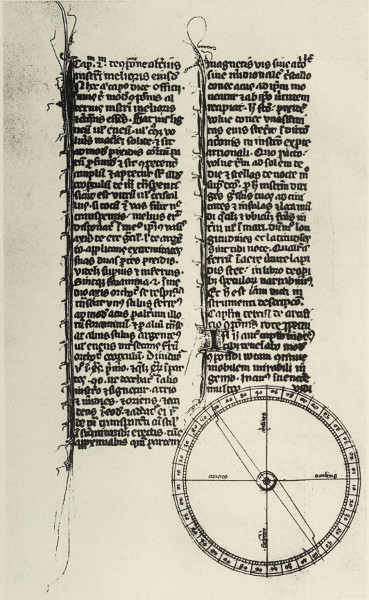
Petrus Peregrinus. Facsimile of a Ms. at the Bodleian Library, of the “Epistola de Magnete,” wherein is described the earliest known pivoted compass.
Gilbert alludes to this perpetual-motion engine as having been devised or delineated by Peregrinus after he had got the idea from others (“De Magnete,” Book II. chap. xxxv.), and says that Jerome Cardan writes (“Opera,” Batav., 1663; “De Rerum Varietate,” Book, IX. chap. xlviii.) he could construct one out of iron and loadstone—not that he ever saw such a machine; that he merely offers the idea as an opinion and quotes from a report of the physician Antonio de Fantis of Treviso published in “Tabula generalis ac mare magnum scotice subtilitatis....”
In the “Magisterium Naturæ et Artis,” P. Francisci Tertii de Lanis, Brixiæ, 1684, Tractatus Tertius, Caput Secundum, p. 489, under Problema, I, Motus perpetuus magnetis, will be found allusion to the machines of (1) P. Peregrinus, as described in his epistle; (2) Taisnier; (3) Ant. de Fantis (cited by Cardan, as stated above); also mention of those of P. Schottus, Athan. Kircherus, Hieronimus Finugius and others; the most important of these being again alluded to throughout the third chapter of the same tract.
Gilbert makes further allusion to P. Peregrinus in his Book I. chap. i.; Book II. chap. xxxv.; Book III. chap. i.; Book IV. chap. i.; Book VI. chap. iv.
The Peregrinus’ Leyden manuscript (Fol. Cod. No. 227) already alluded to, Libri says (“Histoire des Sciences Mathém....” 1838, Vol. I. p. 383, note), is but a poor copy of the manuscript in the Paris Library (No. 7378A), from which latter the words Petri ad Sygerum have been unfortunately transformed into Petri Adsigerii. He adds (Vol. II. pp. 70–71) that Humboldt cites (“Examen Critique,” p. 243) several authors who have alluded to the pretended Adsigerius. Mention is also made of the fact that W. Wenkebach, professor at the Hague Military School, examined the manuscripts in the Bodleian Library, Nos. 1629, 1794 and 2458, containing the treatise of Peregrinus, and that not one of them has the passage alluding to the declination. The Leyden manuscript, by the way, is said to be the only one, besides the Vatican copy, No. 5733, bearing the full date, which latter was first made known by Thévenot in his “Recueil de Voyages.” And it was a passage found in the Leyden manuscript (Q 27) which led to the belief that Peregrinus had first observed the variation or declination of the magnetic needle. The passage is as follows: “Take note that the magnet, as well as the needle that has been touched by it, does not point exactly to the poles, but that the part of it which is supposed to point to the South sometimes declines a little to the West, and that the part which looks towards the North sometimes inclines to the East. The exact quantity of this declination I have ascertained, after numerous experiments, to be five degrees. However, this declination is no obstacle to our guidance, because we make the needle itself decline from the true South by nearly one point and a half towards the West. A point contains five degrees.” This passage is unquestionably a late addition, being written in a different hand in a circle which itself is an incompleted outline of one of the figures of Peregrinus’ primitive compass.
References.—“Encyclopædia Metropolitana,” Vol. III. p. 737 (“Bibliotheca Bibliothecarum,” fol. 11, p. 1400; “Catalogue of the MSS. in the library of Geneva,” by Senebier, p. 207); “Bulletino di bibliographia e di storia delle scienze ...” B. Boncompagni, Vol. I. pp. 1–32, 65–99, 101–139, 319–420; Vol. IV. pp. 257–288, 303–331; “Cat. bibl. publicæ univers. Lug. Bat.,” p. 365; W. Wenkebach, “Sur Petrus Adsigerius ...” Rome, 1865 (taken from Vol. VII. No. 3 of the “Annali Pura ed Applicata”); Brunet, “Manuel du Libraire,” 1863, Vol. IV. p. 493; “Br. Museum Library,” 538, G 17; “Journal des Savants,” for April-May 1848, and September 1870; Walker, “Magnetism,” 1866, p. 6; “English Cyclopædia,” Vol. VIII. p. 160, also Dr. Hutton’s “Phil. and Math. Dictionary”; Thos. Young, “A Course of Lectures on Nat. Phil. and the Mechanical Arts,” London, 1807, Vol. I. pp. 746, 756; “Electro-magnetic Phenomena,” by T. A. Lyons, New York, 1901, Vol. I. pp. 105–106; Vol. II. p. 565 (with translation of a portion of the original manuscript); “Examen Critique,” A. de Humboldt, Paris, 1836, Vol. III. p. 31; “Science and Literature of the Middle Ages,” Paul Lacroix, London, pp. 88–89, 280–282; Silvanus P. Thompson, “Proceedings of the British Academy,” 1905–6, p. 377. It may be added that Houzeau et Lancaster, “Bibl. Générale,” Vol. I. part i. p. 640, allude, at No. 3197, to a manuscript of P. Peregrinus, “Nova compositio astrolabii particularis,” as being in the Library of Geneva and as citing the year 1261 in connection with the astronomical tables of John Campan (Campanus, Italian mathematician, who died about 1300): “Biog. Générale,” Vol. VIII. p. 373.
A.D. 1270.—Riccioli (Giovanni Battista), an Italian astronomer, member of the Society of Jesuits, b. 1598, d. 1671, asserts that at this period under the reign of St. Louis (1226–1270), French navigators were already using the magnetic needle, which they kept floating in a small vase of water, and which was supported by two tubes to prevent its falling to the bottom.
For a detailed account of the work of this well-known scientist consult: “Biographie Générale” Vol. XLII. pp. 147–149; Fabroni, “Vitæ Italorum,” Vol. II; Jean Baptiste Delambre, “Hist. de l’Astron. Mod.,” 1821; Davis, “The Chinese,” Vol. III. p. 11; Venanson, “Boussole,” pp. 70–71; Klaproth, “Boussole,” p. 54; Becquerel, “Résumé,” p. 59; Alex. Chalmers, “Gen. Biog. Dict.,” 1811, Vol. XXVI. pp. 182–183; Fischer, “Geschichte der Physik,” Vol. I; Tiraboschi, “Storia della letter. Ital.,” Vol. VIII; “English Cyclopædia,” Vol. V. pp. 76–77. Riccioli’s “Almagestum Novum,” Bologna, 1651, in two volumes, gives in book nine of the second volume the sentence of Galileo. This is the work which an old savant called “the pandects of astronomical knowledge” (Morhof Polyhistor, Vol. II. p. 347).
A.D. 1271–1295.—Polo (Marco), Paulum Venetum, is reported by many to have brought the compass from China to Italy. This is, however, supported by no evidence, nor is any allusion whatever made to the fact in the account he rendered of his voyage. Before Marco Polo set out on his travels, as Humboldt states, the Catalans had already made voyages “along the northern islands of Scotland as well as along the western shores of tropical Africa, while the Basques had ventured forth in search of the whale, and the Northmen had made their way to the Azores (the Bracir islands of Picignano).”
Polo relates that he set out from Acre in 1271, and returned to Venice “in the year 1295 of Christ’s Incarnation.” His “Travels” (“Il Milione di Messer Marco Polo”) according to the review of Col. Henry Yule, consists of a prologue and four books. It was dictated by him to a fellow prisoner, Rusticiano or Rusticello, of Pisa, and “it would appear now to be definitely settled that the original was ... of just such French as we might expect in the thirteenth century from a Tuscan amanuensis following the oral dictation of an Orientalized Venetian.”
Polo’s journeyings extended “so far to the north that he leaves the North Star behind him, and thence so far to the south that the North Star is never seen.”
References.—Becquerel, “Elec. et Magn.,” Vol. I. p. 70; Sonnini, in Buffon, “Minéraux,” Vol. VI. p. 84; Humboldt, “Cosmos,” 1849, Vol. II. pp. 625, 656, or 1860, pp. 250–251; “The Book of Ser Marco Polo,” by Sir Henry Yule, New York, 1903, which contains a very extensive bibliography at end of the second volume; Libri, “Hist. des Sc. Mathém.,” Paris, 1838, Vol. II. pp. 26, 140, etc.; D. A. Azuni, “Dissertation sur la Boussole,” p. 69; Miller, “Hist. Phil. Ill.,” 1849, Vol. I. pp. 179–180; “Encycl. Brit.,” ninth ed., Vol. XIX. p. 407; “Journal des Savants” for September 1818, also May 1823, and the five articles published January to May 1867; see also “Centennaire de Marco Polo,” par. H. Cordier, Paris, 1896, containing “bibliographie très complète de toutes les éditions de Marco Polo et des ouvrages qui lui sont consacrés.”
A.D. 1282.—Baïlak, native of Kibdjak, wrote this year, in Arabic, his book on “Stones,” wherein he says that he saw during his voyage from Tripoli to Alexandria, in 1242, the captains of the Syrian sea construct a compass in the following manner: “When the night is so dark as to conceal from view the stars which might direct their course according to the position of the four cardinal points, they take a basin full of water, which they shelter from wind by placing it in the interior of the vessel; they then drive a needle into a wooden peg or a corn-stalk, so as to form the shape of a cross, and throw it into the basin of water prepared for the purpose, on the surface of which it floats. They afterwards take a loadstone of sufficient size to fill the palm of the hand, or even smaller; bring it to the surface of the water, give to their hands a rotatory motion towards the right so that the needle turns on the water’s surface; they then suddenly and quickly withdraw their hands, when the two points of the needle face north and south. I have seen them, with my own eyes, do that during my voyage at sea from Tripolis to Alexandria.”
References.—E. Salverte, “Phil. of Magic,” New York, 1847, Vol. II. pp. 221–222, note; “American Journal of Science and Arts,” Vol. XL. p. 247; Davis, “The Chinese,” Vol. III. p. xii; Klaproth, “Lettre à M. de Humboldt,” pp. 59, 60, 67; Knight, “Mech. Dict.,” Vol. II. pp. 1371 and 1397; “Electro-Magn. Phenom.,” by T. A. Lyons, New York, 1901, Vol. II. p. 564.
A.D. 1302.—Gioia—Goia (Flavio or Joannes), an Italian pilot reported born at Positano, near Amalfi, is said by Flamnius Venanson (“De l’invention de la boussole nautique,” Naples, 1808, pp. 138 and 168) to be the real inventor of the mariner’s compass. This view is supported by Briet (Philippe), “Annales Mundi,” Vol. VI: Géog. et Hydrog., lib. x. cap. 8; by Voltaire (“Essai sur les Mœurs,” 1819, Vol. III. chap. cxli.), and by many others, but Klaproth (“Lettre ...” 1834, pp. 132–136) quotes Anthony of Bologna, called the Panormitan, as saying that Gioia lived in the fourteenth century and wrote both “Prima dedit nautis usum magnetis Amalphis” and “Inventrix præclara fuit magnetis Amalphis.” He adds that a statement to the same effect was made by Arrigi Brechmann in his “Historia Pandectarum Amalphitorum,” Dissertatio I, No. 22, Neapoli, 1735, p. 925, but that both are equally incorrect, for Gioja could not have invented an instrument which had already been in use more than a hundred years before his time.[19]
In his “Essay on Several Important Subjects,” London, 1676, Joseph Glanvill remarks (p. 33): “I think there is more acknowledgment due to the name of this obscure fellow, that hath scarce any left, than to a thousand Alexanders and Cæsars or to ten times the number of Aristotles and Aquinas’. And he really did more for the increase of knowledge and advantage of the world, by this one experiment, than the numerous subtile disputers that have lived ever since the creation of the School of Wrangling.”
In the “Navigator’s Supply,” published 1597, William Barlowe speaks of “the lame tale of one Flavius at Amelphus in the Kingdome of Naples; for to have devised it (the compass) is of very slender probabilitie.”
M. D. A. Azuni says (“Boussole,” 1809, p. 144) that Gioja may have possibly invented the method of suspending the magnetic needle upon a perpendicular pivot so that it would remain horizontal whatever the movements of the vessel. This is very likely; at any rate, it must be admitted that this particular mode of support permits a freer movement to the needle in any direction and admits of more exact observations than when the needle is floating upon the water.
At pp. 487–505, Vol. II of his “Histoire des Sciences Mathématiques,” Guillaume Libri transcribes all he is able to from the almost illegible Peter Peregrinus’ manuscript, No. 7378A, in the Paris Bibliothèque, and refers to the imperfect mode of suspending the magnetic needle therein shown. It is, says he, similar to that spoken of by Francesco da Buti (Libri, Vol. II. pp. 67–68; Bertelli, “Pietro Peregrino,” pp. 63–66), who makes first mention of the compass in the Dante commentary (“Comment, sopra la Divina Commedia”) to be found in the collection of manuscripts No. 29, held by the Magliabechiana Library of Florence. He adds that the suspension of the needle is likewise alluded to by Guerino detto il Meschino, in a work first composed prior to the “Divina Commedia” (an Italian romance, attributed to one Andrew the Florentine) as imbellico, or in bellico, in bilico, meaning in suspense, throughout the editions of Padua, 1473, Bologna, 1475, Milan, 1482 and Venice, 1480, 1498. Mention is also made by Libri of the writings of Adélard de Bath on the compass, at p. 62 of his second volume.
References.—Camillus Leonardus, “Speculum Lapidum”; the notes at p. 180, Vol. I. of Dr. Geo. Miller’s “Hist. Phil. Ill.,” London, 1849, Vol. I. p. 179, note; Venanson, “Boussole,” pp. 158, 160; Knight, “Mech. Dict.,” Vol. II. p. 1398; Collenutius—Collenuccio—“Compendio ... regno di Napoli,” Venice, 1591; “Discussione della leggenda di Flavio Gioia, inventore della bussola” (T. Bertelli, in “Rivista di Fisica Mat. e Sc. Nat.,” Pavia, 1901, II. pp. 529–541); Matteo Camara, “Memorie ... di Amalfi,” Salerno, 1876; “Literary Digest,” July 6, 1901, translated from “Le Cosmos,” Paris, June 8, 1901; Giraldi, “Libellus de Re Nautica,” Bâle, 1540; Admiral Luigi Fincati, “Il Magnete, la calamita e la bussola,” Rome, 1878; “Annales de Géographie,” Vol. XI. No. 59, pp. 7–8 for September 15, 1902, and G. Grimaldi in the “Mem. d. Accad. Etrus. di Cortona”; Paulus Jovius, “Historiarum,” Florence, 1552; Pietro Napoli Signorelli, “Sull’invenzione della bussola nautica ...”; M. A. Blondus, “De Ventis,” Venice, 1546; Cælius Calcagninus, “Thesaurus Græcarum Antiquitatum,” 1697, Vol. XI. p. 761; Houzeau et Lancaster, “Bibl. Gén.,” Vol. II. p. 149; “Riv. G. Ital.,” X. 1903, pp. 1, 11, 105–122, 314–334.
For Briet (Philippe), b. 1601, d. 1668, see Michaud, “Biog. Univ.,” Paris, 1843, Vol. V. p. 527. The best, most complete edition of Briet’s “Annales Mundi” is the Venice, 1693.
A.D. 1327–1377.—It has been claimed by F. M. Arouet de Voltaire, who asserts it at Vol. III. pp. 251–252 of his “Essai sur les Mœurs et l’Esprit des Nations,” Paris, 1809, “that the first well-authenticated use of the compass” was made by the English during this period, which is that of the reign of King Edward III.
By Voltaire, the extraordinary (prodigieuse) antiquity of the Chinese is not questioned. They knew of the compass, but he says “it was not employed by them for its proper use, that of guiding vessels at sea. They travelled only along the shores. Possessed, as they were, of a country that furnished everything, they did not feel the need of going, as we do, to the other end of the world” (Vol. I. pp. 239, 247). Speaking of the Portuguese (Vol. III. p. 257) he says: “It was not before known if the magnetic needle would point to the south on approaching the South Pole; it was found to point constantly to the north during the year 1486.”
From the time of Edward III, the compass was known in England by the names of adamant, sailing needle and sail-stone dial, as has been shown in the writings of Chaucer and others, the most important of which will be duly quoted in their order. The compass was alluded to, more particularly, by John Gower, “Confessio Amantis,”[20] Books I and VI; by Richard Hakluyt, “Voyages,” Vol. I. pp. 213, 215; and by Edward Fairfax, “Godefroy de Boulogne,” Book XV. s. 18.
It may be well to record here that Voltaire was “confessedly the foremost name, the acknowledged head of European literature of his time.” Goethe calls him “the greatest literary man of all time, the most astonishing creation of the Author of Nature” (“Nouvelle Biographie,” Vol. XLV. i. p. 445). Though not the first French author who wrote on the wonderful discoveries of Newton, he was the first to make them extensively known on the Continent.
References.—Sir Harris Nicolas, “Hist. Roy. Navy,” 1847, Vol. II. p. 180; Humboldt, “Cosmos,” 1859, Vol. V. p. 57, note; Whewell, “Hist. of the Ind. Sc.,” 1859, Vol. I. p. 431; “Crit. and Misc. Essays,” by Thomas Carlyle, Boston, 1860, pp. 5–78. “La France Littéraire,” par Joseph M. Quérard, Vol. X. Paris, 1839, pp. 276–457, devotes as many as 182 pages to bibliographical notices of Voltaire and names 1131 publications written by or relating to him, whilst in Quérard’s “Bibliographie Voltairienne” will be found a still more extended account at pp. i-xxxvi and at pp. 1–84.
The Mariner’s Compass
Regarding the mariner’s compass, it can scarcely be doubted, from what precedes, that it came to the knowledge of Europeans in the manner indicated under the A.D. 1190 date.
Baïlik of Kibdjak—Baüak Kibdjaki—spoke of its use as generally well known by the Syrian navigators, who constructed it in exactly the same way as did the Chinese (A.D. 1111–1117 and A.D. 1282), and which resembled the compass seen by Brunetto Latini in the possession of Friar Bacon while in England prior to the year 1260 (Knight, “Mech. Dict.,” Vol. II. p. 1397).
Edrisi (Idrisi or Aldrisi), the most eminent of the Arabian geographers, is said by Boucher to have given a confirmed account of the polarity of the magnet, the early knowledge of which by the Arabs has been shown conclusively by Jacob de Vitry, Vincent de Beauvais and Albertus Magnus.
Signor P. T. Bertelli, who has been mentioned under the A.D. 1190 date, could not find any reference, however remote, to the directive property of the loadstone throughout a careful examination of Latin and Greek works dating from the sixth century B.C. to the tenth century A.D. He admits that the directive property was known to the Chinese, who had made rude floating needle compasses before the beginning of the Christian era, although these compasses are likely to have been brought home by the Amalfian sailors, who are, by some writers, represented as having substituted the pivoted needle as well as added the Rose of the Winds.[21] He will not, however, recognize the claims made in favour of Flavio Gioja. On the other hand, A. Botto has shown that the Amalfitans introduced the compass between the tenth and the eleventh centuries (“Contributo agli studi storici sull’origine della bussola nautica,” 1899). Consult likewise Vol. IX of “Annales de Géogr. et de Bibliogr.,” 1899, p. 8.
At p. 195 of the December 1904 issue of “Terrestrial Magnetism” is a short article relative to the claim made that the compass was invented by a Veronese named Salomone Ireneo Pacifico (A.D. 776–846) during the first half of the ninth century. It states that Bertelli considers this due to a misinterpretation of an inscription on Pacifico’s tomb, and it alludes to Bertelli’s previous paper on the subject in “Terrestr. Magn.,” Vol. VIII. No. 4, p. 179 (see also the number of “Terrestr. Magn.” for June 1905, p. 108, and the “Geographical Journal” for March 1905, pp. 334–335).
The earliest recorded use of the compass in a Spanish vessel, according to Capmany (“Memorias Historicas,” 1792), is to be found in the Chronicle of Don Pedro Niño, Conde de Buelna, as follows: “It is reported that Conde’s galleys left the island of La Alharina along the coast of Bombay ... and the pilots compared their needles which had been rubbed with the magnet stone....”
In Dr. Plumptre’s notes on Dante, reference is made to the fact that the European knowledge of the magnetic needle came from Arabia, and, like Humboldt, he quotes in support thereof an allusion from the Spanish “Leyes de las Partidas” belonging to the first half of the thirteenth century. The passage in the last named is spoken of by M. Fern de Navarrete in his “Discurso historico,” etc., 1802 (II. tit. ix. ley 28) and reads thus: “The needle which guides the seaman in the dark night and shows him, both in good and in bad weather, how to direct his course is the mediatrix (medianera) between the loadstone (la piedra) and the north star....” Humboldt adds: “See the passage in ‘Las siete Partidas del sabio Rey Don Alonso el IX’ [according to the usually adopted chronological order, Alfonso the tenth], Madrid, 1829, Vol. I. p. 473.”[22]
On the other hand, the knowledge of the compass by the Arabs in the thirteenth century has been most decidedly contested by E. Renaudot (“Anciennes Relations des Indes et de la Chine,” Paris, 1717, p. 3); by D. A. Azuni (“Dissertation sur l’origine de la Boussole,” Paris, 1809, pp. 102, 127); by Giovanni Battista Ramusio (“Coll. Voy.,” 1554, Vol. I. p. 379); by A. Collina (“Considerazioni,” etc., Faenza, 1748, p. 121, etc.). Buffon says (“Théorie de la Terre,” Paris, An. VIII. tome i. p. 300): “I know that some pretend the Arabs have invented the compass and have used it long before the French (see ‘Abrégé de l’histoire des Sarrazins,’ de Bergeron, p. 119) ... but that opinion always appeared to me devoid of reason; for there is no word in the Arabian, Turkish or Persian tongue which can be made to signify the compass.... They employ the Italian word bossola....”
The same view is entertained by Dr. William Robertson, principal of the University of Edinburgh, who, after announcing in his “History of the Reign of Charles V,” London, 1769, Vol. I. p. 78, that the mariner’s compass was invented soon after the close of the Holy War, gives at pp. 333–335 of his “Historical Disquisition,” London, 1812, a translation of the above passage taken from an early edition of that illustrious French naturalist George Louis Le Clerc, Comte de Buffon. Robertson adds: “This shows that the knowledge of this useful instrument was communicated to them (the Arabs) by the Europeans. There is not one single observation of ancient date made by the Arabians on the variation of the needle, or any instruction deduced from it for the assistance of navigators.... When Mr. Niehbuhr was at Cairo, he found a magnetic needle in the possession of a Mohammedan which served to point out the Kaaba, and gave it the name of el magnetis, a clear proof of its European origin.”
The claims of France to the discovery of the compass have been laid by some to the fact that the north point of the early instruments was generally drawn in the form of a fleur de lys, but Voltaire says (“Essai,” etc., Vol. III. p. 251), that the Italians drew this in honour of the sovereigns of Naples, a branch of the French royal family. The able writer in the English Cyclopædia (“Arts and Sciences,” Vol. III. p. 102) considers the design to be only “an ornamented cross which originated in devotion to the mere symbol; though, as the compass undoubtedly came, he says, into Europe from the Arabs, the fleur de lys might possibly be a modification of the mouasala, or dart, the name by which the Arabs called the needle” (“Phil. Mag.,” Vol. XVIII. p. 88).
References.—Hallam, “Middle Ages,” Vol. III. chap. ix. part ii.; Klaproth, “La Boussole,” pp. 53, 54 and 64–66; Davis, “The Chinese,” Vol. III. p. 12; “Silliman’s Journal,” XL. 242–250; “Nautical Magazine,” April 1903; “Ciel et Terre,” Juin 1, 1904, pp. 156–158; “Histoire de la Boussole,” par P. D. M. Boddært; Libri, “Hist. des Sc. Mathém.,” Paris, 1838, Vol. I. pp. 136–137, 382, etc.; Article “Bussola” in “Nuova Encycl. Italiana,” by Bocardo, Vol. IV. Torino, 1877, p. 377, poesia di Ugo di Sercy (Bercy) e di Giovanni di Mehun; “Harper’s Magazine,” New York, for February, 1904; V. Molinier, “Notice ... boussole au xiiie siècle,” Toulouse, 1850; G. Grimaldi, “Dissert. ... della bussola,” Roma, 1741; McCulloch, “Traités ... boussole,” Paris, 1853; Magliozzi, “Notizie ... bussola,” Napoli, 1849; Dr. Geo. Miller, “Hist. Phil. Illust.,” London, 1849, Vol. I. p. 180, note. For Edrisi, see “Journ. des Savants,” issued in April and August 1843, and in December 1846.
A.D. 1391.—Chaucer (Geoffrey), the father of English poetry, thus expresses himself in “The Conclusions of the Astrolabie” (“English Poets,” London, 1810, Vol. I): “I haue giuen thee a sufficient astrolabye for oure orizont compowned after the latitude of Oxenforde.... Now hast thou here, the fower quarters of thin astrolabie, deuided after the fower principall plages or quarters of the firmament.... Now is thin Orisonte departed in XXIIII partiez by thi azymutz, in significacion of XXIIII partiez of the world; al be it, so that ship men rikne thilke partiez in XXXII.”
“Now maugre Juno, Aneas For all her sleight and her compas Atcheiued all his auenture.” “House of Fame,” B. I.
“The stone was hard of adamaunt, Whereof they made the foundemaunt, The tour was round made in compas, In all this world no richer was.” “Rom. of the Rose.”
“Right as betwene adamants two Of euen weight, a pece of yron set, Ne hath no might to moue to ne fro For what that one may hale, that other let.” “Assem. of Foules.”
References.—“English Poets,” London, 1810, Vol. I. p. 453; Ch. Wells Moulton, “Library of Literary Criticism,” Vol. I. pp. 77–81.
A.D. 1436.—Bianco—Biancho—(Andrea), was an Italian cartographer living at Venice early in the fifteenth century, who published, in 1436, an atlas exhibiting charts of the magnetic variation. The knowledge of the latter, which is so indispensable to the correction of a ship’s reckoning, was then ascertained less by the sun’s rising and setting than by the polar star.
One of Bianco’s charts, now in the Biblioteca Marciana, Venice, shows two islands at the West of the Azores, leading many to believe that he possessed some knowledge of the existence of North and South America.
In Justin Winsor’s description of Dr. John G. Kohl’s collection of early maps (“Harvard Univ. Bulletin,” Vol. III. pp. 175–176), it is said that the original of Andrea Bianco’s Map of the World A.D. 1436, now at Venice, was reproduced by Joachim Lelewell (“Géographie du Moyen Age,” Pl. XXXII), and also in M. F. de Barros de Santarem’s “Essai sur l’histoire de la cosmographie et de la cartographie” (Pls. XXIII, XLIII).[23] Reference is also made thereto in Winsor’s “Bibliography of Ptolemy’s Geography,” sub anno 1478. Mr. Winsor adds: “Bianco’s views are of interest in early American cartography from the deductions which some have drawn from the configuration of the islands ‘Antillia’ and ‘De la man Satanaxio’—(two islands on its western verge)—that they represent Pre-Columbian discovery of South and North America.” Humboldt (“Crit. Untersuchungen,” I. 413, 416) has discussed the question, and pointed out that one island, “Antillia,” had earlier appeared on a map of 1425, and D’Avezac finds even earlier references to the same island.
To Andrea Bianco may be ascribed the best of all known forms of wind-roses. Admiral L. Fincati illustrates, in his well-known pamphlet “Il Magnete, la Calamita e la Bussola,” Rome, 1878, all the best-known examples from 1426 to 1612, those of Bianco having upon them either the fleur de lys (referred to at A.D. 1327–1377) or the letter T[symbol], or designs of a triangle or trident, to indicate the north, whilst the east is designated by a cross, in same manner as shown in the 1426 Giraldi and the Oliva 1612–1613.[24]
For other forms and accounts of these rose-of-the-winds or compass cards, it would be well to consult more particularly Nordenskiöld, Nils Adolf Erik (1832–1901), “Periplus” (1897), as well as his “Facsimile Atlas” published eight years previously; Pedro de Medina, “Arte de Navegar”; Francesco Da Buti, “Comment, sopra la Div. Com.”; Simon Stevin’s “Haven-finding Art”; Athan. Kircher, “Magnes, sive de Arte Magnetica”; and Guillaume de Nautonniez, “Mécométrie de l’Eymant ... déclinaison guideymant pour tous les lieux ...” published 1602–1604.[25]
References.—“Biog. Gen.,” Vol. V. pp. 922–923, Mazzuchelli, “Scrittori d’ Italia”; “New Int. Encycl.,” New York, 1902–1903, Vol. II. p. 796; Larousse, “Dict. Univ.,” Vol. II. p. 672; Humboldt, “Cosmos,” 1859, Vol. V. p. 55; Johnson’s “New Univ. Cycl.,” 1878, Vol. III. p. 230; “Der Atlas des Andrea Bianco vom Jahre 1436 of Oscar Peschel,” Venedig, 1869; Justin Winsor, “Narrative and Critical Hist. of America,” Boston, 1889, Vol. I. pp. 50–56, 114, 117; “Formaleoni, saggio sulla nautica antica de Veneziani,” Venez., 1783, pp. 51–59 (Libri, “Hist. des. Math.,” Vol. III).
A.D. 1490–1541.—Paracelsus (Aureolus Theophrastus)—the assumed name of Philippus Aureolus Theophrastus Bombast von Hohenheim—a native of Switzerland, admitted by unprejudiced writers to have been one of the greatest chemists of his time (Hemmann, “Medico—Sur. Essays,” Berlin, 1778). The author of “Isis Unveiled” states that he made use of electro-magnetism three centuries before Prof. Oersted’s discovery, and that he rediscovered the occult properties of the magnet, “the bone of Horus,” which, twelve centuries before his time, had played such an important part in the theurgic mysteries, thus very naturally becoming the founder of the school of magnetism and of mediæval magico-theury. But Mesmer, who lived nearly three hundred years after him, and as a disciple of his school brought the magnetic wonders before the public, reaped the glory that was due to the fire-philosopher, while the great master died in want (“Isis Unveiled,” Vol. I. pp. 71, 72, 164).
Madame Blavatsky further adds (Vol. I. p. 167) that the full views of Paracelsus on the occult properties of the magnet are explained partially in his famous book “Archidoxorum,” wherein he describes the wonderful tincture, a medicine extracted from the magnet, and called “Magisterium Magnetis,” and partially in the “De Ente Dei” and “De Ente Astrorum,” lib. i.
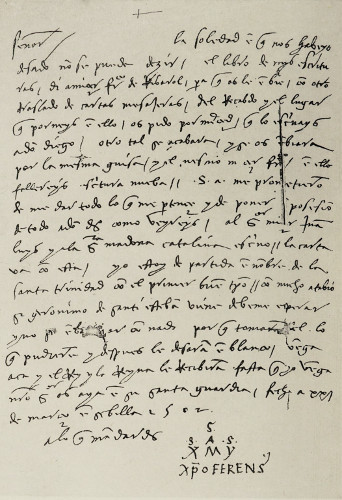
Christopher Columbus. Photographic reproduction of his letter, March 21st, 1502, to Nicolo Oderigo, Ambassador to France and to Spain, which was acquired by the King of Sardinia and presented by him to the City of Genoa.
It is now preserved in the Palace of the Genoese Municipality.
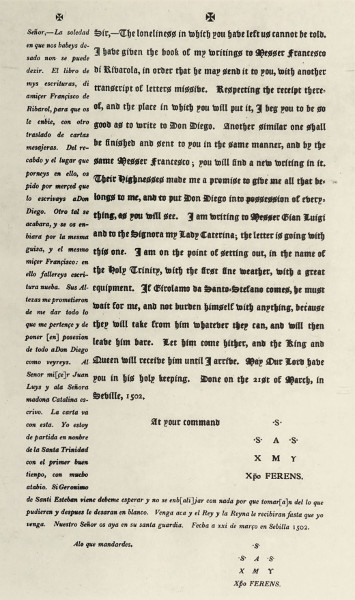
Christopher Columbus. Translation of the letter written by him to Nicolo Oderigo, shown opposite; made into English by Mr. G. A. Barwick, B.A., of the British Museum. Permission to reproduce both original letter and its translation was given by Messrs. B. F. Stevens & Brown, London.
Señor,—La soledad en que nos habeys desado non se puede dezir. El libro de mys escrituras, di amiçer Françisco de Ribarol, para que os le enbie, con otro traslado de cartas mesajeras. Del recabdo y el lugar que porneys en ello, os pido por merçed que lo escrivays aDon Diego. Otro tal se acabara, y se os enbiara por la mesma guisa, y el mesmo miçer Françisco: en ello fallereys escritura nueba. Sus Altezas me prometieron de me dar todo lo que me pertençe y de poner [en] posesion de todo aDon Diego como veyreys. Al Señor mi[çe]r Juan Luys y ala Señora madona Catalina escrivo. La carta va con esta. Yo estoy de partida en nonbre de la Santa Trinidad con el primer buen tienpo, con mucho atabio. Si Geronimo de Santi Esteban viene debeme esperar y no se enb[ali]jar con nada por que tomar[a]n del lo que pudieren y despues le desaran en blanco. Venga aca y el Rey y la Reyna le recibiran fasta que yo venga. Nuestro Señor os aya en su santa guardia. Fecha a xxi de março en Sebilla 1502.
Alo que mandardes,
·S·
·S· A ·S·
X M Y
X[-p]o FERENS.
Sir,—The loneliness in which you have left us cannot be told. I have given the book of my writings to Messer Francesco di Rivarola, in order that he may send it to you, with another transcript of letters missive. Respecting the receipt thereof, and the place in which you will put it, I beg you to be so good as to write to Don Diego. Another similar one shall be finished and sent to you in the same manner, and by the same Messer Francesco; you will find a new writing in it. Their Highnesses made me a promise to give me all that belongs to me, and to put Don Diego into possession of everything, as you will see. I am writing to Messer Gian Luigi and to the Signora my Lady Caterina; the letter is going with this one. I am on the point of setting out, in the name of the Holy Trinity, with the first fine weather, with a great equipment. If Girolamo da Santo-Stefano comes, he must wait for me, and not burden himself with anything, because they will take from him whatever they can, and will then leave him bare. Let him come hither, and the King and Queen will receive him until I arrive. May Our Lord have you in his holy keeping. Done on the 21st of March, in Seville, 1502.
At your command
·S·
·S· A ·S·
X M Y
Xp̄o FERENS.
In the words of Paracelsus, we give the following extracts concerning the loadstone, taken from “The Hermetic and Alchemical Writings ...” by A. E. Waite, London, 1894:
Vol. I. p. 17.—“The adamant. A black crystal called ... Evax ... is dissolved in the blood of a goat.”
“The magnet. Is an iron stone, and so attracts iron to itself. Fortified by experience.... I affirm that the magnet ... not only attracts steel and iron, but also has the same power over the matter of all diseases in the whole body of man.”
Vol. I. pp. 132 and 145.—“A magnet touched by mercury or anointed with mercurial oil, never afterwards attracts iron ... same if steeped in garlic....”
Vol. I. p. 136.—“The life of the magnet is the spirit of iron which can be taken away by rectified vinum ardens itself or by spirit of wine.”
Vol. II. p. 59.—“Wherever the magnet has grown—there, a certain attractive power exists, just as colocynth is purgative and the poppy is anodyne....”
Mr. A. E. Waite says (Vol. II. p. 3) that the ten books of Paracelsus’ Archidoxies stand in the same relation to Hermetic Medicine as the nine books Concerning the Nature of Things stand to Hermetic Chemistry and to the science of metallic transmutation.
References.—Biography of Paracelsus, in Larousse, “Dict Univ.,” Vol. XII. pp. 171–172, in F. Hartmann, 1887, and in the ninth ed. of the “Encycl. Brit.,” Vol. XVIII. pp. 234–236; Van Swinden, “Recueil,” etc., La Haye, 1784, Vol. I. pp. 356–358; Gilbert, “De Magnete,” Book I. chaps. i. and xiv., also Book II. chap. xxv.; “Journal des Savants” for November 1849; Walton and Cotton, “Complete Angler,” New York and London, 1847, pp. 212–213, for notes regarding Paracelsus, Robert Fludd, Jacob Behmen and the Rosicrucians; “Dictionnaire Historique de la Médecine,” N. F. Eloy, Mons, 1778, Vol. III. pp. 461–471; “History and Heroes of the Art of Medicine,” J. Rutherfurd Russell, London, 1861, pp. 157–175; “Histoire Philosophique de la Médecine,” Etienne Tourtelle, Paris, An. XII. (1804) Vol. II. pp. 326–346; “History of Magic,” Joseph Ennemoser, London, 1854, Vol. II. pp. 229–241.
At p. 55 of the first supplement to “Select. Bibliog. of Chemistry,” by H. C. Bolton, Washington, 1899, mention is made of the Paracelsus Library belonging to the late E. Schuberth of Frankfort-on-the-Main ... as containing 194 titles of works on Paracelsus and 548 titles of works relating to Paracelsus and his doctrines; the section on Alchemy embracing as many as 351 titles.
A.D. 1492.—Columbus, Colombo, Colon (Christopher), the discoverer of America., is the first to determine astronomically the position of a line of no magnetic variation (on which the needle points to the true north) the merit of which discovery has, by Livio Sanuto, been erroneously attributed to Sebastian Cabot. (Livio Sanuto, “Geographia distincta in XII libri ...” wherein the whole of Book I is given to reported observations of the compass and to accounts of different navigators.)
Columbus did not, as many imagine, make the first observations of the existence of magnetic variation, for this is set down upon the charts of Andrea Bianco, but he was the first who remarked, on the 13th of September, 1492, that “2½ degrees east of the island of Corvo, in the Azores, the magnetic variation changed and passed from N.E. to N.W.” Washington Irving thus describes the discovery (“History ... Ch. Columbus,” Paris, 1829, Vol. I. p. 198): “On the 13th of September, in the evening, being about two hundred leagues from the island of Ferro (the smallest of the Canaries), Columbus, for the first time, noticed the variation of the needle, a phenomenon which had never before been remarked. He perceived, about nightfall, that the needle, instead of pointing to the North Star, varied about half a point, or between five and six degrees to the north-west, and still more on the following morning. Struck with this circumstance, he observed it attentively for three days and found that the variation increased as he advanced. He at first made no mention of this phenomenon, knowing how ready his people were to take alarm; but it soon attracted the attention of the pilots, and filled them with consternation. It seemed as if the laws of nature were changing as they advanced, and that they were entering into another world, subject to unknown influences (Las Casas, ‘Hist. Ind.,’ l. i. c. 6). They apprehended that the compass was about to lose its mysterious virtues; and, without that guide, what was to become of them in a vast and trackless ocean? Columbus tasked his science and ingenuity for reasons with which to allay their terrors. He told them that the direction of the needle was not to the polar star but to some fixed and invisible point. The variation, therefore, was not caused by any fallacy in the compass, but by the movement of the North Star itself, which, like the other heavenly bodies, had its changes and revolutions, and every day described a circle around the pole. The high opinion that the pilots entertained of Columbus as a profound astronomer gave weight to his theory, and their alarm subsided.”
Humboldt says: “We can, with much certainty, fix upon three places in the Atlantic line of no declination for the 13th of September, 1492, the 21st of May, 1496 and the 16th of August, 1498.”
References.—“Columbus and his Discoveries,” in the “Narrative and Critical History of America,” by Justin Winsor, Boston, 1889, Vol. II. pp. 1–92; “Christopher Columbus, His life, work ...” by John Boyd Thacher, 1903; Giov. Bat. Ramusio, “Terzo volume delle Navigationi e Viaggi ...” 1556; Dr. Geo. Miller, “History Phil. Illust.,” London, 1849, Vol. II. pp. 216–219; David Hume, “History of England,” London, 1822, Vol. III. pp. 387–398; Guillaume Libri, “Histoire des Sciences Mathématiques en Italie,” Halle, 1865, Vol. III. pp. 68–85; “Columbus, a Critical Study,” by Henry Vignaud, London, 1903; Weld, “Hist. Royal Society,” Vol. II. p. 429; Thos. Browne, “Pseudodox. Epid.,” 1658, Book II. pp. 68–69; Humboldt, “Cosmos,” 1849, Vol. I. p. 174; Vol. II. pp. 636, 654–657, 671–672, and Vol. V. (1859) pp. 55–56, 116; Knight, “Mech. Dict.,” Vol. II., pp. 1374, 1397; Poggendorff, “Geschichte der Physik,” Leipzig, 1879, p. 270; “Raccolta di documenti e studi publicati della R. Com. Columb. pel 40 Centenario alla scoperta dell’America,” Roma, 1892; Humboldt, “Examen Critique ... progrès de l’astronomie nautique,” Paris, 1836, Vol. I. pp. 262–272, etc.
It may be worth noting here that the ashes of Columbus, removed from the Cathedral of Havana, were placed in a mausoleum at Seville, November 17, 1902 (“Science,” Dec. 12, 1902, p. 958).
Amongst the numerous claimants to the discovery of America, some have placed the great navigator Martin Behaim—Behem—(1430–1506), who received his instruction from the learned John Müller (Regiomontanus) and became one of the most learned geographers as well as the very best chart maker of his age. Cellarius, Riccioli and other writers assert that Behaim had, before Columbus, visited the American Continent, while Stuvenius shows, in his treatise “De vero novi orbis inventore,” that the islands of America and the strait of Magalhæns were accurately traced upon the very celebrated globe called the “World Apple” completed by Behaim in the year 1492, and which is still to be seen in Behaim’s native city of Nürnberg.[26] (See Mr. Otto’s letter to Dr. Franklin, in the second volume of the “Transactions of the American Philosophical Society held at Philadelphia for promoting useful knowledge,” likewise Humboldt, “Examen critique de l’histoire de la Géographie,” Vol. II. pp. 357–369; “The Reliquary,” London, Vol. VI. N.S. Jan.-Oct. 1892, pp. 215–229; Justin Winsor, “Narrative and Critical History of America,” Boston 1889, Vol. II. pp. 104–105; “Geogr. Jour.,” Vol. V. March 1895, p. 228.)
It was this same Martin Behaim (Humboldt, “Cosmos,” 1860, Vol. II. p. 255) who received a charge from King John II of Portugal to compute tables for the sun’s declination and to teach pilots how to “navigate by the altitudes of the sun and stars.” It cannot now be decided whether at the close of the fifteenth century the use of the log was known as a means of estimating the distance traversed while the direction is indicated by the compass; but it is certain that the distinguished voyager Francisco Antonio Pigafetta (1491–1534) the friend and companion of Magellan—Magalhæns—speaks of the log (la catena a poppa) as of a well-known means of measuring the course passed over. Nothing is to be found regarding way-measurers in the literature of the Middle Ages until we come to the period of several “books of nautical instruction,” written or printed by this same Pigafetta (“Trattato di Navigazione,” probably before 1530); by Francisco Falero, a brother of Ruy Falero, the astronomer (“Regimiento para observar la longitud en la mar,” 1535); by Pedro da Medina, of Seville (“Arte de Navegar,” 1545); by Martin Cortez, of Bujalaroz (“Breve Compendio de la esfera, y de la arte de navegar,” 1551), and by Andres Garcia de Cespedes (“Regimiento de Navigacion y Hidrografia,” 1606). From almost all these works—some of which, if not all, have naturally become very scarce—as well as from the “Summa de Geografia” which Martin Fernandez de Enciso had published in 1519, we learn most distinctly that the “distance sailed over” was then ascertained in Spanish and Portuguese ships not by any distinct measurement, but only through estimation of the eye, according to certain established principles. Medina says (lib. iii. caps. 11–12): “In order to know the course of the ship, as to the length of distance passed over, the pilot must set down in his register how much distance the vessel hath made according to hours (i. e. guided by the hour-glass, ampoleta); and, for this, he must know that the most a ship advances in an hour is four miles, and, with feebler breezes, three or only two.” Cespedes, in his “Regimiento” (pp. 99 and 156) calls this mode of proceeding echar punto por fantasia, and he justly remarks that if great errors are to be avoided, this fantasia must depend on the pilot’s knowledge of the qualities of his ship. Columbus, Juan de la Cosa, Sebastian Cabot and Vasco da Gama, were not acquainted with the log and its mode of application, and they all estimated the ship’s speed merely by the eye, while they ascertained the distance they had made merely through the running down of the sand in the glasses known as ampoletas.
References.—For F. A. Pigafetta, for Petro de Medina and for Martin Cortez, Houzeau et Lancaster, “Bibl. Génér.,” Vol. I. pt. ii. pp. 1221–1223; “New Gen. Biog. Dict.,” Jas. Rose, London, 1850, Vol. XI. p. 113; “Biog. Univ.” (Michaud), Vol. XXXIII. p. 297; “Grand Dict. Univ.” (Larousse), Vol. XII. p. 999; “Nouv Biog. Gen.” (Hœfer), Vol. XL. p. 207. Also Dr. G. Hellmann’s “Neudrucke,” 1898, No. 10, for reproduction of Francisco Falero’s “Tratato del Esphera y del arte del marear” (Del Nordestear de las Agujas), 1535, as well as for reproduction of Martin Cortez’ “Breve Compendio” (De la piedra Yman), 1551.
A.D. 1497.—Gama (Vasco or Vasquez da), celebrated Portuguese navigator, is known positively to have made use of the compass during the voyage he undertook this year to the Indies. He says that he found the pilots of the Indian Ocean making ready use of the magnet. The first book of the history of Portugal by Jerome Osorius—wherein he gives (pp. 23–24, Book I. paragraph 15, 1581 ed.) a very extended “description de l’aiguille marine, invention des plus belles et utiles du monde”—states that, instead of a needle, they used a small magnetized iron plate, which was suspended like the needle of the Europeans, but which showed imperfectly the north.
Gilbert says (“De Magnete,” Book IV. chap. xiii.) that, as the Portuguese did not rightly understand the construction and use of the compass, some of their observations are untrustworthy and that in consequence various opinions exist relative to magnetic variation. For example, the Portuguese navigator Roderigues de Lazos—Lagos—takes it to be one-half point off the Island of St. Helena; the Dutch, in their nautical journal, make it one point there; Kendall, an expert English navigator, makes it only one-sixth of a point, using a true meridional compass. Diego Alfonso finds no variation at a point a little south-east of Cape das Agulhas,[27] and, by the astrolabe, shows that the compass points due north and south at Cape das Agulhas if it be of the Portuguese style, in which the variation is one-half point to the south-east.
References.—Azuni, “Boussole,” p. 121; Klaproth, “Boussole,” p. 64; Knight, “Mech. Dict.,” Vol. II. p. 1398; Larousse, “Dict.,” Vol. VIII. p. 977; “Voyageurs anciens et modernes” (Charton), 1855; “Le Comte Amiral D. Vasco da Gama,” par D. Maria T. da Gama, Paris, 1902.
A.D. 1497.—Cabot (Sebastian), a prominent English navigator, lands, June 24, 1497, on the coast of Labrador, between 56 degrees and 58 degrees north latitude.
At p. 150 of the 1869 London edition of Mr. J. F. Nicholl’s “Life of Seb. Cabot” it is said the latter represented to the King of England that the variation of the compass was different in many places, and was not absolutely regulated by distance from any particular meridian; that he could point to a spot of no variation, and that those whom he had trained as seamen, as Richard Chancellor and Stephen Burrough, were particularly attentive to this problem, noting it at one time thrice within a short space.
References.—Richard Hakluyt, “The Principal navigations, voyages, traffiques and discoveries of the English nation,” 1599: at pp. 237–243, for the voyage of Richard Chancelor, pilote maior, and, at p. 274, for “the voyage of Steuen Burrough, master of the pinnesse called the Serchtrift”; Livio Sanuto, “Geografia,” Venice, 1588, lib. i.; Fournier, “Hydrographie,” lib. xi.; “Library of Am. Biog.,” by Jared Sparks, Boston, 1839, Vols. II and VII as per Index at pp. 318–319; “Jean et Seb. Cabot,” par Hy. Harisse, Paris, 1882; Geo. P. Winship, “The Cabot Bibliography,” London and New York, 1900; Humboldt, “Examen Critique,” Vol. IV. p. 231, and “Cosmos,” Vol. II. (1860) pp. 640, 657–658; Biddle, “Memoir of Seb. Cabot,” 1831, pp. 52–61.
A.D. 1502.—Varthema-Vertomannus (Ludovico di) leaves Europe for the Indies, as mentioned at p. 25 of his “Travels,” translated by J. Winter Jones, London, 1863, from the original “Itenerario ... ne la India ...” Milano, 1523. He states that the Arabs who navigated the Red Sea were known to have long since made use of the mariner’s chart and compass, and he tells us, in the introduction and at p. 249, that “the captains carried the compass with the needle after our manner,” and that their chart was “marked with lines perpendicular and across.” When the polar star became invisible, they all asked the captain by what he could then steer them, and “he showed us four or five stars, among which there was one (B. Hydrus) which he said was opposite to (contrario della) our North Star, and that he sailed by the north because the magnet was adjusted and subjected to our north, i. e. because this compass was no doubt of European origin—its index pointing to the north, and being unlike that of the Chinese pointing to the south.”
References.—Cavallo, “Magnetism,” London, 1787, Chap. IV; also, “Hakluyt’s Collection of the early voyages, travels and discoveries,” London, 1811, Vol. IV. p. 547, for “The navigation and voyages of Lewes Vertomannus.”
A.D. 1530–1542.—Guillen (Felipe), an ingenious apothecary of Seville, and Alonzo de Santa Cruz (who was one of the instructors of mathematics to young Charles V, King of Spain and Emperor of Germany, and the Cosmografo Mayor of the Royal Department of Charts at Seville), construct variation charts and variation compasses by which solar altitudes can be taken.
References.—Humboldt, “Cosmos,” 1849, Vol. II. p. 658, and 1859, Vol. V. p. 56; L. A. Bauer, “U. S. Magn. Tables,” 1902, p. 26.
Although based upon very imperfect observations, the magnetic charts thus devised by Alonzo de Santa Cruz antedate by more than one hundred and fifty years the work of Dr. Halley (at A.D. 1683).
A.D. 1544.—Hartmann (Georg) a vicar of the church of Saint Sebaldus, at Nuremberg, writes March 4, to the Duke Albrecht of Prussia, a letter which was brought to light by Moser and which reads as follows: “Besides, I find also this in the magnet, that it not only turns from the north and deflects to the east about nine degrees, more or less, as I have reported, but it points downward. This may be proved as follows: I make a needle a finger long, which stands horizontally on a pointed pivot, so that it nowhere inclines toward the earth, but stands horizontal on both sides; but, as soon as I stroke one of the ends (with the loadstone) it matters not which end it be, then the needle no longer stands horizontal, but points downward (fällt unter sich) some nine degrees, more or less. The reason why this happens I was not able to indicate to his Royal Majesty.” The above seems to establish the fact that Hartmann first observed the dip of the magnetic needle independently of Robert Norman.
Gilbert refers (“De Magnete,” Book I. chap. i.) to Fortunius Affaitatus—Affaydatus—an Italian physicist who, says he, has some rather silly philosophizing about the attraction of iron and of its turning to the poles, thus alluding to the latter’s small work called “Physicæ (et) ac astronomiæ (astronomicæ) considerationes,” which appeared at Venice in 1549. Nevertheless, it is a question whether Affaitatus was not actually the first to publish the declination of the magnetic needle. (“Biogr. Gén.,” Vol. I. p. 346; Mazzuchelli, “Scrittori d’Italia”; Bertelli, “Mem. sopra P. Peregrino,” p. 115; Adelung, Supplément à Jocher, “Allgem. Gelehrten-Lexicon”; Johann Lamont, “Handbuch des Magnetismus,” Leipzig, 1867, p. 425; J. C. Poggendorff, “Biogr.-Lit. Handwörterbuch,” Leipzig, 1863, Vol. I. p. 15; Michaud, “Biogr. Univ. Anc. et Mod.,” Vol. I. p. 208, Paris, 1843; Brunet, “Manuel,” Paris, 1860; “Biog. Cremonese de Lancetti”; M. le Dr. Hœfer, “Biog. Gen.,” Paris, 1852, Vol. I. p. 346.)
References.—Dove, “Repertorium der Physik,” Vol. II, 1838, pp. 129–130; Poggendorff, “Geschichte der Physik,” 1879, p. 273; L. Hulsius, “Descriptio et usus,” Nürnberg, 1597; “Ency. Brit.,” 1883, Vol. XV. p. 221; P. Volpicelli, “Intorno alle prime ... magnete” (Atti dell Acad. Pont. de Nuov. Lincei, XIX. pp. 205, 210).
A.D. 1555.—Olaus Magnus, a native of Sweden and Archbishop of Upsala (where he died during 1568) issued in Rome his great work “Historia de Gentibus Septentrionalibus,” which, for a long time, remained the chief authority on Swedish matters. In this book, Gilbert says (“De Magnete,” lib. i. cap. 1) allusion is made to a certain magnetic island and to mountains in the north possessing such power of attraction that ships have to be constructed with wooden pegs so that as they sail by the magnetic cliffs there be no iron nails to draw out.
To this, reference is made by Thos. Browne (“Pseud. Epidem.,” 1658, Book II. p. 78) as follows: “Of rocks magnetical, there are likewise two relations; for some are delivered to be in the Indies and some in the extremity of the North and about the very pole. The Northern account is commonly ascribed unto Olaus Magnus, Archbishop of Upsala, who, out of his predecessors—Joannes, Saxo and others—compiled a history of some Northern Nations; but this assertion we have not discovered in that work of his which commonly passeth among us; and should believe his geography herein no more than that in the first line of his book, where he affirmeth that Biarmia (which is not 70 degrees in latitude) hath the pole for its zenith, and equinoctial for the horizon.”
In a Spanish book entitled “The Naval Theatre,” by Don Francisco de Seylas and Louera, we find two causes assigned for the variation of the declination; one is “the several mines of loadstones found in the several parts of the earth ...” the other being that “there is no doubt but large rocks of loadstones may affect the needles when near them ...” (“Philos. History ... Roy. Acad. Sc. at Paris,” London, 1742, Vol. II. pp. 279–280).
References.—Claudus Ptolemæus, “Geographia,” lib. vii. cap. 2 (and others named by Bertelli Barnabita at foot of p. 21 of his “Pietro Peregrino de Maricourt,” Roma, 1868, viz. Klaproth, “Lettre sur la Boussole,” Paris, 1834, p. 116; Thos. H. Martin, “Observ. et Théor. des anciens,” Rome, 1865, p. 304; Steinschneider, “Intorno. alla calamita,” Roma, 1868); also Albertus Magnus, Lugduni, 1651; Mr. (Thomas) Blundeville, “His Exercises”; Fracastorio, in the seventh chapter of his “De Sympathia et Antipathia”; F. Maurolycus, “Opuscula,” 1575, p. 122a; Lipenius, “Navigatio Salomonis Ophiritica”; Paulus Merula, “Cosmographia Generalis,” Leyden, 1605; Toussaincte de Bessard, “Dialogue de la Longitude,” Rouen, 1574; U. Aldrovandi, “Musæum Metallicum,” 1648, pp. 554, 563, wherein he alludes to the magnetic mountains spoken of by Sir John Mandeville; Ninth “Encycl. Brit.,” Vol. XVII. p. 752; also the entry at A.D. 1265–1321.
A.D. 1558.—Porta (Giambattista della), Italian natural philosopher (1540–1615), carries on a series of experiments with the magnet for the purpose of communicating intelligence at a distance. Of these experiments, he gives a full account in his “Magiæ Naturalis,” the first edition of which is said to have been published at Naples when Porta was but fifteen years of age (“Encycl. Brit.,” article “Optics”). Prof. Stanley Jones says this is the earliest work in which he has found allusions to a magnetic telegraph.
Porta’s observations are so extraordinary—and they attracted so much attention as to justify eighteen separate editions of his work in different languages prior to the year 1600—that extracts must needs here prove interesting. They are taken out of “Natural Magick in XX Bookes by John Baptist Porta, a Neapolitaine ... London 1658,” the seventh book of which treats “Of the wonders of the loadstone.”
Proem: “And to a friend that is at a far distance from us and fast shut up in prison, we may relate our minds; which I doubt not may be done by two mariner’s compasses, having the alphabet writ about them ...”
Chap. I (alluding to the loadstone):
“The Greeks do call it Magnes from the place, For that the Magnet’s hand it doth embrace.”
Nicander thinks the stone was so called—and so doth Pliny—from one Magnes, a shepherd.
In Chap. XVIII he states that “the situation makes the Vertues of the Stone contrary ... for the stone put above the table will do one thing, and another thing if it be put under the table ... that part that drew above will drive off beneath; and that will draw beneath that drove off above: that is, if you place the stone above and beneath in a perpendicular.”
In Chap. XXV, in allusion to “a long concatenation of iron rings,” he thus quotes Lucretius:
“A stone there is that men admire much That makes rings hang in chains by touch. Sometimes five or six links will be Fast joyn’d together and agree. All this vertue from the Stone ariseth, Such force it hath ...”
Chap. XXVII alludes to the Statue hung by Dinocrates: “... but that is false, that Mahomet’s chest hangs by the roof of the Temple. Petrus Pellegrinus saith, he shewed in another work how that might be done: but that work is not to be found.... But I say it may be done—because I have now done it—to hold it fast by an invisible band, to hang in the air: onely so, that it be bound with a small thread beneath, that it may not rise higher: and then striving to catch hold of the stone above, it will hang in the air, and tremble and wag itself.”
In Chap. XXVIII he says that “Whilst the loadstone is moved under a table of wood, stone or any metal, except iron, the needle in the mariner’s compass will move above, as if there is no body between them. St. Augustine (‘Liber de Civitate Dei’) knew this experiment (likewise alluded to by Camillus Leonardus in his ‘Speculum Lapidum,’ published 1502). But that is much more wonderful that I have heerd: that if one hold a loadstone under a piece of silver, and put a piece of iron above the silver, as he moves his hand underneath that holds the stone, so will the iron move above; and the silver being in the middle, and suffering nothing, running so swiftly up and down, that the stone was pulled from the hand of the man, and took hold of the iron.”
Chap. XXX is headed: “A loadstone on a plate of iron, will not stir iron,” and he again quotes Lucretius:
“Pieces of iron I have seen When onely brass was put between Them and the Loadstone, to recoil: Brass in the middle made this broil.”
In Chap. XXXII he tells us that an Italian “whose name was Amalphus ... knew not the Mariner’s Card, but stuck the needle in a reed, or a piece of wood, cross over: and he put the needles into a vessel full of water that they might flote freely: then carrying about the loadstone, the needles would follow it: which being taken away, as by a certain natural motion, the points of the needles would turn to the north pole: and, having found that, stand still.... Now the Mariner’s Compass is made, and a needle touched with the Loadstone, is so fitted to it, that, by discovering the pole by it, all other parts of the heavens are known. There is made a rundle with a Latin-navel upon a point of the same metal, that it may run roundly freely. Whereupon, by the touching onely of one end, the needle not alone partakes of the vertues of it, but of the other end also, whether it will or not....”
Chap. XLVIII is headed “Whether Garlick can hinder the vertues of the loadstone.” By Porta we are informed that “Plutarch saith Garlick is at great enmity with the loadstone; and such antipathy and hatred there is between these invisible creatures, that if a loadstone be smeered with Garlick, it will drive away iron from it,” which is confirmed by Ptolemy, who states “that the loadstone will not draw iron, if it be anoynted with Garlick; as Amber will no more draw straws, and other light things to it, if they be first steeped in oyl.” He found that when the loadstone “was all anoynted over the juice of Garlick, it did perform its office as well as if it had never been touched with it.”
In Chap. LIII Porta denies “that the diamond doth hinder the loadstone’s vertue.” “Some pretend,” says he, “there is so much discord between the qualities of the loadstone and the diamond, and they are so hateful, one against the other, and secret enemies, that if the diamond be put to the loadstone, it presently faints and loses all its forces. (Pliny.) The loadstone so disagreeth with the diamond, that if iron be laid by it, it will not let the loadstone draw it; and if the loadstone do attract it, it will snatch it away again from it. (St. Augustine.) I will say that I have read of the loadstone: how that, if the diamond be by it, it will not draw iron; and, if it do when it comes neer the diamond, it will let it fall” (Marbodeus, of the Loadstone ... Marbodei Galli ... de lapidibus pretiosis Enchiridion ... Freiburg, 1530, 1531):
“All loadstones by their vertue iron draw; But of the diamond it stands in awe: Taking the iron from’t by Nature’s Law.”
“I tried this often, and found it false; and that there is no truth in it.”
With reference to the above, see Plat (at A.D. 1653), who also alludes to the fact of the softening of the diamond with Goat’s blood. This is alluded to by Porta in the next chapter.
Chapter LIV contains extracts from Castianus in Geoponic. Græc., Marbodeus and Rhenius, the interpreter of Dionysius.
In 1560 there was established at Naples, by the versatile Giam. della Porta, the first Academy of Sciences—Academia Secretum Naturæ—to which were admitted only those who had contributed to the advancement of medicine or to scientific studies in general (“Science,” December 19, 1902, p. 965).
References.—Libri, “Hist. des Sc. Mathém.” Vol. IV. pp. 108–140, 399–406; Houzeau et Lancaster, Vol. II. p. 229; The Fourth Dissertation of the “Encycl. Brit.,” p. 624; Sarpi, at A.D. 1632; Poggendorff, “Geschichte der Physik,” 1879, pp. 133, 273–274; “Encycl. Brit.,” the article on “Optics”; “Journal des Savants” for September 1841.
A.D. 1575–1624.—Boehm—Böhme—Behmen (Jacob), a mystical German writer, known as the theosophist par excellence, is the author of “Aurora,” etc. (1612), “De Tribus Principiis” (1619) and of many other treatises, which were reprinted under the title of “Theosophia Revelata,” and which contain his many very curious observations concerning astrology, chemistry, theology, philosophy and electricity.
References.—“Notice sur J. Boehm,” La Motte-Fouqué, 1831; “Notes and Queries” for July 28, 1855, p. 63; Ninth “Britan.,” Vol. III. p. 852; J. Ennemoser, “History of Magic,” Vol. II. pp. 297–328.
A.D. 1576.—Norman (Robert), a manufacturer of compass needles at Wapping, is the first who determined the dip or inclination to the earth of the magnetic needle in London, by means of a dipping needle (inclinatorium) of his own making. Five years later (1581) Norman publishes a pamphlet “The Newe Attractive, containing a short discourse of the Magnes or Lodestone, and amongest other his vertues, of a newe discouered secret, and subtill propertie concernyng the Declinyng of the Needle, touched therewith, under the Plaine of the Horizon ...” from which is taken the following:
“Hauing made many and diuers compasses and using alwaies to finish and end them before I touched the needle, I found continuallie that after I had touched the yrons with the stone, that presentlie the north point thereof woulde bend or decline downwards under the horizon in some quantitie; in so much that to the flie of the compass, which was before levell, I was still constrained to put some small piece of ware on the south point and make it equall againe ...” (Weld, “History of the Royal Society,” 1848, Vol. II. p. 432).
In the fourth chapter of his work, Norman describes the mode of making the particular instrument with which he was enabled to establish the first accurate measurement of the dip “which for this citie of London, I finde, by exact obseruations to be about 71 degrees 50 mynutes.”
Whewell thus alludes to several investigations in the same line:
“Other learned men have, in long navigations, observed the differences of magnetic variations, as Thomas Hariot, Robert Hues, Edward Wright, Abraham Kendall, all Englishmen: others have invented magnetic instruments and convenient modes of observation such as are requisite for those who take long voyages, as William Borough, in his book concerning the variation of the compass; William Barlo, in his ‘Supplement’; Robert Norman, in his ‘Newe Attractive.’ This is that Robert Norman (a good seaman and an ingenious artificer) who first discovered the dip of magnetic iron” (“Enc. Metr.,” p. 738; read also paragraph 366 of J. F. W. Herschel’s “Prelim. Disc.,” 1855).
In Book I. chap. i. of Gilbert’s “De Magnete,” he says that Norman posits a point and place toward which the magnet looks but whereto it is not drawn: toward which magnetized iron, according to him, is collimated but which does not attract it. He alludes again to this “respective point” (Book IV. chaps. i. and vi.), saying that Norman originated the idea of the “respective point” looking, as it were, toward hidden principles, and held that toward this the magnetized needle ever turns, and not toward any attractional point: but he was greatly in error, albeit he exploded the ancient false opinion about attraction. Gilbert then proceeds to show how this theory is proved by Norman. The original passage in Norman’s “Newe Attractive” (London, 1581, Chap. VI) is as follows:
“Your reason towards the earth carrieth some probabilitie, but I prove that there be no Attractive, or drawing propertie in neyther of these two partes, then is the Attractive poynt lost, and falsly called the poynt Attractive, as shall be proved. But because there is a certain poynt that the needle alwayes respecteth or sheweth, being voide and without any Attractive propertie: in my judjment this poynt ought rather to bee called the poynt Respective.... This poynt Respective, is a certayne poynt, which the touched needle doth always Respect or shew....”
For the means of determining the dip or inclination, see “English Ency.”—Arts and Sciences—Vol. VIII. p. 160.
We have thus far learned that the declination or variation was alluded to by Peter Peregrinus (A.D. 1269) in the Leyden MS.; that Norman was the first to determine the dip or inclination, and we shall, under the 1776 date, find that Borda determined the third magnetic element called the intensity.
In 1581 appeared “The newe attractive ... a discours of the variation of the cumpas ... made by W. B(orough).” This was followed, in 1585 and in 1596, by “The newe Attractive ... newly corrected and amended by M. W. B.,” also, in 1614, by “The New Attractive, with the application thereof for finding the true variation of the compass, by W. Burrowes.”
Norman is also the author of “The safegarde of Saylers, or Great Rutter ... translated out of Dutch ... by R. Norman,” 1590, 1600, 1640.
References.—Noad, “Manual of Electricity,” London, 1859, p. 525; Gassendi, at A.D. 1632; Humboldt, “Cosmos,” 1859–1860, Vol. I. p. 179; Vol. II. pp. 281, 335; Vol. V. p. 58; Geo. Hartmann, A.D. 1543–1544; “Nature,” Vol. XIII. p. 523; Walker, “Magnetism,” p. 146, and, for a photo reproduction of the title-page to the 1581 edition as well as a copy of its contents, see G. Hellmann “Neudrucke ...” 1898, No. 10; also Sidney Lee, “Dict. of Nat. Biogr.,” Vol. XLI. p. 114, and William Whiston (1667–1752), “The Longitude and Latitude, discovered by the Inclinatory or Dipping Needle,” London, 1721.
A.D. 1580.—The celebrated naturalist Li-tchi-tchin, who finished his Pen-thsao-Kang-Mou towards the end of 1580, says: “If the loadstone was not in love with iron it would not attract the latter.” Eight and a half centuries before, about the year A.D. 727, the same allusion had been made by Tchin-Thsang-Khi in his “Natural History” (Klaproth, “Lettre à M. de Humboldt ...” Paris, 1834, p. 20).
A.D. 1580.—In Parke’s translation of the “History of the Kingdom of China,” written by Juan G. de Mendoza, a Spanish missionary sent to the Chinese Empire by Philip II, appears the following (Vol. II. p. 36): “The Chinos doo gouerne their ships by a compasse deuided into twelue partes and doo vse no sea cardes, but a briefe description of Ruter (Ruttier—Routier—direction book) wherewith they do nauigate or saile.”
A.D. 1581.—Burrowes—Borough—Burroigh (William), “a man of unquestionable abilities in the mathematiques,” Comptroller of the English navy in the reign of Elizabeth, who has been alluded to as Robert Norman, is the first in Europe to publish well authenticated observations upon the magnetic variation or declination made by him from actual observation, while voyaging between the North Cape of Finmark and Vaigatch (Vaygates). These are recorded at length in his little book dedicated to “the travaillers, seamen and mariners of England” and entitled “A Discourse of the Variation of the Cumpas, or Magneticall Needle. Wherein is Mathematically shewed, the manner of the observation, effects, and application thereof, made by W. B. And is to be annexed to The Newe Attractive of R. N. 1581 (London).”
At pp. 7 and 8 of his “Terrestrial and Cosmical Magnetism,” Cambridge, 1866, Mr. Walker gives extracts from the twelve chapters of Burrowes’ work which, “containing, as it does, the first recorded attempt at deducing the declination of the needle from accurate observations, must be considered as making an epoch in the history of terrestrial magnetism.”
References.—Johnson, “New Univ. Encycl.,” 1878, Vol. III. p. 230, and the tables of the variations at pp. 274–275 of Vol. II. of Cavallo’s “Elements of Natural Philosophy,” 1825. See the photo reproduction of “A Discourse ...” 1596 ed. in G. Hellmann’s “Neudrucke ...” 1898, No. 10.
A.D. 1585.—Juan Jayme and Francisco Galli made a voyage from the Philippines to Acapulco, solely for the purpose of testing by a long trial in the South Sea a declinatorium of Jayme’s invention, from which M. de Humboldt says (“Cosmos,” 1859, Vol. V. p. 56) some idea may be formed of the interest excited in reference to terrestrial magnetism during the sixteenth century.
A.D. 1586.—Vigenere (Blaise de), in his annotations to Livy (“Les cinq premiers livres de Tite-Live,” Paris, 8vo, Vol. I. col. 1316) alludes to the possibility of communicating the contents of a letter through a thick stone wall by passing a loadstone over corresponding letters circumscribing the compass needle.
References.—“Emporium of Arts and Sciences,” Vol. I. p. 302; Fahie, p. 20.
A.D. 1589.—Acosta (Joseph d’), learned Jesuit, who has been already mentioned under the A.D. 121 entry, says in Chap. XVII. lib. i. of his masterly “Historia Natural de las Indias” (“Histoire Naturelle et Moralle des Indes tant Orientalles qu’Occidentalles,” traduite par Robert Reynault Cauxois, 1598, 1606) that he is able to indicate four lines of no variation (instead of one only discovered by Columbus) dividing the entire surface of the earth: “foure poyntes in all the world, whereas the needle looked directly towards the North.” Humboldt remarks that this may have had some influence on the theory advanced, in 1683, by Halley, of four magnetic poles or points of convergence.
References.—Humboldt, “Cosmos,” 1859–1860, Vol. I. pp. 66, 193, note; Vol. II. pp. 280, 281; Vol. V. p. 140.
A.D. 1590.—Cæsare (Giulio-Moderati), a surgeon of Rimini, observes the conversion of iron into a magnet by position alone. This effect was noticed on a bar which had been used as a support to a piece of brickwork erected on the top of one of the towers of the church of St. Augustine as is mentioned at the 1632 entry of Pietro Sarpi.
A.D. 1597.—Barlowe—Barlow (William)—who died May 25, 1625, and was Archdeacon of Salisbury—publishes his “Navigators’ Supply,” from which the following is extracted: “Some fewe yeares since, it so fell out that I had severall conferences with two East Indians which were brought into England by Master Candish (Thomas Cavendish, one of the great navigators of the Elizabethan Age) and had learned our language.... They shewed that in steade of our compas they (in the East Indies) use a magneticall needle of sixe ynches long ... upon a pinne in a dish of white china earth filled with water; in the bottome whereof they have two crosse lines for the foure principall windes, the rest of the divisions being reserved to the skill of their pilots.”
Barlowe also published in 1613, 1616 and 1618 different editions of his work on the magnet, the full title of the last named being “Magneticall Advertisements or diuers pertinent obseruations and approued Experiments concerning the nature and properties of the Loadstone. Whereunto is annexed a briefe Discoverie of the idle Animadversions of Mark Ridley, Dr. in Physike upon this treatize.”[28] Therein (Preface to the reader), he speaks of “That wonderful propertie of the body of the whole earth called the magneticall vertue (most admirably founde out and as learnedly demonstrated by Doctor Gilbert, physitian vnto our late renowned soveraigne Queen Elizabeth of happy memory) is the very true fountaine of all magneticall knowledge. So that although certain properties of the loadstone were knowne before, yet all the reasons of those properties were vtterly vnknowne and never before revealed (as I take it) vnto the sonnes of man....” Just before the Preface appears the following letter which (as William Sturgeon remarks) affords a good idea of the opinion entertained by Gilbert of Barlowe’s talents in this branch of science: “To the Worshipfull, my good friend, Mr. William Barlow, at Easton by Winchester. Recommendations with many thanks for all your paines and courtesies, for your diligence and enquiring, and finding diuers good secrets, I pray proceede with double capping your Loadstone you speake of, I shall bee glad to see you, as you write, as any man. I will haue any leisure, if it were a moneth, to conferre with you, you haue shewed mee more,—and brought more light than any man hath done. Sir, I will commend you to my L. of Effingham, there is heere a wise learned man, a Secretary of Venice, he came sent by that State, and was honourably receiued by her Majesty, he brought me a lattin letter from a Gentleman of Venice that is very well learned, whose name is Iohannes Franciscus Sagredus, he is a great Magneticall man and writeth that hee hath conferred with diuers learned men of Venice, and with the Readers of Padua, and reporteth wonderfull liking of my booke, you shall haue a coppy of the latter: Sir, I purpose to adioyne an appendix of six or eight sheets of paper to my booke after a while, I am in hand with it of some new inuentions, and I would haue some of your experiments, in your name and inuention put into it, if you please, that you may be knowen for an augmenter of the art. So far this time in haste I take my leaue the XIII of February. Your very louing friend, W. Gilbert.”
Speaking of William Barlowe, Anthony à Wood says: “This was the person who had knowledge of the magnet twenty years before Dr. Will. Gilbert published his book of that subject, and therefore by those that knew him he was accounted superior, or at least equal, to that doctor for an industrious and happy searcher and finder out of many rare and magnetical secrets” (“Athenæ Oxonienses,” London, 1813, Vol. II. p. 375). Under heading of Gilbert, the “British Museum Catalogue of Printed Books,” 1888, has it that “Mag. Adv.” was compiled partly from “De Magnete.”
References.—Mark Ridley, “Magn. Animad.,” 1617, p. xi; Cavallo, “Magnetism,” 1787, p. 46; A.D. 1302; Sidney Lee, “Dict. of Nat. Biogr.,” Vol. III. pp. 233–234; “La Grande Encycl.” (H. Lamisault), Vol. V. p. 430; Pierre Larousse, “Grand Dict. Univ. du xixe siècle,” Paris, 1867, Vol. II. p. 239; Claude Augé, “Le Nouveau Larousse,” Vol. I. p. 738; “Wood’s Ath. Ox.” (Bliss), Vol. II. p. 375; Hœfer, “Nouv. Biogr. Univ.,” Vol. IV. p. 53; “Biogr. Britannica”; Hutton, “Mathem. Dict.”; “British Annual,” I.
A.D. 1599.—Wright (Edward), English mathematician, connected with the East India Company and author of the Preface to Gilbert’s original “De Magnete,” published in London “Die Havenvinding—The Haven-finding Art: Translation of Simon Stevinus’ ‘Portuum investigandorum ratio,’” in which is urged the advantage of keeping registers of the variations observed on all voyages. Thus, says Lardner, the variation of the variation not only as to time, but as to place, had at this period begun to receive the attention of those engaged in navigation.
Wright constructed for Prince Henry a large sphere which represented the motion of the planets, moon, etc., and he predicted the eclipses for seventeen thousand one hundred years. He is said to have discovered the mode of constructing the chart which is known by the name of Mercator’s Projection.
Simon Stevinus, above mentioned, also called Stephanus—Simon of Bruges—was a most distinguished mathematician and physicist (1548–1628), and is alluded to by Edward Wright not only in the Preface to Gilbert’s “De Magnete” above referred to, but also in Book IV. chap. ix. of the latter work. The English translation of “Portuum investigandorum ratio” was afterwards attached to the third edition of Wright’s “Certaine errors in navigation detected and corrected.”
References.—“English Cycl.,” Vol. VI. p. 834; “Biogr. Génér.,” Vol. XLIV. pp. 496–498; Larousse, “Dict.,” Vol. XIV. p. 1100; G. Hellmann, “Neudrucke ...” 1898, No. 10; “Chambers’ Encycl.,” 1892, Vol. IX., p. 725; “La Grande Encycl.,” Vol. XXX. pp. 489–490; Montucla, “Hist. des Mathém.,” Paris, An. VIII. Vol. II; Quetelet, also Van de Weyer, “Simon Stevin,” 1845; “Mémoires de l’Académie,” Paris, 1753, p. 275; Steichen, “Vie et Travaux de S. Stevin,” 1846; “Terrestrial Magnetism,” Vol. I. p. 153, and Vol. II. pp. 37, 72, 78.
A.D. 1599.—Pancirollus (Guido)—Panciroli (Gui)—already quoted at A.D. 121, further remarks: “The ancients sailed by the pole star, which they call Cynosura. The compass is believed to have been found at Amalfi, about 300 years ago by one Flavius. And this unknown fellow (if it was Flavius) hath deserved more than 10,000 Alexanders and as many Aristotles.... This single act hath improved knowledge and done more good to the world than all the niceties of the subtle schools.”
References.—“History of Things Lost,” London, 1715, Vol. II. p. 338; Græsse, Vol. V. p. 117; also his biography in Larousse, “Dict. Univ.,” Vol. XII. p. 108, and in the “Dict. de Biographie,” Vol. II. p. 2012.
A.D. 1600.—Schwenter (Daniell), Professor of Oriental languages at Altdorff, describes, under the assumed name of Janus Hercules de Sunde, in his “Steganologia et Steganographia,” the means of communicating intelligence at a distance by employing two compass needles circumscribed with an alphabet, the needles being shaped from the same piece of steel, and magnetized by the same magnets.
Under caption “The First Idea of the Electric Telegraph,” the following appeared in the “Journal of the Franklin Institute,” Vol. XXI. 1851, p. 202: “In the number of the Philosophical Magazine for May, 1850, I [N. S. Heineken] observe that Prof. Maunoir claims, for his friend Dr. Odier, the first idea of the electric telegraph. I herewith send you a translation of ‘How two people might communicate with each other at a distance by means of the magnetic needle,’ taken from a German work by Schwenter, entitled ‘Deliciæ Physico-Mathematicæ,’ and published at Nürnberg in 1636 ... upward of a century before the period alluded to by Prof. Maunoir. Indeed, Oersted’s grand discovery was alone wanting to perfect the telegraph in 1636. The idea, in fact, appears to have been entertained prior even to this date, for Schwenter himself quotes, at p. 346, from a previous author.” This “previous author” is either Giambattista della Porta, mentioned at A.D. 1558, or Famianus Strada, who appears herein under the A.D. 1617 date.
The passage from Dr. Louis Odier’s letter relative to an electric telegraph is given at A.D. 1773 (see J. J. Fahie, “A History of Electric Telegraphy to the Year 1837,” London, 1884, pp. 21–22).
A.D. 1600.—Gilbert—Gilberd—Gylberde (William), of Colchester (1544–1603), physician to Queen Elizabeth and to James I of England, justly called by Poggendorff “The Galileo of Magnetism,” publishes his “De magnete, Magneticisque Corporibus, et de Magno magnete tellure; Physiologia nova, plurimis et argumentis et experimentis demonstrata,” to which he had given “seventeen years of intense labour and research”[29] and which he dedicates “alone to the true philosophers, ingenuous minds, who not only in books but in things themselves look for knowledge,” and wherein the phenomena of electricity are first generalized and classified.
This great work is subdivided into six books, which respectively treat of the loadstone, of magnetic movements (coitio), of direction (directio), of variation (variatio), of declination (declinatio), and of the great magnet, the earth[30] of circular movement (revolutio).