Introductory material (continued 2)
Reading edition
Avempace—Abn Bekr Muhammed Ibn Yahga, Arabic philosopher, physician and poet (d. 1138), introduced the peripatetic philosophy into Andalusia, and wrote commentaries on Aristotle, in addition to a book, “Conduct of the Individual,” alluded to by Averroës, likewise several works upon medicine and music.
References.—“The History of Philosophy” of Dr. Friedrich Ueberweg, tr. by Geo. S. Morris, New York, 1885, Vol. I. p. 414 (Munk, “Mélanges de Philosophie,” pp. 383–410); “New Int. Encycl.,” New York, 1902, Vol. II. p. 281; Brockelmann, “Geschichte der Arabischen Litteratur”; James Gow, “A Short History of Greek Mathematics,” Oxford, 1884, pp. 203–205 for Arabic learning in Spain.
Averroës—Muhammed Ibn Ahmed Ibn-Roschd, “the commentator,” “the last great thinker of the Moslem world in the West” (1120–1198), was an illustrious Moorish philosopher and physician best known by his commentaries and paraphrases upon Aristotle. It is said Averroës was recommended to the Calif as the fittest person to expound the works of Aristotle and make them accessible to all (“History of Classical Scholarship,” J. E. Sandys, Cambridge, 1903, p. 541).
References.—Renan, “Averroës et l’Averroïsme,” Paris, 1852; “Dict. of Philos. and Psychology,” by J. M. Baldwin, New York, 1901, p. 96; “Journal des Savants” for Feb. 1892, pp. 118–126 passim; Antonii, “Bibl. Hisp. Vetus,” Vol. II. pp. 240–248; Wüstenfeld, “Geschichte d’ Arab. A. V. N.,” 1840; “Engl. Cycl.,” Vol. I. pp. 448–449; Eloy, “Dict. Hist. de la Médecine,” Vol. I. pp. 220–221; Dr. Friedrich Ueberweg, “History of Philosophy,” tr. by Geo. S. Morris, New York, 1885, Vol. I. pp. 407–408, 415–417; Dr. W. Windelband, “History of Philosophy,” auth. tr. by Jas. H. Tufts, New York, 1893, pp. 317, 338; “Dictionnaire des Sciences Philosophiques,” par une société de savants, Paris, 1852, Vol. III. pp. 157–172.
“Euclide geometra e Tolommeo, Ippocrate, Avicenna, e Galieno Averrois che ’l gran comento feo.” (Dante, “Divina Commedia,” Inferno, Canto IV.)
Augusta Th. Drane places Averroës at the head of all Arabic interpreters of Aristotle, and incidentally says it would be hard to determine his religion, for he scoffed alike at Christianity, Judaism and Mahometanism.
Avicenna—Abohalis, Ibn Sina, Al Rayis or “the chief”—(980–1037), “the greatest thinker of the Moslem world in the East,” a native of Aschena, near Bokhara, was the most celebrated physician of his day. In the “Journal des Savants” for March 1892, “l’Alchimie d’Avicenne” is very extensively treated of at pp. 179–189, and Avicenna is said (“Journal des Savants” for February 1892, pp. 118–128) to be the alchemist most frequently alluded to in the “Speculum Naturale” of Vincent de Beauvais. His writings were so highly esteemed that the Sultan of Egypt ordered them to be translated by the celebrated Jewish Rabbi, Maimonides—Moses Ben Maimon—(born at Cordova, in Spain, about A.D. 1132).
References.—Casiri, “Bibl. Arab. Hispan.,” Vol. I. p. 268; Hottinger, “Bibl. Quadrip.,” 1664, pp. 256, 261; “Dict. des Sciences Philosophiques,” Paris, 1852, Vol. III. pp. 172–178; S. Klein, “Dissertatio,” 1846; Houzeau et Lancaster, “Bibl. Gen.,” Vol. I. pt. i. pp. 469–470; “The Edinburgh Encycl.,” 1830, Vol. III. p. 107; “Engl. Cycl.,” Vol. I. pp. 449–450; Gilbert, “De Magnete,” Book I. chaps. i., viii., xv. and Book II. chap. ii.; Eloy, “Dict. Hist. de la Médecine,” Vol. I. pp. 223–227; Dr. Friedrich Ueberweg, “History of Philosophy,” tr. by Geo. S. Morris, New York, 1885, Vol. I. pp. 407, 412–413; Dr. W. Windelband, “History of Philosophy,” auth. tr. by Jas. H. Tufts, New York, 1893, p. 317; “New Gen. Biog. Dict.,” London, 1850, Vol. XII. p. 43; “Dict. of Philosophy and Psychology,” by J. M. Baldwin, New York, 1901, Vol. I. p. 97; “Lectures on Metaphysics and Logic,” by Sir Wm. Hamilton, London, 1860, Vol. II. pp. 167, 171; “Historical View of the Literature of the South of Europe,” by J. C. L. S. de Sismondi, London, 1846, Vol. I.
Duns Scotus, John, “Doctor Subtilis” (born about 1270, died in 1308), a very prominent schoolman, who was educated at Oxford, entered the Order of St. Francis, and became one of the great founders of scholastic thought. But little is known as to his origin, except that a monument, erected to his memory at Cologne during the year 1533, bears the following: “Scotia me genuit, Anglia me suscepit, Gallia me docuit, Colonia (Germania) me tenet.”
As shown by Luc. Wadding in his “J. Duns-Scoti Opera,” twelve volumes, published at Lyons in 1639, his works are quite numerous, the most important consisting of questions and commentaries on the writings of Aristotle and on the “Sentences” of Peter Lombard.
Joannes Duns Scotus is very frequently referred to by Dr. W. Windelband (“History of Philosophy,” auth. tr. by Jas. H. Tufts, New York, 1893, pp. 311, 314–315, 321–326, 344), and is mentioned as “the acutest and deepest thinker of the Christian Middle Ages, who brought the germs of the philosophy of the will, contained in Augustine’s system, to their first important development, and so from the metaphysical side gave the impulse for a complete change in the direction of philosophical thought.”
References.—“Dict. of Nat. Biog.,” London, 1888, Vol. XVI. pp. 216–220; Ritter’s “Geschichte der Philosophie”; Dr. Friedrich Ueberweg, “History of Philosophy,” tr. by Geo. S. Morris, New York, 1885, Vol. I. pp. 452–457; Larousse, “Dict. Univ.,” Vol. VI. p. 1398, containing an extensive list of references; Alfred Weber, “History of Philosophy,” New York, 1896, pp. 246–252 (tr. of Frank Thilly); “Biog. Gén.,” Vol. XV. pp. 256–257; “La Grande Encycl.,” Vol. XV. pp. 71–72; Pluanski, “Thèse sur Duns Scot,” Paris, 1887; “The Great Schoolmen of the Middle Ages,” W. J. Townsend, London, 1881, “Duns Scotus,” Chap. XV.; J. B. Hauréau, “La Philosophie Scholastique,” Paris, 1850, Vol. II. pp. 307–417. Consult also the biographies written by Ferchius, Berti, Caveili and Veglensis, and, for a complete exposition of his system, C. Werner, “Die Scholastik des Späteren Mittelalters,” Vienna, 1881, Vol. I; “Illustrations of the History of Medieval Thought,” by R. L. Poole, London, 1884.
A.D. 1254.—Bacon (Roger), “the most remarkable man in the most remarkable century of the Middle Ages” (E. H. Plumptre, 1866), sometimes called Friar Bacon (1214–1294), a Franciscan monk of Ilchester, who devoted himself to the study of science at Oxford and Paris and “whose deep penetration into the mysteries of nature justly entitled him to the appellation of “The Wonderful Doctor,” treats of the magnet and of its properties at pp. 383–384 of his “Opus Minus” (J. S. Brewer, “Fr. R. Bacon,” London, 1859), and dwells upon the loadstone as a miraculum in parte notum.
Bacon is also the author of many other works, the most important of which are his “Opus Majus” and “Opus Tertium” (first published in English respectively in 1733 and 1859), the last named having been originally written out for Pope Clement IV and intended to serve as a preamble to the “Opus Minus” and “Opus Majus,” although it was later than either in the date of its composition (Brewer, op. cit. p. xliv). Leland has said that it is easier to collect the leaves of the Sybil than the titles of all of Bacon’s works. At pp. 218–222, Vol. III. of the ninth edition “Encyclopædia Britannica” will be found a synopsis of the six parts into which Jebb divided the “Opus Majus” (pronounced by Whewell “at once the Encyclopædia and the Organum of the thirteenth century”), and likewise an account of his other works, besides numerous references to leading authorities.
In the “Opus Tertium,” the last of the series of three which, it is said, were all completed in about eighteen months, he speaks more than once of A.D. 1267 as being the then current year. This happens to be but two years prior to the date of the epistle of Pierre Pélerin de Maricourt, the great experimentalist (Petrus Peregrinus), whom he commends (p. lxxv) in the following words: “For there are only two perfect mathematicians, Master John of London[16] and Master Peter of Maricourt, the Picard ... who is worth more than any of them ... of whom I have fully written in my ‘Opus Minus’ and of whom I shall write more in its proper place.” Of this Master Peter, whom he calls one of his most illustrious pupils, he further says that, being “struck with the genius that dawned in his countenance,” he took him under his protection from his fifteenth year and instructed him so carefully that he outstripped all of his contemporaries both at Oxford and at Paris. “There is no one,” adds he, “who knows so much of the root of Philosophy ...” and one who, “through experiment, gains such knowledge of things natural, medical, chemical; indeed, of everything in the heavens or earth.”
Gilbert states (“De Magnete,” Book I. chap. i.) that many believe the work of Peter Peregrinus on the magnet owes its origin to the opinions of Roger Bacon. And in the Appendix I to Brewer’s work—p. 537, chap. vi. “De Experimentis Mirabilibus”—will be found Bacon’s views fully exposed on the operations of the magnet.
References.—“Fratris Rogeri Bacon, O. M. Opus Majus,” S. Jebb, Londini, 1733; “L’Alchimie et les Alchimistes,” Paris, 1860, by Louis Figuier, who, at p. 97, calls Roger Bacon La plus vaste intelligence que l’Angleterre ait possédée; “Essai Théorique ... des connaissances humaines,” par G. Tiberghien, Bruxelles, 1844, Vol. I. pp. 388–389; Dr. Geo. Miller, “History Philosophically Illustrated,” London, 1849, Vol. II. p. 112; Humboldt, “Cosmos,” New York, 1860, Vol. II. pp. 43, 229, 241, 245, 318; “Journal des Savants” for March, April, May and August 1848, also for December 1859 and February 1891; “Origin, Progress and Destiny of the English Language and Literature,” by John A. Weisse, New York, 1879, pp. 28, 233–234, 236, 424; “History of Latin Christianity,” by Henry Hart Milman, London, 1857, Vol. VI. pp. 279–303; “Opus Majus,” by John Henry Bridges, Oxford, 1897, Vol. I. pp. xxv-xxvi, and Vol. II. pp. 203–206, containing a valuable tabulated list of facts relating to Bacon’s life; “Roger Bacon,” par Emile Charles, Paris, 1861, pp. 15–19, 339–391; “De Bibliorum Textibus,” by Dr. Hody; Wm. Whewell, “History of the Inductive Sciences,” 1858, Vol. I. pp. 512–522, or 1859, Vol. I. pp. 209–210, 245–246, 512–522, Vol. II. p. 55; also “Philosophy of the Inductive Sciences,” London, 1840, Vol. II. pp. 323–337; “The Philosophical Magazine,” Vol. XII. pp. 327–337; Enfield, Book VII. chap. iii.; “Catalogue Général des livres imprimés de la Bibliothèque Nationale,” Paris, 1901, Vol. VI. pp. 256–259; “Encyclopædia Britannica,” Edinburgh, 1842, seventh edition. Vol. I. as per Index at p. 17; “Les Editions de Roger Bacon” in the “Journal des Savants” for July 1905.
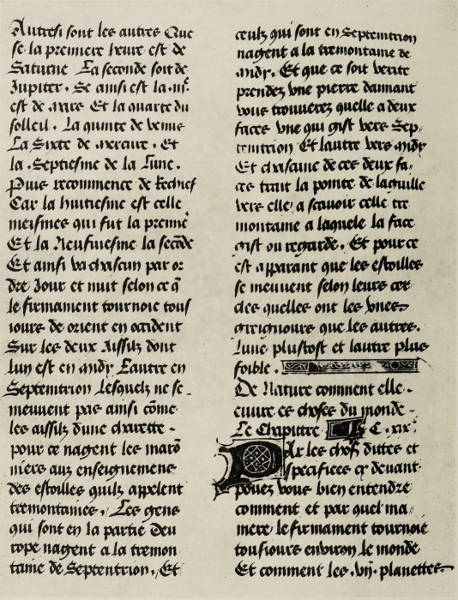
Brunetto Latini. “Li livres dou Trésor.”
Page taken from the 15th century Ms. in the Bibliothèque Nationale, Paris.
A.D. 1260.—Brunetto Latini, b. 1230, d. 1294, “maestro del divino poeta Dante,” celebrated Florentine encyclopædist, composes his “Tesoro,” rewritten in French (“Livres dou Trésor”), wherein he speaks clearly of the compass as at some time likely to be useful at sea. But he adds: “No master mariner dares to use it, lest he should fall under the supposition of being a magician; nor would even the sailors venture themselves out to sea under his command if he took with him an instrument which carries so great an appearance of being constructed under the influence of some infernal spirit.”
The “Tesoro” is said to be a kind of abridgment of the Bible, of Pliny, of Solinus, of the Ethics of Aristotle, of the rhetorical writings of Cicero and of the political works of Aristotle, Plato and Xenophon (“New Biog. Dict.,” London, 1850, Vol. IX. p. 205). It would be well to consult “La Table Générale des bulletins ... Sociétés Savantes,” par M. Octave Teissier, Paris, 1873, p. 44, regarding the collection of different manuscripts of Brunetto’s extensive work.
References.—Davis, “The Chinese,” 1844, Vol. III. p. xi; Venanson, “Boussole,” pp. 75, 148–154; Azuni, “Boussole,” p. 139; Klaproth, “Boussole,” pp. 45–46; “Journal des Savants” for January 1865, also for January and February 1880; “The Monthly Magazine” for June 1802; Libri, “Hist. des Sciences Mathématiques,” Paris, 1838, Vol. II. pp. 64, 152–156.
A.D. 1265–1321.—Dante—Durante—(Alighieri), illustrious Italian poet, regarded as the greatest poetical genius that flourished between the Augustan and Elizabethan ages, composed, during his exile, the “Divina Commedia,” which was the first poem written in the Italian language. In Canto XII. vv. 28–30 of his “Paradiso,” translated by Dr. Plumptre, he thus alludes to the mariner’s compass:
“Then from the heart of one of those new lights, There came a voice which made me turn to see, E’en as the star the needle’s course incites.”
Guido Guinicelli (1240–1276), priest and scholar, and whom Dante considered not only the greatest of living Bolognese poets, but his master in poetry (Note: “Purg.,” XXVI. Vol. I. p. 327, v. 92) refers to the nautical compass in nearly the same terms as Dante (“Rime. Ant.,” p. 295). He adds: “The mountains of loadstone give the virtue to the air of attracting iron, but, because it (the loadstone) is far off, (it) wishes to have the help of a similar stone to make it (the virtue) work, and to direct the needle toward the star” (P. L. Ginguené, “Hist. Lit. d’Italie,” Vol. I. p. 413; Guido delle Colonne—Io Colonna da Messina—Mandella Lett. p. 81, Florence, 1856).
At pp. 35 and 130 of Bertelli’s “Pietro Peregrino di Maricourt,” Roma, 1868, Memoria prima, appear verses said to be by Guinicelli and by Guido delle Colonne, judge of Messina, who flourished about 1250, and which are translated literally into English as follows:
“In those parts under foreign skies Are the mountains of loadstone, Which give power to the air To attract iron, but, because distant, It requires to have assistance from similar stones, To bring it into use, And direct the needle towards the star. The learned relate that the loadstone Could not attract Iron by its power, Were it not that the air between them aids; Although the calamite is a stone, The other existing stones Are not so powerful To attract, because they have not the influence.”
The “Paradiso,” translated by A. J. Butler, London, 1885, Canto XII. v. 29, reads: “Si mosse voce, che l’ago (needle) alla stella,” and Fazio degli Uberti in the “Dittamondo” (about 1360) has “Quel gran disio, che mi, traeva addietro come ago a calamita” (III. 2).
References.—Hœfer, “Nouv. Biog. Gén.,” Vol. XIII. pp. 21–50, the last-named page containing an unusual number of citations; “Biblogr. Dantesca,” by Colomb de Batines, Prato, 1845–1846; “La Grande Encyclopédie,” Vol. XIII. pp. 887–901, embracing many additional references; the note at p. 154 of Plumptre’s “Dante,” also Humboldt’s “Cosmos,” 1849, Vol. II. p. 629; Libri, “Hist. des Sc. Math.,” Paris, 1838, Vol. II. pp. 164, etc.; Frederic C. Harrison, “The New Calendar of Great Men,” London, 1892, pp. 310–315.
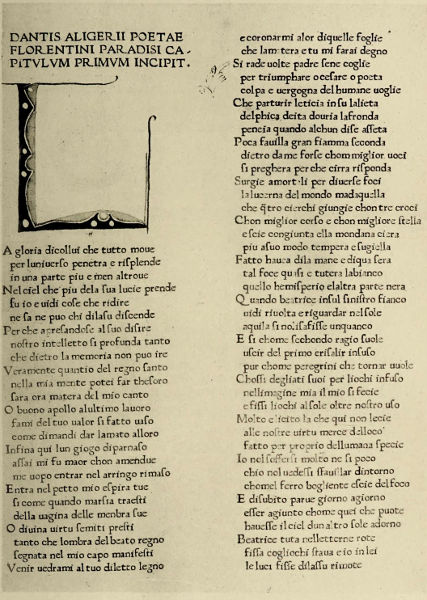
Dante Alighieri. “La Divina Commedia,” Mantuae 1472, the first page of what is by many regarded as the oldest edition of the earliest known poem written in the Italian language.
Now in the Bibliothèque Sainte Geneviève, Paris.
A.D. 1266.—It is shown by Th. Torffæus (Latin for Thormodr Torfason), an Icelandic scholar (b. 1636, d. 1719), who published “Historia Rerum Norvegicarum” (Hafniæ, 1711, IV. c. 4, p. 345), that at this date the northern nations were acquainted with the mariner’s compass. In the “History of Norway” here alluded to, he mentions the fact that the poem of the Icelandic historian, Jarl Sturla (Snorri Sturlason) written in 1213, on the death of the Swedish Count Byerges, was rewarded with a box containing a mariner’s compass.
References.—Suhm, “In effigien Torfæi, una cum Torfænis”; “Nouv. Biogr. Générale de Hœfer,” Vol. XLV. p. 495; “New Gen. Biog. Dict.,” London, 1850, Vol. XII. p. 263; Jessen, “Norge,” pp. 83–99; Larousse, “Dict. Univ.,” Vol. XV. p. 312; Michaud, “Biog. Univ.,” Vol. XLI. p. 683.
A.D. 1269.—Peregrinus (Petrus), Pierre Pélerin de Maricourt, Méhéricourt—Magister Petrus de Maharnecuria, Picardus—doubtless a Crusader, was, as Roger Bacon tells us (“Opus Tertium,” cap. xi) the only one, besides Master John of London, who, at this period, could be deemed a thoroughly accomplished, perfect mathematician, and was one who understood the business of experimenting in natural philosophy, alchemy and medicine better than any one else in Western Europe.
Peregrinus is the author of a letter or epistle, “Written in camp at the Siege of Lucera (delle Puglie—Nucerræ) in the year of our Lord 1269, on the 8th day of August,” addressed to his Amicorum intime, a soldier, by the name of Sygerus de Fontancourt—Foucaucourt—Foucancort.
Of this epistle, which is the earliest known work of experimental science, there are but few reliable complete manuscript copies. Most of these have been very ably analyzed by P. D. Timoteo Bertelli Barnabita in the exhaustive Memoirs published by him in Rome during 1868, and still better detailed by Dr. Silvanus P. Thompson in his several valuable printed researches and lectures on the subject, but there has been of it only one printed issue in book form, that of the Lindau physician, A. P. Gasser, which appeared at Augsburg during 1558.
Several attempts at translation have been made, notably by Guillaume Libri (“Histoire des Sciences Mathématiques ...” Paris, 1838, Vol. II. p. 487) who admitted that, with the aid of several paleographers, he could not decipher many of the abbreviated faint characters existing in the Bibliothèque Nationale manuscript (No. 7378A in quarto, at folio 67), and by Tiberius Cavallo, who does scarcely better with the Leyden copy (Fol. Cod. No. 227) which was discovered by him, and but a portion of which he transcribes in the supplement to his “Treatise on Magnetism,” London, 1800, pp. 299–320. A translation was also made by Brother Arnold, of the La Salle Institute in Troy, N.Y., and published during 1904, but the most meritorious version now existing is the one entitled “Done into English by Silvanus P. Thompson from the printed Latin versions of Gasser 1558, Bertelli 1868, and Hellmann 1898, and amended by reference to the manuscript copy in his possession, formerly amongst the Phillipps’ manuscripts, dated 1391.” This translation, “printed in the year 1902, in the Caxton type, to the number of 250 copies,” reflects very great credit upon Prof. Thompson, who has given us such a faithful interpretation of the original work as would naturally be expected at his hands, and who has, besides, rubricated this right royal little volume and caused it to be issued in one of the most attractive typographical fashions of the Chiswick Press.
The Hellmann 1898 Berlin version just alluded to, which appeared in “Neudrucke von Schriften und Karten ...” No. 10 (Rara Magnetica), contains a photographic reproduction of the Augsburg 1558 title-page, and, it may be added, the volume of Phillipps’ manuscripts, of which Prof. Thompson became the fortunate possessor, includes one of Chaucer’s treatises on the Astrolabe, besides the Peregrinus’ manuscript in question.
During the year 1562 much of the original epistle was pilfered by Joannes Taisnier Hannonius, who badly condensed and deformed it and incorporated it as new matter, conjointly with some papers of his own, in a book entitled “Oposculum ... de Natura Magnetis et ejus effectibus ...” Coloniæ, 1562; and that much was translated “into Englishe” by Richarde Eden, London, about 1579, under title of “A very necessarie and profitable booke concerning navigation.”
Much has been said at different times regarding the contents of the above-named epistle, the full title of the Paris MS. No. 7378 of which reads
“Epistola Petri Peregrini de Maricourt ad Sygerum de Foucaucourt militem de magnete,”
but no résumé of it could better be given than by quoting here its first page, which has been translated as follows:
This treatise on the magnet contains two parts, of which Part I is complete in ten chapters, and Part II in three.
Of Part I: Chap. I states the object of the work;
Chap. II, of what the investigator in this line of work should be;
Chap. III, of a knowledge of the loadstone;
Chap. IV, of the science of the discovery of the parts of the loadstone;
Chap. V, of the source of the discovery of poles in the loadstone—which of them is the north and which the south;
Chap. VI, in what manner a magnet attracts a magnet;
Chap. VII, how iron touched with the magnet turns towards the poles of the globe;
Chap. VIII, in what manner a magnet attracts iron;
Chap. IX, why the northern part attracts the southern part, and the converse;
Chap. X, of the inquiry whence the magnet derives the natural power it possesses.
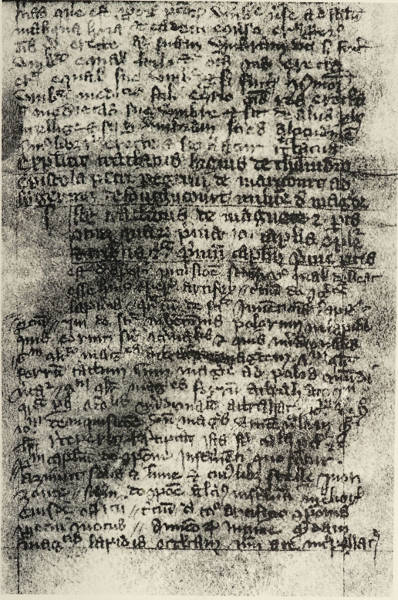
Petrus Peregrinus. “Epistola ... de Magnete.”
The earliest known treatise of experimental science, now in the Bibliothèque Nationale, Paris.
Of Part II: Chap. I, on the construction of an instrument (floating compass) by which the azimuth of the sun and moon, and of any star above the horizon, can be ascertained;
Chap. II, on the construction of a better instrument (pivoted compass) for like purpose;
Chap. III, on the construction of a wheel for perpetual motion.
An analyzation of each chapter in turn will show how satisfactorily Peregrinus has developed, in connected series, all of the early experiments upon which are based his theories of the loadstone.