A Leaf from my Scrap Book.
Reading edition
May, 1849.
SAMUEL R. WARD AND FREDERICK DOUGLASS.
Perhaps a fitter occasion never presented itself, nor was more properly availed of, for the exhibition of talent, than when Frederick Douglass and Samuel R. Ward debated the "question" whether the Constitution was or not a pro-slavery document.
With the "question" at issue we have, at present, nothing to do; and with the arguments so far only as they exhibit the men.
Both eminent for talent of an order (though differing somewhat in cast) far above the common level of great men.
If any inequalities existed, they served rather to heighten than diminish the interest of the occasion, giving rise to one of the severest contests of mind with mind that has yet come to my notice.
Douglass, sincere in the opinions he has espoused, defends them with a fervor and eloquence that finds scarcely a competitor.
In his very look—his gesture—in his whole manner, there is so much of genuine, earnest eloquence, that they leave no time for reflection. Now you are reminded of one rushing down some fearful steep, bidding you follow; now on some delightful stream, still beckoning you onward.
In either case, no matter what your prepossessions or oppositions, you for the moment, at least, forget the justness or unjustness of his cause and obey the summons, and loath, if at all, you return to your former post.
Not always, however, is he successful in retaining you. Giddy as you may be with the descent you have made, delighted as you are with the pleasure afforded, with the elysium to which he has wafted you, you return too often dissatisfied with his and your own impetuosity and want of firmness. You feel that you had had only a dream, a pastime, not a reality.
This great power of momentary captivation consists in his eloquence of manner—his just appreciation of words.
In listening to him, your whole soul is fired—every nerve strung—every passion inflated—every faculty you possess ready to perform at a moment's bidding. You stop not to ask why or wherefore.
'Tis a unison of mighty yet harmonious sounds that play upon your imagination; and you give yourself up, for a time, to their irresistible charm.
At last, the cataract which roared around you is hushed, the tornado is passed, and you find yourself sitting upon a bank (at whose base roll but tranquil waters), quietly meditating that why, amid such a display of power, no greater effect had really been produced.
After all, it must be admitted, there is a power in Mr. Douglass rarely to be found in any other man.
With copiousness of language, and finish of diction, when even ideas fail, words come to his aid—arranging themselves, as it were, so completely, that they not only captivate, but often deceive us for ideas; and hence the vacuum that would necessarily occur in the address of an ordinary speaker is filled up, presenting the same beautiful harmony as do the lights and shades of a picture.
From Mr. Douglass, in this, perhaps, as much as in any other respect, does Mr. Ward differ. Ideas form the basis of all Mr. Ward utters. Words are only used to express those ideas.
If words and ideas are not inseparable, then, as mortar is to the stones that compose the building, so are his words to his ideas.
In this, I judge, lays Mr. Ward's greatest strength. Concise without abruptness—without extraordinary stress, always clear and forcible; if sparing of ornament, never inelegant. In all, there appears a consciousness of strength, developed by close study and deep reflection, and only put forth because the occasion demanded,—a power not only to examine but to enable you to see the fairness of that examination and the justness of its conclusions.
You feel Douglass to be right, without always seeing it; perhaps it is not too much to say, when Ward is right you see it.
His appeals are directed rather to the understanding than the imagination; but so forcibly do they take possession of it, that the heart unhesitatingly yields.
If, as we have said, Mr. Douglass seems as one whirling down some steep descent whose very impetuosity impels;—ere you are aware of it, it is the quiet serenity of Mr. Ward, as he points up the rugged ascent, and invites you to follow, that inspires your confidence and ensures your safety. Step by step do you with him climb the rugged steep; and, as you gain each succeeding eminence, he points you to new scenes and new delights;—now grand—sublime; now picturesque and beautiful;—always real. Most speakers fail to draw a perfect figure. This point I think Mr. Ward has gained. His figures, when done, stand out with prominence, possessing both strength and elegance.
Douglass' imagery is fine—vivid—often gaudily painted. Ward's pictures—bold, strong, glowing.
Douglass speaks right on; you acknowledge him to have been on the ground—nay, to have gone over the field; Ward seeks for and finds the corners; sticks the stakes, and leaves them standing; we know where to find them.
Mr. Douglass deals in generals; Mr. Ward reduces everything to a point.
Douglass is the lecturer; Ward the debater. Douglass powerful in invective; Ward in argument. What advantage Douglass gains in mimicry Ward recovers in wit.
Douglass has sarcasm, Ward point.
Here, again, an essential difference may be pointed out:—
Douglass says much, at times, you regret he uttered. This, however, is the real man, and on reflection you like him the better for it. What Ward says you feel to be but a necessity, growing out of the case,—that it ought to have been said—that you would have said precisely the same yourself, without adding or diminishing a single sentence.
Douglass, in manner, is at all times pleasing; Ward seldom less so; often raises to the truly majestic, and never descends below propriety. If you regret when Douglass ceases to speak, you are anxious Ward should continue.
Dignity is an essential quality in an orator—I mean true dignity.
Douglass has this in an eminent degree; Ward no less so, coupled with it great self-possession. He is never disconcerted—all he desires he says.
In one of his replies to Mr. Douglass I was struck with admiration, and even delight, at the calm, dignified manner in which he expressed himself, and his ultimate triumph under what seemed to me very peculiar circumstances.
Douglass' was a splendid effort—a beautiful effusion. One of those outpourings from the deeps of his heart of which he can so admirably give existence to.
He had brought down thunders of well-merited applause; and sure I am, that a whisper, a breath from almost any other opponent than Mr. Ward, would have produced a tumult of hisses.
Not so, however, now. The quiet, majestic air, the suppressed richness of a deep-toned, but well-cultivated voice, as the speaker paid a few well-timed compliments to his opponents, disturbed not, as it had produced, the dead stillness around.
Next followed some fine sallies of wit, which broke in on the calm.
He then proceeded to make and accomplished one of the most finished speeches to which I have ever listened, and sat down amidst a perfect storm of cheers.
It was a noble burst of eloquence,—the gatherings up of the choicest possible culled thoughts, and poured forth, mingling with a unison of brilliant flashes and masterly strokes, following each other in quick succession; and though felt—deeply felt, no more to be described than the vivid lightning's zig-zag, as produced from the deep-charged thunder-cloud.
If Douglass is not always successful in his attempts to heave up his ponderous missiles at his opponents, from the point of his descent, he always shows determination and spirit.
He is often too far down the pass, however, (herculean though he be,) for his intent.
Ward, from the eminence he has gained, giant-like, hurls them back with the force and skill of a practised marksman, almost invariably to the detriment of his already fallen victim.
In Douglass you have a man, in whose soul the iron of oppression has far entered, and you feel it.
He tells the story of his wrongs, so that they stand out in all their naked ugliness.
In Ward, you have one with strong native powers,—I know of none stronger; superadded a careful and extensive cultivation; an understanding so matured, that fully enables him to successfully grapple with men or errors, and portray truth in a manner equalled by few.
After all, it must be admitted, both are men of extraordinary powers of mind.
Both well qualified for the task they have undertaken.
I have, rather than anything else, drawn these outline portraits for our young men, who can fill them up at leisure.
The subjects are both fine models, and may be studied with profit by all,—especially those who are destined to stand in the front rank.
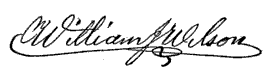
(signature) William J. Wilson
Note.—It has been some years since the above sketch was drawn; and though my impressions, especially of Mr. Douglass, has undergone some slight change since,—seeing in him enlarged, strengthened, and more matured thought, still I think, on the whole, the careful observer will attest substantially to its correctness.