Autobiography of Charles Clinton Nourse (continued 5)
Reading edition
The constitution of the state required, in order to convict the defendant, a vote of guilty by two-thirds of the members of the senate. Instead of this the highest vote against the defendant upon any article was fifteen votes, or less than one-third, and upon the first, second, third, fourth, and fifth articles that embraced the original controversy with Governor Sherman, upon which he refused to approve the Auditor's bond and appointed his subservient commission, there was not a single vote of guilty against the Auditor, but he was unanimously acquitted. Upon several of the articles it appears that some of the senators voted "guilty" upon a very slim and unwarranted basis. For instance one of the articles of impeachment was against the Auditor for drawing a warrant in behalf of his clerk for the month's salary, the warrant specifying the particular section and chapter of the law that made an appropriation for the purpose of paying this clerk. The fact of the service being within the personal knowledge of the Auditor, and the receipt of the clerk being upon the stub of the warrant issued, and yet the managers insisted that there ought to have been a paper filed stating the account as between the clerk and the Auditor, and because it was not drawn out and filed among the papers of the office, six of the senators voted to find him guilty and to impeach him. It was a mere technicality, extremely, finely drawn out, and showed a disposition to try and ruin a man and his reputation without conscience or any regard to their duty as men and their oath as senators. The vote of fifteen upon the Bremer County Bank question against the Auditor may be justified upon the theory that a public officer situated as the Auditor was, having an important duty to perform, should not accept of any gift or favor or money that might be construed as something he had hoped for or expected when he performed his official duty. The act of receiving the money under the circumstances, though not criminal, was one of those acts of doubtful propriety that could scarcely be justified in a public officer.
The acquittal of Mr. Brown was beyond question a righteous and just act. Governor Larrabee, the newly elected Governor, had already restored Mr. Brown to his office and discharged the appointee to fill the created vacancy, and the people of the state retired Mr. Sherman from public employment permanently. After retiring from office he engaged in managing an insurance company at his former place of residence in the state, in which he was unsuccessful.
The state of Iowa paid to the attorneys in the case selected by Mr. Brown the sum of six dollars a day. I charged Mr. Brown, however, one thousand dollars for my entire services in connection with his impeachment, and he gave me his note for the balance, deducting the amount I had received from the state. This note was signed by S. F. Stewart. Some months afterwards I received from Stewart's wife a very remarkable letter, full of tears and sympathy for Brown, begging me to remit the amount on the note as Mr. Brown was poor and had been much wronged and abused. I ascertained that Stewart at or about the time he signed the note, had obtained from Mr. Brown a transfer to some valuable stock in the Iowa Homestead newspaper at much less than the real value of the stock, and that they had counted the amount due me on this note as part of the consideration of the transfer. Estimating Mrs. Stewart's sympathy for Mr. Brown at its true value, I insisted on my note being paid in full, which Mr. Brown cheerfully did.
Mr. Brown was further vindicated by the subsequent action of the general assembly of the state in making a reasonable appropriation to reimburse him for his expenses and attorney's fees paid out in making his defense against the articles of impeachment. The result of the investigation before the senate also had a very beneficial effect upon the home insurance companies in that it gave public confidence as to their solvency, and gave assurance that the proper department of state would make the investigation of their transactions from time to time thorough and real, and not as before merely nominal.
CHAPTER XV
MORE LAW CASES
In the summer of 1874 the city of Des Moines was thrown into a state of considerable excitement by the fact of finding the body of a murdered man on the sidewalk near the corner of Walnut and Second street. There was a house of bad repute in the vicinity, and the coroner's jury made a thorough investigation, seemingly as far as practicable, as to the cause and origin of the death. The inhabitants of the house referred to were examined under oath, and the women who boarded there denied any knowledge whatever of the cause of the man's death. The Governor of the state offered a reward of five hundred dollars for the discovery and conviction of the murderer. At the next session of the grand jury of Polk county two of the women boarders at the house of bad repute referred to, and who had denied all knowledge of the murder, appeared before the grand jury and testified with much detail that Charles Howard, a man who had frequented their house, had been guilty of the murder and had carried out the dead body and laid it upon the sidewalk. The grand jury indicted Howard accordingly for murder in the first degree. The trial came on at the December term of the Polk county district court, and in view of the public excitement, which was largely kept alive by the daily press, Howard, by his attorney, made a motion for a change of venue on the ground of prejudice of the inhabitants of the county. Under the peculiar provisions of our statute, counter affidavits were permitted for the purpose of showing that there was no feeling in the community that would prevent Howard from receiving a fair trial. The sheriff informed me that in walking two squares from the court house he had met two hundred men who were willing to sign such counter affidavits, and had obtained a large number of them, which were filed accordingly. The district judge, H. W. Maxwell, overruled the motion for a change of venue, and the trial proceeded. The only testimony introduced in the conviction of Howard was that of the two bad women who had testified before the coroner's jury that they had no knowledge whatever in regard to the killing of Johnson. I was not personally engaged in any way as an attorney in this case, but about ten o 'clock at night after the jury had retired to consider their verdict, Judge Maxwell sent for me to come to the court house for consultation. I found he had also sent for a like purpose for Mr. D. O. Finch, one of the oldest members of the Polk county bar. The judge advised us that the jury had not agreed upon their verdict, but that some one had through the bailiff sent a note in to the jury room threatening the jury with violence in case they failed to convict the defendant. Judge Maxwell was much excited and asked Mr. Finch and myself what he ought to do under the circumstances. We advised him by all means to have the defendant conveyed for safe keeping to some place outside of the county, in charge of the sheriff, and to have it done secretly and immediately lest the mob might seize the accused and commit violence. We also advised him to discharge the jury from a further consideration of the case, as their verdict found under the influence of threats would be worthless, and that he ought also in vindication of his own court to thoroughly investigate the question as to who was guilty in sending or permitting a threat to be communicated to the jury. Instead of being influenced by our advice Judge Maxwell had the jury brought into the courtroom for further instructions, and told them that great excitement and feeling prevailed in the community in regard to the case, and that it was important that the jury should not disagree but should find a verdict in the case. The next morning the jury brought in a verdict of guilty, and the defendant waiving time for sentence, Judge Maxwell had the prisoner brought into court. The courtroom was crowded by an excited mob, and the judge took occasion to harangue the prisoner, denouncing his conduct in the most vehement manner. He then sentenced the prisoner to imprisonment in the penitentiary for life. That night the excited mob broke open the jail, took the prisoner from his cell with a rope tied around his neck, and hung him to a lamp post in the court house square. The opinion of most of the persons who paid any attention to this trial was that there was no reliable evidence of Howard's guilt, and that the probabilities were that the whole case was manufactured for the purpose of securing the reward offered for his conviction. Whether or not the reward was ever paid I have not been able to ascertain, but certain it is that the cowardice of the court and the indiscretion of the public press were responsible for the murder of a man who, to say the least of it, was never proved guilty by any competent evidence.
We had among the distinguished judges that acted as teachers in our law school at Transylvania University a very eminent jurist who sometimes when he felt merry treated the class to that which was not only instructive but also entertaining. On one occasion he delivered to the class the following:
Young Gentlemen: You will find that the general principles of the law are few and easily comprehended, but in their application to the ever-varying transactions of human life the best of minds will differ, hence arises what we denominate the glorious uncertainties of the law whereby we have our bread.
The case that I am about to cite would satisfy the most credulous that there are other causes that produce uncertain results besides the difference in applying the general principles of the law to different cases.
Section 3, article XI of the constitution of the state of Iowa, provided as follows: "No county or other political or municipal corporation shall be allowed to become indebted in any manner or for any purpose to an amount in the aggregate exceeding five per centum on the value of the taxable property within such county or corporation, to be ascertained by the last state or county tax list previous to the incurring of such indebtedness." In November, 1870, the taxable property, real and personal, within and subject to taxation by the said city of Des Moines, as ascertained by the last state and county tax list, amounted to the sum of $3,140,805 and no more, and that five per centum on said amount was only the sum of $157,040.25. In the month of May, 1869, the city had by ordinance authorized the issuing of bonds to the amount of $50,000 for the purpose of funding outstanding warrants, and afterwards in May, 1870, they had enacted a further ordinance authorizing the issuing of bonds for funding outstanding warrants on the city treasurer to the amount of $75,000, all of which bonds had been duly issued and were outstanding at the time of the commencement of the suit hereinafter mentioned. In addition to these bonds aggregating $125,000 there were also outstanding warrants upon the treasury to the amount of $55,000, making an aggregate indebtedness of the city $180,000. On the 7th of July, 1870, the city passed a further ordinance authorizing the issuing of bonds to the amount of $130,000 for the building and repair of certain bridges across the Des Moines and Raccoon rivers, thus exceeding the constitutional limit upon the city's indebtedness.
George Sneer, a citizen and taxpayer of the city of Des Moines, applied to me to bring a suit to test the validity of this last bond issue of $130,000, informing me that the bonds had been placed in the hands of B. F. Allen, then a banker of the city of Des Moines. I informed him I was willing to take the case provided that the suit should be maintained in good faith, that I was satisfied that the bonds were absolutely void whether in the hands of Allen or any other person, being issued in plain violation of the constitution of the state, and that every person purchasing any evidence of indebtedness against the city was bound to take notice of the existing indebtedness of the city and was charged with knowledge thereof, as it was a matter of record and easily ascertained. Mr. Sneer informed me that he desired the question of the validity of the bonds tested in good faith, and that if I undertook the case I might prosecute it to the end. He contracted to pay me the sum of two hundred dollars for my services, and I accordingly prepared the bill for a perpetual injunction against the city council, city treasurer, and B. F. Allen. No one was made defendant to the petition except Allen and members of the city council and the city treasurer. Answers were filed by Mr. Withrow for B. F. Allen and by Seward Smith, his partner, for the city of Des Moines and members of the city council, and the case was submitted on bill and answer. There was no denial of the facts set forth in the petition in regard to the indebtedness of the city, nor did anyone appear in the case claiming to be bona fide purchasers of the bonds, but the answer of Allen was to the effect that he acted as agent for the city and had sold the bonds to one George P. Opdike & Co. of New York City. Maxwell was judge of the district court, and to my surprise entered the following decree in the case:
This cause coming on for final hearing on the plaintiff's petition, and answer made thereto, and the defendant's answer and cross petition, and thus heard upon the pleadings alone, and the court having heard the argument of counsel, inspected the said record and being fully advised in the premises, doth order, adjudge and decree, that the plaintiff's bill be dismissed; that the bridge bonds described therein be treated as in every respect binding obligations of the city of Des Moines according to the tenor thereof, and that the parties thereto and those in privity with them be forever concluded from asserting or maintaining any defense against the payment of said bonds, and the interest thereon, on the grounds that the same were irregularly issued in excess of the constitutional limitation upon the power of the said city to become indebted; that the money now in possession of the defendant Allen, be applied by the proper officers of the city of Des Moines to the purposes for which the same was raised; and that the defendant have and recover the costs herein taxed at —— dollars, and that execution issue therefor. To which plaintiff excepts.
Upon the rendition of this decree I immediately entered an appeal in behalf of George Sneer, and perfected the same by filing the proper abstract of record in the supreme court of the state. The cause was submitted to the supreme court on printed arguments on April 4, 1871. At the October term of the supreme court, being an argument term held at Davenport at that date, the supreme court really decided the case by an opinion written by Judge Beck in behalf of a majority of the court, and the opinion was sent by Justice Day to the clerk about the time the court was to adjourn, with orders to file the same, and Mr. Charles Linderman, the clerk of the court, informed me that he had actually marked the opinion "Filed," and that about the time that the filing was completed Judge C. C. Cole, then one of the judges of the supreme court, entered the clerk's office and filed with him a paper signed by George Sneer dismissing his appeal, and that he entered upon the records of the court the following entry: "On application of appellant, it is ordered by the court that the appeal herein be, and the same is hereby dismissed."
At the ensuing regular term of the supreme court held at Des Moines, December 5, 1871, the following entry was made in the case: "At the argument term held at Davenport in October last, on application of George Sneer per se, appellant herein, the court ordered that the appeal be dismissed." Before this dismissal either at Davenport or at Des Moines Sneer had settled with me and paid me the fee agreed upon, and I had nothing further to do with the case except to reproach him for violating his agreement with me that I should prosecute the case to a final result.
It appeared from the sequel that Judge Cole had also prepared a dissenting opinion in the case, and these two opinions, that written by Judge Beck as the opinion of the court, and the one written by himself were both published in the Western Jurist the ensuing January, the one marked "B" and the other marked "C," but suppressing the fact that the opinion marked "B" was the opinion of a majority of the court, and that none of the judges, except Judge Cole, agreed with the opinion marked "C;" and having the following extraordinary note printed in connection with the opinions, Judge Cole being then the editor of the Western Jurist: "These two articles, this and the following which advocates a different view of the same question, are from members of the profession in Iowa occupying equal prominence before the public, and whose opinions are entitled to consideration." Whilst these opinions do not give the detail of the case that was submitted to the court and to which they relate, yet by carefully reading them you can easily see that they refer to an actual controversy that had been pending before the supreme court. The supreme court of Iowa subsequently decided the question that was involved in the case of Sneer vs. the City of Des Moines, establishing the principle as applied to this transaction to the effect that the bonds were absolutely void in the hands even of an innocent purchaser if such had been the case. See
McPherson vs. Foster, 43 Iowa, page 48.
Mosher vs. Independent School Dist., 44 Iowa, page 122.
French vs. Burlington, 42 Iowa, page 614.
Andrews vs. Orient Fire Ins. Co., 88 Iowa, page 579.
Holliday vs. Hildebrandt, 66 Northwestern Reporter, page 89.
The dismissal of the appeal by Sneer left the decree entered by Judge Maxwell in full force as though no appeal had ever been taken, and the parties procuring this result, after they had full knowledge of the fact that the majority of the judges of the supreme court held the bonds void, are fully entitled to all of the credit that their conduct merits, and I only record the matter here as a matter of history and as vindication of myself and to exonerate myself from any responsibility for the final result, as I had no knowledge of the dismissal of the appeal until long after the thing was done.
I have within the past few weeks examined the archives of the supreme court, and find that the original opinion of the court written by Judge Beck signed "B" and printed in the Western Jurist (see Vol. VI-1872) cannot be found, and also the paper signed by George Sneer dismissing the appeal is missing from the files of the court. I presume the city council, as they had by their attorney asked to be enjoined from disputing the validity of these bonds, had obtained a decree against themselves to that effect, very willingly paid the bonds when they matured, but of this I have no actual knowledge.
CHAPTER XVI
Birth of a Son and Personal Incidents
Leaving the history of political and professional for the present, it will now be necessary to revert and give in some detail matters more personal and affecting more nearly my own private life. I have already given an account of my marriage and removal to Des Moines.
On the 18th of February, 1863, my wife and myself were made happy by the birth of our only child. This hope deferred came after ten years of waiting. Whilst the child was still an infant I was compelled to be absent on professional business at Indianola in Warren county. I concluded my business as soon as possible and hurried home, feeling an unpleasant premonition that everything was not all right with the mother and the child. Heavy rains had swollen the streams between Indianola and Des Moines, and as I approached the small bridge crossing the creek about four miles south of Des Moines, I found the water running several feet deep over the floor of the bridge. I knew this made the passage very dangerous because frequently such floods took away the flooring and made it probable that the horse and buggy in which I was riding might be cast into the flood of the stream. After some hesitation, however, I determined to take the risk and plunged into the stream accordingly. I got safely over and was much relieved when I found myself again on solid ground. I got home a little after dark and found an old lady who had been employed as nurse to the little one, who was squalling violently, engaged in trotting the infant upon her knee, as my wife lay on the bed on the very verge of hysterics. The next morning early I put out to find a nurse woman possessed of more flesh and patience, and the domestic trouble subsided. The first six months after the arrival of the little stranger my wife could scarcely obtain an hour's consecutive rest. The normal condition of the child appeared to be colicky. As I had to be engaged throughout the day in my business we finally established a second bedroom and I divided the time at night as well as I could with my wife, taking my turn at walking the floor at "half dress." The child, however, proved a great comfort to us and a pleasure, though for many months it was the pursuit of pleasure under difficulties.
At the approach of the following year we were surprised by a visit from the wife of Mr. Charles McMeekin, my wife's brother, who then resided at Cincinnati, Ohio. His wife brought with her two children, a boy and a girl, she herself being something of an invalid. It was very difficult at that time, as it has been ever since, to obtain competent domestic help, and after entertaining this lady and her two children for several months I found it necessary to notify my brother-in-law that situated as I was it was no longer convenient for me to entertain his family, and they accordingly left us and went to live at a boarding house kept by Mrs. Washburn on Fourth street. The next summer, at the request of my wife, I consented to take one of the sons of her sister Eliza, and I furnished the means for his transportation from Newport, Kentucky, to Des Moines. I tried to give this boy instructions in reading, writing, and arithmetic, but found him not inclined to study, and especially disinclined to afford any help or assistance about the house. He had been raised under the shadow of a peculiar institution and had imbibed a strong prejudice against anything like work. After worrying with him for three or four months and being unable to make anything out of him, I sent him home to his mother.
In 1849 I purchased two lots on the northeast corner of Center and Fifth streets and removed my old buildings from my place on Fourth street to the lots so purchased, making some improvements on the buildings. These lots and buildings I afterwards sold and built a new house on the old place on Fourth street.
In the fall of 1877, whilst on a visit to Ohio, my half-brother, Charles R. Nourse, invited me to a private interview in which he disclosed the fact to me that he was engaged to be married and wanted me to do something to help him start in life in some kind of business. The young man had not improved his opportunities for an education and had spent several winters doing farm work. Before I had left home on that occasion Sylvanus Edinburn had proposed to exchange a small farm that he had in the suburbs of the city, of eighty-eight acres, for some property I had acquired in town. It occurred to me that I might help the boy by making the trade for this farm, and I accordingly told him if he would have his mother send an invitation to his intended to come and take dinner with us, and I liked the looks of the proposed wife I would do something for him. He readily consented to this arrangement, as did also his intended, and as she appeared to be an industrious and bright young woman I came home and completed the purchase of the farm which I obtained a deed for in March, 1878. There was no building on the farm fit to live in. I had the old house moved onto the barn-lot and fixed up for a granary, and built a new house at the expense of about fifteen hundred dollars. In the following spring Charles R. with his bride put in an appearance and I settled them in their new home, where they lived happily for a number of years, but finally after about fifteen years that most fatal of all curses, strong drink, got possession of the young man and he went to the bad.
In the year of 1875 while visiting my sister at Tuscola, Illinois, I found her in possession of a very large and increasing family. I was especially pleased with her second daughter, Rose, then a young lady about twenty years of age, and suggested to my sister that if she would consent I would take Rose home with me and help her to an education. Accordingly in 1876 Rose came to Des Moines and made her home with us.
My oldest brother, Joseph G. Nourse, had died at Cincinnati, Ohio, in March, 1863, and about the year of 1876 I had induced his widow with her three boys to remove to Des Moines, her oldest daughter Susan having previously married to Mr. J. A. Jackson. I had before that time induced Mr. Jackson and his wife also to remove to Des Moines and had given Mr. Jackson employment in my office as an assistant. I had also built on Fourth street a one story cottage of three rooms and a kitchen, which they occupied for a year or two.
After my niece, Rose Vimont, had been with us for probably a year I became satisfied that she had not succeeded in winning the affections of my wife. Dr. C. R. Pomeroy had been our pastor at the Centenary Methodist church for several years and had removed to Emporia, Kansas, and taken charge of the State Normal School at that place. As Rose desired to prepare herself for a teacher I went with her to Emporia in the spring of 1877 and placed her at the institution under the care of Dr. Pomeroy and his wife, where she remained for twelve months, when school was suspended by reason of a fire which destroyed the buildings. Rose returned to Des Moines and the following year, 1878, she taught a small school in the brick schoolhouse on the northwest corner of my farm, and had a room and boarded with my half brother, Charles R. Afterwards she obtained a situation in the public schools of the city of Des Moines and became a very successful teacher, remaining in the city some fifteen years or more.
Soon after the purchase of my farm, in order further to promote the interests of my brother and give him employment, I became interested in the purchase and raising of pure bred short-horn cattle, committing to my brother the immediate supervision and care of them on the farm, and building some extensive barns and other out-buildings. I subsequently bought from George Sneer 126 acres of valuable land in section 20, township 79, range 24, and afterwards in July, 1879, bought thirty-seven acres adjoining the tract that I had purchased of Edinburn, making a part of the home farm. I also bought adjoining the same original tract eleven acres from a man by the name of Parks.
Subsequently I contracted with a man by the name of Miller to put down a bore hole on my land near the barns, with the hope of procuring artesian water for my cattle and a flowing well. In this I was disappointed, but I required the man to keep an accurate journal of the different strata through which he bored, and at the distance of about 140 feet below the surface he went through a valuable strata of coal averaging from four and one-half to six feet in thickness. I subsequently leased the right to take coal from these lands to the Keystone Coal Company, under which lease they sunk a shaft and operated a mine on the home place for about thirteen years. The royalty from the coal during these thirteen years more than paid the original purchase price of this land, which cost me originally only about fifty dollars per acre.
About the year 1878 I received a letter from my old friend, Amos Harris, formerly a resident of Centerville, Iowa, then living at Wichita, Kansas, informing me of the death of a man by the name of Loring, who had been a former client of mine, residing at Indianola, Iowa. He stated that Mr. Loring had left a widow and some five little children, all girls, the youngest an infant only a few months old, and that the family was left in a destitute condition; that upon questioning Mrs. Loring she had told him that I had transacted some business as attorney for herself and husband, and had sold a house and lot in Indianola that they had deeded to me, with a promise upon my part that after paying certain debts for the collection of which I was attorney, if there was anything left they should have it. I had realized about one hundred dollars over and above the amount paid out and I immediately sent Mrs. Loring fifty dollars for the relief of her immediate necessities, and afterwards paid her the balance. Some four or five years after this Mrs. Loring came to Des Moines, bringing with her this young child then about four or five years of age, stating that she had a short time before that married a man by the name of Gregory, that he was a man of considerable means but refused to support her first husband's children, that she wished to make some arrangement to have this young child cared for, that she had already disposed of her older girls among her relatives. I introduced her to Mrs. Winkley, then a resident of Des Moines, who kept a school for small children and boarded and cared for them, a lady to whom my son had been going to school and who was held in high estimation by her many friends. Mrs. Gregory, as she then was, arranged with Mrs. Winkley to leave her youngest child with her to be cared for, and left with me some money to pay Mrs. Winkley from time to time, and also any other expenses that might be incurred in the care of the child. Mrs. Winkley lived on Third street within a block or two of our residence, and I frequently had this child visit our home. My wife seemed to be interested in the child and became attached to her, as I did also myself. Along about the first of February, 1882, Mrs. Gregory came into my office in Des Moines, stating that she had come to take her child Susie, as she could no longer afford to bear the expense of her keeping with Mrs. Winkley. I asked her if that was the only objection to the child remaining where it was, and she said yes, she was very well satisfied but she was then separated from her husband and was not able to pay the expense incident to the child's keeping in her present situation. I asked her if she had any home to which she could take the child, and she said no, that she had employment at some sanitary institution but it really was not a home for the little one. Upon the impulse of the moment and without any very considerable thought upon the subject and having no consultation with my wife, I told Mrs. Gregory to leave the child where it was and I would bear the expense of caring for her. My income from my practice at that time was averaging about $10,000 a year and I saw nothing very serious about this undertaking, but upon reporting it to my wife she expressed herself very much dissatisfied. Upon further reflection I feared that after the child became older the mother might claim its custody, and for my own protection I wrote out articles of adoption and sent it to the mother, which she duly executed and returned it to me, surrendering to me the full care, custody and control of the child, which articles were duly recorded in Polk county, Iowa, on the 8th of February, 1882. After remaining for several years with Mrs. Winkley I sent this child to Chicago to the school of Miss Rebecca Rice, where she remained for a number of years and received a very satisfactory education. The enterprise, however, of caring for and educating this child was not a success. My wife imbibed a strong prejudice against her and never received her as a member of the family. When she was about seventeen years of age she became dissatisfied and I sent her to her mother, who was then living in California. She did not remain with her mother, but afterwards came back to me and by her own wish and desire I arranged to have her taught telegraphy by the superintendent of city telegraphs at Chicago. In the meantime I ascertained that while she was in California she had engaged herself to be married to a man by the name of Guldager. I tried to dissuade her from this early and inconsiderate engagement but she had not learned the lesson of obedience and was not easily controlled by good advice or counsel. Her California lover furnished her the means and she left without my knowledge or consent and went to California to him when she was about eighteen years of age, and was married.
After the dissolution of my partnership with Williamson & St. John in 1865, I continued the practice of law without any partner in business, receiving assistance from time to time from young men who were studying law in the office or who were beginners in the profession. None of these, however, proved entirely satisfactory.
About the year 1870 Benjamin F. Kauffman, then a young man recently graduated in the law department of the State University, came to me desiring a situation in my office. I had been so disappointed in the young men who had preceded him that I hesitated about making any further engagement in that direction. Judge George G. Wright, however, who had been one of Mr. Kauffman's preceptors at the law school, warmly recommended him and urged me to give him a position in the office. He was entirely without means and I offered finally to pay his board for six months and take him upon trial. He asked me what he could expect after the expiration of the six months. I told him that after six months if I found that I could get along without him I should discontinue the arrangement. He replied that that was a very hard proposition. I told him no, that he was a young man in good health, full of energy, and if he could not make himself a necessity to my business in six months there was no reason why I should continue even to pay his board. He said if he accepted my proposition, what would I do for him at the end of the six months. I told him that if he made himself a necessity to my business so that I could not get along without him, he would then be master of the situation and I thought there would be no trouble about arranging terms that would be entirely satisfactory to him. He came into the office accordingly and applied himself diligently to business. I occasionally stated to him some question involved in cases I had pending and desired him to examine the authorities and make a brief upon the question involved. He proved to be of very material assistance, very industrious, with a clear mind capable of understanding and analyzing and applying the cases he found in the books bearing upon the question under investigation. At the end of six months I arranged a partnership with him and he continued in that relation for seventeen years, with much profit pecuniarily both to himself and myself.
In the year of 1874 I exchanged a lot that I owned on Center street with Mrs. McCauley for property on Fifth street, taking the deed in the name of the firm of Nourse & Kauffman, upon which we built the subsequent year a two story brick building, occupying the south half of the first story for our law offices. We subsequently bought from Thomas Boyd the forty-four feet on the east end of this purchase, giving us the entire forty-four south feet of lot 2, block 22, of the original town, and in the year 1886 we built a four story brick building covering the entire surface of the lot.
On the dissolution of my partnership with Mr. Kauffman I formed a partnership with my nephew, Clinton L. Nourse, and we removed into the new building and occupied the front rooms of the second story. Mr. Kauffman in the meantime entered into partnership with one N. T. Guernsey and occupied rooms on the fourth floor of the building.
About the first of January, 1880, I received information that my father, who had removed to and was then residing at Reynoldsburg, Ohio, was very ill and not expected to live. I immediately went to Reynoldsburg. My father was still conscious and able to recognize me, but was very nearly approaching the end. My brother, John D., who resided then at Lancaster, Ohio, was in attendance upon my father but unable to arrest the disease. On the 3rd of January my father passed away. After his death in conference with my step-mother in regard to her future, I found she was disposed to join her sister, Mary Herron, in building a small house in West Rushville and making her home there. I was satisfied that this arrangement would not last. My step-mother was a self-sacrificing woman and I knew her sister's disposition was very exacting. It was also arranged that my half-sister Mary should live with them. When I bid my step-mother good-bye I told her that I had no confidence in the permanency of the arrangement she had made with her sister, but in view of her faithfulness to my father during his old age I wanted her to feel that she should have a home, and if the arrangement she had made to live with her sister did not prove satisfactory, not to hesitate about advising me of the fact, and I would provide her a home on the farm where her youngest boy Charles R., was then living. As I anticipated, after a few years I received information that mother and sister Mary both desired to come to Iowa and avail themselves of my proffered help. They came accordingly and the first year resided with my half-brother Charles. Mother then had about twelve-hundred dollars of the small means left, and I proposed to borrow this money and build her a house which she should have rent free, and I would pay her interest on the twelve-hundred dollars which would enable her to live comfortably on the farm. I accordingly built the cottage for herself and her daughter Mary, which they continued to occupy for several years. In the meantime sister Mary taught a Sunday School class in the neighborhood, and among her scholars was one Chris Mathes. This rude uneducated boy, seventeen years younger than herself, pretended to fall in love with her and on the first of January, 1889, she became his wife. In March, 1896, my step-mother died, leaving what little means she had to her daughter Mary, and what was left of the money she had advanced to me for building the house she had occupied on the farm, which I afterwards paid over to Mary in full.
CHAPTER XVII
Breeder of Short Horn Cattle
My half-brother, Charles R., continued on the farm in my employment and in the care of my short-horn cattle business until the year 1889, when I sold out my entire herd. During the ten years I was in the business I enjoyed the recreation and attention to my stock, finding it a great relief from my nervous tension and anxiety incident to an extensive practice of the law. Soon after I commenced the business I attended a meeting of the short-horn breeders of the state at West Liberty, Iowa, at which time there was organized a Short-Horn Breeders' Association of the state of Iowa, and I was elected president of the association and continued in that office for seven years and until I retired from the business. In the meantime we had also organized a national association at Chicago for the purpose of purchasing the short-horn herd books published in New York, Ohio, and Kentucky, and establishing the American Short-Horn Herd Book, which became the only authentic publication of pedigrees of short-horn cattle in the United States. I was made a member of this board of control and continued in that relation for a number of years, until I declined a further election because of my retirement from the business. Our board of directors represented some eleven different states of the Union with one director from Canada. Our annual meetings were held at the time of the annual Fat Stock Show in Chicago, and the gentlemen with whom I was associated in that capacity were among the most pleasant acquaintances I ever made during my lifetime. I found them intelligent, broad-minded men, entirely unselfish and devoted to the interests of the Association. During my connection with the board we paid off the entire indebtedness incurred in the purchase of the Short-Horn Herd Book as theretofore published by Mr. Allen of New York, and also the indebtedness incurred in the purchase of the Kentucky Herd Book and the Ohio Herd Book. Our state association also met once a year in connection with the Improved Stock Breeders' Association of the state. We generally wound up these sessions of our meetings with a banquet given us by the citizens of the place where we held our meetings. At these banquets we had a number of toasts and speeches, rather of the humorous than of the instructive kind. I give herewith a specimen that I find printed with the proceedings of the association held at Ottumwa on the 4th day of December, 1885.
The Short-horn and Improved Stock Breeders' associations of Iowa were intended in a great measure by their founders as missionary societies. It was contemplated that they would hold their conventions in the smaller towns and more sparsely settled portions of the state, where their discussions upon breeds and breeding would educate the farmers around in these great and important industries.
A feast like this in one of the thriving and finest cities of the state is hardly consistent with this benevolent and self-sacrificing purpose, and I have reason to fear for the consequences; we may fall from grace. At a recent session of the New York Annual Conference of the Methodist Episcopal church, it is said that the bishop had great difficulty in satisfying the preachers about their appointments. One of the elders gravely informed the bishop, that the preachers in his district had two ambitions; one was to get to heaven, and the other was to be stationed in the city of New York, and if they were to miss either, he thought they would prefer to go to New York!
Now I know many of these self-sacrificing gentlemen I see around me have in the past of their lives been trying to do good, looking for their reward largely in the next world; but I fear in the future, when we come to fix the place of our next annual meeting, they will forget the spirit of self-sacrifice and the world to come, and say, "Let us go to Ottumwa!" [Great laughter.]
I wish I could express to the citizens of Ottumwa the genuine appreciation that I know these my brethren feel for them. It could not be otherwise than that they should love you. You have appreciated us and we must ever appreciate you. Your example also may be valuable to us; others may hear of your good works and may be thereby moved to be equally mindful of our necessities. [Applause.]
My first knowledge of Ottumwa was in the year 1851. It was then a straggling village of one street lined on either side with wooden shanties. It would have been impossible for me to have imagined then that in a few short years, whilst I am yet a young man [laughter], there should be built here a substantial city of fifteen thousand inhabitants. This goodly town is indeed a proud monument to the thrift, enterprise, intelligence, and taste of its inhabitants. Its commercial and manufacturing interests, and its tasteful architecture you may justly be proud of.
Iowa is indeed a remarkable state and her people a peculiar people. We have but few drones in the hive. Our population is made up of simply the young and the strong and the enterprising of the other states that have come hither to build up their personal fortunes, and who have at the same time laid well and strong the foundations of a great state. There is scarcely a college or university of any of the older states that is not well represented in our men and women. We have come together here and what one did not know he has learned from his next door neighbor. All have contributed something to the common fund of knowledge and enterprise. We have now built our own schoolhouses and colleges, and today we have a less per cent of illiteracy than any other state in the Union. But there is one burden on my heart and one thought I desire to express: What is the future to be? Are we giving to the state the children that may worthily fill our places and take up and carry forward the work that we have begun? The highest duty that we owe to the state is to furnish to it in our children that perfect type of manhood that will constitute its true glory. What signifies this accumulation of wealth, these fine buildings, this beautiful architecture, if our sons are to be profligates and the accursed saloon is to destroy all the fruit of our toil. The time has come when as citizens and as fathers we must seriously address ourselves to this problem of our civilization.
I came to Iowa more than thirty years ago. I formed many warm attachments among the young men, then just beginning life. I remember the pride and hope that these young men and their then young wives had in their children. As I visit the older towns where these men have lived and won honorable distinction I have inquired for their children. Alas! Too often it is a sad story and a painful remembrance, and I have asked myself the question, is this always to be so? And is there no help?
But enough of this; I forget I was not appointed to preach a sermon, but to respond to a toast, and to express the appreciation of these stockbreeders for your kindness. You have done well. The scriptures exhort "that we should not be forgetful to entertain strangers for thereby some have entertained angels unawares." Now I am willing to admit that it would be a violent imagination that would mistake one of these lusty stockbreeders for an angel. It will probably be some time before even the pin-feathers will sprout from their shoulder blades. But they are susceptible and under proper influences and conditions I don't know what may happen. I remember in the early days of Des Moines, when we were dependent upon ourselves entirely for amusements, the ladies got up a public entertainment consisting chiefly of tableaux. I had the honor of officiating as stage manager. One representation was of a good and an evil spirit, representing an angel and a devil. The ladies were quite tardy in getting ready. I went into the green room to hurry matters and found the ladies dressing [great applause and continued interruption]. Do not interrupt in the middle of a sentence. I was saying I found the ladies dressing the angel—a young lady to whom they were attaching a pair of wings. I chided their delay and unfortunately remarked, "that it took a long time to make an angel out of a woman." The man who was to represent the evil spirit was sitting by, all ready, with blackened face and horns, and one of the ladies, pointing to him instantly remarked, "that it took but little time to make a devil out of a man." Of course it is only a question of time with all of this crowd. We all expect to be angels but it will take time and good feeding.
I believe I have fully exhausted the subject assigned to me, to say nothing of the audience. It is sad to have to make a speech when you don't know beforehand what you are going to say and nobody knows after you are done what you have said. Brethren we have cast our bread upon the waters—and it has returned to us after many days, literally and substantially.
I cannot conclude without thanking you for your quiet and uninterrupted attention.
During my visit to Emporia, Kansas, with my niece, Rose Vimont, I found a volume written by Alexander H. Stephens, evidently for the purpose of justifying the attempt that had been made to destroy the government of the United States by the disintegration of the government and the establishment of the doctrine of the right of secession. That fall I was invited by the president of the faculty of Simpson Centenary College at Indianola, Iowa, to deliver an address at the college commencement. I accordingly prepared with considerable care a lecture upon the constitutional relations of the national and state governments, in which I endeavored to combat the heresies contained in Stephens's book, and the great truth that the national government was not a compact between sovereign states, but was what it purported to be—a government emanating from the source of all power: to-wit, the people. The trustees and faculty of the college, after this lecture, honored me by conferring upon me the degree of Doctor of Laws. This lecture I afterwards delivered, upon the invitation of the president and faculty of Drake University, before the students of that institution, and also before the law class of the State University at Iowa City.
About this time I also prepared and delivered on several occasions a lecture upon the legal rights of married women, containing some sarcasm and criticism upon the advanced legislation by which under our laws a wife could bring suit in the courts and obtain judgment upon a promissory note executed by her husband and payable to herself, citing an instance in which this doctrine had actually been put in practice, and remarking upon the right of the wife to issue execution against her husband and cause a levy to be made upon his personal property for the payment of the judgment, stating, however, that the law in its humanity and pity for the husband had fortunately exempted the husband's wearing apparel, including his pantaloons, from execution. This lecture I also delivered, at the request of several local institutions in several parts of the state.
CHAPTER XVIII
B. F. Allen's Bankruptcy
On the 2nd day of January, 1875, the citizens of Des Moines were startled by the news that the Cook County Bank of Chicago, Illinois, of which bank B. F. Allen was president, had closed its doors. A meeting of the citizens was called and held for consultation to ascertain what effect this would have on the local affairs of our city. Impressions seemed to prevail at first that the failure of the Cook County Bank did not necessarily involve the failure of B. F. Allen or of his private bank in the city of Des Moines, or of the National Bank of this city, of which he was president. The great question before the meeting was to ascertain "where we were at." A committee was appointed for that purpose. I had the temerity to suggest that this committee could easily ascertain what we all desired to know by examining the bills receivable in Mr. Allen's bank. I was decidedly of the opinion that the Cook County Bank had never failed and closed its doors while Mr. Allen controlled the means to avoid such a result. Some months before this time, on my return home from business out of the state, my partner, Mr. Kauffman, informed me that he had purchased a certificate of deposit on B. F. Allen's bank at a liberal discount from one J. C. Taylor. The certificate of deposit was of recent date, payable twelve months after date. It occurred to me a very strange performance that Mr. Taylor should deposit fifteen hundred dollars in the bank and take a certificate payable twelve months after date, and then go into the market and sell such a certificate at a liberal discount. As I then suspected, and afterwards ascertained the fact to be, Taylor had not deposited fifteen hundred dollars in the bank, but had furnished the bank his promissory note payable to the Cook County Bank and had received in exchange for it a certificate of deposit payable twelve months after date, and this note of Taylor's had been endorsed by Allen as president of the Cook County Bank, and had been sent to New York as an asset upon which to raise money. Fortunately this little transaction coming to my knowledge induced me to remove my business from B. F. Allen's bank and I lost nothing by his failure.
A short time after this; to-wit, about the 26th of January, 1875, a gentleman from New York, to-wit, A. N. Denman, formerly a clerk in the office of Allen, Stephens & Co., came into my office and put in my hands for suit and foreclosure the following remarkable document:
New York, 18 Nov., 1874.
I hereby acknowledge the receipt of $465,000 of advances to the Cook County National Bank of Chicago for my account, same being made by Allen, Stephens & Co. in money, paper, and endorsements. I have arranged with them for additional advances. In consideration thereof I hereby grant and convey to Allen, Stephens & Co. by way of mortgage and as security for such advances, all my real estate of every kind and description, and wherever situated.
B. F. Allen.
This mortgage was not filed for record with the recorder of deeds of Polk county until the 19th of January, 1875. On the 30th of November, 1874, it had been placed in a sealed package and intrusted to Mr. Denman in the city of New York with sealed instructions and directions for him to proceed with the package to Chicago and there await further instructions. He was not even informed of the contents of the package and was instructed not to open it until he received advices from New York as to further proceedings.
When the people of Des Moines began to realize that B. F. Allen had really become a bankrupt they were ready to believe almost any theory that would exonerate him from the censure that he deserved in risking the money of his depositors in wild and foolish speculation. One theory promulgated and believed was that he had been deceived in the value of the assets of the Cook County Bank when he purchased the same. On the contrary the evidence taken in the suit to which I have alluded shows that he did not pay a dollar of his own money for the stock of the Cook County Bank. Several years before his failure and before his purchase of the Cook County Bank, or a controlling interest in it, he had been appointed by the United States Circuit Court of Des Moines receiver in a litigation that had been commenced against the Chicago, Rock Island & Pacific Railroad Company. As such receiver he had come into possession of about $800,000 of bonds issued by the Rock Island Company. These bonds he had hypothecated in New York City for money with which he carried on his speculations, and as the time approached for him to make settlement of his receivership he found it necessary to do something in order to save the sureties on his bond. He accordingly went to Chicago and in May, 1873, he purchased the controlling interest in the Cook County Bank, giving a draft for the larger part of it on Allen, Stephens & Co., and his note for the balance, all of which was ultimately paid out of the money of the depositors of the Cook County Bank. The funds that he came in control of by this means enabled him to settle his receivership. Mr. Allen, in his testimony in the case referred to gives the following account of his losses by speculation:
As a member of the firm of B. F. Murphy & Co., Chicago $ 200,000
H. M. Bush & Co., Grain Speculation 75,000
Lewis & Stephens, speculators (grain) 30,000
Swamp Land speculation 18,000
San Pete Coal Co. of Utah 18,000
Denver Coal Lands 5,000
Kentucky Lands 25,000
South Evanston property 40,000
Building on So. Evanston property 40,000
Sheffield near South Chicago 32,000
Grand Pacific Hotel stock 10,000
Prairie Avenue Residence 31,000
Chicago Railway Construction Co. 10,000
Canada Southern Railway Co. 60,000
Toledo, Wabash & Western R.R. Co. 35,000
Speculation Stock Exchange 150,000
These losses only foot up $779,000, whereas in truth and in fact the depositor's accounts in his private bank in Des Moines alone amounted to $800,000 at the time of his failure, and his indebtedness to the Charter Oak Life Insurance Company for money procured by Blennerhassett from that institution amounted to over one-half million dollars, and a draft of the Iowa State National Bank $100,000 not credited to that bank until after the failure. In May 1874, one Warren Hussey, of Utah, visited Blennerhassett & Stephens in New York City and induced them to procure a pretended loan of $400,000 from the Charter Oak Life Insurance Company, then represented by its vice-president, a man by the name of White. The money was advanced as a pretended loan to one Matthew Gisborn without any security whatever save the personal security of Gisborn & Hussey, with a private understanding that Mr. White and Messrs. Blennerhassett & Stephens should have the benefit of anticipated dividends on the stock of the mine, a large share of which was in the hands of Warren Hussey for his commission as procurer; in other words, it was a speculation on the part of Allen, Stephens & Co. and White, the vice-president of the Charter Oak Life Insurance Company, being one of the causes of the failure thereafter of the Charter Oak Life Insurance Company, as the stock proved to be entirely worthless and the security of Gisborn & Hussey was of no value whatever. On April 22, 1875, B. F. Allen was adjudged a bankrupt on the petition of his creditors filed on the 23rd of February, 1875, and Hoyt Sherman, of Des Moines, was appointed assignee in bankruptcy. Mr. Jeff S. Polk and Mr. Bisbee, an attorney of Chicago, were employed by the assignee in bankruptcy to defeat the suit for the foreclosure of the mortgage. The main ground of defense to this mortgage was that at the time of its execution there was an agreement between Allen and Stephens & Blennerhassett that it should be withheld from record, and that between the time of its execution and the time that it was recorded Stephens & Blennerhassett represented that Allen was solvent and possessed of large properties in real estate, and they caused him to be rated by the commercial bureaus of the country as worth one million dollars, and at the same time knew that he was in fact insolvent, and this defense was held to be abundantly proved by the testimony taken in the case, and the supreme court of the United States decided that as against the creditors and the assignee in bankruptcy the mortgage was absolutely void. After the original petition was filed for the foreclosure of the mortgage I filed a supplemental bill making the Charter Oak Life Insurance Company the plaintiff and Hoyt Sherman, the assignee in bankruptcy, the respondent. After several months had elapsed from the time the suit was begun I concluded to make a personal visit to Blennerhassett & Stephens, of New York City, and try to understand the real situation and facts in the case. I spent some two weeks interviewing the two men who constituted the firm, but for some reason not known to me I never could obtain from them any very accurate account or reliable statement of the facts necessary to be understood to make the proper presentation of the case. Mr. Blennerhassett especially appeared to be a very peculiar man and his desire for concealment amounted to a controlling passion. The books of the firm of Allen, Stephens & Co. had locks upon their lids and Blennerhassett carried the key. No attempt was made to inform me of the detail of the transaction between them and the Cook County Bank, and I never became fully advised as to these matters except as they were developed by the testimony afterwards taken. The evidence showed that the correspondence between the house in New York and Mr. Allen was carried on by means of a cipher or fictitious word. Allen was represented as "head," Blennerhassett as "arm," and Stephens as "leg" of some imaginary person. The transmission of the mortgage itself to Chicago in a sealed package with sealed instructions, and the manner in which the business was transacted were well calculated to excite suspicion, or in other words give the impression that there was something that it was necessary to conceal. That Allen was insolvent and had been for several years prior to his actual failure the testimony left no doubt, and the manner in which he conducted his business in connection with the house in New York was overwhelming proof that the parties knew that he could not promptly meet his pecuniary obligations. The real interested party in the transaction was the Charter Oak Life Insurance Company. Mr. White, the vice-president, proved to be under the influence of Blennerhassett and obtained the money of the company in matters of loan and discount to an extent that was wholly unjustifiable.
My visit to New York, however, was a very profitable one to myself. The Charter Oak Life Insurance Company and several of the banks to whom Allen's mortgages and bills receivable had been negotiated from time to time, including $100,000 of bonds of the Des Moines Gas Company, placed in my hands their collections, and I think that the securities that I brought home with me amounted to one half million dollars, and in the suit and foreclosure of these collaterals the firm of Nourse & Kauffman made very handsome profits. The litigation lasted a number of years and a final result was not obtained until the decision of the supreme court of the United States at the April term, 1882. The opinion is reported in United States Supreme Court Reports, Volume 105, page 100. After this decision was made we filed a claim of the Charter Oak Life Insurance Company against the bankrupt estate as a general creditor. In the meantime the Charter Oak Life Insurance Company itself had gone into bankruptcy. We had some doubt as to whether our claim would be allowed as we had insisted on a preference that the court had decided was fraudulent. Mr. J. S. Polk and Mr. Bisbee, of Chicago, finally bought the claim of the Charter Oak Life Insurance Company against the bankrupt estate, and had no difficulty in having it allowed by Mr. Sherman, the assignee. These men also bought large and valuable portions of the real estate from Mr. Sherman, the assignee, and received a conveyance accordingly. The estate paid to the general creditors only, as we were advised, about fifteen cents on the dollar. Another interesting feature of the transaction was that Mr. Allen claimed the benefit of the homestead law of Iowa and claimed the fine residence on Terrace Hill with forty acres of land as exempt from his debts. The homestead law of Iowa, however, only exempted a homestead in favor of a resident of the state. Mr. Allen had been for a number of years a resident of Chicago, had purchased a home there, and had paid out $31,000 on the purchase. We also proved that he had voted as a citizen of Chicago, I think at the city, county, and state elections, and that he had offered the property on Terrace Hill for sale and had caused a number of articles to be published in the city papers claiming the property to be worth $100,000. A compromise, however, was made by the assignee in bankruptcy by which Mr. Allen was allowed the buildings and a limited amount of ground, and Mr. F. M. Hubbell purchased the same for $40,000. This $40,000 did him no good, for within a year or two he lost it in another grain speculation on the board of trade in Chicago. In the meantime his wife, who was a daughter of Captain F. R. West, had become insane and imagined that her husband's creditors were pursuing her because of their losses, and she died within a few months after losing her reason. Mr. Allen a few years afterwards removed to California, where he still lives at the time of the present writing, holding some employment from the United States government in connection with the business of preserving the timber on the public lands in that state.
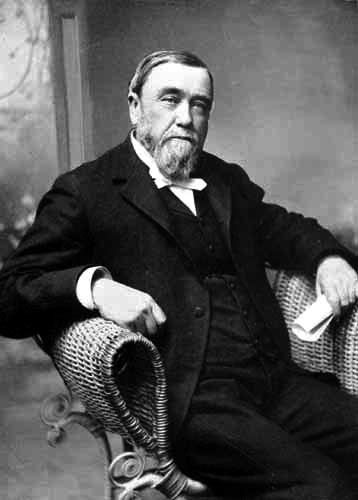
Charles Clinton Nourse From Photograph by I. W. Kramer, Des Moines
CHAPTER XIX
About Prohibition
In the month of November, 1889, the democratic party of the state of Iowa, for the first time since the election of Governor Grimes in 1854, succeeded in electing their candidate for governor; to-wit, Horace Boies. This was brought about by a singular combination between the railroad and the saloon interests of the state. I have already given some account of the effect upon the question of prohibition of the foolish policy pursued by the pretended friends of temperance in securing from the supreme court of the state a decision against the right to manufacture alcohol within the limits of the state for the purpose of export, and also the foolishness and wickedness of certain pretended friends of prohibition in instituting fraudulent prosecutions with a view to making costs and fees for their own personal profit. During the administration of Governor Larrabee the railroads of the state had become very restive under the control exercised by the Railroad Commissioners of the state under the law of 1888. In the month of August, 1888, some thirty suits were commenced in the district court of Polk county against the Rock Island, Northwestern, and "Q" railroads for penalties incurred in failure to make their reports to the Commissioners as required by the statute. The railroads of Iowa had become a very potent political power. We had five railroads extending from the Mississippi to the Missouri river, and in every county of the state in which these roads were located the railroads had one or more active attorneys to look after their interests, and under such captaincy as Blythe, of Burlington, and Hubbard, of Cedar Rapids, they exercised a very important influence over the politics of the state, controlling to a large extent the nomination of supreme judges and district judges and other state officers. The people of the state had become restive under the domination of this power. The open and shameless peddling of railroad passes to the members of the general assembly had begun to lose its power as against the rising indignation of the people. In the counties of Lee, Des Moines, Muscatine, Scott, and Dubuque on the Mississippi river, and such interior counties as Johnson and Crawford, with their foreign population, the saloon power of the state, uniting with the railroads, was sufficient to cause a successful revolt against the party in power. Horace Boies, the democratic candidate for governor, openly and shamelessly declared the prohibitory law to be cruel and unjust in its provisions, and his utterances in this behalf encouraged the violators of the law to believe what they afterwards realized, that though the courts might assess penalties, yet an executive who believed the penalty to be unjust could easily be persuaded to exercise pardoning power in their remission, and such was the result. For four years during the administration of Horace Boies the effort to enforce the prohibitory law was almost paralyzed. After incurring all the expense and trouble incident to the conviction of any one violating the prohibitory law, the people had the mortification of seeing the judgments of the courts rendered nugatory by the wrongful exercise of the pardoning power, vested by the constitution in the governor for wise and proper purposes, prostituted by an unscrupulous politician for his own political advancement and that of his party.
Another cause of this successful revolution in the politics of the state arose from the absolute cowardice of the leading republicans of the state in not defending the legislation for which they were responsible. During the candidacy of Boies for his second term, a gentleman who was a candidate on the state ticket for a state office applied to me and asked my consent to publicly discuss the question of prohibition with Mr. Boies in case the state central committee of the party would arrange for such discussion. I gave my consent to such an arrangement, provided the committee would agree to the same, but he afterwards reported to me that the committee did not think it advisable. On the part of the public speakers in behalf of the republican cause the only discussion of the question of prohibition was an apology for the enactment of the law. They did not attempt to discuss the question of right or wrong, but only that the law was enacted because the people by their vote upon the constitutional amendment had signified their approval of prohibition. The result of this cowardice and the four years' domination of the democratic party had its result in the platform adopted by the republican state convention in the year 1893. Only the year before this the republican state convention had adopted a resolution promising the people of the state that the party would take no backward step on the subject of prohibiting the sale of intoxicating liquors as a beverage, and at this convention in 1893 they adopted the following resolution:
Resolved, That prohibition is not a test of republicanism. The general assembly has given to the state a prohibitory law as strong as any that has been enacted in any country. Like any other criminal statute, its retention, mitigation or repeal must be determined by the general assembly, elected by and in sympathy with the people and to it is relegated the subject, to take such action as they may deem best in the matter, maintaining the present law in those portions of the state where it is now or can be made efficient, and giving to other localities such methods of controlling and regulating the liquor traffic as will best serve the cause of temperance and morality.
Under this platform, which merely meant the return of the open licensed saloon to Iowa in such localities in which the people would tolerate them, Mr. A. B. Cummins and his followers were all received back with open arms as prodigal sons and became at once important leaders politically in the republican party. The friends of prohibition were shocked and alarmed at this result and at once the prominent and more courageous prohibitionists of the state joined in a call for an independent republican convention favorable to prohibition. At the solicitation of a number of prohibitionists in the city of Des Moines I prepared the following address and call for a state convention, which address was adopted by a public meeting, held in the city of Des Moines:
When, through the machinations of men who, in their desire for success, have lost sight of principle, causes dear to humanity are about to be sacrificed, it becomes the duty of patriotic citizens to make an organized effort to rescue their imperiled rights.
As republicans we assert our unqualified devotion to the doctrines and principles of the republican party as heretofore set forth in our national platform, and as declared by republican state conventions and put in practical effect in the state of Iowa by republican legislators prior to the meeting of the republican state convention, held at Des Moines on the sixteenth inst. We declare that through the patriotic efforts of the republican party of Iowa prohibition had become the settled policy of the state, and that any attempt on the part of the politicians to induce the party to take a backward step on that question is to repudiate a past honorable record and to uselessly endanger future success by a base imitation of a hitherto despised opposition.
More than forty years ago the people of Iowa without distinction of party declared through the enactment of their general assembly, that the "people of this state would hereafter take no part in the profits of the retail of intoxicating liquors." This principle was again approved by the people of the state in the adoption of the act of 1855, approved by Governor Grimes, and more recently the people again endorsed the principle by adopting a constitutional amendment prohibiting the sale of intoxicating liquors for the purpose of a beverage. The people of the state of Iowa have never indicated any desire for a change of policy on this question, but on the contrary through the action of their representatives expressly elected upon this issue, they have constantly and consistently adhered to our present law.
The declarations of the recent republican convention have not been brought about by any change of sentiment on the part of the republicans of the state, but in our judgment its action is the result of a combination of politicians who had other and ulterior purposes at heart, and have failed to realize that whatever may have been their own want of convictions upon the question, the great mass of people have been honest and sincere. The honest voters of the republican party are not "clay in the hands of the potter," to be molded into any fashion that may suit the professional politician. The battle that for the past quarter of a century they have been waging against the liquor power and influence, and in which they have gained so many signal triumphs, has not been prompted by a mere desire for office or place, nor have our forces been kept together by the mere "cohesive power of the hope of public plunder." Hence if the defeat of 1891 could in any measure have been attributed to the position of the party on the question of prohibition, it would not constitute a valid reason for a shameful surrender and retreat. When the republican party declared for the maintenance of the prohibitory law, and promised that the party would take no backward step on this question, the earnest and honest men of the party did not mean that the party would only pursue that policy so long as it would win, but they meant that prohibition was right and that they would maintain the right, and that they intended to fight it out on that line, not only that summer, but until the saloon should make an unconditional surrender.
We have reasons to believe and do believe that the platform of the convention of the sixteenth inst., on the subject of temperance, was brought about by the same combination of railroad and saloon influence that defeated our party in the election of 1891, aided by the timid and half-hearted defense of our platform through the weakness of our state central committee.
The implied threat of the same combination to repeat their opposition in the approaching election, induced the republican state central committee to unite in accomplishing this surrender. It is said and often repeated that there is no hope for the cause of prohibition except through the success of the republican party. This was undoubtedly true so long as the state platform pledged the party to maintain and enforce the law.
The platform adopted on the sixteenth inst. not only does not promise to maintain prohibition as a state policy, but expressly declares in favor of "something else" in those localities where the prohibitory law was not enforced. This "something else" in the pretended "interest of true temperance" can deceive no man who does not desire to be deceived. It is a base imitation of democratic state platforms, and intends merely the "Schmidt bill" or the "Gatch bill" or some other equally objectionable attempt to abandon prohibition as a principle and as a state policy.
We believe in the sovereignty of the state of Iowa, and in its undivided sovereignty over every foot of territory within its boundaries. We do not believe the general assembly should attempt to exercise the power to make an act criminal in one part of the state and license the same act in another part of the state. The constitution of our state requires that all laws enacted by the general assembly "shall have a uniform operation." If the state shall concede that the sale of intoxicating liquors may be licensed in one part of the state and saloons may be lawfully established in one city or county, with what consistency can the state punish such acts as criminal when done in another locality within her jurisdiction. The establishment of a saloon for the propagation of drunkenness is either innocent or a criminal act. We recognize no middle ground. We do not believe in compromising with criminals or commuting offenses committed against the best interests of humanity. Neither do we believe the republican party of Iowa can ever survive an act so inconsistent with principle and her former professions, as would be the repeal of our present prohibitory law or the enactment of a license system for any part of the state.
We do not propose or recommend opposition to the election of any candidate for the general assembly on the republican ticket who is in favor of maintaining and enforcing our present law. The election of such is consistent with our past history and policy and will secure a republican United States senator. If, however, any candidate for the general assembly on the republican ticket shall declare for a saloon as against what has heretofore been recognized as republicanism, the responsibility of his defeat, with all its political consequences, will be upon him, and not upon those who are true to their convictions and principles and the past policy of the party.
We, therefore, the republicans of Polk county in mass convention assembled, at the instance and with the coöperation of the republicans of Sac and other counties of the state, who protest and dissent from the action of the state convention of the sixteenth inst., with the view of an organized effort that may save our party from committing the great wrong and outrage attempted, do hereby invite all citizens who agree with us in sentiment and purpose to meet in delegate convention in Calvary Tabernacle at Des Moines, Iowa, on Tuesday the fifth day of September, A.D. 1893, at 10 A.M., to take such steps and devise such measures as
First. Will secure the election to the general assembly at the November election of such candidates only as will maintain the present prohibitory law.
Second. As will secure such action and such an expression of the will and wishes of the people of the state as will convince the republican managers that the path of honor is the only path of safety.
The call for this convention alarmed the leaders of the republican party in the state, and they were very active in their efforts to counteract its effect. The convention was held according to the call on the 5th of September, 1893, and we had a very large representation and a very enthusiastic convention. We adopted a platform embracing the principles indicated in the call for the convention and nominated a state ticket. Our candidate for Governor, Mr. L. S. Coffin, was not present in the convention, but Doctor Fellows, a prominent prohibitionist of the state, vouched for his entire sympathy with the movement and his acceptance of the nomination. Mrs. J. Ellen Foster, who had been president of the national W.C.T.U., was sent by politicians from Washington, D.C., and was present at the convention, for the purpose, if possible, of alienating such as she could influence from taking part in or endorsing the movement. She seated herself in the gallery over against the chair occupied by the president and scowled and looked vengeance at those who took an active part in its proceedings. When I read the call for the convention before set out she looked for all the world like Tam O'Shanter's wife when waiting for Tam's return, "Knitting her brows like a gathering storm and nursing her wrath to keep it warm." During the recess of the convention she was very busy button-holing first one and then another of the prominent prohibitionists in attendance, taking them to a private parlor in the hotel and laboring with them to convince them that the success of the republican party was more important than the question of prohibition. After our nomination of Coffin as our candidate for Governor, Mr. Lafe Young, editor of the Capital, made a visit to Mr. Coffin at his home at Fort Dodge. Mr. Coffin had prepared his letter of acceptance of our nomination, but Young induced him to cut it in two and change the latter half of it so that it would read a declination of the nomination, and by some means unknown to the public induced Mr. Coffin to take the stump and make a number of speeches on the tariff question during the political canvass that year. By some means unknown also to me, the leading railroad lawyers of the state who had supported Boies were induced to return to their allegiance to the republican party, and the party succeeded in electing Jackson their candidate for governor, and also electing a legislature in sympathy with their saloon platform. The general assembly that met in January, 1894, accordingly passed the act known as the mulct law, being chapter 62 of the laws of the 25th general assembly of the state. This act does not in terms attempt to repeal the prohibitory law then in force in the state. On the contrary, section 16 of the act expressly provides: "Nothing in this act contained, shall be in any way construed to mean that the business of the sale of intoxicating liquors is in any way legalized, nor is the same to be construed in any manner or form as a license, nor shall the assessment or payment of any tax for the sale of liquors as aforesaid, protect the wrongdoer from any penalty now provided by law, except that on conditions hereinafter provided certain penalties may be suspended."
The next section of the act provides for the circulation of a petition, and by obtaining a certain majority or percentage of the voters to sign a petition to that effect the penalties provided in the prohibitory liquor law shall not be enforced against the offender. Under this law the brewers of St. Louis and Milwaukee employed men to circulate petitions, paying them five dollars a day for their services in obtaining signatures to petitions in certain counties of the state, under which the parties who paid the required tax were secured against any prosecutions for violations of the law. I tried several cases in the district and supreme court of the state for the purpose of testing the constitutionality of this act of the legislature. It placed the pardoning power theretofore exercised by the Governor of the state in the hands of the brewers of Milwaukee and St. Louis and their employees, provided they could by such means as they might adopt, obtain the required number of signatures to such petitions. It clearly recognized that what was a crime under the law in one part of the state, might be committed provided the necessary amount was furnished and paid into the public treasury as a commutation for the offense, and that payment should be made in advance without reference to the number of offenses that might be committed. It was clearly not a law of uniform operations under the decisions of our supreme court as theretofore held, for it was a crime in one city or county in the state and not a crime in another city or county of the state; notwithstanding the law making it a crime was still left in full force and effect, except as it was abrogated in a particular locality by the signing of certain petitions. Strange to say the supreme court of Iowa, notwithstanding their former decisions to which I have heretofore referred, sustained this law and its constitutionality, and under it in all of the counties of the state where we had any considerable foreign population the legalized saloon has returned to do its deadly work and the only compensation for it is that men who call themselves republicans have been able to hold and enjoy the honors of public office. After the decision of our supreme court upon the question of the constitutionality of this act I received from the editors of a law publication east a communication requesting my views and opinions for publication in their law magazine, and I simply wrote upon the letter addressed to me the statement that the decision made by our supreme court under this law was a political necessity and that it was an old and true adage that necessity knew no law, and I had no further comments to make upon it.
Since the prominent part that I took in this canvass of 1893 my standing with the republican party has been rather impaired; nevertheless, subsequently in the campaigns of Mr. Wm. Jennings Bryan involving the national policy of the republican party, I have taken very active part. The free coinage of silver heresy of Mr. Bryan I regarded as a serious menace to the integrity and honor of the nation, and I spent very considerable time and my own private means in making public speeches condemning that wild and visionary scheme. In state politics I have taken no active part since 1894. I never belonged to or coöperated with what has been known as the "Third party" or the prohibition party as a national organization. When the prohibitionists of Iowa united with the national organization I strongly advised against it. I could not see any hope of accomplishing anything by such an organization. The states of Kansas, Iowa, and the Dakotas had become prohibition, and in my judgment the only effectual way of reaching the question of prohibiting the sale of intoxicating liquors as a beverage, or the establishment of places of resort for such sale, was by the exercise of the police power of the states in the management of their own domestic affairs. The congress of the United States had no control over the subject, except in the matter of revenue laws or the taxing of the manufacture or sale of liquors. Our courts and the supreme court of the United States had agreed that the payment of taxes under these revenue laws and the issuing of what has been called a license, was really no protection as against the state law and its penalties. The general government does not exercise police power within the state but it may enforce penalties for the violation of revenue laws or enact laws regulating commerce within the states, but it cannot prohibit the establishment of the saloon or the maintenance of such a place merely upon the ground of preserving public order and morality. I could not and never have been able, therefore, to see the propriety of a national organization based upon the idea of prohibiting the sale of intoxicating liquors as a beverage, or establishing places of resort for such sale.
Another objection to this third party, the national prohibition party, so-called, has been the adoption of a platform favoring universal suffrage without reference to sex. This also is a question over which the congress of the United States have not heretofore exercised any jurisdiction. The question of suffrage or the right to vote has been a matter peculiarly within the control of each state of the Union and its local constitution and laws, and is not and never has been a matter of national politics. I have always believed and still believe that if the prohibitionists had confined their efforts to the several states, capturing those in which they had some prospect of success, their cause would have grown and become stronger each year. The great centers of population such as New York City, Chicago, Cincinnati, and St. Louis, and such other cities filled as they are with foreign population, who have no sympathy with the manners and customs pertaining to these agricultural states, cannot in my judgment be brought under the control of prohibition at any time during the present or next generation of men, and I regard it as foolish to spend our time and our money in such quixotic efforts. My hope in inaugurating the movement that we made in 1893 was simply to teach the republicans of Iowa the lesson that success politically was not to be attained in this state by subservience to the saloon power, and that defeat in the election of that year might result in a return of the party to its better and higher purposes in maintaining that which was right and just and humane. That we were defeated in that effort at that time was most unfortunate, but the domination of the political power of the saloon, I still have faith to believe, will work its own destruction, and that the people of this state will return to their former convictions.
CHAPTER XX
Personal Incidents
In the spring of the year 1888 I sold my home, 707 Fourth street, and built a house for my residence on my farm. We left the old home with no little regret. It had been our place of residence since the fall of 1859, with the exception of two years in which we fitted up the property temporarily on the corner of Fifth and Center, while we built the new house on Fourth in the old location. We had planted the shade trees of hard and soft maple. Here our child had been born and had grown to manhood, here we had celebrated our silver wedding in 1878, and had enjoyed the society of many kind friends and persons of distinction and influence in the state. Bishop Andrews, the bishop of the Methodist Episcopal church, with his family, resided nearly opposite to our house, and Bishop Hearst and his family had lived on Third street nearby, and our excellent neighbors, A. Y. Rawson and his first wife, Thos. F. Withrow and his family, had been our kind friends through many years. Here we had entertained such men as Governor Grimes and Governor Kirkwood and his wife, Senator Harlan and his wife, Bishop Waldron, Bishop Simpson, and other distinguished men of the state and of the church.
The most difficult problem in my life that I had to solve was the care and education of my son. I felt that everything was at stake in his proper discipline and education. During his early childhood we sent him to school as already mentioned to Mrs. Winkley, afterwards for some years to the public school and still later to Callanan College, an institution taught by Dr. Pomeroy. When the time came for him to go from home and attend college my first thought was to send him to Iowa City to the State University, but I had grave fears in regard to the influence that prevailed in that city. The college campus was environed by saloons and public sentiment of that town was far from being what it ought to have been. Attorneys had been mobbed in the streets of the city for the offense of prosecuting the violators of the prohibitory law, and there had been no proper expression of public sentiment condemning the outrage. I consulted with a number of the best citizens of Iowa City in regard to the matter of sending my son there for his education, but I became satisfied that they knew but very little of what was transpiring in the city after bedtime. I thought it prudent to make an investigation on my own account. I accordingly took the train that left Des Moines at five o'clock in the afternoon, arriving at Iowa City about half past nine. I went to the St. James Hotel and quietly registered my name and engaged a room for the night, but did not go to bed. I waited until about half past ten or eleven o'clock, and took my hat and started out on a tour of inspection. I visited a number of the saloons on the public square and found them filled with young men, no doubt students of the college, and I met several crowds of these young gentlemen on the street headed by one of the trustees of the college in not a very sober condition. I returned to my hotel with my mind fully made up that my boy should go without an education before I would subject him to the risk of being educated in such a town. Subsequently I visited Ames in company with my wife and selected a proper room in the dormitory for my son's occupancy, and we sent him to Ames accordingly. He afterwards spent a year in California before settling down to business as an architect in Des Moines.