Autobiography of Charles Clinton Nourse (continued 3)
Reading edition
CHAPTER VI
Visits Virginia Relatives
Soon after the close of the Civil War I went to Washington, D.C., for the purpose of arguing a case then pending in the supreme court of the United States. The court made an order advancing some important cases in which I think the government was interested, and this necessarily delayed the hearing of the cause in which I was engaged and left on my hands a week or more of leisure. I determined to improve the opportunity by going to Harper's Ferry and to Shepherdstown, West Virginia, for the purpose of finding and visiting some of my mother's relatives. I had an uncle, Charles Cameron, who had lived at Harper's Ferry when we left Maryland in 1841. I took the train to Harper's Ferry, and upon my arrival there ascertained from the hotel clerk that my uncle Charles had died a short time before the Civil War and that his family had removed to Washington. I asked the clerk if he could point out to me some old resident of the place from whom I could obtain information. Whilst talking with him a man entered the office to whom he recommended me as a person that could tell me all about Harper's Ferry before the war. From this gentleman I learned that my uncle, John Cameron, was living with a married daughter several miles over on the Maryland side, just under Maryland Heights. I walked out to the place and had a most delightful visit with him and his daughter, and son-in-law and family. My uncle was a tall, splendidly framed man, a fine specimen of the old Virginia gentleman, over six feet in height, with his faculties unimpared, a fine physique, and was then ninety-three years of age. He went with me the next day over to Shepherdstown, West Virginia, where we found still living and in fine health my uncle, Daniel Cameron, and wife, their daughter, their granddaughter, and their great-granddaughter, all living under the same roof. When Sunday came I went with my cousin to church and she took me to the Methodist Church South. At dinner that day I asked my uncle John if he had been to church. He said, "Certainly, sir." I asked him what church he attended. He answered, "The Methodist church." I turned to my cousin Susan and asked her if we had been to the Methodist church. She said, "Yes, the Methodist Church South." I said to my uncle, "Then you were at the Methodist Church North?" "I attended, sir, the Methodist church of the United States of America." My cousin stepped upon my toes about this time under the table, from which I took the hint that the question of church north and the Methodist church was rather a delicate subject to discuss in the family. I was pleased to find that my relatives had all been true to the cause of the United States and were earnest Union people, except the sons-in-law, who, being young men, were compelled to go into the rebel army.
I visited some of the old places where my father had formerly resided and where he had taught school, and I also visited the grave of my mother and grandmother Cameron in the village churchyard adjacent to the old brick building where I had attended Sunday school when a child. I had arranged with a gentleman who had married my cousin, Ann Cameron, to go with him the next day by way of Sharpsburg, over to Boonesboro, Maryland, but that evening I received a telegram from the clerk of the supreme court advising me that my case would probably be called Monday or Tuesday, and I hastened back to Washington. After disposing of my business in Washington I made a visit to my brothers at Rushville, Ohio. Whilst here we received news of the nomination of General George B. McClelland as democratic candidate for the presidency in opposition to Mr. Lincoln, who had been nominated for his second term. An old acquaintance, Charles Wiseman, who was postmaster at Lancaster, came to see me at Rushville and told me they had posted me for a political speech that night, and he compelled me to go with him and fill the appointment. I found in Lancaster many old friends and acquaintances, boys who had been with me at school, and they gave me a hearty greeting. The old court house was filled to overflowing that night and I dispensed to them for over two hours the gospel of true Republicanism and loyalty to the country. We had a very enthusiastic meeting, and my old friend, John D. Martin, especially gave me a very hearty commendation.
Before my return home I also visited Millersburg, Kentucky, to see my sister Susan and her family. Her husband, William Vimont, had suffered some during the war. His negro cook and her grown boy had been emancipated by their own will, the fugitive slave law being then practically inoperative. Morgan, in his raid through the country, had also stolen Vimont's fine horse, which served somewhat as an antidote for the wrong that he felt had been visited upon him by the Union people. In passing over from his house to the village of Millersburg two incidents occurred which served to illustrate the state of affairs at that time in Kentucky. Upon reaching the turnpike near Mr. Vimont's house we met one of his uncles riding in a buggy, just coming out of the gate which led to his residence, and he informed us with much feeling and passion that when he woke up that morning he discovered that there was not a nigger on his place, that he had no nigger at home to cook his breakfast for him, and that he had to "hitch up his own horse, sah." This last item appeared to be the culmination of his grief. A few hundred yards further we passed a blacksmith shop, and upon the large door that constituted the entrance to the shop we found in red chalk the image of a man drawn, and the door within the lines of this image was full of bullet holes. Mr. Vimont informed me that the blacksmith, who was a violent secessionist, had been accustomed to amuse himself by drawing upon the door of the shop the outline of a person, calling it Lincoln, and then standing a short distance away, revolver in hand, gratifying his rebel heart by filling the image full of bullet holes.
It was during this visit to my brother-in-law that I urged upon him the propriety of selling his little farm and purchasing land in some western state and removing his family thither, which he finally did a few years later, when he removed to Tuscola, Illinois.
I attended religious services in the village on the Sabbath, and was much interested in hearing a sermon from the text, "Be not deceived, God is not mocked, for whatsoever a man soweth that shall he also reap." The sermon that the minister preached was by no means the same as my thoughts framed from this text when I thought of the desolation that I had witnessed through this state, and the effects of the dark shadow that was just then lifting from one of the fairest lands that a benevolent Creator had ever prepared for a people, but which the stupidity and cupidity of man had cursed with human slavery. The preacher appeared to be perfectly blind as to the crop that his audience had reaped from the fearful sowing of their fathers, or dared not mention even had he thought of it.
CHAPTER VII
Pleasure Trip to Colorado
In the summer of 1872 I joined a party of friends for the purpose of visiting Colorado. The party consisted of Judge Byron Rice, Doctor Ward, Alexander Talbott, Mr. Weaver, a druggist, and Monroe, a clothing merchant, and myself. We went by rail to Denver. We took with us a tent cloth, some blankets, buffalo robes, and bedding. At Denver we purchased a three-seated spring wagon and a pair of good mules. We also hired a teamster with another pair of mules and wagon, and bought a camping outfit, cooking utensils, and provisions. From Denver we went south to Colorado Springs. Our first camp south of Denver was at a place called Haystack Ranch, so called because there had never been a haystack on the ranch, but three immense boulders bore a striking resemblance to three haystacks, in the vicinity of which a settler had erected his buildings. A small mountain stream supplied him with the facilities of irrigating his land. He had built a fine large milk house, paved with flagstones and so arranged that he could turn the mountain stream of ice cold water on the floor of the building and thus regulate its temperature. He also had built an overshot water wheel with a small trough or flume and through this trough he turned the water onto his wheel from time to time as he wished it, and utilized its power to churn his butter. He milked about thirty cows, which he told us were fed entirely upon the buffalo grass in the valley near by among the foothills, and that he sent his butter twice a week to the city of Denver. The man was evidently living an easy, pleasant life, and getting rich without any severe toil or drudgery. The town of Colorado Springs was then a single street with a few straggling houses. Within a few miles of it we found the newly laid out city of Manitou. The surveyors were still at work surveying the streets. One large hotel was in course of erection and the valley up Cheyenne canyon contained about two hundred tents filled with invalids and health seekers. In this canyon could be found mineral waters of any temperature and almost any ingredients; principally iron, sulphur, lime, and soda. On a beautiful plateau of ground near where the hotel was being erected we pitched our tent and made our camp for several days. We finally concluded to make the ascent of Pike's Peak. Besides the two mules that we had bought, we hired some ponies accustomed to the trail, except that Mr. Monroe, one of our party, declared that he was able to walk, and refused to be provided with other transportation. We proposed to go up the mountain to the timber line the first day, and stay all night, and the next morning attempt to reach the summit by sunrise, for the purpose of enjoying what we were assured would be a most magnificent view of the country. Judge Rice and myself were a little late in procuring our ponies, and the other four of the party started in advance of us, Monroe on foot. "Halfway," as it was called, up the mountain, we stopped for rest and refreshment at a little log shanty erected by two enterprising young men, who there supplied luncheon and sleeping accommodations to the traveling public. The trail at that time was barely visible to the naked eye, and the climbing was difficult and somewhat dangerous even with our trained animals. Several hundred yards before we reached the timber line, so-called, we found Monroe lying in the path and apparently almost lifeless. The rare mountain air had scarcely left him oxygen enough to preserve life, and he had succumbed to the inevitable. We found near the timber line a shelving rock or rather a large cavity in the rock, where we took up our quarters for the night. Carrying Monroe to this place and wrapping him in blankets, we infused life into him by administering several doses of brandy, of which Judge Rice fortunately had a small flask. A large pine tree had fallen across the outer edge of this rock against which we could place our feet to prevent slipping over its edge, and here we all tried to sleep. A fearful thunder storm came up in the night, but fortunately the storm was below us. It was indeed a grand sight to see the forked lightnings darting through the clouds below us, without any apprehension of their finding our retreat. Our sleep, however, was very indifferent. We had been in the territory only about ten days and our breathing apparatus had not adjusted itself to the necessities of a life in these altitudes. We fairly gasped for breath. In the morning when we awoke we found that we could take our ponies no farther on the trail, for there was none visible to the eye. The remainder of the journey to the top of the peak was necessarily a climbing over huge rocks scattered here and there without reference to the convenience of adventurers. We could walk or rather climb about one hundred feet between rests and then fall down under the shadow of a great rock to recuperate enough strength for a venture of perhaps a hundred feet more. After climbing about four or five hundred feet or more in this manner we each began to feel a roaring in the ears and a nausea of the stomach, and at last had the discretion to call council in which we unanimously concluded with old Falstaff, one of Shakespeare's heroes, that the better part of valor was discretion, and we concluded to return to the valley below and forego the magnificence of a sunrise view from the top of Pike's Peak. When we got back upon our way as far as the timber line where we had hitched our ponies, I found my pony had taken "French leave" and gone down on the trail without waiting for my valuable company. I was doubtful at first whether I should be able to walk to camp, which was then over eight miles from the place of our night's adventure, but I had not proceeded down the mountain a mile before my strength returned to me and my lungs filled with sufficient oxygen to restore my vigor. We all got back to camp safely, even including the dilapidated Monroe, and the consensus of opinion was that we were glad we went up Pike's Peak, but were more satisfied with the reflection that we did not have to go again. After another day's rest we took to the road with our mule teams and wagons, passing over a beautiful mountain road up Cheyenne canyon. Every few hundred yards we passed some beautiful cascade or water fall, formed by the dashing waters of some mountain stream supplied from the eternal snows that crowned the mountain peaks around us. Our road lay through the so-called South Park. On the high table lands before we reached this park we passed through a forest of petrified wood. At one cabin, occupied by a gentleman who kept a small hotel, we found the foundation of his house made of this petrified timber, and his chimney and fireplace of the same material. We gathered a few specimens that we afterwards brought home with us. In South Park we passed what was called the salt works. Here some English capitalist had built an immense plant for manufacturing salt. A natural spring that threw a constant stream of salt water, probably ten or twelve inches in diameter, supplied the water from which the salt was to be made. Large and commodious buildings with evaporating apparatus had been erected. An expenditure of probably fifty or one hundred thousand dollars had been made. There was only one difficulty about this Utopian enterprise and that was that the salt had to be manufactured so far from civilization that it cost more to transport it than it would be worth when it reached the market, hence the enterprise had been an ignominious failure and had been abandoned.
Leaving this point we passed through the South Pass of the Rockies and on to the headwaters of the Arkansas river. We went up this river to the town of Granite, that had been a thriving mining village when placer mining in these parts was profitable; thence we went to Twin Lakes, two small beautiful lakes of water among the mountains, where we camped and supplied ourselves with mountain trout. On the way we frequently shot mountain grouse. With our breakfast bacon and most excellent flour and potatoes, and our own improvised cooking and our excellent appetites, we all fared sumptuously every day. We returned via another route, passing through Fairplay. Returning to Denver we sold our team and wagon for just its original cost, and paid our teamster with his outfit four dollars a day. We had kept an accurate account of our expenditures and found that $1.50 a day for each of us had paid all of our expenses, including our transportation, for our three weeks' trip. We made a trip then by rail and stage line, going first over to Idaho Springs, visiting that beautiful little valley, and some of our party going as far as Georgetown. Returning to Denver, we all came home by rail well satisfied with our trip, but when we struck the blue grass regions of Iowa and its fields of ripening corn, with the memories of the homes that we were nearing our hearts were made glad that we lived in a land of civilization and plenty.
CHAPTER VIII
Centennial Address
In the year 1876 the patriotic citizens of the state of Pennsylvania, and especially of the old city of Philadelphia, had conceived the idea of a world's fair to commemorate the great event of the world; to-wit, the declaration of the independence of the American colonies from the mother country. In planning this great exhibition the managers had invited the governors of the several states of the Union to appoint, each, one of their citizens to deliver an address in behalf of their state, giving something of its history and settlement, its resources and possibilities. In pursuance of this plan Governor Samuel J. Kirkwood of Iowa did me the honor to appoint me to make the address in behalf of Iowa. I prepared such an address with considerable care, and delivered the same upon the exposition grounds on the 7th day of September, 1876. My cousin, Henry Clay Cameron, who was then professor of Greek at Princeton University, did me the honor to visit me at Philadelphia at this time and took luncheon with my wife and myself upon the exposition grounds; also Samuel F. Miller, justice of the supreme court of the United States came from Washington and was present on that occasion, and many other distinguished men. Among other gentlemen present were official representatives of a number of the governments and nations of Europe. The legislature of Iowa printed at the state expense some twenty thousand copies of this address, that were thereafter distributed among the people of the state. I have sent at their request to a number of the libraries in the different states printed copies of this address, and now the supply has been about exhausted and the document is about out of print, and I think I should give here a short synopsis of it.
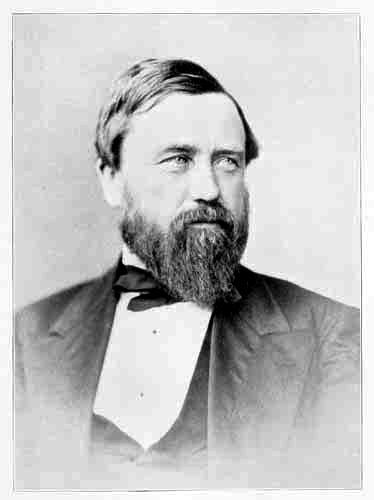
Charles Clinton Nourse From Photograph by W. Kurtz, Madison Square, New York, 1876
The following is the introductory matter, stating something of the discovery of the territory that now constitutes our state:
Mr. President, and Ladies and Gentlemen: On the 13th of May, A.D. 1673, James Marquette and Louis Joliet, under the direction of the French authorities of Canada, started from the Straits of Mackinaw, in their frail bark canoes, with five boatmen, "to find out and explore the great river lying on the west of them, of which they had heard marvelous accounts from the Indians about Lake Michigan."
From the southern extremity of Green bay they ascended the Fox river, and thence carried their boats and provisions across to the Wisconsin. Descending that stream, they reached the Mississippi on the 17th of June, and entered its majestic current, "realizing a joy," wrote Marquette, "that they could not express." Rapidly and easily they swept down to the solitudes below, and viewed on their journey the bold bluffs and beautiful meadows on the western bank of the stream, now revealed for the first time to the eyes of the white man. This was the discovery of Iowa.
The address then proceeds to give a short account of the first settlements in Iowa at Keokuk, Burlington, Davenport, and Dubuque, and also the settlements afterwards made at Council Bluffs and Sioux City, and cites the various treaties made from time to time between the government of the United States and the Indians, extinguishing the Indian title. It also gives something of the topography of the country, and in regard to its resources and the natural fertility of the soil it contains the following:
We have now on exhibition in the Centennial buildings 15,000 pounds of Iowa soil, selected from forty-five different counties of our state. This exhibition shows a vertical section of the natural formation of the earth to the depth of six feet from the surface. The selection has been made from five several groups of seven counties each. The counties have been classified according to their contiguity, or natural location, as the northwest, northeast, southwest, southeast, and central. These specimens of strata are exhibited just in the condition they existed in the earth. The strata, undisturbed, have been transferred to glass tubes six inches in diameter and six feet in length. These tubes are encased in black walnut, and each labeled with the name of the county from which the strata have been taken. The object has been in good faith to show the world what Iowa really is, without exaggeration, and without room for cavil. Here is the formation from nature's own laboratory. Behold, what hath God wrought!
The address also particularly gives an account of our school system, our state university and agricultural college, our benevolent institutions for the unfortunate classes, also the extent of our newspaper publications. It discusses to some extent the questions arising out of the Civil War and the heroism of our troops. On this subject the address contains the following:
It is impossible, in the reasonable length to which this paper should be limited, to write even a summary of the battles in which Iowa soldiers took part. The history of her troops would be substantially a history of the war in the south and west. To recount a portion of those battles and sieges would be to give a partial history to the neglect of others, equally deserving of honorable mention. A task alike impossible would be to give here the names of the heroes, living and dead, who distinguished themselves by their courage and valor. Our efficient Adjutant General has preserved in the archives of his department, the material from which this glorious history will one day be written, for the honor of the state and the inspiration of the generations that shall come after us. In the adjutant's department at Des Moines are preserved the shot-riddled colors and standards of our regiments. Upon them, by special authority, were inscribed, from time to time during the war, the names of the battle fields upon which these regiments gained distinction. These names constitute the geographical nomenclature of two-thirds of the territory lately in rebellion. From the Des Moines river to the Gulf, from the Mississippi to the Atlantic, in the mountains of West Virginia, and in the Valley of the Shenandoah, the Iowa soldier made his presence known and felt, and maintained the honor of the state and the cause of the nation. They were with Lyon at Wilson's Creek, with Tuttle at Donelson. They fought with Siegel and with Curtis at Pea Ridge; with Crocker at Champion Hills; with Reid at Shiloh. They were with Grant at the surrender of Vicksburg. They fought above the clouds with Hooker at Lookout Mountain. They were with Sherman in his march to the sea, and were ready for battle when Johnston surrendered. They were with Sheridan in the Valley of the Shenandoah, and were in the veteran ranks of the nation's deliverers that stacked their arms in the national capital at the close of the war.
The address concludes as follows:
Iowa hails with joy this centennial of our nation's birth. She renews her vows of devotion to our common country, and looks with hope to the future. The institution of slavery, that once rested as a shadow upon the land, that was fast producing a diverse civilization dangerous to our unity and nationality, has been forever abolished.
This centennial exhibition of our national greatness and material progress must re-awaken in the mind and heart of every American emotions of profound love for his country, and of patriotic pride in her success. Surely no American would consent that such a civilization as is evidenced here should perish in the throes of civil war. If there be anything in the history of Iowa and its wonderful development to excite a just pride, the other, and especially the older states of the Union may justly claim to share in it. Such as we are, the emigration from the other states made us. Our free soil, free labor, free schools, free speech, free press, free worship, free men and free women, were their free gift and contribution. Iowa is the thirty-year old child of the republic that celebrates the first centennial of its birth. Our state is simply the legitimate offspring of a civilization that has found its highest expression in building up sovereign states. Iowa was not a colony planted by the oppressions of the parent government, and that threw off her allegiance as soon as she gained strength to assert her independence; but she was the outgrowth of the natural vitality and enterprise of the nation, begotten in obedience to the divine command to multiply and replenish—born a sovereign by the will and desire of the parent, and baptized at the font of liberty as a voluntary consecration of her political life. Not a sovereign in that absolute sense that would make the federal government an impossibility, but sovereign within her sphere and over the objects and purposes of her jurisdiction, with such further limitations only upon her powers as render an abuse of them impossible, to the end that the personal liberty and private rights of the citizen should be more secure.
This wonderful exhibition of mechanical skill, of cunning workmanship, and of the fruits of the earth, is but the evidence of the existence and character of the people that have produced them. The great ultimate fact that America would demonstrate is the existence of a people capable of attaining and preserving a superior civilization, with a government self-imposed, self-administered, and self-perpetuated. In this, her centennial year, America can exhibit nothing to the world of mankind more wonderful or more glorious than her new states—young empires, born of her own enterprise, and tutored at her own political hearthstone. Well may she say to the monarchies of the old world, who look for evidences of her regal grandeur and state, "Behold, these are my jewels." And may she never blush to add: "This one in the center of the diadem is called IOWA."
CHAPTER IX
Temperance and Prohibition
In giving a further account of the activities of subsequent years it will be almost impossible to preserve anything like a chronological order of events, and it will be necessary to take up certain subjects or topics that employed much of my time and energies, and probably as important as any other part of my life was my connection with the subject of temperance and prohibition.
The code of Iowa enacted in 1850 took effect July 1, 1851. Under the head of "Intoxicating Liquors" it enacted as follows: "The people of Iowa will hereafter take no part in the profits of the sale of intoxicating liquors." It then provided that the establishment of any place for the sale of intoxicating liquors to be drank on or about the premises should constitute a public nuisance, and enacted penalties against the sale of intoxicating liquors to be drank on or about the premises, and provided for the abatement of such nuisances and the punishment of all persons violating the provisions of this statute. This code was very excellent in the principle upon which the law was based; to-wit, that the people and government ought not to be a party to or share the profits of the sale of that which was the cause of so much poverty and crime, and the statute aimed at the destruction of the places of resort where the habit of drinking such liquors was contracted and promoted; but in its practical operation the law itself and its provisions were a failure. The words, "To be drank on or about the premises," involved two uncertainties—first, as to the meaning of the words "on or about," and secondly, as to the guilty knowledge or intent of the vendor of the liquors when he made his sale, as to the manner and where the purchaser intended to drink. Courts and juries gave very different and very liberal interpretation in the application of this law to different cases, and many of our judges and justices were not well educated in the idea that the sale of intoxicating liquors as a beverage was really a crime against the community and against humanity. As a result of these uncertainties of the law, the people of the state in 1854 elected a legislature, the majority of the members of which were pledged to enact a statute of absolute prohibition. Such a statute passed both branches of the general assembly, and was approved by Governor Grimes. The settlements in the larger towns along the Mississippi river and in several of the interior counties embraced very many Germans and other persons of foreign birth, accustomed to the use, not only of intoxicating liquors, but to places of resort where the same could be drank at their leisure and pleasure. The result of this foreign demand was a fatal amendment to the statute of 1854-5 known as the "Wine and Beer Clause," which permitted the licensing and sale of beer and native wine made from the grapes or other fruits grown within the state. The practical result of this law was the establishment of the saloon in charge of keepers who paid no respect to the law and sold all kinds of intoxicating drinks under pretense of beer and native wine.
During our Civil War the people of the state were so absorbed in the progress of events that involved the existence of our nationality that they gave but little attention to local state and police legislation, but soon after the close of the war, the thought of the people was directed to the great curse of the licensed saloon and its effects upon the morals and habits of our people. In order that the policy of the state with reference to this matter might not be subjected to the caprice of political party conventions and elections, the people demanded and sought to enact an amendment to the constitution of the state that should embrace to its fullest extent a provision prohibiting the sale of intoxicating liquors as a beverage within the state, including not only alcoholic liquors, but also malt liquors. In order to secure such a provision by way of amendment to the constitution it was necessary to secure the election of two successive general assemblies to pass upon such an amendment, and to secure a vote of the people endorsing and adopting the same at a subsequent election. The provisions of our constitution on the subject of amending the same were as follows:
Any amendment or amendments to this constitution may be proposed in either house of the general assembly; and if the same shall be agreed to by a majority of the members elected to each of the two houses, such proposed amendment shall be entered on their journals, with the yeas and nays taken thereon, and referred to the legislature to be chosen at the next general election, and shall be published, as provided by law, for three months previous to the time of making such choice; and if, in the general assembly so next chosen as aforesaid, such proposed amendment or amendments shall be agreed to by a majority of all the members elected to each house, then it shall be the duty of the general assembly to submit such proposed amendment to the people in such manner, and at such time as the general assembly shall provide; and if the people shall approve and ratify such amendment or amendments by a majority of the electors qualified to vote for members of the general assembly, voting thereon, such amendment or amendments shall become a part of the constitution of this state.
In pursuance of the provisions of this constitution the eighteenth general assembly of the state of Iowa, to-wit, in the year 1880, adopted as an amendment to the constitution of the state the following: "No person shall manufacture for sale, or sell, or keep for sale as a beverage, any intoxicating liquors whatever, including ale, wine and beer. The general assembly shall by law prescribe regulations for the enforcement of the prohibition herein contained, and shall thereby provide suitable penalties for the violation of the provisions hereof." This amendment, by omission of the clerk of the house of representatives, was not entered in full upon the journals of that body. It was, however, embraced in a joint resolution of the two houses and fully identified by its title upon the journal of the house and senate, and the vote adopting the same was duly recorded by yeas and nays as required by the constitution. The publication of this action of the eighteenth general assembly was duly made in the newspapers prior to the election of the nineteenth general assembly, and at the session of that body another joint resolution was passed in both houses embracing the amendment and reciting the action of the eighteenth general assembly thereon, and this joint resolution passed both houses, and the yeas and nays were fully recorded, and proclamation was made by the Governor of the state, and the people of the state at a subsequent election held on June 27, 1882, after a vigorous canvass of the merits of the question, endorsed and adopted the amendment by nearly thirty thousand majority.
On the 26th day of August, 1882, a pretended suit was brought in the district court of Scott county by a brewing establishment owned and operated by Koehler & Lange against a saloon keeper by the name of Hill, in the city of Davenport, upon an account for beer sold by the brewer to the saloon keeper, and the saloon keeper set up by way of defense that he bought the beer and it was sold to him for the purpose of being sold as a beverage and that the sale was unlawful and contrary to the provisions of the amendment to the constitution. That this suit was a mere conspiracy for the purpose of having the amendment to the constitution declared void there can be no question. The judge of the district court of Scott county was opposed to the amendment personally and politically, as were also the attorneys that conducted these proceedings. The principal answer of the saloon keeper was to set up the constitutional amendment and the brewer replied stating that the constitutional amendment was not legally adopted, especially because the amendment had not been spread upon the journals of the house of representatives of the eighteenth general assembly verbatim, but that it had only been embraced in a certain joint resolution of the two houses. The judgment of the district court was against the brewer for the beer, and he took a pretended appeal therefrom to the supreme court of the state. When the case reached the supreme court J. A. Harvey, Esq., who had been an active man in the general assembly in favor of the amendment, and who was also an avowed prohibitionist and friend of the amendment, was employed by the Women's Temperance Union of the state to appear in the case and argue the matter before the supreme court, involving the legality of the amendment. The Women's Temperance Union also employed Judge William E. Miller, an ex-judge of the supreme court of our state, who prepared and filed in the case a printed argument. I was at that time absorbed in my own private practice and had a case on trial in the district court, and was unable to attend the session of the court at which the case was argued. I had been very active in the canvass pending the adoption of this amendment at the popular election, and had spent much time in making speeches before the people in its behalf. I had promised Mr. Harvey that if my other professional engagements would admit of it I would assist him in the oral argument before the supreme court. To my great surprise, and to the surprise and consternation of the people of the state, the majority of the judges of the supreme court decided that the amendment had not been legally adopted, giving as their chief reason therefor the failure of the eighteenth general assembly to have spread upon the house journal a verbatim copy of the constitutional amendment at the time it was adopted by that house. As soon as this decision was made known I prepared and filed in the supreme court of the state a petition for a re-hearing of the case. This re-hearing was granted. The Governor of the state employed Senator James F. Wilson of Fairfield, and Hon. John F. Duncombe, of Fort Dodge, to appear and make oral argument in behalf of the amendment. I also appeared in the case at my own request and upon my own motion and argued the case orally at Davenport on the final hearing. Two of the judges of the supreme court; Judges Seevers and Rothrock, were not friends of the amendment, and I think, in sentiment, were opposed to it. Judge Day's action in the matter in agreeing with Messrs. Seevers and Rothrock was a surprise to his friends, but I have no doubt his decision was honestly made. I think this re-hearing might possibly have resulted in a favorable opinion from a majority of the court had it not been for the intemperate zeal of a portion of the public press, particularly the Des Moines Register edited by the Clarksons in which the majority opinion of the supreme court was denounced. The judges who constituted the majority of the court could scarcely be expected to change their views and opinions under the pressure of the brutal attacks that were made upon them through the press. Judge Beck, the fourth judge of the court, had delivered a very able dissenting opinion sustaining the constitutional amendment. That the decision of the supreme court upon this question was radically wrong, I have never entertained the least doubt in my own mind. The supreme court in its majority opinion recognized the fact that the only proper and legal evidence of the final action of the legislative body in the enactment of its laws must be found in its enrolled bills, duly certified by the presiding officers of the senate and house of representatives respectively. The authorities were uniform, and no court had ever before undertaken to examine the journals of a legislative assembly for the purpose of contradicting and falsifying the duly certified action of the legislature by its presiding officer. Every bill that passes the general assembly of the state is duly enrolled by the clerk elected for that purpose by the house in which the bill originated. It is then supposed to be carefully examined by the committee on enrolled bills and reported in open session of the house, and is then presented by the clerk or secretary to the several presiding officers in open session for their signatures, and thence in the care of the proper committee on enrolled bills is presented to the Governor for his approval. To go behind this official action of the two branches of the legislature and undertake to examine and criticise the action of the clerk in recording or failing to record any part of its proceedings, by the courts of the state, is simply to destroy the independence of the law-making power, and is nothing more or less than usurpation on the part of a coördinate branch of the government. The constitution of Iowa in its provisions in regard to an amendment of that instrument selects, first, the two houses of the general assembly, secondly, the executive of the state, and thirdly, the people of the state, the source of all political power, and entrusts to them and them alone the power to amend its organic law. This amendment originated with and was carefully prepared by and approved by both branches of the eighteenth general assembly, and subsequently by the nineteenth general assembly, there can be no question; that it was then submitted to a vote of the people, voted and approved by the people by a large majority, was then proclaimed by the Governor of the state in his proclamation as part of the organic law of the state, there was no question, and I do not hesitate to say, after years of thought and deliberation upon this matter, that the decision of the supreme court of the state in the case of Koehler & Lange against Hill was simply usurpation. During the pendency of this re-hearing and before the final arguments in the case Mr. Hill, the saloon-keeper of Davenport, attempted to defeat the re-hearing by asking the court to strike from the files the petition for rehearing and denying the authority of the attorneys who had filed the same to act in his name. The Governor of the state, after the final disposition of the cause, appropriated $750 to the three principal counsel engaged in the re-hearing, and sent me one-third of the amount; to-wit, $250 for my services in the matter.
The constitutional amendment thus attempted to be rendered null and void by the opinion of the supreme court in the case of Koehler & Lange against Hill was really only an amendment to the constitution enjoining upon the legislature the duty of enacting a prohibitory liquor law, and forbidding the enactment of any statute authorizing the license and sale of intoxicating liquors as a beverage. The immediate effect of the decision of the supreme court was to arouse the people of the state to an assertion of their rights in regard to these matters; consequently they elected a general assembly in the fall of 1883, a large majority of whose members were pledged to give the people, by legislative enactment, a law such as the constitutional amendment required, and in pursuance of that purpose the twentieth general assembly enacted the prohibitory law, chapter 143, page 146 of the laws of that session. This law was popularly known as the Clark law, taking its name from the fact that it was introduced into the senate by Senator Clark of Page county. He was not, however, the author of the law, and was only entitled to the credit of having introduced it as a member of the senate.
Some time before these events there had been organized in the state of Iowa a temperance league, with its headquarters at Des Moines. Mr. J. A. Harvey, before referred to, and myself, with Louis Todhunter of Indianola, had been appointed by the Temperance League a committee to draft a prohibitory law and secure its passage by the twentieth general assembly. Another effect of the decision of the supreme court in the Koehler & Lange case was the retirement of Judge Day from the supreme bench of the state, and the election of Judge Read of Council Bluffs in his stead. I was a delegate to the republican state convention from Polk county. I did not sympathize with the idea of the defeat for renomination of a judge of the court on the simple ground that his decision or action as judge did not meet with the approval of the people, but I could not, with my ideas of right and justice, approve of the renomination of any judge of the court that had assumed the prerogative attempted to be exercised by the majority of judges in the Koehler & Lange case, and I cordially supported Judge Read for the nomination. I had assisted Mr. Harvey in framing the prohibitory law that was enacted by the twentieth general assembly, part of which was written by myself. I did not entirely agree with the committee, however, in providing as that statute does that the prosecuting witness or party filing informations for a violation of the law should take to his personal use any part of the fines or penalties provided for in the statute. I disliked that feature of the law for the reason that I anticipated that bad men, for the sake of personal profit and gain, would bring the law into disrepute. The State Temperance League undertook to provide, to a greater or less extent, for the prosecution of offenders under this law of the twentieth general assembly. I was on the committee appointed by the League and was chairman of the committee that had advisory powers in regard to prosecutions undertaken or promoted by the officers of the League, and as chairman of that committee I had occasion, a number of times, to defeat the purposes and plans of those who sought to use the authority of the League for some ulterior purpose. The most serious case of this kind that arose during my administration related to the effort of a certain whiskey trust to use the prohibitory law as a means of destroying an industry established in Des Moines by invitation of its business men just prior to the taking effect of this prohibitory law of 1884. One of the chief men in encouraging the establishment of the International Distillery in Des Moines, so-called, was J. S. Clarkson, editor-in-chief then of the Des Moines Register. This International Distillery was an alcohol manufactory, established by a man by the name of Kidd. Before he invested his money in the plant he had taken the precaution to consult with a number of prominent citizens and prohibitionists of the city of Des Moines, to know whether or not his enterprise would at all be affected by the constitutional amendment or the statute that might be passed in pursuance thereof. Pending the action of the general assembly upon the constitutional amendment, the Des Moines Register had insisted upon some legislative interpretation of the meaning and effect of the proposed amendment upon the question of the manufacture of alcohol within the state as an article of commerce, for the purpose of shipping the same to the markets abroad and not to be sold within the state. In pursuance of the suggestion of the Des Moines Register, the state senate of Iowa in 1882 adopted the following explanatory resolution as to the meaning and intent of the amendment then pending, and thereafter to be voted upon by the people, as follows:
Whereas, doubts have been suggested as to the true intent and meaning of the joint resolution agreed to by the 18th general assembly, and by this general assembly, as proposing to amend the constitution of the state so as to prohibit the manufacture and sale of intoxicating liquors as a beverage within this state; and
Whereas, it is desirable that such doubts should be removed as far as practicable before said proposed amendment is voted upon by the people; therefore,
Be it resolved by the senate, that said proposed amendment was and is designed and intended to prevent the manufacture within this state, for sale within this state, as a beverage, all intoxicating liquors, including ale, wine and beer, and to prohibit the selling of such liquors within this state for use as a beverage, and to prohibit the keeping of such liquors for sale as a beverage within this state; and was not designed to prohibit the manufacture for sale, or keeping for sale, of such liquors for any or all other purposes.
A short time before this resolution was passed a meeting of the board of trade of the city of Des Moines was held with reference to the same matter. It was attended by many of the most prominent prohibitionists of the city, and all concurred in the view of the amendment afterward taken by the senate. The sense of the meeting was expressed by a resolution reported by a committee, consisting of T. S. Wright, J. S. Polk, and J. S. Clarkson, and adopted with but one dissenting vote. The resolution is as follows:
Whereas, the agitation of the proposed amendment to the constitution of this state, prohibiting the manufacture of alcoholic liquors for sale, is creating doubt and uncertainty in the minds of capitalists proposing to invest a large amount of means in the manufacture of alcohol in this city; and
Whereas, we are satisfied the great majority of the people of the state do not construe such amendment as prohibiting the manufacture of alcohol for exportation, but that it simply prohibits its manufacture for sale as a beverage in the state, a view in which the leading friends and the most of the supporters of the amendment concur; and
Whereas, we are sure the people of the state would vote down overwhelmingly any amendment absolutely prohibiting the manufacture of alcohol; therefore be it
Resolved, that the Des Moines Board of Trade accept the interpretation of the leading friends and supporters of the amendment, that it intends only to prohibit the manufacture for sale of alcoholic liquors in the state as a beverage, pledges itself to the support and defense of capitalists investing in such manufacturing as against all doubts as to the real meaning of the amendment, and further, that we will lend our active influence toward securing such legislative expression as will put upon the amendment the construction that it will only prohibit the manufacture of such liquors for sale as a beverage in the state.
This meeting of the board of trade, which was attended by many of the prominent prohibitionists of the city and of the state, I did not attend, though invited to be present.
In pursuance of the encouragement thus given to Mr. Kidd, and prior to the taking effect of the prohibitory law of 1884, Mr. Kidd expended several hundred thousand dollars in the building of his plant for the manufacture of alcohol at the city of Des Moines, Iowa, and continued such manufacture without interruption until certain prosecutions were commenced against him at the instance of the Western Export Association, a whisky trust organized by the distillers of the United States to prevent an excess of alcohol being manufactured, and by this means to regulate and keep up the price of the article. After the decision of the principal suit undertaken in this behalf, in which I. E. Pearson and a man by the name of Loughran were nominal plaintiffs and the International Distillery and Mr. Kidd were defendants, a decision adverse to the distillery was obtained and the defendants took an appeal to the supreme court of the state. Mr. Kidd and his attorney called upon me and reminded me of the fact that our firm, consisting of B. F. Kauffman and myself, had given them a written opinion to the effect that the law of 1884 did not make it unlawful to manufacture alcohol in this state as an article of merchandise, to be shipped and disposed of beyond the limits of the state, and Mr. Kidd appealed to me to know if I was willing to accept of a retainer to argue that question in the supreme court of the state on his appeal, suggesting that he thought it my duty to do so as a lawyer, and asked if I was afraid to perform my duty in that behalf. I told him that I was not afraid and accepted of the employment.
As soon as this became known to the Des Moines Register, its editors commenced a series of abusive articles against me, containing misrepresentations and insinuations, and for some reasons best known to the editors of that paper and of which I am not advised, they became very active in trying to promote the success of this prosecution against the distillery and to destroy the same. These articles of the State Register created, of course, quite an inquiry among the friends of prohibition in the state, and they wrote a number of letters to Mrs. A. E. McMurray, secretary of the State Temperance League, making inquiry in regard to the matter of my employment. She accordingly wrote a letter to me upon the subject and I answered the same very fully, giving a history of the whole controversy, and particularly the motives of the men that were trying to destroy Kidd and his enterprise. Though the letter is somewhat in detail, yet, as it is a complete answer to all of the criticisms that have been made of my professional conduct in this matter, I give it here in full:
Des Moines, Iowa, March 19, 1887.
Mrs. E. A. McMurray, Secretary of Iowa State Temperance Alliance:
I have your communication of the 17th inst., and appreciating the motives that have prompted it, I take pleasure in responding to your inquiries.
The case of I. E. Pearson and S. J. Loughran against John S. Kidd, now pending upon appeal in the supreme court of the state, and in which I have been retained for the defendant, involves only the question as to the right of the defendant to manufacture alcohol in this state, under the permit granted him by the board of supervisors of Polk county, for the purpose of export. There is no pretense that Mr. Kidd, since the taking effect of our present statute, has ever sold any intoxicating liquors, or alcohol, within the state of Iowa, for any purpose whatever. The only evidence offered to sustain the petition is contained in the official reports of Mr. Kidd to the auditor of the county, by which it appears that he has manufactured alcohol and shipped it out of the state. The article manufactured by Mr. Kidd and put upon the market is not itself a beverage, and is not and cannot be used as such in the form in which he has produced and sold it. The case was first tried in the circuit court of Polk county, before Judges Given and Henderson, upon an application for a preliminary injunction. In December last those two judges delivered an opinion in the case, deciding that Mr. Kidd had not in any manner violated the prohibitory law, and they refused an injunction. At the present term of the district court Judge Conrad, our newly-elected district judge, put a different construction upon the law and held, that by the amendment made to the prohibitory law by the legislation of 1884 it was unlawful to manufacture alcohol in the state for export; and this is the sole question to be determined by the supreme court upon the appeal. This answers the first inquiry in your letter, as to what is involved in the case.
Your next question is whether or not my employment in this case is consistent with my past record; and whether or not it is calculated to impair my influence and usefulness for the cause of prohibition in the future.
I was one of the committee appointed by the State Temperance Alliance to prepare a bill to be presented to the legislature for its consideration, in 1884, that should carry out the will of the people of Iowa, as expressed in the amendment to the constitution, which amendment the supreme court of the state had then decided was not operative, by reason of the failure of the eighteenth general assembly to properly enter the same upon their journals.
As early as the 31st of May, 1881, I prepared and delivered before the Methodist state convention that was held in Des Moines at that date an address on the legal phase of the prohibitory amendment. This address was afterwards printed in pamphlet form by the Prohibitionist, and was circulated during the amendment campaign as a campaign document, and seemed to meet with the views of the friends of prohibition at that time. In that address I took occasion to discuss the meaning and scope of the proposed amendment, and in it occurs the following passage, defining my view of the legislation that would be required by that amendment, if adopted. I quote:
We have, in regard to spirituous liquors, laws upon our statute books designed to prohibit their manufacture or sale, except for medicinal, mechanical, culinary and sacramental purposes. For these lawful purposes certain persons are authorized to sell. They must obtain a permit, give bonds, keep books, etc., and are subject to the supervision and control of the authorities. The manufacturer could be required to sell only to persons thus authorized to sell for lawful purposes; if sold within the state, otherwise than as permitted by the statute, the act could be punished by fine or confiscation.
May 12, 1881, I attended a meeting of the State Bar Association of Iowa, the proceedings of which are reported in the Des Moines Register of May 13, 1881. That meeting discussed the meaning and interpretation of the proposed prohibitory amendment to the constitution. Mr. Cummins, an attorney of this city, offered a resolution at that meeting as follows:
Resolved, That the proposed amendment prohibits the manufacture of intoxicating liquors within the state for sale as a beverage without the state.
The Register's report says that "Judge Nourse arose and stated that Iowa had no control over the liquor after it left the state."
From the above it will appear that my interpretation of the constitutional amendment and of the efforts that we were about to make at that time to control the manufacture of intoxicating liquors within this state, did not contemplate any interference with the manufacture of alcohol for the purpose of export. That this view was in entire harmony with the views and opinions of the great mass of the people then favoring legislation upon this subject, is conclusively shown by the following extracts taken from the Iowa State Register of the following dates:
The Amendment's Meaning
(Iowa State Register, February 3, 1882)
Nine-tenths of the mass of the supporters of the amendment that we know of hold the view that it is to deal with liquors only so far as forbidding their sale for use as a beverage in this state. So it is not a "Des Moines idea" at all, but the view of the great body of supporters of the amendment itself.
The truth is, then, as shown by the records of the supporters of the submission of the amendment in the legislature, and by the testimony of nine-tenths of the supporters of it among the people who have publicly expressed themselves, that the amendment was not intended to prohibit manufactures for export. The State Bar Association at its last meeting discussed the meaning of it, and failed to agree upon it, opinion being about equally divided as to whether it means absolute and total prohibition or only as to manufacture and sale as a beverage in this state. We do not doubt that the original friends of the amendment intended to have it go no further than to make it deal with liquor as a beverage in Iowa. Nor do we doubt that the great body of them hold to the view now that it is intended to go no further than that. They know that the state has no power to go beyond that, and they realize that to attempt to carry the amendment, with the interpretation of total prohibition or manufacture given to it, it would be defeated.
For the people of Iowa will never consent, in our judgment, to prohibit the manufacture of their greatest staple into alcohol for export. In that form Iowa corn can be sent into South America and to the ports of the Mediterranean Sea, while in its raw form it can only go there by taking from five to ten bushels to pay the freight on one. This alcohol trade must be supplied, and will be supplied, and Iowa corn will inevitably supply a good deal of it, whether it is made up into alcohol for this purpose in Iowa, to the profit of the Iowa farmer, or whether it be shipped to Chicago and St. Louis, or elsewhere, at the loss of the Iowa farmer, and made into form there.
We do not ask that the amendment itself shall be tinkered with. But we do ask that the same majority which shall vote to submit it to the people shall put on record the true interpretation of its meaning. From this position we do not intend to be driven either by the ridicule of whisky rings or whisky papers, nor by the sneers of temperance papers, which have not yet examined into the question themselves, and would have every body else as stupid about it as they are themselves.
The Amendment's Meaning
(Iowa State Register, February 7, 1882)
The truth is, and all who have watched the progress of this contest know that it was never intended to make this amendment aim to do more than it was possible to do, namely, to exercise police power in its own state, and not aim to attempt to stop inter-state commerce, nor try and prohibit the use of liquor in other states.
(Appended is a letter from Hon. L. S. Coffin, supporting the Register's view.)
The Amendment's Meaning
(Iowa State Register, February 21, 1882)
We plainly told members of the convention before it met, in order that they might be warned in time, that thousands and thousands of voters were waiting for the true interpretation of the amendment before deciding as to their position toward it—The Register as a paper, among them. When they adjourned, evading and ignoring a question on which probably hung, and still hangs, the fate of the amendment at the polls, we held that the legislature should take some action to ascertain the real meaning of the amendment before ratifying it. This we held could be done by asking the attorney general, the lawyer and adviser of the state, to give his views as to its actual meaning.
These stills, encouraged by the government laws and by the people of Iowa, have begun their manufacture in the state. If Iowa is ever to be anything of a manufacturing state, it can hope to be so mostly, and will be profited mostly by manufactures from its own staple crop. This can go into alcohol, and always be sold, and yet rarely if ever, be used as a beverage. For alcohol is used in thousands of mechanical ways. It is made into varnish by putting gums and resins with it. It is mixed with spirits of turpentine, and makes camphene and burning fluids in endless quantities, used all over South America and Europe. It is made into cologne and other perfumed spirits by flavoring it with different kinds of oil, and all over Europe, when fuel is scarce, it is used in vast quantities for cooking and heating stoves. Millions and millions of gallons of it are used for other mechanical purposes. Very little of it in this form is ever used for a beverage. To say that Iowa corn should be made into this form in Illinois, or in Cincinnati, or New York, or Liverpool, but not in Iowa, is to still leave it to be so converted, and with Iowa bearing the whole loss and reaping none of the gain.
So we say, let us have the amendment's real meaning, so that it may be fully understood by the people, and voted up or down as it shall deserve to be.
As a member of the committee appointed to prepare a bill for the action of the general assembly of 1884, I can say that there was at no time any thought by the majority of that committee of asking any legislation that would prohibit the manufacture of intoxicating liquors for medicinal and mechanical purposes or for export and sale beyond the jurisdiction of our laws. That committee was composed of lawyers who fully understood that any legislation that we could obtain must be based upon the police power of the state to regulate the sale of intoxicating liquors within its jurisdiction. The Utopian idea that the legislature of Iowa could control the use to which intoxicating liquors, manufactured and sold as an article of commerce in the markets of the world, might be applied in another state, I do not think was at all entertained by the members of that committee, save perhaps one of them, Mr. Todhunter. The bill that was prepared by the committee and presented to the legislature was not enacted into a law in the form in which we originally presented it; but house file No. 516½ was reported by the committee as a substitute for that and other bills that had been introduced on the subject and was passed in both the house and the senate in the form in which it came from the committee, and constitutes chapter 143 of the acts of the twentieth general assembly. And it is this law upon which Judge Conrad bases his opinion. That the friends of this law never intended or believed that it would prohibit the manufacture of alcohol in this state for export clearly appears from the record. Pending the vote upon the passage of this bill in the house the friends of the bill indulged in very little speech-making, and Governor Carpenter and Mr. Kerr were the only members who undertook to reply to the assaults of its opponents. The first effort of the opponents of the bill was to try and load it down with amendments and thereby secure its defeat. An amendment was offered by Mr. Bolter, of Harrison, making the bill an absolute prohibition of the manufacture of intoxicating liquors in this state, and this amendment came within one vote of being adopted. The vote stood fifty votes against the amendment and forty-nine for it. The entire fifty members that voted against this amendment of Mr. Bolter, voted for the passage of the bill the next day, while of the forty-nine that voted for Mr. Bolter's amendment nearly all of them voted against the passage of the bill. The Iowa State Register the morning after this vote was taken contained the following leading editorial giving an account of this attempt to kill the bill. I quote from the State Register of February 29, 1884, as follows:
The house spent the day yesterday on the prohibition bill. Our report in detail shows how desperately the democrats are fighting the inevitable.
The spectacle of the democrats voting at one time yesterday, for dishonest purposes, for absolute prohibition, and next ranging themselves on the side of the low license or practically no temperance law at all, is a vivid illustration of the insincerity of that party on the temperance question. Their attitude is insincerity itself, and they are ready to do anything to defeat honest temperance measures. The only test vote had yesterday was on the Bolter absolute prohibition bill (amendment) which was defeated by forty-nine yeas to fifty nays; all the democrats and all the greenbackers and one republican, Mr. Schee, voting for the amendment. Fifty republicans voted in the negative.
During the pendency of the discussion the Register of the same date contains a report of the speeches of Governor Carpenter and Mr. Kerr in favor of the bill. The following is the full text of Mr. Kerr's speech as reported in the Register of February 28, 1884. Mr. Kerr said:
The opponents of the bill were wonderfully afraid it would not prohibit. There had never been any question as to the constitutionality of the amendment passed in 1882. It was only the manner of its enactment by the nineteenth general assembly that had rendered it invalid. He agreed with Mr. Dabney that the manufacture of liquors for any purpose was wrong. What was it the people of the state wanted to prohibit? The saloons; those hot-beds of infamy that were constantly bringing disgrace upon the state and misery upon the people. Any representative who fails to crystallize into form of law the will of the people fails to do his duty. How are we to know this sentiment, if not by the votes of the people? There is no better way. Mr. Bolter was eloquent in his denunciations of the evils of intoxication and he agreed with that gentleman and hoped when the time came the man from Harrison would vote in accordance with that sentiment. There are no interests in the state, vested or otherwise, that are higher than the interests of the whole people of the state, and it was better for a few to lose a few dollars than to entail and fasten upon the state an industry that directly or indirectly injures every man in it. It is best for all to have the business wiped out. Mr. Merrill asked Mr. Kerr if the bill permitted the manufacture of liquors for export. Mr. Kerr replied that the bill had been prepared by its friends and it was not intended to have it loaded down by its enemies. The intention of the law was not to prohibit the manufacture for exportation, as there were some doubts as to whether that could be done.
This law as it passed the house was published in full in the Register of the 28th of February, and on the 29th of February we have this leading editorial in the same paper:
The Iowa City Press tries to prove the impossible thing that the proposed prohibitory law in Iowa will discriminate against Iowa brewers and in favor of Iowa distillers. The same stale cry of the democratic campaign. We have heretofore shown that the proposed interdiction treats distillery and brewery alike and leaves both free to manufacture for export.
As to the vineyards of Johnson and other Iowa counties, their products ought to be able to ship as far and sell as well as the product of the Iowa distillers, and it will do so if it is a good article; if it is not a good article it will find no buyer at home now or abroad hereafter.
I have quoted the above remarks of Mr. Kerr, for the reason that Mr. Kerr was one of the most staunch and extreme prohibitionists on that he was in favor of absolute prohibition; but at the same time he distinctly repudiates the idea that the legislation which he was then advocating was intended to accomplish any such end. The state temperance convention had simply demanded of the legislature that the will of the people of Iowa as expressed in the vote upon the constitutional amendment should be embodied in a law of the state. Or as Mr. Kerr very significantly remarks, should be "crystallized into law." It is well known as a part of the history of this temperance movement that the Iowa State Register, the leading journal of the state that advocated the constitutional amendment, demanded of the nineteenth general assembly, as one of the conditions upon which it would support the amendment, that it should adopt a joint resolution defining the meaning and intent of that proposed amendment, and that it should declare that it was not intended to prevent the manufacture of intoxicating liquors for the purpose of export and sale beyond the state boundaries. That resolution, with the vote by which it was adopted, is on page 501 of the senate journal, 1882, and is as follows:
Whereas, doubts have been suggested as to the true intent and meaning of the joint resolution proposing to amend the constitution of this state, etc.; therefore be it
Resolved by the senate, that said proposed amendment was and is designed and intended to prohibit the manufacture within this state for sale within this state as a beverage, of all intoxicating liquors, including ale, wine and beer, and to prohibit the selling of such liquors within this state for use as a beverage, and prohibit the keeping of such liquors, for sale as a beverage within this state; and was not designed to prohibit the manufacture, sale or keeping for sale of such liquors for any or all other purposes.
The yeas were: Senators Abraham, Arnold, Boling, Brown of Keokuk, CLARK OF PAGE, Cotton, Dashiel, Gillet, Greenlee, Huston, Hartshorn, HEMMINGWAY, Johnson, Kamrar, Logan, Marshall, Nichols of Benton, Nichols of Guthrie, NICHOLS OF MUSCATINE, Parker, Patrick, Poyneer, Prizer, Russell of Greene, Russell of Jones, Sudlow, Terrill, Wall, Whaley, Wilson, Wright—31.
All republicans and all prohibitionists, except Wall, who was a greenbacker. Those who think that it is disloyalty to the cause in me to advocate this same doctrine now should reflect that Clark of Page, and Hemmingway, and Pliney Nichols, are all in the same boat—to say nothing of the Iowa State Register, at whose special procurement this resolution was passed. The next morning after this resolution was adopted, March 18, 1882, the Register contained the following editorial:
The senate defined the meaning of the proposed prohibitory amendment and gave to it the beverage interpretation for which the Register has so steadily and persistently contended. So that now the people of Iowa have the true definition of the amendment, which is, that it is to deal with liquors in manufacture and sale only as a beverage in the state of Iowa. It was this interpretation that the Register asked for in order to support it.
But the meaning of this law is, in my judgment, clear, from the text of the act itself without reference to this legislative history. This law left in full force section 1542 of the code, which defines the offense of keeping intoxicating liquors with intent to sell the same in the following terms:
No person shall own and keep, or be in any way concerned, engaged or employed in owning or keeping intoxicating liquors with intent to sell the same within this state, or permit the same to be sold therein, in violation of the provisions hereof.
This is in entire harmony with two decisions of our supreme court rendered prior to 1884, declaring that alcohol was an article of commerce that might be lawfully held and owned and kept within this state and for sale and export beyond the state. The prohibition contained in this section, 1542, against keeping intoxicating liquors with intent to sell the same within the state, is a clear declaration of the legislature that to keep or own the same with intent to sell it beyond the bounds of the state is not a violation of the law. And the amendment of 1884 in regard to the transportation of liquors, an amendment which I prepared myself and which was incorporated in the law in the very language in which I wrote it, prohibits any railroad company or common carrier from knowingly "bringing into the state" or "transporting intoxicating liquors between points within the state" without first having been furnished with a certificate from the county auditor certifying that the consignee or person for whom the liquor is to be transported is authorized to sell the same within the state. It is very evident, that if this provision of law, which is section 1553, was intended to prohibit the export of intoxicating liquors, it would not have been so careful to limit the prohibition to importation and to transportation between points within the state. The section was written with express reference to the theory that the manufacture of intoxicating liquors in this state for purposes of export was not prohibited by law.
After this law of 1884 took effect, it will be remembered, that we organized in Iowa county alliances for the purpose of prosecuting offenders and enforcing its penalties. Such an organization was effected in Polk county, and I had the honor of being nominated as the chairman of the judiciary committee of such organization, which committee was charged with the duty of employing attorneys and enrolling prosecutions under the law. In May, 1884, Judge C. C. Cole, of this city, received from the Western Export Association of Distillers in the United States a claim against the International Distillery for $17,499.68, which it was claimed Mr. Kidd owed the pool, on account of over-production. It will be necessary to give some explanation of the character of this claim. The Western Export Association is an association of the alcohol distillers of the United States, chiefly located at Peoria, Illinois, whereby they undertake to control the manufacture of alcohol and limit its production in relation to the demand, and thus control and keep up the price of the article. The entire scheme is an unlawful one as against public policy, in that it establishes a monopoly and prevents competition in the production of a legitimate article of commerce and sale. Judge Cole was too good a lawyer to go into court with a suit upon such a demand, and he conceived the idea of using the criminal processes of the law against Mr. Kidd for the purpose of extorting from him this demand of the whisky pool. In accordance with this purpose Mr. J. S. Clark, his partner and afterwards one of the plaintiffs in this present suit, Mr. S. J. Loughran, was induced to appear before the county alliance and offer the services of Mr. Cole free of any charge to the alliance, for the purpose of prosecuting the International Distillery and harassing them with prosecutions upon alleged violation of the law, and asking that the secretary of our association, Mr. Littleton, give the use of his name for the purpose of filing complaints. The proposition was referred to the judiciary committee of the county alliance, of which I was chairman, and was duly presented to me by the secretary. It is hardly necessary for me to say that I refused to enter into such a conspiracy or to favor the use of the alliance for any such purpose. We had organized in good faith in this county for the purpose of enforcing the prohibitory law in the interest of the cause of temperance, and not for the purpose of collecting the illegal demands of the whisky pool and the distillers of Illinois. The following is a literal copy of Judge Cole's letter to Mr. John S. Kidd, in relation to this claim:
Des Moines, Iowa, May 24, 1884.
John S. Kidd, Esq., President International Distillery Company, Des Moines, Iowa.
Dear Sir: The Western Export Association has placed in my hands for collection by immediate suit a claim of $17,499.68 against the International Distillery Company, and you as its president. My pleasant personal associations with you have prompted me to ask and obtain permission for my client to delay the actual bringing of the suit till noon of Monday next, May 26th. I could not obtain leave for further delay because certain members of the association, who also have retained me to bring suit if this is not settled, claim that they are being further damaged to the extent of thousands of dollars daily, by the course of your company. Hoping to see you and to receive payment of the claim before Monday noon, I remain as ever
Very truly yours,
C. C. Cole
To this very remarkable epistle Mr. Kidd made response of the same date as follows:
Permit me to suggest that you should not allow personal considerations to interfere with professional duties. This bit of advice is given gratis and by way of friendly return for the favor of your grace over Sabbath on the modest demand you make.
Yours truly,
John S. Kidd
It is unnecessary to say in this connection that Judge Cole never filed any petition in court on this modest demand. After the county alliance refused the use of its name or influence for the purpose of extorting this money out of Mr. Kidd, a clerk in Judge Cole's law office filed complaint against Mr. Kidd and procured warrants for the seizure of alcohol manufactured and shipped for export beyond the bounds of the state. All of these prosecutions proved ignominious failures. The present suit against Mr. Kidd was commenced in December, 1885, Lewis Todhunter appearing of record as attorney for the plaintiff, and I. E. Pearson and S. J. Loughran as the nominal plaintiffs.
In October, 1885, Mr. Loughran, at a meeting of the county alliance, offered a resolution instructing its officers to commence suit against the International Distillery, provided evidence could be found against it. I was not present at the meeting, and on motion of Mr. Lee the resolution was referred to the judiciary committee.
Upon inquiry of Mr. Harvey, the then president, and Mr. Littleton, the secretary, I found that neither of those officers had any information upon which a suit could be predicated, and neither would advise a prosecution. Mr. Loughran nor any one else ever approached the committee on the subject, or furnished the alliance any evidence.
The statement has been made that I was at this time the attorney for Mr. Kidd. This is wholly untrue. It is true, however, that early in 1884 the firm of Nourse & Kauffman was called upon by Mr. Kidd, for a consultation with the attorneys, Messrs. Lehmann & Park, in regard to his business affairs, and upon the matter of the construction of the act of 1884, Mr. Kidd advising us at that time that he desired strictly to observe the law in the manufacture of alcohol. We gave him our opinion at the time, and he paid our firm a fee of fifty dollars. I have had no business connection with Mr. Kidd or the International Distillery since that time, until my employment in this case, after the decision of Judge Conrad a few weeks ago.
Early in the year 1886 the secretary of the Polk county alliance reported that the funds of the organization and the available subscriptions were exhausted, and that liabilities had been incurred that we were unable to meet. Several unsuccessful efforts to have the subscriptions to our funds renewed were made. Mr. Harvey, on account of other engagements, declined a re-election as president of the county alliance in June, 1886. It seemed impossible to get a responsible person to accept of the position. Under these circumstances I. E. Pearson succeeded to that office. Though a gentleman of elegant leisure, he has never, since his election, been able, by his influence or exertions, to put a dollar into the treasury of the alliance.
He has, however, been operating quite extensively on "his own hook," as he says. His principal enterprise, apart from his present suit against Mr. Kidd, has been to watch the incoming of the monthly reports that the law requires the druggist to make to the county auditor, and whenever, by any misadventure, their reports have been delayed a few days beyond the time fixed by the law, Pearson has brought suit against them for the one hundred dollars penalty provided by the statute, and then compromised for the largest amount he could get out of the defendant. In this way he has made hundreds of dollars for himself and has been able to support such an improved style of personal appearance that it has attracted public attention and newspaper comment.
In this new role of "affidavit maker" to the State Register he has already attained distinction. Whether this enterprise will prove a financial success I do not know, as I am not advised as to the terms of the new partnership. It is not yet known whether Pearson has taken the State Register into partnership, or whether the Register has taken in Pearson.
It has always been my fortune in life to antagonize men of this stamp. If I have not as many friends as some men of less positive opinions, I have the consolation to know that I have reason to be proud of the character of my enemies.
By what means he has induced eminent counsel, backed by the active influence of the Iowa State Register, to prosecute this case against Mr. Kidd, remains a mystery. To the oft-repeated inquiries of members of the alliance for information on this subject his answers have been evasive and entirely unsatisfactory. Judge Cole in his letter to Mr. Kidd mentions that certain members of the export association were being damaged "to the extent of thousands of dollars daily" by the course pursued by the International Distillery. "Thousands of dollars daily" is a large amount of money, and a very grave apprehension exists in the minds of many of the temperance men of this community that these "certain other individuals" are not idle spectators in this contest. When or how Judge Cole and Mr. Runnells or the Iowa State Register came into the case I do not know—I only know that they "got there."
"… he has no wings at all, But he gets there all the same."
Judge Cole and Mr. Runnells are also defending Hurlbut, Hess & Co., and the six thousand dollars of intoxicating liquors condemned by the jury in that case. They are also attorneys for Rowe, the man who shot down Constable Logan. No one, I believe, has questioned their right to act as counsel for the defense in these matters or even suggested the impropriety of their employment. I certainly would not do so. The Iowa State Register has besought the public to suspend any judgment as to the guilt or innocence of Rowe, but to await the judicial investigation of the case. This is certainly commendable forbearance, but why the same spirit of fair play should not be manifested toward Mr. Kidd pending the judicial determination of his rights, I cannot understand. Does it make any difference because Mr. Runnells is defending in the one case and prosecuting in the other? Surely a man who has invested two hundred and fifty thousand dollars in manufacturing in our city, by the advice and encouragement of the Register, is entitled to as much consideration as the man who takes the life of a public officer whilst in the discharge of an official duty. The statement that the State Temperance Alliance has ever favored or endorsed the prosecution of Mr. Kidd is wholly without foundation.
I have now answered very fully all of the inquiries in your letter save, perhaps, the last, and that is as to the relation and effect of the present suit to the cause of prohibition in Iowa. Permit me to say to you, and through you to the true friends of prohibition in this state, that we have now upon our statute books a most excellent law, that is every day gaining favor with the people, and that has survived all open warfare upon it. In my humble judgment the most we now have to fear is not the open opposition of its enemies, but the follies and indiscretions of its friends. As I have already conclusively shown in this communication, we procured the enactment of this law by assuring the people of this state that we did not intend to interfere with the manufacture of alcohol or intoxicating liquors for medicinal or mechanical purposes, nor as an article of commerce for export. The question is, have we anything to gain by duplicity and insincerity, and by now claiming for this law what we did not claim for it when we procured its enactment by the general assembly? Above all things, have we, as prohibitionists, anything to gain by entering into an alliance with the distillers of other states who are making war upon a productive industry in our own state, for the sole purpose of promoting their own pecuniary interests in destroying competition in their business? Have we anything to gain by turning aside from the great work that we have undertaken of destroying the saloon as a place of resort where our young men are taught the habit of intoxication, and engaging in the Utopian scheme of regulating the supply of alcohol in the markets of the world, the use of which it is impossible for us to control after it passes beyond the jurisdiction of our laws?
There is another very grave and important question that the true friends of prohibition in Iowa should stop to consider. The courts of the United States have more than intimated that if the prohibitory law of Iowa does in fact destroy the value of property built for a use which was lawful at the time of its erection, that such a law is a violation of the constitution of the United States, unless it also makes provision for compensation to the owner.
This International Distillery was built and in full operation before the amendment of 1884 was enacted. By virtue of its provisions a limitation only, in my humble judgment, was placed upon the uses for which alcohol might be sold within the state. The answer to the position that our law is unconstitutional because it affects the value of this property is, that it does not prevent the manufacture of alcohol for export or for sale within the state for lawful purposes. But if we propose to destroy the value of this property by this new interpretation of our statute, and say that it is our purpose and intent to prevent its use for the manufacture of alcohol for export, then may we not seriously apprehend that our law will be held unconstitutional, and may we not, in attempting too much, lose all? The fable of the dog crossing the log over the stream, that dropped the meat from his mouth in order that he might grasp the shadow, I would recommend to the careful study and perusal of some of our pretended friends.
But there is still another political phase of this question that we ought to carefully consider. Heretofore we have put the opponents of this law upon the necessity of defending the saloon as an institution; we have made the suppression of these places of resort the war-cry of our campaign. Is it the part of wisdom to change this issue and assume the affirmative of the proposition that the good order and peace of society requires that we should ship our corn to Peoria to be manufactured into alcohol rather than have it manufactured in our own state, either for medicinal or mechanical purposes or for export? For one I fail to see any wisdom in such a proceeding. I am not prepared to join in or acquiesce in such a folly. In accepting a retainer from Mr. Kidd in the case now pending in the supreme court I did so because it was my plain duty, as a lawyer, to defend the legal rights as I believe them to be, of a man whose property was unjustly and illegally assailed. I was not employed in the case until after Judge Conrad's decision. That the temperance people of Iowa will find any fault with me for presenting to the supreme court the question of law involved in this appeal I cannot well believe. How will these questions be answered?
First. Do they ask or desire that the property of any citizen shall be destroyed and condemned without a fair and full trial before the appellate court?
Second. Does not a fair trial also involve the right of the citizen to have the aid of a counsel?
Third. If the defendant is to have the aid of counsel, can my employment be any more objectionable than the employment of one who is an enemy of the law?
Fourth. Is it not true that the view of the statute that I propose to present to the court, is the view that we nearly all pretended to have when we procured the passage of the law?
The decision of Judge Conrad, though made no doubt with the utmost sincerity and good faith on his part, I regard as a mistake, and an unfortunate one for the cause of prohibition. In the interview published by the Register I said that neither the decisions of courts nor the conduct of lawyers or newspapers would defeat the ultimate triumph of prohibition. I still have faith in that proposition. If I have erred, or if the courts shall decide too much or too little, yet legal prohibition as a principle is right, and I believe will ultimately triumph. I do not believe the present prosecution of Mr. Kidd is justified by the law or the facts, and injustice and illegal prosecutions are not in my judgment the means of success in a good cause. Whatever personal malice may originate of misrepresentation or abuse of me in this matter, gives me no concern. I am used to this kind of thing and have never turned aside from my professional duty because of attempted newspaper intimidations. I am now in the thirty-sixth year of my practice in Iowa, and can afford, I think, to perform a plain professional duty. Asking pardon for the extent of this communication, which I have necessarily made somewhat in detail in order that your questions might be fully answered, I remain as I have ever been, an earnest friend and co-worker in the cause of prohibition, and
Most truly your humble servant,
C. C. Nourse
The case of Pearson & Loughran against the International Distillery and J. S. Kidd was submitted to the supreme court upon oral and printed argument at the June term, 1887.
The republican state convention that was to nominate a supreme judge met at Des Moines, August 24th of that year. The supreme court at that time consisted of W. H. Seevers, Joseph Reed, Jos. M. Beck, James H. Rothrock, and Austin Adams. The latter named judge's term expired the first of January, 1888, and either his renomination or the nomination of some one in lieu of him came before the republican convention to be held in August. J. S. Clarkson, the editor of the Register, and Mr. John Runnells, Esquire, the attorney of record nominally of Pearson and Loughran, but in fact acting for the whisky trust; to-wit, the Western Export Association, secured their nomination as delegates to the republican state convention. During the sitting of the court and before any opinion was announced it was well understood in the community that Judges Seevers and Reed had written an opinion reversing the decision of Judge Conrad, and that Judges Beck and Rothrock had written an opinion affirming the case, and that the fifth judge; to-wit, Judge Adams, had not yet officially concurred in either opinion and that the result of the case would rest with Judge Adams as he might concur with one or the other of these opinions. J. S. Clarkson and Mr. John Runnells, just prior to the meeting of the state convention, asked for a private interview with Judge Adams, which was accorded them. Just what was said or done in that interview and what subjects were discussed between these gentlemen and Judge Adams I do not know. It is possible they talked about the weather and that the question of the renomination of Judge Adams, and his views and opinions or inclinations with reference to the distillery, may not have been mentioned between them. Very considerable opposition to Judge Adams's renomination had developed throughout the state, principally upon the ground of his alleged favoritism to the railroad interests, and his renomination was in great doubt; indeed, when the convention met Judge Adams failed to get the nomination, and his friends, Clarkson and Runnells, only succeeded in controlling thirteen votes in his favor in the Polk county delegation. After the convention and the defeat of Judge Adams, Mr. Clarkson wrote a very mournful howl over Judge Adams's defeat, exceedingly regretting the result. Still there was no opinion filed in the distillery case until the night of the 10th day of September following, when Judge Adams's name appears as concurring in the opinion written by Judge Beck. These two opinions are very remarkable. The opinion written by Judge Beck and concurred in by Rothrock and Adams assumes the extraordinary position that inasmuch as the law in expressed terms permitted the manufacture of alcohol within the state for medicinal, mechanical, and sacramental purposes, and did not in terms provide for the manufacture within the state for export, therefore it was prohibited by the law.