Autobiography of Charles Clinton Nourse (continued 2)
Reading edition
One incident I recall that probably is worth recording: I spoke at Glenwood, in Mills county, to a large audience of ladies and gentlemen, and after discussing the political issues of the day I told them that there was a matter of a personal nature that I had not yet mentioned and that I would communicate to them in confidence: that I had been nominated by the republican state convention as their candidate for Attorney General of the state, that after my nomination I was somewhat doubtful as to the course I ought to pursue, whether or not it would be best to stay at home and trust to the strength of my party, or whether I ought to go over the state and discuss the political questions of the day and let the people know and hear for themselves what manner of man I was, that they might judge for themselves as to my competency to fill the important office for which I was a candidate. That in all cases of doubt or difficulty I had made it a rule to consult my wife, and I laid the matter before her, asking her advice as to what she thought it was best for me to do; that she immediately decided that I must go and speak to the people and let them see and hear me, adding that I could trust the people, that the people of Iowa beyond question knew and appreciated a good man when they could see and hear him. The audience shouted their applause at this conclusion of my address, and when I came down from the platform many friends came and shook hands with me, and especially the ladies, assuring me that the decision of my wife was correct.
The result of the election is a matter of history. Mr. Lincoln received the electoral vote of Iowa by some fifteen thousand majority, as did also every candidate on the republican ticket, including myself. At the close of my first term I was renominated and re-elected without opposition.
The duties of my office as Attorney General of the state consisted in advising the Governor and state officers when called upon by either of them for my opinion, and also when requested by that body to give my opinion to the general assembly, also to represent the state in all criminal cases appealed to the supreme court of the state. Our supreme court at that time met twice a year; to-wit, in April and October, in the city of Davenport, Iowa, and my duties required me to attend there during the sessions of the court. The judges of the court, a reporter, and myself, and most of the attorneys visiting the court from time to time, boarded at the Burtis House, an excellent hotel kept by Dr. Burtis at that time. It made up a pleasant party, and it was rather a pleasant episode in my professional life. The only important opinion I was called upon to give to the general assembly was as to the constitutionality of the proposed law providing for the soldiers' vote. The supreme court of Pennsylvania had held a similar statute under their constitution to be unconstitutional and void. I examined the question carefully, because it was one of great importance. So many of our loyal voters in the state were absent from the state as soldiers in the Civil War, and there was a great danger that those who sought to embarrass the prosecution of the war might place in control of our state affairs men inimical to the cause of the Union and nation. I gave an opinion to the legislature that the proposed law was constitutional. It was passed and afterwards sustained by the unanimous opinion of the judges of our supreme court, and from that time forward there was no question about the political status and conduct either of our state legislatures or our representatives in the national congress.
Soon after the opening of the Civil War the legislature of Iowa was called together in extra session, and enacted a law providing for the issuing of $800,000 of war defense bonds to be sold for the purpose of providing means to equip and muster into service the troops to be furnished by Iowa for the national cause. It also provided for three state commissioners with authority to put these bonds upon the market and sell the same at the best rate they could obtain. A number of other states in the Union had also provided for the issuing of bonds and the raising of means to arm and equip their soldiers. Hence when these commissioners went to New York for the purpose of putting our bonds upon the market, no desirable bids could be obtained. Our Secretary of State, Elijah Sells, had been ordered or requested by Governor Kirkwood to take these bonds to New York in order that they might be ready for delivery in case of sale. There was danger to be apprehended that the commissioners might attempt to hypothecate these bonds, or pledge them for a loan of money. The bonds bore eight per cent interest per annum, and they would constitute a great prize if the money sharks could get hold of them and sell them at any price they might bring in a money market then flooded with similar paper. Being advised of the situation, I accompanied the Secretary of State to New York, at my own instance and expense, for the purpose of advising the Governor and commissioners that under the law they had no authority to pledge or hypothecate these bonds, but could only sell them in the manner expressly provided by the statute. I had an opportunity of giving this advice, which I did very readily in New York, and I had the satisfaction of seeing the bonds brought back to our state and sold at a fair price to our own people.
My salary as Attorney General was one thousand dollars a year and a contingent fund of four hundred dollars additional each year. My official duties occupied about one-half of my time, and I continued in the general practice, except as to criminal cases, which yielded me about fourteen hundred dollars additional, making my income during these four years about twenty-eight hundred dollars which was rather more than any state officer or even judge of the supreme court received at that time.
Upon the inauguration of Mr. Lincoln in 1860 John A. Kasson, the man whom I had defeated for the nomination of Attorney General of the state, went to Washington City and secured the appointment as Second Assistant Postmaster General, which position he held until the fall of the year 1862, when he secured the nomination for congress from the republican congressional convention of this, the then fifth congressional district.
Upon the election of Mr. Lincoln in 1865 for his second term, I became an applicant for the position of United States District Attorney, putting my application in the hands of Senator Harlan. I also had letters from all of our members of congress and from Senator Grimes favoring my appointment. Mr. Kasson claimed that the appointment fell in his congressional district and he was entitled by courtesy to nominate the person who should receive it. Mr. Withrow, who was still a personal and political friend of Mr. Kasson, came to me personally and stated that if I would write to Mr. Kasson and signify my willingness to receive the appointment as coming through him, that Mr. Kasson would have the appointment made. I accordingly wrote to Mr. Kasson, stating that if he was disposed to recommend my appointment upon considerations of my fitness for the office and without reference to any supposed personal obligations to favor his political aspirations for the future, that I would be willing so to receive it. Upon receiving this letter, Mr. Kasson immediately went to the President and presented to him the name of Caleb Baldwin, of Council Bluffs, stating that Senator Harlan had been consulted and had agreed to Mr. Baldwin's appointment. Mr. Harlan, upon being advised of what Mr. Kasson had done, immediately went to the President, and at his request the appointment was suspended. On the 14th day of April ensuing, Mr. Lincoln was assassinated and Andrew Johnson, the Vice President, succeeded to the presidency. I immediately requested Mr. Harlan to pursue the subject of my appointment to the office no farther, and there the controversy dropped. I have regarded my disappointment in this matter as rather fortunate than otherwise, as I was not in harmony with the administration of Andrew Johnson and should not have cared to have held office under his administration.
Pending the presidential election the people of Iowa were fully advised as to the threats that were made that in case of Mr. Lincoln's election the southern states would secede from the Union. They were also fully aware of the fact that the then national administration was doing all it could to encourage the southern politicians who were uttering these threats. The position of Mr. Buchanan's administration was that the constitution of the United States conferred on the National Government no power to coerce a state, or, in plain terms, to preserve the nation and prevent its disintegration. The fact that civil war might be inaugurated and was threatened in case Mr. Lincoln was elected was well understood and duly considered. The people of Iowa indulged in no feelings of hatred toward the people of any state or section of the Union. There was, however, on the part of the majority a cool determination to consider and decide upon our national relations to the institution of slavery, uninfluenced by any threat of violence or civil war.
After the election of Mr. Lincoln and the call for troops to aid in putting down the rebellion, I visited Washington City for the first time in my life. The rebel troops occupied the entire country between Richmond and Manassas and menaced the national capital. On the Saturday before the battle of Bull Run, so-called, I went in company with some friends in a carriage as far as Fairfax Court House. I saw there a number of Union soldiers that had been wounded the day before in the artillery engagement with the rebel general, Beauregard. I returned to Washington Saturday night and arranged with General Curtis, then our member of congress from Iowa, to go out in the morning by rail to the place of the anticipated battle. I remained at Alexandria until after noon on Sunday with the hope of getting transportation on the railway. We could hear the booming of the cannon during the afternoon. I remained in Alexandria till about two o'clock. On finding the expected transportation on the railway delayed and doubtful, I returned to Washington. About midnight we received news of the disastrous results of the engagement that day. The next morning, Monday, I started home on an early train, as my professional engagements that week required my presence in Des Moines. During the great struggle that followed for the preservation of our nation I spent much of my time and all of my income in traveling over the state and attending public meetings, and made frequent addresses in behalf of the Union cause. I did not enter the volunteer service as a soldier or officer of the Union army for the reason that I was satisfied I could do more good to the cause in the position I then occupied as Attorney General of the state. I did at one time apply to Governor Kirkwood for a military appointment as a major in the Third Iowa Cavalry. He very bluntly told me that he did not think he could spare me from the place that I then filled, and he did not think it good policy to spoil a good lawyer for the sake of making a poor soldier. I had no military education and no knowledge of military affairs, and my health was such that I could not have been of any use to the service except in a position where I could take better care of myself than was possible as a soldier in the ranks.
CHAPTER IV
Resumes the Practice of Law
At the close of my second term of office, to-wit, January, 1865, I resumed the practice of law. The firm of Williamson & Nourse, which had existed since my settlement in Des Moines in 1858, had taken into partnership Jacob M. St. John, formerly of Keosauqua, Iowa. As I now had to depend entirely upon my practice for my income I dissolved partnership with Messrs. Williamson and St. John and commenced to practice alone.
In the fall of 1865 Judge Gray, the judge of our district court, died, and Governor William M. Stone, without any solicitation upon my part, at the request of a number of the members of the bar of Polk county, October 16, 1865, appointed me to fill the unexpired term of Judge Gray, deceased. The salary of this position at that time was only $1300 a year, and I accepted of it after considerable hesitation. At the first term of court I held in the city of Des Moines it became my duty to try a number of cases for a violation of the laws of the state prohibiting the sale of intoxicating liquors, except beer or wine made from grapes or other fruit grown in this state. This wine and beer clause of the law had been adopted by the legislature by way of an amendment to what was called the Maine law that had been enacted by the legislature at its session in 1854-5. A number of saloons had been established in Des Moines and licensed to sell native wine and beer, but in fact they all sold whiskey and other spirituous liquors. The grand jury had indicted some seventeen of these saloons as public nuisances under the law. The courts in Iowa prior to this time had adopted the policy of imposing slight fines upon these saloons about once a year, thereby establishing the very worst and the most reprehensible kind of a license. The sheriff and other officers of the county, elected by the people from time to time, were largely under the influence of these saloons and their patrons. When I called the first of these cases for trial it became necessary to fill up the jury panel from the bystanders, and when the sheriff called the name of a person that he directed to take a place upon the jury, I accidentally noticed that the next case for trial was a case against a defendant of the same name of the person called into the jury-box. I privately called the sheriff to my side and asked him if the person that he had placed upon the jury was the same person as the defendant in the next case, accused of a like offense of the one we were to try. After some hesitation he said he thought he was the same person. I told him that was not a proper discharge of his duties, that he must fill up the panel of the jury with good, law-abiding citizens, and not from those who stood charged with crime on the records of the court. He suggested that I should excuse the juror. I told him no, the mistake was his and not mine, and that he must correct his own mistakes, that he should go to the juror himself and tell him and have him stand aside, and that he must be very careful whilst I presided in that court not to make any more such mistakes. The result was that he filled up the panel with good law-abiding citizens, and that defendant and sixteen others were tried and convicted within the next ten days. I did not pass sentence upon any of the defendants until all the trials were completed. In the meantime I was visited by a number of temperance men who felt anxious to know what character of sentence I was going to give to these persons. I told them it was not proper for me to receive any suggestions out of court, and if they had any to make it must be made in open court in the presence of the defendants themselves or their counsel. I did, however, give the matter very grave and serious consideration. This law in its spirit and in its letter was intended to prohibit the sale or establishing or keeping a place for the sale of intoxicating liquors, other than the wine and beer excepted by the provisions of the law. The slight fines that had theretofore been imposed for this offense had simply been tolerated, and amounted in practice to a system of licensing these violations of the law. I felt it my duty to do something that should prohibit what the law prohibited. After the trials were all over I had the defendants all brought into court and gave them my views concerning the law and concerning the duty of every good citizen to obey and observe the law strictly and in good faith; that this law existed upon the statute books by the same authority as the law that protected them in their persons and in their property, and that the disregard of it was simply to set at defiance the authority from which all our laws eminated. The man who kept the poorest and meanest of these saloons I fined only the sum of one hundred dollars, stating as a reason therefor that the witnesses upon the trial had said they were ashamed to be seen in his saloon and hurried away as soon as possible; that probably the class of men of whom he was making drunkards were not our most valuable citizens. I graded the fines against the others of the sixteen according to the class of persons I thought they were injuring, and the highest fine I imposed was five hundred dollars, against the man who had taken the trouble to prove in the trial that he kept a most respectable resort and that none but the very best citizens of the city were in the habit of drinking at his bar. This action upon my part not only created an excitement locally, but the news of it spread rapidly throughout the state and a number of our district judges followed my example.
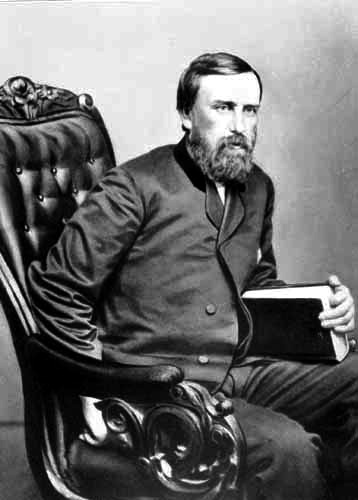
Charles Clinton Nourse From an air brush copy of an old photograph loaned by D. W. Nourse, Kenton, Ohio
When I assumed the duties of judge of the district I found the dockets much crowded with cases that had been delayed, chiefly because of the unnecessary consumption of time by attorneys in the trial of their causes. For instance, one case in Polk county that involved only the question of the identity of a calf worth three or four dollars had occupied two weeks of the time of the court in its former trial. When I called the case for trial a number of attorneys suggested to me that the case would probably consume the balance of the term, and they might as well dismiss their witnesses and continue their causes. I told them that they were probably mistaken as to the time that would be occupied in the trial of that case. The first witness in behalf of the plaintiff was a timid young girl about fourteen years of age, a daughter of the plaintiff. She told in a simple straightforward way what she knew about the marks on the calf that her father had claimed, and her belief that it was her father's calf. The attorney for the defendant unfortunately was somewhat under the influence of liquor, and putting both heels up on the trial table, he leaned back and in a very rude, aggressive manner addressed the young girl, saying, "I suppose you put in about all of your time examining the calves on your father's farm, don't you?" I immediately reproved the attorney and asked him if he had any questions to ask the witness in regard to the marks upon the calf or its identity. He replied in a haughty manner that he supposed he could examine the witness in his own way and ask his own questions. I immediately told the witness to stand aside and asked the plaintiff to call the next witness. The attorney then said he had not cross-examined the witness and wished to do so. I merely remarked that I had given him an opportunity to do so and he had not improved it, and he could save his strength for the next witness. The result of this kind of discipline was that the case was tried within two days instead of two weeks, and the great calf case was disposed of. I only give this as a specimen of the reforms that I tried to introduce into our courts.
In the most of the counties of our district, which embraced seven at that time, we had no court houses. My first court in Warren county had to be held in the old Methodist church. It had been the custom to fill the aisles and the space about the altar with saw-dust, with one table as the trial table for the attorneys, and four or five rickety chairs. This saw-dust when it became heated, as it did in the winter time from the large stoves used in heating the room, filled the air with very fine particles of dust that often settled upon the lungs of the members of the bar and the court, and was itself injurious to health. After impaneling the grand jury on the first day of the term at Indianola I announced that the court would adjourn until Tuesday and that the sheriff would clean the room of this sawdust and furnish matting for the aisles and the place about the platform, and also furnish an additional table for the use of the attorneys and a dozen good substantial chairs. The sheriff informed me in open court that the board of supervisors had refused to furnish such conveniences, and probably would not allow the bills if he should purchase these articles. I advised him that it was his duty to obey the orders of the court, and to present his bill to the supervisors and if they failed to allow the bill to take his appeal to the district court and I would see that he recovered judgment and got his pay. Sufficient to say that the next morning the matting was laid, the table and chairs were furnished in good order, and I never heard of any difficulty about the allowance of the bills by the board of supervisors. I pursued the same policy in Madison and several other counties of the district, and never heard that I lost favor with anybody because I insisted on having a decent court.
On the 3d of March, 1866, at a subsequent term of the court held in Warren county, Mr. Thomas F. Withrow, an attorney of the Polk county bar and my neighbor, came into court one morning just before noon in company with John A. Kasson, then a representative in congress from this district and a resident of the city of Des Moines. Mr. Withrow filed with the clerk of the court a petition for divorce in behalf of Mr. Kasson's wife, and asking for a divorce on the grounds that Mr. Kasson had been guilty of adultery. To this petition Mr. Kasson filed an answer admitting his guilt, and both parties asked for an immediate hearing of the cause. I dismissed the jury then impaneled and announced that the court would not adjourn but remain open for business, asking the clerk and sheriff to remain, and that the bystanders and others were at liberty to retire. I read over the papers carefully and told Mr. Withrow that I could not grant the petition upon the answer; that if he had any evidence it must be produced in open court as I must be satisfied of the existence of the facts alleged in the petition. Mr. Withrow said he had the letters of the defendant written to his wife from time to time, fully acknowledging his guilt, and he would return to the hotel and get his satchel containing these letters and produce them in open court if I required it. Mr. Kasson then begged of Mr. Withrow not to produce those letters, and turning to me said he would himself be a witness as to the facts and thought that ought to be sufficient. I told him I could not grant a divorce that would have the appearance of being granted merely upon the consent of the parties, that I wished to be satisfied fully that there was no collusion in the matter between himself and wife, and that he was in fact guilty as charged. He assured me that there was no collusion, that the charge was actually true and that the facts actually existed as charged against him. At this he broke down and professed almost to cry, and I told Mr. Withrow to prepare the decree of divorce. It was accordingly prepared, reciting that it was granted upon evidence of the truth of the allegations of the petition, and I accordingly signed the decree.
Upon my return to Des Moines at the close of the session, the legislature then being in session, I was waited upon by one or more members of the general assembly, suggesting that there was a rumor that the divorce of Mr. Kasson's wife had been procured and granted simply by consent of parties, and they proposed to introduce a bill for an act to prevent such divorces in the future. I explained that the rumor was entirely unfounded and that the divorce had been granted upon satisfactory evidence offered in open court. I recite these facts at some detail because of their importance with reference to results, and what occurred that fall, 1866.
Mr. Kasson was a candidate for re-nomination to congress. The opposing candidate was General G. M. Dodge, then a resident of Council Bluffs. I did not take any active part in this contest further than to express my preference for General Dodge, and that I could not consistently, with my views of propriety, support Mr. Kasson under the circumstances. When the conventions were held that fall for nominating delegates to the convention that should nominate congressmen, district judge, and prosecuting attorney, the Polk county convention, being under the control of Kasson's friends, nominated the same set of delegates to attend both the congressional and the district conventions. After very heated contests in the convention for nomination of congressmen, Mr. Kasson was defeated, and I was informed by the delegation that they would not support me for the nomination for district judge because I had refused to help them in the matter of nominating Mr. Kasson. The next day when the convention met for the nomination of judge and district attorney I went before the convention in person and withdrew my name from the convention, stating as a reason therefor that I could not with propriety be a candidate before that convention without the support of the delegates from my own county. The convention nominated Mr. Maxwell, then district attorney, for judge. My office did not expire until the ensuing January, but I at once sent my resignation to the Governor of the state, thus terminating my judicial career on August 1, 1866.
In this contest for congress, Mr. H. M. Hoxie and Mr. Thomas F. Withrow, formerly warm friends and supporters of Mr. Kasson, had abandoned him and were active supporters of General Dodge.
Upon my retirement from the bench, the members of the Polk county bar had a meeting and adopted very complimentary resolutions which they had enrolled and were kind enough to present to me as a testimonial of their approval of the manner in which I had discharged my duties as judge of the court.
The salary of judge of the district court at that time was the meager sum of thirteen hundred dollars a year, out of which I paid my own expenses on the district. During my term of office as Attorney General I had spent a considerable part of my income in attending public meetings and traveling through the state, addressing public assemblies upon the issues growing out of the war. I had not accumulated sufficient means to pay for my homestead and I now determined, as far as practicable, to devote myself to my practice as an attorney and accumulate something for the future.
During the administration of Governor William M. Stone, his private secretary had endorsed a number of warrants issued by the Treasurer of the United States in favor of the state of Iowa, known as "swamp land warrants." Governor Stone had entrusted the detail of the business of his office to his private secretary. These warrants came into the hands of the secretary and he assumed the responsibility of endorsing the Governor's name upon them from time to time, and having them cashed at the Second National Bank. At first he paid this money over to the State Treasurer, but as no inquiry was made as to the transactions and Governor Stone was paying but little attention to the details of business in the office, he cashed a number of these warrants and appropriated the money to his own use and purchased considerable real estate in his own name.
On the first of January following, these transactions became public and the Governor repudiated the authority of the secretary to make the endorsements upon the drafts. He procured from the secretary mortgages upon considerable of the property purchased by him to secure so much of the proceeds of these drafts as remained unaccounted for. The grand jury indicted the secretary for a number of these transactions for forging the Governor's signature. This secretary applied to me through Mr. Withrow, about the time of my resignation as judge, to employ me as counsel to assist in his defense. The secretary had no money or means to pay me for my services and as he already had able and efficient counsel, I declined the employment.
About the same time suits were brought to foreclose these mortgages given by the secretary, and also to hold the bank responsible for the moneys that had not come into the hands of the State Treasurer. Pending these suits of a civil character, by agreement of the parties and their counsel, the case was referred to me as referee. During the summer I occupied several weeks in taking the testimony carefully before a stenographer and reported the same with my conclusions of fact and law to the district court, which report was confirmed by the district court and upon appeal to the supreme court by the secretary, that court also affirmed my decision, and under these judgments the property was sold and the state partly remunerated for the loss.
Governor Stone also solicited me to act as special prosecutor in prosecuting the indictments against the secretary for forgery, but in consideration of the fact that the secretary had failed to obtain my services in his defense because of his poverty, I declined to take any retainer or part in the prosecutions.
I only recite these matters here because the secretary for his own purposes saw proper to make a number of virulent attacks upon me in various scurrilous articles that he published. As he was a man of no reputation and soon after left the state and died in obscurity and poverty, it is not necessary here to notice them.
The indictments against the secretary were never tried, I think, for the reason that the trial would necessarily have exposed the fact of the Governor's carelessness and inattention to the detail of his official duties. The Governor was otherwise not to blame for these unfortunate results and was himself free from any taint of dishonesty or corruption.
Notwithstanding my determination to retire from politics and devote myself entirely to the practice of law, the republican state convention, in the fall of 1867, without any procurement or solicitation upon my part, selected me as chairman of the state central committee. I conducted the canvass that resulted in the election of Colonel Samuel Merrill. The entire cost of this canvass, including the employment of a secretary to the committee, was only the sum of $800, one-fourth of which the candidate for Governor contributed. I make note of this, for the reason that in later years, and at the time of the present writing, these central committees of the states and of the nation, are expending thousands and hundreds of thousands of dollars upon the election of the candidate of their party.
I also at the time I was chairman of the state central committee, furnished a team to Messrs. Thomas F. Withrow and F. W. Palmer, the latter then editor of the Register, to make a political canvass through the western half of the state. The very next year, 1868, Mr. Palmer became a candidate for congress in this district, Mr. Kasson being again a candidate for a seat in congress and again defeated in the nomination. I attended the congressional convention which was held at Council Bluffs that year, and was well satisfied with the result.
In the summer of 1869 Judge George G. Wright, before that time one of the judges of the supreme court of the state of Iowa, and who had removed from Keosauqua and become a permanent citizen of Des Moines, called upon me to confer with me upon the subject of his election to the United States Senate. He was fearful that Mr. John A. Kasson, who had been a member of the house of representatives of the state the last previous session, would be a candidate for the state senate. He expressed himself as having no confidence whatever in Mr. Kasson's friendship toward him, and he desired me to be a candidate and seek the nomination for the position of state senator. I peremptorily declined, for the reason that I did not want to engage in any political fight or difference with Mr. Kasson, and I could not afford at that time to leave my practice for a place in the state senate. Judge Wright insisted that he must have a friend in the senate from Polk county upon whom he could rely, and urged me to name some one who could be nominated and elected. After canvassing the names of several gentlemen, I suggested the name of B. F. Allen, then the leading banker in western Iowa, giving as my reason for urging Mr. Allen's name that the friends of Mr. Kasson would not present Mr. Kasson's name in opposition to Mr. Allen at that time, and the further reason that the people of Des Moines would at the then coming session of the general assembly ask for an appropriation to commence the building of a permanent capitol, and that Mr. Allen by virtue of his influence through the western part of the state especially could probably do more than any other man to secure such an appropriation. Judge Wright replied that the name of Mr. Allen had been suggested, but that he was satisfied that that gentleman would not accept of the nomination because his business required his undivided attention. I suggested to Judge Wright that I thought I was better acquainted with Mr. Allen than himself, and that if a number of our friends would call upon Mr. Allen, one at a time, suggesting and urging him to be a candidate for the senate, in less than ten days he would not only be willing but anxious to receive the nomination. We accordingly pursued that course, and my prediction was verified. Mr. Allen became a candidate and received the nomination, but this did not prevent Mr. Kasson from again being a candidate for the nomination to the lower house.
At the ensuing session of the legislature the desired appropriation for a permanent capitol at Des Moines was secured and Judge Wright was elected to the United States Senate, defeating William B. Allison who was then, for the first time, a candidate for that position.
Mr. Kasson worked diligently to secure the appropriation for the capitol, as did also Mr. Allen in the senate and George W. Jones, Mr. Kasson's colleague, in the house.
The citizens of Des Moines were very deeply interested in this appropriation for the permanent capitol, and every one, including the ladies, brought to bear all proper influence upon the members to secure their votes for it. The great event of the winter socially was a grand party given by Mr. Allen in the splendid mansion which he had just finished, situated on Terrace Hill, now the property of Mr. F. M. Hubbell. The ladies of the town also gave an old fashioned concert at Moore's Hall, and an amateur theatrical performance at its close, of which I had the honor to be the author. The play was a farce illustrating the absurd features of a general assembly of the state of Iowa whose members were one-half ladies and the other half gentlemen. The play represented a session of the general assembly of the state of Iowa in the year 1900. The old capitol building, then occupied by the legislature, was supposed to have fallen down and to have killed a number of the members of the sitting general assembly, and one of the bills discussed by the mock legislature was a proposed appropriation for the benefit of the surviving families of the members who had lost their lives in the destruction of the old capitol. The great discussion arose upon a motion to strike out the sum of sixty-two and one-half cents, and many of the speeches that had been made against the appropriation for the new capitol upon the question of economy were largely quoted from, by those opposed to the sixty-two and one-half cents.
Another point made in the play was that upon the question of woman's rights. Dubuque county was supposed to be represented by a lady weighing over two hundred pounds, and her husband, a dwarf, then residing in the city, who weighed about seventy pounds. Whenever a vote was taken upon any question respecting the rights of their sex the legislature divided, the men voting on the one side and the women always on the other. The lady who was supposed to be the wife of the dwarf, whenever a rising vote was taken upon a question of this nature, seized her supposed husband by the coat collar and tried to compel him to stand up and be counted on the side with the ladies. The frantic efforts of the little fellow to desist and to vote with those of his own sex created uproarious applause and amusement for the audience, as did also the following part of the play:
The lady supposed to be the wife of the dwarf arose and addressed the speaker upon a question of privilege. She said she had just received a telegram from home, stating that her youngest child was taken suddenly ill, and she requested the house to grant leave of absence for her husband, as it was very desirable that he should return home and care for the sick child. Another member of the house, a gentleman, arose and inquired whether the sick child was a boy or a girl. The lady responded with some acrimony that all her children were girls of whom she boasted she had seven, and was proud of it.
The ladies of the city entered into this play with much spirit and performed their parts so admirably that it furnished a very rich entertainment for the winter.
The bill making the appropriation for the erection of the permanent capitol finally became a law, and Mr. Kasson attempted to monopolize for himself all the glory of the achievement. He had a brass band serenade him at his house, and John P. Irish of Iowa City make a congratulatory speech to him as the hero that had accomplished so much for the city of Des Moines.
In the year 1874 Mr. Kasson was again nominated as the republican candidate for congress and was successful in the election. In this contest he was opposed by the then editors of the Register, a newspaper at that time published by the Clarkson brothers.
In the early part of September, 1874, Mr. J. C. Savery, a citizen of Des Moines at that time, and for several years a client of mine, called upon me and showed me several letters in manuscript, relating to Mr. Kasson's conduct while a member of the legislature of Iowa, and while a member of congress, and stated that he proposed to publish those letters as he was opposed to Mr. Kasson's election. He asked my advice as his attorney as to whether or not there was anything in the letters that would make him liable to a civil suit for damages in case of their publication. I advised him that if the letters were published and any suit was brought against him it would be necessary to show either the absolute truth of them or that they were published from proper motives and that he had a good reason to believe that the statements were true. As Mr. Savery had been my friend and client, and had not been at all prominent in political life, I advised him as a friend not to mix up in the contest and not to publish the letters, as he was a private citizen having no special interest in the question as to who would or would not be elected to congress. He, however, determined that the letters should be published and he gave them to the Register for publication. These letters were a very severe arraignment of Mr. Kasson's political career, and he thought proper to commence suit in the district court of Polk county against Mr. Savery and the editors of the Register for libel. Such a suit was brought October 21, 1874. Mr. Savery requested me to meet Mr. Clarkson for the purpose of consultation and with a view to my employment, in connection with Colonel Gatch, to defend the suit. I stated to them that the trial of the cause would involve a good deal of labor and time, that in the then state of political excitement, it would be very difficult to obtain a favorable result as the partisans of Mr. Kasson, if they secured a place upon the jury, would hardly give much weight to the testimony that might be produced. I signified, however, that I was willing to take the employment, provided I was paid liberally for my professional services. To this Mr. Richard Clarkson demurred very strongly, insisting that as Mr. Kasson was at least a political opponent and enemy of mine I ought to be willing to defend their case for an opportunity to ventilate the character of the plaintiff in the suit. I stated to Mr. Clarkson that if I engaged in that suit it would be for the purpose of performing my duty as an attorney and officer of the court, and that I should under no circumstances allow any personal matters of my own to influence what I might have to do or say in regard to the case; that the court room was not the place for a lawyer to gratify his personal feelings toward any of the parties to the litigation. This conference terminated without any agreement as to my employment. Afterwards, Mr. Savery came to me to see me alone and stated that Colonel Gatch had named a very small sum that he was willing to accept as compensation for assisting in the trial of the case. Mr. Savery urged upon me that he was then in poor circumstances financially and not able to pay any large fee; that he had been my client and paid me considerable sums of money in times past and urged upon me that I ought to stand by him now in the time of his trouble; that if I would accept of a like amount that Colonel Gatch had agreed to take for his services, he, Mr. Savery would pay half, and the Clarksons would pay the other half. I finally agreed to these terms. I tried the case. It consumed very considerable time in its preparation and trial. I copy here for information as to the character and scope of this case the opening statement that I made to the jury in regard to the issues involved, and the evidence that the defendants would offer in support of their defense. I always regarded the opening statement of a case as very important and that it should give to the jury a clear idea of the case they were to try, and of the facts upon which my client relied. I always believed strongly in the importance of first impressions, and I give this as a specimen of my skill in that behalf and for the further purpose of showing that it is utterly free from personal feeling or ill will toward the plaintiff. The following is the opening statement as made and reported and published at that time:
With permission of the Court, Gentlemen: In a case like this, it is hard for jurors to divest themselves entirely of their relations, politically and socially, to parties, and come to the consideration of it as a dry question of fact under the instruction of the court.
The petition that has been read to you selects from certain articles that were published during the political canvass last fall, three certain items of charges made against Mr. Kasson that it is supposed by Mr. Kasson and his friends cannot be proved. Why those three particular charges out of quite a number should have been selected and the others passed by, I do not know. Probably any one of the other charges damaged him as much as any one of these. But for some reason best known to the plaintiff, he has been willing to stand all the injury and all the damage they did; because he didn't care about having them investigated in court. (He has a right to pick out and say this one is not true, and the other is not true, I put you on the proof of this.) These three particular charges are set out, and they claim so much damages for saying these particular things about this particular individual. The answer I will read to you and then try to give you some idea of the evidence that will be introduced on the part of the defendants. [Here Mr. Nourse read the answer relating to the first charge, and continued.]
The facts are, these articles were written by Mr. Savery, and published in the Register, which was conducted and published by the defendants, Mr. R. P. Clarkson and Mr. J. S. Clarkson.
[Reads from petition again, beginning with the words: "Now, sir, this was the way you played your hand."]
Mr. Nourse continued: That is the answer we make to the first charge, relating to what is called the Smoky Hill route. I will say, in order that you may understand the evidence, and the facts in reference to that business, that Mr. Kasson was our member of congress in 1866, as will appear by the testimony, living and residing in this town, having for his colleagues Messrs. Price, Wilson, Allison, Judge Hubbard, and Mr. Grinnell. At that time one of the most vital questions to the people of Iowa, especially to the people of this congressional district, was whether or not the roads running east and west through Iowa should connect with, and become a part of the great Pacific route, extending from the Atlantic to the Pacific ocean. Prior to 1866 congress had passed a law to aid the construction of the Pacific Railway. That law provided for several Iowa branches, and provided for a branch connecting with the St. Louis roads through Kansas, and provided that all these branches should unite at what is known as the one hundredth meridian, some distance west of Omaha. And a further provision in that bill was that the Union Pacific Railroad Company should build from the one hundredth meridian westward, meeting the road that should be built from California eastward. That was the Union Pacific Railroad proper. It will appear in evidence, gentlemen, that Mr. Kasson, up to the very moment, the very day and hour on which he gave this vote in congress, had publicly and privately expressed himself in favor of the Omaha route, and delivered a public lecture against the Smoky Hill route, and explaining to the people of this locality the great advantages they were to derive from being upon the main line of this great thoroughfare. It will further appear in evidence, gentlemen, that the Kansas company, with the Pennsylvania Central road—in combination with the St. Louis interests—devised a scheme, in the winter of 1866, whereby they proposed to make the Kansas road, connecting with St. Louis, the main branch of the Pacific road, and thus entirely defeat the building of the roads westward to the hundredth meridian, connecting with the Iowa roads. That was the scheme that was undertaken, and a bill having that object was rushed through the senate and came to the house of representatives, when Thaddeus Stevens took charge of it. The friends of the bill made a strong combination, refused to let it be referred to a committee, and refused even to allow it to be printed for the information of the house, and put it upon its passage under the spur and whip, crushed out debate, and crushed out explanation and discussion. Mr. Kasson was the only member of the house of representatives from Iowa that was permitted by Thaddeus Stevens, who had the floor, to occupy the time of the house, and to the surprise of everyone Mr. Kasson was found to have gone over to the enemy. We have the depositions of Hiram Price and James F. Wilson, and the Congressional Globe that will explain to you his false position. Mark the explanation Mr. Kasson attempted to make on the floor of congress. He based his defense simply on the claim that the Kansas branch road would make a rival road and afford competition.
This, gentlemen, will appear in evidence when we come to investigate this matter. It does not answer the proposition and but for the fact that the money was speedily raised and the road built from Omaha to reach the hundredth meridian, before the Kansas branch got their road built there, we would have lost everything; we would have lost all that congress had granted to us, to build the road up the Platte Valley. This has been carefully concealed by Mr. Kasson in all his explanations and in all his discussions and he has, with his oily, deceptive subterfuges, tried to hide this enormity of his past life from his constituents. We hope, gentlemen, aided by the evidence of these members of congress, intelligent men, honest men, who have stood by the people of Iowa—we hope, with their depositions and the circumstances, and the evidence contained in the Congressional Globe, to show this matter up to you. We will prove to you by men who were on the ground that no sufficient motive could honestly have induced that man to have cast his vote in the way he did; that it was a surprise upon every intelligent man that knew what his pledges and promises and professions had been up to that time. Now, when this man offered himself as a candidate for congress last fall a year ago, one of the defendants in this case, who never was a candidate for office in his life, who had no interest in politics whatever, except as a citizen interested in our material interests, in our city, in our state, took the responsibility upon himself to ask Mr. Kasson through the public press to explain this, his extraordinary conduct and his treachery to his constituents; he got no answer except the insufficient one, the deceptive one, that Mr. Kasson wanted a rival railroad. Again, gentlemen, it will further appear in evidence that this was an additional subsidy of lands, that instead of connecting with the main line at the one hundredth meridian, this Kansas company was authorized to change its route and build the road to Denver, from Denver up to Cheyenne, and receive all the lands on either side of whatever route they may fix upon, and not requiring them to unite with the main line until they got fifty miles west of Denver. That they received on the line from Denver to Cheyenne the heart of the Territory of Colorado. That was a subsidy, and that the road got that subsidy, and that the parties who passed the bill undertook to deceive the members of congress in regard to it.
Now, gentlemen, this is all there is on this first matter. This publication was made, public attention was called to the fact that one of our members of congress, when asked how he would explain Mr. Kasson's vote, said he didn't know; but he could have taken twenty-five thousand dollars for his vote. That statement was made public by Mr. Savery in this communication to the citizens of this congressional district. Now this is the first matter which Mr. Kasson has chosen to bring before you, and to make an issue, and claim for damages to his character. Now we cannot prove—Mr. Kasson knows—we have no facilities for proving who was around there, or what money they had, or the means by which that bill was passed by congress. We can show you, gentlemen, only this one thing, that as a citizen of Iowa and as a representative of Iowa he betrayed his constituents wantonly; that he was in a scheme in which there was money; that is all; that this communication was made to the public, stating the bare facts at a time when it was necessary for the public to know them and by a man who had no interest in maligning Mr. Kasson, or injuring him. Savery had no personal feeling, and had no personal animosity towards him, but he felt, as a citizen, some indignation towards the man for the course he had pursued in congress. So much, gentlemen, for the first charge that was made. You are to judge whether that communication at the time it was made, and under the circumstances it was made, was justifiable. You are to take all the facts, and all the testimony with regard to it. Now as to the second matter that is set out in the answer.
Mr. Barcroft: Will you just tell the jury whether the bill that Mr. Kasson voted for under the Iowa Railroad were not built on the continuous line?
Mr. Nourse: I have already stated, that but for the extraordinary efforts by which money was raised, and the road pushed to the hundredth meridian first and this scheme defeated, we would never have been on the main line. But no thanks to Mr. Kasson for it. We are on the main line because these men went to work with superhuman energy to get to the hundredth meridian first, and they got there first, and that is the reason we are on the main line. If we had not reached it before they did, we would not have had a dollar of money with which to have built our line, and the other would have been the main line. That is the fact as it will appear conclusively from the testimony in this case. Gentlemen, I invite your special attention to the second charge, for if I can succeed in getting the jury to understand this question it is the end of the plaintiff's case. Fortunately for us on this question we have pretty conclusive proof, and with all the gentleman's ingenuity and that of his counsel, he will not be able to escape. We will show you, gentlemen, that in the year 1868 the old Des Moines Valley Railroad Company had forfeited her rights to the grant of lands that had been granted to her in the year 1858, by reason of not building the road as the original act required. The people of Boone county were dissatisfied because the Des Moines Valley Railroad Company had surveyed their road west up by Grand Junction, instead of going up the Des Moines river. Mr. Orr introduced a bill called the resumption bill, No. 139, in the house of representatives. That bill was read the first and second times, was ordered to be printed, and was referred to the railroad committee, of which Mr. Kasson was a member. The railroad committee prepared a substitute for that bill, as is set out here, in which they provided for a release of the company from all forfeitures and still allow them to have the lands and to build their road upon certain terms and conditions, and reported that bill back to the house of representatives as a substitute for house file No. 139. That substitute, gentlemen, is in Mr. Kasson's own handwriting, and we will be able to produce it here and show you the bill as he reported it originally to the house of representatives.
The records will show you, gentlemen, that after that bill came in, after this substitute was reported, Wilson of Tama county, with another gentleman constituting a minority of the committee on railroads, made a minority report in which they recommended what was called the "Doud amendment," or the Granger clause of that bill, in which they provided as set out in the answer: "that the company accepting the provisions of this act was at all times to be subject to legislative control." I will give you the very language of the amendment as it now appears in the law, so you may get the idea fully. [Reads.] "The company accepting the provisions of this act shall at all times be subject to such rules, regulations and rates of tariff for transportation of freight and passengers as may from time to time be enacted by the General Assembly of the State of Iowa." The minority of the committee recommended that amendment, and it was adopted; and it was the only amendment that ever was adopted by the legislature.
We will prove to you, gentlemen, that a forgery was committed, and the following words interpolated into that bill: "But the non-acceptance by the Des Moines Valley Railroad Company of this act shall not prevent all the foregoing provisions thereof from having the same operation and effect as if the same had been accepted by said company;" and we will prove to you that these words were agreed upon between Mr. Kasson and the railroad company's attorney, in a private room in the Savery House, and that he agreed to put them in the bill, and the attorney testifies that the provision escaped criticism. And this is the second charge: We charge him with so manipulating that bill as purposely to defeat the will of the legislature. That he did it fraudulently, and that he did it corruptly will be proved to you beyond a doubt; that this charge was made, honestly believing it to be true, in order that the people of this congressional district might know the character of the man that was asking for their suffrages. After he voted against Wilson's amendment, and failed to honestly defeat it, we are prepared to show that by an agreement between him and the general attorney of the road, he undertook to get this nullifying clause into the bill, and that he did get it in the bill, and that he did not get it there by the vote of the house.
Mr. Barcroft: You do claim that you have any such allegation in your answer?
Mr. Nourse: I claim that what we charge Kasson with was that he manipulated that proviso through the legislature, and we propose to prove it. We propose to prove that it came from him and originated with him. We may have other evidence on this point more full and complete that it is not necessary now to take the time to detail.
The third specification, gentlemen, relates to the vote of Mr. Kasson and his conduct with reference to the C., R.I. & P.R.R. Co. And here, fortunately, I can say to you that we are not without direct and satisfactory testimony. We thought that we could prove that he had taken money on both sides from both parties in the case, but we haven't succeeded fully. We have evidence, however, of this state of facts: That Mr. Kasson in the early part of that session voted for a bill that had for its purpose and object the helping of Tracy, who was then the president of the road, to retain his power and his place as president, and to complete the road from here to Council Bluffs; that a bill for that purpose was passed in the early part of the session and approved on the 11th of February, and that Mr. Kasson voted for it. Thus far all was right. It will further appear by the evidence that the legislature had a recess of a few weeks after that, and that Kasson disappeared from here and turned up in Wall street, New York; that he was found in conference with the men connected with the Northwestern Railroad and who had bought up the stock of the Rock Island road, with a view of obtaining control of it, who were anxious to secure the repeal of the Tracy bill. We will prove to you that Kasson promised these men his influence to have that bill repealed; that he came back to Des Moines and was in conference with them, promising them his aid, that he subsequently changed his mind and abandoned them, that they didn't succeed; and that Mr. Tracy out of sheer gratitude, as Kasson claims, offered him five hundred dollars in money; that he (Kasson) took the money, but stipulated that it should be called a retainer.
In his own deposition Kasson swears he got the money. But he says he didn't get the money until after the legislature adjourned, and when it was offered to him as a present, he said he couldn't accept of it unless it was offered to him as a retainer; and that Mr. B. F. Allen, who offered him the money, went away and came back again, and said that he could take it as a retainer; and that he supposed that Allen had seen Mr. Tracy. This is the way Kasson gets out of this. We will prove to you by Mr. Tracy that he never had retained Mr. Kasson, or authorized anybody else to retain him for the company; that he never requested Kasson to perform any professional services for that road; that he never performed any professional services for the road, and that he had been out of the practice of the law for years. It will further appear in evidence that Mr. Kasson has not practiced law since 1860; that this attempt to make it a retainer is simply a subterfuge to cover up the taking of pay for his services in the legislature, to a railroad corporation. Now, this all came to the knowledge of these defendants, and they proposed, in good faith, to publish to the community the facts in regard to Mr. Kasson's conduct. It is said by plaintiff's attorney that they will show to you that the Clarksons were the personal enemies of Mr. Kasson. I will say to you, gentlemen, that it is not true, and that I don't believe they will prove it; I don't believe in this community they can prove a thing that is not true. On the contrary, the Clarksons never had any personal or political difficulty with Mr. Kasson whatever. Every motive on earth that could induce men to act through favoritism was upon the other side of the question.
Mr. Kasson had no desire to face his accusers, or subject himself to an examination before the jury. He was not present at the beginning of the trial and had taken the precaution to have his own deposition taken in New York upon interrogatories doubtless prepared carefully by himself, as the interrogatories disclosed nothing as to the explanation he had invented for the purpose of rebutting the testimony against him. This would avoid any cross-examination.
After the defendant's testimony had been introduced in part, however, the evidence seemed to make quite an impression against the plaintiff's cause and his counsel in desperation telegraphed to him requiring him to come at once to Des Moines. After a few days, he put in his appearance and I immediately had a subpoena issued and served upon him, requiring his attendance as a witness. After we closed our evidence, Mr. Kasson disappeared between two days and we searched for him in vain in the state. His counsel, Mr. Barcroft, offered his deposition taken in New York, then as rebutting testimony, when the following colloquy occurred, which I here quote from the notes of the official reporter:
Judge Nourse, for the defense, asked to have Mr. Kasson brought into court, stating that a subpoena had been issued for him, and as he was not present, asking an attachment for him. Mr. Barcroft replied: "Whether he will be here or not, I don't know. I think he is out of the state. I don't know that he will be here, and I don't know that he will not, but think the probabilities are that he will not. We don't claim the right to read his deposition if he is present. He is not present, and is not in the state. I don't expect him to be here."
The deposition was then read.
As already anticipated, the jury could not agree upon a verdict. Six of Mr. Kasson's political friends upon the jury insisted on finding in his favor, and six who were not his political supporters and friends, some being democrats and some republicans, insisted on not finding a verdict in his favor. The case went over the term and was afterwards compromised upon what terms I never understood, except that the plaintiff dismissed his suit and probably paid the costs, and Mr. Savery advised me that as part of the terms upon which the suit was to be dismissed, Mr. Kasson was to make a political speech at Moore's Opera House and Colonel Gatch and the Clarksons were to occupy the platform as indicative of their friendly appreciation of that gentleman, and I also with Mr. Savery was entitled to a like honor. Mr. Savery did not appear upon the platform and I utterly refused to recognize the right of anyone to contract for my appearance there, and I was conspicuously absent.
Mr. Savery paid me his half of the fee that I was to receive for my services, and upon presenting my bill for the other half to Mr. Richard Clarkson, I found he had charged me up for printing the speech I had made to the jury, having at my request printed the revised copy of the speech in pamphlet form, and thus he squared the account, never paying me one cent for my services in the case.
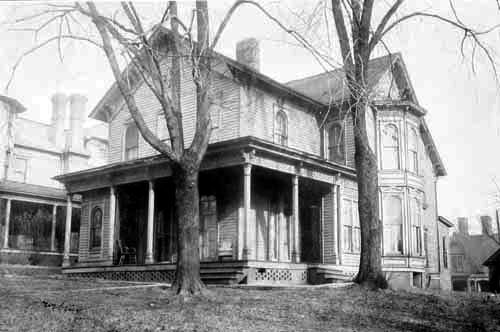
707 Fourth Street, Des Moines, For twenty-seven years the home of Charles Clinton Nourse
CHAPTER V
Some Important Law Suits
It is not within the scope or purpose of this writing to enter into or discuss the merits of the various suits in which I was employed. I cannot, however, give any idea of the fifty years of my life during which I was engaged in a number of important suits, without reference to their nature and character, and the management to which I attributed important results.
In the latter part of the year 1864, whilst in attendance at the supreme court at Davenport, I was retained by the Chicago & Northwestern Railroad Company, in company with Mr. Thomas F. Withrow, to assist the general counsel of that corporation in a suit, then recently brought in the United States circuit court for the southern district of Iowa, enjoining the company and its agents and employees from putting a certain span of their bridge across the Mississippi river at the town of Clinton, Iowa. Mr. James Grant of Davenport and a Mr. Lincoln of Cincinnati had been employed by the river interests to prevent the completion of this bridge on the ground that it would prove an obstruction to the navigation of the river. Mr. Withrow and myself spent a day in examining the alleged obstruction to navigation, the company furnishing us a steamboat in which we passed through the piers on which the drawbridge was to be placed. We returned to Des Moines late Saturday evening. The United States circuit court at Des Moines met the following Monday. On Sunday Mr. Withrow went to his office and carefully examined the statutes of the United States relating to the powers of the court in granting injunctions. He sent for me in the afternoon. On examination we ascertained that the statute of the United States contained a peculiar provision, not known to the practice in our state courts. It provided that when an injunction was granted in vacation by the judge of the district court of the United States, it should remain in force only until the close of the ensuing term of the circuit court; that if the injunction was granted by one of the judges of the supreme court or a judge of the circuit court of the United States, it should remain in force until it was dissolved by the order of the court. We immediately opened telegraphic communication with General Howe, who was then attorney of the Chicago & Northwestern Railroad Company, and had in charge the defense of the case. He and Judge Grant, it seems, had been engaged in taking depositions and procuring evidence with reference to the question of obstruction of the navigation by the existence of these piers in the river, and both General Howe and Mr. Grant appeared to be acting upon the hypothesis that it was necessary for the defense to make a motion and showing for the dissolution of the injunction. We called the attention of General Howe to the provisions of the United States statute, and as we were well acquainted with the peculiarities of Judge Grant we advised that if we did nothing upon the part of defense at the ensuing term of court, it was probable that Grant would take no action in the matter and the injunction would stand dissolved at the close of the term by operation of law. On examination of the question General Howe agreed with our conclusions, and we then arranged that he take the train on Monday morning and come as far as Ames, Iowa, bringing with him all evidence, depositions, and papers that we might need in case there was to be any hearing before the court; that General Howe should occupy a boxcar at Ames and not subject himself to personal observation, whilst we would take charge of the interests of our client at Des Moines and do nothing save to let the law take its course, and we would advise General Howe by telegram if Judge Grant woke up and attempted to obtain any order of court continuing the injunction. Judge Grant was in attendance upon the court, and several times inquired after General Howe, stating that he was expecting him daily. Day after day of the term passed and nothing was done. Finally, the business of the term being disposed of, Justice Miller, then justice of the supreme court of the United States and presiding, announced that if there was no further business before the court the term would be adjourned. Judge Grant addressed the court and stated that he had been waiting during the entire term expecting the appearance of General Howe; that he understood that Messrs. Nourse and Withrow had been employed in behalf of the defendants, but no motion had been filed with reference to the injunction in the case against the bridge company or railroad company, and he wished to know whether or not we intended to do anything. Mr. Withrow looked at me and placed upon me the responsibility of replying to judge Grant's remarks. I said that it was true that Mr. Withrow and myself had been employed in the case, but only as local counsel and the only authority we had was to act under the instructions of the general counsel of the railroad company, General Howe; that we had no authority or direction to file any motion in the case, and I added very meekly that if any harm should come to our clients by reason of any neglect in the matter the responsibility would rest entirely with General Howe and not with my Brother Withrow and myself. Upon this Judge Grant announced that he had to go to Washington City upon professional business immediately upon adjournment of the court, and he would not consent that any motion would be heard in regard to the injunction matter in vacation. This closed the event and the court adjourned sine die. As Judge Miller passed out of the court house down the stairs, Judge Grant having previously left the room, Mr. Withrow could hardly contain himself and burst into uproarious laughter and attracted the attention of Judge Miller, who looked over his shoulder and remarked good-naturedly that he supposed Judge Grant did not understand us. As previously arranged, the mechanics engaged in the bridge construction had carefully prepared their timber and every bolt necessary for the span that should make up the drawbridge between these two piers. Judge Grant went his way to Washington, and upon his return to Iowa three weeks afterwards he found the cars in operation crossing the bridge. He immediately went to Judge Love, and making the necessary affidavits for contempt of court, obtained warrants for the arrest of the parties engaged in constructing the bridge. Without disclosing what our knowledge and view of the law was upon the subject, the parties at once gave bond and security for their appearance at the next term of court to answer the charge of contempt. When the next term of court convened, Justice Miller and Judge Love presiding, I made the necessary motion to discharge the defendants upon the ground that the injunction had been dissolved by operation of law immediately upon the adjournment of the prior term of court, and there being no injunction in force, the completion of the bridge did not constitute any contempt of court. The motion was sustained and the defendants discharged.
Judge Howe and Judge Blodgett of Chicago were so delighted with the result, that they telegraphed to Chicago for a case of wines and inviting Judge Grant and Mr. Lincoln of Cincinnati, who represented the plaintiffs in the case, into our room, we spent a very merry evening together and all seemed to enjoy the evening save Judge Grant who could hardly forgive himself for his over-confidence which had resulted fatally to his clients.
During the evening many excellent anecdotes were indulged in: among others was one by Judge Blodgett for the benefit of plaintiff's counsel. He said in the early history of the lawyers who were in the habit of traveling the circuit in Illinois, they had a gentleman come among them who would never admit that he had made a mistake. The attorneys were accustomed to amuse themselves in the evening at the hotel, and among other amusements they had a game called "kicking the slipper," which consisted in inducing some green victim to put a slipper upon one foot and attempt to throw it into the air and kick the slipper with the other foot before it reached the floor. One evening they induced the over confident attorney to undertake the experiment, with the result that he came flat upon the floor in the attempt to kick the slipper with the other foot. The other lawyers thereupon greeted him with a hearty round of laughter, but he sprang to his feet and said to them, "Now, gentlemen, you needn't laugh, you needn't think you fooled me, for I want you to understand that I had no sooner struck the floor before I understood that it was a trick." Mr. Lincoln was a merry, good-natured man and enjoyed this anecdote at his expense very much, but Judge Grant hardly saw the application of Judge Blodgett's anecdote.
At the next session of congress the railroad company obtained the passage of a law constituting the bridge a part of the mail route of the United States, and the court subsequently dismissed the plaintiff's case. Thus we were successful in gaining our case by knowing when it was best to do nothing. The use of the bridge was invaluable to our clients, and the railroad company sent me a draft for two hundred dollars as compensation for the short speech I had made advising Judge Grant in the court that we had no instructions to do anything in the case, and the responsibility of our failure to do anything, if injurious to our client, would rest with General Howe, attorney in chief of the road.
Whilst upon this question of management I will give you an account of another case of some importance that resulted in our complete success because we did something that we did not learn out of any of our law books.
A certain young woman in the last stages of consumption had been turned out of the house of her near relatives, and compelled to take up her quarters in a second-class hotel in Des Moines during her last sickness. She had made a will in which she willed to the Catholic priest of the city, Father Brazil, a valuable tract of land for the use and benefit of the Catholic church. After her death her relatives, who had neglected her shamefully during her sickness, brought suit to contest the validity of this will upon the ground of undue influence on the part of Father Brazil, and mental incapacity on the part of the deceased. Judge Kavanaugh, a young bachelor then about thirty years of age and a member of the Catholic church, and since then judge of the court in Chicago, Illinois, had been employed by Father Brazil to defend the suit, and he subsequently came to me and retained me to assist him in the trial of the cause. During the sickness of the deceased she had employed a professional nurse, a young woman about thirty years of age. We were informed before the trial came on that the relatives who were contesting the will had been very courteous and kind and generous toward this young nurse woman, and during the holidays had made her valuable presents in consideration of her kindness to the deceased. At the opening of the term I noticed this young woman came into court, receiving the courtesies and attention of Judge Cole, who was counsel for the relatives that were contesting the will. She was rather a handsome woman, evidently intelligent and quick-witted, rather fond of admiration, and as she was to be the star witness for the other side of the case, I at once made up my mind that the whole case must turn upon her testimony. As the deceased had been frequently under the influence of opiates, administered by the physician for the purpose of relieving her suffering from time to time, it would be a very easy matter for a young woman gifted as this one was with facility of speech, to make the most of the incoherent utterances of the patient while under the influence of opiates. I foresaw that it would not do to subject this young woman to a severe cross-examination or say anything that implied that we doubted her honesty or veracity, and yet something must be done or we were sure to lose our case. I took my young bachelor friend, Judge Kavanaugh, to one side and told him wherein we were in danger, and as he was a member of the same church and was himself an Irishman, and had no doubt "kissed the Blarney stone," it was absolutely necessary for him to cultivate the acquaintance of this witness, even to the very verge of proposing matrimony. I told him I could easily attend to the law of the case, the cross-examination of the witnesses, but this witness was outside my jurisdiction. He readily agreed to undertake the part of the case that I assigned to him. He accompanied the lady to and fro from her hotel at every adjournment or sitting in the court, and she evidently was very much pleased with his attentions. I cautioned him not to talk too much about the case, but talk of other things that he would find probably more agreeable subjects of conversation to the witness and to himself. He performed his part so admirably that when Judge Cole called upon his star witness she proved a flat failure upon his hands. She said yes in answer to his questions, that when the deceased was under the influence of her opiates she was a little flighty, but that amounted to nothing, that when the influence of the opiate was gone she was perfectly rational and capable of understanding what she was doing at all other times. The result was that the jury found a verdict in our favor and the will was sustained. Judge Given, however, who was a member of the Presbyterian church, seemed to be disappointed at the result of the suit, and set aside the verdict and granted the parties a new trial. From this action of the court we took an appeal to the supreme court, and the supreme court reversed Judge Given's decision, holding that there was no evidence that would have justified the jury in finding against the validity of the will, and they remanded the cause with orders to the district court to render judgment in our favor. In conversation with Father Brazil after the case was over we were discussing the probable reasons that induced Judge Given to set aside the verdict of the jury. I suggested that perhaps he had been reading Eugene Sue's remarkable work called The Wandering Jew. I asked Father Brazil if he had ever read that book. He smiled pleasantly and said yes, and when I expressed my surprise that he should indulge in such literature, he remarked very calmly that he always thought best to know what the world was saying about his church and people.
I will give here also next an account of the most important criminal case I ever defended. A man by the name of Yard had shot and killed a party by the name of Jones. He claimed that he pointed a shotgun over the shoulder of his wife at the time Jones was approaching his wife about to commit an assault upon her for an illegal purpose, when he fired the gun and Jones fell dead as a result. Jones had come onto the premises where Yard and his wife resided, having in each hand a bucket with which he was supposed to be intending to go to a well for water. The buckets were found some distance, probably twenty-five or thirty steps from the door, and the prosecution claimed that the buckets indicated the place at which the deceased was at the time he was fired upon and killed. Yard and his wife were both in jail at the time I was sent for, and the first thing I did was to enjoin upon them the necessity of absolute silence and refusal to answer any questions or to communicate with any party or parties who might possibly thereafter testify against them. Upon a preliminary trial before the justice I waived an examination of the case and had the defendants enter bail for their appearance at court. A man by the name of Smith, who was the owner of the gun with which the deceased was shot and who had loaned it to Yard only a few days before, was indicted with Yard and his wife as accessory to the crime. As the defense in this case would depend entirely upon the testimony of Yard and his wife I at once appreciated the absolute importance of having these parties tell the exact truth without equivocation or invention. My experience as a lawyer had taught me that persons deeply interested in the result of the trial, participating in a transaction such as the killing of another, are subject to such a state of nervous excitement that they frequently do not remember with any degree of accuracy the collateral facts and circumstances attending the more important events, and persons of ordinary intellect imagine it is important that they should be able to recollect and answer accurately every question that is made in regard to the collateral facts and circumstances attending the principal event, and almost invariably they invent answers to such questions and pretend to know what really they do not know and do not recollect. The result is that they involve themselves in contradictions and impossibilities, and let confusion destroy even the reliable and truthful parts of their evidence, and this was what I feared in this case. I was accused by some members of the bar and outsiders of training these parties as witnesses in their own behalf, and in one sense of the word it was true, but I only trained them to tell the truth, carefully eliminating from their story and had them eliminate everything that I was satisfied upon thorough examination was the result of their invention instead of their recollection. I first examined each of the parties separately and took down their statements carefully, and after comparing them tried to make up my mind as to what was absolutely true and as to what part of their story was invention. I then brought the parties together and discussed with them such parts of their story as I was satisfied had been supplied by them and had them admit and concede that they did not distinctly recollect the matter as stated. I repeated this process the third time. In some manners the man and his wife differed as to their recollections as to some things that had happened, and when I was satisfied that the difference was honest I made no effort to correct or to reconcile their statements, for my experience also taught me that absolute coincidence in every particular of their statements would tend rather to discredit than to confirm the truth of what they related. Another difficulty in the trial of the case was the excitable temperament of Mrs. Yard, and what I feared most was that the prosecutor by severe cross-examination might make her angry and she would display some temper and make some statement that would injure her case. When she was upon the stand under cross-examination by Judge Given, who was then the prosecuting attorney, I kept my eye upon the woman carefully. She was under examination at least three hours, and only once did the prosecutor succeed in exciting her so that she developed any passion. He said to her in a very abrupt and preëmptory manner, "Now please turn and face that jury and tell them that you removed those buckets from the doorstep to the place where they were found." As she turned in a passion to face the jury, flushed with excitement, I was fortunate enough in catching her eye and fixing her attention a moment, when her passion subsided, and in a very calm lady-like way she said, "Gentlemen, I did remove those buckets from the doorstep and place them out in the yard just as I have heretofore related." She said this in such a calm lady-like way that I was satisfied we had gained our case. I proved, of course, the bad character of the deceased and that he was a bad and dangerous man, and also the good character and reputation of the husband, which indeed had been and was unimpeachable up to that time. I examined in this case over seventy witnesses in behalf of the defense. The jury retired and were only out an hour or less, when they returned a verdict of not guilty.
In the latter part of the administration of Cyrus Carpenter as Governor of the state, the State Treasurer was also treasurer of the Board of Trustees of the Agricultural College. The two offices had no legal connection, and it was merely an incident that the same man had been elected to both positions—the one by the people of the state, and the other by the Board of Trustees of the college. The Trustees of the college in making their annual report to the legislature reported that their treasurer had proved a defaulter to the sum of about $27,000, and that they had, in order to secure the college, taken from him deeds for all his real estate including his homestead—all of the property save his homestead having, as they understood, been purchased by their treasurer with funds belonging to the college. About nine o'clock one evening I received a visit from the deputy treasurer of state who informed me that the legislature, then in session, had passed a joint resolution, appointing a committee for the purpose of investigating the question as to what funds of the Agricultural College had been used, and also as to the proper administration of the funds belonging to the state in the state treasury; that the Treasurer of State and of the Agricultural College, being the same person, was about to be examined the next day by this committee of investigation, and upon advice of his friends he wished to employ counsel, and wished that I would act as his counsel in the matter, and particularly the deputy wished me that night to go with him and have a consultation with the treasurer. I accordingly accompanied him to the house of the party. I found him to be an old man probably between sixty and seventy years of age, white hair and beard, blue eyes, a fine stalwart frame, but laboring under intense excitement. I listened carefully to his story, in which the deputy frequently interpolated or supplemented the statements. The care with which both parties persisted that the funds were not state funds, but it was only the funds of the Agricultural College that had been wrongfully used or appropriated, made me fear that neither the principal nor his deputy were telling me all that they knew. I felt as Shakespeare says in one of his plays, "Methinks the person doth protest too much." We were standing in front of the fireplace and the light of the fire threw a peculiarly bright light upon the countenance of the treasurer, and the deputy remarked, "Now you understand these funds were in the hands of the treasurer of the Agricultural College, and that he did not use the state funds. If he was defaulter as Treasurer of State he could be punished by imprisonment in the penitentiary, but if he was only defaulter as treasurer of the Agricultural College that would be a different affair. Is it not so?" The State Treasurer was eyeing me very earnestly and watching carefully for my answer to the deputy's question. My answer was that I was not prepared to say that that was true, and the State Treasurer turned still paler and more nervous because my answer was not satisfactory. My conference lasted until after midnight. I returned home feeling very anxious for the old man, but still satisfied in my own mind that I had not heard the entire truth. The next day the committee of investigation, consisting of members of the house and senate, convened, and I was present when the State Treasurer was examined by them. The story was told very much as it was told to me the night before, some questions of a general nature were asked, but nobody seemed to understand the importance of knowing when and what particular fund had come into the hands of the treasurer as custodian of the funds of the college, or when or what particular amounts had been used or confiscated by him. The committee adjourned until next morning. That afternoon the house of representatives had passed a joint resolution requesting the Attorney General to give an opinion as to whether or not a defalcation by the treasurer of the Agricultural College funds constituted a crime, and also instructed him that in case it constituted an offense he should at once commence a prosecution against the party in question. Fortunately, this action of the house of representatives offered me a good excuse or pretext at least, to have the treasurer refuse to answer any further questions by the investigating committee, and we accordingly withdrew him from the witness stand. Within the next day or two the deputy came to me and showed me a lot of memoranda made on slips of paper in his handwriting, containing certain figures, the aggregate of which amounted to the sum for which it was claimed the treasurer of the Agricultural College funds was in default. The deputy advised me that these slips had been kept in the state treasury vault and had been counted as cash items from time to time. Within a few days after that I had an interview with Dr. Welch, the president of the Agricultural College, and he stated to me that he was not satisfied that the funds that had been used by the treasurer were Agricultural College funds at all, and that the loss was saddled onto the college very much to the embarrassment of that institution, as they now had to wait for their money until such time as the property which had been turned over to the trustees could be turned into cash. He said he had a letter in his possession written by the deputy stating that the treasurer was away from home at that date and that he had not drawn the $30,000 theretofore appropriated by the legislature for the benefit of the college, but that the treasurer would return in a short time and that he would advise the president on his return. At my request the president furnished me this letter and its date, and I found upon comparing it with the date of the warrant drawn in favor of the treasurer of the Agricultural College for the $30,000 and the cancellation of that warrant; that is, when it was marked paid, that there was a wonderful correspondence between the date of the letter and the date when the warrant was marked paid. The deputy, at my request, had given me these slips of paper containing this memoranda and I had carefully locked them away in my iron safe, thinking that possibly they might be of future use. At the next term of the district court of Polk county the grand jury found two indictments against the State Treasurer, one as defaulter to the state of Iowa as Treasurer of State, and the other as defaulter to the State Agricultural College, but examining the minutes of the grand jury, I found that there was no evidence whatever before the grand jury that the State Treasurer had used any state funds at any time for any purpose, and the indictment of him as such a defaulter was not justified by any testimony taken by the grand jury. I immediately suspected that there was a secret hand at work intending that this old man should be convicted, if not of one offense, then of the other. Upon investigation I found that there had been some informality and illegality in drawing and impaneling the grand jury that found these indictments. On proper motion in court I had both indictments quashed and the matter continued for the action of the grand jury at the succeeding term of court. At the next term of court a new grand jury was impaneled, the foreman of which was a personal friend of the treasurer and a very honorable gentleman. He took occasion to suggest to me that it was very painful to him to have to find indictments against my client, the treasurer, but that he should certainly perform his duty in that respect. I said to him that that was all right, but it was not right for a grand jury to find an indictment against any man without some evidence before it, tending to show he was guilty of the particular crime for which they found their indictment, and told him that the former grand jury had indicted my client for defalcation as Treasurer of State without a particle of evidence, save and except that as treasurer of the Agricultural College board he had made default as to that fund. The result was that this grand jury brought in an indictment only against my client as defaulter as treasurer of the Agricultural College, and for unlawfully using and converting to his own use the funds of that institution. The case was continued from term to term for several years, and in the meantime the property that had been turned over to the trustees had been converted into money, and the loss of the State Agricultural College had been made entirely good. Still the indictment remained against my client and had to be tried and disposed of. The old man had given up his house and his home and there was much sympathy existing in the community for him, and a general impression got abroad that he was the victim of others who had unloaded some very unprofitable property upon him and induced him to invest in it with the expectation that it could be re-sold to advantage and the money refunded before it should be called for. Whether this was true or not and who the parties were that had induced the old gentleman to betray his trust, I do not know and have never tried to ascertain. The time came finally that the man was to be put upon his trial. He came into my office the day before the case was to be called for trial, looking pale and haggard, told me he had bid his wife good-bye and his boys and that he was prepared for the worst, that he supposed there was no hope for him, that he could endure it but it was hard on the family at home. I invited him into my private room and seating him at the opposite side of my table I said to him that for the sake of his wife and children I had made up my mind that he should be acquitted. He looked at me incredulously and asked what I meant, and how it was possible for him to escape conviction. He said he had already confessed his fault and they had his confession all taken down in writing before the investigating committee. I stepped to my safe and took out the memoranda that I had obtained from his deputy and laid them down before him. Looking him fully in the face, I said, "Tell me what those papers mean?" He asked me where I got them, and said he supposed they had been destroyed long ago. I told him no, that I carefully preserved them because it might be, as I thought, for his interest at some time or other to tell the truth, that there had been enough lies told about the business, and now probably the truth might save him. He asked what I meant. I said to him, "Here is a memoranda of the amounts that you took out of the safe that belonged to the state of Iowa. They never were in your hands as treasurer of the Agricultural College and you know it and you have known it all the time. You thought I was deceived, but I was not. I have known the truth and I hoped the time might come when the truth might benefit you more than the falsehood." I showed him the letter written by the deputy to President Welch. I had a memoranda of the date of the cancellation of the $30,000 warrant issued to him as treasurer of the Agricultural College. I looked him fully in the face and said, "You never had that money in your hands, you never received it, you were not at home when that warrant was cancelled, and you know it." He sighed deeply and said, "That is true, but I told a different story and now what am I to do?" I said to him, "All you have to do is to tell the truth." The old man took courage and told me that I had guessed the truth and it was true that he had never used a dollar of Agricultural College funds. Upon the trial I introduced in evidence the memoranda that had been kept in the safe of the State Treasurer, I introduced the warrant that had been issued by the auditor to the treasurer for Agricultural College funds, I proved by Dr. Welch the letter that had been written him by the deputy and the date of the transaction, and I satisfied the jury beyond a doubt that my client was not guilty of the only crime for which he then stood indicted, to-wit, defaulter to the Agricultural College funds. Judge Leonard, then upon the district bench, had been former prosecutor in the district and did not listen with complaisance to any defense which tended to acquit an accused person, but after wrestling with him for quite awhile he finally admitted my defense and the testimony sustaining it, and instructed the jury flatly that the defendant was not on trial as defaulter to the funds of the state of Iowa, but as defaulter as treasurer of the Agricultural College funds, and they must find him guilty of the latter or they must acquit him, and the jury brought in a verdict of not guilty. This result created quite an excitement in the community and throughout the state, and I acquired some reputation as a criminal lawyer, but few persons understood the real nature of the defense that was made or how it was that the defendant was acquitted in the case, and attributed it to some extraordinary ability upon my part, whereas in truth and in fact I only gained my case by insisting upon my client telling and proving that which was true and abandoning a falsehood that I suspected then and have ever since believed was invented for him in order that other persons should not be suspected of any guilty knowledge of what had really occurred. My client returned to his home, to his wife and children, at least free from a record of conviction for a felony.