Autobiography of Charles Clinton Nourse (continued 4)
Reading edition
The opinion of the minority of the court written by Judge Seevers, and concurred in by Judge Reed, assumes the position that inasmuch as the manufacture for the purpose of export was not prohibited, therefore, it was lawful. The opinion of the majority of the court, it was claimed, was contrary to the language and decision of our supreme court in the cases theretofore decided by the court in Niles v. Fries, 35 Iowa, 41, and Becker v. Betten, 39 Iowa, 668. In the former case in 35 Iowa, Judge Beck himself in delivering the opinion of the court uses the following language: "Intoxicating liquors in the possession of a citizen who holds them for the purpose of selling them lawfully, within the state, or for transporting them without the state for lawful traffic, are not, under the statute, subject to seizure." Judge Beck gets rid of the force and effect of his prior decision by saying that his language was "obiter dicta." When, however, the opinion comes to wrestle with the question as to confining the police power of the state, to matters that concern the good order of society and the health of the people of the state, but did not extend to the inhabitants of the other states of the Union, Judge Beck gets rid of this suggestion by claiming that there is a sort of comity between the states by which the legislature of one state ought to consider the well being and happiness of the people of the other states. This suggestion is rather fanciful than otherwise, particularly as applied to this case, for that the other states, particularly New York to which this alcohol was exported, have never undertaken to control either the manufacture, sale, or use of alcoholic spirits. In the interpretation of all statutes and in case of doubt it is a well recognized rule of interpretation that the court must consider what evil it was existing prior to the enactment of the statute that the statute was intended to correct or remedy. The idea that the people of Iowa were seized with a desire to limit the manufacture of alcohol in order to prevent it being taken to New York was simply Utopian and had no real existence. The real parties that were attempting to limit the manufacture of alcohol in Iowa for export was the whisky trust that desired to keep up the price of the article in the New York market, and this fact was well known to the supreme court and to the three judges that concurred in the opinion of the majority. Judge Beck's opinion, aside from the question of law involved, was a very excellent temperance speech against the use of alcohol as a beverage, but had no relation whatever to the case. I write thus freely upon this subject for the reason that Mr. Kauffman and myself had given a written opinion as to the reasonable construction of this law, relying upon the former decisions of our own supreme court and the language of Judge Beck himself. Mr. Kidd had made his investment in good faith in a manufacturing industry, manufacturing an article that was recognized as useful for many purposes, both as a medicine and for mechanical purposes, and there was nothing in the article itself to determine the use for which it was intended when it was manufactured. Whilst it might be used for the purpose of making a beverage destructive to human life and happiness, yet, so far as the law was concerned, it was only by restricting the sale of it for the destructive uses to which it might be applied that any remedy could be made effectual.
The effect of this decision politically, as a means of destroying the faith of the people in a law that the legislature had wisely passed, was soon made manifest. There was at this time in the city of Des Moines a young lawyer, then attorney for the Chicago and Rock Island Railroad Company, ambitious for political preferment, by the name of A. B. Cummins. His partner in business was Mr. Carroll Wright, the son of ex-Chief Justice Wright who was attorney for Koehler & Lange in securing the opinion of the supreme court that destroyed legally the constitutional amendment. A meeting of anti-prohibition republicans was called and held at the city council chamber in the city of Des Moines about August 25, 1887, in which certain resolutions were adopted denouncing the prohibitory law and favoring local option and licensing of the sale of intoxicating liquors. The resolutions of that convention were signed by ninety-two nominal republicans, and they nominated as their candidates for the legislature A. B. Cummins and Adam Baker. Mr. Cummins accepted the nomination in a letter dated August 25, 1887, writing a letter joining in the denunciations against the prohibitory law of Iowa and the fraudulent practices of the constables who had taken advantage of the law to make profit to their own use.
In addition to this work of the enemies of prohibition in Iowa, performed as its pretended friends and advocates, there were several other causes at work to weaken the confidence of the people in the statute. Two constables of the city of Des Moines set about to make money out of the enforcement of the law. They entered into a conspiracy with the persons who were selling intoxicating liquors, inducing them to put one or two bottles of liquor in a convenient place in their establishments, and then filing information under the law against the place, procuring a search warrant, searching the place and finding these few bottles, prosecuting and destroying the two bottles, no one appearing to claim the same, and then having the costs of the proceedings all taxed up against the county. These bills ran up to hundreds of dollars, and the enemies of the law were loud in their denunciations of the statute, but had little to say against the criminal practices of those whose duty it was to observe and enforce the law.
Mr. Cummins made a vigorous canvass of the county, receiving in addition to the nomination of these so-called republicans, the nomination of the democratic convention, and by the aid of the democratic party and the whisky interests of the county he succeeded in being elected a member of the next general assembly under his oft-repeated pledge during the canvass to secure if possible the repeal of the prohibitory law, and the enactment of the license law.
With all these influences, however, operating against the law, the next general assembly made no serious attempt to repeal the act. By an act approved January 29, 1857, the legislature had attempted to establish what was known as local option in Iowa. The act of 1857 provided for the license and sale of intoxicating liquors in any county of the state where the people by majority vote of the electors adopted the same, and by such adoption that the provisions of the act of 1854 would stand repealed as to that county. Our supreme court held this act of 1857 to be unconstitutional for the reason that our constitution required that all laws should be of uniform operation, and upon this subject of uniformity the court uses the following language:
The sixth section of the bill of rights declares, that "all acts of a general nature shall have a uniform operation." Constitution, Article I. Recognizing as we do the distinction between laws of a general nature and those of a special or local character, we understand by the "operation" of a law is meant its practical working and effect. It is not, in our opinion, a sufficient compliance with the requirements of the constitution, that under the provisions of the act of the 29th of January, 1857, the question of licensing the sale of spirituous liquors is to be submitted to the vote of the qualified electors of all the counties of the state. Something more is contemplated by the constitution, in the words "uniform operation." We must look further, and to the effect of such submission to the vote of the people, and to the consequences to result from the adoption of the law. The prohibitory liquor law is a law of a general nature, and its operation must be uniform throughout the state. Can we say that such is the case, if it remains in full force in one county, while it is repealed in others by a vote of the people, and a license law adopted in its stead? And is the act of 1857, if the effect of it is to bring about this want of uniformity in the operation of a law of a general nature, to be deemed constitutional and valid? We think not.
The vote authorized to be taken upon the adoption of the act, while it is objectionable in a constitutional point of view, as transferring the law-making powers from the legislature to the people, is further objectionable in view of the possible, not to say the probable, result of such vote. We cannot undertake to determine, nor can it, under any circumstances, be foreseen, that the result of the vote will be uniform in all the counties of the state, either in favor of license or against it. In some of the counties the vote may not be taken; in others, the majority may be against license; while in others, the majority may be in its favor. Unanimity of sentiment, either one way or the other, can hardly be reckoned upon. These views, we think, add weight to the argument against the constitutionality of submitting the act to a vote of the people. We do not, however, base wholly upon them our conclusion against the validity of the act in question, nor upon the fact that the result of the vote upon the question of adopting it may not be uniform throughout the state. Upon this latter branch of the subject, the members of the court are not unanimous in opinion.
The majority of the court are of the opinion, that while the act must without doubt be deemed to be a law of a general nature, it is liable to objection, as prescribing no uniform rule of civil conduct to the people of the state, and as not providing of itself for its uniform operation. The legislative power must command. It must not leave to the people the choice to obey or not to obey its requirements. It is not a law enacted according to the requirements of the constitution, if there is left to the action and choice of the people upon whom it is to operate the determination of a question which may result in a want of uniformity in the operation of a law of a general nature.
I shall take occasion to refer to this decision of the supreme court hereafter when I come to notice the passage by the legislature of the miserable subterfuge now known as the "mulct law."
CHAPTER X
Regulation of Freight and Passenger Tariffs
Leaving the subject of temperance and prohibition for the present, the next important question of a public nature in which I became interested professionally was the question of the regulation of freight and passenger tariffs by the general assembly of the state. The general assembly of 1888 enacted a law providing for the election of three Railroad Commissioners, and gave them authority to prepare schedules of rates that might be charged by the railroads of the state for the transportation of freight and passengers.
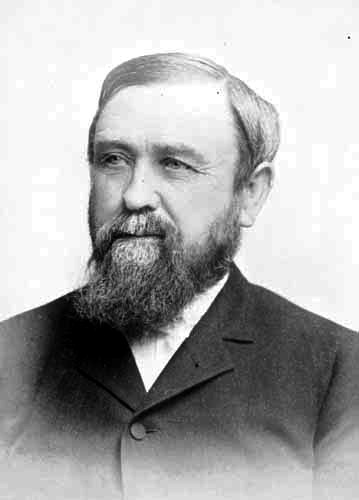
Charles Clinton Nourse From Photograph by Pearson. Des Moines
Under this statute the people elected as Commissioners Frank T. Campbell, Peter A. Dey, and Spencer Smith. In pursuance of the authority of the statute these Commissioners proceeded to formulate schedules of rates to be charged by the several railroads of the state. The law required the Commissioners to publish for three successive weeks in certain newspapers the date at which these rates should take effect. Before the third publication was made the attorneys of the Northwestern Railroad Company telegraphed to the Railroad Commissioners requesting a change of the date of the taking effect of their proposed schedule of rates, and received from the secretary of the board, under the instructions of Mr. Dey, an answer that the time of the taking effect would be changed accordingly. A new advertisement was prepared and published, but before the three insertions were completed three of the principal railroad companies operating in the state; to-wit, the Northwestern, Chicago, Burlington & Quincy, and the Milwaukee & St. Paul filed their petitions with the circuit court of the United States for an injunction against the further publication of the notice, on the ground that the rates fixed by the Railroad Commissioners were not compensatory. The hearing of this application was had before Justice Brewer at his residence in Leavenworth, Kansas. I was employed by the Railroad Commissioners to appear in their behalf, and Mr. James T. Lain, of Davenport, was employed by certain shippers of that place to appear with me in the case. We argued the case before Justice Brewer, and he granted the injunction on the 28th of July, 1888. This injunction in large part was based upon the evidence of the complainants' general manager to the effect that the Commissioners had adopted a classification known as the western classification, which, as compared with the classification known as the Illinois classification made a difference against the railroads of fifty per cent. Subsequent to the granting of these injunctions, upon complaint of certain shippers the Railroad Commissioners, after a hearing before them, proceeded to formulate new schedules, and in pursuance of what appeared to be the principal objection at the former hearing they adopted a classification more favorable to the railroad companies known as the Illinois classification. Immediately upon this action of the Railroad Commissioners the railroad companies filed a supplemental bill asking a further injunction to restrain the Railroad Commissioners from putting into effect these new rates with the new classification. Mr. Campbell of the Railroad Commissioners immediately waited on me asking my further appearance in the cause to argue the question of a further injunction as against their new schedules and classification. He expressed a doubt as to whether or not it was worth our efforts to defeat this new application as he was disposed to think that Judge Brewer would grant whatever the railroad companies might ask in this behalf. I told him that he had a duty to perform as a public officer, in my opinion, and if the Commissioners did their duty in making the proper resistance to this new application, the responsibility would rest with Judge Brewer if he failed in his duty. We accordingly made the necessary preparation for a hearing, which was finally had at St. Paul, Minnesota. In the argument of this case the attorneys for the three railroads applying for the injunction made a very formidable array of distinguished counsel embracing the ablest lawyers of Chicago and Milwaukee. A. J. Baker was then Attorney General of the state of Iowa and nominally appeared with me for the Commissioners, but gave me no assistance whatever. We had for an audience in the argument of the case many leading men of Minnesota, members of the State Grange of that state, which association was then in session at St. Paul. I took into the court-room a blackboard that I extemporized for the occasion and taking several copies of the official reports of the railroads in question, I put one copy in the hands of Justice Brewer, holding another copy in my hand and putting the figures upon the blackboard, showing the earnings of these railroads and what they were pleased to call their fixed charges, and demonstrating beyond question that the complaints made of the proposed railroad rates were without foundation. The same person who had made an affidavit in regard to the difference between the Illinois and the western classification had made a new affidavit stating that there was an error in his former computation. I criticised with some severity the reliability of the affidavits in which mistakes occurred according to the convenience and exigencies of this litigation. I had not much confidence in the result, however, but I felt quite complimented when a number of the leading men of the Minnesota Grange, who were present at the argument, made me a complimentary visit at the hotel that evening. The attorney for the railroad company who was expected to make the closing argument in the case complained that he did not feel very well and only spoke about fifteen or twenty minutes in a general way, without going into the facts or figures in the case. My supposed assistant, the Attorney General of the state of Iowa, took no part in the argument, and on my way home that night I learned that he had been in conference with Mr. Stickney of the Chicago Great Western Railroad Company, and had made an arrangement with that gentleman for employment as attorney for that corporation, to take effect at the close of his then official term which was to occur in a few months. On the 2nd day of the ensuing February, 1889, Justice Brewer filed in the circuit court his opinion refusing the injunction on the supplemental bill and entering an order dissolving the injunctions theretofore granted, at the cost of the complainants. The railroad companies made no further fight against the action of the Railroad Commissioners but acquiesced therein, and found the earnings of their several roads "compensatory."
Concurrent with this proceeding on the part of the Northwestern Railroad Company and the Chicago, Burlington & Quincy, and Milwaukee & St. Paul, the Chicago, Rock Island & Pacific Railroad Company and the Burlington, Cedar Rapids & Northern applied to and obtained from Judge Fairall, of Iowa City, district judge of Johnson county, an injunction against the Railroad Commissioners to the same effect as that issued by Justice Brewer. I appeared with Mr. Lain before the district court and argued a motion to dissolve this injunction before Judge Fairall, which was refused, and from his order refusing to dissolve the injunction we at once took an appeal to the supreme court of Iowa. This appeal was heard and submitted to the supreme court by both printed and oral argument, but after the action of Justice Brewer upon the supplemental bill in the federal court, the attorneys for the Chicago, Rock Island & Pacific Railroad Company and the Burlington, Cedar Rapids & Northern dismissed their suit in the district court of Johnson county, and then applied to the supreme court for an order dismissing the appeal in that court. We resisted this application, but the court held that as the original suit was dismissed the injunction itself necessarily was dissolved, and as the appeal was only from an interlocutory order, the court had no occasion to deliver an opinion upon the merits of the controversy. The opinion of the court permitting these parties to dismiss their suit in this manner will be found in 76th Iowa, 278.
Mr. A. B. Cummins, since Governor of the state of Iowa, has lately been posing as the original friend of the people in this fight against railroad injustice. It would be well to state here that I do not know when he became a convert to the importance of regulating the action of railroads in justice to the people, but as the foregoing was the first great contest we had in Iowa on this subject, I give here a speech delivered by that gentleman as late as December 22, 1891, at a banquet of the Railroad Employees' Club, as follows:
It is the railroad, it is the spirit that has moved and stimulated that property which has made it possible to people in the valley of the Mississippi, which has made it possible to create within the limits of the United States a greater wealth than has any other nation on the face of the earth. I speak of the transportation industry as limited to railways, and so limited, it is instructive to reflect that the railways of the earth are now of the value of something near $33,000,000,000, an appalling sum that no human mind can appreciate, save when compared with some other species of property. The railways of the earth, without reckoning either "wind or water," are equal to one-tenth of all the property of the world. The railways represent substantially one-third of all the invested capital of mankind; and if all the currency of the civilized world and its gold and all its silver and its currency in paper; all its precious stones, its diamonds and rubies were heaped together in such places as would contain them, they would still represent less than one-half of the railway property of the world. The comparisons indicate in what a stupendous enterprise you are now engaged. I have no disposition, whatever, to convert a single sentiment suggested by my brother Wallace, I do not recognize a conflict between the farmers of the nation or the state of Iowa and the railways. No fair man ought to recognize any such conflict, but THAT THE STATE OF IOWA OR THAT HER ORGANIZED TRIBUNALS HAVE DONE INJUSTICE TO THE RAILWAYS AND THROUGH THEM TO THE RAILWAY EMPLOYEES, NO FAIR MINDED MAN CAN DISPUTE. These systems grew up; they most naturally fall into the hands best adapted to organize and handle them, and I would be the last man in the world to claim that, as they grew up, as they were systemized and organized, that wrong was not done here or wrong was not done there. I know too well that there were grievous complaints justly made against the management of railways not only in this state, but in many others. But I beg the people of Iowa to remember, and the railway employees to remember that, although railway managers and railway presidents may sometimes be unjust, that affords no excuse whatever for the sovereign power of the state of Iowa in being unjust. The wrongs of capital produce, it is said, the anarchist—so it is with respect to the wrongs perpetrated by the railway companies, the railway organizations. They created a prejudice which, in its impetus, has carried the attack made upon the railway property far beyond what is justified by the sober second thought and judgment of those who instituted it, and far beyond the limits which the fair-minded people of Iowa now justify.
The constitution of the United States in express terms gives to the congress of the United States the power to regulate commerce between the states and with foreign nations. In pursuance of this power and duty imposed by the constitution, the congress of the United States in February, 1887, enacted a statute defining the duties and obligations of common carriers engaged in the transportation of freight and passengers between the states, and by express terms gave to the people a right of action in the federal courts against any railroad company violating its duty as defined by the act. This right of action was by civil suit for such damages as inured to the party by reason of a wrongful act of a common carrier.
The Chicago & Northwestern Railroad Company had a main line of road extending from Chicago, in the state of Illinois, located through the state of Iowa to Council Bluffs on the Missouri river. From the main line of this road at Carroll, in Carroll county, this company had constructed a number of branches running northwest from that point, known as the Sac City Branch and the Sioux City and Mapleton Branch. During the year 1890 we brought a number of suits against the Chicago & Northwestern Railroad Company for unjust discrimination and overcharge for shipments of corn and oats from various points on these branch roads to Chicago, and also a number of suits for shipments made at Carroll and points west on the main line of its road. The cases for shipments on the branch lines of its road were settled by the company, and we collected for our clients about $75,000. Suits for shipments on the main line of its road were contested by the railroad company. We tried two of these cases before the United States circuit court at Des Moines, Judge Shiras presiding, and obtained verdicts and judgments in the causes. The railroad company took a writ of error to the United States court of appeals, and these causes were submitted to that court upon both oral and printed arguments at the May term, 1892, of that court, sitting at St. Louis, Missouri. After the causes had been so submitted, Judge N. M. Hubbard who had made the argument in behalf of the railroad company, left St. Louis and went to Chicago for consultation with the general solicitor of that road, Mr. Goudy. After a few days, the court of appeals still being in session at St. Louis, Judge Hubbard appeared before the court, without any notice to me, and had the order submitting the causes set aside and dismissed his appeal or writ of error. After a few weeks had elapsed he sued out another writ of error in the same cases to the United States court of appeals, which, according to the arrangements for the sitting of that court, would be held at St. Paul in the state of Minnesota, and Justice Brewer of the supreme court of the United States would be in attendance as the presiding judge of that court.
It would be too long and too tedious a story to enter into particulars in regard to these suits, and the questions of fact and law involved in them. The unusual and unwarranted conduct of the attorneys for the Northwestern road in getting these cases before Justice Brewer for his decision and determination was by no means a compliment to the judge for whom they manifested such a strong partiality. Neither would I indulge in any surmise as to the grounds for their partiality. It is sufficient to say they were not disappointed in the result and that Judge Brewer reversed both of these judgments.
I afterward determined if possible to obtain the opinion of the supreme court of the United States upon the questions of law involved in these cases. I accordingly brought another suit for another client; to-wit, one E. M. Parsons, in a case involving an amount sufficient to entitle me to an appeal directly to the supreme court of the United States, having previously attempted to get the supreme court of the United States to review the decision of Justice Brewer in the former cases upon writs of certiorari, the same being denied by the supreme court. Judge Shiras, presiding in the circuit court at Des Moines, in view of the action of the circuit court of appeals in the other cases, sustained a demurrer pro forma to my amended petition filed in the Parsons case, and it was upon demurrer admitting the averments and allegations in this petition that the case was heard before the supreme court of the United States. Justice Brewer delivered the opinion in the Parsons case in which he held that the statements of the petition did not entitle the plaintiff to recovery. The opinion discloses the fact that Judge Brewer was somewhat offended at my attempt to have the supreme court pass upon the questions of law involved in the cases that he had disposed of as the presiding judge in the court or appeals. I had supposed that a judge of the supreme court of the United States would regard it rather as a compliment than otherwise to his sense of fairness to believe that he was capable of impartially and without prejudice, sitting with his brother judges, to review one of his own decisions, but the opinion shows plainly that I overestimated that distinguished jurist, and that he thought more of his infallibility than I did of his impartiality. This opinion of the court will be found in the case of Parsons vs. The Chicago & Northwestern Railroad Company in volume 167, United States Reports, 324. The court in this opinion asserts the very extraordinary position that the Interstate Commerce Law in providing a remedy whereby a shipper of grain might recover his actual damages for a refusal of the railroad company to comply with the law which was enacted for his protection, was in the nature of a penal statute, and that the petition of the plaintiff in such a case must expressly aver and negative the existence of any possible excuse for the wrong committed by the railroad company.
One great benefit to the public of these suits against the Chicago & Northwestern Railroad Company was to arouse public attention to the necessity of further legislation by congress in order to carry out the design of the original act for the protection of the public. Congress had already by amendment to the act provided for penalties against any parties violating its provisions, but the suits that I brought were simply for actual damages and injuries, and not for any penalty whatever under the law. The penal clause in the act as amended March 2, 1889, reads as follows: "That any common carrier subject to the provisions of this act, or, wherever such common carrier is a corporation, any director or other officer thereof, or any receiver, trustee, lessee, agent, or person, acting for or employed by such corporation, who, alone or with any other corporation, company, person, or party, shall willfully do or cause to be done, or shall willfully suffer or permit to be done, any act, matter, or thing in this act prohibited or declared to be unlawful, or who shall aid or abet therein, or shall willfully omit or fail to do any act, matter, or thing in this act required to be done, or shall cause or willfully suffer or permit any act, matter or thing so directed or required by this act to be done not to be so done, or shall aid or abet in such omission or failure, or shall be guilty of any infraction of this act, or shall aid or abet therein, shall be deemed guilty of a misdemeanor, and shall, upon conviction thereof in any district court of the United States within the jurisdiction of which such offense was committed, be subject to a fine of not to exceed five thousand dollars for each offense: Provided, that if the offense for which any person shall be convicted as aforesaid shall be an unlawful discrimination in rates, fares, charges, for transportation of passengers or property, such person shall, in addition to the fine herein provided for, be liable to imprisonment in the penitentiary for a term of not exceeding two years, or both such fine and imprisonment, in the discretion of the court." The charge of Judge Shiras to the jury in the two cases tried before the United States circuit court, before referred to, will be found in full in volume 48 of the Federal Reporter, commencing on page 50, and the opinion of Justice Brewer, presiding in the circuit court of appeals, before referred to, in which he reverses these judgments, will be found in the 10 U.S. court of appeals on page 430.
It may be interesting to any law student and to anyone who desires to determine where right and justice should have prevailed, to compare the charge of Judge Shiras to the jury and the principles of law recognized by Judge Shiras, with the opinion of Justice Brewer. It is not within my purpose to re-argue any of my causes in this paper.
It is sufficient to say that the supreme court held the provisions of the inter-state commerce law, that gave to shippers a remedy for unjust discrimination by a civil suit for damages, to be a penal statute upon the ground that if the railroad company discriminated by charging one person ten dollars for a particular service and charged another person twenty dollars for a like service, then a suit to recover back the ten dollars thus unjustly demanded and received by the railroad company was in the nature of a statute to recover a penalty. Upon this mode of reasoning a suit against any person or corporation who unjustly and unlawfully gets possession of my money, for the purpose of recovering back what they illegally obtained, would come under the head of a suit to recover a penalty. The trouble with the supreme court of the United States has been that they have uniformly regarded this legislation by congress to protect the people against unjust charges and discriminations as intended to punish the railroad companies of the country, and the court has felt called upon to protect the railroads from legislation interfering with their absolute control over their freight and passenger traffic. The court has assumed the role of a conservative element in the government, intended for the protection of railroad property against the legislative power of the country.
CHAPTER XI
Des Moines River Land Titles
The next important litigation in which I was engaged during my professional career, of public interest, was my engagement by Roswell S. Burrows, one of the original stockholders of the Des Moines Navigation Company, in suits growing out of his ownership of certain lands belonging to the Des Moines river grants, so-called. I will not undertake in this paper to go into a detailed history of the Des Moines river titles, so-called. Colonel C. H. Gatch some years ago prepared for publication a series of articles that were published in the Annals of Iowa, Volume I, that gives a detailed account and history of the land grant by congress, and the various decisions of the United States land department construing the original grant of 1846, and also the decision of the supreme court of the United States in the numerous cases from time to time decided by that court. I deem this the most correct and just account of this important litigation that has ever been given to the public. Honorable B. F. Gue also published in his History of Iowa what purports to be an account of the various decisions and rulings of the land department and of the actions of the courts with reference to these lands. A part of his history is correct, but in treating of the rights of certain of the settlers he has done great injustice to the stockholders of the Des Moines Navigation Company who furnished the money to the company for the purchase of these lands. The first unwarranted statement contained in Mr. Gue's history is that persons who brought and maintained suits for possession of their lands against certain settlers were mere speculators who had bought a doubtful title to these lands for a song. The contract between the state of Iowa and the Des Moines Navigation Company, whereby that company became interested in certain lands of this grant, was made in 1853, after the state had disposed of the larger part of the lands lying below the Raccoon fork of the Des Moines river, and was made at a time when there was no question as to the right of the state to the lands above the Raccoon fork to the northern boundary of the state. Under this contract the company paid to the state, upon the execution of the agreement, over $60,000 in cash for the purpose of enabling the state to pay the indebtedness that had been incurred by the board of public works up to that time. The contract provided that the company should continue the work under supervision of a state engineer and commissioner, chosen by the state of Iowa, and should advance the money to pay, as the work progressed, a specific amount per cubic foot for stone work, excavation, timbers, and other material furnished in the construction of the locks and dams. Estimates were to be made from time to time by the engineer of the work of the amount expended by the company at the prices named in the contract, and as fast as $30,000 was so expended the company was to receive lands at $1.25 per acre. At the time this contract was made it had been found impossible to sell and dispose of the lands by the state commissioners rapidly enough to get money to pay the contractors who theretofore had been doing the work under contracts with the commissioners. The only difference between the Des Moines Navigation Company and the contractors engaged in this work was that the former now agreed to furnish money in advance to pay off the old unpaid obligations of the commissioners, and agreed to advance money as it was needed and take the lands in gross at $1.25 per acre as fast as each additional $30,000 were advanced and expended on the work. In the summer of 1857 the company made a demand on Mr. Manning, commissioner of the Des Moines River Improvement, to certify to them additional lands on certain estimates made by the engineer, which Mr. Manning refused. They accordingly brought suit against the commissioner asking of the court a writ of mandamus to compel him to certify the lands shown to be due them by the certificate of the engineer. I have already referred to this suit in the former part of this paper. I was employed by Mr. Manning and defended against it upon the ground chiefly that before the company could maintain suit for specific performance it was necessary for them to show that they had in all respects complied with their various contract obligations toward the state. The main provision of the contract that the commissioner claimed had not been complied with related to the progress of the work; that is to say, one-fourth of the entire contemplated improvement between the Raccoon fork of the Des Moines river and the Mississippi river had not been completed. The company, being defeated in this application for mandamus, ceased work upon the improvement, and in the winter of 1858 a settlement was made between the state and the company. This settlement was more especially brought about by those who had organized a railroad company for the purpose of building a railroad from Keokuk up the valley of the Des Moines river. This organization was known as the Keokuk, Fort Des Moines & Minnesota Railroad Company, and they desired a grant from the state of the remaining lands of the grant to aid them in the construction of their railroad. The basis of the settlement between the state and the Des Moines Navigation Company was simply that the company should receive a conveyance from the state for the lands that had been certified to the state under the grant up to that time, and that had not been heretofore disposed of by the state, or certified to the company, amounting to about 37,500 acres, and should pay to the state $20,000 in addition to the money already paid and expended on the improvement, and should surrender and cancel their contract and right to any further lands of the grant. (The terms of this settlement are contained in a joint resolution of the seventh general assembly, found on page 425 of the acts of that session.) At the time of this settlement there was no question by anyone as to the extent of the grant and the validity of the title of the state to the alternate sections five miles on either side of the river up to the northern boundary of the state.
In pursuance of the settlement proposed by the joint resolution which was accepted by the company, Governor Lowe on May 3, 1858, executed fourteen deeds or patents to the Navigation Company, conveying by particular description the lands to which the company was entitled under the resolution of compromise; and on May 18, 1858, a general deed conveying the same and any previously omitted lands by general description.
Another disturbing element in regard to the title to the lands arose under the grant of congress made in 1856 to the state of Iowa, to aid in the construction of certain lines of railroad crossing the state and having their initial point at the Mississippi river, and crossing the Des Moines river at various points between the Raccoon fork and the northern boundary of the state. These railroad companies raised the question as to the validity of the title of the Des Moines Navigation Company to the lands they had purchased from the state north of the Raccoon fork of the river. The Dubuque & Sioux City Railroad Company brought suit, or rather induced Litchfield to bring suit against them for lands lying within the line of their grant under act of 1856, or rather that would have been within their grant if not reserved from its operation or that had not been granted for the improvement of the Des Moines river. This suit was adroitly managed on the part of the railroad company so as to avoid testing any question of its title, and contained a stipulation that the company was in possession of the land under their grant and the court was only called upon to decide the extent of the grant under the act of 1846 to the state for the improvement of the river, and the supreme court of the United States decided that the act of 1846 did not grant to the state for the improvement of the river any lands north of the Raccoon fork. This decision was made at the December term, 1859, and is found reported in 23 Howard, S.C.U.S., page 66. The act of 1856, making the grant to the state for the purpose of aiding in the construction of these railroads, in express terms reserved from the operation of the grant any lands that had been theretofore reserved by any competent authority under any other grant of congress. The announcement of this decision created considerable excitement in the Des Moines valley, and the river lands above the Raccoon fork that had theretofore been deeded by the state to the Des Moines Navigation Company and had been by that company divided among its stockholders in consideration of the moneys that they had advanced to the company, and had been paid by the company to the state as before stated, were considered the lawful prey of every adventurer who could induce the local land offices to allow them to locate a land warrant upon any of these lands.
Another class of persons, however, were deeply interested in the question of this title. Prior to the contract made with the Des Moines Navigation Company the state of Iowa had sold some fifty thousand acres or more of these lands located above the Raccoon fork of the river, and many of these lands were occupied by actual settlers who had made improvements thereon and had paid the state valuable considerations for their title. To avoid the hardships that must otherwise have resulted from the decision of the supreme court, congress on March 2, 1861, passed the following joint resolution: "Resolved, that all the title which the United States still retain in the tracts of land along the Des Moines river, above the mouth of the Raccoon fork thereof, which have been certified to said state improperly by the department of the interior as a part of the grant by act of congress approved August 8, 1846, and which are now held by bona fide purchasers under the state of Iowa, be, and the same is hereby relinquished to the state of Iowa."
The congress of the United States further on the 12th of July, 1862, passed an act in express terms extending the grant to the northern boundary of the state, and providing that such lands "be held and applied in accordance with the provisions of the original grant, except that the consent of congress is hereby given to the application of a portion thereof to aid in the construction of the Keokuk, Fort Des Moines & Minnesota Railroad, in accordance with the provisions of the act of the general assembly of the state of Iowa, approved March 22, 1858."
At the December term, 1866, the supreme court of the United States, in the case of Samuel Wolcott vs. The Des Moines Navigation Company, reported in 5 Wallace, page 681, made a further decision confirming the title of the Des Moines Navigation Company under the acts of congress of 1861-2, to the lands that had been deeded to them by the state of Iowa as before recited, and further deciding that the lands within the five mile limits of the Des Moines river had been reserved by competent authority for this work of internal improvement at the time of the passage of the railroad grant of 1856.
Mr. Gue in his history of Iowa unfortunately attempts to disparage the title of the stockholders of the Des Moines Navigation Company by stating they were mere speculators who had purchased an impaired title, and were therefore entitled to no consideration. On the contrary, the men who received these deeds directly from the Des Moines Navigation Company were stockholders who had advanced their money in payment of their stock, which money had been paid over by that company directly to the state.
Soon after the decision of the supreme court in the Litchfield case in 1859, a suit was brought in the circuit court of the United States for the southern district of Iowa, asking an injunction against the local United States land officers at Fort Dodge and at Des Moines, to prevent them from receiving and recognizing any location or purchase of these reserved lands. The reservation of the land affected not only the lands within the railroad grant, but affected the right of any person to locate upon or purchase these lands from the United States, as they were not lands subject to settlement or entry. Justice Miller heard this application for an injunction, and an argument was filed by the authorities in Washington claiming that the proper officers of the land department had the sole authority to determine the question as to whether or not these lands were subject to location and entry, and that the question of the effect of such location and entry could only be decided by the courts, after entries were made and patents granted; that if the lands were not legally subject to entry as to any person claiming them, the action of the land officers would be void, and a court, if called upon by the owner, could cancel any patent or other evidence of title illegally issued. Justice Miller, after the full argument of the case, sustained this view of the case and held that the only remedy for parties claiming these lands under the act of 1846, and the subsequent act of 1861-2, was to apply to the court for the cancellation of any titles wrongfully issued by the land department or by the President. In accordance with this view of the case a number of suits were brought by the grantees of the Des Moines Navigation Company, who received their titles from the company in consideration of the moneys they had advanced as stockholders, and the supreme court of the United States, upon appeal to that court, cancelled a number of entries and patents that had been wrongfully issued. An attempt was made to make a distinction between the Des Moines Navigation Company and individuals who had purchased the lands from the state of Iowa, and settled thereon.
Mr. Gue in his history of Iowa claims that the act of congress of 1861 was only intended for the protection of those purchasers from the state who had actually settled upon their lands and made improvements thereon, and that congress in using the words "bona fide purchasers from the state of Iowa" did not include in those words citizens or residents of the state of New York who had bought their lands in good faith from the state of Iowa. The supreme court of the United States in the very purpose of its organization was intended by the constitution to organize a judicial body or tribunal before which all citizens of the United States should be equal before the law, without regard to the state in which they had their residence or location. There was no question about the fact that the Des Moines Navigation Company was a bona fide purchaser of these lands. At the time that they paid their money and took a conveyance from the state of Iowa, the stockholders of that company honestly believed they were getting a good and perfect title and were paying out their money for same in the utmost good faith. The statement of Mr. Gue in his history before referred to, that the persons who received deeds for these lands from the Des Moines Navigation Company were mere speculators, purchasing for a song a doubtful and disputed title, is wholly without foundation and fact, and the denunciation of the supreme court of the United States because the court made no distinction between bona fide purchasers because of their location or residence, very greatly mars the reliability and impartiality that ought to have been characteristic of this history of Iowa. Mr. Gue was a resident of Fort Dodge, where for years the atmosphere of that locality was permeated by the passion of men who had been disappointed in their attempt to secure a title to lands that they all knew before and at the time of the location and attempted entry on the same, had already been sold for a valuable consideration by the state of Iowa. The opinion of the supreme court, delivered by Justice Miller in the case of Williams vs. Baker, reported in 17 Wallace, 144, contains an accurate and clear exposition of this entire controversy, which fortunately was settled by the supreme court of the United States, and to which they have continuously and consistently adhered. Long after the diversion of the remaining lands of this grant to the Keokuk, Fort Des Moines & Minnesota Railroad Company, the Iowa Homestead Company, grantee of the Dubuque & Sioux City Railroad Company brought suit for a portion of these lands embraced in the river grant above the Raccoon fork, and attempted to disturb the title. In the meantime the Keokuk, Fort Des Moines & Minnesota Railroad Company had mortgaged these lands for the purpose of continuing their road from Des Moines to Fort Dodge. On the foreclosure of this mortgage these remaining lands were sold to a company known as the Des Moines & Fort Dodge Railroad Company, organized for the purpose of owning and operating that portion of the old Des Moines Valley road that had been constructed between Des Moines and Fort Dodge. On the foreclosure of this mortgage I had represented Martin Flynn and a number of the other contractors, for whom I had filed a mechanics' lien for work done and material furnished in the construction of the road north of Gowrie. I succeeded in obtaining a provision in the decree of foreclosure making these liens paramount to that of the mortgage, and when the road was purchased by the new organization called the Des Moines & Fort Dodge Railroad Company they were compelled to pay off Flynn and these other lien holders in order to secure their title. This new railroad organization elected Mr. Charles Whitehead, an attorney of New York City, its president, and I received from Mr. Whitehead a telegram asking if I could be retained as general attorney of their road. I replied that upon the receipt of a draft for five hundred dollars I would accept of the same as a general retainer. One object, I think, that the company had in desiring my services was to secure some one familiar with the question of the title of these Des Moines river lands that the new organization had bought in connection with this other part of the road.
The last contest over the title was the case of the Iowa Homestead Company claiming the title under the railroad grant of 1856. It was the case of the Iowa Homestead vs. The Des Moines & Fort Dodge Railroad Company, reported in 17 Wallace, 84. Mr. Gue, in his history of Iowa, makes a special point as to the hardship visited on one of the settlers by the name of Crilley. I was attorney for Mr. Burrows in that case. Mr. Crilley first attempted to locate a warrant upon a tract of land near Fort Dodge prior to the decision of the supreme court of the United States in the Striker case. He was refused permission to make any such location or entry and was distinctly informed by the local land officers that the lands belonged to the Des Moines river grant. After the decision in the Striker case in 1859 and after the settlement between the state of Iowa and the Des Moines Navigation Company and the payment of the last $20,000 of the consideration, and after the execution of the deeds and patents by the state to the Des Moines Navigation Company, Crilley succeeded in inducing the local land officers to allow his location, and ultimately obtained a patent through their influence, signed by the President. The circuit court of the United States declared his patent void and decreed cancellation of the same. He took his appeal to the supreme court at Washington and that court affirmed the decree. The judges of the circuit court at Des Moines permitted Mr. Crilley, by his attorney, then to file a claim for his improvements under the occupying claimant law of Iowa. Commissioners were appointed and his improvements were valued at a very liberal amount, far in excess of their real value or cost. Mr. Burrows paid the money into court and Crilley received the same, but after he received pay for his improvements he still refused to vacate the land. A writ was issued to dispossess him, and upon the service of the writ by the United States marshal, Mr. Crilley presented a loaded revolver to the deputy marshal and threatened his life. The marshal thereupon returned to Des Moines and secured authority to arrest Mr. Crilley, which he did, and Mr. Crilley was actually detained in prison for several weeks and until he agreed peaceably to surrender possession of the land. This is the whole story of the inhumanity out of which Mr. Gue's history of Iowa makes a case of such extreme cruelty and hardship.
That this controversy over the title of the Des Moines river grant was a most unfortunate one, both for those who purchased the lands from the state and those who attempted to purchase them from the general government after the state had sold them, there can be no question. It was also very detrimental to the settlement of that part of the state. The squatters or settlers made very indifferent improvements and very indifferent cultivation of the land, and seldom if ever paid any taxes. After the title of the Des Moines Navigation Company and its stockholders and grantees had become fully settled, the counties where these lands were located levied taxes upon the same, and suits were brought against the Des Moines Navigation Company and its grantees. The supreme court of Iowa held that from the date of the joint resolution of 1861 the title to these lands inured to and became perfect in those who had purchased and taken their deeds from the Des Moines Navigation Company, and held them liable for the taxes that had been assessed from the date of that joint resolution of 1861.
I continued to act as attorney for the Des Moines & Fort Dodge Railroad Company for about ten years. I was not, however, employed upon a salary, but only after my general retainer charged that company from time to time for services actually rendered, and charged them as I did any other client.
CHAPTER XII
A. O. U. W. Controversy
One other case of some notoriety and public interest in which I was engaged in the latter years of my practice was the controversy between the two branches of the Ancient Order of United Workmen. It seems that the Grand Lodge of this organization had adopted an amendment to their plan of organization by which in case of extraordinary loss and liability occurring in any locality, and within the jurisdiction of some subordinate state lodge, the members of lodges in other states might be assessed and required to contribute for the payment of such extraordinary losses. A portion of the members in the state of Iowa refused to recognize this requisition and seceded from the organization as a national body, and organized another state lodge by the same name, Ancient Order of United Workmen, and incorporated themselves under the general provisions of the law of Iowa for the organization of benevolent societies, repudiating any connection with the national lodge. Those who adhered to the national organization still continued, however, to do business by their old name and under their former organization as adherents of the national body. The new organization, relying upon their incorporation as giving them some special advantage, brought suit in the district court of Dubuque county for an injunction against this old organization adhering to the national body, and sought to perpetually enjoin them from the use of the name "Ancient Order of United Workmen," or the initials "A.O.U.W." Upon the trial of this case on demurrer in the district court in Dubuque, I sought to obtain a continuance of the hearing on the ground of my ill health, having been confined to my room and my bed for some three weeks. The judge of the district court granted a continuance only for a few days. I went to Dubuque, however, and made a three hours' argument in the case, sitting in my chair, not having strength to stand upon my feet. The court granted a perpetual injunction against my client. An appeal was taken immediately to the supreme court and an interlocutory order obtained staying the injunction until the case could be heard in that court. On the final hearing and trial the injunction was dissolved, and the right of my client to use and do business under the title of "Ancient Order of United Workmen" was successfully maintained. This decision is fully reported in supreme court reports, 96 Iowa, 592.
CHAPTER XIII
Important Events in Career
It will be necessary now to go back a few years in order to record certain events important in my personal career.
In the summer of 1880 James A. Garfield received from the republican national convention at Chicago the nomination as candidate for President of the United States. At that time the states of Indiana and Ohio continued to hold their state elections early in the month of October, and the result of the elections in those two states in October had a most important and almost controlling influence upon the result of the presidential contest at the ensuing November election.
Early in September of that year I received from the state central committee of the state of Indiana an invitation to accompany ex-Governor Kirkwood of Iowa in a canvassing tour of two weeks, which invitation I accepted. We had a very agreeable and enjoyable trip. Governor Kirkwood was a very companionable man and was received with much honor and enthusiasm, and our meetings were largely attended and were quite successful. Part of the time we did not speak together at the same meetings, but had separate appointments assigned us. At one point where there existed a considerable manufacturing industry, the local committee waited upon us at our hotel before the speaking, and suggested that they desired us to especially discuss the tariff question and its effect upon our American manufacturers. After the committee had retired Governor Kirkwood walked the floor of the room for a few minutes, and turning suddenly upon me he said, "Charlie, do you understand this tariff question?" I told him no, I knew very little about it. "Well," he said, "I was raised a democrat and am not much of a tariff man anyhow, and I want you to take up this tariff question if either of us must." I told him that I could talk about the general effect of protecting American labor and the duty of the American congress to so arrange the tariff upon imports as to relieve our people from competition with the low wages paid in Europe; that the American laborer must receive higher wages than the European laborer for he must educate his children and must enjoy better conditions in life, and as our free institutions were based upon the intelligence of the voter, we could not afford to allow the laboring man to occupy the position socially or politically of the European laborer; that I could talk along that line all they wanted, but when it came to discussing schedules or specific duties I should not venture upon any such discourse; in fact, I was satisfied that few people understood the subject sufficiently to discuss the detail of tariff duties with intelligence. I filled the bill accordingly, as Governor Kirkwood placed that part of the program in my charge, but he himself did not say "tariff" once.
At Indianapolis we attended a grand rally at which Roscoe Conkling, of New York, was the principal orator of the day. The managers had arranged for a grand parade, and the Governor with myself and several other gentlemen were assigned to a carriage that was to take prominent part in the procession. Conkling had arrived, it seems, early in the day, and the procession was delayed for over an hour waiting for that distinguished gentleman to complete his toilet before making his appearance in public. The streets and the balcony of the hotel were lined with ladies in their holiday attire, and as the procession passed by we heard frequent inquiries from the finely dressed maidens as to which was Conkling, and when he was pointed out to them they were enthusiastic in their declarations that he was a handsome man. I was introduced to Mr. Conkling in the corridor of the hotel, after his speech, and was shocked and surprised at his want of courtesy and decent manners. He was there for the purpose of advocating the election of Mr. Garfield, and adding if possible enthusiasm to the occasion, and yet openly in the hearing of the crowd he was cursing the folly of the convention in nominating Mr. Garfield instead of renominating Grant for the third term. A more arrogant and conceited public man it has never been my misfortune to meet.
An incident occurred the following Sunday morning more pleasant to record. I got up very early, and going down to the lower portico of the hotel I found a few persons astir. I felt somewhat lonesome and seeing a well dressed, intelligent looking colored man on the pavement, I entered into conversation with him in regard to the political situation, and asked him whether or not the colored men of the city would not all support Mr. Garfield, the republican nominee. To my surprise he said, "No, sah, some of them will vote the democratic ticket." I said to him, "How is it possible for a colored man to support the democratic ticket in view of the history of the past twenty-five years? The colored race have been emancipated and enfranchised and made equal before the law through the efforts of the republican party of the nation. How, then, can any of your people support the democratic party?" "Well, sah," said he, "in some respects a colored man is very much like a white man." Said I, "What do you mean by that?" "Well, sah," said he, "I'll tell you. Occasionally, sah, you will find a colored man that is a damn fool." I saw a twinkle in his eye and realized that he was intending his reply for a joke. I immediately offered him my hand and shook hands with him heartily, telling him that since there were so many white men of that kind I supposed it would be unreasonable not to expect occasionally a colored man that was a fool.
Upon my return to Iowa after the October election in Indiana I made a speech in the opera house at Oskaloosa, Iowa, and the gallery was filled with colored men, many of them from What Cheer, a mining district near Oskaloosa. I related to them the particulars of my interview with the colored gentleman of Indianapolis. They enjoyed it hugely and gave me rounds of applause, and I told them I hoped that in some respects they would not be like the few that were back in Indiana.
After the election of Mr. Garfield, Governor Kirkwood was appointed Secretary of the Interior, and as I had official business before the supreme court that summer I visited Washington City in company with my wife, and spent a pleasant two weeks admiring the wonders of the national capital. Bishop Andrews, of the Methodist Episcopal church, had been for a number of years a resident of Des Moines and our near neighbor on Fourth street, and in company with his excellent wife Mrs. Nourse had a very enjoyable time. Governor Kirkwood also arranged that we should attend a private reception of the President and his wife, and Mrs. Nourse enjoyed the privilege of quite a tete a tete with the President's lady, officially known as the first lady of the land. When my wife bid her good evening she shook hands with her and expressed the hope that she would be very happy in her new position. Mrs. Garfield was rather a sad faced person and responded in a tone almost prophetic, "I hope so. We do not know." Afterwards upon the assassination of Mr. Garfield I was called upon to take part in a meeting held in the Baptist church in Des Moines, commemorating the memory of that excellent man. I found in my wife's scrap book some years afterwards a newspaper clipping containing a report of the remarks I made on that occasion which I here insert:
For the past five days our nation has been in mourning and the Christian civilization of the world has sympathized with us in our bereavement. By official proclamations, by public meetings and resolutions, by draping our homes and places of business and houses of worship with the emblems of mourning, we have sought to give expression to our sorrow and to testify our appreciation of our noble dead.
Tomorrow the whole nation is to attend upon his burial and the day is set apart as sacred to his memory. And yet with all this we cannot restore the life that has been so wantonly destroyed. Death is inexorable, and we can do nothing for him who has gone out from the shores of time forever.
But in a better sense of the word Garfield is not dead. So long as we cherish the manly virtues of which his life was the exponent, so long as we remember the trials and sacrifices of his boyhood, the labors and successes of his riper years, the heroism, faith, fidelity of his life, and the calm triumphant heroism of his death, so long will he live to us and to the nation, and so long may we be profited by his life.
I can think of no better text this morning for profitable consideration than one of the many rich gems of thought he has left us out of the storehouse of this great heart and intellect. At the graves of the fallen heroes of the late war he expressed this sentiment, "I love to believe that no heroic sacrifice is ever lost, that the characters of men are molded and inspired by what their fathers have done, that treasured up in American souls are all the unconscious influences of the great deeds of the Anglo Saxon race, from Agincourt to Bunker Hill."
In the oldest book of the Book of Books the patient man in his deep affliction asks the question, "If a man dies shall he live again?" This question refers primarily to man's immortality, but we may dwell upon it in its other meaning, this morning, as relating to the silent and unconscious power and influence of the life and example of the one whom we say is dead.
And think what a treasure we have in the memory of this man. Others have challenged the admiration of the world because of their great abilities. Others have been brave in war and wise in counsel. Others have been heroes and statesmen, and we have honored them and done homage to their greatness, but this man was not only great and wise and brave, but a good, true and pure man also, and the nation loved him. We give honor to his greatness, we give the tribute of praise to his great abilities and his great achievements, but we bring tears and heart throbs to the tomb where manly virtue, purity, and faith are to be enshrined. How much there is in the life of this man that we would wish to bring into the everyday life of our homes. Here is the model of a life from which we would have our children mold their own future, no blemishes to record, nothing to apologize for, nothing to cover up—it stands out in its moral perfection and beauty—in its intellectual strength and greatness—in its religious faith and fervor, a fully developed manhood—a complete character—a perfect pattern.
Do you want an inspiration for your child? Repeat to him the story of this man's youth, of his struggle with poverty and adversity, without influential friends or fortune. Do you want to teach the young men of the nation the value of sincerity, honesty, earnestness, and truthfulness in the affairs of life? Here is the demonstration and the proof that even in American politics and American statesmanship, dishonesty, deceit, and duplicity are not necessary to success. Do you want to rebuke the conceit of the would-be learned who teach our young men that the religious faith that their mothers taught them is somehow a reproach to their intellectual progress—we have here a man of the broadest culture, of the strongest intellectual grasp and development, whose religious faith was the very basis and strength of his greatness and intellectual power.
CHAPTER XIV
The Brown Impeachment Case
The discussion of law cases and the questions of fact and of law that they involved may be a little tedious to a non-professional reader, but they constituted so large a part in my life that it is impossible to give much of an account of myself and what I have been doing for so many years past, without at least a brief account of the nature of the suits in which I was engaged as counsel.
Probably the most important case in which I was engaged during my professional career was the celebrated impeachment case against John L. Brown, Auditor of the state of Iowa.
Mr. Brown was first elected to the office of Auditor of State in October, 1882, and took his office the following January. One of the important duties of this office was the duty of having the insurance companies, organized under the laws of Iowa and doing business in the state, examined from time to time to ascertain if they complied strictly with the law, and if their reports made to his office were just and true, and their business conducted in such a manner as to insure their solvency and ability to pay the losses of their policy holders. There had been in the state of Iowa for a number of years a number of failures of companies that were organized without capital and without experience or strict integrity upon the part of those who sought to insure the property of others, some of them having none of their own. I remember one insurance company organized in Des Moines by an enterprising young lawyer, without means, who obtained the names of a number of persons that he claimed had subscribed stock to his company. The law required twenty-five per cent of this stock to be paid up before the company was entitled to do business. The gentleman, of course, elected himself president of the company, and he drew his drafts upon the supposed subscribers to stock for the twenty-five per cent that the law required should be paid up, to constitute the capital of the company. He took these drafts to B. F. Allen, then a prominent banker in western Iowa and doing business in Des Moines, and deposited his drafts and obtained from Allen a certificate of deposit for so much money. This he exhibited to the Auditor of State, and upon the faith of this certificate of deposit obtained authority to transact business. His drafts were all dishonored so that he was proceeding to do business without any capital whatever, and actually issued some policies. It was only necessary to incur a loss to complete the bankruptcy of the concern. Of course the foregoing is an extreme case, but it illustrates how easily the law was evaded and how absolutely necessary it was to have a strict supervision of these companies that could incorporate themselves under the general insurance company laws of the state.
Mr. Brown had been a soldier in the Civil War and had lost an arm in its service, was very upright, and a downright man, and did not depend upon his suavity of manner for his success in life. He was a man of quick temper and abrupt manners, but was sensitive of his honor and at all times conscious of his integrity of purpose. In pursuance of his official duty he felt the necessity of strict supervision and a thorough examination of the insurance companies of the state, that had sprung up in almost every important town and city in the state, and the officers and directors of the different companies were not paying much attention to the detail of the affairs of their companies and would generally entrust the business to the persons who had organized the company and become its president and secretary. In selecting a person who could make these examinations with fidelity and thoroughness he deemed it necessary to engage some one who was not a resident of the state and who would not probably be influenced by local or political consideration in the discharge of his duties. He employed as chief examiner of these companies a gentleman who resided in Chicago, and whose reputation was beyond question as an expert, by the name of H. S. Vail. This gentleman charged for his services twenty-five dollars a day for the time actually engaged, and in addition thereto some five to ten dollars for assistant accountants. The law provided that the expenses of these investigations should be approved by the Auditor, and upon his certificate the several companies examined were required to pay the bill. These examinations proved to be very expensive in some cases, and perhaps in a few cases an unnecessary burden and expense to the companies, but the real cause of complaint was that the expert found many irregularities, and without fear or favor, reported them in writing to the Auditor for his action. In one case the president of an insurance company had been electing his board of directors by stock issued to himself, upon which he had not paid a dollar into his treasury, and was paying himself out of the limited income of the company the handsome sum of ten thousand dollars a year as president, and his son-in-law three thousand dollars a year as attorney of the company. In a number of cases the president of the company was found to have issued to himself stock upon which he had not paid a dollar, and the Auditor required all of these and many other like delinquencies to be corrected.
He was visited by the friends and attorneys of these officers who were thus disturbed in their operations, and the Auditor was not found to be a very complacent or accommodating individual, but on the contrary an outspoken, determined, and unyielding man in the discharge of what he conceived to be his duties. The last resource of these afflicted insurance officers was an appeal to Buren R. Sherman, then Governor of Iowa, formerly filling the office of Auditor of State and under whose administration these insurance men had been undisturbed. He found Mr. Brown equally obdurate and unwilling to palliate or in any way overlook the delinquencies of these insurance companies, but he determined to afford his friends some relief, and upon the re-election of Mr. Brown as Auditor of State in the fall of 1884, he sought an excuse for refusing to approve of the official bond that Mr. Brown presented to him and which was necessary to the qualification of the Auditor for his second term of office. The first pretense of Sherman for refusing to approve the Auditor's bond was that Mr. Brown had not complied with the law in making report to the Treasurer of State as the law required of the fees of his office. As it turned out in the evidence on the trial, and as Sherman well knew the fact to be, the fees of the office had been reported and accounted for as the statute required, save only that the aggregate amount of the fees as shown by the fee-book in the Auditor's office had been reported and accounted for at the end of each month, and the details specifying from what source each item was received was not copied from the fee-book in the Auditor's office and filed with the State Treasurer. In addition to this the Governor also obtained information from a discharged clerk in the Auditor's office that the clerks in the office frequently received compensation of small sums for giving information and collecting statistical matter at the request of individuals where no official duty was enjoined by law upon the Auditor or his assistants and no fee was prescribed. As no account was kept of these small sums of money and they were paid to the clerk who did the voluntary work for persons requesting it, no statement could be made of the amounts or dates, or the services rendered.
In the meantime the controversy spread, the insurance companies through their officers and agents taking an active part as against Mr. Brown, and Mr. Sherman becoming more and more arrogant. He finally determined to remove Mr. Brown from office.
We had upon the statute book a law whereby the Governor of the state was authorized to suspend a subordinate officer, if indeed there was any such thing as a subordinate officer under our constitution, by appointing a commission to examine his books and papers and the affairs of his office, and if, upon making such report to the Governor, it was apparent that the public safety required a suspension of the officer from official duties, he might issue such order of suspension. Sherman found three men willing to do his bidding in this respect and appointed them commissioners to examine the affairs of all the state officers. The commissioners understood that this meant only Brown and meant only that they should put into form Sherman's side of his controversy with the Auditor. The committee accordingly performed what was required of them and reported to the Governor that the public safety and public good required the suspension of the Auditor. They reported no facts in addition to those already recited in regard to the money received by the clerks in the office for matters outside of their official duties, save and except fees paid by certain banks for bank examinations under the law, for which no fee was provided by law, and which they advised the Governor that the Attorney General claimed did not belong to the state treasury, but were illegally charged and paid. They also informed the Governor that in the year of 1883, the correspondence notifying the Auditor of the requirements of the insurance companies in regard to the appointment of agents had been destroyed. As all of these appointments were matters of record and the fees for their issuing were also regularly entered upon the books of the Auditor, this was one of the extraordinary finds of this extraordinary committee. They also advised the Governor in this report that the law required the reports of fees should be sworn to, and their interpretation of the law was that the Auditor himself should have made the affidavit, and instead thereof it was made by a clerk in the office.
Upon this remarkable report of this remarkable commission Sherman at once made an order, not suspending but removing Mr. Brown from office, and appointing J. W. Cattell, formerly Auditor of State, to take his place. Mr. Cattell was in no very great haste to do this, but after the order was served by the sheriff upon Mr. Brown he very wisely entered into a negotiation with Brown to see if the difficulty could not in some way be adjusted, and have Brown make such reports to the Governor as would be satisfactory. Mr. Cattell was an honorable and honest man, and really desired that these matters should be satisfactorily arranged, but this was not the purpose of the Governor as manifested by his conduct, and he determined to have his own way. He accordingly filed information before a justice of the peace accusing Brown of a misdemeanor in holding the office after his order of suspension or removal, and upon this affidavit he obtained a warrant for the arrest of Mr. Brown. The constable served the warrant upon Brown, and Mr. Brown was about to give bond for his appearance to answer the charge, when the Governor, having previously ordered and arranged with the Adjutant General so to do, appeared with an armed force of the Governor's Guards, so-called, who, with set bayonets and loaded muskets took charge of the Auditor's office. Hearing that something of an extraordinary nature was transpiring at the capitol, I left my office and went over to the state house to see what could be done for my client, and was proceeding to the Auditor's office when I was stopped by two of the soldiers crossing bayonets in front of me, one of them cocking his rifle and threatening to shoot me if I proceeded any further. Fortunately the captain commanding the squad had a little sense left and told the soldier to put up his gun, and so my life was saved. The Governor in addition to the use of the militia as above recited, also employed ex-Governor William M. Stone to assist Mr. Galusha Parsons, and they filed a petition in the name of Jonathan W. Cattell against John L. Brown in the district court of Polk county under the provision of the statute for proceedings in "quo warranto" by which the right and title to an office could be tested. We were fortunate in having for district judge at that time William Connor, a good lawyer and an honest man. Mr. Parsons and Governor Stone attempted upon the presentation of their petition to get some peremptory order for the removal of Mr. Brown from office, but the court called their attention to the express provision of the statute that he had no authority to make any order in the premises until the final trial, and that the case must go upon the docket and be tried upon its merits before any order or removal could be made. Upon the impeachment trial Sherman under oath denied that he had employed counsel to commence this suit, and Mr. Cattell testified that he had nothing to do with the employment of any counsel to bring the suit. The suit was finally dismissed, nobody appearing to care about any investigation of the merits of the proceeding. We accordingly had Mr. Brown, who had given bail, surrender himself to his bondsmen, and we applied to the supreme court of the state, then sitting at Davenport, for a writ of habeas corpus to test the constitutionality of the statute under which, without trial and without investigation and without hearing, the Governor had attempted to deprive Mr. Brown of his office. The supreme court decided this case at the Dubuque term in 1885, Seevers, judge, delivering a dissenting opinion, and Beck, judge, taking no part in the decision as he was not present at the submission of the cause. Adams, judge, delivered the opinion of the three remaining judges; to-wit, himself, Rothrock, and Reed. The majority of the court held that the law under which the Governor acted did not authorize any removal from office, and that it was only constitutional upon the hypothesis that Brown should have a hearing and trial. The dissenting opinion of Judge Seevers holds that as the law made no provision for any hearing or trial, and the suspension was for an indefinite time and might at the pleasure of the Governor be perpetual, it was therefore void and did not authorize the proceedings. Thus matters stood until the fall of the year 1885, when the people elected William Larrabee as Governor instead of Sherman, whose term of office would expire on the first of January ensuing.
The presumption indulged in by the majority of the court in its opinion that Mr. Brown's removal from office was only a temporary suspension, and that the Governor certainly would give him a hearing as to the matters complained of and found by the special commission, is made to appear more absurd by the subsequent action of Mr. Sherman himself, who, on the 9th of December, 1885, made the following entry in the executive journal, and assumed to appoint J. W. Cattell to fill what he was pleased to call a vacancy in the office of the Auditor of State. The entry is as follows:
December, 9, 1885.
Whereas, at the general election held on the 4th day of November, 1884, J. L. Brown was re-elected to the office of Auditor of State; and
Whereas, the said J. L. Brown, re-elected as aforesaid, neglected and refused to qualify as such re-elected officer, and because thereof his official bond as such officer was not approved nor filed, and continued in such refusal until the 3rd day of March, 1885, and unto this time, and on account thereof on the day last aforesaid Jonathan W. Cattell was duly appointed as Auditor of State and immediately qualified by giving bond and taking the oath of office as required by law, which said bond was duly approved according to law; and
Whereas, at the general election held on the 3rd day of November, 1885, there was no person elected to the said office of Auditor of State, as ascertained by the official canvass this day concluded by the state board of canvassers; and
Whereas, it is incumbent upon me to fill the vacancy in said office now held under appointment; therefore
Jonathan W. Cattell is hereby appointed Auditor of State, to have and to hold the same until the next general election in November, 1886; and upon his qualifying thereto by giving bond and taking the oath of office, as required by law, he will be obeyed and respected accordingly.
Buren R. Sherman
A legislature was elected that fall, and as the only opportunity for a hearing and a vindication of Mr. Brown, he sent a communication to the house of representatives requesting an investigation and an impeachment, to the end that he might have a trial before the senate.
The insurance agents of the state who had been wounded by the investigation of their affairs, Sherman and his political adherents filled the lobbies of the legislature, and were anxious also for Brown's impeachment. Finally the house of representatives brought in articles of impeachment, containing thirty counts, and the senate ordered Mr. Brown arrested and brought before them for trial. As I had been Mr. Brown's counsel throughout all of these difficulties, he came to me for aid and wished me to act as his counsel. In the meantime he had received a number of letters from "Tom, Dick, and Harry" throughout the state, lawyers who wished to do some cheap advertising of themselves, offering to attend to his case without compensation. I told Mr. Brown that I would undertake his case on condition that I might select my own assistants. I realized that the court, to-wit, the fifty senators then entitled to seats in the senate, was of rather peculiar construction. We had in the first place a large majority of republicans, but we also had a number of very able and influential democrats in the senate. We had some Germans and some opposed to prohibition. It was necessary, in selecting attorneys, to consult the peculiar constitution of the senate and its make-up, and political partialities and proclivities. Mr. Brown agreed to my terms and I named Mr. J. C. Bills, of Davenport, and Mr. Fred W. Lehmann, of Des Moines, as the attorneys I desired to assist me in his defense. Mr. Lehmann was an excellent lawyer and a rising young man, very popular at that time with the democrats of the state. Mr. Bills was then nominally a republican, but had opposed the prohibitory law and stood well with that political element, besides being a good lawyer.
Acting upon my theory as to first impression, I made an opening statement to the senate giving them a very careful and detailed history of the case, and of the facts that we expected to prove upon the several counts of the indictment or impeachment. In addition to these two counsel we also had the assistance of E. S. Huston, of Burlington, a relative of S. F. Stewart, the deputy auditor. Mr. Huston especially looked after and cared for the interests of the deputy during the trial. The managers upon the part of the house of representatives were Messrs. S. M. Weaver, John H. Keatley, L. A. Riley, G. W. Ball, J. E. Craig, R. G. Cousins, E. C. Roach. The trial continued about three months. I found I had made no mistake in selecting my assistant attorneys. We had a room set apart for us in the capitol, where we were in counsel arranging the program for the day's work before the senate, and assigning to each attorney his particular share of the work of the day. I always dreaded in coöperating with attorneys in the trial of causes, having some one to assist me who would be an annoyance and a drawback rather than a help, but I found in Mr. Lehmann and Mr. Bills two good lawyers and men of good judgment and discretion, and we had a most agreeable as well as a successful time of it on our side of the trial table.
The trial had not progressed more than a few weeks before we were able to turn the tide of feeling and sentiment in our favor, or rather in favor of our client, and the case, instead of being a prosecution of John L. Brown, actually became an exposure of the petty tyranny and foolishness of Buren R. Sherman, and the managers on the part of the house were forced into the position of recognizing Sherman as their client and recognizing the necessity of defending his conduct rather than of convicting Mr. Brown of any serious offense against the law.
It also was apparent before we had proceeded very far in the case that the managers of the prosecution did not entirely agree from time to time between themselves as to the part that each should take in the proceedings. Some of the men had evidently hoped to make a great reputation for themselves as lawyers, and were being disappointed in the result as to that particular.
We had one serious hindrance and drawback in our case. F. S. Stewart, the deputy auditor, proved a very heavy load to carry. He had many winning ways by which he made no friends, and his conduct proved him to be a greedy, grasping man, and if the impeachment had been against him instead of Mr. Brown we should have found "Jordan a hard road to travel." In addition to his regular salary he had drawn a very considerable sum of money for extra pay and compensation for work he had done in the Auditor's office, as he claimed, out of regular hours. He had also collected as bank examiner from the various banks he examined a considerable amount of fees for which there was no provision or warrant of law, and had taken the money to his own use. The only serious charge against Mr. Brown and the only one from which we apprehended any danger, grew out of the examination of the Bremer County Bank, situated in Waverly, Bremer county, Iowa. That bank had for its rival another bank in the locality, that probably would have profited by having it go out of business, and they were entirely disappointed and dissatisfied because the examination of the bank by Mr. Brown in person and by an assistant proved the bank to be a solvent concern. After the examination of the bank and after Mr. Brown had given in for publication a certificate of their solvency, and without any previous request for compensation or suggestion of payment from any source, the cashier of the bank had paid to Mr. Brown voluntarily the sum of one hundred dollars as compensation for his extra services and expenses during the investigation of the affairs of the bank.
The charge in the articles of impeachment was that this was a bribe to Mr. Brown that had induced him to certify fraudulently and falsely to the solvency of the bank. We proved beyond controversy that the bank was solvent and continued to be so for several years after the investigation, and that the certificate of solvency given to it was just and right and proper, and there was no foundation for the charge that it was given from any corrupt motive. This matter of the Bremer County Bank did not constitute any part of the original trouble or accusation against Brown by the Governor, but it was trumped up by Brown's enemies and was soon gathered in by the Governor's "muck-rake."
After all the evidence had been put in, both upon the part of the prosecution and the defense, there remained one important question for us to decide—as to whether or not we would put Mr. Brown upon the stand as a witness in his own case. The only thing we had to fear from our client as a witness was his sensitiveness and pride and his determination to resent any insult or imputation against his honesty and integrity in office. We knew he had some enemies in the senate who were at the same time his judges and were to vote upon the question of his guilt, and these senators had the right to ask him any questions upon cross-examination they might see proper. It would not do for his counsel to object to the relevancy or propriety of any questions that might be asked, as it might appear if we did so that we had something to hide or from which to shield our client. We had a long conference with Mr. Brown before we decided what course to pursue upon this question of making him a witness. He continued to vow to us that he would not consent to submit to any insulting interrogatories, no matter from whom they came, and that he would talk back if any such were propounded. I finally had a private conference with Mr. Brown and urged upon him the absolute necessity that if he went upon the stand as a witness, of being perfectly cool and dispassionate and not manifesting any passion or resentment toward any of the senators who might question him. After a long conference upon this point, he finally promised me that he would do his best to suppress his indignation and his feelings, and would quietly answer any questions that might be asked him. The next day we put Mr. Brown upon the stand as a witness, and to his credit it may be said that he behaved himself most admirably, and won the respect and esteem of the senate by his dignified and courteous behavior.