THEOLOGIANS.
Reading edition
Rev. Timothy Johnes, D. D.
Of the historic characters of Morristown, none are more prominent than the Rev. Dr. Johnes, who began his pastorate in the old Meeting House of Morristown which was probably reared before his coming. His labors began August 13th, 1742. He was ordained and installed February 9th, 1743, and continued pastor through the scenes of the Revolution till his death in 1791. He was the friend of Washington and supported him effectually in many of the measures he adopted in which his strong influence with the community was of great weight and value.
It was the daughter of Rev. Dr. Johnes, Theodosia, who married Col. Jacob Ford, jr., who lived at what is now known as the Washington Headquarters and offered the hospitality of her mansion to Washington during his second winter at Morristown. He also offered the Presbyterian church building for hospital use during the terrible scourge of small-pox,—himself acting as chief nurse to the soldiers,—and, with his congregation, worshipped for many months in the open air, on a spot still shown behind his house, on Morris street, which is standing to-day, and now owned and occupied by Mrs. Eugene Ayers. It was on this spot, in a natural basin which the congregation occupied as being somewhat sheltered from the bitter winds of winter, and which may still be seen, that good Pastor Johnes administered the Communion to Washington. "This was the only time," says Rev. Dr. Green, in his "Morristown" in the "History of Morris County", after his entrance upon his public career, that Washington is certainly known to have partaken of the Lord's Supper. In The Record for June and August, 1880, we find a full account of this historic incident. As the Communion time drew near, Washington sought good Pastor Johnes, we are told, and inquired of him, if membership of the Presbyterian church was required "As a term of admission to the ordinance." To this the doctor replied, "ours is not the Presbyterian table, but the Lord's table, and we hence give the Lord's invitation to all his followers of whatever name." "On the following Sabbath," says Dr. Green, "in the cold air, the General was present with the congregation, assembled in the orchard in the rear of the parsonage", on the spot before referred to, "and joined with them in the solemn service of Communion."
In the family of good Pastor Johnes, a granddaughter of whom, Mrs. O. L. Kirtland, is with us still, the last of a large number of brothers and sisters, it has been known for generations that they originated in Wales. We have from Mrs. Kirtland's granddaughter the following interesting record:
"Rev. Timothy Johnes came to Morristown, N. J., from Southampton about 1742. His great-great-grandfather, Richard Johnes, of Somerset, Eng., descended from a younger branch of the Johnes of Dolancotlie in Caemarthenshire, Wales, came over and settled in Charleston, Mass., in 1630, was made constable, and had 'Mr.' before his name, an honor in those days. He went to live at Southampton, L. I., in 1644, and he and his descendants held important positions there for nearly two hundred years. Burke's Landed Gentry states that the Johnes were descended from Urien Reged, one of King Arthur's Knights, and who built the Castle Caer Caenin, and traced descent back to Godebog, King of Britain. But accurate record must begin at a later date, when William Johnes, in the reign of Elizabeth, was Commander on the 'Crane' and killed in a battle against the Spanish Armada."
Rev. Timothy Johnes, D. D., was the great-great-grandson of the first Johnes who arrived in this country. Rev. Timothy graduated at Yale in 1737; was born in 1717 and died in 1794. He received many ordination calls while at Southampton, Long Island, and was perplexed as to which one to accept, so "he referred the matter, says the great-great-granddaughter before referred to," to Providence, deciding to accept the next one made. He had not risen from his knees more than twenty minutes, when two old men came to his house and asked him to become pastor of a small congregation that had collected at Morristown, then called by the Indian tongue Rockciticus. When nearly here, after traveling long in the forest, he inquired of his guides: "Where is Rockciticus?" "Here and there and every where," was the reply, and so it was, scattered through the woods.
Of Dr. Johnes' children,—Theodosia, as we have stated, was the hostess of Washington at the Ford mansion, her home, and now the Washington Headquarters. Anna, the eldest daughter, married Joseph Lewis and is the ancestress of one of our distinguished authors, the Rev. Theodore Ledyard Cuyler, D. D. The daughter of this Anna Lewis, married Charles Morrell and they occupied the house of Mr. Wm. L. King on Morris St., and there entertained Lafayette as their guest in the winter of '79 and '80. Their daughter, Louisa married Ledyard Cuyler and they had a son, Theodore Ledyard Cuyler, well-known to us and to all the world. Mary Anna, a grand daughter, married Mr. Williams, of Newburg, and others of the family followed there. They pronounce the name John-es, giving up the long o (Jones), of the old Doctor's sounding of the name. A grandson, Frank, went west and had a large family who are more or less distinguished in Decatur, Illinois. They omit the e in the name and call themselves Johns. It is only in Morristown that the family retain the original spelling of Johnes and pronunciation of Jones.
The son of the old Doctor, William, remained in the old house, and there brought up a large family of whom the above two, named, were members, also Mrs. Kirtland, who is still with us, with her daughter and grandchildren, and Mrs. Alfred Canfield, who long lived among us but has passed away.
One of the old Doctor's sons was named, as we might expect, George Washington and was the grandfather of Mrs. Theodore Little, and built the old house on the hill near our beautiful Evergreen Cemetery. This house was built soon after Washington's occupation of Morristown, and the large place including the ancient house has lately been sold and will soon be laid out in streets and lots, as the demand comes from the increasing population of our city. Fortunate are we to have so many of the old land-marks left to us!
Mrs. Woodruff, the step-mother, honored and beloved, of Mrs. Whelpley Dodge, was also a daughter of old Doctor Johnes.
Another son of the old Doctor was Dr. John B. Johnes, who built the house with columns opposite the old place, still standing, and there he lived and died, high in his profession, greatly honored and beloved. His daughter Margaret, was the step-mother of another of our distinguished men and writers, the Rev. Arthur Mitchell, D. D.
And so we find this ancient family from Wales, the land of the poetic Celts, and many of whom are yet living in that corner of the world from which these came, still sending on their influence and maintaining their high standard of principle and honor, which characterized good Pastor Johnes, during the fifty-four years of his ministry in Morristown.
Rev. James Richards, D. D.
The Rev. Dr. Richards, who was settled as the third pastor over the First Church of Morristown, May 1st, 1795, was a theological author, many of whose sermons and other writings are published, and later, he was professor of theology in the Auburn theological seminary. Dr. Richards, like Dr. Johnes, was of Welsh descent. His salary was $440, in quarterly payments, the use of the parsonage, and firewood. To supplement this income, resort was had to a "wood-frolick", which was, we are told, a great event in the parish and to which the men brought the minister's years' supply of fuel and for which the ladies prepared a supper. The "spinning visit" was another feature of his pastorate, on which occasion were brought various amounts of "linen thread, yard and cloth". The thread brought, being not always of the same texture and size, it was often a puzzle indeed to the weaver to "make the cloth and finish it alike". At last the meagreness of this pastor's salary proved so great a perplexity, especially as his expenses were increasing with his growing family, that he gave up the problem, and went to Newark, N. J., accepting a call from the First Presbyterian Church there, from which, after fifteen years, he went as professor of theology to the Auburn Seminary, where he remained until his death in 1843.
Rev. Albert Barnes.
Fifth in order of these early divines of the Morristown's First Church, is the Rev. Albert Barnes. He occupied this pastorate from 1825 to June 1830. It was here that he preached, in 1829, that remarkable sermon, "The Way of Salvation", which was the entering wedge that prepared the way for the unfortunate division among the Presbyterians into the two schools Old and New, which division and the names attached to each side, it may gladly be said, came to an end by a happy union of the two branches, a few years ago.
The Rev. Albert Barnes was also a pioneer of the Temperance movement in Morristown and his eloquence and influence in this cause resulted in the closing of several distilleries. From Morristown he was called to Philadelphia, where he passed through his severest trials. It is needless to mention that he was a voluminous writer and that he has made a world-wide reputation by his valuable "Notes on the Gospels", so well-known to all Biblical scholars. Rev. Mr. Henderson of London says: "I consider Barnes 'Notes on the New Testament' to be one of the most valuable boons bestowed in these latter days upon the Church of Christ." And the Rev. David King of Glasgow says: "The primary design of the Rev. Albert Barnes' books is to furnish Sunday School teachers with plain and simple explanations of common difficulties."
We are impressed with the rare modesty of so eminent a writer and distinguished divine when he read that the Rev. Albert Barnes several times refused the title of "D. D.", from conscientious motives.
Among the celebrated sermons and addresses published by this author was one very powerful sermon on "The Sovereignty of God", and also an "Address delivered July 4th, 1827," at the Presbyterian church, Morristown. In the "Advertisement" or preface, to the former, the author says in pungent words: "It was written during the haste of a weekly preparation for the Sabbath and is not supposed to contain anything new on the subject. * * * The only wonder is that it (the very plain doctrine of the Bible) should ever have been called in question or disputed—or that in a world where man's life and peace and hopes, all depend on the truth that god reigns, such a doctrine should have ever needed any demonstration."
The condition of Morristown when Mr. Barnes came into the pastorate, in respect of intemperance was almost beyond the power of imagination, serious, as the evil seems to us at the present day. He found "drinking customs in vogue and distilleries dotted all over the parish." Fearlessly he set himself to stem this evil, which indeed he did succeed in arresting to a large extent. His "Essays on Temperance" are marvellous productions, as full of fire and energy and the power of conviction to-day as when first issued from the press, and these addresses were so powerful in their effect on the community that "soon," says our historian, Rev. Dr. Green, "seventeen (of the 19) distilleries were closed and not long after his departure, the fires of the other two went out."
In the course of one of his arguments, he says: "There are many, flitting in pleasure at an imagined rather than a real distance, who may be saved from entering the place of the wretched dying, and of the horrid dead. Here I wish to take my stand. I wish to tell the mode in which men become abandoned. In the language of a far better moralist and reprover than I am (Dr. Lyman Beecher), I wish to lay down a chart of this way to destruction, and to rear a monument of warning upon every spot where a wayfaring man has been ensnared and destroyed.
"I commence with the position that no man probably ever became designedly a drunkard. I mean that no man ever sat down coolly and looked at the redness of eyes, the haggardness of aspect, the weakness of limbs, the nausea of stomach, the profaneness and obscenity and babbling of a drunkard and deliberately desired all these. I shall be slow to believe that it is in human nature to wish to plunge into all this wretchedness. Why is it then that men become drunkards? I answer it is because the vice steals on them silently. It fastens on them unawares, and they find themselves wallowing in all this corruption, before they think of danger."
The power and beauty of Mr. Barnes' most celebrated sermon on "The Way of Salvation", impresses the reader, from page to page. Towards the close, he says:
FROM "THE PLAN OF SALVATION."
"The scheme of salvation, I regard, as offered to the world, as free as the light of heaven, or the rains that burst on the mountains, or the full swelling of broad rivers and streams, or the heavings of the deep. And though millions do not receive it—though in regard to them the benefits of the plan are lost, and to them, in a certain sense, the plan may be said to be in vain, yet I see in this the hand of the same God that pours the rays of noonday on barren sands and genial showers on desert rocks, and gives life, bubbling springs and flowers, where no man is in our eyes, yet not to His, in vain. So is the offer of eternal life, to every man here, to every man everywhere, sincere and full—an offer that though it may produce no emotions in the sinner's bosom here, would send a thrill of joy through all the panting bosoms of the suffering damned."
Rev. Samuel Whelpley.
Rev. Mr. Whelpley became Principal of the Morristown Academy in 1797 and remained until 1805. He came from New England and was originally a Baptist, but in Morristown he gave up the plan which he had cherished of becoming a Baptist minister and united with the Presbyterian church. In 1803, he gave his reasons for this change of views, publicly, in a "Discourse delivered in the First Church" and published. His "Historical Compend" is one of his important works. It contains, "A brief survey of the great line of history from the earliest time to the present day, together with a general view of the world with respect to Civilization, Religion and Government, and a brief dissertation on the importance of historical knowledge." This was issued in two volumes "By Samuel Whelpley, A. M., Principal of Morris Academy" and was printed by Henry P. Russell and dedicated to Rev. Samuel Miller, D. D.
This author was not, by-the-way, the father of Chief Justice Whelpley, of Morristown, who also is noticed in this book, but was the cousin of his father, Dr. William A. Whelpley, a practicing physician here.
"Lectures on Ancient History, together with an allegory of Genius and Taste" was another of Mr. Whelpley's books. Among his works, perhaps the most celebrated was, and is, "The Triangle", a theological work which is "A Series of numbers upon Three Theological Points, enforced from Various Pulpits in the City of New York." This was published in 1817, and a new edition in 1832. In this work, says Hon. Edmund D. Halsey, the leaders and views of what was long afterward known as the Old School Theology were keenly criticised and ridiculed. The book caused a great sensation in its day and did not a little toward hastening the division in the Presbyterian Church into Old and New School. This book was published without his name, by "Investigator". In it the author says:
FROM "THE TRIANGLE."
"You shall hear it inculcated from Sabbath to Sabbath in many of our churches, and swallowed down, as a sweet morsel, by many a gaping mouth, that a man ought to feel himself actually guilty of a sin committed six thousand years before he was born; nay, that prior to all consideration of his own moral conduct, he ought to feel himself deserving of eternal damnation for the first sin of Adam. * * * No such doctrine is taught in the Scriptures, or can impose itself on any rational mind, which is not trammeled by education, dazzled by interest, warped by prejudice and bewildered by theory. This is one corner of the triangle above mentioned.
"This doctrine perpetually urged, and the subsequent strain of teaching usually attached to it, will not fail to drive the incautious mind to secret and practical, or open infidelity. An attempt to force such monstrous absurdities on the human understanding, will be followed by the worst effects. A man who finds himself condemned for that of which he is not guilty will feel little regret for his real transgressions.
"I shall not apply these remarks to the purpose I had in view, till I have considered some other points of a similar character;—or, if I may resort to the metaphor alluded to, till I have pointed out the other two angles of the triangle."
Stevens Jones Lewis.
Mr. Lewis was a grandson of Rev. Dr. Timothy Johnes and great uncle of the Rev. Theodore L. Cuyler, D. D. He was a theologian whose writings made a ripple in the orthodox stream of thought, and was disciplined in the First church for his doctrines. He published two pamphlets in justification of his peculiar views. The first was on "The Moral Creation the peculiar work of Christ. A very different thing from that of the Physical Creation which is the exclusive work of God", printed in Morristown by L. B. Hull, in 1838. Also there was one entitled "Showing the manner in which they do things in the Presbyterian church in the Nineteenth Century". "For the rulers had agreed already that if any man did confess that Jesus was Christ ('was Christ, not God Almighty'), he should be put out of the synagogue." "Morristown, N. J., Printed for the author, 1837."
Rev. Rufus Smith Green, D. D.
The Rev. Dr. Green, so much esteemed by the people of all denominations in Morristown, has a claim to honorable mention among our authors, having written largely and to good purpose.
His "History of Morristown," a division of the book entitled the "History of Morris County", published by Munsell & Co., New York, in 1882, is a valuable contribution to our literature, combining in delightful form, a large amount of information from many sources, which has cost the writer much labor. As a book of reference it is in constant demand in the "Morristown Library" now, and one of the books which is not allowed long to remain out, for that reason. This fact carries its own weight without further comment.
Dr. Green succeeded the Rev. John Abbott French in June, 1877, to the pastorate of the First Presbyterian Church of Morristown, and remained until 1881, when he accepted the charge of the Lafayette St. Presbyterian Church of Buffalo, N. Y., and removed to that city.
After his graduation at Hamilton College, N. Y., in 1867, Dr. Green went abroad and was a student in the Berlin University during 1869 and '70. During this period he gained complete command of the German language, which has been vastly helpful to him in his writing as well as, in many instances, in his pastoral work. He was graduated from the Auburn Theological Seminary in 1873. He then accepted a charge at Westfield, N. Y., and in 1877 came to Morristown. During his Morristown pastorate, he began the publication of The Record, a monthly periodical devoted to historical matter connected with the First Church in particular, but also with Morristown generally and Morris County as well,—the First Church, in its history, striking it roots deep, and radiating in many directions. This was continued for the years 1880 and 1881, 24 numbers. Rev. Wm. Durant, Dr. Green's successor in the pastorate of the First Church, resumed the work in January 1883, and continued its publication until January 1886. It is an invaluable contribution to the early history of the town and county.
Another of Dr. Green's publications is "Both Sides, or Jonathan and Absalom", published in 1888 by the Presbyterian Board of Publication, Philadelphia. This is a volume of sermons to young men, the aim of which can be seen from the preface which we quote entire:
"It would be difficult to find two characters better fitted than those of Jonathan and Absalom to give young men right views of life—the one, in its nobleness and beauty, an inspiration; the other, in its vanity and wicked self-seeking, an awful warning. The two present both sides of the picture, and from opposite points of view teach the same lessons never more important than at the present time. It has been the author's purpose to enforce these lessons rather than to write a biography. May they guide many a reader to the choice of the right side!"
In writing of the friendship of Jonathan and David the author says:
"The praises of Friendship have been sung by poets of all ages,—orator's have made it a theme for their eloquence,—philosophers have written treatises upon it,—historians have described its all too rare manifestations. No stories from the far off Past are more charming than those which tell of Damon and Pythias,—of Orestes and Pylades—of Nisus and Euryalus—but better and more inspiring than philosophic treatise or historic description, more beautiful even than song of poet, is the Friendship of which the text speaks,—the love of Jonathan for David. It is one of the world's ideal pictures, all the more prized, because it is not only ideal but real. It was the Divine love which made the earthly friendship so pure and beautiful."
For Our Church at Work, a monthly periodical of many years' standing connected with the Lafayette Street church, of Buffalo, Dr. Green has largely written.
An important pamphlet on "The Revised New Testament" was published in 1881, by the Banner Printing Office, of Morristown, and, in addition to these, fugitive sermons, and numerous articles for newspapers and periodicals have passed from his pen to print.
When Dr. Green left Morristown, this was the tribute given him at the final service in the old church where hundreds of people were turned away for want of room. These were the words of the speaker on that occasion: "Dr. Green came to a united people; he has at all times presided over a united people and he leaves a united people."
Rev. William Durant.
Rev. Wm. Durant followed the Rev. Dr. Green in his ministry in the First Presbyterian Church in Morristown, May 11th, 1883, remaining in this charge until May, 1887, when he resigned, to accept the call of the Boundary Avenue Church, Baltimore, Md. He took up also, with Hon. John Whitehead as editor, at first, the onerous though very interesting work of The Record, which labor both he and Rev. Dr. Green as well as Mr. Whitehead, gave "as a free will offering to the church and the community".
Rev. Mr. Durant was born in Albany, N. Y., and prepared for college at the Albany Academy. He then travelled a year in Europe, studied theology at Princeton and was graduated from that college in 1872. The same year he took charge of the First Presbyterian Church in Milwaukee, for the summer only, after which he traveled through the west, and was then ordained to the ministry, in Albany, and installed pastor of the Sixth Presbyterian Church of that city, from which, in 1883, he came to Morristown, as we have said.
While in Albany he edited "Church Polity", a selection of articles contributed by the Rev. Charles Hodge, D. D., to the Princeton Review; Scribner's Sons, publishers. Afterwards, in Morristown, he published a "History of the First Presbyterian Church, Morristown," with genealogical data for 13,000 names on its registers; a part of this only has been published. "A Letter from One in Heaven; An Allegory", is a booklet of singular interest as the title would suggest. One or two short stories of his have been published among numerous contributions to religious papers on subjects of ecclesiology and practical religion, also a score or more of sermons in pamphlet form.
He is at present preparing, for publication, a "Durant Genealogy", to include all now in this country of the name and descent. This was begun in the fall of 1886.
In the opening number of The Record for January 1883, after the suspension of the publication for two years, we print the following paper of "Congratulations" from Rev. Wm. Durant, which as it concerns the spirit of Morristown, we give in full:
"CONGRATULATIONS", ON THE REVIVAL OF "THE RECORD".
The season is propitious. The Record awakes from a long nap—not as long as Rip Van Winkle's—to greet its readers with a Happy New Year.
But where is the suggestion of those garments all tattered and torn? We mistake. It is not Rip Van Winkle, but the Sleeping Beauty who comes to us, by fairy enchantment, decked in the latest fashion. Sleep has given her new attractions.
Happy we who may receive her visits with the changing moons, and scan her treasures new and old. Her bright look shows a quick glance to catch flashes of present interest. And there is depth, too, a far offness about her glance. Its gleam of the present is the shimmer that lies on the surface of a deep well of memory. What stories she can tell us of the past! Though so youthful her appearance, she romped with our grandmothers and made lint for the hospital and blankets for the camps, that winter Washington was here, when his bare-foot soldiers shivered in the snows on Mount Kemble or lay dying by scores in the old First Church. Yes, she was a girl of comely parts, albeit of temper to enjoy a tiff with her good mother of Hanover, when our city was a frontier settlement, full only of log cabins and primitive hardships in the struggle against wild nature.
For a maiden still, and one who has seen so many summers, marvelous is her cheery, youthful look. Ponce de Leon made the mistake of his life when he sought his enchanted fountain in Florida instead of where Morristown was to be. It is not on the Green, for the aqueduct folks now hold the title.
From lips still ruddy with youth, is it not delicious to hear the gossip of olden time! And our maiden knows it all, for she was present at all the baptisms, danced at all the weddings, thrilled with heavenly joy when our ancestors confessed the Son of Man before the high pulpit, and stood with tears in her eyes when one after another they were laid in the graves behind. Their names are still on her tongues' end, and it is with loving recollection that she tells of the long lists like the one she brings this month.
But her gossip is not all of names. What she will tell of events and progress, of the unwritten history that has given character to families, to State or Nation, there is no need of predicting, we have only to welcome her at our fireside and listen while she speaks.
Rev. J. Macnaughtan, D. D.
Dr. Macnaughtan, present pastor of the First Presbyterian Church and successor of Rev. Wm. Durant, a profound scholar and thinker and most interesting writer, has not entered largely into the world of letters as an author or a publisher of his writings. Some papers of his, and some articles have, however, been published from time to time and a sermon now and then, notably, within two years, one on "Revision: Its Spirit and Aims", and the Centennial Sermon that was delivered on Sunday, October 11th, 1891, on the memorable occasion of the Centennial of the erection of the present First Church building. This sermon was published in the Banner, of Morristown, and is to appear again, with all the interesting addresses and sketches, given on that day and on the following days of the celebration,—in the book which Mr. Whitehead is preparing on "The History of the First Presbyterian Church".
Dr. Macnaughtan's pastorate will always be associated with this time of historic retrospection and also with the passing away of the old building and the introduction of the new. Of this old building, endeared to many of Morristown's people, this book will probably be the last to make mention while it stands. An old-time resident touchingly says of the coming event: "There have been great changes within my remembrance (in Morristown). I was born in 1813 and have always lived where I do now. My memory goes back to the time when there were only two churches in the town; the First Presbyterian and the Baptist. The latter is now being removed for other purposes, and our old church, that has stood through its 100 years, will soon be removed, to make place for a new one. I was in hopes it would remain during my days, but the younger generation wants something new, more in the present style."
FROM THE "CENTENNIAL SERMON."
Ask now of the days that are past. —Deuteronomy 4:32.
One hundred years ago on the 20th of last September (1891), a very stirring and animated scene could have been witnessed on this spot where we are so quietly assembled this morning for our Sabbath worship. On the morning of that day, some 200 men were assembled here, with the implements of their calling, and the task of erecting this now venerable structure was begun. The willing hands of trained mechanics and others, under the direction of Major Joseph Lindsley and Gilbert Allen, both elders of the church, lifted aloft these timbers, and the work of creating this sanctuary was begun. When one inspects the timbers forming the frame of this structure, great masses of hewn oak, and enough of it to build two structures of the size of this edifice, as such buildings are now erected, one sees how necessary it was that so great a force of men should be on hand. One can well believe that the animation of the scene was only equalled by the excited emotions of the people, in whose behalf the building was being erected. The task begun was a gigantic one for that time. The plans contemplated the erection of a structure which, "for strength, solidity and symmetry of proportion," should "not be excelled by any wooden building of that day in New Jersey." But it was not alone the generosity of the plan of the structure that made it a gigantic enterprise, but the material circumstances of the people who had undertaken the work. The men of a hundred years ago were rich for the most part only in faith and self-sacrifice. But looking at this house as it stands to-day, and remembering the generations who under this roof have been reproved, guided, comforted, and pointed to the supreme ends of being, who shall say that they who are rich only in faith and self-sacrifice are poor? Out of their material poverty our fathers builded this house through which for a century God has been sending to our homes and into our lives the rich messages of his grace and salvation—where from week to week our souls have been fronted with the invisible and eternal, and where by psalm and hymn, and the solemn words of God's grand Book, and the faithful preaching of a long line of devoted and consecrated men, we have been reminded of the seriousness and awfulness of life, of the sublime meanings of existence, and the grand ends which it is capable of conserving; where multitudes have confessed a Saviour found, and have consecrated their souls to their new found Lord; where doubts have been dispelled, where sorrow has been assuaged, where grief has found its antidote and the burdened heart has found relief; where thought has been lifted to new heights of outlook, and the heart has been enriched with conceptions of God and duty that have given a new grandeur to existence, where the low horizons of time have been lifted and pushed outward, till the soul has felt the thrill of a present eternity. Our heritage has indeed been great in the possession of this old white Meeting-House.
(Several points Dr. Macnaughtan makes as follows):
In scanning the life that has been lived here during the last hundred years, I find it, first of all, to have been a consistent life. It is a life that has been true to the great principles of religious truth for which the name of Presbyterian stands. * * I find, in the second place, that the life that has been lived here has been an evangelistic life. * * In the third place, it has been an expansive life. * * * * Here has been nourished the mother hive from which has gone forth, to the several churches in the neighborhood, the men and women who have made these churches what they are to-day. * * * In the fourth place, it has been a beneficent life. The voices that have rung out from this place have but one accent—Righteousness.
Rev. C. DeWitt Bridgman.
The Baptist Church is the second of our Morristown churches in point of age. It was formed August 11, 1752. It was the Rev. Reune Runyon who was its pastor during those terrible days of the Revolution, when the scourge of small pox prevailed. All honor to him, for a "brave man and true", as says our historian, "loyal to his country as well as faithful to his God." He, with good Parson Johnes, upheld the arm of Washington and both offered, for their congregations, their church buildings, to shelter the poor, suffering soldiers, in their conflict with the dread disease. This constancy is all the more creditable when we consider that two of his immediate predecessors had already fallen victims to the disease, each, after a very short pastorate.
Rev. C. DeWitt Bridgman claims our attention as a writer. A friend writing of the Rev. Mr. Bridgman, at the present time, says: "The Baptist Church at Morristown was the first pastorate of the Rev. C. DeWitt Bridgman and I think was filled to the entire satisfaction of his friends and admirers who were and are many. His brilliant oratory and rare gifts as an eloquent, scholarly and polished speaker are well-known. A life-long friend of my family, I dwell on the lovable and loyal characteristics which have made him dear to us."
In a letter received by the author of this book, from the Rev. Mr. Bridgman, we find a little retrospect which is interesting. "I went to Morristown," he says, "immediately after graduating from the Baptist Theological Seminary, in Rochester, in 1857. The Baptist Church had a membership of about 130, all but five or six of them living outside the village. The House of Worship was small and uncomfortable, but at once was modernized and enlarged, and the congregation soon after grew to the measure of its capacity. As I was then but 22 years old, the success was in some measure due, I must believe, to the sympathy which the young men of the village had for one with their ardor. However that may be, the church, for the first time, seemed to be recognized as in touch with the life of the village, and it was the opening of a new chapter in the history of the church."
Rev. Mr. Bridgman made the oration at the 4th of July county celebration, soon after his arrival, in the First Presbyterian church. For two and a half years, he remained in this charge when he removed to Jamaica Plain, Mass. Subsequently he was pastor for fifteen years, of Emmanuel Baptist church, Albany, then for thirteen years of the Madison Avenue church in New York, when he entered the Episcopal church and became rector of "Holy Trinity," on Lenox avenue and 122nd St., New York, a position which he still occupies.
Articles from this writer's pen have appeared from time to time during this long career, in the religious press, besides occasional sermons of power and impressiveness.
In the letter above referred to, Mr. Bridgman says he remembers very pleasantly many acquaintances among those not connected with his church as well as those in its membership and "it will be a great pleasure," he adds, "to recall the old faces and the old days, over the pages of your book, when it shall have been issued."
Rev. G. D. Brewerton, who is already among our Poets, followed the Rev. Mr. Bridgman, in 1861, for a short pastorate.
Rev. J. T. Crane, D. D.
The Methodist Episcopal church was the third in order among our local churches and was organized in 1826. Among the many pastors of this church, the Rev. Dr. Crane demands our notice as an author. It was he who laid the corner-stone, while pastor in 1866, of the third church building, a superb structure, which is mostly the generous gift of the Hon. George T. Cobb, who gave to it $100,000.
We find in our Morristown library, an interesting and valuable volume entitled "Arts of Intoxication; the Aim and the Results." By Rev. J. T. Crane, D. D., author of "Popular Amusements", "The Right Way", &c. This author was a voluminous writer, and recognized as one of the ablest in the Conference. This book was published in 1870 and in it the author says:
"The great problem of the times is, 'What shall be done to stay the ravages of intoxication?' The evil pervades every grade of civilization as well as all depths of barbarism, the degree of its prevalence in any locality being determined apparently more by the facilities for indulgence than by climate, race or religion.
"In heathen China the opium vice is working death. On the eastern slopes of the Andes, the poor remnants of once powerful nations are enslaved by the coca-leaf, and the thorn-apple, and thus are fixed in their fallen estate. In Europe and America the nations who claim to be the leaders of human progress are fearfully addicted to narcotic indulgences which not only impose crushing burdens upon them, wasting the products of their industry and increasing every element of evil among them, but render even their friendship dangerous to the savage tribes among whom their commerce reaches. Italy, France, Germany, England and the United States are laboring beneath a mountain weight of crime, poverty, suffering and wrong of every description, and no nation on either continent is fully awake to the peril of the hour. Questions of infinitely less moment create political crises, make wars, and overthrow dynasties." Then, Dr. Crane proceeds to show that the "Art of Intoxication" is not a device of modern times, and quotes from the Odyssey, in illustration; he discusses the mystery of it and notices the mutual dependence of the body and spirit upon one another. He tells the story of the coca-leaf, thorn-apple and the betel-nut, also of tobacco and treats of the tobacco habit and the question generally; of the hemp intoxicant and the opium habit and, finally, of alcohol,—its production, its delusions, its real effect, the hereditary effect, the wrong of indulgence, the folly of beginning, the strength of the enemy, the damage done and remedial measures. It is the most picturesque and attractive little book on the subject that we have seen."
Rev. Henry Anson Buttz, D. D., LL. D.
Rev. Dr. Buttz, President of Drew Theological Seminary, ministered in the Methodist Episcopal Church in Morristown from 1868 to 1870. While preaching in Morristown he was elected Adjunct Professor of Greek in Drew Theological Seminary, filling the George T. Cobb professorship. This chair he occupied until December 7, 1880, when he was unanimously elected to succeed Bishop Hurst. He received the degree of A. M. in 1861 from Princeton College and in 1864 from Wesleyan University, and that of D. D. from Princeton in 1875.
Dr. Buttz is without doubt one of the most distinguished men of the Methodist Episcopal Church. His preaching, always without notes, is impressive and of the style usually designated as expository. His contributions to English literature have been to a large extent, fugitive articles on many subjects in various church periodicals, but his greatest published work is probably a Greek text book, "The Epistle to the Romans", which is regarded by scholars as one of the most accurate and critical guides to the study of that letter of St. Paul. It is announced by him that all the New Testament Epistles are to be published on the same plan. "The entire work, when completed," says a writer in the Mt. Tabor Record, "will be a valuable contribution to Biblical literature, and an enduring monument to the genius and research of the author."
Rev. Jonathan K. Burr, D. D.
Rev. Dr. Burr, one of the most distinguished divines of the Methodist Episcopal church, was stationed at Morristown in 1870-2. He was born in Middletown, Conn., on Sept. 21st, 1825; was graduated at Wesleyan University in 1845; studied in Union Theological Seminary in New York city in 1846; in 1847 he entered the ministry, occupying some of the most important pulpits within the Newark Conference of the M. E. Church. He was also professor of Hebrew and Exegetical Theology in Drew Theological Seminary, while pastor of Central church, Newark, N. J. He was author of the Commentary on the Book of Job, in the Whedon series, and a member of the Committee of Revision of the New Testament. He received the degree of D. D. from Wesleyan in 1872; also, in that year, he was delegate to the General Conference of the M. E. church. For many years he was a trustee of the Wesleyan University and also of Hackettstown Seminary.
He wrote the articles upon Incarnation and Krishna in McClintock and Strong's Biblical Cyclopædia and also made occasional contributions to the religious journals. In 1879 his health failed and he was obliged to retire from the ministry. His death followed on April 24th, 1882.
From his "Commentary on the Book of Job" we take the following paragraph out of an Excursus on the passage, "I know that my Redeemer liveth," &c.:
FROM "COMMENTARY ON THE BOOK OF JOB."
In the earlier ages truth was given in fragments. It was isolated, succinct, compressed, not unlike the utterances of oracles. The reader will be reminded of the gospel given in the garden, the prediction by Enoch of a judgment to come, the promise of Shiloh and the prophecies through the Gentile Balaam. They, who thus became agents for the transmission of divine truth, may have failed to comprehend it in all its bearings, but the truth is on that account none the less rich and comprehensive. In the living God who shall stand upon the dust, Job may not have seen Christ in the fulness of the atonement; nor in the view of God "from the flesh", have grasped the glories of the resurrection morn; but the essential features of these two cardinal doctrines of Scripture are these, identical with those we now see in greater completeness; even as the outlines of a landscape, however incompletely sketched, are still one with those of the rich and perfected picture.
Rev. J. E. Adams.
Rev. Mr. Adams, the present pastor of the Morristown Methodist Episcopal Church, entered upon this charge in May, 1889, succeeding the Rev. Oliver A. Brown, D. D. He was transferred, by Bishop Merrill, from the Genesee Conference to the Newark Conference for that purpose, the church having invited him and he having accepted a few months previously. He came directly from the First Methodist Church of Rochester, N. Y., to Morristown. Dr. Adams is a clever and thoughtful writer. He says himself: "I have done nothing in authorship that is worthy of record. I have only written newspaper and magazine articles occasionally and published a few special sermons. I am fond of writing and have planned quite largely for literary work, including several books, but very exacting parish work has thus far delayed execution."
Some of his sermons published are as follows:
"St. Paul's Veracity in Christian Profession Sustained by an Infallible Test. Text: Romans 1:16. Published in New Brunswick, N. J., 1877."
"The Final Verdict in a Famous Case. A Bible Sermon Preached Before the Monmouth County Bible Society, and published by that Society in 1883."
"The Golden Rule. A Discussion of Christ's Words in Matthew 7:12, in the First Methodist Episcopal Church, Rochester, N. Y. Published in Rochester, 1886."
"Human Progress as a Ground of Thanksgiving. A Thanksgiving Sermon, Preached in Morristown, N. J., 1889, and published by request."
Rev. James Munroe Buckley, D.D., LL. D.
At this point, three theologians and editors present themselves, not occupying definite pulpits, but often taking a place in one or another, as opportunity for usefulness occurs. These are the Rev. James M. Buckley, D. D. and the Rev. James M. Freeman, D. D., of the Methodist Episcopal Church and the Rev. Kinsley Twining, D. D., of the Congregational.
Of the genius of Dr. Buckley, it may be said, it is so all-embracing that it would be difficult to tell what he is not, in distinctive literary capacity. First of all certainly, he is a theologian, then editor, orator, scientist, traveler and so on among our classifications. One is led to apply to him the familiar saying that "he who does one thing well, can do all things well."
It is pleasant to note that a man of such keen observation and well balanced judgment as Dr. Buckley, after extensive travel in our own country and abroad can state, as many of us have heard him, that, of all the beautiful spots he has seen in one country and another, none is so beautiful, so attractive and so desirable, in every respect, as Morristown.
Dr. Buckley is a true Jerseyman, for he was born in Rahway, N. J., and educated at Pennington, N. J. Seminary. He studied theology, after one year at Wesleyan University, at Exeter, N. H., and joined the New Hampshire Methodist Episcopal Conference on trial, being stationed at Dover in that state. In 1864 he went to Detroit and in 1866 to Brooklyn, N. Y. In 1881, he was elected to the Methodist Ecumenical Conference in London and also in that year was elected editor of the New York Christian Advocate, which position he has held to the present time. The degree of D. D. was conferred upon him by Wesleyan University in 1872 and LL. D. by Emory and Henry College, Virginia.
As a traveler, Dr. Buckley is represented by his work on "The Midnight Sun and the Tsar and the Nihilist" being a book of "Adventures and Observations in Norway, Sweden and Russia". This book is full as we might expect of information communicated in the most entertaining manner, full of very graphic descriptions, original comments, spices of humor, with a clever analysis of the people and conditions of life around the author—all of which characteristics give us a feeling that we are making with him this tour of observation. In the chapters on "St. Petersburg" and "Holy Moscow", we see these qualities especially evidenced. Here is a short paragraph quite representative of the author, who is writing of the Cathedral of the Assumption, Moscow, an immense building in the Byzantine style of architecture, in which a service of the Greek church is going on:
"The monks sang magnificently, but there was not a face among them that exhibited anything but the most profound indifference. Some of the young monks fixed their eyes upon the ladies who accompanied me from the hotel, and kept them there even while they were singing the prayers, which they appeared to repeat like parrots, without any internal consciousness or recognition of the meaning of the words, but in most melodious tones." Again, the author visits a Tartar Mosque where he and his party are told "with oriental courtesy, that they may be permitted to remain outside the door, looking in, while the service progresses:
"Here," he says, "I was brought for the first time in direct contact with that extraordinary system of religion which, without an idol, an image, or a picture, holds one hundred and seventy million of the human race in absolute subjection, and whose power, after the lapse of twelve hundred years, is as great as at the beginning."
Of the summoning of the people to prayers from the minaret, he writes:
"Dr. J. H. Vincent for many years employed at Chatauqua the late A. O. Van Lennep, who went upon the summit of a house at evening time, dressed in the Turkish costume, and called the people to prayer.
"I supposed when I heard him that he was over-doing the matter as respects the excruciating tones and variations of voice which he employed, or else he had an extraordinary qualification for making hideous sounds, whereby he out-Turked the Turks, and sometimes considered whether Dr. Vincent did not deserve to be expostulated with for allowing such frightful noises to clash with the ordinary sweet accords of Chatauqua. Worthy Mr. Van Lennep will never appear there again, but I am able to vindicate him from such unworthy suspicion as I cherished. He did his best to produce the worst sounds he could, but his worst was not bad enough to equal the reality. With his hands on his ears, the Mohammedan priest of the great mosque of Moscow emitted, for the space of seven minutes or thereabouts, a series of tones for which I could find no analogy in anything I had ever heard of the human voice. There seemed occasionally a resemblance to the smothered cries of a cat in an ash-hole; again to the mournful wail of a hound tied behind a barn; and again to the distant echo of a tin horn on a canal-boat in a section where the canal cuts between the mountains. The reader may think this extravagant, but it is not, and he will ascertain if ever he hears the like."
Dr. Buckley's published writings are, besides his great work as editor of The Christian Advocate, in editorials and in many directions,—and besides the book we have already mentioned, "The Midnight Sun, the Tsar and the Nihilist"; "Oats versus Wild Oats"; "Christians and the Theatre"; "Supposed Miracles", and "Faith Healing, Christian Science, and Kindred Phenomena", published quite recently (in October, 1892). Among magazine articles, may be especially mentioned "Two Weeks in the Yosemite", and in pamphlet form have appeared some letters worthy of mention, about "A Hereditary Consumptive's Successful Battle for Life".
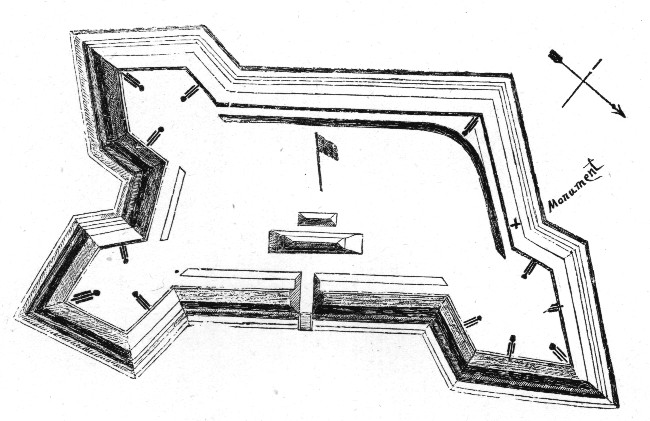
PLAN OF FORT NONSENSE. FROM PEN AND INK SKETCH BY MAJOR J. P. FARLEY, U. S. A.
As a philanthropist, Dr. Buckley is widely interested in all questions concerning humanity, and he responds continually with his time and thought to the appeals made to him from one direction and another. Our own State Charities Aid Association of New Jersey owes much to Dr. Buckley for his warm and earnest co-operation in its early struggles in Morristown for existence, and in its work, since then.
As an orator, all who have heard Dr. Buckley feel that he has what is called the magnetic power of controlling and carrying with him his audience, and a remarkable capacity for mastering widely different subjects. The beautiful spring day (April 27, 1888), will long be remembered, when the people of Morristown had the opportunity of hearing his eloquent address at the unveiling of the Soldiers Monument on Fort Nonsense.
In Dr. Buckley's last book on "Faith Healing; Christian Science and Kindred Phenomena," published by the Century Company, quite lately, (October, 1892), the subjects of Astrology, Coincidences, Divinations, Dreams, Nightmares and Somnambulism, Presentiments, Visions, Apparitions and Witchcraft are treated. Papers have been contributed by him on these subjects at intervals for six years with reference to this book, but the contents of the latter are not identical, i. e. they have been improved and added to. From this we give the following extract:
EXTRACT FROM "FAITH HEALING, CHRISTIAN SCIENCE AND KINDRED PHENOMENA."
The relation of the Mind Cure movement to ordinary medical practice is important. It emphasizes what the most philosophical physicians of all schools have always deemed of the first importance, though many have neglected it. It teaches that medicine is but occasionally necessary. It hastens the time when patients of discrimination will rather pay more for advice how to live and for frank declarations that they do not need medicine, than for drugs. It promotes general reliance upon those processes which go on equally in health and disease.
But these ethereal practitioners have no new force to offer; there is no causal connection between their cures and their theories.
What they believe has practically nothing to do with their success. If a new school were to arise claiming to heal diseases without drugs or hygiene or prayer, by the hypothetical odylic force invented by Baron Reichenbach, the effect would be the same, if the practice were the same.
Recoveries as remarkable have been occurring through all the ages, as the results of mental states and nature's own powers.
The verdict of mankind excepting minds prone to vagaries on the border-land of insanity, will be that pronounced by Ecclesiasticus more than two thousand years ago:
"The Lord hath created medicines out of the earth; and he that is wise will not abhor them. My son, in thy sickness be not negligent; but pray unto the Lord and he will make thee whole. Leave off from sin and order thy hands aright, and cleanse thy breast from all wickedness. Then give place to the physician, for the Lord hath created him; let him not go from thee, for thou hast need of him. There is a time when in their hands there is good success. For they also shall pray unto the Lord, that He would prosper that which they give for ease and to prolong life."
Rev. James M. Freeman, D. D.
Dr. Freeman is the second of the trio of theologians and editors, whose homes are in Morristown. For the last twenty years, he has been associate editor of "Sunday School Books and Periodicals and of Tracts" of the Methodist Episcopal Church. His Biblical studies are well known. His "Hand-Book of Bible Manners and Customs" was compiled with great care after years of research and published in 1877. This "Hand-Book" has been invaluable to Bible students and in it a large amount of information is given in small space, and in an interesting and entertaining manner.
Another important volume is "A Short History of the English Bible". Both these works are in the Morristown Library, presented by the author.
Many years ago, Dr. Freeman published, under the name of Robin Ranger, some charming story-books "for the little ones", in sets of ten tiny volumes. This work has placed him already in our group of Story-Writers.
Besides these, there are two Chautauqua Textbooks, viz., "The Book of Books" and "Manners and Customs of Bible Times", also "The Use of Illustration in Sunday School Teaching".
The "Hand-Book of Bible Manners and Customs", in particular, and the "Short History of the English Bible" are books which one can not look into without desiring to own. In the former, the author says in his short but admirable preface:
"Though the Bible is adapted to all nations, it is in many respects an Oriental book. It represents the modes of thought and the peculiar customs of a people who, in their habits, widely differ from us. One who lived among them for many years has graphically said: 'Modes, customs, usages, all that you can set down to the score of the national, the social, or the conventional, are precisely as different from yours as the east is different from the west. They sit when you stand; they lie when you sit; they do to the head what you do to the feet; they use fire when you use water; you shave the beard, they shave the head; you move the hat, they touch the breast; you use the lips in salutation, they touch the forehead and the cheek; your house looks outwards, their house looks inwards; you go out to take a walk, they go up to enjoy the fresh air; you drain your land, they sigh for water; you bring your daughters out, they keep their wives and daughters in; your ladies go barefaced through the streets, their ladies are always covered'.
"The Oriental customs of to-day are, mainly, the same as those of ancient times. It is said by a recent writer that 'the Classical world has passed away. We must reproduce it if we wish to see it as it was.' While this fact must be remembered in the interpretation of some New Testament passages, it is nevertheless true that many ancient customs still exist in their primitive integrity. If a knowledge of Oriental customs is essential to a right understanding of numerous Scripture passages, it is a cause of rejoicing that these customs are so stereotyped in their character that we have but to visit the Bible lands of the present day to see the modes of life of patriarchal times."
Therefore, the author undertakes and undertakes with remarkable success, to illustrate the Bible by an explanation of the Oriental customs to which it refers.
Rev. Kinsley Twining, D. D., LL. D.
Rev. Dr. Twining, up to 1879, devoted his time and attention entirely to the ministry and charge of two large city Congregational churches, one in Providence, R. I. While in the latter city, he published a book of "Hymns and Tunes", for his church there, which was acceptable and popular among the people, and contributed largely to develop the hearty congregational singing for which end it was compiled. While in this charge, he was for some time abroad, and mingled considerably in the literary life of Germany, and also in the musical life of that country. Hence, he is a fine theorist in music.
Since 1879 he has been literary editor of The Independent, and during these years he has written enough valuable editorials and reviews to fill many books. Many of his lectures, addresses, essays and other writings have appeared in magazines and other publications, notably a charming description of an "Ascent of Monte Rosa" in the American Journal of Science and Arts, of May, 1862. We find in a book entitled "Boston Lectures, 1872", a chapter given to one on "The Evidence of the Resurrection of Jesus Christ, by Rev. Kinsley Twining, Cambridge, Mass.", in which the argument is, as might be expected, keen and clear. One of his more recent published papers was read by him at one of the Literary Reunions at Mr. Bowen's in Brooklyn, N. Y., and attracted much attention. It has since been given in Morristown: subject, "The Wends, or a Queer People Surviving in Prussia".
Dr. Twining has made a special study of Shakespeare and holds a high rank as a Shakesperian critic and scholar.
With regard to editorial work, it may be said an editor has a maximum of influence, the minimum of recognition,—for nobody knows who does it. It is certain that powerful editorials sometimes turn the tide of public opinion or actually establish certain results which affect the progress of the world, and at least make a mark in the world's advance. Who, indeed, can compute or measure the power of the press at the present day?
We choose for Dr. Twining, some paragraphs from his editorial which has already acquired some celebrity in The Independent of Sept. 15, 1892, on John Greenleaf Whittier. The death of the poet occurred on the 7th of the same September and he had been one of the earliest and most regular contributors to that paper since 1851.
FROM EDITORIAL ON JOHN GREENLEAF WHITTIER.
It has been said that every man of genius makes a class distinct by himself, out of relation and out of comparison with everybody else. At all events poets do, the first born in the progeny of genius; and of none of them is this truer than of the four great American poets, Bryant, Longfellow, Lowell and Whittier. In what order of merit they stand in their great poetic square, the distinct individuality of genius bestowed on each makes it needless to inquire. They have been our lights for half a century, and now that they have taken their permanent place in the galaxy of song, will continue to shine there, to use the phrase which Whittier himself invented for Dr. Bowditch's sun-dial, as long as there is need of their "light above" in our "shade below."
Whittier is the ballad-master and legend singer of the American people. Had he known the South and the West as he knew New England, he would have sung their legends as he has sung those of New England. The meaning of all this is that he is the minstrel of our people. This he has been, and this he will remain. Whether it is in the solemn wrath of the great ballad, "Skipper Ireson's Ride," one of the greatest in modern literature, in the high patriotic strain of "Barbara Frietchie," in the pathos of "The Swan Song," of "Father Avery," "The Witch's Daughter," or in the grim humor of "The Double-Headed Snake of Newberry."
"One in body and two in will,"
it matters little what the subject is, or from whence it comes, the poem has in it some reflection of the common humanity, and as such speaks and will speak to the hearts of men.
It has been the fashion to write of Victor Hugo as the poet of democratic humanity. We shall not dispute his claim. There is a certain epic grandeur in his work which entitles him to a seat alone. But to those who believe the world is moving toward a democracy whose ideals are the realization of the Sermon on the Mount, whose essence is ethical, and whose laws are gentleness, usefulness and love, Greenleaf Whittier will be the true democratic poet whose heart beats most nearly with the pulses of the democratic age, and who best represents the principles which are to give it permanence.
Rev. Theodore Ledyard Cuyler, D. D.
The Rev. Dr. Cuyler should immediately follow the group of editors and theologians, as he has been a regular writer for the religious press, as well as for the secular, for many years. To the former he has contributed more than 3,000 articles, many of which have been re-published and translated into foreign languages.
In reply to a request for certain information, Dr. Cuyler, in a letter dated from Brooklyn, January 13, 1890, and written "in a sick room, where he was laid up with the 'Grip'", a disease of the present day which we hope may become historic,—replies to the author of this book as follows:
"Probably no American author has a longer association with Morristown than I have; for my ancestors have laid in its church-yards for more than a century.
"My great-great-grandfather, Rev. Dr. Timothy Johnes, preached in the 1st Presbyterian Church for 50 years and administered the Communion to General Washington.
"My great-grandfather, Mr. Joseph Lewis, was a prominent citizen of Morristown and an active friend and counsellor of Washington.
"My grandmother, Anna B. Lewis, was born in Morristown.
"My mother, Louisa F. Morrell, was also born in Morristown (in 1802) in the old family "Lewis Mansion" in which Mr. William L. King now lives.
"I was at school in Morristown in 1835 and it was my favorite place for visits for many, many years. I have often preached or spoken there.
"The man most familiar with my literary work is Dr. J. M. Buckley, the editor of the Christian Advocate—who now resides in Morristown."
This letter was signed with his name, as "Pastor of Lafayette Avenue Presbyterian Church." Less than a month later he announced to his astonished congregation, his intention of resigning his charge among them on the first Sabbath of the following April, when it would be exactly thirty years since he came to a small band of 140 members, which then composed his flock. At the close of his remarks on that occasion he said: "It only remains for me to say that after forty-four years of uninterrupted ministerial labors it is but reasonable to ask for some relief from a strain that may soon become too heavy for me to bear."
During the celebration of the twenty-fifth anniversary of his pastorate, in 1885, he told his congregation that during that time he had preached over 2,300 discourses, had made over 1,000 addresses, officiated at about 600 marriages, baptized 800 children, received into the church 3,700 members, of whom about 1,600 were converts, and had lost but one Sunday for sickness. Probably few men are more widely known for their literary and oratorical powers and extended usefulness both in the pulpit and out of it. Few, if any, have accomplished more in the same number of years or made a wider circle of warm and earnest friends both at home and abroad. Among the latter is the Hon. Wm. E. Gladstone, and was, the late John Bright. In his sermons and addresses, the personality of Dr. Cuyler is so marked that to hear him once is to remember him always. In England he has been especially popular as a preacher and temperance advocate. The latter cause he has espoused most warmly during his entire life.
Dr. Cuyler was born in the beautiful village of Aurora, N. Y., upon Cayuga Lake, of which his great-grandfather, General Benjamin Ledyard, was the founder. He was graduated at Princeton in 1841, and at Princeton Theological Seminary in 1846. Two years later, he was ordained into the Presbyterian Ministry, and was installed pastor of the Third Presbyterian Church of Trenton, N. J., then of the Market St. Reformed Dutch Church of New York City, and in April 1860, of the Brooklyn Lafayette Avenue Presbyterian Church.
Among the author's books are the following, nearly all of which have been reprinted in London and have a very wide circulation in Great Britain. Five or six of them have been translated into Dutch and Swedish:
"Stray Arrows", "The Cedar Christian", "The Empty Crib", a small book published many years ago after the death of one of his children and full of solace and consolation to the hearts of sorrowing parents; "Heart Life"; "Thought Hives"; "From the Nile to Norway"; "God's Light on Dark Clouds"; "Wayside Springs", and "Eight to the Point," of the "Spare Minute Series".
Dr. Cuyler himself says that he considered his chief literary work to have been the preparation of over 3,000 articles for the leading religious papers of America. There might be added to this the publication of a large number of short and popular tracts.
Here again we find, as in several instances before recorded in this book, a man of long experience and good judgment placing in the highest rank of writings, useful to mankind, those done for the religious or secular newspapers. We give a short passage
FROM, "GOD'S LIGHT ON DARK CLOUDS."
There is only one practical remedy for this deadly sin of anxiety, and that is to take short views. Faith is content to live "from hand to mouth," enjoying each blessing from God as it comes. This perverse spirit of worry runs off and gathers some anticipated troubles and throws them into the cup of mercies and turns them to vinegar. A bereaved parent sits down by the new-made grave of a beloved child and sorrowfully says to herself, "Well, I have only one more left, and one of these days he may go off to live in a home of his own, or he may be taken away; and if he dies, my house will be desolate and my heart utterly broken." Now who gave that weeping mother permission to use that word "if"? Is not her trial sore enough now without overloading it with an imaginary trial? And if her strength breaks down, it will be simply because she is not satisfied with letting God afflict her; she tortures herself with imagined afflictions of her own. If she would but take a short view, she would see a living child yet spared to her, to be loved and enjoyed and lived for. Then, instead of having two sorrows, she would have one great possession to set over against a great loss; her duty to the living would be not only a relief to her anguish, but the best tribute she could pay to the departed.
Rt. Rev. Wm. Ingraham Kip, D.D., LL.D.
Bishop Kip, since 1853, Bishop of California, was called to old St. Peter's Church, Morristown, immediately after his taking orders in 1835. "The first time the service of the Protestant Episcopal Church was used in Morristown, so far as known," says our historian, "was in the Summer of 1812. At that time Bishop Hobart of New York was visiting Mr. Rogers at Morristown, and by invitation of the officers of the First Presbyterian Church, he officiated one Sunday in their church, preaching and using the Episcopal service."
For two years, 1820 and '21, the service was held on Sundays, at the house of George P. McCulloch, and finally on Dec. 4th, 1828, the church building was consecrated which has stood until quite recently. Now a superb stone edifice covers the ground of the old church.
In the ancestry of Bishop Kip we have a link with the far off story of France, for he is descended from Ruloff de Kype of the 16th Century, who was a native of Brittany and warmly espoused the part of the Guises in the French civil war between Protestants and Papists. After the downfall of his party, this Ruloff fled to the Low Countries; his son Ruloff became a Protestant and settled in Amsterdam and his son Henry made one of the Company which organized in 1588 to explore a northeast passage to the Indies. He came with his family, to America in 1635, but returned to Holland leaving here his two sons Henry and Isaac. Henry was a member of the first popular assembly in New Netherlands and Isaac owned the property upon which now stands the City Hall Park of New York.
In 1831, the young William Ingraham, was graduated at Yale College and after first studying law and then divinity was admitted to orders and at once became the third rector of St. Peter's, at Morristown, remaining from July 13th, 1835, until November of the following year. Columbia bestowed upon him in 1847, the degree of S. T. D. Between the rectorship of St. Peter's and the bishopric of California, he served as assistant at Grace Church, New York, and was rector of St. Paul's, at Albany.
Bishop Kip has published a large number of books, many of which have gone through several editions. In addition he has written largely for the Church Review and the Churchman and several periodicals. Among his books are "The Unnoticed Things of Scripture", (1868); "The Early Jesuit Missions" (2 Vols., 6 editions, 1846); "Catacombs of Rome", (8 editions, 1853); "Double Witness of the Church", (27 editions, 1845); Lenten "Fast", (15 editions, 1845); the last two were published in both England and America as was also "Christmas Holydays in Rome", (1846). Besides these are "Early Conflicts of Christianity", (6 editions); "Church of the Apostles"; "Olden Times in New York"; "Early Days of My Episcopate", (1892).
EXTRACT FROM THE PREFACE OF THE "EARLY JESUIT MISSIONS."
There is no page of our country's history more touching and romantic than that which records the labors and sufferings of the Jesuit Missionaries. In these western wilds they were the earliest pioneers of civilization and faith. The wild hunter or the adventurous traveler, who, penetrating the forests, came to new and strange tribes, often found that years before, the disciples of Loyola had preceded him in that wilderness. Traditions of the "Black-robes" still lingered among the Indians. On some moss-grown tree, they pointed out the traces of their work, and in wonder he deciphered, carved side by side on its trunk, the emblem of our salvation and the lilies of the Bourbons. Amid the snows of Hudson's Bay—among the woody islands and beautiful inlets of the St. Lawrence—by the council fires of the Hurons and the Algonquins—at the sources of the Mississippi, where first of the white men, their eyes looked upon the Falls of St. Anthony, and then traced down the course of the bounding river, as it rushed onward to earn its title of "Father of Waters"—on the vast prairies of Illinois and Missouri—among the blue hills which hem in the salubrious dwellings of the Cherokees—and in the thick canebrakes of Louisiana—everywhere were found the members of the Society of Jesus. Marquette, Joliet, Brebeuf, Jogues, Lallemand, Rasles and Marest,—are the names which the West should ever hold in remembrance. But it was only by suffering and trial that these early labours won their triumphs. Many of them too were men who had stood high in camps and courts, and could contrast their desolate state in the solitary wigwam with the refinement and affluence which had waited on their early years. But now, all these were gone. Home—the love of kindred—the golden ties of relationship—all were to be forgotten by these stern and high-wrought men, and they were often to go forth into the wilderness, without an adviser on their way, save their God. Through long and sorrowful years, they were obliged to "sow in tears" before they could "reap in joy."
Rev. William Staunton, D. D.
With this author, the fifth rector of old St. Peter's Church, in Morristown, we go back in association to the ancient city of Chester, England, where he was born and where his grandfather on his mother's side was a leading dissenting minister and the founder of Queen's Street Chapel, Chester. His father, an intellectual man and well read in Calvinistic theology, also affiliated with the Independents, but was often led by his fine musical taste to attend with his son the services of the Cathedral. It was in this Cathedral of Chester, which is noted for the beauty and majesty with which the Church's ritual is rendered,—that the boy acquired that love of music which placed him in after life in the front rank of church musicians. One who knew him well has said of him in this respect: "This knowledge of music was profound and comprehensive. He was not simply a musical critic or a composer of hymn tunes and chants, but he had followed out through all its intricacies the science of music. So well known was he for his learning and taste in this department that it was a common thing for professional musicians of distinction to go to him for advice and to submit their compositions to him, before publication. Much of his own music has been published. But his musical accomplishments are best attested by the work which he did as associate editor of Johnson's Encyclopedia." He was in particular, the musical editor of this work and wrote nearly all of the articles relating to music in it. He was also a prolific writer for church reviews and other periodicals. Among his publications in book form are: "A Dictionary of the Church", (1839); "An Ecclesiastical Dictionary", (1861); "The Catechist's Manual", a series of Sunday School instruction books; "Songs and Prayers"; "Book of Common Prayer"; "A Church Chant Book", and "Episodes of Clerical and Parochial Life".
Dr. Staunton came with his father and the family, when fifteen years of age, to Pittsburg, Pa. He was closely associated with the Rev. Mr. Hopkins, afterward the Bishop of Vermont. His first ministerial charge was that of Zion Church, Palmyra, N. Y., and it was in 1840 he accepted the rectorship of St. Peter's Church, Morristown, which position he held for seven years. He then organized in Brooklyn, N. Y., a much needed parish, which he named St. Peter's after the parish he had just relinquished.
"Dr. Staunton," says the present rector of St. Peter's, the Rev. Robert N. Merritt, D. D., who took up the work of the parish in 1853, and to whose untiring exertions, the parish and the people of Morristown are largely indebted for the erection of the massive and beautiful stone structure that stands on the site of the church of Dr. Staunton's time,—"Dr. Staunton was no ordinary man, though he never obtained the position in the church to which his abilities entitled him. Besides being above the average clergyman in theological attainments, he was a scientific musician, a good mechanic, well read in general literature, and so close an observer of the events of his time that much information was always to be gained from him. His retiring nature and great modesty kept him in the back ground."
The following interesting reminiscence comes to us, in a letter, from one of the boys who was under his ministration when rector for seven years of old St. Peter's. "I remember", says this parishioner, "Dr. Staunton very distinctly and with much affection as well as regard and gratitude, for the training I had from him in the doctrines and ordinances of the church. He was for those days a very advanced churchman, being among the first to yield to the influence the Oxford movement was exercising and to adopt the advance it inaugurated in the ritual and service of the liturgy informing strictly however himself and teaching his people to recognize the authority of the rubrics. He maintained this, I think, till his death, and was ranked then as a conservative rather than a high churchman, though when he was here, the same attitude made him to be thought by some as almost dangerously ultra.
"He was not eloquent nor what might be called an attractive preacher, but wrote well and accomplished a great deal as a careful and impressive teacher of sound doctrine and Christian morality.
"Dr. Staunton was an accomplished scholar in scientific as well as ecclesiastical learning, was skilled as a draughtsman and designed, I remember, the screen of old St. Peter's when the chancel stood at the South street end; and it was wonderfully good and effective of its kind. He was also a trained musician, and at one time instructed a class of young ladies in thorough-bass, among them being the two Misses Wetmore, my eldest sister, and others, and, in addition to this, he made the choir while he was here, both in the music used and its efficiency, a vast improvement upon what it had been. He was a tall man, fully six feet, of a severe countenance and rather austere manner, leading him to be thought sometimes cold and unsympathetic, though really he was most kind and considerate, and in all respects a devoted and watchful pastor. He published, I think, a church dictionary later in life which is still a standard book and authority.
"These are my impressions of Dr. Staunton received principally as a very young boy, though confirmed by an acquaintance continued till his death, and I retain the most sincere gratitude for the abiding faith in the sound doctrine of the Episcopal Church which he, after my mother, so trained me in that I have accepted them ever since as impregnable; and for this I am sure there are many others of his pupils and parishioners besides myself to 'call him blessed.'"
Rev. Arthur Mitchell, D. D.
Rev. Dr. Mitchell was the third pastor of the South Street Presbyterian Church, which was the fifth, says our historian, "in our galaxy of churches." The time of his ministration, during which the church was greatly enlarged, both internally and externally, was from 1861 to 1868.
Dr. Mitchell is the son of Matthew and Susan Swain Mitchell, and was born in Hudson, N. Y. He was graduated at Williams College in 1853, was tutor in Lafayette College, Pa., for one year, and then traveled for a year in Europe and the East. Returning he entered the Union Theological Seminary of New York City and was graduated from there in 1859. In this year he accepted the charge of the Third Presbyterian Church in Richmond, Va., and in Oct. 1861, he became pastor of what was then called, the "Second Presbyterian Church" in Morristown. The first Presbyterian Church of Chicago, Ill., claimed him in 1868 and in 1880 the First Presbyterian Church of Cleveland, Ohio. In 1884, Dr. Mitchell became Secretary of the Foreign Missions of the Presbyterian Church to which position he had been called fifteen years before, but had felt constrained to decline. This important office, which from his intense and life-long interest in the great cause of Christian missions to the heathen world, he was remarkably qualified to fill, he has held to the present time. In all his ministrations, in each individual church which he has served, he has succeeded in imparting his own love of, and interest in, Foreign Missions and his position as Secretary of this department of the church organization has enabled him to stimulate the great congregations and masses of individuals throughout the denomination.
Dr. Mitchell's eloquence in the pulpit and on the platform, is so well-known that it seems hardly worth while to refer to it. Mastering his subject completely as he does, he has the rare power of condensing clearly and giving out his thoughts in language and in tones of voice which hold and attract his audience to the end. He has published no books, only sermons and addresses in pamphlet form and innumerable articles in magazines and newspapers. To the great value of this sort of literary work, several of our distinguished authors have already testified. In the Church at Home and Abroad, we find the most exhaustive articles from Dr. Mitchell's pen, on the missions and conditions of the various countries of the earth which he has also recently visited in a trip around the world. These are all written from so large a standpoint that they are about as interesting to the general reader as to the specialist. In the publication, the "Concert of Prayer" many of these valuable papers are found and a considerable number of his addresses, articles, &c., are bound among those of other writers, in large volumes. In the next generation we find a writer also, in Dr. Mitchell's daughter, Alice, who does not desire mention for the reason that her writings are so fragmentary and scattered. Nevertheless, her literary work has been considerable and cannot be easily measured or described. One who knows her well, says: "Not many ladies are better read in missionary annals." In an article of hers, of great interest, published in the Concert of Prayer for Church Work Abroad, and entitled "The Martyrs of Mexico," we come upon the story of the Rev. John L. Stephens, previously mentioned in this book among "Travels", &c., and who, Miss Mitchell tells us, was one of the earliest missionaries of the Congregational church to Mexico.
We have already mentioned that Mr. Matthew Mitchell, the father of our writer, lived in Morristown for many years and married for his second wife, Miss Margaret, the daughter of the good Doctor John Johnes, and the granddaughter of the good Pastor Johnes.
We give a short passage from the opening of Dr. Mitchell's Memorial Sermon on James A. Garfield, delivered in the First Presbyterian Church of Cleveland, Ohio, on Sunday, Sept. 25, 1881, and published by a number of prominent men who requested the privilege:
FROM THE "MEMORIAL SERMON" ON JAMES A. GARFIELD.
We share, my friends, to-day, the greatest grief America has ever known. It is no exaggeration to say that no one stroke of Providence has ever spread throughout all our land such poignant and universal pain, or has been so widely felt as a shock and a sorrow in every portion of the earth.
I am not using words without care. I do not forget those dreadful days of April, sixteen years ago, when the slow procession passed from State to State, bearing the remains of the beloved Lincoln to the tomb. But there was one whole section of our land, it will be remembered, which had never acknowledged him as their ruler, and had never viewed him alas! except as their foe. Innumerable noble hearts there discussed the crime that laid him low; but although they abhorred the assassin's crime, around his victim their sentiments of confidence and admiration and loyalty had never been gathered.
I do not forget the horror which smote the nation when Hamilton fell, the universal pall of sorrow of which our fathers tell us,—the metropolis of the country draped in black, the vast and solemn cortège, which amidst weeping throngs, followed Hamilton through its chief avenue to the grave.
And as one heart, the hearts of Americans mourned for Washington. There were friends of liberty who wept with them in every part of the world. But liberty itself had not then so many friends on earth as now. By one great nation Washington was held to have drawn a rebel sword. And against another, our earlier ally, he had unsheathed it and stood prepared for war. And even by the countrymen of Washington it could not be forgotten that he had nearly fulfilled the allotted years of man. His work was done. His years of war had won for his country the full liberty she sought. His eight glorious years of Presidential life had organized the Government, established its relations to foreign powers and made its bulwarks strong. At his death it was even said that he had "deliberately dispelled the enchantment of his own great name;" with wonderful unselfishness he himself placed the helm in other hands, looked on for a time at the prosperity which he had taught others to supply, and "convinced his country that she depended less on him than either her enemies or her friends believed." And then he died in the peaceful retirement of his home. It was the death of a venerated father whose work was done.
Rev. Charles E. Knox, D. D.
For six or eight months in the midst of the Rev. Arthur Mitchell's pastorate, a distinguished scholar of the Presbyterian Church, the Rev. Charles E. Knox, D. D., filled Dr. Mitchell's place as pastor of the South Street Church, Morristown, while the latter was absent in Europe and Palestine. This period was from September 1863 to May 1864. When Dr. Mitchell resigned in 1868, the present pastor, Rev. Dr. Erdman, was called at Dr. Knox's suggestion. From 1864 to 1873, Dr. Knox was pastor of the church at Bloomfield, N. J., and since that time has been President of the German Theological School of Newark, which is located in Bloomfield. Dr. Knox says, in writing of his sojourn in Morristown: "I had a happy time with the good South street people and have retained always the liveliest interest in all that belongs to them."
"A Year with St. Paul" had just been published when the charge of this South Street Church was undertaken. It has since been translated into Arabic at Beirut, Syria. "It is in good part," says the author, "a compilation and condensation of Conybeare and Howson's Life and Epistles of St. Paul", (then in two large and expensive volumes), with some original matter. It has a chapter for every Sunday of the year.
Dr. Knox began in Morristown a series of "Graduated Sunday School Text Books,"—Primary Year, Second Year, Third Year, Fourth Year and Senior Year. This was an introduction of the secular graded system into Sunday School Teaching. It introduced the Quarterly Review which has since been followed.
"David the King," a life of David with section maps inserted in the page and a location of the Psalms in his life, was published later at Bloomfield.
Rev. Albert Erdman, D. D.
The Rev. Dr. Erdman is entitled to honorable mention among Morristown writers. He has been the faithful pastor of the South Street Presbyterian Church since May 1869, following the Rev. Arthur Mitchell, D. D. It was during his ministry that in 1877, the church edifice was totally consumed by fire, and the beautiful new building located on its site, in the late Byzantine style. It is said by one who knows and appreciates Dr. Erdman's work that "few men read more or digest better their reading."
For several years, he has prepared "Notes on the International Sunday School Lessons", for a monthly periodical published in Toronto, Canada.
A number of sermons have been published by request, among them the "Sermon on the Fiftieth Anniversary of the South Street Presbyterian Church".
Addresses on "Prophetic and other Bible Studies" have been printed in Annual Reports of the Bible Conference at Niagara-on-the-Lake, Ontario, and, besides these, many fugitive newspaper articles of value and importance.
Dr. Erdman has been largely interested in the general welfare, and especially the philanthropies, of the town, outside of his immediate church, and by this public spirit, earnestly and fearlessly manifested, in many instances, he has no doubt greatly extended his sphere of influence.
He has been a warm supporter of, and has given much time and personal attention to the establishment of the Morris County Charities Aid Association and of the State Association which followed, carefully studying the questions of pauper and criminal reform for which purpose this organization exists.
In the Semi-Centennial Sermon we find the following remarkable record:
EXTRACT FROM THE SEMI-CENTENNIAL SERMON ON THE 50TH ANNIVERSARY OF THE CHURCH'S ORGANIZATION.
I must note the unique fact that the history of these fifty years of Church life is the history of uninterrupted prosperity. Even that which seemed at the time to be against us—the destruction by fire of the former house of worship—proved to be, as are all the Lord's afflictions, a blessing in disguise; for the history of the church since is that of continued and ever-increasing prosperity, if growing numbers and enlarged usefulness be criterion of success. A spirit of harmony and goodwill mark its whole course, and it is, therefore, with unmingled pleasure and gratitude to God, we may recall the past. No roots of bitterness and strife to be covered up, no rocks of offense to be carefully avoided!
How the memories of the past throng around us—the saintly lives of fathers and mothers, the godly service and earnest prayers of pastors and people, the fervent appeals from pulpit and teacher's chair,—surely it would seem there could be no valid reason why any should be still unsaved or unwilling to take up the duties of Christian service.
Finally, as we here recall the story of the past and rejoice in the prosperity of the present, and while we look forward to still larger service and blessing in the days to come, let us, with a deep sense of our unworthiness and dependence, say, with the Psalmist: "Not unto us, O Lord, not unto us; but unto Thy name be all glory."
Rev. Joseph M. Flynn, R. D.
The Roman Catholic Church in Morristown erected its first building in 1847. It was a small wooden structure, with seating capacity for about 300 people and is now used by the parish school. It was in 1871 that the first priest in full charge, Rev. James Sheeran, was stationed here, and at his death in 1881, the Rev. Joseph M. Flynn succeeded, who has continued in charge of the parish to the present time. He was named "Dean of the Catholics in Morris and Sussex Counties" about six years ago.
This author has recently published a book, (Morristown, N. J., 1892), "The Story of a Parish" from the first chapter of which we quote. Also he has written some magazine articles and a brochure on "Lent and How to Spend it." He is now preparing for publication a volume of short sermons.
"The Story of a Parish" is the story of the foundation and development of this parish of the Church of the Assumption, in Morristown.
In the opening chapter, the author says:
"We know that Raphael, Bramante, and Michel Angelo threw into St. Peter's the very heart and soul of their inspiration, to erect to the living God such a temple as the eye of man had never gazed upon.
"But there are other monuments which thrill no less the beholder, and the names of their creators sleep in an impenetrable obscurity. The cross-crowned fane, lifting to the highest heaven the sign of man's redemption, may tell us neither of him whose genius conceived nor of the toilers whose strong arm and cunning eye, in the burning heats of Summer, or in the chilling blasts of Winter, unfolded to the wondering crowds who daily watched their labors, step by step, inch by inch, the beauties whose finished product Time has preserved to us in many a shire of Britain; by the glistening lakes and verdant vales of Erin; in sunny Italy, in fair France, and in the hallowed soil bathed by our own Potomac. To the humble laborer who dug the trenches, to the artist whose chisel carved foliage or cusp or capital, a share in our grateful memory is due."
Rev. George Harris Chadwell.
The group of people who originated the idea of forming a second Episcopal Church in Morristown, perfected their plans in 1852. The following year the church building was erected. The first rector, Rev. J. H. Tyng, assumed his duties in September, 1852. The Rev. W. G. Sumner accepted a call to the parish in 1870. As he is now Professor of Political Economy at Yale University—he will come, with his specialty, into a later group. In 1880, Rev. George H. Chadwell became rector of the parish, coming from Brooklyn where he had been assistant to the Rev. Charles Hall, D. D., rector of Trinity Church of that City.
Mr. Chadwell courageously undertook the removal of the church edifice from the spot where it had stood since 1854, on the corner of Morris and Pine streets, to its present site on South street, on which occasion he delivered one of his important "Addresses" which was published and largely distributed. He lived to see his aim accomplished and not long after gave, in the church again, on what proved to be the last Sunday of his life, a sermon, which was also published under the title of "A Farewell Discourse."
Mr. Chadwell also published a monthly paper during his rectorship, called The Rector's Assistant, and wrote in other directions.
In the "Address on the Occasion of the Re-opening of the Edifice for Divine service," August 22, 1886, we find a reference to the interesting history of the land on which the building now stands, and its association with many of the old families of Morristown, as follows: