BOOK X, LINES 814 TO 842.
Reading edition
The destinies now are for Lausus the last threads Gathering in; for Æneas his powerful scimitar ruthless815 Drives through the midst of the youth, and buries it wholly within him, Right through the menacer's targe, and his delicate armor, the keen blade Passed through the tunic his mother had woven in tissue of gold thread For him, and blood filled all of his bosom; then life on the breezes Mournful withdrew to the shades, and abandoned his body untimely.820 But as the son of Anchises in truth on the visage and features Gazed of the dying—the features, becoming amazingly pallid— Pitying deeply he sighed and instinctively tendered his right hand, Fresh as the image recurred to his mind of regard for a father: "What to thee now, O pitiable boy, for these laudable efforts,825 What shall the pious Æneas, befitting such nobleness render? Keep it—thine armor, in which thou rejoicest, and I to thy parents' Shades and their ashes, if this could be any requital, remit thee; Yet thou in this, though unlucky, canst solace thy sorrowful exit, That by the hand of the mighty Æneas thou fallest." Abruptly830 Chides he his faltering comrades, as gently from earth he uplifts him, Soiling his ringlets with blood, that were combed in the comeliest fashion. Meanwhile, his father was down by the wave of the stream of the Tiber Staunching his wound with its waters, and resting his body, reclining Close by the trunk of a tree. At a distance his coppery helmet825 Hangs on its boughs, and at rest on the sod is his cumbersome armor: Standing around are his warriors chosen; he sickly and panting Eases his neck, as his out-combed beard streamed down on his bosom; Often he asks after Lausus, and many a messenger sends he Back to recall him, and bear him his sorrowful parent's injunctions:840 But on his armor his comrades were weepingly bearing the lifeless Lausus away—a hero o'ercome by the wound of a hero.
Rev. J. Leonard Corning, D. D.
Dr. Corning, who, with his family, was for some years a resident of Morristown and is now abroad, is represented later in the volume, among the writers on Art. We give here his beautiful poem, "The Ideal".
THE IDEAL.
Awake, asleep, in dreams, amid the din of mortal striving, I feel thee ever near, vision of fancy's sweet contriving: The setting sun and twilight glow Thou art the music sweet and low. When on the sands, at dead of night, Dark waves are breaking in their might, While, through the billowy crests, the wild winds roar, Thou art the gull who over all dost soar. Amid the storm and lightning flash, The pelting rain and thunder crash, When faces blanch, and none can will, Thou, heavenly bow, art faithful still. 'Tis not the kiss, the touch, the sigh, That bringeth love from earth to sky; For motions strange about the heart Reveal the inner nature of thy part.
Mrs. Mary Lee Demarest.
Mrs. Augustus W. Cutler has kindly given us the following monograph:
"In a Memorial of the late Mrs. Mary Lee Demarest occurs the following passage: 'For two hundred and fifty years, the English readers of the Bible were obliged to content themselves with the phrase, 'They seek a country'. It was not the whole thought. It was reserved for a corps of learned revisers to light upon the happy phrase, 'They are seeking a country of their own'.' But a score of years before the wise grammarians reached this line, a youthful poetess, seeing and greeting the Heavenly promise from afar, wrote simply and sweetly:
"'I'll ne'er be fu' content, until mine een do see The shining gates o' Heaven, an' my ain countree'.
"This youthful poetess was Mary Lee, afterwards Mrs. T. F. C. Demarest.
"Before her marriage, in 1870, she spent several years in Morristown and became identified with the place and its interests; and there are many persons living here who remember her sweet face and gentle ways.
"A taste for the Scotch dialect is said to have been acquired from an old Scotch nurse who lived a long time in the family, when the children were young. The girl caught it so completely, that when deeply moved, she was wont to drop into it, for the more vigorous expression of her feelings. 'Somehow', said she, 'the Scotch is more homely, less formal to me'. Thus, in the poem alluded to, could the thoughts contained in it, have been expressed as beautifully and tenderly in the mother tongue?
"Again, there is a little poem in the same dialect, entitled 'My Mither', which appeals to every heart.
"Though many of her poems and prose writings are of a devotional character, yet she had a keen sense also of the humorous side of life as the verses entitled 'Allen Graeme', will testify.
"Mrs. Demarest traveled extensively throughout our own country, and also abroad. Two volumes of her writings have been published—one entitled 'Gathered Writings', a collection of short stories, fragments of foreign travel and reflections".
MY AIN COUNTREE.
I am far frae my hame, an' I'm weary afterwhiles, For the langed-for hame-bringing an' my Father's welcome smiles; I'll ne'er be fu' content, until mine een do see, The shining gates o' heaven an' my ain countree. The earth is fleck'd wi' flowers, mony tinted fresh and gay, The birdies warble blithely, for my Father made them sae; But these sights an' these soun's will as naething be to me, When I hear the angels singing in my ain countree. I've His gude word o' promise that some gladsome day, the King To his ain royal palace His banished hame will bring; Wi' een an' wi' hearts running owre, we shall see The King in His beauty, in our ain countree; My sins hae been mony, an' my sorrows hae been sair, But there they'll never vex me, nor be remembered mair; His bluid has made me white—His hand shall dry mine e'e, When he brings me hame at last, to mine ain countree. Sae little noo I ken, o' yon blessed, bonnie place, I ainly ken its Hame, whaur we shall see His face; It wud surely be eneuch forever mair to be In the glory o' His presence in our ain countree. Like a bairn to its mither, a wee birdie to its nest, I wad fain be ganging noo, unto my Saviour's breast, For he gathers in His bosom witless, worthless lambs like me, An' carries them Himsel', to His ain countree. He's faithfu' that has promised, He'll surely come again, He'll keep his tryst wi' me, at what hour I dinna ken; But he bids me still to wait, an' ready aye to be To gang at ony moment to my ain countree. So I'm watching aye, and singing o' my hame as I wait, For the soun'ing o' His footfa' this side the gowden gate, God gie His grace to ilk ane wha' listens noo to me, That we a' may gang in gladness to our ain countree.
Hon. Anthony Q. Keasbey.
We cannot do better than quote the words of Dr. Thomas Dunn English, the well-known author of "Ben Bolt", now living in Newark, N. J.,—with regard to Mr. Keasbey.
"Here, in Newark", says he, "we have a lawyer of distinction, Anthony Q. Keasbey, who occasionally throws off some polished verses, as he excuses them, by way of 'safety plugs for high mental pressure,' and these are always smooth and scholarly. They are mostly privately printed for the amusement of the poet and a few chosen friends. One of these, however, has such a vein of tenderness and so much heart music that it deserves to become public property and to remain as much the favorite with others as it is with me." The poem referred to is, "My Wife's Crutches."
"Unquestionably", continues Dr. English, "Mr. Keasbey stands well in his profession, and for years, under several Federal administrations, filled the office of United States District Attorney with credit to himself and advantage to the public; but this little tender poem does more honor to his intellect than his legal acquirements, however eminent they may be, and gives him a still stronger claim to the regard of his many friends."
Among Mr. Keasbey's published collected poems are "Palm Sunday", of which Mr. Stedman once said he had put it away among some fine hymns; also "May", published in England and set to music by Faustina Hodges. These verses were inspired by the falling of the cherry blossoms on the grave of little May, and are most sweet and touching. One of the best is "The Dirge for Old St. Stephen's", written while they were demolishing the church built on Mr. Keasbey's ground, where now a "mart and home" have taken its place as was anticipated by the poet.
Mr. Keasbey has published numberless papers in prominent journals and magazines. Some of these are to be collected and published in book form. His address on "The Sun: How Man has Regarded it in Different Ages", is well worthy of preservation in more permanent form than that in which it appears at present; also "The Sale of East New Jersey at Auction", an address delivered February 1st, 1862, before the New Jersey Historical Society at Trenton, on the Bi-Centennial of the Sale. This is full of interesting information, told in a charming way and is valuable for reference.
The paper on "The Sun", was inspired by Mr. Keasbey's reading with great interest, the papers of Professor Norman Lockyer, the great astronomer, describing his researches into the constitution of the sun, through the medium of the spectroscope and the photograph. Mr. Keasbey had been interested in observing the extent to which modern science had reached with respect to the actual condition of the sun and the materials of which it is composed. This led him to the thoughts of how very recent had been any such attempts to understand its true nature and, from that reflection, he was led to consider, as a subject of a paper, how human eyes in all ages have looked upon the sun and in what manner they have regarded it. This published address was delivered before the Brooklyn Historical Society, a brilliant audience present, and Rev. Dr. Storrs, presiding.
A book on Florida, "From the Hudson to the St. John's", describing a month's journey to Florida and the St. John's River was published in 1875; also, more recently, a small book on "Isthmus Transit by Chiriqui and Golfo Dulce", with a view of describing the Chiriqui mountain rib or back bone of Darien and all the executive and legislative action, with respect to the region between Panama and Nicaragua, with reference to railroad communication across the isthmus from the harbor of Chiriqui on the coast to the Pacific.
In the Hospital Review, of July, 1882, is a very striking and powerful paper on the "Tragedy of the Lena Delta", where De Long and his companions so heroically met their fate in the Arctic snows.
Below is the favorite of Dr. English among the Poems:
MY WIFE'S CRUTCHES.
Ye solemn, gaunt, ungainly crutches, That serve her frame such slippery tricks, Were you within my lawful clutches, I'd fling you back in River Styx. Ye grew beside the Boat of Charon, In murky fens of Stygian gloom, Nor ever, like the rod of Aaron, Shall your grim spindles burst in bloom. Your reeds were tuned for groans rheumatic, And croaking sighs from gouty man; Nor e'er shall thrill with tones ecstatic, As did the pipes of ancient Pan. Avaunt you, then, ye helpers dismal! Offend my eyes and ears no more; Go stalking back to realms abysmal And guide the ghosts on Lethe's shore. But see! while yet my words upbraid them, Her crutches bud with blossoms fair, And Patience, Love and Faith have made them Than Aaron's rod, more rich and rare. And hark! from out their hollows slender, No dismal groans or sighs proceed,— But tones of joy more sweet and tender Than swelled from Pan's enchanted reed. Then stay! your use her worth discloses, Your ghastly frames her worth transmutes, From withered sticks, to stems of roses— From creaking reeds, to magic flutes.
Major Lindley Hoffman Miller.
Major Miller, a brother of our well-known townsman, Henry W. Miller, was among the first of the 7th Regiment of New York City, who answered the call of the government to march to Washington for the protection of the Capitol. He served in that regiment through the riots in New York, and afterwards joined a Colored Regiment and was promoted to the rank of Major. He served in this position at Memphis and elsewhere through the South. In this campaign he lost his health and came home to die. He died in June, 1864, and was laid in old St. Peter's churchyard.
Mr. Miller was a man of brilliant mind and unusual genius. His fugitive poems are very beautiful. They were published in various journals of the time, and one we will add to this short sketch of his brief but valuable life, "The Skater's Song", full of spirit and dash, and gay with the heart of youth.
THE SKATER'S SONG, BY MOONLIGHT!
Come away, from your blazing hearths! Come away, in the gleaming night, Where the radiant sky is peering down With a million eyes of light! Heigho! for the glancing ice, For the realm of the old Frost King! We'll shake the chain of the bounding stream Till all its fetters ring! Then away! my boys, away! Far over the ice we'll sweep, And wake the slumbering echo's voice From the gloom of its winter sleep! Come away, from your cheerless books! Come away, in the clear, cold air! And read in the deeps of the starry night God's endless volume there. Ho! now we're flashing along, At the snow-flake's drifting rate! Did ever anything stir the pulse Like a glimmering moonlight skate? Then away! my boys, away! Far over the ice we'll sweep, And wake the slumbering echo's voice From the gloom of its winter sleep! Come away, from the ball-room's glare! Come away, to a merrier dance,— To a hall, whose floor is the flashing ice, Whose light is the stars' pure glance! Now we're watching the moon in her dreams, Now we dash at our speed again; While the stream groans under the icy links Which the frost has forged for his chain! Then away! my boys, away! Far over the ice we'll sweep, And wake the slumbering echo's voice From the gloom of its winter sleep! Come away, each lady fair! Come, add to the magical sight! And mingle the silvery tones of your words With the echoing "voices of night"! Heigho! for the frozen plain! Here's a glancing mirror, I ween, Reflecting all the beautiful forms That move in our fairy-like scene. Away! my lady, away! Far over the ice we'll sweep, And wake the slumbering echo's voice From the gloom of its winter sleep! Come away, from your sorrow and grief, All you that are gloomy and sad! Unwrinkle your brows to the whistling wind, Till your hearts grow merry and glad! Ho! Hark! how the laughter in peals, Is shaking the tides of the air, And shouting aloud to drown with its joy The muttering murmurs of care! Then away! my boys, away! Far over the ice we'll sweep, And wake the slumbering echo's voice From the gloom of its winter sleep! Come, one and all, then, away! Come, cheerily join in our song, And mingle with music the ring of the steel, Keep in time, as we're sweeping along! Heigho! for the throne of the Frost! We'll frighten the phantoms of night, And serenade, far under the depths, The river's listening sprite! Then away! my boys, away! Far over the ice we'll sweep, And wake the slumbering echo's voice From the gloom of its winter sleep!
Miss Henrietta Howard Holdich.
Miss Holdich, poetess and story-writer, has been a resident of Morristown, since 1878, and has written at various periods since she was seventeen years of age. Her poems, stories, and other writings have appeared from time to time in Harper's Magazine and other important publications. We would like to give Miss Holdich's beautiful and thoughtful poem, "In Holy Ground", suggested by a Russian Legend, but, as we give her Centennial story entire, our space does not allow. She is represented, instead, by a few lovely lines written for a golden wedding and sent to the happy pair with a basket of flowers and fruit.
LINES
WRITTEN FOR A GOLDEN WEDDING.
Orange buds a maiden wears On the blissful wedding morn; Snowy buds on golden hair Tell of love and faith new born. Ripened now the perfect fruit, Fifty sunny years have passed; Golden fruit on snowy hair Tells of love and faith that last.
William Tuckey Meredith.
Mr. Meredith, a Philadelphian by birth, and also a banker in New York City, is also one of our summer residents, his main interest in Morristown coming, as he says, from the fact that his grandmother was a Morristown Ogden. He served as an officer in the United States Navy with Farragut at the battle of Mobile Bay and was afterwards his secretary.
Mr. Meredith is perhaps best known by his spirited poem, entitled "Farragut", which appeared in The Century, in 1890, and heads the group of "Various Poems" in Stedman and Hutchinson's Library of American Literature.
Besides this, Mr. Meredith has written for The New York Times and other journals and publications at various times. He wrote for The Century a War article on "Farragut's Capture of New Orleans", which may be found in Volume IV of the published series. A novel appeared with his name, in 1890, entitled "Not of Her Father's Race", in which the "Fox Hunt" is, the author tells us, a study of a bag chase in which he took part some years ago near Morristown, although he has laid the scene in Newport. We give the poem, "Farragut".
FARRAGUT.
MOBILE BAY, 5 AUGUST, 1864.
Farragut, Farragut, Old Heart of Oak, Daring Dave Farragut, Thunderbolt stroke, Watches the hoary mist Lift from the bay, Till his flag, glory-kissed, Greets the young day. Far, by gray Morgan's walls, Looms the black fleet. Hark, deck to rampart calls With the drum's beat! Buoy your chains overboard, While the steam hums; Men! to the battlement, Farragut comes. See, as the hurricane Hurtles in wrath Squadrons of cloud amain Back from its path! Back to the parapet, To the guns' lips, Thunderbolt Farragut Hurls the black ships. Now through the battle's roar Clear the boy sings, "By the mark fathoms four," While his lead swings. Steady the wheelmen five "Nor' by East keep her," "Steady" but two alive: How the shells sweep her! Lashed to the mast that sways Over red decks, Over the flame that plays Round the torn wrecks, Over the dying lips Framed for a cheer, Farragut leads his ships, Guides the line clear. On by heights cannon-browed, While the spars quiver; Onward still flames the cloud Where the hulks shiver. See, yon fort's star is set, Storm and fire past. Cheer him, lads—Farragut, Lashed to the mast! Oh! while Atlantic's breast Bears a white sail, While the Gulf's towering crest Tops a green vale; Men thy bold deeds shall tell, Old Heart of Oak, Daring Dave Farragut Thunderbolt stroke!
Hannah More Johnson.
Miss Johnson, the niece of Mr. J. Henry Johnson, one of Morristown's old residents, and the last preceptor of the old Academy, will be found again among "Historians". She has written and published a large number of poems, besides, and from them we select the following:
THE CHRISTMAS TREE.
Shall I tell you a story of Christmas time? Of what Nellie found by her Christmas tree? If I tell it at all, it must be in rhyme For it seems like a song to Nellie and me That ripples along to a breezy tune, Like a brook that sings through the woods in June; And yet it was dark November weather When song and story began together. "Papa", said Nellie, with wistful tone, "When God sends little children here, Do beautiful angels flutter down As once when they brought our Saviour dear? Don't they sing in the sky, where we can't see And listen up there to Harry and me? 'Cause I prayed last night for the bestest things Heavenly Father sends us, and Harry said I might ask for a sister who hadn't wings A dear little sister to sleep in my bed; For my other one went away, you know, To sing with the angels long ago, And I want another to stay with me A dear little sister like Daisy Lee. So high, Papa! Look, don't you see? Just up to my chin. Heavenly Father knows 'Bout her dress and her shoes and her curly hair 'Cause I told him all, and so I s'pose The first little sister He has to spare He'll send her down here, oh won't she be A dear little sister for Harry and me!" "Yes, my Nellie", her father said, One gentle hand on the curly head With tender caress and whispered word Too low for her ear, 'though a Bright-one heard And passed it up, meet signal given From love on earth to love in heaven; "Yes, my Nellie, wait and see! We are all in our Heavenly Father's care And He'll send what is best for you and me When we look to Him with a loving prayer". The days passed on. 'Twas that happy time When bells ring out with their Christmas chime; There were people at work all over the land Busy for Santa Claus, heart and hand, And some in cabin and work-shop dim Who wouldn't have work if it wasn't for him; And Harry and Nellie?—There were none In that Christmas time had a gayer tree. Papa was at work at early dawn And the children all tip-toe to see; But the dark December day wore on E'er the door was opened noiselessly, And the light streamed out in the dusky hall From a beautiful cedar bright and tall. Starry tapers were gleaming there, Toy and trumpet and banner fair, The topmost flag on the ceiling bore While the laden branches swept the floor; While gay little Rover frisking in, Led the children in frolic and din As they spied each treasure and in their glee Shouted with joy round the Christmas tree, While Papa stood back in a corner to see. "Oh! Harry", said Nellie, "I do declare Here's a basket for me!" She opened the lid And pulled back the blanket folded there And what d'ye think was safely hid But a dear live baby so fast asleep That it never waked up with the children's shout Till Nellie asked, "is it ours to keep?" And kissed its hand as she stood in doubt. "Of course," said Harry, "don't angels know When God has told them which way to go? That's our little sister we wanted so!" "Little sister", said Nellie, "I'm very glad, I know you're the best Heavenly Father had And now you're ours and you're going to stay 'Cause the angels have left you and gone away". "No, my Nellie", a voice replied, As Papa drew near to Nellie's side, "Let us pray they may watch over this little one Day by day, till life is done, That she may be glad through eternity She was ever left 'neath our Christmas tree".
Miss Margaret H. Garrard.
Our gifted young townswoman, Miss Garrard, who has often entertained us with her rare dramatic talent, has contributed, for a number of years, articles in prose and verse to well-known magazines and journals, notably to Lippincott's Magazine and Life. In Lippincott for June, 1890, we find a very pretty poem embodying a clever thought and entitled "A Coquette's Motto". In a previous number appears "A Trip to Tophet", which is a sparkling and graphic description of a descent into a silver-mine at Virginia City, California. In it occurs the following picture of the visitor's surroundings:
"The next few minutes will always be a haunting memory to me. The long, dark passages, the burning atmosphere, the scattered lights, the weird figures of the miners appearing, only to vanish the next moment in the surrounding gloom, all recur like some infernal dream".
We select to represent Miss Garrard, the first poem she published in Life:
THE PLAQUE DE LIMOGES.
You hang upon her boudoir wall, Plaque de Limoges! She prizes you above them all Plaque de Limoges! Yet do your blossoms never move, Although she looks on them with love, And treasures your hard buds above The gathered bloom of field and grove, Insensate, cold Limoges! Brilliant in hue your every flower, Plaque de Limoges! Copied from some French maiden's bower, Plaque de Limoges! But still you let my lady stand— The fairest lady in the land— Caressing you with her soft hand, Nor breathe, nor stir at her command, Cold-hearted clay—Limoges! Would that I in your place might be, Plaque de Limoges! That she might stand and gaze on me, Plaque de Limoges! I'd live in love a little space, Then—fling my flowers from their place, At her dear feet to sue for grace, Until she'd raise them to her face, Happy, but crushed Limoges!
Miss Julia E. Dodge.
Though Miss Dodge finds her place naturally and kindly in the society of our poets, all readers of The Century will remember a charming prose paper of hers called "An Island of the Sea", beautifully illustrated by Thomas Moran and published in 1877. Before and since that time, her pen has not been idle, for short, prose articles have been scattered here and there, in various periodicals, and it is difficult to select from the number of thoughtful and delicate poems now before us, one to represent her. The poem, "A Legend of St. Sophia in 1453", is full of spirit and fire. It was written in 1878, when the advance of the Russian forces towards Constantinople seemed to point to the fulfillment of ancient prophecy and the restoration of Christian dominion over the stronghold of Islam. The poem entitled "Satisfied" was first published in The Churchman and afterwards placed, without the author's knowledge, in a collection called "The Palace of the King", published by Randolph & Co. Among the other poems are: "Our Daily Bread", "Spring Song", "Telling Fortunes", "September Memories", and "To a Night-Blooming Cereus", which last we give principally because, besides being a beautiful expression of a beautiful thought, it was written under the inspiration of a flower sent to the writer from an ancient plant in a Morristown conservatory.
TO A NIGHT-BLOOMING CEREUS.
O fleeting wonder, glory of a night, Only less evanescent than the gleam That marks the lightning's track, or some swift dream That comes and, vanishing, eludes our sight! How canst thou be content, thy whole rich stream Of life to lavish on this hour's delight, And perish ere one morning's praise requite Thy gift of peerless splendor? It doth seem Thou art a type of that pure steadfast heart Which hath no wish but to perform His will Who called it into being, no desire But to be fair for Him; no other part Doth choose, but here its fragrance to distil For one brief moment ere He bid "Come higher"!
Charles D. Platt.
Mr. Platt, the faithful principal of our Morris Academy, has of late, "at odd moments and in vacations," as he says, written verses of local reference and others, upon various subjects, which have been published in our local papers and elsewhere.
Born at Elizabeth, N. J., Mr. Platt lived there until 1883. He was graduated at Williams' College in 1877, taught in the Rev. J. F. Pingry's School in Elizabeth for six years, came to Morristown and took charge of the Morris Academy in 1883, and has retained that position to the present time.
Among the poems which refer to local interests are "Fort Nonsense," which we give in the opening chapter on "Historic Morristown"; "The Old First Church"; "The Lyceum" and "The Washington Headquarters", which last will follow this short sketch, as embodying so much that is interesting of that historic building and its surroundings.
Other of the poems might, perhaps, for some special qualities, better represent Mr. Platt than this; there is the excellent and gay little parody, which we would like to give, of "That Old Latin Grammar". "The Wild Lily" is charming. Then there are "Memorial Day"; "Easter Song"; "Modern Progress"; "A Myth"; and "John Greenleaf Whittier", the last written and published upon the occasion of the poet's death September 16th, 1892. Besides these, there are the "Ballades of the Holidays" which form a series by themselves, dealing in part with the subject of popular maxims, and including poems for Christmas, New Year's Day, Discovery Day and other holidays. We give
THE WASHINGTON HEADQUARTERS, MORRISTOWN, NEW JERSEY.
What mean these cannon standing here, These staring, muzzled dogs of war? Heedless and mute, they cause no fear, Like lions caged, forbid to roar. This gun[A] was made when good Queen Anne Ruled upon Merry England's throne; Captured by valiant Jerseymen Ere George the Third our rights would own. "Old Nat",[B] the little cur on wheels, Protector of our sister city, Was kept to bite the British heels, A yelping terror, bold and gritty. That savage beast, the old "Crown Prince",[C] A British bull-dog, glum, thick-set, At Springfield's fight was made to wince, And now we keep him for a pet. Upon this grassy knoll they stand, A venerable, peaceful pack; Their throats once tuned to music grand, And stained with gore their muzzles black. But come, that portal swinging free, A welcome offers, as of yore, When, sheltered 'neath this old roof-tree, Our patriot-chieftain trod this floor. And with him in that trying day Was gathered here a glorious band; This house received more chiefs, they say, Than any other in our land.[D] Hither magnanimous Schuyler came, And stern Steuben from o'er the water; Here Hamilton, of brilliant fame, Once met and courted Schuyler's daughter. And Knox, who leads the gunner-tribes, Whose shot the trembling foeman riddles, A roaring chief,[E] his cash subscribes To pay the mirth-inspiring fiddles.[F] The "fighting Quaker", General Greene, Helped Knox to foot the fiddlers' bill; And here the intrepid "Put." was seen, And Arnold—black his memory still. And Kosciusko, scorning fear, Beside him noble Lafayette; And gallant "Light Horse Harry" here His kindly chief for counsel met. "Mad Antony" was here a guest,— Madly he charged, but shrewdly planned; And many another in whose breast Was faithful counsel for our land. Among these worthies was a dame Of mingled dignity and grace; Linked with the warrior-statesman's fame Is Martha's comely, smiling face. But look around, to right to left; Pass through these rooms, once Martha's pride, The dining hall of guests bereft, The kitchen with its fire-place wide. See the huge logs, the swinging crane, The Old Man's seat by chimney ingle, The pots and kettles, all the train Of brass and pewter, here they mingle. In the large hall above, behold The flags, the eagle poised for flight: While sabres, bayonets, flint-locks old, Tell of the struggle, and the fight. Old faded letters bear the seal Of men who battled for a stamp; A cradle and a spinning-wheel Bespeak the home behind the camp. Apartments opening from the hall Show chairs and desks of quaint old style, And curious pictures on the wall Provoke a reverential smile. Musing, we loiter in each room And linger with our vanished sires; We hear the deep, far-echoing boom That spoke of old in flashing fires. But deepening shadows bid us go, The western sun is sinking fast; We take our leave with footsteps slow, Farewell, ye treasures of the past. A century and more has gone, Since these old relics saw their day; That day was but the opening dawn Of one that has not passed away. Our banner is no worthless rag, With patriot pride hearts still beat high; And there, above, still waves the flag For which our fathers dared to die.
Mrs. Julia R. Cutler.
Mrs. Cutler's graceful pen has already contributed to this volume the sketch of Mrs. Mary Lee Demarest and also another to follow of Mrs. Julia McNair Wright. Her pen has been busy at occasional intervals from girlhood, when as a school-girl her essays were, as a rule, selected and read aloud in the chapel, on Friday afternoons, and a poem securing the gold medal crowned the success.
Living since her marriage, in the old historic house of Mr. Cutler's great-grandfather, the Hon. Silas Condict, fearless patriot of the Revolution, and President of the Council of Safety during the whole of that period that "tried men's souls", it is little wonder that the traditions of '76 clinging about the spot should nurture and develop the poetic spirit of the girl. It was in 1799, after Mr. Condict's return from Congress that he built the present house familiar to us all, but the old house stands near by, full of the most interesting stories and traditions of revolutionary days.
Mrs. Cutler has written many articles, often by request, for papers or magazines, and verses prompted by circumstances or surroundings, or composed when strongly impressed upon an especial subject.
FIRST PRESBYTERIAN CHURCH, 1791, SESSION HOUSE AND MANSE. MORRIS COUNTY SOLDIER'S MONUMENT, 1871.
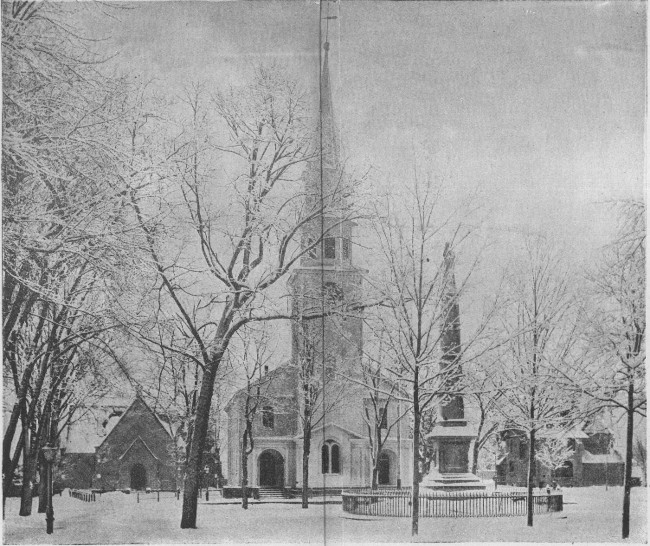
Before us lies a lovely poem of childhood, entitled "Childish Faith", founded on fact, but we select from the many poems of Mrs. Cutler, the Centennial Poem given below and written on the occasion of the Centennial of the old First Church.
CENTENNIAL FIRST PRESBYTERIAN CHURCH.
The moon shines brightly down, o'er hill and dale As it shone down, One Hundred years ago, On these same scenes. The stars look down from Heaven As they did then, as calm, serene, and bright— Fit emblems of the God, who changes not. Only in him can we find sure repose 'Mid change, decay and death, who is the same To-day as yesterday, forevermore. Through the clear air peal forth the silvery notes, Of thy old Bell, thou venerable pile, Thou dear old Church, whose birthday rare, We come to celebrate with tender love. One Hundred years! How long; and yet, how short When counted with the centuries of the past That help to make the ages of the world: How long when measured by our daily cares, The joys, the sorrows that these years have brought To us and ours. "Our fathers, where are they?" The men of strength, one hundred years ago, As full of courage, purpose, will, as we, Have gone to join the "innumerable throng" That worship in the Father's House above. Their children, girls and boys, like the fair flowers, Have blossomed, faded, and then passed away, Leaving their children and grandchildren, too, To fill their places, take their part in life. How oft, dear Church, these walls have heard the vows That bound two hearts in one. How oft the tread Of those that bore the sainted dead to rest. How oft the voices, soft and low, of those Who, trusting in a covenant-keeping God Gave here their little ones to God. A faith Which He has blessed, as thou canst truly tell, In generations past, and will in days to come. How many servants of the most high God, Beneath thy roof have uttered words divine, Taught by the Spirit, leading souls to Christ And reaping, even here, their great reward. Many of these have entered into rest Such as remains for those who love the Lord. Others to-day, have gathered here to tell What God has done in years gone by, and bear Glad testimony to the truth, that in this place His name has honored been.—'Tis sad to say Farewell. But 'tis decreed, that thou must go. Time levels all; and it will lay thee low. But o'er thy dust full many a tear shall fall, And many a prayer ascend, that the true God, Our Father's God, will, with their children dwell, And that the stately pile which soon shall rise, Where now, thou art, a monument shall be Of generations past, recording all The truth and mercies of a loving God. Oct. 14th, 1891.
Miss Frances Bell Coursen.
The rhythmic, airy verses of Miss Coursen, full of the spirit of trees, flowers, the clouds, the winds and the insinuating and lovely sounds of nature, charm us into writing the author down as one of Morristown's young poets. The verses have attractive titles which in themselves suggest to us musical thoughts, such as "To the Winds in January"; "June Roses"; "In the Fields"; and "What the Katydids Say". We quote the latter for its bright beauty.
WHAT THE KATYDIDS SAY.
"Katy did it!" "Katy didn't!" Doesn't Katy wish she had? "Katy did!" that sounds so pleasant, "Katy didn't" sounds so bad. Katy didn't—lazy Katy, Didn't do her lessons well? Didn't set her stitches nicely? Didn't do what? Who can tell? But the livelong autumn evening Sounds from every bush and tree, So that all the world can hear it, "Katy didn't" oh dear me! Who would like to hear forever Of the things they hadn't done In shrill chorus, sounding nightly, From the setting of the sun. But again, who wouldn't like it If they every night could hear, "Yes she did it, Katy did it", Sounding for them loud and clear? So if you've an "awful lesson", Or "a horrid seam to sew", Just you stop and think a minute, Don't decide to "let it go". In the evening, if you listen, All the Katydids will say "Yes she did it, did it, did it!" Or, "she didn't". Now which way?
Miss Isabel Stone.
Miss Stone, long a resident of Morristown, has published many poems in prominent journals and magazines, also stories, but always under an assumed name. She will take a place in another group, that of Novelists and Story-Writers. She is represented here by her poem on "Easter Thoughts".
EASTER THOUGHTS.
Sometimes within our hearts, the good lies dead, Slain by untoward circumstances, or by our own free will, And through the world we walk with bowèd head; Or with our senses blinded to our choice, Thinking that "good is evil—evil good;" Or, with determined pride to still the voice That whispers of a "Resurrection morn." This is that morn—the resurrection hour Of all the good that has within us died, The hour to throw aside with passionate force The cruel bonds of wrong and blindness—pride— And rise unto a level high of power, Of strength—of purity—while those we love rejoice With "clouds of angel witnesses" above, And all the dear ones, who before have gone. And we ascend, in the triumphant joy And peace, and rapture of a changèd self That now transfigured stands—no more the toy Of circumstance—or pride, or sin, to blight— Until we reach sublimest heights— And stand erect, eyes fixed upon the Right— Strong in the strength that wills all wrong to still, Will—pointing upwards to th' ascended Lord, Bless, aye, thrice bless, this fair, sweet Easter Dawn.
Rev. G. Douglass Brewerton.
The Rev. Mr. Brewerton was pastor of the Baptist Church in Morristown in 1861, and during the early years of our Civil War. He was very patriotic and public-spirited and founded a Company of boy Zouaves in the town, which is well remembered, for at that time the war-spirit was the order of the day. He wrote a number of poems which were published in the Morristown papers and others. Of these, the following is one, published January 30, 1861.
OUR SOLDIERS WITH OUR SAILORS STAND.
A NATIONAL SONG
RESPECTFULLY DEDICATED TO THE VOLUNTEERS OF BOTH SERVICES, BY ONE WHO ONCE WORE THE UNIFORM OF THE FEDERAL GOVERNMENT.
Our soldiers with our sailors stand, A bulwark firm and true, To guard the banner of our land, The Red, the White, the Blue. The forts that frown along the coast, The ramparts on the steep, Are held by men who never boast, But true allegiance keep. While still in thunder tones shall speak Our giants on the tide, Rebuking those who madly seek To tame the eagle's pride. While breezes blow or sounding sea Be whitened by a sail, The banner of the brave and true Shall float, nor fear the gale. While Ironsides commands the fleet, Shall patriot vows be heard, Where pennants fly or war drums beat, True to their oaths and word. Then back, ye traitors! back, for shame! Nor dare to touch a fold; We'll guard it till the sunshine wane And stars of night grow old. Thus ever may that flag unrent At peak and staff be borne, Nor e'er from mast or battlement By traitor hands be torn.
Mrs. Alice D. Abell.
Mrs. Abell has for several years contributed poems and articles to various papers and magazines. From the poems we select the following, which was copied in a Southern paper as well as in two others, from The New York Magazine in which it first appeared:
BEHIND THE MASK.
Behind the mask—the smiling face Is often full of woe, And sorrow treads a restless pace Where wealth and beauty go. Behind the mask—who knows the care That grim and silent rests, And all the burdens each may bear Within the secret breast? Behind the mask—who knows the tears That from the heart arise, And in the weary flight of years How many pass with sighs? Behind the mask—who knows the strain That each life may endure, And all its grief and countless pain That wealth can never cure? Behind the mask—we never know How many troubles hide, And with the world and fashion show Some spectre walks beside. Behind the mask—some future day, When all shall be made plain; Our burdens then will pass away And count for each his gain.
George Wetmore Colles, Jr.
The following is by one of the young writers of Morristown, written at Yale University and published in the Yale Courant of February, 1891:
TO A MOUNTAIN CASCADE.
To him who, wearied in the noontide glare, Seeks cool refreshment in thy quiet shade, In all thy beauteous rainbow tints arrayed, How sweet! O dashing brook, thy waters are! Sure, such a glen fair Dian with her train Chose to disport in, when Actæon bold That sight with mortal eyes dared to behold Which mortals may not see and life retain. To such a glen I, too, at noonday creep, Leaving the dusty road and haunts of men, To quaff thy purling, sparkling ripples; then To plunge within thy clear, cold basin deep. Alone in Nature's lap (this mossy sod) I lie; feel her sweet breath upon me blow; Hear her melodious woodland voice, and know Her passing love, the eternal love of God!