HISTORIANS AND ESSAYISTS.
Reading edition
William Cherry.
ANCIENT CHRONICLER.
William Cherry is a veritable "Old Mortality", judging from a unique volume found in the Morristown Library. This ancient sexton of the First Presbyterian Church, was a true wanderer among graves. It is said by those who remember, or who had it from their fathers, that the old house adjoining the Lyceum Building is the one in which Mr. Cherry lived and no doubt reflected on the uncertainty of life, while he compiled his melancholy record.
The following is the title of the old volume published by him and printed by Jacob Mann in the year 1806:
"Bill of Mortality: Being a Register of all the Deaths, which have occurred in the Presbyterian and Baptist Congregations of Morristown, New Jersey; For Thirty-Eight Years Past, Containing (with but few exceptions) the Cause of every Disease. This Register, for the First Twenty-Two Years, was kept by the Rev. Dr. Johnes, since which Time, by William Cherry, the Present Sexton of the Presbyterian Church at Morris-Town".
"Time brushes off our lives with sweeping wings."—Hervey.
Some of the causes of disease given are as follows:
"Decay of Nature"; "Teething"; "Old Age"; "A Swelling"; "Mortification"; "Sudden"; "Phrenzy"; "Casual"; "Poisoned by Night-Shade Berries"; "Lingering Decay", &c. We find no mention of "Heart Failure".
This curious and valuable volume needs no further comment.
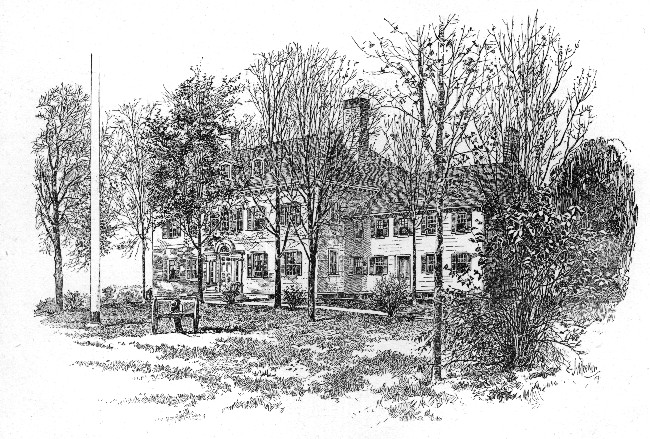
THE WASHINGTON HEADQUARTERS. FROM GARDEN AND FOREST. Copyright 1892, by the GARDEN AND FOREST PUBLISHING CO.
Rev. Joseph F. Tuttle, D. D.
To the Rev. Joseph F. Tuttle, D. D. we are indebted for the invaluable chronicles of events, of the life of the people, and of Washington and his army in Morristown during the Revolutionary period. Apparently, all this interesting story, in its details, would have been lost to us, except for his indefatigable zeal in collecting from the lips of living men and women, the eye-witnesses of what he relates, or from their immediate descendants, the story he gives us with such pictorial charm and beauty, warm from his own imaginary dwelling in the period of which he writes.
For the following sketch of this author we are indebted to the historian who follows, the Hon. Edmund D. Halsey.
Rev. Joseph F. Tuttle, D. D., son of Rev. Jacob and Elizabeth Ward Tuttle, was born at Bloomfield, N. J., March 12th, 1818. Fitted for college principally at Newark Academy, he graduated at Marietta College with first honors of his class in 1841. He entered Lane Seminary and was licensed to preach in 1844. In 1847 he was called to pastorate of church at Rockaway, N. J., as associate to his aged father-in-law, Rev. Dr. Barnabas King. He left Rockaway to accept the Presidency of Wabash College in 1862, and, after thirty years in that position, resigned in 1892.
During his fifteen years in this county he was a most voluminous and acceptable writer for the press—writing for the Observer, Evangelist, Tribune and other papers. But he is principally remembered more for his work as a local historian. He wrote, "The Early History of Morris County"; "Biographical Sketch of Gen. Winds"; "Washington in Morris County"; "History of the Presbyterian Church at Rockaway"; "Life of William Tuttle"; "Revolutionary Fragments", (a series of articles published in The Newark Sentinel of Freedom); "Early History of Presbyterianism in Morris County", and other shorter articles. At the time his Revolutionary articles were published there were still men living who had personal knowledge of the events of that era and he gathered an immense amount of material which but for him would have been lost.
The following from the pen of Dr. Tuttle appeared in The Newark Daily Advertiser of April, 1883:
A FINE RELIC AND A FINE POEM.
Thirty years ago and more my surplus energy was devoted to the innocent delights of hunting up places, people, facts and traditions associated with the American Revolution as preserved in Morris County. Some very charming rides were taken to Pompton, Mendham, Baskingridge, Spring Valley, Kimball Mountain, Singack, and other places. My rides made me certain that Morris County is both rich in beautiful scenery and historic associations. The results of these rides appeared in a series of "Revolutionary Fragments" printed in the Advertiser, as also in some elaborate papers before the Historical Society.
One day I visited the Ford Mansion, and met that polished and elegant gentleman, the late Henry A. Ford, Esq., then its proprietor. He was the son of Judge Gabriel H. Ford, grandson of Colonel Jacob Ford, Jr., whose widow was the hostess of Washington, the Winter of 1779-80, great-grandson of Colonel Jacob Ford, Sr., who built the "Ford Mansion," and great-great-grandson of John Ford, of Hunterdon County, whose wife was Elizabeth who was brought to Philadelphia from Axford, England, when she was a child a year old. Her father was drowned by falling from the plank on which he was walking from the ship to the shore. Philadelphia then had but one house in it. Mrs. Ford's second husband was Lindsley, and "the widow Elizabeth Lindsley died at the house of her son, Col. Jacob Ford, Sr., April 21, 1772, aged ninety-one years and one month," and so the courtly master of the "Ford Mansion," when I called to visit it, was of the fifth generation from the child-emigrant, whose father was drowned in the Delaware, in 1682.
The pleasure of the visit was greatly enhanced by the attentions of Miss Louisa, daughter of the gentleman named. She afterward became the wife of Judge Ogden of Paterson. The father and daughter with delightful courtesy took me over the famous house and associated in my memory the rooms and halls, and even the antique furniture with the family's most illustrious guest. I was especially interested in the old mirror that had hung in Washington's bedroom. Miss Ford produced a poem on that mirror, written, I think, by an aunt, and at my request she read it. She was a charming reader and promised me a copy.
Under date of Paterson, October 31st, 1856, Mrs. Ogden was kind enough to send me the promised copy with a note apologizing for the delay and adding: "I think, however, you will find the poetry has not spoiled by keeping." I have not ceased to be thankful that my first visit to the Ford Mansion was so pleasantly associated with the attentions of the father and daughter, both of whom have since died.
The mirror is a fine relic still to be seen with other elegant old furniture, belonging to the Ford family, at the "Washington Quarters" at Morristown, and I am sure all will regard the poem which pleased me so much thirty years ago as "one that has not spoiled by keeping."
ON AN OLD MIRROR USED BY WASHINGTON AT HIS HEADQUARTERS IN MORRISTOWN.
Old Mirror! speak and tell us whence Thou comest, and then, who brought thee thence. Did dear old England give thee birth? Or merry France, the land of mirth? In vain another should we seek At all like thee—thou thing antique. Of the old mansion thou seem'st part; Indeed, to me, its very heart; For in thy face, though dimmed with age, I read my country's brightest page. Five generations, all have passed, And yet, old Mirror, thou dost last; The young, the old, the good, the bad, The gay, the gifted and the sad Are gone; their hopes, their sighs, their fears Are buried deep with smiles and tears. Then speak; old Mirror! thou hast seen Full many a noble form, I ween; Full many a soldier, tall and brave, Now lying in a nameless grave; Full many a fairy form and bright Hath flitted by when hearts were light; Full many a bride—whose short life seemed Too happy to be even dreamed; Full many a lord and titled dame, Bearing full many an honored name; And tell us, Mirror, how they dressed— Those stately dames, when in their best? If robes and sacques the damsels wore, And sweeping skirts in days of yore? But tell us, too, for we must hear Of him whom all the world revere. Thou sawest him when the times so dark Had made upon his brow their mark; Those fearful times, those dreary days, When all seemed but a tangled maze; His noble army, worn with toils, Giving their life blood to the soils. Disease and famine brooding o'er, His country's foe e'en at his door; But ever saw him noble, brave, Seeking her freedom or his grave. His was the heart that never quailed; His was the arm that never failed! Old Mirror! thou hast seen what we Would barter all most dear to see; The great, the good, the noblest one; Our own immortal Washington! Well may we gaze—for now in thee Relies of the great past we see, Well may we gaze—for ne'er again, Old Mirror, shall we see such men; And when we too have lived our day, Like those before us passed away, Still, valued Mirror, may'st thou last To tell our children of the past; Still thy dimmed face, thy tarnished frame Thy honored house and time proclaim; And ne'er may sacrilegious hand, While Freedom claims this as her land One stone or pebble rashly throw To lay thee, honored Mirror, low. Y. F.
Hon. Edmund D. Halsey.
Mr. Halsey, historian, biographer, as well as lawyer, has published our most valuable "History of Morris County", and is considered an authority upon that subject, his accuracy being unquestioned. By his sterling integrity and superior intellectual ability, he has, in the practice of his profession, gained the entire confidence of the community in which, as a lawyer, he has passed the greater part of his life.
Included in his literary work are "Personal Sketches" of Governor Mahlon Dickerson, Colonel Joseph Jackson, and others; "The Revolutionary Army in Morris County in 1779-'80"; and a brief sketch of the Washington Headquarters entitled "History of the Washington Association of New Jersey", published in Morristown in 1891.
Mr. Halsey also assisted Mr. William O. Wheeler in the publication of a book of unique interest and of unusual value, especially to genealogists and antiquarians, the title of which reads "Inscriptions on Tombstones and Monuments in the Burying Grounds of the First Presbyterian Church and St. John's Church at Elizabeth, New Jersey".
Mr. Halsey is a prominent member of the "Historical Society of New Jersey", as well as of the "Washington Association of New Jersey".
We quote from his "History of the Washington Association" the following "brief history of the title of the property".
FROM "HISTORY OF THE WASHINGTON ASSOCIATION OF NEW JERSEY."
Colonel Jacob Ford, Senior—prominent as a merchant, iron manufacturer, and land owner, who was president Judge of the County Court from the formation of the County in 1740 until his death in 1777, and who presided over the meeting, June 27, 1774, which appointed the first "Committee of Correspondence"—conveyed the tract of 200 acres surrounding the house to his son, Jacob Ford, junior, March 24, 1762. In 1768 he conveyed to him the Mount Hope mines and meadows where the son built the stone mansion still standing. In 1773 Jacob Ford, junior, rented this Mount Hope property for fifty years to John Jacob Faesch and David Wrisbery, and these men proceeded to build the furnace afterward useful to the patriot army in supplying it with cannon and cannon-balls.
Colonel Jacob Ford, junior, after making this lease returned to Morristown, and, probably with his father's aid, began at once the erection of these Headquarters, and had just completed the building when the war broke out. He was made Colonel of the Eastern Battalion of the Morris County Militia and was detailed to cover Washington's retreat across New Jersey in the "mud rounds" of 1776—a service accomplished with honor and success. In this or in similar service, Colonel Ford contracted pneumonia, of which he died January 10, 1777, and was buried with military honors by order of Washington. He left a widow, Theodosia Ford, and five young children. She was the daughter of Rev. Timothy Johnes, whose pastorate of the First church extended from 1742 to 1794, and who is said to have administered the Communion to Washington. This lady in 1779-80 offered to Washington the hospitality of her house, and here was his Headquarters from about December 1, 1779 to June 1780. In 1805, Judge Gabriel H. Ford, one of the sons of Colonel Jacob, purchased his brothers' and sister's interest in the property and made it his home until his death in 1849. By his will dated January 27, 1848, Gabriel H. Ford, devised this, his homestead to his son, Henry A. Ford, who continued to occupy it until his death, which occurred April 22, 1872. From the heirs of Henry A. Ford title was derived to the four gentlemen who organized the Association, namely: Governor Theodore F. Randolph, Hon. George A. Halsey, General N. N. Halsted, and William Van Vleck Lidgerwood, Esq.
Hon. John Whitehead.
BIOGRAPHER AND HISTORIAN.
Of Mr. Whitehead's new departure into the field of romance, we have already spoken and a portion of his story "A Fishing Trip to Barnegat", is given to represent him among "Novelists and Story Writers".
His literary work of many years covers a variety of departments in literature.
In the Northern Monthly Magazine which began some years ago, as a periodical of high order we find running through several numbers a "History of the English Language", contributed by Mr. Whitehead, in which he starts from a true and philosophic premise. It is this: "It would be difficult to separate any one creation from the whole universe and pronounce that it is not subject to law." The reader discovers that these magazine articles contain the germs of all that has been written in many exhaustive works on the philosophy and growth of language.
For a number of years, Mr. Whitehead was editor of The Record, a small sheet opened by the First Presbyterian Church of Morristown, the value of which historically increases with each year. For this, he wrote largely, sketches of prominent men of Revolutionary times and of others connected with the congregation of the church.
Some important papers were contributed by him to the local press, including "A Review of Fitz John Porter's Case", in the Morristown Banner, also "Sketches of Morris County Lawyers". A series of "Sketches" was also published in the Newark Sunday Call, entitled "Newark Aforetime", referring to Newark and Newark people, fifty years ago.
Many of Mr. Whitehead's speeches and addresses have been published, among them, those given at the Centennial Celebration of the First Presbyterian Church of Morristown; at the Centennial Celebration of the Presbyterian Church at Springfield, N. J.; two or three addresses before the Society of the Sons of the American Revolution, and an address delivered two or three years ago before the Washington Association of N. J. Of the latter Association, Mr. Whitehead is an honored member as well as of the Historical Society of New Jersey.
In the course of his study and writing, we have already mentioned among "Translators," Mr. Whitehead has made several valuable translations from German and French authors.
We must not overlook one principal labor which is far more herculean than we, who are so greatly benefited by it, perhaps fully comprehend, namely, the Catalogue, in two volumes, of the Library, in which Morristown justly takes so much pride. This was a voluntary work.
Mr. Whitehead is now engaged on a "History of Morris County", to form one chapter in a new illustrated "History of New Jersey," to be published by Colonel U. S. Sharp. He has also in preparation the "History of the First Presbyterian Church" of Morristown, in which will appear the interesting proceedings of the Centennial exercises, recently held there.
A series of fine articles on "The Supreme Court of New Jersey" are now appearing in The Green Bag of Boston. This Green Bag is a magazine published in the interests of the legal fraternity, as from its significant name we see, and this magazine is the nearest approach so far made by Americans towards the traditional appendage of the English barrister, everywhere seen over the border in Canada, by which, it is well known, he is always accompanied when he goes to court and while he remains there in attendance. This bag contains his briefs, papers and other impedimenta connected with trials. It is not surprising, but it is touching, to find Boston holding on to this last hope of accomplishing that for which so many frantic efforts have been made in this country, only to meet with failure.
The last article in this magazine, of the series on "The Supreme Court of New Jersey", is delightful in expression and in form; it has a fine large type, is illustrated with well-executed portraits of the judges, in group and singly, and is altogether most attractive and interesting.
Bayard Tuckerman.
Mr. Tuckerman, who resided for some time in Morristown, and whose ancestry is associated with artistic and literary taste and genius, is the author of "The Life of General Lafayette", published in 1889, during his residence in Morristown, and, a copy of which was presented by the author, in person, to the Morristown Library. Before this, he published a "History of English Prose Fiction", in 1882, and after it, in 1889 again, he edited "The Diary of Philip Hone". This author is now engaged on another book, to be published in the spring in the "Makers of America" series, with the title of "Peter Stuyvesant".
"The Diary of Philip Hone" is a charming book, especially to those familiar with old New York. The editorship of any life requires a talent for selection and a gift for combining and drawing together much desultory matter, but when we consider that the two volumes, into which Mr. Tuckerman compressed his material were less than one-fourth the original diary, which fills twenty-eight quarto manuscript volumes, the herculean task is at once apparent. A critic in one of the popular journals says of it: "As a rule the diary needs little interpretation and it may be welcomed as an agreeable, gossipy contribution to civic annals, and as a pleasant record of a citizen of some distinction, parts and usefulness in his generation".
In the "Life of General Lafayette", Mr. Tuckerman has evinced his superior love of industrious, conscientious study. The book is acknowledged to be essentially truthful and exceptionally just above anything ever written of Lafayette. It has been truly said of Mr. Tuckerman that "he tells the story of Lafayette's life in such a way that the interest increases as it proceeds" and that "he shows his skill as a biographer in this as in making both the narrative itself and his own criticism of the subject heighten our sympathy". He has not allowed himself to be turned from the actual statement of fact by that peculiar sentiment of the romantic side of Lafayette's career which has more or less colored the opinions of so many other biographers. Mr. Tuckerman himself says that "Lafayette's name has suffered more from the admiration of his friends than from the detraction of his enemies."
FROM THE "LIFE OF GENERAL LAFAYETTE."
The visit to America was supplemented in the following summer of 1785 by a journey through Germany and Austria.
Many distinguished officers were met. At one camp, as he (Lafayette) wrote to Washington, he found Lord Cornwallis, Colonels England, Abercrombie, and Musgrave; "on our side" Colonel Smith, Generals Duportail and Gouvion; "and we often remarked, Smith and I, that if we had been unfortunate in our struggle, we would have cut a poor figure there." Again;
Writing from Valley Forge to the Comte de Broglie, he gave a sad picture of the poverty and sufferings of the army. "Everything here", he said, "combines to inspire disgust. At the smallest sign from you I shall return home". But the misery of Valley Forge never abated one jot of Lafayette's enthusiasm. The privations which he saw and shared only made him put his hand the more often into his own pocket, and redouble his efforts to obtain aid from the treasury of France.
To Lafayette, the happiest portion of this voyage to America was the time passed in the company of Washington. Hastening from New York immediately on his arrival, he allowed himself to be delayed only at Philadelphia. "There is no rest for me," he wrote thence to Washington, "until I go to Mt. Vernon. I long for the pleasure to embrace you, my dear general; in a few days I shall be at Mt. Vernon, and I do already feel delighted with so charming a prospect." Two weeks of a proud pleasure were then passed in the society of the man who was always to remain his beau ideal. To walk about the beautiful grounds of Mt. Vernon with its honored master, discussing his agricultural plans; to sit with him in his library, and listen to his hopes regarding the nation for which he had done so much, were honors which Lafayette fully appreciated. He has left on record the feelings of admiration with which he saw the man who had so long led a great people in a great struggle retire to private life, with no thought other than satisfaction at duty performed. And it was a legitimate source of pride to himself that he had enlisted under his standard before fortune had smiled upon it, and had worked with all his heart to crown it with victory. The two men thoroughly knew each other.
The words of Lafayette will be found, in this volume, in the paper on "George Washington."
He (Washington) responded to Lafayette's demonstrative regard by a sincere paternal affection. Later in the summer, Lafayette met Washington again, and visited in his company some of the scenes of the late war. When the time for parting had come, Washington accompanied his guest as far as Annapolis in his carriage. There the two friends separated, not to meet again.
On his return to Mt. Vernon, Washington added to his words of farewell, a letter in which occur the following passages; "In the moment of our separation, upon the road as I travelled, and every hour since, I have felt all that love, respect, and attachment for you, with which length of years, close connection and your merits have inspired me. I often asked myself, as our carriages separated, whether that was the last sight I ever should have of you, and though I wished to say no, my fears answered yes. I called to mind the days of my youth, and found they had long since fled, to return no more; that I was now descending the hill I had been fifty-two years climbing, and that, though I was blest with a good constitution, I was of a short-lived family, and might soon expect to be entombed in the mansion of my fathers. These thoughts darkened the shades and gave a gloom to the picture, and consequently to my prospect of seeing you again. But I will not repine; I have had my day. * * * * It is unnecessary, I persuade myself, to repeat to you, my dear Marquis, the sincerity of my regards and friendship; nor have I words which could express my affection for you, were I to attempt it. My fervent prayers are offered for your safe and pleasant passage, happy meeting with Madame de Lafayette and family, and the completion of every wish of your heart." To these words Lafayette replied from on board the "Nymphe," on the eve of his departure for France: "Adieu, adieu, my dear general. It is with inexpressible pain that I feel I am going to be severed from you by the Atlantic. Everything that admiration, respect, gratitude, friendship, and filial love can inspire is combined in my affectionate heart to devote me most tenderly to you. In your friendship I find a delight which words cannot express. Adieu, my dear general. It is not without emotion that I write this word, although I know I shall soon visit you again. Be attentive to your health. Let me hear from you every month. Adieu, adieu."
Loyall Farragut.
BIOGRAPHER.
With Morristown is associated the beautiful memoir of our great Admiral, in honor of whom one of the streets of our city is named. In the old house now removed from its original position to the end of Farragut Place, this honored commander once visited for several days, walking over the ground now occupied by the houses of many families, delighted as a boy with everything in nature; noticing and observing the smallest detail of what was going on around him and interesting himself equally in the humblest individual who crossed his path and in the most distinguished visitor who asked to be presented.
The "Life of David Glasgow Farragut" was written according to the admiral's expressed wish, by his only son, Loyall Farragut, who for a short time had, in Morristown, his summer home, and who presented to the Morristown Library a copy of his book.
The Farraguts came from the island of Minorca, where the name is now extinct. In the volume referred to, we find these words: "George Farragut, father of the admiral was sent to school at Barcelona, but was seized with the spirit of adventure, and emigrated to America at an early age. He arrived in 1776, promptly sided with the colonists, and served gallantly in the struggle for independence, as also in the war of 1812. It is said that he saved the life of Colonel Washington in the battle of Cowpens."
In reading this volume one is transported to the times and scenes described, and everywhere is felt the grandeur, beauty and simplicity of character of this truly great and lovable man. In the touching letter to his devoted wife, on the eve of the great battle, is seen, as an example to all men of future generations, the realization of a man's fidelity to the woman of his choice, even in the moment of greatest extremity, and the possibility of the tenderest heart existing side by side with the daring courage of one of the bravest men the world has ever seen.
Wonderfully stirring are the descriptions given of the river fight on the Mississippi and of the battle of Mobile Bay, after which Admiral Farragut received from Secretary Welles the following congratulatory letter:
"In the success which has attended your operations, you have illustrated the efficiency and irresistible power of a naval force led by a bold and vigorous mind and the insufficiency of any batteries to prevent the passage of a fleet thus led and commanded. You have, first on the Mississippi and recently in the bay of Mobile, demonstrated what had previously been doubted,—the ability of naval vessels, properly manned and commanded, to set at defiance the best constructed and most heavily armed fortifications. In these successive victories, you have encountered great risks, but the results have vindicated the wisdom of your policy and the daring valor of our officers and seamen."
Josiah Collins Pumpelly.
Mr. Pumpelly, long a resident of Morristown, claims our attention as a writer, rather than an author, as he has not been a publisher of books, beyond a collection of three Addresses in pamphlet form entitled "Our French Allies in the Revolution and Other Addresses".
Several sketches entitled "Reminiscences of Colonial Days", and others of the same character, all involve considerable research and add to our literary possessions in connection with historic Morristown. His "Address on Washington", delivered before the Washington Association of New Jersey, at the Morristown Headquarters, February 22, 1888, was published by the Association, and has long been for sale there. Of this, the writer says, "I rejoice that even in this slight way, I can be of service to an Association whose faithful care of this home of Washington in the trying winter of 1779 and '80 deserves the lasting gratitude of every loyal Jerseyman." In closing this address, Mr. Pumpelly said, quoting from our favorite historian, Rev. Dr. Tuttle, "each old parish in our County had its heroes, and each old church was a shrine at which brave men and women bowed in God's fear, consecrating their all to their country." Mr. Pumpelly adds: "So instead of referring our children to Greek and Roman patriots, we have but to call up for them the names of our own men and women, who have here amid the hills of Morris, wrought out for us this heritage, so much grander, so much nobler than they themselves ever dreamed." This address is now bound in a larger pamphlet with "Our French Allies", to which we have referred and which was read before the New Jersey Historical Society, at Trenton, January 22d, 1889 and "Fort Stanwix and Battle of Oriskany", an address delivered before the Society of the Sons of the Revolution, in New York City, Dec. 3, 1888.
There was an important paper read by Mr. Pumpelly before the New Jersey Society of the Sons of the Revolution, on June 10th, 1889, and by them adopted in their meeting of that date, and afterwards published, on "The Birthplace of our Immortal Washington and the Grave of his Illustrious Mother, shall they not be Sacredly Preserved?"
Another address followed on "Joseph Warren" before the Massachusetts Society of the Sons of the American Revolution, on April 18th, 1890, on the occasion of the 114th Anniversary of the Battle of Lexington. He was then President of the New Jersey Society of the Sons of the American Revolution.
A paper was read by request on "Mahlon Dickerson, Industrial Pioneer and old time Patriot," on January 27, 1891, before the New Jersey Historical Society.
Mr. Pumpelly has also given much time and literary effort in philanthropic and sanitary directions. Many articles have appeared from time to time from his pen in behalf of reforms in the treatment of our dependent, delinquent, and defective classes, all tending to social economic improvement and, at one time, assisting materially the advance of the State Charities Aid Association of New Jersey of which he was for several years an active member.
His attention is now being turned to the story of the Huguenots in this country. He is just completing a quite exhaustive paper upon the Huguenots in New Jersey, which is to be given by request before the Genealogical Society of New York, in January 1893, after which the subject is to be prepared by him for use in a school text-book.
In The New York Genealogical and Biographical Record, of April 1892, is "A Short Sketch of the Character and Life of John Paul Jones", written in a most interesting and delightful manner and given before the New York Genealogical and Biographical Society, January 8, 1892. We quote from
WHAT DOES THE CAUSE OF HUMAN FREEDOM OWE TO THE HUGUENOT?
In looking back over the milestones which mark in history the relapse and advance, the failure and the successes, of the principles of civilization, we note that at a certain period it was the Teutonic Nations which broke loose from Rome and the Latin Nations who adhered to the Pope. Also, that in France, opposition to Rome was early and considerable. Thus the Waldenses, Albigenses, and Lefevre and his colleagues were Huguenots and lovers of human freedom before the name itself was known—Calvinists before Calvin, Lutherans before Luther, Wiclyfites before Wiclyf.
That great movement for the liberty of conscience and personal freedom, civil and religious, was not in France an importation, for God had deposited the first principles of the work in a few brave hearts of Picardy and Dauphiny before it had begun in any other country of the globe. Not to Switzerland nor to Germany belongs the honor of having been first in the work, but to France and the Huguenot.
It was the voice of Lefevre, of Etaples, France, a man of great nobility of soul as well as genius of mind, which was to give the signal of the rising of this morning star of liberty. He it was who taught Farel, the great French reformer and "master-builder" with Luther.
Hannah More Johnson.
Miss Johnson's poem, "The Christmas Tree", has taken its place in our Poet's corner. She is also mentioned among Novelists and Story-Writers for her well-known stories of "Lost Willie"; "Ella Dutton"; "Snow Drifts"; "Signal Lights", and "First the Blade" published by A. D. F. Randolph and by the Presbyterian Board. But perhaps her most important work is "Mexico, Past and Present", an excellent and charmingly written history of Mexico, a book of interest and importance, with sixty three maps and illustrations, treating not only the history, but the present condition and prospects of that country. This work is found in many libraries, and places Miss Johnson among our Historians.
Miss Johnson is the daughter of Mr. Jacob Johnson and niece of our townsman, Mr. J. Henry Johnson, who was the last preceptor of the old Morris Academy. Though long a resident of Morristown, she now makes her home in Philadelphia where she is editor of a Missionary Publication.
"I first thought of myself as a writer", says Miss Johnson, "when I saw my name for the first time in print and nearly fainted with fright. I have never recovered from that shock and not until I had had more than one collision with publishers have I consented to give my name to articles."
Last September (1892) "Bible Lights in Mission Paths" was published: "The long interval between my first and my last book," says the author, "was filled with what seems to me the true work of my life." And it is curious how this work of life came to her quite unsought and unexpectedly. Let us hear it in her own words. "About twelve years ago," she tells us, "a relative became proprietor of a small religious weekly in Philadelphia, The Presbyterian Journal. I had the entire charge of the missionary department. Shortly afterward, the Presbyterian Alliance met in our city and the Woman's Foreign Missionary Society, (of which I was and still am a Director), held in connection with that great convocation in the Academy of Music, an all-day meeting in one of the churches. Presbyterian women were there from every quarter of the world beside others from sister churches. At noon as I sat, talking over the programme for the afternoon with Mrs. A——, she said regretfully, 'I am afraid that we shall not be able to get these women to speak loud enough to be heard all over this great church. It would be delightful if we could have a full report.' 'I think I could get one up, Mrs. A——,' said I. 'I have been taking notes of the speeches all the morning and this afternoon we are to have written reports and papers.' 'I can get them all for you,' she said quickly. That night I went home laden with documents, three-fourths of them from the Old World. The Journal publishers offered to send out an extra and send it to any address I gave. Within a week, this extra was mailed to every mission station throughout the world, which had been in any way represented at this woman's meeting or mentioned in its reports. Ever since that busy, busy week with French, English, Scotch, German, Italian, Belgian and Irish women, I have been a constant reporter of Missionary meetings. This led to a series of articles for Monthly Concerts, proposed for the use of pastors and other leaders of missionary meetings. Twelve articles a year for about four years, each one of which had cost months of research and study, I had time for nothing else. It was weary work. All roads led to Rome and I couldn't pick up a book or a daily that didn't give me an item or a suggestion. The nameless writer was generally supposed to be some Doctor of Divinity shelved with a sore throat or other ministerial disability. I remember one time when a carefully prepared article (of mine) on Siam appeared in The Gospel of all Lands, credited to The London Missionary News. It had been taken from the magazine in which it was first published, profusely illustrated and sent out as an English production."
Besides this Miss Johnson has furnished monthly articles for various papers and occasional poems, for magazines. Thus we see her very busy life has been fruitful of unusual results.
Mrs. Julia McNair Wright.
Mrs. Wright has already been mentioned among Novelists and Story-Writers. For the following graphic sketch, we are indebted to one of our writers, Mrs. Julia R. Cutler.
"One of the authors whose sojourn in our 'beautiful little town', as she calls it, was of a comparatively brief period, from 1881-'83, but whose writings, as showing deep research in many fields of thought, both scientific and historical, entitle her to more than a brief mention, is Mrs. Julia McNair Wright.
"Her husband, the Rev. Dr. William J. Wright, is President of and, Professor of Metaphysics, in a Western College. Much of Mrs. Wright's time is spent in visiting different large cities, at home and abroad, where she can have access to libraries and gain information on various subjects connected with her books.
"While in Morristown, she wrote, at the request of the Presbyterian Board of Publication, her book on "The Alaskans" and also a short work on the religious life, called "Mr. Standfast's Journey", besides preparing for the press a book entitled "Bricks from Babel", which she had previously written while visiting London and the British museum. The Rev. Joseph Cook fully endorses this book, and calls it 'a most admirable compendium of ethnography.' A set of religious biographies were, also, about this time, published in Arabic.
"These works written and prepared for the press while she was occupying her quiet cottage home on Morris Plains, would alone have entitled her to a prominent place among the authors of whom Morristown has reason to be proud. But these are but a small portion of her literary labors. Judging from the number of books which appear over her signature, she must indeed be gifted with the 'pen of a ready writer.'
"Among the more prominent works are 'The Early Church in Britain'; 'The Complete Home', of which over one hundred thousand copies have been sold; 'Saints and Sinners of the Bible'; 'Almost a Nun'; 'The Priest and Nun'; 'A Wife Hard Won', a novel published by Lippincott; 'The Making of Rasmus'; 'Rasmus a Made Man'; and 'Rag Fair and May Fair'. The last deals with social questions in England, and is being re-published in London, as indeed a number of her other books have been, as well as translated into the French language.
"Mrs. Wright's latest work, completed during a recent visit to the British museum, is a Series of Readers on Natural Science, called 'Nature Readers, Seaside and Wayside', which are having a large run in this country, in England and in Canada and which are a new invention in school books. They have been more warmly received than any books for our schools, for the past twenty-five years.
"Very few persons have the talent of dealing with so many subjects and doing it so well. Even the Temperance cause owes much to Mrs. Wright, as its earnest advocate, and many of her thrilling stories on this subject have touched the hearts and inspired the actions of those who have read them. Nor has she, amid her multitude of duties, forgotten the young, as the large number of volumes on the shelves of our Sabbath School libraries, bearing her name can testify.
"May the pen Mrs. Wright has so wisely and deftly used, in the cause of education and humanity, long continue through her skillful hand, to trace its characters upon the hearts and minds of those with whom it comes in contact!"
Mrs. Edwina L. Keasbey.
Though Mrs. Keasbey has published a most attractive and useful book, full of practical thoughts idealized, yet we place her and Mrs. Stockton in this grouping for the reason that a large part of her writing was of this character, on the whole. Much of it was graphically descriptive of scenes in foreign lands and at home, usually accompanied with reflections which indicate the Essay character. Like others of our writers, there is a variety in her writing and choice of subjects which makes it somewhat difficult to place her with exactness.
Most of Mrs. Keasbey's writing was originally done for The Hospital Review, a paper edited by her, during eleven years, for the St. Barnabas Hospital, which was founded largely through her efforts and influence and was a work to which she devoted her life. For this was written a series of papers entitled "A Lame Woman's Tramp through some Alpine Passes", and "Bits of English Scenery Sketched by a Lame Hand", among which is a fine and vivid picture of the first sight of Durham Cathedral. So, for this Hospital Review were originally written the papers now collected and bound in one of the prettiest little volumes one could desire, convenient in size, artistic in design and with clear, large type and broad margins. This is entitled "The Culture of the Cradle".
In the education of children, Mrs. Keasbey has found the key and basis of all true and reasonable training, in the development of the child's individuality. The object of this book is to suggest the meaning and purpose of true culture and to show how it must begin with the cradle and, says the author, "to give some suggestions and leaves from experience that may be of use to those who are striving to begin, in the right way, the education of their children." The book, published in 1886, has had a large sale and the entire proceeds have been devoted to the Hospital of St. Barnabas, which the author so much loved.
Mrs. Keasbey was the eldest daughter of the Hon. J. W. Miller, and she inherited well her intense love of good works from her honored mother, who was so long identified with Morristown's philanthropic and charitable work. She was born in the old Macculloch mansion on Macculloch Avenue and lived there till her marriage in 1854, after which her literary qualities and rare executive abilities went to adorn the city of Newark where she will be tenderly remembered, and where her works live after her.
FROM "THE CULTURE OF THE CRADLE."
As I sit by my window on this beautiful spring day, preparing my article upon "The Nurture of Infants," a pair of little birds are building their nest in the vine that grows about my piazza, so I take my text from them.
How busy they are, how absorbed in their work! The whole world contains for them no other point of interest, but only this little crotch in the vine which they have chosen to build their cradle in for their future little ones. We may be quite sure that it is the best spot in the whole vine, not too shady or too sunny, just happily out of the reach of cruel cat or mischievous boys, and then the cradle will be so perfect, strong enough to resist the winds that shake the vine, and covered enough to withstand the spring rains, and warm enough to shelter the little ones as they crack the shell; and so comfortable with its soft padding of cotton and down to cherish and protect the little tender bodies when they come into this cold world.
I think it is nearly finished to-day, for the little mother has settled herself down into it and nestled herself in it and picked off her own soft down, and stuffed it in with the cotton that she had lined the nest with. She looks so satisfied and content, as if she would say, "it is quite ready now for my little darlings."
With this little mother there is no word of complaint or selfish murmur though she is going to sit in that nest for many a long day and dark night, through storm and sunshine, until the little ones come forth from their eggs to gladden her heart and repay her care and work of preparation.
Can we mothers have a better teacher or a wiser example than this little bird, whose lessons in motherhood have come to her direct from her Creator?
Mrs. Marian E. Stockton.
As to Mrs. Stockton's charming pen, we must reluctantly refrain from noticing her many essays and writings in various directions, principally prepared at the request of literary societies and other organizations,—always read by some one else, owing to the writer's great dislike for coming into public notice, and always published, and sent about, by the Society or group of people for whom they were written. The title of this book compels us, however, to mention this gifted woman's name, and we give below an extract from one delightful paper, written as usual by request for an important occasion, read by a distinguished literary woman, and as usual published.
FROM "HOME AND SOCIETY."
It may help to a proper understanding of the line of thought followed in this paper if I state in the beginning that it is, chiefly, an attempt to get a definite answer to the question so often asked: What is Society? It is an effort to arrive at a conclusion which the majority of American women may be willing to accept. Otherwise we shall find ourselves so beset with perplexities that we shall not be able to get anything out of our subject. For most persons have very vague ideas regarding society, and would find it difficult to express them. I have tried to get at the ideas of a few persons who might be supposed to know, with but small result. One says: "It is a limited company of persons of wealth and leisure who give up their time chiefly to entertainments and pleasure." This view of the subject suggests the familiar advertisements of a certain soap, reversing the sign; for taking out the pure article—i. e., the persons composing this society—we would have 99 44-100 of the people of the United States with no society at all. So very little of the pure article will, I think, scarcely suffice to float this definition.
Another says: "It is a collection of the best people in a city or neighborhood who give a tone to the place." This is better, but calls forth other questions. Whom do you mean by the "best people"? What is "tone"? What sort of "tone" do they give? New York, New Orleans, and Poker Flat would give widely different answers to these questions.
Another defines it as "a number, large or small, of cultured people." This conveys a charming idea to the mind, but it is too limited, for we are considering to-day society in its broadest as well as its best aspects; and, surely, we would none of us be willing to deny to good-hearted, honest, decent people, the pleasure of forming a society of their own kind, and enjoying it in a rational—if uncultured—fashion. We want to-day to get hold of a comprehensive idea of society.
Last summer, at a fashionable resort, I heard some New York ladies speaking, with admiration, of another lady in the hotel, and one exclaimed: "What a pity she is not in Society!" To this they all agreed, and another kindly asked: "Can't we do something to help her to know people?" As I knew this lady, and was aware of the fact that, when she returned to the city at the beginning of every season, she sent out cards to six hundred people, I was much surprised; for, if visiting and being visited by six hundred people is not being "in society", I do not know what is. Therefore, I could only infer that she was not in their special coterie.
A very intelligent woman once told me frankly, that she could not imagine anything that could be called society outside the City of New York.
Again I was told, some time ago, by a literary lady who was then residing in this city (but who is not here now): "Literary people are not recognized in New York society." I use her own words and they puzzled me. Soon after, there chanced to fall in my way a description of New York life by a Frenchman who had been entertained by all sorts of people. He stated that the most charming society in this city is the literary society, and he proceeded to paint it in glowing colors. Between the literary lady on one side and Max O'Rell on the other, I gave up that conundrum.
These few examples of misconceptions and wrong-headedness in regard to what society really is will suffice to show how necessary it is to get a clear and comprehensive definition for it. To get this we must disentangle ourselves from all these figments, go back, and enter through the gate which naturally leads into society.