SCIENTISTS.
Reading edition
Samuel Finley Breese Morse, LL. D.
Nothing could be more romantic than the story of the Telegraph, the practical application of which began in Morristown, for it is morally certain that without the enthusiastic confidence in its success generously manifested by Alfred Vail, the young inventor, and his father Judge Stephen Vail, who freely contributed of his means to the experiments of Professor Morse, this great gift to the world would have been indefinitely delayed.
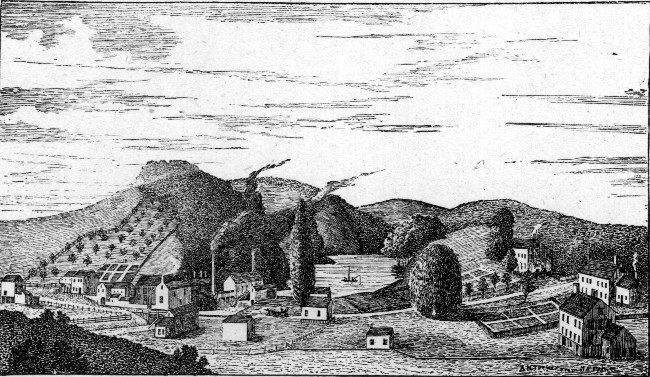
SPEEDWELL IRON WORKS, AS REPRESENTED ON AN ANCIENT INVOICE.
Morse was poor. He had exhausted his means by the necessary time and thought given to the development of his conception, when the value of this work was realized by these two men. It was as an artist, that Morse went first to Speedwell, on October 29, 1837, to observe the progress of his new machinery which was being prepared there at the Speedwell Iron Works belonging to Judge Vail, by Alfred Vail and his assistant, William Baxter. Morse had accepted a commission, doubtless given him as a means of relieving his pecuniary stress, to paint the portraits of several members of Judge Vail's household. It will be remembered, that besides his great invention, Professor Morse was an artist of considerable reputation, as well as an author. In his youth, it is said, he was more strongly marked by his fondness for art than for science. He was a pupil of Washington Allston, a member of the Royal Academy, and studied with Benjamin West. He painted the portraits of many distinguished men, among them the then President of the United States, James Monroe, for the city of Charleston; and, later, Fitz Greene Halleck and Chancellor Kent, now in the Astor Library, and the full length portrait of Lafayette for the city of New York. He was one of the founders and was first President of the National Academy of Design, and it was on his return from the pursuit of his renewed study of art abroad that he met with the remarkable experience which turned his attention from art to invention and gave him his life work. In a letter written to Alfred Vail by Professor Morse, and given in Mr. Vail's book on "The American Electro-Magnetic Telegraph", (page 153), we find the following account:
"In 1826, the lectures before the New York Atheneum, of Dr. J. F. Dana, who was my particular friend, gave to me the first knowledge ever possessed of electro magnetism, and some of the properties of the electro magnet; a knowledge which I made available in 1832, as the basis of my own plan of an electro telegraph. I claim to be the original suggestor and inventor of the electric magnetic telegraph, on the 19th of October, 1832, on board the packet ship Sully, on my voyage from France to the United States and, consequently, the inventor of the first really practicable telegraph on the electric principle. The plan then conceived and drawn out in all its essential characteristics, is the one now in successful operation."
Professor Morse had more honors and medals than perhaps any American living. He belonged to a distinguished literary family. His two brothers founded The New York Observer in 1823. This is now the oldest weekly in New York and the oldest religious paper in the State. As an author, he wielded the pen of a ready writer. He not only published controversial pamphlets concerning the telegraph, but contributed articles and poems to many magazines and edited the works of Lucretia Maria Davidson, accompanying them by a personal memoir. He published in 1835, a book entitled, "Foreign Conspiracy against the Liberties of the United States; Imminent Dangers to the Free Institutions of the United States through Foreign Immigration and the Present State of the Naturalization Laws, by an American". Later were published "Confessions of a French Catholic Priest, to which are added Warnings to the People of the United States, by the Same Author", (edited and published with an introduction, 1837), and "Our Liberties Defended, the Question Discussed, is the Protestant or Papal System most favorable to Civil and Religious Liberty".
Alfred Vail.
To Alfred Vail belongs a place of honor, as the author of a valuable book on "The American Electro-Magnetic Telegraph", and a place of honor, also, as having been the man to perceive, at a critical moment, the importance to the world of the great invention of Professor Morse. He was among the spectators who witnessed the first operation of the electro-magnetic telegraph at the New York University and saw then, for the first time, the apparatus. Of this occasion he writes as follows: "I was struck with the rude machine, containing, as I believed, the germ of what was destined to produce great changes in the condition and relations of mankind." Again, he says, "I rejoiced to carry out the plans of Professor Morse. I promised him assistance, provided he would admit me to a share of the invention,—to which proposition he assented. I returned to my rooms, locked my door, threw myself upon the bed and gave myself up to the reflections upon the mighty results which were certain to follow the introduction of this new agent in serving the wants of the world". With this intense conviction, young Vail communicated his enthusiasm to his father, Judge Stephen Vail, who owned the Speedwell Iron Works and who generously supplied the means by which the plans for the electric telegraph were put into successful operation. It is an interesting fact that these same Speedwell Iron Works are variously connected with the history of the country, for "here was forged the shaft of the Savannah, the first steamship that crossed the Atlantic and here were manufactured the tires, axles and cranks of the first American locomotives."
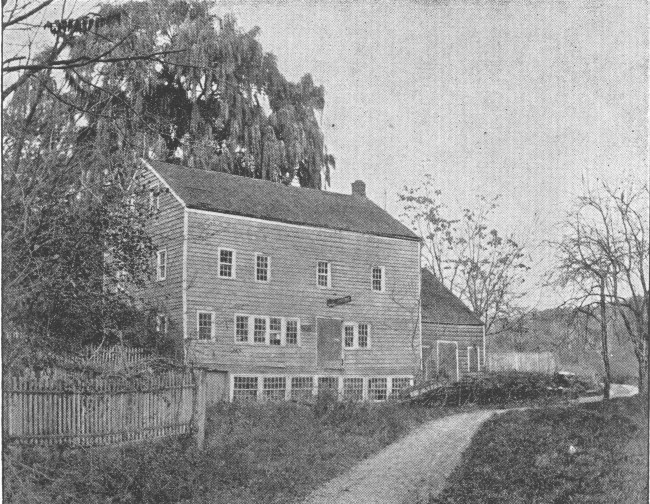
In The Century for April 1888, is a most interesting article, entitled "The American Inventors of the Telegraph, with Special Reference to the Services of Alfred Vail". This is exhaustive of the subject, was written by Franklin Leonard Pope, and was supervised by Mrs. Alfred Vail, as she tells us, and the statements fortified by documents, correspondence and designs. To The Century editors and to Mr. James Cummings Vail, of Morris Plains, son of Alfred Vail, we are indebted for the use of the plate of the Speedwell Iron Works, redrawn from an ancient invoice, the age of which is not known. The illustration of the "Factory" in which the first successful trial and, afterwards, the first public exhibition, of the electric telegraph took place, is from a photograph of the building as it stands at the present day, on the lot in which stands the homestead house, now occupied by Mrs. Lidgerwood.
"I have always understood", says Mr. J. C. Vail, (Jan'y 5, 1893), "that the room in which my father and Baxter (his young assistant) worked and called the 'work shop', was in an old stone building within the Iron Works enclosure, between the bridge and Morristown and is still standing, and is the only stone building within that enclosure."
Of these buildings and associations, Mrs. John H. Lidgerwood, the granddaughter of Judge Vail, now living on the place, at Speedwell, writes as follows, Dec. 12, 1892:
"My grandfather makes but three entries in his diary:
"'1838, January 6th. Dr. Gale came this morning. They (Prof. Morse, Alfred Vail, and the Dr.) have worked the Tellegraph in the Factory this evening for the first time.'
"'10th. Mr. Morse and Alfred are working and showing the Tellegraph.'
"'11th. A hundred came to see the Tellegraph work.'
"The old house", continues Mrs. Lidgerwood, "in which my grandfather then lived, still remains near the foot of the hill nearest the town. The interior has been entirely changed and I never knew the room occupied by Professor Morse.
"The shop, in which the machine was constructed, and which was called the 'work shop', has also been rebuilt. Its four walls are all that are left of the original building. The floor of that room was taken away to make a one story building and the windows were put in the roof. It is now entirely vacant and stands on the side of the dam opposite the saw mill, the gable end of the old shop facing the road. One end of the foundation was partly torn away by the freshet that destroyed the old bridge. The experiments were made in a building called 'The Factory', which is at the foot of our lawn. It was built for a Cotton Factory, but only used for making buttons, owing, I believe, to some fault in its construction.
"My grandfather has told me frequently that the machine was placed on the first floor, and about three miles of copper wire, insulated by being wound with cotton yarn, was wound around the walls of the second story. There are some hooks still in the side walls but I do not know if they are the same. I have still a small portion of the original wire used in the experiments. I do not know the age of any of these buildings. The works were probably here long before the Revolution. I have heard my grandfather say there was a forge here at that time."
The machine used on the occasion to which Judge Vail refers in his diary, and on which he himself had sent the first message of all, "a patient waiter is no loser," is now loaned by the family to the Smithsonian Institute, Washington, D. C.
From the time the first telegraphic message was sent by Alfred Vail from the "Factory" at Speedwell and received by Professor Morse two miles away, and the next experiment when Morse and Vail operated with complete success through ten miles of space,—to the final triumph at Washington, many and great were the perils and moments of anguish through which the inventors passed. It was on the 24th of May, 1844, when the supreme test of the telegraph was made at Washington and the message was sent to Mr. Vail in Baltimore, in the words selected by Miss Annie G. Ellsworth and taken from Numbers xxiii: 23, "What hath God wrought."
During these years Alfred Vail, it is claimed, had "not only become a full partner in the ownership of the invention, but had supplied the entire resources and facilities for obtaining patents and for constructing the apparatus for exhibition at Washington; and more than this, he had introduced essential improvements not only in the mechanism, but in the fundamental principles of the telegraph." Vail felt that Morse had not acknowledged, as he expected, his (Vail's) part in the invention or fully recognized his rights of partnership. Of this, the Hon. Amos Kendall, the friend and associate of both, has said: "If justice is done, the name of Alfred Vail will forever stand associated with that of Samuel F. B. Morse in the history and introduction into public use of the electro-magnetic telegraph."
Mr. Vail's book, which has place in most of the prominent libraries of Europe and America, was published in 1845 and is entitled "The American Electro-Magnetic Telegraph with the Reports of Congress and a description of all Telegraphs known, employing Electricity or Galvinism". It is illustrated by eighty-one wood engravings.
FACTORY AT SPEEDWELL. IN WHICH THE FIRST EXHIBITION OF THE ELECTRO-MAGNETIC TELEGRAPH TOOK PLACE.
William Graham Sumner, LL. D.
Professor Sumner is a New Jersey man, born at Paterson. He inherited from his father, Thomas Sumner, who came to this country from England in 1836, several important qualities which those who know the son will recognize. Thomas Sumner, we are told, was a man of the strictest integrity, of indefatigable industry, of sturdy common sense and possessing the courage of his convictions. Two of Professor Sumner's early teachers in Hartford, one of them Mr. S. M. Capron, in the classical department, had also great influence upon his character. He was graduated from Yale College in 1863. In the summer of that year, he went abroad, studied French and Hebrew in Geneva, after which he spent two years at the University of Göttingen, in the study of ancient languages, history, especially church history, and biblical science. Here, he tells us, he was "taught rigorous and pitiless methods of investigation and deduction. Their analysis was their strong point. Their negative attitude toward the poetic element, their indifference to sentiment, even religious sentiment, was a fault, seeing that they studied the Bible as a religious book and not for philology and history only; but their method of study was nobly scientific, and was worthy to rank, both for its results and its discipline, with the best of the natural science methods."
Mr. Sumner went to Oxford in 1866, with the intention and desire of reading English literature on the same subjects which he had pursued at Göttingen. "I expected," he says, "to find it rich and independent. I found that it consisted of second-hand adaptation of what I had just been studying."
Returning to this country, while tutor in Yale College, in 1866, Mr. Sumner published a translation of Lange's "Commentary on Second Kings". In 1867, he was ordained deacon in the Protestant Episcopal Church, and two years later, he received full ordination in New York and became assistant to Rev. Dr. Washburn at Calvary Church, New York, under whom he was made editor of a broad church paper. In September, 1870, he became rector of the Church of the Redeemer at Morristown, N. J., from which event he claims our attention as an author.
With regard to the course of his young ministry in this parish he says; "When I came to write sermons, I found to what a degree my interest lay in topics of social science and political economy. There was then no public interest in the currency and only a little in the tariff. I thought that these were matters of the most urgent importance, which threatened all the interests, moral, social and economic, of the nation, and I was young enough to believe that they would all be settled in the next four or five years. It was not possible to preach about them, but I got so near to it that I was detected sometimes, as, for instance, when a New Jersey banker came to me, as I came down from the pulpit, and said: 'There was a great deal of political economy in that sermon.'"
In September, 1872, Mr. Sumner accepted the chair of Political and Social Science at Yale College, in which he has so highly distinguished himself. Of this he says: "I had always been very fond of teaching and knew that the best work I could ever do in the world would be in that profession; also that I ought to be in an academical career. I had seen two or three cases of men who, in that career, would have achieved distinguished usefulness, but who were wasted in the parish and pulpit".
In 1884, Prof. Sumner received the degree of LL. D. from the University of Tennessee. A distinguished American economist well acquainted with Prof. Sumner's work has given to a writer from whom we quote, the following estimate of his method and of his position and influence as a public teacher: "For exact and comprehensive knowledge Prof. Sumner is entitled to take the first place in the ranks of American economists; and as a teacher he has no superior. His leading mental characteristic he has himself well stated in describing the characteristics of his former teachers at Göttingen; namely, as 'bent on seeking a clear and comprehensive conception of the matter "or truth" under study, without regard to any consequences whatever,' and further, when in his own mind Prof. Sumner is fully satisfied as to what the truth is, he has no hesitation in boldly declaring it, on every fitting occasion, without regard to consequences. If the theory is a 'spade', he calls it a spade, and not an implement of husbandry."
Professor Sumner has published, besides Lange's "Commentary on the Second Book of Kings", the "History of American Currency"; "Lectures on the History of Protection in the United States"; "Life of Andrew Jackson", in the American Statesmen Series; "What Social Classes Owe to Each Other"; "Economic Problems"; "Essays on Political and Social Science"; "Protectionism"; "Alexander Hamilton", in the Makers of America Series, (1890); "The Financier (Robert Morris) and the Finances of the American Revolution", (1891); besides a large number of magazine articles on the same line of subjects.
Elwyn Waller, Ph. D.
Three writers now present themselves, each of whom is distinguished in his department, one of Chemistry, one of Mining and Metallurgy, and one of Mathematics. The Author's Club would exclude these brilliant men from recognition, but here the clause of our title, "and Writers", saves us. Prof. Waller amusingly expresses the position when he says, "I supposed that reference in your book would be made to those who had achieved more or less distinction in what has sometimes been termed 'polite literature.' While I am not ready to admit that the literature of my profession (chemistry) is 'impolite', it probably is too technical to come within the scope of your work."
Like many of our residents, Dr. Waller's time is divided between New York and Morristown, being Professor of Analytical Chemistry at Columbia School of Mines, New York. He has written much of value; innumerable pamphlets and articles for various magazines, for chemical periodicals and Sanitary Reports and for journals far and wide, both technical and general in character, among which are The Century and The Engineering and Mining Journal. He has written certain articles for Johnson's Encyclopædia, and has edited articles in other books all of which are to be reckoned as technical, but valuable contributions to current chemical literature. He has completed a book on "Quantitative Chemical Analysis", from the MSS. of one of his Colleagues, which was left unfinished in 1879 and he is now engaged in revising and practically re-writing the same work. Besides, he has written gossipy letters for The Evening Post, and The Evening Mail, of New York, from various far-off islands and inland points, where he has usually made one of a scientific party. One series of letters was written while a member of the U. S. St. Domingo Expedition.
George W. Maynard, Ph. D.
Another scientific man, ranking high in his department of Mining and Engineering, is Professor George W. Maynard, who is just now principally engaged in Colorado, passing back and forth between that State and his home in Morristown. He has had extensive travels over our own country and continent, and abroad. He is a close observer and many of us are familiar with his graphic descriptions of the scenes which he has witnessed, notably in Mexico, also with the illustrated lectures on these and other subjects, which he has generously given from time to time.
Professor Maynard is a graduate of Columbia College, New York, and was Demonstrator in Chemistry in that College for a year. He then studied abroad at Göttingen, Clousthal and Berlin, and was for four years Professor of Mining and Metallurgy in the Rensselaer Polytechnic Institute, of Troy, N. Y. His published writings, which have mostly been of a technical character, have appeared in various technical journals and in the "Transactions of the American Institute of Mining Engineers", and in The Journal of the Iron and Steel Institute of Great Britain. Of the above mentioned societies, he is an active member and also of the New York Academy of Sciences.
Emory McClintock, LL. D.
The third of our group of specialists is Dr. Emory McClintock, whom one of his brother scientists warns us we should "not forget to mention as he is one of the most eminent mathematicians in the United States". As associated with Morristown, in his beautiful home on Kemble Hill, high overlooking the Lowantica valley and scenes full of memories of the Revolution, we claim him with pride, in spite of his saying that his writings have all been records of scientific researches and not literary in any sense and that he has never written a book, big or little, nor even a magazine article. It remains, that his many writings are of great value as published in pamphlet form or in periodicals of technical character, such as The Bulletin of the New York Mathematical Society, which is "A Historical and Critical Review of Mathematical Science"; or, The American Journal of Mathematics from which a large pamphlet is reprinted on The Analysis of Quintic Equations, or, in the direction of his art or specialty as a life insurance actuary, where appears, among other writings, a large pamphlet on The Effects of Selection—being "An Actuarial Essay," in which we find very interesting matter for the general reader.
Andrew F. West, LL. D.
Professor West, of Princeton College, is well remembered as a resident of Morristown for two years, (1881-1883). He was at that time, the predecessor of Mr. Charles D. Platt, at the Morris Academy, and mingled largely in the literary, social and musical circles of the city. He, like Dr. McClintock, is a Pennsylvanian, and was born at Pittsburg.
Since Mr. West accepted a professorship at Princeton College, which was the occasion of his leaving Morristown, he has written largely on classical and medieval subjects.
His last book, just published, by Charles Scribner's Sons, New York, 1892, is entitled "Alcuin and the Rise of the Christian Schools." It appears in the Series of "The Great Educators", edited by Nicholas Murray Butler. It is a volume of 205 pages, and contains a sketch of Alcuin at York and at Tours, also treating of his educational writings, his character, his pupils, and his later influence.
Various literary, philological and educational articles in reviews have been contributed by Professor West, and two books additional to the one mentioned, have been published by him. These are, "The Andria and Heauton Timorumenos, of Terence," edited with introduction and notes, and published by Harper and Brothers (1888); and "The Philobiblon of Richard de Bury," edited from the manuscripts, translated and annotated. The latter is in three volumes: I., The Latin Text; II., The English Version; III., Introduction and Notes Printed by Theodore De Vienne for the Grolier Club of New York, (1889).
José Gros.
From the shores of Spain, has come to us one of our advanced thinkers and writers, Señor José Gros. He is a disciple of Henry George and, on one occasion, introduced that distinguished man to a Morristown audience, in our Lyceum Hall, giving, to a large number of people assembled, the opportunity of listening to his own exposition of the views about which so wide and warm a controversy has raged.
Señor Gros was born and educated in Spain. He has traveled extensively through Italy, France, Germany, England, and a portion of our own country, finally taking a position in a commercial house in New York, in 1859, in which he remained until 1870, when he retired to Morristown. Since then, in his own words, he has "dedicated most of his time to the study of history and science, more especially social science," for which he has been writing articles for western magazines and journals and also for one or more of our local papers.
In the Locomotive Firemen's Magazine, of Terre Haute, Indiana, a large number of these articles have appeared. They go with this magazine to all the States and Territories of the Union, to parts of Canada and Mexico, and they are connected with over 500 Labor Clubs. The subject of one series of these papers is "Civilization With its Problems". Other subjects are, "The Struggle for Existence"; "Confusion in Economic Thought"; "Governments by Statics or Dynamics"; "Congested Civilizations"; "Social Skepticism", and a series on "To-day's Problems". In all his arguments, Señor Gros considers as vital to advance in Social Science the principles of the Christian religion. "No system," he says, "can save us from disasters without clear perceptions of duty on what I call 'Christian citizenship.'"