THE MISSOURI RIVER JOURNALS
Reading edition
1843
INTRODUCTION
THIS journey, which occupied within a few days of eight months,—from March 11, 1843, to November 6 of the same year,—was undertaken in the interest of the "Quadrupeds of North America," in which the three Audubons and Dr. Bachman were then deeply engaged. The journey has been only briefly touched upon in former publications, and the entire record from August 16 until the return home was lost in the back of an old secretary from the time of Audubon's return in November, 1843, until August, 1896, when two of his granddaughters found it. Mrs. Audubon states in her narrative that no record of this part of the trip was known to exist, and none of the family now living had ever seen it until the date mentioned.
Not only is the diary most valuable from the point of view of the naturalist, but also from that of the historian interested in the frontier life of those days.
M. R. A.
As the only account of the journey from New York to St. Louis which can now be found is contained in a letter to my uncle Mr. James Hall, dated St. Louis, March 29, 1843, the following extract is given:—
"The weather has been bad ever since we left Baltimore. There we encountered a snow-storm that accompanied us all the way to this very spot, and at this moment the country is whitened with this precious, semi-congealed, heavenly dew. As to ice!—I wish it were all in your icehouse when summer does come, should summer show her bright features in the year of our Lord 1843. We first encountered ice at Wheeling, and it has floated down the Ohio all around us, as well as up the Mississippi to pleasant St. Louis. And such a steamer as we have come in from Louisville here!—the very filthiest of all filthy old rat-traps I ever travelled in; and the fare worse, certainly much worse, and so scanty withal that our worthy commander could not have given us another meal had we been detained a night longer. I wrote a famous long letter to my Lucy on the subject, and as I know you will hear it, will not repeat the account of our situation on board the 'Gallant'—a pretty name, too, but alas! her name, like mine, is only a shadow, for as she struck a sawyer[239] one night we all ran like mad to make ready to leap overboard; but as God would have it, our lives and the 'Gallant,' were spared—she from sinking, and we from swimming amid rolling and crashing hard ice. The ladies screamed, the babies squalled, the dogs yelled, the steam roared, the captain (who, by the way, is a very gallant man) swore—not like an angel, but like the very devil—and all was confusion and uproar, just as if Miller's prophecy had actually been nigh. Luckily, we had had our supper, as the thing was called on board the 'Gallant,' and every man appeared to feel resolute, if not resolved to die.
"I would have given much at that moment for a picture of the whole. Our compagnons de voyage, about one hundred and fifty, were composed of Buckeyes, Wolverines, Suckers, Hoosiers, and gamblers, with drunkards of each and every denomination, their ladies and babies of the same nature, and specifically the dirtiest of the dirty. We had to dip the water for washing from the river in tin basins, soap ourselves all from the same cake, and wipe the one hundred and fifty with the same solitary one towel rolling over a pin, until it would have been difficult to say, even with your keen eyes, whether it was manufactured of hemp, tow, flax, or cotton. My bed had two sheets, of course, measuring seven-eighths of a yard wide; my pillow was filled with corn-shucks. Harris fared even worse than I, and our 'state-room' was evidently better fitted for the smoking of hams than the smoking of Christians. When it rained outside, it rained also within, and on one particular morning, when the snow melted on the upper deck, or roof, it was a lively scene to see each person seeking for a spot free from the many spouts overhead.
"We are at the Glasgow Hotel, and will leave it the day after to-morrow, as it is too good for our purses. We intended to have gone twenty miles in Illinois to Edwardsville, but have changed our plans, and will go northwest sixteen miles to Florissant, where we are assured game is plenty, and the living quite cheap. We do not expect to leave this till the 20th or 22d of April, and should you feel inclined to write to me, do so by return of mail, if possible, and I may get your letter before I leave this for the Yellowstone.
"The markets here abound with all the good things of the land, and of nature's creation. To give you an idea of this, read the following items: Grouse, two for a York shilling; three chickens for the same; Turkeys, wild or tame, 25 cents; flour $2.00 a barrel; butter, sixpence for the best—fresh, and really good. Beef, 3 to 4 cents; veal, the same; pork, 2 cents; venison hams, large and dried, 15 cents each; potatoes, 10 cents a bushel; Ducks, three for a shilling; Wild Geese, 10 cents each; Canvas-back Ducks, a shilling a pair; vegetables for the asking, as it were; and only think, in the midst of this abundance and cheapness, we are paying at the rate of $9.00 per week at our hotel, the Glasgow, and at the Planters we were asked $10.00.
"I have been extremely kindly received and treated by Mr. Chouteau and partners. Mr. Sire, the gentleman who will command the steamer we go in, is one of the finest-looking men I have seen for many a day, and the accounts I hear of him correspond with his noble face and general appearance."
THE MISSOURI RIVER JOURNALS
1843
I LEFT home at ten o'clock of the morning, on Saturday the 11th of March, 1843, accompanied by my son Victor. I left all well, and I trust in God for the privilege and happiness of rejoining them all some time next autumn, when I hope to return from the Yellowstone River, an expedition undertaken solely for the sake of our work on the Quadrupeds of North America. The day was cold, but the sun was shining, and after having visited a few friends in the city of New York, we departed for Philadelphia in the cars, and reached that place at eleven of the night. As I was about landing, I was touched on the shoulder by a tall, robust-looking man, whom I knew not to be a sheriff, but in fact my good friend Jediah Irish,[240] of the Great Pine Swamp. I also met my friend Edward Harris, who, with old John G. Bell,[241] Isaac Sprague, and young Lewis Squires, are to be my companions for this campaign. We all put up at Mr. Sanderson's. Sunday was spent in visits to Mr. Bowen,[242] Dr. Morton,[243] and others, and we had many calls made upon us at the hotel. On Monday morning we took the cars for Baltimore, and Victor returned home to Minniesland. The weather was rainy, blustery, cold, but we reached Baltimore in time to eat our dinner there, and we there spent the afternoon and the night. I saw Gideon B. Smith and a few other friends, and on the next morning we entered the cars for Cumberland, which we reached the same evening about six. Here we had all our effects weighed, and were charged thirty dollars additional weight—a first-rate piece of robbery. We went on now by coaches, entering the gap, and ascending the Alleghanies amid a storm of snow, which kept us company for about forty hours, when we reached Wheeling, which we left on the 16th of March, and went on board the steamer, that brought us to Cincinnati all safe.
We saw much game on our way, such as Geese, Ducks, etc., but no Turkeys as in times of yore. We left for Louisville in the U.S. mail steamer, and arrived there before daylight on the 19th inst. My companions went to the Scott House, and I to William G. Bakewell's, whose home I reached before the family were up. I remained there four days, and was, of course, most kindly treated; and, indeed, during my whole stay in this city of my youth I did enjoy myself famously well, with dancing, dinner-parties, etc. We left for St. Louis on board the ever-to-be-remembered steamer "Gallant," and after having been struck by a log which did not send us to the bottom, arrived on the 28th of March.
On the 4th of April, Harris went off to Edwardsville, with the rest of my companions, and I went to Nicholas Berthoud, who began housekeeping here that day, though Eliza was not yet arrived from Pittsburgh. My time at St. Louis would have been agreeable to any one fond of company, dinners, and parties; but of these matters I am not, though I did dine at three different houses, bon gré, mal gré. In fact, my time was spent procuring, arranging, and superintending the necessary objects for the comfort and utility of the party attached to my undertaking. The Chouteaux supplied us with most things, and, let it be said to their honor, at little or no profit. Captain Sire took me in a light wagon to see old Mr. Chouteau one afternoon, and I found the worthy old gentleman so kind and so full of information about the countries of the Indians that I returned to him a few days afterwards, not only for the sake of the pleasure I enjoyed in his conversation, but also with the view to procure, both dead and alive, a species of Pouched Rat (Pseudostoma bursarius)[244] wonderfully abundant in this section of country. One day our friend Harris came back, and brought with him the prepared skins of birds and quadrupeds they had collected, and informed me that they had removed their quarters to B——'s. He left the next day, after we had made an arrangement for the party to return the Friday following, which they did. I drew four figures of Pouched Rats, and outlined two figures of Sciurus capistratus,[245] which is here called "Fox Squirrel."
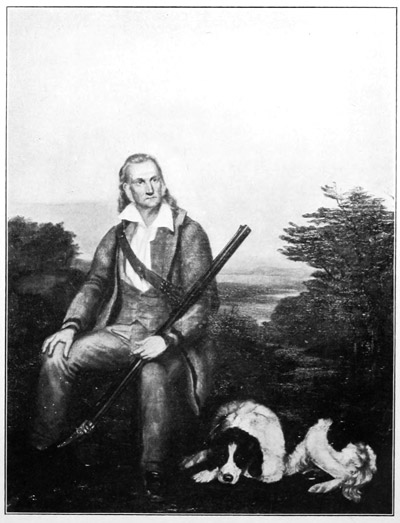
AUDUBON. FROM THE PORTRAIT BY JOHN WOODHOUSE AUDUBON (ABOUT 1841).
The 25th of April at last made its appearance, the rivers were now opened, the weather was growing warm, and every object in nature proved to us that at last the singularly lingering winter of 1842 and 1843 was over. Having conveyed the whole of our effects on board the steamer, and being supplied with excellent letters, we left St. Louis at 11.30 a. m., with Mr. Sarpy on board, and a hundred and one trappers of all descriptions and nearly a dozen different nationalities, though the greater number were French Canadians, or Creoles of this State. Some were drunk, and many in that stupid mood which follows a state of nervousness produced by drinking and over-excitement. Here is the scene that took place on board the "Omega" at our departure, and what followed when the roll was called.
First the general embarkation, when the men came in pushing and squeezing each other, so as to make the boards they walked upon fairly tremble. The Indians, poor souls, were more quiet, and had already seated or squatted themselves on the highest parts of the steamer, and were tranquil lookers-on. After about three quarters of an hour, the crew and all the trappers (these are called engagés)[246] were on board, and we at once pushed off and up the stream, thick and muddy as it was. The whole of the effects and the baggage of the engagés was arranged in the main cabin, and presently was seen Mr. Sarpy, book in hand, with the list before him, wherefrom he gave the names of these attachés. The men whose names were called nearly filled the fore part of the cabin, where stood Mr. Sarpy, our captain, and one of the clerks. All awaited orders from Mr. Sarpy. As each man was called, and answered to his name, a blanket containing the apparel for the trip was handed to him, and he was ordered at once to retire and make room for the next. The outfit, by the way, was somewhat scanty, and of indifferent quality. Four men were missing, and some appeared rather reluctant; however, the roll was ended, and one hundred and one were found. In many instances their bundles were thrown to them, and they were ordered off as if slaves. I forgot to say that as the boat pushed off from the shore, where stood a crowd of loafers, the men on board had congregated upon the hurricane deck with their rifles and guns of various sorts, all loaded, and began to fire what I should call a very disorganized sort of a salute, which lasted for something like an hour, and which has been renewed at intervals, though in a more desultory manner, at every village we have passed. However, we now find them passably good, quiet, and regularly sobered men. We have of course a motley set, even to Italians. We passed the mouth of the Missouri, and moved very slowly against the current, for it was not less than twenty minutes after four the next morning, when we reached St. Charles,[247] distant forty-two miles. Here we stopped till half-past five, when Mr. Sarpy, to whom I gave my letters home, left us in a wagon.
April 26. A rainy day, and the heat we had experienced yesterday was now all gone. We saw a Wild Goose running on the shore, and it was killed by Bell; but our captain did not stop to pick it up, and I was sorry to see the poor bird dead, uselessly. We now had found out that our berths were too thickly inhabited for us to sleep in; so I rolled myself in my blanket, lay down on deck, and slept very sound.
27th. A fine clear day, cool this morning. Cleaned our boilers last night, landing where the "Emily Christian" is sunk, for a few moments; saw a few Gray Squirrels, and an abundance of our common Partridges in flocks of fifteen to twenty, very gentle indeed. About four this afternoon we passed the mouth of the Gasconade River, a stream coming from the westward, valuable for its yellow-pine lumber. At a woodyard above us we saw a White Pelican[248] that had been captured there, and which, had it been clean, I should have bought. I saw that its legs and feet were red, and not yellow, as they are during autumn and winter. Marmots are quite abundant, and here they perforate their holes in the loose, sandy soil of the river banks, as well as the same soil wherever it is somewhat elevated. We do not know yet if it is Arctomys monax, or a new species.[249] The weather being fine, and the night clear, we ran all night and on the morning of the 28th, thermometer 69° to 78° at sunrise, we were in sight of the seat of government, Jefferson. The State House stands prominent, with a view from it up and down the stream of about ten miles; but, with the exception of the State House and the Penitentiary, Jefferson is a poor place, the land round being sterile and broken. This is said to be 160 or 170 miles above St. Louis.[250] We saw many Gray Squirrels this morning. Yesterday we passed under long lines of elevated shore, surmounted by stupendous rocks of limestone, with many curious holes in them, where we saw Vultures and Eagles[251] enter towards dusk. Harris saw a Peregrine Falcon; the whole of these rocky shores are ornamented with a species of white cedar quite satisfactorily known to us. We took wood at several places; at one I was told that Wild Turkeys were abundant and Squirrels also, but as the squatter observed, "Game is very scarce, especially Bears." Wolves begin to be troublesome to the settlers who have sheep; they are obliged to drive the latter home, and herd them each night.
This evening the weather became cloudy and looked like rain; the weather has been very warm, the thermometer being at 78° at three this afternoon. We saw a pair of Peregrine Falcons, one of them with a bird in its talons; also a few White-fronted Geese, some Blue-winged Teal, and some Cormorants,[252] but none with the head, neck, and breast pure white, as the one I saw two days ago. The strength of the current seemed to increase; in some places our boat merely kept her own, and in one instance fell back nearly half a mile to where we had taken in wood. At about ten this evening we came into such strong water that nothing could be done against it; we laid up for the night at the lower end of a willow island, and then cleaned the boilers and took in 200 fence-rails, which the French Canadians call "perches." Now a perche in French means a pole; therefore this must be patois.
29th. We were off at five this rainy morning, and at 9 a. m. reached Booneville,[253] distant from St. Louis about 204 miles. We bought at this place an axe, a saw, three files, and some wafers; also some chickens, at one dollar a dozen. We found here some of the Santa Fé traders with whom we had crossed the Alleghanies. They were awaiting the arrival of their goods, and then would immediately start. I saw a Rabbit sitting under the shelf of a rock, and also a Gray Squirrel. It appears to me that Sciurus macrourus[254] of Say relishes the bottom lands in preference to the hilly or rocky portions which alternately present themselves along these shores. On looking along the banks of the river, one cannot help observing the half-drowned young willows, and cotton trees of the same age, trembling and shaking sideways against the current; and methought, as I gazed upon them, of the danger they were in of being immersed over their very tops and thus dying, not through the influence of fire, the natural enemy of wood, but from the force of the mighty stream on the margin of which they grew, and which appeared as if in its wrath it was determined to overwhelm, and undo all that the Creator in His bountifulness had granted us to enjoy. The banks themselves, along with perhaps millions of trees, are ever tumbling, falling, and washing away from the spots where they may have stood and grown for centuries past. If this be not an awful exemplification of the real course of Natures intention, that all should and must live and die, then, indeed, the philosophy of our learned men cannot be much relied upon!
This afternoon the steamer "John Auld" came up near us, but stopped to put off passengers. She had troops on board and a good number of travellers. We passed the city of Glasgow[255] without stopping there, and the blackguards on shore were so greatly disappointed that they actually fired at us with rifles; but whether with balls or not, they did us no harm, for the current proved so strong that we had to make over to the opposite side of the river. We did not run far; the weather was still bad, raining hard, and at ten o'clock, with wood nearly exhausted, we stopped on the west shore, and there remained all the night, cleaning boilers, etc.
Sunday 30th. This morning was cold, and it blew a gale from the north. We started, however, for a wooding-place, but the "John Auld" had the advantage of us, and took what there was; the wind increased so much that the waves were actually running pretty high down-stream, and we stopped until one o'clock. You may depend my party was not sorry for this; and as I had had no exercise since we left St. Louis, as soon as breakfast was over we started—Bell, Harris, Squires, and myself, with our guns—and had quite a frolic of it, for we killed a good deal of game, and lost some. Unfortunately we landed at a place where the water had overflowed the country between the shores and the hills, which are distant about one mile and a half. We started a couple of Deer, which Bell and I shot at, and a female Turkey flying fast; at my shot it extended its legs downwards as if badly wounded, but it sailed on, and must have fallen across the muddy waters. Bell, Harris, and myself shot running exactly twenty-eight Rabbits, Lepus sylvaticus, and two Bachmans, two Sciurus macrourus of Say, two Arctomys monax, and a pair of Tetrao [Bonasa] umbellus. The woods were alive with the Rabbits, but they were very wild; the Ground-hogs, Marmots, or Arctomys, were in great numbers, judging from the innumerable burrows we saw, and had the weather been calm, I have no doubt we would have seen many more. Bell wounded a Turkey hen so badly that the poor thing could not fly; but Harris frightened it, and it was off, and was lost. Harris shot an Arctomys without pouches, that had been forced out of its burrow by the water entering it; it stood motionless until he was within ten paces of it; when, ascertaining what it was, he retired a few yards, and shot it with No. 10 shot, and it fell dead on the spot. We found the woods filled with birds—all known, however, to us: Golden-crowned Thrush, Cerulean Warblers, Woodpeckers of various kinds, etc.; but not a Duck in the bayou, to my surprise. At one the wind lulled somewhat, and as we had taken all the fence-rails and a quantity of dry stuff of all sorts, we were ready to attempt our ascent, and did so. It was curious to see sixty or seventy men carrying logs forty or fifty feet long, some well dried and some green, on their shoulders, all of which were wanted by our captain, for some purpose or other. In a great number of instances the squatters, farmers, or planters, as they may be called, are found to abandon their dwellings or make towards higher grounds, which fortunately are here no farther off than from one to three miles. After we left, we met with the strength of the current, but with our stakes, fence-rails, and our dry wood, we made good headway. At one place we passed a couple of houses, with women and children, perfectly surrounded by the flood; these houses stood apparently on the margin of a river[256] coming in from the eastward. The whole farm was under water, and all around was the very perfection of disaster and misfortune. It appeared to us as if the men had gone to procure assistance, and I was grieved that we could not offer them any. We saw several trees falling in, and beautiful, though painful, was the sight. As they fell, the spray which rose along their whole length was exquisite; but alas! these magnificent trees had reached the day of oblivion.
A few miles above New Brunswick we stopped to take in wood, and landed three of our Indians, who, belonging to the Iowa tribe, had to travel up La Grande Rivière. The wind lulled away, and we ran all night, touching, for a few minutes, on a bar in the middle of the river.
May 1. This morning was a beautiful one; our run last night was about thirty miles, but as we have just begun this fine day, I will copy here the habits of the Pouched Rats, from my notes on the spot at old Mr. Chouteau's, and again at St. Louis, where I kept several alive for four or five days:—
Plantation of Pierre Chouteau, Sen., four miles west of St. Louis, April 13, 1843. I came here last evening in the company of Mr. Sarpy, for the express purpose of procuring some Pouched Rats, and as I have been fortunate enough to secure several of these strange creatures, and also to have seen and heard much connected with their habits and habitats, I write on the spot, with the wish that no recollection of facts be passed over. The present species is uncommonly abundant throughout this neighborhood, and is even found in the gardens of the city of St. Louis, upon the outskirts. They are extremely pernicious animals to the planter and to the gardener, as they devour every root, grass, or vegetable within their reach, and burrow both day and night in every direction imaginable, wherever they know their insatiable appetites can be recompensed for their labor. They bring forth from five to seven young, about the 25th of March, and these are rather large at birth. The nest, or place of deposit, is usually rounded, and about eight inches in diameter, being globular, and well lined with the hair of the female. This nest is not placed at the end of a burrow, or in any particular one of their long galleries, but oftentimes in the road that may lead to hundreds of yards distant. From immediately around the nest, however, many galleries branch off in divers directions, all tending towards such spots as are well known to the parents to afford an abundance of food. I cannot ascertain how long the young remain under the care of the mother. Having observed several freshly thrown-up mounds in Mr. Chouteau's garden, this excellent gentleman called to some negroes to bring spades, and to dig for the animals with the hope I might procure one alive. All hands went to work with alacrity, in the presence of Dr. Trudeau of St. Louis, my friends the father and son Chouteau, and myself. We observed that the "Muloë"[257] (the name given these animals by the creoles of this country) had worked in two or more opposite directions, and that the main gallery was about a foot beneath the surface of the ground, except where it had crossed the walks, when the burrow was sunk a few inches deeper. The work led the negroes across a large square and two of the walks, on one side of which we found large bunches of carnations, from which the roots had been cut off obliquely, close to the surface of the ground, thereby killing the plants. The roots measured 7/8 of an inch, and immediately next to them was a rosebush, where ended the burrow. The other side was now followed, and ended amidst the roots of a fine large peach-tree; these roots were more or less gashed and lacerated, but no animal was there, and on returning on our tracks, we found that several galleries, probably leading outside the garden, existed, and we gave up the chase.
This species throws up the earth in mounds rarely higher than twelve to fifteen inches, and these mounds are thrown up at extremely irregular distances, being at times near to each other, and elsewhere ten to twenty, or even thirty, paces apart, yet generally leading to particular spots, well covered with grapes or vegetables of different kinds. This species remains under ground during the whole winter, inactive, and probably dormant, as they never raise or work the earth at this time. The earth thrown up is as if pulverized, and as soon as the animal has finished his labors, which are for no other purpose than to convey him securely from one spot to another, he closes the aperture, which is sometimes on the top, though more usually on the side towards the sun, leaving a kind of ring nearly one inch in breadth, and about the diameter of the body of the animal. Possessed of an exquisite sense of hearing and of feeling the external pressure of objects travelling on the ground, they stop their labors instantaneously on the least alarm; but if you retire from fifteen to twenty paces to the windward of the hole, and wait for a quarter of an hour or so, you see the "Gopher" (the name given to it by the Missourians—Americans) raising the earth with its back and shoulders, and forcing it out forward, leaving the aperture open during the process, and from which it at times issues a few steps, cuts the grasses around, with which it fills its pouches, and then retires to its hole to feed upon its spoils; or it sometimes sits up on its haunches and enjoys the sun, and it may then be shot, provided you are quick. If missed you see it no more, as it will prefer altering the course of its burrow and continuing its labors in quite a different direction. They may be caught in common steel-traps, and two of them were thus procured to-day; but they then injure the foot, the hind one. They are also not uncommonly thrown up by the plough, and one was caught in this manner. They have been known to destroy the roots of hundreds of young fruit-trees in the course of a few days and nights, and will cut roots of grown trees of the most valued kinds, such as apple, pear, peach, plum, etc. They differ greatly in their size and also in their colors, according to age, but not in the sexes. The young are usually gray, the old of a dark chestnut, glossy and shining brown, very difficult to represent in a drawing. The opinion commonly received and entertained, that these Pouched Rats fill their pouches with the earth of their burrows, and empty them when at the entrance, is, I think, quite erroneous; about a dozen which were shot in the act of raising their mounds, and killed at the very mouth of their burrows, had no earth in any of these sacs; the fore feet, teeth, nose, and the anterior portion of the head were found covered with adhesive earth, and most of them had their pouches filled either with blades of grass or roots of different sizes; and I think their being hairy rather corroborates the fact that these pouches are only used for food. In a word, they appear to me to raise the earth precisely in the manner employed by the Mole.
When travelling the tail drags on the ground, and they hobble along with their long front claws drawn underneath; at other times, they move by slow leaping movements, and can travel backwards almost as fast as forwards. When turned over they have much difficulty in replacing themselves in their natural position, and you may see them kicking with their legs and claws for a minute or two before they are right. They bite severely, and do not hesitate to make towards their enemies or assailants with open mouth, squealing like a rat. When they fight among themselves they make great use of the nose in the manner of hogs. They cannot travel faster than the slow walk of a man. They feed frequently while seated on the rump, using their fore paws and long claws somewhat like a squirrel. When sleeping they place the head beneath the breast, and become round, and look like a ball of earth. They clean their whiskers and body in the manner of Rats, Squirrels, etc.
The four which I kept alive never drank anything, though water was given to them. I fed them on potatoes, cabbages, carrots, etc. They tried constantly to make their escape by gnawing at the floor, but in vain. They slept wherever they found clothing, etc., and the rascals cut the lining of my hunting-coat all to bits, so that I was obliged to have it patched and mended. In one instance I had some clothes rolled up for the washerwoman, and, on opening the bundle to count the pieces, one of the fellows caught hold of my right thumb, with fortunately a single one of its upper incisors, and hung on till I shook it off, violently throwing it on the floor, where it lay as if dead; but it recovered, and was as well as ever in less than half an hour. They gnawed the leather straps of my trunks during the night, and although I rose frequently to stop their work, they would begin anew as soon as I was in bed again. I wrote and sent most of the above to John Bachman from St. Louis, after I had finished my drawing of four figures of these most strange and most interesting creatures.
And now to return to this day: When we reached Glasgow, we came in under the stern of the "John Auld." As I saw several officers of the United States army I bowed to them, and as they all knew that I was bound towards the mighty Rocky Mountains, they not only returned my salutations, but came on board, as well as Father de Smet.[258] They all of them came to my room and saw specimens and skins. Among them was Captain Clark,[259] who married the sister of Major Sandford, whom you all know. They had lost a soldier overboard, two had deserted, and a fourth was missing. We proceeded on until about ten o'clock, and it was not until the 2d of May that we actually reached Independence.
May 2. It stopped raining in the night while I was sound asleep, and at about one o'clock we did arrive at Independence, distant about 379 miles from St. Louis.[260] Here again was the "John Auld," putting out freight for the Santa Fé traders, and we saw many of their wagons. Of course I exchanged a hand-shake with Father de Smet and many of the officers I had seen yesterday. Mr. Meeks, the agent of Colonel Veras, had 148 pounds of tow in readiness for us, and I drew on the Chouteaux for $30.20, for we were charged no less than 12½ to 25 cts. per pound; but this tow might have passed for fine flax, and I was well contented. We left the "Auld," proceeded on our way, and stopped at Madame Chouteau's plantation, where we put out some freight for Sir William Stuart. The water had been two feet deep in her house, but the river has now suddenly fallen about six feet. At Madame Chouteau's I saw a brother of our friend Pierre Chouteau, Senr., now at New York, and he gave me some news respecting the murder of Mr. Jarvis. About twenty picked men of the neighborhood had left in pursuit of the remainder of the marauders, and had sent one of their number back, with the information that they had remained not two miles from the rascally thieves and murderers. I hope they will overtake them all, and shoot them on the spot. We saw a few Squirrels, and Bell killed two Parrakeets.
May 3. We ran all last night and reached Fort Leavenworth at six this morning. We had an early breakfast, as we had intended to walk across the Bend; but we found that the ground was overflowed, and that the bridges across two creeks had been carried away, and reluctantly we gave up our trip. I saw two officers who came on board, also a Mr. Ritchie. The situation of the fort is elevated and fine, and one has a view of the river up and down for some distance. Seeing a great number of Parrakeets, we went after them; Bell killed one. Unfortunately my gun snapped twice, or I should have killed several more. We saw several Turkeys on the ground and in the trees early this morning. On our reaching the landing, a sentinel dragoon came to watch that no one tried to escape.
After leaving this place we fairly entered the Indian country on the west side of the river, for the State of Missouri, by the purchase of the Platte River country, continues for about 250 miles further on the east side, where now we see the only settlements. We saw a good number of Indians in the woods and on the banks, gazing at us as we passed; these are, however, partly civilized, and are miserable enough. Major Mason, who commands here at present, is ill, and I could not see him. We saw several fine horses belonging to different officers. We soon passed Watson, which is considered the head of steam navigation.
In attempting to pass over a shallow, but a short, cut, we grounded on a bar at five o'clock; got off, tried again, and again grounded broadside; and now that it is past six o'clock all hands are busily engaged in trying to get the boat off, but with what success I cannot say. To me the situation is a bad one, as I conceive that as we remain here, the washings of the muddy sands as they float down a powerful current will augment the bar on the weather side (if I may so express myself) of the boat. We have seen another Turkey and many Parrakeets, as well as a great number of burrows formed by the "Siffleurs," as our French Canadians call all and every species of Marmots; Bell and I have concluded that there must be not less than twenty to thirty of these animals for one in any portion of the Atlantic States. We saw them even around the open grounds immediately about Fort Leavenworth.
About half-past seven we fortunately removed our boat into somewhat deeper water, by straightening her bows against the stream, and this was effected by fastening our very long cable to a snag above us, about 200 yards; and now, if we can go backwards and reach the deep waters along shore a few hundred yards below, we shall be able to make fast there for the night. Unfortunately it is now raining hard, the lightning is vivid, and the appearance of the night forbidding.
Thursday, May 4. We had constant rain, lightning and thunder last night. This morning, at the dawn of day, the captain and all hands were at work, and succeeded in removing the boat several hundred yards below where she had struck; but unfortunately we got fast again before we could reach deep water, and all the exertions to get off were renewed, and at this moment, almost nine, we have a line fastened to the shore and expect to be afloat in a short time. But I fear that we shall lose most of the day before we leave this shallow, intricate, and dangerous channel.
At ten o'clock we found ourselves in deep water, near the shore on the west side. We at once had the men at work cutting wood, which was principally that of ash-trees of moderate size, which wood was brought on board in great quantities and lengths. Thank Heaven, we are off in a few minutes, and I hope will have better luck. I saw on the shore many "Gopher" hills, in all probability the same as I have drawn. Bell shot a Gray Squirrel which I believe to be the same as our Sciurus carolinensis. Friend Harris shot two or three birds, which we have not yet fully established, and Bell shot one Lincoln's Finch[261]—strange place for it, when it breeds so very far north as Labrador. Caught a Woodpecker, and killed a Cat-bird, Water-thrush, seventeen Parrakeets, a Yellow Chat, a new Finch,[262] and very curious, two White-throated Finches, one White-crown, a Yellow-rump Warbler, a Gray Squirrel, a Loon, and two Rough-winged Swallows. We saw Cerulean Warblers, Hooded Flycatchers, Kentucky Warblers, Nashville ditto, Blue-winged ditto, Red-eyed and White-eyed Flycatchers, Great-crested and Common Pewees, Redstarts, Towhee Buntings, Ferruginous Thrushes, Wood Thrush, Golden-crowned Thrush, Blue-gray Flycatcher, Blue-eyed Warbler, Blue Yellow-back, Chestnut-sided, Black-and-White Creepers, Nuthatch, Kingbirds, Red Tanagers, Cardinal Grosbeaks, common House Wren, Blue-winged Teals, Swans, large Blue Herons, Crows, Turkey-buzzards, and a Peregrine Falcon, Red-tailed Hawks, Red-headed, Red-bellied, and Golden-winged Woodpeckers, and Partridges. Also, innumerable "Gopher" hills, one Ground-hog, one Rabbit, two Wild Turkeys, one Whippoorwill, one Maryland Yellow-throat, and Swifts. We left the shore with a strong gale of wind, and after having returned to our proper channel, and rounded the island below our troublesome situation of last night, we were forced to come to under the main shore. Here we killed and saw all that is enumerated above, as well as two nests of the White-headed Eagle. We are now for the night at a wooding-place, where we expect to purchase some fresh provisions, if any there are; and as it is nine o'clock I am off to bed.
Friday, May 5. The appearance of the weather this morning was rather bad; it was cloudy and lowering, but instead of rain we have had a strong southwesterly wind to contend with, and on this account our day's work does not amount to much. At this moment, not eight o'clock, we have stopped through its influence.
At half-past twelve we reached the Black Snake Hills[263] settlement, and I was delighted to see this truly beautiful site for a town or city, as will be no doubt some fifty years hence. The hills themselves are about 200 feet above the river, and slope down gently into the beautiful prairie that extends over some thousands of acres, of the richest land imaginable. Five of our trappers did not come on board at the ringing of the bell, and had to walk several miles across a bend to join us and be taken on again. We have not seen much game this day, probably on account of the high wind. We saw, however, a large flock of Willets, two Gulls, one Grebe, many Blue-winged Teals, Wood Ducks, and Coots, and one pair of mated Wild Geese. This afternoon a Black Squirrel was seen. This morning I saw a Marmot; and Sprague, a Sciurus macrourus of Say. On examination of the Finch killed by Harris yesterday, I found it to be a new species, and I have taken its measurements across this sheet of paper.[264] It was first seen on the ground, then on low bushes, then on large trees; no note was heard. Two others, that were females to all appearance, could not be procured on account of their extreme shyness. We saw the Indigo-bird, Barn Swallows, Purple Martin, and Greenbacks;[265] also, a Rabbit at the Black Snake Hills. The general aspect of the river is materially altered for the worse; it has become much more crooked or tortuous, in some places very wide with sand-banks naked and dried, so that the wind blows the sand quite high. In one place we came to a narrow and swift chute, four miles above the Black Snake Hills, that in time of extreme high water must be very difficult of ascent. During these high winds it is very hard to steer the boat, and also to land her. The settlers on the Missouri side of the river appear to relish the sight of a steamer greatly, for they all come to look at this one as we pass the different settlements. The thermometer has fallen sixteen degrees since two o'clock, and it feels now very chilly.
Saturday, May 6. High wind all night and cold this morning, with the wind still blowing so hard that at half-past seven we stopped on the western shore, under a range of high hills, but on the weather side of them. We took our guns and went off, but the wind was so high we saw but little; I shot a Wild Pigeon and a Whippoorwill, female, that gave me great trouble, as I never saw one so remarkably wild before. Bell shot two Gray Squirrels and several Vireos, and Sprague, a Kentucky Warbler. Traces of Turkeys and of Deer were seen. We also saw three White Pelicans, but no birds to be added to our previous lot, and I have no wish to keep a strict account of the number of the same species we daily see. It is now half-past twelve; the wind is still very high, but our captain is anxious to try to proceed. We have cut some green wood, and a considerable quantity of hickory for axe-handles. In cutting down a tree we caught two young Gray Squirrels. A Pewee Flycatcher, of some species or other, was caught by the steward, who ran down the poor thing, which was starved on account of the cold and windy weather. Harris shot another of the new Finches, a male also, and I saw what I believe is the female, but it flew upwards of 200 yards without stopping. Bell also shot a small Vireo, which is in all probability a new species[266] (to me at least). We saw a Goshawk, a Marsh Hawk, and a great number of Blackbirds, but could not ascertain the species.[267] The wind was still high when we left our stopping place, but we progressed, and this afternoon came alongside of a beautiful prairie of some thousands of acres, reaching to the hills. Here we stopped to put out our Iowa Indians, and also to land the goods we had for Mr. Richardson, the Indian agent. The goods were landed, but at the wrong place, as the Agent's agent would not receive them there, on account of a creek above, which cannot at present be crossed with wagons. Our Sac Indian chief started at once across the prairie towards the hills, on his way to his wigwam, and we saw Indians on their way towards us, running on foot, and many on horseback, generally riding double on skins or on Spanish saddles. Even the squaws rode, and rode well too! We counted about eighty, amongst whom were a great number of youths of different ages. I was heartily glad that our own squad of them left us here. I observed that though they had been absent from their friends and relatives, they never shook hands, or paid any attention to them. When the freight was taken in we proceeded, and the whole of the Indians followed along the shore at a good round run; those on horseback at times struck into a gallop. I saw more of these poor beings when we approached the landing, perched and seated on the promontories about, and many followed the boat to the landing. Here the goods were received, and Major Richardson came on board, and paid freight. He told us we were now in the country of the Fox Indians as well as that of the Iowas, that the number about him is over 1200, and that his district extends about seventy miles up the river. He appears to be a pleasant man; told us that Hares[268] were very abundant—by the way, Harris saw one to-day. We are now landed on the Missouri side of the river, and taking in wood. We saw a Pigeon Hawk, found Partridges paired, and some also in flocks. When we landed during the high wind we saw a fine sugar camp belonging to Indians. I was pleased to see that many of the troughs they make are formed of bark, and that both ends are puckered and tied so as to resemble a sort of basket or canoe. They had killed many Wild Turkeys, Geese, and Crows, all of which they eat. We also procured a White-eyed and a Warbling Vireo, and shot a male Wild Pigeon. Saw a Gopher throwing out the dirt with his fore feet and not from his pouches. I was within four or five feet of it. Shot a Humming-bird, saw a Mourning Warbler, and Cedar-birds.
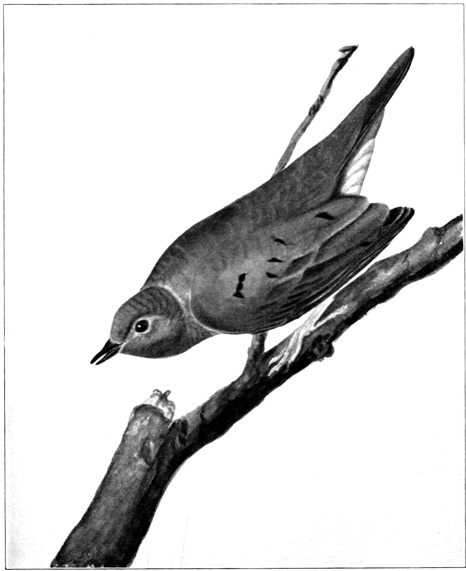
COLUMBA PASSERINA, GROUND DOVE. (Now Columbigallina passerina terrestri.) FROM THE UNPUBLISHED DRAWING BY J. J. AUDUBON, 1838.
May 7, Sunday. Fine weather, but cool. Saw several Gray Squirrels and one Black. I am told by one of our pilots, who has killed seven or eight, that they are much larger than Sciurus macrourus, that the hair is coarse, that they are clumsy in their motions, and that they are found from the Black Snake Hills to some distance above the Council Bluffs.
We landed to cut wood at eleven, and we went ashore. Harris killed another of the new Finches, a male also; the scarcity of the females goes on, proving how much earlier the males sally forth on their migrations towards the breeding grounds. We saw five Sand-hill Cranes, some Goldfinches, Yellowshanks, Tell-tale Godwits, Solitary Snipes, and the woods were filled with House Wrens singing their merry songs. The place, however, was a bad one, for it was a piece of bottom land that had overflowed, and was sadly muddy and sticky. At twelve the bell rang for Harris, Bell, and me to return, which we did at once, as dinner was preparing for the table. Talking of dinner makes me think of giving you the hours, usually, of our meals. Breakfast at half-past six, dinner at half-past twelve, tea or supper at seven or later as the case may be. We have not taken much wood here; it is ash, but quite green. We saw Orchard Orioles, Blue-gray Flycatchers, Great-crested and Common Pewees, Mallards, Pileated Woodpeckers, Blue Jays, and Bluebirds; heard a Marsh Wren, saw a Crow, a Wood Thrush, and Water Thrush. Indigo-birds and Parrakeets plentiful. This afternoon we went into the pocket of a sand bar, got aground, and had to back out for almost a mile. We saw an abundance of Ducks, some White Pelicans, and an animal that we guessed was a Skunk. We have run about fifty miles, and therefore have done a good day's journey. We have passed the mouths of several small rivers, and also some very fine prairie land, extending miles towards the hills. It is now nine o'clock, a beautiful night with the moon shining. We have seen several Ravens, and White-headed Eagles on their nests.
May 8, Monday. A beautiful calm day; the country we saw was much the same as that we passed yesterday, and nothing of great importance took place except that at a wooding-place on the very verge of the State of Missouri (the northwest corner) Bell killed a Black Squirrel which friend Bachman has honored with the name of my son John, Sciurus Audubonii.[269] We are told that this species is not uncommon here. It was a good-sized adult male, and Sprague drew an outline of it. Harris shot another specimen of the new Finch. We saw Parrakeets and many small birds, but nothing new or very rare. This evening I wrote a long letter to each house, John Bachman, Gideon B. Smith of Baltimore, and J. W. H. Page of New Bedford, with the hope of having them forwarded from the Council Bluffs.
May 9, Tuesday. Another fine day. After running until eleven o'clock we stopped to cut wood, and two Rose-breasted Grosbeaks were shot, a common Blue-bird, and a common Northern Titmouse. We saw White Pelicans, Geese, Ducks, etc. One of our trappers cut one of his feet dreadfully with his axe, and Harris, who is now the doctor, attended to it as best he could. This afternoon we reached the famous establishment of Belle Vue[270] where resides the brother of Mr. Sarpy of St. Louis, as well as the Indian Agent, or, as he might be more appropriately called, the Custom House officer. Neither were at home, both away on the Platte River, about 300 miles off. We had a famous pack of rascally Indians awaiting our landing—filthy and half-starved. We landed some cargo for the establishment, and I saw a trick of the trade which made me laugh. Eight cords of wood were paid for with five tin cups of sugar and three of coffee—value at St. Louis about twenty-five cents. We have seen a Fish Hawk, Savannah Finch, Green-backed Swallows, Rough-winged Swallows, Martins, Parrakeets, Black-headed Gulls, Blackbirds, and Cow-birds; I will repeat that the woods are fairly alive with House Wrens. Blue Herons, Emberiza pallida—Clay-colored Bunting of Swainson—Henslow's Bunting, Crow Blackbirds; and, more strange than all, two large cakes of ice were seen by our pilots and ourselves. I am very much fatigued and will finish the account of this day to-morrow. At Belle Vue we found the brother-in-law of old Provost, who acts as clerk in the absence of Mr. Sarpy. The store is no great affair, and yet I am told that they drive a good trade with Indians on the Platte River, and others, on this side of the Missouri. We unloaded some freight, and pushed off. We saw here the first ploughing of the ground we have observed since we left the lower settlements near St. Louis. We very soon reached the post of Fort Croghan,[271] so called after my old friend of that name with whom I hunted Raccoons on his father's plantation in Kentucky some thirty-eight years ago, and whose father and my own were well acquainted, and fought together in conjunction with George Washington and Lafayette, during the Revolutionary War, against "Merrie England." Here we found only a few soldiers, dragoons; their camp and officers having been forced to move across the prairie to the Bluffs, five miles. After we had put out some freight for the sutler, we proceeded on until we stopped for the night a few miles above, on the same side of the river. The soldiers assured us that their parade ground, and so-called barracks, had been four feet under water, and we saw fair and sufficient evidence of this. At this place our pilot saw the first Yellow-headed Troupial we have met with. We landed for the night under trees covered by muddy deposits from the great overflow of this season. I slept soundly, and have this morning, May 10, written this.
May 10, Wednesday. The morning was fine, and we were under way at daylight; but a party of dragoons, headed by a lieutenant, had left their camp four miles distant from our anchorage at the same time, and reached the shore before we had proceeded far; they fired a couple of rifle shots ahead of us, and we brought to at once. The young officer came on board, and presented a letter from his commander, Captain Burgwin, from which we found that we had to have our cargo examined. Our captain[272] was glad of it, and so were we all; for, finding that it would take several hours, we at once ate our breakfast, and made ready to go ashore. I showed my credentials and orders from the Government, Major Mitchell of St. Louis, etc., and I was therefore immediately settled comfortably. I desired to go to see the commanding officer, and the lieutenant very politely sent us there on horseback, guided by an old dragoon of considerable respectability. I was mounted on a young white horse, Spanish saddle with holsters, and we proceeded across the prairie towards the Bluffs and the camp. My guide was anxious to take a short cut, and took me across several bayous, one of which was really up to the saddle; but we crossed that, and coming to another we found it so miry, that his horse wheeled after two or three steps, whilst I was looking at him before starting myself; for you all well know that an old traveller is, and must be, prudent. We now had to retrace our steps till we reached the very tracks that the squad sent after us in the morning had taken, and at last we reached the foot of the Bluffs, when my guide asked me if I "could ride at a gallop," to which not answering him, but starting at once at a round run, I neatly passed him ere his horse was well at the pace; on we went, and in a few minutes we entered a beautiful dell or valley, and were in sight of the encampment. We reached this in a trice, and rode between two lines of pitched tents to one at the end, where I dismounted, and met Captain Burgwin,[273] a young man, brought up at West Point, with whom I was on excellent and friendly terms in less time than it has taken me to write this account of our meeting. I showed him my credentials, at which he smiled, and politely assured me that I was too well known throughout our country to need any letters. While seated in front of his tent, I heard the note of a bird new to me, and as it proceeded from a tree above our heads, I looked up and saw the first Yellow-headed Troupial alive that ever came across my own migrations. The captain thought me probably crazy, as I thought Rafinesque when he was at Henderson; for I suddenly started, shot at the bird, and killed it. Afterwards I shot three more at one shot, but only one female amid hundreds of these Yellow-headed Blackbirds. They are quite abundant here, feeding on the surplus grain that drops from the horses' troughs; they walked under, and around the horses, with as much confidence as if anywhere else. When they rose, they generally flew to the very tops of the tallest trees, and there, swelling their throats, partially spreading their wings and tail, they issue their croaking note, which is a compound, not to be mistaken, between that of the Crow Blackbird and that of the Red-winged Starling. After I had fired at them twice they became quite shy, and all of them flew off to the prairies. I saw then two Magpies[274] in a cage, that had been caught in nooses, by the legs; and their actions, voice, and general looks, assured me as much as ever, that they are the very same species as that found in Europe. Prairie Wolves are extremely abundant hereabouts. They are so daring that they come into the camp both by day and by night; we found their burrows in the banks and in the prairie, and had I come here yesterday I should have had a superb specimen killed here, but which was devoured by the hogs belonging to the establishment. The captain and the doctor—Madison[275] by name—returned with us to the boat, and we saw many more Yellow-headed Troupials. The high Bluffs back of the prairie are destitute of stones. On my way there I saw abundance of Gopher hills, two Geese paired, two Yellow-crowned Herons, Red-winged Starlings, Cowbirds, common Crow Blackbirds, a great number of Baltimore Orioles, a Swallow-tailed Hawk, Yellow Red-poll Warbler, Field Sparrow, and Chipping Sparrow. Sprague killed another of the beautiful Finch. Robins are very scarce, Parrakeets and Wild Turkeys plentiful. The officers came on board, and we treated them as hospitably as we could; they ate their lunch with us, and are themselves almost destitute of provisions. Last July the captain sent twenty dragoons and as many Indians on a hunt for Buffaloes. During the hunt they killed 51 Buffaloes, 104 Deer, and 10 Elks, within 80 miles of the camp. The Sioux Indians are great enemies to the Potowatamies, and very frequently kill several of the latter in their predatory excursions against them. This kind of warfare has rendered the Potowatamies very cowardly, which is quite a remarkable change from their previous valor and daring. Bell collected six different species of shells, and found a large lump of pumice stone which does float on the water. We left our anchorage (which means tied to the shore) at twelve o'clock, and about sunset we did pass the real Council Bluffs.[276] Here, however, the bed of the river is utterly changed, though you may yet see that which is now called the Old Missouri. The Bluffs stand, truly speaking, on a beautiful bank almost forty feet above the water, and run off on a rich prairie, to the hills in the background in a gentle slope, that renders the whole place a fine and very remarkable spot. We tied up for the night about three miles above them, and all hands went ashore to cut wood, which begins to be somewhat scarce, of a good quality. Our captain cut and left several cords of green wood for his return trip, at this place; Harris and Bell went on shore, and saw several Bats, and three Turkeys. This afternoon a Deer was seen scampering across the prairies until quite out of sight. Wild-gooseberry bushes are very abundant, and the fruit is said to be very good.
May 11, Thursday. We had a night of rain, thunder, and heavy wind from the northeast, and we did not start this morning till seven o'clock, therefore had a late breakfast. There was a bright blood-red streak on the horizon at four o'clock that looked forbidding, but the weather changed as we proceeded, with, however, showers of rain at various intervals during the day. We have now come to a portion of the river more crooked than any we have passed; the shores on both sides are evidently lower, the hills that curtain the distance are further from the shores, and the intervening space is mostly prairie, more or less overflowed. We have seen one Wolf on a sand-bar, seeking for food, perhaps dead fish. The actions were precisely those of a cur dog with a long tail, and the bellowing sound of the engine did not seem to disturb him. He trotted on parallel to the boat for about one mile, when we landed to cut drift-wood. Bell, Harris, and I went on shore to try to have a shot at him. He was what is called a brindle-colored Wolf,[277] of the common size. One hundred trappers, however, with their axes at work, in a few moments rather stopped his progress, and when he saw us coming, he turned back on his track, and trotted off, but Bell shot a very small load in the air to see the effect it would produce. The fellow took two or three leaps, stopped, looked at us for a moment, and then started on a gentle gallop. When I overtook his tracks they appeared small, and more rounded than usual. I saw several tracks at the same time, therefore more than one had travelled over this great sandy and muddy bar last night, if not this morning. I lost sight of him behind some large piles of drift-wood, and could see him no more. Turkey-buzzards were on the bar, and I thought that I should have found some dead carcass; but on reaching the spot, nothing was there. A fine large Raven passed at one hundred yards from us, but I did not shoot. Bell found a few small shells, and Harris shot a Yellow-rumped Warbler. We have seen several White Pelicans, Geese, Black-headed Gulls, and Green-backed Swallows, but nothing new. The night is cloudy and intimates more rain. We are fast to a willowed shore, and are preparing lines to try our luck at catching a Catfish or so. I was astonished to find how much stiffened I was this morning, from the exercise I took on horseback yesterday, and think that now it would take me a week, at least, to accustom my body to riding as I was wont to do twenty years ago. The timber is becoming more scarce as we proceed, and I greatly fear that our only opportunities of securing wood will be those afforded us by that drifted on the bars.
May 12, Friday. The morning was foggy, thick, and calm. We passed the river called the Sioux Pictout,[278] a small stream formerly abounding with Beavers, Otters, Muskrats, etc., but now quite destitute of any of these creatures. On going along the banks bordering a long and wide prairie, thick with willows and other small brush-wood, we saw four Black-tailed Deer[279] immediately on the bank; they trotted away without appearing to be much alarmed; after a few hundred yards, the two largest, probably males, raised themselves on their hind feet and pawed at each other, after the manner of stallions. They trotted off again, stopping often, but after a while disappeared; we saw them again some hundreds of yards farther on, when, becoming suddenly alarmed, they bounded off until out of sight. They did not trot or run irregularly as our Virginian Deer does, and their color was of a brownish cast, whilst our common Deer at this season is red. Could we have gone ashore, we might in all probability have killed one or two of them. We stopped to cut wood on the opposite side of the river, where we went on shore, and there saw many tracks of Deer, Elk, Wolves, and Turkeys. In attempting to cross a muddy place to shoot at some Yellow-headed Troupials that were abundant, I found myself almost mired, and returned with difficulty. We only shot a Blackburnian Warbler, a Yellow-winged ditto, and a few Finches. We have seen more Geese than usual as well as Mallards and Wood Ducks. This afternoon the weather cleared up, and a while before sunset we passed under Wood's Bluffs,[280] so called because a man of that name fell overboard from his boat while drunk. We saw there many Bank Swallows, and afterwards we came in view of the Blackbird Hill,[281] where the famous Indian chief of that name was buried, at his request, on his horse, whilst the animal was alive. We are now fast to the shore opposite this famed bluff. We cut good ash wood this day, and have made a tolerable run, say forty miles.
Saturday, May 13. This morning was extremely foggy, although I could plainly see the orb of day trying to force its way through the haze. While this lasted all hands were engaged in cutting wood, and we did not leave our fastening-place till seven, to the great grief of our commander. During the wood cutting, Bell walked to the top of the hills, and shot two Lark Buntings, males, and a Lincoln's Finch. After a while we passed under some beautiful bluffs surmounted by many cedars, and these bluffs were composed of fine white sandstone, of a soft texture, but very beautiful to the eye. In several places along this bluff we saw clusters of nests of Swallows, which we all looked upon as those of the Cliff Swallow, although I saw not one of the birds. We stopped again to cut wood, for our opportunities are not now very convenient. Went out, but only shot a fine large Turkey-hen, which I brought down on the wing at about forty yards. It ran very swiftly, however, and had not Harris's dog come to our assistance, we might have lost it. As it was, however, the dog pointed, and Harris shot it, with my small shot-gun, whilst I was squatted on the ground amid a parcel of low bushes. I was astonished to see how many of the large shot I had put into her body. This hen weighed 11¾ pounds. She had a nest, no doubt, but we could not find it. We saw a good number of Geese, though fewer than yesterday; Ducks also. We passed many fine prairies, and in one place I was surprised to see the richness of the bottom lands. We saw this morning eleven Indians of the Omaha tribe. They made signals for us to land, but our captain never heeded them, for he hates the red-skins as most men hate the devil. One of them fired a gun, the group had only one, and some ran along the shore for nearly two miles, particularly one old gentleman who persevered until we came to such bluff shores as calmed down his spirits. In another place we saw one seated on a log, close by the frame of a canoe; but he looked surly, and never altered his position as we passed. The frame of this boat resembled an ordinary canoe. It is formed by both sticks giving a half circle; the upper edges are fastened together by a long stick, as well as the centre of the bottom. Outside of this stretches a Buffalo skin without the hair on; it is said to make a light and safe craft to cross even the turbid, rapid stream—the Missouri. By simply looking at them, one may suppose that they are sufficiently large to carry two or three persons. On a sand-bar afterwards we saw three more Indians, also with a canoe frame, but we only interchanged the common yells usual on such occasions. They looked as destitute and as hungry as if they had not eaten for a week, and no doubt would have given much for a bottle of whiskey. At our last landing for wood-cutting, we also went on shore, but shot nothing, not even took aim at a bird; and there was an Indian with a flint-lock rifle, who came on board and stared about until we left, when he went off with a little tobacco. I pity these poor beings from my heart! This evening we came to the burial-ground bluff of Sergeant Floyd,[282] one of the companions of the never-to-be-forgotten expedition of Lewis and Clark, over the Rocky Mountains, to the Pacific Ocean. A few minutes afterwards, before coming to Floyd's Creek, we started several Turkey-cocks from their roost, and had we been on shore could have accounted for more than one of them. The prairies are becoming more common and more elevated; we have seen more evergreens this day than we have done for two weeks at least. This evening is dark and rainy, with lightning and some distant thunder, and we have entered the mouth of the Big Sioux River,[283] where we are fastened for the night. This is a clear stream and abounds with fish, and on one of the branches of this river is found the famous red clay, of which the precious pipes, or calumets are manufactured. We will try to procure some on our return homeward. It is late; had the weather been clear, and the moon, which is full, shining, it was our intention to go ashore, to try to shoot Wild Turkeys; but as it is pouring down rain, and as dark as pitch, we have thrown our lines overboard and perhaps may catch a fish. We hope to reach Vermilion River day after to-morrow. We saw abundance of the birds which I have before enumerated.
May 14, Sunday. It rained hard and thundered during the night; we started at half-past three, when it had cleared, and the moon shone brightly. The river is crooked as ever, with large bars, and edged with prairies. Saw many Geese, and a Long-billed Curlew. One poor Goose had been wounded in the wing; when approached, it dived for a long distance and came up along the shore. Then we saw a Black Bear, swimming across the river, and it caused a commotion. Some ran for their rifles, and several shots were fired, some of which almost touched Bruin; but he kept on, and swam very fast. Bell shot at it with large shot and must have touched it. When it reached the shore, it tried several times to climb up, but each time fell back. It at last succeeded, almost immediately started off at a gallop, and was soon lost to sight. We stopped to cut wood at twelve o'clock, in one of the vilest places we have yet come to. The rushes were waist-high, and the whole underbrush tangled by grape vines. The Deer and the Elks had beaten paths which we followed for a while, but we saw only their tracks, and those of Turkeys. Harris found a heronry of the common Blue Heron, composed of about thirty nests, but the birds were shy and he did not shoot at any. Early this morning a dead Buffalo floated by us, and after a while the body of a common cow, which had probably belonged to the fort above this. Mr. Sire told us that at this point, two years ago, he overtook three of the deserters of the company, who had left a keel-boat in which they were going down to St. Louis. They had a canoe when overtaken; he took their guns from them, destroyed the canoe, and left them there. On asking him what had become of them, he said they had walked back to the establishment at the mouth of Vermilion River, which by land is only ten miles distant; ten miles, through such woods as we tried in vain to hunt in, is a walk that I should not like at all. We stayed cutting wood for about two hours, when we started again; but a high wind arose, so that we could not make headway, and had to return and make fast again, only a few hundred yards from the previous spot. On such occasions our captain employs his wood-cutters in felling trees, and splitting and piling the wood until his return downwards, in about one month, perhaps, from now. In talking with our captain he tells us that the Black Bear is rarely seen swimming this river, and that one or two of them are about all he observes on going up each trip. I have seen them swimming in great numbers on the lower parts of the Ohio, and on the Mississippi. It is said that at times, when the common Wolves are extremely hard pressed for food, they will eat certain roots which they dig up for the purpose, and the places from which they take this food look as if they had been spaded. When they hunt a Buffalo, and have killed it, they drag it to some distance—about sixty yards or so—and dig a hole large enough to receive and conceal it; they then cover it with earth, and lie down over it until hungry again, when they uncover, and feed upon it. Along the banks of the rivers, when the Buffaloes fall, or cannot ascend, and then die, the Wolves are seen in considerable numbers feeding upon them. Although cunning beyond belief in hiding at the report of a gun, they almost instantly show themselves from different parts around, and if you wish to kill some, you have only to hide yourself, and you will see them coming to the game you have left, when you are not distant more than thirty or forty yards. It is said that though they very frequently hunt their game until the latter take to the river, they seldom, if ever, follow after it. The wind that drove us ashore augmented into a severe gale, and by its present appearance looks as if it would last the whole night. Our fire was comfortable, for, as you know, the thermometer has been very changeable since noon. We have had rain also, though not continuous, but quite enough to wet our men, who, notwithstanding have cut and piled about twelve cords of wood, besides the large quantity we have on board for to-morrow, when we hope the weather will be good and calm.
May 15, Monday. The wind continued an irregular gale the whole of the night, and the frequent logs that struck our weather side kept me awake until nearly daybreak, when I slept about two hours; it unfortunately happened that we were made fast upon the weather shore. This morning the gale kept up, and as we had nothing better to do, it was proposed that we should walk across the bottom lands, and attempt to go to the prairies, distant about two and a half miles. This was accordingly done; Bell, Harris, Mr. La Barge[284]—the first pilot—a mulatto hunter named Michaux, and I, started at nine. We first crossed through tangled brush-wood, and high-grown rushes for a few hundreds of yards, and soon perceived that here, as well as all along the Missouri and Mississippi, the land is highest nearest the shore, and falls off the farther one goes inland. Thus we soon came to mud, and from mud to muddy water, as pure as it runs in the Missouri itself; at every step which we took we raised several pounds of mud on our boots. Friend Harris very wisely returned, but the remainder of us proceeded through thick and thin until we came in sight of the prairies. But, alas! between us and them there existed a regular line of willows—and who ever saw willows grow far from water? Here we were of course stopped, and after attempting in many places to cross the water that divided us from the dry land, we were forced back, and had to return as best we could. We were mud up to the very middle, the perspiration ran down us, and at one time I was nearly exhausted; which proves to me pretty clearly that I am no longer as young, or as active, as I was some thirty years ago. When we reached the boat I was glad of it. We washed, changed our clothes, dined, and felt much refreshed. During our excursion out, Bell saw a Virginian Rail, and our sense of smell brought us to a dead Elk, putrid, and largely consumed by Wolves, whose tracks were very numerous about it. After dinner we went to the heronry that Harris had seen yesterday afternoon; for we had moved only one mile above the place of our wooding before we were again forced on shore. Here we killed four fine individuals, all on the wing, and some capital shots they were, besides a Raven. Unfortunately we had many followers, who destroyed our sport; therefore we returned on board, and at half-past four left our landing-place, having cut and piled up between forty and fifty cords of wood for the return of the "Omega." The wind has lulled down considerably, we have run seven or eight miles, and are again fast to the shore. It is reported that the water has risen two feet, but this is somewhat doubtful. We saw abundance of tracks of Elk, Deer, Wolf, and Bear, and had it been anything like tolerably dry ground, we should have had a good deal of sport. Saw this evening another dead Buffalo floating down the river.
May 16, Tuesday. At three o'clock this fair morning we were under way, but the water has actually risen a great deal, say three feet, since Sunday noon. The current therefore is very strong, and impedes our progress greatly. We found that the Herons we had killed yesterday had not yet laid the whole of their eggs, as we found one in full order, ripe, and well colored and conditioned. I feel assured that the Ravens destroy a great many of their eggs, as I saw one helping itself to two eggs, at two different times, on the same nest. We have seen a great number of Black-headed Gulls, and some Black Terns, some Indians on the east side of the river, and a Prairie Wolf, dead, hung across a prong of a tree. After a while we reached a spot where we saw ten or more Indians who had a large log cabin, and a field under fence. Then we came to the establishment called that of Vermilion River,[285] and met Mr. Cerré, called usually Pascal, the agent of the Company at this post, a handsome French gentleman, of good manners. He dined with us. After this we landed, and walked to the fort, if the place may so be called, for we found it only a square, strongly picketed, without portholes. It stands on the immediate bank of the river, opposite a long and narrow island, and is backed by a vast prairie, all of which was inundated during the spring freshet. He told me that game was abundant, such as Elk, Deer, and Bear; but that Ducks, Geese, and Swans were extremely scarce this season. Hares are plenty—no Rabbits. We left as soon as possible, for our captain is a pushing man most truly. We passed some remarkable bluffs of blue and light limestone, towards the top of which we saw an abundance of Cliff-Swallows, and counted upwards of two hundred nests. But, alas! we have finally met with an accident. A plate of one of our boilers was found to be burned out, and we were obliged to stop on the west side of the river, about ten miles below the mouth of the Vermilion River. Here we were told that we might go ashore and hunt to our hearts' content; and so I have, but shot at nothing. Bell, Michaux, and I, walked to the hills full three miles off, saw an extraordinary quantity of Deer, Wolf, and Elk tracks, as well as some of Wild Cats. Bell started a Deer, and after a while I heard him shoot. Michaux took to the top of the hills, Bell about midway, and I followed near the bottom; all in vain, however. I started a Woodcock, and caught one of her young, and I am now sorry for this evil deed. A dead Buffalo cow and calf passed us a few moments ago. Squires has seen one other, during our absence. We took at Mr. Cerré's establishment two engagés and four Sioux Indians. We are obliged to keep bright eyes upon them, for they are singularly light-fingered. The woods are filled with wild-gooseberry bushes, and a kind of small locust not yet in bloom, and quite new to me. The honey bee was not found in this country twenty years ago, and now they are abundant. A keel-boat passed, going down, but on the opposite side of the river. Bell and Michaux have returned. Bell wounded a large Wolf, and also a young Deer, but brought none on board, though he saw several of the latter. Harris killed one of the large new Finches, and a Yellow-headed Troupial. Bell intends going hunting to-morrow at daylight, with Michaux; I will try my luck too, but do not intend going till after breakfast, for I find that walking eight or ten miles through the tangled and thorny underbrush, fatigues me considerably, though twenty years ago I should have thought nothing of it.
May 17, Wednesday. This was a most lovely morning. Bell went off with Michaux at four a. m. I breakfasted at five, and started with Mr. La Barge. When we reached the hunting-grounds, about six miles distant, we saw Bell making signs to us to go to him, and I knew from that that they had some fresh meat. When we reached them, we found a very large Deer that Michaux had killed. Squires shot a Woodcock, which I ate for my dinner, in company with the captain. Michaux had brought the Deer—Indian fashion—about two miles. I was anxious to examine some of the intestines, and we all three started on the tracks of Michaux, leaving Squires to keep the Wolves away from the dead Deer. We went at once towards a small stream meandering at the foot of the hills, and as we followed it, Bell shot at a Turkey-cock about eighty yards; his ball cut a streak of feathers from its back, but the gobbler went off. When we approached the spot where Michaux had opened the Deer, we did so cautiously, in the hope of then shooting a Wolf, but none had come; we therefore made our observations, and took up the tongue, which had been forgotten. Bell joined us, and as we were returning to Squires we saw flocks of the Chestnut-collared Lark or Ground-finch, whose exact measurement I have here given, and almost at the same time saw Harris. He and Bell went off after the Finches; we pursued our course to Squires, and waited for their return. Seeing no men to help carry the Deer, Michaux picked it up, Squires took his gun, etc., and we made for the river again. We had the good luck to meet the barge coming, and we reached our boat easily in a few minutes, with our game. I saw upwards of twelve of Harris' new Finch (?) a Marsh Hawk, Henslow's Bunting, Emberiza pallida, Robins, Wood Thrushes, Bluebirds, Ravens, the same abundance of House Wrens, and all the birds already enumerated. We have seen floating eight Buffaloes, one Antelope, and one Deer; how great the destruction of these animals must be during high freshets! The cause of their being drowned in such extraordinary numbers might not astonish one acquainted with the habits of these animals, but to one who is not, it may be well enough for me to describe it. Some few hundred miles above us, the river becomes confined between high bluffs or cliffs, many of which are nearly perpendicular, and therefore extremely difficult to ascend. When the Buffaloes have leaped or tumbled down from either side of the stream, they swim with ease across, but on reaching these walls, as it were, the poor animals try in vain to climb them, and becoming exhausted by falling back some dozens of times, give up the ghost, and float down the turbid stream; their bodies have been known to pass, swollen and putrid, the city of St. Louis. The most extraordinary part of the history of these drowned Buffaloes is, that the different tribes of Indians on the shores, are ever on the lookout for them, and no matter how putrid their flesh may be, provided the hump proves at all fat, they swim to them, drag them on shore, and cut them to pieces; after which they cook and eat this loathsome and abominable flesh, even to the marrow found in the bones. In some instances this has been done when the whole of the hair had fallen off, from the rottenness of the Buffalo. Ah! Mr. Catlin, I am now sorry to see and to read your accounts of the Indians you saw[286]—how very different they must have been from any that I have seen! Whilst we were on the top of the high hills which we climbed this morning, and looked towards the valley beneath us, including the river, we were undetermined as to whether we saw as much land dry as land overflowed; the immense flat prairie on the east side of the river looked not unlike a lake of great expanse, and immediately beneath us the last freshet had left upwards of perhaps two or three hundred acres covered by water, with numbers of water fowl on it, but so difficult of access as to render our wishes to kill Ducks quite out of the question. From the tops of the hills we saw only a continual succession of other lakes, of the same form and nature; and although the soil was of a fair, or even good, quality, the grass grew in tufts, separated from each other, and as it grows green in one spot, it dies and turns brown in another. We saw here no "carpeted prairies," no "velvety distant landscape;" and if these things are to be seen, why, the sooner we reach them the better. This afternoon I took the old nest of a Vireo, fully three feet above my head, filled with dried mud; it was attached to two small prongs issuing from a branch fully the size of my arm; this proves how high the water must have risen. Again, we saw large trees of which the bark had been torn off by the rubbing or cutting of the ice, as high as my shoulder. This is accounted for as follows: during the first breaking up of the ice, it at times accumulates, so as to form a complete dam across the river; and when this suddenly gives way by the heat of the atmosphere, and the great pressure of the waters above the dam, the whole rushes on suddenly and overflows the country around, hurling the ice against any trees in its course. Sprague has shot two Emberiza pallida, two Lincoln's Finches, and a Black and Yellow Warbler, Sylvicola [Dendrœca] maculosa. One of our trappers, who had gone to the hills, brought on board two Rattlesnakes of a kind which neither Harris nor myself had seen before. The four Indians we have on board are three Puncas[287] and one Sioux; the Puncas were formerly attached to the Omahas; but, having had some difficulties among themselves, they retired further up the river, and assumed this new name. The Omahas reside altogether on the west side of the Missouri. Three of the Puncas have walked off to the establishment of Mr. Cerré to procure moccasins, but will return to-night. They appear to be very poor, and with much greater appetites than friend Catlin describes them to have. Our men are stupid, and very superstitious; they believe the rattles of Snakes are a perfect cure for the headache; also, that they never die till after sunset, etc. We have discovered the female of Harris's Finch, which, as well as in the White-crowned Finch, resembles the male almost entirely; it is only a very little paler in its markings. I am truly proud to name it Fringilla Harrisii, in honor of one of the best friends I have in this world.
May 18, Thursday. Our good captain called us all up at a quarter before four this fair morning, to tell us that four barges had arrived from Fort Pierre, and that we might write a few letters, which Mr. Laidlaw,[288] one of the partners, would take to St. Louis for us. I was introduced to that gentleman and also to Major Dripps,[289] the Indian agent. I wrote four short letters, which I put in an envelope addressed to the Messieurs Chouteau & Co., of St. Louis, who will post them, and we have hopes that some may reach their destination. The names of these four boats are "War Eagle," "White Cloud," "Crow feather," and "Red-fish." We went on board one of them, and found it comfortable enough. They had ten thousand Buffalo robes on the four boats; the men live entirely on Buffalo meat and pemmican. They told us that about a hundred miles above us the Buffalo were by thousands, that the prairies were covered with dead calves, and the shores lined with dead of all sorts; that Antelopes were there also, and a great number of Wolves, etc.; therefore we shall see them after a while. Mr. Laidlaw told me that he would be back at Fort Pierre in two months, and would see us on our return. He is a true Scot, and apparently a clean one. We gave them six bottles of whiskey, for which they were very thankful; they gave us dried Buffalo meat, and three pairs of moccasins. They breakfasted with us, preferring salt meat to fresh venison. They departed soon after six o'clock, and proceeded rapidly down-stream in Indian file. These boats are strong and broad; the tops, or roofs, are supported by bent branches of trees, and these are covered by water-proof Buffalo hides; each has four oarsmen and a steersman, who manages the boat standing on a broad board; the helm is about ten feet long, and the rudder itself is five or six feet long. They row constantly for sixteen hours, and stop regularly at sundown; they, unfortunately for us, spent the night about two miles above us, for had we known of their immediate proximity we should have had the whole of the night granted for writing long, long letters. Our prospect of starting to-day is somewhat doubtful, as the hammering at the boilers still reaches my ears. The day is bright and calm. Mr. Laidlaw told us that on the 5th of May the snow fell two feet on the level, and destroyed thousands of Buffalo calves. We felt the same storm whilst we were fast on the bar above Fort Leavenworth. This has been a day of almost pure idleness; our tramps of yesterday and the day previous had tired me, and with the exception of shooting at marks, and Sprague killing one of Bell's Vireo, and a Least Pewee, as well as another female of Harris's Finch, we have done nothing. Bell this evening went off to look for Bats, but saw none.
May 19, Friday. This has been a beautiful, but a very dull day to us all. We started by moonlight at three this morning, and although we have been running constantly, we took the wrong channel twice, and thereby lost much of our precious time; so I look upon this day's travel as a very poor one. The river was in several places inexpressibly wide and shallow. We saw a Deer of the common kind swimming across the stream; but few birds were killed, although we stopped (unfortunately) three times for wood. I forgot to say yesterday two things which I should have related, one of which is of a dismal and very disagreeable nature, being no less than the account given us of the clerks of the Company having killed one of the chiefs of the Blackfeet tribe of Indians, at the upper settlement of the Company, at the foot of the great falls of the Missouri, and therefore at the base of the Rocky Mountains, and Mr. Laidlaw assured us that it would be extremely dangerous for us to go that far towards these Indians. The other thing is that Mr. Laidlaw brought down a daughter of his, a half-breed of course, whom he is taking to St. Louis to be educated. We saw another Deer crossing the river, and have shot only a few birds, of no consequence.
May 20, Saturday. We have not made much progress this day, for the wind rose early, and rather ahead. We have passed to-day Jacques River,[290] or, as I should call it, La Rivière à Jacques, named after a man who some twenty or more years ago settled upon its banks, and made some money by collecting Beavers, etc., but who is dead and gone. Three White Wolves were seen this morning, and after a while we saw a fourth, of the brindled kind, which was trotting leisurely on, about 150 yards distant from the bank, where he had probably been feeding on some carrion or other. A shot from a rifle was quite enough to make him turn off up the river again, but farther from us, at a full gallop; after a time he stopped again, when the noise of our steam pipe started him, and we soon lost sight of him in the bushes. We saw three Deer in the flat of one of the prairies, and just before our dinner we saw, rather indistinctly, a number of Buffaloes, making their way across the hills about two miles distant; after which, however, we saw their heavy tracks in a well and deep cut line across the said hills. Therefore we are now in what is pronounced to be the "Buffalo country," and may expect to see more of these animals to-morrow. We have stopped for wood no less than three times this day, and are fast for the night. Sprague killed a Pipilo arcticus, and Bell three others of the same species. We procured also another Bat, the Vespertilio subulatus of Say, and this is all. The country around us has materially changed, and we now see more naked, and to my eyes more completely denuded, hills about us, and less of the rich bottoms of alluvial land, than we passed below our present situation. I will not anticipate the future by all that we hear of the country above, but will continue steadily to accumulate in this, my poor journal, all that may take place from day to day. Three of our Indian rascals left us at our last wooding-ground, and have gone towards their miserable village. We have now only one Sioux with us, who will, the captain says, go to Fort Pierre in our company. They are, all that we have had as yet, a thieving and dirty set, covered with vermin. We still see a great number of Black-headed Gulls, but I think fewer Geese and Ducks than below; this probably on account of the very swampy prairie we have seen, and which appears to become scarce as we are advancing in this strange wilderness.