THE EUROPEAN JOURNALS (continued 6)
Reading edition
Sunday, September 7. The traveller who visits France without seeing a fête, such as I have seen this day at St. Cloud, leaves the country unacquainted with that species of knowledge best adapted to show the manners of a people. St. Cloud is a handsome town on the Seine, about five miles below Paris, built in horseshoe form on the undulating hills of this part of the country. These hills are covered with woods, through which villas, cottages, and chateaux emerge, and give life to the scene. On the west side of the village, and on its greatest elevation, stands the Palace of the Kings, the Emperors, and the people. I say the people, because they are allowed to see the interior every day. With Parker, I took a cab directly after breakfast to the barrière des bons hommes, and walked the remaining distance, say three miles. We had the Seine in view most of the way, and crossed it on a fine iron bridge, one end of which forms the entrance to St. Cloud, in front of which the river winds. We reached the gates of the palace, and found they were not opened till twelve o'clock; but a sergeant offered to show us the King's garden,—an offer we accepted with pleasure. The entrance is by an avenue of fine trees, their tops meeting over our heads, and presenting, through the vista they made, a frame for a beautiful landscape. We passed several pieces of water, the peaceful abode of numerous fish, basking on the surface; swans also held their concave wings unfurled to the light breeze—orange trees of fair size held their golden fruit pendent—flowers of every hue covered the borders, and a hundred statues embellished all with their well-modelled forms. So unmolested are the birds that a Green Woodpecker suffered my inspection as if in the woods of our dear, dear America. At the right time we found ourselves in the King's antechamber, and then passed through half a dozen rooms glittering with richest ornaments, painted ceilings, large pictures, and lighted by immense windows; all, however, too fine for my taste, and we were annoyed by the gens d'armes watching us as if we were thieves. It was near two o'clock when we left, the weather beautiful, and heat such as is usually felt in Baltimore about this season. The population of Paris appeared now to flock to St. Cloud; the road was filled with conveyances of all sorts, and in the principal walk before the Palace were hundreds of petits marchands, opening and arranging their wares. Music began in different quarters, groups lay on the grass, enjoying their repasts; every one seemed joyous and happy. One thing surprised me: we were at St. Cloud ten hours,—they told us fifty thousand (?) were there, and I saw only three women of noticeable beauty; yet these short brunettes are animated and apparently thoughtless, and sing and dance as if no shadow could ever come over them. At four o'clock all was in full vigor; the sounds of horns and bugles drew us towards a place where we saw on a platform a party of musicians, three of whom were Flemish women, and so handsome that they were surrounded by crowds. We passed through a sort of turnstile, and in a few minutes an equestrian performance began, in which the riders showed great skill, jugglers followed with other shows, and then we left; the same show in London would have cost three shillings; here, a franc. We saw people shooting at a target with a crossbow. When the marksman was successful in hitting the centre, a spring was touched, and an inflated silken goldfish, as large as a barrel, rose fifty yards in the air,—a pretty sight, I assure thee; the fins of gauze moved with the breeze, he plunged and rose and turned about, almost as a real fish would do in his element. Shows of everything were there; such a medley—such crowds—such seeming pleasure in all around us, I never remarked anywhere but in France. No word of contention did I hear; all was peace and joy, and when we left not a disturbance had taken place. We had an excellent dinner, with a bottle of Chablis, for three francs each, and returning to the place we had left, found all the fountains were playing, and dancing was universal; the musicians were good and numerous, but I was surprised to remark very few fine dancers. The woods, which were illuminated, looked extremely beautiful; the people constantly crossing and re-crossing them made the lights appear and disappear, reminding me of fireflies in our own woods in a summer night. As we passed out of the gates, we perceived as many persons coming as going, and were told the merriment would last till day. With difficulty we secured two seats in a cart, and returned to Paris along a road with a double line of vehicles of all sorts going both ways. Every few rods were guards on foot, and gens d'armes on horseback, to see that all went well; and we at last reached our hotel, tired and dusty, but pleased with all we had seen, and at having had such an opportunity to see, to compare, and to judge of the habits of a people so widely different from either Americans or English.
September 8. We went to pay our respects to Baron Cuvier and Geoffroy St. Hilaire;[164] we saw only the first, who told us to be at the Académie Royale des Sciences in an hour. I had hired a portfolio, and took my work. As soon as we entered, Baron Cuvier very politely came to us, ordered a porter to put my book on a table, and gave me a seat of honor. The séance was opened by a tedious lecture on the vision of the Mole; then Cuvier arose, announcing my friend Swainson and me and spoke of my work; it was shown and admired as usual, and Cuvier requested to review it for the "Mémoires of the Academy." Poor Audubon! here thou art, a simple woodsman, among a crowd of talented men, yet kindly received by all—so are the works of God as shown in His birds loved by them. I left my book, that the librarian might show it to all who wished to see it.
September 9. Went to the Jardin du Roi, where I met young Geoffroy, who took me to a man who stuffs birds for the Prince d'Essling, who, I was told, had a copy of my work, but after much talk could not make out whether it was Wilson's, Selby's, or mine. I am to call on him to-morrow. I took a great walk round the Boulevards, looking around me and thinking how curious my life has been, and how wonderful my present situation is. I took Mrs. Swainson to the Louvre, and as we were about to pass one of the gates of the Tuileries, the sentinel stopped us, saying no one could pass with a fur cap; so we went to another gate, where no such challenge was given, and reached the Grand Gallery. Here amongst the Raphaels, Correggios, Titians, Davids, and thousands of others, we feasted our eyes and enlarged our knowledge. Taking Mrs. Swainson home, I then made for L'Institut de France by appointment, and gave my prospectus to the secretary of the library. Young Geoffroy, an amiable and learned young man, paid me every attention, and gave me a room for Swainson and myself to write in and for the inspection of specimens. How very different from the public societies in England, where instead of being bowed to, you have to bow to every one. Now, my Lucy, I have certainly run the gauntlet of England and Paris, and may feel proud of two things, that I am considered the first ornithological painter, and the first practical naturalist of America; may God grant me life to accomplish my serious and gigantic work.
September 10. Breakfast over, I made for the Boulevards to present the letters from good friends Rathbone and Melly. I saw Mr. B——, the banker, who read the letter I gave him, and was most polite, but as to ornithology, all he knew about it was that large feathers were called quills, and were useful in posting ledgers. From there to the Jardin du Roi, where I called on Monsieur L. C. Kiener, bird stuffer to the Prince of Massena (or Essling),[165] who wished me to call on the Prince with him at two, the Prince being too ill to leave the house. Mr. and Mrs. Swainson were to go with me to see the collection he had made, of many curious and beautiful things, and when we reached the house we were shown at once to the museum, which surpasses in magnificence and number of rare specimens of birds, shells, and books, all I have yet seen. This for a while, when I was told the Prince would receive me. I took my pamphlet in my arms and entered a fine room, where he was lying on a sofa; he rose at once, bowed, and presented his beautiful wife. As soon as I had untied my portfolio, and a print was seen, both exclaimed, "Ah! c'est bien beau!" I was asked if I did not know Charles Bonaparte, and when I said yes, they again both exclaimed, "Ah! c'est lui, the gentleman of whom we have heard so much, the man of the woods, who has made so many and such wonderful drawings." The Prince regretted very much there were so few persons in France able to subscribe to such a work, and said I must not expect more than six or eight names in Paris. He named all whom he and his lady knew, and then said it would give him pleasure to add his name to my list; he wrote it himself, next under that of the Duke of Rutland. This prince, son of the famous marshal, is about thirty years of age, apparently delicate, pale, slender, and yet good-looking, entirely devoted to Natural History; his wife a beautiful young woman, not more than twenty, extremely graceful and polite. They both complimented me on the purity of my French, and wished me all success. My room at the hotel being very cramped, I have taken one at L'Hôtel de France, large, clean, and comfortable, for which I pay twenty-five sous a day. We are within gun-shot of Les Jardins des Tuileries. The retraite is just now beating. This means that a few drummers go through the streets at eight o'clock in the evening, beating their drums, to give notice to all soldiers to make for their quarters.
September 12. I went early to Rue Richelieu to see the librarian of the King, Mr. Van Praët, a small, white-haired gentleman, who assured me in the politest manner imaginable that it was out of the question to subscribe for such a work; he, however, gave me a card of introduction to M. Barbier, a second librarian, belonging to the King's private library at the Louvre. On my way I posted my letters for London; the inland postage of a single letter from Paris to London is twenty-four sous, and the mail for London leaves four days in the week. M. Barbier was out, but when I saw him later he advised me to write to the Baron de la Bouillerie, intendant of the King's household. So go my days.—This evening we went to the Italian Opera; it was not open when we arrived, so we put ourselves in the line of people desirous to enter, and at seven followed regularly, with no pushing or crowding (so different from England), as the arrangements are so perfect. We received our tickets, the change was counted at leisure, and we were shown into the pit, which contains three divisions; that nearest the orchestra contains the most expensive seats. The theatre is much less in extent than either Drury Lane or Covent Garden, but is handsome, and splendidly decorated and lighted. The orchestra contains more than double the number of musicians, and when the music began, not another sound was heard, all was silence and attention. Never having been at the opera since my youth, the music astounded me. The opera was Semiramis, and well executed, but I was not much pleased with it; it was too clamorous, a harmonious storm, and I would have preferred something more tranquil. I remarked that persons who left their seats intending to return laid on their seats a hat, glove, or card, which was quite sufficient to keep the place for them. In London what a treat for the thieves, who are everywhere. I walked home; the pure atmosphere of Paris, the clear sky, the temperature, almost like that of America, make me light-hearted indeed, yet would that I were again in the far distant, peaceful retreats of my happiest days. Europe might whistle for me; I, like a free bird, would sing, "Never—no, never, will I leave America."
September 13. I had to take my portfolio to Baron Cuvier, and I went first to Geoffroy de St. Hilaire, who liked it much, and retracted his first opinion of the work being too large. Monsieur Dumesnil, a first-rate engraver, came to see me, sent by Prince de Massena, and we talked of the work, which he told me honestly could not be published in France to be delivered in England as cheaply as if the work were done in London, and probably not so well. This has ended with me all thoughts of ever removing it from Havell's hands, unless he should discontinue the present excellent state of its execution. Copper is dearer here than in England, and good colorers much scarcer. I saw Cuvier, who invited us to spend the evening, and then returned to the Pont des Arts to look for bird-skins. I found none, but purchased an engraved portrait of Cuvier, and another of "Phidias and the Thorn." I have just returned with Swainson from Baron Cuvier's, who gives public receptions to scientific men every Saturday. My book was on the table; Cuvier received me with special kindness, and put me at my ease. Mademoiselle Cuvier I found remarkably agreeable, as also Monsieur de Condillot. The first very willingly said he would sit to Parker for his portrait, and the other told me that if I went to Italy, I must make his house my home. My work was seen by many, and Cuvier pronounced it the finest of its kind in existence.
September 14, Sunday. Versailles, where we have spent our day, is truly a magnificent place; how long since I have been here, and how many changes in my life since those days! We first saw the orangerie, of about two hundred trees, that to Frenchmen who have never left Paris look well, but to me far from it, being martyrized by the hand of man, who has clipped them into stiff ovals. One is 407 years old. They produce no golden fruit, as their boxes are far too small to supply sufficient nourishment, and their fragrant blossoms are plucked to make orange-flower water. From this spot the woods, the hunting-grounds of the King, are seen circling the gardens, and are (we are told) filled with all kinds of game. The King's apartments, through which we afterwards went, are too full of gilding for my eyes, and I frequently resorted to the large windows to glance at the green trees. Amongst the paintings I admired most little Virginia and Paul standing under a palm-tree with their mothers; Paul inviting the lovely child to cross a brook. In the stables are a hundred beautiful horses, the choice of Arabia, Australasia, Normandy, Limousin, etc., each the model of his race, with fiery eyes, legs sinewy and slender, tails to the ground, and manes never curtailed. Among them still remain several that have borne the great Napoleon. From here we walked again through woods and gardens; thus, my Lucy, once more have I been at Versailles, and much have I enjoyed it.
September 15. France, my dearest friend, is indeed poor! This day I have attended at the Royal Academy of Sciences, and had all my plates spread over the different large tables, and they were viewed by about one hundred persons. "Beau! bien beau!" issued from every mouth, but, "Quel ouvrage!" "Quel prix!" as well. I said that I had thirty subscribers at Manchester; they seemed surprised, but acknowledged that England, the little isle of England, alone was able to support poor Audubon. Poor France! thy fine climate, thy rich vineyards, and the wishes of the learned avail nothing; thou art a destitute beggar, and not the powerful friend thou wast represented to be. Now I see plainly how happy, or lucky, or prudent I was, not to follow friend Melly's enthusiastic love of country. Had I come first to France my work never would have had even a beginning; it would have perished like a flower in October. It happened that a gentleman who saw me at Versailles yesterday remembered my face, and spoke to me; he is the under secretary of this famous society, and he wrote for me a note to be presented to the Minister of the Interior, who has, I am told, the power to subscribe to anything, and for as many copies of any work as the farmers of France can well pay for through the enormous levies imposed on them. Cuvier, St. Hilaire, and many others spoke to me most kindly. I had been to Cuvier in the morning to talk with him and Parker about the portrait the latter is to paint, and I believe I will describe Cuvier's house to thee. The footman asked us to follow him upstairs, and in the first room we caught a glimpse of a slight figure dressed all in black, that glided across the floor like a sylph; it was Mlle. Cuvier, not quite ready to see gentlemen: off she flew like a Dove before Falcons. We followed our man, who continually turned, saying, "This way, gentlemen." Eight rooms we passed filled with books, and each with a recessed bed, and at last reached a sort of laboratory, the sanctum sanctorum of Cuvier; there was nothing in it but books and skeletons of animals, reptiles, etc. Our conductor, surprised, bid us sit down, and left us to seek the Baron. My eyes were fully employed, and I contemplated in imagination the extent of the great man's knowledge. His books were in great disorder, and I concluded that he read and studied them, and owned them for other purposes than for show. Our man returned and led us back through the same avenue of bed-chambers, lined with books instead of satin, and we were conducted through the kitchen to another laboratory, where the Baron was found. Politeness in great men is shown differently from the same quality in fashionable society: a smile suffices to show you are welcome, without many words, and the work in hand is continued as if you were one of the family. Ah! how I delight in this! and how pleased I was to be thus welcomed by this learned man. Cuvier was looking at a small lizard in a tiny vial filled with spirit. I see now his sparkling eye half closed, as if quizzing its qualities, and as he put it down he wrote its name on a label. He made an appointment with Mr. Parker, and went on quizzing lizards. Being desirous of seeing a gambling house, young Geoffroy took me to one in the Palais Royal, a very notorious one, containing several roulette tables, and there we saw a little of the tactics of the gentlemen of the trade. The play, however, was not on this occasion high. The banquiers, or head thieves, better call them, are lank and pale, their countenances as unmoved as their hearts. From here we went to the establishment of Franconi, where I saw wonderful feats of horsemanship.
September 17. There is absolutely nothing to be done here to advance my subscription list, and at two o'clock I went with Swainson to a marchand naturaliste to see some drawings of birds of which I had heard. They were not as well drawn as mine, but much better painted.
September 18. I went to install Parker at Baron Cuvier's. He had his canvas, etc., all ready and we arrived at half-past nine, too early quite. At ten, having spent our time in the apartment of the Giraffe, Parker went in to take a second breakfast, and I to converse with Mlle. Cuvier. The Baron came in, and after a few minutes to arrange about the light, sat down in a comfortable arm-chair, quite ready. Great men as well as great women have their share of vanity, and I soon discovered that the Baron thinks himself a fine-looking man. His daughter seemed to know this, and remarked more than once that her father's under lip was swelled more than usual, and she added that the line of his nose was extremely fine. I passed my fingers over mine, and, lo! I thought just the same. I see the Baron now, quite as plainly as I did this morning; an old green surtout about him, a neck-cloth, that might well surround his body if unfolded, loosely tied about his chin, and his silver locks like those of a man more bent on studying books than on visiting barbers. His fine eyes shot fire from under his bushy eyebrows, and he smiled as he conversed with me. Mlle. Cuvier, asked to read to us, and opening a book, read in a clear, well accentuated manner a comic play, well arranged to amuse us for a time, for sitting for a portrait is certainly a great bore. The Baroness joined us; I thought her looks not those of a happy person, and her melancholy affected me. The Baron soon said he was fatigued, rose and went out, but soon returned, and I advised Parker not to keep him too long. The time was adjourned to Sunday next. In Connecticut this would be thought horrible, in England it would be difficult to effect it, and in Paris it is considered the best day for such things. Again I went to the Louvre, and this evening went with young Geoffroy to the celebrated Frascati. This house is a handsome hôtel, and we were introduced by two servants in fine livery into a large wainscoted room, where a roulette table was at work. Now none but gentlemen gamble here. We saw, and saw only! In another room rouge et noir was going on, and the double as well as the single Napoleons easily changed hands, yet all was smiling and serene. Some wealthy personage drew gold in handsful from his pockets, laid it on a favorite spot, and lost it calmly, more than once. Ladies also resort to this house, and good order is always preserved; without a white cravat, shoes instead of boots, etc., no one is admitted. I soon became tired of watching this and we left.
September 19. Friend Swainson requested me to go with him this morning to complete a purchase of skins, and this accomplished I called on M. Milbert, to whom I had a letter from my old friend Le Sueur,[166] but he was absent. I now went to the Jardin du Roi, and at the library saw the so-called fine drawings of Mr. H——. Lucy, they were just such drawings as our boy Johnny made before I left home, stiff and dry as a well-seasoned fiddle-stick. The weather and the sky are most charming. This evening M. Cainard, whom I have met several times, asked me to play billiards with him, but the want of practice was such that I felt as if I never had played before. Where is the time gone when I was considered one of the best of players? To-morrow I will try to see M. Redouté.[167]
September 20. I had the pleasure of seeing old Redouté this morning, the flower-painter par excellence. After reading Le Sueur's note to him, dated five years ago, he looked at me fixedly, and said, "Well, sir, I am truly glad to become acquainted with you," and without further ceremony showed me his best works. His flowers are grouped with peculiar taste, well drawn and precise in the outlines, and colored with a pure brilliancy that depicts nature incomparably better than I ever saw it before. Old Redouté dislikes all that is not nature alone; he cannot bear either the drawings of stuffed birds or of quadrupeds, and evinced a strong desire to see a work wherein nature was delineated in an animated manner. He said that as he dined every Friday at the Duke of Orleans', he would take my work there next week, and procure his subscription, if not also that of the Duchess, and requested me to give him a prospectus. I looked over hundreds of his drawings, and found out that he sold them well; he showed me some worth two hundred and fifty guineas. On my way to the Comte de Lasterie, I met the under secretary of the King's private library, who told me that the Baron de la Bouillerie had given orders to have my work inspected and if approved of to subscribe to it. I reached the Comte de Lasterie's house, found him half dressed, very dirty, and not very civil. He was at breakfast with several gentlemen, and told me to call again, which I will take into consideration. I must not forget that in crossing the city this morning I passed through the flower market, a beautiful exhibition to me at all times. This market is abundantly supplied twice a week with exotics and flowers of all sorts, which are sold at a cheap rate.
September 21. The weather is still beautiful, and Parker and I took the omnibus at the Pont des Arts, which vehicle, being Sunday, was crowded. I left Parker to make a second sitting with Cuvier, and went to the Jardin du Roi, already filled with pleasure-seekers. I took a seat beside a venerable old soldier, and entered into conversation with him. Soldier during more than thirty years, he had much to relate. The Moscow campaign was spoken of, and I heard from the lips of this veteran the sufferings to which Napoleon's armies had been exposed. He had been taken prisoner, sent to the interior for two years, fed on musty bread by the Cossacks, who forced them to march all day. He had lost his toes and one ear by the frost, and sighed, as he said, "And to lose the campaign after all this!" I offered him a franc, and to my surprise he refused it, saying he had his pension, and was well fed. The garden was now crowded, children were scrambling for horse-chestnuts, which were beginning to fall, ladies playing battledore and shuttlecock, venders of fruit and lemonade were calling their wares, and I was interested and amused by all. Now to Baron Cuvier again. I found him sitting in his arm-chair; a gentleman was translating the dedication of Linné (Linnæus) to him, as he was anxious that the Latin should not be misconstrued; he often looked in some book or other, and I dare say often entirely forgot Parker, who notwithstanding has laid in a good likeness. The Baron wishes me to be at the Institute to-morrow at half-past one.
September 22. I was at the Institute at half-past one—no Baron there. I sat opposite the clock and counted minutes one after another; the clock ticked on as if I did not exist; I began the counting of the numerous volumes around me, and as my eyes reached the centre of the hall they rested on the statue of Voltaire; he too had his share of troubles. Savants entered one after another; many bowed to me, and passed to their seats. My thoughts journeyed to America; I passed from the Missouri to the Roanoke, to the Hudson, to the Great Lakes—then floated down the gentle Ohio, and met the swift Mississippi which would carry me to thee. The clock vibrated in my ears, it struck two, and I saw again that I was in an immense library, where the number of savants continually increased, but no Cuvier; I tried to read, but could not; now it was half-past two; I was asked several times if I was waiting for the Baron, and was advised to go to his house, but like a sentinel true to his post I sat firm and waited. All at once I heard his voice, and saw him advancing, very warm and apparently fatigued. He met me with many apologies, and said, "Come with me;" and we walked along, he explaining all the time why he had been late, while his hand drove a pencil with great rapidity, and he told me that he was actually now writing the report on my work!! I thought of La Fontaine's fable of the Turtle and the Hare; I was surprised that so great a man should leave till the last moment the writing of a report to every word of which the forty critics of France would lend an attentive ear. For being on such an eminence he has to take more care of his actions than a common individual, to prevent his fall, being surrounded, as all great men are more or less, by envy and malice. My enormous book lay before him, and I shifted as swift as lightning the different plates that he had marked for examination. His pencil moved as constantly and as rapidly. He turned and returned the sheets of his manuscript with amazing accuracy, and noted as quickly as he saw, and he saw all. We were both wet with perspiration. It wanted but a few minutes of three when we went off to the Council room, Cuvier still writing, and bowing to every one he met. I left him, and was glad to get into the pure air. At my lodgings I found a card asking me to go to the Messageries Royales, and I went at once, thinking perhaps it was my numbers from London; but no such thing. My name was asked, and I was told that orders had been received to remit me ten francs, the coach having charged me for a seat better than the one I had had. This is indeed honesty. When I asked the gentleman how he had found out my lodgings, he smiled, and answered that he knew every stranger in Paris that had arrived for the last three months, through his line of employees, and that any police-officer was able to say how I spent my time.
September 23. The great Gérard, the pupil of my old master, David, has written saying he wishes to see my work, and myself also, and I have promised to go to-morrow evening at nine. To-day I have been to the King's library, a fine suite of twelve rooms, filled with elegant and most valuable copies of all the finest works. I should suppose that a hundred thousand volumes are contained here, as well as portfolios filled with valuable originals of the first masters. The King seldom reads, but he shoots well. Napoleon read, or was read to, constantly, and hardly knew how to hold a gun. I was surprised when I spoke of Charles Bonaparte to notice that no response was made, and the conversation was abruptly turned from ornithologists to engraving. I have now been nearly three weeks in Paris and have two subscribers—almost as bad as Glasgow. I am curious to see the Baron's report, and should like to have it in his own handwriting. This is hardly possible; he seldom writes, Mlle. Cuvier does his writing for him.
September 24. To have seen me trot about from pillar to post, across this great town, from back of the Palais Royal to the Jardin du Luxembourg, in search of M. Le Médecin Bertrand and a copy of Cuvier's report, would have amused any one, and yet I did it with great activity. Such frailty does exist in man, all of whom are by nature avaricious of praise. Three times did I go in vain to each place, i. e., to the house in the Rue d'Enfans, and the Globe Office, three miles asunder. Fatigue at last brought me to bay, and I gave up the chase. I proceeded to the King's library. My work had had the honor to have been inspected by the Committee, who had passed a favorable judgment on its merits. I was informed that should the King subscribe, I must leave in France a man authorized by act of attorney to receive my dues, without which I might never have a sol. The librarian, a perfect gentleman, told me this in friendship, and would have added (had he dared) that Kings are rarely expected to pay. I, however, cut the matter short, knowing within myself that, should I not receive my money, I was quite able to keep the work. In the evening I dressed to go to M. Gérard's with M. Valenciennes; but he did not come, so there must have been some mistake—probably mine.
September 25. Went with Swainson to the Panthéon, to see if the interior corresponds with the magnificence of the exterior; it is fine, but still unfinished. All, or almost all, the public edifices of Paris far surpass those of London. Then to see Cuvier, who was sitting for his portrait, while the Baroness was reading to him the life of Garrick. He had known Mrs. Garrick, and his observations were interesting. The likeness is good, and Cuvier is much pleased with it; he gave me a note for M. Vallery the King's librarian. Parker had received a note from M. Valenciennes, saying he had forgot my address, and had spent the evening going from place to place searching for me, and requested I would go with him to Gérard next Thursday. Did he forget to question the all-knowing police, or did the gentleman at the Messageries exaggerate?
September 26. I spent some time in the Louvre examining very closely the most celebrated pictures of animals, birds, fruits, and flowers. Afterwards we all went to the French Opera, or, as it is called here, L'École de Musique Royale. The play was "La Muette," a wonderful piece, and the whole arrangement of the performance still more so. There were at one time two hundred persons on the stage. The scenery was the finest I have ever beheld,—at the last, Mount Vesuvius in full and terrific eruption; the lava seemed absolutely to roll in a burning stream down the sides of the volcano, and the stones which were apparently cast up from the earth added to the grand representation. The whole house resounded with the most vociferous applause, and we enjoyed our evening, I assure thee.
September 27. Found old Redouté at his painting. The size of my portfolio surprised him, and when I opened the work, he examined it most carefully, and spoke highly of it, and wished he could afford it. I proposed, at last, that we should exchange works, to which he agreed gladly, and gave me at once nine numbers of his "Belles fleurs" and promised to send "Les Roses." Now, my Lucy, this will be a grand treat for thee, fond of flowers as thou art; when thou seest these, thy eyes will feast on the finest thou canst imagine. From here to the Globe office, where I saw the rédacteur who was glad to have me correct the proof sheets as regarded the technical names. I did so, and he gave me, to my delight, the original copy of Cuvier himself. It is a great eulogium certainly, but not so feelingly written as the one by Swainson, nevertheless it will give the French an idea of my work.
September 28. I have lived many years, and have only seen one horse race. Perhaps I should not have seen that, which took place to-day at the Champ de Mars, had I not gone out of curiosity with M. Vallery. The Champ de Mars is on the south side of the Seine, about one and one half miles below Paris; we passed through Les Jardins des Tuileries, followed the river, and crossed the Pont de Jéna opposite the entrance to l'École Militaire, situated at the farther end of the oval that forms the Champ de Mars. This is a fine area, and perfectly level, surrounded by a levee of earth, of which I should suppose the material was taken from the plain on which the course is formed. Arriving early, we walked round it; saw with pleasure the trees that shaded the walks; the booths erected for the royal family, the prefect, the gentry, and the canaille, varying greatly in elegance, as you may suppose. Chairs and benches were to be hired in abundance, and we each took one. At one o'clock squadrons of gens d'armes and whole regiments of infantry made their appearance from different points, and in a few minutes the whole ground was well protected. The King was expected, but I saw nothing of him, nor, indeed, of any of the royal family, and cannot even assert that they came. At two every seat was filled, and several hundreds of men on horseback had taken the centre of the plain divided from the race track by a line of ropes. The horses for the course made their appearance,—long-legged, slender-bodied, necks straight, light of foot, and fiery-eyed. They were soon mounted, and started, but I saw none that I considered swift; not one could have run half as fast as a buck in our woods. Five different sets were run, one after another, but I must say I paid much greater attention to a Mameluke on a dark Arab steed, which with wonderful ease leaped over the ground like a Squirrel; going at times like the wind, then, being suddenly checked by his rider, almost sat on his haunches, wheeled on his hind legs, and cut all sorts of mad tricks at a word from his skilful master. I would rather see him again than all the races in the world; horse racing, like gambling, can only amuse people who have nothing better to attend to; however, I have seen a race!
September 30. I saw Constant, the great engraver, Rue Percie, No. 12; he was at work, and I thought he worked well. I told him the purpose of my visit, and he dropped his work at once to see mine. How he stared! how often he exclaimed, "Oh, mon Dieu, quel ouvrage!" I showed him all, and he began calculating, but did so, far too largely for me, and we concluded no bargain. Old Redouté visited me and brought me a letter from the Duc d'Orléans, whom I was to call upon at one o'clock. Now, dearest friend, as I do not see Dukes every day I will give thee a circumstantial account of my visit. The Palais of the Duc d'Orléans is actually the entrance of the Palais-Royal, where we often go in the evening, and is watched by many a sentinel. On the right, I saw a large, fat, red-coated man through the ground window, whom I supposed the porter of his Royal Highness. I entered and took off my fur cap, and went on in an unconcerned way towards the stairs, when he stopped me, and asked my wishes. I told him I had an engagement with his master at one, and gave him my card to take up. He said Monseigneur was not in (a downright lie), but that I might go to the antechamber. I ordered the fat fellow to have my portfolio taken upstairs, and proceeded to mount the finest staircase my feet have ever trod. The stairs parted at bottom in rounding form of about twenty-four feet in breadth, to meet on the second floor, on a landing lighted by a skylight, which permitted me to see the beauties of the surrounding walls, and on this landing opened three doors, two of which I tried in vain to open. The third, however, gave way, and I found myself in the antechamber, with about twelve servants, who all rose and stood, until I had seated myself on a soft, red-velvet-covered bench. Not a word was said to me, and I gazed at all of them with a strange sensation of awkwardness mingled with my original pride. This room had bare walls, and a floor of black and white square marble flags. A man I call a sergeant d'armes, not knowing whether I am right or wrong, wore a sword fastened to a belt of embroidered silk, very wide; and he alone retained his hat. In a few minutes a tall, thin gentleman made his entrance from another direction from that by which I had come. The servants were again all up in a moment, the sergeant took off his hat, and the gentleman disappeared as if he had not seen me, though I had risen and bowed. A few minutes elapsed, when the same thing occurred again. Not knowing how long this might continue, I accosted the sergeant, told him I came at the request of the Duke, and wished to see him. A profound bow was the answer, and I was conducted to another room, where several gentlemen were seated writing. I let one of them know my errand, and in a moment was shown into an immense and superbly furnished apartment, and my book was ordered to be brought up. In this room I bowed to two gentlemen whom I knew to be members of the Légion d'Honneur, and walked about admiring the fine marble statues and the paintings. A gentleman soon came to me, and asked if perchance my name was Audubon? I bowed, and he replied: "Bless me, we thought that you had gone and left your portfolio; my uncle has been waiting for you twenty minutes; pray, sir, follow me." We passed through a file of bowing domestics, and a door being opened I saw the Duke coming towards me, to whom I was introduced by the nephew. Lucy, Kentucky, Tennessee, and Alabama have furnished the finest men in the world, as regards physical beauty; I have also seen many a noble-looking Osage chief; but I do not recollect a finer-looking man, in form, deportment, and manners, than this Duc d'Orléans. He had my book brought up, and helped me to untie the strings and arrange the table, and began by saying that he felt a great pleasure in subscribing to the work of an American, for that he had been most kindly treated in the United States, and should never forget it. The portfolio was at last opened, and when I held up the plate of the Baltimore Orioles, with a nest swinging amongst the tender twigs of the yellow poplar, he said: "This surpasses all I have seen, and I am not astonished now at the eulogiums of M. Redouté." He spoke partly English, and partly French; spoke much of America, of Pittsburgh, the Ohio, New Orleans, the Mississippi, steamboats, etc., etc., and added: "You are a great nation, a wonderful nation."
The Duke promised me to write to the Emperor of Austria, King of Sweden, and other crowned heads, and asked me to write to-day to the Minister of the Interior. I remained talking with him more than an hour; I showed him my list of English subscribers, many of whom he knew. I asked him for his own signature; he took my list and with a smile wrote, in very large and legible characters, "Le Duc d'Orléans." I now felt to remain longer would be an intrusion, and thanking him respectfully I bowed, shook hands with him, and retired. He wished to keep the set I had shown him, but it was soiled, and to such a good man a good set must go. At the door I asked the fat porter if he would tell me again his master was out. He tried in vain to blush.
October 1. Received to-day the note from the Minister of the Interior asking me to call to-morrow at two. At eight in the evening I was ready for M. Valenciennes to call for me to go with him to Gérard. I waited till ten, when my gentleman came, and off we went; what a time to pay a visit! But I was told Gérard[168] keeps late hours, rarely goes to bed before two, but is up and at work by ten or eleven. When I entered I found the rooms filled with both sexes, and my name being announced, a small, well-formed man came to me, took my hand, and said, "Welcome, Brother in Arts." I liked this much, and was gratified to have the ice broken so easily. Gérard was all curiosity to see my drawings, and old Redouté, who was present, spoke so highly of them before the book was opened, that I feared to discover Gérard's disappointment. The book opened accidentally at the plate of the Parrots, and Gérard, taking it up without speaking, looked at it, I assure thee, with as keen an eye as my own, for several minutes; put it down, took up the one of the Mocking-Birds, and, offering me his hand, said: "Mr. Audubon, you are the king of ornithological painters; we are all children in France and in Europe. Who would have expected such things from the woods of America?" My heart thrilled with pride at his words. Are not we of America men? Have we not the same nerves, sinews, and mental faculties which other nations possess? By Washington! we have, and may God grant us the peaceable use of them forever. I received compliments from all around me; Gérard spoke of nothing but my work, and requested some prospectuses for Italy. He repeated what Baron Cuvier had said in the morning, and hoped that the Minister would order a good, round set of copies for the Government. I closed the book, and rambled around the rooms which were all ornamented with superb prints, mostly of Gérard's own paintings. The ladies were all engaged at cards, and money did not appear to be scarce in this portion of Paris.
October 2. Well, my Lucy, this day found me, about two o'clock, in contemplation of a picture by Gérard in the salon of the Minister of the Interior. Very different, is it not, from looking up a large decaying tree, watching the movements of a Woodpecker? I was one of several who were waiting, but only one person was there when I arrived, who entered into conversation with me,—a most agreeable man and the King's physician, possessed of fine address and much learning, being also a good botanist. Half an hour elapsed, when the physician was called; he was absent only a few minutes, and returning bowed to me and smiled as my name was called. I found the Minister a man about my own age, apparently worn out with business; he wore a long, loose, gray surtout, and said, "Well, sir, I am glad to see you; where is your great work?" I had the portfolio brought in, and the plates were exhibited. "Really, monsieur, it is a very fine thing;" and after some questions and a little conversation he asked me to write to him again, and put my terms in writing, and he would reply as soon as possible. He looked at me very fixedly, but so courteously I did not mind it. I tied up my portfolio and soon departed, having taken as much of the time of M. de Marignac as I felt I could do at this hour.
October 4. Went with Swainson to the Jardin du Roi to interpret for him, and afterwards spent some time with Geoffroy de St. Hilaire, hearing from him some curious facts respecting the habits and conformation of the Mole. He gave me a ticket to the distribution of the Grand Prix at the Institut. I then ascended four of the longest staircases I know, to reach the cabinet of M. Pascale, the director of the expenses of S.A.R. the Duc d'Orléans. What order was here! Different bookcases contained the papers belonging to the forests—horses—furniture—fine arts—libraries—fisheries—personal expenses, and so on. M. Pascale took out M. Redouté's letter, and I perceived the day of subscription, number of plates per annum, all, was noted on the margin. M. Pascale sent me to the private apartments of the Duchesse. Judge of my astonishment when I found this house connected with the Palais-Royal. I went through a long train of corridors, and reached the cabinet of M. Goutard. He took my name and heard my request and promised to make an appointment for me through M. Redouté, who is the drawing-master of the daughters of the Duchesse. With Parker I went to see the distribution of prizes at L'Institut Français. The entrance was crowded, and, as in France pushing and scrambling to get forward is out of the question, and very properly so, I think, we reached the amphitheatre when it was already well filled with a brilliant assemblage, but secured places where all could be seen. The members dress in black trimmed with rich green laces. The youths aspiring to rewards were seated round a table, facing the audience. The reports read, the prizes were given, those thus favored receiving a crown of laurel with either a gold or silver medal. We remained here from two till five.
Sunday, October 5. After a wonderful service at Notre Dame I wandered through Les Jardins des Plantes, and on to Cuvier's, who had promised me a letter to some one who would, he thought, subscribe to my book; but with his usual procrastination it was not ready, and he said he would write it to-morrow. Oh, cursed to-morrow! Do men forget, or do they not know how swiftly time moves on?
October 6. Scarce anything to write. No letter yet from the Minister of the Interior, and I fear he too is a "To-morrow man." I went to Cuvier for his letter; when he saw me he laughed, and told me to sit down and see his specimens for a little while; he was surrounded by reptiles of all sorts, arranging and labelling them. In half an hour he rose and wrote the letter for me to the Duke of Levis, but it was too late to deliver it to-day.
October 7. While with M. Lesson to-day, he spoke of a Monsieur d'Orbigny[169] of La Rochelle; and on my making some inquiries I discovered he was the friend of my early days, my intimate companion during my last voyage from France to America; that he was still fond of natural history, and had the management of the Musée at La Rochelle. His son Charles, now twenty-one, I had held in my arms many times, and as M. Lesson said he was in Paris, I went at once to find him; he was out, but shortly after I had a note from him saying he would call to-morrow morning.
October 8. This morning I had the great pleasure of receiving my god-son Charles d'Orbigny. Oh! what past times were brought to my mind. He told me he had often heard of me from his father, and appeared delighted to meet me. He, too, like the rest of his family, is a naturalist, and I showed him my work with unusual pleasure. His father was the most intimate friend I have ever had, except thee, my Lucy, and my father. I think I must have asked a dozen times to-day if no letter had come for me. Oh, Ministers! what patience you do teach artists!
October 11. This afternoon, as I was despairing about the ministers, I received a note from Vicomte Siméon,[170] desiring I should call on Monday. I may then finish with these high dignitaries. I saw the King and royal family get out of their carriages at the Tuileries; bless us! what a show! Carriages fairly glittering—eight horses in each, and two hundred hussars and outriders. A fine band of music announced their arrival. Dined at Baron Cuvier's, who subscribed to my work; he being the father of all naturalists, I felt great pleasure at this. I left at eleven, the streets dark and greasy, and made for the shortest way to my hotel, which, as Paris is a small town compared to London, I found no difficulty in doing. I am astonished to see how early all the shops close here.
October 13. At twelve o'clock I was seated in the antechamber of the Vicomte Siméon; when the sergeant perceived me he came to me and said that M. Siméon desired me to have the first interview. I followed him and saw a man of ordinary stature, about forty, fresh-looking, and so used to the courtesy of the great world that before I had opened my lips he had paid me a very handsome compliment, which I have forgot. The size of my work astonished him, as it does every one who sees it for the first time. He told me that the work had been under discussion, and that he advised me to see Baron de la Brouillerie and Baron Vacher, the secretary of the Dauphin. I told him I wished to return to England to superintend my work there, and he promised I should have the decision to-morrow (hated word!) or the next day. I thought him kind and complaisant. He gave the signal for my departure by bowing, and I lifted my book, as if made of feathers, and passed out with swiftness and alacrity. I ordered the cab at once to the Tuileries, and after some trouble found the Cabinet of the Baron de Vacher; there, Lucy, I really waited like a Blue Heron on the edge of a deep lake, the bottom of which the bird cannot find, nor even know whether it may turn out to be good fishing. Many had their turns before me, but I had my interview. The Baron, a fine young man about twenty-eight, promised me to do all he could, but that his master was allowed so much (how much I do not know), and his expenses swallowed all.
October 14. Accompanied Parker while he was painting Redouté's portrait, and during the outlining of that fine head I was looking over the original drawings of the great man; never have I seen drawings more beautifully wrought up, and so true to nature. The washy, slack, imperfect messes of the British artists are nothing in comparison. I remained here three hours, which I enjoyed much.
October 15. Not a word from the minister, and the time goes faster than I like, I assure thee. Could the minister know how painful it is for an individual like me to wait nearly a month for a decision that might just as well have been concluded in one minute, I am sure things would be different.
October 18. I have seen two ministers this day, but from both had only promises. But this day has considerably altered my ideas of ministers. I have had a fair opportunity of seeing how much trouble they have, and how necessary it is to be patient with them. I arrived at Baron de la Brouillerie's at half-past eleven. A soldier took my portfolio, that weighs nearly a hundred pounds, and showed me the entrance to a magnificent antechamber. Four gentlemen and a lady were there, and after they had been admitted and dismissed, my name was called. The Baron is about sixty years old; tall, thin, not handsome, red in the face, and stiff in his manners. I opened my book, of which he said he had read much in the papers, and asked me why I had not applied to him before. I told him I had written some weeks ago. This he had forgot, but now remembered, somewhat to his embarrassment. He examined every sheet very closely, said he would speak to the King, and I must send him a written and exact memorandum of everything. He expressed surprise the Duc d'Orléans had taken only one copy. I walked from here to Vicomte Siméon. It was his audience day, and in the antechamber twenty-six were already waiting. My seat was close to the door of his cabinet, and I could not help hearing some words during my penance, which lasted one hour and a half. The Vicomte received every one with the same words, "Monsieur (or Madame), j'ai l'honneur de vous saluer;" and when each retired, "Monsieur, je suis votre très humble serviteur." Conceive, my Lucy, the situation of this unfortunate being, in his cabinet since eleven, repeating these sentences to upwards of one hundred persons, answering questions on as many different subjects. What brains he must have, and—how long can he keep them? As soon as I entered he said: "Your business is being attended to, and I give you my word you shall have your answer on Tuesday. Have you seen Barons Vacher and La Brouillerie?" I told him I had, and he wished me success as I retired.
October 19. About twelve walked to the plains d'Issy to see the review of the troops by the King in person. It is about eight miles from that portion of Paris where I was, and I walked it with extreme swiftness, say five and a half miles per hour. The plain is on the south bank of the Seine, and almost level. Some thousands of soldiers were already ranged in long lines, handsomely dressed, and armed as if about to be in action. I made for the top of a high wall, which I reached at the risk of breaking my neck, and there, like an Eagle on a rock, I surveyed all around me. The carriage of the Duc d'Orléans came first at full gallop, all the men in crimson liveries, and the music struck up like the thunder of war. Then the King, all his men in white liveries, came driving at full speed, and followed by other grandees. The King and these gentry descended from their carriages and mounted fine horses, which were in readiness for them; they were immediately surrounded by a brilliant staff, and the review began, the Duchesses d'Orléans and de Berry having now arrived in open carriages; from my perch I saw all. The Swiss troops began, and the manœuvres were finely gone through; three times I was within twenty-five yards of the King and his staff, and, as a Kentuckian would say, "could have closed his eye with a rifle bullet." He is a man of small stature, pale, not at all handsome, and rode so bent over his horse that his appearance was neither kingly nor prepossessing. He wore a three-cornered hat, trimmed with white feathers, and had a broad blue sash from the left shoulder under his right arm. The Duc d'Orléans looked uncommonly well in a hussar uniform, and is a fine rider; he sat his horse like a Turk. The staff was too gaudy; I like not so much gold and silver. None of the ladies were connections of Venus, except most distantly; few Frenchwomen are handsome. The review over, the King and his train rode off. I saw a lady in a carriage point at me on the wall; she doubtless took me for a large black Crow. The music was uncommonly fine, especially that by the band belonging to the Cuirassiers, which was largely composed of trumpets of various kinds, and aroused my warlike feelings. The King and staff being now posted at some little distance, a new movement began, the cannon roared, the horses galloped madly, the men were enveloped in clouds of dust and smoke; this was a sham battle. No place of retreat was here, no cover of dark woods, no deep swamp; there would have been no escape here. This was no battle of New Orleans, nor Tippecanoe. I came down from my perch, leaving behind me about thirty thousand idlers like myself, and the soldiers, who must have been hot and dusty enough.
October 20. Nothing to do, and tired of sight-seeing. Four subscriptions in seven weeks. Slow work indeed. I took a long walk, and watched the Stock Pigeons or Cushats in the trees of Le Jardin des Tuileries, where they roost in considerable numbers, arriving about sunset. They settle at first on the highest trees, and driest, naked branches, then gradually lower themselves, approach the trunks of the trees, and thickest parts, remain for the night, leave at day-break, and fly northerly. Blackbirds do the same, and are always extremely noisy before dark; a few Rooks are seen, and two or three Magpies. In the Jardin, and in the walks of the Palais-Royal, the common Sparrow is prodigiously plenty, very tame, fed by ladies and children, killed or missed with blow-guns by mischievous boys. The Mountain Finch passes in scattered numbers over Paris at this season, going northerly, and is caught in nets. Now, my love, wouldst thou not believe me once more in the woods, hard at it? Alas! I wish I was; what precious time I am wasting in Europe.
October 21. Redouté told me the young Duchesse d'Orléans had subscribed, and I would receive a letter to that effect. Cuvier sent me one hundred printed copies of his Procès verbal.
October 22. The second day of promise is over, and not a word from either of the ministers. Now, do those good gentlemen expect me to remain in Paris all my life? They are mistaken. Saturday I pack; on Tuesday morning farewell to Paris. Redouté sent me three volumes of his beautiful roses, which thou wilt so enjoy, and a compliment which is beyond all truth, so I will not repeat it.
October 26. I received a letter from Baron de la Brouillerie announcing that the King had subscribed to my work for his private library. I was visited by the secretary of the Duc d'Orléans, who sat with me some time, a clever and entertaining man with whom I felt quite at ease. He told me that I might now expect the subscriptions of most of the royal family, because none of them liked to be outdone or surpassed by any of the others.[171] Good God! what a spirit is this; what a world we live in! I also received a M. Pitois, who came to look at my book, with a view to becoming my agent here; Baron Cuvier recommended him strongly, and I have concluded a bargain with him. He thinks he can procure a good number of names. His manners are plain, and I hope he will prove an honest man. He had hardly gone, when I received a letter from M. Siméon, telling me the Minister of the Interior would take six copies for various French towns and universities, and he regretted it was not twelve. So did I, but I am well contented. I have now thirteen subscribers in Paris; I have been here two months, and have expended forty pounds. My adieux will now be made, and I shall be en route for London before long.
London, November 4. I travelled from Paris to Boulogne with two nuns, that might as well be struck off the calendar of animated beings. They stirred not, they spoke not, they saw not; they replied neither by word nor gesture to the few remarks I made. In the woods of America I have never been in such silence; for in the most retired places I have had the gentle murmuring streamlet, or the sound of the Woodpecker tapping, or the sweet melodious strains of that lovely recluse, my greatest favorite, the Wood Thrush. The great poverty of the country struck me everywhere; the peasantry are beggarly and ignorant, few know the name of the Département in which they live; their hovels are dirty and uncomfortable, and appear wretched indeed after Paris. In Paris alone can the refinements of society, education, and the fine arts be found. To Paris, or to the large cities, the country gentleman must go, or have nothing; how unlike the beautiful country homes of the English. I doubt not the "New Monthly" would cry out: "Here is Audubon again, in all his extravagance." This may be true, but I write as I think I see, and that is enough to render me contented with my words. The passage from Calais was short, and I was free from my usual seasickness, and London was soon reached, where I have been busy with many letters, many friends, and my work. I have presented a copy of my birds to the Linnæan Society, and sold a little picture for ten guineas. And now I must to work on the pictures that have been ordered in France.
November 7. To-day is of some account, as Mr. Havell has taken the drawings that are to form the eleventh number of my work. It will be the first number for the year 1829. I have as yet had no answer from the Linnæan Society, but thou knowest how impatient my poor nature always is.
November 10. I have been painting as much as the short days will allow, but it is very hard for me to do so, as my Southern constitution suffers so keenly from the cold that I am freezing on the side farthest from the fire at this very instant. I have finished the two pictures for the Duc d'Orléans; that of the Grouse I regret much to part with, without a copy; however, I may at some future time group another still more naturally.
November 15. We have had such dismal fog in this London that I could scarcely see to write at twelve o'clock; however, I did write nearly all day. It has been extremely cold besides, and in the streets in the middle of the day I saw men carrying torches, so dark it was.
November 17. I anticipated this day sending all my copies for Paris, but am sadly disappointed. One of the colorers employed brought a number so shamefully done that I would not think of forwarding it. It has gone to be washed, hot pressed, and done over again. Depend upon it, my work will not fail for the want of my own very particular attention.
December 23. After so long neglecting thee, my dear book, it would be difficult to enter a connected account of my time, but I will trace the prominent parts of the lapse. Painting every day, and I may well add constantly, has been the main occupation. I have (what I call) finished my two large pictures of the Eagle and the Lamb, and the Dog and the Pheasants, and now, as usual, can scarce bear to look at either. My friends the Swainsons have often been to see me, and good Bentley came and lived with me for a month as a brother would. I parted from him yesterday with pain and regret. Several artists have called upon me, and have given me false praises, as I have heard afterwards, and I hope they will keep aloof. It is charity to speak the truth to a man who knows the poverty of his talents and wishes to improve; it is villanous to mislead him, by praising him to his face, and laughing at his work as they go down the stairs of his house. I have, however, applied to one whom I know to be candid, and who has promised to see them, and to give his opinion with truth and simplicity; this is no other, my Lucy, than the president of the Royal Academy, Sir Thomas Lawrence. The steady work and want of exercise has reduced me almost to a skeleton; I have not allowed myself the time even to go to the Zoölogical Gardens.
December 26. I dined yesterday (another Christmas day away from my dear country) at a Mr. Goddard's; our company was formed of Americans, principally sea-captains. During my absence Sir Thomas Lawrence came to see my paintings, which were shown to him by Mr. Havell, who reported as follows. On seeing the Eagle and Lamb he said, "That is a fine picture." He examined it closely, and was shown that of the Pheasants, which I call "Sauve qui peut." He approached it, looked at it sideways, up and down, and put his face close to the canvas, had it moved from one situation to two others in different lights, but gave no opinion. The Otter came next, and he said that the "animal" was very fine, and told Havell he would come again to see them in a few days. I paid him my respects the next morning, and thought him kinder than usual. He said he would certainly come to make a choice for me of one to be exhibited at Somerset House, and would speak to the Council about it.
The remaining three months before Audubon sailed for America, April 1, 1829, were passed in preparations for his absence from his book, and many pages of his fine, close writing are filled with memoranda for Mr. Havell, Mr. J. G. Children, and Mr. Pitois. Audubon writes: "I have made up my mind to go to America, and with much labor and some trouble have made ready. My business is as well arranged for as possible; I have given the agency of my work to my excellent friend Children, of the British Museum, who kindly offered to see to it during my absence. I have collected some money, paid all my debts, and taken my passage in the packet-ship 'Columbia,' Captain Delano. I chose the ship on account of her name, and paid thirty pounds for my passage. I am about to leave this smoky city for Portsmouth, and shall sail on April 1." The voyage was uneventful, and America was reached on May 1. Almost immediately began the search for new birds, and those not delineated already, for the continuation and completion of the "Birds of America."
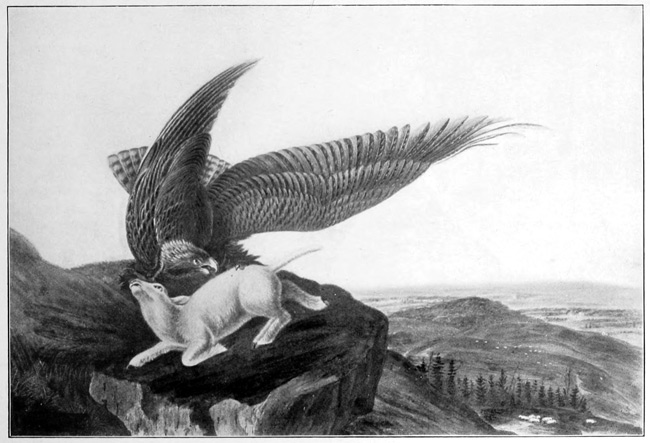
EAGLE AND LAMB. PAINTED BY AUDUBON, LONDON, 1828. IN THE POSSESSION OF THE FAMILY.